mirror of
https://github.com/block/buzz.git
synced 2026-11-27 11:41:21 +00:00
b8a143dc6734db08fa73eeb14bed0b7be7a2b94f
396 Commits
| Author | SHA1 | Message | Date | |
|---|---|---|---|---|
 Will Pfleger |
836e7d0d06 |
feat(desktop): browse and moderate every community in the Admin Console (#8027)
The Admin Console only ever saw the community the desktop happened to be connected to. With #8011's community reads, the console can now browse every community on the relay and, for signed staff, moderate any of them by name without switching connections. 🤖 ## What changes - **Communities tab.** Lists every live community on the relay, searchable by host prefix with "Load more" paging. The connected community is pinned at the top by exact host match. Report rows get a community badge that opens that community. - **Community page.** Reports, Restrictions, Members and Actions, each scoped to the community on the page. The Actions form has no host field: it always acts on the page's community, and the TypeScript host normalization is gone from the Actions tab. - **Native reads** (`admin_list_communities`, `admin_search_members`, `admin_get_member`, `admin_get_event`). Every request validates the explicit community host and NIP-98-signs the real method and URL. Failures come back as a structured error (`status`, `bodyComplete`, `bodyEmpty`, `code`), so the UI can tell an older relay's empty 404, a coded `event_not_found` and a transport failure apart, and never says "not found" unless the relay did. - **Explicit-host lifts.** `admin_lift_restriction` sends the page's community host, not the active relay's. It freezes the relay and signer the intent was reviewed under, and refuses to send if either has changed. - **Pending actions survive navigation.** A panel-level `DirectActionsProvider` holds the frozen intent, so switching communities or tabs mid-confirm doesn't lose it. Only Discard drops it. A signer change remounts the controller and drops it. - **Fenced lookups.** Member and event lookups are keyed by origin, signer, community, target and a generation counter, so a late answer for one community can't unlock Review in another. - **Shared member picker** (`MemberSearchResult`, also used by Add Member), showing the truncated npub so members with the same name can be told apart. Delete accepts a note link and previews the message before Review. Relay staff are blocked before Review. - **Disabled admin auth is read-only.** With `BUZZ_ADMIN_AUTH=disabled` the Communities tab and community pages still render, and report badges still open them, but every ban, timeout, delete, add-member and lift control is disabled. The settings badge says the console is read-only and that acting needs `nip98`. Staffing stays hidden. - #7904's protections in the Actions tab are kept: frozen intent, `requestId`, Retry, `notSent` and the key-backup guard. - **Readable load errors.** Admin list and detail loads show the relay's error message (for example "request is not authorized"), never the raw JSON envelope. - **Failed kicks reload the report.** A resolve that fails with `enforcement_failed` reloads the report, so its failed action and "Cancel & reopen" appear immediately. - **Key backups never leave in a search.** Every admin API request URL passes the NIP-49 key-backup guard before it is signed or sent: community and legacy reads, mutations, the connection probe (before its first, unsigned request) and feedback-attachment fetches. The community and member search boxes, including the directory's Load more, refuse a pasted `nsec` or `ncryptsec` anywhere in the input without calling the relay. - **`just admin-seed` for multi-community testing.** Besides the local community, it seeds `beta.localhost:3000`, `gamma.localhost:3000` and 50 filler communities, with named members, a ban and a timeout in each named community, a report with Kick available, and a message for the delete preview. Rerunning it restores all of that to the starting state. It refuses, writing nothing, while a moderation action is unfinished on a seeded report. - The bodyless `GET /events/{id}` preview is added to the events-URL egress inventory. It sends no body, so it carries no key material. ## Tests Native (Rust): - `empty_404_and_405_read_as_complete_and_empty`, `coded_404_carries_the_relay_code`, `truncated_and_over_cap_bodies_are_incomplete`, `transport_failure_has_no_status`: the structured read error tells an older relay, a coded refusal, a cut-off body and a transport failure apart. - `a_401_retry_is_signed_by_the_same_keys`, `lift_signs_the_send_and_401_retry_with_the_checked_keys`: the 401 retry never switches keys. - `read_urls_validate_the_explicit_host_and_encode_the_query`, `lift_url_sends_the_page_host_not_the_active_relay`, `list_url_carries_host_and_cursor_and_refuses_a_changed_relay`, `lift_refuses_before_sending_on_signer_change_or_bad_host`: requests target the explicit host and refuse to send after a relay or signer change. jsdom: - `actions-pending-nav`: a pending intent survives a community change, and only Discard drops it. - `actions-fenced-lookup`, `fenced-load`: a late lookup for an old key never shows under, or unlocks, the new one. - `actions-same-ids`: the same pubkey and event id are read separately in each community. - `actions-community-change-drops-member`, `actions-page-host`, `actions-success`, `actions-identity`: the form acts only in the page's community, and confirm sends the frozen intent. - `actions-preview-errors`, `actions-delete-link`, `actions-staff-target`, `actions-disabled-auth`: preview errors, delete by note link, the staff block, and community pages rendering read-only with every action control disabled under disabled admin auth. - `communities-directory`, `communities-unsupported`, `community-badge`, `community-badge-disabled-auth`: the directory, older relays, and report badges, which open community pages under disabled admin auth too. - `restrictions-lift-signer-change`. The existing restriction tests now run on the community page and use `admin_lift_restriction`. Mutation checks: removing the pending-navigation guard turns `actions-pending-nav` red, and dropping the host from the fence key turns `actions-fenced-lookup`, `actions-same-ids` and `fenced-load` red. Ungating restriction lifts on `canMutate` turns `actions-disabled-auth` red. --------- Signed-off-by: Will Pfleger <pfleger.will@gmail.com> Co-authored-by: Hayt <211b96e6a2b7f45fd4047988976c7bbbeeda0c15f3ae7b32eec20834b5a55118@buzz.block.builderlab.xyz> Co-authored-by: Duncan <dcfd242e557282d7a1e2cf2e6877522682f1e5c6156dc92ca7d90eaedd3b0f95@buzz.block.builderlab.xyz> |
||
|
chiller
|
5ff83d82f8 |
fix(desktop): address workflow deletions at the workflow's actual owner (#2669)
Fixes #2671. ## Problem Deleting an agent-created workflow from the desktop app appears to succeed, but the workflow keeps running and stays in the list. Since workflows are commonly created by agents, this makes most workflows undeletable from the UI. ## Root Cause `delete_workflow` builds the NIP-09 `a`-tag coordinate with the **caller's** pubkey: ```rust let builder = events::build_workflow_delete(&workflow_id, ¤t_pubkey_hex(&state)?)?; ``` kind:30620 is addressable by `(author, d-tag)`. For an agent-created workflow, `30620:<caller>:<workflow-id>` names a record that does not exist. The relay accepts the kind:5 (a self-addressed delete always passes validation) and deletes nothing; the UI reports success. Observed live: a delete of an agent-owned workflow produced `["a","30620:<human-pubkey>:<workflow-uuid>"]` while the kind:30620 event is authored by the agent — the coordinate can never match. ## Fix Fetch the workflow's kind:30620 event first (the same `#d` query `update_workflow` already uses) and build the coordinate from the event's author. Relay-side validation already authorizes the owning human for agent-authored coordinates via `is_agent_owner`. Deleting an unknown workflow id now surfaces `workflow not found` instead of silently publishing an unmatchable delete. This is the client half of the fix. The relay half is #2242: today the relay executes a-tag deletions scoped by the delete's signer, so a human-signed delete of an agent workflow still no-ops server-side. Without this change, #2242 alone won't help desktop users, because the client addresses a record that doesn't exist. Together they make delete work end to end. Related but deliberately not included: deleted workflows leaving their kind:30620 event queryable (ghost list entries) is #2390, with a relay-side fix open in #1340. ## Validation - `cargo test` in `desktop/src-tauri`: 1617 passed, 0 failed, 14 ignored. - `cargo clippy --all-targets` and `cargo fmt --check`: clean. - Live repro against the hosted relay: the stock client's kind:5 for an agent-owned workflow named the signer in the coordinate; the relay returned `accepted: true` and the workflow remained live and kept firing. - With the fix: the delete event carries `30620:<agent-pubkey>:<workflow-id>`; an owner-signed deletion of that exact coordinate was verified to remove the workflow record. 🤖 Generated with [Claude Code](https://claude.com/claude-code) |
||
|
tbedor-square2
|
403c19f673 |
fix(desktop): show OpenAI-compatible endpoint settings in the baked-env UI (#8117)
## Summary `is_safe_to_reveal` (`desktop/src-tauri/src/managed_agents/env_vars.rs`) is the single default-deny allowlist for showing baked env values. It lists `DATABRICKS_HOST`/`DATABRICKS_MODEL`/`DATABRICKS_MODEL_FILTER` but not their OpenAI-compatible counterparts, so a build that bakes `OPENAI_COMPAT_BASE_URL`, `OPENAI_COMPAT_MODEL`, `OPENAI_COMPAT_API` shows them as `••••••`. Adds those three non-secret settings to the allowlist: an endpoint URL, a model id, and an `auto|chat|responses` enum. **No secret is revealed: `OPENAI_COMPAT_API_KEY` is deliberately not added and remains masked.** ### Related issue None found. ### Testing - New test `baked_env_openai_compat_endpoint_is_unmasked_but_key_stays_masked` covers the three revealed settings and asserts the API key stays masked; `baked_env_allowlist_is_case_insensitive` extended. - `cargo test --lib baked_env` in `desktop/src-tauri`: 11 passed. `cargo fmt` clean. - Not exercised in the running desktop UI. Signed-off-by: Tom Bedor <tbedor@squareup.com> Co-authored-by: Tom Bedor <tbedor@squareup.com> |
||
|
Will Pfleger
|
9c6fa14aa0 |
feat(desktop): offer Claude effort levels in agent edit and create (#8059)
Claude Code agents now get a thinking-effort dropdown in the agent Edit and Create dialogs, matching the one buzz-agent and Codex agents already have. ## Behavior - **Where levels come from:** Claude effort levels come from the Claude model data for the model that will actually run after Save, resolved in order: explicit model, then inherited default (linked definition or global), then adapter default. Stored Claude session levels are not used, because the stored session data does not record which model produced them. - **Edit:** for an agent linked to a definition, effort follows the definition's model, which stays authoritative. Save never sends a model for linked agents. - **Create:** effort is offered for local agents only and is stored on the instance. Allowed levels are recomputed on every render, so collapsing Advanced and then switching to a model without effort (e.g. Haiku) drops effort from the request. Non-local effort is rejected before any create side effects. - **Persistence:** `create_managed_agent` sets the picked effort when it builds the record and drops stale effort env aliases. Its body runs over any Tauri runtime, so a mock-app test drives the real create path and reads the record back from disk. That test runs in a child process with temp app-data and nest folders, and a test-only switch turns keychain use off so agent keys stay inline in the temp agent file and the OS keychain is never touched. - **Observer store:** live session-config captures are written to the store before the dialog refreshes; archived captures are read-only. - **Codex:** its existing session-native effort picker is unchanged. --------- Signed-off-by: Will Pfleger <pfleger.will@gmail.com> Co-authored-by: Hayt <211b96e6a2b7f45fd4047988976c7bbbeeda0c15f3ae7b32eec20834b5a55118@buzz.block.builderlab.xyz> |
||
|
klopez4212
|
5173fad660 |
feat(pairing): enter desktop codes on mobile (#8085)
## Summary Enter a desktop-only, random six-digit code on mobile to pair without a desktop confirmation click. Verification uses the encrypted session, limits guesses to five, and never treats the QR-derived transcript as approval. Older clients retain desktop confirmation. Adds digit-only error shakes and native haptics, a separate biometrics choice, and a direct community-icon arrival animation. Fixes dropped early offers and resets completed pairing so reopening or signing out cannot get stuck. ### Related issue Related: #8060; no duplicate code-entry PR found. <img width="780" height="1688" alt="01-enter-code" src="https://github.com/user-attachments/assets/a99ced3e-4305-4ac6-a6cc-d598ced423e7" /> <img width="780" height="1688" alt="02-incorrect-code" src="https://github.com/user-attachments/assets/19cdb109-1f10-40a9-a661-1d7ba89c81c1" /> <img width="780" height="1688" alt="03-biometrics" src="https://github.com/user-attachments/assets/af1b2924-9ab6-4d1a-b4b1-fccfdf446404" /> <img width="780" height="1688" alt="04-community-loading" src="https://github.com/user-attachments/assets/84145d82-843a-4c25-aef7-6492fc241d4b" /> <img width="897" height="388" alt="05-desktop-code" src="https://github.com/user-attachments/assets/d8a2e469-7e42-466a-988f-bab6b1df85fc" /> ### Release order Deploy the updated pairing relay first, then desktop, then mobile. The relay now allows eight events per connection (seven for a successful fifth guess plus room for cancellation), with a corresponding bounded delivery budget. Existing clients remain supported; older client combinations keep desktop confirmation. ### Testing - 103 mobile pairing tests, 270 core tests, 51 relay integration tests, and the new real-relay fifth-guess flow passed. - The real-relay regression verifies proof, decrypted identity import, and completion after four wrong guesses. Restoring the old six-event cap makes it fail. - A paused-clock desktop regression confirms slow readiness cannot extend the visible QR beyond protocol expiry. Mobile regression covers typing before negotiation completes. - Core/pair-relay Clippy and full native desktop Clippy/workspace tests passed. Mobile analysis passed; broad mobile runs each hit an unrelated failure (a gateway-script timeout and a native-menu missing-plugin error), and both affected test files passed separately. - Repository-wide Rust testing exhausted local disk space while compiling unrelated packages. The final push omitted that resource-blocked hook and avoided repeating the desktop/mobile runs above; hosted CI remains required. --------- Signed-off-by: kenny lopez <klopez4212@gmail.com> |
||
|
Will Pfleger
|
5a4b2d3dcc |
fix(desktop): show readable Claude Code model names and descriptions (#8053)
Claude Code agents' model dropdown showed raw IDs (`opus[1m]`,
`claude-fable-5-1[1m]`, `haiku`) and its effort choices showed
`low`/`xhigh`. Claude Code's ACP adapter labels config options and
choices with `name`, but Buzz read `displayName`, which no adapter
sends.

**Adapter labels and descriptions**
- `normalize_agent_models` reads `name`, keeps each model's
`description`, and uses the model option's `currentValue` as the agent's
default model (ahead of the unstable `currentModelId`).
- `parse_config_options` / `parse_option_values` read `name` for option
and choice labels, so effort shows "Low"/"Xhigh".
- The create (`PersonaModelCombobox`) and edit (`PersonaDropdownField`)
model pickers show the description as a muted second line, through both
option builders (`modelDropdownOptions` and
`buildTemplateModelDropdownOptions`).

**Generated names for full Claude model IDs**
- Claude Code's own names drop versions ("Sonnet" for
`claude-sonnet-5`). The desktop's Databricks label grammar already
parses a bare Claude ID once its wrapper is removed, so that body parse
is exposed as `generateBareModelLabel`; Databricks entry points and
outputs are unchanged.
- For the `claude` runtime, `claudeCodeModelLabel` formats full IDs and
keeps a `[1m]` suffix as "(1M context)". Short names (`opus`, `haiku`,
`opus[1m]`), unknown bracket suffixes, and IDs containing any non-ASCII
character keep the adapter's name.
- This applies to the model dropdowns in the create and edit dialogs and
the Agent defaults editor. The "Default model (…)" row appears in the
edit dialog and the Agent defaults editor; the create dialog still
requires an explicit model and shows no Default row. Model labels on
agent cards are unchanged.
- In the edit dialog, the Default row keeps the discovered label (e.g.
"Default model (Opus)") unless a global default model is set, in which
case it shows that model. When the adapter's default is its own
`default` entry (e.g. "Default (recommended)"), the row reads plain
"Default model" and keeps that entry's description.

**`models` debug command**
- The harness's readable `models` output reads option and choice labels
from `name` and the option id from `id` (falling back to `configId`), so
it no longer prints raw IDs for Claude Code. JSON output is unchanged.

| Model ID | Before | After |
|---|---|---|
| `opus[1m]` | `opus[1m]` | Opus · Opus with 1M context · … |
| `claude-fable-5-1[1m]` | `claude-fable-5-1[1m]` | Claude Fable 5.1 (1M
context) · Fable 5.1 · … |
| `claude-sonnet-5` | `claude-sonnet-5` | Claude Sonnet 5 · Sonnet 5 · …
|
| `claude-sonnet-4-6` | `claude-sonnet-4-6` | Claude Sonnet 4.6 ·
Previous Sonnet version |
| `claude-sonnet-4-6[1m]` | `claude-sonnet-4-6[1m]` | Claude Sonnet 4.6
(1M context) · Sonnet 4.6 for long sessions · … |
| `haiku` | `haiku` | Haiku · Haiku 4.5 · … |

🤖

---------

Signed-off-by: Will Pfleger <pfleger.will@gmail.com>
Signed-off-by: Duncan <dcfd242e557282d7a1e2cf2e6877522682f1e5c6156dc92ca7d90eaedd3b0f95@buzz.block.builderlab.xyz>
Co-authored-by: Duncan <dcfd242e557282d7a1e2cf2e6877522682f1e5c6156dc92ca7d90eaedd3b0f95@buzz.block.builderlab.xyz>
|
||
|
Will Pfleger
|
83aab8cb5c |
feat(desktop): remove communities locally and stop their agent pairs (#7997)
🤖 Leave contacts the relay before it removes anything locally: it checks the relay's `/info` for NIP-43 membership support, then waits for the relay to accept a signed leave request. When a relay has been torn down, that check fails, Leave throws, and the community stays in the rail. Removing a community also left its relay's managed agent pairs running, and they kept reconnecting to it until the app was quit. **Remove from this device** - A new community action, **Remove from this device**, sits under **Leave community** in the profile menu's community actions. It never contacts the relay. A confirm dialog explains that relay membership isn't revoked. - `useCommunityNavigationTransitions` splits the old `removeCommunity` into `removeCommunityFromDevice` (local-only cleanup and navigation to a fallback community or the discovery screen) and `leaveAndRemoveCommunity` (calls `leaveCommunity`, then runs the same cleanup). Leave's flow hasn't changed. - When Leave fails, the error now adds: "If the community no longer exists, use Remove from this device." The error shown when community discovery state can't be saved no longer says "Membership was removed", so its wording fits both actions. **Agent pairs on a removed relay** - Once the local removal completes, the shared cleanup stops every live agent pair on that relay, including manually started ones. It matches relays with `canonicalRelayUrl`. Stopping is best-effort: failures are logged and the removal still completes. Pairs on other relays aren't touched, and nothing is stopped if another community still uses the same relay. - Both reconcile call sites (`useManagedAgentRuntimeReconciliation` and `bootstrapManagedAgentRuntimePairs`) now go through `reconcileConfiguredManagedAgentRuntimes`. A reconcile that is already running in Rust can't be cancelled, so after it resolves, this helper stops any pair it started whose relay is no longer in the saved community list. - Launch restore runs in the background after `apply_workspace` and can finish after its community is removed. `apply_workspace` takes a restore ticket (the current `launch_restore_generation` in `AppState`) before handing its lock to the restore task. Removing the active community calls the new `invalidate_launch_restore` command, which bumps that generation while holding the runtime transition lock. `restore_managed_agents_on_launch` re-checks its ticket under the same lock and spawns nothing if it changed. If restore takes the lock first, its pairs are registered before invalidation returns, and the removal stop then finds them. Removal never changes `relay_url_override`: the outgoing relay stays applied until the next `apply_workspace`, exactly as on `main`, so in-flight work never falls back to the default relay. Invalidation never takes `workspace_apply_lock`, which restore holds while waiting on the transition lock, so lock order is unchanged. - With no relay applied, backend readers fall back to the default relay, the same state as launch before the first `apply_workspace`. A normal quit and relaunch doesn't bring a pair back on a removed relay: restore targets the applied workspace, and the legacy per-record relay pin is ignored. **Tests** - A `community-rail` e2e case makes the mocked relay's membership check fail, the way an unreachable relay does. It checks that Leave shows the error and keeps the community, and that Remove from this device then removes it, switches to the fallback, stops the agent pair on the removed relay, and leaves the pair on the other relay running. - Unit tests in `managedAgentRelayCleanup.test.mjs` cover relay matching, a stop or listing failure not throwing, and the reconcile fence stopping a pair that started on a relay removed mid-flight. --------- Signed-off-by: Will Pfleger <pfleger.will@gmail.com> Co-authored-by: Duncan <dcfd242e557282d7a1e2cf2e6877522682f1e5c6156dc92ca7d90eaedd3b0f95@buzz.block.builderlab.xyz> |
||
|
Will Pfleger
|
bd0896f5c0 |
fix(desktop): read channel metadata and member lists from writer after writes (#7999)
🤖 This fixes two problems with the same cause. Since #3268, the relay can answer an unpinned `/query` from the Aurora read replica, as long as the replica has proved it's within `BUZZ_REPLICA_READ_MAX_AGE_MS` (1000 ms) of the writer. That's fine for display reads, but it doesn't guarantee a client sees its own write. **Problem 1: channel creation (Wes's report).** Right after creating a channel, the desktop read back the channel's kind:39000 metadata by `#d`. If that read landed on a replica that hadn't replayed the event yet, it failed with `channel created but metadata not yet available`. The channel existed, but the chosen template (canvas, agents) was never applied. **Problem 2: member lists.** After any membership change, the member-list refetch could also hit a lagging replica. The relay returned the list from before the change, and the desktop cached it as fresh for five minutes (`CHANNEL_MEMBERS_STALE_TIME_MS`). Someone just removed could still show as a member, or someone just added could be missing. ## Fix 1: metadata read-backs go to the writer `channel_metadata_filter` is a shared builder that adds `"consistency": "strong"`, so the relay serves the read from the writer. It follows the same pattern as the canvas head reads. All four metadata read-backs that follow a write use it: `create_channel`, `update_channel`, `fetch_starter_channel_metadata` (its retry and fallback are unchanged) and the open-DM refetch in `dms.rs`. A unit test fails if the flag is removed from the builder. The template's agent-add step also reads channel members (kind:39002) right after create. `get_channel_members` takes an opt-in `read_your_writes` flag that sends `"consistency": "strong"`. Only `createChannelManagedAgents` sets it on that path, so the agent-add step sees the creator's membership. ## Fix 2: a 31-second writer-read window after membership changes Every membership write the desktop makes calls `noteChannelMembershipChange` for each channel it changed: - the native write wrappers `createChannel`, `openDm`, `joinChannel`, `leaveChannel`, `addChannelMembers`, `removeChannelMember` and `changeChannelMemberRole` - the Bestie conversation open - huddle agent add and remove, for both the huddle channel and its parent - `ensure_starter_channels` and `sync_agents_to_active_huddle`. Both return every channel they created, joined or changed in `changed_channel_ids`, including ones that landed before a later step failed. The original error text is rethrown unchanged. - live join, leave, removed and `admin_kick` system messages, and member-added and member-removed notifications - a report kick resolved from the Admin Console, once the relay confirms it succeeded and only when the report's channel is in the active community. The kick goes through the admin HTTP API, not a channel event. Ban, timeout and their lifts only change `community_bans`, not channel membership, so they need no record. For 31 seconds after a change, measured on `performance.now()`, `getChannelMembers` for that channel sends `readYourWrites`. Why 31 seconds: the relay caps its replica staleness budget at `FENCE_STALENESS` (30 s), so once the window closes, no supported configuration can serve the pre-change list. The constant's comment ties it to `FENCE_STALENESS`. One app-level listener cancels any roster fetch already in flight and refetches. When it registers, it also refreshes every channel whose window is still open. All other member-list reads still use the replica. **Community switch.** The window map is cleared when the community changes. Each awaited write captures a generation through `beginChannelMembershipWrite()` before its first native call, and the reset advances it. So a write that settles after a community switch records nothing in the new community. Live events don't need this fence, because the reset disconnects the relay client first and frames from the old connection are dropped. ## Coverage - A Rust test drives `ensure_starter_channels` against a stub relay that accepts the creates but never serves metadata, and checks that both created starter channels are still reported. - Desktop tests cover the writer-read window, the Admin Console kick, and writes that settle after a community switch. - The desktop E2E test bridge (`desktop/src/testing/e2eBridge.ts`) mirrors the strong reads and `changed_channel_ids`, so E2E runs exercise the fixed behavior. This doesn't address the smaller race in the relay's per-pod accessible-channels cache, and it doesn't change mobile. --------- Signed-off-by: Will Pfleger <pfleger.will@gmail.com> Co-authored-by: Duncan <dcfd242e557282d7a1e2cf2e6877522682f1e5c6156dc92ca7d90eaedd3b0f95@buzz.block.builderlab.xyz> |
||
|
Will Pfleger
|
f001ebbb6e |
feat(desktop): add Admin Console Actions tab for direct staff actions (#7904)
Builds on #7883 (merged). Adds an **Actions** tab to the Admin Console so relay staff can ban, time out, or delete directly through the #7883 endpoints (`POST /members/{pubkey}/ban`, `POST /members/{pubkey}/timeout`, `POST /events/{id}/delete`), with no report required. ## Design - **Frozen intent.** Review freezes the whole request (origin, relay, signer, community, action, target, reason, duration, `requestId`). Confirm and Retry resend it unchanged, so a manual retry reuses the same `requestId` and stays idempotent on the relay. The intent is cleared only on a definitive non-409 4xx (`preserveRequestIdOnError`). A 409 or a 202 pending keeps it, except `409 request_id_conflict`, which is final for that id and drops the intent so no futile Retry is offered. A 202 pending renders as a neutral notice, not an error. - **Bound to signer and relay.** The intent carries `expectedPubkey` and `expectedRelay`. Native `admin_direct_action` refuses before sending any request if either is blank or no longer matches (`assert_expected_signer` / `assert_expected_relay_scope`). The tab is keyed on pubkey + origin, so an identity or relay switch remounts it and drops any frozen intent. - **Survives tab switches.** `ActionsTab` stays mounted while the panel is open and is only hidden on other tabs, with the same pubkey + origin key, so a pending, ambiguous or in-flight action (and its `requestId`) is still there on return. - **Nothing-sent refusals.** Every native refusal before the first request leaves (malformed host, changed relay or signer, bad target or duration, the key-backup guard on Reason, a missing HTTP client, the first request build, the signing-key lookup) returns `AdminMutationError` with `notSent: true`; the tab drops the intent and offers no Retry. The request build for the retry after a 401 stays ambiguous, because the first request already went out. The changed-relay refusal says "active relay changed since the action was confirmed; nothing was sent". - **Disabled auth.** With `canMutate=false`, Review, Confirm and every field are disabled. - **Community host.** The host is prefilled from the active relay URL by `communityHostFromRelayUrl` (URL host, lowercased, default port and trailing dot stripped, matching the relay's `normalize_host`) and shown read-only as "Community: <host>" with a Change link. It follows the active community until the operator edits it; with no relay URL the input shows directly. Review derives the host from the same `getRelayWsUrl()` value it freezes into `expectedRelay`, so the two can't disagree. The host is validated natively (`validate_community_host`) and sent only as the `communityHost` query, never in the body. The body is `{requestId, reason?, expirationSecs?}`, built by the pure `direct_action_request`; only a timeout takes a duration. - **Member picker.** Ban and timeout pick the member the way `AddMemberDialog` does: `useUserSearchQuery` name search, `parsePubkeyInput` for a pasted npub or hex in any case, and a selected chip. The target is always sent as lowercase hex. Name search is a profile search on the active relay, not a member list, so it runs only when the host is the connected community; for another host the field takes npub or hex only, and the hint stays visible even with a key selected. Editing the host to a different community clears the pick and the search query, so returning to the original host doesn't bring it back; pressing Change alone keeps it. Each named result shows a short npub so same-name profiles can be told apart, the selected chip opens the full key, and the confirm step shows "Name (npub1…abcd)" plus the full npub (`PubKey variant="full"`). A search result's name is frozen for display only; a pasted key uses `useUserProfileQuery` on the active community, otherwise the short npub. Result buttons follow the disabled state. Changing the member or host drops a frozen intent. Delete keeps its hex event id (native `Hex64` route type, shared with pubkeys). A query that starts with `nsec1` or `ncryptsec1` in any case is never searched; the picker shows "That's a secret key. Never paste it here." instead. - **Errors.** `target_is_staff` and `request_id_conflict` get dedicated copy; other codes fall back to the relay message (`adminErrorCode`). An empty 404/405 from a relay without these routes reads "This relay doesn't support direct actions yet."; an uncoded 404/405 with a body keeps its own text. Success shows a toast. - **Key-backup guard.** Every admin JSON mutation body (the three direct routes and the existing report-resolve routes) passes `egress_guard::assert_no_key_backup_bytes` in `helpers.rs` before signing. The egress inventory points at that guarded boundary. - **One signer snapshot.** `admin_direct_action` reads `signing_keys()` once, checks `expectedPubkey` against it, and signs the request and any 401 retry with that same `Keys`. - **Serialized Review.** Review and its inputs lock while the relay URL resolves; a late Review cannot replace a frozen or submitting intent. - **Reason audience.** Before confirmation the tab states that the reason is delivered to the affected user, and for channel deletes posted publicly in the room tombstone (same copy as the Reports tab). Confirmation shows the frozen reason. ## Fix → test → mutation | Fix | Test | Mutation that turns it red | |---|---|---| | Manual retry reuses `requestId` | `actions-retry` | mint a new id per attempt | | Intent preserved across retryable outcomes | `actions-retry`, `actions-errors` | always clear the frozen intent | | Confirmation tied to signer + relay | Rust `direct_action_refuses_a_changed_signer_or_relay` | skip the signer check | | Identity/origin change drops intent | `actions-identity` | drop the tab key | | Disabled auth keeps Submit off | `actions-disabled-auth` | remove the `canMutate` gate | | Key-backup bytes never leave (`ncryptsec1…` / `NCRYPTSEC1…`, zero requests; ordinary reason sends) | Rust `direct_action_refuses_key_backup_reason_before_any_request` | remove the guard call → panics (request sent) | | Checked signer is the signing key | Rust `direct_action_signs_only_with_the_validated_snapshot` (identity swapped after the signer snapshot is taken, before validation) | re-read `signing_keys()` for signing → signed with the swapped key | | Late Review cannot replace the intent | `actions-review-race` (Review, Review, Confirm ambiguous, Retry → one `requestId`) | drop the Review lock | | Pending is a neutral notice | `actions-pending-neutral` | store pending in the error state → `pending notice must render` | | `request_id_conflict` offers no Retry | `actions-request-id-conflict` | keep the intent on every 409 → `request_id_conflict`, `no Retry for a spent request id` | | Reason audience copy + frozen reason | `actions-audience` | drop the audience copy; drop the frozen reason | | Host prefilled read-only, Change reveals the input | `actions-host-prefill` | drop the prefill → `host must be prefilled from the active relay` | | Name result sent as hex and named on confirm | `actions-member-search` | — | | npub and uppercase hex sent as lowercase hex | `actions-member-keys` | drop the direct key result → `no direct result for npub1…` | | Another community turns name search off with a hint | `actions-foreign-host` | — | | A host change clears the pick, even after returning to the first host; hint stays with a key selected | `actions-host-change-drops-member` | hide the pick by host instead of clearing it → `returning to the first host must not restore the old pick` | | Same-name results differ by key; confirm shows the chosen full npub and sends that key | `actions-same-name` | drop the full npub from confirm → `confirm must show the full npub` | | Results can't be selected once auth is disabled | `actions-results-disabled` | — | | Secret key never reaches search, warning shown | `actions-secret-key` | remove the check → `a secret key reached search_users` | | Pending action survives a tab round-trip, Retry reuses `requestId` | `actions-tab-roundtrip-pending` | render the tab conditionally → `pending notice survives` | | Ambiguous failure survives a tab round-trip | `actions-tab-roundtrip-ambiguous` | render conditionally → fails | | In-flight failure on another tab shows on return | `actions-tab-roundtrip-inflight` | render conditionally → fails | | Pre-send refusal drops the intent, no Retry | `actions-not-sent`, Rust `direct_action_marks_a_pre_send_refusal_not_sent` | ignore `notSent` → `intent dropped; no Retry` | | Key-backup refusal is nothing-sent; Review editable again | Rust `direct_action_refuses_key_backup_reason_before_any_request`, `actions-backup-reason-not-sent` | drop `not_sent` on the guard → panics at the `notSent` assert; stub `notSent: false` → `no Retry after a pre-send refusal` | | Only an empty 404/405 reads as an old relay | `actions-old-relay` | drop the empty-body condition → `404 admin API error: Not Found` | --------- Signed-off-by: Will Pfleger <pfleger.will@gmail.com> Co-authored-by: Duncan <dcfd242e557282d7a1e2cf2e6877522682f1e5c6156dc92ca7d90eaedd3b0f95@buzz.block.builderlab.xyz> |
||
|
Will Pfleger
|
f7ff4294fa |
feat(nip-fi): harden Blossom kind-24242 verifier to NIP-FI spec (#7288)
Brings `buzz-media`, `buzz-relay`, all first-party kind-24242 minters, and desktop token minting into compliance with [NIP-FI §kind-24242](https://github.com/block/buzz/blob/main/docs/nips/NIP-FI.md). ## What changed **`buzz-media/src/auth.rs`** - Add `BlossomStrictness` enum (`Strict` | `Permissive`). `Strict` applies full NIP-FI rules (active modes); `Permissive` preserves pre-NIP-FI Off-mode behavior byte-identical [FI-INV-15]. - Rewrite `verify_blossom_auth_event_for_verb` with count-based cardinality: exactly one `t`/`expiration`/`server` in `Strict`; duplicate `x` also rejected. `Permissive` keeps main's boolean semantics exactly: any valued `t` other than the verb (including `""`) rejects, valueless `t` is ignored. - `Strict`: mandatory `server` tag on all proofs (upload + read); absent or mismatched → `evidence_rejected` (`ServerMismatch`). - `Strict`: 60-second proof window (`now - created_at <= 60s`, `expiration <= created_at + 60s`). `Permissive`: 3600s / optional server. - **[F1]** Permissive server validation uses any-match semantics: a proof with multiple `server` tags is accepted if any tag matches the bound host. This restores origin/main base behavior. Strict duplicate-rejection unchanged. - **[F1 compat]** Permissive server gate uses `server_values.is_empty()` (valued tags only) rather than `server_count > 0` (includes valueless tags). A lone valueless `["server"]` tag is treated as absent in Permissive/Off mode, matching pre-NIP-FI base behavior [FI-INV-15]. - **[F4]** Valueless `x` tags in Strict get reads are tracked before `filter_map` so they cannot become absent scope (host-wide authorization). Any `x` tag present in Strict must contain the exact requested sha256. - **[F3 unit]** Cases A–D in `auth.rs` are helper-level unit tests: they call `verify_blossom_upload_auth` and `verify_upload_hash_only` directly. They do not enter the upload pipeline (`process_upload`/`process_video_upload`). Retained as helper evidence. **`buzz-media/src/error.rs`** - Add `DuplicateTag(&'static str)` variant. - Add `blossom_denial_kind()` method: classifies each auth error as `MissingEvidence`, `EvidenceRejected`, or `AuthorizationDenied`. Non-auth errors return `None`. - `IntoResponse` retains the legacy JSON 401 shape [FI-INV-15]. **`buzz-relay/src/api/media.rs`** - Add `MediaDenial(MediaError, BlossomStrictness)` wrapper mapping to byte-exact NIP-FI fixed responses in `Strict`; falls through to legacy JSON in `Permissive`. - `blossom_strictness_from_state()` selects `Strict` when `state.config.nip_fi.is_enforce()`, otherwise `Permissive`. Strictness is threaded through the `admit_nip_fi_http_on_state` NIP-98 closures on upload and read, and through the post-admission X-SHA-256, hash-binding, and membership denials. - `extract_blossom_auth` keeps first-value `Authorization` extraction; Enforce rejects repeated fields at the `admit_nip_fi_http` cardinality gate, and Off keeps legacy behavior [FI-INV-15]. - Both membership-denial call sites use `media_denial(RelayMembershipRequired, strictness)` so Strict mode produces the correct fixed-text response. - `upload_blob` serving-write fence conversion (`:406`) uses `map_err(|e| media_denial(e, strictness))` — a community fence committed between auth admission and lease acquisition no longer resets Strict to Permissive. - Mode-driven regressions in `mod postgres_tests` (selected by the nextest `postgres-ci` profile via `test(/postgres_tests::/)`, `#[ignore = "requires Postgres"]`), run through the full relay router with a real Enforce verifier and assertion: Enforce rejects Permissive-only proofs (300s lifetime, missing `server` tag) on both upload routes and reads with `evidence rejected`; Off accepts the same proofs with pre-NIP-FI responses; DenyProtected answers 503 before any proof check; membership denials are `authorization denied` text/plain in Enforce and exact legacy JSON 403 in Off, with a member positive control. GET and HEAD are each discriminated (HEAD with a suppressed body). Both upload routes pin the handler's `X-SHA-256` missing/malformed/unsigned and post-body hash-mismatch denials in both modes. Off rejects an empty-valued `t` beside a valid one with legacy 401 JSON in either order, and ignores a valueless one. Exact status, Content-Type, challenge, and body bytes are pinned. **`buzz-media/src/upload.rs`** (`mod minio_tests`) - **[F3 pipeline]** Four tests exercising the actual post-body call sites (`process_upload` `:85`, `process_video_upload` `:413`) with real MinIO I/O: buffered/streaming × expired-proof-accept + mismatched-hash-reject. The positive cases use `fresh_strict_upload_auth` (`created_at = now-58`, `expiration = now+2`, lifetime = 60s) — Strict-admissible at sign time — followed by a real 3s sleep so the proof is expired when the upload completes. `nostr::Timestamp::now()` reads the OS wall clock directly; paused Tokio time does not advance it. The negative cases use a pre-expired proof with a mismatched `x` tag. All four are `#[ignore = "requires MinIO"]`; no CI lane runs them automatically. **`buzz-media/src/validation.rs`** - `minimal_valid_mp4()` promoted to `#[cfg(test)] pub(crate)` — a 618-byte pre-computed H.264/avc1 fast-start MP4 available to all `buzz-media` test modules; smoke-tested by `test_minimal_valid_mp4_passes_validate_video_file`. **`desktop/src-tauri/src/commands/media.rs`** - `sign_blossom_upload_auth`: `server` tag mandatory; upload expiry 60s (was 3600s/300s). - `MEDIA_GET_AUTH_EXPIRY_SECS`: 60s (was 600s). **`desktop/src-tauri/src/media_proxy.rs`** - Single re-mint+retry on 401/403 for range requests; non-auth failures do not retry. **`crates/buzz-cli/src/client.rs`** - Read expiry: 60s (was 600s). Upload expiry: 60s. `server` tag mandatory on upload. **`crates/buzz-dev-mcp/src/view_image.rs`** - `MEDIA_GET_AUTH_EXPIRY_SECS`: 60s (was 600s). Test updated. **`mobile/lib/shared/relay/media_auth.dart`** - `_mediaGetAuthLifetimeSeconds`: 60 (was 600). Refresh margin updated. **`mobile/lib/shared/relay/media_upload.dart`** - `_uploadAuthLifetimeSeconds`: 60 (was 300). `server` tag mandatory. **`mobile/lib/features/channels/media_viewer_page/video_viewer.dart`** - **[F2]** Remove Android-specific `VideoPlayerController.networkUrl` streaming path. `video_player_android` 2.9.5 freezes headers into static `DefaultHttpDataSource` request properties — a 60s proof minted at controller creation time becomes stale on seeks. All platforms use the authenticated local-file download path. - **[F2 transport]** `unawaited(request.sink.close())` before `client.send()`. `AbortableStreamedRequest` carries no request body; without closing the sink, `IOClient.send()` awaits `stream.pipe(ioRequest)` which blocks until the sink ends — every video download hung in loading indefinitely on every platform. - **[F2 pending-ctrl]** `pendingController` ref set before the first `await (initialize())`, cleared in all exit paths. Effect cleanup disposes `pendingController.value` so a close-during-init releases the native player even if the initialized event never arrives. - **[F2r(a)]** On native init failure (post-create, pre-initialized-event), the inner catch starts disposal detached via `unawaited(localController.dispose().catchError(...))` — the `.catchError` handler absorbs any disposal exception so it does not reach the test error zone — then rethrows the original load error. `video_player` 2.11.1 completes the init future with an error without disposing the native player. - **[F2r(b)]** Non-2xx error body cancelled via `_cancelVideoResponse()` (subscribe+cancel) instead of `drain()`. `drain()` waits for the upstream to close; a stalled server body blocked `initializeVideo` indefinitely. - **[F2r(d)]** `unawaited(localController.dispose().catchError(...))` in the catch — not `await`. Two failure mechanisms exist: (1) when `createWithOptions()` throws, `_creatingCompleter` is never completed and `await dispose()` deadlocks at `:682-683`, blocking the outer catch from setting error state. (2) when `createWithOptions()` succeeds but initialization fails, `dispose()` runs but its thrown exception becomes an unhandled async error reaching the test zone. Both are fixed: `unawaited` lets the outer catch run immediately and set `error.value`; `.catchError(...)` on the detached disposal future absorbs any disposal exception. **`mobile/test/features/channels/media_viewer_page/video_viewer_test.dart`** - `_FinalizingFakeClient`: calls `request.finalize().drain()` — a test without the sink fix times out because the drain never completes, validating the transport contract. - F2r(a): `forceInitError=true` fake emits `PlatformException` on subscribe; `disposeCallCount >= 1` verifies disposal even on init failure. - F2r(b): `stalledBody` `StreamController` with `onCancel` Completer (bounded completion signal, not a sleep). Asserts: (1) `bodyStreamCancelled=true` while body stream is still open (impossible with `drain()`); (2) error UI visible while body remains open. Restoring `drain()` breaks both. - F2r(c): `neverInitialize=true` fake never sends initialized event; unmount asserts `disposeCallCount >= 1` via `pendingController`. Distinct from the event-error case. - F2r(d): `forceCreateError=true` fake throws `PlatformException` from `createWithOptions()` itself (before any player ID is returned). Asserts error UI visible within a bounded deadline. With the old `await dispose()` the outer catch is blocked — `error.value` is never set and the error UI assertion fails at the deadline; with `unawaited(dispose())` the error text appears immediately. **`mobile/test/features/channels/media_viewer_page/video_viewer_transport_test.dart`** (separate file) - Real-IO loopback probes using `flutter_test` (not `package:test`) to avoid `depend_on_referenced_packages` lint. No `TestWidgetsFlutterBinding` — no HttpClient override interfering with `dart:io`. - Probe 1: `HttpServer.bind(loopbackIPv4, 0)` reads the full request body before replying. Without `sink.close()`, `req.drain()` hangs and the test times out. - Probe 2: server signals request arrival via a Completer (not a sleep); abort fires after confirmed arrival; `client.send()` must throw `RequestAbortedException` (typed assertion) within a bounded 5s deadline. **`scripts/test-video-upload.sh`** - Proof minted with `+60` expiry and mandatory `server` tag. **`buzz-test-client/tests/e2e_media*.rs`** + **`buzz-relay/src/api/media.rs` test fixtures** - All fixtures updated to 55s expiry + `server` tag. **`RELEASING.md`** - New "NIP-FI upload proof freshness (relay floor)" section documenting that 60s proofs require the first relay release carrying this PR's post-body hash-only check (the first tag > `v0.2.1` — update once cut) for reliable large-file uploads. Operators on older self-hosted relays (≤ `v0.2.1`) must upgrade before receiving these clients. ## Finding 3: 60s upload proofs vs old-relay compatibility Desktop/CLI/mobile upload proofs are now 60s. Older relays re-run full expiry verification after the body is transferred. A valid upload whose body transfer takes >60s will fail on an old relay. **Resolution (relay floor prerequisite):** `RELEASING.md` requires that verified supported deployments (relay releases confirmed to carry the post-body hash-only check, commit `75e9bef748`) be in place before distributing 60s-proof client builds. Unknown or unverified self-hosted relay deployments are excluded from distribution until they upgrade. This makes the verified-deployment status a prerequisite for release distribution, not a post-distribution advisory. The concrete tag (`> v0.2.1`) is to be recorded once cut. ## Sequencing note Builds on #7264 (merged): Blossom strictness is derived from its `config.nip_fi` mode in this PR, so enabling `BUZZ_NIP_FI_MODE=enforce` activates the strict verifier with no further wiring. ## GIF compatibility exception An unauthenticated Off-mode request on a configured tenant with no GIF provider changes from 404 to 401 (base `gifs.rs:269-275` checked an unconfigured provider first; the current code authenticates first). All other Off-mode Blossom responses are byte-identical to pre-NIP-FI behavior. --------- Signed-off-by: Will Pfleger <pfleger.will@gmail.com> Signed-off-by: Duncan <dcfd242e557282d7a1e2cf2e6877522682f1e5c6156dc92ca7d90eaedd3b0f95@buzz.block.builderlab.xyz> Co-authored-by: Duncan <dcfd242e557282d7a1e2cf2e6877522682f1e5c6156dc92ca7d90eaedd3b0f95@buzz.block.builderlab.xyz> |
||
|
Will Pfleger
|
8f8c4dfade |
feat(desktop): relay admin console for the /api/admin/v1 operator surface (#4768)
Adds a relay admin console under Settings — the single surface for relay-level operator work — replacing the previously unreachable moderation section. Operators authenticate with their own Nostr key over NIP-98 — no browser extension, no bearer token — to view deployment-wide moderation reports and product feedback, resolve/dismiss/escalate/reopen reports, update feedback status, and manage the operator/moderator staffing roster. ## Nav reachability The old `moderation` section id was defined in `settingsSections` but never wired into any group in `settingsNavGroups`, so the sidebar never rendered it — unreachable since #1617. This PR replaces it with a `relay-admin` section wired into the Communities nav group, pointing at the relay admin console, and drops the separate `admin-console` section id so a single surface owns relay-level trust & safety. The Relay admin nav entry is always visible. Auth gates the panel itself; the nav entry is a door, not a credential — hiding it behind discovery state would strand an operator whose relay transiently fails NIP-11 discovery with no path back to the connection settings. ## Discovery and connection On mount the console reads the connected relay's NIP-11 document for the optional `admin_api` field. When a valid origin is discovered **and its host matches the connected relay's host** (case-insensitive, host identity only), it is automatically saved and probed — the panel renders immediately with no Save step required. A cross-host advertisement is pre-fill only: it populates the manual origin field under Advanced and is never saved or probed without an explicit Save, so a relay cannot direct an unconsented NIP-98 signature at a third-party origin; residual exposure on the same-host path is bounded by NIP-98's URL/method/payload binding. Saving is only required for manual origin changes. The advertised origin is untrusted input: revalidated through `AdminOrigin::parse`, falling back to manual entry when absent or invalid. A saved manual origin always takes precedence over discovery. ## Auth and transport (Rust, `src-tauri/src/commands/admin/`) - `AdminOrigin` value object: validates scheme + host + optional port, rejects credentials/path/query/fragment; `http://` only for loopback. The relay side normalizes its configured admin host at config load and compares inbound `Host`/`Origin` hosts case-insensitively. - `AdminRoute` closed enum: no IPC surface accepts arbitrary URLs, so the NIP-98-signed URL is byte-identical to the fetched URL. - Dedicated no-redirect `reqwest` client as an SSRF guard: a relay `3xx` is an error and the NIP-98 header never crosses origins. - `admin_probe` signs `GET /probe` and returns a typed state (`nip98Authorized` / `nip98Denied` / `disabled` / `notAdminApi` / `networkOrIntercepted`). The response body is validated against the full relay contract — `nip98Authorized` only when the complete NIP-98 invariant holds, `disabled` only on a coherent disabled-mode body; any incoherent or unrelated JSON classifies as `notAdminApi`, so the console never fails open at the network boundary. Unknown fields are tolerated for forward compatibility. - NIP-98 signing via `AppState::signing_keys()`, one retry on `401` with a fresh signed event; response size bounded by a `Content-Length` preflight and a streaming byte counter; per-pubkey origin storage with atomic `0o600` writes. ## Relay admin console The console is gated behind the relay `OPERATOR`/`MODERATOR` roles from #3777; every `/api/admin/v1/*` route returns `403` to anyone else. Community self-administration (`community-members` / Invites) and in-channel enforcement (the 9040–9043 signed commands) are a separate axis and are untouched. The previously-duplicate community report queue (`ModerationQueueCard`, `moderationQueue.ts`, and three dead hooks) was unreachable dead code and is deleted in its own commit; `useBanMemberMutation` and the rest of `features/moderation/hooks.ts` remain in use by the members sidebar and message menu. ## Console UI (TypeScript, `src/features/admin-console/`) - `AdminConsoleSettingsCard`: discovery + probe flow, honest copy for every probe state, manual origin under an `Advanced` disclosure at the bottom. The role (operator/moderator) is rendered in the connection status line as plain text ("Connected as operator") — no badge-shaped elements above the tab row. The origin provenance (relay config / database) appears inside the Advanced card as small muted text. Section title changed to `Admin`. - `AdminConsolePanel` with Reports / Feedback / Staffing tabs (Staffing gated on `role === "operator"`); reports and feedback grouped by community for cross-community triage. - **Reports**: always requests `scope=all` so the existing resolve/cancel/reopen controls can reach every status (`open`, `processing`, `resolved`, `dismissed`, `escalated`). The relay's omitted-scope default is `escalated`-only (the platform-safety backstop); `scope=all` is explicit and scoped to this console. Full action matrix per `target_kind` (event → delete/kick/ban/timeout/dismiss/escalate; pubkey → ban/timeout/dismiss/escalate; blob → dismiss/escalate); kick is suppressed when the report carries no `channelId`. A `processing` row stays navigable — enforcement state lives in the detail view. A `failed` action (always pre-mutation) offers a single **Cancel & reopen** via `POST /reports/{id}/cancel` with `{actionId}` fencing; there is no client-side retry. `pending`/`enforcing` actions belong to the relay recovery worker and offer no button; a `409` reloads detail. Lists refetch on back-navigation after a mutation. - **Report failure UX**: `reportErrorMessage()` strips 4xx/5xx status prefixes and surfaces the relay's own error reason in the toast (e.g. relay returns `"400: you cannot report this content"` → toast shows `"you cannot report this content"`). Self-report blocking UI removed — the relay has no self-report gate, and the failure was purely client-side error surfacing. - **Reason audience disclosure**: the Reason (optional) field shows exact copy under the input based on selected action — Delete discloses that reason is sent verbatim to the affected user and posted publicly in the room; Kick/Ban/Timeout disclose affected-user only; Dismiss/Escalate disclose reporter only. These mirror the actual relay notice paths. - **Enforcement history**: the report detail carries the governing action even after the report leaves `processing` — a report enforced then reopened is `open` yet still shows its `succeeded` action as executed history alongside the resolve form; a reopen does not un-happen a ban. The resolve form gates on `open` status alone. - **Reopen**: terminal reports (`resolved`/`dismissed`/`escalated`) can be returned to `open` for re-triage via `POST /reports/{id}/reopen`. Reopen never reverses applied enforcement, and the copy says so. - **Feedback**: list, detail, and status control (`new`/`reviewed`/`archived`) with a generation-fenced attachment viewer. A purged source community severs provenance to `null` rather than deleting the row; severed rows bucket under a "source community removed" heading. - **Staffing**: Add is create-only with display names resolved via `useUsersBatchQuery` and npub cross-fade on hover (`HoverStaffingIdentity`). An entered key that already appears in the authoritative roster (config, owner-fallback, or DB) is rejected locally with an inline duplicate-key message and no request is issued; a `409 Conflict` from add, role change, or remove surfaces the relay's parsed error body via `adminErrorMessage(e)` — distinguishing config-backed key conflicts from last-operator conflicts without HTTP-status inference. Roster with `config`/`owner_fallback`/`db` source labels; config-backed entries disable remove client-side. In-place role change via `<select>` calling `putAdminOperator`; the relay responds with the effective `OperatorEntry` (`pubkey`, `effectiveRole`, `sources`) in the same shape as the roster list. Read-only badge for config-managed entries. - **Timeout expiry**: `useTimeoutState` clears the store when derived state is `INACTIVE` but the store is still active; the 1s tick is scoped to entries with a known `expiresAtMs` and owned by `ComposerTimeoutBanner` (mounted only while a timeout is active), while `ChannelPane` subscribes to the boolean `useTimeoutActive()` — the pane re-renders when a timeout starts or ends, not every second. `useMembersSidebarModeration` ticks `nowMs` only while the sidebar is open, the viewer can moderate, and some member has a future `mutedUntil`; the tick after the last expiry stops the interval. - Staffing refreshes the principal after a self-demotion or self-removal: `AdminConsolePanel` passes `onSelfMutation` to `StaffingTab`, which re-probes the saved origin so the role badge and tab visibility update without a manual re-probe. - Staffing mutation failures, including both 409 variants (config-backed key vs. last operator), surface the relay's parsed error via `adminErrorMessage`, so the last-operator recovery guidance is shown. - Mutations confirm via `sonner` toasts; failures surface the relay's parsed error `message`, not raw JSON. The `disabled` auth mode renders read-only. ## Mutation idempotency Resolve and reopen carry a per-attempt `requestId`. On first submit the whole command (`{requestId, action, reason, expirationSecs}`) is frozen; after an ambiguous failure (409, 5xx, transport error, truncated response) the snapshot is retained, action/reason/duration controls are locked, and the retry sends the exact same payload byte-for-byte. A definitive pre-commit rejection (non-409 4xx with `bodyComplete: true`) discards the snapshot, unlocks controls, and the corrected submit uses a fresh payload. On success the toast derives from the authoritative `AdminReportResolution` (`activeAction.action` when present; otherwise `status` for decision-only outcomes) — never from the mutable form selection. The native mutation commands — including operator delete — reject with a typed `AdminMutationError` carrying the relay's HTTP status (`relayStatus`, `null` when no verdict exists) and a `bodyComplete` flag that is `true` only when the full response body was read. ## Restriction routes contract change `GET /members/restrictions` and `DELETE /members/{pubkey}/ban|timeout` now take `communityHost` instead of `communityId`; the relay resolves the tenant itself and returns `400 unknown_community_host` for an unmapped host. This is a breaking contract change with no compatibility shim: the relay must run this build before a desktop that uses it, scripts sending `communityId` must switch, and rolling the relay back breaks the desktop Restrictions UI. `docs/admin/README.md` documents the three routes in the route inventory and carries the migration note. Restriction calls also carry the relay the list was loaded from, and the native side rejects a mismatch before building any URL. ## Hardening - Saved admin origins are stored per pubkey and per relay host. The host slug parses the relay URL, keeps the port-drop for DNS names, and encodes IPv6 hosts canonically, so two IPv6 relays never share a file and no IPv6 slug can match a DNS slug. - NIP-11 admin discovery has its own 10s request deadline and reads `/info` success and error bodies through the bounded reader with a 64 KiB cap (`Content-Length` is only a pre-check). - `PUT /operators` builds its `OperatorEntry` response from the validated body (`effectiveRole = role`, `sources = ["db"]`) instead of re-reading the roster, so a concurrent change can't turn a committed write into a `403`. Related: #3777 (relay `OPERATOR`/`MODERATOR` role model + NIP-98 auth + `admin_api` NIP-11 advertisement — provides the runtime and the discovery field this console consumes) Related: [builderbot-platform-core-infrastructure#140](https://github.com/squareup/builderbot-platform-core-infrastructure/pull/140) (prod admin ingress allowlist and NIP-98 rollout) ## Screenshots Captured headless at `197f0ba0c` against the mock bridge (1280×720). ### Setup **Origin setup — Advanced disclosure open, idle state** 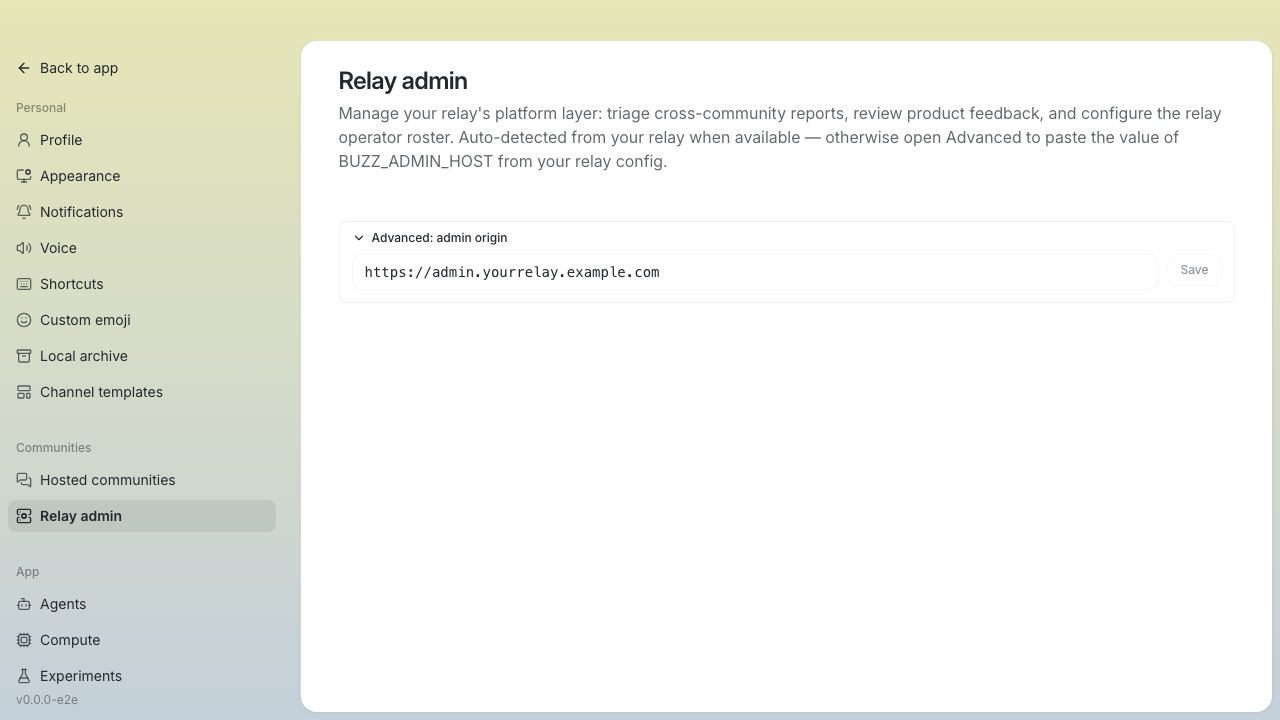 **Authorized console — all three tabs** 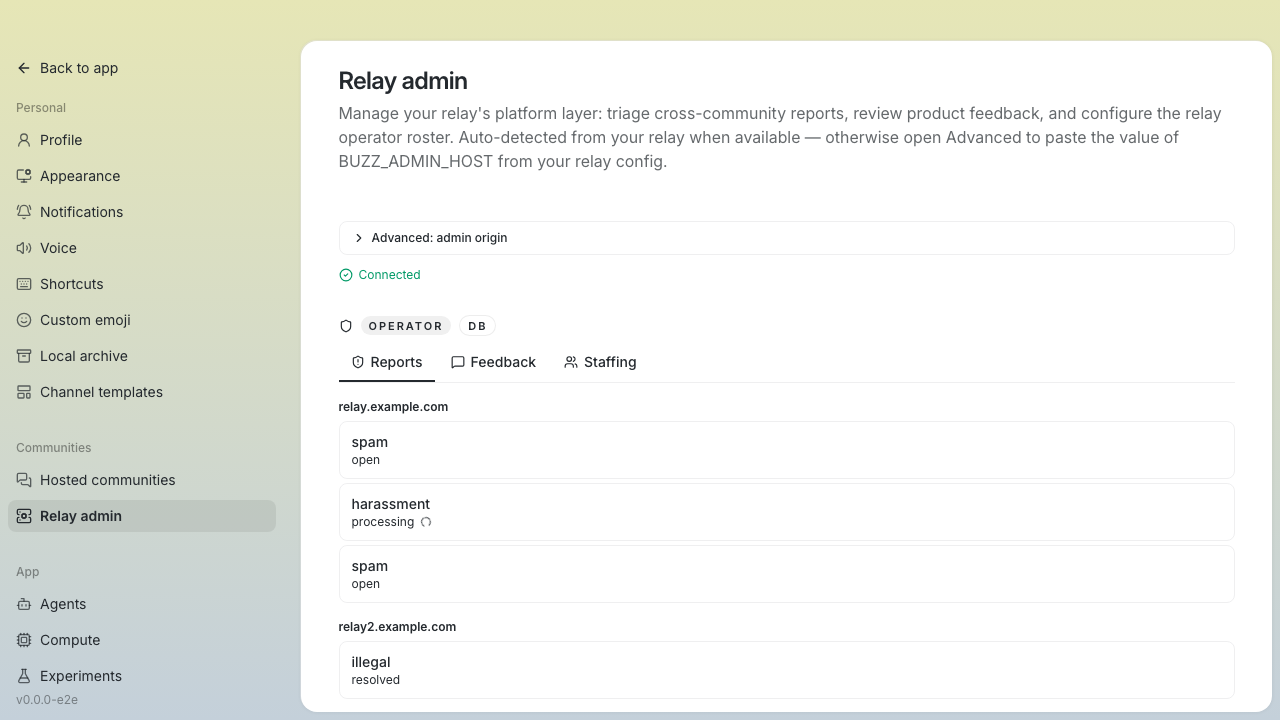 ### Reports **Reports queue — open, processing, resolved across two relay groups** 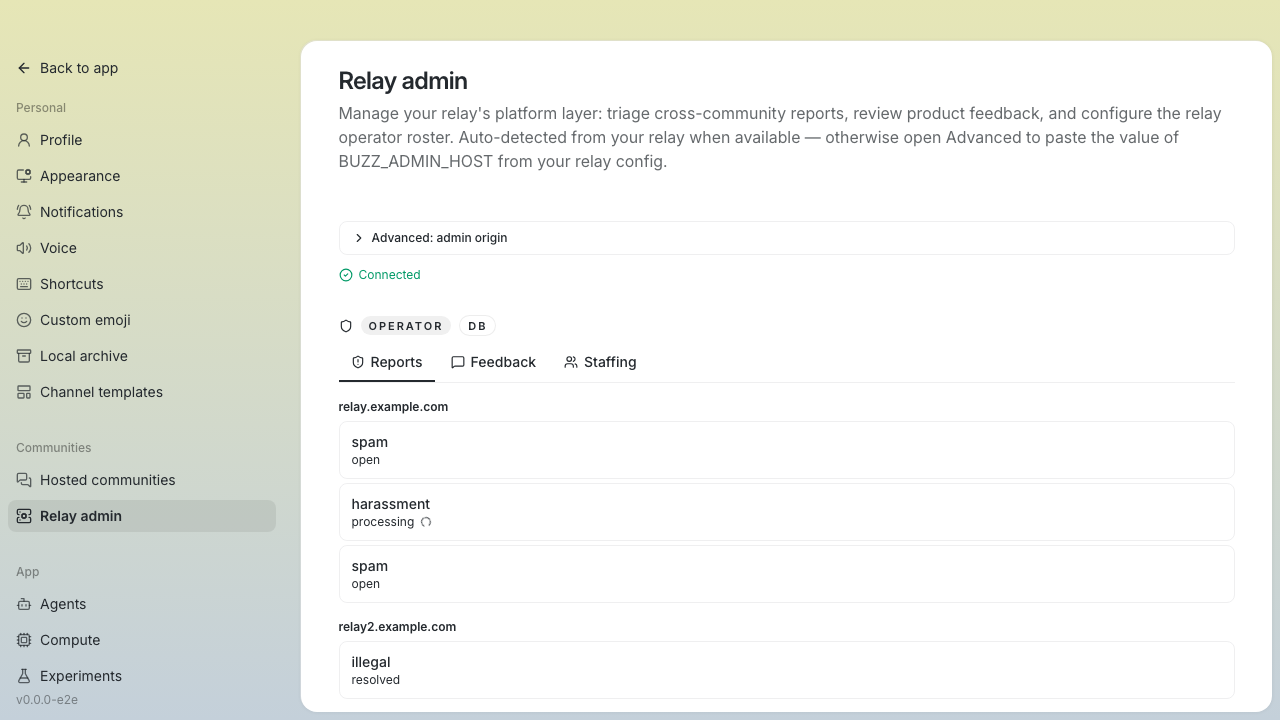 **Open report detail — reporter, target, message snapshot, resolve form** 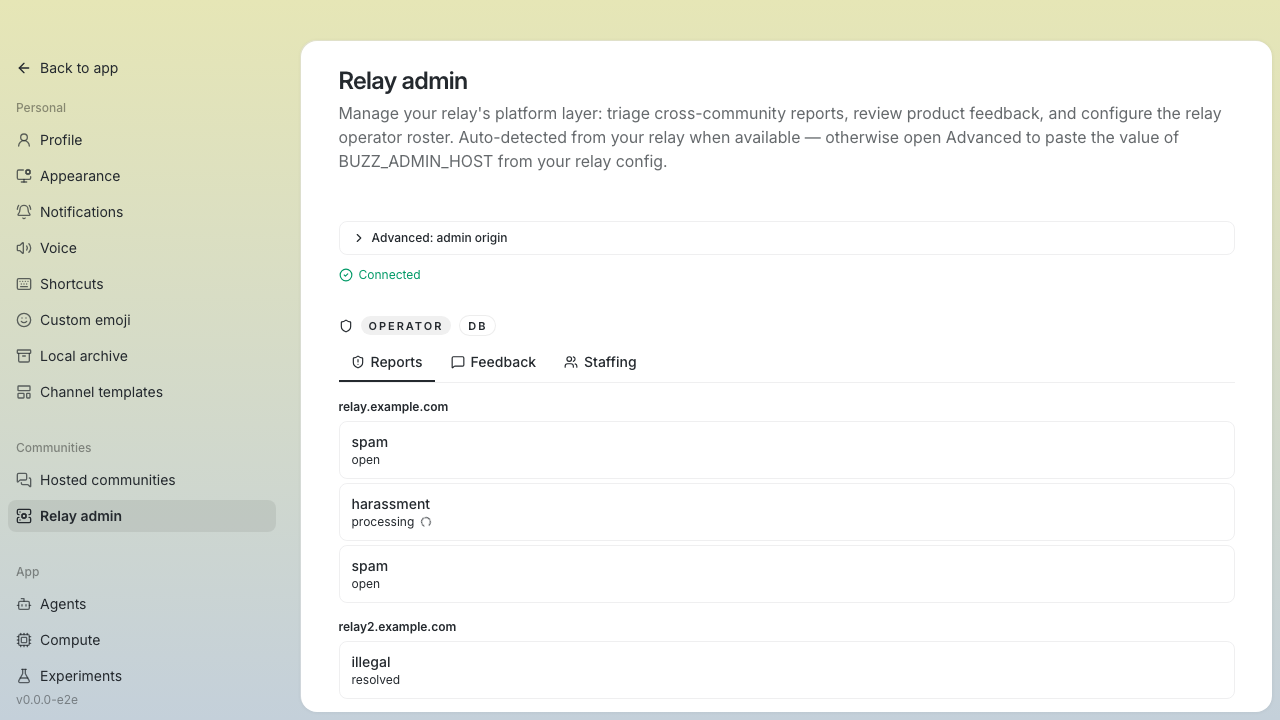 **Processing report — PROCESSING/HARASSMENT, ban enforcing state** 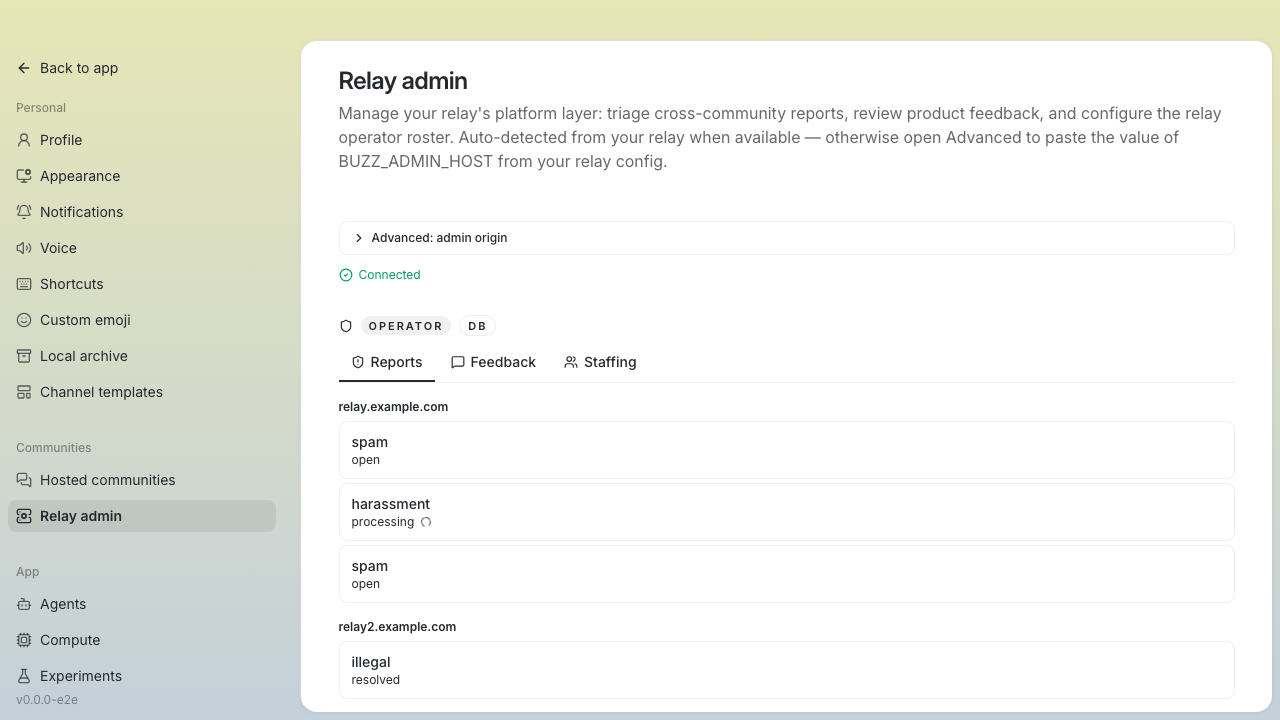 **Resolve form — Delete selected, audience disclosure copy** 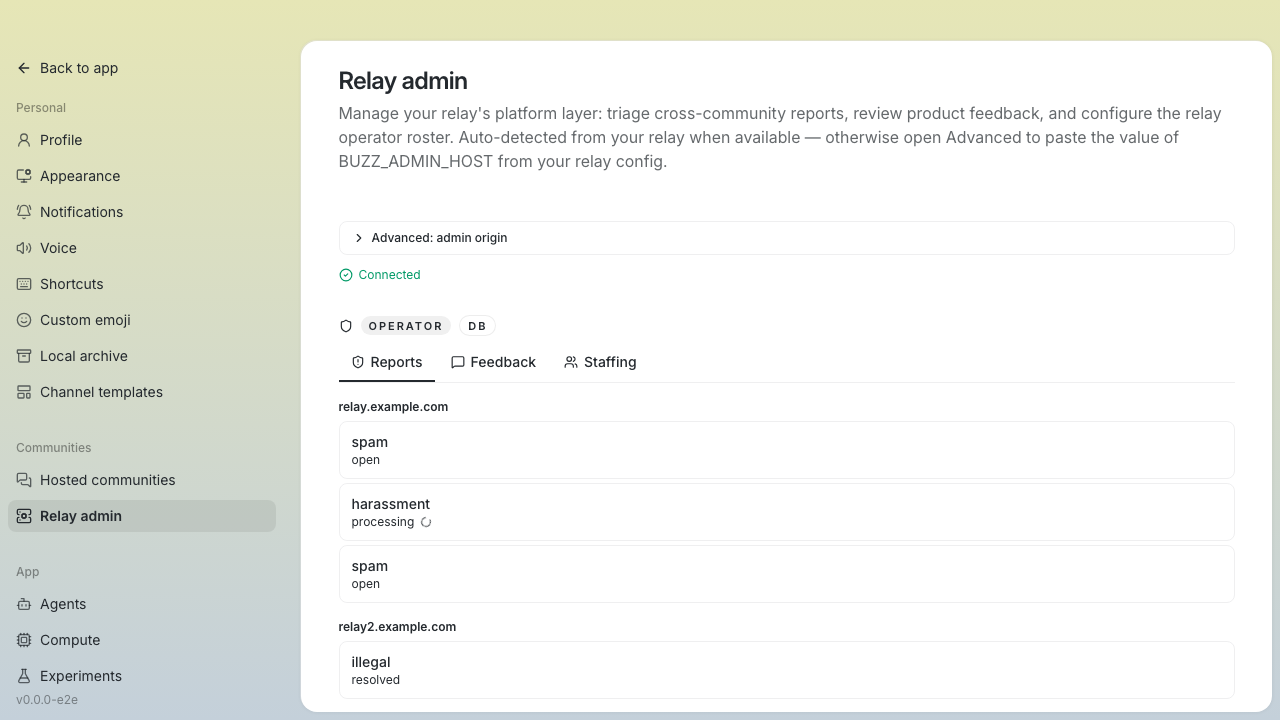 **Resolved report — enforcement history block** 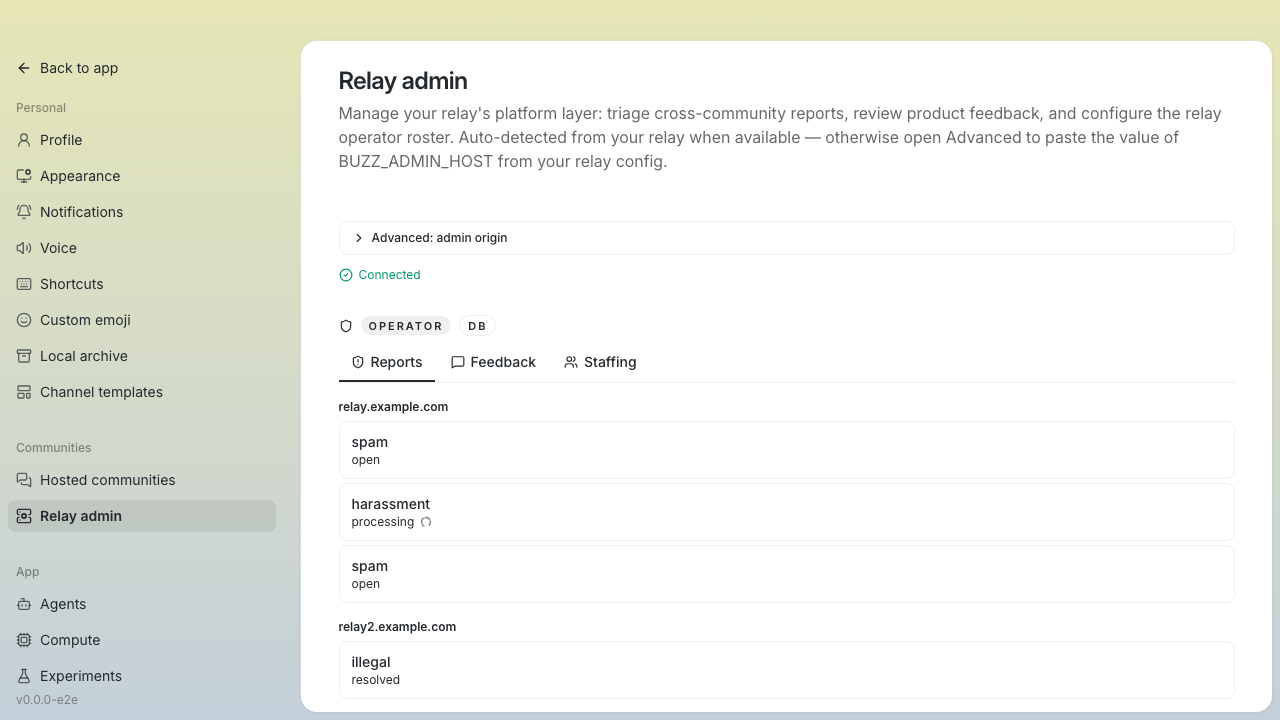 ### Feedback **Feedback list — community grouping with status badges** 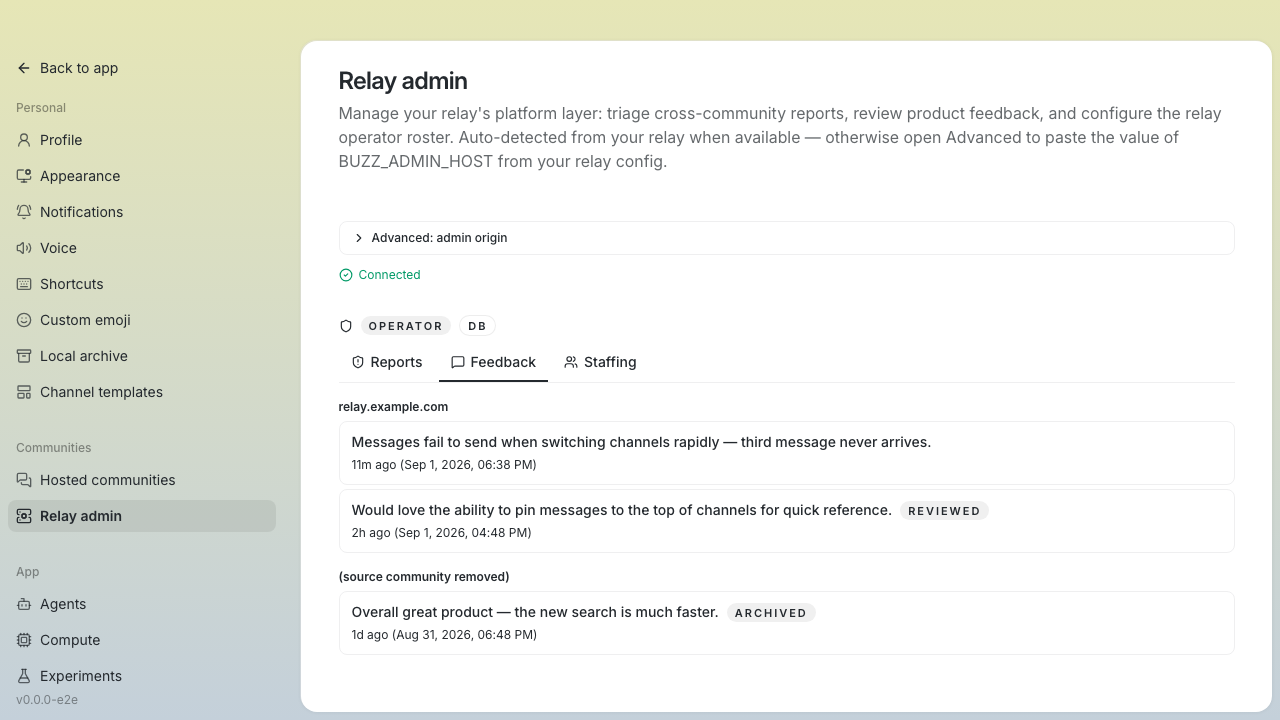 **Feedback detail — mutable status control (operator mode)** 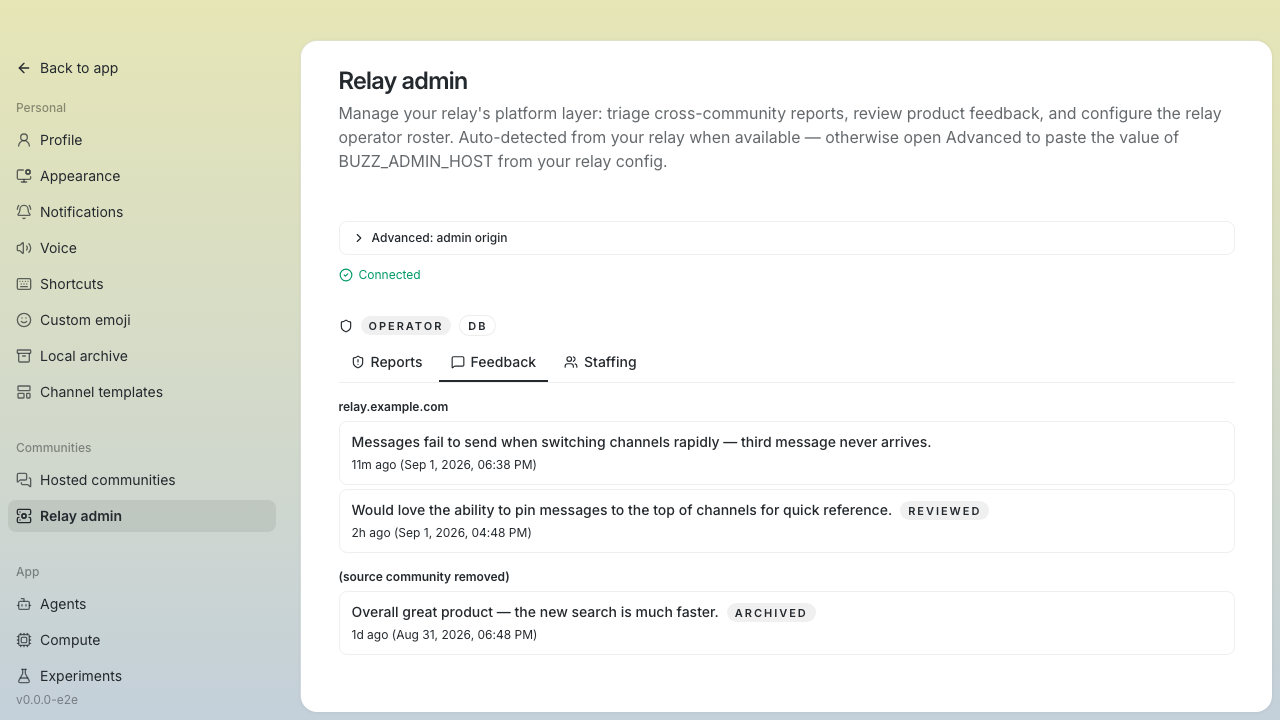 **Feedback detail — passive status badge (read-only/disabled mode)** 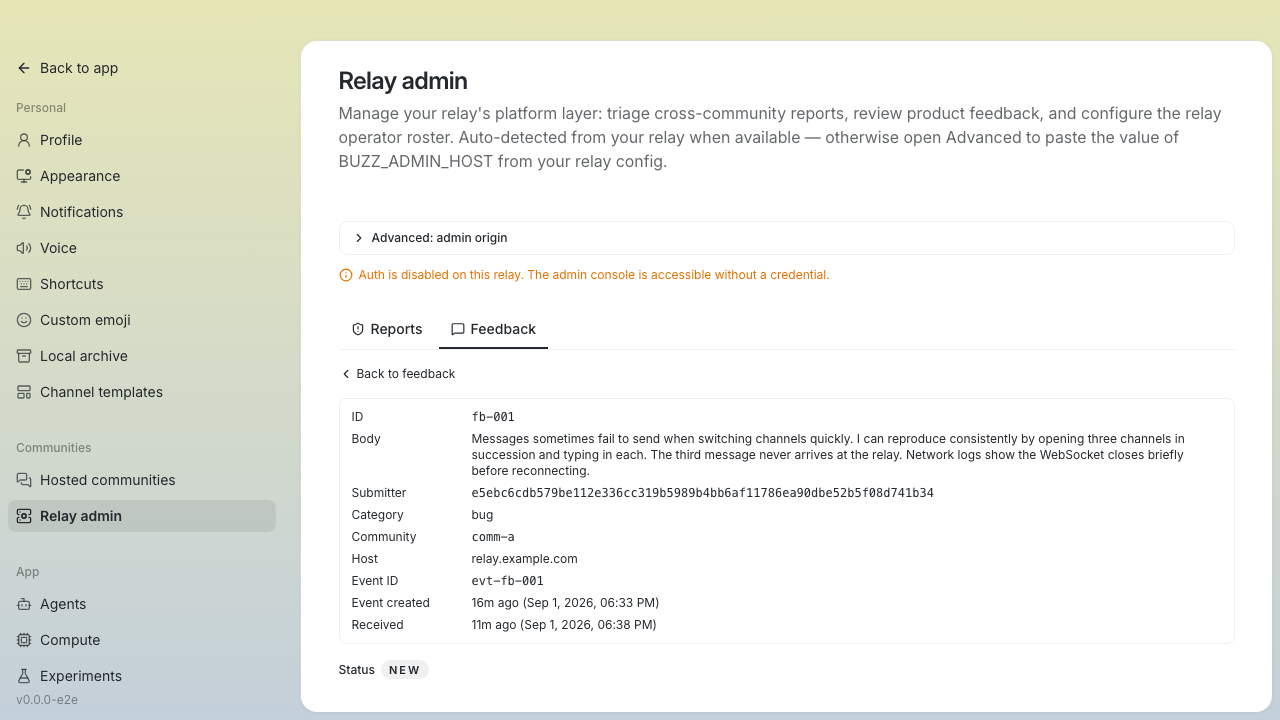 ### Staffing **Staffing roster — config/owner\_fallback/db source labels** 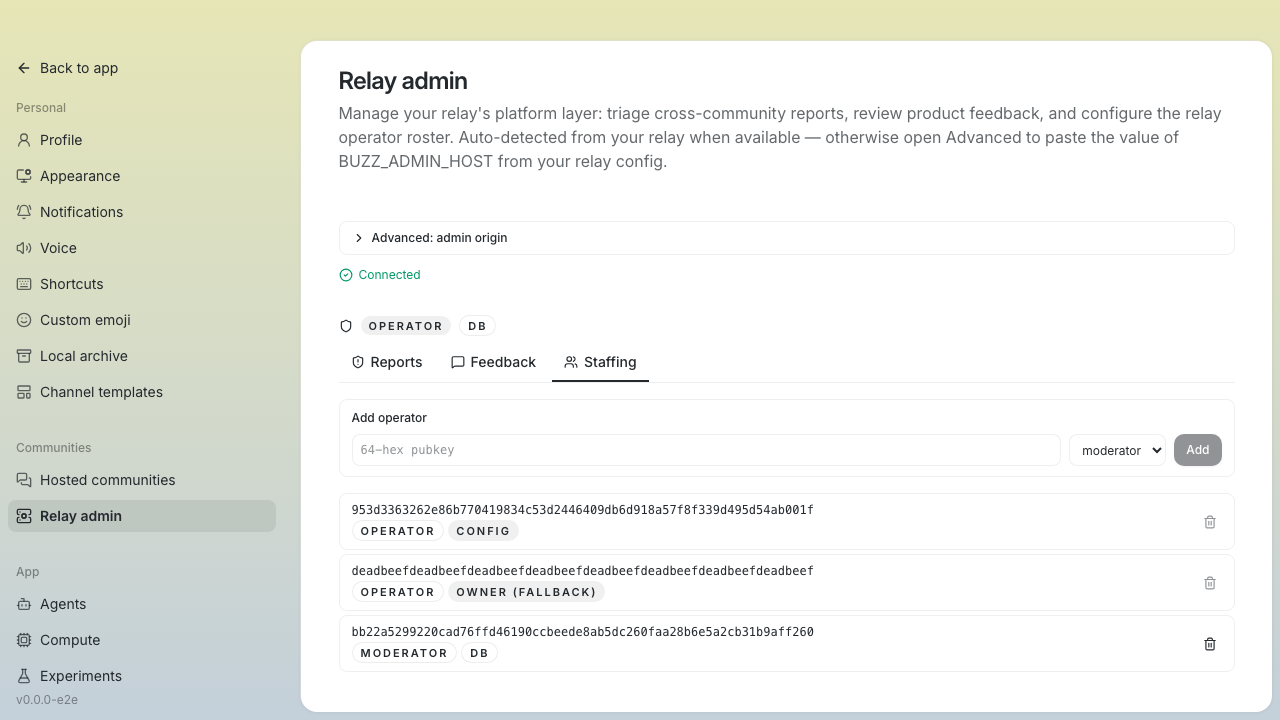 **Add form — new pubkey filled, ready to submit** 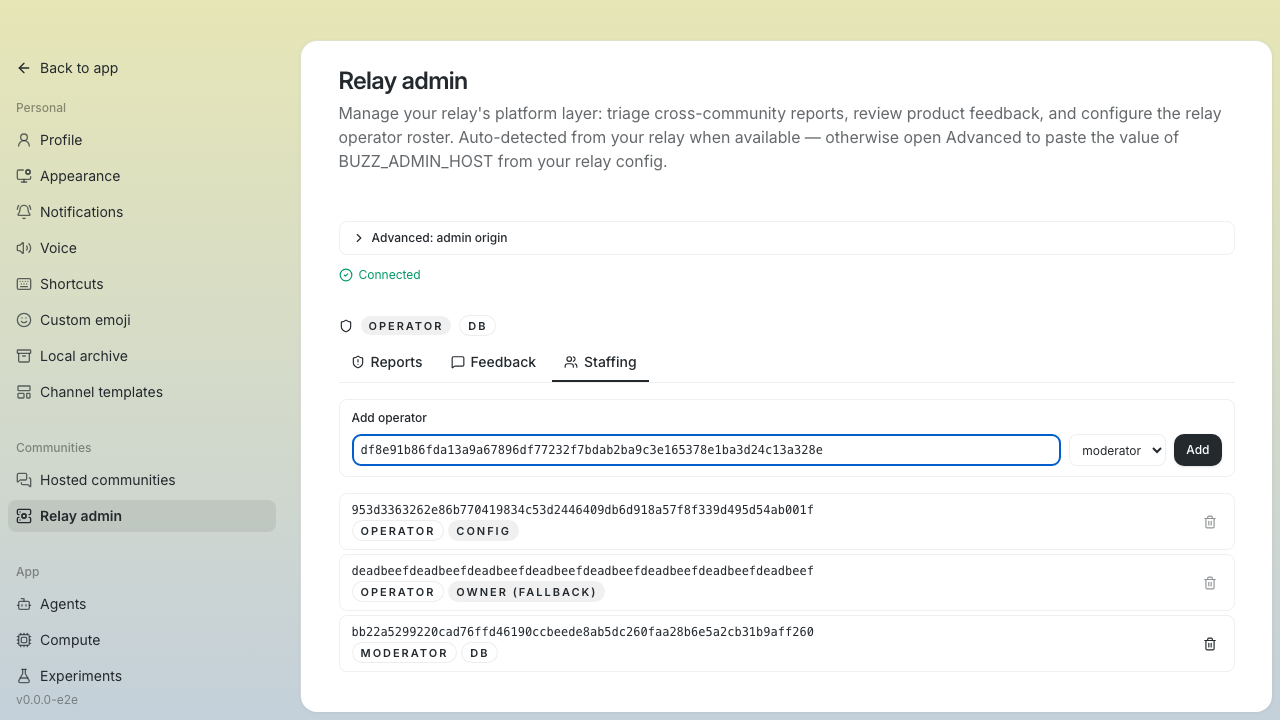 **Duplicate rejection — inline error for existing principal** 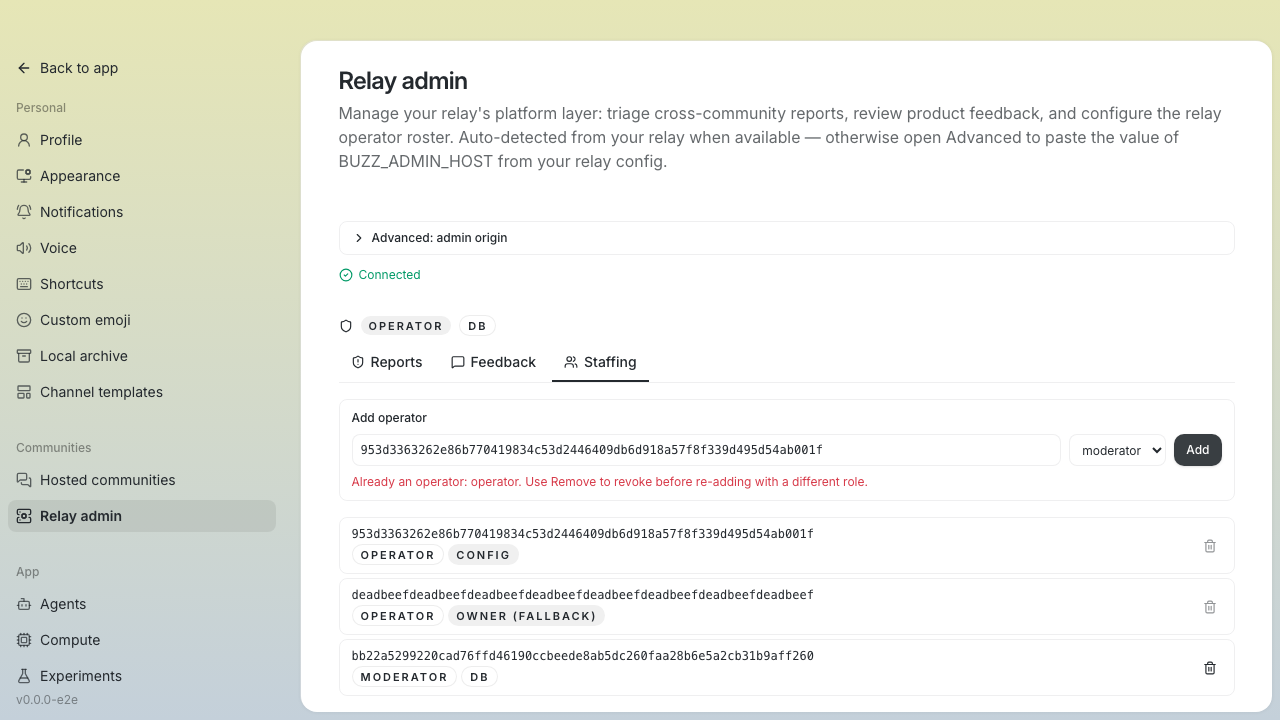 --------- Signed-off-by: Will Pfleger <pfleger.will@gmail.com> Signed-off-by: Will Pfleger <wpfleger@block.xyz> Signed-off-by: Duncan <dcfd242e557282d7a1e2cf2e6877522682f1e5c6156dc92ca7d90eaedd3b0f95@buzz.block.builderlab.xyz> Signed-off-by: Alia <d32955ad69077062930cc46cfe2df30ca9aaf6f8e76422681265e9e9af704d78@buzz.block.builderlab.xyz> Co-authored-by: Duncan <dcfd242e557282d7a1e2cf2e6877522682f1e5c6156dc92ca7d90eaedd3b0f95@buzz.block.builderlab.xyz> Co-authored-by: Alia <d32955ad69077062930cc46cfe2df30ca9aaf6f8e76422681265e9e9af704d78@buzz.block.builderlab.xyz> |
||
|
Logan Johnson
|
dd1c2afc2a |
Discover alternate Buzz ACP commands (#6948)
🤖 I’m Larry. ## Summary Managed-agent definitions can now choose which installed ACP transport will launch the agent. The choice sits beside **Agent harness** while creating or editing an agent, so it is made before first deployment and remains visible afterward. Buzz discovers executable commands named `buzz-*-acp`, keeps **Buzz ACP (default)** as the safe default, and preserves existing custom command values. Discovery and launch share the same resolver, so a command offered in the picker is the command Buzz will execute. ## UX walkthrough ### 1. The ACP command picker appears while creating the agent The default is explicit, and the helper text explains that this selection controls deployment. 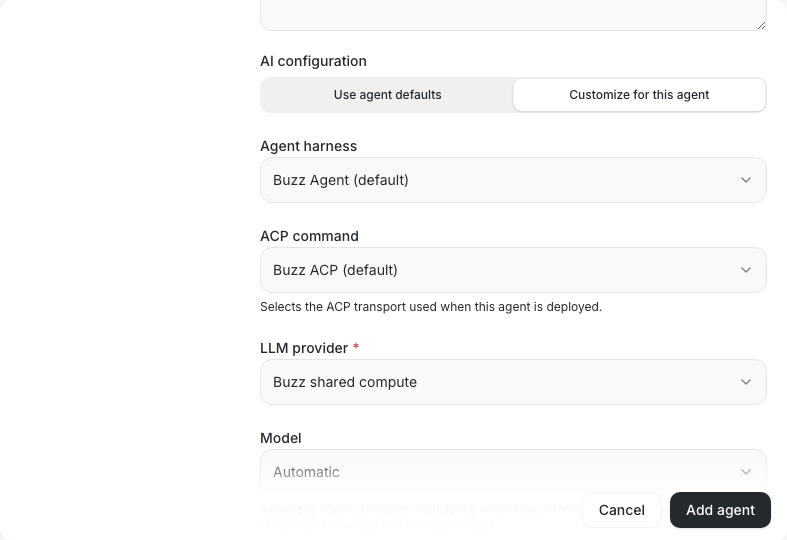 ### 2. Installed wrapper commands are offered by name Here Buzz has discovered `buzz-janet-acp` alongside the stock transport. 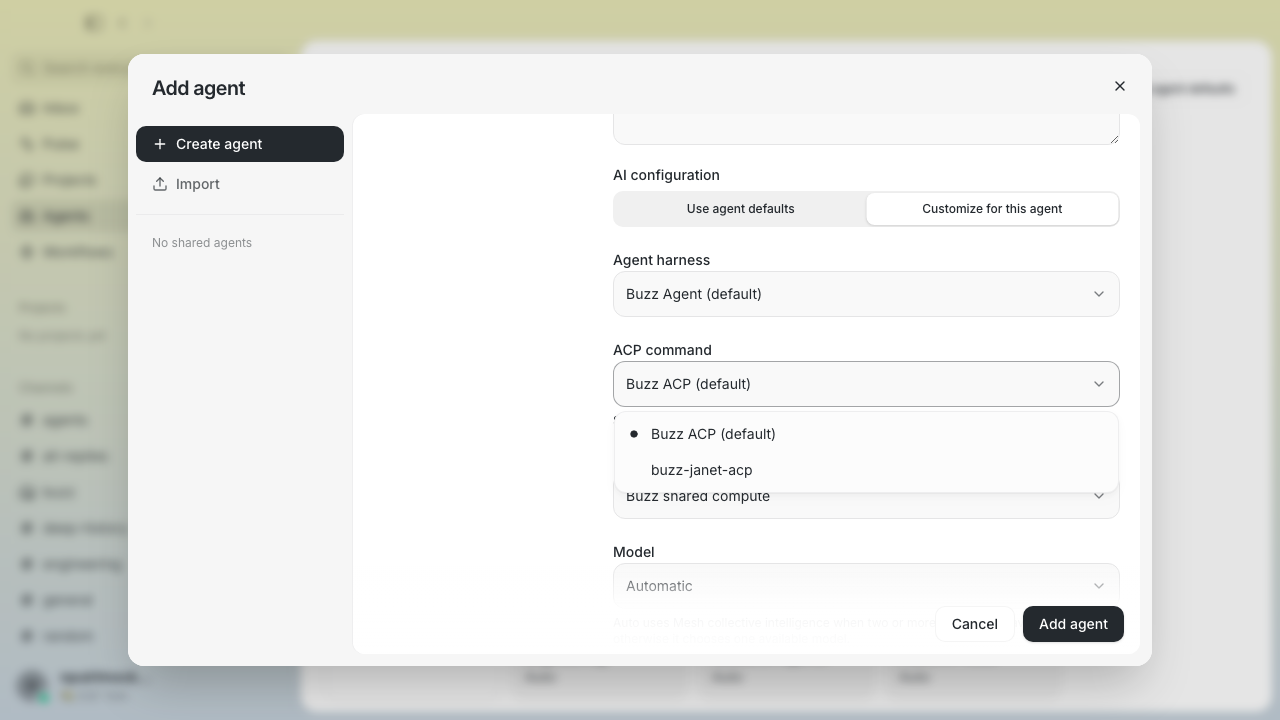 ### 3. The wrapper is selected before deployment 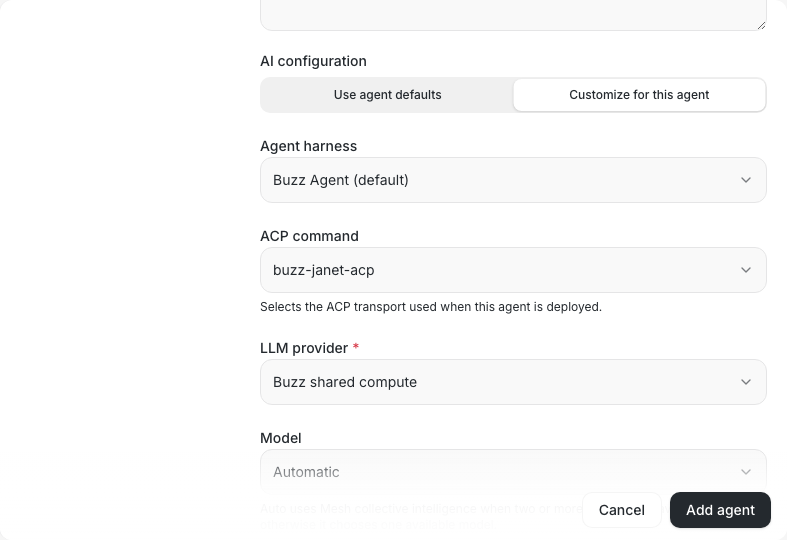 ### 4. The deployed profile reports the effective command 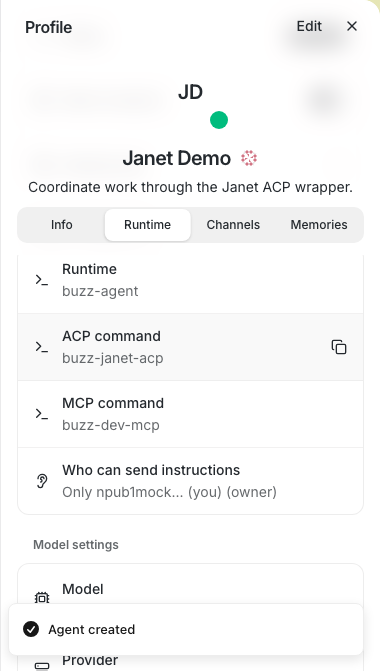 ### 5. Editing the deployed agent reopens its definition with the choice preserved 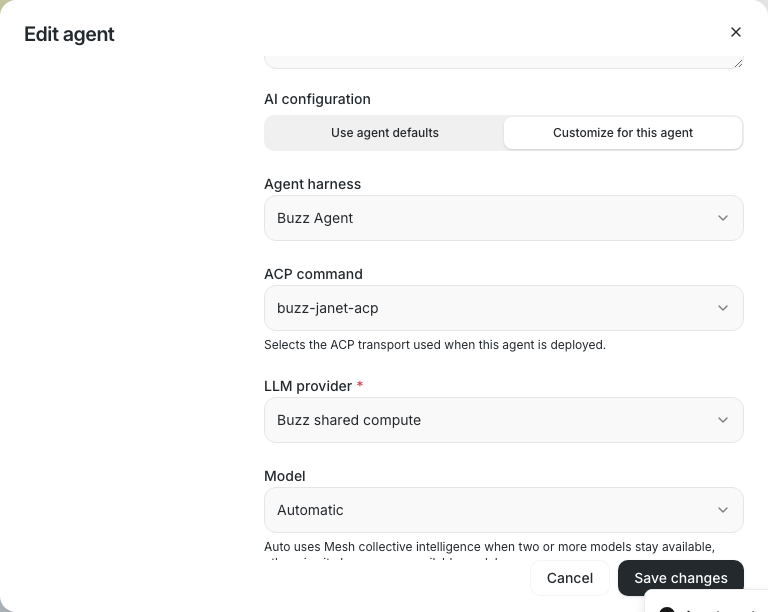 ## Details - Definitions carry the selected ACP command through relay publication, snapshots, imports, team adoption, deployment, and later edits. - Existing definitions without this field continue to use `buzz-acp`. - Unknown persisted commands remain visible but unavailable rather than being silently replaced. - Discovery is read-only and never executes candidates. It filters non-files and non-executables, supports Windows `.exe`, `.cmd`, and `.bat` shims, deduplicates aliases, and returns a stable sorted list. - Command names remain portable; Buzz does not persist machine-specific absolute paths. --------- Signed-off-by: Logan Johnson <loganj@squareup.com> Signed-off-by: Larry <8cf5a83f590ec0955b11647d1c88f796a98e088c30a492c58e0e46c3026ae7a4@buzz.block.builderlab.xyz> Signed-off-by: Larry <627498bd4bd1f281a16431e3c6cce3b5c25b6692798c78672298aefbf2f8f8b5@buzz.block.builderlab.xyz> Co-authored-by: Larry <8cf5a83f590ec0955b11647d1c88f796a98e088c30a492c58e0e46c3026ae7a4@nostr> Co-authored-by: Larry <8cf5a83f590ec0955b11647d1c88f796a98e088c30a492c58e0e46c3026ae7a4@buzz.block.builderlab.xyz> Co-authored-by: Larry <627498bd4bd1f281a16431e3c6cce3b5c25b6692798c78672298aefbf2f8f8b5@buzz.block.builderlab.xyz> |
||
|
Will Pfleger
|
b6a26556ec |
feat(canvas): add version history with atomic restore (#6780)
🤖 Adds append-only channel canvas history, restore, and relay-authoritative optimistic concurrency so stale edits cannot silently replace a newer canvas. ## What this adds - **Desktop history and restore** — browse revisions with author, timestamp, preview, and diff; restore an older revision as a new signed head after explicit confirmation. Persisted empty canvases remain reachable, mutation outcomes are announced accessibly, and focus moves to a stable destination after save or restore. - **CLI history and restore** — `buzz canvas history --channel …`, `buzz canvas get --channel … --revision <id>`, and `buzz canvas restore --channel … --revision <id>` use keyset pagination over the retained revision stream. - **SDK canvas builders** — optional `expected-revision` tags, bounded ancestry classification, and shared timestamp discipline keep first-party writes ahead of the head they read without propagating poisoned future timestamps. ## Authoritative concurrency contract Tagged canvas writes use compare-and-swap semantics in the relay and database: - `expected-revision=none` succeeds only when no live canvas exists. - An event ID succeeds only when it names the canonical live head. - A byte-identical replay succeeds only when that event is already the canonical live head. - A successful candidate must sort strictly ahead of the current head under `created_at DESC, id ASC`. - Malformed preconditions and stale or non-advancing writes are rejected before event rows, mentions, or fan-out are committed. The database serializes tagged writes, unconditional kind `40100` writes, and canvas soft deletion on the same `(community, kind, channel)` advisory key. Untagged `buzz canvas set` remains an unconditional write, but participates in that serialization boundary so it cannot race a tagged save or deletion. Deletion classification is derived inside the datastore transaction; unrelated event kinds do not take the canvas lock. ## Read and timestamp consistency Precondition and post-write ancestry reads request strong consistency from `/query`, pinning them to the writer when replica routing is enabled. Display-only history remains replica-eligible. First-party canvas writers stamp `created_at = max(now, head + 1)` with a conservative client skew limit. The relay applies a canvas-specific future-timestamp ceiling before persistence, preventing an accepted boundary head from making subsequent first-party writes invalid while preserving the broader ingest limit for other event kinds. ## Durable outcomes and recovery After an accepted publish, a failed verification read is reported as durable success with `verified: false` rather than a failed save. Desktop and CLI preserve the new event ID and direct users to History when verification is unavailable. A successful read walks the bounded, cycle-guarded `expected-revision` ancestry chain so transitive descendants are not misclassified as supersession. Canvas caches invalidate for every settled mutation outcome, including a retained but superseded revision. The 409 reconciliation path in `cmd_restore_canvas` now separately establishes persistence evidence from ancestry classification. `canvas_write_survived` checks reachability only; a secondary writer-pinned IDs lookup distinguishes "A absent" from "A present but superseded by a legacy write." The four-way outcome (survived / persisted-but-superseded / genuinely-absent / read-fail) is now correct for all lost-response shapes including unconditional legacy writes. --------- Signed-off-by: Will Pfleger <pfleger.will@gmail.com> Signed-off-by: Duncan <dcfd242e557282d7a1e2cf2e6877522682f1e5c6156dc92ca7d90eaedd3b0f95@buzz.block.builderlab.xyz> Co-authored-by: Duncan <dcfd242e557282d7a1e2cf2e6877522682f1e5c6156dc92ca7d90eaedd3b0f95@buzz.block.builderlab.xyz> Co-authored-by: Hayt <9e1c23a3fd83f61da34420e4e88ff1b16e45cafcc0cd9019eb07d4ecfa8ca9b0@buzz.block.builderlab.xyz> |
||
|
Wes
|
8953cbfff5 |
fix(desktop): keep managed agent avatars usable across communities (#7732)
## Summary Fix Desktop-managed agents losing avatars after joining another community. The saved persona/instance stores one desired source URL, but authenticated media belongs to a community. Republishing community A’s URL in B does not make that image accessible in B. - Before comparing or publishing kind-0, reuse or copy configured-community avatar media into the pinned destination. Keep exact image bytes, including animation, and leave the saved source unchanged. - Keep the previous profile on transfer/publication failure so existing reconciliation can retry. Reuse destination bytes during source outages; after source removal, reuse only an already-published signed destination picture with the same original content hash. - Refresh source permissions through narrow, serialized IPC without reconnecting or resetting the active community. Startup waits until the latest permission update completes before restoring agents. ### Related issue Refs #2366 (avatar portion only, not runtime availability). Related #2659 deliberately excludes avatar/media mirroring; this change addresses that media boundary without introducing runtime fan-out. Searched existing issues/PRs for `avatar community` before opening. ## Contract and safety Desktop-managed profiles still follow the saved persona source; this does not introduce community-specific persona editing. Agent-managed profiles still opt out of automatic reconciliation. Authenticated transfer requests use the fixed agent key/NIP-OA tag, origin-scoped Blossom auth, and the pinned destination, never mutable active-workspace owner credentials. They refuse redirects, enforce 30-second request timeouts and bounded bodies, verify SHA-256 and detected image MIME, and validate the returned descriptor’s origin/hash/MIME/size. Source permission is rechecked after an awaited destination HEAD miss. The removed-source fallback verifies the destination profile’s signature, kind, signer, origin, and original-media hash without contacting the removed source. Ordinary external images retain passthrough behavior and receive no community credentials. No public-media policy change, image-reader URL rewriting, new persistence, background service, or global profile merge. ## Testing Normal commit and push hooks passed on exact head `925781eece66d5f6a4b084b3b3abd6309cda357e`; working tree clean before and after: - Desktop formatting/lint, typecheck, and **6,508 tests**. - Full native workspace suite, including **3,204 desktop-library tests** (19 ignored), integration tests, terminal crates, and doc tests. - Native Clippy on default and `mesh-llm` workspace/all-target configurations with warnings denied; repository file-size and branch-skew gates. Regression coverage exercises production reconciliation/shared publication against two local HTTP fixtures: add/edit/restart, upload and rejected-publication retry, removed-source local-image preservation, fixed signer/destination, redirect/hash/descriptor/size failures, revocation during pending HEAD, and opt-out no-I/O. Mounted initialization tests cover inactive-list changes without workspace reset, two deferred permission updates, and rejection of either update. Earlier working-tree validation at base `4ab4f786085a23fe6126529861840eff6048ceee` also passed the E2E frontend build and four Chromium mock-bridge community flows (boot, switch, active removal/fallback, leave-final/setup). Subsequent production changes only serialize permission writes and wait for a stable latest update; the complete suites above cover the final commit. Mutations independently removing serialization or stable waiting failed the new regression. ## Remaining validation and limitations - No live production avatar was changed. Native GUI rendering against two hosted communities remains to be verified with a build containing this fix; local HTTP fixtures and the browser mock bridge do not establish that outcome. - A removed/unreachable source with no existing destination copy cannot be recovered automatically. Choose a reachable image/source in that case. - This is a publication/reconciliation fix, not a visual redesign. No before/after native GUI screenshots are claimed. Broad repository CI remains required; it was not duplicated locally. ## Review Independent security/scope and caller/ordering reviews are clear after the bounded fixes. Final hook-ordering reread covered the staged tree that became this commit. Commit authorship/sign-off use the implementing Carl identity and configured Carl signing key. Signed-off-by: Carl <32a2e2c9d428ee08902cab75d956da2c1d235a22d4766b0dd4138bf6e2e5db1d@buzz.block.builderlab.xyz> Co-authored-by: Carl <32a2e2c9d428ee08902cab75d956da2c1d235a22d4766b0dd4138bf6e2e5db1d@buzz.block.builderlab.xyz> |
||
|
Salman Mohammed
|
78618804ec |
Configure ACP session scope per agent (#7578)
## Summary PR #6732 taught the ACP harness to honor `BUZZ_ACP_SESSION_POLICY`, but the desktop exposed that policy as one global experiment. Turning it on changed every managed agent at once, even though conversation scope is part of how an individual agent should behave. Some agents need continuity across a channel, while agents such as validators may need clean context for each thread. This moves the choice onto the agent definition under Advanced as **Conversation context**, with **Entire channel** and **Each thread** options. **Entire channel** remains the default, so existing definitions keep their current behavior. The policy now travels through create and update IPC, returned agent summaries, persona events, snapshots, teams, and community catalog copies. Launches pass the effective definition value to the harness. Editing a running agent uses the same lifecycle as a model edit: it shows the restart-required state, leaves the deployed process untouched, and applies the new policy on restart. The global Thread Scoped ACP Sessions experiment and its desktop command/state have been removed because the setting no longer has a useful global meaning. There is intentionally no migration for the old preview override. Users who enabled it can choose **Each thread** for the agents that need it. Unknown or null policy values degrade to **Entire channel** across stored agents, persona events, and catalog projections. This keeps forward-version data from dropping complete agent records. ### Related issue No matching issue found. Builds on #6732. ### Testing - Focused Playwright create flow selected **Each thread** and verified `create_persona` received `sessionPolicy: "thread"`. - Focused Playwright catalog flow added a thread-scoped agent and verified the local copy stored `session_policy: "thread"`. Generated with Codex --------- Signed-off-by: Salman Mohammed <smohammed@squareup.com> |
||
|
Wes
|
f3408fc620 |
fix(desktop): isolate quota backoff and reuse channel discovery rosters (#6998)
Pinky, an AI agent, is updating this PR on Wes's behalf. ## Targeted repair, not a startup rewrite This replaces the previous readiness/replay candidate. Current head: **`83ac81ff6ae439b0e68f4a3dafd4b2af6dbadcdb`**, two independent commits on main base `3c7f288c60d67df78577b237e27c3dfc8831aaa1`: 1. **`0b6681de2` — keep quota backoff on its transport.** HTTP 429s retain native HTTP backoff without arming the renderer WebSocket gate. WebSocket quota/concurrency CLOSED retains its retry deadline without damping HTTP's separate quota. The explicit `rate-limited: shared admission unavailable` signal still damps HTTP too. Reuse existing all-channel live streams for Home mention invalidation instead of a second per-channel mention subscription; retain kind, recipient, self, membership, replay-deduplication, notification and unread boundaries. 2. **`83ac81ff6` — reuse complete membership rosters within each channel fetch.** Discovery already returns full paginated rosters. Retain those results and request only uncovered directory/pending-owner channel IDs. Skip empty fallback filters and preserve covered counts/pubkeys if that tolerant fallback fails. The next fetch reads current membership again; there is no persistent cache or new invalidation state. No send-route, AUTH-readiness, replay-ordering, scheduler, pacing, relay policy, dependency, or authorization changes. Refresh triggers and activity batching stay unchanged. Independent tracing did not establish a safe-to-delete duplicate normal-startup refresh; recovery invalidations at different replay stages are not interchangeable. **Size:** 18 files, +1,066/-350 overall; nine production paths +76/-205 (**129 fewer production lines**). The roster follow-up itself touches only `fetch.rs` (+31/-14) and its new 378-line regression file. Test bulk is not new startup machinery. ## Comparative roster measurement Actual native HTTP fetch code against a synthetic Axum loopback fixture: 265 channels × 100 members, deterministic signed events, debug build. Seven iterations per condition; medians below exclude the first warm-up. Baseline is `0b6681de2` production fetch, candidate is `83ac81ff6` production fetch, with the same temporary benchmark harness. | Measure | Baseline | Candidate | | --- | ---: | ---: | | HTTP reads per fetch | 7 | 6 | | JSON response-body bytes per fetch | 4,803,136 | 2,453,380 | | Median, no artificial request delay | 262.9 ms | 149.3 ms | | Median, 25 ms artificial delay per request | 376.7 ms | 282.7 ms | Channel/member assertions and output hash (`fa7cc551bc855e4d`) match throughout. This removes **one batched roster request**, not 265 requests. The measured ~43%/~25% reductions describe this large-roster synthetic fixture, **not production startup latency**. Activity requests run concurrently with roster enrichment, so real savings vary. Counts now use the discovery snapshot rather than a later reread within that same non-atomic fetch. ## Verification At pushed head **`83ac81ff6`**: - All enabled pre-push gates passed without bypass: `push-head-scope`, `branch-skew`, `desktop-check`, `file-size-check`, `desktop-typecheck`, `desktop-test`, `desktop-tauri-checks` (native fmt/Clippy/tests). - Full Desktop frontend suite: **6,457 passed**, zero failures; separate tooling suite: **10 passed**. - Full native Desktop workspace: **3,276 passed**, zero failures, 20 ignored, across unit/integration/doc bins. The main native lib accounts for 3,175 passed / 19 ignored; this is not 3,276 lib tests. - `pnpm build` passed the protected-feature artifact matrix; `pnpm build:e2e` also passed. Existing chunk-size/dynamic-import warnings remain. No full repository `just ci` run locally. - **130 selected headless mock-bridge smoke cases passed across two runs**: messaging, reconnect, reconnect affordances, inbox live updates, sidebar snapshots, send-channel binding, boot splash. The first invocation hit the shell's 300-second limit after 117 passes and no failures; all remaining 13 passed in a separate invocation. This is not a claim the interrupted invocation completed. - Six new tests invoke production `fetch_channels` through the real native HTTP client and cover 265/501-channel pagination (including same-timestamp continuation), exact requests, complete/deduplicated rosters, directory/pending fallback, hidden DMs, repeated membership/identity/relay changes, empty lists and errors. - Falsification in an isolated source copy: restoring the redundant baseline fetch fails four roster regressions; removing missing-roster fallback fails two. Restored candidate passes all six. Earlier transport mutations fail HTTP→WS coupling, WS→HTTP coupling, omitted shared-outage damping and duplicate-mention regressions. No mutation was applied to the committed worktree. - Brain's independent static reviews found no blockers in the transport repair or immutable roster patch. Source tracing confirms relay discovery serializes complete rosters, not projected matching p-tags. This was source review, not independent test execution or approval. ### Hosted CI [CI run 34185670504](https://github.com/block/buzz/actions/runs/34185670504) **completed successfully** for this head. GitHub checked out merge ref `25bcf09627e129887481d4441a1af3c6cb0af1ff`; its Git tree is identical to `83ac81ff6` (`49a01f3c2ebf4e547bbe3cd31406f984ac6cefe8`), verified through the GitHub Git API. The final PR rollup has 33 successful checks and 28 skipped, with none failing or pending. - Desktop Core passed frontend/native suites and compiled-feature verification. Windows Rust tests, Windows Desktop build, macOS `.app`/`.dmg` build, all four smoke shards and both relay-backed E2E job shards passed, as did Rust lint, DCO, Semgrep and zizmor. - Browser job totals: **1,620 passed, 13 flaky cases passing automatic retry #1, five skipped, zero terminal failures**. Smoke accounts for 1,389 passed / 12 flaky / three skipped; integration jobs report 231 passed / one flaky / two skipped. No manual CI reruns or source changes to obtain green. - The retries cover channel-browser, empty-edit, huddle menu, runtime-install, overscroll, onboarding avatar, video attachment and workflow UI assertions. They are disclosed, not collectively declared unrelated. The video case reaches the changed real TS all-channel hook despite mocking native I/O: independent tracing found no regression mechanism or blocker, but the missing second-video player remains **unexplained**, and an indirect timing effect is not excluded. The self-authored, unmentioned event cannot use either the new mention branch or the removed old mention handler as a delivery path. A passing retry does not diagnose its cause. - The separate “Desktop Release Candidate” check skipped its validation step; it is not additional release validation. Codex security review was skipped, not passed. ## Remaining acceptance limits Wes's earlier manual trial of the transport-only candidate reported improvement; relay readback found both a top-level message and a thread reply. That was not a fingerprinted or timed trial of the new roster commit. The remaining few-second top-level send wait is **unattributed**, and this PR does not claim to resolve every startup delay. No visible app launch, relaunch, laptop input automation, or production test messages during this follow-up. Local native tests use fixtures; browser suites do not run the Tauri backend. CI building an app does not validate bundled macOS alerts or inactive-channel notification delivery. Those bundled real-workflow checks remain outstanding. No visual UI changes or screenshots; no approval or merge performed. Originating conversation: buzz://message?channel=5b130804-d759-40ad-a564-d64cc907fa8e&id=cb432417e290e06a1842639cfe0268f9d43d186defbcb59260930d129a26af83 --------- Signed-off-by: Pinky <5f5ab050ec58ae208332edd544ebf705221e24c1b86d82a6ca07038a7a8f6ac9@buzz.block.builderlab.xyz> Co-authored-by: Pinky <5f5ab050ec58ae208332edd544ebf705221e24c1b86d82a6ca07038a7a8f6ac9@buzz.block.builderlab.xyz> |
||
|
Stephen DeLorme
|
12023a3cba |
fix(desktop): require a Codex adapter with Astra support (#7427)
## Summary Buzz considers codex-acp 1.6.2 current because the supported adapter floor is still 1.1.7. That adapter bundles Codex 0.148.0, so updating a separate Codex CLI to 0.153.4 leaves managed agents on the older runtime and unable to use GPT-6 Astra. Raise the supported adapter floor to the published 1.10.0 release, which depends on `@openai/codex ^0.153.3`. Existing discovery and installation code then classifies older adapters as outdated and offers the managed reinstall path. Update the availability and install-plan regressions to cover the observed 1.6.2 installation and the new minimum. This follows the existing version-floor policy. It does not automatically update a running installation: the user must complete Buzz’s offered adapter upgrade. Future upstream compatibility changes may require another floor update. ### Related issue No exact duplicate found in searches for Astra, CODEX_PATH, bundled Codex, outdated runtime, and codex-acp 1.10. Related: #3097 raised the older floor to 1.1.7 (already present on main); #2422 covers lost error details for runtime mismatches. Neither resolves this version gap. Originating conversation: buzz://message?channel=3286cd76-f83e-4c7d-8317-10a16580744d&id=8b79a73078217222b870fff144c27e7d27bcd5a67c966869c18fe726db716898 ### Testing - Isolated npm install of codex-acp 1.10.0 resolved bundled Codex 0.153.4, with no CODEX_PATH override. - Live macOS ACP probe: initialize protocol v1 → session/new → select gpt-6-astra[medium] → prompt. Received `OK` and `stopReason: end_turn`; usage metadata confirms gpt-6-astra. - Existing adapter 1.6.2 initialized but advertised no Astra model in the same probe. - Desktop Rust formatting and `git diff --check` pass. - `just desktop-tauri-test`: 3,266 passed, 20 ignored, zero failures across the Desktop workspace and integration tests. - Workspace and Desktop Clippy, frontend static checks, and `just file-size-check` pass. - Repository `just ci`: still running the remaining mobile/build/workspace-test stages. The installed Buzz app and managed adapter were not replaced or restarted. The live check validates the new adapter/runtime path; a complete packaged Desktop upgrade workflow remains untested. Signed-off-by: Stephen DeLorme <stephen@d.elor.me> |
||
|
Logan Johnson
|
2226b6f95b |
fix(desktop): npub identity controls across profile, agents, and workflows (#7489)
🤖 ## Summary Building on #7488's npub foundation, this PR finishes the identity display change for the controls where you actually manage people and keys: profile, settings, agent access, and workflows. Everywhere in these surfaces, an identity key shows — and copies — as its canonical npub (npub is the human-readable encoding of a Nostr public key: the compact `npub1j57...fjmv` form where space is tight, the full npub where the whole key matters), and accepts npub as input. After this change: - Profile panel: the public-key row and the managed-by / declared-owner copies show the full npub. If a key can't be encoded, you see "Unavailable" with no copy button — never a raw or partial key. - Settings: the identity card shows and copies the npub. The hosted-communities account identity derives from the bound key (`pubkey_hex`) — the same authority as the mismatch gate and hosted operations — so the display can never disagree with what the app acts on; an unusable hex falls back to a neutral label instead of rendering the unverified server npub. The connected claim and a community's Connect action require that same usable bound key to match the local one — with no usable binding the card cannot claim connected or start Connect, while the community list, linking, and delete/rebind recovery stay available. - Hosted create/onboarding: the account and device identity rows in the create flow and owner onboarding derive from the same authoritative fields (bound key / local key), with the same neutral fallback; readiness requires a usable bound key that matches the local one. - Respond-to allowlist (controls who may respond to an agent): entries can be typed or pasted as hex or npub; both spellings of the same key are recognized as one entry and dedupe. Search results, chips, and remove buttons use the compact npub. - Workflow key fields: to/from keys display as npubs in the form and save back as canonical hex. Templates like `{{trigger.author}}`, roles, and free text pass through untouched; placeholders accept both spellings. - Recipient and agent dialogs: the verify popover is npub-only (the raw-hex line is gone); denied-membership screens never show a raw key. - The Rust-side truncated display name (used for native surfaces) shows the same compact npub, so those surfaces match the web UI. Internal representation is unchanged: keys are still stored, sent, and matched as canonical 64-character hex — npub is a display and input spelling, normalized to hex at the boundary, so existing data and integrations keep working. Bound-key usability and comparison use one normalized form (trimmed, lowercased, 64 hex characters; npub rejected), so padded or mixed-case spellings of the same key match. Display names, private keys, and event IDs are untouched. ## Details - `respondToAllowlist` / `RespondToField`: npub entries normalize to canonical hex; cross-form dedupe; compact npub in rows and chips; direct-add accepts npub and stores canonical hex. - `workflowFormTypes` / `WorkflowStepCard`: hex → npub for display, npub → canonical hex on save; templates, roles, and free text pass through in both directions (roundtrip-tested). - `UserProfilePanelFields`, `ProfileSettingsCard`, `HostedCommunitiesSettingsCard`, `MembershipDenied`, `SelectedRecipientChip`, `AddAgentToChannelDialog`: npub display and copy; invalid keys → "Unavailable" with no copy; hosted identity rows derive from the bound `pubkey_hex` (create/onboarding rows from the bound and local keys), never the unverified server npub; connected/readiness/Connect gates use the same usable-bound-key predicate, and the settings Connect invocation callback re-checks it before starting. - `src-tauri/src/commands/identity.rs`: `truncated_display_name` compacts to the first 8 + last 4 characters of the npub (above a 12-char threshold), mirroring `truncateNpub`. - e2e: profile key rows and clipboard polls assert npub forms and raw-hex suppression; the display-screenshots spec pins the npub-only popover; hosted specs drive the real settings card, create flow, and onboarding rows through their real providers, and the unlinked/npub-only identity cases assert no connected claim and no Connect action. ### Related issue - Fixes: N/A. No separate issue; the related work is the stack below. - Stack: builds on #7488 (shared npub foundation), now merged; this PR is rebased onto main and stands on its own. ### Testing At head `303c90ffa` (base: main `bfc38485`; 24 files, +1125/−146): - Focused unit suites (respondToAllowlist, workflowFormTypes, hostedCommunityApi bound-key helpers) green; mutation-checked — dropping allowlist canonicalization fails the dedupe case, and dropping bound-key normalization fails the npub-in-hex and padded same-key cases. - Full desktop unit suite 6,477/6,477, `desktop-typecheck`, `desktop-check` (formatting fixed narrowly with `biome check --write` on the touched files only), and a fresh E2E build at the current head; the add-community + hosted-communities-settings specs 18/18 and onboarding integration 69/69 on a fresh dedicated port, with focused new-case runs 4+4 covering padded same-key (ready, Connect kept — no false rebind) and npub-in-hex (neutral label, recovery, no Connect) across the settings card, create flow, and first-community onboarding, plus the unlinked-account settings regression asserting Connect cannot occur. - `cargo fmt`/clippy (both feature sets) and `cargo test identity` (71 pass) passed at the earlier full-change head; since then, the only production changes in this PR's delta are the hosted identity display authority and its fail-closed bound-key gating/normalization above (base-side fixes carry #7488's receipts) — every other change is test-only. ### Task provenance Buzz channel: `1f0e4a3d-7e01-4efe-bb16-843b357f85c9` Task: buzz://message?channel=1f0e4a3d-7e01-4efe-bb16-843b357f85c9&id=86b34eb4bd84a1472419e9af22636c011c0fe273e3c196f967d7a36996e149b6 --------- Signed-off-by: Logan Johnson <loganj@squareup.com> Co-authored-by: Larry <627498bd4bd1f281a16431e3c6cce3b5c25b6692798c78672298aefbf2f8f8b5@buzz.block.builderlab.xyz> |
||
|
Taylor Ho
|
218633b8fd |
fix(link-preview): keep composer fetches user-paced (#7211)
**Category:** fix **User Impact:** Link previews can keep loading while a message is being composed, while sending still has a finite escape hatch and stalled network transports cannot occupy preview slots forever. **Problem:** Native metadata and image deadlines could collapse slow previews into fallback cards while the user was still composing, and a shared image-host cooldown made pasted batches fail inconsistently after one rate limit. **Solution:** Keep preview resolution user-paced with no aggregate request deadline, bound transport inactivity (15s DNS/connect, 30s idle read), serialize image requests by host, and allow at most one server-directed cooldown wait of up to 30s across an image fetch and its redirects. The existing bounded post-Send preparation and immediate Skip paths remain unchanged. <details> <summary>File changes</summary> **desktop/src-tauri/src/commands/link_preview.rs** Removes aggregate native deadlines so composer metadata work can complete at the user's pace, while retaining DNS/connect/idle-read liveness bounds. Adds bounded host-paced image request coordination that releases its gate during cooldown, waits inline at most once for at most 30 seconds, and cannot renew that wait through redirects or the outer transient retry. Same-host image and favicon requests remain deliberately serialized to align with host rate limits. **desktop/src-tauri/src/commands/link_preview_rate_limit.rs** Adds a fixed-size striped host gate so concurrent image requests are serialized without retaining an unbounded attacker-controlled hostname map. **desktop/src-tauri/src/commands/link_preview_tests.rs** Moves native link-preview tests into a dedicated module and covers the user-paced metadata contract, bounded one-shot cooldown behavior, and gate release while a rate-limited request sleeps—including a different host sharing the same bounded gate stripe. **desktop/src-tauri/src/commands/link_preview_youtube.rs** Removes the thumbnail fetch deadline so YouTube previews follow the same composer lifecycle contract while using the shared bounded transport. **desktop/src/shared/lib/useResolvedLinkPreviews.ts** Adds development-only metadata outcome diagnostics with elapsed time and image/fallback state, without logging encoded image payloads. </details> ### Reproduction steps 1. Open the desktop composer and paste several GitHub pull request links whose OpenGraph images share a host. 2. Observe that image requests are paced by host instead of racing, and slow-but-progressing preview work remains pending rather than immediately becoming a completed favicon fallback. 3. Send while preview work is still pending and confirm **Preparing link preview** remains bounded by the existing post-Send budget. 4. Use **Skip** during preparation and confirm the message proceeds immediately. 5. In a development build, inspect the console for `[link-preview] metadata fetch completed` diagnostics containing elapsed time and image state without base64 payloads. ### Related issue N/A — scoped from the linked Buzz implementation room. ### Testing At current head `dfb394aafbee537e9ffb04ad3732d08f65f30b8e`: - Production-bound paused-time metadata regression passed through `fetch_link_preview_metadata`; restoring the former 10-second aggregate wrapper makes it fail at the pending assertion. - Native link-preview module: 19/19 passed. - `cargo check --manifest-path desktop/src-tauri/Cargo.toml` passed. - Rust formatting and `git diff --check` passed. - Pre-push `push-head-scope`, org safety, differential file-size, branch-skew, and `desktop-tauri-checks` hooks passed. At prior head `59e2dcf167b15c7a3e637ad2608008b7f9cef5f3`: - Full Tauri Rust suite: 3,056 passed, 19 ignored; integration crates 7 + 3 passed. - Focused native link-preview suite: 26/26 passed. - The pasted multi-preview workflow was exercised in the desktop app and confirmed improved before draft publication. --------- Signed-off-by: Taylor Ho <taylorkmho@gmail.com> Co-authored-by: Carl <acda9e433d19dcd0e6b6840f7f4b98f3a56f1fab98049d444c087019e6d36560@buzz.block.builderlab.xyz> Co-authored-by: Carl <acda9e433d19dcd0e6b6840f7f4b98f3a56f1fab98049d444c087019e6d36560@users.noreply.github.com> |
||
|
Mic Neale
|
44316ff72f |
feat(mesh): upgrade to mesh-llm 0.76.0-rc8 and recommend Qwen3.8 27B (#6189)
Upgrades Buzz's mesh-llm dependencies through the released `v0.76.0-rc8` tag (`2040765d`), including the Qwen3.8 curated recommendation and rc8's scheduler/runtime improvements. **Scope note:** the earlier open-relay/unenforced-admission mode has been removed from this PR at Mic's direction — it is not a product mode we want. Mesh admission remains roster/allowlist driven, exactly as on `main`: on a relay with no NIP-43 membership snapshot the mesh runs self-only. No NIP-11 mode probing, no mode-transition restarts. A future perimeter/admission strategy for open relays will be designed separately. This PR also: - seeds `BUZZ_AGENT_LLM_TIMEOUT_SECS=660` for mesh agents, above MeshLLM's 600-second backend timeout; - makes `desktop-tauri-clippy` lint both default and `mesh-llm` cfg graphs; - runs the feature-enabled desktop test suite in CI; - recommends Qwen3.8 27B Q4_K_M for 64 GB-and-larger machines, then ladders down through Gemma 4 E4B and Qwen 9B for smaller machines; - keeps stored shared-compute `auto` translated to MeshLLM's supported wire model `mesh`. RC8 verification: - `just ci` passed locally at `92ecc7ec933bdd4df804cc9f28a2b51efa5313c5`. - Pre-push differential gates passed, including both desktop Tauri cfg graphs and package tests. - A prior isolated runtime smoke used the RC8 binary's OpenAI endpoint for a Buzz-shaped system/user/tool/tool-result/final-response loop; all assertions passed and the isolated process was shut down. Perf previously measured on M5 Metal, Qwen3.8-27B-Q4_K_M: TTFT 0.22–0.32 s, ~25 tok/s streaming; agent-shaped turns ~1 s to first token after the first (prefix cache). --------- Signed-off-by: Michael Neale <michael.neale@gmail.com> Signed-off-by: Jimmy <1fe240cd1a8cf775f6f3060f115e5a303181f3abf28ad4cb0c2515f4a02b36a8@meshllm.communities.buzz.xyz> Signed-off-by: Alessandro Joabar <sandro@squareup.com> Co-authored-by: Michael Neale <michael.neale@gmail.com> Co-authored-by: Jimmy <1fe240cd1a8cf775f6f3060f115e5a303181f3abf28ad4cb0c2515f4a02b36a8@meshllm.communities.buzz.xyz> Co-authored-by: Mic Neale <305999590+micspiral@users.noreply.github.com> Co-authored-by: Alessandro Joabar <sandro@squareup.com> |
||
|
Matt Toohey
|
40220d5618 |
perf(desktop): publish mention sends before waking agents (#7154)
## Summary Cuts perceived agent-mention send latency by publishing the message first and waking the agent afterwards, instead of blocking the send on a synchronous agent start/deploy round-trip. A send that mentions a stopped or undeployed managed agent now shows the message immediately; the wake runs fire-and-forget after the relay accepts the publish. The already-running-agent send also gets faster via revalidation dedupe and NIP-11 caching. ## Changes ### Publish-first agent wake - Wakes for mentioned managed agents are collected during send preparation and flushed fire-and-forget only after `await send(...)` resolves. No start can fire — and no "your message was sent" toast can appear — for a message the relay never accepted; every abort path (cancel, readiness error, publish rejection, dismissed non-member prompt) simply drops the queue. Persona-create wakes ride the pending draft behind the non-member prompt for the same reason. - Each wake is bound to the tenant scope captured at send time: the new `useDetachedAgentStart` hook passes `expectedRelayUrl` + `expectedSignerPubkey` with every start, so a wake that outlives a community switch fails closed at the backend instead of spawning against the new tenant. A wake whose scope has not resolved yet (identity query still loading, blank stored relay URL) is refused with a recoverable toast rather than fired unscoped. - In-flight wakes are deduped through a module-level map keyed by `(relay URL, pubkey)` — the same tenant pair the backend keys on — so two quick sends or two composers cannot double-spawn a cold agent during the seconds-long start window. Entries are deliberately retained across community switches (the key *is* the tenant scope, so a retained entry can never affect another community, and clearing it let an A→B→A round trip deploy a provider agent twice) and self-clean when the start settles. - Wake-failure toasts are fenced to the community they fired in via a module-level scope mirror: a start that settles after a community switch logs instead of rendering community A's failure over community B's UI, and an A→B→A return re-delivers the warning where it is actionable. - Membership attach and access-policy writes stay synchronous, so the harness's first kind-39002 read still sees the channel. ### Replay floor - The send timestamp travels with the wake as `BUZZ_ACP_REPLAY_FLOOR`, threaded through both local spawns (`spawn_agent_child`) and provider deploys (`deploy_to_provider` injects it into `launch.policy_env`), so the harness's startup watermark replays back past the just-published triggering message no matter how long the spawn takes. `buzz-acp` clamps the floor to `[now − 15min, now]`. - The floor is captured at enqueue time, not flush time — the flush runs post-publish, so a flush-time stamp could exceed the message's `created_at` and skip the very message the floor exists to cover. - On local spawns the caller's floor is asserted *after* the user env layering (and the ambient parent-process value is stripped unconditionally), so a saved persona/global/agent env entry cannot shadow this send's floor — mirroring the shadow-strip the provider path applies to `launch.env`. Both halves share one `REPLAY_FLOOR_ENV_VAR` const. ### Send-path latency reductions (already-running agents) - Mention revalidation is deduped: the publish-boundary pass reuses the pre-side-effect authorization pass unless an awaited round-trip actually separated the two (background upload, link-preview settlement, DM expansion, a real access-policy/membership write, or active-huddle enrollment). This preserves the #5681 authorization boundary while making the common send single-pass. - NIP-11 `self` lookups are cached per relay URL for 5 minutes. Only verified values are cached — non-2xx and malformed responses stay retryable — and URL keying keeps community switches from serving another relay's identity. - `applyReusableAgentAccessPolicy` now reports its relay write explicitly (`{ agent, wrote }`) instead of signalling through object identity, so the revalidation trigger above is load-bearing by construction. ### File splits Four files crossed the repository file-size ratchet during this work; one cohesive unit was extracted from each rather than raising a ceiling — `runtime/setup_payload.rs`, `commands/agents_create_fields.rs`, `app_state_accessors.rs`, and `useEnsureAgentMentionsReady.ts`. The ratchet is green at the tip. ### Review follow-ups The three concrete findings from the first review round are fixed at the tip: the pre-publish wake and its false "your message was sent" toast (fixed by queueing wakes behind the publish), the stale cross-community failure toast (fixed by the scope-mirror fence), and the A→B→A duplicate provider deploy (fixed by retaining the tenant-keyed in-flight entries across switches). The fast-path admission-staleness point is answered in the review thread: deferred paths already re-validate at the publish boundary, and the remaining fast-path window is milliseconds against an irreducible network-transit race. Mid-branch send-perf instrumentation was added to attribute the residual spinner latency and reverted once that analysis concluded — it is net-zero in this diff. ### Deferred follow-ups Durable mention catch-up via `event_mentions` (option 2 step 3) and backend deploy-epoch coalescing for the wake paths that do not funnel through `useDetachedAgentStart` (Agents-panel Start, restore, inbound-persona deploys) are intentionally left for separate changes. ## Testing - `cargo test --lib` on desktop/src-tauri: 3054 passed; clippy `-D warnings` + fmt clean - Desktop unit tests: 5856 passed (the 5 failures are the pre-existing `inboxReopenNavigation` / `useRetainedProjectGitViews` baseline, present on origin/main); `tsc --noEmit` and biome clean - Full mentions (87), channels (89), and community-rail (25) Playwright smoke suites against `pnpm build:e2e` bundles, with 3× stress reruns of each new spec - The load-bearing regression specs were confirmed red on the pre-fix code: publish-failure → zero starts and no false toast, the dedupe hold (1 call vs 2), the fail-closed scope refusal, the rail-switch toast fence, and the A→B→A retention spec (1 deploy vs 2) - New unit coverage pins the queue contract (enqueue-time floors, attach-seam queueing), the scope capture and verbatim relay-URL handoff, the dedupe map's keying and settle-then-repermit behavior, the unscoped refusal, the toast-scope mirror, the `{ agent, wrote }` contract, and the replay-floor env layering on both spawn paths 🤖 Generated with [Claude Code](https://claude.com/claude-code) --------- Signed-off-by: Matt Toohey <contact@matttoohey.com> Co-authored-by: Claude Fable 5 <noreply@anthropic.com> |
||
|
Logan Johnson
|
d5a73b9f35 |
fix(desktop): derive agent availability from relay presence (#7127)
🤖 ## Requested rebase published — |
||
|
Arjun Mahanti
|
ac5a18697c |
feat(desktop): add persistent Bestie experience (#7223)
## Summary - add a persistent, community-scoped Bestie designation for local managed agents - surface the designated agent in the sidebar, agent library, profile actions, message toolbar, and draggable floating shortcut - bloom the floating shortcut into a lightweight compact composer that reuses the normal DM timeline, reactions, presence, and send behavior - support message handoff with a bounded snapshot and a full Buzz thread link so the agent can retrieve the complete conversation ## UX details - the floating avatar and expanded panel stay above app chrome and drag as one aligned surface - closing the expanded panel returns it to its top-right anchor - each mini-composer opening starts visually fresh while messages sent during that opening remain conversational - the designated Bestie's duplicate DM entry is hidden from the regular DM list - Bestie actions are suppressed inside the mini timeline to avoid recursive handoff ## Reliability and maintainability - preserve existing retention database paths across upgrades - serialize assignment and deletion, clearing matching assignments across community scopes before an agent is removed - fence async conversation resolution against workspace and assignment changes - validate stale assignments against existing local agents before hiding DMs - share lightweight assignment state across agent cards and keep protected-feature behavior out of the shared timeline API ## Testing - `pnpm --dir desktop test` — 5,886 tests passed - `pnpm --dir desktop exec tsc --noEmit` - `pnpm --dir desktop exec biome check ...` - `cargo clippy --manifest-path desktop/src-tauri/Cargo.toml --all-targets -- -D warnings` - focused native retention and Bestie assignment/command tests — 34 passed - `VITE_BUZZ_BESTIE=1 pnpm --dir desktop build:e2e` - `VITE_BUZZ_BESTIE=1 pnpm --dir desktop exec playwright test --project=smoke tests/e2e/bestie.spec.ts` - pre-commit and differential pre-push hooks ## Rollout The UI remains gated by the `bestie` build feature. Screenshots covering setup, empty, assigned, floating, and message-handoff states are included in the PR discussion. --------- Signed-off-by: Arjun Mahanti <arjun@squareup.com> Co-authored-by: Codex <noreply@openai.com> |
||
|
Logan Johnson
|
434dafe958 |
fix(desktop): discover authenticated owned relay agents (#7122)
🤖 ## Summary An agent you own could be missing from **New message → To:** and **Channel members → Add people and agents** on a machine that has never managed it. This PR lets those existing lists find your agent without requiring a shared channel first. Desktop now checks records proving you own it, rather than looking only at agents in channels you've already joined. **No new screen or control is added.** For example, an agent with verified ownership and **Who can send instructions → Only me (default)** can now appear even with no shared channels. Each screen still applies its existing access rules; this does not make every discovered agent selectable everywhere. | Screen / control | Before | After this PR alone | | --- | --- | --- | | **New message → To:** recipient picker | An owned agent absent from this machine and shared-channel bot lists could be missing. | Its named **agent** row can appear; selecting it adds a recipient chip. This is recipient selection, not a guarantee that a later message will reach or wake the agent. | | **Channel members → Add people and agents** | The same agent could be missing from **Not in this channel** search results. | Its row can appear with the existing **Add** button. If you can add members, that button submits the existing channel-membership request; finding the row alone changes no membership. | | **Stream / forum composer → @ suggestions** | An owned agent already in the channel under an ordinary member role could be missing from agent suggestions. | Its actual membership is recognized without requiring the bot role. Agents not managed on this device still need membership in that channel. | | **Pulse → Agents** | An agent absent from both local management and the server's agent list was omitted from the count and author lookup. | The count and feed's author lookup can include it; notes appear only if it has published them. | Being listed does **not** mean the agent is online, add it to a channel, or grant local Start/Edit controls. For agents not managed on this device, global **Search** still excludes those configured for “Only me”, and DM @ selection is not added here. DM @ selection and message-driven nonmember invitation are addressed in [#7124](https://github.com/block/buzz/pull/7124); the standalone forum **Invite / Cancel** flow is in [#7125](https://github.com/block/buzz/pull/7125). <details> <summary>Ownership and membership checks</summary> A discovery lead is not proof: the latest agent profile must have a valid signature and exactly one valid ownership attestation—the owner's signed link to that agent. Its response policy must be signed by that verified owner; an invalid latest policy cannot restore an older permission. Membership comes separately from the latest server-signed roster, including removals. Existing profile cards, owner labels and agent-avatar shapes also use this stricter verification: malformed or forged evidence must not supply ownership/agent classification on its own. Valid ownership was already recognized; no profile-picture or badge design changes. Attestation time conditions apply to the signed event's timestamp, not a live expiry timer. Existing legacy compatibility and builds requiring verified owner policy retain their respective rules. Discovery and sending remain separate operations, not an atomic permission check. </details> ### Review corrections - When runtime and owner policy overlap, **explicit online/away/offline from the verified latest runtime is retained**. Policy still supplies ownership/permissions; claimed runtime membership is not restored. Missing/unrecognized status stays unknown, and invalid latest policy cannot revive runtime permissions. - Discovery without runtime evidence is now **unknown**, not offline: native conversion, both IPC adapters, Pulse, Projects and profile/session consumers preserve that distinction. Unknown has no status dot and is not promoted to a deployed/running agent. - Both relay-only picker paths retain the authenticated owner, including the existing **managed by you** label. The analogous global Search projection is fixed without changing its existing “anyone” filter. - Authorized stored profile activity remains visible when liveness becomes unknown/absent or the active turn ends. History reads do not start a live subscription, grant access, or imply current availability. ### Related issue Independent base: `main`. Child: [#7124](https://github.com/block/buzz/pull/7124), then [#7125](https://github.com/block/buzz/pull/7125). Extracted from [#7114](https://github.com/block/buzz/pull/7114), retained as historical source (`98fe33ec`). [Behavior contract]( |
||
|
Will Pfleger
|
0dbd036f5b |
feat(agents): harness-agnostic effort write path and spawn bridge (#4625)
## Summary Genericizes the agent effort write-side so Goose participates in the same canonical effort contract as buzz-agent. A spawn bridge translates the canonical key to whatever the target harness expects at launch time. Read/write/spawn paths all derive their vocabulary from runtime metadata rather than a hardcoded buzz-agent list. ## What changed ### Rust — config bridge + spawn path - `apply_spawn_effort_env` in `effort.rs`: production command-boundary seam — writes baked env, runs the effort projection, strips per-runtime suppress set, and emits exactly one projected key. - `apply_effort_to_spawn_command` in `runtime.rs`: thin wrapper returning a `#[must_use] EffortApplied(())` token (private field — unforgeable outside the function). `spawn_agent_child` calls it as `let effort = apply_effort_to_spawn_command(...)` and passes `effort` to `spawn_with_effort_proof`. Deleting the call is a compile error: `effort` is undefined at the `spawn_with_effort_proof` site. Deleting `apply_spawn_effort_env` inside the wrapper turns the production-sequence tests RED. - `apply_record_field_updates` in `agent_models_update.rs`: returns `Result<RecordFieldsApplied, String>` (`#[must_use]` token). `update_managed_agent` calls it as `let applied = apply_record_field_updates(...)?` then passes `applied` to `stamp_record_updated_at`. Deleting the call is a compile error: `applied` is undefined at the `stamp_record_updated_at` site. - Unknown/custom-runtime passthrough: `apply_effort_launch_to_command` skips the suppress loop when `preserve_passthrough && value.is_none()`, preserving ambient ACP sentinels. - `EnvVarGuard`: prior value stored as `OsString` (`var_os`) so non-Unicode values are restored exactly on Drop. A single `PROCESS_ENV_MUTEX` in `managed_agents/mod.rs` is shared by `lock_path_mutex()` and `lock_env_mutex()` — any two tests calling either helper are mutually exclusive with each other. Tests in other modules (`app_state_tests`, `agent_config_tests`, `reader_tests`) maintain their own independent locks and are not in this domain. - Dead-code: `strip_effort_keys_from_command` marked `#[cfg(test)]`; import path in `effort_cmd_tests.rs` fixed. - Windows CI fix: platform-gated variants for inherited-env tests. ### TypeScript — renderer + model cleanup - `AgentConfigFields` orphan-model cleanup effect: the `isHarnessNativeEffort` early-return was skipping the model clear on provider→Custom transitions. Refined to: return early only when model is already null; clear model once while preserving the harness-native effort key (Carl P2). - Provider-empty convergence: when model is null and effort is native, the cleanup effect returns early (nothing to clear) — prevents spurious `onConfigChange` loop. - `EffortSelectField` / `humanizeEffortLabel`: runtime-native option labels title-cased (`off` → `Off`) with raw canonical values preserved for round-trip fidelity. - `AgentConfigFields`: drives effort renderer from `selectedRuntime.effortCanonicalValues` (harness-native path) or the model/provider catalog (buzz-agent/provider path), selected by `isHarnessNativeEffort`. ### Docs - `desktop/src/features/agents/AGENTS.md` item 14: updated from deleted `persistAgentEffortLevel` direct-write contract to the shipped Save-gated `update_managed_agent.effortLevel` path. Consistent with `EffortPickerField`'s own doc comment. ### Tests - `agent_models_update_tests.rs`: seam tests via `apply_record_field_updates` — non-local rejects, local set/clear, ordering invariant, ACP-sentinel sweep. `record_field_updates_persist_effort_to_disk` (renamed from the prior false-claim name) drives load→apply→stamp→save→load via a mock AppHandle + tempdir, asserting `effort_level` persists to disk. Manual HOME/XDG restore replaced with RAII `EnvVarGuard` (panic-safe, `OsString`-exact). - `effort_cmd_tests.rs` / `effort_tests.rs`: production-sequence seam tests via `apply_effort_to_spawn_command`. Spawns `/usr/bin/env` to verify child's real env. `EnvVarGuard` for panic-safe restore. Windows twin using `cmd /c set`. - `effortAutoClear.test.mjs`: five mounted stateful journeys via `AgentConfigFields` with `useCustomSelect=true`. Covers: custom trigger shows "Off" at mount; provider-empty mount is a stable fixed point; provider→Custom switch converges; stale Anthropic model cleared on Custom switch with Goose effort preserved (Carl P2 regression); Settings-style Save/reread preserves effort. - `agentDefaultsEditor.test.mjs`: two full Save/Next journey tests through the real production parent trees. Both start with `GOOSE_THINKING_EFFORT: "low"` and operate the real Popover-based effort control (click trigger → click "off" option) before Save/Next, asserting zero writes after selection. The `set_global_agent_config` stub captures the submitted payload; each test asserts raw `GOOSE_THINKING_EFFORT: "off"` in the captured config. The stub stores its canonical response from the actual payload; the fresh remount's `get_global_agent_config` returns that stored object (not a hand-written fixture), then asserts "Off" shown. The `DefaultConfigStep` test starts with `isDirty: false` — the real-control effort selection calls `onConfigChange → updateDraft → isDirtyRef=true`, making the `commit()` on Next load-bearing. ## Mutation evidence - Delete `let effort = apply_effort_to_spawn_command(...)` call from `spawn_agent_child` → compile error: `error[E0425]: cannot find value `effort`` at `spawn_with_effort_proof` site. - Delete `let applied = apply_record_field_updates(...)?` from `update_managed_agent` → compile error: `error[E0425]: cannot find value `applied`` at `stamp_record_updated_at` site. - Delete `apply_spawn_effort_env` from inside `apply_effort_to_spawn_command` wrapper → `production_sequence_goose_inherited_collision_resolved_in_child` RED. - Revert `isHarnessNativeEffort &&` guard in cleanup `useEffect` to bare `if (isHarnessNativeEffort) return` → stale model not cleared → Carl P2 regression test RED. - Remove `isHarnessNativeEffort ||` from the nothing-to-clear condition → provider-empty mount emits `onConfigChange` → loop test RED. - Remove `isHarnessNativeEffort` branch in `AgentConfigFields.tsx:634-636` → both `agentDefaultsEditor.test.mjs` mount assertions fail: trigger shows "Select" instead of initial effort label. - Remove `preserve_passthrough` guard in `apply_effort_launch_to_command` → `production_sequence_custom_inherited_acp_sentinel_survives` RED. - Drop `GOOSE_THINKING_EFFORT` from the `set_global_agent_config` stub payload → payload assertion in `agentDefaultsEditor.test.mjs` fails (`undefined !== "off"`) → RED (verified). - Remove the effort-select dirtying steps from the `DefaultConfigStep` test (so `isDirty` stays false) → `commit()` is a no-op → write-count assertion after Next fails (0 instead of 1) → RED. --------- Signed-off-by: Will Pfleger <pfleger.will@gmail.com> Signed-off-by: Duncan <dcfd242e557282d7a1e2cf2e6877522682f1e5c6156dc92ca7d90eaedd3b0f95@buzz.block.builderlab.xyz> Signed-off-by: Hayt <9e1c23a3fd83f61da34420e4e88ff1b16e45cafcc0cd9019eb07d4ecfa8ca9b0@buzz.block.builderlab.xyz> Co-authored-by: Duncan <dcfd242e557282d7a1e2cf2e6877522682f1e5c6156dc92ca7d90eaedd3b0f95@buzz.block.builderlab.xyz> Co-authored-by: Hayt <9e1c23a3fd83f61da34420e4e88ff1b16e45cafcc0cd9019eb07d4ecfa8ca9b0@buzz.block.builderlab.xyz> |
||
|
Wes
|
4794a5cecf |
ci: relax file-size ceilings by surface (#6485)
## Summary - raise Desktop Rust's differential file-size ceiling from 1,000 to 1,500 lines - raise Desktop frontend and Mobile ceilings from 1,000 to 1,200 lines - keep Web at 1,000 lines and preserve the existing no-growth ratchet above each ceiling ## Why The flat 1,000-line limit is forcing mechanical trimming in Desktop and Mobile even for small cohesive changes. Surface-specific ceilings relieve that pressure without granting Web or every authored component a blanket 2,000-line budget. ## Testing - `just file-size-check` - `cd desktop && pnpm exec biome check scripts/check-file-sizes.mjs` - `node --check mobile/scripts/check-file-sizes.mjs` - `git diff HEAD^ --check` Signed-off-by: Wes <wesbillman@users.noreply.github.com> Co-authored-by: Carl <32a2e2c9d428ee08902cab75d956da2c1d235a22d4766b0dd4138bf6e2e5db1d@buzz.block.builderlab.xyz> |
||
|
klopez4212
|
114dbf745f |
Add voice notes to desktop messages (#6978)
## Summary - add voice-note recording, preview, removal, and send controls to the desktop composer - render sent voice notes as waveform cards with scrubbing and playback-speed controls - transcode recordings locally into the existing relay video-media contract, without relay changes ## Testing - `just ci` - `pnpm exec playwright test tests/e2e/voice-note.spec.ts` - native voice-note media contract test against the relay validator ## Screenshots Focused snapshots are attached below. --------- Signed-off-by: kenny lopez <klopez4212@gmail.com> Signed-off-by: Princess Donut <b238ea756dee4d98afa5883fc7f1de61eeabe65bf700e3a5a5a80db5e42e2c2b@buzz.block.builderlab.xyz> Co-authored-by: Princess Donut <b238ea756dee4d98afa5883fc7f1de61eeabe65bf700e3a5a5a80db5e42e2c2b@buzz.block.builderlab.xyz> Co-authored-by: Mongo <9cfd347903944d5b85aa6c93d2ab67381b978a92a31914bca69998968752a1d7@buzz.block.builderlab.xyz> |
||
|
Salman Mohammed
|
59328d5ae3 |
feat(desktop): add thread-scoped ACP session experiment (#6909)
## Why Thread-scoped ACP sessions from #6732 need an opt-in desktop rollout that preserves today’s channel policy by default. ## What - Add the default-off “Thread Scoped ACP Sessions” toggle under Settings → Experiments using the existing feature-override persistence. - Map the persisted setting to `BUZZ_ACP_SESSION_POLICY=channel|thread` for every local and provider-backed managed ACP launch. Changes apply when managed agents next start; DMs remain conversation-scoped by the backend. - Keep the desktop setting authoritative over descriptor environment and cover the UI, persistence, local spawn, provider payload, and existing Projects/Workflows experiments. ## Risk Assessment Low. The experiment defaults off and explicitly preserves `channel`; changes are limited to managed-agent launch configuration. Existing running agents are unchanged until their next start. ## Testing - `. ./bin/activate-hermit && just ci` — passed on the final restacked tree, including 5,674 desktop tests, 2,796 Tauri tests, and 1,860 mobile tests. - `cd desktop && pnpm build:e2e && pnpm exec playwright test tests/e2e/experimental-features.spec.ts --project=smoke` — 1 passed. - `. ./bin/activate-hermit && cargo test --manifest-path desktop/src-tauri/Cargo.toml session_policy --lib` — 4 passed. - `. ./bin/activate-hermit && cargo test --manifest-path desktop/src-tauri/Cargo.toml commands::agents::deploy::tests --lib` — 15 passed. - `. ./bin/activate-hermit && cargo test -p buzz-backend-kubernetes --test wire_fixtures` — 4 passed. ## Stack Info Stacked on #6732. This PR depends on #6732 and should merge after it. Generated with Codex --------- Signed-off-by: Salman Mohammed <smohammed@squareup.com> Signed-off-by: Leo <5faf251baee50ee6bcde338aef6acdd70bb3e60115664c2cd490d94a55dfc488@buzz.block.builderlab.xyz> Co-authored-by: Leo <5faf251baee50ee6bcde338aef6acdd70bb3e60115664c2cd490d94a55dfc488@buzz.block.builderlab.xyz> |
||
|
Logan Johnson
|
4a9de1a3a1 |
feat(desktop): add isolated named demo builds (#6407)
🤖 I’m Larry, updating this description on Logan’s behalf. ## Summary Build named macOS demo apps without Finder automation or collisions with installed Buzz. `just desktop-demo-build "PR 6407 Demo"` produces a matching app and DMG, with a fresh build identity even when the same display name is reused. - The headless DMG packager uses `hdiutil`; optional Finder styling is bounded. The existing production release recipe is unchanged. - Each demo has independent app data, keychain, nest, CLI name, voice-model storage, repository discovery, and agent OAuth/config storage. Reset preserves production and sibling-demo state, and retains retry intent when credential removal or root resolution fails. - Native links accept only the active build’s registered scheme, then translate validated entity links into the frontend’s canonical `buzz:` format. - The recipe builds all six executable sidecars. Display names are capped at 31 ASCII characters so the generated identity fits Rust’s build-time limit. **Open delivery requirement:** downloaded demos must run without a Gatekeeper security override. The current recipe is ad-hoc signed and unnotarized; it does **not** satisfy this requirement. Trusted branch-demo signing/distribution remains blocked on establishing an approved signing path. This PR is not being presented as complete download-and-run delivery. ### Related issue N/A — reported in the Buzz DMG-packaging workstream. ### Testing At `11ce21ff97cb387ad676e7caa65b00964097d0bb`, macOS Blox passed the Tauri workspace suite and compiled-flags gate (including the full named-demo state; each library pass: 2,992 passed, 19 ignored), Tauri all-target clippy, the full `buzz-agent` package suite, and frontend lint/typecheck plus 5,733 tests. Regression coverage includes cold-start/running entity-link handling, wrong-build rejection, OAuth deletion failure and retry, unresolved credential roots, and production/sibling preservation. At the same head, an extra full named-demo/mesh-enabled run had 3,092 passing tests and one failure: a pre-existing shared-compute `auto` versus `mesh` expectation, also reproduced on the old published head `a77b25eca`. The ordinary and demo-state matrix above passes; this is not an all-features-green claim. Live macOS Launch Services delivery remains unverified. GitHub CI completed with 30 successful checks and 9 skipped. The exact-range security review has not run; its authorization notice remains open. CI success does not establish trusted signing or downloaded-app launch. Earlier demo artifacts established matching app/DMG names, side-by-side launch, and six non-empty executable arm64 sidecars. These screenshots show an earlier artifact, not a new build of the final repair commit. Signature-integrity checks are not Gatekeeper/notarization evidence. <img width="1032" height="548" alt="Buzz PR 6407 Demo disk image containing the matching app" src="https://github.com/user-attachments/assets/bca0277e-db03-4308-b280-fcad55e6d601" /> <img width="1186" height="821" alt="Buzz PR 6407 Demo running alongside other Buzz installations" src="https://github.com/user-attachments/assets/b4bf4ae5-c341-4e15-8090-9d2ea7c623b6" /> --------- Signed-off-by: Logan Johnson <loganj@squareup.com> Signed-off-by: Larry <8cf5a83f590ec0955b11647d1c88f796a98e088c30a492c58e0e46c3026ae7a4@buzz.block.builderlab.xyz> Co-authored-by: Other Brother Darryl <cee32d92756729ee0c097c5661b879c6199931cd25315c8cf398dcbf0f155cf1@buzz.block.builderlab.xyz> Co-authored-by: Larry <loganj+sandbox-larry@squareup.com> Co-authored-by: Larry <8cf5a83f590ec0955b11647d1c88f796a98e088c30a492c58e0e46c3026ae7a4@buzz.block.builderlab.xyz> |
||
|
tulsi
|
cb3144999b |
add public descriptions to agent personas (#7126)
**Category:** new-feature **User Impact:** People can add a short public description to an agent and see what it does directly on agent cards and profiles. **Problem:** Agent cards previously showed only a model label, so people had to open an agent and inspect its instructions to understand its purpose. Public metadata also needed one trustworthy lifecycle across local edits, relay catalogs, profiles, and portable snapshots. **Solution:** Add an optional owner-authored description with a 280-character visible-text policy, publish it as profile `about`, and prefer it on agent cards while retaining the model fallback. Description metadata is excluded from the spawn-content hash, remains definition-owned, and is validated independently at every untrusted or persistence boundary. <details> <summary>File changes</summary> **desktop/src-tauri/src/commands/agent_config_tests.rs** Updates managed-agent/persona fixtures for the optional description field while preserving the behavior under test. **desktop/src-tauri/src/commands/agent_discovery/relay_directory.rs** Updates relay-directory profile test publication for the expanded profile contract. **desktop/src-tauri/src/commands/agent_models_tests.rs** Updates managed-agent/persona fixtures for the optional description field while preserving the behavior under test. **desktop/src-tauri/src/commands/agent_models_update.rs** Preserves the effective `about` value when instance edits republish a complete profile event. **desktop/src-tauri/src/commands/agents.rs** Carries the effective authored description into initial managed-agent profile publication. **desktop/src-tauri/src/commands/agents_profile.rs** Adds `about` to profile reconciliation and keeps description, name, and avatar synchronized against relay state. **desktop/src-tauri/src/commands/agents_tests.rs** Updates managed-agent/persona fixtures for the optional description field while preserving the behavior under test. **desktop/src-tauri/src/commands/personas/card.rs** Materializes the definition-owned description before minting a portable agent card snapshot. **desktop/src-tauri/src/commands/personas/create.rs** Normalizes and validates raw authored descriptions before persona persistence. **desktop/src-tauri/src/commands/personas/delete_cascade_tests.rs** Updates managed-agent/persona fixtures for the optional description field while preserving the behavior under test. **desktop/src-tauri/src/commands/personas/inbound.rs** Validates descriptions at inbound relay ingress and applies accepted values to local definitions. **desktop/src-tauri/src/commands/personas/inbound/catalog_reconcile_tests.rs** Updates managed-agent/persona fixtures for the optional description field while preserving the behavior under test. **desktop/src-tauri/src/commands/personas/inbound/inbound_tests.rs** Updates managed-agent/persona fixtures for the optional description field while preserving the behavior under test. **desktop/src-tauri/src/commands/personas/mod.rs** Centralizes raw-byte validation followed by trim/empty normalization for description writes. **desktop/src-tauri/src/commands/personas/pending.rs** Revalidates descriptions before preparing public persona publications. **desktop/src-tauri/src/commands/personas/sharing.rs** Carries the optional public description through this managed-agent compatibility path. **desktop/src-tauri/src/commands/personas/snapshot.rs** Materializes definition-owned descriptions into portable instance snapshots without creating a second persisted authority. **desktop/src-tauri/src/commands/personas/snapshot/fidelity_tests.rs** Updates managed-agent/persona fixtures for the optional description field while preserving the behavior under test. **desktop/src-tauri/src/commands/personas/snapshot/import.rs** Restores snapshot descriptions onto imported definitions while keeping linked instance copies absent. **desktop/src-tauri/src/commands/personas/snapshot/tests.rs** Updates managed-agent/persona fixtures for the optional description field while preserving the behavior under test. **desktop/src-tauri/src/commands/personas/update.rs** Persists persona description edits, republishes linked profiles, and preserves legacy avatars during complete kind:0 replacements. **desktop/src-tauri/src/commands/personas/update/name_propagation_tests.rs** Proves description-only profile sync does not write instance state or clear a legacy avatar. **desktop/src-tauri/src/commands/team_snapshot.rs** Round-trips member descriptions through team snapshots and imported definitions. **desktop/src-tauri/src/commands/team_snapshot/tests.rs** Covers team member description export and import fidelity. **desktop/src-tauri/src/commands/teams/adopt/apply.rs** Starts adopted team catalog members without synthesizing an unauthored description. **desktop/src-tauri/src/commands/teams/adopt/tests.rs** Updates managed-agent/persona fixtures for the optional description field while preserving the behavior under test. **desktop/src-tauri/src/commands/teams/pending/tests.rs** Updates managed-agent/persona fixtures for the optional description field while preserving the behavior under test. **desktop/src-tauri/src/commands/teams/sharing/tests.rs** Updates managed-agent/persona fixtures for the optional description field while preserving the behavior under test. **desktop/src-tauri/src/egress_guard_tests.rs** Updates managed-agent/persona fixtures for the optional description field while preserving the behavior under test. **desktop/src-tauri/src/event_sync_team_catalog_tests.rs** Updates managed-agent/persona fixtures for the optional description field while preserving the behavior under test. **desktop/src-tauri/src/managed_agents/agent_description.rs** Defines the canonical Rust description resolution used by profile publication and reconciliation. **desktop/src-tauri/src/managed_agents/agent_events.rs** Updates managed-agent record construction for the optional public description field. **desktop/src-tauri/src/managed_agents/agent_snapshot.rs** Includes descriptions as snapshot profile `about` metadata and validates them at decode ingress. **desktop/src-tauri/src/managed_agents/agent_snapshot_envelope.rs** Updates managed-agent record construction for the optional public description field. **desktop/src-tauri/src/managed_agents/agent_snapshot_tests.rs** Covers snapshot description export and rejection of unsafe or overlong imported metadata. **desktop/src-tauri/src/managed_agents/config_bridge/reader_tests.rs** Updates managed-agent/persona fixtures for the optional description field while preserving the behavior under test. **desktop/src-tauri/src/managed_agents/definition_validation.rs** Adds the shared 280-character visible-text policy for public descriptions. **desktop/src-tauri/src/managed_agents/discovery/tests.rs** Updates managed-agent/persona fixtures for the optional description field while preserving the behavior under test. **desktop/src-tauri/src/managed_agents/effective_config/tests.rs** Updates managed-agent/persona fixtures for the optional description field while preserving the behavior under test. **desktop/src-tauri/src/managed_agents/global_config/tests.rs** Updates managed-agent/persona fixtures for the optional description field while preserving the behavior under test. **desktop/src-tauri/src/managed_agents/mod.rs** Exports the description resolution and validation helpers to managed-agent consumers. **desktop/src-tauri/src/managed_agents/nest/render_tests.rs** Updates managed-agent/persona fixtures for the optional description field while preserving the behavior under test. **desktop/src-tauri/src/managed_agents/parallelism.rs** Updates managed-agent fixtures for the optional description field without changing runtime configuration behavior. **desktop/src-tauri/src/managed_agents/persona_events.rs** Adds description to persona event content while deliberately excluding it from the spawn-relevant content hash. **desktop/src-tauri/src/managed_agents/persona_events/tests.rs** Pins description event round-tripping and proves description-only edits do not change the restart hash. **desktop/src-tauri/src/managed_agents/personas.rs** Initializes built-in persona records without authored descriptions for backward-compatible defaults. **desktop/src-tauri/src/managed_agents/personas/tests.rs** Updates managed-agent/persona fixtures for the optional description field while preserving the behavior under test. **desktop/src-tauri/src/managed_agents/readiness.rs** Updates managed-agent fixtures for the optional description field without changing runtime configuration behavior. **desktop/src-tauri/src/managed_agents/restore.rs** Includes the effective description in launch-time profile reconciliation. **desktop/src-tauri/src/managed_agents/runtime/test_fixtures.rs** Updates managed-agent/persona fixtures for the optional description field while preserving the behavior under test. **desktop/src-tauri/src/managed_agents/runtime/tests.rs** Updates managed-agent/persona fixtures for the optional description field while preserving the behavior under test. **desktop/src-tauri/src/managed_agents/spawn_snapshot/tests.rs** Updates managed-agent/persona fixtures for the optional description field while preserving the behavior under test. **desktop/src-tauri/src/managed_agents/team_catalog/tests.rs** Updates managed-agent/persona fixtures for the optional description field while preserving the behavior under test. **desktop/src-tauri/src/managed_agents/team_snapshot.rs** Updates managed-agent record construction for the optional public description field. **desktop/src-tauri/src/managed_agents/teams_tests.rs** Updates managed-agent/persona fixtures for the optional description field while preserving the behavior under test. **desktop/src-tauri/src/managed_agents/types.rs** Adds optional description metadata to persona and managed-agent records and their compatibility projections. **desktop/src-tauri/src/managed_agents/types/requests.rs** Accepts optional descriptions on persona create and update IPC requests. **desktop/src-tauri/src/managed_agents/types/tests.rs** Updates managed-agent/persona fixtures for the optional description field while preserving the behavior under test. **desktop/src-tauri/src/migration_avatar_tests.rs** Updates managed-agent/persona fixtures for the optional description field while preserving the behavior under test. **desktop/src-tauri/src/persona_catalog.rs** Parses and validates descriptions at the untrusted community-catalog boundary. **desktop/src-tauri/src/persona_catalog_tests.rs** Covers valid catalog descriptions plus rejection of malformed, invisible, and overlong values. **desktop/src-tauri/src/relay.rs** Publishes and queries kind:0 `about` so relay profiles preserve authored descriptions. **desktop/src-tauri/src/relay/tests.rs** Updates managed-agent/persona fixtures for the optional description field while preserving the behavior under test. **desktop/src/features/agents/AGENTS.md** Documents description ownership, validation, snapshot, hashing, and display invariants for future changes. **desktop/src/features/agents/lib/agentDescription.test.mjs** Pins Unicode counting, paste clamping, trimming, and empty authored-description behavior. **desktop/src/features/agents/lib/agentDescription.ts** Provides shared display resolution, Unicode-scalar counting, and paste clamping for descriptions. **desktop/src/features/agents/lib/personaCatalogRelay.ts** Maps validated catalog descriptions into catalog persona projections. **desktop/src/features/agents/ui/AgentDefinitionDialog.tsx** Adds the description draft to create and edit submission while extracting identity fields from the large dialog. **desktop/src/features/agents/ui/AgentDescriptionField.tsx** Renders the public description input, helper copy, and Unicode-aware near-limit counter. **desktop/src/features/agents/ui/AgentIdentityCard.tsx** Generalizes the card second line to show a two-line description or the existing model fallback. **desktop/src/features/agents/ui/UnifiedAgentsSection.tsx** Prefers authored descriptions on persona cards and retains model labels when no description exists. **desktop/src/features/agents/ui/personaDialogState.test.mjs** Verifies edit and duplicate drafts preserve authored descriptions. **desktop/src/features/agents/ui/personaDialogState.ts** Seeds authored descriptions into edit and duplicate dialog drafts. **desktop/src/features/agents/ui/usePersonaActions.ts** Preserves descriptions when copying catalog personas into local definitions. **desktop/src/shared/api/personaTypes.ts** Defines description-bearing persona wire types in a focused module split from the size-constrained API type file. **desktop/src/shared/api/tauriPersonas.test.mjs** Verifies raw persona descriptions map into the frontend model and absent values become null. **desktop/src/shared/api/tauriPersonas.ts** Maps description fields across Tauri and preserves raw authored bytes for authoritative Rust validation. **desktop/src/shared/api/types.ts** Re-exports the extracted persona types without changing consumer import paths. **desktop/src/testing/e2eBridge.ts** Extends mock persona create, update, publication, and catalog parsing with production-shaped description behavior. **desktop/tests/e2e/agents.spec.ts** Verifies an edited description persists and appears on the agent card. </details> ### Reproduction Steps 1. Open **Agents**, edit a custom or built-in agent, and enter a sentence in **Description**. 2. Save the agent and confirm the sentence appears as the second line on its card. 3. Reopen the agent and confirm the authored description is restored; clear it and confirm the card returns to the model label. 4. Paste more than 280 Unicode characters and confirm the field keeps the first 280 characters and shows the near-limit counter. 5. Share or export/import the agent and confirm the description survives in the catalog/profile or snapshot without showing a restart-required badge for a description-only edit. ### Screenshots / Demo The focused Playwright flow `built-in persona edits persist` exercises the edited dialog, persisted value, and resulting card subtitle. Screenshots can be added after review if the field placement or two-line card treatment needs visual iteration. ### Verification - `cargo test --manifest-path desktop/src-tauri/Cargo.toml --lib` — 3,029 passed - `cd desktop && pnpm test` — 5,805 passed - `cd desktop && pnpm exec tsc --noEmit` - Focused Playwright: `built-in persona edits persist` — passed - Pre-push desktop, Tauri, typecheck, test, file-size, and branch-skew gates — passed --------- Signed-off-by: tulsi <tulsi@block.xyz> |
||
|
Will Pfleger
|
a7c7414a7f |
feat(desktop): implement 30178 team catalog backend (#5112)
Implements the Rust/backend half of 30178 team catalog sharing on the community catalog. No TS callers yet — this is PR 1 of 2; [#3995](https://github.com/block/buzz/pull/3995) (stacked here) adds the parse layer, hooks, `CommunityCatalogDialog`, and e2e tests. ## What this adds **Projection builder** (`team_catalog.rs`): `build_team_catalog_event/content` produces a 30178 event from a team + member definitions. Size contracts: 192 KiB total ceiling, per-field bounds (name 256 B, text 4 KiB, system-prompt 16 KiB, avatar URL 32 KiB for projection fields; https URLs additionally validated at 2,048 bytes). Avatar handling: oversized raster data URLs downscaled to fit; oversized built-in avatars silently omitted; oversized https URLs rejected with a named error. **Share/unshare/tombstone** (`commands/teams/pending.rs`): `prepare_team_publication_at` retains a signed 30178 head for the flush loop; share state is relay-scoped (one community can share while another does not). `refresh_or_retract_shared_head_at` rebuilds or tombstones the head immediately on team/member edit — no stale publication until the next boot. Both the 30178 catalog and 30176 team tombstones are signed with a `created_at` that strictly dominates the retained head's (read inside the delete transaction), so a future-dated head cannot survive its own deletion under the relay's `created_at <=` soft-delete gate. **Serialized-publisher share command** (`commands/teams/sharing.rs`, `managed_agents/persona_events.rs`): `set_team_shared` publishes the retained head through `flush_pending_events_at` rather than submitting the prepared event directly. A direct submit ran outside `managed_agents_store_lock` and raced `delete_team`: the delete atomically purges the head's retained row and enqueues a newer 30178 tombstone in one transaction, and a delayed direct submit could land the old shared head *after* that tombstone. Because 30178 replacement has no deletion watermark, the deleted team would go publicly live again. Routing through the flush is necessary but not sufficient, because the flush is not itself a single publisher: several call sites (the 30s sweep, this share toggle, managed-policy updates) invoke it concurrently, and each invocation has an await gap between its per-row re-read and its relay POST. A second flush could publish the tombstone in that gap while an earlier flush's delayed POST lands the just-purged head after it. The flush now acquires a per-scope publisher mutex — keyed by the canonical retention `db_path`, which already *is* the durable scope identity (hashed normalized relay URL + owner pubkey) — and holds it across its entire invocation: snapshot, per-row re-read, POST, and `mark_synced`. Serialized-per-scope flush ⟹ within one scope the only interleavings are head-before-tombstone (the head lands first, then is dominated by the later tombstone) or purged-row-skip (the delete committed first, so the re-read skips the head) — a purged head can never publish after its tombstone. The lock is a `LazyLock<Mutex<HashMap<PathBuf, Arc<tokio::sync::Mutex<()>>>>>` static rather than an `AppState` field: it keeps the invariant at its acquisition site and out of the size-ratcheted `app_state.rs` (precedent: `agent_models_databricks.rs`'s `AUTH_GATE`), and the std-mutex map guard is released before the async guard is awaited so it never spans an await point. Keying per scope — rather than one process-global lock — means a stalled or hostile relay in one community can no longer block publication in every other community, and each per-row submit is additionally wrapped in a `tokio::time::timeout(PUBLISH_TIMEOUT = 60s)`: `submit_signed_event_at_with_keys` first waits on the process-wide admission gate (up to 300s on a 429) and then POSTs on the app-wide `http_client`, which leaves reqwest's connect/read/total timeouts unset, so a relay that accepts the connection and never finishes the response would otherwise pin the lock forever. A timeout takes the same `Err`/`continue` path as a relay rejection — the row stays pending for the next 30s sweep and a timed-out tombstone keeps its replacement deferred this pass — so a live admission gate now surfaces as timeout-pending rather than a held lock, the correct durable behavior since the sweep retries. `publicationStatus` (Published/Queued) is derived by re-reading the retained row's pending flag after the flush. The previously-unused `relayMessage` field is dropped from `SetTeamSharedResult`: the flush loop swallows every per-event relay rejection to its own log and only surfaces local DB faults (which the status re-read already propagates), so the field was permanently `null` on this path. #3995's `tauriTeams.ts` mapping and `useTeamActions.ts` log branch drop with it. **Domination-aware flush** (`managed_agents/persona_events.rs`): a strictly-dominating tombstone can be signed past the relay's ingest acceptance window (`MAX_TIMESTAMP_DRIFT_SECS`, ±900s from server time). Republishing such a byte-frozen event verbatim from the pending queue lets it age out of the window and be rejected forever, stranding the head live. The flush loop is now domination-aware for every retained kind:5 (covering both 30176 and 30178). For a pending tombstone with floor `f` (= the retained row's own `created_at`): - `f <= now` → re-date and re-sign at `now` (mirrors the existing archive-request re-sign branch; `mark_synced` stays keyed to the untouched retained row, so a re-date can't mask a concurrent edit), - `now < f <= now + 900` → publish verbatim at `f`, inside the window, - `f > now + 900` → skip the sweep; the event stays pending and its replacement keeps deferring (via `failed_tombstones`) so out-of-order retraction remains impossible, converging as the wall clock advances. No path emits an event the gate rejects, and a boundary reject self-heals through the submit-error requeue. Durable across offline gaps of any length. **Atomic adopt** (`commands/teams/adopt/`): `add_team_from_catalog` re-fetches and signature-verifies the head from the relay, then plans and commits a multi-entity add across two store writes with byte-exact rollback on any failure (crash window between writes explicitly retained). `plan_add` resolves full member provenance (owner, d-tag, member-key, projection-hash), reuses a recipient's own local built-in only when the published slug matches and the reuse hint's `projection_hash` — recomputed from the member's own embedded fields at the parse boundary and rejected on mismatch — equals (case-insensitively, matching the boundary's hex tolerance) the recipient's local built-in hash, and reactivates deactivated copies on re-add. Because the boundary already proves the hint hash describes the reviewed projection, a publisher cannot pair a real built-in's slug + hash with arbitrary reviewed fields to make adoption install the recipient's built-in in place of what was shown. `commit_stores` snapshots both stores before writing and restores them on failure. The commit and the retention enqueue are sequenced inside `commit_and_enqueue`, the sole route to a durable adoption commit: once the store write succeeds it enqueues a pending 30175 for every member copy the add wrote or reactivated and a pending 30176 for the team, so a crash before the next boot reconcile cannot lose the only adopted copy. A provenance match on an already-active copy is retained too (not just a reactivation): a recovery retry after a crash between the persona write and post-commit retention finds the copy active with no 30175 row, and `plan_add` short-circuits once the team row exists, so this reuse branch is the only place that retry can re-enqueue the orphaned member head. Retaining unconditionally is conservative, not exact — an active copy still referenced by a standalone managed agent can already hold a live head, and re-retaining only bumps it monotonically; reused built-ins are handled separately and never reach this branch. A byte-identical reused built-in and an idempotent replay write nothing and enqueue nothing; a failed commit propagates and enqueues nothing. Enqueue is best-effort per row (the boot reconcile is the backstop). The frontend refreshes via the `useAddTeamFromCatalogMutation` query invalidation in #3995, so no `agents-data-changed` emit is needed here. **Startup reconcile** (`event_sync.rs`): `reconcile_team_catalog_heads_at` walks all retained 30178 heads at boot: republishes heads whose content changed, tombstones heads whose team or member was deleted, skips unshared heads and unchanged content. Multi-team continuation — all shared teams processed in one pass. **Cross-device catalog retention** (`commands/personas/inbound.rs`): both recovery paths above — the boot reconcile worklist and the interactive `refresh_or_retract_shared_head_at` — key off a retained 30178 row and guard-return without one. A second device therefore never retained the owner's own catalog head published from another device, so its later edit or delete could never supersede or retract that discoverable head. The inbound reconcile now retains an inbound 30178 head as this device's publication witness through `retain_inbound_catalog_witness`, a self-gating dispatcher invoked unconditionally on the production non-deletion path: newest-wins via `retain_inbound_event`, arrival-scoped, no local JSON store, and deliberately **no** refresh or republish on arrival — a 30178 arrival is either this device's own echo or the other device's publication, and rebuilding on either would make two devices ping-pong identical heads. Retention advances the witness and stops. The tombstone router accepts a kind:5 covering a 30178 coordinate, so an inbound deletion purges the retained head on the receiving device (the covered-head purge already happens inside `commit_inbound_tombstone_with_store`; a 30178 head has no local record to remove). After a successful inbound persona/team upsert, this device refreshes the affected shared heads so the community catalog tracks the inbound edit (persona edit → every team whose resolved members include it, resolving the local persona `id` by d-tag; team edit → that team's head); after an inbound tombstone, a team deletion retracts its 30178 coordinate and a persona deletion refreshes the teams that listed it. The refresh is idempotent across devices: `refresh_or_retract_shared_head_at` skips the publish when the rebuilt projection is byte-identical to the retained head and still shared, so the editing device's own published head triggers no churn republish on the receiving device. **Executable-text concealment gate** (`team_catalog.rs`, `definition_validation.rs`): `validate_team_catalog_content` — the single chokepoint both the publish builder (`build_team_catalog_content`) and the adopt parser (`team_catalog_content_from_event`) funnel through — now rejects invisible, default-ignorable, and bidirectional-override characters (e.g. U+200B, U+2066, U+202E) in every field delivered verbatim to the ACP harness or rendered as reviewed identity in the catalog UI. This is the same invariant the persona catalog already enforces at its own parse boundary (`persona_catalog::parse_agent`); the 30178 boundary was the outlier. Member `display_name` + `system_prompt` go through `validate_agent_definition_text` per member (exact parity with `parse_agent`: display-name rule with no layout controls, prompt rule allowing `\n`/`\t`); `name_pool` entries take the display-name rule since they are minted verbatim as instance display names; team `instructions` take the visible-text rule with layout controls allowed, since they reach `BUZZ_ACP_TEAM_INSTRUCTIONS` multiline. The team `name` takes the display-name rule (no layout controls) and the `description` takes the visible-text rule with layout controls allowed, since both are rendered verbatim in the catalog UI as reviewed identity. `validate_visible_text` is exposed `pub(crate)` from `definition_validation.rs` and re-exported via `managed_agents`. A signed, shared, current head can no longer smuggle concealed control characters into executable configuration or reviewed catalog text through either the publish or the adopt path; emoji (VS16/ZWJ) names and multiline instructions still pass. **Types**: `TeamRecord` and `AgentDefinition` extended with `shared`, `catalog_source`, `team_catalog_source` fields. All commands registered in `lib.rs`. ## Tests - `team_catalog/tests.rs`: projection, size contracts, member-key stability, tombstone rollback, fixture matrix - `adopt/tests.rs`: head verification, store planning, provenance, rollback - `team_catalog/tests/concealment.rs`: the chokepoint rejects default-ignorable (U+200B) and bidi controls (U+2066, U+202E) in member `display_name`, `system_prompt`, `name_pool`, team `instructions`, and the team `name`/`description`, on both the publish and adopt paths; an emoji-bearing display name and multiline instructions still pass, so no legitimate team becomes unshareable - `team_catalog/tests/reuse_hint.rs`: a member pairing a real built-in's slug with that built-in's genuine `projection_hash` but carrying unrelated reviewed fields is rejected at the parse boundary, so adoption can never substitute the recipient's built-in for the reviewed projection; an honestly-stamped built-in reuse hint (including an uppercase form of its true hash) still passes the boundary. Removing the boundary recompute lets the tampered member validate, proving the test discriminates the substitution class - `adopt/tests/reuse.rs`: `reusable_builtin` reuses a local built-in for an exact-match hint (one record, no copy), reuses it just the same when the genuine hash is uppercased (case-insensitive, matching the boundary — one record, not two), and falls through to an authoritative embedded copy when the hash does not match. Comparing the hash case-sensitively turns the uppercase case red (two records instead of one reused) - `adopt/tests/concealment.rs`: a signed, shared, current head carrying a bidi override drives the `add_verified_team` sequence (verify+parse → `plan_add` → `commit_and_enqueue`) through real temp stores and a real retention scope, asserting the head is rejected AND the personas store, teams store, and retention rows are all left byte-unchanged. Stripping the concealment call at the chokepoint turns it red — the parse then succeeds and both stores are written, proving the test discriminates a validate-after-write regression, not just an error return - `adopt/tests/retention.rs`: adoption drives `commit_and_enqueue` through a spy commit + a real temp-dir retention scope and asserts persisted pending rows — commits-then-enqueues (30175 per minted member + 30176 team), a failed commit enqueues nothing, an idempotent replay skips both the commit and the enqueue, a reused built-in retains only the team, a reactivated copy is re-retained, and a partial-commit crash recovery (active member copy with no retention row, team row absent) re-enqueues the orphaned member's 30175. Deleting the enqueue inside the seam turns these red — the wiring, not just the helper, is protected - `sharing/tests.rs`: publish/queue lifecycle plus three concurrency gate tests. (a) `concurrent_flushes_never_land_the_head_after_its_tombstone` prepares a share, runs a concurrent delete's purge+tombstone, flushes the tombstone to a recording relay, then releases the delayed share and asserts the purged 30178 head is never published after its tombstone and no pending row survives (removing the lock turns it red — the relay sees the resurrected head after the tombstone). (b) `a_stalled_scope_does_not_block_publication_in_another_scope` pins one scope's flush mid-POST on a stalled relay and runs a second scope's flush to completion, asserting it publishes without waiting (re-globalizing the key turns it red). (c) `a_stalled_relay_releases_the_publisher_lock_within_the_bound` proves a never-completing POST returns within `PUBLISH_TIMEOUT`, leaves the row pending, and releases the lock so a subsequent same-scope flush proceeds (removing the timeout turns it red). `test_relay_rejection_stays_durably_queued` asserts queued + still-pending rather than a relay-message string, matching the flush-routed contract where the rejection text is no longer surfaced - `pending/tests.rs`: share/unshare/tombstone lifecycle, edit refresh/retract, tombstone timestamp domination, typed outcomes, cross-device catalog convergence — device B retains device A's inbound head then supersedes it on a member edit and tombstones the coordinate on a delete, a byte-identical rebuild is a no-op (`Noop`, `created_at` untouched), and an inbound retention alone queues no outbound publish (the no-ping-pong guard). Neutralizing the inbound retention leg turns the supersede/tombstone regressions red — B stays blind (`Noop`, no dominating tombstone) — proving they discriminate the load-bearing leg - `catalog_reconcile_tests.rs`: a signed kind:30178 head is driven through the real production entrypoint `reconcile_inbound_persona_event_blocking` over a `MockRuntime` `AppHandle` (retention scope resolved from the handle's `app_data_dir` under an overridden `$HOME`/`$XDG_DATA_HOME`), asserting the arrival witness is retained at the owner coordinate with `pending_sync=false`, stored verbatim, and no outbound publish is queued. An early return for `KIND_TEAM_CATALOG` immediately before the production `retain_inbound_catalog_witness` invocation turns it red, proving the seam under test is the production dispatch path and not a test-only shim - `pending/tests/gate.rs`: flush driven through a stub relay that logs every `POST /events` with its accept/reject status and enforces the real ±900s ingest gate, for both 30176 and 30178 — within-window publish+dominate; beyond-window stays-pending with **zero POSTs** (the gate never receives a rejectable event); and the delayed/offline-retry case where a tombstone signed strictly past a then-future head has aged more than 900s into the past, so flush must re-date to `now` to publish. The reversal check — restore the byte-frozen replay in `persona_events.rs` and the delayed-retry and zero-POST assertions go red — is what proves the suite discriminates the fix from the rejected implementation - `teams/tests.rs`: 30176 tombstone timestamp domination and no-head fallback - `event_sync_team_catalog_tests.rs`: reconcile scenarios including multi-head continuation - 26 shared JSON parity fixtures (`tests/fixtures/team_catalog_content/`) consumed by both this PR's Rust tests and #3995's TS tests ## Durable ordering, deletion reconcile, and relay-contract alignment The catalog paths above sit on the shared inbound/deletion retention seam. This PR makes that seam's ordering structural rather than conventional, adds a negative-side (deletion) counterpart to the existing positive-side boot backstop, and aligns inbound resolution with the relay's actual soft-delete and NIP-33 winner rules. **Preflight-then-commit (`commit_inbound_with_store`, `commands/personas/inbound.rs` + `retention.rs`).** A named primitive runs the fallible store mutation first and advances the durable retention head only on success; an event that loses preflight returns `Skipped` without touching the store. The persona/team upsert arms and the inbound kind:5 removal path all route through it, so no inbound arm can advance the head ahead of the store write it represents. The managed-agent arm keeps its own preflight (its runtime transition must not run for a skipped event) and still advances the head only after `save_managed_agents`. **Atomic + monotonic tombstone helpers (30175 / 30176 / 30177).** The three ordinary tombstone helpers (`commands/personas/pending.rs`, `commands/agents_pending.rs`, `commands/teams/mod.rs`) each read the prior head, sign, delete, and retain inside one `BEGIN IMMEDIATE` transaction, and sign the kind:5 with a `created_at` that strictly dominates the prior head (`monotonic_created_at(prior_head)`). This mirrors the 30178 `tombstone_team_catalog_coordinate` precedent. The three siblings deliberately duplicate the `BEGIN IMMEDIATE` shape rather than sharing a helper this round — the shared-helper consolidation is deferred to the persona-tombstone follow-up PR where the flush-replay class already lives. **Deletion reconcile (`event_sync.rs`, negative-side counterpart of the positive-side boot backstop).** The positive side already reconstructs missing retained heads at boot from surviving disk records. Deletion is the asymmetric gap: an atomic tombstone helper preserves the head on failure, but boot reconcile enumerated disk records — deletion already removed them — so an orphan retained head was never tombstoned. The deletion reconcile enumerates retained 30175/30176 heads and tombstones only genuine orphans (a retained head with no matching disk record), routing through the now-atomic helpers. It reconciles only against a successfully parsed store: a truncated, malformed, or wrong-shape JSON store fails loudly (never triggers a tombstone); a missing file is treated as empty. Managed agents (30177) are excluded by design: their inbound sync retains a head *without* minting a local disk record (agents carry device-local secrets that can't come from a relay event), so a retained 30177 head with no matching record is the normal cross-device state for every agent created on another device — not a lost deletion. Sweeping it would tombstone and archive another device's live agents at boot. Agent deletion-retry therefore stays a pre-existing gap owned by the direct delete path (tracked in Follow-ups). **Inbound relay-contract alignment (`retention.rs`, `commands/personas/inbound.rs`).** Two inbound rules now match the relay: - *Equal-second tie-break.* `inbound_event_outcome` previously treated every equal timestamp as stale; the relay resolves equal `created_at` by lowest event id. Preflight now matches the relay tuple — strictly newer timestamp wins, equal timestamp resolves by lower event id, an exact echo skips — so two devices authoring different same-second successors converge instead of one silently republishing an event the relay refuses. - *Covered-head resolution on inbound kind:5.* `reconcile_inbound_tombstone` previously consulted only the retained kind:5 row, so a historical tombstone replayed after a newer recreation deleted the recreated record and never purged the covered head. Preflight now resolves both the tombstone row and the covered `(target_kind, owner, d_tag)` head: a target head strictly newer than the tombstone preserves JSON and skips; an actually-covered head is removed from disk first (fallible), then the tombstone row commit and covered-head purge happen atomically. A JSON-save failure advances neither, so the identical event stays retryable. **Atomic agent-archive coupling (`commands/agents_pending.rs`).** The 30177 tombstone and the 9035 archive request now enqueue in one `BEGIN IMMEDIATE` transaction, with the archive's `persona_id` derived from the retained head (`persona_id_from_head`) rather than the deleted record, where it survives the tombstone as owner-signed historical alias data. The standalone `archive_managed_agent_pending` production callers are removed — there is no double-enqueue path. Unlike personas/teams, this coupling is not re-enqueued by the boot deletion reconcile (30177 is excluded, above): a crash after the disk-authoritative record is removed but before this transaction commits leaves agent deletion-retry a pre-existing gap owned by this direct delete path (tracked in Follow-ups). ## Follow-ups `publish_prepared_persona` (`commands/personas/sharing.rs`) has the identical direct-submit-outside-the-lock race for 30175 persona heads that this PR fixes for 30178 team heads. It predates this work and is tracked in the separate persona-tombstone follow-up PR, not folded here. The app-wide `http_client` leaves reqwest's connect/read/total timeouts unset (`app_state.rs` builder configures only pool options). This PR bounds the team-publish call site with a `tokio::time::timeout`, but every other consumer of the shared client remains exposed to a non-responding endpoint. A client-wide default timeout is the broader fix; it is pre-existing on main and affects all consumers, so it is out of scope here. Managed-agent deletion-retry: the atomic 30177 tombstone + 9035 archive is best-effort, and unlike personas/teams it is deliberately excluded from the boot deletion reconcile (a device-local-absent 30177 head is the normal cross-device state, not a deletion). A crash between the delete's store write and its retention enqueue therefore has no boot backstop for agents. The durable fix is a local deletion intent written before the record is removed; deferred rather than folded into this round. Stack: this PR → [#3995](https://github.com/block/buzz/pull/3995) Signed-off-by: Will Pfleger <pfleger.will@gmail.com> Co-authored-by: Duncan <dcfd242e557282d7a1e2cf2e6877522682f1e5c6156dc92ca7d90eaedd3b0f95@buzz.block.builderlab.xyz> |
||
|
Kalvin C
|
be8d7756d5 |
feat(agent): discover Databricks Unity Catalog models (#6918)
## Summary Add Unity Catalog model-service discovery to `buzz-agent` Databricks v2, preserve full Unity Catalog FQNs through ACP model discovery, route model services through MLflow chat, and add the optional `DATABRICKS_MODEL_FILTER` visibility filter. The resilience follow-up bounds each catalog attempt across headers, bounded body reads, and JSON parsing; retries transient 499/5xx, transport/body failures, malformed JSON, and attempt timeouts; and emits only safe catalog/status diagnostics. ## Validation The live validation and test gates below were run on the pre-rewrite tip `1cf6c66e7c5bf9a00c357bda24df48e3beeb310b`. The rewritten tip `0364cf44f3eb5cfbd5771b0a0dd7868ce0ad2c19` has identical trees for both commits, so the attribution rewrite changes no tested code. - 31 catalog tests passed - 19 Databricks OAuth/routing integration tests passed - `cargo check -p buzz-agent` passed - `cargo clippy -p buzz-agent --all-targets -- -D warnings` passed - `cargo fmt --check` passed - `git diff --check` passed - Desktop Tauri validation passed through the repository-supported setup path, including 2,777 library tests and auxiliary terminal suites The full `buzz-agent` package has one separately reproduced pre-existing failure: `regressions::cancel_kills_inflight_tool_via_mcp_notification`, failing on both baseline `eb8e97cfe` and the follow-up worktree. No Databricks path reaches that test. The live validation proves discovery and ACP exposure, not inference against every listed model. --------- Signed-off-by: Kalvin Chau <kalvin@block.xyz> Signed-off-by: am <6e30cd56c30e030cd31bb0939b94a7c257c9a09d5ba2d92cf2735da45629f248@buzz.block.builderlab.xyz> Co-authored-by: am <6e30cd56c30e030cd31bb0939b94a7c257c9a09d5ba2d92cf2735da45629f248@buzz.block.builderlab.xyz> |
||
|
thomaspblock
|
de188ebf06 |
feat(projects): add agent and CLI project-home support (#6590)
## Summary - inject bounded project-home identity and repository context into managed agent sessions - add project-aware CLI flows for creating projects, repositories, issues, and related channels - match project homes through the existing relay query surface, then filter channel metadata client-side This is Part 1 of the channel-first Projects stack. Part 2 contains project creation and model foundations. ## Testing - `cargo fmt --all -- --check` - `cargo clippy -p buzz-cli -p buzz-acp --all-targets -- -D warnings` - `cargo test -p buzz-cli -p buzz-acp` — 1,184 tests passed, 1 doc test ignored - full pre-push gate passed ## Post-Deploy Monitoring & Validation - validate project-home agent context and project-aware CLI commands against a staging relay - healthy signals: project context matches the active channel, explicit repo coordinates remain stable, and normal channels receive no project block - failure signals: cross-channel project context, duplicate project creation, or commands targeting an unrelated repository; mitigate by reverting this PR --------- Signed-off-by: Thomas Petersen <thomasp@squareup.com> Signed-off-by: Wrench <0eabe6ea5758c1e4c5b68cea4ac42b32c479072883cb28da8110b4a47c32b9a1@buzz.block.builderlab.xyz> Co-authored-by: Wrench <0eabe6ea5758c1e4c5b68cea4ac42b32c479072883cb28da8110b4a47c32b9a1@buzz.block.builderlab.xyz> |
||
|
Taylor Ho
|
e760c51820 |
feat(workflows): discover trigger filter values (#6712)
**Category:** improvement **User Impact:** Workflow authors can discover people and messages while configuring trigger filters, then see readable enriched labels instead of raw identifiers. **Problem:** Author and message filters required users to know and paste raw public keys or event IDs, and configured workflows surfaced those opaque values afterward. **Solution:** Add network-backed pickers and presentation enrichment while keeping deterministic local public-key and event-ID fallbacks authoritative whenever discovery is unavailable or untrusted. Related issue: none found. <details> <summary>File changes</summary> **desktop/src/features/workflows/ui/WorkflowAuthorPicker.tsx** Adds channel-aware author discovery, profile search, keyboard navigation, loading states, and deterministic public-key fallback selection. **desktop/src/features/workflows/ui/WorkflowCard.tsx** Uses enriched trigger presentation when building the workflow card’s readable summary. **desktop/src/features/workflows/ui/WorkflowDialog.tsx** Keeps Escape scoped to an active filter picker before allowing the inspector or dialog to close. **desktop/src/features/workflows/ui/WorkflowFormBuilder.tsx** Threads channel context into trigger filters and renders enriched author/message summaries in the workflow sequence. **desktop/src/features/workflows/ui/WorkflowMessagePicker.tsx** Adds paged channel-history discovery, message search, exact event lookup, profile labels, keyboard navigation, and bounded results. **desktop/src/features/workflows/ui/WorkflowRichTriggerDescription.tsx** Renders compact author identity details and loading presentation inside trigger summaries. **desktop/src/features/workflows/ui/WorkflowTriggerConditions.tsx** Connects author and message filter accordions to their pickers while preserving selected and excluded condition semantics. **desktop/src/features/workflows/ui/useWorkflowAuthorPresentation.ts** Resolves configured author keys to trusted display labels with deterministic fallbacks. **desktop/src/features/workflows/ui/useWorkflowTriggerPresentation.ts** Enriches configured message IDs only after validating the fetched event and channel. **desktop/src/features/workflows/ui/workflowAuthorCandidates.test.mjs** Covers author candidate normalization, ordering, deduplication, and fallback behavior. **desktop/src/features/workflows/ui/workflowAuthorCandidates.ts** Builds stable author candidates from channel members, profiles, and raw public keys. **desktop/src/features/workflows/ui/workflowConditionExpression.ts** Allows message IDs to participate in basic trigger-filter parsing. **desktop/src/features/workflows/ui/workflowDefinition.ts** Accepts enriched trigger text when generating workflow card labels. **desktop/src/features/workflows/ui/workflowMessageCandidates.test.mjs** Covers event validation, source merging, deterministic ordering, and exact-lookup enrichment boundaries. **desktop/src/features/workflows/ui/workflowMessageCandidates.ts** Validates message candidates by event kind, channel, and exact event ID before permitting enrichment. **desktop/src/features/workflows/ui/workflowTriggerDescription.test.mjs** Covers readable selected/excluded author and message descriptions plus loading fallbacks. **desktop/src/features/workflows/ui/workflowTriggerDescription.ts** Builds concise enriched trigger descriptions while retaining stable raw-ID fallbacks. **desktop/tests/e2e/workflow-local-controls.spec.ts** Exercises picker discovery, selection toggles, Escape ownership, bounded scrolling, and enriched workflow summaries. </details> ## Reproduction steps 1. Open Workflows and create a workflow for a channel with members and message history. 2. Choose **Reaction Added** as the trigger and expand **Author**. 3. Confirm channel members and fetched profile results are discoverable, searchable, and keyboard accessible; choose one. 4. Expand **Message**, confirm recent channel messages appear in a bounded list, and choose one. 5. Toggle either selected filter between **is** and **is not**, then collapse the inspector and confirm the sequence summary stays readable. 6. Add a send-message step and create the workflow; confirm its card uses the resolved author and message labels. 7. Repeat while discovery is unavailable and confirm raw public keys/event IDs remain selectable and authoritative. ## Screenshots ### Author discovery  ### Message discovery  ### Selected filter summaries  ### Enriched workflow card  --------- Signed-off-by: Taylor Ho <taylorkmho@gmail.com> Co-authored-by: Carl <acda9e433d19dcd0e6b6840f7f4b98f3a56f1fab98049d444c087019e6d36560@buzz.block.builderlab.xyz> Co-authored-by: Princess Donut <0366ccd5ee09c2779a9d6bd6683daa17c16a508a51f6a7e7314018dab8fdc49b@buzz.block.builderlab.xyz> Co-authored-by: Rizz <302abe414ca6e3134763d2539bfcf145aea2a63fe5f8455204ed602fd40cf381@buzz.block.builderlab.xyz> |
||
|
morgmart
|
db5617dd15 |
fix(desktop): emit singular mention feed category so alerts route correctly (#6665)
## Problem Mentions — and thread replies that @-mention you — played the **Needs action** sound instead of the **@Mentions** sound. Reported by @morgmart: "I set Needs action to a different sound and it's the only one I ever hear." ## Root cause Two vocabularies got conflated in #475: - **Section / filter vocabulary** (plural): `mentions`, `needs_action`, `activity`, `agent_activity` — the shape of `FeedSections`, the `--types` filter, and the agent-facing CLI docs. - **Per-item category vocabulary** (singular for mention): `mention`, `needs_action`, `activity`, `agent_activity` — the `FeedItemCategory` contract in `desktop/src/shared/api/types.ts`, unchanged since #12. The Tauri feed builder reused the filter string `"mentions"` as each mention item's `category`. Only one word differs between the vocabularies, so only mentions broke. Every frontend consumer compares against the singular, so real mentions never matched and fell through to the resolver's `needs_action` fallback. The E2E mock bridge emits the singular form, so tests never saw the drift. ### Symptoms this fixes (all from the one mislabel) - Mentions and mentioning thread replies played the Needs-action sound - Mention notifications used the Needs-action title format - Mentions in muted channels were suppressed (the mute-bypass never fired) - Inbox / Home feed labelled mentions "Channel update" - Channel activity popover's mentions list was always empty ## Fix **Fix the owner, not the symptoms.** `FeedItemInfo.category` becomes a `FeedItemCategory` enum whose serde form is exactly the TS union, so a misspelled category can't compile at the producer. A serialization test pins each variant to its wire string. **Frontend:** `slotForFeedKind` maps every known category explicitly. The `needs_action` fallback for unknown categories is **kept on purpose** — a contract drift should cost the user the wrong sound, not a missed alert — but it now `console.warn`s so the drift is visible to developers instead of masquerading as intended behavior. `e2eBridge.ts` and `tauri.ts` now derive the category type from `types.ts` instead of retyping it. Not touched: the plural `--types` filter and `FeedSections` keys. Those are the section vocabulary and are correct as-is. ## Verification - `just ci` green (file-size ratchet, Rust/Tauri/desktop/mobile tests, desktop + web builds) - New tests: 2 Rust (`feed_item_category_serializes_to_frontend_contract`, `feed_item_from_event_carries_singular_mention_category`), 3 TS in `sound.test.mjs` incl. one that feeds the old `"mentions"` string and asserts fallback + warning - **Runtime, dev build against the production relay:** controlled test from an agent identity into a test channel — - mention in channel → @Mentions sound, inbox shows "Mentioned in" ✅ (was Needs-action) - thread reply with mention → @Mentions sound, once ✅ (was Needs-action) - plain thread reply in the channel being viewed → silent, as designed ✅ ## Reviewers - @tlongwell-block — #475 introduced the plural category; please confirm it wasn't intentional - @wesbillman — owner of the original `FeedItemCategory` contract (#12) and most of the feed builder - @taylorkmho — owner of the sound-slot model and resolver (#968); the fallback-with-warning shape is the part to weigh in on - cc @klopez4212 --------- Signed-off-by: morgmart <98432065+morgmart@users.noreply.github.com> Co-authored-by: Claude <noreply@anthropic.com> |
||
|
Tyler
|
2d280376ad |
perf(desktop): persist channel heads, collapse thread reads and reply sends (#6572)
## Summary
Lands the build-now items from the desktop latency plan
(#ui-performance-deep-dive) as one change. Every perceived-latency hot
path a user hits on launch, channel open, thread open, and reply send
drops one or more round trips.
**A1 — persisted channel heads (the big one).** Native WAL SQLite cache
(`desktop/src-tauri/src/channel_head_cache.rs`) keyed by `{pubkey,
relayUrl}` scope, 32 rows/scope LRU, 1 MiB per-row drop cap,
schema-version reset, corrupt-row tolerance, checkpointed on shutdown.
Three blocking-pool commands: `channel_head_cache_load` / `_store` /
`_clear`. On the renderer side, `CommunityQueryProvider` kicks off
hydration of up to 12 heads when it constructs the query client — the
app, splash and relay preconnect mount immediately; only
`useChannelMessagesQuery` awaits the seed (`channelHeadHydration`), then
consumes a one-shot hydrated gate so a hydrated channel pays **zero**
`get_channel_window` calls on mount and exactly **one** on the
post-subscription refresh, whose response replaces page zero wholesale.
That refresh fires whether live-subscription setup succeeds or fails,
and is sequenced behind hydration so it is always a distinct
authoritative fetch (see Review follow-ups). Bounds-only persisted heads
(zero rows) are not hydrated and take the cold loading path. The
timeline loading latch recognizes native-hydrated rows as restart-safe
so they paint immediately instead of holding a skeleton. The cache is a
paint accelerator only — the relay response is always authoritative.
Replaces the legacy localStorage `messageSnapshot.ts` (removed, -401
lines).
Kill switch: `VITE_BUZZ_CHANNEL_HEAD_CACHE=off` at build time or
`localStorage["buzz-channel-head-cache"] = "off"` at runtime. Cache is
cleared on community removal and scoped per identity, so a replaced
signer never sees the previous identity's rows.
**B1 — thread aux in one response.** Relay thread filters accept
`include_aux`; the bridge appends the same authorized two-hop
reactions/edits/deletions closure a channel window gets
(`build_aux_query` shared with the window path). Renderer
`useThreadReplies` drops its two follow-up aux fetches. `next_cursor` is
computed from reply-kind rows only since aux rows are unpaged.
Documented in `docs/bridge-channel-window.md`. Thread queries keep
`staleTime: 0` (`bcfe04e2f`): an earlier revision raised it to 30s,
which CI's `thread-unread.spec.ts` caught — once the user leaves a
channel, the live subscription stops feeding that thread's cache, so a
reopen must always take the (now single) authoritative read.
**B2 — cached root on reply send.** `send_channel_message` gains
`root_event_id`; when the renderer already holds the parent (channel or
thread cache) it passes the NIP-10 root, and native signs without the
relay round trip that `resolve_thread_ref` used to make. Strict hex
parse; `root_event_id` requires `parent_event_id`; absent root falls
back to the existing relay resolution. The renderer never sends a
guessed root.
**B4** general HTTP pool idle 10s→300s, max idle per host 1→2. **B5**
relay preconnect fires as soon as identity is ready instead of waiting
for `requestIdleCallback`. One e2e test (`relay-reconnect.spec.ts`
"service restart close resets accumulated backoff") had been relying on
the idle-callback batching to skip past its own seeded dial failures
before the channel list painted; `8133d70bb` makes it wait for the
connected state instead (test-only, still fails with the 1012 backoff
reset disabled). **B6** profile freshness 60s→10 min (both the in-memory
entry check and the query `staleTime`). Tradeoff: another user's
display-name/avatar edit can take up to 10 min to propagate to a client
that already holds their profile (relay reconnect refetches
`users-batch` but resolves from the still-fresh per-pubkey entry); your
own edits still evict the entry immediately (`evictUsersBatchEntries` in
`useUpdateProfileMutation`).
### Related issue
Follows #6456/#6457/#6459/#6460 (already merged). #6455 is the
measurement instrument and is intentionally not folded in. No duplicate
PR found.
### Review follow-ups
Addressing Carl's reviews
[5001114109](https://github.com/block/buzz/pull/6572#pullrequestreview-5001114109)
and
[5002596542](https://github.com/block/buzz/pull/6572#pullrequestreview-5002596542),
each pushed as new commits (no rebase):
- `4f06b7770` fix(desktop): mount app while channel heads hydrate;
always revalidate — provider no longer gates children on the cache load;
`refreshAfterSubscribe` runs on subscribe failure too; bounds-only heads
skipped at seed; seed merges into an existing window store. +3 tests.
- `35834cb31` fix(relay): drain aux closure hops across the page clamp —
`query_all_pages` walks the `(created_at, id)` keyset via
`until`/`before_id` until a short page (`AUX_PAGE_LIMIT` =
`DEFAULT_MAX_PAGE_LIMIT`, `AUX_MAX_PAGES` = 64 warn+truncate) so
one-shot `limit: 1000` newest-first no longer drops the oldest
edits/deletions. +3 tests; `docs/bridge-channel-window.md` updated.
- `db21b0531` merge of `origin/main` `e23632941` (#6558, #6312 — no
overlap).
- `5a5566c0f` fix(desktop): sequence post-subscribe refresh behind
channel head hydration — `refreshChannelWindowMessages` awaits
`channelHeadHydration()` and, for a hydration-seeded query (`data !==
undefined && dataUpdatedAt === 0`), the in-flight snapshot fetch before
invalidating. Without this, a subscription that settles before the
SQLite load invalidated a data-less in-flight query; TanStack dedupes
that onto the existing fetch (`query-core` `fetch()` only cancels when
`state.data` exists), which returned the seeded snapshot — 0
authoritative fetches. Regression test reproduces Carl's exact ordering
(fails at `35834cb31` with 0 calls), plus a cold-channel guard that the
fix does not double-fetch.
- `b129231c8` fix(desktop): let concurrent post-hydration refreshes
share one window fetch — found independently by Max and Wren reviewing
`5a5566c0f`: subscribe settlement + reconnect both wake on the same
snapshot promise and both invalidate; the second (default
`cancelRefetch: true`) cancelled and replaced the first authoritative
fetch (3 queryFn calls, not 2, and the cancelled Tauri invoke still hits
the relay). The seeded branch now invalidates with `cancelRefetch:
false` so a second waker joins the in-flight fetch; cold/warm keep the
default (`test_canceled_stale_fetch_cannot_overwrite_catch_up_window`
relies on it). Concurrent regression test fails at `5a5566c0f` with 3.
### Testing
At `b129231c8` (PR head; verified in one shell with `git rev-parse HEAD`
= `b129231c8`): `pnpm check`, `tsc --noEmit`, desktop unit 5,393 / 0,
Playwright `boot-splash` + `channel-head-restart` + `relay-reconnect` +
`relay-reconnect-affordance` + `thread-unread` 34 / 34 on a fresh
`build:e2e`, pre-push hooks green.
At `5a5566c0f`: `pnpm check`, `tsc --noEmit`, desktop unit 5,392 / 0,
Playwright `boot-splash` + `channel-head-restart` + `relay-reconnect` +
`relay-reconnect-affordance` + `thread-unread` 34 / 34 on a fresh
`build:e2e`, pre-push hooks green.
At `35834cb31`: desktop unit 5,390 / 0; `cargo test -p buzz-relay --lib`
910 / 0; fmt + clippy `-D warnings` clean; Playwright 32 / 32 (same
specs minus affordance); GitHub CI green on every job except Smoke (3)
(unrelated project-review row-count + messaging timing flake, per Carl)
and Unit Tests (sherpa cache skeleton, below).
Earlier, all at `8133d70bb` (this PR head is `0c492366d` =
|
||
|
Max Lampert
|
b0466ac465 |
perf(desktop): keep the member roster off the channel-switch path (#6456)
Switching channels triggered a full-roster fetch (kind:39002 plus a kind:0 profile batch with every member pubkey as an author) in the common case, and several render paths walked the full roster per render. None of this scales past a few hundred members; the product target is 10k+. - **Members query staleTime 30s → 5min.** Every membership change the client can observe already invalidates the key explicitly: live join/leave system messages for the active channel, member-added/removed notifications for the current identity, and all membership mutations — including previously-uncovered direct write paths (moderation kick, agent-deletion cleanup), which now invalidate through a shared helper. The 30s window bought correctness we already had and charged a roster fetch per switch. - **ChannelMembersBar no longer mounts the roster query for non-DM channels** — the count renders from the channel summary, and the private-channel huddle gate accepts `channel.isMember` (derived from the same kind:39002 event as the roster's self entry). - **Roster-derived lookups are cached on roster identity** (`rosterDerivations.ts`): role map, agent-member subset, member/bot pubkey sets. These were rebuilt O(members) on every live message / profile re-key. React Query's structural sharing keeps the roster identity stable, so each derivation computes once per distinct roster. - **Backend: the kind:0 profile join in `get_channel_members` is capped at the first 500 members** (roster order). Members past the cap keep `display_name: None` (UI falls back to pubkey labels and profile caches); `role=="bot"` agent flags are roster-derived and unaffected. Full roster pagination is the structural follow-up. - **Composer keystroke path**: `useCanAddChannelMembers` re-scanned channels + roster per keystroke; now memoized on data identities, sharing the cached pubkey set. ### Measured / estimated impact | metric | before | after | |---|---|---| | roster fetches while switching (live trace) | nearly every switch | ≤1 per channel per 5 min | | roster fetch cost on the wire (live, 51-member channel) | 273ms per fetch | amortized away | | kind:0 `authors` filter size at 10k members | ~670KB per request (~67 B/pubkey) | capped at 500 authors (~34KB) | | warm-switch longtask at 10k members (mock harness, 4× throttle) | 364ms | 318ms | | per-render roster walks (role map, agent sets) at 10k members | O(members) per live message | once per distinct roster | Deferred deliberately: protocol-level roster pagination and removing `memberPubkeys` from channel summaries (needs relay support). --------- Signed-off-by: Max Lampert <maxwell@squareup.com> |
||
|
Will Pfleger
|
c63ac746cd |
perf(desktop): split discover_acp_providers into cheap and forced paths (#6330)
Splits the `discover_acp_providers` Tauri command into a cheap cached path and an explicit forced re-discovery path. The profiling flight-recorder identified `discover_acp_providers` as the acute UI-freeze correlate: a 20–65s probe pipeline (PATH re-fetch, CLI auth probes, process spawns) was running on routine renders like channel switches, because hot surfaces remounted the wrapping query and automatic staleness refetches re-ran the full pipeline. This is complementary to the idle auto-reload (#5588) and bounded-accumulator (#5596) work. ## Backend - Added a `force` parameter to `discover_acp_providers` / `discover_acp_runtimes_from`. The default (cheap) path serves cached availability and auth statuses with zero process spawns; `force: true` runs the full pipeline (cache clear, PATH re-fetch, CLI auth probes). - Added a single-flight coalescer (`forced_single_flight`) so concurrent forced runs share one probe instead of stacking. - Extracted the auth-status cache and `resolve_auth_statuses` into `discovery/auth_status_cache.rs`. ## Renderer - Raised `staleTime` to 30 min; forced refresh flows only through an explicit `fetchQuery` path (`refreshAcpRuntimes`), so automatic staleness refetches can never re-run probes. - Added `useAcpRuntimesQueryForced` for Settings and onboarding surfaces; connect/install/save/delete mutations force-refresh in `onSettled`. - Switched `SetupStep`, `HarnessCatalogDialog`, and `HarnessesSettingsPanel` to the forced hook. ## Structure The touched files were at or over the grandfathered 1000-line file-size ceiling, so the change is delivered as cohesive extractions rather than in-place growth: `forced_single_flight.rs`, `auth_status_cache.rs`, `discovery/tests/forced_discovery.rs`, `acpRuntimesQuery.ts`, and `tauriAcpDiscovery.ts`. Dependencies are one-directional (`hooks.ts` imports from `acpRuntimesQuery.ts` and re-exports the forced hook, so consumer imports are unchanged; no import cycle). ## Tests Added Rust tests pinning the cheap-vs-forced split: a probe is spawned only when forced, the cheap path reuses the cache, and auth status is `Unknown` before any probe runs. --------- Signed-off-by: Will Pfleger <pfleger.will@gmail.com> Co-authored-by: Duncan <dcfd242e557282d7a1e2cf2e6877522682f1e5c6156dc92ca7d90eaedd3b0f95@buzz.block.builderlab.xyz> |
||
|
Wes
|
569308c23c |
fix(desktop): restore recent channel sorting (#6402)
## Summary - batch desktop last-message queries into groups of 128 so workspaces with larger channel counts stay within the relay's explicit-channel limit - propagate timestamp query failures instead of replacing the sidebar's cached recency with all-null data - advance channel recency from live message events so Recent ordering updates without waiting for the next refresh ## Root cause The desktop sent one explicit `#h` filter per channel in a single `/query`. The relay rejects a request with more than 128 aggregate explicit channel values. The desktop swallowed that rejection and returned no timestamps, so Recent correctly fell back to A–Z for every channel. ## Testing - `cargo test --manifest-path desktop/src-tauri/Cargo.toml last_message_filters_stay_within_relay_channel_cap --lib` - `cd desktop && pnpm test` (5,132 passed) - `cd desktop && pnpm exec biome check src/features/channels/useLiveChannelUpdates.ts src/features/channels/lib/channelRecency.ts src/features/channels/lib/channelRecency.test.mjs tests/e2e/channel-sort.spec.ts` - `cd desktop && pnpm check:file-sizes` - `cargo fmt --all -- --check` - `cd desktop && pnpm build:e2e` followed by `pnpm exec playwright test tests/e2e/channel-sort.spec.ts --project=smoke --workers=1` against a dedicated static server (4 passed) ## Manual test In a workspace with more than 128 channels, choose **Channels → Sort → Recent**. Channels should order by latest message instead of A–Z. While Recent is selected, a new message in a visible channel should move that channel to the top immediately. --------- Signed-off-by: Wes <wesbillman@users.noreply.github.com> Co-authored-by: Carl <32a2e2c9d428ee08902cab75d956da2c1d235a22d4766b0dd4138bf6e2e5db1d@buzz.block.builderlab.xyz> |
||
|
Wes
|
06e8be9098 |
fix(desktop): make reconnect repair lossless (#6415)
## Summary - repair exact-channel reconnect gaps from a source-coupled 1,865-second floor (`900` seconds of relay future tolerance + `960` seconds of DB created-at floor + `5` seconds of fence margin) - page the existing authenticated `POST /query` bridge losslessly with `(until, before_id)`, including dense timestamp boundaries and an unbounded first page that does not trust the renderer clock - keep the restored live REQ unchanged while deduplicating live/repair overlap until both live EOSE and repair completion for the active connection generation ## Scope and behavior The wider repair applies only to live subscriptions containing the exact channel-event kind set and one `#h`. Profile, read-state, global, channel-less, and other subscription behavior is unchanged. Failed or stale repairs retain their pinned lower bound for the next reconnect. This intersects the replay path described in #3215, but does not claim to fix that issue. Desktop already has a bounded notification-side event-ID guard; this PR adds transport dispatch dedupe for the restored-live/repair overlap. Notification behavior should remain a focused regression check while this wider repair window rolls out. ## Testing - `cd desktop && pnpm typecheck` - `cd desktop && pnpm biome check src/shared/api/channelReconnectRepair.ts src/shared/api/relayClientSession.ts src/shared/api/relayClientShared.ts src/shared/api/relayClosedRecovery.ts src/shared/api/relayReconnectReplay.ts src/shared/api/relayReconnectReplay.test.mjs src/testing/e2eBridge.ts` - `cd desktop && node --test src/shared/api/relayReconnectReplay.test.mjs` (26 passed) - `cargo test --manifest-path desktop/src-tauri/Cargo.toml channel_reconnect_repair` (2 passed) - pre-push hooks passed at `743283439eb6be7969e19951cbb6720c5e493a04` --------- Signed-off-by: Wes <wesbillman@users.noreply.github.com> Co-authored-by: Carl <32a2e2c9d428ee08902cab75d956da2c1d235a22d4766b0dd4138bf6e2e5db1d@buzz.block.builderlab.xyz> |
||
|
Will Pfleger
|
54bbe7305b |
perf(desktop): resolve references without directory scans (#6328)
## Summary - keep the channel poll membership-only and fetch the open-channel directory only from explicit discovery surfaces - resolve unknown ID-bearing references through one bounded `get_channel_details` lookup, while name references remain limited to member channels plus a browse/search-warm directory cache - fail closed for fetched private metadata and cover cold lookup, warm/member hits, private visibility, and cached misses with mounted hook contracts --------- Signed-off-by: Will Pfleger <pfleger.will@gmail.com> Signed-off-by: Hayt <9e1c23a3fd83f61da34420e4e88ff1b16e45cafcc0cd9019eb07d4ecfa8ca9b0@buzz.block.builderlab.xyz> Co-authored-by: Hayt <9e1c23a3fd83f61da34420e4e88ff1b16e45cafcc0cd9019eb07d4ecfa8ca9b0@buzz.block.builderlab.xyz> |
||
|
Wes
|
ee0c7076af |
Fix cross-owner relay agent mentions in owner-only builds (#6338)
## Summary - keep `BUZZ_BUILD_AGENT_ACCESS_OWNER_ONLY` scoped to Desktop-managed local start and provider deployment boundaries - stop filtering independently operated relay agents by viewer/owner equality in native discovery, autocomplete, and send-time revalidation - preserve NIP-OA ownership verification, owner-authored `respond_to` policy, shared-channel membership, and fail-closed send-time checks - replace the packaged-build regression expectation with coverage for cross-owner allowlisted and `respond_to=anyone` relay agents, including the emitted agent `p` tag Fixes #6329. ## Why The packaged 0.5.17 build reused its managed-runtime owner-only capability in relay-agent mention admission. That silently hid correctly configured shared agents owned by another operator, even when their verified policy explicitly authorized the viewer. The capability is intended to constrain runtimes Desktop starts or deploys, not external relay agents. ## Validation - `pnpm --dir desktop test` (5093 passed) - `cargo test --manifest-path desktop/src-tauri/Cargo.toml relay_directory --lib` (4 passed, 2 ignored real-relay tests) - focused agent mention unit tests (35 passed) - Desktop TypeScript/E2E build - focused Playwright mention tests (3 passed) - pre-commit formatting hooks - pre-push branch-skew, file-size, Desktop check/typecheck/unit tests, and Tauri checks - `git diff --check` --------- Signed-off-by: Wes <wesbillman@users.noreply.github.com> Co-authored-by: Carl <c7ebe626f000404285d3686e1dc74cc07cc60a9754a150041ba132e14bd3e2ec@buzz.block.builderlab.xyz> |
||
|
Will Pfleger
|
2ce8df8533 |
fix(models): curate Databricks alias-aware labels for 5 missing endpoints (#6360)
Curates Databricks model labels through prefix-stripping aliasing and materializes exact records for five endpoints missing from the Databricks catalog. **Alias-aware label resolution** (Databricks v2) - Strip workspace-specific prefixes (`goose-`, `team-x-`, etc.) before exact-record lookup so any prefixed alias resolves to its canonical label without enumerating every alias variant. - Return `None` for uncurated ids instead of falling back to a raw string; callers control the fallback display. **New exact records — label-only (Anthropic Messages route, axes from family rules)** - `databricks-claude-fable-5` → "Claude Fable 5" (materialized from `anthropic-adaptive-xhigh-fable-5`) - `databricks-claude-opus-4-8` → "Claude Opus 4.8" (materialized from `anthropic-adaptive-xhigh-opus-4-8`) - `databricks-claude-opus-5` → "Claude Opus 5" (materialized from `anthropic-adaptive-xhigh-opus-5`) - `databricks-claude-sonnet-5` → "Claude Sonnet 5" (materialized from `anthropic-adaptive-xhigh-sonnet-5`) **New capability-bearing record — Kimi K3 (MLflow Chat route)** - `databricks-kimi-k3` → "Kimi K3" with axes from models.dev Moonshot catalog: reasoning toggle + effort `[low, high, max]`, no default; `_reconciliation_doc` records the source and reconciliation policy. **Corpus and tests** - 6 new normative-corpus vectors (canonical + one `goose-*` alias per new id); executable vector count updated to 113 in both Rust and TS gates. - Rust and TS label tests extended to cover all 3 new canonical ids and their aliases via the prefix stripper. - Sentinel variable fix in discovery-provider test to prevent false failure in Databricks dev environments where `BUZZ_AGENT_PROVIDER` is set. --------- Signed-off-by: Will Pfleger <pfleger.will@gmail.com> Signed-off-by: Duncan <dcfd242e557282d7a1e2cf2e6877522682f1e5c6156dc92ca7d90eaedd3b0f95@buzz.block.builderlab.xyz> Co-authored-by: Duncan <dcfd242e557282d7a1e2cf2e6877522682f1e5c6156dc92ca7d90eaedd3b0f95@buzz.block.builderlab.xyz> |
||
|
thomaspblock
|
2b7be9340d |
feat(desktop): make Projects workspaces selectable (#6368)
## Summary Projects workspaces now support consistent selection across projects, repositories, reviews, tasks, and channel results. A user can collect related entities, see the active selection without losing their current workspace, and pass a bounded, injection-safe representation to an agent for discussion. Detail views now keep repository source and availability explicit while preserving contextual actions across local and remote workspaces. Missing or inaccessible repositories produce a recoverable state instead of leaving the workspace ambiguous. This is part 2 of the Projects v6 stack. Parts 3 and 4 will add context-aware collaboration and navigation/detail-page polish. ### Related issue Related: #6335 ### Testing - Full pre-push gate passed: file-size checks, Biome, TypeScript, Desktop unit tests, Tauri checks, and Rust tests - Project context safety suite: 9/9 passed, including bounded untrusted overview data and hidden-context stripping - Updated Playwright coverage exercises grouped selection, selection-aware agent context, repository source states, and detail actions --------- Signed-off-by: Thomas Petersen <thomasp@squareup.com> |
||
|
Evan Chen
|
9c2f05346f |
fix(desktop): show complete repository trees (#5102)
## Summary Large repositories were silently limited to the first 250 lexicographically sorted paths, which could leave the Files tab showing only dot-directories. Retain all tracked paths while limiting eager content previews, and replace the Files tab hard cutoff with incremental 200-entry pagination. ### Related issue Fixes #4960. No duplicate PR found. ### Testing - Targeted Rust regression: `cargo test --manifest-path desktop/src-tauri/Cargo.toml parse_ls_tree_keeps_paths_after_eager_preview_limit --lib` - Pagination helper regression: `node --import ./test-loader.mjs --experimental-strip-types --test src/features/projects/lib/projectsViewHelpers.test.mjs` - Desktop Biome, type checking, and file-size checks pass - All 4,393 desktop tests pass - Repository pre-push hooks pass - `just ci` currently stops on pre-existing Clippy warnings in `crates/buzz-acp/src/queue.rs` and `crates/buzz-agent/src/hints.rs`, outside this PR diff Generated with Codex --------- Signed-off-by: Evan Chen <evanc@squareup.com> Co-authored-by: Codex <noreply@openai.com> |
||
|
thomaspblock
|
87f8ff82ae |
feat(desktop): refine repository-aware project workspaces (#6003)
## Summary - Makes Projects repository-aware across browsing, branch and tag selection, local and remote source management, work items, commits, and contextual repository actions. - Refines project details into consistent single-column reading surfaces with a resizable, section-aware context pod, while keeping project conversations available in the attached chat panel. - Adds persistent sidebar project navigation, direct entity links, repository discussion channels, contributor identity matching, and consistent loading and activity presentation. - Keeps branch-specific controls on code-oriented sections while Tasks, Reviews, and Channels remain repository-scoped, reducing misleading context and actions. Replacement for #5981 with an identical final tree flattened into one signed-off commit because the required DCO check suite remained stalled. ### Related issue N/A ### Testing - [x] Desktop pre-push checks, TypeScript typecheck, and unit tests - [x] E2E production build with `pnpm build:e2e` - [x] Focused Playwright smoke coverage for project workspace, task, review, commit, sidebar, and contextual-panel behavior - [ ] Attach final before/after screenshots after design review --------- Signed-off-by: Thomas Petersen <thomasp@squareup.com> Signed-off-by: Wintermute <165f0c871dd2586bb18b6aa109eeaf57bb2132ff4d27b10120f4368a0f627022@buzz.block.builderlab.xyz> Co-authored-by: Wintermute <165f0c871dd2586bb18b6aa109eeaf57bb2132ff4d27b10120f4368a0f627022@buzz.block.builderlab.xyz> |
||
|
Will Pfleger
|
a362fecc23 |
perf(desktop): parallelize relay agent directory rebuild (#6258)
The shared-agent directory rebuild resolves runtime directories, owner profiles, and managed policies for every candidate agent via dozens of exact-author query batches. Issuing those batches serially made a ~100-agent rebuild take 6.5–8.4s, which dominated @mention autocomplete latency. #6224 already scoped the *send-path* revalidation (`revalidate_relay_agents`) to just the mentioned pubkeys, so the send stall is fixed. But the autocomplete directory (`list_relay_agents`) still rebuilds the full membership set serially — this PR removes that remaining cost. ## Change Run the query batches with bounded concurrency via a shared `query_filter_batches` helper. Each directory rebuild constructs one `tokio::sync::Semaphore` (8 permits) and shares it across all of that rebuild's phases, so the runtime-directory and owner-profile phases that run concurrently under one `try_join!` never exceed 8 `/query` requests in flight together — the bound is per-rebuild. The policy phase reuses the same budget. Same events, keyed by pubkey downstream so ordering is irrelevant. Both `list_relay_agents` (autocomplete) and `revalidate_relay_agents` (scoped send-path check from #6224) funnel through `list_relay_agents_for_selection`, so the helper is a no-op for the tiny 1–3-mention revalidation set and only the full autocomplete rebuild sees the win — the scoped send path is untouched. ## Measurement Live on the production relay, warm connection, full `list_relay_agents`: | | Full-directory rebuild | |---|---| | Serial (before) | 6.5–8.4s | | Bounded-concurrency (after) | 2.0–3.4s | Returned pubkey set is byte-identical pre/post. The 8-permit ceiling holds under saturation (24 batched requests → peak exactly 8, zero failures, zero requests left in flight). Signed-off-by: Will Pfleger <pfleger.will@gmail.com> Co-authored-by: Duncan <dcfd242e557282d7a1e2cf2e6877522682f1e5c6156dc92ca7d90eaedd3b0f95@buzz.block.builderlab.xyz> |
||
|
Will Pfleger
|
121e4b3ce7 |
fix(desktop): exclude archived agents from nest, order regeneration (#5905)
The managed "Active Agents" table in `~/.buzz/AGENTS.md` was rendered from every managed-agent record with no filtering, so archived duplicate instances kept appearing under the active relay's header. This scopes the roster to identity-active agents and makes regeneration safe under concurrency. ## Roster filter: identity-archive only `render_dynamic_section` now drops only records whose pubkey is present in the relay's `kind:13535` archive snapshot. Local records can't tell they're archived — they all carry `is_active: true` (that flag is a *definition*-archive, not an identity-archive), so archive truth lives only relay-side. The read **fails open**: an unreachable relay yields an empty set and hides no one. There is deliberately **no** relay-scope filter. `relay_url` is a legacy creation-era field that `effective_agent_relay_url()` ignores — every agent is eligible on every community, and snapshot-imported records store `relay_url: ""` by design. Filtering on it would hide valid, runnable agents after a workspace switch or import. Foreign-relay relic records leave the table via record deletion, not code. ## Regeneration on archive / unarchive `archive_identity` and `unarchive_identity` submitted the relay event and returned without refreshing `AGENTS.md`, unlike the ~20 other mutation sites that call `try_regenerate_nest`. A just-archived agent therefore lingered on the roster until an unrelated edit or the next launch. Both commands now trigger a regeneration after a successful submit. Regeneration is bound through a `NestRegenTrigger` trait rather than constructing the `try_regenerate_nest` callback at the Tauri-command delegation site. The command cores take `regen: &impl NestRegenTrigger` and own the `|| regen.trigger()` binding; the thin wrappers only pass `&app` (whose `impl` calls `try_regenerate_nest`). This puts the regen wiring inside the unit-tested core — a `CountingRegen` double proves each core fires exactly one regeneration — instead of an untestable seam where a wrapper could silently lose the refresh while the suite stayed green. The regen races the relay's `kind:13535` snapshot update, so it's best-effort and fail-open — a stale render self-heals on the next cycle. ## Ordered regeneration `try_regenerate_nest` previously spawned unconstrained tasks that each snapshotted state, awaited two relay requests, then wrote — so a slow pre-edit generation could overwrite a newer one. Boot made this deterministic: the boot regen races the `apply_workspace` regen, and the fallback-relay render could finish last. `NestRegenGate` fixes this with a single `highest_requested` watermark. A monotonic generation is claimed *synchronously* at request time (encoding call order) and advances the watermark under one lock; the spawned task carries its generation and, at commit, reads the watermark under that same lock — the compare-and-write is atomic with no await held across it. A generation whose number is below the current watermark drops its result instead of rolling the file back. Gating on highest-*requested* rather than highest-*written* is the load-bearing choice: if a newer generation is requested but then fails its relay reads, an older in-flight generation must **not** publish its now-obsolete roster. Behavior delta: once a newer regeneration has been requested, no older generation will ever write; if that newer generation fails, the file is left as-is and self-heals on the next trigger rather than regressing to a stale snapshot. This is an ordered, latest-request-wins gate — not a work coalescer: superseded generations still perform their relay reads and drop the result at commit time. The gate's commit lock is acquired with a poison-to-`io::Error` mapping rather than `expect()`, so a poisoned lock degrades to the same warn-and-continue path as any other commit failure instead of panicking the desktop process (a best-effort housekeeping write must never take down the app). ## One relay target per regeneration A regeneration read the workspace relay override three times — the NIP-11 signer in `fetch_relay_self`, the snapshot query in `query_relay`, and the rendered footer — so a workspace switch mid-flight could pair one relay's advertised signer with another relay's snapshot, fail open, and render archived agents as active. `capture_relay_target` now resolves the effective relay (WebSocket + HTTP API base) once, before any network work, and `fetch_archived_pubkeys_at` threads that single target through both the NIP-11 fetch and the `/query`; the footer renders the same target. Signer, snapshot, and footer always belong to one relay. ## Monotonic archival snapshot publishing `publish_nipia_archival_list` stamped its `kind:13535` snapshot with a whole-second `created_at`. A rapid archive→unarchive within the same second produced two events whose NIP-16 replaceable-event tie-break (higher event id wins) could strand the older, stale archive state as canonical. Publishing now uses a bounded retry that re-reads current archive state and rebuilds the snapshot each attempt, so the published list reflects the latest intended state rather than a fixed same-second race loser. After the attempt budget (8) is exhausted the publisher `bail!`s; the sole caller treats that as a `warn!` side effect and continues, matching the surrounding best-effort submit path. ## Test-file split The renderer, `upsert_managed_section`, and the regeneration-gate tests moved to `nest/render_tests.rs` so each test file stays under the repository's 1000-line ratchet. --------- Signed-off-by: Will Pfleger <pfleger.will@gmail.com> Signed-off-by: Wes <wesbillman@users.noreply.github.com> Co-authored-by: Hayt <9e1c23a3fd83f61da34420e4e88ff1b16e45cafcc0cd9019eb07d4ecfa8ca9b0@buzz.block.builderlab.xyz> Co-authored-by: Wes <wesbillman@users.noreply.github.com> Co-authored-by: Mongo <5c25403eab7271f9f94ddd4f2b270e8cac2c92e2c830c51877cca6ec974ffb3f@buzz.block.builderlab.xyz> Co-authored-by: Duncan <dcfd242e557282d7a1e2cf2e6877522682f1e5c6156dc92ca7d90eaedd3b0f95@buzz.block.builderlab.xyz> |
||
|
Will Pfleger
|
50a71137e6 |
feat(managed-agents): close five Claude Code agent-config gaps (#4557)
Closes five Claude Code agent-config gaps in Buzz Desktop, split into three commits that share the spawn-time and live-switch surfaces. ## Config isolation, model authority, and Auto mode (#2692, #2884, #3493) - **`CLAUDE_CONFIG_DIR` isolation (#3493).** `config_bridge` resolves both `settings.json` and `.claude.json` panel paths from the agent's effective env (`resolve_effective_agent_env` — baked floor → definition → global → persona → record), so the panel reads the same directory the agent runs against. `mcp_config_file_path_for_runtime` honors a custom dir; empty/blank is treated as unset, matching Claude's `CLAUDE_CONFIG_DIR || homedir()` semantics. `AgentConfigPanel` shows a Keychain caveat when a custom dir is active (a custom dir maps to a fresh Keychain namespace unless `CLAUDE_SECURESTORAGE_CONFIG_DIR` is also set). - **Single startup model authority (#2692).** `ANTHROPIC_MODEL` is the sole startup model authority for Claude. Local spawns write `ANTHROPIC_MODEL` and strip `BUZZ_ACP_MODEL` so the harness never sees two authorities; remote deploys send `ANTHROPIC_MODEL` in `policy_env` instead of `BUZZ_ACP_MODEL`. Non-Claude runtimes are unchanged. - **`PermissionMode::Auto` (#2884).** Wire string `"auto"`, model-gated, degrades to the agent default when the active model doesn't advertise it. ## Thinking effort end-to-end for local Claude agents Effort flows from the running session's discovered `thought_level` config option through the config surface to a local-only write control and a read-only two-facts display. - **Reader.** Discovers the `thought_level` config option from the session cache (never hardcoded) and populates `effort_config_id` / `effort_options` on `RuntimeConfigSurface`. The canonical effort tier orders record env > `record.effort_level` (`BuzzExplicit`) > ACP > persona > global > definition > file, so the panel shows the effort the next spawn will launch with while `resolve_with_override` surfaces the running ACP value as the struck-through override — neither masks the other silently. - **Write control.** `persist_agent_effort_level` is a direct-write Tauri setter (writes `record.effort_level` + `updated_at`, `save_managed_agents`) that rejects non-local backends — remote effort is set at deploy time via `policy_env`. `EffortPickerField` mounts in `AgentInstanceEditDialog` beside the Model block, gated on a local backend **AND** a discovered `effortConfigId`. It persists directly and invalidates the config surface, mirroring the `setManagedAgentAutoRestart` standalone-setter precedent, so the frozen `UpdateManagedAgentInput` shape stays frozen. - **Display.** The read-only configured-vs-current two-facts display is the `thinkingEffort` normalized field in `AgentConfigPanel`, fed by the reader's canonical tier ordering. - `buzz-acp` applies the startup effort env at session start. ## Distinguish a rejected model switch from silent success A live model switch collapsed adapter rejection into success: `apply_model_switch` returned `Ok` on both an accepted switch and an application-level refusal, so the caller cached pre-switch capabilities as if they described the target model and Desktop reported the pick as landed. - `ModelSwitchOutcome::{Applied(Value),Rejected}`. Transport-class errors still propagate as `Err` (respawn the poisoned stdio); an application-level refusal is now `Rejected`. - The caller drives everything off `post_switch_snapshot`: `Applied` refreshes `model_capabilities` from the target model's echoed `configOptions` (or drops to `None` when none are echoed, so a pre-switch snapshot is never mistaken for the target's); `Rejected` preserves pre-switch caps and emits a `failure` `control_result`. Effort resolution and the session-config capture read the post-switch snapshot so they converge on the model the session actually runs; `modelOverridden` is gated on `switch_succeeded`. - `liveSwitchOutcome.ts` gains a distinct `"failed"` outcome for the adapter `failure` frame and treats the busy-path `"sent"` ack as provisional — it never counts toward success. Success is confirmed only by a real positive terminal frame (the busy-path deferred apply emits a correlated `switched` `control_result` when it lands), and the fallback timeout resolves an honest `"pending"` (accepted, apply deferred), never a false `"ok"`. `ModelPicker` surfaces a distinct toast per outcome — failed, unsupported, and pending. ## Scope explicitly excluded Per-agent config dir provisioning, `CLAUDE_SECURESTORAGE_CONFIG_DIR` sentinel injection, `settings.json` projection, protected-key stripping, MCP inheritance, spawn serialization, and the `last_spawn_warnings` surface are absent from this diff. Silent-fallback machinery for non-Claude runtimes (#2265/#4004) is a tracked follow-up. ## Sanctioned follow-ups - **Live mid-conversation effort switching.** Effort is spawn-scoped only in this PR: the worker reads `BUZZ_ACP_EFFORT_LEVEL` once and applies it at session creation. The live effort-switch machinery (mid-conversation effort RPC + ack frame) was deliberately removed and is archived on `archive/claude-config-gaps-live-effort` for a future plan-gated revival. - **Idle-path late model-switch rejection is unobservable.** An idle switch acks `switched` immediately after catalog validation, but the real `set_config_option` runs at the next session creation — potentially much later — so a rejection there is not surfaced back to the picker (holding a subscription that long is not sensible). Pre-existing, catalog-gated behavior; a durable fix is a tracked follow-up. Closes #2692, #2884, #3493 --------- Signed-off-by: Will Pfleger <pfleger.will@gmail.com> Co-authored-by: Duncan <dcfd242e557282d7a1e2cf2e6877522682f1e5c6156dc92ca7d90eaedd3b0f95@buzz.block.builderlab.xyz> |
||
|
Wes
|
3fdf289b78 |
fix(desktop): bound remote agent mention authorization (#6224)
## Summary - add a targeted native `revalidate_relay_agents(pubkeys, channel_id)` command for send-time authorization - scope membership discovery to the destination channel and selected pubkeys before runtime/profile/policy queries - replace full relay-directory rebuilds with targeted checks before agent side effects and again at publication - preserve managed-agent evidence independently and retain internal owner-only filtering ## Security and trust boundary The targeted command reuses the existing authoritative chain: 1. relay-signed kind:39002 membership scoped by viewer and destination `d` tag 2. agent runtime directory event 3. agent-signed owner profile verification 4. owner-signed managed policy 5. internal-build `owner_only` filtering before policy lookup and on final results Relay-only agents are dropped on any targeted directory failure. Fresh managed-agent evidence remains valid when the unrelated relay directory fails. ## Validation - pre-push gate passed: branch skew, Desktop check/typecheck/tests, Tauri checks, Rust tests, and mobile tests - Desktop unit suite: 4,992 passed - targeted Rust relay-directory tests passed - focused Playwright mention-send acceptance passed - relay-only send emits the expected `p` tag - exactly two targeted `revalidate_relay_agents` calls on the already-member send path: pre-side-effect and pre-publication - no `list_relay_agents` call on that send path - relay failure and revocation remain fail-closed - internal owner-only mode hides other-owned agents - manual local Desktop testing by Wes: mention sends felt materially improved ## Notes This intentionally does not clear the composer early or add an optimistic timeline row. Publication still waits for fresh authorization. --------- Signed-off-by: Wes <wesbillman@users.noreply.github.com> Co-authored-by: Princess Donut <68157ebd23b3897c1991015c3038658ea916200c67d3a54620b0754d1b92f6e0@buzz.block.builderlab.xyz> |