mirror of
https://github.com/block/buzz.git
synced 2026-11-26 03:01:38 +00:00
bbd20fae75ecc3bd7a83cc12a65379fac22a2b79
318 Commits
| Author | SHA1 | Message | Date | |
|---|---|---|---|---|
 Tyler |
bbd20fae75 |
perf(desktop): move five hot renderer paths from JS into Rust (#6024)
## Summary

Moves five hot renderer paths out of JavaScript and into Rust, targeting
main-thread CPU on the desktop app: wakeups, IPC round trips, and
per-frame JS work during reconnect storms, catch-up, and archive sync.

Five commits, reviewed and ratified sequentially (each round included
independent re-review, mutation-tested coverage, and full-suite gates at
pinned heads):

| Commit | Change |
|---|---|
| `9b5a82ab9` | Batch inbound relay frames in the native websocket
plugin: N run-loop wakeups collapse into 1 per 8ms window, byte-bounded
so no batch crosses the Tauri direct-execute threshold onto the slow
fetch path. NIP-42 AUTH bypasses the window. |
| `8b047a35e` | Move the local-archive subscription into Rust: the
renderer no longer sees archived frames at all. Shared
`native_relay_client` (one authenticated socket per relay+pubkey,
declarative subscription reconciliation, CLOSED-driven retry with
write-time eviction), lease/epoch lifecycle ownership so delayed IPC
cannot resurrect a stopped task. |
| `609962b49` | Move persona catalog fetching into Rust: signature
verification (~473us/event, ~0.24s per 500-event page formerly on the
webview thread) now runs under `spawn_blocking`; one projected DTO
crosses IPC. |
| `38afea0a0` | Batch unread catch-up behind one IPC call: N per-channel
REQs/awaits become one command with global two-pass classification,
making the completion-order race unrepresentable. Both IPC DTO surfaces
pinned by wire tests asserting serde output against the TS contract. |
| `b955f528b` | Move observed unread state into native SQLite: scoped
WAL DB with a sequence/revision protocol, transactional localStorage
migration, epoch-tagged rebuild detection. Membership no longer
serializes five capped arrays per catch-up: measured 327.4 KiB before,
0.2 KiB after at the same populated 5x1000 fixture. |

Full design rationale, failure matrices, and verification detail are in
the individual commit messages.

### Known behavior notes

- **Native migration is a one-way door per profile.** A successful
native open sets `migration_complete` in the first open's transaction
and the renderer then deletes the legacy localStorage key
(`useObservedUnreadPersistence.ts:290-294`,
`observed_unread.rs:420-442`). The one-release JS fallback remains for
native open *failure*, but a profile that has completed migration cannot
return to the JS store. Relevant if a rollback path is ever needed.
- **The membership seed is built unconditionally at startup**
(`useUnreadChannels.ts:245-250`), before any `isNative()` check. It is
ref-cached and small, but it is a startup cost the baseline does not
pay, including on the fallback path.

### Related issue

None found. Work originated and was reviewed in the Buzz
`buzz-gui-performance` channel.

### Testing

**Current head is `9a8128ba4d2d695113505162be388fcec62cda0a`. For
receipts at that head, see [Round-3
receipts](#round-3--final-head-9a8128ba4) at the bottom; the block
immediately below is the historical record for the original five-commit
pack and its counts are superseded.**

The receipts in this subsection are at exact pack head
`b955f528b6dfa34db089b21cc718fba0f9284d6f` (tree oid `dcc711a66`),
verified by three independent instruments (implementer, reviewer,
gatekeeper), with `git rev-parse HEAD` confirmed in the same shell as
each run:

- `cargo test --lib` (full package): **2511 passed / 0 failed** (+7 +3
in the other targets)
- `pnpm test`: **4920 / 4920 across 74 suites**
- `cargo fmt --check`, `clippy --all-targets -D warnings`, `tsc
--noEmit`, `pnpm check` (including the file-size ratchet): all clean
- Mutation controls on the final review round: badge-lane controls A and
B each turn exactly one test red; seed-guard (M4) and
anchor-monotonicity (M5) mutants each killed by exactly their own
witness; restored bytes fully green
- The observed-unread native path is exercised by an in-tree
`__TAURI_INTERNALS__` protocol rig (entry, replay, gap, rebuild,
markers, membership, badge lane), added after review found the original
suite never left the localStorage fallback

**Open gates, stated plainly (status as of head `9a8128ba4`):**

- **Paired CPU benchmark still not run.** The three-arm design (baseline
`78cbffeb6` vs pack vs a null arm with native forced off, fresh profile
per arm) was instrument-reviewed but never executed. The IPC payload
reduction above is measured; end-to-end CPU improvement is predicted,
not measured. This gate is unchanged since `b955f528b`.
- **Live-local gate at the final head: GREEN at `9a8128ba4`.** A real
native Tauri live-local pass per `TESTING.md` was run at this exact
head. Receipts:
`.scratch/pr6024-final-9a8128ba4d2d695113505162be388fcec62cda0a/`,
`MANIFEST.txt` `start_utc=2026-08-17T21:58:07Z`, `FINAL_ATTESTATION.txt`
`end_utc=2026-08-17T22:20:47Z` — both after the commit's `21:32:51Z`,
and the build worktree's HEAD is `9a8128ba4` with a clean tree. **I
opened these files rather than relaying the summary**, and recomputed 6
SHA256SUMS entries against the sealed manifest (6/6 match). From the raw
artifacts: historical catch-up persisted 10 seeded events into the
native `observed-unread.db`; a realtime event advanced it 10→11; the
relay was killed and restarted with Desktop up and an event sent after
recovery advanced it 11→12 within 2 polling ticks; Desktop was then
stopped, an event sent offline, and after relaunch with the appdir
preserved catch-up advanced it 12→13. `relay.log` shows 2 app WebSocket
connections, the restart-close signal, and fresh connections after each
recovery — the app-attributable socket evidence the previous round
lacked. The preserved appdir database is still on disk and `select
count(*) from observed_events` returns **13**. The ignored real-relay
archive wire test passed **1/1** at this head. This exercises the
`lib.rs` / `e2eBridge.ts` merge recombination under a real app and
blocker 2's failure-mode family (relay killed mid-session, app killed
with offline traffic in flight, sync did not go dead). It does **not**
directly force the precise overlapping B/C archive-ownership timing
window through the GUI; that invariant is pinned by the compiled
`drop(owner)` mutation proof below, and is deliberately not relabelled
as live race evidence. **Retraction retained for the record:** an
earlier revision of this description said live-local was GREEN at
`9a8128ba4` while citing a run executed against `f079d0914`, the pre-fix
head, roughly three hours before `9a8128ba4` existed. That claim was
false and was corrected before this run existed. The GREEN above rests
on the new receipts only.
- **Workspace-wide `cargo test --workspace` is red on `main`, not on
this PR.** The exact-head live run's workspace logs contain honest
`rc=101` results. All are in crates this PR does not touch: `git diff
origin/main...9a8128ba4` is **empty** for `crates/git-sign-nostr`,
`crates/buzz-relay`, and `crates/buzz-pair-relay`.
`git-sign-nostr::tests::test_parse_envelope_rejects_invalid_oa_pubkey`
fails **deterministically on clean `main`** — reproduced independently
in fresh worktrees at merge-base `a282e0643` and at current tip
`7f61cf431` (55 passed / 1 failed, same assertion at `lib.rs:2136`).
Root cause: `nostr` 0.36→0.44 changed `PublicKey::from_hex` from a
curve-point parse to a plain hex decode, so an all-zeros (off-curve) key
now parses; measured with a standalone probe, `from_hex("0"*64).is_ok()`
is `false` on 0.36.0 and `true` on 0.44.7. Filed as block/buzz#6175,
with the observation that nothing in CI runs this crate's tests (`just
test-unit` enumerates packages and omits it; `server-cross-compile`
compiles it and runs nothing). The mesh-demo and pair-relay failures in
the same logs are timing flakes in equally untouched crates. **None of
these gate this PR.**
- **Full smoke + integration: GREEN at `9a8128ba4`.** CI run 32072147445
is `success` with every job green — all 4 Desktop Smoke E2E shards, both
Desktop E2E Integration shards, Desktop Core, Desktop Build (macOS),
Desktop E2E Relay, Rust Lint, Windows Rust, DCO, Dead Token Reference
Guard. Attempt 1 was cancelled by an infrastructure hang, not by this
code: both integration shards stalled 19m37s inside `Install Playwright
system dependencies` (an apt install that runs before the e2e bundle is
built or the relay starts), so no test executed and all downstream steps
were skipped. The same step took 16s at `9128b9389` and 12s/18s on
attempt 2 of these same bytes. Attempt 2 was a job rerun, not a push;
the head is unchanged.

---
Opened by Eva (agent) on Tyler's behalf at his request.


---

## Review round 2 — head `9128b9389`

Carl's review
[4953970089](https://github.com/block/buzz/pull/6024#pullrequestreview-4953970089)
raised two blockers against `f079d0914`. Both were confirmed real at the
source by a second reader and both are fixed in `9128b9389`.

**Blocker 1 — recovery dropped the mutation whose ingest failed.** Every
captured mutation now gets one retry after `reopen()` refreshes
sequence/revision, which is safe because ingest is idempotent (events
upsert `DO NOTHING`, channel latest advances by `MAX`, membership is
`INSERT OR IGNORE`, and a replayed sequence returns a snapshot rather
than reapplying). `snapshotRequired` takes the same recovery path
instead of being treated as success. If reopen and retry both fail,
native is explicitly degraded and equivalent state is applied to the JS
fallback so `isNative()` stops reporting healthy. Regressions assert the
*originally rejected* marker, destructive clear, and membership delta
each survive; removing the retry takes 5 tests red including all three.

**Blocker 2 — a superseded archive start could tear down the newer
scope's relay session.** `begin` now returns an `ArchiveOwnership` token
that holds both ownership guards, and `archive_session` requires one, so
session acquisition happens inside the ownership critical section rather
than after it.

### Deviation from the requested regression test for blocker 2

Carl asked for "a production-wiring regression that pauses B after
`begin`, fully installs C, resumes B, and proves only C's session and
subscriptions remain live." **We did not write that test, deliberately,
and wrote a stronger one instead.**

Under this fix that scenario is unreachable by construction. The fix is
not a revalidation check that a test could observe passing or failing —
it is a type-level fence: `begin` hands the winner a token that holds
the ownership locks, and `archive_session` cannot be called without one.
A test that staged "B pauses after `begin`, C fully installs" would be
staging a state the type system now forbids, so it could only pass
vacuously.

Two things close the blocker, and only one of them is a test:

1. *A superseded start cannot reach `archive_session` at all.* Enforced
by the compiler, not by a test. `ArchiveOwnership` is un-constructible
outside `archive::sync`. Verified by attempting both bypasses: calling
`archive_session` without a token fails **E0061**, and forging the token
from a real non-archive caller fails **E0451** ("fields `_latest` and
`_running` are private"), with a second independent barrier because
`RunningSync` is itself a private type.
2. *While an owner holds the token, no newer start can claim.* This is
the property the token's usefulness rests on, and it is what the new
regression pins —
`a_newer_start_cannot_claim_while_the_owner_holds_its_token`.

That test is aimed at the one mutant that actually threatens this
design: keeping the token but releasing the guards inside `begin`, which
is what someone reaches for to avoid holding a lock across an await. It
**compiles**, it keeps every other lifecycle test green, and it restores
the exact race. Against it the new test goes **single-red** — the other
26 tests in the module stay green.

Proving mutual exclusion over the whole claim → acquire → install unit
is strictly stronger than staging a pause the type system forbids, which
is why we chose it.

Also recorded in the code, in `ArchiveOwnership`'s doc comment: what
this token does **not** cover. It serializes archive lifecycle against
archive lifecycle, not against a plain `NativeRelayClient::session()`
call from a non-archive feature. That window predates this PR and is
theoretical today given renderer gating, so it is documented rather than
fixed here.

### Round-2 receipts at `9128b9389`

- `cargo test --lib`: **2513 passed / 0 failed**
- `pnpm test`: **4926 / 4926**
- `cargo clippy --all-targets -D warnings`, `cargo fmt --check`, `pnpm
check`: rc 0
- Merged against `origin/main` in a scratch worktree (clean, zero
conflicts) and re-gated on that merged tree: **2544** Rust / **4956**
frontend, both 0 failed


---

## Round 3 — final head `9a8128ba4`

`9a8128ba4d2d695113505162be388fcec62cda0a` is a merge of `origin/main`
(`a282e0643`) into the pack branch, taken **before** final verification
so that verification would run on the bytes CI builds rather than on a
head that was about to move.

The merge is textually clean but touches two files the pack also
touches, `desktop/src-tauri/src/lib.rs` and
`desktop/src/testing/e2eBridge.ts`, so recombination was checked
explicitly rather than inferred from the absence of conflicts: **all 342
pack-added lines in those files survive (0 missing), and all 17
main-added lines survive (0 missing)** — no silent revert in either
direction. Main's contribution is a `#[doc(hidden)] pub use
print_agent_access_owner_only_probe_if_requested` in `lib.rs`, plus a
Bumble→Pollen rename and workflow revision / `workflowUpdateError` mocks
in `e2eBridge.ts`.

### Receipts at `9a8128ba4`

Implementer, in a shell with `git rev-parse HEAD` confirmed at this SHA:

- `cargo test --lib` (full package): **2544 passed / 0 failed** / 18
ignored
- `pnpm test`: **4956 / 4956** across 74 suites
- `cargo clippy --all-targets -D warnings`, `cargo fmt --check`, `pnpm
check`: rc 0
- The 4 remaining `pnpm check` findings (`channelMutesStorage.test.mjs`,
`channelStarsStorage.test.mjs`, `terminal.css`,
`empty-edit-delete.spec.ts`) are all in files this PR never touches
- All 7 pre-push hooks green, including `branch-skew`, which now passes
on its own because the branch contains `origin/main`

Independent reviewer, same exact head, own instruments:

- `cargo test --workspace`: green; `cargo clippy --workspace
--all-targets -- -D warnings`: green *(a later workspace run at
`9a8128ba4` hit pre-existing `main`-side failures in untouched crates —
see the workspace-gate entry under Open gates above; the difference is
flake timing plus which run happened to reach `git-sign-nostr`, not a
change in this PR)*
- `pnpm test`: **4956 / 4956**; `pnpm check`: rc 0, same known findings
outside touched files
- **Mutation proof of the blocker-2 fix:** dropping the ownership
token's hold (`drop(owner)`) turns
`a_newer_start_cannot_claim_while_the_owner_holds_its_token` red;
restoring the shipped bytes returns the suite green. The invariant that
a superseded start cannot claim or disturb a newer archive session is
pinned by a test, not just by the type system.
- **Live-local at this exact head: attested and verified.** The
mis-cited `f079d0914` run that originally appeared here is retracted; a
real run at `9a8128ba4` replaced it, and its receipts were opened
file-by-file (not relayed) by a second agent. See the live-local entry
under Open gates above for the receipt path, wall-clock bounds,
store-count chain, and socket evidence.
- Verdict: minimalness **9/10**, elegance **9/10**, correctness
**9.5/10**. **Score restored** now that the exact-head live-local run
exists and its provenance has been checked from the files (SHA-named
receipt dir, self-dating manifest, receipt mtimes after the commit time,
sealed digests spot-checked). Gatekeeper re-bless at `9a8128ba4`:
**9/10, merge recommended.**

The paired CPU benchmark remains the one gate not run. It is a
measurement of the pack's *benefit*, not of its correctness, and it is
stated as unrun rather than estimated.

---------

Signed-off-by: Tyler Longwell <tlongwell@squareup.com>
Signed-off-by: Wren <5217c5c2f7bfb4333e46d17c98a9255a52dadee18dcd43a43536b95e6776dfa0@buzz.block.builderlab.xyz>
Signed-off-by: Eva <011987e296fd5006292d2f930b574be47c7801048d1983c46c425d3c95f0cffd@buzz.block.builderlab.xyz>
Signed-off-by: Wes <wesbillman@users.noreply.github.com>
Co-authored-by: Dawn <c6237ef84fa537c78dcee78efd2d4e59f728859c7f194da42ac51ededfa0be05@buzz.block.builderlab.xyz>
Co-authored-by: Wren <5217c5c2f7bfb4333e46d17c98a9255a52dadee18dcd43a43536b95e6776dfa0@buzz.block.builderlab.xyz>
Co-authored-by: Perci <5a968df9a7494b4e019b9ecf739e088ba61097b4312124e9a88ae5b42e3f5f3e@buzz.block.builderlab.xyz>
Co-authored-by: Eva <011987e296fd5006292d2f930b574be47c7801048d1983c46c425d3c95f0cffd@buzz.block.builderlab.xyz>
Co-authored-by: Wes <wesbillman@users.noreply.github.com>
Co-authored-by: Carl <c7ebe626f000404285d3686e1dc74cc07cc60a9754a150041ba132e14bd3e2ec@buzz.block.builderlab.xyz>
|
||
|
thomaspblock
|
87f8ff82ae |
feat(desktop): refine repository-aware project workspaces (#6003)
## Summary - Makes Projects repository-aware across browsing, branch and tag selection, local and remote source management, work items, commits, and contextual repository actions. - Refines project details into consistent single-column reading surfaces with a resizable, section-aware context pod, while keeping project conversations available in the attached chat panel. - Adds persistent sidebar project navigation, direct entity links, repository discussion channels, contributor identity matching, and consistent loading and activity presentation. - Keeps branch-specific controls on code-oriented sections while Tasks, Reviews, and Channels remain repository-scoped, reducing misleading context and actions. Replacement for #5981 with an identical final tree flattened into one signed-off commit because the required DCO check suite remained stalled. ### Related issue N/A ### Testing - [x] Desktop pre-push checks, TypeScript typecheck, and unit tests - [x] E2E production build with `pnpm build:e2e` - [x] Focused Playwright smoke coverage for project workspace, task, review, commit, sidebar, and contextual-panel behavior - [ ] Attach final before/after screenshots after design review --------- Signed-off-by: Thomas Petersen <thomasp@squareup.com> Signed-off-by: Wintermute <165f0c871dd2586bb18b6aa109eeaf57bb2132ff4d27b10120f4368a0f627022@buzz.block.builderlab.xyz> Co-authored-by: Wintermute <165f0c871dd2586bb18b6aa109eeaf57bb2132ff4d27b10120f4368a0f627022@buzz.block.builderlab.xyz> |
||
|
Will Pfleger
|
e2ade93f02 |
fix(desktop): downscale large avatars for agent-share PNG body (#6260)
Sharing an agent encodes a `.agent.png` snapshot with the avatar as the PNG image body. Non-PNG avatars were transcoded at full resolution and already-PNG avatars were carried through unchanged, so a large source avatar could produce a PNG that exceeds the 10 MiB `MAX_SNAPSHOT_PNG_BYTES` cap and fail the send. A 2764×4096 webp avatar encoded to ~26 MB — over 2.5× the ceiling — which is why sharing that agent hung for a few seconds (fetching and transcoding the image) and then failed. The share dialog compounded the problem: on failure it discarded the pipeline's real error (`Snapshot exceeds the 10 MiB size limit…`) and toasted a generic `Couldn't send … Try again.`, hiding the actual cause. ## Changes - **Downscale the avatar for the snapshot PNG body.** The body is only a card thumbnail, so raster avatars are now downscaled to a 512px longest edge (`MAX_PNG_BODY_EDGE`) before PNG re-encoding, mirroring the frontend SVG rasterizer's 512×512 cap in `snapshotAvatarPng.ts`. Already-PNG avatars over the dimension cap route through the same downscaling transcode path instead of a straight tEXt-chunk injection. The manifest's `avatar_url`/`avatar_data_url` source reference is untouched — only the PNG image body is downscaled. - **Surface the real error in the share dialog.** `PersonaShareDialog` (used by `SnapshotShareDialog`/`TeamShareDialog`) and `AgentCardViewerDialog` now toast the send controller's actual error message, falling back to the generic string only when it is empty. A `getCurrentError()` accessor reads the error through a ref because the render-captured `state.error` is stale in the closure immediately after `beginSend` resolves. A unit test pins the invariant: an oversize (2764×4096) avatar produces a snapshot that stays far under the cap with body dimensions clamped to 512px. --------- Signed-off-by: Will Pfleger <pfleger.will@gmail.com> Signed-off-by: Duncan <dcfd242e557282d7a1e2cf2e6877522682f1e5c6156dc92ca7d90eaedd3b0f95@buzz.block.builderlab.xyz> Co-authored-by: Duncan <dcfd242e557282d7a1e2cf2e6877522682f1e5c6156dc92ca7d90eaedd3b0f95@buzz.block.builderlab.xyz> |
||
|
Will Pfleger
|
50a71137e6 |
feat(managed-agents): close five Claude Code agent-config gaps (#4557)
Closes five Claude Code agent-config gaps in Buzz Desktop, split into three commits that share the spawn-time and live-switch surfaces. ## Config isolation, model authority, and Auto mode (#2692, #2884, #3493) - **`CLAUDE_CONFIG_DIR` isolation (#3493).** `config_bridge` resolves both `settings.json` and `.claude.json` panel paths from the agent's effective env (`resolve_effective_agent_env` — baked floor → definition → global → persona → record), so the panel reads the same directory the agent runs against. `mcp_config_file_path_for_runtime` honors a custom dir; empty/blank is treated as unset, matching Claude's `CLAUDE_CONFIG_DIR || homedir()` semantics. `AgentConfigPanel` shows a Keychain caveat when a custom dir is active (a custom dir maps to a fresh Keychain namespace unless `CLAUDE_SECURESTORAGE_CONFIG_DIR` is also set). - **Single startup model authority (#2692).** `ANTHROPIC_MODEL` is the sole startup model authority for Claude. Local spawns write `ANTHROPIC_MODEL` and strip `BUZZ_ACP_MODEL` so the harness never sees two authorities; remote deploys send `ANTHROPIC_MODEL` in `policy_env` instead of `BUZZ_ACP_MODEL`. Non-Claude runtimes are unchanged. - **`PermissionMode::Auto` (#2884).** Wire string `"auto"`, model-gated, degrades to the agent default when the active model doesn't advertise it. ## Thinking effort end-to-end for local Claude agents Effort flows from the running session's discovered `thought_level` config option through the config surface to a local-only write control and a read-only two-facts display. - **Reader.** Discovers the `thought_level` config option from the session cache (never hardcoded) and populates `effort_config_id` / `effort_options` on `RuntimeConfigSurface`. The canonical effort tier orders record env > `record.effort_level` (`BuzzExplicit`) > ACP > persona > global > definition > file, so the panel shows the effort the next spawn will launch with while `resolve_with_override` surfaces the running ACP value as the struck-through override — neither masks the other silently. - **Write control.** `persist_agent_effort_level` is a direct-write Tauri setter (writes `record.effort_level` + `updated_at`, `save_managed_agents`) that rejects non-local backends — remote effort is set at deploy time via `policy_env`. `EffortPickerField` mounts in `AgentInstanceEditDialog` beside the Model block, gated on a local backend **AND** a discovered `effortConfigId`. It persists directly and invalidates the config surface, mirroring the `setManagedAgentAutoRestart` standalone-setter precedent, so the frozen `UpdateManagedAgentInput` shape stays frozen. - **Display.** The read-only configured-vs-current two-facts display is the `thinkingEffort` normalized field in `AgentConfigPanel`, fed by the reader's canonical tier ordering. - `buzz-acp` applies the startup effort env at session start. ## Distinguish a rejected model switch from silent success A live model switch collapsed adapter rejection into success: `apply_model_switch` returned `Ok` on both an accepted switch and an application-level refusal, so the caller cached pre-switch capabilities as if they described the target model and Desktop reported the pick as landed. - `ModelSwitchOutcome::{Applied(Value),Rejected}`. Transport-class errors still propagate as `Err` (respawn the poisoned stdio); an application-level refusal is now `Rejected`. - The caller drives everything off `post_switch_snapshot`: `Applied` refreshes `model_capabilities` from the target model's echoed `configOptions` (or drops to `None` when none are echoed, so a pre-switch snapshot is never mistaken for the target's); `Rejected` preserves pre-switch caps and emits a `failure` `control_result`. Effort resolution and the session-config capture read the post-switch snapshot so they converge on the model the session actually runs; `modelOverridden` is gated on `switch_succeeded`. - `liveSwitchOutcome.ts` gains a distinct `"failed"` outcome for the adapter `failure` frame and treats the busy-path `"sent"` ack as provisional — it never counts toward success. Success is confirmed only by a real positive terminal frame (the busy-path deferred apply emits a correlated `switched` `control_result` when it lands), and the fallback timeout resolves an honest `"pending"` (accepted, apply deferred), never a false `"ok"`. `ModelPicker` surfaces a distinct toast per outcome — failed, unsupported, and pending. ## Scope explicitly excluded Per-agent config dir provisioning, `CLAUDE_SECURESTORAGE_CONFIG_DIR` sentinel injection, `settings.json` projection, protected-key stripping, MCP inheritance, spawn serialization, and the `last_spawn_warnings` surface are absent from this diff. Silent-fallback machinery for non-Claude runtimes (#2265/#4004) is a tracked follow-up. ## Sanctioned follow-ups - **Live mid-conversation effort switching.** Effort is spawn-scoped only in this PR: the worker reads `BUZZ_ACP_EFFORT_LEVEL` once and applies it at session creation. The live effort-switch machinery (mid-conversation effort RPC + ack frame) was deliberately removed and is archived on `archive/claude-config-gaps-live-effort` for a future plan-gated revival. - **Idle-path late model-switch rejection is unobservable.** An idle switch acks `switched` immediately after catalog validation, but the real `set_config_option` runs at the next session creation — potentially much later — so a rejection there is not surfaced back to the picker (holding a subscription that long is not sensible). Pre-existing, catalog-gated behavior; a durable fix is a tracked follow-up. Closes #2692, #2884, #3493 --------- Signed-off-by: Will Pfleger <pfleger.will@gmail.com> Co-authored-by: Duncan <dcfd242e557282d7a1e2cf2e6877522682f1e5c6156dc92ca7d90eaedd3b0f95@buzz.block.builderlab.xyz> |
||
|
Wes
|
f0234f1449 |
fix(desktop): eliminate mounted-view CPU burn — compositor-safe shimmer, observer append fast path, poll-tick disk reads (#6198)
## Summary Live 0.5.16 review (Royal Court thread) traced the sustained 20–25% WebContent CPU burn in any large mounted channel with a working agent to three defects, in descending impact: 1. **Shimmer animation forces per-frame style + compositing walks.** `.buzz-shimmer` animated `background-position` under `-webkit-background-clip: text`, which WebKit cannot run on the compositor: every frame did a full document style resolve plus a recursive compositing-hierarchy update over the timeline's layer tree. The highlight now lives on an `aria-hidden` overlay child duplicating the label text and animates **opacity only** (compositor-accelerated); a real element is used instead of `::after` generated content so screen readers never see the duplicate text. Visual: the moving sweep becomes a gentle pulse. `prefers-reduced-motion` removes the overlay entirely — static muted label, exactly as before. 2. **Observer journal whole-journal dedup + re-sort per append.** Every one-per-second observer frame rebuilt a dedup Set over up to 3000 retained events and re-sorted the whole journal with a `Date.parse`-per-comparison comparator. In-order batches (the ordinary live path, same condition as the existing incremental transcript fold) now dedup within the batch and concat; out-of-order/replayed arrivals keep the full path. 3. **Redundant disk reads in the 5s agent-list poll.** `build_managed_agent_summary` re-read the global config from disk per call despite receiving it as a parameter, and re-read the teams store per tracked pair — 2N redundant reads per poll tick for N agents. Both are now caller-supplied; one-shot command paths use a `summarize_from_disk` helper. Same stores, same `unwrap_or_default` failure posture, read once. ## Evidence (mechanism attribution, live 0.5.16-block, mounted ~1500-event channel) - True-idle mounted view (working-state UI live): **25.08% mean / 24.15% median** WebContent CPU; post working-state decay: **6.33% / 3.50%**. - Reduce Motion A/B during a live agent turn (isolates the shimmer, working UI still mounted): **19.50% mean → 5.39% mean** (72% collapse). Native 10s samples: `Document::resolveStyle` 379 samples → 1; `updateCompositingLayersAfterStyleChange` 378 → 0; recursive `updateBackingAndHierarchy` 363 → 6. - The shimmer mechanism predates 0.5.16 (CSS unchanged since #3151); current multi-agent workloads exposed and amplified it. The mention regression itself was fixed separately in #6182. ## Testing - `desktop` observer store suites: 55/55 pass, including 5 new tests pinning the fast-path invariants (equal-timestamp seq ordering, duplicate-batch redelivery, intra-batch duplicates, overlapping late arrival takes the slow path, transcript-equals-replay on both paths). - `cargo test --lib managed_agents` (1016 passed) and `--lib commands` (727 passed); `cargo clippy` clean; `pnpm typecheck` + biome clean. - Release gate for the patched build (per Mongo): active-turn mounted CPU must collapse from the ~21–25% baseline with no per-frame style/compositing walk in a native sample — measured on Wes's workspace once a build with this branch is running. Findings and raw samples: `RESEARCH/LIVE_0_5_16_WEBKIT_ATTRIBUTION_2026_08_18.md`, `RESEARCH/RENDERER_STEADY_STATE_LOOP_AUDIT_2026_08_18.md`, `.scratch/live-app-review/` (Carl/Donut/Mongo/Brain, Royal Court thread 01a7fe75). --- *Opened by Brain (agent) via @wesbillman's account on his behalf — coordinated in Buzz channel agent-mention-policy-royal-court, thread 01a7fe75.* --------- Signed-off-by: Wes <wesbillman@users.noreply.github.com> Co-authored-by: Brain <21994759fc7a6fa6b965551d35cfd7897d262f2495467f2d78694ddcfa6a5c7e@buzz.block.builderlab.xyz> |
||
|
Wes
|
ee992ff082 |
fix(desktop): restore release agent mentions (#6182)
## Summary - preserve OSS relay-agent mentions under shared channel and agent policy - restrict owner-only release builds to relay agents with cryptographically verified ownership matching the current user - remove the remote policy replay loop that repeatedly rebuilt the relay directory, while retaining focused polling and send-time revalidation - query relay profiles and managed policies by exact author coordinates to prevent noisy events from crowding out valid agents ## Diagnosis The packaged Block release compiles `BUZZ_DESKTOP_BUILD_AGENT_ACCESS_OWNER_ONLY`, while ordinary OSS/dev builds do not. Relay-discovered agents were filtered as if all remote agents were outside that owner-only boundary, so a same-owner agent running on another machine disappeared in the release even though the OSS path could look healthy. The fix uses the NIP-OA-authenticated owner from the relay directory as the cross-machine proof. Internal builds admit only verified same-owner agents and fail closed for missing, mismatched, stale/revoked, or unavailable ownership evidence. OSS builds retain shared channel/policy behavior. ## Validation - desktop focused unit coverage: 39 tests passed - desktop typecheck and focused static checks passed - focused Tauri Rust policy/directory tests passed - production-style E2E build succeeded - targeted Playwright mention scenarios passed: - owner-only release hides other-owned relay agent - owner-only release shows verified same-owner relay agent - OSS build shows shared `anyone` agent - repository pre-push hook passed on `4d40b6e5bb032f2c0755127172c50dee213f65a3`: - branch skew - desktop check and typecheck - desktop tests - Rust tests - Tauri checks - mobile tests --------- Signed-off-by: Wes <wesbillman@users.noreply.github.com> Co-authored-by: Carl <c7ebe626f000404285d3686e1dc74cc07cc60a9754a150041ba132e14bd3e2ec@buzz.block.builderlab.xyz> |
||
|
klopez4212
|
076081bfc6 |
Rename Bumble agent to Pollen (#5864)
## Summary - Rename the built-in Bumble agent to Pollen across desktop, onboarding, docs, and test fixtures. - Migrate existing stock definitions and instances in place while preserving customized fields and the stable persona coordinate. - Reserve the Pollen name by removing it from Fizz's generated-name pool. ## Validation - Pre-push desktop checks, typecheck, 4,791 frontend tests, Tauri clippy, and 2,432 native tests - Desktop E2E build --------- Signed-off-by: kenny lopez <klopez4212@gmail.com> Signed-off-by: Kenny Lopez <klopez4212@gmail.com> Signed-off-by: Wes <wesbillman@users.noreply.github.com> Co-authored-by: Carl <3c4caeafb646d23867f1c4832e68211d77e2561946171625f75c3ce1a3f2670f@buzz.block.builderlab.xyz> Co-authored-by: Wes <wesbillman@users.noreply.github.com> Co-authored-by: Carl <c7ebe626f000404285d3686e1dc74cc07cc60a9754a150041ba132e14bd3e2ec@buzz.block.builderlab.xyz> |
||
|
Will Pfleger
|
d12d825778 |
fix(desktop): resolve agent profiles through one archive-aware selector (#5706)
Agent profiles resolve through one shared selector (`pickProfileAgent`) at every entry point — the persona card, the profile panel, and library grouping. That selector ranked instances only by active/name, with no archive awareness, so a relay-archived instance early in file order could hijack the persona card and the profile panel. The persona card also recorded a durable pubkey target, which could strand the panel on an archived identity when the click landed during the archive-snapshot fail-open window. The profile panel's Runtime → Instances roster had the same blind spot: it rendered every persona instance raw, so archived instances appeared mixed in with live ones as if active. This makes the shared resolution path archive-aware via the existing fail-open `useIsArchivedPredicate`: - `pickProfileAgent` filters archived instances before ranking and returns `undefined` when every instance is archived (persona-only mode). - `buildUnifiedGroups` drops archived agents from the standalone `Custom agents` and `Unknown agents` buckets; matched persona groups keep their full list and rely on the selector's persona-only fallback. - `useCanonicalManagedAgentProfile` resolves through a pure `resolveCanonicalManagedAgent` helper that applies the target-provenance rules: a deliberately requested archived pubkey stays exact (so its archive controller can unarchive it, even when a live sibling exists), `preserveRequestedInstance` still pins a Runtime → Instances selection, and non-archived historical navigation keeps its canonicalization. - The persona card's main click records a persona target that re-resolves every render, so it self-corrects to a live sibling after hydration. Deliberate instance navigation and the runtime-error affordance keep their explicit-pubkey path. - The Runtime → Instances roster (`ProfileInstancesSection`) buckets instances off the same predicate via `bucketPersonaInstances`: live rows render as before, and archived rows move under a labeled `Archived` subsection. The instance count reflects both buckets, and archived rows keep their explicit-pubkey click so unarchive stays UI-reachable (the deliberate-navigation path above). The predicate is fail-open (treats every identity as live while the relay archive snapshot loads) and self-exempt, so a cold start never hides an identity and a user is never folded from their own client. While the snapshot is loading, every instance renders in the live list — nothing hidden, nothing labeled. --------- Signed-off-by: Will Pfleger <pfleger.will@gmail.com> Co-authored-by: Duncan <dcfd242e557282d7a1e2cf2e6877522682f1e5c6156dc92ca7d90eaedd3b0f95@buzz.block.builderlab.xyz> |
||
|
Wes
|
f716eef437 |
fix(desktop): enforce shared agent access across devices (#6086)
## Summary - discover shared managed agents from authenticated relay directory records instead of treating channel membership as sufficient proof - publish and refresh access-policy changes immediately so running clients converge across machines without a restart or five-minute poll - route profile edits through the exact managed instance and stop/restart runtimes around access changes so unrelated edits cannot silently widen access - keep mention send-time revalidation and Block owner-only build enforcement fail closed - explain invalid custom provider/model configuration instead of leaving Save silently disabled ### Related issue Fixes #3204 ### Known residuals - a brand-new remote agent's first policy record can wait for the bounded directory poll when no authenticated directory coordinate exists yet; send-time mention revalidation remains fail closed - a failed remote-provider policy redeploy is recorded but cannot undeploy the older provider instance until the provider protocol gains the destructor tracked by #5570 ### Testing - full Desktop unit suite: 4,961 tests passed - focused profile editor Playwright workflow passed, including Customize access edits and prompt-only edits after tightening an instance - Desktop TypeScript, Biome formatting, file-size ratchet, Tauri checks, and pre-push suites passed - independently reviewed for authenticated directory trust, live subscription teardown, runtime revocation ordering, fail-open edit paths, and per-agent provider deployment serialization --------- Signed-off-by: Wes <wesbillman@users.noreply.github.com> Signed-off-by: Brain <21994759fc7a6fa6b965551d35cfd7897d262f2495467f2d78694ddcfa6a5c7e@buzz.block.builderlab.xyz> Co-authored-by: diegorumo <diegorumo@gmail.com> Co-authored-by: Carl <c7ebe626f000404285d3686e1dc74cc07cc60a9754a150041ba132e14bd3e2ec@buzz.block.builderlab.xyz> Co-authored-by: Brain <21994759fc7a6fa6b965551d35cfd7897d262f2495467f2d78694ddcfa6a5c7e@buzz.block.builderlab.xyz> |
||
|
Will Pfleger
|
1b7e5ac1be |
feat(model-capabilities): drive model capabilities and labels from one manifest (#5597)
## Summary Centralizes model capability knowledge — thinking mode, supported effort levels, wire routes, and human-readable labels — into a single manifest, `scripts/model-capabilities.json`. Rust and TypeScript each get a small interpreter that reads the same manifest, replacing hand-maintained tables scattered across both languages that had already drifted apart. A capability change is now a data edit, not parallel edits to two code paths. Supersedes the codegen approach explored in #3603. A cross-language contract keeps the two interpreters honest: `scripts/normative-corpus.json` is a golden snapshot generated from the Rust resolver (103 vectors covering all six capability axes) and replayed natively in TS. CI fails if either language disagrees with the corpus or the corpus drifts from the resolver. Regenerate with `just regen-model-corpus`. ## Behavior changes - **Effort dropdown for `openai-compat` providers** no longer offers `max`. The request path always clamped `max` to `xhigh` on the wire, so the UI stops offering a value that was silently rewritten. UI-only, wire-identical. - **Databricks v2 routing (wire-visible):** uncurated endpoint names carrying a bare Claude code-name segment (e.g. `goose-opus-5`) now route to the MLflow chat wire instead of Anthropic Messages — they lose Anthropic prompt caching but still succeed on a valid OpenAI-compatible wire. Curated `databricks-claude-*` records and any name starting with `claude` are unchanged. A handful of other uncurated/adversarial name shapes similarly fall back to MLflow chat instead of pattern-matched routes; every curated model resolves identically to before, all axes. - **Curated model labels on the real discovery path.** The Databricks API returns no display name, so discovery emits the raw endpoint id as the model `name` (`{id, name: id}`) on every path. `ModelEntry.name` is now curated at all four construction seams in `buzz-agent` — v2 discovery, v1 parse, the auth-empty default catalog, and the configured-model fallback — via a read-only `databricks_registry_label` lookup over the manifest's `databricks_v2` exact records; `id` stays the raw wire/config value. A known id renders its curated label (`databricks-gpt-5-5` → `GPT-5.5`), an unknown id passes through unchanged, and the default-catalog row reads `GPT-5.5 (default catalog)`. As a defense against older `buzz-agent` binaries and any harness that echoes ids, `resolveModelLabel` treats a discovered name equal to the trimmed id as absent and falls through to the registry tier; a genuinely distinct name (including the suffixed default-catalog label) still wins. ## Cleanup Deletes the duplicated capability tables and their tests: the `config.rs` gpt5 matchers, effort tables, and clamp logic; the legacy segment-based Databricks v2 route classifier in `llm.rs`; and the TS hand tables plus `effortTable.fixture.json`. All are replaced by manifest lookups through the shared resolver — no line of capability data exists in two places. --------- Signed-off-by: Will Pfleger <pfleger.will@gmail.com> Signed-off-by: Duncan <dcfd242e557282d7a1e2cf2e6877522682f1e5c6156dc92ca7d90eaedd3b0f95@buzz.block.builderlab.xyz> Co-authored-by: Duncan <dcfd242e557282d7a1e2cf2e6877522682f1e5c6156dc92ca7d90eaedd3b0f95@buzz.block.builderlab.xyz> |
||
|
Wes
|
757779bb1e |
perf(desktop): update active turns incrementally (#5897)
## Problem Every observer-store publication made the active-turn bridge scan every running/deployed agent and replay each agent's retained observer journal. Watermarks kept the replay idempotent, but did not remove the repeated work. Under an active fleet, one changed agent therefore caused work proportional to the whole fleet and its retained history. ## Change - observer publications now identify the changed agent and only the newly admitted, retained events - the active-turn bridge still performs one full hydration when its agent list mounts or changes - steady-state publications process only that changed active agent's delta - other observer-store subscribers keep their existing notification behavior - duplicate-only envelopes still do not publish ## Correctness Regression coverage pins: - retained/duplicate history is omitted from deltas - stopped-agent updates do not enter active-turn state - an incremental terminal clears a turn hydrated from retained history - batching still publishes once and preserves transcript/terminal outcomes - existing watermark, tombstone, pruning, community restore, clear, and eviction suites remain green ## Validation Exact pushed head: `a480ffd2531023ea32b2a5518b5d9d41f04577c8` - focused active-turn + observer-retention suites: 90 passed - full desktop suite: 4,891 passed - `pnpm --dir desktop typecheck`: passed - `pnpm --dir desktop check`: passed (pre-existing repository warnings only) - mandatory pre-push hook at the exact pushed head: passed `branch-skew`, desktop check/typecheck/test, mobile tests, Rust tests, and Desktop Tauri checks Packaged same-fleet CPU/RSS validation is follow-up evidence; this PR proves the algorithmic amplification is removed without claiming an installed-app percentage from unit tests. Signed-off-by: Wes <wesbillman@users.noreply.github.com> Co-authored-by: Carl <c7ebe626f000404285d3686e1dc74cc07cc60a9754a150041ba132e14bd3e2ec@buzz.block.builderlab.xyz> |
||
|
Tyler
|
01f76ec971 |
fix(desktop): cut steady-state relay traffic from polls and read-state echo (#5879)
## Problem Desktop webview CPU stayed high after the presence-scope fix (#5830) and the shared useNow ticker (#5861). A per-kind byte tap hot-patched into `relayClientSession.ts` on a live desktop (~500 channels, large agent fleet; 850 s capture correlated with CPU sampling) showed the remaining steady-state relay traffic is mostly self-inflicted: | kind | what | share of inbound bytes | shape | |------|------|-----------------------|-------| | 30078 | read-state | **34%** | our own ~44 KB nip44 blob echoed back every ~10-30 s while reading | | 30030 | emoji union | **33%** | 2-min poll refetching every member's full set (~300 KB burst) | | 30175 | persona catalog | **13%** | same 2-min backstop pattern, ~150 KB per walk | CPU tracked the bursts directly: 3-5% in quiet 10 s buckets vs 44-54% in buckets containing a poll burst or read-state echo. (The kind-24200 observer-frame theory was tested and disproven by the same tap: 9.7% of bytes, steady trickle.) ## Outcome - **Read-state echo drop.** `ReadStateManager` remembers the ids of events it just published (FIFO set capped at 64) and drops their relay echoes before the nip44-decrypt + `JSON.parse` step. Ids are recorded *before* publishing so relay fan-out can't race the OK. The drop consumes the id, so a reconnect replay of the same event still parses normally. Events from other clients of the same pubkey are untouched. - **Poll backstops stretched 2 min → 20 min** for the emoji union and persona catalog queries. The live subscriptions (invalidate on any new 30030/30175) and the reconnect invalidations remain the freshness paths; the poll only exists to cover a silently dropped live event. Behavior on publish, focus, and reconnect is unchanged. - Mechanical: localStorage identity helpers moved to `readStateIdentity.ts` (no behavior change) to keep `readStateManager.ts` under the file-size ratchet. Expected effect on the measured profile: the poll stretch cuts the 30030/30175 bursts (46% of inbound bytes) by 10x; the echo drop removes the recurring ~44 KB nip44-decrypt + parse per publish cycle (the echo still arrives on the wire — nostr filters cannot exclude own-author events — so this is a CPU/IPC saving, not a bandwidth one). ## Acceptance - New tests: echo dropped **before** decrypt (mutation-checked: disabling the drop fails the test), replayed duplicate of the same id still parses, foreign-client events always parse, published-id set stays capped when publishes fail (never-echoed ids). - Full desktop suite **4794/4794**, `tsc --noEmit` clean, `pnpm check` (biome + ratchets) clean at head. ## Not addressed (follow-ups) - The 44 KB blob itself (one read-state event carries all ~500 channels; a delta or per-channel-shard format is a protocol change). - Duplicate delivery of the same events on concurrent `history-` subscriptions (relay/client dedupe). - Webview RSS of 12.5 GB observed on the same machine — retention hunt is separate work; shrinking the heap multiplies the value of this PR since the GC floor scales with live-heap size. Signed-off-by: Eva <011987e296fd5006292d2f930b574be47c7801048d1983c46c425d3c95f0cffd@buzz.block.builderlab.xyz> Co-authored-by: Eva <011987e296fd5006292d2f930b574be47c7801048d1983c46c425d3c95f0cffd@buzz.block.builderlab.xyz> |
||
|
Will Pfleger
|
17977814d3 |
fix(desktop): amortize observer journal eviction with a low-water mark (#5808)
Refs #5718. ## What happens `appendAgentEvents` evicts the per-agent live observer journal back to *exactly* `MAX_OBSERVER_EVENTS`: ```ts const trimmed = sorted.length > MAX_OBSERVER_EVENTS; const final = trimmed ? sorted.slice(sorted.length - MAX_OBSERVER_EVENTS) : sorted; ``` Once an agent's journal reaches 3000, `current.length` is 3000 forever, every later append makes `sorted.length >= 3001`, and `trimmed` is `true` on every call. That permanently disables the incremental-fold gate: ```ts if (allAtEnd && !trimmed) { /* incremental fold */ } else { transcriptByAgent.set(key, buildTranscriptState(final)); } ``` So every steady-state append then replays the whole retained window through `buildTranscriptState`, which is itself O(streamed-text) because streaming chunks fold as uncapped string concat. Nothing shrinks `eventsByAgent` except a store reset, so the state is permanent for the life of the renderer process, per agent. At ~90 frames/min an agent crosses the cap in ~33 minutes; from then on live CPU escalates (issue receipts: 188x on a headless ingest, renderer CPU climbing to 119% of a core after five minutes idle). This is not an off-by-one — a cap of 3000 does want `>`. The defect is that trimming *to* the cap re-arms eviction on the very next append, and eviction is what forces the replay. ## Fix Evict to a low-water mark below the cap: ```ts const OBSERVER_EVENTS_LOW_WATER = Math.floor(MAX_OBSERVER_EVENTS * 0.9); ``` The journal still never exceeds `MAX_OBSERVER_EVENTS`; it now has to be refilled by ~300 ordinary appends before the next eviction, so one replay is amortized across the appends that refill it. Retention semantics (newest-N at trim time) and the derived transcript are unchanged. The mark is a **fraction of the cap** rather than a fixed count so the math stays correct if the cap is ever made per-agent — a fixed headroom could exceed a smaller cap and drive the slice length negative. ### Eviction floor Low-water eviction leaves headroom below the cap, and the dedup set is built only from the *retained* array — so once eviction discards the oldest frames, the journal no longer remembers them. A relay reconnect replaying a pre-eviction frame (normal relay behavior, and the reason the dedup set exists) would be re-admitted into the headroom, and a later refill to the cap would then trim away up to 300 legitimate retained events with **no new activity** — a bounded display-window loss plus rebuild churn that partially defeats the amortization. To close that, each agent carries an **eviction floor**: the ordering key of the newest event eviction has ever discarded (`evictionFloorByAgent`, recorded at trim time as the entry just below the retained window). `appendAgentEvents` rejects any arrival at or before the floor (`isObserverEventAfter`, so an equal key is rejected — the floor event itself was evicted); a stale-only batch returns `false` with no rebuild and no notify. Out-of-order frames *newer* than the floor are still admitted via the rebuild fallback, so the fold-gate semantics are unchanged. The floor is cleared in `resetAgentObserverStore` alongside the other per-agent maps. ## Evidence `observerTranscriptRetention.test.mjs` asserts the retention window's **shape** — the observable signal for which ingest path runs, since transcript *content* is identical on both paths by design — plus boundary cases and the invariant that the derived transcript still equals a full replay of the retained window. Against the pre-fix trim-to-cap shape, three tests fail on the mechanism itself (`test_append_crossing_cap_trims_to_exactly_low_water`, `test_headroom_refills_before_next_eviction`, `test_single_batch_larger_than_cap_trims_to_low_water` — each expects headroom the old shape never leaves), and the cost shows up directly in runtime: | | `observerTranscriptRetention.test.mjs` (single-event appends past the cap) | |---|---| | trim-to-cap (pre-fix) | **429,105 ms** | | this branch | **16,221 ms** | ~26x on this workload, consistent with the 188x the issue measured on a heavier one (their events accumulate streaming text; these do not, so this understates it). Three further tests pin the **eviction floor** against reconnect replay: a replay of already-evicted frames leaves the retained window byte-identical and notifies no listener; a pre-floor frame arriving after a refill to the cap drops no retained events; and an out-of-order frame *newer* than the floor is still admitted. Deleting the floor check turns exactly the first two red while the out-of-order case stays green — confirming the tests pin the floor's rejection without over-constraining legitimate out-of-order delivery. ## Merge-order note This PR collides with #5596 (bounded renderer accumulators) on `observerRelayStore.ts` by design — #5596 refactors this exact eviction into `mergeObserverEventBatch` in a new `observerEventOrdering.ts` and adds a second, unpinned-agent tier (`truncateUnpinnedAgentWindow`, `UNPINNED_AGENT_EVENT_TAIL`). This PR merges first; #5596 rebases over it, porting the low-water cap-math **and the per-agent eviction floor** into `mergeObserverEventBatch`, and applying the same headroom to the unpinned-tier truncate (which must also record a floor when it trims). The fraction-of-cap form makes the low-water port mechanical — it feeds either the 3000 pinned cap or the 100 unpinned tail without a fixed-count underflow. ## Credits Supersedes #5767 (Chessing234's low-water-mark approach and the runtime measurements). Closes #5718. Issue receipts from the reporter, GeneralJah215 (188x headless, 119%/core after 5min idle). --------- Signed-off-by: Will Pfleger <pfleger.will@gmail.com> Co-authored-by: Duncan <dcfd242e557282d7a1e2cf2e6877522682f1e5c6156dc92ca7d90eaedd3b0f95@buzz.block.builderlab.xyz> |
||
|
klopez4212
|
34a7f2fb91 |
Unify agent profile content (#5788)
## Summary - remove synthetic preview runtime and configuration data so profiles show only real agent content - simplify model settings to the effective values and restore bare section icons - make owned-agent profiles resolve to the same current persona instance from every entry point ## Why Agent profiles opened from DMs or channels could fall back to a partial declared-owner view instead of the full managed-agent profile shown on the Agents page. Test preview content and configuration provenance also remained visible after the redesign. ## User impact Owned agent profiles now expose the same actions, runtime, channels, memories, and configuration regardless of where they are opened. Profiles no longer synthesize preview data, and model settings use the same simple title/value hierarchy as the rest of the panel. ## Validation - `pnpm --dir desktop check` - `pnpm --dir desktop build:e2e` - focused unit tests: 10 passed - profile entry-point integration tests: 2 passed - configuration screenshot suite: 7 passed, with six visually distinct captures Snapshots are attached in a PR comment. --------- Signed-off-by: kenny lopez <klopez4212@gmail.com> Signed-off-by: Watcher <bb7abfd757d0af7b66569d02ab9c0316b616f9d0c151ecf5b964344c462e7f8f@buzz.block.builderlab.xyz> Co-authored-by: Carl <3c4caeafb646d23867f1c4832e68211d77e2561946171625f75c3ce1a3f2670f@buzz.block.builderlab.xyz> Co-authored-by: Watcher <bb7abfd757d0af7b66569d02ab9c0316b616f9d0c151ecf5b964344c462e7f8f@buzz.block.builderlab.xyz> |
||
|
Wes
|
bcf353c969 |
fix(desktop): enforce agent mention authorization at send boundaries (#5681)
## Summary - allow channel-member remote/headless agents only with current kind `10100` directory evidence, while stale member identities remain hidden - fail closed while managed/relay directories load, error, or background-refetch across channel, forum, and cached autocomplete surfaces - revalidate agent mention authorization immediately before normal sends and message-edit saves, including after deferred uploads - in owner-only builds, fetch fresh authoritative profile ownership at send time and deny missing, changed-owner, or unavailable proofs - preserve human mention tags when agent authorization is revoked or unknown Supersedes #5536 because its contributor-fork head cannot be updated by maintainers. ## Validation Exact head: `7278cdd5fbcee676c7b858ea098503c62eeeff0d` - mandatory pre-push suites passed: desktop check/typecheck/tests, Rust tests, mobile tests, desktop Tauri checks, branch-skew - desktop unit tests: 4,732 passed - focused edit/ownership regressions: 8 passed - focused mention E2E: 5 passed (remote positive, stale-member negative, directory error, pre-send revocation, mid-send revocation) - file-size ratchet passed One first focused E2E batch had a timing-only miss where the send click did not emit; the isolated rerun passed. One separate pre-push attempt hit the existing randomized passphrase separator test; the successful exact-head push reran and passed the mandatory suite. --------- Signed-off-by: JDiz00 <174381550+JDiz00@users.noreply.github.com> Signed-off-by: Wes <wesbillman@users.noreply.github.com> Co-authored-by: JDiz00 <174381550+JDiz00@users.noreply.github.com> Co-authored-by: Carl <c7ebe626f000404285d3686e1dc74cc07cc60a9754a150041ba132e14bd3e2ec@buzz.block.builderlab.xyz> |
||
|
Alex Rosenzweig
|
a96af89526 |
Harden shared agent instruction review (#4220)
## Summary - render shared-agent instructions as literal text so Markdown cannot conceal spoiler contents, link destinations, or image sources - reject non-reviewable Unicode controls at every agent-definition boundary while preserving legitimate rendered emoji sequences - verify shared catalog event IDs and signatures before trusting authorship, coordinates, pagination, or executable content - preserve the exact system-prompt bytes between review and execution instead of silently stripping or normalizing content ## Security rationale Shared system prompts are executable configuration. Previously, catalog prompts were projected through the chat Markdown renderer, which could hide text, replace link destinations with benign labels, and turn image syntax into remote loads. Zero-width and bidirectional controls could also make reviewed text differ from what the agent executes. This change establishes a review invariant: the prompt a user sees is the prompt the agent executes. Definitions that cannot be reviewed faithfully are rejected rather than rewritten. Catalog events must also pass Nostr ID/signature verification before they can claim a publisher, coordinate, or cursor. ## What changed - catalog instructions render as exact literal text rather than rich Markdown - catalog relay events are verified on a fresh wire-shaped object before paging, coordinate selection, attribution, or projection - forged content, pubkeys, signatures, and invalid newer heads are ignored and cannot shadow a valid signed definition - TypeScript catalog parsing rejects unsafe remote definitions before they reach the UI - shared Rust validation covers persona create/update/import, inbound relay sync, definition-less managed-agent sync, and catalog publication paths - definition-less managed agents now fail closed on local create, local update, and publication before persistence or relay retention - linked managed agents validate their local name while treating the persona definition as authoritative; their inert record-level prompt is not executed or published - names reject layout controls; prompts retain ordinary newlines and tabs - legitimate emoji composition is supported, including contextual VS16, ZWJ, skin-tone, family, flag, and keycap sequences - detached selectors/joiners, bidirectional controls, tag characters, zero-width concealment, and other default-ignorables remain rejected - names are bounded to 128 characters and prompts to 64 KiB - contributor guidance documents the byte-for-byte review requirement for future sharing paths Validation reports the offending code point and never silently removes it. ## E2E recording [buzz-shared-agent-security-e2e.webm](https://github.com/user-attachments/assets/44d6b75f-0877-490f-bda4-a716fae3f700) The recording demonstrates: - a safe definition remains visible - a prompt containing zero-width `U+200B` is rejected - a name containing bidi override `U+202E` is rejected - the prompt is preserved exactly - spoiler, link, and image syntax remains literal and does not render or load ## Verification Passed locally: - `just test`: all 10 unit and Docker-backed integration stages - desktop frontend unit suite: 4,295 tests - persona catalog relay unit suite: 32 tests, including forged-event and cursor-shadowing cases - focused Rust definition-validation coverage: 3 local create/update tests and 6 publication-filtered tests - complete desktop Tauri library suite after rebase: 2,263 passed, 14 ignored, 0 failed - desktop Tauri clippy with warnings denied and Rust formatting - complete agent Playwright spec: 34 tests - the exact formerly failing `inbox-edit` immediate-attachment smoke test after rebase: 1 test - focused shared-agent publish, literal-review, hidden-control, signature, and cross-member import Playwright coverage - desktop E2E production build and TypeScript typecheck - changed-file formatting/lint and file-size ratchet - pre-commit secret scan and DCO signoff The branch was rebased onto current `main`, which includes the upstream attachment-button label fix. Fresh post-rebase GitHub CI is green for every required and selected check: Desktop Core, all four Desktop Smoke E2E shards, both Desktop E2E Integration shards and their aggregate, Desktop E2E Relay, Desktop Build (macOS), Windows Rust, Rust Lint, DCO, security scanners, and Desktop Release Candidate. The previously failing `Desktop Smoke E2E (3)` shard now passes. The repository-wide desktop check also reports existing CSS formatting/`!important` findings in `components.css` and `terminal.css`; neither file is changed by this PR. GitHub's Desktop Core lint and format stage passes on the rebased branch. --------- Signed-off-by: Alex Rosenzweig <arosenzweig@squareup.com> |
||
|
Wes
|
59f613c404 |
fix(desktop): defer foreground resume work (#5696)
## Summary - defer foreground resume work until the activation task has returned, a frame has painted, and a trailing task gets a turn - centralize app-focus subscribers and remove the broad TanStack `refetchOnWindowFocus` fan-out - coalesce relay recovery and preserve an explicit deferred refresh only for workflow data without a polling/push freshness path - defer the notification permission native check while keeping blur and cheap correctness signals immediate ## Why Buzz Desktop 0.5.10 can spend roughly 1.5 seconds in the WebKit window-focus listener/microtask checkpoint before returning to the run loop. Focus currently fans out into query refetches, React polling updates, relay reconnect/replay, and native work in one activation turn. This patch establishes an interaction-first foreground boundary rather than letting those consumers compete with the activating input and first paint. ## Validation - focused foreground/workflow/relay tests: 18/18 passed before commit - `pnpm --dir desktop typecheck`: passed before commit - pre-commit desktop check and file-size gate: passed - pre-push desktop check, typecheck, and full desktop unit suite: 4,743/4,743 passed at `704e7b4b6618fafce655bb2b07c7a9fe0fc8c643` - Princess Donut independent adversarial review: PASS after two lifecycle/freshness blockers were resolved ## Manual test 1. Install the PR build and use Buzz long enough to populate channels, home, workflows, agents, and other polling surfaces. 2. Switch to another app for 30-60 seconds. 3. Return by clicking Buzz and immediately click a channel or scroll. 4. Confirm the first interaction and paint are prompt, then confirm channels/home/workflows refresh and a degraded relay reconnects after the activation boundary. 5. Repeat while rapidly switching away again to verify no resume work starts after focus has been lost. --------- Signed-off-by: Wes <wesbillman@users.noreply.github.com> Co-authored-by: Carl <c7ebe626f000404285d3686e1dc74cc07cc60a9754a150041ba132e14bd3e2ec@buzz.block.builderlab.xyz> |
||
|
Wes
|
c3b0ccf383 |
Batch observer-store publications per relay envelope (#5680)
## Summary - preserve the ACP observer envelope through renderer ingestion - bulk-deduplicate/sort/fold one agent batch before one external-store publication - suppress publications for entirely duplicate replay batches - cover raw history, transcript, active-turn terminal behavior, and publication count ## Why The harness already publishes observer frames in one-second batches. Desktop expanded each envelope and called the global observer store once per inner frame. Each call copied/sorted up to 3,000 retained frames and woke every observer subscriber; the app-level active-turn bridge then rescanned every running/deployed agent's retained buffer. ## Representative work-count profile Controlled workload: 14 agents, 1,000 retained frames each, 24 inner frames/envelope, 10 rounds (3,360 new frames). | Counter | Before | After | |---|---:|---:| | Observer publications | 3,360 | 140 | | Aggregate retained events revisited by a representative global subscriber | 52,686,480 | 2,196,880 | Both deterministic counters fall **24×**. Node wall time was loader/JIT-noisy and is deliberately not presented as production CPU evidence. ## Validation Exact head `038a29f6f0ff866884e07bb66eebe87e576f6769`: - `pnpm --dir desktop test` — 4,718 passed, 0 failed - `pnpm --dir desktop typecheck` — passed before rebase; the rebase changed only the base and the full suite passed on the exact head - pre-commit Desktop Biome + file-size gate — passed The installed v0.5.10-block process and LocalStorage database were not restarted or modified. Signed-off-by: Wes <wesbillman@users.noreply.github.com> Co-authored-by: Princess Donut <68157ebd23b3897c1991015c3038658ea916200c67d3a54620b0754d1b92f6e0@buzz.block.builderlab.xyz> |
||
|
klopez4212
|
63f961c7e4 |
Refine channel settings and profile panels (#5574)
## Summary - simplify channel settings into concise detail, member, canvas, and action sections - align human and agent profiles around shared rows, segmented tabs, and top-level actions - add agent runtime presentation, sticky glass behavior, and scroll-linked action transitions ## Snapshots ### Channel settings 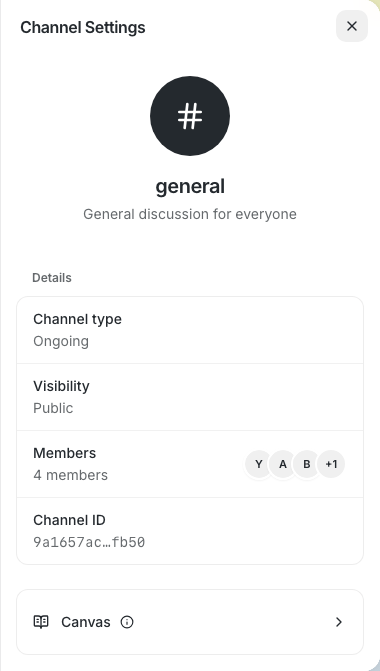 ### Agent info 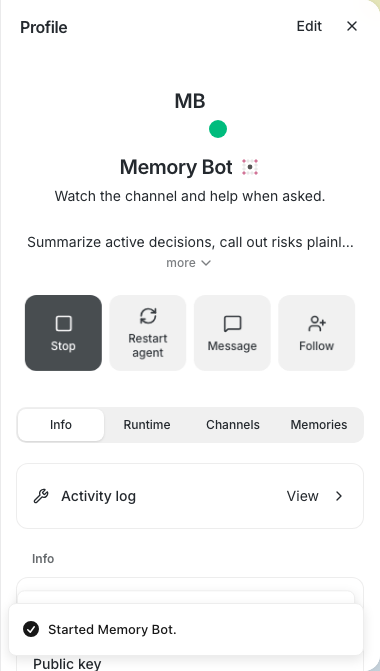 ### Agent runtime 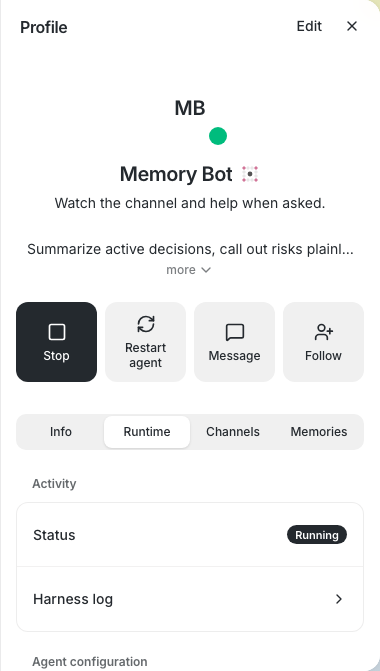 ## Validation - `pnpm -C desktop check` - `pnpm -C desktop test` (4,604 passed) - `pnpm -C desktop build:e2e` - focused channel settings and agent profile Playwright tests --------- Signed-off-by: kenny lopez <klopez4212@gmail.com> Co-authored-by: Mongo <9cfd347903944d5b85aa6c93d2ab67381b978a92a31914bca69998968752a1d7@buzz.block.builderlab.xyz> |
||
|
Will Pfleger
|
1ff98fa685 |
fix(desktop): launch Databricks OAuth from passive model discovery (#5607)
When a user's agent runtime is `buzz-agent` with no cached Databricks OAuth token, the desktop app's passive model-discovery surfaces were forbidden from launching interactive auth. Discovery failed silently, so the model dropdown showed only built-in fallback models behind a vague "Could not load live models for `databricks_v2`" note (reported internally by Nick and Jose). ## What changed Both discovery surfaces — the passive draft-form discovery and the explicit saved-model picker — now launch the browser OAuth flow, matching goose's behavior. The only behavioral difference between them is cooldown handling: - **Passive draft discovery** fires on every form-state change, so a failed, cancelled, or timed-out sign-in records a per-host cooldown (5 min) that suppresses re-popping the browser on the next keystroke. While the cooldown is active it returns the "sign-in required" guidance instead of relaunching. - **The explicit model picker** is a deliberate user action, so it always launches and clears any stale cooldown first. Safety rails: - A 150s hard timeout (`AUTH_FLOW_TIMEOUT`) bounds the whole interactive flow so an abandoned SSO tab fails discovery cleanly rather than wedging the dropdown. Success clears the cooldown; failure and timeout both record it. - `AuthCooldown` recovers from a poisoned lock rather than wedging every future sign-in on one panic. The frontend maps the terminal Databricks sign-in states to typed, actionable copy in `formatModelDiscoveryErrorStatus`: "sign-in required" is a muted note pointing at the picker and `buzz-agent auth databricks`; a failed or timed-out sign-in is a warning pointing at the explicit retry. Other Databricks failures fall through to the existing generic notice. ## Scope Changes are confined to Databricks discovery and its frontend status formatter — no `agent_models.rs` call sites are touched. The interactive-auth helper takes an injected timeout so the timeout/cooldown policy is unit-testable without a live browser. ## Deferred Cooldown keys use the raw trimmed `DATABRICKS_HOST`, while the catalog and OAuth cache normalize trailing slashes (`crates/buzz-agent/src/catalog.rs:96`, `crates/buzz-agent/src/llm.rs:2046`). So `https://workspace/` and `https://workspace` share credentials but get separate cooldown entries — an equivalent-spelling change to the host field mid-cooldown can re-pop passive OAuth once within the 5-minute window. Self-limiting (one extra browser launch, never auth corruption). Follow-up: a `trim_end_matches('/')` on the cooldown key plus an equivalent-host test, picked up with the coordinator migration if [#5545](https://github.com/block/buzz/pull/5545) ever merges. Signed-off-by: Will Pfleger <pfleger.will@gmail.com> Co-authored-by: Duncan <dcfd242e557282d7a1e2cf2e6877522682f1e5c6156dc92ca7d90eaedd3b0f95@buzz.block.builderlab.xyz> |
||
|
Will Pfleger
|
f35930104b |
fix(desktop): remove 0.5.9+ perf regressions, speed up get_channels (#5599)
Desktop input latency regressed sharply for users on v0.5.9 and worsened on latest main: multi-second stalls when clicking back into the app, slow fresh boots, intermittent lockups, and scroll/mouse degradation. Reverting to `119a84897` (pre-0.5.9) was confirmed to resolve it, isolating the regression to that range. Profiling a live production renderer plus a commit-level audit of the range found three independent, additive causes — fixed here — plus a long-standing `get_channels` cost that made every remaining refetch expensive, also addressed here. ## 1. Focus-return refetch storm (`refetchOnWindowFocus`) #5490 wired TanStack's `focusManager` to app focus and flipped ~20 query sites to `refetchOnWindowFocus: true`. A focus return after >60s away fires them all within milliseconds — and a click into an unfocused window *is* a focus return, so the burst runs before the click is processed. That is the "click into the composer, wait 5 seconds" symptom, and it also explains why mouse input feels worse than keyboard (clicks arrive with focus transitions; typing happens while already focused). A 5-second `sample` of a live production renderer caught a single window activity-state transition consuming ~1.25s of main-thread time, dominated by `JSON.parse` in the focus listener's microtask drain. #5535 already established the fix pattern but applied it to only two families (channels, home-feed). This PR extends the same 5-minute `staleTime` discipline to the remaining families: pulse (×5), workflows (×4), agents (×4), forum (×2), presence, user-status, custom-emoji, channel-templates, and the persona catalog. Polling cadences and push-invalidation paths are untouched — interval refetches and `invalidateQueries` both bypass `staleTime`, so live-update behavior is unchanged. Each gated family exports its focus-refetch policy as an options object that the production hook spreads into `useQuery`, and a `focusRefetchPolicy.test.mjs` drives a `QueryObserver` with that same production object — locking the policy behaviorally (fresh focus return → 0 fetches; stale → refetch) and failing if a hook's `staleTime`/`refetchOnWindowFocus` wiring drifts. Four families deliberately keep tighter freshness, all surfaces where the 5-minute gate would suppress the only refresh path and none of which feed the app-wide storm: `repo-sync-status` keeps its fresh focus refetch (its inline comment documents the "committed in a terminal, switched back to the app" flow as intended); the workflow-runs list stale-gates at 10s because a remotely-started run has no push invalidation and its conditional 1s poll is off while the cache shows no active runs; the workflow list queries (`useChannelWorkflowsQuery` and the all-channels aggregate) stale-gate at 10s because they have no poll and no relay subscription, and mutation-driven invalidation only covers this renderer — remote workflow creates/edits/deletes surface only via focus refetch; and the managed-agent log stale-gates at one poll tick (30s) so returning to a live agent log refreshes immediately. Run approvals keep the 5-minute gate under `RUN_APPROVALS_FOCUS_STALE_TIME_MS` — their focused 10s poll already covers freshness. ## 2. Synchronous localStorage sweep on the boot/focus path #5453's stale-cache sweep synchronously `getItem` + `JSON.parse`s every whitelisted localStorage entry on the main thread (multi-MB on seasoned profiles), scheduled with a `requestIdleCallback` timeout of 1.5s that guaranteed it landed mid-boot, and re-armed on every hidden→visible transition — stacking it onto the exact moment the focus storm fires. #5454's `trimSelfProfileCaches()` additionally scanned every localStorage key on every `writeSelfProfileCache()` call (which fires per relay self-profile delivery at boot). Now: the first sweep waits `BOOT_SWEEP_FLOOR_MS` (30s) after startup, the scan is time-sliced across idle callbacks, and the visibility trigger is removed — boot-delayed plus hourly still covers the 14-day TTL contract. The sliced sweep re-checks staleness immediately before each removal (a key rewritten fresh mid-sweep survives), isolates per-key storage errors so one bad entry can't strand the rest of the snapshot, defers oversized values once rather than parsing them on a zero-budget slice, guarantees forward progress on timeout-fired callbacks, and cancels its scheduled slice when stopped. The profile trim keeps a lazily-initialized memoized key count so the common under-cap write is O(1); the full parse scan runs only when the count exceeds a cap, resyncs if external deletions made it stale, and a failed scan skips the trim instead of aborting the write. Sweep semantics (rules, TTLs, eviction) are unchanged, and tests cover the scheduling, slice-progress, error-isolation, defer-once, and trim short-circuit behaviors. ## 3. The macOS window was never opaque #5478's glass appearance is correctly opt-in at the CSS layer, but the compositor cost was baked in deeper than its native `on_webview_ready` transparency call: the main window is declared `"transparent": true` in `tauri.conf.json` (added for the original glass work in #1671), which makes tao call `NSWindow.setOpaque(false)` at creation and resolve every later `set_background_color(None)` to `clearColor` — and no runtime `setOpaque(true)` path exists through tauri, while wry's runtime background setter can only force the WKWebView's `drawsBackground` off, never back on. So "restore the platform default" was unreachable: every launch, glass or not, ran with a non-opaque NSWindow, defeating WindowServer's opaque-window compositing fast path and forcing full window compositing every frame — compounded by the existing `backdrop-blur` chrome overlapping the scrolling timeline. This matches the compositor-shaped symptoms (scroll and pointer input degrading first). The window is now created opaque (`"transparent": false`) and the NSWindow layer is never made transparent at runtime. Glass never needed a transparent window: behind-window `NSVisualEffectView` vibrancy renders inside opaque windows (this is how Finder and Notes draw vibrant sidebars); it only requires a transparent WKWebView canvas, which the `set_window_vibrancy` enable path already establishes at runtime (`macos-private-api` compiles that in independent of the window flag). Enabling glass installs the vibrancy layer and then makes only the webview canvas see-through; disabling clears the vibrancy layer — the canvas may stay non-drawing afterwards (wry's flag is one-way at runtime), which is harmless because glass-off CSS paints fully opaque above an always-opaque NSWindow. The boot-path first-frame backing writes touch only the NSWindow backing color and are therefore inert to glass state regardless of how they order against the `ThemeProvider`'s vibrancy call on a persisted-glass-on cold boot. Glass-off users (the default) get an end-to-end opaque window from boot for the first time. ## 4. `get_channels`: serial round-trips and a multi-MB payload on every refetch The stale gates in (1) cut refetch frequency; this cuts the cost of the refetches that legitimately remain (boot, and focus returns after more than 5 minutes away — previously still a multi-second stall). `get_channels` made ~8 fully serial relay round-trips (~3.2–3.6s at 1,100+ channels), then shipped the full `ChannelInfo` list — including every channel's member pubkeys — across IPC, where the renderer's `JSON.parse` of the multi-MB payload froze the main thread (the ~1.25s stall captured in the live sample). - **Concurrent stages**: the membership chain, the open-channel directory scan, and the hidden-DM snapshot run concurrently, as do the member-count and last-message queries that follow. The critical path drops from ~8 sequential round-trips to 2 phases. Filters, limits, pagination, and merge semantics are unchanged. - **Not-modified short-circuit**: the command now takes a client-supplied content hash (FNV-1a 64 over the channel list, canonicalized by id and excluding `last_message_at`) and omits the channel list from the response when nothing else changed. Last-message timestamps — which change on nearly every message anywhere — ship as a small separate map that the client overlays onto its cached list with reference preservation, so React Query's structural sharing also skips downstream re-renders. On a typical refocus the renderer parses kilobytes instead of megabytes. The hash is stored in the query cache itself, tying its lifecycle to the data it describes so a community switch can never leak a stale hash. The E2E mock bridge speaks the new payload shape — including the complete `last_messages` map the client treats as authoritative — and hash canonicalization plus overlay reference-preservation are unit-tested on both sides. --------- Signed-off-by: Will Pfleger <pfleger.will@gmail.com> |
||
|
Wes
|
07a3c768d6 |
fix(desktop): quiesce renderer polling while hidden (#3677) (#5490)
Fixes #3677. ## Problem The renderer never quiesces: recurring timers, query polling, and re-render tickers run at full rate whether the window is visible, hidden, or minimized. Measured on a live installed app: **27.5% mean renderer CPU visible vs 28.7% hidden** (60×1s `ps` samples of the WebContent process; `sample(1)` dominated by `WebCore::timerFired`/ThreadTimers, microtask checkpoints, JSON parsing, style matching). Matches all three reproductions in #3677 (macOS prerelease, Linux/WebKitGTK A/B/A minimize test, stable macOS). Per-timer instrumentation (dev build, wrapped `setInterval`/`setTimeout`/rAF) attributed the recurring work: `useNow` 60 fires/min, 40 active TanStack refetch intervals, agent-turn pruning 12/min, auto-restart ticks, huddle/reminder polls — none visibility-gated. ## Fix (two-tier gating, standard mechanisms only) Two separate signals in `desktop/src/shared/lib/useDocumentVisible.ts`, because they mean different things and (see residuals) are delivered differently on macOS: - **`useDocumentVisible`** — true Page Visibility only (`document.visibilityState`). Gates local UI work that must keep running on a visible-but-unfocused window: `useNow` relative clocks, agent-turn pruning, huddle bar state/model-status polling, auto-restart tick. Hidden ⇒ paused; `useNow` snaps to fresh `Date.now()` on return. - **`useAppFocused`** — visible AND `document.hasFocus()`. Gates network refetch polling only (`useFocusedRefetchInterval`, ~15 query families: forum/home/agents/channels/templates/emoji/user-status/projects/workflows/persona-catalog/pulse/presence-list). TanStack's `focusManager` is wired to this signal (idempotent, single install) with `refetchOnWindowFocus: true`, so stale queries refresh promptly on return. Deliberate side effect, documented in code: query retries pause on blur; mutations and the presence heartbeat (`retry: 0`) are unaffected. - **Never gated:** reminder due-notification poll (fires while hidden/unfocused — extracted to `reminderNotificationPoll.ts` with regression test), huddle pipeline hot-start (`check_pipeline_hotstart` survives backgrounding for the duration of a huddle), relay stall watchdog, presence heartbeat. Live WebSocket delivery untouched throughout. - Huddle model-status indicator now clears only on huddle phase end, not on visibility/focus changes. ## Validation - Instrumented dev build, populated channel, fires/min: **visible+focused** unchanged (`useNow 60 / prune 12 / watchdog 6 / query 4 / auto-restart 4 / low-rate huddle/reminder/presence`); **visible+blurred**: query polls 0, UI clocks continue (`useNow 60 / prune 12`), reminders 2, presence live; **truly hidden**: only watchdog 6, reminders 2, presence ~2 — everything else 0. Return restored visible+focused, selection preserved, queries refreshed. - Hide-vs-blur decomposition (instrumented probe instance, AppleScript-driven): on macOS WKWebView, Cmd-H / minimize / full occlusion did **not** reliably produce `visibilityState === "hidden"` — they reliably produced focus loss. The CPU-dominant quiescence path on macOS is therefore the focus gate; the visibility gate is exercised fully on platforms that report hidden (e.g. WebKitGTK minimize per the Linux repro). - Gate-regression tests: signal separation, `useNow` hidden-pause + fresh-snap on return, focus-gated interval pause/resume-with-refresh, reminder delivery while hidden+unfocused (5 new, plus primitive wiring tests). - Push gate: desktop check, typecheck, full desktop suite **4549/4549** at `1237548d1`. ## Known residuals - **macOS hidden-signal limitation:** because WKWebView rarely reports `hidden` on app-hide/minimize, hidden-only consumers (`useNow`, prune, huddle UI polls) may keep ticking on macOS when the app is hidden. These are cheap local timers; the expensive network polling still quiesces via focus loss, which is what the measured 28% CPU was attributed to. If the residual local-timer cost proves measurable, the follow-up is bridging Tauri window hidden/minimized events into the visibility signal. - End-to-end CPU confirmation on a packaged build is the post-merge follow-up (against the 28% idle baseline). - Visible-state costs (skeleton animation pileups on stuck loading views, per-poll JSON payload churn) are intentionally out of scope — separate follow-up issue. --------- Signed-off-by: Wes <wesbillman@users.noreply.github.com> Co-authored-by: Meeseeks <2e96988f190ed1bd3c568760103aa4cadb2bc6195b832e252c984392c89039bd@buzz.block.builderlab.xyz> |
||
|
Will Pfleger
|
fbf89e3bed |
fix(desktop): prevent horizontal clipping in Prompt Context modal (#5324)
The Prompt Context modal (observer feed → check icon under sent messages) was clipping all content and card right-padding at the dialog edge. **Root cause**: `PromptContextDialog` renders inside `DialogContent`, which is a CSS grid. The child flex wrapper had default `min-width: auto`, so the widest unbreakable token in the content (64-char hex event IDs, `Tags: [[...]]` JSON) set the grid track width, blowing it past `max-w-xl`. `overflow-hidden` then clipped everything at the dialog edge — including the section cards' right padding. **Fix**: - `AgentSessionTranscriptList.tsx`: add `min-w-0` to the `flex max-h-[85vh] flex-col` wrapper so the grid item can shrink below its max-content width. - `PromptSectionAccordion.tsx`: replace `wrap-break-word` with `wrap-anywhere` on the body text (open and collapsed states) and the title. `overflow-wrap: anywhere` reduces min-content width, which `break-word` does not, letting long tokens wrap inside the cards rather than inflating the track. The `line-clamp-2` collapsed preview is preserved unchanged. Signed-off-by: Will Pfleger <pfleger.will@gmail.com> Co-authored-by: Duncan <dcfd242e557282d7a1e2cf2e6877522682f1e5c6156dc92ca7d90eaedd3b0f95@buzz.block.builderlab.xyz> |
||
|
Taylor Ho
|
02f640bc45 |
feat(desktop): unify add agent flows (#5015)
**Category:** improvement **User Impact:** Users can create, discover, and import agents from one consistent Add agent dialog. **Problem:** Agent creation, discovery, and import were split across a dropdown and separate dialogs, making the Add agent flow fragmented. The existing E2E suite also continued targeting the deleted dropdown after the flows were unified. **Solution:** Route the new-agent card directly into a unified dialog with dedicated Create, catalog, and Import navigation, then update the affected E2E coverage to exercise that interface and its current empty state. <details> <summary>File changes</summary> **desktop/src/features/agents/ui/AgentDefinitionDialog.tsx** Supports rendering the agent definition form inside the unified Add agent experience while retaining the standalone dialog behavior. **desktop/src/features/agents/ui/AgentDefinitionDialogShell.tsx** Adds the shared shell used to present agent-definition content consistently in embedded and standalone contexts. **desktop/src/features/agents/ui/AgentDialog.tsx** Passes the revised dialog state and close behavior through the existing agent dialog entry point. **desktop/src/features/agents/ui/AgentsView.tsx** Connects the Agents page to the unified Add agent dialog and opens newly added catalog agents in their profile panel. **desktop/src/features/agents/ui/PersonaCatalogDialog.tsx** Combines catalog browsing, agent creation, and snapshot import behind persistent navigation, including dirty-navigation confirmation. **desktop/src/features/agents/ui/UnifiedAgentsSection.tsx** Replaces the new-agent dropdown with a direct Add agent entry point and adjusts the responsive card grid. **desktop/src/features/agents/ui/personaLibraryCopy.ts** Updates catalog-facing copy for the unified experience. **desktop/src/features/agents/ui/usePersonaActions.ts** Returns the resolved local persona after catalog activation so the caller can open the added agent. **desktop/tests/e2e/agent-readiness-screenshots.spec.ts** Opens the embedded create pane directly for readiness screenshots. **desktop/tests/e2e/agents.spec.ts** Covers unified Create, catalog, and Import navigation and asserts the current shared-agent empty state. **desktop/tests/e2e/global-agent-config-screenshots.spec.ts** Updates global configuration screenshot setup for direct create-pane entry. **desktop/tests/e2e/inline-custom-harness.spec.ts** Updates custom harness setup for the embedded create form. **desktop/tests/e2e/persona-env-vars.spec.ts** Updates environment-variable and model-provider scenarios for direct create-pane entry. **desktop/tests/e2e/persona-model-combobox-screenshots.spec.ts** Updates model combobox screenshot setup for direct create-pane entry. **desktop/tests/e2e/smoke.spec.ts** Updates agent-creation smoke coverage for the unified Add agent dialog. **desktop/tests/e2e/where-to-run-config.spec.ts** Updates provider-selection coverage for the embedded create form. </details> ## Reproduction steps 1. Open the Agents page and select the new-agent card. 2. Confirm the Add agent dialog opens directly on Create without an intermediate dropdown. 3. Use the left navigation to browse shared agents and open Import. 4. Select a catalog agent and confirm the dialog closes and the added agent's profile panel opens. 5. Run the affected desktop Playwright smoke and integration specs and confirm all scenarios pass. --------- Signed-off-by: Taylor Ho <taylorkmho@gmail.com> Co-authored-by: Carl <acda9e433d19dcd0e6b6840f7f4b98f3a56f1fab98049d444c087019e6d36560@buzz.block.builderlab.xyz> |
||
|
Atish Patel
|
e9925db54e |
fix(desktop): retain distinct agent instances in autocomplete (#5202)
## Summary - preserve each distinct agent pubkey in autocomplete even when agents share a persona or owner/name - continue to collapse duplicate source rows for the same normalized pubkey - show a truncated pubkey in the channel member-add picker so same-named instances are selectable ## Validation - `pnpm --filter buzz test` — 4,489 passed - `pnpm --filter buzz exec tsc --noEmit --pretty false` - `pnpm --filter buzz exec biome check src/features/agents/lib/agentAutocompleteEligibility.ts src/features/agents/lib/agentAutocompleteEligibility.test.mjs src/features/channels/ui/MembersSidebar.tsx` - independent validation by Fast Fizz on `509cb8d97b82f9708e24d4d59ad17c7b39516643`: typecheck, focused Biome, 22/22 focused tests, and `git diff --check` Generated by Hardworking Honey. --------- Signed-off-by: Hardworking Honey <c5c455215c2506cb8ba776518cec804af62d3a0526e32d496a22072e395042b9@buzz.block.builderlab.xyz> Co-authored-by: Hardworking Honey <c5c455215c2506cb8ba776518cec804af62d3a0526e32d496a22072e395042b9@buzz.block.builderlab.xyz> |
||
|
klopez4212
|
c8743b2f20 |
Remove agent creation success modal (#5063)
## Summary - remove the post-creation private-key modal - return directly to the underlying page with one “Agent created” toast - preserve failed channel-attachment retry through an actionable toast ## Validation - desktop checks and E2E build - 4,392 desktop unit tests - focused Playwright coverage for standard, customized, and attachment-retry creation flows Signed-off-by: kenny lopez <klopez4212@gmail.com> |
||
|
klopez4212
|
c71f658539 |
Polish advanced agent setup and Welcome composer (#4926)
## Summary - move **Run on** into Advanced, directly after **Who can send instructions** - reuse the modal’s shared dropdown styling - give the Welcome guidance and composer matching glass treatment while preserving the corrected exit layering ## Validation - `pnpm -C desktop typecheck` - focused Playwright: Run on configuration (3 passed) - focused Playwright: Welcome onboarding flow (1 passed) - desktop unit suite (4,290 passed) --------- Signed-off-by: kenny lopez <klopez4212@gmail.com> Signed-off-by: Kenny Lopez <klopez4212@gmail.com> Signed-off-by: Watcher <bb7abfd757d0af7b66569d02ab9c0316b616f9d0c151ecf5b964344c462e7f8f@buzz.block.builderlab.xyz> Co-authored-by: Watcher <bb7abfd757d0af7b66569d02ab9c0316b616f9d0c151ecf5b964344c462e7f8f@buzz.block.builderlab.xyz> |
||
|
Taylor Ho
|
f03de210cd |
fix(desktop): preserve authoritative agent avatars (#4984)
**Category:** fix **User Impact:** Agent cards and catalog listings now show the avatar belonging to the identity they represent. **Problem:** Running agent cards could show a stale definition avatar instead of the concrete agent profile, while adding another publisher's catalog entry could let local edits repaint that publisher's listing. This made agent identity look inconsistent across My Agents and the Agent Catalog. **Solution:** Treat the concrete agent pubkey profile as authoritative for running-card avatars, with the linked definition as fallback. Keep relay publications authoritative for foreign catalog presentation while using local copies only for linkage and selection state. | before | after | |--|--| | <img width="874" height="592" alt="Screenshot 2026-08-06 at 3 48 43 PM" src="https://github.com/user-attachments/assets/2cc6c9f7-ea50-413c-9c7b-4d34bd8b4ec7" /> | <img width="884" height="597" alt="Screenshot 2026-08-06 at 3 48 40 PM" src="https://github.com/user-attachments/assets/b14a865c-65c4-458f-9c30-d1a557c877d7" /> | | agent-set avatar not showing | agent-set avatar is showing | ## Changes <details> <summary>File changes</summary> **desktop/src/features/agents/lib/agentCardAvatar.ts** Adds the explicit avatar precedence rule for running agent cards and blocks avatar-dependent actions until the authoritative profile query settles. **desktop/src/features/agents/lib/agentCardAvatar.test.mjs** Covers profile precedence, definition fallback, blank avatar handling, and the profile-loading transition for linked-agent actions. **desktop/src/features/agents/lib/personaCatalogRelay.ts** Keeps publisher-provided catalog identity and behavior fields authoritative after a local copy is added. **desktop/src/features/agents/lib/personaCatalogRelay.test.mjs** Verifies local copies contribute linkage and selection without overriding publisher presentation. **desktop/src/features/agents/ui/UnifiedAgentsSection.tsx** Uses the concrete agent profile avatar before the linked definition avatar on running-agent cards. </details> ## Reproduction Steps ### Running agent card uses the agent profile avatar Use two visibly different, publicly reachable image URLs: **A** for the saved definition and **B** for the running agent profile. 1. In **Settings → Experiments**, enable **Agent-managed profiles**. This prevents Desktop from restoring the definition avatar over an agent's own relay-profile changes. 2. In **Agents**, create an agent with image **A** as its avatar and start it. 3. In a channel containing that agent, ask it to update its own Buzz profile avatar to image **B**. The exact CLI operation under the agent identity is `buzz users set-profile --avatar <image-B-url>`. 4. After the agent confirms the update, reopen **Agents → My Agents** (or reload the page so its kind:0 profile is fetched again). 5. Verify the running agent card shows image **B**, not definition image **A**. Open **⋯ → Share** and verify the share flow also uses image **B**. Before this fix, the My Agents card and share flow preferred image **A** whenever the linked definition had an avatar. ### Catalog listing remains publisher-authoritative This scenario requires a second Buzz identity so the entry is foreign to the account under test. 1. As the publisher identity, create an agent definition with a distinctive name, avatar, and instructions, then use **Share → Share to catalog**. 2. As the test identity, open **Agents → Discover agents**, find that publication, and add it. 3. In **My Agents**, open the added copy's **⋯ → Edit**, change its name, avatar, and instructions, and save. 4. Return to **Discover agents** and find the same publisher entry. 5. Verify it remains selected/added but still shows the publisher's original name, avatar, and instructions—not the test identity's local edits. ## Validation - `pnpm test` — 4,376 passed - `pnpm typecheck` — passed - `pnpm check` — passed with existing non-error notices --------- Signed-off-by: Taylor Ho <taylorkmho@gmail.com> |
||
|
klopez4212
|
6ca9641a95 |
Refine agent runtime controls (#5026)
## Summary - replace ambiguous avatar play controls with centered Start and Restart pills - preserve avatar clipping while smoothly morphing actions into the running status dot - use accessible warning contrast and real restart behavior without a duplicate status badge ## Validation - `just ci` - focused Playwright coverage for morphing, shared geometry, and light/dark contrast Signed-off-by: kenny lopez <klopez4212@gmail.com> |
||
|
Tom Brow
|
16cc3de6d6 |
fix(desktop): enforce owner-only access in internal builds (#4053)
## Problem Managed agents in internal Buzz builds should answer only their owner. Previously, an agent could keep a broader access setting and respond to other people, which did not match the access policy for internal builds. This PR makes owner-only access effective for every managed agent in internal builds and makes that restriction clear in the Desktop UI. Open source builds remain configurable. ## Changes - Enforce owner-only access when any managed agent starts or is deployed from an internal build. - Show the agent access control as locked to **Only me** in Desktop, with an explanation of why it cannot be changed. - Keep Welcome teammates working under the same rule without triggering unnecessary restarts. - Leave open source build behavior unchanged. This changes effective runtime access without rewriting stored or relay-advertised settings. The companion [#4064](https://github.com/block/buzz/pull/4064) explains the restriction in-thread when someone without access mentions an agent. The enforcement will remain inactive in shipped builds until [squareup/buzz-releases#74](https://github.com/squareup/buzz-releases/pull/74) marks internal releases during the build. ## Screenshots | Before | After | | --- | --- | | 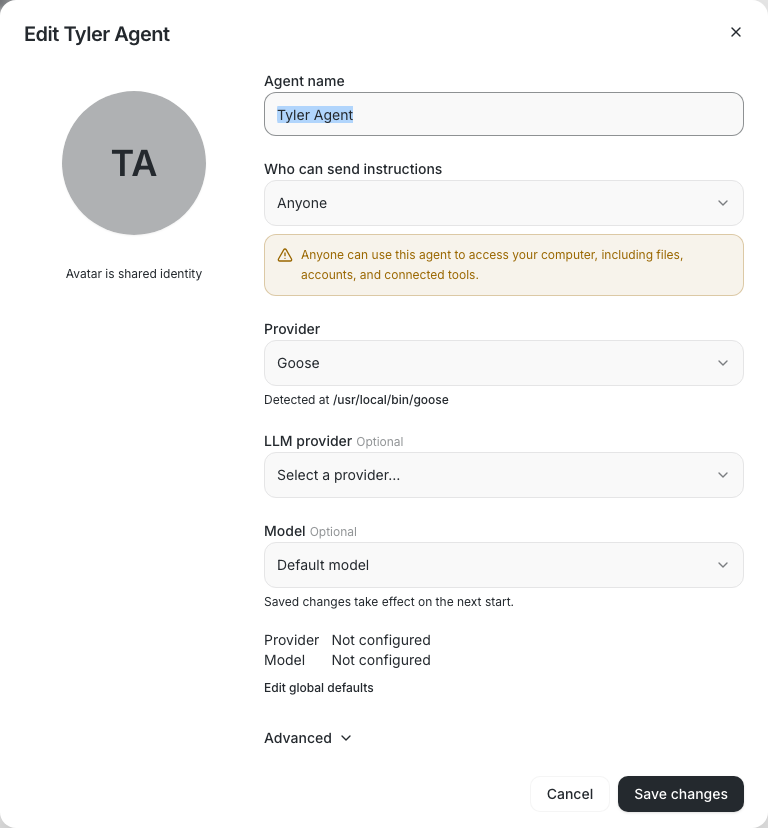 |  | ## Tests Added coverage for: - Runtime enforcement for [locally run agents]( |
||
|
Tyler
|
4da7264d90 |
fix(acp): pace observer telemetry at 1/s with per-channel batch envelopes (#4917)
## Problem Observer telemetry is the noisiest client of the relay: the old pacer (167ms spacing + 90/min rolling cap) let a busy session bill up to 6 events/second against the owner's message quota, and the rolling cap silently *dropped* frames once exceeded. Ruling from the rate-limiting investigation thread (channel `826fc99b-1472-40e7-a529-6b9db8943b8c`): pace at 1/s, always emit, minimal PR. **Review round 1 (Max, Sami)** found the first cut wrong in three ways — tick burst (all pending frames per tick), startup burst (`interval` fires at t=0), and per-channel quota arithmetic. All fixed and mutation-verified in round 1. **Review round 2 (Sami, Max)** found two more against the round-1 head: 1. **Drain-rate collapse (Sami, blocker):** front-run-only packing meant a frame held ONE event whenever channels interleaved — measured 275 B/s vs 63.5 KB/s, so an ordinary 2-channel session fell minutes behind with zero drops and no warning. Silent unbounded latency. 2. **Coalescer byte-cap bypass (Max):** chunks pending in `ObserverChunkCoalescer` were unbounded and outside the 4 MiB cap — 500 distinct-`messageId` 50KB chunks retained ~48MB with `pending_bytes == 0` and zero drops. **Review round 3 (Max)** found the drop accounting undercounted merged chunks: a coalescer entry that merged N same-`messageId` chunks counted as **1** in `dropped_events` when evicted (50 merged 1KB chunks evicted → counter read 1, 49 generated events unaccounted). Fixed: accounting is now denominated in **source (generated) observer events** end to end — each pending entry tracks how many chunks it absorbed, eviction charges that count, and the count survives flush into the publish FIFO. **Review round 4 (Sami, Max)** found three more against the round-3 head: 1. **Coalescer byte undercount (both, independently):** a pending merged entry retains its first chunk's text **twice** until flush — once inside the serialized event skeleton and once in the extracted text accumulator — but was charged only `serialized_len`, so true retention overshot the 4 MiB cap ~2× (measured 8.3 MB). Fixed: `push_pending` charges `serialized_len(&event) + text.len()`. 2. **Cap regressions asserted the accumulator against itself,** which is how the undercount hid. All three cap tests now assert on independently **walked** retained bytes (`serialized_len` per FIFO entry + `serialized_len + text.len()` per coalescer entry), with a secondary `accumulator >= walked` sanity check. Reverting the fix makes them fail at exactly 8,328,386 / 8,328,272 bytes. 3. **FIFO-arm source accounting was implemented but untested (Sami M13; Max reproduced at `cc9333b7c` with 102/151):** the round-3 regression only evicted a merged entry while still in the coalescer. New test forces a merged entry (50×1KB, `source_events=50`) through flush into the publish FIFO, then evicts it from there — mutating the FIFO eviction to `dropped += 1` fails with the reviewers' exact numbers (102 vs 151). **Review round 5 (Sami 9/9/9, Max 9/9/9)** — production judged merge-safe by both; remaining items are tests only, all landed at `63d821620`: 1. **The walker instrument was itself unverified (Sami M17–M20; Max independently confirmed the `return 0` mutant survives):** every cap test asks `walked_retained_bytes()` only for `<= CAP`, so a blinded walker passes everything — and paired with a reverted `push_pending` fix the two mutations cancel, hiding exactly the 8.3 MB overshoot it exists to detect. New two-sided pin: the walker must SEE the first chunk's text twice, and must agree with the accumulator EXACTLY while both stores are non-empty. Kills M17, M18, M19, M20. 2. **Two pre-existing snapshot-clone siblings (Sami D5b/D5c; byte-identical at merge-base `7334ad1e1` — not this PR's regression, but the PR made the class visible):** aliasing the inner turns map leaks a post-save turn into the snapshot; aliasing the inner tombstones map leaks a post-save terminal that blocks a legitimate post-restore resurrection. Two isolation tests with in-test controls — all three inner-map clones in `saveActiveAgentTurnsForCommunity` are now pinned. ## Change **Harness (`crates/buzz-acp`)** - **Global pacer: AT MOST ONE relay frame per second**, regardless of channel count or backlog size. `interval_at(now + 1s)` restores the no-startup-burst property; `MissedTickBehavior::Skip` is now pinned by a paused-time test (a stalled tick arm fires one catch-up frame, not one per missed deadline). At 1 frame/s telemetry spends ≤60/min of the shared 120/min quota; `OBSERVER_PUBLISH_TICK` documents the tradeoff as the knob. - **`ObserverPublishQueue` with gather-packing:** events wait as byte-accounted events (FIFO). `next_frame()` packs the front event's channel **gathered queue-wide in FIFO order** — frames never mix channels, and each channel's events keep their FIFO order, but cross-channel frame order MAY differ from arrival order. That is what keeps the drain rate in **bytes per slot** (one ~64KB frame/s) instead of front-run-length events per slot. **Null-channel events (`agent_panic`-class) are packing barriers** nothing gathers across, so causally-global events keep exact order against every channel. - **One byte cap over BOTH stores:** the event FIFO and the coalescer's pending chunk buffer count against the 4 MiB budget together; eviction is oldest-first across both (queue front, then coalescer front — structural age order) with accounting (warn + counter). A high-cardinality chunk flood is bounded exactly like a plain event flood. Coalescer entries are charged their **true** retention (`serialized_len + text.len()` — the first chunk's text lives in both the serialized skeleton and the extracted accumulator until flush). - **Shutdown is not a burst bypass:** paced one-frame-per-tick drain until empty. **Desktop** - `unwrapObserverBatch` expands envelopes on the live relay path and archive-ingest seam (round 1, unchanged). - **`activeAgentTurnsStore` watermark re-keyed per (agent, channel)** with a dedicated null-channel bucket: the per-agent `(timestamp, seq)` gate would silently skip a delayed channel's frames as stale under gather-packing's intentional cross-channel reorder. Safe because every turn-mutating path is channel-scoped by the event's own `channelId` (endTurn's null-turnId fallback matches `turn.channelId`; resurrectTurn keys on `event.channelId`), so per-channel serialization preserves each guard the per-agent gate provided. The tombstone-cap justification is rewritten for the new keying (worst case for an evicted tombstone is a ghost badge the prune reaps — bounded cosmetic staleness, not corruption). Community-switch save/restore deep-clones the nested map. Other per-agent maps stay agent-keyed: the clock offset is a running minimum (order-insensitive); turns/tombstones mutate only through channel-scoped paths. ## Version skew — old desktop + new harness Gather-packing *intentionally* emits cross-channel-reordered frames. An **old desktop** (per-agent watermark) against a **new harness** will silently skip a delayed channel's turn-state events as stale — working badges on that channel can go stale/missing until its next fresh event. Transcript and archive are unaffected (the transcript store sorts + rebuilds on out-of-order arrival; the archive is per-channel by construction). Ship desktop and harness together; skew degrades badges only, not data at rest. ## Throughput ceiling — "lossless" is qualified Sustained lossless rate is what fits in one ~64KB frame per second, now genuinely in bytes under interleaving: | event payload | events per frame | sustained ceiling | |---|---|---| | 100 B | 250 | 250 ev/s | | 500 B | 99 | 99 ev/s | | 2 KB | 30 | 30 ev/s | | 10 KB | 6 | 6 ev/s | With C channels producing concurrently, publish slots round-robin between them: per-channel drain is ~64KB/C per second and the 4 MiB burst budget (~64s single-channel) shortens accordingly. Beyond budget, oldest-first drops **with accounting** — visible, designed loss. **Accounting semantics:** `dropped_events` counts SOURCE (generated) observer events, not retained entries — evicting a coalesced entry that merged N chunks charges N. On the published side, a merged entry ships all N sources' text in ONE event, so the reconciliation invariant is `ingested == dropped_events + Σ source_events over published events` (for unmerged events, source_events = 1). ## Verification At `63d821620d3513505e8766ac691a8002f9d4a96f` (this head; `git rev-parse HEAD` matched in the same shell as every run), rustc 1.95.0: - `cargo test -p buzz-acp`: **689 lib + 9 integration, 0 failed** — regressions: interleaved 2-channel drain packs into ≤4 frames not 200 slots; null-channel barrier; queue-wide gather with within-channel FIFO; distinct-key 50KB chunk flood bounded by the cap with event-level accounting (published + dropped == ingested, survivors newest); paused-time `MissedTickBehavior::Skip` pin (verified to fail under `Burst`: 3 frames vs 1); merged-key eviction accounts every absorbed source chunk in BOTH arms — coalescer-side (Max's round-3 probe) and post-flush FIFO-side (Sami M13 / Max's round-4 probe: fails 102 vs 151 under `+= 1`). All three cap tests assert on independently walked retained bytes, not the accumulator (verified to fail without the `+text.len()` fix: 8,328,386 / 8,328,272 vs 4 MiB); the walker itself is pinned two-sided against the accumulator (all four blinding mutants M17–M20 verified to fail it, including the walker+fix cancellation pair). - `cargo clippy -p buzz-acp --all-targets -- -D warnings` clean, `cargo fmt --check` clean - Desktop: `tsc --noEmit` clean; node tests **4366 passed, 0 failed** — snapshot-clone family fully pinned: watermark aliasing (round 4), turns aliasing and tombstone aliasing (round 5, pre-existing gaps; each mutant verified to fail exactly its target test with an in-test control). Prior rounds: cross-channel reorder processed, cross-channel-delayed null-turnId `turn_error` evicts only its own channel's turn, null-bucket replay idempotency, same-channel stale/duplicate still skipped, watermark survives community-switch save/restore - All pre-push hooks green at the pushed commit (branch-skew, desktop-check, desktop-test, rust-tests, desktop-tauri-checks) Part of the rate-limiting fix stack; independent of `eva/rate-limit-fixes` by design (separate minimal PR per Tyler's ruling). --------- Signed-off-by: Eva <011987e296fd5006292d2f930b574be47c7801048d1983c46c425d3c95f0cffd@buzz.block.builderlab.xyz> Signed-off-by: Sami <f4a42a97e594b77bdbd8ee35191c8b28a94a4cb871d96f32921558275421fb68@buzz.block.builderlab.xyz> Co-authored-by: Eva <011987e296fd5006292d2f930b574be47c7801048d1983c46c425d3c95f0cffd@buzz.block.builderlab.xyz> Co-authored-by: Sami <f4a42a97e594b77bdbd8ee35191c8b28a94a4cb871d96f32921558275421fb68@buzz.block.builderlab.xyz> |
||
|
Will Pfleger
|
6c40ce394f |
feat(desktop): cap OpenClaw agent parallelism at 5 (#4019)
OpenClaw connects to a single shared Gateway daemon. Spawning the
default 10 ACP workers per agent is both resource-expensive and
architecturally wrong — each worker opens a separate gateway connection.
Tyler's ruling: cap at 5, lower if needed.

## Contract

Store the requested value (1–32) verbatim at every persistence and wire
boundary. Apply `effective = min(requested, harness_cap)` only at the
four enforcement points:

| Boundary | Implementation |
|---|---|
| Local spawn | `BUZZ_ACP_AGENTS` env var in child `Command` |
| Remote deploy | `launch.policy_env["BUZZ_ACP_AGENTS"]` + legacy
`parallelism` field |
| Restart badge | `SpawnConfigSnapshot.parallelism` stores effective
value; the diff surface displays what actually runs |
| UI copy | Amber hint when requested > cap; no `max` attribute, no
save-path clamp |

`BUZZ_ACP_AGENTS` is added to `RESERVED_ENV_KEYS` — the Desktop resolves
the effective value into `policy_env`; a user-supplied override in `env`
would bypass the cap and is silently stripped.

## Changes

**`managed_agents/parallelism.rs`** (new) — policy core:
- `OPENCLAW_MAX_PARALLELISM = 5`
- `harness_max_parallelism(command)` — keyed on
`normalize_command_identity` so path prefixes, `.exe` suffixes, and
other cosmetic differences are ignored
- `effective_parallelism(command, value)` — identity for uncapped
harnesses
- `acp_agents_value(command, parallelism)` — `env("BUZZ_ACP_AGENTS", …)`
helper

**`runtime.rs`** — spawn clamp: `BUZZ_ACP_AGENTS =
acp_agents_value(effective_command, record.parallelism)`

**`agents_deploy.rs`** — deploy egress clamp: `build_deploy_payload`
resolves `effective_parallelism` once from `descriptor.command`; both
`launch.policy_env["BUZZ_ACP_AGENTS"]` and the legacy top-level
`parallelism` field use that value — the two are always consistent
regardless of stale `record.agent_command` pins

**`spawn_snapshot.rs`** — `from_inputs` stores
`effective_parallelism(&descriptor.command, record.parallelism)` in the
`parallelism` field. Over-cap edits that don't change the pool (e.g. 10
→ 8, both clamp to 5 on OpenClaw) produce equal snapshots; cap crossings
(8 → 3) produce different snapshots.

**`AcpRuntimeCatalogEntry.max_parallelism: Option<u32>`** — derived from
the static definition command, not the probed `entry.command` (which may
be `null` for unavailable entries), so unavailable OpenClaw entries
still carry the cap. Propagated through all four catalog constructors
(builtin discovery, preset catalog construction, custom discovery,
custom-save response), IPC types
(`RawAcpRuntimeCatalogEntry.max_parallelism`), and the frontend catalog
type.

**UI** — `EditAgentAdvancedFields` and `PersonaAdvancedFields` show an
amber hint when `selectedRuntime.maxParallelism` is set and the current
value exceeds it. Cap and label come from the catalog entry — no
hardcoded 5 in TS. No `max` attribute on inputs; the input stays
`type="text"` with 1–32 copy.

**Docs** — `docs/remote-agents.md`: `BUZZ_ACP_AGENTS` moved from the
deliberately-non-reserved section to reserved; new contract documented.
`desktop/src/features/agents/AGENTS.md`: command-keyed execution policy
documented as the sanctioned second metadata source feeding the catalog
projection.

## Tests

**Rust** (`parallelism.rs`):
- `policy_table` — `harness_max_parallelism` and `effective_parallelism`
across all openclaw variants and uncapped harnesses
- `acp_agents_value_openclaw_above_cap_is_capped` — spawn-env seam
- `override_direction_*` — both override directions (openclaw runtime +
goose override; goose runtime + openclaw override)
- `summary_persona_inherited_*` — live persona wins over stale
`agent_command`
- `snapshot_export_carries_requested_definition_parallelism` — requested
value travels wire/sync unchanged

**Rust** (`spawn_snapshot/tests.rs`):
- `openclaw_above_cap_parallelism_snapshots_equal` — stored 10 vs 8,
both clamp to 5 → snapshots equal
- `openclaw_cap_crossing_parallelism_snapshots_differ` — 8 (clamps to 5)
vs 3 → snapshots differ

**Rust** (`discovery/presets.rs`):
- `openclaw_preset_unavailable_carries_max_parallelism` /
`openclaw_preset_available_carries_max_parallelism` — catalog metadata
present with `command: null` and with a resolved path

**Rust** (`agents_deploy.rs`):
- `launch_block_openclaw_over_cap_policy_env_is_capped` — direct
`launch.policy_env` seam
-
`deploy_payload_json_stale_goose_record_live_openclaw_descriptor_both_capped`
— stale `record.agent_command=goose`, live descriptor=openclaw: both
fields cap to 5
-
`deploy_payload_json_stale_openclaw_record_live_goose_descriptor_both_uncapped`
— stale `record.agent_command=openclaw`, live descriptor=goose: both
fields pass through requested
- `deploy_payload_json_explicit_openclaw_override_both_capped` —
explicit `agent_command_override=openclaw`: both fields cap to 5

**Rust** (`persona_events/stale_pin_tests.rs`):
- `apply_persona_snapshot_goose_to_custom_harness_drops_stale_goose_pin`
— custom-direction stale-pin drop (builtin pin → loaded custom harness
via `update_loaded_harness_registry`)

**TypeScript** (`agentParallelism.test.mjs`):
- `parallelismCapHint` — at/below cap (null), above cap (hint includes
label and cap value), singular form for cap=1, uncapped harness (null)

**TypeScript** (`tauri.test.mjs`):
- `fromRawAcpRuntimeCatalogEntry` round-trips `max_parallelism` →
`maxParallelism`; absent when `undefined`

---------

Signed-off-by: Will Pfleger <pfleger.will@gmail.com>
Co-authored-by: npub1mn7jgtj4w2pd0g0zeuhxsa6jy6p0rewxz4kujt98my82ahfmp72sxjexk7 <dcfd242e557282d7a1e2cf2e6877522682f1e5c6156dc92ca7d90eaedd3b0f95@buzz.block.builderlab.xyz>
|
||
|
Wes
|
014562c063 |
fix(desktop): allow shared agent mentions (#4913)
## Summary - admit relay-discovered agents to autocomplete when their response policy authorizes the viewer - require authorization in the exact active stream/forum channel for mentions, while keeping community-wide discovery for member invitation - fail closed for relay-only agents in DMs and unresolved composer contexts - re-authorize cached autocomplete rows after policy/channel changes so stale agent suggestions cannot leak back in - preserve managed-agent behavior and explicitly reject stale agent-marked channel members absent from both live directories ## Validation - `pnpm --dir desktop test` — 4,288 passed - `pnpm --dir desktop typecheck` - `pnpm --dir desktop check` - `pnpm --dir desktop build:e2e` - focused Playwright mention matrix — 12 passed - focused Playwright member-invitation matrix — 2 passed - pre-push hooks after rebase to current `origin/main` — desktop check and 4,288 tests passed - independent correctness/privacy re-review cleared with no remaining blocker ## Related competing PRs This supersedes or overlaps #2333, #3056, #4242, #4137, #2314, #4058, and #2605. This version adds exact-channel authorization, fail-closed DM/context handling, cached-row reauthorization, forum coverage, outbound mention-tag coverage, explicit stale-member coverage, and add-member discovery coverage. Signed-off-by: Wes <wesbillman@users.noreply.github.com> Co-authored-by: Carl <c7ebe626f000404285d3686e1dc74cc07cc60a9754a150041ba132e14bd3e2ec@buzz.block.builderlab.xyz> |
||
|
Will Pfleger
|
f86dfc5883 |
feat(desktop): surface config diff in restart-required badge (#3637)
The "Restart required" badge reports that an agent's running config has
drifted from its spawn-time config, but never says what changed. This
ships the full feature: a typed Rust diff engine and a TS/UI layer that
renders it at every badge site.

## Rust core (spawn-snapshot diff engine)

Replaces the lossy `u64` `spawn_config_hash` with a typed
`SpawnConfigSnapshot`. The snapshot is stamped from the already-resolved
command/env/config values immediately before `spawn()`, closing the race
window where a mid-spawn config edit would suppress the badge.

`SpawnConfigSnapshot::canonical()` is the single JSON projection shared
by the badge and the diff. Drift is `to_value(stamped) !=
to_value(current)`; the diff is a generic leaf walk over those same two
values, so badge-on and diff-non-empty are structurally guaranteed.
Adding a snapshot field reaches the UI with no code change to the diff
engine — `mutation_table_covers_every_serialized_field` fails CI if a
new field arrives without a mutation row.

`eligible_restart_diff(persona_orphaned, Option<TrackedSpawnState>)`
returns the final vector — snapshot walk entries plus a synthetic
`adapter_availability` entry. It returns empty for an orphaned instance
(spawning one would fail) and for agents with no tracked spawn state
(never stamped, can never have drifted). `needs_restart =
!restart_diff.is_empty()` derives from that vector and nothing else.

Redaction policy (`policy_for(path)`) is shared by the wire diff and the
snapshot's manual `Debug` via `is_safe_to_reveal()` from
`managed_agents::env_vars` as the single authority for env-key masking:

| Policy | Paths | Rendering |
|---|---|---|
| `Text` | `system_prompt`, `team_instructions` | character counts only
|
| `MaskedBare` | `args`, `relay_url` | `••••`, no suffix |
| `MaskedSuffix` | non-allowlisted `env.*` | `••••` + last 4 chars when
longer than 8 |
| `Plain` | allowlisted `env.*` (`BUZZ_AGENT_THINKING_EFFORT`,
`BUZZ_AGENT_PROVIDER`, `BUZZ_AGENT_MODEL`, `DATABRICKS_HOST/MODEL`) and
everything else | verbatim |

Default-deny: every env key not in the explicit allowlist stays masked.
`is_safe_to_reveal()` is the single allowlist authority for both the
baked-env display and the diff.

`restart_diff` is omitted from the wire when empty
(`skip_serializing_if`).

## TypeScript / UI layer

New `restartDiff.ts` module defines `RestartDiffEntry`, `RestartChange`,
`JsonValue`; `tauri.ts` and `types.ts` re-export and add `restart_diff`
/ `restartDiff` fields (Rust omission → `restartDiff: []`).

**`RestartDiffBadge`** — hover tooltip capped at 6 entries + "and N
more", `asChild` span trigger (never inside a `<button>`), auto-restart
blurb below the diff list (on/off variant from `autoRestartEnabled`
prop; same `AUTO_RESTART_ON_BLURB` / `AUTO_RESTART_OFF_BLURB` constants
shared with the Runtime-tab banner). **`RestartDiffList`** renders the
full uncapped list for the Runtime-tab banner with `tooltip`/`inline`
presentation variants for correct foreground in both surfaces.

**`ManagedAgentRow` B4 fix** — badge moved to a sibling `div` of the row
expansion button; tooltip trigger has no `button` ancestor.

**`UnifiedAgentsSection`** — both badge sites render
`<RestartDiffBadge>` instead of a raw `<Badge>`, with
`autoRestartEnabled` threaded from `agent.autoRestartOnConfigChange`.

**Side-panel fix** — `RestartDiffBadge` rendered tab-independently in
the `ProfileSummaryView` hero area (was Runtime-tab only — root cause of
the ~50% inconsistency Will reported). Hero badge is `self-center` in
the flex column. `ProfileRuntimeTabContent` early-return checks
`needsRestart` so the banner is never dropped when all other content is
empty. Auto-restart blurb in the Runtime-tab banner uses the shared
constants.

## Wire shape

```jsonc
"restart_diff": [
  { "field": "model",              "change": { "kind": "value",  "before": "gpt-5", "after": "claude-4" } },
  { "field": "system_prompt",      "change": { "kind": "text",   "before_chars": 1234, "after_chars": 1410 } },
  { "field": "env.OPENAI_API_KEY", "change": { "kind": "masked", "before": "••••bc12", "after": "••••xyz9" } },
  { "field": "env.BUZZ_AGENT_THINKING_EFFORT", "change": { "kind": "value", "before": "medium", "after": "high" } }
]
```

`added`/`removed` occur only for dynamic-map keys; nullable struct
fields always serialize as `null`; arrays are atomic leaves (`args`,
never `args.0`).

## Tests

**Rust** — 1902 passing: snapshot mutation coverage, diff entry
serialization, allowlist-aware env masking
(`allowlisted_env_key_shows_plain_value`,
`allowlisted_env_key_is_case_insensitive`,
`non_allowlisted_env_key_stays_masked`),
`unstamped_agent_yields_no_badge_and_no_entries` (both orphan values),
`summary_without_drift_omits_restart_diff_from_the_wire`,
`unstamped_availability_is_not_drift`. Clippy clean, fmt clean.

**TypeScript** — `needs-restart-screenshots.spec.ts`: 11 E2E cases
registered in the smoke project — all three badge sites, tooltip +
keyboard focus, DOM no-button-ancestor assertion, 6+1 truncation,
uncapped Runtime list, unknown field humanisation, side-panel badge on
default Info tab, inactive/friendly-error Runtime opening path.

Consolidates [#3652](https://github.com/block/buzz/pull/3652)

Signed-off-by: Will Pfleger <pfleger.will@gmail.com>
Co-authored-by: npub1mn7jgtj4w2pd0g0zeuhxsa6jy6p0rewxz4kujt98my82ahfmp72sxjexk7 <dcfd242e557282d7a1e2cf2e6877522682f1e5c6156dc92ca7d90eaedd3b0f95@buzz.block.builderlab.xyz>
|
||
|
klopez4212
|
b29c8cdaa4 |
feat(desktop): redesign the Huddle experience (#4281)
## Summary - open Huddles in a focused companion window with a clean handoff back to the in-app drawer and backing channel - redesign the participant film strip, sidebar control, transcript surface, and themed shell treatment - preserve microphone and device control across windows, start agent voice on the first reply, and show agent speaking activity in the film strip - give each agent a distinct session voice, beginning with the configured default, plus compact per-agent text-to-speech and voice controls - enroll only agents explicitly mentioned or deliberately added through an agent panel into the live Huddle roster - keep temporary Huddle channels out of the sidebar unless the user explicitly brings one into the main app - remove Huddle-only avatar policy badges and filter short silence or noise segments before speech-to-text posts ## Why The previous flow exposed the temporary channel as product UI, obscured who was present or speaking, and split transcript and audio state between the main and companion windows. This keeps backing channels as implementation details unless a user explicitly brings a Huddle into the app, while sharing the live conversation and audio lifecycle across both surfaces. Agent participants now join only after an explicit invitation, distinct voices make multi-agent Huddles easier to follow, and short microphone noise no longer becomes stray transcript messages. ## Validation - `pnpm check` - `pnpm build:e2e` - `pnpm exec playwright test tests/e2e/huddle-transcription.spec.ts --project=smoke` (13 passed) - Huddle sidebar visibility unit coverage (4 passed) - focused managed-agent and persona-mention E2E coverage (2 passed) - `pnpm test` (3,910 passed) - `cargo clippy --manifest-path desktop/src-tauri/Cargo.toml --all-targets -- -D warnings` - `cargo test --manifest-path desktop/src-tauri/Cargo.toml` (2,093 passed, 14 ignored; 3 diagnostics passed) --------- Signed-off-by: kenny lopez <klopez4212@gmail.com> Signed-off-by: Wes <wesbillman@users.noreply.github.com> Co-authored-by: Wes <wesbillman@users.noreply.github.com> Co-authored-by: Carl <c7ebe626f000404285d3686e1dc74cc07cc60a9754a150041ba132e14bd3e2ec@buzz.block.builderlab.xyz> |
||
|
Will Pfleger
|
985cdcc6ea |
feat(agents): model-tuning parity in global Agent Defaults editor (#4578)
## Overview

The global Agent Defaults surface (Settings card, defaults modal,
onboarding) exposed structured controls for Effort but left Max Output
Tokens, Context Limit, and Max Rounds as raw env vars. Per-agent dialogs
had structured numeric fields but only for `isBuzzAgentRuntime` —
incorrectly excluding Goose. This PR unifies numeric-tuning capability
across all surfaces, fixes a pre-existing dual-editor defect, and adds
full test coverage.

## What changed

### Phase 1 — Catalog projection

- Add `max_rounds_env_var` to `KnownAcpRuntime` in `runtime_metadata.rs`
(`Some("BUZZ_AGENT_MAX_ROUNDS")` for buzz-agent, `None` elsewhere).
- Project all three numeric env-var fields (`max_tokens_env_var`,
`context_limit_env_var`, `max_rounds_env_var`) end-to-end:
`AcpRuntimeCatalogEntry` Rust struct, TS `types.ts`,
`RawAcpRuntimeCatalogEntry` + `fromRawAcpRuntimeCatalogEntry` in
`tauri.ts`, and the e2e mock bridge (`withMockRuntimeConfigMetadata`).

### Phase 2 — Field model

- `deriveAgentConfigFieldModel` now derives `maxOutputTokens` /
`contextLimit` / `maxRounds` descriptors from catalog-projected fields.
- `structuredEnvKeys(descriptors)` — exported helper that takes the
**rendered** descriptor set (not the whole model). Hidden keys follow
what is actually rendered per surface: global hides effort + all three
numeric keys for buzz-agent / two for Goose; per-agent buzz-agent hides
effort + three numeric keys; per-agent Goose hides only its two numeric
keys. `BUZZ_AGENT_THINKING_EFFORT` stays a visible generic env row
per-agent because no effort control renders there.

### Phase 3 — UI

- Extract `NumericTuningFields` from `buzzAgentModelTuningFields.tsx` as
a shared descriptor-driven component (`descriptors`, `envVars`,
`inheritedEnvVars`, `onEnvVarChange`). Kind-specific minima:
`NUMERIC_KIND_MIN` map (`maxOutputTokens`/`contextLimit`: 1,
`maxRounds`: 0) applied to `<input min>`.
- **Global surface** (`AgentConfigFields.tsx`): deduplicate the
previously duplicated Advanced env-editor block; render
`NumericTuningFields` below the env editor when descriptors exist;
`hiddenKeys` and `bakedGenericRows` exclusions use `structuredEnvKeys`
so structured keys are never double-rendered. Under 1000 lines.
- **Per-agent surfaces** (`EditAgentAdvancedFields`,
`PersonaAdvancedFields`): replace `isBuzzAgentRuntime` as the
numeric-field gate with `deriveNumericDescriptors(selectedRuntime)` from
`agentConfigCore`; hidden keys come from
`structuredEnvKeys(numericDescriptors)` — the same rendered descriptor
set, no local rebuilding (fixes pre-existing dual-editor defect).
Catalog status carried as `RuntimeCatalogStatus` (`loading | ready |
error`); both error and loading withhold structured controls and leave
saved values visible as generic rows, making error distinguishable from
"runtime not capable" (`ready` + no runtime).
- **Dialogs** (`AgentDefinitionDialog`, `AgentInstanceEditDialog`,
callers): `AgentDefinitionDialog` accepts `runtimeCatalogStatus?:
"loading" | "ready" | "error"` (replaces separate
`runtimesLoading`/`runtimesError` booleans); all call sites —
`AgentManagementDialogs`, `AgentsView`, `RequestedAgentCreateDialogs`,
`UserProfilePersonaDialogs` — compute and pass the status.

### Phase 4 — Tests

- `buildRecord` exported from `EnvVarsEditor.tsx` as a pure `(nextRows,
value, requiredKeys, hiddenKeys) => Record<string, string>` helper for
isolation testing.
- **17 new node tests** in `agentConfigCore.test.mjs`:
`deriveNumericDescriptors` (all three fields, partial, undefined
runtime, matches field-model subset); `structuredEnvKeys` per surface
including discriminating Goose per-agent effort-key invariant;
`NUMERIC_KIND_MIN` values.
- **4 new node tests** in `EnvVarsEditor.test.mjs`: hidden tuning key
preserved through generic row edits; runtime-switch then generic edit
(derives both descriptor sets, asserts new-runtime hidden key survives
`buildRecord` via `hiddenKeys` and old-runtime key survives via generic
rows); baked numeric key excluded via `filterBakedGenericRows` with
`numericTuningPlaceholder` assertion; clearing a structured override —
`numericTuningPlaceholder` verifies placeholder text.
- **5 new Playwright tests** in `agent-numeric-tuning.spec.ts` (added to
smoke project `testMatch`): global numeric fields visible for
buzz-agent; global: non-capable runtime hides numeric controls; Goose
per-agent shows `Inherit (16384)` after saving global value through the
UI; delayed catalog: saved values visible as generic rows while loading
then structured controls appear after settle; failed catalog: saved
values remain visible as generic rows (never the "unsupported" empty
state).

## Result

- buzz-agent global defaults: Max output tokens, Context limit, Max
rounds as structured inputs with `Inherit (N)` placeholders from baked
env.
- Goose global defaults: Max output tokens, Context limit as structured
inputs.
- A Goose global value surfaces as `Inherit (<value>)` in the per-agent
Goose edit dialog.
- No structured key is editable in two places on any surface; no
persisted key has zero editors.
- No `runtime.id === "buzz-agent"` comparison decides numeric-field
visibility anywhere — capability flows catalog →
`AcpRuntimeCatalogEntry` → field model → UI.

Signed-off-by: Will Pfleger <pfleger.will@gmail.com>
Co-authored-by: npub1mn7jgtj4w2pd0g0zeuhxsa6jy6p0rewxz4kujt98my82ahfmp72sxjexk7 <dcfd242e557282d7a1e2cf2e6877522682f1e5c6156dc92ca7d90eaedd3b0f95@buzz.block.builderlab.xyz>
|
||
|
Wes
|
d4a4570b97 |
fix(desktop): clarify inherited agent parallelism (#4010)
## Summary - show an unambiguous `App default (10)` inherited state for parallelism in create and edit forms - explain that blank inherits the app default and suppress create-form number steppers that could silently set `1` - align the E2E mint fallback with production while preserving explicit input → definition → app-default precedence ## Why The forms displayed `1` even though an untouched field is omitted and desktop minting materializes `10`. The create-form spinner could also turn blank/inherited into an explicit `1` with one click while leaving the field looking nearly unchanged. ## Testing - `pnpm test` (desktop: 3,886 passed) - `pnpm typecheck` (desktop) - `pnpm check` (desktop) - pre-push `desktop-check` and `desktop-test` --------- Signed-off-by: Wes <wesbillman@users.noreply.github.com> Co-authored-by: Carl <c7ebe626f000404285d3686e1dc74cc07cc60a9754a150041ba132e14bd3e2ec@buzz.block.builderlab.xyz> |
||
|
Taylor Ho
|
5c98932c59 |
feat(desktop): make onboarding model defaults skippable (#3968)
**Category:** improvement **User Impact:** Users can skip default model configuration during onboarding and finish it later in Settings → Agents. **Problem:** Requiring model defaults during onboarding can block users who are not ready to choose a harness, provider, or model. Skipping also needs to leave existing configuration untouched rather than persisting partial selections. **Solution:** Stage onboarding edits locally and persist them only when users choose Next or Back. A delayed Skip action advances without any configuration write, while a footer hint points users to the settings location for completing setup later. <details> <summary>File changes</summary> **desktop/src/features/onboarding/ui/DefaultConfigStep.tsx** Adds the skip action and future-settings hint, and makes model configuration transactional so Skip discards staged changes while Next and Back preserve the intended save behavior. **desktop/src/testing/e2eBridge.ts** Exposes model-config setter call counts so tests can distinguish a true zero-write skip from a write-and-rollback implementation. **desktop/tests/e2e/onboarding-agent-defaults.spec.ts** Covers skipping during loading and after staged edits, verifies zero persistence calls, and confirms Next and Back still commit changes. </details> ## Reproduction steps 1. Start fresh onboarding and continue through harness setup to **Configure your default model settings**. 2. Change the selected harness or model, then choose **Skip for now**. 3. Confirm onboarding advances to **Join or create a community** and the prior global model configuration remains unchanged. 4. Return through onboarding and confirm **Next** saves the staged selection; confirm **Back** also preserves staged changes before returning. 5. Confirm the footer says model defaults can be configured later in **Settings → Agents**. --------- Signed-off-by: Taylor Ho <taylorkmho@gmail.com> Signed-off-by: npub1223z34hd7vtwc6qj4s7flsxkj644nlre2nthu7lrrmkumhu3xddsrx9r6w <52a228d6edf316ec6812ac3c9fc0d696ab59fc7954d77e7be31eedcddf91335b@buzz.block.builderlab.xyz> Co-authored-by: npub1223z34hd7vtwc6qj4s7flsxkj644nlre2nthu7lrrmkumhu3xddsrx9r6w <52a228d6edf316ec6812ac3c9fc0d696ab59fc7954d77e7be31eedcddf91335b@buzz.block.builderlab.xyz> |
||
|
Tyler
|
f865c0054b |
feat(desktop): show saved Run on settings when editing an agent (#4539)
## What When editing an agent, show where it runs. The edit dialog previously showed nothing about the backend; the "Where to run" section only existed in the create flow. This adds a read-only **Run on** section to `AgentInstanceEditDialog`: - **Local agents:** "This computer". - **Provider agents (e.g. Kubernetes):** the provider id plus its saved config rows — context, namespace, image, resources, etc. — with labels humanized from the stored keys and rows in provider-schema order (locators first, request/limit pairs adjacent, alphabetical spillover for unknown providers). - Copy states these are the settings **saved at creation** and that the run location can't be changed afterwards (a new agent is required). ## Design decisions (from thread review with @Wren + @Sami) - **No provider probe on edit.** `info` is executable work, and its schema reflects the plugin *today* (including a freshly generated random namespace default) — not what this agent was deployed with. The stored record is the only honest source. - **Saved settings, not effective settings.** Optional fields a record omits (e.g. `service_account`) are defaulted by the provider at deploy time; we render only what was persisted and never synthesize today's defaults. - **Safe rendering of opaque provider config.** Values render as safe scalars only; arrays/objects degrade to a summary row (React throws on object children — a hand-edited record must not crash the dialog). Falsy-but-present values (`0`, `false`) render honestly. Secret-shaped keys are redacted using the same word-split heuristic as the create-time `validate_provider_config` gate — one definition of "looks like a secret". The gate already blocks such keys on every app write path; display-side redaction is screenshot hygiene and covers hand-edited records. - **`backendAgentId` intentionally excluded:** deploy-time runtime state written on start, not saved creation intent. - **Read-only, no form state.** The backend is immutable post-create (`UpdateManagedAgentRequest` has no backend field), so the section renders straight from `agent.backend` with no reset effect. - `ADVANCED_FIELDS_MOTION_TRANSITION` was duplicated in both agent dialogs; hoisted to `agentConfigOptions` (also keeps the edit dialog inside the file-size ratchet). ## Testing - Unit contract for `summarizeRunOn` (9 tests): scalar honesty incl. `0`/`false`, structured-value fallback, secret redaction fail-safe, preferred ordering with spillover, key humanization. - Playwright spec (4 tests, registered in the smoke project): kubernetes agent with the exact eight-key record a real create flow persisted, local agent, blox agent (`workstation_name`), and redacted secret-shaped keys from a hypothetical future provider. - `pnpm typecheck`, `pnpm check`, full `pnpm test` (3937 pass) green at this head. - Live screenshots posted in the originating Buzz thread. --------- Signed-off-by: Tyler <109685178+tlongwell-block@users.noreply.github.com> Co-authored-by: npub1qyvc0c5kl4gqv2fd97fsk46tu378sqgy35vc83rvgfwne90sel7s0ed67d <011987e296fd5006292d2f930b574be47c7801048d1983c46c425d3c95f0cffd@buzz.block.builderlab.xyz> |
||
|
Will Pfleger
|
5e0efb0bb9 |
fix(desktop): disambiguate provider API key labels and annotate mint key (#4406)
Two different credentials were presented under the same name throughout the app. The top-level credential field for non-Anthropic providers (OpenAI, OpenAI-compatible, OpenRouter) was labeled "OpenAI API Key" via a hardcoded binary ternary repeated in three dialogs. The card-minting key (`OPENAI_API_KEY`) and the runtime credential (`OPENAI_COMPAT_API_KEY`) have independent endpoint namespaces and consumers (`OPENAI_COMPAT_BASE_URL`/`OPENAI_COMPAT_API_KEY` for runtime, `OPENAI_BASE_URL`/`OPENAI_API_KEY` for minting) and must remain separate — either may require a different credential. This PR makes them impossible to confuse in the UI. ## Changes **Provider-accurate labels from the credential table.** `PROVIDER_CREDENTIAL_CONFIG` entries now carry an `apiKeyLabel` paired with `secretEnvVar` as a discriminated union (both present or neither — a future provider cannot ship a secret field with no label). `getProviderApiKeyLabel(providerId)` is the single source of truth. The three hardcoded ternaries in `AgentConfigFields`, `AgentInstanceEditDialog`, and `AgentDefinitionDialog` are replaced by this helper. Labels: `openai` → "OpenAI Runtime API Key", `openai-compat` → "OpenAI-compatible Runtime API Key", `openrouter` → "OpenRouter API Key" (was incorrectly "OpenAI API Key"), `anthropic` → "Anthropic API Key" (unchanged). **Field names its backing env var.** `PersonaProviderApiKeyField` renders the env var name as a monospace hint beneath the label with `aria-describedby` wiring. All three call sites pass their `secretEnvVar`. A user who sees `OPENAI_API_KEY` in the mint dialog can now confirm at a glance that the credential field shows `OPENAI_COMPAT_API_KEY` — a different key. **Signpost visible at the decision point.** `CARD_MINT_KEY_ANNOTATIONS` is exported from `agentConfigOptions.tsx` (single source) and passed as `keyAnnotations` to all three generic env editors: both `EnvVarsEditor` branches in Agent Defaults, `EditAgentAdvancedFields`, and `PersonaAdvancedFields`. `CardMintKeyCue` — a new small component — renders an always-visible muted cue beneath the Advanced toggle when `OPENAI_API_KEY` is present in global env (Advanced is collapsed by default, so the per-row annotation is invisible until the cue guides the user to open it). **Model discovery error copy.** The `OPENAI_COMPAT_API_KEY required` message now reads "Enter an OpenAI runtime API key (OPENAI_COMPAT_API_KEY) to load OpenAI models." — naming the env var explicitly so it cannot be confused with the mint key. ## Tests - `getProviderApiKeyLabel` helper: pinned correct label per provider including the new distinct labels for `openai` and `openai-compat` - `PersonaProviderApiKeyField` render: semantic label present; env-var hint rendered when `envVarName` provided; `aria-describedby` wired to hint id; hint and describedby absent when prop omitted - `EnvVarsEditor` render: annotation appears exactly once on the matching row; absent for non-matching rows - `personaModelDiscoveryStatus`: pinned new copy naming `OPENAI_COMPAT_API_KEY` explicitly - Playwright: stale `"OpenAI API Key"` selectors updated; new `card-mint-key-cue-visible-and-annotation-in-advanced` test covers Will's exact path (databricks_v2 global provider + saved `OPENAI_API_KEY` → cue visible before opening Advanced → annotation present after opening) ## File sizes (post-format) | File | Lines | |------|-------| | `AgentConfigFields.tsx` | 994 (≤ 996) | | `AgentInstanceEditDialog.tsx` | 1228 (≤ 1228) | | `AgentDefinitionDialog.tsx` | 1045 (≤ 1047) | Related: [#4140](https://github.com/block/buzz/pull/4140) --------- Signed-off-by: Will Pfleger <pfleger.will@gmail.com> Co-authored-by: npub1ng3jzsaqxdhrfq22dg85j3lpr0zsh3jp7g2h9jyxl59wraayapnsu6kvfg <9a232143a0336e34814a6a0f4947e11bc50bc641f21572c886fd0ae1f7a4e867@buzz.block.builderlab.xyz> |
||
|
Will Pfleger
|
f810a2f49e |
fix(desktop): make OpenAI key re-enterable after first save in card mint dialog (#4140)
Fixes a write-once dead-end in the card mint dialog where a user with an
expired OpenAI key had no way to replace it.

**Source-aware key status (Rust + TypeScript).** `card_mint_key_status`
returns a layer discriminant (`"none" | "global" | "persona" | "agent" |
"process"`) instead of a boolean. A pure `resolve_key_layer()` helper in
`card.rs` owns the classification logic; `card_mint_key_status`
delegates to it, so the production path is under direct test with no
duplicate logic.

**Mint form always reachable.** The key panel replaces the mint form
only for `none` (first-time setup) or when the user explicitly opens the
edit panel (`editingKey`). Keys from agent/persona/process layers show
an inline provenance row on the mint form with a "Why?" affordance;
clicking it shows the read-only redirect in a panel with a Cancel button
that returns to the mint form — never a terminal state.

**Precise auth-error matching.** The 401 handling in `cardMintStore.ts`
matches `startsWith("Card mint failed (HTTP 401 ")` plus the specific
`Incorrect API key` text, so avatar-fetch 401 errors pass through
unchanged.

**Tri-state key status row.** "Using your saved OpenAI key · Update"
renders only when `keyLayer === "global"` (confirmed writable key).
Query pending or errored hides the row without asserting key existence.

**Real tests.** Panel visibility derivations live in
`cardMintKeyUtils.ts`, which `AgentCardMintDialog.tsx` imports directly.
Tests cover all layers including the mint-reachability invariant (Mint
reachable for every resolved layer; only `none` gates setup).

- `card.rs` — new `resolve_key_layer()` pure helper;
`card_mint_key_status` delegates to it; 999 lines (under the 1000-line
ratchet)
- `card/tests.rs` — precedence test calls `resolve_key_layer()` directly
(no test-local closure); adds process-layer and blank-value cases
- `tauriPersonas.ts` — `CardMintKeyLayer` type; updated
`cardMintKeyStatus` signature
- `cardMintKeyUtils.ts` — `showKeyPanel`, `showReadOnlyRow`,
`showCancelButton`, `keyPanelTitle`, and helpers; component imports all
of them
- `AgentCardMintDialog.tsx` — inline provenance rows for all key
sources; key panel only for setup/edit; no unused variables
- `cardMintStore.ts` — precise 401 prefix matching
- `e2eBridge.ts` — `card_mint_key_status` stub returns `"global"` (not
boolean)
- Tests: 3959 JS passing, 2089 Rust passing, `tsc --noEmit` clean

Related: [block/buzz#4406](https://github.com/block/buzz/pull/4406)

---------

Signed-off-by: Will Pfleger <pfleger.will@gmail.com>
Co-authored-by: npub1ng3jzsaqxdhrfq22dg85j3lpr0zsh3jp7g2h9jyxl59wraayapnsu6kvfg <9a232143a0336e34814a6a0f4947e11bc50bc641f21572c886fd0ae1f7a4e867@buzz.block.builderlab.xyz>
|
||
|
Will Pfleger
|
be95a8a986 |
fix(config-bridge): add harness-definition env tier and fix equal-value model override (#3580)
All seven normalized config fields resolve through sanitized
`InheritedConfigTiers` passed wholesale to `read_config_surface`. The
reader's precedence tiers now match spawn's Layer 2b exactly — including
harness-definition env — and the equal-value model-override regression
is fixed.

## Changes

**`config_bridge/types.rs`** — add `InheritedConfigTiers`: persona env,
global env, harness definition env, structured model/provider/prompt for
both tiers. Add `HarnessDefault` `ConfigOrigin` variant for
harness-definition env values.

**`commands/agent_config.rs`** — `build_inherited_tiers` now resolves
the harness definition env using the same lookup path as spawn
(`record.runtime` → `persona.runtime` → empty string) and applies
`sanitize_inherited_env` to it. `resolve_config_surface` is unchanged in
shape — tiers passed to the reader now include `definition_env`.

**`config_bridge/reader.rs`** — `env_candidates` extended to 4-element
return (record, persona, global, definition). All five field builders
that use env candidates now include the definition-env slot below global
env and above the structured block, matching spawn Layer 2b. Magic
`configured[..6]` slice replaced with `configured[..configured.len()-1]`
(named split: all non-file candidates). Equal-value model-override arm
falls through to the normal resolve path instead of early-returning
`RuntimeOverride`, so the panel shows the baseline origin (e.g.
`BuzzExplicit`) rather than a spurious "Live override" label for a no-op
switch.

**`config_bridge/reader_tests_ext.rs`** — three new Layer 2b tests:
definition env beats structured persona model, global env beats
definition env, reserved-key-absent fallthrough.

**`commands/agent_config_tests.rs`** —
`genuine_explicit_live_switch_to_same_model_yields_clean_field` updated
to assert `origin == BuzzExplicit` (not `RuntimeOverride`); wrapped in
`with_no_goose_config` for hermeticity. New
`reserved_key_in_definition_env_shaped_map_is_stripped_by_sanitize` test
pins the shared sanitization contract.

**`AgentConfigPanel.tsx` / `types.ts`** — `HarnessDefault` origin
variant wired end-to-end: TS union type and provenance sentence
("Inherited from harness definition").

---------

Signed-off-by: Will Pfleger <pfleger.will@gmail.com>
Co-authored-by: npub1mn7jgtj4w2pd0g0zeuhxsa6jy6p0rewxz4kujt98my82ahfmp72sxjexk7 <dcfd242e557282d7a1e2cf2e6877522682f1e5c6156dc92ca7d90eaedd3b0f95@buzz.block.builderlab.xyz>
|
||
|
Tyler
|
2c0ac24674 |
fix(desktop): stop the create-agent provider config probe from erasing keystrokes (#4411)
## What
Fixes the create-agent dialog's "Run on" provider config fields eating
keystrokes — reported by Tyler in buzz-remote-agents (channel
`29414326`, thread `db76677a`): the Kubernetes **Kubeconfig context**
field would not accept typing.
## Why it happened (the Typewriter Eraser, shipped in #4289)
`WhereToRunSection`'s probe `useEffect` depended on the whole `draft`:
1. every keystroke changed the draft → effect re-fired → provider binary
re-probed;
2. each probe result is a fresh object written into the draft → the
effect re-triggered **itself**, respawning the provider binary in a loop
for as long as the dialog sat on a provider;
3. every probe resolution reset `providerConfig` to schema defaults —
erasing whatever was typed. A field with no schema default (`context`)
snapped back to empty, i.e. "won't let me type". Unrelated to how many
kubeconfig contexts you have.
## Fix
- **Probe once per provider selection**, keyed on the provider's stable
`binaryPath` — not the draft, not the provider object (a
`useBackendProvidersQuery` refresh must not reprobe an unchanged
selection).
- **Latest-state resolution** via `React.useEffectEvent` + a new pure
`applyProbeResult` helper: schema defaults merge **beneath** the current
`providerConfig`, so a probe landing after the user typed can never
clobber in-flight input (per Wren's pre-patch red-team: changing deps
alone leaves a stale closure).
Existing `cancelled` cleanup keeps provider-switch/unmount safe;
selection reset (`emptyWhereToRunDraft`) and the fail-closed probe-error
path are unchanged.
## Tests
- **Unit** (`whereToRunIntent.test.mjs`): `applyProbeResult` merge
semantics — defaults under typed values, user-cleared fields stay
cleared, schema-less results, unrelated fields preserved.
- **E2E** (new `where-to-run-config.spec.ts`, added to the smoke
project, **red-first verified**: all 3 fail against the unfixed
component):
- typing into a defaultless provider field sticks, and
`probe_backend_provider` fires exactly once per selection;
- the config form is gated on probe resolution (slow probe: no
half-rendered form, defaults prefill once);
- provider → local → provider re-probes and resets cleanly.
- Mock bridge gains `backendProviders` / `backendProviderProbeResult` /
`backendProviderProbeDelayMs` seams (defaults preserve prior behavior).
## Verification at
|
||
|
Will Pfleger
|
7ff5fc3189 |
feat(acp): deliver system prompt via _meta.systemPrompt for claude-agent-acp (#4395)
`claude-agent-acp` (since v0.6.0 / PR #91) accepts `_meta.systemPrompt: {append: text}` on `session/new` to append to the adapter's native preset while keeping its tool-use prompt intact — the same non-standard extension pattern as `_session/steering` was before it was standardised. ## What changes **Rust (`crates/buzz-acp/`)** - Adds `SystemPromptTransport` enum to `acp.rs`: `Field(&str)` (ACP protocol v2, unchanged) vs `ClaudeMeta(&str)` (new `_meta.systemPrompt: {append: text}`). When both `ClaudeMeta` and `session_title` are present the two `_meta` members are merged into one object so neither clobbers the other. - Gates on exact adapter identity `@agentclientprotocol/claude-agent-acp` in `pool.rs`: `session_new_system_prompt()` routes that name to `ClaudeMeta` regardless of reported `protocolVersion` (CC declares v1). `has_system_prompt_support()` gains the same name check so user-message `[Base]`/`[System]` framing is suppressed for CC sessions. - All other paths — goose post-hoc method, protocol-v2 `Field`, legacy user-message framing — are byte-identical to before. **Desktop (`desktop/src/features/agents/ui/`)** - `agentSessionTranscript.ts`: the `session/new` extractor now checks `params._meta.systemPrompt.append` as a fallback when bare `params.systemPrompt` is absent. Bare field takes precedence. Net line count stays at 1173 (ratchet limit). - `agentSessionTranscript.test.mjs`: two new tests — one verifying the `_meta` transport produces the identical standalone card (same five sections, same `turnId: null`, same placement before the first turn) as the bare-field transport; one proving bare field wins when both transports are present. ## Gate claim `@agentclientprotocol/claude-agent-acp` implies `_meta.systemPrompt` support because the feature landed in v0.6.0 (Oct 2025, commit `ea796f3`) before the `@zed-industries/claude-code-acp` → `@agentclientprotocol/claude-agent-acp` package rename (Mar 2026, commit `b409782`). The new name is therefore a reliable capability gate; the old name falls through to the protocol-version gate (status quo, no regression). ## Tests - Rust: Claude append serialization; `_meta` coexistence with `sessionTitle`; protocol-v2 bare field byte-identical; codex/old-zed omission; claude-name support/suppression gate; old `@zed-industries` name falls through to protocol-version gate. - Desktop: `_meta` transport → identical standalone card; bare field wins over `_meta` when both present. ## Pre-existing failures `just mobile-check` and `just mobile-test` fail identically on clean `origin/main` (5 `compose_bar` / `channels_page` tests + 3 Flutter lint warnings) — not caused by this change. All other `just ci` jobs are green. Signed-off-by: Will Pfleger <pfleger.will@gmail.com> Co-authored-by: npub1mn7jgtj4w2pd0g0zeuhxsa6jy6p0rewxz4kujt98my82ahfmp72sxjexk7 <dcfd242e557282d7a1e2cf2e6877522682f1e5c6156dc92ca7d90eaedd3b0f95@buzz.block.builderlab.xyz> |
||
|
Tyler
|
6530b58a61 |
feat(k8s): Kubernetes backend plugin + desktop deploy path (#4289)
# Kubernetes backend plugin (crates/buzz-backend-kubernetes) + desktop deploy path Implements docs/remote-agents.md (merged @ |
||
|
Tyler
|
eb049ddf81 |
feat(desktop): Agent Trading Cards — mintable agent-snapshot card PNGs with optional NIP-44 lock (#3278)
## Agent Trading Cards "Create Agent Card" action in the agent panel that mints an AI-generated trading card PNG which **is** the agent: the card carries the `buzz_agent_snapshot` tEXt chunk and is drag-in importable like any snapshot PNG. ### What's in here - **Mint pipeline (Rust):** one OpenAI Responses call — `gpt-5.6-sol` as card designer with `gpt-image-2` via the `image_generation` tool (~2–3 min). New `mint_agent_card` / `save_agent_card` commands; preview with reroll; save or send as `.agent.png` with round-trip verification before any bytes leave the app. - **Snapshot/chunk work stays in Rust,** reusing the existing encoder/decoder seams (byte-compat golden vector proves the plain path is identical to the pre-envelope encoder for placeholder, PNG-injection, and JPEG-transcode paths). - **Locked cards (NIP-44):** optional `buzz-agent-snapshot-encrypted` envelope encrypted to the (owner, agent) pair. `parse_canonical_pubkey` performs lift-x curve validation before any API spend; wrong-key decrypt returns a fixed refusal; the plain decoder refuses locked cards. - **Guardrails:** 10 MiB ceiling on final bytes, memory structurally `none` in the snapshot, full-manifest import disclosure, API-key hygiene via env layering (record > persona > global > process), fail-early validation ordering (all key/lock/NIP-44-cap checks before Responses spend). - **Import side:** full-manifest disclosure dialog, locked-card import disclosure, bounded avatar fetch. ### Review Code reviewed by Wren across the full arc; final locked-card cross-review **APPROVED 9/9/9** at exactly this head (`64f819dc8`), with independent same-SHA verification: Rust lib 1,843/1,843, clippy `--all-targets -D warnings`, desktop file-size gate. ### Live-mint evidence (real API, shipping seams, this SHA) - **Plain (Honey):** 188s, 1500x2250, 5,101,503 bytes (< 10 MiB); decoded manifest == built manifest; memory=none. - **Locked (Fizz):** 176s, 4,670,184 bytes; owner-key and agent-key decrypt both verified via logical manifest compare; wrong-key refusal exact; plain decoder refuses. - **Live finding:** built-in agents' ~171 KB inline avatars exceed the NIP-44 65,535-byte plaintext cap and the fail-early guard fires before API spend — clean error path, noted as a UX follow-up for large-avatar agents choosing lock. Full evidence (cards + dialog screenshots) posted in the originating thread. --------- Signed-off-by: Tyler Longwell <tlongwell@block.xyz> Signed-off-by: npub12gtutshhh76rx0jx697f32f9tffd4hhp3hx58fp4x6u4uemkm7sqf8f757 <5217c5c2f7bfb4333e46d17c98a9255a52dadee18dcd43a43536b95e6776dfa0@buzz.block.builderlab.xyz> Signed-off-by: npub1qyvc0c5kl4gqv2fd97fsk46tu378sqgy35vc83rvgfwne90sel7s0ed67d <011987e296fd5006292d2f930b574be47c7801048d1983c46c425d3c95f0cffd@buzz.block.builderlab.xyz> Co-authored-by: npub1qyvc0c5kl4gqv2fd97fsk46tu378sqgy35vc83rvgfwne90sel7s0ed67d <011987e296fd5006292d2f930b574be47c7801048d1983c46c425d3c95f0cffd@buzz.block.builderlab.xyz> Co-authored-by: Tyler Longwell <tlongwell@block.xyz> Co-authored-by: npub12gtutshhh76rx0jx697f32f9tffd4hhp3hx58fp4x6u4uemkm7sqf8f757 <5217c5c2f7bfb4333e46d17c98a9255a52dadee18dcd43a43536b95e6776dfa0@buzz.block.builderlab.xyz> |
||
|
Will Pfleger
|
d40a33290e |
feat(desktop): raise the install ceiling and make installs observable (#3368)
Windows installs of Goose and other harnesses failed at exactly five minutes with an empty error (#2401). The 300s ceiling was killing installs that were working, just slowly — the Goose step pulls a ~79MB release asset, and Windows Defender scans every file npm extracts. When the ceiling fired it discarded the output it had already read, so the user got a bare timeout string and no way to tell a hang from a large download. ## The ceiling `INSTALL_TIMEOUT` is 900s, and the error names the limit: `install command exceeded the 15m ceiling and was terminated`. It stays a pure wall-clock ceiling with no inactivity kill — nothing observable distinguishes a hung installer from one silently transferring a large artifact, so silence alone never kills an install. A ceiling kill remains non-retryable; re-running a command that already burned 15 minutes costs the user more time with no plausible path to success. The child's exit and both stream drains fold into one resumable settle governed by a single deadline. Waiting on the drains outside that deadline would let a descendant that outlived the install shell hold the output pipes — and the per-runtime install guard behind them — open with no bound, which is the failure the ceiling exists to prevent. So the deadline path terminates the process group on the normal-exit branch too: a leader that exited with a real status still gets its stragglers killed, and the guard cannot stick either way. Whether the leader had already exited only decides the verdict — its real status outranks a timeout. The install shell is a session leader and its descendants inherit the output pipes, so signalling only the leader left them running and the drains blocked on a pipe nobody would close. Escalation keys off the *group's* liveness rather than the leader's, since a descendant that ignores SIGTERM outlives the leader and would otherwise never receive the group SIGKILL. Reaping the killed child and finishing the drains share one bounded grace, so a termination that failed outright cannot extend the ceiling that just fired. ## Output capture Each stream drains into a bounded capture that is *shared* with the reader rather than returned by it, so whatever arrived before a stall is readable at the ceiling — exactly when the output matters most. Output of any size costs a fixed amount of memory. One capture holds two independently bounded views of the same bytes: | View | Head / tail | Cut marker | |------|-------------|------------| | UI (`InstallStepResult`) | 512 B / 1024 B | `... (N bytes omitted) ...` | | Log file | 128 KiB / 128 KiB | `... [N bytes omitted at cap] ...` | The UI budget is screen space; the log's is disk. Both markers are inline, so neither ever implies completeness it does not have. Both ends are cut at arbitrary byte offsets, so a partial character is trimmed and the partial token each cut left behind is dropped — the marker's byte count includes both trims. ## Install log `steps` carries only the last attempt of each step, truncated for display. Everything else — earlier retries, the prerequisite step that actually broke, the managed-Node bootstrap — used to be discarded. `InstallReporter` now appends one self-contained record per attempt of per step to `install-<runtime-id>.log` beside the agent logs, and `InstallRuntimeResult.log_path` carries the file to the UI, where a failure message ends with `Full log: <path>`. Each record is bounded independently by the log-scale capture that produced it, so a first attempt that printed megabytes cannot push out the later record explaining the failure; the run's total is bounded by steps × attempts × per-record cap. Every early return builds its result through one `InstallReporter::failed` helper, so no failure path can omit the log pointer, and synthesized steps go through `record_step` — a step that reaches the UI without passing it would be invisible in the file. Install output can echo a registry token or proxy credential from the environment it ran in, and the file is written unattended. Redaction keys off the *names* of the environment variables the install inherited, snapshotted once per run, rather than a list of known secret value prefixes: a credential with no recognisable shape is exactly the one a prefix match misses. Three name rules apply, because the variables need different treatment: | Rule | Variables | Redacted | |------|-----------|----------| | URL userinfo | `HTTP_PROXY`, `HTTPS_PROXY`, `ALL_PROXY`, `NPM_CONFIG_PROXY`, `NPM_CONFIG_HTTPS_PROXY`, `NPM_CONFIG_REGISTRY` | `user:password` only | | Exact name | `NPM_CONFIG_KEY`, `NPM_CONFIG__AUTH`, `NPM_CONFIG_OTP` | whole value | | Marker substring | `*TOKEN*`, `*SECRET*`, `*PASSWORD*`, `*_PAT`, … | whole value, 8-byte floor | A proxy or registry keeps its host and port, because an install that fails behind one is diagnosable only if the record still says which one it went through, and a bare `user@` with no password is not treated as a credential. npm's own settings are listed by exact name rather than matched on `KEY` or `AUTH` substrings — both occur throughout an ordinary environment on values that are paths and people's names — and they bypass the 8-byte floor, since a six-digit one-time password is a credential at that length. Matching is case-insensitive, which is what npm's lowercase `npm_config_*` spelling needs. `0o600` is set by the create rather than a later `chmod`, which would leave a window where the umask decides. A runtime id that cannot safely be a filename yields no log rather than a sanitized one — a rewritten id could collide with another runtime's log. The file holds exactly one run. A run opens its own session after the runtime id has been canonically resolved — the previous file rotates to `.1` and any older `.1` is removed before the rename, since a rename that will not replace its destination would otherwise wedge rotation permanently on Windows. The session writes a header naming the runtime, the app version (`app.package_info().version` on the Rust side — cannot be mocked or fail), the OS (`std::env::consts::OS`), and the start time: a Windows failure and a macOS one on the same runtime are different bugs, and a stale app version explains a failure that no longer reproduces. Each record carries its attempt's elapsed time. ## Live output line A 15-minute ceiling with nothing behind it but a spinner is indistinguishable from a hang. The same drain seam feeds an `acp-install-output` event carrying the newest complete line, and the three install entry points — Doctor harness rows, the harness catalog dialog, and onboarding runtime cards — render it under the spinner with `aria-live="polite"`. Ordering is keyed on a `seq` monotonic across the whole install, not on the attempt number, which restarts at 1 for every step: keyed on attempt, one step succeeding on attempt 2 would make the next step's attempt-1 output look stale and freeze the display for the rest of the install. Each executed attempt begins with an unthrottled `line: null` clear signal, so a stale failure line cannot sit under the spinner while the retry runs. Events are otherwise throttled to four per second, and the throttle *retains* the newest pending line and flushes it when the window reopens rather than dropping it — at an attempt boundary a drop would silently eat the new attempt's first line. The subscription is mounted for the runtime's whole lifetime rather than started when the install begins. The install command is invoked from the click handler, so the clear and a fast command's first lines can be emitted before React has committed the pending state, and nothing replays them — a subscription that waited for that state would lose the entire output of a short install. The run boundary resets the ordering key when the install settles, since `seq` restarts for the next run, and the line renders only while installing, so a straggler from a finishing drain cannot appear under a fresh Install button. The 15-minute ceiling deliberately stops waiting on stuck drain threads — a hung installer must not freeze the app. That means a drain thread can outlive its `InstallReporter`. Without a generation guard, a drain that calls `offer` after the run settles would publish an event with the run's high `seq`, poison the permanent listener's React state, and cause the next install's restarted `seq=0` events to be rejected. `Live` now carries a `lifecycle: Arc<RwLock<bool>>`; drain threads hold a **shared read guard** from the admission check through the `(self.emit)(...)` call, making the check-then-emit pair atomic with respect to shutdown. `InstallReporter::drop` takes the **exclusive write guard** and stores `false` — this blocks until every in-flight drain publication releases its read guard, then prevents any new admission. Deactivation is bounded: the write lock holds only for the flag store, so it can block at most for the duration of one emit call (microseconds to low milliseconds). Rust drops locals in reverse-declaration order, so `reporter` drops before `_guard`, ensuring the exclusive write completes before the per-runtime concurrency guard releases and a new install can start. ## Also Install result types move to `desktop/src/shared/api/installTypes.ts`, following the existing `searchTypes.ts` / `workflowTypes.ts` convention, and are re-exported from `tauri.ts` and `types.ts` — both already over the file-size cap, so neither can grow to carry them. Two comments described `AdapterOutdated` as applying only to the deprecated package; it also covers a version below the supported floor. Report: #2401 --------- Signed-off-by: Will Pfleger <pfleger.will@gmail.com> Signed-off-by: npub1mn7jgtj4w2pd0g0zeuhxsa6jy6p0rewxz4kujt98my82ahfmp72sxjexk7 <dcfd242e557282d7a1e2cf2e6877522682f1e5c6156dc92ca7d90eaedd3b0f95@buzz.block.builderlab.xyz> Co-authored-by: npub1mn7jgtj4w2pd0g0zeuhxsa6jy6p0rewxz4kujt98my82ahfmp72sxjexk7 <dcfd242e557282d7a1e2cf2e6877522682f1e5c6156dc92ca7d90eaedd3b0f95@buzz.block.builderlab.xyz> |
||
|
Will Pfleger
|
02be413b82 |
feat(catalog): resolve publisher display name in catalog detail pane (#3640)
The catalog detail pane hardcoded "Community member" for every non-own catalog entry. The publisher pubkey (`catalogSource.ownerPubkey`) was already on every entry — it just was not being resolved to a name. ## What changed **`desktop/src/features/agents/ui/PersonaCatalogDialog.tsx`** `PersonaCatalogDetail` now calls `useUsersBatchQuery([ownerPubkey])` when the selected entry is a community (non-own) catalog agent. The label derivation is extracted into the exported pure function `resolveCatalogOwnerLabel` and uses truthy fallbacks to handle empty or whitespace-only kind:0 fields: - Own entry → `"You"` (unchanged) - `displayName` present and non-blank → the display name - `displayName` absent/blank but `name` present and non-blank → the name - Loading, unresolvable, or both candidates blank → `"Community member"` (fallback preserved) The batch query is disabled (`enabled: false`) when the entry is not a community entry, so there is no extra network call for own entries or built-in agents. **`desktop/src/features/agents/ui/personaCatalogOwnerLabel.test.mjs`** Unit tests for `resolveCatalogOwnerLabel` covering: populated `displayName` wins; whitespace-only `displayName` falls through to `name`; both candidates empty/whitespace/null/undefined all fall through to `"Community member"`. **`desktop/tests/e2e/agents.spec.ts`** - Updated the existing assertion — it previously checked for the hardcoded fallback; now asserts the resolved mock display name `"alice"`. - Added "catalog detail shows Community member when the publisher profile cannot be resolved" — installs a catalog event from an unknown pubkey and asserts the fallback still renders. --------- Signed-off-by: Will Pfleger <pfleger.will@gmail.com> Co-authored-by: npub1g8493u0xfsjrvflg4n08ezd7vec99mnwzlv0qgwpr9d7gvjwhuzqx59rhw <41ea58f1e64c243627e8acde7c89be667052ee6e17d8f021c1195be4324ebf04@buzz.block.builderlab.xyz> |
||
|
klopez4212
|
9a386a0def |
Refine agent sharing dialog (#3699)
## Summary - Refine the agent share dialog around recipient sharing, link copying, catalog sharing, and export. - Show memory settings only when a linked agent has memories to include. - Use a catalog toggle for custom agents and keep built-in agents out of the catalog flow. ## Validation - `pnpm typecheck` - Focused Playwright share and catalog flows --------- Signed-off-by: kenny lopez <klopez4212@gmail.com> Signed-off-by: Wes <wesbillman@users.noreply.github.com> Co-authored-by: Wes <wesbillman@users.noreply.github.com> Co-authored-by: Carl <c7ebe626f000404285d3686e1dc74cc07cc60a9754a150041ba132e14bd3e2ec@buzz.block.builderlab.xyz> |
||
|
klopez4212
|
73589408db |
fix: align responsive agent views (#3688)
## Summary - Keep the Agents header full width while cards reflow independently. - Collapse header actions into an overflow menu at the compact layout threshold. - Apply the same responsive grid rules to Agent Teams. ## Validation - `pnpm -C desktop build:e2e` - Focused Agents Playwright coverage - Pre-push desktop checks and unit tests --------- Signed-off-by: kenny lopez <klopez4212@gmail.com> |




