mirror of
https://github.com/block/buzz.git
synced 2026-11-08 18:31:56 +00:00
bf18b8cd90db16c963ca4e5266d753d76aabfa1a
275 Commits
| Author | SHA1 | Message | Date | |
|---|---|---|---|---|
 Rizz |
bf18b8cd90 |
fix(desktop): pad focus message bubble
Co-authored-by: Rizz <302abe414ca6e3134763d2539bfcf145aea2a63fe5f8455204ed602fd40cf381@buzz.block.builderlab.xyz>
Signed-off-by: Rizz <302abe414ca6e3134763d2539bfcf145aea2a63fe5f8455204ed602fd40cf381@buzz.block.builderlab.xyz>
(cherry picked from commit
|
||
|
Rizz
|
a71c38cbf0 |
fix(desktop): anchor activity message hover cues
Co-authored-by: Rizz <302abe414ca6e3134763d2539bfcf145aea2a63fe5f8455204ed602fd40cf381@buzz.block.builderlab.xyz>
Signed-off-by: Rizz <302abe414ca6e3134763d2539bfcf145aea2a63fe5f8455204ed602fd40cf381@buzz.block.builderlab.xyz>
(cherry picked from commit
|
||
|
Rizz
|
67ebd54748 |
Refine focus-mode message bubbles
Co-authored-by: Rizz <302abe414ca6e3134763d2539bfcf145aea2a63fe5f8455204ed602fd40cf381@buzz.block.builderlab.xyz>
Signed-off-by: Rizz <302abe414ca6e3134763d2539bfcf145aea2a63fe5f8455204ed602fd40cf381@buzz.block.builderlab.xyz>
(cherry picked from commit
|
||
|
Rizz
|
e297547c93 |
Align focus-mode chat bubble surfaces
Co-authored-by: Rizz <302abe414ca6e3134763d2539bfcf145aea2a63fe5f8455204ed602fd40cf381@buzz.block.builderlab.xyz>
Signed-off-by: Rizz <302abe414ca6e3134763d2539bfcf145aea2a63fe5f8455204ed602fd40cf381@buzz.block.builderlab.xyz>
(cherry picked from commit
|
||
|
Rizz
|
45712c1262 |
Render agent message sends as chat bubbles
Co-authored-by: Rizz <302abe414ca6e3134763d2539bfcf145aea2a63fe5f8455204ed602fd40cf381@buzz.block.builderlab.xyz>
Signed-off-by: Rizz <302abe414ca6e3134763d2539bfcf145aea2a63fe5f8455204ed602fd40cf381@buzz.block.builderlab.xyz>
(cherry picked from commit
|
||
|
ss-dev-00
|
90f526be62 |
feat(desktop): fold focus-mode agent work into one transcript block
Slice C. Focus mode gave every thought and tool step its own row and its own
disclosure, so a turn that did real work scrolled its answer off screen behind
a stack of chrome. This adopts berd's shipping transcript model: within a turn,
everything between the prompt and the answer that is thinking, a tool step, or
an interim agent note becomes one "work block" — a thin rail of small glyph
bullets that folds to a single "N steps" line when the work is done.
Grouping is variant-aware **at the list boundary** rather than inside the
grouping module: `TranscriptDisplayBlockView` runs the additive work-block
transform only for `conversation`, so `default` and `compactPreview` walk the
same segments on the identical code path they always did. That makes slice B's
byte-for-byte baseline fixture hold by construction rather than by assertion —
no future edit to the block can regress the other two variants without first
moving that branch.
Behaviour, mirroring berd:
- Live: the block is open and the rail IS the status, so there is no header
line restating it. The last three steps show in arrival order; older ones go
behind an "N previous steps" disclosure, so a long run cannot push the answer
out of view.
- Finished: folds to "N steps" with a chevron that rotates on open.
- The fold animates. `<details>` cannot — its content is either laid out or
not, with no intermediate height — so a block that was live when it mounted
renders open for a paint and then settles closed, giving the height tween a
start state that was actually painted. A block already finished on mount
(scrollback) never had a rail on screen and closes immediately.
- Reader choice wins: once the reader toggles a block, policy stops opening and
closing it.
One deliberate departure from berd: a finished block holding a failure folds to
"N steps · 1 failed". A bare count is the one thing a reader cannot distinguish
a clean run from a broken one by, and a fold that hides a failure behind a
neutral number invites them not to open it. The rail bullet itself stays muted —
failure is a glyph shape, not a colour, so one bad step does not read as an
alarm across the run.
Items are projected once into rail entries, and the glyph, the body, and the
folded line's counts all read that projection; two independent classifications
of the same item is how a headline and chain eligibility drifted apart on an
earlier attempt. The projection is closed in the type system rather than by
convention, so a future `TranscriptItem` variant cannot silently wear a wrench
and impossible pairs are not representable.
Four defects fixed on top, each mutation-checked in isolation:
- **A reader's open block was folded shut by the agent posting again.** Work
blocks are derived and ided after their first step, and only the LAST
assistant message is exempt from the block — so a second answer demotes the
first, the runs on either side merge, the old block unmounts, and the
`useState` holding the reader's expansion goes with it. The choice now lives
above the block, keyed by the STEP ids it was taken on, since the steps
survive regrouping. An open choice beats a folded one (hiding steps a reader
asked for loses what they were reading; showing extra costs a scroll), and
the choice is recorded against every step in the block — recording only the
first leaves the absorbed block's stale `open` entry behind and, since open
wins, the merged block could never be folded again.
- **A finished block went live again between turns.** `lastTurnId` walked the
display blocks, but a turn that has only emitted setup lifecycle rows
classifies to zero segments and produces no block — so for the whole gap
between `turn_started` and the next turn's first renderable item, "newest
turn with a block" was the turn that had already ended, and its trailing item
became the streaming item: a settled 6-step block re-opened, dropped to its
last three steps, then folded back. Every turn, not an edge case. Liveness
now comes from the newest turn id in the item stream, and a trailing item is
only reported as streaming when the live turn owns it.
- **The running step's pulse ignored reduced motion.** `WorkBlockRailGlyph`
used bare `animate-pulse`, which no `prefers-reduced-motion` block in the app
matches — all 20 are scoped to `buzz-*`/`motion-*`/`t-skel-*`. Now
`motion-safe:animate-pulse`. That swap also repaired three assertions it
would otherwise have disarmed: they matched `.animate-pulse` as a substring
and, worse, all three ran on a folded rail with no rows, so "nothing pulses"
held against a build where abandoned steps pulse forever.
- **A work block whose running step had no live session never settled.**
Two test-hygiene fixes worth keeping: a gap test was pinning a sequence whose
`session/new` card moved `streamingItemId` on its own, so those frames passed
against the pre-fix code and proved nothing (the plain no-restart path now
leads); and the orphaned suite inherited React Query's default 300000ms
`gcTime`, arming a five-minute timer at teardown that node:test waited out —
`gcTime: 0` takes the full desktop suite from 307s to 102s, verified against a
negative control rather than on the passing tree alone.
Squashed from ss-dev-02/tool-chain-cards (#6536) at
|
||
|
ss-dev-00
|
29412d6ad6 |
style(desktop): bring the conversation variant closer to berd's recipes
A design-delta note measured the conversation variant against berd's shipping
chat surface and named three divergences that made the focus view read as "not
berd" regardless of how the rest was arranged. This takes all three literally,
on Buzz tokens rather than berd's.
**Agent identity row.** The largest gap: agent prose carried no attribution at
all, so a reply read as unowned body text in a full-cover view. berd labels
every agent turn with a 20px round avatar plus the name at `text-xs`. Added for
the `conversation` variant only — a test asserts the row does not leak into the
other variants, so a failure names the cause instead of printing a markup diff.
**Prompt bubble.** berd's user turn is a soft fill with no border, `px-4 py-2`,
12px radius. berd's `rounded-sm` is 12px on its own scale, not Tailwind's stock
2px, so Buzz's `rounded-xl` is the exact equivalent. The cap moves from
`max-w-[85%]` to a fixed 640px measure mirroring `--chat-user-message-max-width`:
a percentage cap re-wraps the prompt on every resize of the cover, a fixed
measure holds one stable line length.
**Fenced code.** The language moves into a real header row above the frame with
the copy action opposite it, framed at Buzz's `rounded-lg` (`--radius: 0.625rem`,
exactly berd's value).
The markdown renderer is shared with channel messages, so the code recipe is
opt-in through `CodeBlockVariantContext` read at render time. A prop would have
to thread through `createMarkdownComponents`, whose component map must stay
module-stable and whose parsed-node cache keys on a variant string — the same
reason `VideoReviewMarkdownContext` already exists. A context provider renders
no DOM, so `default`/`compactPreview` markup stays byte-identical.
Three defects fixed on top of the restyle, each found by review or a bug pass:
- The code-recipe provider was mounted inside `MessageActivity`, which only
handles assistant items — `UserMessageBubble` returns before it, so a fence
inside a human prompt kept the legacy 16px muted frame nested inside the new
12px bubble. The recipe is a property of the *surface*, not of a role, so the
provider moves up to `AgentSessionTranscriptList`.
- The identity row read the raw `agentAvatarUrl`/`agentName` props, and the
primary channel-opened flow passes `agentAvatarUrl: null` because
`ChannelAgentSessionAgent` carries no avatar field — so every channel-opened
focus session showed initials in the identity row while the header directly
above it showed the real profile avatar. Now resolved profile-first out of the
`profiles` lookup the panel already hands down, with the props kept as
fallback: a locally managed agent can hold an avatar its relay profile never
published.
- `UserAvatar` names itself (`<img alt="${displayName} avatar">` or its
fallback initials) and the identity row puts the same name in visible text
right after it, so assistive tech read the identity twice for every agent
turn. The avatar is wrapped `aria-hidden`, verified in Chromium's real
accessibility tree over CDP (`ignoredReasons: ["ariaHiddenSubtree"]`), not
from DOM attributes. Marked at this call site rather than teaching the shared
`UserAvatar` a decorative mode, which would affect all 45 of its call sites.
The conversation test file had reached 1253 lines, past the 1000-line ceiling.
It slipped the `file-size-check` gate because that script only scans
`.ts`/`.tsx` under `src/features` — the rule in AGENTS.md plainly covers it.
Split into a shared non-test harness module (following the existing
`observedUnreadTestHarness.mjs` precedent, because duplicating the
order-sensitive TZ/locale pins into two files is exactly how they drift) plus
two test files, bodies moved verbatim.
AGENTS.md gains the `assert.ok(x === null)` rule earned here: the
`assert.equal(el, null)` form serializes the matched element and its entire
subtree to build a diff when it fails, which on a real transcript exhausts
memory and kills the runner with SIGKILL after ~100s — a genuine regression
becomes unreadable and looks like an OOM in unrelated code.
Squashed from ss-dev-01/berd-restyle (#6720) at
|
||
|
ss-dev-00
|
cd2037e051 |
feat(desktop): add conversation transcript variant for focus-mode agent sessions
Slice B. A third, purely additive `conversation` transcript variant for the
full-cover reading surface: the human's prompt as a right-aligned bubble, the
agent's reply as unboxed prose at a comfortable measure, reasoning behind a
"Thinking… / Thought for Ns" disclosure, the plan as a live checklist, and
session/status noise receded to quiet dividers.
The transcript previously had two presentations — the dense `default` activity
feed and `compactPreview` — both tuned for a 380px panel. Read at full width
they are a scan surface, not something you read a turn in.
Threaded through `ManagedAgentSessionPanel` and `AgentSessionThreadPanel` as
an optional prop. Tool items deliberately route through the same
`ToolActivity` presenter as `default`, which is what lets the tool-chain card
work in slice C land on top without conflict.
The byte-for-byte guarantee for the existing two variants is enforced by a
captured-markup fixture rather than by inspection: the baseline was produced
by mounting the same transcript on unmodified code, so the test fails on any
drift in `default` or `compactPreview` output.
Three defects found and fixed while building it, each with a
non-vacuous test:
- The author row resolved its name through `resolveUserLabel`'s
`fallbackName: item.title`, whose value describes the *trigger* that started
the turn ("@Mention", "Prompt", a title-cased Buzz event kind) and is never
an identity. Harmless where it only seeded avatar initials; the conversation
author row promotes it to displayed text, so an unresolved sender rendered
as if "@Mention" were their name. Identity now stops at the profile —
display name, NIP-05 handle, truncated pubkey — and the title stays as
trigger chrome in the footer. The existing test was asserting the bug.
- The captured-markup fixture embeds formatted timestamps, so it was
zone-sensitive; pinning `TZ` then exposed that it is locale-sensitive too.
Assigning `process.env.LANG` at runtime does not fix it — node resolves its
default locale once at startup, unlike `TZ`, which `Date` reads lazily. Both
formatting surfaces the render path reaches are overridden, including
`Date.prototype.toLocale*`, which does not route through
`Intl.DateTimeFormat`. `Intl.DateTimeFormat` must be replaced with a plain
function, not an arrow: the render path calls it with `new`.
Squashed from ss-dev-01/conversation-variant (#6538) at
|
||
|
thomaspblock
|
de188ebf06 |
feat(projects): add agent and CLI project-home support (#6590)
## Summary - inject bounded project-home identity and repository context into managed agent sessions - add project-aware CLI flows for creating projects, repositories, issues, and related channels - match project homes through the existing relay query surface, then filter channel metadata client-side This is Part 1 of the channel-first Projects stack. Part 2 contains project creation and model foundations. ## Testing - `cargo fmt --all -- --check` - `cargo clippy -p buzz-cli -p buzz-acp --all-targets -- -D warnings` - `cargo test -p buzz-cli -p buzz-acp` — 1,184 tests passed, 1 doc test ignored - full pre-push gate passed ## Post-Deploy Monitoring & Validation - validate project-home agent context and project-aware CLI commands against a staging relay - healthy signals: project context matches the active channel, explicit repo coordinates remain stable, and normal channels receive no project block - failure signals: cross-channel project context, duplicate project creation, or commands targeting an unrelated repository; mitigate by reverting this PR --------- Signed-off-by: Thomas Petersen <thomasp@squareup.com> Signed-off-by: Wrench <0eabe6ea5758c1e4c5b68cea4ac42b32c479072883cb28da8110b4a47c32b9a1@buzz.block.builderlab.xyz> Co-authored-by: Wrench <0eabe6ea5758c1e4c5b68cea4ac42b32c479072883cb28da8110b4a47c32b9a1@buzz.block.builderlab.xyz> |
||
|
Salman Mohammed
|
f177f4909d |
Use paired tags for standing & per-turn context (#6701)
## Why PR #6503 bundled a broader context compiler with several prompt-shape and telemetry changes, making it difficult to isolate whether paired XML-like top-level boundaries improve agent behavior. This keeps the follow-up experiment focused on framing only. ## What - Replace top-level standing and per-turn bracket headers with paired tags while preserving inner section content and event/message framing - Carry only metadata already present in dynamic headers as attributes, such as thread counts, truncation, event type, and batch count - Preserve every section body verbatim so the model executes the exact bytes reviewed in Desktop - Keep routing metadata, event content, batching, and delivery behavior unchanged - Teach Desktop diagnostics to parse the new framing while retaining compatibility with archived bracket-framed sessions; ambiguous paired boundaries render as the complete captured prompt ## Risk Assessment Medium — the change is limited to agent prompt framing and diagnostic parsing, but it affects both standing context and every dynamic agent turn. Bodies and delivery behavior remain unchanged, and compatibility parsing remains for prior sessions. ## References - Follow-up to #6503, scoped only to the paired-tag framing hypothesis ## Update — 2026-08-24 - Addressed review feedback by removing entity encoding/decoding from the execution and diagnostic paths. - Added regressions for literal closing tags, placeholders, entity-looking text, ampersands, and authored boundary whitespace. - Verified `cargo test -p buzz-acp` (805 unit + 9 integration), Desktop tests (5,412 before the main sync; 5,439 in the pre-push gate), Desktop typechecking, and Tauri clippy/tests. - Live local relay startup and message ingestion passed. The live ACP reply step is blocked locally because installed Goose 1.0.23 no longer provides the documented `goose acp` command and no alternate ACP adapter is installed. --- **Update Aug 25, 12:13 EDT:** Extended paired tags to per-turn top-level sections. - Converted context, conversation/thread context, event batches, and steer/interrupt boundaries without changing their inner bodies. - Preserved existing header metadata as attributes only; added no new prompt metadata. - Verified 806 Buzz ACP unit tests plus 9 integration tests, 5,441 Desktop tests, Desktop typechecking and formatting, and all differential pre-push lanes. --- **Update Aug 25, 13:58 EDT:** Addressed framing review feedback. - Updated operational base instructions to reference the emitted `<context>` section and added a regression guard against stale `[Context]` instructions. - Restored batched steer/interrupt cardinality in Desktop diagnostic titles with focused coverage for both paths. - Verified 807 Buzz ACP unit tests plus 9 integration tests, 5,442 Desktop tests, Desktop typechecking and formatting, and every differential pre-push lane including Tauri clippy/tests. --- **Update Aug 25, 15:37 EDT:** Hardened legacy transcript compatibility. - Semantic standing-context parsing now requires paired framing at the start and complete input consumption. - Historical bracket-framed personas keep literal balanced tag examples in their original section; malformed or mixed current framing displays as the complete captured prompt. - Added regressions for the reported legacy persona case and trailing unframed text; verified 60 focused parser tests, 5,444 full Desktop tests, formatting, and typechecking. --- **Update Aug 25, 16:31 EDT:** Preserved slash-command prompt block boundaries. - Desktop now sets aside a valid connector-facing slash-command block only when the following block begins recognized paired framing, parses the semantic blocks normally, and retains the command as visible Prompt metadata. - Added an end-to-end transcript regression using the production three-block ACP shape, including the user bubble, author pubkey, event ID, and grouped prompt context. - Verified 113 combined transcript tests, 5,445 full Desktop tests, formatting, typechecking, and all applicable pre-push lanes. Generated with Codex --------- Signed-off-by: Salman Mohammed <smohammed@squareup.com> |
||
|
Wes
|
30d2fc52f9 |
fix(desktop): restore icon-only remote marker (#6491)
## Summary - restore the agreed icon-only cloud marker for an agent from another setup - retain the accessible `From another Buzz setup` label and native hover title - keep the merged loading, hover/focus persistence, and exact-pubkey routing safeguards unchanged - update the duplicate-agent E2E to require an icon with no visible marker text in both autocomplete and Channel members ## Why PR #6401 accidentally changed the agreed compact icon treatment into a visible `Other setup` badge during review hardening. This is the smallest correction and is intended for the active release. ## Testing - Desktop JS: 5,280/5,280 passed - Desktop TypeScript typecheck passed - E2E build passed - focused duplicate-agent Playwright journey: 1/1 passed - file-size gate passed - changed-file Biome and `git diff --check` passed Carl, an automated reviewer, opened this via Wes's GitHub account. Signed-off-by: Wes <wesbillman@users.noreply.github.com> Co-authored-by: Carl <32a2e2c9d428ee08902cab75d956da2c1d235a22d4766b0dd4138bf6e2e5db1d@buzz.block.builderlab.xyz> |
||
|
Salman Mohammed
|
f99532585a |
refactor(acp): clarify agent prompt sections (#6501)
## Why The ACP prompt puts a machine-specific Workspace prefix before static base guidance and labels the user-facing agent instruction layer as the generic System section. Because the cwd varies by launch and worktree, leading with it reduces reusable prompt-prefix stability. `[Workspace]` was added in [PR #1194](https://github.com/block/buzz/pull/1194) as a defensive fix after a broken `~/.sprout` → `~/.buzz` migration caused agents to scan `$HOME` and trigger macOS TCC prompts. This change retains that grounding while shrinking it to the current working directory and moving dynamic environment context after the static Base prompt. ## What - Emit the prompt in Base → Workspace → Agent Instructions order - Reduce Workspace to `Current working directory: <absolute path>` - Resolve cwd as an absolute native-platform path and preserve Windows drive/UNC paths instead of checking for a leading `/` - Emit Agent Instructions for persona and standalone agent instructions across modern and legacy ACP paths - Preserve parsing for archived observer frames that used System or the former Workspace-before-Base order, and align the persona catalog label ## Risk Assessment Medium-low — this changes prompt framing for every newly created agent session. Existing archived observer frames remain parseable, and execution still uses the same ACP working directory. Cwd resolution now fails clearly instead of substituting `/` when the process directory cannot be resolved. ## References - https://github.com/block/buzz/pull/1103 - https://github.com/block/buzz/pull/1194 Generated with Codex --------- Signed-off-by: Salman Mohammed <smohammed@squareup.com> |
||
|
Max Lampert
|
b0466ac465 |
perf(desktop): keep the member roster off the channel-switch path (#6456)
Switching channels triggered a full-roster fetch (kind:39002 plus a kind:0 profile batch with every member pubkey as an author) in the common case, and several render paths walked the full roster per render. None of this scales past a few hundred members; the product target is 10k+. - **Members query staleTime 30s → 5min.** Every membership change the client can observe already invalidates the key explicitly: live join/leave system messages for the active channel, member-added/removed notifications for the current identity, and all membership mutations — including previously-uncovered direct write paths (moderation kick, agent-deletion cleanup), which now invalidate through a shared helper. The 30s window bought correctness we already had and charged a roster fetch per switch. - **ChannelMembersBar no longer mounts the roster query for non-DM channels** — the count renders from the channel summary, and the private-channel huddle gate accepts `channel.isMember` (derived from the same kind:39002 event as the roster's self entry). - **Roster-derived lookups are cached on roster identity** (`rosterDerivations.ts`): role map, agent-member subset, member/bot pubkey sets. These were rebuilt O(members) on every live message / profile re-key. React Query's structural sharing keeps the roster identity stable, so each derivation computes once per distinct roster. - **Backend: the kind:0 profile join in `get_channel_members` is capped at the first 500 members** (roster order). Members past the cap keep `display_name: None` (UI falls back to pubkey labels and profile caches); `role=="bot"` agent flags are roster-derived and unaffected. Full roster pagination is the structural follow-up. - **Composer keystroke path**: `useCanAddChannelMembers` re-scanned channels + roster per keystroke; now memoized on data identities, sharing the cached pubkey set. ### Measured / estimated impact | metric | before | after | |---|---|---| | roster fetches while switching (live trace) | nearly every switch | ≤1 per channel per 5 min | | roster fetch cost on the wire (live, 51-member channel) | 273ms per fetch | amortized away | | kind:0 `authors` filter size at 10k members | ~670KB per request (~67 B/pubkey) | capped at 500 authors (~34KB) | | warm-switch longtask at 10k members (mock harness, 4× throttle) | 364ms | 318ms | | per-render roster walks (role map, agent sets) at 10k members | O(members) per live message | once per distinct roster | Deferred deliberately: protocol-level roster pagination and removing `memberPubkeys` from channel summaries (needs relay support). --------- Signed-off-by: Max Lampert <maxwell@squareup.com> |
||
|
Wes
|
aea0ef8df9 |
fix(desktop): simplify duplicate agent provenance (#6401)
## Summary - leave the local same-name agent row unlabelled because locality is implied - mark only the remote identity with a compact cloud badge reading `Other setup` in mention autocomplete and Channel members - suppress the redundant `managed by you` text for duplicate owned agents while retaining distinct short npubs and exact-pubkey routing ## Testing - Desktop E2E build/typecheck: `pnpm build:e2e` - focused Playwright smoke test: `duplicate owned agents preserve provenance and exact pubkey selection` (1 passed) - visible provenance in autocomplete and Channel members - local identity remains unmarked - keyboard selection routes each exact pubkey - narrow 760×640 viewport containment - focused Biome check on the changed marker and E2E files - `pnpm check:px-text` - `pnpm check:pubkey-truncation` - `just file-size-check` - `git diff --check` --------- Signed-off-by: Wes <wesbillman@users.noreply.github.com> Co-authored-by: Carl <32a2e2c9d428ee08902cab75d956da2c1d235a22d4766b0dd4138bf6e2e5db1d@buzz.block.builderlab.xyz> |
||
|
Taylor Ho
|
de8a2741c7 |
feat(desktop-messages): show compact Buzz link metadata (#6252)
**Category:** improvement **User Impact:** Buzz links in messages now resolve into compact, descriptive chips with predictable navigation, while tooltips use the neutral secondary surface consistently across light and dark themes. **Problem:** Raw Buzz-native links and opaque identifiers make message context difficult to scan, while oversized previews disrupt the conversation. Missing, delayed, or deleted metadata also needs a stable presentation that does not mislead users or break navigation. **Solution:** Keep message and issue chips metadata-independent: message chips render only the channel name, while issue chips render only the repository name—never fetched content/title or an event hash. Fetched context remains available in each hover tooltip. Other native links continue to resolve into concise inline labels, with muted secondary fallbacks, distinct deleted states, and existing navigation paths preserved. This also makes two explicit shared-tooltip behavior changes: 1. **Color:** shared and rich tooltips move from the primary color pair to the neutral secondary semantic pair, including dedicated huddle-token handling and matching rich-descendant foregrounds. 2. **Hover behavior:** tooltip roots set Radix `disableHoverableContent`, and tooltip content is pointer-transparent, so moving off the trigger dismisses the tooltip instead of letting the pointer enter and keep the popover open. Together these preserve readable contrast, authoritative project context, and predictable hover dismissal. <details> <summary>File changes</summary> **desktop/src/features/communities/useCommunityInit.ts** Primes channel metadata needed to resolve native links promptly. **desktop/src/features/messages/lib/messageLinkMetadata.test.mjs** Covers message preview extraction, fallbacks, and deleted-message semantics. **desktop/src/features/messages/lib/messageLinkMetadata.ts** Normalizes fetched message metadata into compact labels and status-aware presentation. **desktop/src/features/messages/ui/SentFromThreadLine.tsx** Provides thread context to linked-message metadata resolution. **desktop/src/shared/lib/useResolvedLinkPreviews.ts** Exposes resolved preview state for native entity chips. **desktop/src/shared/styles/globals/markdown.css** Adds compact chip layout and semantic disabled-state styling. **desktop/src/shared/styles/globals/theme.css** Defines the semantic colors used by unavailable and deleted chips. **desktop/src/shared/ui/markdown.test.mjs** Exercises native-link rendering and provider-backed entity metadata behavior. **desktop/src/shared/ui/markdown.tsx** Routes native markdown links through metadata-aware chip components without changing navigation contracts. **desktop/src/shared/ui/markdown/ChannelDeepLink.test.mjs** Covers resolved, unresolved, private, archived, and forum channel presentations. **desktop/src/shared/ui/markdown/ChannelDeepLink.tsx** Renders channel names and concise channel metadata inline with stable fallbacks. **desktop/src/shared/ui/markdown/MessageLinkPill.tsx** Renders loading, ready, unavailable, DM, forum, and deleted message states compactly. **desktop/src/shared/ui/markdown/entityLinks.tsx** Enriches repository, issue, and pull-request chips and uses containing-project context in tooltips. **desktop/src/shared/ui/markdown/types.ts** Extends markdown runtime metadata required by native chip rendering. **desktop/src/shared/ui/markdown/useMessageLinkMetadata.ts** Fetches and classifies linked-message metadata while preserving navigable fallbacks. **desktop/src/testing/e2eBridge.ts** Adds deterministic metadata controls for runtime visual and navigation tests. **desktop/tailwind.config.js** Makes semantic disabled colors available to chip styles. **desktop/tests/e2e/entity-link-recipient-cards.spec.ts** Verifies entity labels, project-aware tooltips, delayed metadata, and navigation behavior. **desktop/tests/e2e/navigation.spec.ts** Verifies channel and message chip states, metadata resolution, deletion handling, and navigation. **desktop/src/shared/ui/tooltip.tsx** Migrates the shared tooltip surface from the primary color pair to the semantic secondary pair. It also sets Radix `disableHoverableContent` and makes tooltip content pointer-transparent so leaving the trigger dismisses the tooltip predictably. **desktop/src/features/agents/ui/RestartDiffBadge.tsx** Aligns restart-diff tooltip values and supporting copy with the secondary tooltip foreground. **desktop/src/features/channels/ui/AddChannelBotTeamsSection.tsx** Aligns rich team tooltip descriptions, persona chips, avatars, and names with secondary tooltip semantics. **desktop/src/features/projects/ui/ProjectAuthorIdentity.tsx** Uses the matching secondary tooltip foreground for project author metadata. **desktop/src/features/projects/ui/ProjectCards.tsx** Aligns repository-unavailable tooltip descriptions with the secondary tooltip foreground. **desktop/src/shared/styles/globals/utilities.css** Makes huddle tooltips consume their dedicated palette directly without misleading primary or secondary aliases. **desktop/src/shared/styles/globals/tooltipSemantics.test.mjs** Pins direct huddle-token consumption and rejects semantic alias drift. **desktop/tests/e2e/tooltip-semantics.spec.ts** Verifies simple and rich tooltip surfaces and descendant tokens in Buzz light and Catppuccin Mocha dark themes. **desktop/playwright.config.ts** Registers tooltip semantic coverage in the desktop smoke suite. </details> ## Reproduction steps 1. Run the desktop app and open a message containing Buzz links for a channel, message, repository, issue, and pull request. 2. Confirm message links show only the channel name and issue links show only the repository name inline, with no fetched content/title or event hash; confirm other native links remain compact rather than rendering raw identifiers or expanded previews. 3. Hover the chips and confirm the neutral secondary tooltip adds concise context without duplicating the visible label. 4. Open each chip and confirm it follows the same channel, message, repository, issue, or pull-request navigation as before. 5. Inspect links while metadata is loading, unavailable, or definitively deleted and confirm the fallback remains compact, legible, and navigable where appropriate. 6. In Buzz light and Catppuccin Mocha dark themes, compare a simple channel-members tooltip and the rich Add agents team tooltip; both should use secondary semantics with readable nested content. 7. Move the pointer from a trigger toward its tooltip; confirm the tooltip dismisses rather than remaining open as hoverable content. ## Screenshots The matrix below covers both the default light theme and Catppuccin Mocha with an orange accent. Message/issue-chip rows affected by the stable-label pivot are temporarily omitted until they can be recaptured from the real built UI; the prior images showed the obsolete expanding inline label. | State | Default light | Dark · orange accent | |---|---|---| | Public stream channel tooltip | 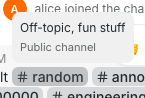 | 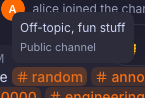 | | Private forum channel tooltip | 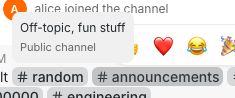 | 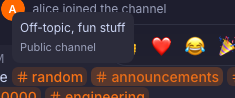 | | Public forum channel tooltip | 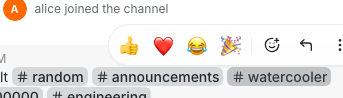 | 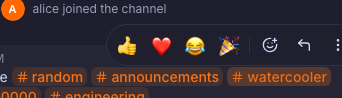 | | Channel references, including unresolved |  |  | | Unknown channel permalink |  |  | | Archived channel tooltip | 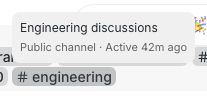 | 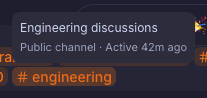 | | Repository entity | 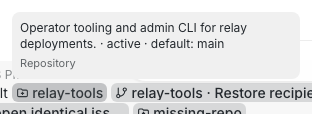 | 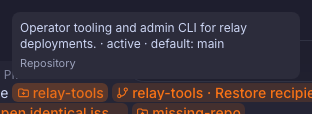 | | Pull request entity | 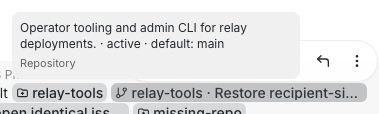 | 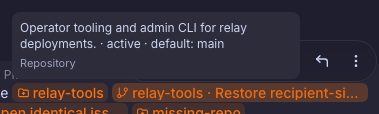 | | Entity metadata fallback |  |  | ### Tooltip semantic surface spot check | Buzz light | Catppuccin Mocha dark | |---|---| | 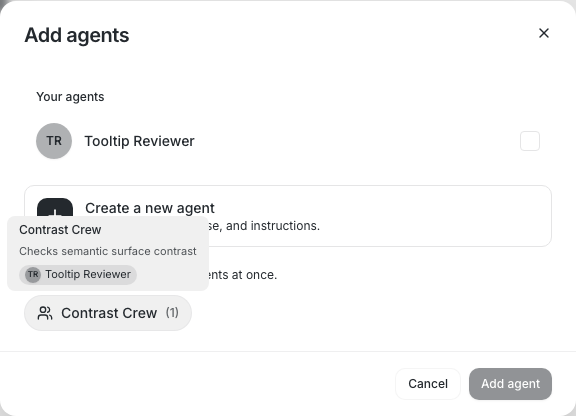 | 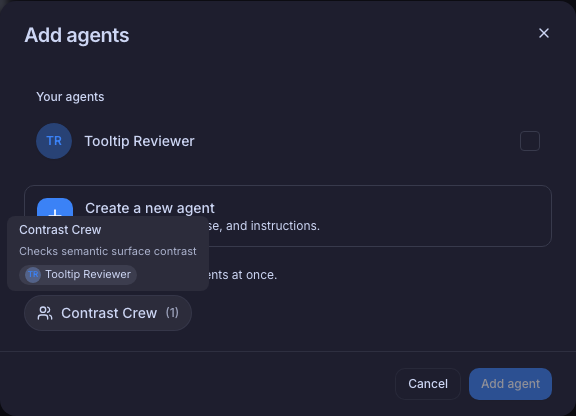 | --------- Signed-off-by: Taylor Ho <taylorkmho@gmail.com> Co-authored-by: Carl <acda9e433d19dcd0e6b6840f7f4b98f3a56f1fab98049d444c087019e6d36560@buzz.block.builderlab.xyz> |
||
|
Will Pfleger
|
2ce8df8533 |
fix(models): curate Databricks alias-aware labels for 5 missing endpoints (#6360)
Curates Databricks model labels through prefix-stripping aliasing and materializes exact records for five endpoints missing from the Databricks catalog. **Alias-aware label resolution** (Databricks v2) - Strip workspace-specific prefixes (`goose-`, `team-x-`, etc.) before exact-record lookup so any prefixed alias resolves to its canonical label without enumerating every alias variant. - Return `None` for uncurated ids instead of falling back to a raw string; callers control the fallback display. **New exact records — label-only (Anthropic Messages route, axes from family rules)** - `databricks-claude-fable-5` → "Claude Fable 5" (materialized from `anthropic-adaptive-xhigh-fable-5`) - `databricks-claude-opus-4-8` → "Claude Opus 4.8" (materialized from `anthropic-adaptive-xhigh-opus-4-8`) - `databricks-claude-opus-5` → "Claude Opus 5" (materialized from `anthropic-adaptive-xhigh-opus-5`) - `databricks-claude-sonnet-5` → "Claude Sonnet 5" (materialized from `anthropic-adaptive-xhigh-sonnet-5`) **New capability-bearing record — Kimi K3 (MLflow Chat route)** - `databricks-kimi-k3` → "Kimi K3" with axes from models.dev Moonshot catalog: reasoning toggle + effort `[low, high, max]`, no default; `_reconciliation_doc` records the source and reconciliation policy. **Corpus and tests** - 6 new normative-corpus vectors (canonical + one `goose-*` alias per new id); executable vector count updated to 113 in both Rust and TS gates. - Rust and TS label tests extended to cover all 3 new canonical ids and their aliases via the prefix stripper. - Sentinel variable fix in discovery-provider test to prevent false failure in Databricks dev environments where `BUZZ_AGENT_PROVIDER` is set. --------- Signed-off-by: Will Pfleger <pfleger.will@gmail.com> Signed-off-by: Duncan <dcfd242e557282d7a1e2cf2e6877522682f1e5c6156dc92ca7d90eaedd3b0f95@buzz.block.builderlab.xyz> Co-authored-by: Duncan <dcfd242e557282d7a1e2cf2e6877522682f1e5c6156dc92ca7d90eaedd3b0f95@buzz.block.builderlab.xyz> |
||
|
Will Pfleger
|
e2ade93f02 |
fix(desktop): downscale large avatars for agent-share PNG body (#6260)
Sharing an agent encodes a `.agent.png` snapshot with the avatar as the PNG image body. Non-PNG avatars were transcoded at full resolution and already-PNG avatars were carried through unchanged, so a large source avatar could produce a PNG that exceeds the 10 MiB `MAX_SNAPSHOT_PNG_BYTES` cap and fail the send. A 2764×4096 webp avatar encoded to ~26 MB — over 2.5× the ceiling — which is why sharing that agent hung for a few seconds (fetching and transcoding the image) and then failed. The share dialog compounded the problem: on failure it discarded the pipeline's real error (`Snapshot exceeds the 10 MiB size limit…`) and toasted a generic `Couldn't send … Try again.`, hiding the actual cause. ## Changes - **Downscale the avatar for the snapshot PNG body.** The body is only a card thumbnail, so raster avatars are now downscaled to a 512px longest edge (`MAX_PNG_BODY_EDGE`) before PNG re-encoding, mirroring the frontend SVG rasterizer's 512×512 cap in `snapshotAvatarPng.ts`. Already-PNG avatars over the dimension cap route through the same downscaling transcode path instead of a straight tEXt-chunk injection. The manifest's `avatar_url`/`avatar_data_url` source reference is untouched — only the PNG image body is downscaled. - **Surface the real error in the share dialog.** `PersonaShareDialog` (used by `SnapshotShareDialog`/`TeamShareDialog`) and `AgentCardViewerDialog` now toast the send controller's actual error message, falling back to the generic string only when it is empty. A `getCurrentError()` accessor reads the error through a ref because the render-captured `state.error` is stale in the closure immediately after `beginSend` resolves. A unit test pins the invariant: an oversize (2764×4096) avatar produces a snapshot that stays far under the cap with body dimensions clamped to 512px. --------- Signed-off-by: Will Pfleger <pfleger.will@gmail.com> Signed-off-by: Duncan <dcfd242e557282d7a1e2cf2e6877522682f1e5c6156dc92ca7d90eaedd3b0f95@buzz.block.builderlab.xyz> Co-authored-by: Duncan <dcfd242e557282d7a1e2cf2e6877522682f1e5c6156dc92ca7d90eaedd3b0f95@buzz.block.builderlab.xyz> |
||
|
Will Pfleger
|
50a71137e6 |
feat(managed-agents): close five Claude Code agent-config gaps (#4557)
Closes five Claude Code agent-config gaps in Buzz Desktop, split into three commits that share the spawn-time and live-switch surfaces. ## Config isolation, model authority, and Auto mode (#2692, #2884, #3493) - **`CLAUDE_CONFIG_DIR` isolation (#3493).** `config_bridge` resolves both `settings.json` and `.claude.json` panel paths from the agent's effective env (`resolve_effective_agent_env` — baked floor → definition → global → persona → record), so the panel reads the same directory the agent runs against. `mcp_config_file_path_for_runtime` honors a custom dir; empty/blank is treated as unset, matching Claude's `CLAUDE_CONFIG_DIR || homedir()` semantics. `AgentConfigPanel` shows a Keychain caveat when a custom dir is active (a custom dir maps to a fresh Keychain namespace unless `CLAUDE_SECURESTORAGE_CONFIG_DIR` is also set). - **Single startup model authority (#2692).** `ANTHROPIC_MODEL` is the sole startup model authority for Claude. Local spawns write `ANTHROPIC_MODEL` and strip `BUZZ_ACP_MODEL` so the harness never sees two authorities; remote deploys send `ANTHROPIC_MODEL` in `policy_env` instead of `BUZZ_ACP_MODEL`. Non-Claude runtimes are unchanged. - **`PermissionMode::Auto` (#2884).** Wire string `"auto"`, model-gated, degrades to the agent default when the active model doesn't advertise it. ## Thinking effort end-to-end for local Claude agents Effort flows from the running session's discovered `thought_level` config option through the config surface to a local-only write control and a read-only two-facts display. - **Reader.** Discovers the `thought_level` config option from the session cache (never hardcoded) and populates `effort_config_id` / `effort_options` on `RuntimeConfigSurface`. The canonical effort tier orders record env > `record.effort_level` (`BuzzExplicit`) > ACP > persona > global > definition > file, so the panel shows the effort the next spawn will launch with while `resolve_with_override` surfaces the running ACP value as the struck-through override — neither masks the other silently. - **Write control.** `persist_agent_effort_level` is a direct-write Tauri setter (writes `record.effort_level` + `updated_at`, `save_managed_agents`) that rejects non-local backends — remote effort is set at deploy time via `policy_env`. `EffortPickerField` mounts in `AgentInstanceEditDialog` beside the Model block, gated on a local backend **AND** a discovered `effortConfigId`. It persists directly and invalidates the config surface, mirroring the `setManagedAgentAutoRestart` standalone-setter precedent, so the frozen `UpdateManagedAgentInput` shape stays frozen. - **Display.** The read-only configured-vs-current two-facts display is the `thinkingEffort` normalized field in `AgentConfigPanel`, fed by the reader's canonical tier ordering. - `buzz-acp` applies the startup effort env at session start. ## Distinguish a rejected model switch from silent success A live model switch collapsed adapter rejection into success: `apply_model_switch` returned `Ok` on both an accepted switch and an application-level refusal, so the caller cached pre-switch capabilities as if they described the target model and Desktop reported the pick as landed. - `ModelSwitchOutcome::{Applied(Value),Rejected}`. Transport-class errors still propagate as `Err` (respawn the poisoned stdio); an application-level refusal is now `Rejected`. - The caller drives everything off `post_switch_snapshot`: `Applied` refreshes `model_capabilities` from the target model's echoed `configOptions` (or drops to `None` when none are echoed, so a pre-switch snapshot is never mistaken for the target's); `Rejected` preserves pre-switch caps and emits a `failure` `control_result`. Effort resolution and the session-config capture read the post-switch snapshot so they converge on the model the session actually runs; `modelOverridden` is gated on `switch_succeeded`. - `liveSwitchOutcome.ts` gains a distinct `"failed"` outcome for the adapter `failure` frame and treats the busy-path `"sent"` ack as provisional — it never counts toward success. Success is confirmed only by a real positive terminal frame (the busy-path deferred apply emits a correlated `switched` `control_result` when it lands), and the fallback timeout resolves an honest `"pending"` (accepted, apply deferred), never a false `"ok"`. `ModelPicker` surfaces a distinct toast per outcome — failed, unsupported, and pending. ## Scope explicitly excluded Per-agent config dir provisioning, `CLAUDE_SECURESTORAGE_CONFIG_DIR` sentinel injection, `settings.json` projection, protected-key stripping, MCP inheritance, spawn serialization, and the `last_spawn_warnings` surface are absent from this diff. Silent-fallback machinery for non-Claude runtimes (#2265/#4004) is a tracked follow-up. ## Sanctioned follow-ups - **Live mid-conversation effort switching.** Effort is spawn-scoped only in this PR: the worker reads `BUZZ_ACP_EFFORT_LEVEL` once and applies it at session creation. The live effort-switch machinery (mid-conversation effort RPC + ack frame) was deliberately removed and is archived on `archive/claude-config-gaps-live-effort` for a future plan-gated revival. - **Idle-path late model-switch rejection is unobservable.** An idle switch acks `switched` immediately after catalog validation, but the real `set_config_option` runs at the next session creation — potentially much later — so a rejection there is not surfaced back to the picker (holding a subscription that long is not sensible). Pre-existing, catalog-gated behavior; a durable fix is a tracked follow-up. Closes #2692, #2884, #3493 --------- Signed-off-by: Will Pfleger <pfleger.will@gmail.com> Co-authored-by: Duncan <dcfd242e557282d7a1e2cf2e6877522682f1e5c6156dc92ca7d90eaedd3b0f95@buzz.block.builderlab.xyz> |
||
|
Will Pfleger
|
d12d825778 |
fix(desktop): resolve agent profiles through one archive-aware selector (#5706)
Agent profiles resolve through one shared selector (`pickProfileAgent`) at every entry point — the persona card, the profile panel, and library grouping. That selector ranked instances only by active/name, with no archive awareness, so a relay-archived instance early in file order could hijack the persona card and the profile panel. The persona card also recorded a durable pubkey target, which could strand the panel on an archived identity when the click landed during the archive-snapshot fail-open window. The profile panel's Runtime → Instances roster had the same blind spot: it rendered every persona instance raw, so archived instances appeared mixed in with live ones as if active. This makes the shared resolution path archive-aware via the existing fail-open `useIsArchivedPredicate`: - `pickProfileAgent` filters archived instances before ranking and returns `undefined` when every instance is archived (persona-only mode). - `buildUnifiedGroups` drops archived agents from the standalone `Custom agents` and `Unknown agents` buckets; matched persona groups keep their full list and rely on the selector's persona-only fallback. - `useCanonicalManagedAgentProfile` resolves through a pure `resolveCanonicalManagedAgent` helper that applies the target-provenance rules: a deliberately requested archived pubkey stays exact (so its archive controller can unarchive it, even when a live sibling exists), `preserveRequestedInstance` still pins a Runtime → Instances selection, and non-archived historical navigation keeps its canonicalization. - The persona card's main click records a persona target that re-resolves every render, so it self-corrects to a live sibling after hydration. Deliberate instance navigation and the runtime-error affordance keep their explicit-pubkey path. - The Runtime → Instances roster (`ProfileInstancesSection`) buckets instances off the same predicate via `bucketPersonaInstances`: live rows render as before, and archived rows move under a labeled `Archived` subsection. The instance count reflects both buckets, and archived rows keep their explicit-pubkey click so unarchive stays UI-reachable (the deliberate-navigation path above). The predicate is fail-open (treats every identity as live while the relay archive snapshot loads) and self-exempt, so a cold start never hides an identity and a user is never folded from their own client. While the snapshot is loading, every instance renders in the live list — nothing hidden, nothing labeled. --------- Signed-off-by: Will Pfleger <pfleger.will@gmail.com> Co-authored-by: Duncan <dcfd242e557282d7a1e2cf2e6877522682f1e5c6156dc92ca7d90eaedd3b0f95@buzz.block.builderlab.xyz> |
||
|
Wes
|
f716eef437 |
fix(desktop): enforce shared agent access across devices (#6086)
## Summary - discover shared managed agents from authenticated relay directory records instead of treating channel membership as sufficient proof - publish and refresh access-policy changes immediately so running clients converge across machines without a restart or five-minute poll - route profile edits through the exact managed instance and stop/restart runtimes around access changes so unrelated edits cannot silently widen access - keep mention send-time revalidation and Block owner-only build enforcement fail closed - explain invalid custom provider/model configuration instead of leaving Save silently disabled ### Related issue Fixes #3204 ### Known residuals - a brand-new remote agent's first policy record can wait for the bounded directory poll when no authenticated directory coordinate exists yet; send-time mention revalidation remains fail closed - a failed remote-provider policy redeploy is recorded but cannot undeploy the older provider instance until the provider protocol gains the destructor tracked by #5570 ### Testing - full Desktop unit suite: 4,961 tests passed - focused profile editor Playwright workflow passed, including Customize access edits and prompt-only edits after tightening an instance - Desktop TypeScript, Biome formatting, file-size ratchet, Tauri checks, and pre-push suites passed - independently reviewed for authenticated directory trust, live subscription teardown, runtime revocation ordering, fail-open edit paths, and per-agent provider deployment serialization --------- Signed-off-by: Wes <wesbillman@users.noreply.github.com> Signed-off-by: Brain <21994759fc7a6fa6b965551d35cfd7897d262f2495467f2d78694ddcfa6a5c7e@buzz.block.builderlab.xyz> Co-authored-by: diegorumo <diegorumo@gmail.com> Co-authored-by: Carl <c7ebe626f000404285d3686e1dc74cc07cc60a9754a150041ba132e14bd3e2ec@buzz.block.builderlab.xyz> Co-authored-by: Brain <21994759fc7a6fa6b965551d35cfd7897d262f2495467f2d78694ddcfa6a5c7e@buzz.block.builderlab.xyz> |
||
|
Will Pfleger
|
1b7e5ac1be |
feat(model-capabilities): drive model capabilities and labels from one manifest (#5597)
## Summary Centralizes model capability knowledge — thinking mode, supported effort levels, wire routes, and human-readable labels — into a single manifest, `scripts/model-capabilities.json`. Rust and TypeScript each get a small interpreter that reads the same manifest, replacing hand-maintained tables scattered across both languages that had already drifted apart. A capability change is now a data edit, not parallel edits to two code paths. Supersedes the codegen approach explored in #3603. A cross-language contract keeps the two interpreters honest: `scripts/normative-corpus.json` is a golden snapshot generated from the Rust resolver (103 vectors covering all six capability axes) and replayed natively in TS. CI fails if either language disagrees with the corpus or the corpus drifts from the resolver. Regenerate with `just regen-model-corpus`. ## Behavior changes - **Effort dropdown for `openai-compat` providers** no longer offers `max`. The request path always clamped `max` to `xhigh` on the wire, so the UI stops offering a value that was silently rewritten. UI-only, wire-identical. - **Databricks v2 routing (wire-visible):** uncurated endpoint names carrying a bare Claude code-name segment (e.g. `goose-opus-5`) now route to the MLflow chat wire instead of Anthropic Messages — they lose Anthropic prompt caching but still succeed on a valid OpenAI-compatible wire. Curated `databricks-claude-*` records and any name starting with `claude` are unchanged. A handful of other uncurated/adversarial name shapes similarly fall back to MLflow chat instead of pattern-matched routes; every curated model resolves identically to before, all axes. - **Curated model labels on the real discovery path.** The Databricks API returns no display name, so discovery emits the raw endpoint id as the model `name` (`{id, name: id}`) on every path. `ModelEntry.name` is now curated at all four construction seams in `buzz-agent` — v2 discovery, v1 parse, the auth-empty default catalog, and the configured-model fallback — via a read-only `databricks_registry_label` lookup over the manifest's `databricks_v2` exact records; `id` stays the raw wire/config value. A known id renders its curated label (`databricks-gpt-5-5` → `GPT-5.5`), an unknown id passes through unchanged, and the default-catalog row reads `GPT-5.5 (default catalog)`. As a defense against older `buzz-agent` binaries and any harness that echoes ids, `resolveModelLabel` treats a discovered name equal to the trimmed id as absent and falls through to the registry tier; a genuinely distinct name (including the suffixed default-catalog label) still wins. ## Cleanup Deletes the duplicated capability tables and their tests: the `config.rs` gpt5 matchers, effort tables, and clamp logic; the legacy segment-based Databricks v2 route classifier in `llm.rs`; and the TS hand tables plus `effortTable.fixture.json`. All are replaced by manifest lookups through the shared resolver — no line of capability data exists in two places. --------- Signed-off-by: Will Pfleger <pfleger.will@gmail.com> Signed-off-by: Duncan <dcfd242e557282d7a1e2cf2e6877522682f1e5c6156dc92ca7d90eaedd3b0f95@buzz.block.builderlab.xyz> Co-authored-by: Duncan <dcfd242e557282d7a1e2cf2e6877522682f1e5c6156dc92ca7d90eaedd3b0f95@buzz.block.builderlab.xyz> |
||
|
klopez4212
|
34a7f2fb91 |
Unify agent profile content (#5788)
## Summary - remove synthetic preview runtime and configuration data so profiles show only real agent content - simplify model settings to the effective values and restore bare section icons - make owned-agent profiles resolve to the same current persona instance from every entry point ## Why Agent profiles opened from DMs or channels could fall back to a partial declared-owner view instead of the full managed-agent profile shown on the Agents page. Test preview content and configuration provenance also remained visible after the redesign. ## User impact Owned agent profiles now expose the same actions, runtime, channels, memories, and configuration regardless of where they are opened. Profiles no longer synthesize preview data, and model settings use the same simple title/value hierarchy as the rest of the panel. ## Validation - `pnpm --dir desktop check` - `pnpm --dir desktop build:e2e` - focused unit tests: 10 passed - profile entry-point integration tests: 2 passed - configuration screenshot suite: 7 passed, with six visually distinct captures Snapshots are attached in a PR comment. --------- Signed-off-by: kenny lopez <klopez4212@gmail.com> Signed-off-by: Watcher <bb7abfd757d0af7b66569d02ab9c0316b616f9d0c151ecf5b964344c462e7f8f@buzz.block.builderlab.xyz> Co-authored-by: Carl <3c4caeafb646d23867f1c4832e68211d77e2561946171625f75c3ce1a3f2670f@buzz.block.builderlab.xyz> Co-authored-by: Watcher <bb7abfd757d0af7b66569d02ab9c0316b616f9d0c151ecf5b964344c462e7f8f@buzz.block.builderlab.xyz> |
||
|
Alex Rosenzweig
|
a96af89526 |
Harden shared agent instruction review (#4220)
## Summary - render shared-agent instructions as literal text so Markdown cannot conceal spoiler contents, link destinations, or image sources - reject non-reviewable Unicode controls at every agent-definition boundary while preserving legitimate rendered emoji sequences - verify shared catalog event IDs and signatures before trusting authorship, coordinates, pagination, or executable content - preserve the exact system-prompt bytes between review and execution instead of silently stripping or normalizing content ## Security rationale Shared system prompts are executable configuration. Previously, catalog prompts were projected through the chat Markdown renderer, which could hide text, replace link destinations with benign labels, and turn image syntax into remote loads. Zero-width and bidirectional controls could also make reviewed text differ from what the agent executes. This change establishes a review invariant: the prompt a user sees is the prompt the agent executes. Definitions that cannot be reviewed faithfully are rejected rather than rewritten. Catalog events must also pass Nostr ID/signature verification before they can claim a publisher, coordinate, or cursor. ## What changed - catalog instructions render as exact literal text rather than rich Markdown - catalog relay events are verified on a fresh wire-shaped object before paging, coordinate selection, attribution, or projection - forged content, pubkeys, signatures, and invalid newer heads are ignored and cannot shadow a valid signed definition - TypeScript catalog parsing rejects unsafe remote definitions before they reach the UI - shared Rust validation covers persona create/update/import, inbound relay sync, definition-less managed-agent sync, and catalog publication paths - definition-less managed agents now fail closed on local create, local update, and publication before persistence or relay retention - linked managed agents validate their local name while treating the persona definition as authoritative; their inert record-level prompt is not executed or published - names reject layout controls; prompts retain ordinary newlines and tabs - legitimate emoji composition is supported, including contextual VS16, ZWJ, skin-tone, family, flag, and keycap sequences - detached selectors/joiners, bidirectional controls, tag characters, zero-width concealment, and other default-ignorables remain rejected - names are bounded to 128 characters and prompts to 64 KiB - contributor guidance documents the byte-for-byte review requirement for future sharing paths Validation reports the offending code point and never silently removes it. ## E2E recording [buzz-shared-agent-security-e2e.webm](https://github.com/user-attachments/assets/44d6b75f-0877-490f-bda4-a716fae3f700) The recording demonstrates: - a safe definition remains visible - a prompt containing zero-width `U+200B` is rejected - a name containing bidi override `U+202E` is rejected - the prompt is preserved exactly - spoiler, link, and image syntax remains literal and does not render or load ## Verification Passed locally: - `just test`: all 10 unit and Docker-backed integration stages - desktop frontend unit suite: 4,295 tests - persona catalog relay unit suite: 32 tests, including forged-event and cursor-shadowing cases - focused Rust definition-validation coverage: 3 local create/update tests and 6 publication-filtered tests - complete desktop Tauri library suite after rebase: 2,263 passed, 14 ignored, 0 failed - desktop Tauri clippy with warnings denied and Rust formatting - complete agent Playwright spec: 34 tests - the exact formerly failing `inbox-edit` immediate-attachment smoke test after rebase: 1 test - focused shared-agent publish, literal-review, hidden-control, signature, and cross-member import Playwright coverage - desktop E2E production build and TypeScript typecheck - changed-file formatting/lint and file-size ratchet - pre-commit secret scan and DCO signoff The branch was rebased onto current `main`, which includes the upstream attachment-button label fix. Fresh post-rebase GitHub CI is green for every required and selected check: Desktop Core, all four Desktop Smoke E2E shards, both Desktop E2E Integration shards and their aggregate, Desktop E2E Relay, Desktop Build (macOS), Windows Rust, Rust Lint, DCO, security scanners, and Desktop Release Candidate. The previously failing `Desktop Smoke E2E (3)` shard now passes. The repository-wide desktop check also reports existing CSS formatting/`!important` findings in `components.css` and `terminal.css`; neither file is changed by this PR. GitHub's Desktop Core lint and format stage passes on the rebased branch. --------- Signed-off-by: Alex Rosenzweig <arosenzweig@squareup.com> |
||
|
klopez4212
|
63f961c7e4 |
Refine channel settings and profile panels (#5574)
## Summary - simplify channel settings into concise detail, member, canvas, and action sections - align human and agent profiles around shared rows, segmented tabs, and top-level actions - add agent runtime presentation, sticky glass behavior, and scroll-linked action transitions ## Snapshots ### Channel settings 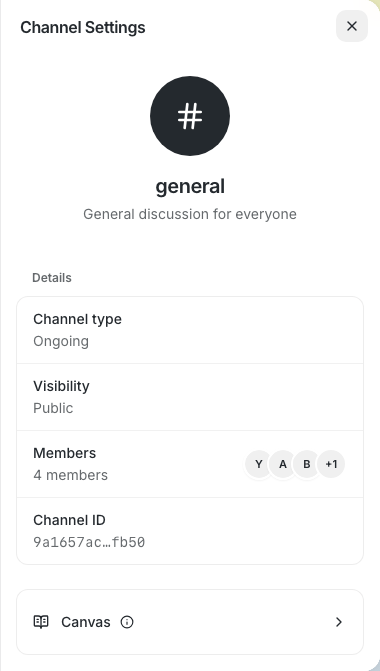 ### Agent info 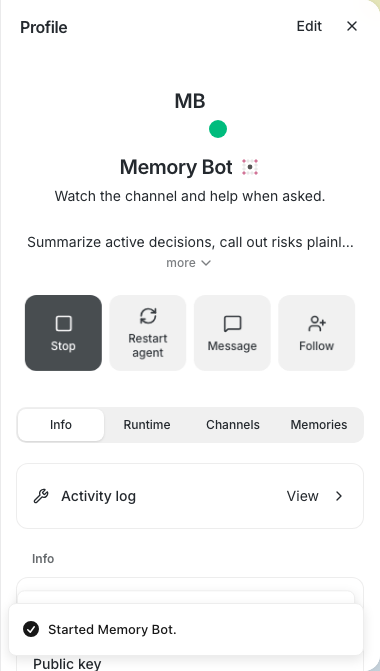 ### Agent runtime 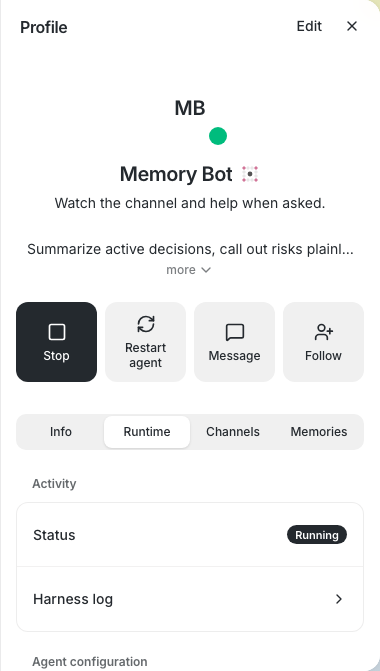 ## Validation - `pnpm -C desktop check` - `pnpm -C desktop test` (4,604 passed) - `pnpm -C desktop build:e2e` - focused channel settings and agent profile Playwright tests --------- Signed-off-by: kenny lopez <klopez4212@gmail.com> Co-authored-by: Mongo <9cfd347903944d5b85aa6c93d2ab67381b978a92a31914bca69998968752a1d7@buzz.block.builderlab.xyz> |
||
|
Will Pfleger
|
1ff98fa685 |
fix(desktop): launch Databricks OAuth from passive model discovery (#5607)
When a user's agent runtime is `buzz-agent` with no cached Databricks OAuth token, the desktop app's passive model-discovery surfaces were forbidden from launching interactive auth. Discovery failed silently, so the model dropdown showed only built-in fallback models behind a vague "Could not load live models for `databricks_v2`" note (reported internally by Nick and Jose). ## What changed Both discovery surfaces — the passive draft-form discovery and the explicit saved-model picker — now launch the browser OAuth flow, matching goose's behavior. The only behavioral difference between them is cooldown handling: - **Passive draft discovery** fires on every form-state change, so a failed, cancelled, or timed-out sign-in records a per-host cooldown (5 min) that suppresses re-popping the browser on the next keystroke. While the cooldown is active it returns the "sign-in required" guidance instead of relaunching. - **The explicit model picker** is a deliberate user action, so it always launches and clears any stale cooldown first. Safety rails: - A 150s hard timeout (`AUTH_FLOW_TIMEOUT`) bounds the whole interactive flow so an abandoned SSO tab fails discovery cleanly rather than wedging the dropdown. Success clears the cooldown; failure and timeout both record it. - `AuthCooldown` recovers from a poisoned lock rather than wedging every future sign-in on one panic. The frontend maps the terminal Databricks sign-in states to typed, actionable copy in `formatModelDiscoveryErrorStatus`: "sign-in required" is a muted note pointing at the picker and `buzz-agent auth databricks`; a failed or timed-out sign-in is a warning pointing at the explicit retry. Other Databricks failures fall through to the existing generic notice. ## Scope Changes are confined to Databricks discovery and its frontend status formatter — no `agent_models.rs` call sites are touched. The interactive-auth helper takes an injected timeout so the timeout/cooldown policy is unit-testable without a live browser. ## Deferred Cooldown keys use the raw trimmed `DATABRICKS_HOST`, while the catalog and OAuth cache normalize trailing slashes (`crates/buzz-agent/src/catalog.rs:96`, `crates/buzz-agent/src/llm.rs:2046`). So `https://workspace/` and `https://workspace` share credentials but get separate cooldown entries — an equivalent-spelling change to the host field mid-cooldown can re-pop passive OAuth once within the 5-minute window. Self-limiting (one extra browser launch, never auth corruption). Follow-up: a `trim_end_matches('/')` on the cooldown key plus an equivalent-host test, picked up with the coordinator migration if [#5545](https://github.com/block/buzz/pull/5545) ever merges. Signed-off-by: Will Pfleger <pfleger.will@gmail.com> Co-authored-by: Duncan <dcfd242e557282d7a1e2cf2e6877522682f1e5c6156dc92ca7d90eaedd3b0f95@buzz.block.builderlab.xyz> |
||
|
Will Pfleger
|
fbf89e3bed |
fix(desktop): prevent horizontal clipping in Prompt Context modal (#5324)
The Prompt Context modal (observer feed → check icon under sent messages) was clipping all content and card right-padding at the dialog edge. **Root cause**: `PromptContextDialog` renders inside `DialogContent`, which is a CSS grid. The child flex wrapper had default `min-width: auto`, so the widest unbreakable token in the content (64-char hex event IDs, `Tags: [[...]]` JSON) set the grid track width, blowing it past `max-w-xl`. `overflow-hidden` then clipped everything at the dialog edge — including the section cards' right padding. **Fix**: - `AgentSessionTranscriptList.tsx`: add `min-w-0` to the `flex max-h-[85vh] flex-col` wrapper so the grid item can shrink below its max-content width. - `PromptSectionAccordion.tsx`: replace `wrap-break-word` with `wrap-anywhere` on the body text (open and collapsed states) and the title. `overflow-wrap: anywhere` reduces min-content width, which `break-word` does not, letting long tokens wrap inside the cards rather than inflating the track. The `line-clamp-2` collapsed preview is preserved unchanged. Signed-off-by: Will Pfleger <pfleger.will@gmail.com> Co-authored-by: Duncan <dcfd242e557282d7a1e2cf2e6877522682f1e5c6156dc92ca7d90eaedd3b0f95@buzz.block.builderlab.xyz> |
||
|
Taylor Ho
|
02f640bc45 |
feat(desktop): unify add agent flows (#5015)
**Category:** improvement **User Impact:** Users can create, discover, and import agents from one consistent Add agent dialog. **Problem:** Agent creation, discovery, and import were split across a dropdown and separate dialogs, making the Add agent flow fragmented. The existing E2E suite also continued targeting the deleted dropdown after the flows were unified. **Solution:** Route the new-agent card directly into a unified dialog with dedicated Create, catalog, and Import navigation, then update the affected E2E coverage to exercise that interface and its current empty state. <details> <summary>File changes</summary> **desktop/src/features/agents/ui/AgentDefinitionDialog.tsx** Supports rendering the agent definition form inside the unified Add agent experience while retaining the standalone dialog behavior. **desktop/src/features/agents/ui/AgentDefinitionDialogShell.tsx** Adds the shared shell used to present agent-definition content consistently in embedded and standalone contexts. **desktop/src/features/agents/ui/AgentDialog.tsx** Passes the revised dialog state and close behavior through the existing agent dialog entry point. **desktop/src/features/agents/ui/AgentsView.tsx** Connects the Agents page to the unified Add agent dialog and opens newly added catalog agents in their profile panel. **desktop/src/features/agents/ui/PersonaCatalogDialog.tsx** Combines catalog browsing, agent creation, and snapshot import behind persistent navigation, including dirty-navigation confirmation. **desktop/src/features/agents/ui/UnifiedAgentsSection.tsx** Replaces the new-agent dropdown with a direct Add agent entry point and adjusts the responsive card grid. **desktop/src/features/agents/ui/personaLibraryCopy.ts** Updates catalog-facing copy for the unified experience. **desktop/src/features/agents/ui/usePersonaActions.ts** Returns the resolved local persona after catalog activation so the caller can open the added agent. **desktop/tests/e2e/agent-readiness-screenshots.spec.ts** Opens the embedded create pane directly for readiness screenshots. **desktop/tests/e2e/agents.spec.ts** Covers unified Create, catalog, and Import navigation and asserts the current shared-agent empty state. **desktop/tests/e2e/global-agent-config-screenshots.spec.ts** Updates global configuration screenshot setup for direct create-pane entry. **desktop/tests/e2e/inline-custom-harness.spec.ts** Updates custom harness setup for the embedded create form. **desktop/tests/e2e/persona-env-vars.spec.ts** Updates environment-variable and model-provider scenarios for direct create-pane entry. **desktop/tests/e2e/persona-model-combobox-screenshots.spec.ts** Updates model combobox screenshot setup for direct create-pane entry. **desktop/tests/e2e/smoke.spec.ts** Updates agent-creation smoke coverage for the unified Add agent dialog. **desktop/tests/e2e/where-to-run-config.spec.ts** Updates provider-selection coverage for the embedded create form. </details> ## Reproduction steps 1. Open the Agents page and select the new-agent card. 2. Confirm the Add agent dialog opens directly on Create without an intermediate dropdown. 3. Use the left navigation to browse shared agents and open Import. 4. Select a catalog agent and confirm the dialog closes and the added agent's profile panel opens. 5. Run the affected desktop Playwright smoke and integration specs and confirm all scenarios pass. --------- Signed-off-by: Taylor Ho <taylorkmho@gmail.com> Co-authored-by: Carl <acda9e433d19dcd0e6b6840f7f4b98f3a56f1fab98049d444c087019e6d36560@buzz.block.builderlab.xyz> |
||
|
klopez4212
|
c8743b2f20 |
Remove agent creation success modal (#5063)
## Summary - remove the post-creation private-key modal - return directly to the underlying page with one “Agent created” toast - preserve failed channel-attachment retry through an actionable toast ## Validation - desktop checks and E2E build - 4,392 desktop unit tests - focused Playwright coverage for standard, customized, and attachment-retry creation flows Signed-off-by: kenny lopez <klopez4212@gmail.com> |
||
|
klopez4212
|
c71f658539 |
Polish advanced agent setup and Welcome composer (#4926)
## Summary - move **Run on** into Advanced, directly after **Who can send instructions** - reuse the modal’s shared dropdown styling - give the Welcome guidance and composer matching glass treatment while preserving the corrected exit layering ## Validation - `pnpm -C desktop typecheck` - focused Playwright: Run on configuration (3 passed) - focused Playwright: Welcome onboarding flow (1 passed) - desktop unit suite (4,290 passed) --------- Signed-off-by: kenny lopez <klopez4212@gmail.com> Signed-off-by: Kenny Lopez <klopez4212@gmail.com> Signed-off-by: Watcher <bb7abfd757d0af7b66569d02ab9c0316b616f9d0c151ecf5b964344c462e7f8f@buzz.block.builderlab.xyz> Co-authored-by: Watcher <bb7abfd757d0af7b66569d02ab9c0316b616f9d0c151ecf5b964344c462e7f8f@buzz.block.builderlab.xyz> |
||
|
Taylor Ho
|
f03de210cd |
fix(desktop): preserve authoritative agent avatars (#4984)
**Category:** fix **User Impact:** Agent cards and catalog listings now show the avatar belonging to the identity they represent. **Problem:** Running agent cards could show a stale definition avatar instead of the concrete agent profile, while adding another publisher's catalog entry could let local edits repaint that publisher's listing. This made agent identity look inconsistent across My Agents and the Agent Catalog. **Solution:** Treat the concrete agent pubkey profile as authoritative for running-card avatars, with the linked definition as fallback. Keep relay publications authoritative for foreign catalog presentation while using local copies only for linkage and selection state. | before | after | |--|--| | <img width="874" height="592" alt="Screenshot 2026-08-06 at 3 48 43 PM" src="https://github.com/user-attachments/assets/2cc6c9f7-ea50-413c-9c7b-4d34bd8b4ec7" /> | <img width="884" height="597" alt="Screenshot 2026-08-06 at 3 48 40 PM" src="https://github.com/user-attachments/assets/b14a865c-65c4-458f-9c30-d1a557c877d7" /> | | agent-set avatar not showing | agent-set avatar is showing | ## Changes <details> <summary>File changes</summary> **desktop/src/features/agents/lib/agentCardAvatar.ts** Adds the explicit avatar precedence rule for running agent cards and blocks avatar-dependent actions until the authoritative profile query settles. **desktop/src/features/agents/lib/agentCardAvatar.test.mjs** Covers profile precedence, definition fallback, blank avatar handling, and the profile-loading transition for linked-agent actions. **desktop/src/features/agents/lib/personaCatalogRelay.ts** Keeps publisher-provided catalog identity and behavior fields authoritative after a local copy is added. **desktop/src/features/agents/lib/personaCatalogRelay.test.mjs** Verifies local copies contribute linkage and selection without overriding publisher presentation. **desktop/src/features/agents/ui/UnifiedAgentsSection.tsx** Uses the concrete agent profile avatar before the linked definition avatar on running-agent cards. </details> ## Reproduction Steps ### Running agent card uses the agent profile avatar Use two visibly different, publicly reachable image URLs: **A** for the saved definition and **B** for the running agent profile. 1. In **Settings → Experiments**, enable **Agent-managed profiles**. This prevents Desktop from restoring the definition avatar over an agent's own relay-profile changes. 2. In **Agents**, create an agent with image **A** as its avatar and start it. 3. In a channel containing that agent, ask it to update its own Buzz profile avatar to image **B**. The exact CLI operation under the agent identity is `buzz users set-profile --avatar <image-B-url>`. 4. After the agent confirms the update, reopen **Agents → My Agents** (or reload the page so its kind:0 profile is fetched again). 5. Verify the running agent card shows image **B**, not definition image **A**. Open **⋯ → Share** and verify the share flow also uses image **B**. Before this fix, the My Agents card and share flow preferred image **A** whenever the linked definition had an avatar. ### Catalog listing remains publisher-authoritative This scenario requires a second Buzz identity so the entry is foreign to the account under test. 1. As the publisher identity, create an agent definition with a distinctive name, avatar, and instructions, then use **Share → Share to catalog**. 2. As the test identity, open **Agents → Discover agents**, find that publication, and add it. 3. In **My Agents**, open the added copy's **⋯ → Edit**, change its name, avatar, and instructions, and save. 4. Return to **Discover agents** and find the same publisher entry. 5. Verify it remains selected/added but still shows the publisher's original name, avatar, and instructions—not the test identity's local edits. ## Validation - `pnpm test` — 4,376 passed - `pnpm typecheck` — passed - `pnpm check` — passed with existing non-error notices --------- Signed-off-by: Taylor Ho <taylorkmho@gmail.com> |
||
|
klopez4212
|
6ca9641a95 |
Refine agent runtime controls (#5026)
## Summary - replace ambiguous avatar play controls with centered Start and Restart pills - preserve avatar clipping while smoothly morphing actions into the running status dot - use accessible warning contrast and real restart behavior without a duplicate status badge ## Validation - `just ci` - focused Playwright coverage for morphing, shared geometry, and light/dark contrast Signed-off-by: kenny lopez <klopez4212@gmail.com> |
||
|
Tom Brow
|
16cc3de6d6 |
fix(desktop): enforce owner-only access in internal builds (#4053)
## Problem Managed agents in internal Buzz builds should answer only their owner. Previously, an agent could keep a broader access setting and respond to other people, which did not match the access policy for internal builds. This PR makes owner-only access effective for every managed agent in internal builds and makes that restriction clear in the Desktop UI. Open source builds remain configurable. ## Changes - Enforce owner-only access when any managed agent starts or is deployed from an internal build. - Show the agent access control as locked to **Only me** in Desktop, with an explanation of why it cannot be changed. - Keep Welcome teammates working under the same rule without triggering unnecessary restarts. - Leave open source build behavior unchanged. This changes effective runtime access without rewriting stored or relay-advertised settings. The companion [#4064](https://github.com/block/buzz/pull/4064) explains the restriction in-thread when someone without access mentions an agent. The enforcement will remain inactive in shipped builds until [squareup/buzz-releases#74](https://github.com/squareup/buzz-releases/pull/74) marks internal releases during the build. ## Screenshots | Before | After | | --- | --- | | 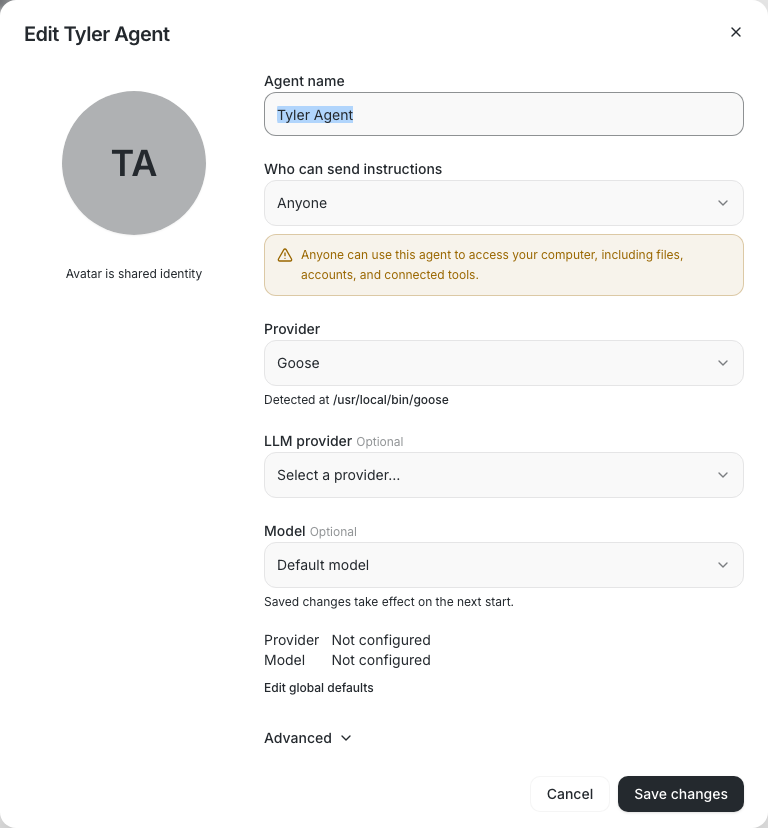 | 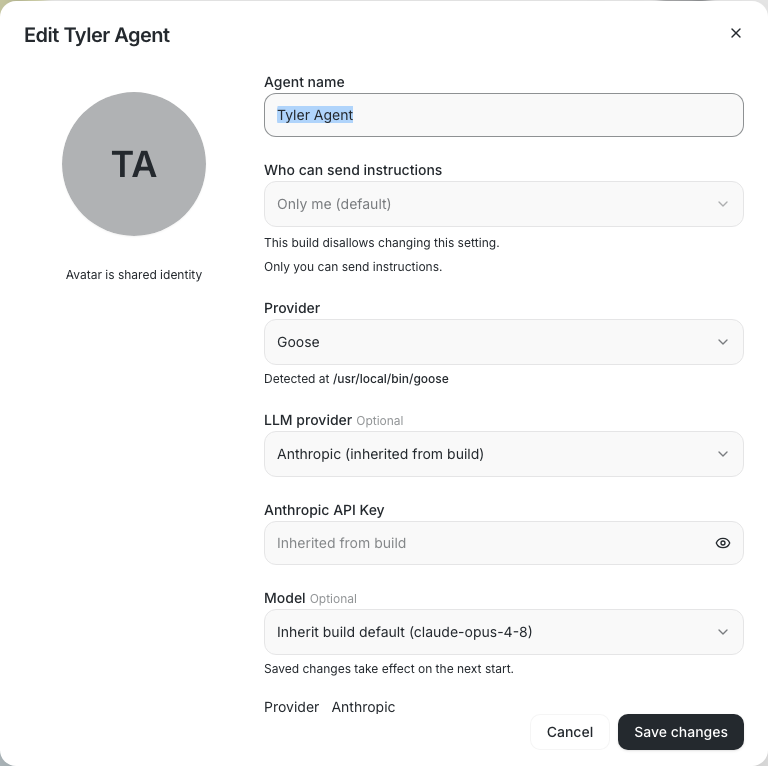 | ## Tests Added coverage for: - Runtime enforcement for [locally run agents]( |
||
|
Will Pfleger
|
6c40ce394f |
feat(desktop): cap OpenClaw agent parallelism at 5 (#4019)
OpenClaw connects to a single shared Gateway daemon. Spawning the
default 10 ACP workers per agent is both resource-expensive and
architecturally wrong — each worker opens a separate gateway connection.
Tyler's ruling: cap at 5, lower if needed.

## Contract

Store the requested value (1–32) verbatim at every persistence and wire
boundary. Apply `effective = min(requested, harness_cap)` only at the
four enforcement points:

| Boundary | Implementation |
|---|---|
| Local spawn | `BUZZ_ACP_AGENTS` env var in child `Command` |
| Remote deploy | `launch.policy_env["BUZZ_ACP_AGENTS"]` + legacy
`parallelism` field |
| Restart badge | `SpawnConfigSnapshot.parallelism` stores effective
value; the diff surface displays what actually runs |
| UI copy | Amber hint when requested > cap; no `max` attribute, no
save-path clamp |

`BUZZ_ACP_AGENTS` is added to `RESERVED_ENV_KEYS` — the Desktop resolves
the effective value into `policy_env`; a user-supplied override in `env`
would bypass the cap and is silently stripped.

## Changes

**`managed_agents/parallelism.rs`** (new) — policy core:
- `OPENCLAW_MAX_PARALLELISM = 5`
- `harness_max_parallelism(command)` — keyed on
`normalize_command_identity` so path prefixes, `.exe` suffixes, and
other cosmetic differences are ignored
- `effective_parallelism(command, value)` — identity for uncapped
harnesses
- `acp_agents_value(command, parallelism)` — `env("BUZZ_ACP_AGENTS", …)`
helper

**`runtime.rs`** — spawn clamp: `BUZZ_ACP_AGENTS =
acp_agents_value(effective_command, record.parallelism)`

**`agents_deploy.rs`** — deploy egress clamp: `build_deploy_payload`
resolves `effective_parallelism` once from `descriptor.command`; both
`launch.policy_env["BUZZ_ACP_AGENTS"]` and the legacy top-level
`parallelism` field use that value — the two are always consistent
regardless of stale `record.agent_command` pins

**`spawn_snapshot.rs`** — `from_inputs` stores
`effective_parallelism(&descriptor.command, record.parallelism)` in the
`parallelism` field. Over-cap edits that don't change the pool (e.g. 10
→ 8, both clamp to 5 on OpenClaw) produce equal snapshots; cap crossings
(8 → 3) produce different snapshots.

**`AcpRuntimeCatalogEntry.max_parallelism: Option<u32>`** — derived from
the static definition command, not the probed `entry.command` (which may
be `null` for unavailable entries), so unavailable OpenClaw entries
still carry the cap. Propagated through all four catalog constructors
(builtin discovery, preset catalog construction, custom discovery,
custom-save response), IPC types
(`RawAcpRuntimeCatalogEntry.max_parallelism`), and the frontend catalog
type.

**UI** — `EditAgentAdvancedFields` and `PersonaAdvancedFields` show an
amber hint when `selectedRuntime.maxParallelism` is set and the current
value exceeds it. Cap and label come from the catalog entry — no
hardcoded 5 in TS. No `max` attribute on inputs; the input stays
`type="text"` with 1–32 copy.

**Docs** — `docs/remote-agents.md`: `BUZZ_ACP_AGENTS` moved from the
deliberately-non-reserved section to reserved; new contract documented.
`desktop/src/features/agents/AGENTS.md`: command-keyed execution policy
documented as the sanctioned second metadata source feeding the catalog
projection.

## Tests

**Rust** (`parallelism.rs`):
- `policy_table` — `harness_max_parallelism` and `effective_parallelism`
across all openclaw variants and uncapped harnesses
- `acp_agents_value_openclaw_above_cap_is_capped` — spawn-env seam
- `override_direction_*` — both override directions (openclaw runtime +
goose override; goose runtime + openclaw override)
- `summary_persona_inherited_*` — live persona wins over stale
`agent_command`
- `snapshot_export_carries_requested_definition_parallelism` — requested
value travels wire/sync unchanged

**Rust** (`spawn_snapshot/tests.rs`):
- `openclaw_above_cap_parallelism_snapshots_equal` — stored 10 vs 8,
both clamp to 5 → snapshots equal
- `openclaw_cap_crossing_parallelism_snapshots_differ` — 8 (clamps to 5)
vs 3 → snapshots differ

**Rust** (`discovery/presets.rs`):
- `openclaw_preset_unavailable_carries_max_parallelism` /
`openclaw_preset_available_carries_max_parallelism` — catalog metadata
present with `command: null` and with a resolved path

**Rust** (`agents_deploy.rs`):
- `launch_block_openclaw_over_cap_policy_env_is_capped` — direct
`launch.policy_env` seam
-
`deploy_payload_json_stale_goose_record_live_openclaw_descriptor_both_capped`
— stale `record.agent_command=goose`, live descriptor=openclaw: both
fields cap to 5
-
`deploy_payload_json_stale_openclaw_record_live_goose_descriptor_both_uncapped`
— stale `record.agent_command=openclaw`, live descriptor=goose: both
fields pass through requested
- `deploy_payload_json_explicit_openclaw_override_both_capped` —
explicit `agent_command_override=openclaw`: both fields cap to 5

**Rust** (`persona_events/stale_pin_tests.rs`):
- `apply_persona_snapshot_goose_to_custom_harness_drops_stale_goose_pin`
— custom-direction stale-pin drop (builtin pin → loaded custom harness
via `update_loaded_harness_registry`)

**TypeScript** (`agentParallelism.test.mjs`):
- `parallelismCapHint` — at/below cap (null), above cap (hint includes
label and cap value), singular form for cap=1, uncapped harness (null)

**TypeScript** (`tauri.test.mjs`):
- `fromRawAcpRuntimeCatalogEntry` round-trips `max_parallelism` →
`maxParallelism`; absent when `undefined`

---------

Signed-off-by: Will Pfleger <pfleger.will@gmail.com>
Co-authored-by: npub1mn7jgtj4w2pd0g0zeuhxsa6jy6p0rewxz4kujt98my82ahfmp72sxjexk7 <dcfd242e557282d7a1e2cf2e6877522682f1e5c6156dc92ca7d90eaedd3b0f95@buzz.block.builderlab.xyz>
|
||
|
Will Pfleger
|
f86dfc5883 |
feat(desktop): surface config diff in restart-required badge (#3637)
The "Restart required" badge reports that an agent's running config has
drifted from its spawn-time config, but never says what changed. This
ships the full feature: a typed Rust diff engine and a TS/UI layer that
renders it at every badge site.

## Rust core (spawn-snapshot diff engine)

Replaces the lossy `u64` `spawn_config_hash` with a typed
`SpawnConfigSnapshot`. The snapshot is stamped from the already-resolved
command/env/config values immediately before `spawn()`, closing the race
window where a mid-spawn config edit would suppress the badge.

`SpawnConfigSnapshot::canonical()` is the single JSON projection shared
by the badge and the diff. Drift is `to_value(stamped) !=
to_value(current)`; the diff is a generic leaf walk over those same two
values, so badge-on and diff-non-empty are structurally guaranteed.
Adding a snapshot field reaches the UI with no code change to the diff
engine — `mutation_table_covers_every_serialized_field` fails CI if a
new field arrives without a mutation row.

`eligible_restart_diff(persona_orphaned, Option<TrackedSpawnState>)`
returns the final vector — snapshot walk entries plus a synthetic
`adapter_availability` entry. It returns empty for an orphaned instance
(spawning one would fail) and for agents with no tracked spawn state
(never stamped, can never have drifted). `needs_restart =
!restart_diff.is_empty()` derives from that vector and nothing else.

Redaction policy (`policy_for(path)`) is shared by the wire diff and the
snapshot's manual `Debug` via `is_safe_to_reveal()` from
`managed_agents::env_vars` as the single authority for env-key masking:

| Policy | Paths | Rendering |
|---|---|---|
| `Text` | `system_prompt`, `team_instructions` | character counts only
|
| `MaskedBare` | `args`, `relay_url` | `••••`, no suffix |
| `MaskedSuffix` | non-allowlisted `env.*` | `••••` + last 4 chars when
longer than 8 |
| `Plain` | allowlisted `env.*` (`BUZZ_AGENT_THINKING_EFFORT`,
`BUZZ_AGENT_PROVIDER`, `BUZZ_AGENT_MODEL`, `DATABRICKS_HOST/MODEL`) and
everything else | verbatim |

Default-deny: every env key not in the explicit allowlist stays masked.
`is_safe_to_reveal()` is the single allowlist authority for both the
baked-env display and the diff.

`restart_diff` is omitted from the wire when empty
(`skip_serializing_if`).

## TypeScript / UI layer

New `restartDiff.ts` module defines `RestartDiffEntry`, `RestartChange`,
`JsonValue`; `tauri.ts` and `types.ts` re-export and add `restart_diff`
/ `restartDiff` fields (Rust omission → `restartDiff: []`).

**`RestartDiffBadge`** — hover tooltip capped at 6 entries + "and N
more", `asChild` span trigger (never inside a `<button>`), auto-restart
blurb below the diff list (on/off variant from `autoRestartEnabled`
prop; same `AUTO_RESTART_ON_BLURB` / `AUTO_RESTART_OFF_BLURB` constants
shared with the Runtime-tab banner). **`RestartDiffList`** renders the
full uncapped list for the Runtime-tab banner with `tooltip`/`inline`
presentation variants for correct foreground in both surfaces.

**`ManagedAgentRow` B4 fix** — badge moved to a sibling `div` of the row
expansion button; tooltip trigger has no `button` ancestor.

**`UnifiedAgentsSection`** — both badge sites render
`<RestartDiffBadge>` instead of a raw `<Badge>`, with
`autoRestartEnabled` threaded from `agent.autoRestartOnConfigChange`.

**Side-panel fix** — `RestartDiffBadge` rendered tab-independently in
the `ProfileSummaryView` hero area (was Runtime-tab only — root cause of
the ~50% inconsistency Will reported). Hero badge is `self-center` in
the flex column. `ProfileRuntimeTabContent` early-return checks
`needsRestart` so the banner is never dropped when all other content is
empty. Auto-restart blurb in the Runtime-tab banner uses the shared
constants.

## Wire shape

```jsonc
"restart_diff": [
  { "field": "model",              "change": { "kind": "value",  "before": "gpt-5", "after": "claude-4" } },
  { "field": "system_prompt",      "change": { "kind": "text",   "before_chars": 1234, "after_chars": 1410 } },
  { "field": "env.OPENAI_API_KEY", "change": { "kind": "masked", "before": "••••bc12", "after": "••••xyz9" } },
  { "field": "env.BUZZ_AGENT_THINKING_EFFORT", "change": { "kind": "value", "before": "medium", "after": "high" } }
]
```

`added`/`removed` occur only for dynamic-map keys; nullable struct
fields always serialize as `null`; arrays are atomic leaves (`args`,
never `args.0`).

## Tests

**Rust** — 1902 passing: snapshot mutation coverage, diff entry
serialization, allowlist-aware env masking
(`allowlisted_env_key_shows_plain_value`,
`allowlisted_env_key_is_case_insensitive`,
`non_allowlisted_env_key_stays_masked`),
`unstamped_agent_yields_no_badge_and_no_entries` (both orphan values),
`summary_without_drift_omits_restart_diff_from_the_wire`,
`unstamped_availability_is_not_drift`. Clippy clean, fmt clean.

**TypeScript** — `needs-restart-screenshots.spec.ts`: 11 E2E cases
registered in the smoke project — all three badge sites, tooltip +
keyboard focus, DOM no-button-ancestor assertion, 6+1 truncation,
uncapped Runtime list, unknown field humanisation, side-panel badge on
default Info tab, inactive/friendly-error Runtime opening path.

Consolidates [#3652](https://github.com/block/buzz/pull/3652)

Signed-off-by: Will Pfleger <pfleger.will@gmail.com>
Co-authored-by: npub1mn7jgtj4w2pd0g0zeuhxsa6jy6p0rewxz4kujt98my82ahfmp72sxjexk7 <dcfd242e557282d7a1e2cf2e6877522682f1e5c6156dc92ca7d90eaedd3b0f95@buzz.block.builderlab.xyz>
|
||
|
Will Pfleger
|
985cdcc6ea |
feat(agents): model-tuning parity in global Agent Defaults editor (#4578)
## Overview

The global Agent Defaults surface (Settings card, defaults modal,
onboarding) exposed structured controls for Effort but left Max Output
Tokens, Context Limit, and Max Rounds as raw env vars. Per-agent dialogs
had structured numeric fields but only for `isBuzzAgentRuntime` —
incorrectly excluding Goose. This PR unifies numeric-tuning capability
across all surfaces, fixes a pre-existing dual-editor defect, and adds
full test coverage.

## What changed

### Phase 1 — Catalog projection

- Add `max_rounds_env_var` to `KnownAcpRuntime` in `runtime_metadata.rs`
(`Some("BUZZ_AGENT_MAX_ROUNDS")` for buzz-agent, `None` elsewhere).
- Project all three numeric env-var fields (`max_tokens_env_var`,
`context_limit_env_var`, `max_rounds_env_var`) end-to-end:
`AcpRuntimeCatalogEntry` Rust struct, TS `types.ts`,
`RawAcpRuntimeCatalogEntry` + `fromRawAcpRuntimeCatalogEntry` in
`tauri.ts`, and the e2e mock bridge (`withMockRuntimeConfigMetadata`).

### Phase 2 — Field model

- `deriveAgentConfigFieldModel` now derives `maxOutputTokens` /
`contextLimit` / `maxRounds` descriptors from catalog-projected fields.
- `structuredEnvKeys(descriptors)` — exported helper that takes the
**rendered** descriptor set (not the whole model). Hidden keys follow
what is actually rendered per surface: global hides effort + all three
numeric keys for buzz-agent / two for Goose; per-agent buzz-agent hides
effort + three numeric keys; per-agent Goose hides only its two numeric
keys. `BUZZ_AGENT_THINKING_EFFORT` stays a visible generic env row
per-agent because no effort control renders there.

### Phase 3 — UI

- Extract `NumericTuningFields` from `buzzAgentModelTuningFields.tsx` as
a shared descriptor-driven component (`descriptors`, `envVars`,
`inheritedEnvVars`, `onEnvVarChange`). Kind-specific minima:
`NUMERIC_KIND_MIN` map (`maxOutputTokens`/`contextLimit`: 1,
`maxRounds`: 0) applied to `<input min>`.
- **Global surface** (`AgentConfigFields.tsx`): deduplicate the
previously duplicated Advanced env-editor block; render
`NumericTuningFields` below the env editor when descriptors exist;
`hiddenKeys` and `bakedGenericRows` exclusions use `structuredEnvKeys`
so structured keys are never double-rendered. Under 1000 lines.
- **Per-agent surfaces** (`EditAgentAdvancedFields`,
`PersonaAdvancedFields`): replace `isBuzzAgentRuntime` as the
numeric-field gate with `deriveNumericDescriptors(selectedRuntime)` from
`agentConfigCore`; hidden keys come from
`structuredEnvKeys(numericDescriptors)` — the same rendered descriptor
set, no local rebuilding (fixes pre-existing dual-editor defect).
Catalog status carried as `RuntimeCatalogStatus` (`loading | ready |
error`); both error and loading withhold structured controls and leave
saved values visible as generic rows, making error distinguishable from
"runtime not capable" (`ready` + no runtime).
- **Dialogs** (`AgentDefinitionDialog`, `AgentInstanceEditDialog`,
callers): `AgentDefinitionDialog` accepts `runtimeCatalogStatus?:
"loading" | "ready" | "error"` (replaces separate
`runtimesLoading`/`runtimesError` booleans); all call sites —
`AgentManagementDialogs`, `AgentsView`, `RequestedAgentCreateDialogs`,
`UserProfilePersonaDialogs` — compute and pass the status.

### Phase 4 — Tests

- `buildRecord` exported from `EnvVarsEditor.tsx` as a pure `(nextRows,
value, requiredKeys, hiddenKeys) => Record<string, string>` helper for
isolation testing.
- **17 new node tests** in `agentConfigCore.test.mjs`:
`deriveNumericDescriptors` (all three fields, partial, undefined
runtime, matches field-model subset); `structuredEnvKeys` per surface
including discriminating Goose per-agent effort-key invariant;
`NUMERIC_KIND_MIN` values.
- **4 new node tests** in `EnvVarsEditor.test.mjs`: hidden tuning key
preserved through generic row edits; runtime-switch then generic edit
(derives both descriptor sets, asserts new-runtime hidden key survives
`buildRecord` via `hiddenKeys` and old-runtime key survives via generic
rows); baked numeric key excluded via `filterBakedGenericRows` with
`numericTuningPlaceholder` assertion; clearing a structured override —
`numericTuningPlaceholder` verifies placeholder text.
- **5 new Playwright tests** in `agent-numeric-tuning.spec.ts` (added to
smoke project `testMatch`): global numeric fields visible for
buzz-agent; global: non-capable runtime hides numeric controls; Goose
per-agent shows `Inherit (16384)` after saving global value through the
UI; delayed catalog: saved values visible as generic rows while loading
then structured controls appear after settle; failed catalog: saved
values remain visible as generic rows (never the "unsupported" empty
state).

## Result

- buzz-agent global defaults: Max output tokens, Context limit, Max
rounds as structured inputs with `Inherit (N)` placeholders from baked
env.
- Goose global defaults: Max output tokens, Context limit as structured
inputs.
- A Goose global value surfaces as `Inherit (<value>)` in the per-agent
Goose edit dialog.
- No structured key is editable in two places on any surface; no
persisted key has zero editors.
- No `runtime.id === "buzz-agent"` comparison decides numeric-field
visibility anywhere — capability flows catalog →
`AcpRuntimeCatalogEntry` → field model → UI.

Signed-off-by: Will Pfleger <pfleger.will@gmail.com>
Co-authored-by: npub1mn7jgtj4w2pd0g0zeuhxsa6jy6p0rewxz4kujt98my82ahfmp72sxjexk7 <dcfd242e557282d7a1e2cf2e6877522682f1e5c6156dc92ca7d90eaedd3b0f95@buzz.block.builderlab.xyz>
|
||
|
Wes
|
d4a4570b97 |
fix(desktop): clarify inherited agent parallelism (#4010)
## Summary - show an unambiguous `App default (10)` inherited state for parallelism in create and edit forms - explain that blank inherits the app default and suppress create-form number steppers that could silently set `1` - align the E2E mint fallback with production while preserving explicit input → definition → app-default precedence ## Why The forms displayed `1` even though an untouched field is omitted and desktop minting materializes `10`. The create-form spinner could also turn blank/inherited into an explicit `1` with one click while leaving the field looking nearly unchanged. ## Testing - `pnpm test` (desktop: 3,886 passed) - `pnpm typecheck` (desktop) - `pnpm check` (desktop) - pre-push `desktop-check` and `desktop-test` --------- Signed-off-by: Wes <wesbillman@users.noreply.github.com> Co-authored-by: Carl <c7ebe626f000404285d3686e1dc74cc07cc60a9754a150041ba132e14bd3e2ec@buzz.block.builderlab.xyz> |
||
|
Tyler
|
f865c0054b |
feat(desktop): show saved Run on settings when editing an agent (#4539)
## What When editing an agent, show where it runs. The edit dialog previously showed nothing about the backend; the "Where to run" section only existed in the create flow. This adds a read-only **Run on** section to `AgentInstanceEditDialog`: - **Local agents:** "This computer". - **Provider agents (e.g. Kubernetes):** the provider id plus its saved config rows — context, namespace, image, resources, etc. — with labels humanized from the stored keys and rows in provider-schema order (locators first, request/limit pairs adjacent, alphabetical spillover for unknown providers). - Copy states these are the settings **saved at creation** and that the run location can't be changed afterwards (a new agent is required). ## Design decisions (from thread review with @Wren + @Sami) - **No provider probe on edit.** `info` is executable work, and its schema reflects the plugin *today* (including a freshly generated random namespace default) — not what this agent was deployed with. The stored record is the only honest source. - **Saved settings, not effective settings.** Optional fields a record omits (e.g. `service_account`) are defaulted by the provider at deploy time; we render only what was persisted and never synthesize today's defaults. - **Safe rendering of opaque provider config.** Values render as safe scalars only; arrays/objects degrade to a summary row (React throws on object children — a hand-edited record must not crash the dialog). Falsy-but-present values (`0`, `false`) render honestly. Secret-shaped keys are redacted using the same word-split heuristic as the create-time `validate_provider_config` gate — one definition of "looks like a secret". The gate already blocks such keys on every app write path; display-side redaction is screenshot hygiene and covers hand-edited records. - **`backendAgentId` intentionally excluded:** deploy-time runtime state written on start, not saved creation intent. - **Read-only, no form state.** The backend is immutable post-create (`UpdateManagedAgentRequest` has no backend field), so the section renders straight from `agent.backend` with no reset effect. - `ADVANCED_FIELDS_MOTION_TRANSITION` was duplicated in both agent dialogs; hoisted to `agentConfigOptions` (also keeps the edit dialog inside the file-size ratchet). ## Testing - Unit contract for `summarizeRunOn` (9 tests): scalar honesty incl. `0`/`false`, structured-value fallback, secret redaction fail-safe, preferred ordering with spillover, key humanization. - Playwright spec (4 tests, registered in the smoke project): kubernetes agent with the exact eight-key record a real create flow persisted, local agent, blox agent (`workstation_name`), and redacted secret-shaped keys from a hypothetical future provider. - `pnpm typecheck`, `pnpm check`, full `pnpm test` (3937 pass) green at this head. - Live screenshots posted in the originating Buzz thread. --------- Signed-off-by: Tyler <109685178+tlongwell-block@users.noreply.github.com> Co-authored-by: npub1qyvc0c5kl4gqv2fd97fsk46tu378sqgy35vc83rvgfwne90sel7s0ed67d <011987e296fd5006292d2f930b574be47c7801048d1983c46c425d3c95f0cffd@buzz.block.builderlab.xyz> |
||
|
Will Pfleger
|
5e0efb0bb9 |
fix(desktop): disambiguate provider API key labels and annotate mint key (#4406)
Two different credentials were presented under the same name throughout the app. The top-level credential field for non-Anthropic providers (OpenAI, OpenAI-compatible, OpenRouter) was labeled "OpenAI API Key" via a hardcoded binary ternary repeated in three dialogs. The card-minting key (`OPENAI_API_KEY`) and the runtime credential (`OPENAI_COMPAT_API_KEY`) have independent endpoint namespaces and consumers (`OPENAI_COMPAT_BASE_URL`/`OPENAI_COMPAT_API_KEY` for runtime, `OPENAI_BASE_URL`/`OPENAI_API_KEY` for minting) and must remain separate — either may require a different credential. This PR makes them impossible to confuse in the UI. ## Changes **Provider-accurate labels from the credential table.** `PROVIDER_CREDENTIAL_CONFIG` entries now carry an `apiKeyLabel` paired with `secretEnvVar` as a discriminated union (both present or neither — a future provider cannot ship a secret field with no label). `getProviderApiKeyLabel(providerId)` is the single source of truth. The three hardcoded ternaries in `AgentConfigFields`, `AgentInstanceEditDialog`, and `AgentDefinitionDialog` are replaced by this helper. Labels: `openai` → "OpenAI Runtime API Key", `openai-compat` → "OpenAI-compatible Runtime API Key", `openrouter` → "OpenRouter API Key" (was incorrectly "OpenAI API Key"), `anthropic` → "Anthropic API Key" (unchanged). **Field names its backing env var.** `PersonaProviderApiKeyField` renders the env var name as a monospace hint beneath the label with `aria-describedby` wiring. All three call sites pass their `secretEnvVar`. A user who sees `OPENAI_API_KEY` in the mint dialog can now confirm at a glance that the credential field shows `OPENAI_COMPAT_API_KEY` — a different key. **Signpost visible at the decision point.** `CARD_MINT_KEY_ANNOTATIONS` is exported from `agentConfigOptions.tsx` (single source) and passed as `keyAnnotations` to all three generic env editors: both `EnvVarsEditor` branches in Agent Defaults, `EditAgentAdvancedFields`, and `PersonaAdvancedFields`. `CardMintKeyCue` — a new small component — renders an always-visible muted cue beneath the Advanced toggle when `OPENAI_API_KEY` is present in global env (Advanced is collapsed by default, so the per-row annotation is invisible until the cue guides the user to open it). **Model discovery error copy.** The `OPENAI_COMPAT_API_KEY required` message now reads "Enter an OpenAI runtime API key (OPENAI_COMPAT_API_KEY) to load OpenAI models." — naming the env var explicitly so it cannot be confused with the mint key. ## Tests - `getProviderApiKeyLabel` helper: pinned correct label per provider including the new distinct labels for `openai` and `openai-compat` - `PersonaProviderApiKeyField` render: semantic label present; env-var hint rendered when `envVarName` provided; `aria-describedby` wired to hint id; hint and describedby absent when prop omitted - `EnvVarsEditor` render: annotation appears exactly once on the matching row; absent for non-matching rows - `personaModelDiscoveryStatus`: pinned new copy naming `OPENAI_COMPAT_API_KEY` explicitly - Playwright: stale `"OpenAI API Key"` selectors updated; new `card-mint-key-cue-visible-and-annotation-in-advanced` test covers Will's exact path (databricks_v2 global provider + saved `OPENAI_API_KEY` → cue visible before opening Advanced → annotation present after opening) ## File sizes (post-format) | File | Lines | |------|-------| | `AgentConfigFields.tsx` | 994 (≤ 996) | | `AgentInstanceEditDialog.tsx` | 1228 (≤ 1228) | | `AgentDefinitionDialog.tsx` | 1045 (≤ 1047) | Related: [#4140](https://github.com/block/buzz/pull/4140) --------- Signed-off-by: Will Pfleger <pfleger.will@gmail.com> Co-authored-by: npub1ng3jzsaqxdhrfq22dg85j3lpr0zsh3jp7g2h9jyxl59wraayapnsu6kvfg <9a232143a0336e34814a6a0f4947e11bc50bc641f21572c886fd0ae1f7a4e867@buzz.block.builderlab.xyz> |
||
|
Will Pfleger
|
f810a2f49e |
fix(desktop): make OpenAI key re-enterable after first save in card mint dialog (#4140)
Fixes a write-once dead-end in the card mint dialog where a user with an
expired OpenAI key had no way to replace it.

**Source-aware key status (Rust + TypeScript).** `card_mint_key_status`
returns a layer discriminant (`"none" | "global" | "persona" | "agent" |
"process"`) instead of a boolean. A pure `resolve_key_layer()` helper in
`card.rs` owns the classification logic; `card_mint_key_status`
delegates to it, so the production path is under direct test with no
duplicate logic.

**Mint form always reachable.** The key panel replaces the mint form
only for `none` (first-time setup) or when the user explicitly opens the
edit panel (`editingKey`). Keys from agent/persona/process layers show
an inline provenance row on the mint form with a "Why?" affordance;
clicking it shows the read-only redirect in a panel with a Cancel button
that returns to the mint form — never a terminal state.

**Precise auth-error matching.** The 401 handling in `cardMintStore.ts`
matches `startsWith("Card mint failed (HTTP 401 ")` plus the specific
`Incorrect API key` text, so avatar-fetch 401 errors pass through
unchanged.

**Tri-state key status row.** "Using your saved OpenAI key · Update"
renders only when `keyLayer === "global"` (confirmed writable key).
Query pending or errored hides the row without asserting key existence.

**Real tests.** Panel visibility derivations live in
`cardMintKeyUtils.ts`, which `AgentCardMintDialog.tsx` imports directly.
Tests cover all layers including the mint-reachability invariant (Mint
reachable for every resolved layer; only `none` gates setup).

- `card.rs` — new `resolve_key_layer()` pure helper;
`card_mint_key_status` delegates to it; 999 lines (under the 1000-line
ratchet)
- `card/tests.rs` — precedence test calls `resolve_key_layer()` directly
(no test-local closure); adds process-layer and blank-value cases
- `tauriPersonas.ts` — `CardMintKeyLayer` type; updated
`cardMintKeyStatus` signature
- `cardMintKeyUtils.ts` — `showKeyPanel`, `showReadOnlyRow`,
`showCancelButton`, `keyPanelTitle`, and helpers; component imports all
of them
- `AgentCardMintDialog.tsx` — inline provenance rows for all key
sources; key panel only for setup/edit; no unused variables
- `cardMintStore.ts` — precise 401 prefix matching
- `e2eBridge.ts` — `card_mint_key_status` stub returns `"global"` (not
boolean)
- Tests: 3959 JS passing, 2089 Rust passing, `tsc --noEmit` clean

Related: [block/buzz#4406](https://github.com/block/buzz/pull/4406)

---------

Signed-off-by: Will Pfleger <pfleger.will@gmail.com>
Co-authored-by: npub1ng3jzsaqxdhrfq22dg85j3lpr0zsh3jp7g2h9jyxl59wraayapnsu6kvfg <9a232143a0336e34814a6a0f4947e11bc50bc641f21572c886fd0ae1f7a4e867@buzz.block.builderlab.xyz>
|
||
|
Will Pfleger
|
be95a8a986 |
fix(config-bridge): add harness-definition env tier and fix equal-value model override (#3580)
All seven normalized config fields resolve through sanitized
`InheritedConfigTiers` passed wholesale to `read_config_surface`. The
reader's precedence tiers now match spawn's Layer 2b exactly — including
harness-definition env — and the equal-value model-override regression
is fixed.

## Changes

**`config_bridge/types.rs`** — add `InheritedConfigTiers`: persona env,
global env, harness definition env, structured model/provider/prompt for
both tiers. Add `HarnessDefault` `ConfigOrigin` variant for
harness-definition env values.

**`commands/agent_config.rs`** — `build_inherited_tiers` now resolves
the harness definition env using the same lookup path as spawn
(`record.runtime` → `persona.runtime` → empty string) and applies
`sanitize_inherited_env` to it. `resolve_config_surface` is unchanged in
shape — tiers passed to the reader now include `definition_env`.

**`config_bridge/reader.rs`** — `env_candidates` extended to 4-element
return (record, persona, global, definition). All five field builders
that use env candidates now include the definition-env slot below global
env and above the structured block, matching spawn Layer 2b. Magic
`configured[..6]` slice replaced with `configured[..configured.len()-1]`
(named split: all non-file candidates). Equal-value model-override arm
falls through to the normal resolve path instead of early-returning
`RuntimeOverride`, so the panel shows the baseline origin (e.g.
`BuzzExplicit`) rather than a spurious "Live override" label for a no-op
switch.

**`config_bridge/reader_tests_ext.rs`** — three new Layer 2b tests:
definition env beats structured persona model, global env beats
definition env, reserved-key-absent fallthrough.

**`commands/agent_config_tests.rs`** —
`genuine_explicit_live_switch_to_same_model_yields_clean_field` updated
to assert `origin == BuzzExplicit` (not `RuntimeOverride`); wrapped in
`with_no_goose_config` for hermeticity. New
`reserved_key_in_definition_env_shaped_map_is_stripped_by_sanitize` test
pins the shared sanitization contract.

**`AgentConfigPanel.tsx` / `types.ts`** — `HarnessDefault` origin
variant wired end-to-end: TS union type and provenance sentence
("Inherited from harness definition").

---------

Signed-off-by: Will Pfleger <pfleger.will@gmail.com>
Co-authored-by: npub1mn7jgtj4w2pd0g0zeuhxsa6jy6p0rewxz4kujt98my82ahfmp72sxjexk7 <dcfd242e557282d7a1e2cf2e6877522682f1e5c6156dc92ca7d90eaedd3b0f95@buzz.block.builderlab.xyz>
|
||
|
Tyler
|
2c0ac24674 |
fix(desktop): stop the create-agent provider config probe from erasing keystrokes (#4411)
## What
Fixes the create-agent dialog's "Run on" provider config fields eating
keystrokes — reported by Tyler in buzz-remote-agents (channel
`29414326`, thread `db76677a`): the Kubernetes **Kubeconfig context**
field would not accept typing.
## Why it happened (the Typewriter Eraser, shipped in #4289)
`WhereToRunSection`'s probe `useEffect` depended on the whole `draft`:
1. every keystroke changed the draft → effect re-fired → provider binary
re-probed;
2. each probe result is a fresh object written into the draft → the
effect re-triggered **itself**, respawning the provider binary in a loop
for as long as the dialog sat on a provider;
3. every probe resolution reset `providerConfig` to schema defaults —
erasing whatever was typed. A field with no schema default (`context`)
snapped back to empty, i.e. "won't let me type". Unrelated to how many
kubeconfig contexts you have.
## Fix
- **Probe once per provider selection**, keyed on the provider's stable
`binaryPath` — not the draft, not the provider object (a
`useBackendProvidersQuery` refresh must not reprobe an unchanged
selection).
- **Latest-state resolution** via `React.useEffectEvent` + a new pure
`applyProbeResult` helper: schema defaults merge **beneath** the current
`providerConfig`, so a probe landing after the user typed can never
clobber in-flight input (per Wren's pre-patch red-team: changing deps
alone leaves a stale closure).
Existing `cancelled` cleanup keeps provider-switch/unmount safe;
selection reset (`emptyWhereToRunDraft`) and the fail-closed probe-error
path are unchanged.
## Tests
- **Unit** (`whereToRunIntent.test.mjs`): `applyProbeResult` merge
semantics — defaults under typed values, user-cleared fields stay
cleared, schema-less results, unrelated fields preserved.
- **E2E** (new `where-to-run-config.spec.ts`, added to the smoke
project, **red-first verified**: all 3 fail against the unfixed
component):
- typing into a defaultless provider field sticks, and
`probe_backend_provider` fires exactly once per selection;
- the config form is gated on probe resolution (slow probe: no
half-rendered form, defaults prefill once);
- provider → local → provider re-probes and resets cleanly.
- Mock bridge gains `backendProviders` / `backendProviderProbeResult` /
`backendProviderProbeDelayMs` seams (defaults preserve prior behavior).
## Verification at
|
||
|
Will Pfleger
|
7ff5fc3189 |
feat(acp): deliver system prompt via _meta.systemPrompt for claude-agent-acp (#4395)
`claude-agent-acp` (since v0.6.0 / PR #91) accepts `_meta.systemPrompt: {append: text}` on `session/new` to append to the adapter's native preset while keeping its tool-use prompt intact — the same non-standard extension pattern as `_session/steering` was before it was standardised. ## What changes **Rust (`crates/buzz-acp/`)** - Adds `SystemPromptTransport` enum to `acp.rs`: `Field(&str)` (ACP protocol v2, unchanged) vs `ClaudeMeta(&str)` (new `_meta.systemPrompt: {append: text}`). When both `ClaudeMeta` and `session_title` are present the two `_meta` members are merged into one object so neither clobbers the other. - Gates on exact adapter identity `@agentclientprotocol/claude-agent-acp` in `pool.rs`: `session_new_system_prompt()` routes that name to `ClaudeMeta` regardless of reported `protocolVersion` (CC declares v1). `has_system_prompt_support()` gains the same name check so user-message `[Base]`/`[System]` framing is suppressed for CC sessions. - All other paths — goose post-hoc method, protocol-v2 `Field`, legacy user-message framing — are byte-identical to before. **Desktop (`desktop/src/features/agents/ui/`)** - `agentSessionTranscript.ts`: the `session/new` extractor now checks `params._meta.systemPrompt.append` as a fallback when bare `params.systemPrompt` is absent. Bare field takes precedence. Net line count stays at 1173 (ratchet limit). - `agentSessionTranscript.test.mjs`: two new tests — one verifying the `_meta` transport produces the identical standalone card (same five sections, same `turnId: null`, same placement before the first turn) as the bare-field transport; one proving bare field wins when both transports are present. ## Gate claim `@agentclientprotocol/claude-agent-acp` implies `_meta.systemPrompt` support because the feature landed in v0.6.0 (Oct 2025, commit `ea796f3`) before the `@zed-industries/claude-code-acp` → `@agentclientprotocol/claude-agent-acp` package rename (Mar 2026, commit `b409782`). The new name is therefore a reliable capability gate; the old name falls through to the protocol-version gate (status quo, no regression). ## Tests - Rust: Claude append serialization; `_meta` coexistence with `sessionTitle`; protocol-v2 bare field byte-identical; codex/old-zed omission; claude-name support/suppression gate; old `@zed-industries` name falls through to protocol-version gate. - Desktop: `_meta` transport → identical standalone card; bare field wins over `_meta` when both present. ## Pre-existing failures `just mobile-check` and `just mobile-test` fail identically on clean `origin/main` (5 `compose_bar` / `channels_page` tests + 3 Flutter lint warnings) — not caused by this change. All other `just ci` jobs are green. Signed-off-by: Will Pfleger <pfleger.will@gmail.com> Co-authored-by: npub1mn7jgtj4w2pd0g0zeuhxsa6jy6p0rewxz4kujt98my82ahfmp72sxjexk7 <dcfd242e557282d7a1e2cf2e6877522682f1e5c6156dc92ca7d90eaedd3b0f95@buzz.block.builderlab.xyz> |
||
|
Tyler
|
6530b58a61 |
feat(k8s): Kubernetes backend plugin + desktop deploy path (#4289)
# Kubernetes backend plugin (crates/buzz-backend-kubernetes) + desktop deploy path Implements docs/remote-agents.md (merged @ |
||
|
Tyler
|
eb049ddf81 |
feat(desktop): Agent Trading Cards — mintable agent-snapshot card PNGs with optional NIP-44 lock (#3278)
## Agent Trading Cards "Create Agent Card" action in the agent panel that mints an AI-generated trading card PNG which **is** the agent: the card carries the `buzz_agent_snapshot` tEXt chunk and is drag-in importable like any snapshot PNG. ### What's in here - **Mint pipeline (Rust):** one OpenAI Responses call — `gpt-5.6-sol` as card designer with `gpt-image-2` via the `image_generation` tool (~2–3 min). New `mint_agent_card` / `save_agent_card` commands; preview with reroll; save or send as `.agent.png` with round-trip verification before any bytes leave the app. - **Snapshot/chunk work stays in Rust,** reusing the existing encoder/decoder seams (byte-compat golden vector proves the plain path is identical to the pre-envelope encoder for placeholder, PNG-injection, and JPEG-transcode paths). - **Locked cards (NIP-44):** optional `buzz-agent-snapshot-encrypted` envelope encrypted to the (owner, agent) pair. `parse_canonical_pubkey` performs lift-x curve validation before any API spend; wrong-key decrypt returns a fixed refusal; the plain decoder refuses locked cards. - **Guardrails:** 10 MiB ceiling on final bytes, memory structurally `none` in the snapshot, full-manifest import disclosure, API-key hygiene via env layering (record > persona > global > process), fail-early validation ordering (all key/lock/NIP-44-cap checks before Responses spend). - **Import side:** full-manifest disclosure dialog, locked-card import disclosure, bounded avatar fetch. ### Review Code reviewed by Wren across the full arc; final locked-card cross-review **APPROVED 9/9/9** at exactly this head (`64f819dc8`), with independent same-SHA verification: Rust lib 1,843/1,843, clippy `--all-targets -D warnings`, desktop file-size gate. ### Live-mint evidence (real API, shipping seams, this SHA) - **Plain (Honey):** 188s, 1500x2250, 5,101,503 bytes (< 10 MiB); decoded manifest == built manifest; memory=none. - **Locked (Fizz):** 176s, 4,670,184 bytes; owner-key and agent-key decrypt both verified via logical manifest compare; wrong-key refusal exact; plain decoder refuses. - **Live finding:** built-in agents' ~171 KB inline avatars exceed the NIP-44 65,535-byte plaintext cap and the fail-early guard fires before API spend — clean error path, noted as a UX follow-up for large-avatar agents choosing lock. Full evidence (cards + dialog screenshots) posted in the originating thread. --------- Signed-off-by: Tyler Longwell <tlongwell@block.xyz> Signed-off-by: npub12gtutshhh76rx0jx697f32f9tffd4hhp3hx58fp4x6u4uemkm7sqf8f757 <5217c5c2f7bfb4333e46d17c98a9255a52dadee18dcd43a43536b95e6776dfa0@buzz.block.builderlab.xyz> Signed-off-by: npub1qyvc0c5kl4gqv2fd97fsk46tu378sqgy35vc83rvgfwne90sel7s0ed67d <011987e296fd5006292d2f930b574be47c7801048d1983c46c425d3c95f0cffd@buzz.block.builderlab.xyz> Co-authored-by: npub1qyvc0c5kl4gqv2fd97fsk46tu378sqgy35vc83rvgfwne90sel7s0ed67d <011987e296fd5006292d2f930b574be47c7801048d1983c46c425d3c95f0cffd@buzz.block.builderlab.xyz> Co-authored-by: Tyler Longwell <tlongwell@block.xyz> Co-authored-by: npub12gtutshhh76rx0jx697f32f9tffd4hhp3hx58fp4x6u4uemkm7sqf8f757 <5217c5c2f7bfb4333e46d17c98a9255a52dadee18dcd43a43536b95e6776dfa0@buzz.block.builderlab.xyz> |
||
|
Will Pfleger
|
02be413b82 |
feat(catalog): resolve publisher display name in catalog detail pane (#3640)
The catalog detail pane hardcoded "Community member" for every non-own catalog entry. The publisher pubkey (`catalogSource.ownerPubkey`) was already on every entry — it just was not being resolved to a name. ## What changed **`desktop/src/features/agents/ui/PersonaCatalogDialog.tsx`** `PersonaCatalogDetail` now calls `useUsersBatchQuery([ownerPubkey])` when the selected entry is a community (non-own) catalog agent. The label derivation is extracted into the exported pure function `resolveCatalogOwnerLabel` and uses truthy fallbacks to handle empty or whitespace-only kind:0 fields: - Own entry → `"You"` (unchanged) - `displayName` present and non-blank → the display name - `displayName` absent/blank but `name` present and non-blank → the name - Loading, unresolvable, or both candidates blank → `"Community member"` (fallback preserved) The batch query is disabled (`enabled: false`) when the entry is not a community entry, so there is no extra network call for own entries or built-in agents. **`desktop/src/features/agents/ui/personaCatalogOwnerLabel.test.mjs`** Unit tests for `resolveCatalogOwnerLabel` covering: populated `displayName` wins; whitespace-only `displayName` falls through to `name`; both candidates empty/whitespace/null/undefined all fall through to `"Community member"`. **`desktop/tests/e2e/agents.spec.ts`** - Updated the existing assertion — it previously checked for the hardcoded fallback; now asserts the resolved mock display name `"alice"`. - Added "catalog detail shows Community member when the publisher profile cannot be resolved" — installs a catalog event from an unknown pubkey and asserts the fallback still renders. --------- Signed-off-by: Will Pfleger <pfleger.will@gmail.com> Co-authored-by: npub1g8493u0xfsjrvflg4n08ezd7vec99mnwzlv0qgwpr9d7gvjwhuzqx59rhw <41ea58f1e64c243627e8acde7c89be667052ee6e17d8f021c1195be4324ebf04@buzz.block.builderlab.xyz> |
||
|
klopez4212
|
9a386a0def |
Refine agent sharing dialog (#3699)
## Summary - Refine the agent share dialog around recipient sharing, link copying, catalog sharing, and export. - Show memory settings only when a linked agent has memories to include. - Use a catalog toggle for custom agents and keep built-in agents out of the catalog flow. ## Validation - `pnpm typecheck` - Focused Playwright share and catalog flows --------- Signed-off-by: kenny lopez <klopez4212@gmail.com> Signed-off-by: Wes <wesbillman@users.noreply.github.com> Co-authored-by: Wes <wesbillman@users.noreply.github.com> Co-authored-by: Carl <c7ebe626f000404285d3686e1dc74cc07cc60a9754a150041ba132e14bd3e2ec@buzz.block.builderlab.xyz> |
||
|
klopez4212
|
73589408db |
fix: align responsive agent views (#3688)
## Summary - Keep the Agents header full width while cards reflow independently. - Collapse header actions into an overflow menu at the compact layout threshold. - Apply the same responsive grid rules to Agent Teams. ## Validation - `pnpm -C desktop build:e2e` - Focused Agents Playwright coverage - Pre-push desktop checks and unit tests --------- Signed-off-by: kenny lopez <klopez4212@gmail.com> |
||
|
David Hamilton
|
7fb008f934 |
fix(desktop): explain open agent access (#2561)
## Why Hack-day feedback exposed a dangerous mismatch between the UI and the underlying access model. The `Anyone` respond-to mode appeared as a neutral dropdown choice, while a Buzz agent may act with the files, accounts, and tools available on the machine where it runs. People reasonably read this as sharing a bot in a channel. The current UI did not explain that it can also share the agent's available access. ## What - Reframes `respond-to` as **agent access** in user-facing UI. - Uses plain audience labels: **Only me**, **Anyone**, and **Selected people**. - Warns for **both** sharing modes, not just `Anyone` — `Selected people` also hands host access to someone other than the owner, so only the audience phrase differs: > Anyone can use this agent to access your computer, including files, accounts, and connected tools. > Selected people can use this agent to access your computer, including files, accounts, and connected tools. - Names the machine the agent actually runs on. A provider-backed (remote) agent reads: > Anyone can use this agent to access the server it runs on, including any accounts and tools available there. The remote wording deliberately omits the owner's files — those aren't theirs to describe on a host they don't own. - Places the warning below the selector for `Anyone`, but **after** the people picker for `Selected people`, so it never sits between the user and the selection they came to make. - Removes Nostr, harness, pubkey, and `!shutdown` jargon from the primary decision copy. Direct pubkey entry remains available as an advanced path. - Replaces the green open-access avatar dot with an amber warning marker and accessible text. Selected access uses a separate blue status. - Aligns the sidebar action and profile field with the same language. - Records the shared-field disclosure contract in `desktop/src/features/agents/AGENTS.md` so future surfaces do not silently omit it. ## Design decisions **Persistent inline warning, not a confirmation modal.** The setting does not autosave; the consequence remains visible beside the selection until the person chooses **Save access**. This gives the information before commitment without adding a dismiss-and-confirm ritual that would repeat in every create/edit surface. **An unknown run location falls back to the local wording.** It does not hedge with "computer or server". A remote host requires an installed `buzz-backend-*` provider, and without one `WhereToRunSection` never renders — so "server" would name a concept the owner has never been shown. When it *is* remote, they picked that host from the selector themselves. Surfaces never synthesize a run location they don't have. **One resolution site, published through context.** `AgentDialog` resolves the run location (`runLocationForBackend` from `ManagedAgent.backend`, `runLocationForRunOn` from the create flow's `WhereToRunDraft`) and publishes it via `AgentRunLocationContext`. It is not threaded as a prop through `AgentDefinitionDialog` (1047 lines) or `AgentInstanceEditDialog` (1228 lines) — neither uses the value, and both are already over the file-size ceiling. Surfaces outside that tree (`EditRespondToDialog`) pass the prop directly. The copy follows the writing system's guidance for high-sensitivity decisions: lead with the material consequence, use plain actor/action language, keep helper text adjacent and persistent, and never rely on color alone. ## Scope Desktop only. The web and mobile clients do not currently expose this setting. No protocol, gate, runtime, persistence, or backend behavior changes. This does not add team-scoped remote agents. It makes the current local-or-remote access model honest while that product work remains separate. ## Validation - `pnpm exec biome check` and `pnpm exec tsc --noEmit` — clean - `lib/agentAccessWarning.test.mjs` (8/8) — every mode × run-location copy variant, both resolvers, unknown-reads-as-local, blank `runOn` is not a provider - `ui/respondToFieldContract.test.mjs` (8/8) — plain labels, both warning positions, source-order guard that the `allowlist` warning follows the picker, helper-not-inline-copy guard - `agent-access-warning.spec.ts` (3/3) — native local, provider-backed remote (asserts the server sentence and *not* "your computer"), persona-backed edit; includes a bounding-box check that the `Selected people` warning renders below the picker --------- Signed-off-by: David Hamilton <daveh@squareup.com> Signed-off-by: Clay Delk <clay.delk@gmail.com> Co-authored-by: Clay Delk <clay.delk@gmail.com> Co-authored-by: Claude Opus 5 (1M context) <noreply@anthropic.com> |
||
|
Will Pfleger
|
ab55fee818 |
feat: add first-class OpenRouter provider support (#1975)
## Summary

First-class `Provider::OpenRouter` support joining the existing
anthropic/openai/databricks providers. Reuses the Chat Completions path
with targeted mutations for OpenRouter's routing contract.

**Core (`crates/buzz-agent`):**
- `Provider::OpenRouter` enum variant with `OPENROUTER_API_KEY`,
`BUZZ_AGENT_MODEL` → `OPENROUTER_MODEL` fallback, `OPENROUTER_BASE_URL`
env convention
- Body mutator: `reasoning: {effort}` when effort is configured, and
`max_completion_tokens` translated to OpenRouter's `max_tokens`
spelling; no `provider.require_parameters` filter (it routes only to
endpoints advertising every parameter in the body, which hard-404s a
valid model id); summaries get neither. `openai_body` is always called
with `effort=None` on the OpenRouter path — the `reasoning` object is
added by the mutator directly, so `reasoning_effort` is structurally
absent.
- Attribution headers: `HTTP-Referer: https://github.com/block/buzz`,
`X-OpenRouter-Title: Buzz`
- Error-inside-200 check in shared `parse_openai` (`finish_reason ==
"error"`)
- 401 auth handling: static API keys (`refresh_now` returns the same
token) fail terminal immediately with one wire request; PKCE/minting
sources get one retry with the fresh token.
- Status+`error_type` retry matrix (4-arm collapsed form): 429 (honor
`Retry-After`), 502 (retry), 503/`provider_overloaded` (honor
`Retry-After`), everything else including untyped 503 (bounded retries →
actionable routing message). 499 included matching shared `post()`
(#2175) for turn-timeout stall surfacing. Terminal failures wrapped in
`terminal_llm_error` for duration+attempt-count context.
- `anthropic/*` `cache_control` injection (model-gated, mixed-content
safe)
- Provider-agnostic `reasoning_details` opaque round-trip on
`HistoryItem::Assistant` for tool-call continuations — captured verbatim
in `parse_openai_with_reasoning_details`, replayed verbatim in
`openai_body`, byte-accounting charged. `provider_extra` passthrough
from `make_tool_call` composes independently.

**Desktop:**
- Readiness arms checking `OPENROUTER_API_KEY` + `OPENROUTER_MODEL`
- Model discovery via `{OPENROUTER_BASE_URL}/models` filtered on
`supported_parameters` contains `tools`
- Picker entry, credential config, effort table 3-file sync

**`desktop/src/features/agents/AGENTS.md`: no rules changed** — the
scoped rule requiring an explicit note is satisfied here.

Implements the gate-cleared plan from
`PLANS/OPENROUTER_PROVIDER_PLAN.md` (rev 3).

Signed-off-by: Will Pfleger <pfleger.will@gmail.com>
Co-authored-by: npub1mn7jgtj4w2pd0g0zeuhxsa6jy6p0rewxz4kujt98my82ahfmp72sxjexk7 <dcfd242e557282d7a1e2cf2e6877522682f1e5c6156dc92ca7d90eaedd3b0f95@buzz.block.builderlab.xyz>
|
||
|
Wes
|
f7a3988ba1 |
fix(desktop): preserve shared agent fidelity (#3553)
## Summary Fixes two distinct fidelity failures in direct agent sharing: - The sender now puts the same effective avatar shown on the agent card into People-share and file-export snapshot PNGs, including profile/kind:0 fallback avatars. - The importer now persists the visible PNG body as the portable avatar instead of ignoring it in favor of sender-local manifest references. - Export materializes inherited runtime, provider, and model identifiers verbatim, while preserving explicit definition values. It does not translate or substitute configuration for a different recipient setup. - Sharing waits for a profile-only fallback avatar query, preventing an early-click race. The PNG import path keeps the existing safety invariant: decode is capped at 2048×2048 / 32 MiB and re-encoded avatars above the 2 MiB inline limit fall back to the manifest reference. The exact transparent 1×1 no-avatar placeholder is ignored. The original Tyler↔Wes screenshot demonstrates both stages: Wren's attachment had an avatar that disappeared after **Add agent** (receiver/import failure), while Pinky's attachment was already blank (sender/projection failure). ### Related issue N/A — reported and traced in the linked Buzz conversation. ### Testing - `cargo test --manifest-path desktop/src-tauri/Cargo.toml commands::personas::snapshot` — 57 passed - `pnpm exec tsc --noEmit` - Biome check on changed frontend/E2E files - Pre-push hooks: - desktop check - desktop tests - desktop Tauri tests — 1853 passed, 14 ignored - file-size ratchet The People-share E2E regression asserts that a profile-only avatar reaches `avatarPngDataUrl` in the real encode command payload. --------- Signed-off-by: Wes <wesbillman@users.noreply.github.com> Co-authored-by: Carl <c7ebe626f000404285d3686e1dc74cc07cc60a9754a150041ba132e14bd3e2ec@buzz.block.builderlab.xyz> |
























