A PTY child inherits its parent's environment by default, and Buzz's own
process holds the user's nsec. `CommandBuilder::new()` pre-seeds its env map
from `std::env::vars_os()` (`cmdbuilder.rs:218` -> `:74`), so the naive spawn
hands a live shell 70 variables including `BUZZ_PRIVATE_KEY`: press the toggle,
type `env`, read the signing key off the screen. Verified against a real PTY,
not inferred.

Three fences, each with the failure it exists to prevent:

* Environment: `env_clear()` first, then rebuild from an allowlist. Order is
  load-bearing and the reverse fails silently -- clearing after populating
  yields an empty environment and no error -- so the gate asserts both
  directions. Allowlist rather than denylist because a denylist is only as
  current as the last person who remembered to extend it.

* PATH: constructed, never inherited, never filtered. Buzz runs under Hermit
  activation, so an inherited PATH makes the user's `cargo` our pinned build
  toolchain -- on Linux, where no `path_helper` reorders it, at the front. The
  test seeds a uniquely-named executable into the parent PATH and proves the
  child cannot resolve it, rather than comparing PATH strings.

* Shell: `$SHELL` -> passwd -> `/bin/sh`, each candidate validated as an
  executable regular file. `access(X_OK)` alone accepts a directory, and a
  `$SHELL` of `/tmp` produces a child that aborts with a Rust runtime panic
  while `get_shell()`, `spawn_command()`, and every layer above report success.
  Raw mode bits alone accept a file the caller cannot execute. The conjunction
  is the check. The resolved shell is injected as `SHELL`, not inherited: those
  differ in exactly the cases the fallback chain exists for.

GUI context crosses a trust boundary. A channel name is attacker-controlled and
lands in a variable shells interpolate into prompts, so `BUZZ_CHANNEL` is
validated against a conservative character class and, on rejection, replaced by
the channel UUID rather than stripped -- a stripped `$(evil)` becomes `evil`,
which looks like a real channel.

Nineteen fixtures, each shown failing under the mutation it exists to catch:
deleting `env_clear`, reordering it to the end, inheriting PATH, denylisting
instead of allowlisting, dropping either half of the executability predicate,
inheriting `SHELL`, sniffing the shell's name for login flags, removing the
passwd candidate, weakening the shared validator, skipping channel-name
validation, stripping instead of substituting, dropping the length cap,
letting the display name reach `BUZZ_CHANNEL_ID`, emitting an empty
`BUZZ_THREAD_ID`, accepting `=` in a key, and adding a credential to the
desktop crate's reserved list without covering it here.

Co-authored-by: tlongwell-block <109685178+tlongwell-block@users.noreply.github.com>
Signed-off-by: tlongwell-block <109685178+tlongwell-block@users.noreply.github.com>
Scaffolds the terminal emulator behind the Buzz substrate: grid state, the
parser and its two hardening fences, the closed listener set, and the damage
encoding the renderer will consume. No PTY, no child process, no window --
those belong to the embedder, so this crate stays testable against byte
fixtures on every platform.

Three things ship together because each is load-bearing for the others:

* The crate itself.

* The explicit `members` key in the workspace manifest. With a bare
  `[workspace]`, `cargo test/check --workspace` expands to a set that
  excludes this crate, and its gates pass green-and-empty over a real
  defect. Verified as a four-arm matrix on this repo.

* A file-size ratchet rule for `src-tauri/crates`. The ratchet's only Rust
  root was `src-tauri/src`, so the crate would be born outside the repo's
  one size discipline -- silently, since the check exits 0. Verified: a
  1500-line file under `crates/` passes without the rule and fails with it,
  while the real crate passes.

Two fences, both enforced on byte counts rather than a clock, because a
clock makes the bound depend on machine speed:

* F1 aborts a synchronized update once it buffers 64 KiB.
* F2 rebuilds the parser once 256 KiB of parser-visible bytes are charged.

F1 turned out to be dual-purpose. Measured under a flood, the reader's lock
hold is p50 1 us while the renderer's *wait* for the same lock is p50
4245 us -- so the plan's original "reader hold under one frame" requirement
passes trivially while the window is visibly stuck. The gate is now the
renderer's acquire latency, and F1 is what holds it down: p95 127 us with
the fence, 16383 us without.

That gate also needs a fair lock. `std::sync::Mutex` lets the read loop
barge, and the renderer completed 12 frames to the reader's 39893
acquisitions; `FairMutex` under the same flood gives 76 and 63 us.

Six fixtures, each shown failing under the mutation it exists to catch:
deleting F1, deleting F2, omitting flush accounting, charging raw input,
and swapping the fair lock for a barging one.

Co-authored-by: Dawn (sprout agent) <c6237ef84fa537c78dcee78efd2d4e59f728859c7f194da42ac51ededfa0be05@sprout-oss.stage.blox.sqprod.co>
Signed-off-by: tlongwell-block <109685178+tlongwell-block@users.noreply.github.com>
## Buzz Desktop release v0.5.3

- **Frozen main:** `54c8ef30a9bb9c59a4415a8a7ee84c7c5454b48a`
- **Reviewed candidate:** `d0c06978bbf494ded6fe1a55d69d810ae9b65863`
- **Previous desktop release:** `v0.5.2`
- **Proposed immutable tag:** `desktop-v0.5.3`

This PR must be **squash merged** only after the Desktop Release
Candidate check passes. The branch must remain based directly on current
; stale base, payload drift, incomplete notes, or an unauthorized merge
produce no tag.

The checked-in changelog accounts for every non-merge commit in the
release range. Publication remains bound to the immutable candidate tag.

Signed-off-by: Wes <wesbillman@users.noreply.github.com>
Co-authored-by: Release Automation <release-automation@users.noreply.github.com>
## Context
Pocket TTS currently offers bundled reference voices. People also need a
local, private way to add a voice without sending audio to a cloud
service.
## Summary
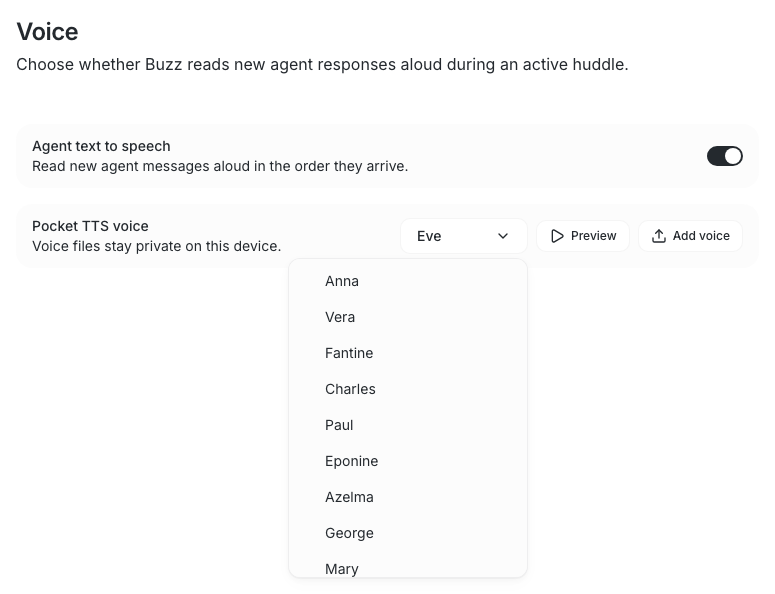
Add a Pocket voice import flow to Voice settings. Buzz opens the native
file picker, decodes common audio formats in the reusable `buzz-voice`
crate, canonicalizes the selected audio, stores it under a
content-derived identity in app data, selects it, and lets the user
delete it later.
## Changes
- Accept WAV, M4A, MP3, FLAC, OGG, and AIFF files between 2 and 30
seconds, including multichannel sources.
- Decode and downmix accepted audio to canonical mono 32 kHz PCM16 WAV
before hashing and storage.
- Store imported voices behind stable `pocket:imported:<sha256>`
identities and content-addressed files.
- Keep absolute file paths inside the native process and expose only
voice metadata to React.
- Include imported voices in Pocket preview and live huddle playback.
- Add Add voice and delete controls while preserving the bundled Pocket
voice catalog.
- Fall back to Mary when the selected imported voice is deleted.
- Keep durable import, selection, and deletion successful when a live
TTS worker acknowledgement is delayed.
- Preserve bundled voices when optional import metadata is unreadable
and keep failed deletion retryable.
## Related issue
None found.
## Testing
Production decoding was exercised with WAV, M4A with AAC, MP3, FLAC, OGG
Vorbis, and AIFF fixtures. Each format canonicalized to mono 32 kHz
PCM16 WAV. Manual validation in the combined daily-driver build covered
native-picker import, Preview, live-huddle playback, deletion, and Mary
fallback.
## Screenshots
The Voice settings card preserves the bundled Pocket catalog and adds
the local Add voice action.
## Reviewer-reproducible examples
Create common-format fixtures and run them through the production
importer:
```bash
. ./bin/activate-hermit
fixtures="$(mktemp -d)"
ffmpeg -hide_banner -loglevel error -f lavfi -i "sine=frequency=220:duration=3" -ac 2 -ar 44100 "$fixtures/voice.wav"
ffmpeg -hide_banner -loglevel error -i "$fixtures/voice.wav" -c:a aac "$fixtures/voice.m4a"
ffmpeg -hide_banner -loglevel error -i "$fixtures/voice.wav" "$fixtures/voice.mp3"
ffmpeg -hide_banner -loglevel error -i "$fixtures/voice.wav" "$fixtures/voice.flac"
ffmpeg -hide_banner -loglevel error -i "$fixtures/voice.wav" -c:a libvorbis "$fixtures/voice.ogg"
ffmpeg -hide_banner -loglevel error -i "$fixtures/voice.wav" -c:a pcm_s16be "$fixtures/voice.aiff"
BUZZ_VOICE_IMPORT_TEST_DIR="$fixtures" \
cargo test -p buzz-voice imports_common_audio_format_fixtures -- --ignored --nocapture
```
Exercise import persistence, synthesis, deletion, and bundled-voice
fallback with an installed Pocket model:
```bash
BUZZ_POCKET_MODEL_DIR=/path/to/pocket-model-bundle \
cargo test -p buzz-voice --test pocket_import_audio \
objective_import_synthesis_delete_and_mary_fallback \
-- --ignored --nocapture
```
Exercise the native-picker boundary, selection, preview dispatch,
deletion, cancellation, and invalid-file states:
```bash
cd desktop
pnpm build:e2e
pnpm exec playwright test tests/e2e/voice-settings.spec.ts --project=smoke
```
---------
Signed-off-by: John Tennant <jtennant@block.xyz>
Signed-off-by: John Tennant <johnmatthewtennant@gmail.com>
Signed-off-by: John Tennant <jtennant@squareup.com>
Signed-off-by: npub1qyvc0c5kl4gqv2fd97fsk46tu378sqgy35vc83rvgfwne90sel7s0ed67d <011987e296fd5006292d2f930b574be47c7801048d1983c46c425d3c95f0cffd@buzz.block.builderlab.xyz>
Signed-off-by: npub12gtutshhh76rx0jx697f32f9tffd4hhp3hx58fp4x6u4uemkm7sqf8f757 <5217c5c2f7bfb4333e46d17c98a9255a52dadee18dcd43a43536b95e6776dfa0@buzz.block.builderlab.xyz>
Co-authored-by: John Tennant <jtennant@block.xyz>
Co-authored-by: npub1qyvc0c5kl4gqv2fd97fsk46tu378sqgy35vc83rvgfwne90sel7s0ed67d <011987e296fd5006292d2f930b574be47c7801048d1983c46c425d3c95f0cffd@buzz.block.builderlab.xyz>
Co-authored-by: npub12gtutshhh76rx0jx697f32f9tffd4hhp3hx58fp4x6u4uemkm7sqf8f757 <5217c5c2f7bfb4333e46d17c98a9255a52dadee18dcd43a43536b95e6776dfa0@buzz.block.builderlab.xyz>
Relands **#2467** (extract `buzz-voice` crate) and **#3208** (Pocket
voice settings) onto main, after #3266 and #3180 merged.

## Why a fresh PR
The repo is squash-only with delete-branch-on-merge. Squashing #3266
deleted `jtennant/pocket-tts-2026-04`, which was #2467's base — GitHub
auto-closed #2467 and it cannot be reopened. Squash merges also sever
ancestry, so GitHub's natural merge-base reports phantom conflicts for
the whole remaining stack.

## Content provenance
- Byte-identical to the blessed `jt/buzz-voice-refactor` branch
(`93029c577`, tree `6729e0eff` — reviewed by Dawn (#2467) and Max
(#3208) at exact heads) **except** the three files where #3180 and #3208
genuinely interact.
- Three-file resolution (union of both sides):
- `huddle/mod.rs` — #3180's pipeline re-exports + #3208's
`agent_tts_routing` imports.
- `huddle/state.rs` — `reset_preserving_generation` preserves both
`huddle_generation` (#3180) and `tts_enabled` (#3208); test sets merged
into one `tests` module.
- `desktop/src/testing/e2eBridge.ts` — both switch arms kept; no
duplicate case labels.

## Verification at cf32dacd7
- `cargo test` (desktop/src-tauri, pinned 1.95.0): **2047 + 3 pass / 0
fail** (14 ignored: 8 keychain, 4 real_relay, 2 flag-gated)
- `cargo clippy --all-targets -- -D warnings`: clean; `cargo fmt
--check`: clean
- `cargo check --workspace` (root, includes new `buzz-voice` member):
clean; `cargo test -p buzz-voice`: 5/0
- `pnpm test`: **3885 / 0**; `tsc --noEmit`: clean; lint: clean

The 3180×3208 interaction resolution is getting an independent team
re-review before merge.

Buzz channel: buzz-desktop-voice `fd5fb402-b651-4238-89b1-bb3e2fa4dc96`,
thread `b4798ecc`.

Signed-off-by: npub1qyvc0c5kl4gqv2fd97fsk46tu378sqgy35vc83rvgfwne90sel7s0ed67d <011987e296fd5006292d2f930b574be47c7801048d1983c46c425d3c95f0cffd@buzz.block.builderlab.xyz>
Co-authored-by: npub1qyvc0c5kl4gqv2fd97fsk46tu378sqgy35vc83rvgfwne90sel7s0ed67d <011987e296fd5006292d2f930b574be47c7801048d1983c46c425d3c95f0cffd@buzz.block.builderlab.xyz>
## Context

Buzz Desktop currently installs an older Pocket TTS model bundle. The
current
bundle changes the tokenizer, learned BOS input, recurrent-state
contract, and
prompt behavior, so updating download URLs alone is not compatible.

## Summary

This PR upgrades Buzz Desktop to the current pinned Pocket TTS model. It
preserves existing product behavior and the hard 50-token model-input
limit
while adding the required runtime support, verified acquisition, and
crash-safe
cache migration.

## Changes

- Pins an immutable Pocket TTS revision, artifact names, exact byte
sizes,
  SHA-256 checksums, Mary reference voice, and license.
- Loads the bundle-matched SentencePiece tokenizer, learned BOS
embedding, and
  bundle-declared recurrent states.
- Uses one pinned Pocket TTS configuration; no precision or
model-version
  selector is added.
- Preserves the resident engine's exact `<= 50` token contract without
changing
  Desktop segmentation policy.
- Bumps the Pocket cache manifest to v4, verifies size and checksum
before
adoption, atomically swaps the cache, and recovers the last verified
cache
  after interrupted installs, including an incomplete final directory.
- Keeps acquisition, cache migration, worker adoption, and tests within
the
  existing Desktop implementation.
- Removes the obsolete model-quality harness, which was coupled to the
  superseded production prompt and model layout.

## Related issue

None.

## Testing

Manual listening completed on the exact Desktop build. The updated model
improved speech quality and resolved the phrase-start and sample-onset
artifacts. Reproducible integrity and model checks are below.

## Screenshots

N/A. This changes model installation and speech synthesis, not a visual
surface.

## Reviewer-reproducible examples

### Before and after model identity

```sh
git show 35305bfc8fd456ca9a17caa1ddbfaabd87d46981:desktop/src-tauri/src/huddle/models.rs \
  | grep -E 'sherpa-onnx-pocket-tts|TTS_MODEL_VERSION'

git show 211d17c58567448fe7ac95c4fa0ad2b88378849a:desktop/src-tauri/src/huddle/pocket_models.rs \
  | grep -E 'MODEL_REPOSITORY|MODEL_REVISION|MODEL_PRECISION|MAX_TOKENS'
```

The target branch identifies the January bundle. The PR branch
identifies the
immutable April revision, INT8 precision, and 50-token maximum.

### Deterministic runtime validation

Use the pinned artifacts listed in `pocket_models.rs` and run the
model-dependent Pocket tests with the model directory supplied by the
test environment. The checked-in long-sentence fixture must preserve its
expected 48 and 44 token split and produce non-silent PCM.

### Manual listening validation

John listened to an untrimmed Pocket TTS onset-stress clip generated
from the exact user-provided passage, with every sentence synthesized
separately and identical 100 ms digital-silence boundaries. The clip
used no leading period, onset trimming, gain adjustment, or loudness
normalization.

The updated model produced better-quality speech and resolved the
start-of-sample artifacts.

---------

Signed-off-by: John Tennant <jtennant@block.xyz>
Signed-off-by: npub1mprnacetjua2xx3p5eddmhxyk6wv929ymm5py8kd2xfxurxahspqqlgyta <d8473ee32b973aa31a21a65adddcc4b69cc2a8a4dee8121ecd51926e0cddbc02@buzz.block.builderlab.xyz>
Co-authored-by: John Tennant <jtennant@block.xyz>
Co-authored-by: npub1mprnacetjua2xx3p5eddmhxyk6wv929ymm5py8kd2xfxurxahspqqlgyta <d8473ee32b973aa31a21a65adddcc4b69cc2a8a4dee8121ecd51926e0cddbc02@buzz.block.builderlab.xyz>
**Category:** new-feature
**User Impact:** Users can create, download, and verify a
password-protected backup of their private identity from desktop
Settings.

**Problem:** Buzz does not currently give signed-in users a
Settings-based path to protect or validate their private identity
independently of onboarding. **Solution:** Add a focused backup menu to
the private-key row, keep encryption and verification local in Rust, and
preserve completed encrypted backups briefly so native saves can be
retried without repeating encryption.

<details>
<summary>File changes</summary>

**desktop/src/features/settings/**
Adds the background backup lifecycle, create and test dialogs,
private-key menu integration, password handling, and focused unit
coverage.

**desktop/src/features/onboarding/ui/NsecMaskedDisplay.tsx**
Extends the masked private-key display with reusable overflow-menu
actions used by Settings.

**desktop/src/app/App.tsx**
Mounts the backup provider at app scope so encryption and save work
survive closing Settings or the modal.

**desktop/src/shared/api/tauriIdentity.ts**
Adds typed desktop bindings for local backup creation, save, selection,
and verification.

**desktop/src-tauri/src/key_backup.rs and
desktop/src-tauri/src/commands/identity.rs**
Implements local NIP-49 encryption, password generation, file handling,
and public-identity-only verification results.

**desktop/src-tauri/src/egress_guard.rs and guarded call sites**
Blocks encrypted secret material from relay, websocket, snapshot,
sharing, and huddle egress paths.

**desktop/src-tauri tests and fixtures**
Covers encryption, verification, file behavior, and fail-closed
no-egress protections.

**desktop/src/testing/e2eBridge.ts, desktop/tests/, and
desktop/playwright.config.ts**
Expands the mock native bridge and browser coverage across create,
retry, expiry, and current/different-identity verification states.

**desktop/src-tauri/Cargo.toml, Cargo.lock, and assets**
Adds the local cryptography/password-generation dependencies and
embedded short-word list.

</details>

## Reproduction steps

1. Run the desktop app and open **Settings → Profile → Identity**.
2. Open the private-key overflow menu and choose **Create backup**.
3. Enter or generate a valid password, submit, and confirm progress
continues if the dialog or Settings is closed.
4. Save the resulting `.ncryptsec` file; cancel and retry to confirm the
temporary download remains available.
5. Choose **Test backup**, select the file, enter a wrong password, then
retry with the correct password.
6. Confirm success identifies whether the backup matches the current
identity and displays only the public `npub`.

## Screenshots

| Settings identity | Private-key menu | Create backup |
|---|---|---|
| <img width="1280" height="720" alt="image"
src="https://github.com/user-attachments/assets/981e391b-6829-4081-95ca-ca75a369de71"
/> | <img width="1280" height="720" alt="image"
src="https://github.com/user-attachments/assets/7972c68e-7635-47d8-b0ad-9639390d3e6c"
/> | <img width="1280" height="720" alt="image"
src="https://github.com/user-attachments/assets/4709c8f7-cf02-46f1-bec9-b3f98fe56fb2"
/> |

| Encrypting | Download available | Test success |
|---|---|---|
| <img width="1280" height="720" alt="image"
src="https://github.com/user-attachments/assets/1ac3e934-2b4b-4135-bae6-126c715c8c59"
/> | <img width="1280" height="720" alt="image"
src="https://github.com/user-attachments/assets/cb6f07ee-a16f-44a5-b9a0-6b9fe0e4d40d"
/> | <img width="1280" height="720" alt="image"
src="https://github.com/user-attachments/assets/ea58b1b1-966c-46aa-8d59-92c9f06a25bd"
/> |

Visual review and additional states: [Buzz
thread](buzz://message?channel=50ca7ef1-201e-4159-9499-40de3964b7c3&id=87eceb5f0f82fd50c32e560de3d35be48e293760f6620718aafdcef289d475fe)

---------

Signed-off-by: Taylor Ho <taylorkmho@gmail.com>
Co-authored-by: npub1223z34hd7vtwc6qj4s7flsxkj644nlre2nthu7lrrmkumhu3xddsrx9r6w <52a228d6edf316ec6812ac3c9fc0d696ab59fc7954d77e7be31eedcddf91335b@buzz.block.builderlab.xyz>
## Summary

This is **part 1 of 2** split out from #3467 (per Tyler's request),
carrying only the mesh-scoped changes. The agent/ACP response-behavior
changes and the new `send_message` tool stay in #3467 as part 2. All
commits are @michaelneale's work, cherry-picked with authorship
preserved.

- Upgrade embedded Mesh to v0.74.0 (tag-pinned instead of commit rev)
and use canonical Gemma model IDs.
- Keep shared compute serving through member joins, roster changes, app
recovery, and community switching.
- Wait for actual model readiness and avoid resuming incomplete
downloads after quit.
- Leave `BUZZ_AGENT_THINKING_EFFORT` unset by default so each model's
chat template picks its own thinking default (`none` suppressed Gemma
tool-calling entirely; pinning `low` made Qwen3 burn ~4x output budget).
Explicit agent/persona/global values still win.

## Relationship to #3467

Contains the mesh commits from #3467 (`2cd640b23`, `0ad81c341`,
`ad13ed841`) rebased onto current main, with one deliberate exclusion:
the `crates/buzz-agent/src/llm.rs` reasoning→text parser change from
`2cd640b23` is **not** here. That change unconditionally affects every
OpenAI-compat/Responses provider, so it belongs with the reply-behavior
work in part 2, where it can be reviewed as what it is.

Not included (remaining in #3467 / part 2):
- typed `send_message` tool in dev-mcp + `BUZZ_ACP_SEND_MESSAGE_TOOL`
gating
- plain-reply delivery fallback in buzz-acp
(`BUZZ_ACP_DELIVER_PLAIN_REPLIES`)
- the mesh_agent_e2e P5/P6 rewrite (exists to prove the reply path)
- the two `env.insert` preset opt-ins in `relay_mesh.rs` for the flags
above
- the llm.rs parser change

This PR is independently mergeable; part 2's flags are all off by
default so it can land before or after.

## Testing

- `cargo test -p buzz-relay --locked` — 780 passed (one telemetry test
is order-sensitive under parallel default settings; passes in the
pre-push suite and standalone, unrelated to this diff — files untouched
here).
- `just desktop-tauri-test` (default features) — 1877 passed.
- `cargo test --locked --features mesh-llm` in `desktop/src-tauri` —
1961 passed, including the new relay-mesh preset and
coordinator/recovery tests.
- Both `Cargo.lock`s resolve with `--locked` against the v0.74.0 tag.
- Full pre-push hook suite green (rust-tests, desktop-check/test, tauri
checks).

Live validation of the mesh v0.74 upgrade itself is documented on #3467
(two-Mac cross-version test).

---------

Signed-off-by: Michael Neale <michael.neale@gmail.com>
Signed-off-by: Tyler Longwell <tlongwell@block.xyz>
Co-authored-by: Michael Neale <michael.neale@gmail.com>
Co-authored-by: Tyler Longwell <tlongwell@block.xyz>
Microphone/camera capture works on macOS (WKWebView) and Windows
(WebView2) but fails on Linux with `NotAllowedError`. WebKitGTK ships
with `enable-media-stream` off and a default `permission-request`
handler that denies every request.

This reaches the underlying `webkit2gtk::WebView` from
`on_webview_ready` and enables `enable-media-stream`, then installs a
**deny-by-default** `permission-request` handler: a `UserMedia` request
is allowed only from a trusted app origin (`tauri://localhost` in prod,
the Vite dev origin in debug) **and** when it targets an audio/video
device — everything else is denied. No-op on macOS/Windows.

- `webkit2gtk` is pinned to the version wry already uses (`=2.0.2`) so
there's a single shared copy of the native binding.

---------

Signed-off-by: Beckley <mattcbeckley@gmail.com>
## Summary

- Add a **macOS-only** monochrome Buzz menu-bar icon with **Running**
and **Recent** agent sections.
- Show each agent as one selectable macOS row with `Name · elapsed` and
its channel underneath.
- Keep completed work available for quick channel re-entry, alongside
New Channel, Open Buzz, and Quit Buzz.
- Keep the main window alive on close and restore it from both the menu
bar and the macOS Dock.
- Fence queued channel actions by community generation so an in-flight
action from the previous community cannot navigate the newly selected
community.
- Leave Windows and Linux unchanged; cross-platform tray lifecycle
support can follow with platform-specific validation.

<img width="812" height="760" alt="Buzz macOS agent menu"
src="https://github.com/user-attachments/assets/19bfd874-8f06-4496-bdda-7ed2e7b5733f"
/>

## Validation

- `cargo fmt --check`
- Desktop Tauri suite: 1,860 passed, 14 ignored after merging current
`main`
- Desktop tests: 3,769 passed
- Desktop lint, file-size, text, and pubkey checks pass (two
pre-existing informational template-literal notices)
- Regression coverage verifies stale `OpenChannel` actions are discarded
across community changes while `NewChannel` survives

## Manual validation remaining

A native macOS smoke test is still requested before merge: menu
appearance, elapsed updates, Running → Recent, channel navigation, New
Channel, minimized/closed/Dock restore, Open Buzz, and Quit. E2E stubs
the tray IPC and does not exercise the native menu.

---------

Signed-off-by: kenny lopez <klopez4212@gmail.com>
Signed-off-by: Wes <wesbillman@users.noreply.github.com>
Co-authored-by: Wes <wesbillman@users.noreply.github.com>
Co-authored-by: Carl <c7ebe626f000404285d3686e1dc74cc07cc60a9754a150041ba132e14bd3e2ec@buzz.block.builderlab.xyz>
Goose's pre-[#2680](https://github.com/block/buzz/pull/2680) Windows
installer unpacked the CLI to `%USERPROFILE%\goose\goose.exe`. That
directory is on no standard `PATH`, and `common_binary_paths()` never
probed it, so users who installed Goose with the legacy installer stayed
permanently undiscovered — the residual half of #2239.

`resolve_command_uncached` finds binaries outside `PATH` only by
scanning `common_binary_paths()`, so adding the directory there is the
whole fix: Windows basename expansion already supplies
`goose.exe`/`.cmd`/`.bat`, and discovery, readiness probes, and spawn
all route through the same shared resolver. No Goose-specific resolution
path is introduced. The entry sits beside the existing Codex
`%LOCALAPPDATA%\Programs\OpenAI\Codex\bin` probe in the same
`#[cfg(windows)]` block.

The regression test is `#[cfg(windows)]` and is CI-reachable, not dead
code — the `desktop-build-windows` job runs `cargo test --manifest-path
desktop/src-tauri/Cargo.toml --target $env:TARGET` on `windows-latest`.
It asserts the probe list rather than planting a binary:
`common_binary_paths` is a process-lifetime `OnceLock`, so a test cannot
deterministically re-seed `USERPROFILE`, and planting an executable
under the real user profile is not an acceptable side effect. Verified
locally by widening the `cfg` to build on macOS — the test passes with
the probe and fails without it.

The `check-file-sizes.mjs` override for `managed_agents/discovery.rs`
moves 1835 → 1841, the exact post-`cargo fmt` gate count. Verified both
directions: 1841 passes, 1840 fails.

Signed-off-by: Will Pfleger <pfleger.will@gmail.com>
## Summary

`cargo-deny` started failing on **every** PR and on `main` when
**RUSTSEC-2026-0216** was published mid-afternoon today. Nothing in the
tree changed — cargo-deny fetches the advisory DB at run time, so main's
own `Security` job passed at `00ecf2c` and then began failing on the
same commit.

```
error[vulnerability]: Remote Denial of Service via malformed NIP-44 v2 payload
  Cargo.lock:432  nostr 0.44.3  —  RUSTSEC-2026-0216
advisories FAILED, bans ok, licenses ok, sources ok
```

The `nostr` NIP-44 v2 decrypt path reads a 2-byte unpadded-length prefix
via `buffer[0..2]` **after** the HMAC check passes, without verifying
the decrypted buffer holds 2 bytes. A sender who holds the conversation
key — i.e. any DM sender — can craft a payload that decrypts to 0 or 1
bytes and panic the receiver. Remote DoS through any relay that delivers
the event. No key material, plaintext, or memory corruption.

Affects `0.26.0` through `0.44.4`. Fixed in `0.44.5`.

## The change

Lockfiles only, 6 insertions / 6 deletions. The manifest already
declares `nostr = "0.44"` — a caret range — so `0.44.6` needs no
`Cargo.toml` edit.

| Lockfile | Before | After |
|---|---|---|
| `Cargo.lock` | 0.44.3 | 0.44.6 |
| `desktop/src-tauri/Cargo.lock` | **0.44.4** | 0.44.6 |

**The desktop lockfile is the part worth reviewing.**
`desktop/src-tauri` is excluded from the root workspace
(`Cargo.toml:31`), and the `Security` job runs `cargo-deny check` at the
repo root — so it never sees that lockfile. It was pinning a vulnerable
*and* yanked `0.44.4` that no CI check would ever have flagged. Desktop
calls `nip44::decrypt` at `commands/identity.rs:495`. Credit to @Eva for
catching this; I'd have shipped the root-only fix and left it sitting
there.

**This isn't optional maintenance.** `0.44.0` through `0.44.4` are all
yanked on crates.io. `0.44.5` and `0.44.6` are the only live versions in
our range — staying put isn't an available option.

### On the two extra lines in the desktop lockfile

The desktop bump also repoints two existing dependency edges:

```
nostr-derive: syn 2.0.118 -> syn 1.0.109
tempfile:     getrandom 0.4.3 -> getrandom 0.3.4
```

I checked these rather than waving them through: **no packages are added
or removed** — both versions were already present in the graph, so only
which edge points where changed. The resolution is stable across
repeated re-resolves, and a plain re-resolve without the bump produces
zero diff, so this isn't pre-existing lockfile staleness leaking in.

## Verification

At this commit, in a clean worktree off `origin/main`:

- `cargo-deny check advisories` → **`advisories ok`**, exit 0. The same
tree before the bump reported `advisories FAILED` with this advisory, so
the check is doing real work, not passing vacuously.
- `./scripts/run-tests.sh unit` → all five packages pass.
- `cargo test -p buzz-core` 229/229, `-p buzz-cli` 250/250, `-p
buzz-relay --lib` 750 pass / 1 fail — the sole failure
`api::mesh_demo::tests::demo_join_forwarded_arm_round_trips_echo` is
pre-existing and reproduces identically at unmodified `00ecf2c`.
- `desktop-tauri-test` passed in the pre-push hook, which exercises the
crate whose lockfile changed.

## Why not a `deny.toml` ignore

Considered and rejected. This is a reachable panic triggerable by any DM
sender, and buzz-acp agents decrypt DMs from arbitrary senders.
Suppressing it would ship a live remote-DoS to every agent and client in
order to make a dashboard green.

## Note on `spin`

The yanked `spin 0.9.8` / `0.10.0` warnings in the same job are **not**
what fails CI — the log has exactly one hard error, this one. They're
`warning[yanked]`, and warnings don't fail the build. `spin` is also
three levels transitive (`mesh-llm-host-runtime → mdns-sd → flume →
spin`) under a dev-dependency, so it isn't ours to bump. Left alone
deliberately.

## Follow-up

Unblocks #3128 (relay-admin ban gate), which has a zero dependency-file
delta and will inherit this cleanly once main is merged in.

Co-authored-by: Tyler Longwell <tlongwell@block.xyz>
Signed-off-by: Tyler Longwell <tlongwell@block.xyz>

Signed-off-by: Tyler Longwell <tlongwell@block.xyz>
Co-authored-by: npub1jmc9dt2lyvzu3h0kxlwxt5zg4fxp9476awyxw6gwxn72g6cw7exqs64whm <96f056ad5f2305c8ddf637dc65d048aa4c12d7daeb8867690e34fca46b0ef64c@buzz.block.builderlab.xyz>
Co-authored-by: Tyler Longwell <tlongwell@block.xyz>
Uses MeshLLM built-in `mesh` collective intelligence / Mixture of Agents
when Buzz Auto sees two or more distinct physical models. With zero or
one model, Auto remains ordinary `auto`. This is an alternative way to
improve tool responses, accuracy, and resistance to hallucination when a
high-latency distributed mesh contains diverse models.

Models and members may come and go: collective routing enables only
after stable capacity, drops on confirmed contraction, and can recover
later. Mesh-specific failures retry once through ordinary Auto.

This update also pins MeshLLM to a v0.73.1-compatible backport of
[MeshLLM #1074](https://github.com/Mesh-LLM/mesh-llm/pull/1074), so
client-only Buzz nodes cannot enter model election or download a remote
provider model. Buzz preserves the selected local sharing model and
switches an existing client to sharing across a controlled app restart,
retaining one runtime and one `:9337` / `:3131` pair per machine.

Validation:
- Full local `just ci` passes on the cleaned branch.
- MeshLLM host-runtime suite: 1,568 passed, 0 failed; strict Clippy
passes.
- Buzz desktop Tauri suite with `mesh-llm`: 1,721 passed, 0 failed;
strict feature Clippy passes.
- Playwright covers client-to-share using the saved local model and no
destructive stop.
- Packaged two-machine testing proved single-model routing, dual-model
collective routing, tool-markup fallback, and runtime reuse.
- Packaged client-only recheck routed a real Mini Buzz turn through M5
while Mini stayed `is_client=true`, `is_host=false`, hosted no models,
and created no Gemma cache.

Builds on the recovery work merged in #2823; this PR does not duplicate
it.

---------

Signed-off-by: Michael Neale <michael.neale@gmail.com>
Signed-off-by: Tyler Longwell <tlongwell@block.xyz>
Co-authored-by: Michael Neale <michael.neale@gmail.com>
Co-authored-by: npub1qyvc0c5kl4gqv2fd97fsk46tu378sqgy35vc83rvgfwne90sel7s0ed67d <011987e296fd5006292d2f930b574be47c7801048d1983c46c425d3c95f0cffd@buzz.block.builderlab.xyz>
Co-authored-by: Tyler Longwell <tlongwell@block.xyz>
Fixes#2896
**Root cause:** `arboard = "3"` compiles with default features only
(`image-data`), so the Linux build has no Wayland backend. In a Wayland
session every copy lands on the XWayland clipboard; the compositor only
mirrors X11 selections while an XWayland window holds focus, and
arboard's clipboard client is windowless, so Wayland-native apps read
nothing. `set_text` still returns `Ok`, which is why the invite dialog
shows "Copied" with an empty clipboard.
**Fix:** enable arboard's `wayland-data-control` feature. Under Wayland
it uses the `zwlr-data-control` protocol; when `WAYLAND_DISPLAY` is
absent it falls back to X11 as before. The `wl-clipboard-rs` dependency
is target-gated inside arboard, so macOS and Windows builds are
unchanged.
**Verified:** `cargo check` passes on the desktop crate; wl-clipboard-rs
now resolves in the lockfile.
Signed-off-by: Shawn Yeager <shawn@shawnyeager.com>

