mirror of
https://github.com/block/buzz.git
synced 2026-11-28 04:01:45 +00:00
cb4a73e17d0760eba6c3c01811da07e1d3a6b85e
285 Commits
| Author | SHA1 | Message | Date | |
|---|---|---|---|---|
 Will Pfleger |
f86dfc5883 |
feat(desktop): surface config diff in restart-required badge (#3637)
The "Restart required" badge reports that an agent's running config has
drifted from its spawn-time config, but never says what changed. This
ships the full feature: a typed Rust diff engine and a TS/UI layer that
renders it at every badge site.

## Rust core (spawn-snapshot diff engine)

Replaces the lossy `u64` `spawn_config_hash` with a typed
`SpawnConfigSnapshot`. The snapshot is stamped from the already-resolved
command/env/config values immediately before `spawn()`, closing the race
window where a mid-spawn config edit would suppress the badge.

`SpawnConfigSnapshot::canonical()` is the single JSON projection shared
by the badge and the diff. Drift is `to_value(stamped) !=
to_value(current)`; the diff is a generic leaf walk over those same two
values, so badge-on and diff-non-empty are structurally guaranteed.
Adding a snapshot field reaches the UI with no code change to the diff
engine — `mutation_table_covers_every_serialized_field` fails CI if a
new field arrives without a mutation row.

`eligible_restart_diff(persona_orphaned, Option<TrackedSpawnState>)`
returns the final vector — snapshot walk entries plus a synthetic
`adapter_availability` entry. It returns empty for an orphaned instance
(spawning one would fail) and for agents with no tracked spawn state
(never stamped, can never have drifted). `needs_restart =
!restart_diff.is_empty()` derives from that vector and nothing else.

Redaction policy (`policy_for(path)`) is shared by the wire diff and the
snapshot's manual `Debug` via `is_safe_to_reveal()` from
`managed_agents::env_vars` as the single authority for env-key masking:

| Policy | Paths | Rendering |
|---|---|---|
| `Text` | `system_prompt`, `team_instructions` | character counts only
|
| `MaskedBare` | `args`, `relay_url` | `••••`, no suffix |
| `MaskedSuffix` | non-allowlisted `env.*` | `••••` + last 4 chars when
longer than 8 |
| `Plain` | allowlisted `env.*` (`BUZZ_AGENT_THINKING_EFFORT`,
`BUZZ_AGENT_PROVIDER`, `BUZZ_AGENT_MODEL`, `DATABRICKS_HOST/MODEL`) and
everything else | verbatim |

Default-deny: every env key not in the explicit allowlist stays masked.
`is_safe_to_reveal()` is the single allowlist authority for both the
baked-env display and the diff.

`restart_diff` is omitted from the wire when empty
(`skip_serializing_if`).

## TypeScript / UI layer

New `restartDiff.ts` module defines `RestartDiffEntry`, `RestartChange`,
`JsonValue`; `tauri.ts` and `types.ts` re-export and add `restart_diff`
/ `restartDiff` fields (Rust omission → `restartDiff: []`).

**`RestartDiffBadge`** — hover tooltip capped at 6 entries + "and N
more", `asChild` span trigger (never inside a `<button>`), auto-restart
blurb below the diff list (on/off variant from `autoRestartEnabled`
prop; same `AUTO_RESTART_ON_BLURB` / `AUTO_RESTART_OFF_BLURB` constants
shared with the Runtime-tab banner). **`RestartDiffList`** renders the
full uncapped list for the Runtime-tab banner with `tooltip`/`inline`
presentation variants for correct foreground in both surfaces.

**`ManagedAgentRow` B4 fix** — badge moved to a sibling `div` of the row
expansion button; tooltip trigger has no `button` ancestor.

**`UnifiedAgentsSection`** — both badge sites render
`<RestartDiffBadge>` instead of a raw `<Badge>`, with
`autoRestartEnabled` threaded from `agent.autoRestartOnConfigChange`.

**Side-panel fix** — `RestartDiffBadge` rendered tab-independently in
the `ProfileSummaryView` hero area (was Runtime-tab only — root cause of
the ~50% inconsistency Will reported). Hero badge is `self-center` in
the flex column. `ProfileRuntimeTabContent` early-return checks
`needsRestart` so the banner is never dropped when all other content is
empty. Auto-restart blurb in the Runtime-tab banner uses the shared
constants.

## Wire shape

```jsonc
"restart_diff": [
  { "field": "model",              "change": { "kind": "value",  "before": "gpt-5", "after": "claude-4" } },
  { "field": "system_prompt",      "change": { "kind": "text",   "before_chars": 1234, "after_chars": 1410 } },
  { "field": "env.OPENAI_API_KEY", "change": { "kind": "masked", "before": "••••bc12", "after": "••••xyz9" } },
  { "field": "env.BUZZ_AGENT_THINKING_EFFORT", "change": { "kind": "value", "before": "medium", "after": "high" } }
]
```

`added`/`removed` occur only for dynamic-map keys; nullable struct
fields always serialize as `null`; arrays are atomic leaves (`args`,
never `args.0`).

## Tests

**Rust** — 1902 passing: snapshot mutation coverage, diff entry
serialization, allowlist-aware env masking
(`allowlisted_env_key_shows_plain_value`,
`allowlisted_env_key_is_case_insensitive`,
`non_allowlisted_env_key_stays_masked`),
`unstamped_agent_yields_no_badge_and_no_entries` (both orphan values),
`summary_without_drift_omits_restart_diff_from_the_wire`,
`unstamped_availability_is_not_drift`. Clippy clean, fmt clean.

**TypeScript** — `needs-restart-screenshots.spec.ts`: 11 E2E cases
registered in the smoke project — all three badge sites, tooltip +
keyboard focus, DOM no-button-ancestor assertion, 6+1 truncation,
uncapped Runtime list, unknown field humanisation, side-panel badge on
default Info tab, inactive/friendly-error Runtime opening path.

Consolidates [#3652](https://github.com/block/buzz/pull/3652)

Signed-off-by: Will Pfleger <pfleger.will@gmail.com>
Co-authored-by: npub1mn7jgtj4w2pd0g0zeuhxsa6jy6p0rewxz4kujt98my82ahfmp72sxjexk7 <dcfd242e557282d7a1e2cf2e6877522682f1e5c6156dc92ca7d90eaedd3b0f95@buzz.block.builderlab.xyz>
|
||
|
klopez4212
|
b29c8cdaa4 |
feat(desktop): redesign the Huddle experience (#4281)
## Summary - open Huddles in a focused companion window with a clean handoff back to the in-app drawer and backing channel - redesign the participant film strip, sidebar control, transcript surface, and themed shell treatment - preserve microphone and device control across windows, start agent voice on the first reply, and show agent speaking activity in the film strip - give each agent a distinct session voice, beginning with the configured default, plus compact per-agent text-to-speech and voice controls - enroll only agents explicitly mentioned or deliberately added through an agent panel into the live Huddle roster - keep temporary Huddle channels out of the sidebar unless the user explicitly brings one into the main app - remove Huddle-only avatar policy badges and filter short silence or noise segments before speech-to-text posts ## Why The previous flow exposed the temporary channel as product UI, obscured who was present or speaking, and split transcript and audio state between the main and companion windows. This keeps backing channels as implementation details unless a user explicitly brings a Huddle into the app, while sharing the live conversation and audio lifecycle across both surfaces. Agent participants now join only after an explicit invitation, distinct voices make multi-agent Huddles easier to follow, and short microphone noise no longer becomes stray transcript messages. ## Validation - `pnpm check` - `pnpm build:e2e` - `pnpm exec playwright test tests/e2e/huddle-transcription.spec.ts --project=smoke` (13 passed) - Huddle sidebar visibility unit coverage (4 passed) - focused managed-agent and persona-mention E2E coverage (2 passed) - `pnpm test` (3,910 passed) - `cargo clippy --manifest-path desktop/src-tauri/Cargo.toml --all-targets -- -D warnings` - `cargo test --manifest-path desktop/src-tauri/Cargo.toml` (2,093 passed, 14 ignored; 3 diagnostics passed) --------- Signed-off-by: kenny lopez <klopez4212@gmail.com> Signed-off-by: Wes <wesbillman@users.noreply.github.com> Co-authored-by: Wes <wesbillman@users.noreply.github.com> Co-authored-by: Carl <c7ebe626f000404285d3686e1dc74cc07cc60a9754a150041ba132e14bd3e2ec@buzz.block.builderlab.xyz> |
||
|
Will Pfleger
|
985cdcc6ea |
feat(agents): model-tuning parity in global Agent Defaults editor (#4578)
## Overview

The global Agent Defaults surface (Settings card, defaults modal,
onboarding) exposed structured controls for Effort but left Max Output
Tokens, Context Limit, and Max Rounds as raw env vars. Per-agent dialogs
had structured numeric fields but only for `isBuzzAgentRuntime` —
incorrectly excluding Goose. This PR unifies numeric-tuning capability
across all surfaces, fixes a pre-existing dual-editor defect, and adds
full test coverage.

## What changed

### Phase 1 — Catalog projection

- Add `max_rounds_env_var` to `KnownAcpRuntime` in `runtime_metadata.rs`
(`Some("BUZZ_AGENT_MAX_ROUNDS")` for buzz-agent, `None` elsewhere).
- Project all three numeric env-var fields (`max_tokens_env_var`,
`context_limit_env_var`, `max_rounds_env_var`) end-to-end:
`AcpRuntimeCatalogEntry` Rust struct, TS `types.ts`,
`RawAcpRuntimeCatalogEntry` + `fromRawAcpRuntimeCatalogEntry` in
`tauri.ts`, and the e2e mock bridge (`withMockRuntimeConfigMetadata`).

### Phase 2 — Field model

- `deriveAgentConfigFieldModel` now derives `maxOutputTokens` /
`contextLimit` / `maxRounds` descriptors from catalog-projected fields.
- `structuredEnvKeys(descriptors)` — exported helper that takes the
**rendered** descriptor set (not the whole model). Hidden keys follow
what is actually rendered per surface: global hides effort + all three
numeric keys for buzz-agent / two for Goose; per-agent buzz-agent hides
effort + three numeric keys; per-agent Goose hides only its two numeric
keys. `BUZZ_AGENT_THINKING_EFFORT` stays a visible generic env row
per-agent because no effort control renders there.

### Phase 3 — UI

- Extract `NumericTuningFields` from `buzzAgentModelTuningFields.tsx` as
a shared descriptor-driven component (`descriptors`, `envVars`,
`inheritedEnvVars`, `onEnvVarChange`). Kind-specific minima:
`NUMERIC_KIND_MIN` map (`maxOutputTokens`/`contextLimit`: 1,
`maxRounds`: 0) applied to `<input min>`.
- **Global surface** (`AgentConfigFields.tsx`): deduplicate the
previously duplicated Advanced env-editor block; render
`NumericTuningFields` below the env editor when descriptors exist;
`hiddenKeys` and `bakedGenericRows` exclusions use `structuredEnvKeys`
so structured keys are never double-rendered. Under 1000 lines.
- **Per-agent surfaces** (`EditAgentAdvancedFields`,
`PersonaAdvancedFields`): replace `isBuzzAgentRuntime` as the
numeric-field gate with `deriveNumericDescriptors(selectedRuntime)` from
`agentConfigCore`; hidden keys come from
`structuredEnvKeys(numericDescriptors)` — the same rendered descriptor
set, no local rebuilding (fixes pre-existing dual-editor defect).
Catalog status carried as `RuntimeCatalogStatus` (`loading | ready |
error`); both error and loading withhold structured controls and leave
saved values visible as generic rows, making error distinguishable from
"runtime not capable" (`ready` + no runtime).
- **Dialogs** (`AgentDefinitionDialog`, `AgentInstanceEditDialog`,
callers): `AgentDefinitionDialog` accepts `runtimeCatalogStatus?:
"loading" | "ready" | "error"` (replaces separate
`runtimesLoading`/`runtimesError` booleans); all call sites —
`AgentManagementDialogs`, `AgentsView`, `RequestedAgentCreateDialogs`,
`UserProfilePersonaDialogs` — compute and pass the status.

### Phase 4 — Tests

- `buildRecord` exported from `EnvVarsEditor.tsx` as a pure `(nextRows,
value, requiredKeys, hiddenKeys) => Record<string, string>` helper for
isolation testing.
- **17 new node tests** in `agentConfigCore.test.mjs`:
`deriveNumericDescriptors` (all three fields, partial, undefined
runtime, matches field-model subset); `structuredEnvKeys` per surface
including discriminating Goose per-agent effort-key invariant;
`NUMERIC_KIND_MIN` values.
- **4 new node tests** in `EnvVarsEditor.test.mjs`: hidden tuning key
preserved through generic row edits; runtime-switch then generic edit
(derives both descriptor sets, asserts new-runtime hidden key survives
`buildRecord` via `hiddenKeys` and old-runtime key survives via generic
rows); baked numeric key excluded via `filterBakedGenericRows` with
`numericTuningPlaceholder` assertion; clearing a structured override —
`numericTuningPlaceholder` verifies placeholder text.
- **5 new Playwright tests** in `agent-numeric-tuning.spec.ts` (added to
smoke project `testMatch`): global numeric fields visible for
buzz-agent; global: non-capable runtime hides numeric controls; Goose
per-agent shows `Inherit (16384)` after saving global value through the
UI; delayed catalog: saved values visible as generic rows while loading
then structured controls appear after settle; failed catalog: saved
values remain visible as generic rows (never the "unsupported" empty
state).

## Result

- buzz-agent global defaults: Max output tokens, Context limit, Max
rounds as structured inputs with `Inherit (N)` placeholders from baked
env.
- Goose global defaults: Max output tokens, Context limit as structured
inputs.
- A Goose global value surfaces as `Inherit (<value>)` in the per-agent
Goose edit dialog.
- No structured key is editable in two places on any surface; no
persisted key has zero editors.
- No `runtime.id === "buzz-agent"` comparison decides numeric-field
visibility anywhere — capability flows catalog →
`AcpRuntimeCatalogEntry` → field model → UI.

Signed-off-by: Will Pfleger <pfleger.will@gmail.com>
Co-authored-by: npub1mn7jgtj4w2pd0g0zeuhxsa6jy6p0rewxz4kujt98my82ahfmp72sxjexk7 <dcfd242e557282d7a1e2cf2e6877522682f1e5c6156dc92ca7d90eaedd3b0f95@buzz.block.builderlab.xyz>
|
||
|
Wes
|
d4a4570b97 |
fix(desktop): clarify inherited agent parallelism (#4010)
## Summary - show an unambiguous `App default (10)` inherited state for parallelism in create and edit forms - explain that blank inherits the app default and suppress create-form number steppers that could silently set `1` - align the E2E mint fallback with production while preserving explicit input → definition → app-default precedence ## Why The forms displayed `1` even though an untouched field is omitted and desktop minting materializes `10`. The create-form spinner could also turn blank/inherited into an explicit `1` with one click while leaving the field looking nearly unchanged. ## Testing - `pnpm test` (desktop: 3,886 passed) - `pnpm typecheck` (desktop) - `pnpm check` (desktop) - pre-push `desktop-check` and `desktop-test` --------- Signed-off-by: Wes <wesbillman@users.noreply.github.com> Co-authored-by: Carl <c7ebe626f000404285d3686e1dc74cc07cc60a9754a150041ba132e14bd3e2ec@buzz.block.builderlab.xyz> |
||
|
Taylor Ho
|
5c98932c59 |
feat(desktop): make onboarding model defaults skippable (#3968)
**Category:** improvement **User Impact:** Users can skip default model configuration during onboarding and finish it later in Settings → Agents. **Problem:** Requiring model defaults during onboarding can block users who are not ready to choose a harness, provider, or model. Skipping also needs to leave existing configuration untouched rather than persisting partial selections. **Solution:** Stage onboarding edits locally and persist them only when users choose Next or Back. A delayed Skip action advances without any configuration write, while a footer hint points users to the settings location for completing setup later. <details> <summary>File changes</summary> **desktop/src/features/onboarding/ui/DefaultConfigStep.tsx** Adds the skip action and future-settings hint, and makes model configuration transactional so Skip discards staged changes while Next and Back preserve the intended save behavior. **desktop/src/testing/e2eBridge.ts** Exposes model-config setter call counts so tests can distinguish a true zero-write skip from a write-and-rollback implementation. **desktop/tests/e2e/onboarding-agent-defaults.spec.ts** Covers skipping during loading and after staged edits, verifies zero persistence calls, and confirms Next and Back still commit changes. </details> ## Reproduction steps 1. Start fresh onboarding and continue through harness setup to **Configure your default model settings**. 2. Change the selected harness or model, then choose **Skip for now**. 3. Confirm onboarding advances to **Join or create a community** and the prior global model configuration remains unchanged. 4. Return through onboarding and confirm **Next** saves the staged selection; confirm **Back** also preserves staged changes before returning. 5. Confirm the footer says model defaults can be configured later in **Settings → Agents**. --------- Signed-off-by: Taylor Ho <taylorkmho@gmail.com> Signed-off-by: npub1223z34hd7vtwc6qj4s7flsxkj644nlre2nthu7lrrmkumhu3xddsrx9r6w <52a228d6edf316ec6812ac3c9fc0d696ab59fc7954d77e7be31eedcddf91335b@buzz.block.builderlab.xyz> Co-authored-by: npub1223z34hd7vtwc6qj4s7flsxkj644nlre2nthu7lrrmkumhu3xddsrx9r6w <52a228d6edf316ec6812ac3c9fc0d696ab59fc7954d77e7be31eedcddf91335b@buzz.block.builderlab.xyz> |
||
|
Tyler
|
f865c0054b |
feat(desktop): show saved Run on settings when editing an agent (#4539)
## What When editing an agent, show where it runs. The edit dialog previously showed nothing about the backend; the "Where to run" section only existed in the create flow. This adds a read-only **Run on** section to `AgentInstanceEditDialog`: - **Local agents:** "This computer". - **Provider agents (e.g. Kubernetes):** the provider id plus its saved config rows — context, namespace, image, resources, etc. — with labels humanized from the stored keys and rows in provider-schema order (locators first, request/limit pairs adjacent, alphabetical spillover for unknown providers). - Copy states these are the settings **saved at creation** and that the run location can't be changed afterwards (a new agent is required). ## Design decisions (from thread review with @Wren + @Sami) - **No provider probe on edit.** `info` is executable work, and its schema reflects the plugin *today* (including a freshly generated random namespace default) — not what this agent was deployed with. The stored record is the only honest source. - **Saved settings, not effective settings.** Optional fields a record omits (e.g. `service_account`) are defaulted by the provider at deploy time; we render only what was persisted and never synthesize today's defaults. - **Safe rendering of opaque provider config.** Values render as safe scalars only; arrays/objects degrade to a summary row (React throws on object children — a hand-edited record must not crash the dialog). Falsy-but-present values (`0`, `false`) render honestly. Secret-shaped keys are redacted using the same word-split heuristic as the create-time `validate_provider_config` gate — one definition of "looks like a secret". The gate already blocks such keys on every app write path; display-side redaction is screenshot hygiene and covers hand-edited records. - **`backendAgentId` intentionally excluded:** deploy-time runtime state written on start, not saved creation intent. - **Read-only, no form state.** The backend is immutable post-create (`UpdateManagedAgentRequest` has no backend field), so the section renders straight from `agent.backend` with no reset effect. - `ADVANCED_FIELDS_MOTION_TRANSITION` was duplicated in both agent dialogs; hoisted to `agentConfigOptions` (also keeps the edit dialog inside the file-size ratchet). ## Testing - Unit contract for `summarizeRunOn` (9 tests): scalar honesty incl. `0`/`false`, structured-value fallback, secret redaction fail-safe, preferred ordering with spillover, key humanization. - Playwright spec (4 tests, registered in the smoke project): kubernetes agent with the exact eight-key record a real create flow persisted, local agent, blox agent (`workstation_name`), and redacted secret-shaped keys from a hypothetical future provider. - `pnpm typecheck`, `pnpm check`, full `pnpm test` (3937 pass) green at this head. - Live screenshots posted in the originating Buzz thread. --------- Signed-off-by: Tyler <109685178+tlongwell-block@users.noreply.github.com> Co-authored-by: npub1qyvc0c5kl4gqv2fd97fsk46tu378sqgy35vc83rvgfwne90sel7s0ed67d <011987e296fd5006292d2f930b574be47c7801048d1983c46c425d3c95f0cffd@buzz.block.builderlab.xyz> |
||
|
Will Pfleger
|
5e0efb0bb9 |
fix(desktop): disambiguate provider API key labels and annotate mint key (#4406)
Two different credentials were presented under the same name throughout the app. The top-level credential field for non-Anthropic providers (OpenAI, OpenAI-compatible, OpenRouter) was labeled "OpenAI API Key" via a hardcoded binary ternary repeated in three dialogs. The card-minting key (`OPENAI_API_KEY`) and the runtime credential (`OPENAI_COMPAT_API_KEY`) have independent endpoint namespaces and consumers (`OPENAI_COMPAT_BASE_URL`/`OPENAI_COMPAT_API_KEY` for runtime, `OPENAI_BASE_URL`/`OPENAI_API_KEY` for minting) and must remain separate — either may require a different credential. This PR makes them impossible to confuse in the UI. ## Changes **Provider-accurate labels from the credential table.** `PROVIDER_CREDENTIAL_CONFIG` entries now carry an `apiKeyLabel` paired with `secretEnvVar` as a discriminated union (both present or neither — a future provider cannot ship a secret field with no label). `getProviderApiKeyLabel(providerId)` is the single source of truth. The three hardcoded ternaries in `AgentConfigFields`, `AgentInstanceEditDialog`, and `AgentDefinitionDialog` are replaced by this helper. Labels: `openai` → "OpenAI Runtime API Key", `openai-compat` → "OpenAI-compatible Runtime API Key", `openrouter` → "OpenRouter API Key" (was incorrectly "OpenAI API Key"), `anthropic` → "Anthropic API Key" (unchanged). **Field names its backing env var.** `PersonaProviderApiKeyField` renders the env var name as a monospace hint beneath the label with `aria-describedby` wiring. All three call sites pass their `secretEnvVar`. A user who sees `OPENAI_API_KEY` in the mint dialog can now confirm at a glance that the credential field shows `OPENAI_COMPAT_API_KEY` — a different key. **Signpost visible at the decision point.** `CARD_MINT_KEY_ANNOTATIONS` is exported from `agentConfigOptions.tsx` (single source) and passed as `keyAnnotations` to all three generic env editors: both `EnvVarsEditor` branches in Agent Defaults, `EditAgentAdvancedFields`, and `PersonaAdvancedFields`. `CardMintKeyCue` — a new small component — renders an always-visible muted cue beneath the Advanced toggle when `OPENAI_API_KEY` is present in global env (Advanced is collapsed by default, so the per-row annotation is invisible until the cue guides the user to open it). **Model discovery error copy.** The `OPENAI_COMPAT_API_KEY required` message now reads "Enter an OpenAI runtime API key (OPENAI_COMPAT_API_KEY) to load OpenAI models." — naming the env var explicitly so it cannot be confused with the mint key. ## Tests - `getProviderApiKeyLabel` helper: pinned correct label per provider including the new distinct labels for `openai` and `openai-compat` - `PersonaProviderApiKeyField` render: semantic label present; env-var hint rendered when `envVarName` provided; `aria-describedby` wired to hint id; hint and describedby absent when prop omitted - `EnvVarsEditor` render: annotation appears exactly once on the matching row; absent for non-matching rows - `personaModelDiscoveryStatus`: pinned new copy naming `OPENAI_COMPAT_API_KEY` explicitly - Playwright: stale `"OpenAI API Key"` selectors updated; new `card-mint-key-cue-visible-and-annotation-in-advanced` test covers Will's exact path (databricks_v2 global provider + saved `OPENAI_API_KEY` → cue visible before opening Advanced → annotation present after opening) ## File sizes (post-format) | File | Lines | |------|-------| | `AgentConfigFields.tsx` | 994 (≤ 996) | | `AgentInstanceEditDialog.tsx` | 1228 (≤ 1228) | | `AgentDefinitionDialog.tsx` | 1045 (≤ 1047) | Related: [#4140](https://github.com/block/buzz/pull/4140) --------- Signed-off-by: Will Pfleger <pfleger.will@gmail.com> Co-authored-by: npub1ng3jzsaqxdhrfq22dg85j3lpr0zsh3jp7g2h9jyxl59wraayapnsu6kvfg <9a232143a0336e34814a6a0f4947e11bc50bc641f21572c886fd0ae1f7a4e867@buzz.block.builderlab.xyz> |
||
|
Will Pfleger
|
f810a2f49e |
fix(desktop): make OpenAI key re-enterable after first save in card mint dialog (#4140)
Fixes a write-once dead-end in the card mint dialog where a user with an
expired OpenAI key had no way to replace it.

**Source-aware key status (Rust + TypeScript).** `card_mint_key_status`
returns a layer discriminant (`"none" | "global" | "persona" | "agent" |
"process"`) instead of a boolean. A pure `resolve_key_layer()` helper in
`card.rs` owns the classification logic; `card_mint_key_status`
delegates to it, so the production path is under direct test with no
duplicate logic.

**Mint form always reachable.** The key panel replaces the mint form
only for `none` (first-time setup) or when the user explicitly opens the
edit panel (`editingKey`). Keys from agent/persona/process layers show
an inline provenance row on the mint form with a "Why?" affordance;
clicking it shows the read-only redirect in a panel with a Cancel button
that returns to the mint form — never a terminal state.

**Precise auth-error matching.** The 401 handling in `cardMintStore.ts`
matches `startsWith("Card mint failed (HTTP 401 ")` plus the specific
`Incorrect API key` text, so avatar-fetch 401 errors pass through
unchanged.

**Tri-state key status row.** "Using your saved OpenAI key · Update"
renders only when `keyLayer === "global"` (confirmed writable key).
Query pending or errored hides the row without asserting key existence.

**Real tests.** Panel visibility derivations live in
`cardMintKeyUtils.ts`, which `AgentCardMintDialog.tsx` imports directly.
Tests cover all layers including the mint-reachability invariant (Mint
reachable for every resolved layer; only `none` gates setup).

- `card.rs` — new `resolve_key_layer()` pure helper;
`card_mint_key_status` delegates to it; 999 lines (under the 1000-line
ratchet)
- `card/tests.rs` — precedence test calls `resolve_key_layer()` directly
(no test-local closure); adds process-layer and blank-value cases
- `tauriPersonas.ts` — `CardMintKeyLayer` type; updated
`cardMintKeyStatus` signature
- `cardMintKeyUtils.ts` — `showKeyPanel`, `showReadOnlyRow`,
`showCancelButton`, `keyPanelTitle`, and helpers; component imports all
of them
- `AgentCardMintDialog.tsx` — inline provenance rows for all key
sources; key panel only for setup/edit; no unused variables
- `cardMintStore.ts` — precise 401 prefix matching
- `e2eBridge.ts` — `card_mint_key_status` stub returns `"global"` (not
boolean)
- Tests: 3959 JS passing, 2089 Rust passing, `tsc --noEmit` clean

Related: [block/buzz#4406](https://github.com/block/buzz/pull/4406)

---------

Signed-off-by: Will Pfleger <pfleger.will@gmail.com>
Co-authored-by: npub1ng3jzsaqxdhrfq22dg85j3lpr0zsh3jp7g2h9jyxl59wraayapnsu6kvfg <9a232143a0336e34814a6a0f4947e11bc50bc641f21572c886fd0ae1f7a4e867@buzz.block.builderlab.xyz>
|
||
|
Will Pfleger
|
be95a8a986 |
fix(config-bridge): add harness-definition env tier and fix equal-value model override (#3580)
All seven normalized config fields resolve through sanitized
`InheritedConfigTiers` passed wholesale to `read_config_surface`. The
reader's precedence tiers now match spawn's Layer 2b exactly — including
harness-definition env — and the equal-value model-override regression
is fixed.

## Changes

**`config_bridge/types.rs`** — add `InheritedConfigTiers`: persona env,
global env, harness definition env, structured model/provider/prompt for
both tiers. Add `HarnessDefault` `ConfigOrigin` variant for
harness-definition env values.

**`commands/agent_config.rs`** — `build_inherited_tiers` now resolves
the harness definition env using the same lookup path as spawn
(`record.runtime` → `persona.runtime` → empty string) and applies
`sanitize_inherited_env` to it. `resolve_config_surface` is unchanged in
shape — tiers passed to the reader now include `definition_env`.

**`config_bridge/reader.rs`** — `env_candidates` extended to 4-element
return (record, persona, global, definition). All five field builders
that use env candidates now include the definition-env slot below global
env and above the structured block, matching spawn Layer 2b. Magic
`configured[..6]` slice replaced with `configured[..configured.len()-1]`
(named split: all non-file candidates). Equal-value model-override arm
falls through to the normal resolve path instead of early-returning
`RuntimeOverride`, so the panel shows the baseline origin (e.g.
`BuzzExplicit`) rather than a spurious "Live override" label for a no-op
switch.

**`config_bridge/reader_tests_ext.rs`** — three new Layer 2b tests:
definition env beats structured persona model, global env beats
definition env, reserved-key-absent fallthrough.

**`commands/agent_config_tests.rs`** —
`genuine_explicit_live_switch_to_same_model_yields_clean_field` updated
to assert `origin == BuzzExplicit` (not `RuntimeOverride`); wrapped in
`with_no_goose_config` for hermeticity. New
`reserved_key_in_definition_env_shaped_map_is_stripped_by_sanitize` test
pins the shared sanitization contract.

**`AgentConfigPanel.tsx` / `types.ts`** — `HarnessDefault` origin
variant wired end-to-end: TS union type and provenance sentence
("Inherited from harness definition").

---------

Signed-off-by: Will Pfleger <pfleger.will@gmail.com>
Co-authored-by: npub1mn7jgtj4w2pd0g0zeuhxsa6jy6p0rewxz4kujt98my82ahfmp72sxjexk7 <dcfd242e557282d7a1e2cf2e6877522682f1e5c6156dc92ca7d90eaedd3b0f95@buzz.block.builderlab.xyz>
|
||
|
Tyler
|
2c0ac24674 |
fix(desktop): stop the create-agent provider config probe from erasing keystrokes (#4411)
## What
Fixes the create-agent dialog's "Run on" provider config fields eating
keystrokes — reported by Tyler in buzz-remote-agents (channel
`29414326`, thread `db76677a`): the Kubernetes **Kubeconfig context**
field would not accept typing.
## Why it happened (the Typewriter Eraser, shipped in #4289)
`WhereToRunSection`'s probe `useEffect` depended on the whole `draft`:
1. every keystroke changed the draft → effect re-fired → provider binary
re-probed;
2. each probe result is a fresh object written into the draft → the
effect re-triggered **itself**, respawning the provider binary in a loop
for as long as the dialog sat on a provider;
3. every probe resolution reset `providerConfig` to schema defaults —
erasing whatever was typed. A field with no schema default (`context`)
snapped back to empty, i.e. "won't let me type". Unrelated to how many
kubeconfig contexts you have.
## Fix
- **Probe once per provider selection**, keyed on the provider's stable
`binaryPath` — not the draft, not the provider object (a
`useBackendProvidersQuery` refresh must not reprobe an unchanged
selection).
- **Latest-state resolution** via `React.useEffectEvent` + a new pure
`applyProbeResult` helper: schema defaults merge **beneath** the current
`providerConfig`, so a probe landing after the user typed can never
clobber in-flight input (per Wren's pre-patch red-team: changing deps
alone leaves a stale closure).
Existing `cancelled` cleanup keeps provider-switch/unmount safe;
selection reset (`emptyWhereToRunDraft`) and the fail-closed probe-error
path are unchanged.
## Tests
- **Unit** (`whereToRunIntent.test.mjs`): `applyProbeResult` merge
semantics — defaults under typed values, user-cleared fields stay
cleared, schema-less results, unrelated fields preserved.
- **E2E** (new `where-to-run-config.spec.ts`, added to the smoke
project, **red-first verified**: all 3 fail against the unfixed
component):
- typing into a defaultless provider field sticks, and
`probe_backend_provider` fires exactly once per selection;
- the config form is gated on probe resolution (slow probe: no
half-rendered form, defaults prefill once);
- provider → local → provider re-probes and resets cleanly.
- Mock bridge gains `backendProviders` / `backendProviderProbeResult` /
`backendProviderProbeDelayMs` seams (defaults preserve prior behavior).
## Verification at
|
||
|
Will Pfleger
|
7ff5fc3189 |
feat(acp): deliver system prompt via _meta.systemPrompt for claude-agent-acp (#4395)
`claude-agent-acp` (since v0.6.0 / PR #91) accepts `_meta.systemPrompt: {append: text}` on `session/new` to append to the adapter's native preset while keeping its tool-use prompt intact — the same non-standard extension pattern as `_session/steering` was before it was standardised. ## What changes **Rust (`crates/buzz-acp/`)** - Adds `SystemPromptTransport` enum to `acp.rs`: `Field(&str)` (ACP protocol v2, unchanged) vs `ClaudeMeta(&str)` (new `_meta.systemPrompt: {append: text}`). When both `ClaudeMeta` and `session_title` are present the two `_meta` members are merged into one object so neither clobbers the other. - Gates on exact adapter identity `@agentclientprotocol/claude-agent-acp` in `pool.rs`: `session_new_system_prompt()` routes that name to `ClaudeMeta` regardless of reported `protocolVersion` (CC declares v1). `has_system_prompt_support()` gains the same name check so user-message `[Base]`/`[System]` framing is suppressed for CC sessions. - All other paths — goose post-hoc method, protocol-v2 `Field`, legacy user-message framing — are byte-identical to before. **Desktop (`desktop/src/features/agents/ui/`)** - `agentSessionTranscript.ts`: the `session/new` extractor now checks `params._meta.systemPrompt.append` as a fallback when bare `params.systemPrompt` is absent. Bare field takes precedence. Net line count stays at 1173 (ratchet limit). - `agentSessionTranscript.test.mjs`: two new tests — one verifying the `_meta` transport produces the identical standalone card (same five sections, same `turnId: null`, same placement before the first turn) as the bare-field transport; one proving bare field wins when both transports are present. ## Gate claim `@agentclientprotocol/claude-agent-acp` implies `_meta.systemPrompt` support because the feature landed in v0.6.0 (Oct 2025, commit `ea796f3`) before the `@zed-industries/claude-code-acp` → `@agentclientprotocol/claude-agent-acp` package rename (Mar 2026, commit `b409782`). The new name is therefore a reliable capability gate; the old name falls through to the protocol-version gate (status quo, no regression). ## Tests - Rust: Claude append serialization; `_meta` coexistence with `sessionTitle`; protocol-v2 bare field byte-identical; codex/old-zed omission; claude-name support/suppression gate; old `@zed-industries` name falls through to protocol-version gate. - Desktop: `_meta` transport → identical standalone card; bare field wins over `_meta` when both present. ## Pre-existing failures `just mobile-check` and `just mobile-test` fail identically on clean `origin/main` (5 `compose_bar` / `channels_page` tests + 3 Flutter lint warnings) — not caused by this change. All other `just ci` jobs are green. Signed-off-by: Will Pfleger <pfleger.will@gmail.com> Co-authored-by: npub1mn7jgtj4w2pd0g0zeuhxsa6jy6p0rewxz4kujt98my82ahfmp72sxjexk7 <dcfd242e557282d7a1e2cf2e6877522682f1e5c6156dc92ca7d90eaedd3b0f95@buzz.block.builderlab.xyz> |
||
|
Tyler
|
6530b58a61 |
feat(k8s): Kubernetes backend plugin + desktop deploy path (#4289)
# Kubernetes backend plugin (crates/buzz-backend-kubernetes) + desktop deploy path Implements docs/remote-agents.md (merged @ |
||
|
Tyler
|
eb049ddf81 |
feat(desktop): Agent Trading Cards — mintable agent-snapshot card PNGs with optional NIP-44 lock (#3278)
## Agent Trading Cards "Create Agent Card" action in the agent panel that mints an AI-generated trading card PNG which **is** the agent: the card carries the `buzz_agent_snapshot` tEXt chunk and is drag-in importable like any snapshot PNG. ### What's in here - **Mint pipeline (Rust):** one OpenAI Responses call — `gpt-5.6-sol` as card designer with `gpt-image-2` via the `image_generation` tool (~2–3 min). New `mint_agent_card` / `save_agent_card` commands; preview with reroll; save or send as `.agent.png` with round-trip verification before any bytes leave the app. - **Snapshot/chunk work stays in Rust,** reusing the existing encoder/decoder seams (byte-compat golden vector proves the plain path is identical to the pre-envelope encoder for placeholder, PNG-injection, and JPEG-transcode paths). - **Locked cards (NIP-44):** optional `buzz-agent-snapshot-encrypted` envelope encrypted to the (owner, agent) pair. `parse_canonical_pubkey` performs lift-x curve validation before any API spend; wrong-key decrypt returns a fixed refusal; the plain decoder refuses locked cards. - **Guardrails:** 10 MiB ceiling on final bytes, memory structurally `none` in the snapshot, full-manifest import disclosure, API-key hygiene via env layering (record > persona > global > process), fail-early validation ordering (all key/lock/NIP-44-cap checks before Responses spend). - **Import side:** full-manifest disclosure dialog, locked-card import disclosure, bounded avatar fetch. ### Review Code reviewed by Wren across the full arc; final locked-card cross-review **APPROVED 9/9/9** at exactly this head (`64f819dc8`), with independent same-SHA verification: Rust lib 1,843/1,843, clippy `--all-targets -D warnings`, desktop file-size gate. ### Live-mint evidence (real API, shipping seams, this SHA) - **Plain (Honey):** 188s, 1500x2250, 5,101,503 bytes (< 10 MiB); decoded manifest == built manifest; memory=none. - **Locked (Fizz):** 176s, 4,670,184 bytes; owner-key and agent-key decrypt both verified via logical manifest compare; wrong-key refusal exact; plain decoder refuses. - **Live finding:** built-in agents' ~171 KB inline avatars exceed the NIP-44 65,535-byte plaintext cap and the fail-early guard fires before API spend — clean error path, noted as a UX follow-up for large-avatar agents choosing lock. Full evidence (cards + dialog screenshots) posted in the originating thread. --------- Signed-off-by: Tyler Longwell <tlongwell@block.xyz> Signed-off-by: npub12gtutshhh76rx0jx697f32f9tffd4hhp3hx58fp4x6u4uemkm7sqf8f757 <5217c5c2f7bfb4333e46d17c98a9255a52dadee18dcd43a43536b95e6776dfa0@buzz.block.builderlab.xyz> Signed-off-by: npub1qyvc0c5kl4gqv2fd97fsk46tu378sqgy35vc83rvgfwne90sel7s0ed67d <011987e296fd5006292d2f930b574be47c7801048d1983c46c425d3c95f0cffd@buzz.block.builderlab.xyz> Co-authored-by: npub1qyvc0c5kl4gqv2fd97fsk46tu378sqgy35vc83rvgfwne90sel7s0ed67d <011987e296fd5006292d2f930b574be47c7801048d1983c46c425d3c95f0cffd@buzz.block.builderlab.xyz> Co-authored-by: Tyler Longwell <tlongwell@block.xyz> Co-authored-by: npub12gtutshhh76rx0jx697f32f9tffd4hhp3hx58fp4x6u4uemkm7sqf8f757 <5217c5c2f7bfb4333e46d17c98a9255a52dadee18dcd43a43536b95e6776dfa0@buzz.block.builderlab.xyz> |
||
|
Will Pfleger
|
d40a33290e |
feat(desktop): raise the install ceiling and make installs observable (#3368)
Windows installs of Goose and other harnesses failed at exactly five minutes with an empty error (#2401). The 300s ceiling was killing installs that were working, just slowly — the Goose step pulls a ~79MB release asset, and Windows Defender scans every file npm extracts. When the ceiling fired it discarded the output it had already read, so the user got a bare timeout string and no way to tell a hang from a large download. ## The ceiling `INSTALL_TIMEOUT` is 900s, and the error names the limit: `install command exceeded the 15m ceiling and was terminated`. It stays a pure wall-clock ceiling with no inactivity kill — nothing observable distinguishes a hung installer from one silently transferring a large artifact, so silence alone never kills an install. A ceiling kill remains non-retryable; re-running a command that already burned 15 minutes costs the user more time with no plausible path to success. The child's exit and both stream drains fold into one resumable settle governed by a single deadline. Waiting on the drains outside that deadline would let a descendant that outlived the install shell hold the output pipes — and the per-runtime install guard behind them — open with no bound, which is the failure the ceiling exists to prevent. So the deadline path terminates the process group on the normal-exit branch too: a leader that exited with a real status still gets its stragglers killed, and the guard cannot stick either way. Whether the leader had already exited only decides the verdict — its real status outranks a timeout. The install shell is a session leader and its descendants inherit the output pipes, so signalling only the leader left them running and the drains blocked on a pipe nobody would close. Escalation keys off the *group's* liveness rather than the leader's, since a descendant that ignores SIGTERM outlives the leader and would otherwise never receive the group SIGKILL. Reaping the killed child and finishing the drains share one bounded grace, so a termination that failed outright cannot extend the ceiling that just fired. ## Output capture Each stream drains into a bounded capture that is *shared* with the reader rather than returned by it, so whatever arrived before a stall is readable at the ceiling — exactly when the output matters most. Output of any size costs a fixed amount of memory. One capture holds two independently bounded views of the same bytes: | View | Head / tail | Cut marker | |------|-------------|------------| | UI (`InstallStepResult`) | 512 B / 1024 B | `... (N bytes omitted) ...` | | Log file | 128 KiB / 128 KiB | `... [N bytes omitted at cap] ...` | The UI budget is screen space; the log's is disk. Both markers are inline, so neither ever implies completeness it does not have. Both ends are cut at arbitrary byte offsets, so a partial character is trimmed and the partial token each cut left behind is dropped — the marker's byte count includes both trims. ## Install log `steps` carries only the last attempt of each step, truncated for display. Everything else — earlier retries, the prerequisite step that actually broke, the managed-Node bootstrap — used to be discarded. `InstallReporter` now appends one self-contained record per attempt of per step to `install-<runtime-id>.log` beside the agent logs, and `InstallRuntimeResult.log_path` carries the file to the UI, where a failure message ends with `Full log: <path>`. Each record is bounded independently by the log-scale capture that produced it, so a first attempt that printed megabytes cannot push out the later record explaining the failure; the run's total is bounded by steps × attempts × per-record cap. Every early return builds its result through one `InstallReporter::failed` helper, so no failure path can omit the log pointer, and synthesized steps go through `record_step` — a step that reaches the UI without passing it would be invisible in the file. Install output can echo a registry token or proxy credential from the environment it ran in, and the file is written unattended. Redaction keys off the *names* of the environment variables the install inherited, snapshotted once per run, rather than a list of known secret value prefixes: a credential with no recognisable shape is exactly the one a prefix match misses. Three name rules apply, because the variables need different treatment: | Rule | Variables | Redacted | |------|-----------|----------| | URL userinfo | `HTTP_PROXY`, `HTTPS_PROXY`, `ALL_PROXY`, `NPM_CONFIG_PROXY`, `NPM_CONFIG_HTTPS_PROXY`, `NPM_CONFIG_REGISTRY` | `user:password` only | | Exact name | `NPM_CONFIG_KEY`, `NPM_CONFIG__AUTH`, `NPM_CONFIG_OTP` | whole value | | Marker substring | `*TOKEN*`, `*SECRET*`, `*PASSWORD*`, `*_PAT`, … | whole value, 8-byte floor | A proxy or registry keeps its host and port, because an install that fails behind one is diagnosable only if the record still says which one it went through, and a bare `user@` with no password is not treated as a credential. npm's own settings are listed by exact name rather than matched on `KEY` or `AUTH` substrings — both occur throughout an ordinary environment on values that are paths and people's names — and they bypass the 8-byte floor, since a six-digit one-time password is a credential at that length. Matching is case-insensitive, which is what npm's lowercase `npm_config_*` spelling needs. `0o600` is set by the create rather than a later `chmod`, which would leave a window where the umask decides. A runtime id that cannot safely be a filename yields no log rather than a sanitized one — a rewritten id could collide with another runtime's log. The file holds exactly one run. A run opens its own session after the runtime id has been canonically resolved — the previous file rotates to `.1` and any older `.1` is removed before the rename, since a rename that will not replace its destination would otherwise wedge rotation permanently on Windows. The session writes a header naming the runtime, the app version (`app.package_info().version` on the Rust side — cannot be mocked or fail), the OS (`std::env::consts::OS`), and the start time: a Windows failure and a macOS one on the same runtime are different bugs, and a stale app version explains a failure that no longer reproduces. Each record carries its attempt's elapsed time. ## Live output line A 15-minute ceiling with nothing behind it but a spinner is indistinguishable from a hang. The same drain seam feeds an `acp-install-output` event carrying the newest complete line, and the three install entry points — Doctor harness rows, the harness catalog dialog, and onboarding runtime cards — render it under the spinner with `aria-live="polite"`. Ordering is keyed on a `seq` monotonic across the whole install, not on the attempt number, which restarts at 1 for every step: keyed on attempt, one step succeeding on attempt 2 would make the next step's attempt-1 output look stale and freeze the display for the rest of the install. Each executed attempt begins with an unthrottled `line: null` clear signal, so a stale failure line cannot sit under the spinner while the retry runs. Events are otherwise throttled to four per second, and the throttle *retains* the newest pending line and flushes it when the window reopens rather than dropping it — at an attempt boundary a drop would silently eat the new attempt's first line. The subscription is mounted for the runtime's whole lifetime rather than started when the install begins. The install command is invoked from the click handler, so the clear and a fast command's first lines can be emitted before React has committed the pending state, and nothing replays them — a subscription that waited for that state would lose the entire output of a short install. The run boundary resets the ordering key when the install settles, since `seq` restarts for the next run, and the line renders only while installing, so a straggler from a finishing drain cannot appear under a fresh Install button. The 15-minute ceiling deliberately stops waiting on stuck drain threads — a hung installer must not freeze the app. That means a drain thread can outlive its `InstallReporter`. Without a generation guard, a drain that calls `offer` after the run settles would publish an event with the run's high `seq`, poison the permanent listener's React state, and cause the next install's restarted `seq=0` events to be rejected. `Live` now carries a `lifecycle: Arc<RwLock<bool>>`; drain threads hold a **shared read guard** from the admission check through the `(self.emit)(...)` call, making the check-then-emit pair atomic with respect to shutdown. `InstallReporter::drop` takes the **exclusive write guard** and stores `false` — this blocks until every in-flight drain publication releases its read guard, then prevents any new admission. Deactivation is bounded: the write lock holds only for the flag store, so it can block at most for the duration of one emit call (microseconds to low milliseconds). Rust drops locals in reverse-declaration order, so `reporter` drops before `_guard`, ensuring the exclusive write completes before the per-runtime concurrency guard releases and a new install can start. ## Also Install result types move to `desktop/src/shared/api/installTypes.ts`, following the existing `searchTypes.ts` / `workflowTypes.ts` convention, and are re-exported from `tauri.ts` and `types.ts` — both already over the file-size cap, so neither can grow to carry them. Two comments described `AdapterOutdated` as applying only to the deprecated package; it also covers a version below the supported floor. Report: #2401 --------- Signed-off-by: Will Pfleger <pfleger.will@gmail.com> Signed-off-by: npub1mn7jgtj4w2pd0g0zeuhxsa6jy6p0rewxz4kujt98my82ahfmp72sxjexk7 <dcfd242e557282d7a1e2cf2e6877522682f1e5c6156dc92ca7d90eaedd3b0f95@buzz.block.builderlab.xyz> Co-authored-by: npub1mn7jgtj4w2pd0g0zeuhxsa6jy6p0rewxz4kujt98my82ahfmp72sxjexk7 <dcfd242e557282d7a1e2cf2e6877522682f1e5c6156dc92ca7d90eaedd3b0f95@buzz.block.builderlab.xyz> |
||
|
Will Pfleger
|
02be413b82 |
feat(catalog): resolve publisher display name in catalog detail pane (#3640)
The catalog detail pane hardcoded "Community member" for every non-own catalog entry. The publisher pubkey (`catalogSource.ownerPubkey`) was already on every entry — it just was not being resolved to a name. ## What changed **`desktop/src/features/agents/ui/PersonaCatalogDialog.tsx`** `PersonaCatalogDetail` now calls `useUsersBatchQuery([ownerPubkey])` when the selected entry is a community (non-own) catalog agent. The label derivation is extracted into the exported pure function `resolveCatalogOwnerLabel` and uses truthy fallbacks to handle empty or whitespace-only kind:0 fields: - Own entry → `"You"` (unchanged) - `displayName` present and non-blank → the display name - `displayName` absent/blank but `name` present and non-blank → the name - Loading, unresolvable, or both candidates blank → `"Community member"` (fallback preserved) The batch query is disabled (`enabled: false`) when the entry is not a community entry, so there is no extra network call for own entries or built-in agents. **`desktop/src/features/agents/ui/personaCatalogOwnerLabel.test.mjs`** Unit tests for `resolveCatalogOwnerLabel` covering: populated `displayName` wins; whitespace-only `displayName` falls through to `name`; both candidates empty/whitespace/null/undefined all fall through to `"Community member"`. **`desktop/tests/e2e/agents.spec.ts`** - Updated the existing assertion — it previously checked for the hardcoded fallback; now asserts the resolved mock display name `"alice"`. - Added "catalog detail shows Community member when the publisher profile cannot be resolved" — installs a catalog event from an unknown pubkey and asserts the fallback still renders. --------- Signed-off-by: Will Pfleger <pfleger.will@gmail.com> Co-authored-by: npub1g8493u0xfsjrvflg4n08ezd7vec99mnwzlv0qgwpr9d7gvjwhuzqx59rhw <41ea58f1e64c243627e8acde7c89be667052ee6e17d8f021c1195be4324ebf04@buzz.block.builderlab.xyz> |
||
|
klopez4212
|
9a386a0def |
Refine agent sharing dialog (#3699)
## Summary - Refine the agent share dialog around recipient sharing, link copying, catalog sharing, and export. - Show memory settings only when a linked agent has memories to include. - Use a catalog toggle for custom agents and keep built-in agents out of the catalog flow. ## Validation - `pnpm typecheck` - Focused Playwright share and catalog flows --------- Signed-off-by: kenny lopez <klopez4212@gmail.com> Signed-off-by: Wes <wesbillman@users.noreply.github.com> Co-authored-by: Wes <wesbillman@users.noreply.github.com> Co-authored-by: Carl <c7ebe626f000404285d3686e1dc74cc07cc60a9754a150041ba132e14bd3e2ec@buzz.block.builderlab.xyz> |
||
|
klopez4212
|
73589408db |
fix: align responsive agent views (#3688)
## Summary - Keep the Agents header full width while cards reflow independently. - Collapse header actions into an overflow menu at the compact layout threshold. - Apply the same responsive grid rules to Agent Teams. ## Validation - `pnpm -C desktop build:e2e` - Focused Agents Playwright coverage - Pre-push desktop checks and unit tests --------- Signed-off-by: kenny lopez <klopez4212@gmail.com> |
||
|
David Hamilton
|
7fb008f934 |
fix(desktop): explain open agent access (#2561)
## Why Hack-day feedback exposed a dangerous mismatch between the UI and the underlying access model. The `Anyone` respond-to mode appeared as a neutral dropdown choice, while a Buzz agent may act with the files, accounts, and tools available on the machine where it runs. People reasonably read this as sharing a bot in a channel. The current UI did not explain that it can also share the agent's available access. ## What - Reframes `respond-to` as **agent access** in user-facing UI. - Uses plain audience labels: **Only me**, **Anyone**, and **Selected people**. - Warns for **both** sharing modes, not just `Anyone` — `Selected people` also hands host access to someone other than the owner, so only the audience phrase differs: > Anyone can use this agent to access your computer, including files, accounts, and connected tools. > Selected people can use this agent to access your computer, including files, accounts, and connected tools. - Names the machine the agent actually runs on. A provider-backed (remote) agent reads: > Anyone can use this agent to access the server it runs on, including any accounts and tools available there. The remote wording deliberately omits the owner's files — those aren't theirs to describe on a host they don't own. - Places the warning below the selector for `Anyone`, but **after** the people picker for `Selected people`, so it never sits between the user and the selection they came to make. - Removes Nostr, harness, pubkey, and `!shutdown` jargon from the primary decision copy. Direct pubkey entry remains available as an advanced path. - Replaces the green open-access avatar dot with an amber warning marker and accessible text. Selected access uses a separate blue status. - Aligns the sidebar action and profile field with the same language. - Records the shared-field disclosure contract in `desktop/src/features/agents/AGENTS.md` so future surfaces do not silently omit it. ## Design decisions **Persistent inline warning, not a confirmation modal.** The setting does not autosave; the consequence remains visible beside the selection until the person chooses **Save access**. This gives the information before commitment without adding a dismiss-and-confirm ritual that would repeat in every create/edit surface. **An unknown run location falls back to the local wording.** It does not hedge with "computer or server". A remote host requires an installed `buzz-backend-*` provider, and without one `WhereToRunSection` never renders — so "server" would name a concept the owner has never been shown. When it *is* remote, they picked that host from the selector themselves. Surfaces never synthesize a run location they don't have. **One resolution site, published through context.** `AgentDialog` resolves the run location (`runLocationForBackend` from `ManagedAgent.backend`, `runLocationForRunOn` from the create flow's `WhereToRunDraft`) and publishes it via `AgentRunLocationContext`. It is not threaded as a prop through `AgentDefinitionDialog` (1047 lines) or `AgentInstanceEditDialog` (1228 lines) — neither uses the value, and both are already over the file-size ceiling. Surfaces outside that tree (`EditRespondToDialog`) pass the prop directly. The copy follows the writing system's guidance for high-sensitivity decisions: lead with the material consequence, use plain actor/action language, keep helper text adjacent and persistent, and never rely on color alone. ## Scope Desktop only. The web and mobile clients do not currently expose this setting. No protocol, gate, runtime, persistence, or backend behavior changes. This does not add team-scoped remote agents. It makes the current local-or-remote access model honest while that product work remains separate. ## Validation - `pnpm exec biome check` and `pnpm exec tsc --noEmit` — clean - `lib/agentAccessWarning.test.mjs` (8/8) — every mode × run-location copy variant, both resolvers, unknown-reads-as-local, blank `runOn` is not a provider - `ui/respondToFieldContract.test.mjs` (8/8) — plain labels, both warning positions, source-order guard that the `allowlist` warning follows the picker, helper-not-inline-copy guard - `agent-access-warning.spec.ts` (3/3) — native local, provider-backed remote (asserts the server sentence and *not* "your computer"), persona-backed edit; includes a bounding-box check that the `Selected people` warning renders below the picker --------- Signed-off-by: David Hamilton <daveh@squareup.com> Signed-off-by: Clay Delk <clay.delk@gmail.com> Co-authored-by: Clay Delk <clay.delk@gmail.com> Co-authored-by: Claude Opus 5 (1M context) <noreply@anthropic.com> |
||
|
Will Pfleger
|
ab55fee818 |
feat: add first-class OpenRouter provider support (#1975)
## Summary

First-class `Provider::OpenRouter` support joining the existing
anthropic/openai/databricks providers. Reuses the Chat Completions path
with targeted mutations for OpenRouter's routing contract.

**Core (`crates/buzz-agent`):**
- `Provider::OpenRouter` enum variant with `OPENROUTER_API_KEY`,
`BUZZ_AGENT_MODEL` → `OPENROUTER_MODEL` fallback, `OPENROUTER_BASE_URL`
env convention
- Body mutator: `reasoning: {effort}` when effort is configured, and
`max_completion_tokens` translated to OpenRouter's `max_tokens`
spelling; no `provider.require_parameters` filter (it routes only to
endpoints advertising every parameter in the body, which hard-404s a
valid model id); summaries get neither. `openai_body` is always called
with `effort=None` on the OpenRouter path — the `reasoning` object is
added by the mutator directly, so `reasoning_effort` is structurally
absent.
- Attribution headers: `HTTP-Referer: https://github.com/block/buzz`,
`X-OpenRouter-Title: Buzz`
- Error-inside-200 check in shared `parse_openai` (`finish_reason ==
"error"`)
- 401 auth handling: static API keys (`refresh_now` returns the same
token) fail terminal immediately with one wire request; PKCE/minting
sources get one retry with the fresh token.
- Status+`error_type` retry matrix (4-arm collapsed form): 429 (honor
`Retry-After`), 502 (retry), 503/`provider_overloaded` (honor
`Retry-After`), everything else including untyped 503 (bounded retries →
actionable routing message). 499 included matching shared `post()`
(#2175) for turn-timeout stall surfacing. Terminal failures wrapped in
`terminal_llm_error` for duration+attempt-count context.
- `anthropic/*` `cache_control` injection (model-gated, mixed-content
safe)
- Provider-agnostic `reasoning_details` opaque round-trip on
`HistoryItem::Assistant` for tool-call continuations — captured verbatim
in `parse_openai_with_reasoning_details`, replayed verbatim in
`openai_body`, byte-accounting charged. `provider_extra` passthrough
from `make_tool_call` composes independently.

**Desktop:**
- Readiness arms checking `OPENROUTER_API_KEY` + `OPENROUTER_MODEL`
- Model discovery via `{OPENROUTER_BASE_URL}/models` filtered on
`supported_parameters` contains `tools`
- Picker entry, credential config, effort table 3-file sync

**`desktop/src/features/agents/AGENTS.md`: no rules changed** — the
scoped rule requiring an explicit note is satisfied here.

Implements the gate-cleared plan from
`PLANS/OPENROUTER_PROVIDER_PLAN.md` (rev 3).

Signed-off-by: Will Pfleger <pfleger.will@gmail.com>
Co-authored-by: npub1mn7jgtj4w2pd0g0zeuhxsa6jy6p0rewxz4kujt98my82ahfmp72sxjexk7 <dcfd242e557282d7a1e2cf2e6877522682f1e5c6156dc92ca7d90eaedd3b0f95@buzz.block.builderlab.xyz>
|
||
|
Wes
|
7e9b77f72d |
Fix inline raster avatars in agent catalog (#3581)
## Summary - render existing shared personas whose catalog avatar is a bounded inline PNG, JPEG, GIF, or WebP data URL - keep rejecting arbitrary, malformed, unsupported, and oversized `data:` URLs - preserve hosted relay URLs as the forward format; catalog browsing remains read-only ## Root cause Paul's live shared kind:30175 head contains a 144,878-character `data:image/png;base64,...` avatar. The catalog projection accepted HTTP(S) URLs and bounded percent-encoded SVG emoji avatars only, so it projected Paul's avatar to `null` before `ProfileAvatar` rendered it. The owner still saw the local persona avatar, producing the reported owner/viewer mismatch. This patch accepts only four raster MIME types with strict base64 shape and a 256 KiB total URL cap at the existing catalog parsing boundary. It repairs already-signed heads such as Paul without viewer-side uploads or publication side effects. Hosted media remains the canonical forward path. #3578 uploads inline raster avatars during snapshot import, preventing the known source from creating future inline persona/profile values; existing signed catalog heads still need this compatibility path until their owners republish. ## Agent instruction finding The catalog publishes `AgentDefinition.system_prompt` verbatim as the user-authored **Agent instruction**, as documented by the sharing UI and NIP-AP. No Buzz base/core/runtime prompt is concatenated in the publish, catalog, or import path. This PR therefore does not remove authored instructions and accidentally strip copied agents of their behavior. ## Validation - targeted `personaCatalogRelay.test.mjs`: 24 passed - Desktop typecheck: passed - pre-push Desktop frontend suite: 3,771 passed - pre-push Desktop checks: passed - `git diff --check`: passed - independent review: no blockers, 9.4/10 Signed-off-by: Wes <wesbillman@users.noreply.github.com> Co-authored-by: Carl <c7ebe626f000404285d3686e1dc74cc07cc60a9754a150041ba132e14bd3e2ec@buzz.block.builderlab.xyz> |
||
|
Wes
|
f7a3988ba1 |
fix(desktop): preserve shared agent fidelity (#3553)
## Summary Fixes two distinct fidelity failures in direct agent sharing: - The sender now puts the same effective avatar shown on the agent card into People-share and file-export snapshot PNGs, including profile/kind:0 fallback avatars. - The importer now persists the visible PNG body as the portable avatar instead of ignoring it in favor of sender-local manifest references. - Export materializes inherited runtime, provider, and model identifiers verbatim, while preserving explicit definition values. It does not translate or substitute configuration for a different recipient setup. - Sharing waits for a profile-only fallback avatar query, preventing an early-click race. The PNG import path keeps the existing safety invariant: decode is capped at 2048×2048 / 32 MiB and re-encoded avatars above the 2 MiB inline limit fall back to the manifest reference. The exact transparent 1×1 no-avatar placeholder is ignored. The original Tyler↔Wes screenshot demonstrates both stages: Wren's attachment had an avatar that disappeared after **Add agent** (receiver/import failure), while Pinky's attachment was already blank (sender/projection failure). ### Related issue N/A — reported and traced in the linked Buzz conversation. ### Testing - `cargo test --manifest-path desktop/src-tauri/Cargo.toml commands::personas::snapshot` — 57 passed - `pnpm exec tsc --noEmit` - Biome check on changed frontend/E2E files - Pre-push hooks: - desktop check - desktop tests - desktop Tauri tests — 1853 passed, 14 ignored - file-size ratchet The People-share E2E regression asserts that a profile-only avatar reaches `avatarPngDataUrl` in the real encode command payload. --------- Signed-off-by: Wes <wesbillman@users.noreply.github.com> Co-authored-by: Carl <c7ebe626f000404285d3686e1dc74cc07cc60a9754a150041ba132e14bd3e2ec@buzz.block.builderlab.xyz> |
||
|
Apurva324
|
90e058ebf6 |
feat: add explicit entry for claude-opus-5 in model config (#2831)
Fixes #2787 - Added `claude-opus-5` to `config.rs` model classification and adaptive effort helpers. - Updated fixture test configurations to cover `claude-opus-5`. - Verified with `cargo test` and JS unit tests. Signed-off-by: Apurva Shaw <apurvashaw@Apurvas-MacBook-Air.local> Co-authored-by: Apurva Shaw <apurvashaw@Apurvas-MacBook-Air.local> |
||
|
Will Pfleger
|
b0503d80c2 |
feat(desktop): add custom harness inline from agent dialogs (#3252)
Registering a custom ACP harness works today, but only from Settings → Agents. Anyone whose first touchpoint is "New agent" has no way to discover the custom path — the dropdown just lists the baked-in presets plus whatever was registered earlier. This adds an inline "Add custom harness…" entry to the harness dropdown in all three agent surfaces: create, edit-definition (`AgentDefinitionDialog`), and instance edit (`AgentInstanceEditDialog`). The entry is a sentinel option (`ADD_CUSTOM_HARNESS_VALUE`, NUL-prefixed so it can never collide with a real harness id — backend ids match `[a-z0-9_][a-z0-9_-]*`), mirroring the `CUSTOM_ENTRY_ID` trick already used in `HarnessCatalogDialog`. Picking it never writes into form state; it opens `AddCustomHarnessDialog`, a thin modal wrapper hosting the existing `CustomHarnessForm` in `chromeless` mode. `CustomHarnessForm`'s `onSaved` now carries the saved `definition.id` (the form may rewrite it); the two existing call sites ignore the argument, so their behavior is unchanged. Selection after save is deferred rather than immediate. `usePendingHarnessSelection` holds the saved id until the runtime catalog actually publishes it via discovery, then selects it exactly once — so the dialog never selects an id it cannot render, and back-to-back registrations resolve correctly. The wait is scoped to the owning dialog's `open` state: both host dialogs stay mounted when closed, so an unpublished id is dropped on close rather than selecting into reset form state when discovery later catches up. Selection is routed through each dialog's normal dropdown change handler, so provider/model reset (and command pinning in the instance dialog) behave identically to a hand-picked harness. Dismissing the modal leaves the previous selection untouched. `AgentInstanceEditDialog`'s existing "Custom command" option is a different feature (ad-hoc command override vs. a registered reusable harness) and is untouched. Coverage is 16 unit tests in `addCustomHarness.test.mjs` (real React mount, following the existing `.test.mjs` pattern) plus 4 Playwright specs in `inline-custom-harness.spec.ts` covering all three surfaces end-to-end. Both suites were mutation-verified: treating the sentinel as a real selection, selecting before the catalog publishes, never clearing the pending id, ignoring the dialog's open state, and reversing latest-save-wins each turn the unit tests red; reverting the two dialog diffs turns all four e2e specs red. The `check-file-sizes.mjs` overrides for the two dialogs are ratcheted to their exact new counts (1048 and 1229) — verified tight in both directions, N passes and N−1 fails, so no headroom is introduced. --------- Signed-off-by: Will Pfleger <pfleger.will@gmail.com> |
||
|
klopez4212
|
a35771fc44 |
feat(desktop): refine agent catalog sharing (#2439)
## Summary - add custom-agent catalog sharing and hide built-ins from discovery - let owners publish later catalog updates from Share or while saving edits — the save always persists locally, and the publish reports `published` or `queued` (flushed automatically once the relay is reachable again) - preserve agent type, model, and runtime across snapshot import/export - simplify agent and team entry points and tighten catalog layout - migrate the legacy global retention queue into the owner's active scope so pending catalog publishes survive the upgrade - keep the agent list and edits usable in recovery mode by degrading to unshared projections when scope resolution or the retention DB fails - track catalog provenance on copied personas, so adding an already-added foreign agent resolves to the existing copy instead of creating a duplicate - scope inbound persona events to the community relay they arrived on - page the catalog read past the relay's 1,000-row query clamp - unify the share dialog's memory-level choice into a single "What's included" selector that drives both DM-send and copy-link delivery (all six combinations preserved), group the delivery rows above the option rows, and label the catalog toggle "Not shared" / "Shared" - keep emoji avatars on catalog entries — they persist as inline percent-encoded SVG, which the catalog projection's http(s)-only URL guard used to drop, so a shared agent showed initials instead of its avatar - drop the "Active in communities" card from Agents settings, superseded by the per-channel runtime controls in the members sidebar ## Screenshots ### Agent actions 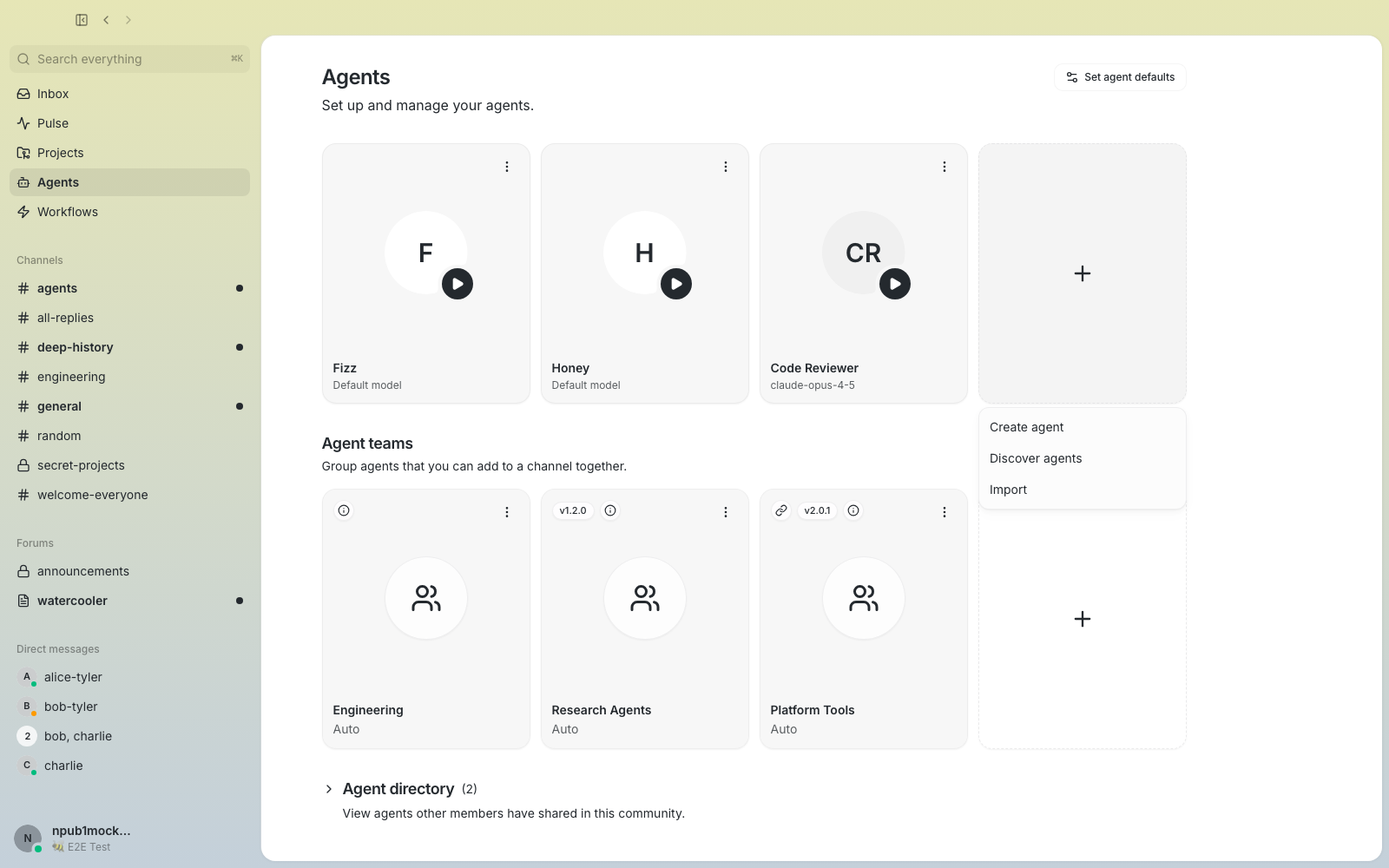 ### Team avatar stack 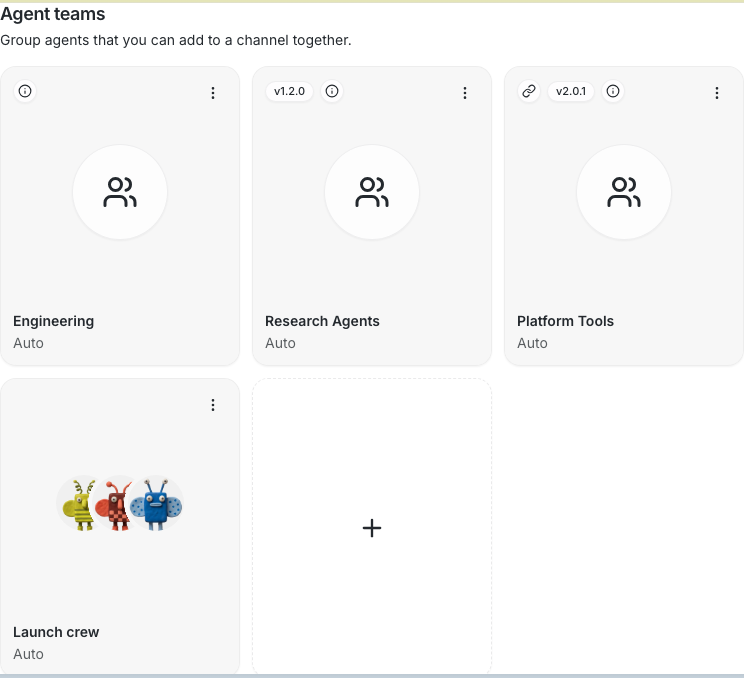 ### Catalog sharing 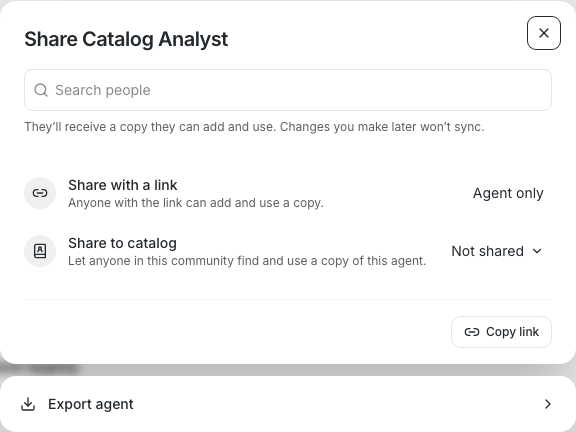 ### Publish while editing 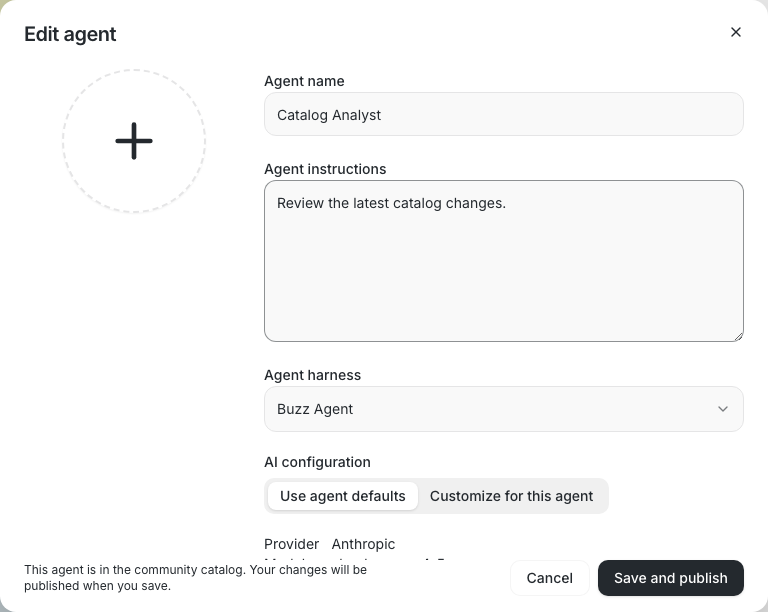 ### Publish from Share 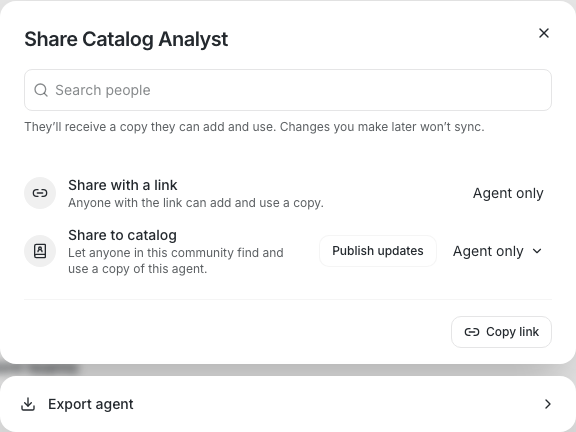 ### Catalog details 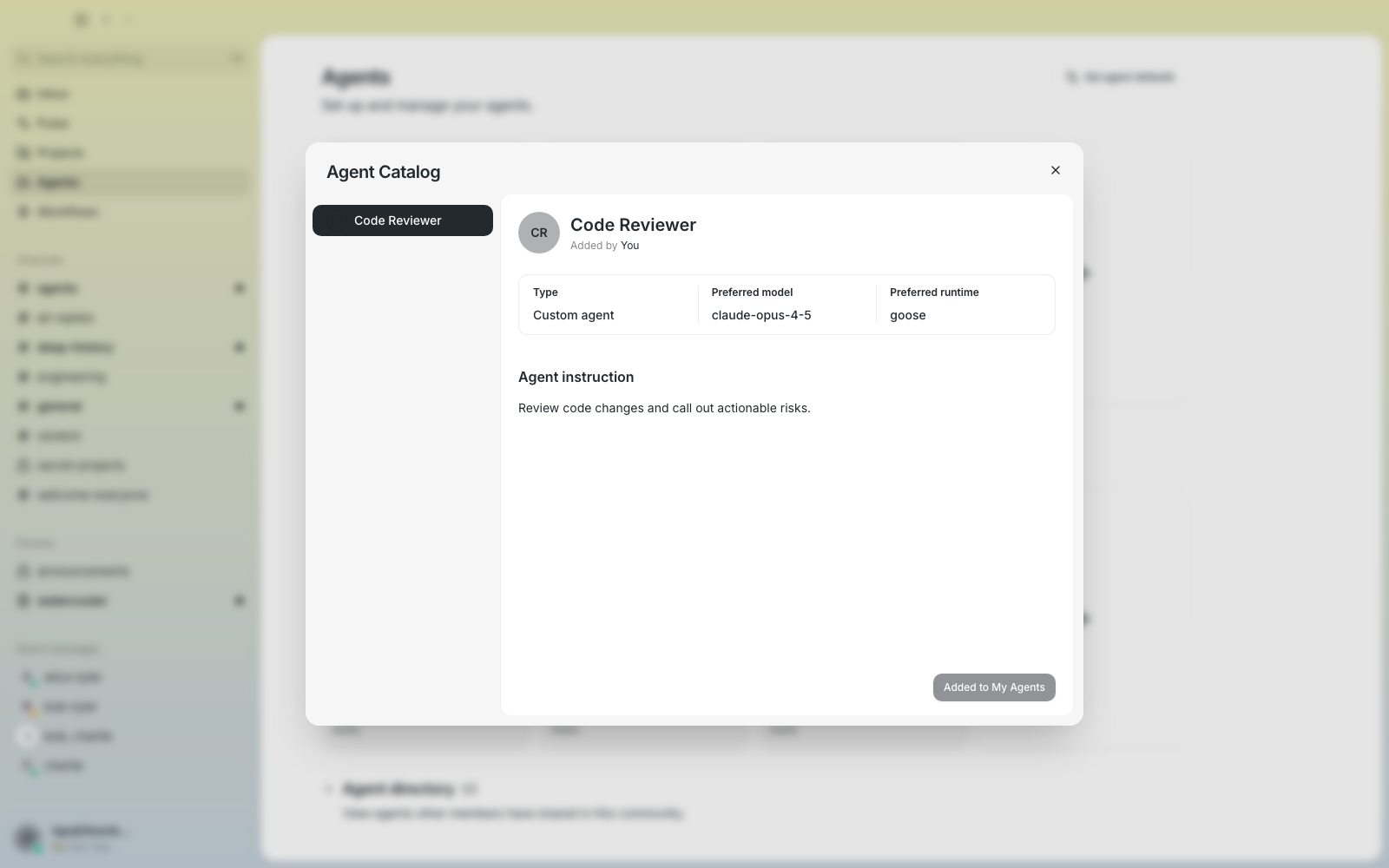 --------- Signed-off-by: kenny lopez <klopez4212@gmail.com> Signed-off-by: Will Pfleger <pfleger.will@gmail.com> Co-authored-by: Will Pfleger <pfleger.will@gmail.com> |
||
|
Clay Delk
|
2bd4c24b71 |
Inbox refactor (#2045)
## Why The Inbox mixed overlapping feed categories with personal work queues, so **All** was not actually comprehensive and several filters did not make it clear why an item appeared. Threads and DMs could produce one row per event instead of one row per conversation, drafts were hidden until selected, and reminders appeared through multiple competing presentations. This refactor makes the **Inbox** a focused, conversation-oriented place to catch up on work relevant to you. It is intentionally not a mirror of every unread event in every channel. ## What changed - Keep the destination named **Inbox** and use the standard Lucide bell icon. - Refocus **All** on DMs, mentions, thread replies, needs-action items, replies from agents the user owns or controls, due reminders, and active drafts. - Exclude generic top-level channel traffic and updates from agents the user does not own or control. - Group each thread or DM into one row, sorted by latest activity. - Resume an unread conversation at its oldest unread message while opening the full thread or DM in the detail pane. - Reuse the existing **New** divider at the unread boundary. - Make the detail title a direct link to the canonical conversation. - Give Reminders and Drafts the same list/detail interaction and location metadata as conversation rows. - Separate Reminders and Drafts from message filters with a subtle divider, without adding another labeled section. - Put reminder and draft counts beside their corresponding filter labels instead of on the generic filter button. - Preserve the selected conversation when switching filters if it remains valid; otherwise select a valid replacement without flashing stale detail. - Use filter-specific empty states and rename the options toggle to **Show unread only**. - Ship the focused behavior directly. The earlier experiment gate, Custom view, and default-view controls have been removed from this PR to keep the first pass focused. ## Filter model | Filter | What appears | | --- | --- | | **All** | One row per personally relevant conversation, plus due reminders and active drafts. Includes DMs, mentions, thread replies, explicit needs-action items, and replies from agents the current user owns or controls. Excludes generic top-level channel traffic, other agents' updates, and reminders that are not due yet. | | **Mentions** | Conversations containing a direct mention. Each conversation appears once and opens with full context. | | **Threads** | Conventional threaded replies, grouped to one row per thread. Broadcast replies are not treated as conventional thread replies. | | **Needs action** | Feed items explicitly classified as requiring action. | | **Agents** | Conversations whose representative response was authored by an agent the current user owns or controls, including top-level DM responses. If a human replies afterward, the conversation leaves this filter until an owned agent responds again. | | **Reminders** | All pending reminders, including upcoming reminders that stay out of **All** until they are due. | | **Drafts** | Active drafts, ordered by their last real edit time. | ## Grouping, ordering, and state - A thread or DM creates one Inbox row rather than one row per event. - An unread conversation resumes at its oldest unread message so intervening context is not skipped. - Conversation rows still sort by their latest activity. - The detail pane opens the full available conversation and shows the shared **New** divider before the first unread message. - Upcoming reminders appear only in **Reminders**. - When a reminder becomes due, it enters **All** at its trigger time. If its source conversation is already represented, the reminder state merges into that row instead of creating a duplicate; otherwise it appears as a standalone reminder row. - A due reminder can enrich a row in another relative filter when that conversation already qualifies for the filter. Reminder lifecycle remains separate from message read state. - Drafts appear in **All** by their last real edit time. Opening an unchanged draft does not move it to the top. - Reminder and draft rows show their location as `In #channel` or `In DM with <name>`. - **Show unread only** hides reminder and draft work queues because they do not share message unread semantics. ## Removed or narrowed - **Remove the old Activity filter.** It overlapped with All while still omitting items All now includes. - **Narrow Agents.** It no longer gathers every agent participating in a shared thread or subsequent human follow-ups. - **Remove duplicate reminder presentations.** The aggregate pending-reminders jump and duplicate generic feed rows are replaced by one list/detail model. - **Remove Custom and default-view settings from this pass.** They added considerable state and UI before the core model had been validated. - **Do not add section labels for Reminders and Drafts.** A divider communicates the distinction without creating another hierarchy in the menu. ## Risk assessment Medium implementation risk because this changes composition, grouping, ordering, read behavior, and personal queues in a primary desktop view. The implementation is scoped to the desktop UI and its local feed projection; it does not change relay schemas or public APIs. ## Testing - Desktop formatting, lint, file-size, text-size, and TypeScript checks passed. - Desktop unit suite: **3,663 passed, 0 failed**. - Desktop E2E production build passed. - Playwright smoke coverage across every spec touching this surface (`channels`, `smoke`, `profile`, `project-inbox`, `community-rail`, `integration`, `drafts-screenshots`): **118 passed, 0 failed**. - Full Playwright smoke project: **732 passed, 1 skipped**. Three local failures were investigated and cleared — `community-rail` keyboard reorder passed on re-run (flaky), while `relay-reconnect:97` and `video-attachment:223` are untouched by this commit (the only change to shared `tests/helpers/bridge.ts` is a comment) and pass in CI. - Unit coverage includes focused All matching, owned-agent filtering, conversation grouping, oldest-unread selection, selection stability, chronological reminder/draft composition, trigger-time reminder ordering, and duplicate reminder suppression. ## Update: July 27, 2026 The naming decision is settled: the surface stays **Inbox**. An earlier pass in this branch had renamed it to **Activity**; that rename has been reverted in `9c00d2d6e`, which is naming-only and changes no behavior. The revert covers file names, component/hook/type/constant identifiers, the sidebar label and tooltip, the `Inbox options` and `Filter inbox:` aria-labels, and the corresponding test names, test ids, and fixture ids. Three things were deliberately left as `activity`: - **The feed API contract** — the `activity` / `agent_activity` categories, the `feed.activity` and `feed.agentActivity` keys, and the `types=` query parameter. These are the server's names, not the surface's. - **Plain-noun usage** — empty states such as "No activity yet", plus `latestActivityAt` and `PROJECT_ACTIVITY_KINDS`. - **Pre-existing agent, project, and profile activity code**, which refers to a different concept entirely. The earlier experiment-gate approach has also been dropped, so `tests/helpers/bridge.ts` no longer claims that an Activity preview feature exists — `preview-features.json` has no such entry and the seed helper enables every desktop feature. Generated with Codex --------- Signed-off-by: Clay Delk <clay.delk@gmail.com> Co-authored-by: Claude Opus 5 (1M context) <noreply@anthropic.com> |
||
|
Taylor Ho
|
d98da7389e |
feat(desktop): redesign agent runtime settings (#3093)
**Category:** improvement **User Impact:** Users can understand, install, authenticate, and manage agent runtimes from one progressively disclosed Agents settings experience. **Problem:** Runtime health and custom harness management were split across overlapping settings surfaces, exposing low-level configuration too early while leaving setup and authentication states hard to understand. **Solution:** Consolidate those operations into one stable runtime list and an Add runtimes catalog, with task-oriented state labels, direct setup actions, and custom configuration contained in a dedicated form. <details> <summary>File changes</summary> **desktop/playwright.config.ts** Registers the visual coverage needed for the redesigned runtime catalog. **desktop/public/harness-logos/CREDITS.md** Documents bundled runtime-mark provenance and the decision not to ship the withdrawn OpenAI mark. **desktop/public/runtime-icons/codex.png** Removes the obsolete Codex bitmap in favor of the neutral fallback. **desktop/public/runtime-icons/goose.svg** Removes the old Goose asset now replaced by the theme-adaptive mark. **desktop/src-tauri/src/managed_agents/discovery.rs** Aligns runtime discovery guidance with the new task-oriented setup language. **desktop/src-tauri/src/managed_agents/discovery/runtime_metadata.rs** Updates runtime metadata used by the redesigned settings states. **desktop/src/features/agents/ui/runtimeAvailabilityWarning.test.mjs** Updates availability-warning expectations for the revised runtime guidance. **desktop/src/features/onboarding/assets/harness-logos/chatgpt.png** Removes the redundant bitmap from the unified runtime icon pipeline. **desktop/src/features/onboarding/assets/harness-logos/goose.png** Removes the redundant Goose bitmap. **desktop/src/features/onboarding/ui/HarnessMarks.tsx** Adds theme-adaptive bundled runtime marks with safe fallbacks. **desktop/src/features/onboarding/ui/RuntimeIcon.tsx** Centralizes runtime logo rendering so settings and catalog rows cannot drift. **desktop/src/features/onboarding/ui/SetupStep.tsx** Aligns onboarding runtime setup copy with the settings terminology. **desktop/src/features/onboarding/ui/presetLogos.test.mjs** Guards bundled-logo behavior and prevents the withdrawn Codex mark from returning. **desktop/src/features/settings/ui/CustomHarnessForm.tsx** Reworks custom runtime creation and editing into a clear, dedicated catalog form. **desktop/src/features/settings/ui/HarnessCatalogDialog.tsx** Introduces the Add runtimes master-detail catalog, grouped setup states, loading treatment, and pinned actions. **desktop/src/features/settings/ui/HarnessManagementCard.tsx** Removes the superseded standalone custom-harness management surface. **desktop/src/features/settings/ui/HarnessRow.tsx** Provides stable operational runtime rows with install, update, authentication, edit, and delete behavior. **desktop/src/features/settings/ui/HarnessesSettingsPanel.tsx** Consolidates runtime health and custom management into one Agents settings panel. **desktop/src/features/settings/ui/SettingsPanels.tsx** Wires the consolidated panel into Agents settings. **desktop/src/features/settings/ui/harnessCatalogCopy.ts** Adds restrained, source-annotated runtime descriptions and setup guidance. **desktop/src/features/settings/ui/harnessCatalogLogic.test.mjs** Covers grouping, state labels, stable row order, actions, and adapter warnings. **desktop/src/features/settings/ui/harnessCatalogLogic.ts** Centralizes catalog grouping, actions, status labels, and runtime-safe warning copy. **desktop/src/features/settings/ui/harnessGalleryLogic.test.mjs** Removes obsolete gallery-only tests after consolidation. **desktop/src/features/settings/ui/harnessGalleryLogic.ts** Retains only the shared custom-runtime safety logic needed by the new surface. **desktop/src/shared/ui/config-nudge-attachment.tsx** Points configuration nudges to Agent runtimes with matching terminology. **desktop/src/testing/e2eBridge.ts** Adds deterministic runtime states for authentication and catalog E2E coverage. **desktop/tests/e2e/doctor-states.spec.ts** Verifies ready, setup-required, node-gated, authentication, loading, and error contracts. **desktop/tests/e2e/harness-catalog-screenshots.spec.ts** Captures whole-pane visual states for the runtime catalog experience. **desktop/tests/e2e/harness-management.spec.ts** Exercises catalog actions and custom runtime create, edit, authentication, and deletion flows. **desktop/tests/e2e/onboarding-agent-defaults.spec.ts** Updates default-runtime expectations for the consolidated experience. **desktop/tests/e2e/profile.spec.ts** Aligns profile navigation assertions with the new settings surface. </details> ## Reproduction steps 1. Open Settings → Agents and inspect Agent runtimes; ready, signed-out, installable, and setup-required runtimes should have stable rows and explicit actions. 2. Open Add runtimes and browse the Setup and Installed groups; select entries to see sourced guidance and a pinned Install or Setup guide action. 3. Select Custom harness, create a runtime, then edit and delete it; verify required-field gating and the blast-radius confirmation. 4. Exercise a signed-out runtime and connect it; the row should move from Sign-in needed to Ready without reordering. 5. Resize the window and switch themes to verify responsive layout and adaptive bundled marks. ## Screenshots | Mixed runtime states | Goose not installed | Sign-in needed | |---|---|---| | <img width="980" height="1000" alt="image" src="https://github.com/user-attachments/assets/28705b39-1d91-440a-a954-fb2d7d8ee759" /> | <img width="980" height="1000" alt="image" src="https://github.com/user-attachments/assets/e65ce8e1-8c85-4272-afb5-e6001b94d560" /> | <img width="980" height="1000" alt="image" src="https://github.com/user-attachments/assets/3987f355-960d-4744-8c26-b3746944a33c" /> | | Add runtimes catalog | Custom runtime | Setup guide | |---|---|---| | <img width="896" height="672" alt="image" src="https://github.com/user-attachments/assets/a2f32c8a-4dff-4929-af96-b07346933335" /> | <img width="896" height="672" alt="image" src="https://github.com/user-attachments/assets/b2e85a0c-3940-4875-a138-4035423c9de7" /> | <img width="896" height="672" alt="image" src="https://github.com/user-attachments/assets/5a690c1c-368e-4ee3-98b9-ffefdc3cf804" /> | Full 13-state screenshot matrix and review evidence: https://buzz.block.builderlab.xyz/channels/c5af9e3e-4317-4853-b3e3-ed9c15bc511d?event=ec88f6e472f2b08d6318ae76fd754fd4f218385f67cfe59b73034c4bc34c9252 --------- Signed-off-by: Taylor Ho <taylorkmho@gmail.com> Signed-off-by: npub1223z34hd7vtwc6qj4s7flsxkj644nlre2nthu7lrrmkumhu3xddsrx9r6w <52a228d6edf316ec6812ac3c9fc0d696ab59fc7954d77e7be31eedcddf91335b@buzz.block.builderlab.xyz> Co-authored-by: npub1223z34hd7vtwc6qj4s7flsxkj644nlre2nthu7lrrmkumhu3xddsrx9r6w <52a228d6edf316ec6812ac3c9fc0d696ab59fc7954d77e7be31eedcddf91335b@buzz.block.builderlab.xyz> |
||
|
Luke Tornquist
|
313f793c87 |
feat(desktop): add search to agent emoji picker (#2630)
## Why The agent avatar picker disables Emoji Mart search, making emojis difficult to find when creating or editing an agent. ## What - Enable sticky search in the shared agent avatar picker - Focus the search field when the Emoji tab opens - Add end-to-end coverage for search, focus, and selection ## Risk Assessment Low — this is limited to the desktop agent avatar picker and does not change avatar persistence or agent configuration. ## References - `pnpm --dir desktop test` — 3,448 passed - `pnpm --dir desktop typecheck` — passed - `pnpm --dir desktop exec playwright test tests/e2e/agents.spec.ts` — 20 passed --- **Update Jul 24, 16:28 EDT:** Completed `CONTRIBUTING.md` validation. ### Manual test 1. Create an agent and open Add avatar → Emoji. 2. Confirm the search field is focused and filters results. 3. Select an emoji and confirm it becomes the avatar. 4. Repeat while editing an existing agent. ### Validation - `just ci` — passed - `just test` — passed ### Follow-up work None. Generated with Codex |
||
|
morgmart
|
7fc0cc82db |
Restore Goose and Buzz Agent to onboarding harness selection (#2731)
> [!NOTE] > **Part 1 of a multi-PR onboarding rework.** This PR only restores the hidden harnesses, adjusts the card layout, and gates onboarding completion on valid config. A follow-up PR (stacked on this branch) restructures the flow: the harness page becomes a single-choice "pick your default harness" step, and install/sign-in/provider setup moves to the following page. Review this one on its own terms — the flow rework is intentionally not here. ## Summary - Restore **Goose** and **Buzz Agent** to onboarding harness selection, reverting the launch-only restriction from #2233 - The restore is the single centralized allowlist (`ONBOARDING_RUNTIME_ORDER` in `onboardingRuntimeSelection.ts`) that #2233 deliberately set up for this moment — setup cards, readiness handoff, and the defaults harness picker all derive from it - Lay the four harness cards out as a single row at `lg` and above (`lg:grid-cols-4`); below 1024px (including the app's 800px minimum window width) the grid is 2×2, and 1-up on narrow viewports - **Gate onboarding Finish on actual config validity** (review finding): the defaults page rendered provider/model/credential fields for provider-required harnesses but Finish only checked that a harness was selected — a fresh user picking Buzz Agent could persist a default that fails at first spawn. The Finish gate now consumes `AgentConfigFields`' existing `onValidityChange` signal. Baked build env and runtime-file config satisfy the gate, so internal builds and existing Goose users are never blocked - Update the unit + E2E specs that pinned the hidden behavior, plus two new E2E cases pinning the Finish gate (blocked-until-configured, and baked-env never blocked) - AGENTS.md rule 7 updated to document the completion gate ## Testing - `onboardingRuntimeSelection.test.mjs` — 4 passed - `pnpm typecheck` — clean - `pnpm exec playwright test tests/e2e/onboarding-agent-defaults.spec.ts --project=smoke` — 21 passed - `onboarding-docked-cta-screenshots.spec.ts` — 3 passed - Biome — clean ## Known cosmetic issue (deferred to PR 2) At the app's minimum window size (800×500) the 2×2 grid extends past the visible area and the footer CTA overlaps card space. Next still hit-tests correctly. PR 2 redesigns this page entirely (cards become a single-choice chooser with no inline setup), so this is deferred rather than patched twice. --------- Signed-off-by: morgmart <98432065+morgmart@users.noreply.github.com> |
||
|
Will Pfleger
|
95fdf97880 |
feat(acp): bring your own harness (BYOH) — generic ACP runtime seam + settings gallery (#2773)
## What

Implements a "bring your own harness" (BYOH) generic ACP mechanism —
replacing per-harness backend code with a data-driven 3-tier system:

- **Tier 1 (compiled-in builtins):** goose, claude, codex, buzz-agent —
unchanged behavior
- **Tier 2 (bundled presets):** cursor, omp, grok, opencode, kimi, amp,
hermes, openclaw, and any future additions — defined in
`PRESET_HARNESSES`, no code duplication, icons stay
TerminalSquare/bundled-asset-only
- **Tier 3 (user-defined custom):** JSON definitions saved to
`custom_harnesses/` under app data; managed via Settings → Agents UI

## Changes

### Core data model
- `HarnessDefinition` — id, label, command, args, env, install URL/hint
- `PRESET_HARNESSES` static table — single source of truth for all
presets; `preset_harness_ids()` derives reserved IDs (D-11: no
hand-maintained copy)
- `source: "builtin" | "preset" | "custom"` tagging on every catalog
entry

### Persistence (B-4, B-6)
- `save_custom_harness_to_dir(dir, definition, rename_old_id)` —
backup-swap atomic write (backs up target → .bak, commits temp → target,
restores .bak on failure, removes .bak on success); safe on Windows
where `fs::rename` over an existing file is "access denied"
- `save_and_warm` / `delete_and_warm` — hold `PERSIST_MUTEX` for the
write + registry-warm pair, eliminating the lost-update race (B-6) where
two concurrent saves could interleave their warm calls and leave a stale
registry snapshot
- Validate-before-mutate: both IDs and env validated before any
filesystem mutation

### Env validation boundary (B-3)
- `validate_harness_definition_pub` calls `validate_user_env_keys` on
definition env at save AND load
- Rejects malformed keys (BUZZ_AUTH_TAG=x forgery shape), reserved keys
(BUZZ_MANAGED_AGENT etc.), NUL bytes, oversized values

### TypeScript boundary (B-2 / Thufir CRITICAL)
- `RawAcpRuntimeCatalogEntry` now declares `definition_env?:
Record<string,string>` and `source: "builtin" | "preset" | "custom"`
- `fromRawAcpRuntimeCatalogEntry` maps `definition_env → definitionEnv`
(camelCase); absent field defaults to `{}`
- Edit form reads `entry.definitionEnv` — env no longer erased on
save-then-edit cycle

### Unified descriptor (Phase A / Thufir F4)
- `EffectiveHarnessDescriptor { command, args, env }` in `readiness.rs`
- `resolve_effective_harness_descriptor()` — single resolver used by
spawn, spawn_hash, summary, get_agent_models (both saved and unsaved),
and readiness
- No competing arg-resolution forms

### Other fixes
- B-5: stop freezing `runtime.defaultArgs` into `record.agent_args` on
normal create paths
- B-7: readiness exec-check — `MissingBinary` variant for custom
commands not found on PATH
- B-8: onboarding transition — `setTimeout(0)` removed, parent-owned
route intent via `navigateAfterComplete` prop
- C-9: collector-discriminating sweep tests with injectable filters
- C-10: `HarnessManagementCard` uses `harnessGalleryLogic` helpers
(killed duplicate filter/sort)
- D-11: `BUILTIN_IDS` derived from `PRESET_HARNESSES` (no
hand-maintained copy)
- D-12: `mobile/pubspec.lock` churn reverted
- D-13: false ownership fast-path comment fixed
- D-14: URL scheme validation for `installInstructionsUrl`
- D-15: OpenClaw Gateway env-locus README line

### Tests added
**B-4 persistence (6 tests):**
`save_to_dir_create_writes_file_and_loads_back`,
`save_to_dir_same_id_edit_replaces_content`,
`save_to_dir_backup_is_cleaned_up_after_same_id_edit`,
`save_to_dir_rename_removes_old_file_and_creates_new`,
`save_to_dir_rename_nonexistent_old_id_is_non_fatal`,
`save_to_dir_roundtrip_with_env_preserves_values`

**B-3 env validation (6 tests):**
`validate_rejects_malformed_key_with_equals_sign`,
`validate_rejects_reserved_key_buzz_managed_agent`,
`validate_rejects_reserved_key_case_insensitive`,
`validate_rejects_nul_byte_in_value`,
`validate_rejects_value_over_per_value_size_limit`,
`validate_accepts_well_formed_env`

**B-2 API boundary (4 TS tests in tauri.test.mjs):**
`fromRawAcpRuntimeCatalogEntry maps definition_env to definitionEnv`,
`defaults definitionEnv to {} when absent`, `preserves source preset`,
`env round-trips through edit payload shape`

## Preset catalog

| ID | Label | Command |
|----|-------|---------|
| `cursor` | Cursor | `cursor-agent acp` |
| `omp` | Oh My Pi | `omp acp` |
| `grok` | Grok Build | `grok agent --always-approve stdio` |
| `opencode` | OpenCode | `opencode acp` |
| `kimi` | Kimi Code | `kimi acp` |
| `amp` | Amp | `amp-acp` |
| `hermes` | Hermes Agent | `hermes-acp` |
| `openclaw` | OpenClaw | `openclaw acp` |

## Review-fix pass (2026-07-26, Eva)

Fixes from the three-way review (Wren / Dawn / Eva) in the
buzz-generic-acp-harnesses thread, pushed as new commits (no rewrite):

1. **installHint edit round-trip** — form seeding extracted to
`formValuesFromCatalogEntry` (single source of truth), input rendered,
full-definition lossless round-trip regression.
2. **Dangling-delete coherence** — delete allowed; confirm counts
referencing agents (direct pin + persona-inherited); summary rows render
`harness (deleted): <id>`; spawn errors become actionable sentences
(`user_facing_harness_error`); composed delete→summary→start test.
3. **Comma-in-args** — rejected at `validate_harness_definition` (shared
by save AND disk load), mirrored inline in the form.
4. **Registry publish race** — collision/dup filtering moved into
`load_custom_harnesses` (both loaders inherit shadowing rules);
discovery publishes by re-reading the dir under `persist_mutex` (lock
scoped to publish only); deterministic interleaving regressions for
save-during-discovery and delete-during-discovery.
5. **Mechanical** — discarded `belongs_to_us` sweep arg deleted,
`load_global_agent_config` hoisted out of the per-record summary loop,
duplicated doc paragraph + stray SAFETY comment removed.
6. **PGID test de-flaked** — leader kept alive through the assertion.

Known follow-up (filed in review, not blocking): file-size split-outs
queued in `check-file-sizes.mjs` entries.

## Gate table — head `bf53f1d60`

| Gate | Result |
|------|--------|
| `cargo test --lib` (desktop/src-tauri) | **1701 passed**, 0 failed, 14
ignored |
| desktop JS suite (`pnpm test`) | **3605 passed**, 0 failed |
| `tsc --noEmit` | clean |
| `biome check` + file-size/px/pubkey checks | clean |
| `cargo clippy --lib -- -D warnings` | clean |
| `cargo fmt --check` | clean |

PR head: `bf53f1d60e3cbd07392e1287b83bb37ba90d0d33` — includes merge of
origin/main (`c2a4ee711`, conflicts in agent_models composed with
#2890's live Databricks discovery)

---------

Signed-off-by: Will Pfleger <pfleger.will@gmail.com>
Signed-off-by: tlongwell-block <109685178+tlongwell-block@users.noreply.github.com>
Signed-off-by: Tyler Longwell <tlongwell@block.xyz>
Co-authored-by: npub1mn7jgtj4w2pd0g0zeuhxsa6jy6p0rewxz4kujt98my82ahfmp72sxjexk7 <dcfd242e557282d7a1e2cf2e6877522682f1e5c6156dc92ca7d90eaedd3b0f95@buzz.block.builderlab.xyz>
Co-authored-by: tlongwell-block <109685178+tlongwell-block@users.noreply.github.com>
Co-authored-by: Dawn (sprout agent) <c6237ef84fa537c78dcee78efd2d4e59f728859c7f194da42ac51ededfa0be05@sprout-oss.stage.blox.sqprod.co>
Co-authored-by: Tyler Longwell <tlongwell@block.xyz>
Co-authored-by: npub1qyvc0c5kl4gqv2fd97fsk46tu378sqgy35vc83rvgfwne90sel7s0ed67d <011987e296fd5006292d2f930b574be47c7801048d1983c46c425d3c95f0cffd@buzz.block.builderlab.xyz>
|
||
|
Mic Neale
|
16d4ec335e |
feat(desktop): use collective mesh routing for Auto (#2825)
Uses MeshLLM built-in `mesh` collective intelligence / Mixture of Agents when Buzz Auto sees two or more distinct physical models. With zero or one model, Auto remains ordinary `auto`. This is an alternative way to improve tool responses, accuracy, and resistance to hallucination when a high-latency distributed mesh contains diverse models. Models and members may come and go: collective routing enables only after stable capacity, drops on confirmed contraction, and can recover later. Mesh-specific failures retry once through ordinary Auto. This update also pins MeshLLM to a v0.73.1-compatible backport of [MeshLLM #1074](https://github.com/Mesh-LLM/mesh-llm/pull/1074), so client-only Buzz nodes cannot enter model election or download a remote provider model. Buzz preserves the selected local sharing model and switches an existing client to sharing across a controlled app restart, retaining one runtime and one `:9337` / `:3131` pair per machine. Validation: - Full local `just ci` passes on the cleaned branch. - MeshLLM host-runtime suite: 1,568 passed, 0 failed; strict Clippy passes. - Buzz desktop Tauri suite with `mesh-llm`: 1,721 passed, 0 failed; strict feature Clippy passes. - Playwright covers client-to-share using the saved local model and no destructive stop. - Packaged two-machine testing proved single-model routing, dual-model collective routing, tool-markup fallback, and runtime reuse. - Packaged client-only recheck routed a real Mini Buzz turn through M5 while Mini stayed `is_client=true`, `is_host=false`, hosted no models, and created no Gemma cache. Builds on the recovery work merged in #2823; this PR does not duplicate it. --------- Signed-off-by: Michael Neale <michael.neale@gmail.com> Signed-off-by: Tyler Longwell <tlongwell@block.xyz> Co-authored-by: Michael Neale <michael.neale@gmail.com> Co-authored-by: npub1qyvc0c5kl4gqv2fd97fsk46tu378sqgy35vc83rvgfwne90sel7s0ed67d <011987e296fd5006292d2f930b574be47c7801048d1983c46c425d3c95f0cffd@buzz.block.builderlab.xyz> Co-authored-by: Tyler Longwell <tlongwell@block.xyz> |
||
|
Tyler
|
5d8ede446f |
feat(agents): lower default agent parallelism from 24 to 10 (#3038)
## What
One-line default change: `DEFAULT_AGENT_PARALLELISM` 24 → 10
(`desktop/src-tauri/src/managed_agents/types.rs`), requested by Tyler in
[buzz-generic-acp-harnesses](buzz://message?channel=d6d84fdc-47fe-4e41-acf5-a08a4a013e6b&id=a047ead3a34ba804c376bf79f29e355d304162a88c7b2a7121e092547c572022).
## Why
Each unit of parallelism is a **full agent subprocess** per agent ×
community pair, spawned eagerly and serially at create/start before the
harness connects to the relay:
- At 24, a desktop with a few dozen agent×community pairs carries >1,000
potential idle subprocesses.
- Slow-starting harnesses (OpenClaw measured at 4–10s per worker) take
minutes to create, and messages sent during that window can be
permanently missed (the startup watermark is captured only after eager
pool init).
- Parallelism is per-channel concurrency — a channel never uses more
than one worker — so 10 still covers concurrent-channel fan-out for
typical agents.
Context: verified RCA + live 1-worker/3-mention experiment in the same
thread. Demand-driven pool growth (seed 1, grow on contention up to the
cap) is agreed as a follow-up; this is the interim risk reduction.
## Scope / blast radius
- Existing agent records keep their persisted `parallelism` value — only
new records and unset defaults change.
- Per-agent override unchanged (1..=32 via agent editor /
`BUZZ_ACP_AGENTS`).
- Readers of the constant (`team_snapshot`, `personas/snapshot/import`,
`commands/agents` mint path) all take the new default transitively; no
other code pins 24.
- `activeAgentTurnsStore.test.mjs` comments updated so the 24-turn
eviction case is framed against the harness cap (32) instead of the
default — coverage unchanged, no assertion touched.
## Verification
At
|
||
|
Will Pfleger
|
8c0e8cb165 |
fix(desktop): make agent definition authoritative for model/provider/prompt (#1968)
## Summary

Introduces a single effective-config resolver that makes agent
definitions authoritative for model, provider, system prompt, and
relay-mesh routing on linked instances. Stale materialized record bytes
are never consulted at spawn, deploy, readiness, hash, card summary, or
mesh preflight.

**Resolution semantics (field-specific):**
- **model/provider (linked):** definition → global. `None` = inherit
global default. Record value never consulted.
- **model/provider (definition-less):** instance → global.
- **system_prompt (linked):** strictly from definition; blank = no
prompt. No global tier for prompt.
- **system_prompt (definition-less):** from the instance.
- **relay-mesh preflight (both):** driven by the same
`resolve_effective_config` resolution spawn's mesh env consults. For a
linked instance the record's own `provider`/`model`/`relay_mesh` bytes
are never consulted; for a definition-less instance with no provider of
its own, the legacy marker and env preset are the last fallback (see
below).
- **Orphaned (linked record, definition missing):** spawn, deploy, and
mesh preflight blocked with actionable user-facing error.

**Changes:**
- New `effective_config` resolver module with `ConfigSource` metadata
(`definition`, `global`, `instance_legacy`)
- All consumers routed through the single resolver: local spawn, deploy,
readiness, spawn hash, card summary, relay-mesh preflight (interactive
start and restore-on-launch)
- `apply_persona_snapshot` no longer preserves stale record
model/provider when definition is blank
- Backend `update_managed_agent` blocks model/provider/prompt writes for
linked records
- Frontend omits model/provider/systemPrompt submission for linked
instances; system prompt override hidden
- `model_source` field added to `ManagedAgentSummary` so card labels
distinguish inherited (`Default model (X)`) from explicit
- Spawn hash now digests resolved model/provider (not raw record fields)
so global default changes trip the restart badge even for runtimes
without `model_env_var`
- Orphan spawn/deploy/mesh-preflight blocked with jargon-free error
("This agent's configuration is missing — it may still be syncing or was
deleted on another device")
- `EffectiveAgentConfig::relay_mesh_model_id()` and
`resolve_effective_relay_mesh_model_id()` added; both mesh preflights
(`start_local_agent_with_preflight`, `restore_managed_agents_on_launch`)
call this instead of the deleted
`relay_mesh_config`/`relay_mesh_model_id` record-byte sniffs
- Legacy relay-mesh records keep their mesh routing. Two shipped
generations predate `provider: "relay-mesh"` and are never rewritten on
load: the typed `relay_mesh` marker (added when `ManagedAgentRecord` had
no `provider` field), and before it the mesh preset written directly
into `env_vars`. `resolve_definition_less` falls back to the marker,
then to the env preset, so these records still resolve to mesh instead
of silently misrouting to an unrelated provider while their stale env
bytes reach the child. The fallback is skipped when the record carries
an explicit `provider` — that states current intent, including a switch
away from mesh — and `resolve_linked` has no legacy fallback at all
- The env discriminator accepts both spellings of the two sentinels
renamed in the Jun-11 window without a record migration: the provider
env key (`BUZZ_AGENT_PROVIDER`, previously `SPROUT_AGENT_PROVIDER`) and
the api-key value (`buzz-mesh-local`, previously `sprout-mesh-local`).
Each is independent, since a record can straddle the window; the current
provider-key spelling wins when both are present
- Dead `persona_field_with_record_fallback` and wrapper
`persona_snapshot_with_agent_config_fallback` deleted; callers use
`persona_snapshot` directly
- New resolver/deploy/hash/write-guard/mesh-preflight tests, including
switch-away and global-inheritance regressions for both mesh preflight
call sites, per-class legacy-mesh resolution (typed marker and env
preset, in every rename-window spelling combination), and the paired
assertions that a linked instance's legacy mesh bytes stay inert

---------

Signed-off-by: Will Pfleger <pfleger.will@gmail.com>
Co-authored-by: npub1mn7jgtj4w2pd0g0zeuhxsa6jy6p0rewxz4kujt98my82ahfmp72sxjexk7 <dcfd242e557282d7a1e2cf2e6877522682f1e5c6156dc92ca7d90eaedd3b0f95@buzz.block.builderlab.xyz>
|
||
|
Will Pfleger
|
8e67cf399d |
chore(desktop): delete dead persona catalog UI cluster (#2886)
## Summary - Deletes 6 orphaned files in `desktop/src/features/agents/ui/` (556 lines) that formed a closed cluster with zero imports from the reachable module graph — orphaned by the 1B dialog consolidation (`PersonaCatalogSurface`, `PersonaCatalogSection`, `PersonaCatalogDetailsSheet`, `PersonaCatalogSelectionBadge`, `PersonaIdentity`, `PersonaLibraryEntryPoints`). - Removes a stale `check-file-sizes.mjs` override entry for the no-longer-existent `PersonaDialog.tsx`. Verified dead two ways: import-graph reachability walk from all entry points puts all six outside the reachable set, and `tsc --noEmit` passes clean after deletion. Their `data-testid`s have zero references outside the cluster. `PersonaCatalogDialog.tsx` is alive (`AgentsView` imports it) and stays. Independent of #1968 — pure dead code removal, no behavioral change. |
||
|
Wes
|
5d1233e841 | refactor(desktop): remove Agent directory section from Agents page (#2290) | ||
|
Will Pfleger
|
20bff59102 |
fix(desktop): track concurrent agent turns up to the harness maximum (#2882)
Desktop's active-turn store capped tracked concurrent turns per agent at `4` while the harness runs `DEFAULT_AGENT_PARALLELISM = 24` parallel agent subprocesses and accepts up to `32` (`--agents` / `BUZZ_ACP_AGENTS`, `value_parser range(1..=32)`). Turns above the cap were silently evicted, so a genuinely-running turn lost its working badge in the sidebar and the agents popover. The eviction also caused the badge set to rotate indefinitely. Evicted turns are still alive, so their hosts keep emitting `turn_liveness` every 10s; `recordActivity` can't find the evicted turn, `resurrectTurn` recreates it, and that eviction drops one of the surviving turns. With two live turns above the cap the visible set churned every 10 seconds. `MAX_TURNS_PER_AGENT` exists only to bound map growth, so it now sits at the harness's hard upper bound of `32` — unreachable for any legitimately-configured agent while still keeping the per-agent map bounded. `MAX_TERMINAL_TOMBSTONES` derives from it (`* 4`), so the tombstone cap moves from 16 to 128. Two regressions cover the reported symptom: a default-parallelism agent working in 24 channels keeps all 24 badges, and the tracked channel set stays stable as `turn_liveness` arrives for turns that previously would have been evicted. Signed-off-by: Will Pfleger <pfleger.will@gmail.com> Co-authored-by: npub1mn7jgtj4w2pd0g0zeuhxsa6jy6p0rewxz4kujt98my82ahfmp72sxjexk7 <dcfd242e557282d7a1e2cf2e6877522682f1e5c6156dc92ca7d90eaedd3b0f95@buzz.block.builderlab.xyz> |
||
|
Will Pfleger
|
a64cc71f6c |
fix(desktop): clear stale working badges on agent stop/restart (#2803)
When Desktop stops or restarts a managed-agent pair, the harness is SIGKILLed after 1s and `turn_completed` never lands. `activeAgentTurnsStore` then sees the "all turns silent at once" pattern and delays badge cleanup for up to 3 min (the pause that protects live badges during transient relay-stream gaps). This is unnecessary when Desktop itself issued the kill — there is no relay-gap ambiguity. ## What changed **`activeAgentTurnsStore.ts`** — new `clearActiveTurnsForAgent(pubkey)` - Tombstones every live turn for the agent via `recordTerminal` (blocks in-flight `turn_liveness` frames from resurrecting them via `resurrectTurn`) - Removes the agent's entry from `activeTurnsByAgent` - Preserves `lastProcessed` (watermark) — full-buffer replay after the clear is a no-op - Preserves `clockOffsetByAgent` — still valid, harmless **`managedAgentRuntimeHooks.ts`** — clearing at the successful-stop boundary - New `clearActiveTurnsForAgentOnStop(pubkey, relayUrl?)` — relay-scope gate: only clears when the stopped pair's relay matches the active community (pair-scoped), or when an active community is configured (agent-wide ops) - New `restartManagedAgentPair(pubkey, relayUrl, stop, clear, start)` — dependency-injected stop → clear → start sequence; the `restart` branch of `useManagedAgentRuntimeAction`'s `mutationFn` is a single call into it. The clear fires after a successful stop and before start begins, so the badge is gone even when start fails, a failed stop clears nothing, and no clear can run after the new process is spawned (genuinely-new turns are never wiped) - `useManagedAgentRuntimeAction.onSuccess` clears for `stop` actions, before the query-cache update **`managedAgentControlActions.ts`** — `onStopped` callback on `respawnManagedAgentWithRules`, invoked after the stop promise resolves and before start begins **`welcomeKickoff.ts`** — same `onStopped` boundary on `restartWelcomeTeammate` **Call sites covered (all stop/restart UI paths):** - `useManagedAgentRuntimeAction` — pair-scoped stop (`onSuccess`) and restart (`restartManagedAgentPair` in `mutationFn`); Members-sidebar + settings card - `useMembersSidebarActions.handleRespawnAll` — via `onStopped` - `useMembersSidebarActions.handleStopAll` — direct local-stop branch - `useMembersSidebarActions.handleLifecycleAction` — local-stop fallback branch - `useAgentLifecycleActions.handleAgentPrimaryAction` — Agents-tab stop - `useAgentLifecycleActions.handleAgentRestart` — via `onStopped` - `useManagedAgentActions.handleStop` / `handleBulkStopRunning` — Agents screen - `useAutoRestartPolicy` — inline, between stop and start - `restartWelcomeTeammate` call site — via `onStopped` Provider agents are excluded at each site: they go through `!shutdown` (relay message), not a direct harness kill. ## Tests Twelve behavior tests across three files: - `activeAgentTurnsStore.test.mjs` (6) — clear removes the agent's turns and notifies subscribers, other agents untouched; full-buffer replay after clear is a no-op (watermark preserved); late `turn_liveness` frame with timestamp ≤ clear time does not resurrect (tombstone); new `turn_started` after clear is tracked normally; badge gone when stop succeeds even if start fails; new frame during start-pending does not resurrect the cleared badge - `managedAgentControlActions.test.mjs` (3) — `onStopped` fires on stop-success/start-failure; does not fire on stop-failure; strict stop → `onStopped` → start ordering - `managedAgentRuntimeHooks.test.mjs` (3) — pair-restart seam: clear ran when start fails (rejection propagates); stop failure invokes neither clear nor start; strict stop → clear → start ordering --------- Signed-off-by: Will Pfleger <pfleger.will@gmail.com> Co-authored-by: npub1mn7jgtj4w2pd0g0zeuhxsa6jy6p0rewxz4kujt98my82ahfmp72sxjexk7 <dcfd242e557282d7a1e2cf2e6877522682f1e5c6156dc92ca7d90eaedd3b0f95@buzz.block.builderlab.xyz> |
||
|
Ayobami Adegoke
|
5e3d2e4849 |
fix(desktop): surface agent rename relay profile sync failure as a warning toast (#2279)
Fixes #1822 ## Problem Renaming an agent via the agent settings dialog performs a local save (always succeeds) and a best-effort relay kind:0 republish (can fail: network blip, auth expiry, relay unreachable). On sync failure the dialog `console.warn`'d the error and closed as a clean success — the user had no signal that the relay still holds the old name, which breaks `@mention` resolution and shows the stale name in other agents' `From:` lines (discovered via #1743). ## Fix Surface `profileSyncError` as a `toast.warning` in `AgentInstanceEditDialog`, matching the treatment the create and persona-save paths already give the same field (`useManagedAgentActions.ts`, `UserProfilePanelPersonaSubmit.ts`). The save is not blocked — the local rename is valid and persists, per the issue's guidance. The toast points at the retry path that actually works: **restarting the agent**. Re-saving the same name does not retry — `update_managed_agent` computes `name_changed` against the already-updated record, so a second identical save skips the sync — but `start_managed_agent` fires `reconcile_agent_profile`, which queries the relay's kind:0 and republishes when the display name diverges. Scope notes: - `EditRespondToDialog` (the third caller of the update mutation) never changes the name, and the Rust side only sets `profile_sync_error` when the name changed — so no change needed there. - The alternative fix in the issue (retry-with-backoff in `sync_managed_agent_profile`) is not taken here; `reconcile_agent_profile` on agent start already provides self-healing, and this change makes that path discoverable at the moment of failure. ## Testing - `just desktop-check` — biome + file-size + px-text + pubkey-truncation guards clean. - `just desktop-test` — 3331 passed, 0 failed. - The handler branch is a straight conditional on the mutation result; the repo's `.test.mjs` convention covers extracted pure logic, and there is no extracted logic here to unit-test (consistent with the equivalent toast branches on the create/persona paths). --------- Signed-off-by: ayobamiseun <adegokeayobamiseun@gmail.com> Signed-off-by: npub1mprnacetjua2xx3p5eddmhxyk6wv929ymm5py8kd2xfxurxahspqqlgyta <d8473ee32b973aa31a21a65adddcc4b69cc2a8a4dee8121ecd51926e0cddbc02@buzz.block.builderlab.xyz> Co-authored-by: npub1mprnacetjua2xx3p5eddmhxyk6wv929ymm5py8kd2xfxurxahspqqlgyta <d8473ee32b973aa31a21a65adddcc4b69cc2a8a4dee8121ecd51926e0cddbc02@buzz.block.builderlab.xyz> |
||
|
klopez4212
|
384c72dee6 |
Refine community management flows (#2738)
## Summary - simplify Add community into clear create and join paths - align community actions and icon editing across the rail, profile menu, and settings - consolidate invites around the member list and a reusable link dialog ## Testing - `pnpm check` - `pnpm test` (3,483 passed) - `pnpm run build:e2e` - focused Playwright coverage (34 passed) ## Snapshots | Add a community | Join an existing community | | --- | --- | |  |  | | Create a new community | Hosted community icon | | --- | --- | |  |  | | Invites | Invite link | | --- | --- | |  |  | --------- Signed-off-by: Wes <wesbillman@users.noreply.github.com> Co-authored-by: Wes <wesbillman@users.noreply.github.com> Co-authored-by: Carl <c7ebe626f000404285d3686e1dc74cc07cc60a9754a150041ba132e14bd3e2ec@buzz.block.builderlab.xyz> |
||
|
Atish Patel
|
b8510ede1b |
fix(desktop): clarify CLI runtime setup (#2680)
## Why Installing the Codex, Claude, or Goose desktop app does not install the command-line harness Buzz needs. The current UI makes that distinction unclear, links some missing-CLI states to adapter documentation, and can report a successful install from the installer exit code even when runtime discovery still fails. On Windows, Buzz also invokes Goose's Bash installer, which writes the executable somewhere Buzz does not discover. ## What - distinguish missing vendor CLIs from missing or outdated ACP adapters in runtime metadata and UI guidance - link Codex, Claude Code, and Goose missing-CLI states to their official CLI installation documentation - explain in Settings, onboarding, and agent configuration that the desktop app alone is not sufficient - use Goose's official PowerShell installer on Windows - refresh PATH and rediscover the requested runtime after installation, keeping the control retryable if the runtime is still unavailable - add Rust and Playwright regression coverage for Windows installer selection, CLI/adapter guidance, false-success prevention, verified installs, and onboarding copy ## Risk Assessment Medium. This changes desktop onboarding and runtime installation behavior. Successful installs now require the runtime catalog to verify availability; previously hidden discovery failures will surface as actionable errors instead of a false success state. ## References - [Codex CLI installation](https://developers.openai.com/codex/cli/) - [Claude Code installation](https://code.claude.com/docs/en/getting-started) - [Goose installation](https://goose-docs.ai/docs/getting-started/installation/) - Follow-up to #2563 and #2587 ## Validation - `just desktop-typecheck` - `just desktop-test` — 3,455 passed - focused Rust post-install verification tests - focused Playwright Doctor/onboarding coverage (in progress; CI and local sequential rerun will provide final results) Generated with Codex --------- Signed-off-by: Atish Patel <atish@squareup.com> Co-authored-by: Codex <noreply@openai.com> Co-authored-by: Goose <opensource@block.xyz> |
||
|
Will Pfleger
|
269ef357f7 |
fix(desktop): parse runtime team instructions section (#2645)
Signed-off-by: Will Pfleger <pfleger.will@gmail.com> Co-authored-by: npub1mn7jgtj4w2pd0g0zeuhxsa6jy6p0rewxz4kujt98my82ahfmp72sxjexk7 <dcfd242e557282d7a1e2cf2e6877522682f1e5c6156dc92ca7d90eaedd3b0f95@buzz.block.builderlab.xyz> |
||
|
klopez4212
|
76aeae7036 | Clarify agent harness defaults in create flow (#2601) | ||
|
Will Pfleger
|
8cb05028be |
fix(observer): eager archive hydration on panel open + 200-frame pages (#2574)
Signed-off-by: Will Pfleger <pfleger.will@gmail.com> Co-authored-by: npub1mn7jgtj4w2pd0g0zeuhxsa6jy6p0rewxz4kujt98my82ahfmp72sxjexk7 <dcfd242e557282d7a1e2cf2e6877522682f1e5c6156dc92ca7d90eaedd3b0f95@buzz.block.builderlab.xyz> |
||
|
Moe Jangda
|
9cf9539040 |
chore: Omit the Model control when an optional-model harness has nothing to select (#2262)
Signed-off-by: Moe Jangda <m.jangda88@gmail.com> Co-authored-by: Cursor <cursoragent@cursor.com> |
||
|
Will Pfleger
|
55c9211241 | fix(desktop): populate team instructions when opening the edit team dialog (#2565) | ||
|
Tyler
|
61cc738ee8 |
feat(desktop+acp): spawn a harness per (agent, community) pair at GUI startup — warm sockets, lazy LLM pool (#2122)
Signed-off-by: Tyler Longwell <tlongwell@block.xyz> Signed-off-by: Matt Toohey <contact@matttoohey.com> Signed-off-by: npub12gtutshhh76rx0jx697f32f9tffd4hhp3hx58fp4x6u4uemkm7sqf8f757 <5217c5c2f7bfb4333e46d17c98a9255a52dadee18dcd43a43536b95e6776dfa0@sprout-oss.stage.blox.sqprod.co> Signed-off-by: Tyler <109685178+tlongwell-block@users.noreply.github.com> Co-authored-by: npub1jh9wn95s0472h86ahapupaf7m6kx4v9sx2n0atj2hltcfer8k06s5n3pyf <95cae996907d7cab9f5dbf43c0f53edeac6ab0b032a6feae4abfd784e467b3f5@sprout-oss.stage.blox.sqprod.co> Co-authored-by: Tyler Longwell <tlongwell@block.xyz> Co-authored-by: npub12gtutshhh76rx0jx697f32f9tffd4hhp3hx58fp4x6u4uemkm7sqf8f757 <5217c5c2f7bfb4333e46d17c98a9255a52dadee18dcd43a43536b95e6776dfa0@sprout-oss.stage.blox.sqprod.co> Co-authored-by: npub1mprnacetjua2xx3p5eddmhxyk6wv929ymm5py8kd2xfxurxahspqqlgyta <d8473ee32b973aa31a21a65adddcc4b69cc2a8a4dee8121ecd51926e0cddbc02@sprout-oss.stage.blox.sqprod.co> Co-authored-by: npub1t2tgm7d8f995uqvmnm8h88sg3wnpp9a5xysjf6dg3tjmgt3ltulqdp8ehr <5a968df9a7494b4e019b9ecf739e088ba61097b4312124e9a88ae5b42e3f5f3e@sprout-oss.stage.blox.sqprod.co> Co-authored-by: Dawn <c6237ef84fa537c78dcee78efd2d4e59f728859c7f194da42ac51ededfa0be05@sprout-oss.stage.blox.sqprod.co> Co-authored-by: npub1qyvc0c5kl4gqv2fd97fsk46tu378sqgy35vc83rvgfwne90sel7s0ed67d <011987e296fd5006292d2f930b574be47c7801048d1983c46c425d3c95f0cffd@sprout-oss.stage.blox.sqprod.co> Co-authored-by: Matt Toohey <contact@matttoohey.com> Co-authored-by: Claude Fable 5 <noreply@anthropic.com> Co-authored-by: npub1hwqy0rnujtl25dzmlhn8qwux4kr8sjhas3ugltx9j5dm5dwkp2dsqjhytw <bb80478e7c92feaa345bfde6703b86ad86784afd84788facc5951bba35d60a9b@buzz.block.builderlab.xyz> |
||
|
Logan Johnson
|
5a3b8176aa | fix(desktop): refresh cached channel member names (#2258) | ||
|
Will Pfleger
|
083f6d6257 |
fix(desktop): surface model discovery failures in agent config UI (#2246)
Signed-off-by: Will Pfleger <pfleger.will@gmail.com> Co-authored-by: npub1mn7jgtj4w2pd0g0zeuhxsa6jy6p0rewxz4kujt98my82ahfmp72sxjexk7 <dcfd242e557282d7a1e2cf2e6877522682f1e5c6156dc92ca7d90eaedd3b0f95@sprout-oss.stage.blox.sqprod.co> |
||
|
morgmart
|
50f4412167 | Hide bundled harnesses from onboarding (#2233) | ||
|
Will Pfleger
|
c5d00a3589 | fix(desktop): resolve activity feed showing channel UUID instead of message content (#2201) | ||
|
Wes
|
d538111b51 |
Fix persisted agent defaults display (#2182)
Signed-off-by: Wes <wesbillman@users.noreply.github.com> Signed-off-by: npub1gjuws2a2dc8z2nszprtg7v6u9q7ffeah3hgl5yx45jwn7y7aqs6s5e9xj6 <44b8e82baa6e0e254e0208d68f335c283c94e7b78dd1fa10d5a49d3f13dd0435@sprout-oss.stage.blox.sqprod.co> Co-authored-by: Pinky <44b8e82baa6e0e254e0208d68f335c283c94e7b78dd1fa10d5a49d3f13dd0435@sprout-oss.stage.blox.sqprod.co> |











