Windows installs of Goose and other harnesses failed at exactly five
minutes with an empty error (#2401). The 300s ceiling was killing
installs that were working, just slowly — the Goose step pulls a ~79MB
release asset, and Windows Defender scans every file npm extracts. When
the ceiling fired it discarded the output it had already read, so the
user got a bare timeout string and no way to tell a hang from a large
download.

## The ceiling

`INSTALL_TIMEOUT` is 900s, and the error names the limit: `install
command exceeded the 15m ceiling and was terminated`. It stays a pure
wall-clock ceiling with no inactivity kill — nothing observable
distinguishes a hung installer from one silently transferring a large
artifact, so silence alone never kills an install. A ceiling kill
remains non-retryable; re-running a command that already burned 15
minutes costs the user more time with no plausible path to success.

The child's exit and both stream drains fold into one resumable settle
governed by a single deadline. Waiting on the drains outside that
deadline would let a descendant that outlived the install shell hold the
output pipes — and the per-runtime install guard behind them — open with
no bound, which is the failure the ceiling exists to prevent. So the
deadline path terminates the process group on the normal-exit branch
too: a leader that exited with a real status still gets its stragglers
killed, and the guard cannot stick either way. Whether the leader had
already exited only decides the verdict — its real status outranks a
timeout.

The install shell is a session leader and its descendants inherit the
output pipes, so signalling only the leader left them running and the
drains blocked on a pipe nobody would close. Escalation keys off the
*group's* liveness rather than the leader's, since a descendant that
ignores SIGTERM outlives the leader and would otherwise never receive
the group SIGKILL. Reaping the killed child and finishing the drains
share one bounded grace, so a termination that failed outright cannot
extend the ceiling that just fired.

## Output capture

Each stream drains into a bounded capture that is *shared* with the
reader rather than returned by it, so whatever arrived before a stall is
readable at the ceiling — exactly when the output matters most. Output
of any size costs a fixed amount of memory.

One capture holds two independently bounded views of the same bytes:

| View | Head / tail | Cut marker |
|------|-------------|------------|
| UI (`InstallStepResult`) | 512 B / 1024 B | `... (N bytes omitted)
...` |
| Log file | 128 KiB / 128 KiB | `... [N bytes omitted at cap] ...` |

The UI budget is screen space; the log's is disk. Both markers are
inline, so neither ever implies completeness it does not have. Both ends
are cut at arbitrary byte offsets, so a partial character is trimmed and
the partial token each cut left behind is dropped — the marker's byte
count includes both trims.

## Install log

`steps` carries only the last attempt of each step, truncated for
display. Everything else — earlier retries, the prerequisite step that
actually broke, the managed-Node bootstrap — used to be discarded.
`InstallReporter` now appends one self-contained record per attempt of
per step to `install-<runtime-id>.log` beside the agent logs, and
`InstallRuntimeResult.log_path` carries the file to the UI, where a
failure message ends with `Full log: <path>`.

Each record is bounded independently by the log-scale capture that
produced it, so a first attempt that printed megabytes cannot push out
the later record explaining the failure; the run's total is bounded by
steps × attempts × per-record cap. Every early return builds its result
through one `InstallReporter::failed` helper, so no failure path can
omit the log pointer, and synthesized steps go through `record_step` — a
step that reaches the UI without passing it would be invisible in the
file.

Install output can echo a registry token or proxy credential from the
environment it ran in, and the file is written unattended. Redaction
keys off the *names* of the environment variables the install inherited,
snapshotted once per run, rather than a list of known secret value
prefixes: a credential with no recognisable shape is exactly the one a
prefix match misses. Three name rules apply, because the variables need
different treatment:

| Rule | Variables | Redacted |
|------|-----------|----------|
| URL userinfo | `HTTP_PROXY`, `HTTPS_PROXY`, `ALL_PROXY`,
`NPM_CONFIG_PROXY`, `NPM_CONFIG_HTTPS_PROXY`, `NPM_CONFIG_REGISTRY` |
`user:password` only |
| Exact name | `NPM_CONFIG_KEY`, `NPM_CONFIG__AUTH`, `NPM_CONFIG_OTP` |
whole value |
| Marker substring | `*TOKEN*`, `*SECRET*`, `*PASSWORD*`, `*_PAT`, … |
whole value, 8-byte floor |

A proxy or registry keeps its host and port, because an install that
fails behind one is diagnosable only if the record still says which one
it went through, and a bare `user@` with no password is not treated as a
credential. npm's own settings are listed by exact name rather than
matched on `KEY` or `AUTH` substrings — both occur throughout an
ordinary environment on values that are paths and people's names — and
they bypass the 8-byte floor, since a six-digit one-time password is a
credential at that length. Matching is case-insensitive, which is what
npm's lowercase `npm_config_*` spelling needs. `0o600` is set by the
create rather than a later `chmod`, which would leave a window where the
umask decides. A runtime id that cannot safely be a filename yields no
log rather than a sanitized one — a rewritten id could collide with
another runtime's log.

The file holds exactly one run. A run opens its own session after the
runtime id has been canonically resolved — the previous file rotates to
`.1` and any older `.1` is removed before the rename, since a rename
that will not replace its destination would otherwise wedge rotation
permanently on Windows. The session writes a header naming the runtime,
the app version (`app.package_info().version` on the Rust side — cannot
be mocked or fail), the OS (`std::env::consts::OS`), and the start time:
a Windows failure and a macOS one on the same runtime are different
bugs, and a stale app version explains a failure that no longer
reproduces. Each record carries its attempt's elapsed time.

## Live output line

A 15-minute ceiling with nothing behind it but a spinner is
indistinguishable from a hang. The same drain seam feeds an
`acp-install-output` event carrying the newest complete line, and the
three install entry points — Doctor harness rows, the harness catalog
dialog, and onboarding runtime cards — render it under the spinner with
`aria-live="polite"`.

Ordering is keyed on a `seq` monotonic across the whole install, not on
the attempt number, which restarts at 1 for every step: keyed on
attempt, one step succeeding on attempt 2 would make the next step's
attempt-1 output look stale and freeze the display for the rest of the
install. Each executed attempt begins with an unthrottled `line: null`
clear signal, so a stale failure line cannot sit under the spinner while
the retry runs. Events are otherwise throttled to four per second, and
the throttle *retains* the newest pending line and flushes it when the
window reopens rather than dropping it — at an attempt boundary a drop
would silently eat the new attempt's first line.

The subscription is mounted for the runtime's whole lifetime rather than
started when the install begins. The install command is invoked from the
click handler, so the clear and a fast command's first lines can be
emitted before React has committed the pending state, and nothing
replays them — a subscription that waited for that state would lose the
entire output of a short install. The run boundary resets the ordering
key when the install settles, since `seq` restarts for the next run, and
the line renders only while installing, so a straggler from a finishing
drain cannot appear under a fresh Install button.

The 15-minute ceiling deliberately stops waiting on stuck drain threads
— a hung installer must not freeze the app. That means a drain thread
can outlive its `InstallReporter`. Without a generation guard, a drain
that calls `offer` after the run settles would publish an event with the
run's high `seq`, poison the permanent listener's React state, and cause
the next install's restarted `seq=0` events to be rejected. `Live` now
carries a `lifecycle: Arc<RwLock<bool>>`; drain threads hold a **shared
read guard** from the admission check through the `(self.emit)(...)`
call, making the check-then-emit pair atomic with respect to shutdown.
`InstallReporter::drop` takes the **exclusive write guard** and stores
`false` — this blocks until every in-flight drain publication releases
its read guard, then prevents any new admission. Deactivation is
bounded: the write lock holds only for the flag store, so it can block
at most for the duration of one emit call (microseconds to low
milliseconds). Rust drops locals in reverse-declaration order, so
`reporter` drops before `_guard`, ensuring the exclusive write completes
before the per-runtime concurrency guard releases and a new install can
start.

## Also

Install result types move to `desktop/src/shared/api/installTypes.ts`,
following the existing `searchTypes.ts` / `workflowTypes.ts` convention,
and are re-exported from `tauri.ts` and `types.ts` — both already over
the file-size cap, so neither can grow to carry them.

Two comments described `AdapterOutdated` as applying only to the
deprecated package; it also covers a version below the supported floor.

Report: #2401

---------

Signed-off-by: Will Pfleger <pfleger.will@gmail.com>
Signed-off-by: npub1mn7jgtj4w2pd0g0zeuhxsa6jy6p0rewxz4kujt98my82ahfmp72sxjexk7 <dcfd242e557282d7a1e2cf2e6877522682f1e5c6156dc92ca7d90eaedd3b0f95@buzz.block.builderlab.xyz>
Co-authored-by: npub1mn7jgtj4w2pd0g0zeuhxsa6jy6p0rewxz4kujt98my82ahfmp72sxjexk7 <dcfd242e557282d7a1e2cf2e6877522682f1e5c6156dc92ca7d90eaedd3b0f95@buzz.block.builderlab.xyz>
## Summary

- make the relay reconnect coordinator authoritative during outages so
query, publish, and subscription traffic waits for the scheduled attempt
instead of cancelling backoff
- release waiting operations after the coordinated AUTH +
live-subscription replay attempt, while preserving one explicit manual
reconnect fast path
- suppress duplicate notification side effects when reconnect replay
overlaps previously delivered events

## Root cause

`resetConnection()` scheduled exponential backoff, but
`ensureConnected()` cleared any pending reconnect timer. Operation-level
retry paths immediately called `ensureConnected()`, so ordinary app
traffic could repeatedly bypass the reconnect policy during an outage.
The resulting churn also replayed overlapping live events into
notification side effects without a shared event-ID guard.

## Validation

- `pnpm --dir desktop typecheck`
- `pnpm --dir desktop test` — 3,823 passed
- pre-push: `desktop-check`, `desktop-test`, and `branch-skew` passed
- file-size, px-text, and pubkey-truncation ratchets passed

---------

Signed-off-by: Wes <wesbillman@users.noreply.github.com>
Co-authored-by: Carl <c7ebe626f000404285d3686e1dc74cc07cc60a9754a150041ba132e14bd3e2ec@buzz.block.builderlab.xyz>
**Category:** new-feature
**User Impact:** Users can create, download, and verify a
password-protected backup of their private identity from desktop
Settings.

**Problem:** Buzz does not currently give signed-in users a
Settings-based path to protect or validate their private identity
independently of onboarding. **Solution:** Add a focused backup menu to
the private-key row, keep encryption and verification local in Rust, and
preserve completed encrypted backups briefly so native saves can be
retried without repeating encryption.

<details>
<summary>File changes</summary>

**desktop/src/features/settings/**
Adds the background backup lifecycle, create and test dialogs,
private-key menu integration, password handling, and focused unit
coverage.

**desktop/src/features/onboarding/ui/NsecMaskedDisplay.tsx**
Extends the masked private-key display with reusable overflow-menu
actions used by Settings.

**desktop/src/app/App.tsx**
Mounts the backup provider at app scope so encryption and save work
survive closing Settings or the modal.

**desktop/src/shared/api/tauriIdentity.ts**
Adds typed desktop bindings for local backup creation, save, selection,
and verification.

**desktop/src-tauri/src/key_backup.rs and
desktop/src-tauri/src/commands/identity.rs**
Implements local NIP-49 encryption, password generation, file handling,
and public-identity-only verification results.

**desktop/src-tauri/src/egress_guard.rs and guarded call sites**
Blocks encrypted secret material from relay, websocket, snapshot,
sharing, and huddle egress paths.

**desktop/src-tauri tests and fixtures**
Covers encryption, verification, file behavior, and fail-closed
no-egress protections.

**desktop/src/testing/e2eBridge.ts, desktop/tests/, and
desktop/playwright.config.ts**
Expands the mock native bridge and browser coverage across create,
retry, expiry, and current/different-identity verification states.

**desktop/src-tauri/Cargo.toml, Cargo.lock, and assets**
Adds the local cryptography/password-generation dependencies and
embedded short-word list.

</details>

## Reproduction steps

1. Run the desktop app and open **Settings → Profile → Identity**.
2. Open the private-key overflow menu and choose **Create backup**.
3. Enter or generate a valid password, submit, and confirm progress
continues if the dialog or Settings is closed.
4. Save the resulting `.ncryptsec` file; cancel and retry to confirm the
temporary download remains available.
5. Choose **Test backup**, select the file, enter a wrong password, then
retry with the correct password.
6. Confirm success identifies whether the backup matches the current
identity and displays only the public `npub`.

## Screenshots

| Settings identity | Private-key menu | Create backup |
|---|---|---|
| <img width="1280" height="720" alt="image"
src="https://github.com/user-attachments/assets/981e391b-6829-4081-95ca-ca75a369de71"
/> | <img width="1280" height="720" alt="image"
src="https://github.com/user-attachments/assets/7972c68e-7635-47d8-b0ad-9639390d3e6c"
/> | <img width="1280" height="720" alt="image"
src="https://github.com/user-attachments/assets/4709c8f7-cf02-46f1-bec9-b3f98fe56fb2"
/> |

| Encrypting | Download available | Test success |
|---|---|---|
| <img width="1280" height="720" alt="image"
src="https://github.com/user-attachments/assets/1ac3e934-2b4b-4135-bae6-126c715c8c59"
/> | <img width="1280" height="720" alt="image"
src="https://github.com/user-attachments/assets/cb6f07ee-a16f-44a5-b9a0-6b9fe0e4d40d"
/> | <img width="1280" height="720" alt="image"
src="https://github.com/user-attachments/assets/ea58b1b1-966c-46aa-8d59-92c9f06a25bd"
/> |

Visual review and additional states: [Buzz
thread](buzz://message?channel=50ca7ef1-201e-4159-9499-40de3964b7c3&id=87eceb5f0f82fd50c32e560de3d35be48e293760f6620718aafdcef289d475fe)

---------

Signed-off-by: Taylor Ho <taylorkmho@gmail.com>
Co-authored-by: npub1223z34hd7vtwc6qj4s7flsxkj644nlre2nthu7lrrmkumhu3xddsrx9r6w <52a228d6edf316ec6812ac3c9fc0d696ab59fc7954d77e7be31eedcddf91335b@buzz.block.builderlab.xyz>
## Why
People joining a community with an existing relay profile should not be
asked to recreate their name and avatar.

## What
- Check the active identity's relay profile after the joined community
becomes active
- Skip directly to the starter-team step when a kind-0 profile event
exists
- Preserve the profile setup path when no event exists or discovery
fails
- Cover both new-profile and existing-profile join paths in E2E tests

## Risk Assessment
Low — the lookup is scoped to the community onboarding profile stage,
runs once per transaction, and fails open to the existing flow.

## References
- `pnpm build:e2e && pnpm exec playwright test --project=integration
tests/e2e/onboarding.spec.ts --grep 'first-community direct join reaches
profile|community onboarding reuses an existing relay profile'` (2
passed)

Generated with Codex

Signed-off-by: npub1rf6fvdj6ut0c4kcmjv4p5mmgh89nj58n69uu3fz3cvk3jn500hqs7emz79 <1a7496365ae2df8adb1b932a1a6f68b9cb3950f3d179c8a451c32d194e8f7dc1@sprout-oss.stage.blox.sqprod.co>
Co-authored-by: npub1rf6fvdj6ut0c4kcmjv4p5mmgh89nj58n69uu3fz3cvk3jn500hqs7emz79 <1a7496365ae2df8adb1b932a1a6f68b9cb3950f3d179c8a451c32d194e8f7dc1@sprout-oss.stage.blox.sqprod.co>
## Summary

This is **part 1 of 2** split out from #3467 (per Tyler's request),
carrying only the mesh-scoped changes. The agent/ACP response-behavior
changes and the new `send_message` tool stay in #3467 as part 2. All
commits are @michaelneale's work, cherry-picked with authorship
preserved.

- Upgrade embedded Mesh to v0.74.0 (tag-pinned instead of commit rev)
and use canonical Gemma model IDs.
- Keep shared compute serving through member joins, roster changes, app
recovery, and community switching.
- Wait for actual model readiness and avoid resuming incomplete
downloads after quit.
- Leave `BUZZ_AGENT_THINKING_EFFORT` unset by default so each model's
chat template picks its own thinking default (`none` suppressed Gemma
tool-calling entirely; pinning `low` made Qwen3 burn ~4x output budget).
Explicit agent/persona/global values still win.

## Relationship to #3467

Contains the mesh commits from #3467 (`2cd640b23`, `0ad81c341`,
`ad13ed841`) rebased onto current main, with one deliberate exclusion:
the `crates/buzz-agent/src/llm.rs` reasoning→text parser change from
`2cd640b23` is **not** here. That change unconditionally affects every
OpenAI-compat/Responses provider, so it belongs with the reply-behavior
work in part 2, where it can be reviewed as what it is.

Not included (remaining in #3467 / part 2):
- typed `send_message` tool in dev-mcp + `BUZZ_ACP_SEND_MESSAGE_TOOL`
gating
- plain-reply delivery fallback in buzz-acp
(`BUZZ_ACP_DELIVER_PLAIN_REPLIES`)
- the mesh_agent_e2e P5/P6 rewrite (exists to prove the reply path)
- the two `env.insert` preset opt-ins in `relay_mesh.rs` for the flags
above
- the llm.rs parser change

This PR is independently mergeable; part 2's flags are all off by
default so it can land before or after.

## Testing

- `cargo test -p buzz-relay --locked` — 780 passed (one telemetry test
is order-sensitive under parallel default settings; passes in the
pre-push suite and standalone, unrelated to this diff — files untouched
here).
- `just desktop-tauri-test` (default features) — 1877 passed.
- `cargo test --locked --features mesh-llm` in `desktop/src-tauri` —
1961 passed, including the new relay-mesh preset and
coordinator/recovery tests.
- Both `Cargo.lock`s resolve with `--locked` against the v0.74.0 tag.
- Full pre-push hook suite green (rust-tests, desktop-check/test, tauri
checks).

Live validation of the mesh v0.74 upgrade itself is documented on #3467
(two-Mac cross-version test).

---------

Signed-off-by: Michael Neale <michael.neale@gmail.com>
Signed-off-by: Tyler Longwell <tlongwell@block.xyz>
Co-authored-by: Michael Neale <michael.neale@gmail.com>
Co-authored-by: Tyler Longwell <tlongwell@block.xyz>
## Summary

- Add a **macOS-only** monochrome Buzz menu-bar icon with **Running**
and **Recent** agent sections.
- Show each agent as one selectable macOS row with `Name · elapsed` and
its channel underneath.
- Keep completed work available for quick channel re-entry, alongside
New Channel, Open Buzz, and Quit Buzz.
- Keep the main window alive on close and restore it from both the menu
bar and the macOS Dock.
- Fence queued channel actions by community generation so an in-flight
action from the previous community cannot navigate the newly selected
community.
- Leave Windows and Linux unchanged; cross-platform tray lifecycle
support can follow with platform-specific validation.

<img width="812" height="760" alt="Buzz macOS agent menu"
src="https://github.com/user-attachments/assets/19bfd874-8f06-4496-bdda-7ed2e7b5733f"
/>

## Validation

- `cargo fmt --check`
- Desktop Tauri suite: 1,860 passed, 14 ignored after merging current
`main`
- Desktop tests: 3,769 passed
- Desktop lint, file-size, text, and pubkey checks pass (two
pre-existing informational template-literal notices)
- Regression coverage verifies stale `OpenChannel` actions are discarded
across community changes while `NewChannel` survives

## Manual validation remaining

A native macOS smoke test is still requested before merge: menu
appearance, elapsed updates, Running → Recent, channel navigation, New
Channel, minimized/closed/Dock restore, Open Buzz, and Quit. E2E stubs
the tray IPC and does not exercise the native menu.

---------

Signed-off-by: kenny lopez <klopez4212@gmail.com>
Signed-off-by: Wes <wesbillman@users.noreply.github.com>
Co-authored-by: Wes <wesbillman@users.noreply.github.com>
Co-authored-by: Carl <c7ebe626f000404285d3686e1dc74cc07cc60a9754a150041ba132e14bd3e2ec@buzz.block.builderlab.xyz>
## Summary
- Show all colon emoji autocomplete matches
- Rank exact and prefix shortcodes before weaker matches
- Add a regression test and screenshot

## Validation
- `pnpm test`
- `pnpm build`
- `pnpm exec playwright test --project=smoke
tests/e2e/custom-emoji.spec.ts --grep "exact standard shortcode"`
- `just desktop-tauri-clippy`

Native Tauri tests were attempted but could not link because the local
disk filled during compilation.

---------

Signed-off-by: kenny lopez <klopez4212@gmail.com>
## Summary
- Replace the permanently reserved composer activity row with a
conditional, content-driven accessory for channel and thread composers.
- Keep the composer dock geometrically stable while activity appears, so
the composer’s bottom edge resizes smoothly without shifting the
conversation.
- Preserve translucent backdrop blur during the resize with a stable
dock-level blur layer, and keep thread overlay/focus-mode alignment
consistent.
- Keep bottom-pinned virtualized conversations fully visible as composer
content, zoom, or viewport height changes without repinning readers who
have scrolled into history.
- Refine the activity lockup with aligned avatars/text and a subtle,
reduced-motion-safe shimmer.
- Centralize the dock’s quiet inset, activity rail, released space, and
activity offset in one CSS-variable geometry contract.

This takes a different, systemic route from the spacing reduction
proposed in #2602 and supersedes that approach.

### Related issue
Related PR: #2602

### Testing
- `./scripts/check-branch-skew.sh`
- `just desktop-check`
- `just desktop-test` — 3,638 passing
- `useAnchoredScroll.test.mjs` — virtualized viewport resize follows the
explicit bottom state
- Focused desktop smoke E2E — 6 passing across stable dock geometry,
multiline growth, viewport resize, reduced motion, blur ownership, and
thread overlay alignment
- Pre-push hooks passed for organization safety, branch skew, desktop
checks/tests, Rust tests, workspace tests, and desktop Tauri tests
- Mobile pre-push is independently red on latest `main`; the exact
`activity_page_test.dart` compiler failure reproduces on untouched
`origin/main`
- Visually tested channel and thread composers across quiet/activity
states, multiline composer growth, and thread overlay/focus mode


https://github.com/user-attachments/assets/ed0b08d9-18e0-4061-b272-ab509dbcd8ee

---------

Signed-off-by: morgmart <98432065+morgmart@users.noreply.github.com>
## Summary
- Adds a pure-TS operator parser (`from:` / `in:` / `after:` /
`before:`) with unit tests. Invalid date tokens stay in the FTS text.
- Extends `search_messages` so the desktop can send `authors` / `since`
/ `until` (and existing `#h`) on the filter the relay already
understands.
- Wires topbar search to strip operators from the prefix query, resolve
`in:` against local channels and `from:` against hex pubkeys / known
agents, then pass the structured fields through.

This is part 1 of #2853 (parser + command plumbing). Autocomplete chips
/ richer `from:@name` resolution can follow in a second PR.

## Test plan
- [x] `node --import ./test-loader.mjs --experimental-strip-types --test
src/features/search/lib/parseSearchOperators.test.mjs`
- [x] Added `search_messages_filter_emits_operator_fields` unit test
(full `buzz-desktop` crate build needs local sidecar binaries in this
environment)
- [ ] Manual: topbar `deploy from:<hex> after:2024-01-01` emits
authors/since on the bridge filter and returns narrowed hits

Made with [Cursor](https://cursor.com)

---------

Signed-off-by: Jatinder Mahajan <jatinder.mahajan@certifyos.com>
Co-authored-by: Jatinder Mahajan <jatinder.mahajan@certifyos.com>
Co-authored-by: Cursor <cursoragent@cursor.com>
Co-authored-by: Will Pfleger <pfleger.will@gmail.com>
## Context

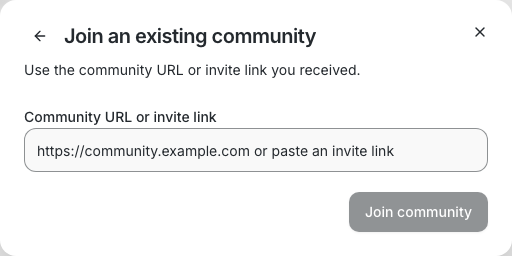
Adding an existing community by relay URL could fail with `Community
rejected: Load failed` even when its WebSocket endpoint was reachable.
The Add Community flow fetched `/api/join-policy` from the WebView, so a
relay without a matching CORS allowance blocked the policy request
before the app could join it.

## Summary

This bug fix fetches join policies through Tauri's native networking
layer for direct URL joins. Invite-code discovery, policy acceptance,
and signed invite claims remain on the WebView path so those operations
can migrate together later.

## Changes

- Uses native networking for Add Community and first-community direct
URL join-policy requests.
- Validates relay schemes, rejects URLs containing credentials, and
refuses redirects.
- Bounds declared and chunked native responses before JSON parsing.
- Preserves existing `404`, non-success status, malformed JSON, and
absent-policy behavior.
- Requires every join-policy caller to choose its transport explicitly.

Public relays using Buzz's default permissive CORS configuration are not
known to be affected.

### Related issue

Related to #2872.

### Testing

#### Reviewer-reproducible examples

End-to-end red/green requires a relay with restrictive CORS and a Buzz
identity authorized to join it.

##### Red: `main`

From a clean checkout of `main`:

```bash
. ./bin/activate-hermit
just staging
```

In Buzz Desktop:

1. Add another community so the restrictive-CORS relay can be removed.
2. Remove that relay.
3. Open Add Community and enter the relay's WebSocket URL.
4. Select Add Community.

Observed result:

```text
Community rejected: Load failed
```

##### Green: this PR

From a clean checkout of this branch:

```bash
. ./bin/activate-hermit
just staging
```

Repeat the same steps above.

Observed result:

```text
The community rejoins successfully.
```

Supporting checks:

- Six native join-policy tests, including oversized declared and chunked
responses.
- Four TypeScript API tests, including the native command contract.
- E2E build and four focused onboarding and sidebar Playwright tests.
- Full `just ci` and pre-push suites.
- Builderbot, Kalvin, and minimize-diff review fanout found no
actionable issues after the final rebase.
**Category:** improvement
**User Impact:** Users can understand, install, authenticate, and manage
agent runtimes from one progressively disclosed Agents settings
experience.

**Problem:** Runtime health and custom harness management were split
across overlapping settings surfaces, exposing low-level configuration
too early while leaving setup and authentication states hard to
understand. **Solution:** Consolidate those operations into one stable
runtime list and an Add runtimes catalog, with task-oriented state
labels, direct setup actions, and custom configuration contained in a
dedicated form.

<details>
<summary>File changes</summary>

**desktop/playwright.config.ts**
Registers the visual coverage needed for the redesigned runtime catalog.

**desktop/public/harness-logos/CREDITS.md**
Documents bundled runtime-mark provenance and the decision not to ship
the withdrawn OpenAI mark.

**desktop/public/runtime-icons/codex.png**
Removes the obsolete Codex bitmap in favor of the neutral fallback.

**desktop/public/runtime-icons/goose.svg**
Removes the old Goose asset now replaced by the theme-adaptive mark.

**desktop/src-tauri/src/managed_agents/discovery.rs**
Aligns runtime discovery guidance with the new task-oriented setup
language.

**desktop/src-tauri/src/managed_agents/discovery/runtime_metadata.rs**
Updates runtime metadata used by the redesigned settings states.

**desktop/src/features/agents/ui/runtimeAvailabilityWarning.test.mjs**
Updates availability-warning expectations for the revised runtime
guidance.

**desktop/src/features/onboarding/assets/harness-logos/chatgpt.png**
Removes the redundant bitmap from the unified runtime icon pipeline.

**desktop/src/features/onboarding/assets/harness-logos/goose.png**
Removes the redundant Goose bitmap.

**desktop/src/features/onboarding/ui/HarnessMarks.tsx**
Adds theme-adaptive bundled runtime marks with safe fallbacks.

**desktop/src/features/onboarding/ui/RuntimeIcon.tsx**
Centralizes runtime logo rendering so settings and catalog rows cannot
drift.

**desktop/src/features/onboarding/ui/SetupStep.tsx**
Aligns onboarding runtime setup copy with the settings terminology.

**desktop/src/features/onboarding/ui/presetLogos.test.mjs**
Guards bundled-logo behavior and prevents the withdrawn Codex mark from
returning.

**desktop/src/features/settings/ui/CustomHarnessForm.tsx**
Reworks custom runtime creation and editing into a clear, dedicated
catalog form.

**desktop/src/features/settings/ui/HarnessCatalogDialog.tsx**
Introduces the Add runtimes master-detail catalog, grouped setup states,
loading treatment, and pinned actions.

**desktop/src/features/settings/ui/HarnessManagementCard.tsx**
Removes the superseded standalone custom-harness management surface.

**desktop/src/features/settings/ui/HarnessRow.tsx**
Provides stable operational runtime rows with install, update,
authentication, edit, and delete behavior.

**desktop/src/features/settings/ui/HarnessesSettingsPanel.tsx**
Consolidates runtime health and custom management into one Agents
settings panel.

**desktop/src/features/settings/ui/SettingsPanels.tsx**
Wires the consolidated panel into Agents settings.

**desktop/src/features/settings/ui/harnessCatalogCopy.ts**
Adds restrained, source-annotated runtime descriptions and setup
guidance.

**desktop/src/features/settings/ui/harnessCatalogLogic.test.mjs**
Covers grouping, state labels, stable row order, actions, and adapter
warnings.

**desktop/src/features/settings/ui/harnessCatalogLogic.ts**
Centralizes catalog grouping, actions, status labels, and runtime-safe
warning copy.

**desktop/src/features/settings/ui/harnessGalleryLogic.test.mjs**
Removes obsolete gallery-only tests after consolidation.

**desktop/src/features/settings/ui/harnessGalleryLogic.ts**
Retains only the shared custom-runtime safety logic needed by the new
surface.

**desktop/src/shared/ui/config-nudge-attachment.tsx**
Points configuration nudges to Agent runtimes with matching terminology.

**desktop/src/testing/e2eBridge.ts**
Adds deterministic runtime states for authentication and catalog E2E
coverage.

**desktop/tests/e2e/doctor-states.spec.ts**
Verifies ready, setup-required, node-gated, authentication, loading, and
error contracts.

**desktop/tests/e2e/harness-catalog-screenshots.spec.ts**
Captures whole-pane visual states for the runtime catalog experience.

**desktop/tests/e2e/harness-management.spec.ts**
Exercises catalog actions and custom runtime create, edit,
authentication, and deletion flows.

**desktop/tests/e2e/onboarding-agent-defaults.spec.ts**
Updates default-runtime expectations for the consolidated experience.

**desktop/tests/e2e/profile.spec.ts**
Aligns profile navigation assertions with the new settings surface.

</details>

## Reproduction steps

1. Open Settings → Agents and inspect Agent runtimes; ready, signed-out,
installable, and setup-required runtimes should have stable rows and
explicit actions.
2. Open Add runtimes and browse the Setup and Installed groups; select
entries to see sourced guidance and a pinned Install or Setup guide
action.
3. Select Custom harness, create a runtime, then edit and delete it;
verify required-field gating and the blast-radius confirmation.
4. Exercise a signed-out runtime and connect it; the row should move
from Sign-in needed to Ready without reordering.
5. Resize the window and switch themes to verify responsive layout and
adaptive bundled marks.

## Screenshots

| Mixed runtime states | Goose not installed | Sign-in needed |
|---|---|---|
| <img width="980" height="1000" alt="image"
src="https://github.com/user-attachments/assets/28705b39-1d91-440a-a954-fb2d7d8ee759"
/> | <img width="980" height="1000" alt="image"
src="https://github.com/user-attachments/assets/e65ce8e1-8c85-4272-afb5-e6001b94d560"
/> | <img width="980" height="1000" alt="image"
src="https://github.com/user-attachments/assets/3987f355-960d-4744-8c26-b3746944a33c"
/> |

| Add runtimes catalog | Custom runtime | Setup guide |
|---|---|---|
| <img width="896" height="672" alt="image"
src="https://github.com/user-attachments/assets/a2f32c8a-4dff-4929-af96-b07346933335"
/> | <img width="896" height="672" alt="image"
src="https://github.com/user-attachments/assets/b2e85a0c-3940-4875-a138-4035423c9de7"
/> | <img width="896" height="672" alt="image"
src="https://github.com/user-attachments/assets/5a690c1c-368e-4ee3-98b9-ffefdc3cf804"
/> |

Full 13-state screenshot matrix and review evidence:
https://buzz.block.builderlab.xyz/channels/c5af9e3e-4317-4853-b3e3-ed9c15bc511d?event=ec88f6e472f2b08d6318ae76fd754fd4f218385f67cfe59b73034c4bc34c9252

---------

Signed-off-by: Taylor Ho <taylorkmho@gmail.com>
Signed-off-by: npub1223z34hd7vtwc6qj4s7flsxkj644nlre2nthu7lrrmkumhu3xddsrx9r6w <52a228d6edf316ec6812ac3c9fc0d696ab59fc7954d77e7be31eedcddf91335b@buzz.block.builderlab.xyz>
Co-authored-by: npub1223z34hd7vtwc6qj4s7flsxkj644nlre2nthu7lrrmkumhu3xddsrx9r6w <52a228d6edf316ec6812ac3c9fc0d696ab59fc7954d77e7be31eedcddf91335b@buzz.block.builderlab.xyz>
## Summary

Pull requests and issues that mention you now appear as
repository-scoped Inbox conversations, so project work can be reviewed
without first navigating to Projects.

Opening a project item resolves its current canonical state and reuses
the existing review, comment, merge, and issue actions. Repository-aware
grouping keeps identical event IDs from different repositories separate,
while loading, missing-data, and partial-query states avoid exposing
stale actions.

### Related issue

None found.

### Testing

- `node --import ./test-loader.mjs --experimental-strip-types --test
src/features/home/lib/projectInbox.test.mjs` — 6 tests passed
- `CI=1 pnpm exec playwright test tests/e2e/project-inbox.spec.ts
--project=smoke` — passed
- Pre-push desktop, mobile, Tauri, and Rust checks — passed

---------

Signed-off-by: Thomas Petersen <thomasp@squareup.com>
## Summary

Project issues, pull requests, reviews, and commit details no longer
flatten rich content into inert or plain text. They now share the
message markdown and media pipeline, preserving NIP-92 `imeta` metadata
so links, images, and videos render consistently.

Commit bodies are fetched only when a single-commit detail view is
opened, keeping list queries lightweight while exposing full context
beside the diff.

### Related issue

None found.

### Testing

- Pre-push suite: `desktop-check`, `desktop-test`, `desktop-tauri-test`,
`rust-tests`, and `mobile-test`
- Project issue and pull request regression tests cover preserving
attachment metadata on roots, updates, and comments
- The project commit detail smoke scenario verifies linked text, images,
and video in commit bodies

Signed-off-by: Thomas Petersen <thomasp@squareup.com>
## Summary
- align the multi-community rail with the content surface and balance
its visible 10px side gutters
- center Mobile pairing, start sessions on demand, and keep retry states
inside the QR area
- reveal the QR code and copy action with 250ms motion and use the
standard loading spinner

The rail was centered within its own box, but the adjacent sidebar added
another 11px to the visible right gap. Mobile pairing also started
before user intent, which could leave an idle session waiting for EOSE.

## Validation
- `pnpm -C desktop build:e2e`
- `pnpm -C desktop test` — 3,516 passed
- `pnpm -C desktop exec playwright test tests/e2e/community-rail.spec.ts
--project=smoke` — 19 passed
- `pnpm -C desktop exec playwright test
tests/e2e/mobile-pairing-qr.spec.ts --project=smoke` — 1 passed

`pnpm -C desktop check` is currently blocked by the existing
`src-tauri/src/managed_agents/runtime.rs` file-size baseline (2,220
lines; limit 2,216).
## Summary
- render mobile pairing QR codes locally with Wallet-inspired styling
- hide the raw pairing URI behind a matching copy button
- add focused rendering and dialog coverage

## Test plan
- desktop lint and 3,489 desktop tests
- focused pairing dialog Playwright test
- decoded the rendered QR back to the exact pairing URI
## Why

Installing the Codex, Claude, or Goose desktop app does not install the
command-line harness Buzz needs. The current UI makes that distinction
unclear, links some missing-CLI states to adapter documentation, and can
report a successful install from the installer exit code even when
runtime discovery still fails. On Windows, Buzz also invokes Goose's
Bash installer, which writes the executable somewhere Buzz does not
discover.

## What

- distinguish missing vendor CLIs from missing or outdated ACP adapters
in runtime metadata and UI guidance
- link Codex, Claude Code, and Goose missing-CLI states to their
official CLI installation documentation
- explain in Settings, onboarding, and agent configuration that the
desktop app alone is not sufficient
- use Goose's official PowerShell installer on Windows
- refresh PATH and rediscover the requested runtime after installation,
keeping the control retryable if the runtime is still unavailable
- add Rust and Playwright regression coverage for Windows installer
selection, CLI/adapter guidance, false-success prevention, verified
installs, and onboarding copy

## Risk Assessment

Medium. This changes desktop onboarding and runtime installation
behavior. Successful installs now require the runtime catalog to verify
availability; previously hidden discovery failures will surface as
actionable errors instead of a false success state.

## References

- [Codex CLI installation](https://developers.openai.com/codex/cli/)
- [Claude Code
installation](https://code.claude.com/docs/en/getting-started)
- [Goose
installation](https://goose-docs.ai/docs/getting-started/installation/)
- Follow-up to #2563 and #2587

## Validation

- `just desktop-typecheck`
- `just desktop-test` — 3,455 passed
- focused Rust post-install verification tests
- focused Playwright Doctor/onboarding coverage (in progress; CI and
local sequential rerun will provide final results)

Generated with Codex

---------

Signed-off-by: Atish Patel <atish@squareup.com>
Co-authored-by: Codex <noreply@openai.com>
Co-authored-by: Goose <opensource@block.xyz>