🤖
## Summary

Building on #7488's npub foundation, this PR finishes the identity
display change for the controls where you actually manage people and
keys: profile, settings, agent access, and workflows. Everywhere in
these surfaces, an identity key shows — and copies — as its canonical
npub (npub is the human-readable encoding of a Nostr public key: the
compact `npub1j57...fjmv` form where space is tight, the full npub where
the whole key matters), and accepts npub as input.

After this change:

- Profile panel: the public-key row and the managed-by / declared-owner
copies show the full npub. If a key can't be encoded, you see
"Unavailable" with no copy button — never a raw or partial key.
- Settings: the identity card shows and copies the npub. The
hosted-communities account identity derives from the bound key
(`pubkey_hex`) — the same authority as the mismatch gate and hosted
operations — so the display can never disagree with what the app acts
on; an unusable hex falls back to a neutral label instead of rendering
the unverified server npub. The connected claim and a community's
Connect action require that same usable bound key to match the local one
— with no usable binding the card cannot claim connected or start
Connect, while the community list, linking, and delete/rebind recovery
stay available.
- Hosted create/onboarding: the account and device identity rows in the
create flow and owner onboarding derive from the same authoritative
fields (bound key / local key), with the same neutral fallback;
readiness requires a usable bound key that matches the local one.
- Respond-to allowlist (controls who may respond to an agent): entries
can be typed or pasted as hex or npub; both spellings of the same key
are recognized as one entry and dedupe. Search results, chips, and
remove buttons use the compact npub.
- Workflow key fields: to/from keys display as npubs in the form and
save back as canonical hex. Templates like `{{trigger.author}}`, roles,
and free text pass through untouched; placeholders accept both
spellings.
- Recipient and agent dialogs: the verify popover is npub-only (the
raw-hex line is gone); denied-membership screens never show a raw key.
- The Rust-side truncated display name (used for native surfaces) shows
the same compact npub, so those surfaces match the web UI.

Internal representation is unchanged: keys are still stored, sent, and
matched as canonical 64-character hex — npub is a display and input
spelling, normalized to hex at the boundary, so existing data and
integrations keep working. Bound-key usability and comparison use one
normalized form (trimmed, lowercased, 64 hex characters; npub rejected),
so padded or mixed-case spellings of the same key match. Display names,
private keys, and event IDs are untouched.

## Details

- `respondToAllowlist` / `RespondToField`: npub entries normalize to
canonical hex; cross-form dedupe; compact npub in rows and chips;
direct-add accepts npub and stores canonical hex.
- `workflowFormTypes` / `WorkflowStepCard`: hex → npub for display, npub
→ canonical hex on save; templates, roles, and free text pass through in
both directions (roundtrip-tested).
- `UserProfilePanelFields`, `ProfileSettingsCard`,
`HostedCommunitiesSettingsCard`, `MembershipDenied`,
`SelectedRecipientChip`, `AddAgentToChannelDialog`: npub display and
copy; invalid keys → "Unavailable" with no copy; hosted identity rows
derive from the bound `pubkey_hex` (create/onboarding rows from the
bound and local keys), never the unverified server npub;
connected/readiness/Connect gates use the same usable-bound-key
predicate, and the settings Connect invocation callback re-checks it
before starting.
- `src-tauri/src/commands/identity.rs`: `truncated_display_name`
compacts to the first 8 + last 4 characters of the npub (above a 12-char
threshold), mirroring `truncateNpub`.
- e2e: profile key rows and clipboard polls assert npub forms and
raw-hex suppression; the display-screenshots spec pins the npub-only
popover; hosted specs drive the real settings card, create flow, and
onboarding rows through their real providers, and the unlinked/npub-only
identity cases assert no connected claim and no Connect action.

### Related issue

- Fixes: N/A. No separate issue; the related work is the stack below.
- Stack: builds on #7488 (shared npub foundation), now merged; this PR
is rebased onto main and stands on its own.

### Testing

At head `303c90ffa` (base: main `bfc38485`; 24 files, +1125/−146):

- Focused unit suites (respondToAllowlist, workflowFormTypes,
hostedCommunityApi bound-key helpers) green; mutation-checked — dropping
allowlist canonicalization fails the dedupe case, and dropping bound-key
normalization fails the npub-in-hex and padded same-key cases.
- Full desktop unit suite 6,477/6,477, `desktop-typecheck`,
`desktop-check` (formatting fixed narrowly with `biome check --write` on
the touched files only), and a fresh E2E build at the current head; the
add-community + hosted-communities-settings specs 18/18 and onboarding
integration 69/69 on a fresh dedicated port, with focused new-case runs
4+4 covering padded same-key (ready, Connect kept — no false rebind) and
npub-in-hex (neutral label, recovery, no Connect) across the settings
card, create flow, and first-community onboarding, plus the
unlinked-account settings regression asserting Connect cannot occur.
- `cargo fmt`/clippy (both feature sets) and `cargo test identity` (71
pass) passed at the earlier full-change head; since then, the only
production changes in this PR's delta are the hosted identity display
authority and its fail-closed bound-key gating/normalization above
(base-side fixes carry #7488's receipts) — every other change is
test-only.

### Task provenance

Buzz channel: `1f0e4a3d-7e01-4efe-bb16-843b357f85c9`

Task:
buzz://message?channel=1f0e4a3d-7e01-4efe-bb16-843b357f85c9&id=86b34eb4bd84a1472419e9af22636c011c0fe273e3c196f967d7a36996e149b6

---------

Signed-off-by: Logan Johnson <loganj@squareup.com>
Co-authored-by: Larry <627498bd4bd1f281a16431e3c6cce3b5c25b6692798c78672298aefbf2f8f8b5@buzz.block.builderlab.xyz>
## Summary
Selecting two people or agents named Scout could replace the first
recipient with the second even though the message still looked right.
This binds each selection to its exact identity: the first keeps
`@Scout`, and a conflicting selection gets `@Scout (<full public key>)`.
Removing one no longer removes or redirects the other.
- Reuse the existing **@ suggestion list**; team selection and automatic
agent addressing reserve and reuse distinct labels too. Typing an
ambiguous name manually shows an instruction to use the picker and
preserves the draft without publishing—in chat, edits and standalone
forums.
- Share literal mention matching across recipient extraction, removal,
display and editing so a shorter name cannot claim another recipient's
longer or qualified label.
- Rebuild authored references when a message is edited, and use the
latest authorized snapshot when reopening or forwarding.
Rendering/editing can recover qualified identities only from the
message's recorded references, not from a key typed into its body.
Unresolvable historical names remain literal rather than guessed
recipients.
- Wrap full-key labels within narrow/zoomed layouts while keeping their
complete accessible label and ordinary mention icons. Edit activation
waits for the action menu's focus cleanup before focusing the editor.
### Related issue
Targets `main`; mention spacing (#7128) is already merged. Split from
#7114. This is independent of the #7124 → #7125 remote-invitation stack
and does not expand agent eligibility or invitation permissions. The
separate Enter-selection suffix issue remains tracked in #7253.
### Testing
The desktop unit suite and focused mock-Chromium checks passed on the
published integration candidate, including pending-paste selection,
edit/forwarding, copy and narrow-layout cases; formatting, types and
frontend builds passed. On `0b3b18c0`, 64 focused trust/paste/selection
unit tests and six mock-Chromium tests passed with zero browser retries,
including actual timeline chip copy → fresh channel paste → send and
mismatched-key rejection; TypeScript, changed-file Biome and an isolated
E2E build passed. The broader browser run had copy failures before the
focused repairs and is not claimed as wholly green. See [live
CI](https://github.com/block/buzz/pull/7133/checks) for current-head
results. No full local `just ci` pass, native/live-relay or
cross-browser validation is claimed.
To try it: select two same-name recipients, remove one, send, then
edit/reopen and forward; only the intended identities should remain.
Type an ambiguous name without choosing a suggestion and check that
sending retains the draft with an error. Inspect full-key labels in a
narrow window at 150% text size, and open Edit and type immediately.
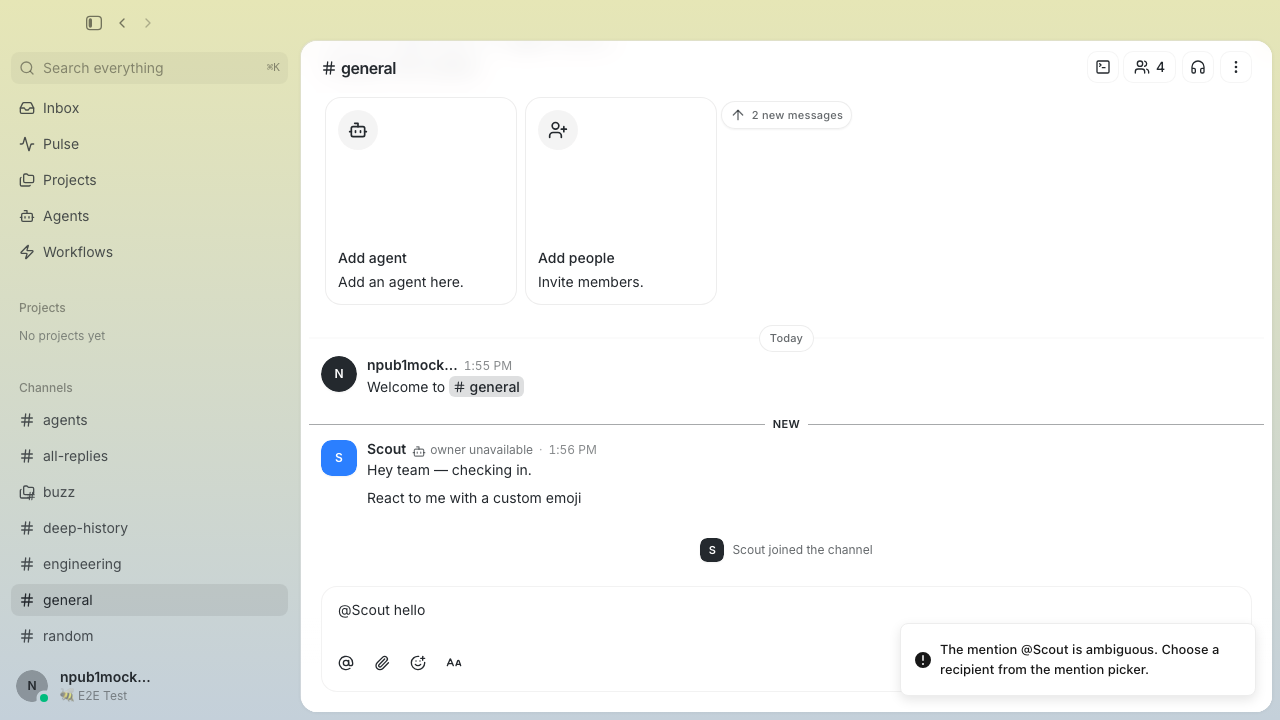
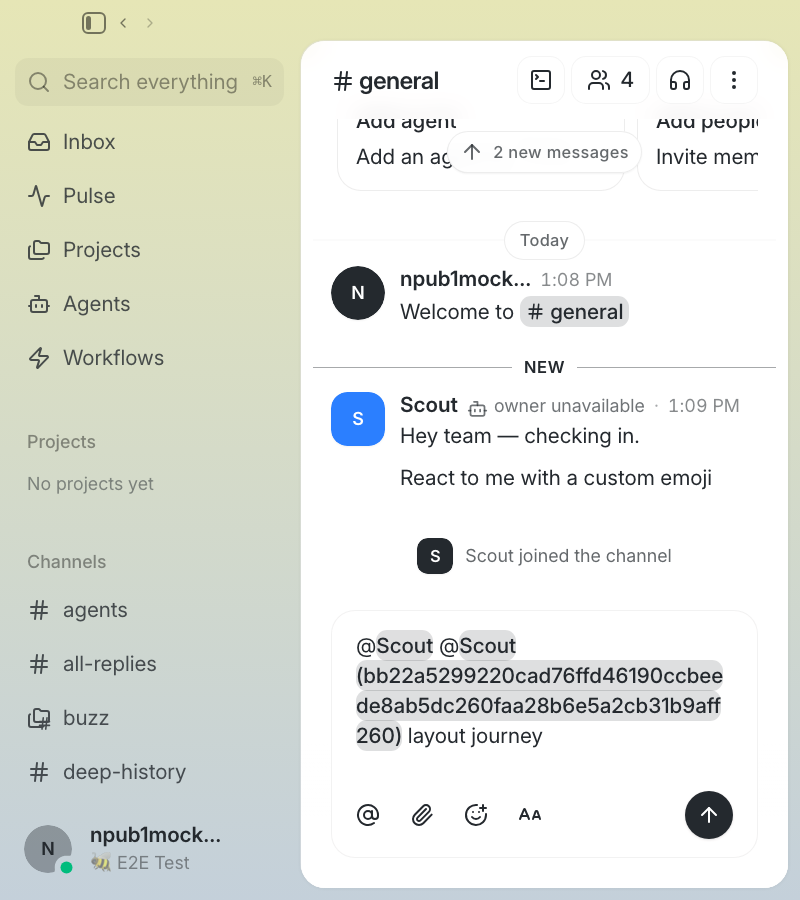
*Earlier mock-browser captures, not current-head runtime proof. No new
before-state capture; screenshots alone do not prove recipient
delivery.*
**Clipboard trust:** generated full-key-qualified mentions now retain
their exact recipient after copy/paste when the full key matches the
clipboard record and community directory/profile state independently
vouches for the base alias, including numeric collision suffixes. A
qualifier alone does not establish trust. Arbitrary historical labels
still cannot always be reconstructed.
---------
Signed-off-by: Logan Johnson <loganj@squareup.com>
Co-authored-by: Larry <627498bd4bd1f281a16431e3c6cce3b5c25b6692798c78672298aefbf2f8f8b5@buzz.block.builderlab.xyz>
Co-authored-by: Bad Janet <150b20bdf6130418df9239dd1bd082c71612c8d653b47c277200365b9be215dc@buzz>
🤖
## Requested rebase published — ef40744b
Rebased onto fetched main **47d068e2109d077414cbf2f4f1c927f6d051037a**,
published **ef40744b3aeb4baaf8c81416e1a644fb5b315f91** with the exact
expected-old `df7fad6a` force-with-lease. No merge.
Manual conflicts were additive: preserve main's exact-key identity
documentation alongside the availability contract, and retain both
Bestie props and the shared availability reader in
`UnifiedAgentsSection`. Range-diff confirms unchanged lifecycle policy:
exact-key action-time authority, Unknown versus Offline, rejected
shutdown retains record/memberships, and separate local/provider/owner
gates. Main's exact-key profile routing survives. Both test-only CI
synchronization repairs (natural toast expiry and bounded stderr wait)
are byte-identical to the prior head. All ten original
authors/messages/DCO/material coauthor trailers are preserved;
configured signing policy was not changed.
Fresh checks on the rebased candidate:
- TypeScript, Biome on 26 changed TypeScript files, differential
file-size gate, and diff whitespace: pass.
- Focused production-hook/card/profile units: **58/58**.
- Fresh E2E build, availability/deletion browser: **11/11**, no retries.
- Main exact-key profile cases plus failed-DM send/startup retries:
**6/6**, no retries.
Previously reviewed full Desktop/buzz-agent package and mutation
evidence is reused for unchanged behavior; no ceremonial full suite, new
native/provider test, or `just ci` pass is claimed. Local configs,
dependency links, and historical artifacts are preserved.
Hosted observation: **MERGEABLE**, **BLOCKED / REVIEW_REQUIRED**, no
new-head formal review. [CI
33699735990](https://github.com/block/buzz/actions/runs/33699735990) is
running (including Rust and Desktop lanes), not a completed success. DCO
and required Security aggregate passed at the observation; the separate
Codex advisory review was skipped. No completed failing check or new
inline feedback observed. Historical approvals are not new-head
approvals. No reviewer/security authorization or merge action was
performed.
---
## Feature summary and retained pre-rebase evidence
## Summary
In Buzz Desktop, an agent could look online just because it had been
started or deployed, even when there was no current sign it was
connected. Cards and profiles now show availability from the agent's
relay presence rather than a saved launch record, so you can distinguish
an online agent from one that was merely deployed.
Agents cards and profiles use presence reported through the shared
server (the relay). A successful presence read with no online agent
shows Offline; failed/disconnected evidence shows unknown, rather than
retaining a misleading cached Online state.
Lifecycle actions remain separate. An offline agent may still have a
Shutdown action because the deployment record exists. Shutdown reports a
**request**, not proof the process stopped. Offline does not imply that
starting a duplicate agent is safe, and Online does not promise a
response.
### Related issue
Independent base: `main`; no stack parent or child among the
replacements. Extracted from
[#7114](https://github.com/block/buzz/pull/7114), retained as historical
source (`98fe33ec`).
[Behavior
contract](f4bb2ed44e/docs/agent-availability.md).
Originating [Buzz
discussion](buzz://message?channel=f7a9536a-1738-4bad-a888-b3ea25010ef1&id=7aa1f0ab23dce514bd8a0221441cf005bf428914621171472b79747c50820848)
· channel `f7a9536a-1738-4bad-a888-b3ea25010ef1`.
### Testing
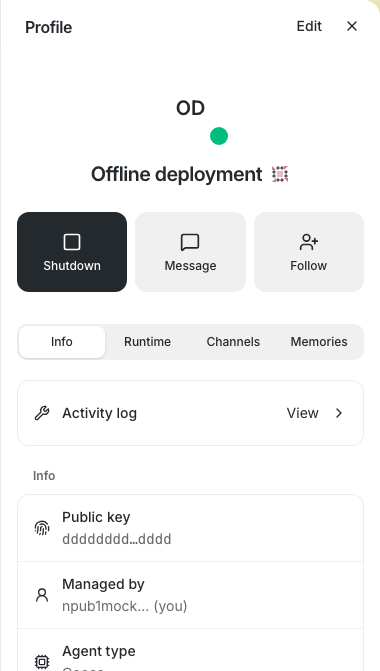
The same saved provider-backed agent, with only authored presence
changing. These are mock-browser states, not a before/after deployment
or live relay transport test; production UI is unchanged by the later
fixture repairs.
**No online presence:** gray dot, existing Shutdown control retained.
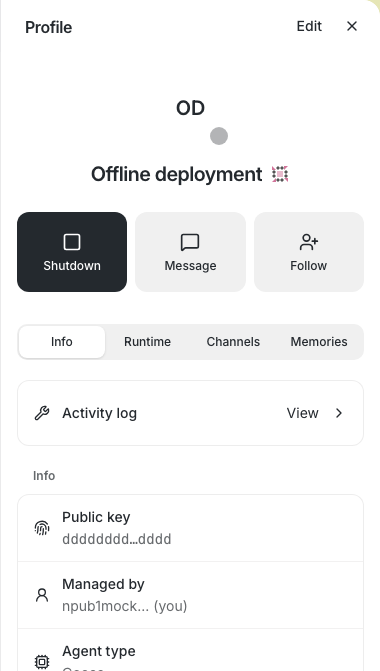
**Online presence:** green dot, same lifecycle control.
[Capture
details](https://github.com/block/buzz/pull/7127#issuecomment-5482264824).
To check manually, compare runtime-only transitions with presence
updates, then disconnect/fail the presence read and verify it does not
stay Online. A Shutdown request should not immediately claim confirmed
termination.
#### Historical pre-rebase evidence and limitations (df7fad6a)
Lifecycle production source remains
**`f4bb2ed44e5a989d93c5f51e93c0bbd2dca941be`**. Current published head
is **`df7fad6ae65dda78508317186a95522d1bb22ed9`**: the prior browser
synchronization at `b78d093e` plus an additive two-file Rust
test-harness synchronization described below. No production bytes,
dependency/configuration files, or prior commits were changed; no
rebase. Current live main `0dbd036f5bff33e7ade75e7639f3218d424a6e73` has
identical failing-test/toaster/send-flow source; the causal browser
comparison used latest successfully tested main
`04babf02655440b4dfd37f2e2df605ead0a030d8`.
**Lifecycle/deletion correction:** both Agents and actual profile
deletion now pass the shared exact-key availability reader, not raw
cached data. It reads the canonical query state and connection at action
time, including after awaited channel discovery.
Failed/disconnected/pending evidence and unqueried persona siblings are
unknown; successful missing means Offline only for a requested key.
Successful background refetch cache remains usable; settled failure
revokes it. No second cache or per-row polling was added.
Provider record + channel + Online/Away/**unknown** awaits shutdown
submission before local removal; rejection preserves record/membership
for retry. Established Offline preserves intentional no-request removal.
No route preserves warned local removal. Local agents retain native
stop-before-remove, independent of presence. Profile consent now
describes a shutdown **request**, not remote deletion or guaranteed
termination. Existing ownership and force gates are unchanged.
**Verified, reused exact-candidate validation:** the independently
approved eleven-file patch (SHA-256
`2f69fe12ef0420e62dea1fd8db28cfa22cde5eecaf8080e656310a3e60d0cf86`) was
committed without byte changes. Desktop **5,921 passed, 0
failed/skipped**, including **26 new mounted production hook/IPC
regressions**; rebuilt availability browser suite **11/11 passed, no
retries**, including four actual profile Delete journeys. Desktop check
(existing 4 warnings/5 infos), typecheck, production/protected-feature
artifact matrix, differential file-size/policy and diff checks passed.
No blanket rerun or new full-repository `just ci` is claimed for this
frontend correction.
Production regressions cover cached Online **and Offline**
failure/disconnection, genuine missing/Offline, pending, successful
inflight refetch versus settled error, retained reader, error during
awaited channel discovery, unqueried persona sibling, shutdown
rejection/order/cancel, no route and local authority. Browser fixtures
use safe mock IPC and a retained provider receipt, not a real
deployment. Three restored mutation controls fail: unknown → skip
shutdown (**15** regressions), Agents raw-cache reader (**6**), actual
profile raw-cache caller (**1 browser journey**, false removal on failed
cached Offline). Independent review approved the exact frozen bytes and
added **4/4 cached-empty failure/disconnection probes** across both
callers. This is local independent approval, not formal GitHub/A Team
clearance.
The prior native propagation/poll-count defects remain closed ([earlier
response](https://github.com/block/buzz/pull/7127#issuecomment-5512278755)).
The prior hover-popover correction at `b55423f6` remains covered by the
full 11-journey browser run: pending/failed/disconnected means no badge
or accessible status, genuine missing/Offline retains an Offline badge.
Its earlier fallback-restoration mutation failed as expected (badge
count 1 rather than 0); that historical witness is reused, not rerun.
**Reused unchanged native/system boundary:** local `just ci` at
`c59067d8` passed workspace/Tauri fmt/clippy, static/policy checks, Rust
unit recipe, native workspace **3,159 passed / 20 ignored**, Web build
and **2,019 mobile tests**. No native implementation changed in this
lifecycle correction. These are historical boundary results, not
new-head native/live certification. [Parent
CI](https://github.com/block/buzz/actions/runs/33650549130) passed with
**14 retry-recovered browser flakes**, not retry-free. Old-head
CI/reviews are not current-head clearance.
**Hosted gates:**
[CI33662151103](https://github.com/block/buzz/actions/runs/33662151103)
on `f4bb2ed4` **FAILED**: smoke shard1 had 322 pass, one failure, one
retry-recovered flaky, two skipped. The failed first-DM retry test timed
out on all three attempts because the error toast intercepted Send. That
failure is preserved, not waived; the scoped test repair below is
published as `b78d093e`.
[CI33668171165](https://github.com/block/buzz/actions/runs/33668171165)
on `b78d093e` subsequently **FAILED** the Rust unit budget regression
described below. Both original failures remain visible; neither was
retried to green. Exact `f4bb2ed4` and `b78d093e` APPROVED reviews cover
unchanged reviewed bytes, not formal approval of the new head. Fresh
exact-head CI and the established automated technical rereview are the
next gates for `df7fad6a`. Historical deletion responses remain
([5092381800](https://github.com/block/buzz/pull/7127#issuecomment-5513759316),
[5092391193](https://github.com/block/buzz/pull/7127#issuecomment-5513763497)).
No formal review dismissed. The [security
notice](https://github.com/block/buzz/pull/7127#issuecomment-5482231278)
and latest-push maintainer/codeowner policy remain separate actionable
gates: eligible Block organization members own current-range
authorization. No merge/security authority exercised.
**CI causal repair (`b78d093e`, test only):** the error `Message failed
to send: Mock first DM send failed.` is deliberately injected by the
existing fixture. CI screenshot and retry trace show the bottom-right
Sonner notification over the actual enabled Send button. `fill()` leaves
the pointer parked there; Sonner pauses its 4-second lifetime while
hovered. A fast run can click before animation settles (unchanged local
test passed in 2.7s; two actual tested-main CI cases passed first
attempt in 3.3s), which does not disprove the failure. Independent
controlled browser runs on `f4bb2ed4` and tested main `04babf` both
reproduced the same toast hit-test at Send `(1203,627,32,32)`,
persistent hover beyond 4s, and intercepted ordinary click with no
second send. Moving the real pointer to the editor allows natural expiry
and successful ordinary retry, preserving all original
DM-channel/recipient assertions. This same synchronization already
exists in the neighboring agent-startup-failure test.
The one-file correction keeps the visible error assertion, scopes its
toast locator, moves the pointer back to the editor and observes normal
toast removal (bounded 10s) before retry. No forced click, direct toast
dismissal, mocked clock, CSS override, skipped test, production behavior
change, or new backend mock. Six focused browser executions pass
(first-send/startup-failure, three repeats each, no retries); the
held-toast control fails on original bytes at the Send click while the
exact repaired test passes. Biome and diff checks pass. Reuse unchanged
5,921 Desktop / 11 availability browser / four independent probes above;
no semantic production change warrants repeating those suites. Original
failed CI attempt/retries, local fast pass, deliberate failing control
and all traces remain in `WORK_LOGS/AVAILABILITY_CI_B9210A40`. Browser
evidence is mock-IPC Chromium, not native/live-relay certification. The
UI still temporarily overlays Send while a notification is hovered; the
test exercises its real move-away/expiry recovery, not immediate
click-through.
**Rust CI causal repair (`df7fad6a`, test only):** [original Rust / Unit
Tests failure,
job100375291370](https://github.com/block/buzz/actions/runs/33668171165/job/100375291370)
tested GitHub merge `223dee91a396d8cb4ebf18b9b8559e5a54951235`.
`context_recovery_budget_exhaustion_surfaces_the_error` failed at
`regressions.rs:2756` in **0.091s** because its immediate stderr
snapshot lacked `context recovery budget spent`. ACP context-error
assertions had already passed. The captured prefix shows all three
budgets **32768 → 16384 → 8192 bytes**, above the 4096-byte floor, and
ends during the third attempt. This is **not evidence of floor
exhaustion**. The collector is an independent Tokio task; a stdout
response is not a stderr barrier. Recovery, harness and test blobs were
identical across the compared base/head/merge parents; no production
regression was implicated.
The shared test Harness now provides a bounded event/condition wait,
registering for collector notifications before reading the buffer to
avoid lost wakeups. The budget and adjacent terminal floor assertions
wait for their own diagnostic and retain the matching snapshot. The
budget test still requires the provider's ACP context error and exactly
three recovery rungs, now corroborated by **exactly four provider
calls** and no floor diagnostic. Timeout remains a real failure with
captured stderr. No fixed sleep, weaker assertion, skip,
provider-limit/logging change, dependency/config edit, or production
change.
**Deterministic causal control:** the same real agent/HTTP-provider/ACP
scenario holds only stderr collection behind a one-shot gate until after
stdout responds. The old immediate snapshot fails the original budget
assertion (intentional exit101); the repaired wait explicitly remains
Pending while held, then passes after release. No scheduler-speed
assumption or fixed sleep. This reproduces the observation race under
controlled delay, **not the exact historical CI schedule**. A
missing-diagnostic test proves the wait actually times out. Original
failure and deliberate failing-control logs/patch remain in
`WORK_LOGS/RUST_TRIAGE_06E32D2D` and `WORK_LOGS/RUST_SYNC_BC5758B9`.
**Final candidate validation:** focused recovery **9/9**, floor **1/1**,
absent-diagnostic timeout **1/1** pass. One full touched-package run,
`cargo test --locked -p buzz-agent`: **695 passed, 0 failed, 1 existing
ignored**, including all **54 regressions**. Local nextest was
unavailable, so this uses the repository-supported cargo-test fallback,
not a claim of nextest reproduction. `cargo fmt --check`, package-scoped
Clippy all-targets with `-D warnings`, differential file-size/policy and
diff checks pass. Previously reviewed availability production and the
Desktop/browser evidence above are unchanged and reused; no all-native
blanket rerun. The test-only delta was self-reviewed against collector
ordering, timeout and falsification evidence. Existing production
approval remains valid for those bytes; exact-new-head technical/CI
clearance is not assumed. The required **Security aggregate** is
distinct from optional Codex advisory feedback; no security
authorization, human review contact, or merge was requested.
**Remaining policy limits:** shutdown submission is not harness
acceptance or process termination; confirmed Offline/no-route local
removal may leave a remote process; route discovery is best effort,
membership cleanup uses `Promise.allSettled`, and multi-instance
deletion is sequential/non-atomic. No distributed singleton,
provider-health, tenant-switch cancellation, live relay TTL or packaged
WebView/VoiceOver certification is claimed. The pre-existing DM-header
raw-presence fallback (`ChannelScreenHeader`/`useActiveChannelHeader`)
remains outside this repair and uncertified. Screenshots above remain
historical mock-browser illustrations, not new deletion or native
transport evidence.
---------
Signed-off-by: Logan Johnson <loganj@squareup.com>
Co-authored-by: Larry <627498bd4bd1f281a16431e3c6cce3b5c25b6692798c78672298aefbf2f8f8b5@buzz.block.builderlab.xyz>
## Summary
- Makes Projects repository-aware across browsing, branch and tag
selection, local and remote source management, work items, commits, and
contextual repository actions.
- Refines project details into consistent single-column reading surfaces
with a resizable, section-aware context pod, while keeping project
conversations available in the attached chat panel.
- Adds persistent sidebar project navigation, direct entity links,
repository discussion channels, contributor identity matching, and
consistent loading and activity presentation.
- Keeps branch-specific controls on code-oriented sections while Tasks,
Reviews, and Channels remain repository-scoped, reducing misleading
context and actions.

Replacement for #5981 with an identical final tree flattened into one
signed-off commit because the required DCO check suite remained stalled.

### Related issue
N/A

### Testing
- [x] Desktop pre-push checks, TypeScript typecheck, and unit tests
- [x] E2E production build with `pnpm build:e2e`
- [x] Focused Playwright smoke coverage for project workspace, task,
review, commit, sidebar, and contextual-panel behavior
- [ ] Attach final before/after screenshots after design review

---------

Signed-off-by: Thomas Petersen <thomasp@squareup.com>
Signed-off-by: Wintermute <165f0c871dd2586bb18b6aa109eeaf57bb2132ff4d27b10120f4368a0f627022@buzz.block.builderlab.xyz>
Co-authored-by: Wintermute <165f0c871dd2586bb18b6aa109eeaf57bb2132ff4d27b10120f4368a0f627022@buzz.block.builderlab.xyz>
**Category:** improvement
**User Impact:** Buzz channel, message, repository, pull request, and
issue links now open reliably and display recognizable context in the
desktop app.
**Problem:** Buzz links could appear as raw or ambiguous URLs, and
navigation links received during startup or community transitions could
be dropped before the UI was ready. Repository and issue shares in
particular required hover context to understand at a glance.
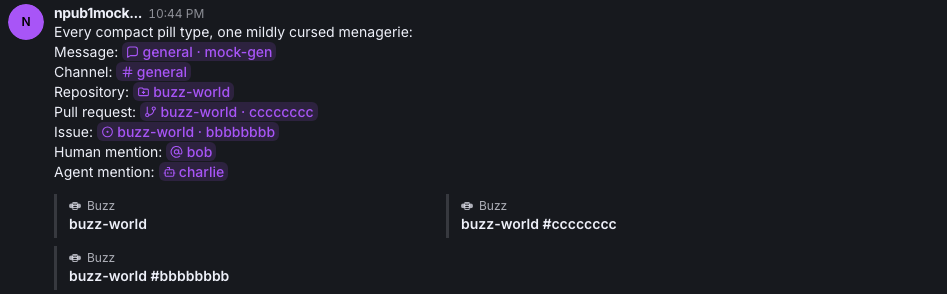
**Solution:** Queue desktop channel/message navigation until the UI is
ready, then render bare Buzz permalinks as icon-prefixed chips with
concise entity context while preserving user-authored Markdown labels as
ordinary links.
<details>
<summary>File changes</summary>
**desktop/src-tauri/src/deep_link.rs**
Adds validated channel-link parsing and a deduplicated, acknowledged
queue so navigation survives frontend startup.
**desktop/src-tauri/src/lib.rs**
Registers the pending-navigation state and commands with the desktop
application.
**desktop/src/features/communities/useCommunityInit.ts**
Resets queued navigation safely across community boundaries without
leaking stale destinations.
**desktop/src/features/messages/lib/channelLink.test.mjs**
Covers valid, malformed, and canonical channel permalink forms.
**desktop/src/features/messages/lib/channelLink.ts**
Defines strict parsing and detection for `buzz://channel/<uuid>` links.
**desktop/src/features/messages/lib/composerMessageLinkNode.test.mjs**
Extends composer-node coverage for normalized Buzz link content.
**desktop/src/features/messages/lib/composerMessageLinkNode.ts**
Keeps composer link-node handling aligned with the expanded Buzz link
surface.
**desktop/src/features/messages/lib/remarkChannelDeepLinks.test.mjs**
Verifies bare channel URLs become renderable deep-link nodes without
touching code.
**desktop/src/features/messages/lib/remarkChannelDeepLinks.ts**
Transforms eligible bare channel links into dedicated Markdown nodes.
**desktop/src/features/messages/lib/remarkEntityLinks.test.mjs**
Covers bare repository, pull-request, and issue detection and code-span
exclusions.
**desktop/src/features/messages/lib/remarkEntityLinks.ts**
Adds dedicated Markdown nodes for bare Buzz project entities.
**desktop/src/shared/deep-link.test.mjs**
Exercises queued navigation, acknowledgement, serialization, and
community-switch behavior.
**desktop/src/shared/deep-link.ts**
Serializes pending deep-link drains and acknowledges destinations only
after successful navigation.
**desktop/src/shared/styles/globals/markdown.css**
Aligns permalink icon geometry and spacing with agent mention chips.
**desktop/src/shared/ui/markdown.test.mjs**
Adds integration coverage for every permalink chip, authored labels,
fallbacks, icons, and static rendering.
**desktop/src/shared/ui/markdown.tsx**
Routes channel and entity nodes through the shared presentation path
while preserving authored link text.
**desktop/src/shared/ui/markdown/BuzzLinkChip.tsx**
Introduces the shared interactive/static permalink chip and
authored-label inline-link components.
**desktop/src/shared/ui/markdown/ChannelDeepLink.tsx**
Renders channel shares and references with Hash icons, names, and
shortened-ID fallbacks.
**desktop/src/shared/ui/markdown/MessageLinkPill.tsx**
Renders ordinary message shares with message icons and channel/message
context while retaining sent-from-thread behavior.
**desktop/src/shared/ui/markdown/entityLinks.tsx**
Maps repositories, pull requests, and issues to Projects-aligned icons
and contextual labels.
**desktop/src/shared/ui/markdown/nodeCache.ts**
Includes entity-link rendering in cached Markdown node handling.
**desktop/src/shared/ui/markdown/utils.ts**
Allows validated channel links through the Buzz URL transform.
**desktop/src/shared/useMessageDeepLinks.ts**
Drains queued navigation links safely and clears them during teardown.
**desktop/src/testing/e2eBridge.ts**
Extends the mock bridge with pending-navigation command behavior.
**desktop/tests/e2e/community-rail.spec.ts**
Verifies queued links do not cross community boundaries.
**desktop/tests/e2e/navigation.spec.ts**
Covers channel/message deep-link navigation during startup and active
sessions.
**desktop/tests/helpers/bridge.ts**
Adds reusable deep-link mock state and acknowledgement helpers.
</details>
## Reproduction steps
1. Run the desktop app and open a channel containing bare
`buzz://channel`, `buzz://message`, `buzz://repo`, `buzz://pr`, and
`buzz://issue` URLs.
2. Confirm each bare URL renders as one cohesive chip with a type icon,
a useful name or shortened identifier, and no duplicated channel `#`
character.
3. Add an authored Markdown link such as `[design
discussion](buzz://issue?...)` and confirm the supplied label remains an
ordinary link rather than becoming a chip.
4. Select channel and message links and confirm they navigate correctly
in warm and cold-start states.
## Screenshots / demos
Houston dark theme with custom purple accent (`#a855f7`), captured from
rebased visual implementation `ad411cc06`; current head `0aafa144f` only
adjusts E2E expectations for the visible mention-label behavior shown
here.
**Composer — channel, message, repository, pull request, and issue
pills**

**Message list — channel, message, repository, pull request, and issue
pills**
---------
Signed-off-by: Taylor Ho <taylorkmho@gmail.com>
Signed-off-by: Carl <acda9e433d19dcd0e6b6840f7f4b98f3a56f1fab98049d444c087019e6d36560@buzz.block.builderlab.xyz>
Co-authored-by: Carl <acda9e433d19dcd0e6b6840f7f4b98f3a56f1fab98049d444c087019e6d36560@buzz.block.builderlab.xyz>
Desktop input latency regressed sharply for users on v0.5.9 and worsened
on latest main: multi-second stalls when clicking back into the app,
slow fresh boots, intermittent lockups, and scroll/mouse degradation.
Reverting to `119a84897` (pre-0.5.9) was confirmed to resolve it,
isolating the regression to that range. Profiling a live production
renderer plus a commit-level audit of the range found three independent,
additive causes — fixed here — plus a long-standing `get_channels` cost
that made every remaining refetch expensive, also addressed here.

## 1. Focus-return refetch storm (`refetchOnWindowFocus`)

#5490 wired TanStack's `focusManager` to app focus and flipped ~20 query
sites to `refetchOnWindowFocus: true`. A focus return after >60s away
fires them all within milliseconds — and a click into an unfocused
window *is* a focus return, so the burst runs before the click is
processed. That is the "click into the composer, wait 5 seconds"
symptom, and it also explains why mouse input feels worse than keyboard
(clicks arrive with focus transitions; typing happens while already
focused). A 5-second `sample` of a live production renderer caught a
single window activity-state transition consuming ~1.25s of main-thread
time, dominated by `JSON.parse` in the focus listener's microtask drain.

#5535 already established the fix pattern but applied it to only two
families (channels, home-feed). This PR extends the same 5-minute
`staleTime` discipline to the remaining families: pulse (×5), workflows
(×4), agents (×4), forum (×2), presence, user-status, custom-emoji,
channel-templates, and the persona catalog. Polling cadences and
push-invalidation paths are untouched — interval refetches and
`invalidateQueries` both bypass `staleTime`, so live-update behavior is
unchanged. Each gated family exports its focus-refetch policy as an
options object that the production hook spreads into `useQuery`, and a
`focusRefetchPolicy.test.mjs` drives a `QueryObserver` with that same
production object — locking the policy behaviorally (fresh focus return
→ 0 fetches; stale → refetch) and failing if a hook's
`staleTime`/`refetchOnWindowFocus` wiring drifts.

Four families deliberately keep tighter freshness, all surfaces where
the 5-minute gate would suppress the only refresh path and none of which
feed the app-wide storm: `repo-sync-status` keeps its fresh focus
refetch (its inline comment documents the "committed in a terminal,
switched back to the app" flow as intended); the workflow-runs list
stale-gates at 10s because a remotely-started run has no push
invalidation and its conditional 1s poll is off while the cache shows no
active runs; the workflow list queries (`useChannelWorkflowsQuery` and
the all-channels aggregate) stale-gate at 10s because they have no poll
and no relay subscription, and mutation-driven invalidation only covers
this renderer — remote workflow creates/edits/deletes surface only via
focus refetch; and the managed-agent log stale-gates at one poll tick
(30s) so returning to a live agent log refreshes immediately. Run
approvals keep the 5-minute gate under
`RUN_APPROVALS_FOCUS_STALE_TIME_MS` — their focused 10s poll already
covers freshness.

## 2. Synchronous localStorage sweep on the boot/focus path

#5453's stale-cache sweep synchronously `getItem` + `JSON.parse`s every
whitelisted localStorage entry on the main thread (multi-MB on seasoned
profiles), scheduled with a `requestIdleCallback` timeout of 1.5s that
guaranteed it landed mid-boot, and re-armed on every hidden→visible
transition — stacking it onto the exact moment the focus storm fires.
#5454's `trimSelfProfileCaches()` additionally scanned every
localStorage key on every `writeSelfProfileCache()` call (which fires
per relay self-profile delivery at boot).

Now: the first sweep waits `BOOT_SWEEP_FLOOR_MS` (30s) after startup,
the scan is time-sliced across idle callbacks, and the visibility
trigger is removed — boot-delayed plus hourly still covers the 14-day
TTL contract. The sliced sweep re-checks staleness immediately before
each removal (a key rewritten fresh mid-sweep survives), isolates
per-key storage errors so one bad entry can't strand the rest of the
snapshot, defers oversized values once rather than parsing them on a
zero-budget slice, guarantees forward progress on timeout-fired
callbacks, and cancels its scheduled slice when stopped. The profile
trim keeps a lazily-initialized memoized key count so the common
under-cap write is O(1); the full parse scan runs only when the count
exceeds a cap, resyncs if external deletions made it stale, and a failed
scan skips the trim instead of aborting the write. Sweep semantics
(rules, TTLs, eviction) are unchanged, and tests cover the scheduling,
slice-progress, error-isolation, defer-once, and trim short-circuit
behaviors.

## 3. The macOS window was never opaque

#5478's glass appearance is correctly opt-in at the CSS layer, but the
compositor cost was baked in deeper than its native `on_webview_ready`
transparency call: the main window is declared `"transparent": true` in
`tauri.conf.json` (added for the original glass work in #1671), which
makes tao call `NSWindow.setOpaque(false)` at creation and resolve every
later `set_background_color(None)` to `clearColor` — and no runtime
`setOpaque(true)` path exists through tauri, while wry's runtime
background setter can only force the WKWebView's `drawsBackground` off,
never back on. So "restore the platform default" was unreachable: every
launch, glass or not, ran with a non-opaque NSWindow, defeating
WindowServer's opaque-window compositing fast path and forcing full
window compositing every frame — compounded by the existing
`backdrop-blur` chrome overlapping the scrolling timeline. This matches
the compositor-shaped symptoms (scroll and pointer input degrading
first).

The window is now created opaque (`"transparent": false`) and the
NSWindow layer is never made transparent at runtime. Glass never needed
a transparent window: behind-window `NSVisualEffectView` vibrancy
renders inside opaque windows (this is how Finder and Notes draw vibrant
sidebars); it only requires a transparent WKWebView canvas, which the
`set_window_vibrancy` enable path already establishes at runtime
(`macos-private-api` compiles that in independent of the window flag).
Enabling glass installs the vibrancy layer and then makes only the
webview canvas see-through; disabling clears the vibrancy layer — the
canvas may stay non-drawing afterwards (wry's flag is one-way at
runtime), which is harmless because glass-off CSS paints fully opaque
above an always-opaque NSWindow. The boot-path first-frame backing
writes touch only the NSWindow backing color and are therefore inert to
glass state regardless of how they order against the `ThemeProvider`'s
vibrancy call on a persisted-glass-on cold boot. Glass-off users (the
default) get an end-to-end opaque window from boot for the first time.

## 4. `get_channels`: serial round-trips and a multi-MB payload on every
refetch

The stale gates in (1) cut refetch frequency; this cuts the cost of the
refetches that legitimately remain (boot, and focus returns after more
than 5 minutes away — previously still a multi-second stall).
`get_channels` made ~8 fully serial relay round-trips (~3.2–3.6s at
1,100+ channels), then shipped the full `ChannelInfo` list — including
every channel's member pubkeys — across IPC, where the renderer's
`JSON.parse` of the multi-MB payload froze the main thread (the ~1.25s
stall captured in the live sample).

- **Concurrent stages**: the membership chain, the open-channel
directory scan, and the hidden-DM snapshot run concurrently, as do the
member-count and last-message queries that follow. The critical path
drops from ~8 sequential round-trips to 2 phases. Filters, limits,
pagination, and merge semantics are unchanged.
- **Not-modified short-circuit**: the command now takes a
client-supplied content hash (FNV-1a 64 over the channel list,
canonicalized by id and excluding `last_message_at`) and omits the
channel list from the response when nothing else changed. Last-message
timestamps — which change on nearly every message anywhere — ship as a
small separate map that the client overlays onto its cached list with
reference preservation, so React Query's structural sharing also skips
downstream re-renders. On a typical refocus the renderer parses
kilobytes instead of megabytes. The hash is stored in the query cache
itself, tying its lifecycle to the data it describes so a community
switch can never leak a stale hash.

The E2E mock bridge speaks the new payload shape — including the
complete `last_messages` map the client treats as authoritative — and
hash canonicalization plus overlay reference-preservation are
unit-tested on both sides.

---------

Signed-off-by: Will Pfleger <pfleger.will@gmail.com>
## Summary

- remove the complete Welcome guidance surface when dismissal reaches
`hidden`
- preserve dismissal across the private and starter Welcome channels for
the active identity
- assert the starter channel's actual `welcome-everyone` title on
re-entry

## Why

PR #5330 introduced two deterministic Desktop E2E failures:

- the inner banner unmounted, but `welcome-composer-guidance-layer`
remained
- the re-entry test expected case-sensitive `Welcome` while navigating
to `welcome-everyone`

The state hook also scoped completion to channel IDs while `ChannelPane`
remounts during navigation. The Welcome guidance is one experience
spanning both Welcome channels, so completion now survives that remount
while remaining identity-scoped.

## Validation

At `b577eb42edffe889f63566f2457eacea720f3593`:

- `pnpm -C desktop typecheck`
- focused Biome check for all four changed files
- E2E build
- both `welcome-everywhere banner` integration tests repeated three
times: **6/6 passed**
- mandatory pre-push desktop check, typecheck, and full desktop unit
suite: **4,535 passed**
- `git diff --check`

Signed-off-by: Wes <wesbillman@users.noreply.github.com>
Co-authored-by: Carl <c7ebe626f000404285d3686e1dc74cc07cc60a9754a150041ba132e14bd3e2ec@buzz.block.builderlab.xyz>
## Problem

The `WelcomeComposerGuidanceLayer` in the `#Welcome` channel was
positioned with `absolute inset-x-0 bottom-full z-[-1]` — outside the
`composerWrapperRef` measurement boundary. `useComposerHeightPadding`
observes `composerWrapperRef`'s block size to set `paddingBottom` on the
timeline scroll container, but the absolutely-positioned layer didn't
contribute to that size. The banner sat directly on top of the newest
message, blocking the thread affordance on that message, and had no
manual dismiss control.

## Fix

**Overlap**: Changed `WelcomeComposerGuidanceLayer` from `absolute
inset-x-0 bottom-full z-[-1]` to `relative` (in normal flow). As a
normal-flow child of `composer-dock`, the layer's full height is now
measured by the ResizeObserver and fed into the timeline's
`paddingBottom`, so the newest message is always fully visible and its
thread affordance is always clickable while the banner shows.

**Dismiss**: Added an `X` close button
(`data-testid="welcome-composer-dismiss-button"`) on the prompt state.
Clicking fires `onDismiss`, which drives `dismissing → hidden`
immediately (same slide-down animation as the auto-dismiss path) and
marks the channel ID as completed in the session ref so the banner does
not reappear on channel re-entry within the session.

**Refactor**: Extracted the banner state machine (refs, timers,
`useEffect`s, and callbacks) from `ChannelPane.tsx` into
`useWelcomeComposerBanner.ts`. This keeps `ChannelPane.tsx` well under
the 1000-line file-size ratchet and makes the state machine
independently testable.

## Changed files

- `desktop/src/features/channels/ui/WelcomeComposerBanner.tsx` —
`WelcomeComposerGuidanceLayer` positioning fix; `onDismiss` prop;
dismiss button; `overflow-hidden` / `mb-0` / `flex-1` cleanup
- `desktop/src/features/channels/ui/ChannelPane.tsx` — remove inline
banner state machine, use `useWelcomeComposerBanner` hook, pass
`onDismiss`
- `desktop/src/features/channels/ui/useWelcomeComposerBanner.ts` — new
hook owning all banner state

---------

Signed-off-by: Will Pfleger <pfleger.will@gmail.com>
Co-authored-by: Hayt <41ea58f1e64c243627e8acde7c89be667052ee6e17d8f021c1195be4324ebf04@buzz.block.builderlab.xyz>
**Category:** fix
**User Impact:** People who onboard by importing an existing key or
recovering from a phone can now use "Skip for now" (and Next) on the
harness setup and model config steps, instead of getting stuck.

**Problem:** On the "Set up your agent harnesses" and "Configure your
default model settings" onboarding steps, clicking **Skip for now** — or
**Next** — did nothing for anyone who reached those steps by importing
an existing key or recovering an identity from a phone. The app stayed
frozen on the step.

**Solution:** The onboarding state machine sets `continuingPubkeyRef` to
the current pubkey on import/recovery to keep the flow on `onboarding`
until setup finishes (added in #4845). But `complete()` never cleared
that ref, so once it matched the current pubkey the stage stayed pinned
to `onboarding` forever — completion could never win. `complete()` now
clears the ref so finishing/skipping actually settles the flow.
Fresh-generated keys never set the ref, which is why first-run fresh-key
skip already worked and the gap went unnoticed.

<details>
<summary>File changes</summary>

**desktop/src/features/onboarding/machineOnboarding.ts**
Clear `continuingPubkeyRef` inside `complete()` so an imported/recovered
identity's "continuing" marker no longer outlives completion and pin the
stage to `onboarding`.

**desktop/tests/e2e/onboarding.spec.ts**
Add a regression test that imports an existing key, reaches harness
setup, clicks **Skip for now**, and asserts onboarding exits (reaches
community onboarding). This fails without the fix. The existing skip
tests only exercised the fresh-key path, which never set the ref — hence
the gap.

</details>

## Reproduction steps

1. Start onboarding and choose **Use an existing key** (or recover from
a phone); import a key and continue to **Set up your agent harnesses**.
2. Click **Skip for now** (or **Next**). Before this change, nothing
happens — the step is stuck. The same trap hits **Configure your default
model settings**.
3. With this change, Skip/Next advances out of onboarding as intended.
4. Automated: `pnpm build:e2e && pnpm exec playwright test
onboarding.spec.ts --project=integration -g "imported-key users can skip
out of harness setup"` — passes with the fix, fails without it.

## Root cause

Introduced by #4845 (`feat(identity): recover desktop identity from a
signed-in phone`), which added `continuingPubkeyRef.current ===
currentPubkey` as an independent condition selecting the `onboarding`
stage. That guard has no off switch: `complete()` set the completion
flag but never cleared the ref, so the OR'd condition kept the stage
pinned. Not a revert candidate — the guard's intent (keep a
just-published identity in onboarding until setup finishes) is correct;
it just needed to release on completion.

Signed-off-by: Taylor Ho <taylorkmho@gmail.com>
## Summary
- treat public starter-channel provisioning as best-effort after
preserving the required private Welcome path
- let community onboarding complete and focus Welcome when the reported
metadata lookup error occurs
- remove the now-obsolete retry-toast expectations for optional starter
provisioning

## Scope
This intentionally does not change relay tombstone semantics or
auto-join existing public channels.

## Test plan
- `pnpm exec playwright test tests/e2e/deep-link-invite.spec.ts` (8
passed)
- `pnpm exec playwright test tests/e2e/onboarding.spec.ts --grep "failed
public starter channel setup"` (1 passed)
- `pnpm typecheck`
- `pnpm check`
- `pnpm test` (4483 passed)
- pre-push hook: branch-skew, desktop-check, desktop-typecheck,
desktop-test passed on `4658a07beb1e1d54443da5cd2e4a28fae0232f24`

---------

Signed-off-by: Wes <wesbillman@users.noreply.github.com>
Co-authored-by: Carl <c7ebe626f000404285d3686e1dc74cc07cc60a9754a150041ba132e14bd3e2ec@buzz.block.builderlab.xyz>
**Category:** new-feature
**User Impact:** People who lose a desktop identity can securely restore
it from a signed-in Buzz phone without creating a replacement identity.
**Problem:** A fresh or identity-lost desktop could not recover its
existing full Buzz identity from an already-authorized phone.
**Solution:** Add a SAS-confirmed reverse NIP-AB transfer, durable
desktop import, a dedicated mobile recovery entry point, and clearer
desktop recovery dialogs with tested loading, drag-and-drop, and failure
states.
https://github.com/user-attachments/assets/e9215c9c-80d0-462f-9161-0fa184ca2f74
<details>
<summary>File changes</summary>
**crates/buzz-core/src/pairing/session.rs**
Adds the reverse encrypted payload and source-completion state
transitions used for phone-to-desktop recovery.
**desktop/src-tauri/src/commands/identity.rs**
Exposes the existing guarded identity commit path for recovery imports.
**desktop/src-tauri/src/commands/pairing.rs**
Adds recovery-mode pairing, durable nsec import, start serialization,
stale-task protection, and explicit rejection of unsupported recovery
payloads.
**desktop/src-tauri/src/lib.rs**
Registers the recovery pairing command.
**desktop/src/app/App.tsx**
Refreshes the recovered identity before continuing onboarding.
**desktop/src/features/onboarding/machineOnboarding.ts**
Adds recovery transitions to the onboarding state machine.
**desktop/src/features/onboarding/ui/BackupPasswordTimeline.tsx**
Adds the visual backup-to-password-to-unlock progression.
**desktop/src/features/onboarding/ui/IdentityRecoveryPairing.tsx**
Implements QR generation, copy fallback, SAS confirmation, cancellation,
expiry, and completion UI.
**desktop/src/features/onboarding/ui/MachineOnboardingFlow.tsx**
Connects private-key, phone, and backup recovery paths to the onboarding
flow.
**desktop/src/features/onboarding/ui/NostrKeyImportForm.tsx**
Polishes recovery dialogs, backup drag-and-drop, loading stability, and
security copy.
**desktop/src/shared/api/tauri.ts**
Keeps the existing pairing API surface focused on standard
desktop-to-mobile pairing.
**desktop/src/shared/api/tauriPairing.ts**
Adds the recovery pairing invoke without growing the ratcheted shared
API file.
**desktop/src/testing/e2eBridge.ts**
Mocks recovery pairing commands and lifecycle events for browser tests.
**desktop/tests/e2e/identity-lost.spec.ts**
Covers lost-identity entry, QR/copy recovery, SAS, cancellation, expiry,
success, errors, backup import, drag-and-drop, and screenshots.
**desktop/tests/e2e/onboarding.spec.ts**
Verifies recovered identities continue through harness setup without
replacement-key side effects.
**mobile/lib/features/pairing/pairing_page.dart**
Adds recovery-only scanning and explicit identity-handoff warnings.
**mobile/lib/features/pairing/pairing_provider.dart**
Recognizes recovery codes, returns the signed-in nsec after mutual SAS
approval, and waits for desktop completion.
**mobile/lib/features/settings/settings_page.dart**
Accepts the recovery route builder at the app composition boundary to
preserve feature isolation.
**mobile/lib/features/settings/settings_page/connection_section.dart**
Adds the signed-in “Send identity to desktop” settings action.
**mobile/test/features/pairing/pairing_page_test.dart**
Covers recovery-only validation and handoff messaging.
**mobile/test/features/pairing/pairing_provider_test.dart**
Covers reverse payload encryption, confirmation ordering, success,
failure, timeout, and cleanup.
</details>
## Reproduction steps
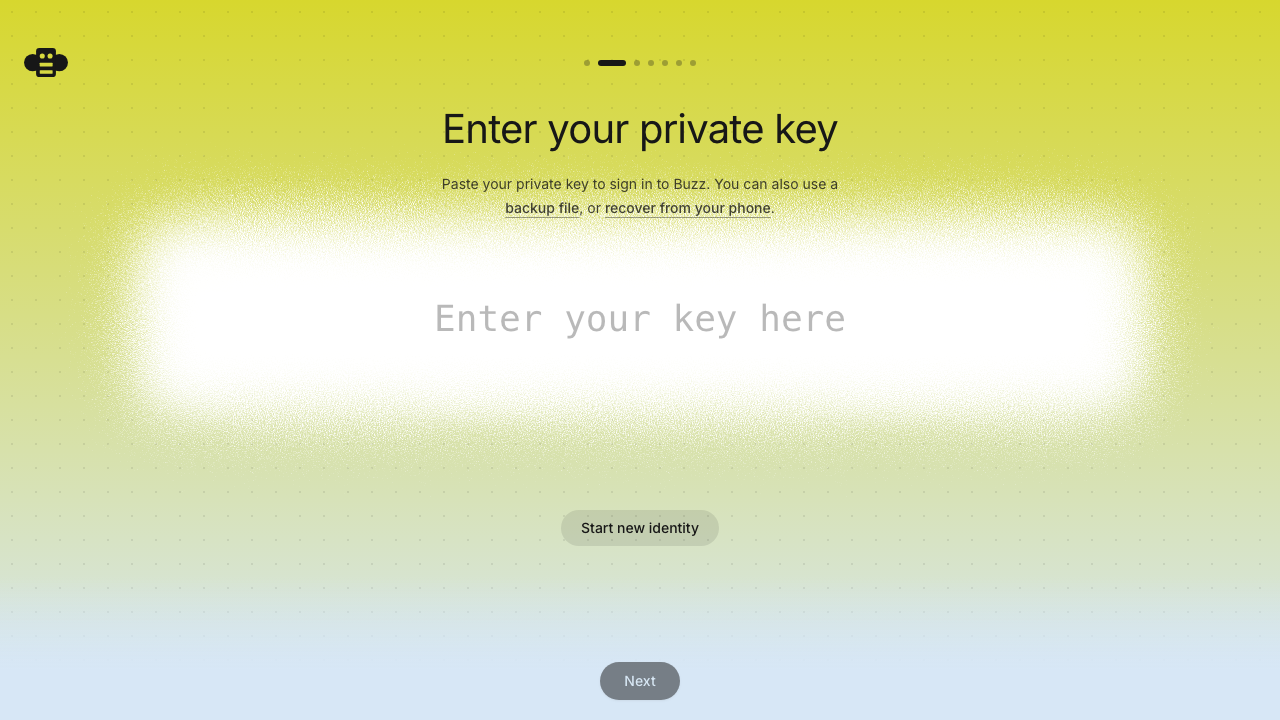
1. Launch Buzz Desktop with identity-lost state and choose **Recover
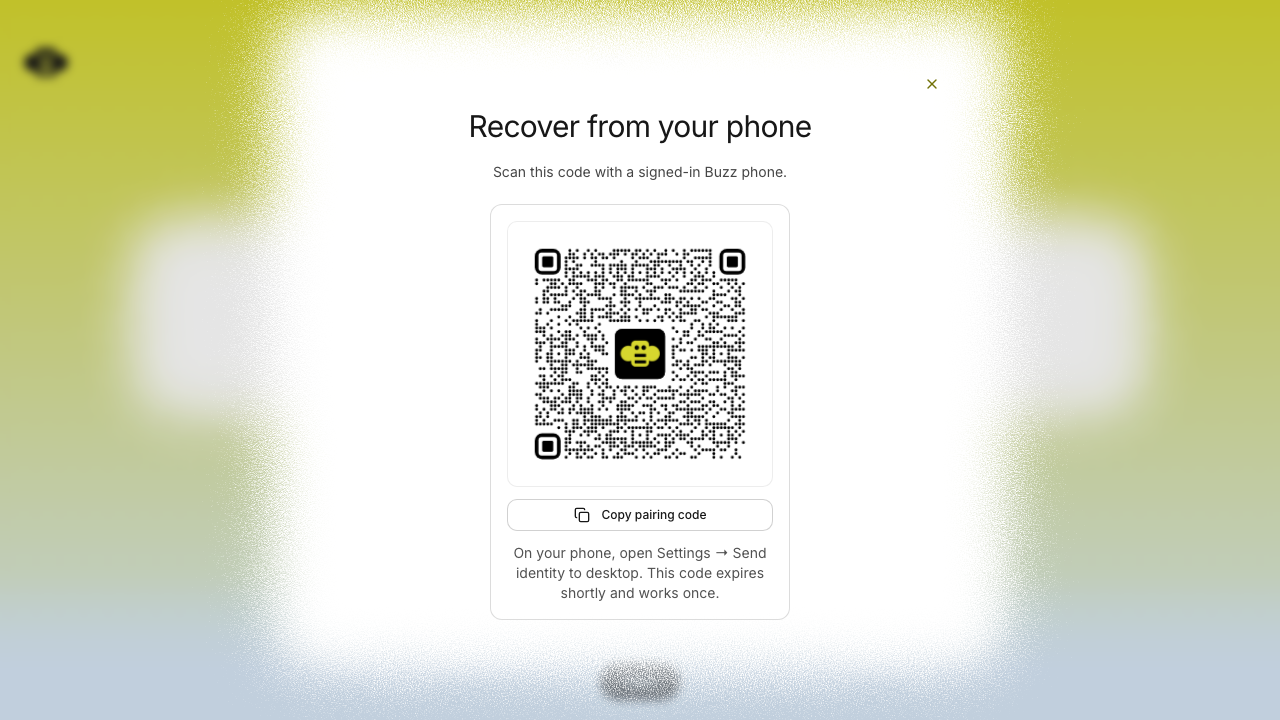
from your phone**.
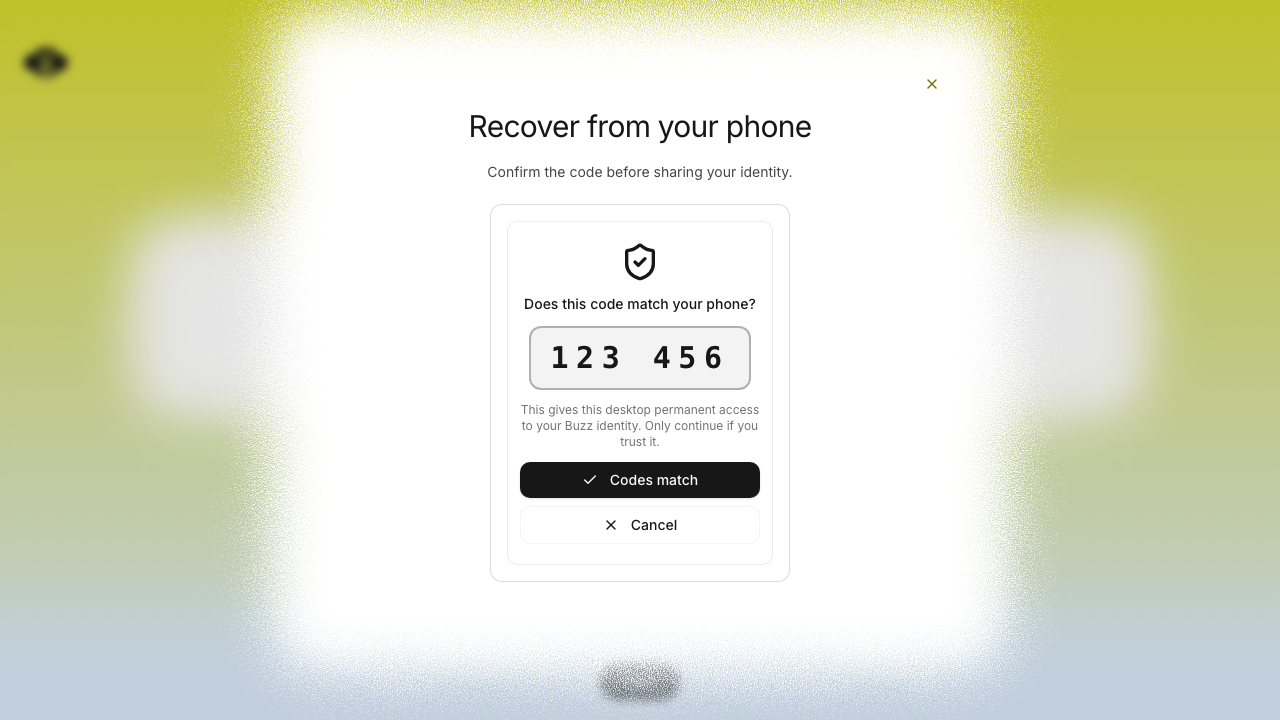
2. Confirm the QR and persistent **Copy pairing code** fallback appear
without layout shift.
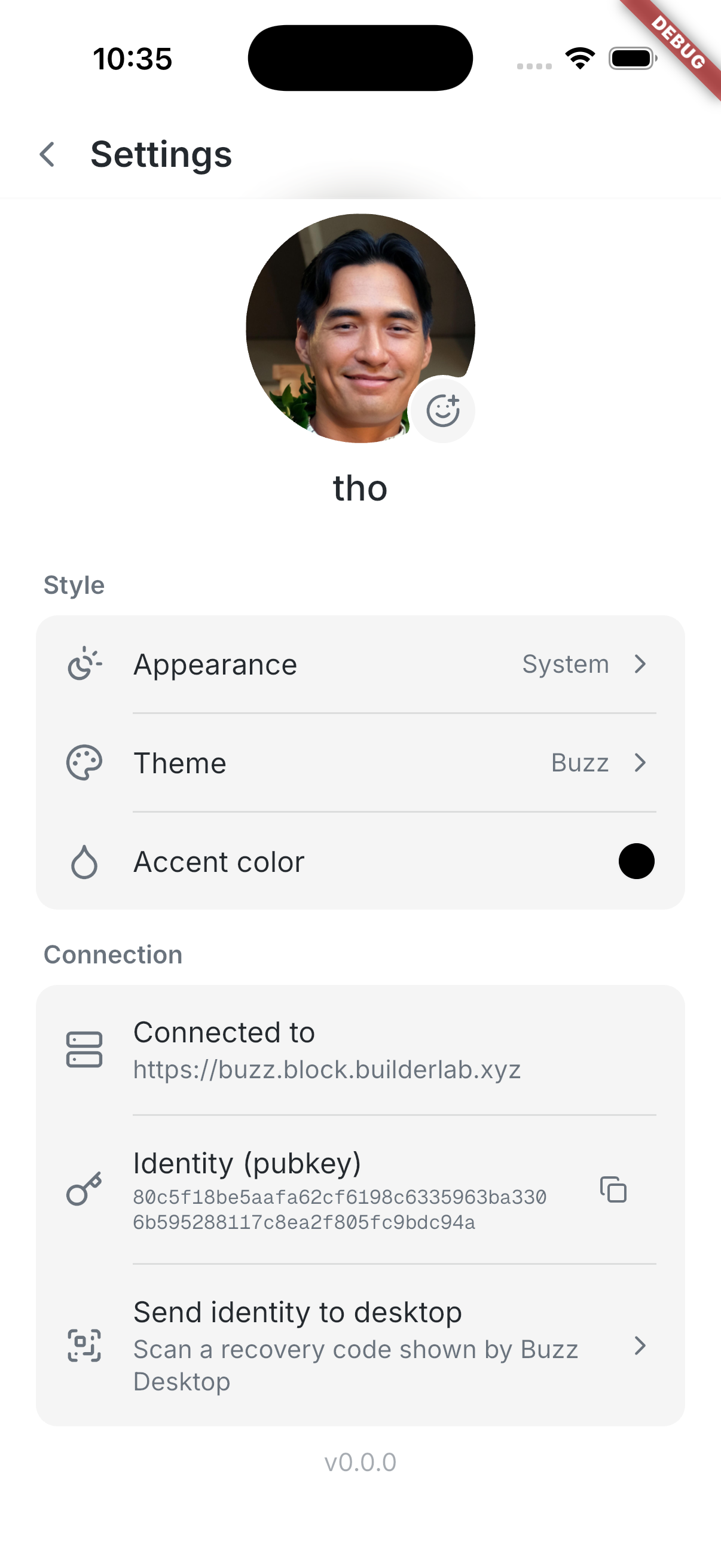
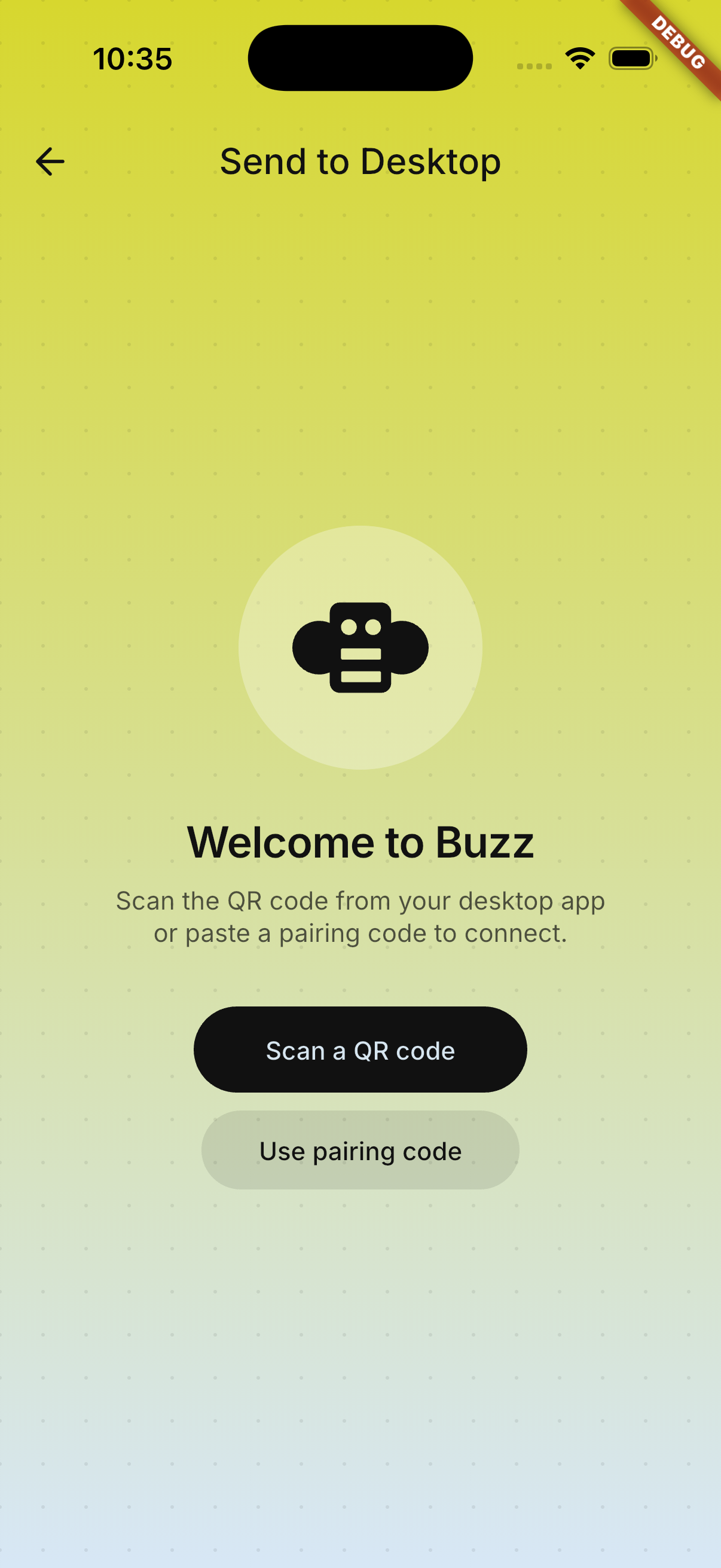
3. On a signed-in phone, open **Settings → Send identity to desktop**,
scan or paste the recovery code, and compare the six-digit SAS on both
devices.
4. Confirm on both sides and verify Desktop restores the identity and
continues to harness setup.
5. Repeat from identity-lost state with **Recover from a backup file**;
verify picker and drag-and-drop both advance to password entry and
restore the encrypted backup.
6. Exercise cancellation, mismatched/unsupported codes, expired
sessions, and an invalid backup; verify each returns actionable,
non-stuck UI.
## Screenshots
### Desktop phone recovery — complete flow
| Recovery entry | Pairing QR | Code match | Receiving identity |
|---|---|---|---|
| 
| 
| 
| 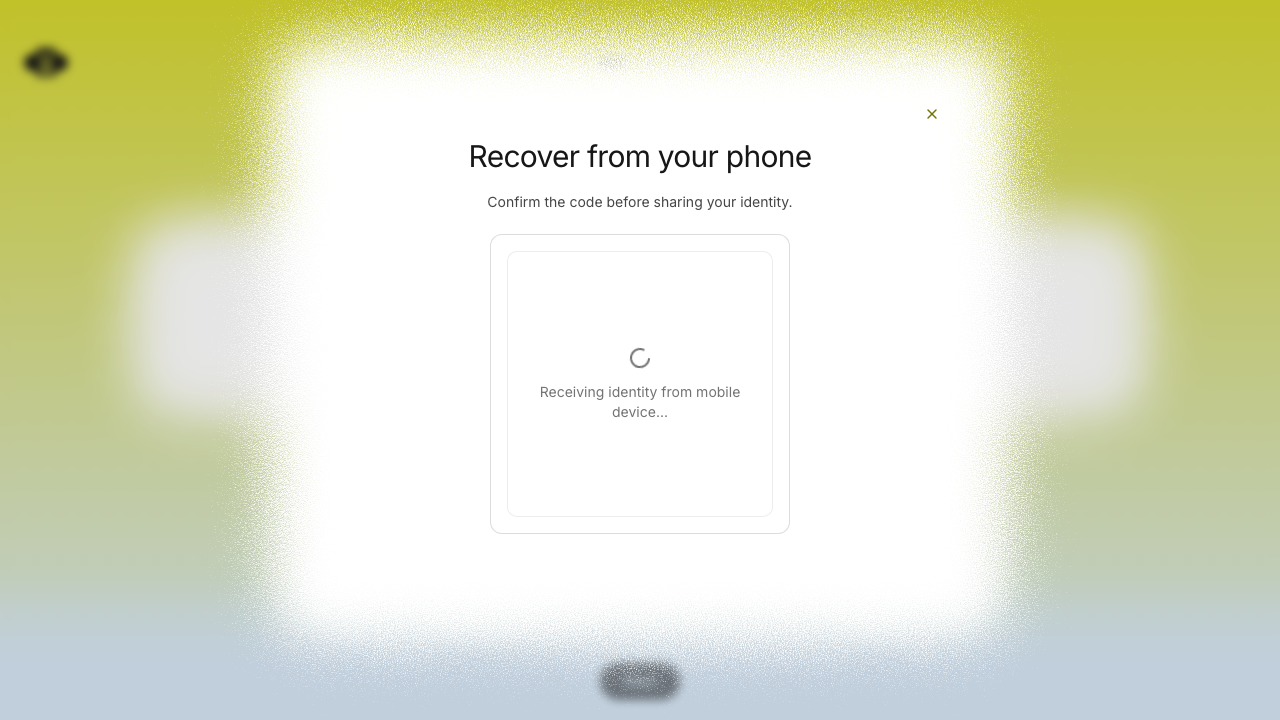
|
### iOS Simulator — complete handoff flow
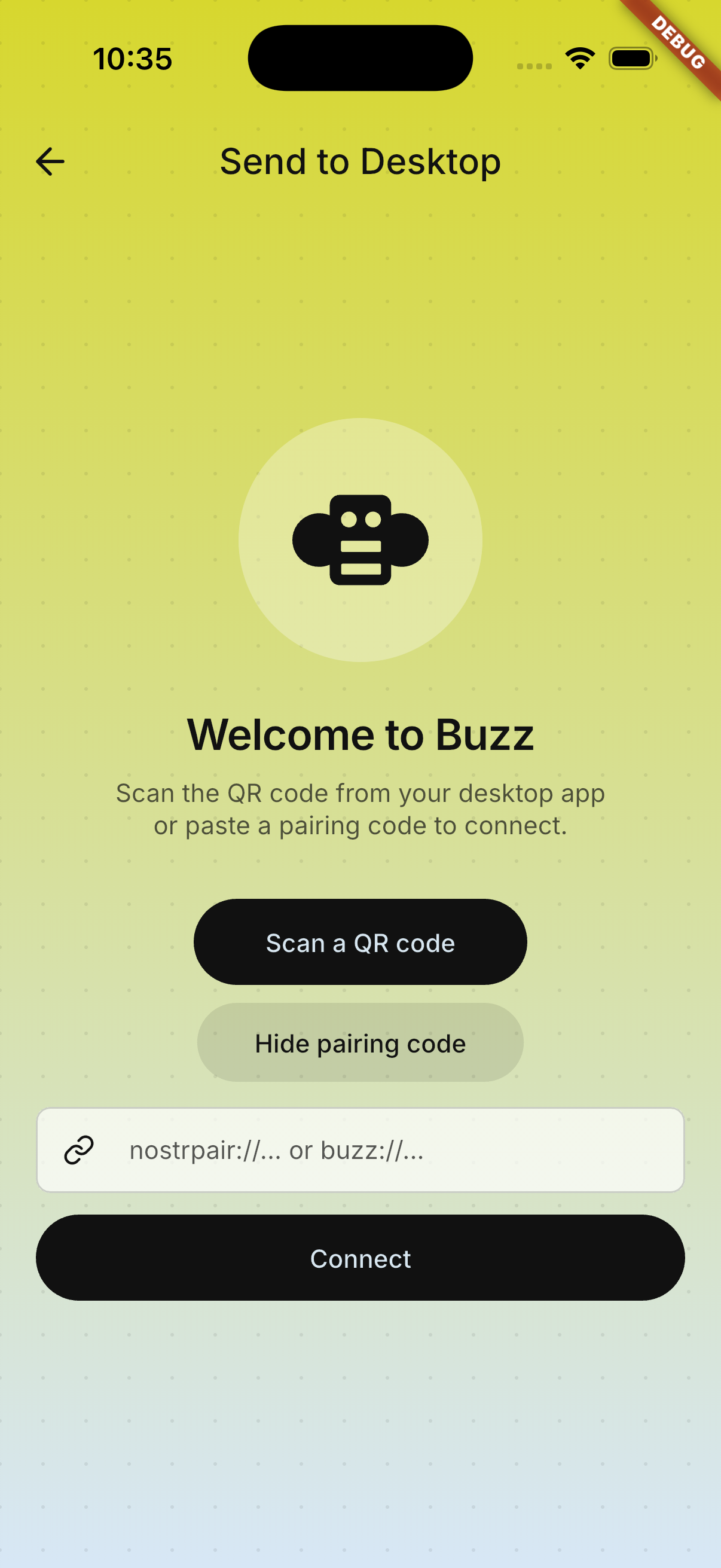
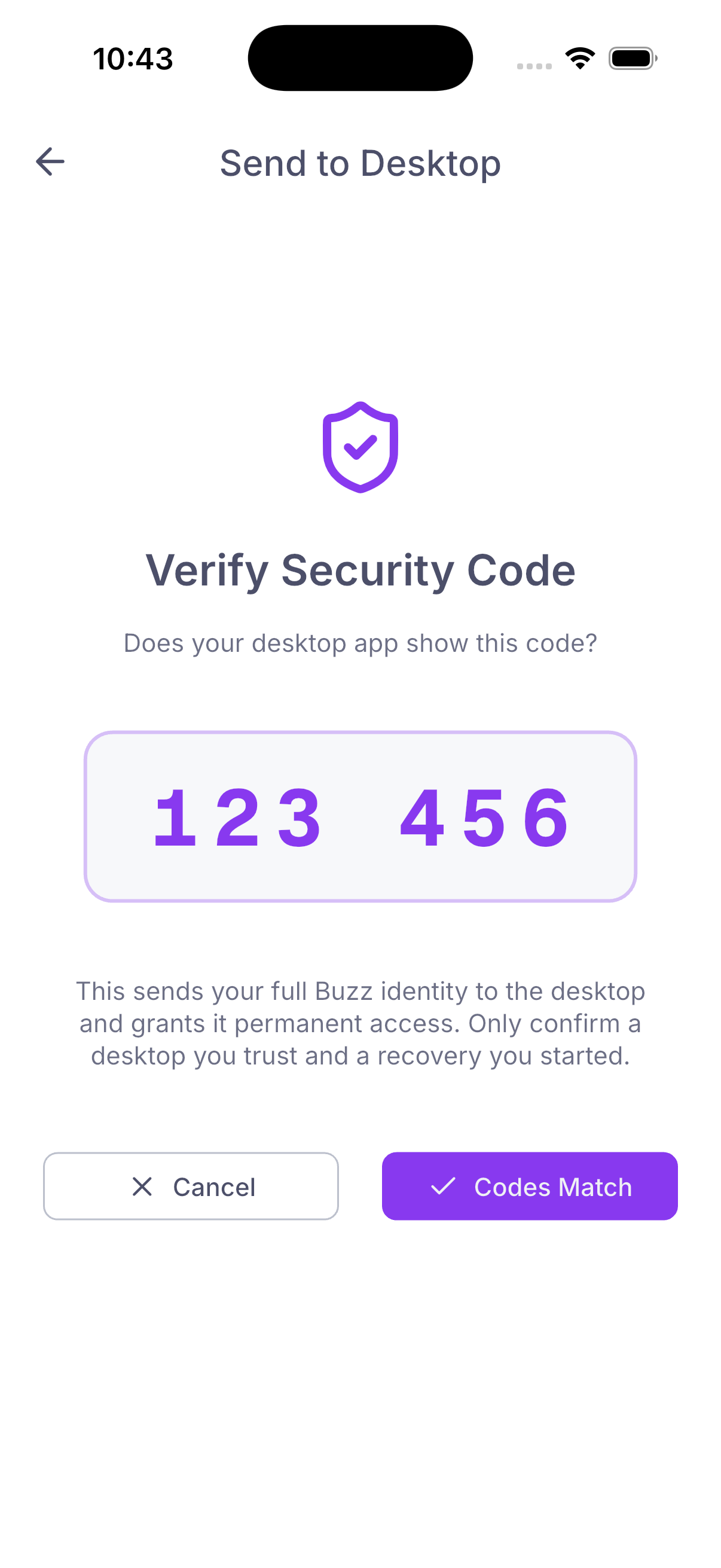
| Settings entry | Recovery scanner | Manual recovery code | Code
confirmation |
|---|---|---|---|
| 
| 
| 
| 
|
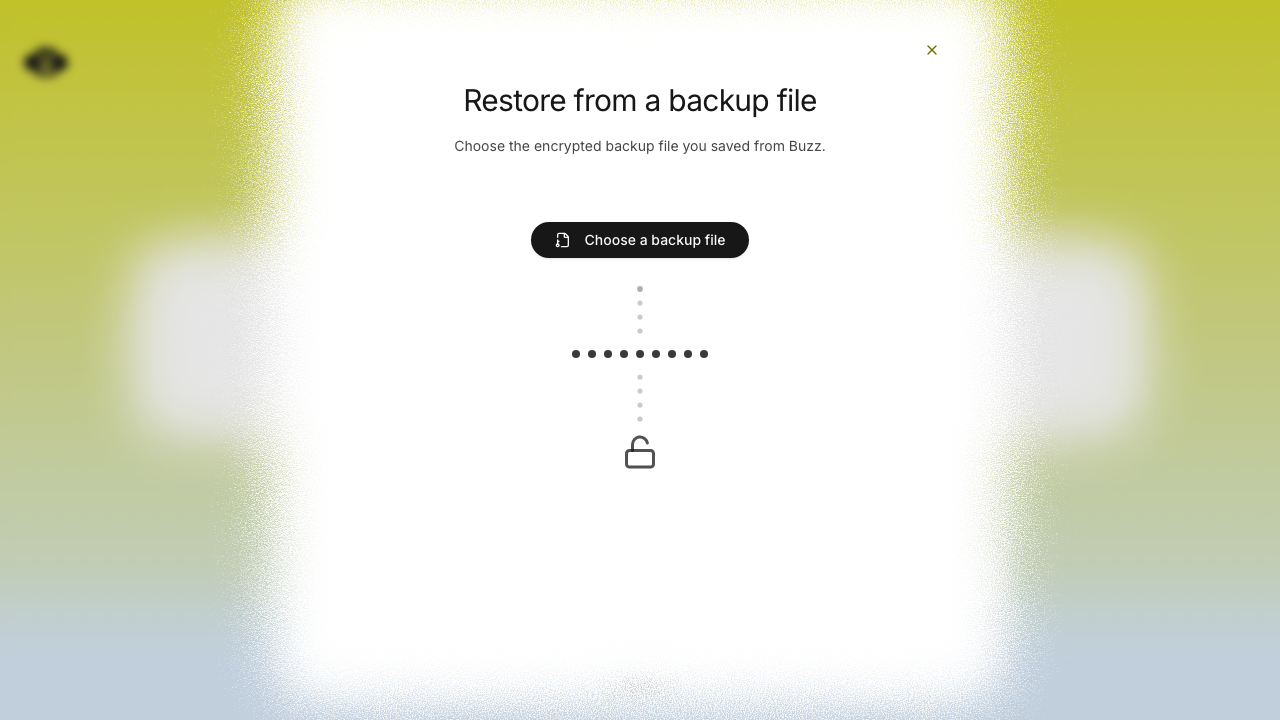
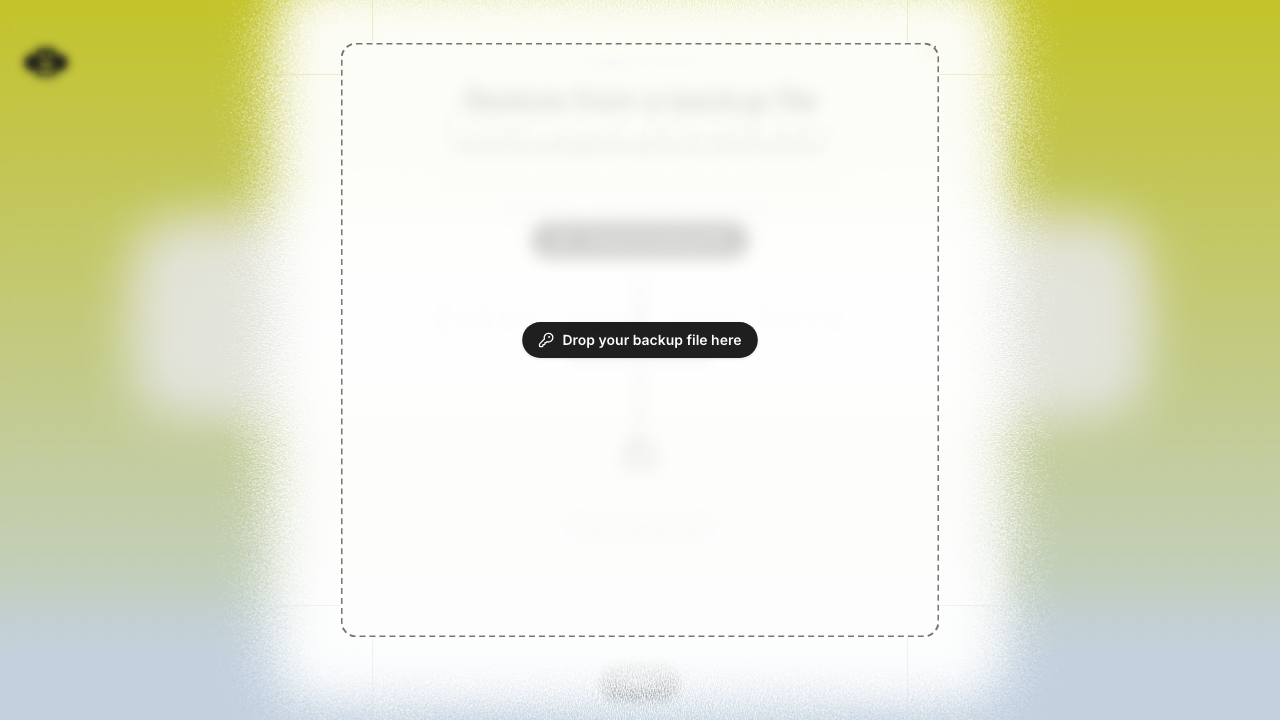
### Encrypted backup recovery — adjusted file flow
| File picker | Drag-and-drop target | Password step |
|---|---|---|
| 
| 
| 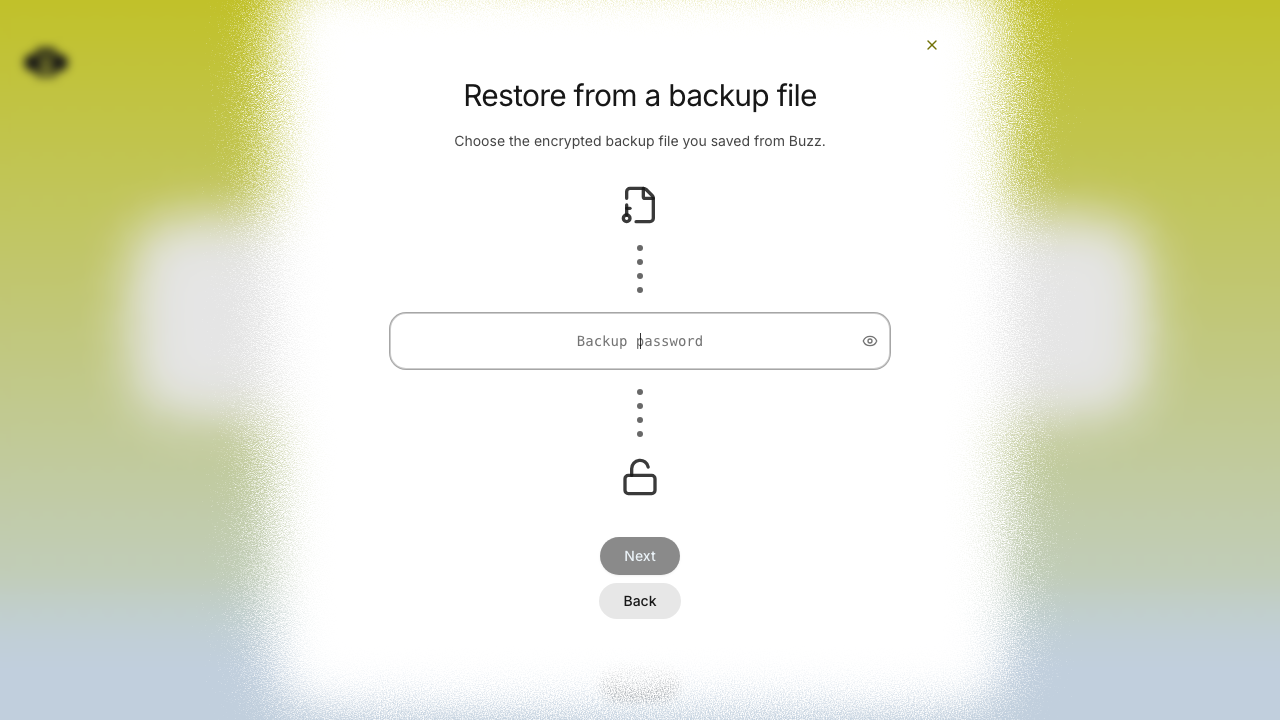
|
## Verification
- `cargo test -p buzz-core pairing` — 71 passed
- `just mobile-test` — 1,169 passed
- `pnpm build:e2e && pnpm exec playwright test identity-lost.spec.ts
--project=smoke` — 15 passed
- Full pre-push gates — desktop checks, desktop unit tests, Rust tests,
Tauri checks, and mobile tests passed
---------
Signed-off-by: Taylor Ho <taylorkmho@gmail.com>
Co-authored-by: npub1223z34hd7vtwc6qj4s7flsxkj644nlre2nthu7lrrmkumhu3xddsrx9r6w <52a228d6edf316ec6812ac3c9fc0d696ab59fc7954d77e7be31eedcddf91335b@buzz.block.builderlab.xyz>
Co-authored-by: Carl <acda9e433d19dcd0e6b6840f7f4b98f3a56f1fab98049d444c087019e6d36560@buzz.block.builderlab.xyz>
## Summary
- Keep the Welcome composer prompt above the dock blur so it stays
readable.
- Remove blur from the prompt and persona-motion paths.
- Cover the crisp, correctly layered banner in the onboarding browser
test.

## Validation
- `pnpm -C desktop exec biome check
src/features/channels/ui/WelcomeComposerBanner.tsx
tests/e2e/onboarding.spec.ts`
- `pnpm -C desktop build:e2e`
- `pnpm -C desktop exec playwright test tests/e2e/onboarding.spec.ts
--grep "finishing onboarding creates starter channels and focuses
welcome-everyone for a new member" --project=integration`

---------

Signed-off-by: kenny lopez <klopez4212@gmail.com>
## Summary

Adds a locally stored **NIP-49 encrypted key backup** (`ncryptsec`) to
the desktop app, per the plan reviewed in buzz-development (Rev 3,
approved 9/10 by Wren; implementation also reviewed and approved 9/10).

**Two-artifact design — canonical bytes originate entirely in Rust:**
- `create_ncryptsec_backup` runs under the `identity_mutation` lock:
encrypt → decrypt-verify against the live pubkey → atomic `0o600` write
to `{app_data_dir}/identity.ncryptsec` → reread/byte-compare → return
the exact persisted bytes. The frontend never re-derives or re-encrypts.
- `save_ncryptsec_copy` writes a portable copy via the save dialog
(parse-gated, secret-file semantics) and never mutates canonical state.
- `generate_backup_passphrase`: 6 words from the EFF short wordlist via
`OsRng` (custom passphrases min 12 chars).
- Import accepts `ncryptsec1` with optional password; the raw-`nsec`
path is untouched. Different-pubkey import and sign-out wipe the
app-managed backup (post-commit, best-effort — a failed import can never
destroy the still-live identity's backup; regression-tested).

**Never-relay guarantee (egress guard + tripwires):**
- `egress_guard.rs` fail-closed at all 8 `/events` submission boundaries
(relay submit funnel, 3× `relay.rs`, huddle STT, both engram submitters,
native WS choke point), rejecting `ncryptsec1`/`NCRYPTSEC1` in text and
binary frames. Scope is deliberately ncryptsec-only: pairing
intentionally carries raw nsec inside its encrypted session.
- Site-granular `/events` inventory tripwire: per-file (`/events` count,
guard-call count) pairs; unlisted files expect zero. Mutation-style
tests prove a ninth site in an existing file, a removed guard, and a new
unlisted file all fail the scan.
- ncryptsec source-allowlist scans in **both** trees (Rust + TS).

**Frontend:** onboarding `BackupStep` is encrypted-by-default — the
default path never invokes `get_nsec` (e2e asserts the command log).
Raw-nsec export stays behind an explicit click with prior semantics.
Shared `EncryptedBackupCreator` powers onboarding + a new settings row;
the import form auto-switches to encrypted mode on `ncryptsec1` paste
(case-insensitive HRP).

**Open product call for @tlongwell-block:** onboarding default is
*encrypted* in this PR; flipping to raw-default is a small change either
way (documented in the plan).

Review history: plan Rev 3 and the implementation were both iterated
with Wren to 9/10 (two blockers from round 1 — import ordering,
inventory granularity — plus an uppercase-bech32 hardening gap, all
fixed in `dde37183e`). Thread: buzz-development.

### Related issue

Follow-up to the direction explored in #385 (NIP-PB, closed) — this
ships local NIP-49 (the standard) instead of a new NIP. No open
duplicate found.

### Testing

All at exactly `dde37183e` (same shell, HEAD verified):

- `cargo test` — 1680 passed / 0 failed / 14 ignored (includes a
deliberate ~70s log_n-18 NIP-49 round trip, spec vector, wrong-password,
NFKC, uppercase-vector decrypt, injection test per egress boundary,
inventory mutation tests, import-ordering regression tests)
- `cargo clippy --all-targets -- -D warnings` — clean; `cargo fmt
--check` — clean
- `pnpm typecheck` — clean; JS unit suite 3529/3529; biome (repo-pinned
2.4.16) clean
- Playwright `onboarding-backup` / `onboarding` /
`onboarding-agent-defaults` / `profile-nsec-reveal` — 86 passed, 1 known
avatar-reservation flake (passed on rerun; untouched by this diff).
`passThroughBackupStep` now exercises the encrypted default, so every
downstream onboarding spec covers the new path.
- Note: browser e2e fakes the crypto via the mock bridge (fixed
spec-vector blob); decryption correctness is proven in the Rust tests.

## Latest onboarding integration

The current head adds an additive `IdentityInfo.storage` field
(`ephemeral`, `system-keyring`, `local-file`, or `environment`) so
onboarding can accurately explain where the active identity is
protected. It surfaces storage metadata only—never key material—and
leaves the existing lost/keyring-locked recovery behavior intact.

---------

Signed-off-by: Tyler Longwell <tlongwell@block.xyz>
Signed-off-by: Taylor Ho <taylorkmho@gmail.com>
Co-authored-by: npub1qyvc0c5kl4gqv2fd97fsk46tu378sqgy35vc83rvgfwne90sel7s0ed67d <011987e296fd5006292d2f930b574be47c7801048d1983c46c425d3c95f0cffd@buzz.block.builderlab.xyz>
Co-authored-by: Tyler Longwell <tlongwell@block.xyz>
Co-authored-by: Taylor Ho <taylorkmho@gmail.com>
Co-authored-by: npub1223z34hd7vtwc6qj4s7flsxkj644nlre2nthu7lrrmkumhu3xddsrx9r6w <52a228d6edf316ec6812ac3c9fc0d696ab59fc7954d77e7be31eedcddf91335b@buzz.block.builderlab.xyz>
## Why
People joining a community with an existing relay profile should not be
asked to recreate their name and avatar.

## What
- Check the active identity's relay profile after the joined community
becomes active
- Skip directly to the starter-team step when a kind-0 profile event
exists
- Preserve the profile setup path when no event exists or discovery
fails
- Cover both new-profile and existing-profile join paths in E2E tests

## Risk Assessment
Low — the lookup is scoped to the community onboarding profile stage,
runs once per transaction, and fails open to the existing flow.

## References
- `pnpm build:e2e && pnpm exec playwright test --project=integration
tests/e2e/onboarding.spec.ts --grep 'first-community direct join reaches
profile|community onboarding reuses an existing relay profile'` (2
passed)

Generated with Codex

Signed-off-by: npub1rf6fvdj6ut0c4kcmjv4p5mmgh89nj58n69uu3fz3cvk3jn500hqs7emz79 <1a7496365ae2df8adb1b932a1a6f68b9cb3950f3d179c8a451c32d194e8f7dc1@sprout-oss.stage.blox.sqprod.co>
Co-authored-by: npub1rf6fvdj6ut0c4kcmjv4p5mmgh89nj58n69uu3fz3cvk3jn500hqs7emz79 <1a7496365ae2df8adb1b932a1a6f68b9cb3950f3d179c8a451c32d194e8f7dc1@sprout-oss.stage.blox.sqprod.co>
## Context

Adding an existing community by relay URL could fail with `Community
rejected: Load failed` even when its WebSocket endpoint was reachable.
The Add Community flow fetched `/api/join-policy` from the WebView, so a
relay without a matching CORS allowance blocked the policy request
before the app could join it.

## Summary

This bug fix fetches join policies through Tauri's native networking
layer for direct URL joins. Invite-code discovery, policy acceptance,
and signed invite claims remain on the WebView path so those operations
can migrate together later.

## Changes

- Uses native networking for Add Community and first-community direct
URL join-policy requests.
- Validates relay schemes, rejects URLs containing credentials, and
refuses redirects.
- Bounds declared and chunked native responses before JSON parsing.
- Preserves existing `404`, non-success status, malformed JSON, and
absent-policy behavior.
- Requires every join-policy caller to choose its transport explicitly.

Public relays using Buzz's default permissive CORS configuration are not
known to be affected.

### Related issue

Related to #2872.

### Testing

#### Reviewer-reproducible examples

End-to-end red/green requires a relay with restrictive CORS and a Buzz
identity authorized to join it.

##### Red: `main`

From a clean checkout of `main`:

```bash
. ./bin/activate-hermit
just staging
```

In Buzz Desktop:

1. Add another community so the restrictive-CORS relay can be removed.
2. Remove that relay.
3. Open Add Community and enter the relay's WebSocket URL.
4. Select Add Community.

Observed result:

```text
Community rejected: Load failed
```

##### Green: this PR

From a clean checkout of this branch:

```bash
. ./bin/activate-hermit
just staging
```

Repeat the same steps above.

Observed result:

```text
The community rejoins successfully.
```

Supporting checks:

- Six native join-policy tests, including oversized declared and chunked
responses.
- Four TypeScript API tests, including the native command contract.
- E2E build and four focused onboarding and sidebar Playwright tests.
- Full `just ci` and pre-push suites.
- Builderbot, Kalvin, and minimize-diff review fanout found no
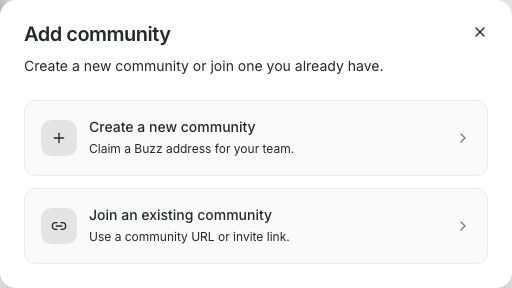
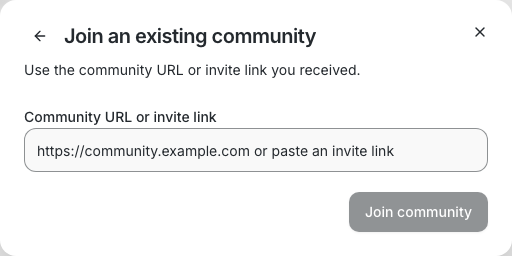
actionable issues after the final rebase.