Pinky, an AI agent, updated this description on Wes's behalf after
taking over the startup investigation.

**Category:** fix

**User Impact:** An EVENT refused by WebSocket admission or handler
saturation receives a correlated `OK(event_id, false, reason)` instead
of an uncorrelated NOTICE, so the client can settle that refusal without
waiting for its publish timeout. Rate-limited refusals also arm client
backoff. This fixes a protocol failure mechanism; it does not establish
that every startup send will succeed or that the reported Desktop
startup incident is fully resolved.

**Problem:** Startup opens several live subscriptions and publishes at
once, and the relay's WebSocket admission gate is a fixed 5-second
window (`ws_admission_budget` = `human_ws_events_per_sec * 5`). If that
shared per-principal quota is exhausted, `enforce_ws_admission`
previously rejected an EVENT with a bare `["NOTICE", reason]`. Quota
pressure is a possible trigger, not proof of the original incident's
complete cause.

A NOTICE carries no event id. Both clients settle a pending publish
*only* from an `OK` keyed by event id (desktop `pendingEvents`, mobile
`_pendingEvents`), so nothing settled — and `handle_text_message`
returns early, so no `OK` ever followed either. The send **could not
fail**; it could only time out at `PUBLISH_TIMEOUT_MS` = 25s. That
explains how this rejection mechanism can produce a roughly 25-second
timeout; attributing the original report to it still requires the actual
startup/send workflow.

The handler-semaphore saturation path had the identical defect, and that
one needs no quota burst to fire.

**Solution:** NIP-01 gives each request type its own acknowledgement
channel, and a rejection is only actionable on the same one. Reject a
REQ with `CLOSED`, an EVENT with `OK(id, false, reason)`, and fall back
to `NOTICE` only where no per-request correlation exists. COUNT refusals
now also use `CLOSED(query_id, reason)` per NIP-45, covering both quota
admission and handler saturation (added in
`cd12c93804b87a24b61075dfd171dc471a0a527f`).

Reason strings are unchanged, so the `rate-limited:` prefix and `retry
in {N}s` hint that existing client gates parse keep working (desktop
`parseRateLimitHint`, mobile `RelayRateLimitGate`, buzz-acp
`set_rate_limit_gate`). Only the frame *type* changes, so
`docs/multi-tenant-relay.md` L7 stays satisfied.

Two notes on how this landed, both worth a reviewer's attention:

1. **A survived mutation became a design change.**
`send_admission_result` originally took a `RejectionTarget` parameter,
and reverting the *second* call site (the per-minute message quota)
survived the whole suite — with Redis unreachable the first quota check
short-circuits, so that line is unreachable in test. Rather than test
around it, the parameter is gone: the target is derived from the frame,
so no call site can name the wrong channel.

2. **The relay fix would have caused a client regression on its own.**
Gate arming lived only in the NOTICE branch. Once rejections arrive as
`OK:false`, `handleOk` failed the send without ever backing off — the
client would retry straight into the same quota. Desktop and Mobile now
arm on a `rate-limited:` OK rejection. ACP was subsequently fixed in
`3b06dd32493596ec650f20abf8805791c50fdc24`: it arms the gate and
re-parks only the refused observer frame, preserving other in-flight
frames. Desktop gets `activateRateLimitIfSignalled` as the single owner
of that prefix test, called from both `handleOk` and the NOTICE branch.

<details>
<summary>File changes</summary>

**crates/buzz-relay/src/rejection.rs** (new)
Owns the admission-rejection concern: `RejectionTarget`,
`rejection_target_for`, `request_rejection_message`,
`send_admission_result`, and `enforce_ws_admission`, moved out of
`connection.rs`. Six tests, two of which drive the real
`enforce_ws_admission` against a real `AppState`.

**crates/buzz-relay/src/connection.rs**
Fix the EVENT handler-semaphore rejection to correlate to the event id;
delegate admission to the new module. Add two tests that drive the real
`handle_text_message` with every handler permit held. Down from 1319 to
1116 lines.

**crates/buzz-relay/src/state.rs**
Widen the existing `test_state` helper to `pub(crate)` so the rejection
tests reuse it rather than adding a ninth copy of `AppState`
construction.

**desktop/src/shared/api/relayRateLimitGate.ts**
Add `activateRateLimitIfSignalled` — one owner for the `rate-limited:`
prefix test, since three inbound frame types now carry it.

**desktop/src/shared/api/relayClientSession.ts**
Arm the gate on a rate-limited OK rejection; route the NOTICE branch
through the same helper. Net zero lines, which keeps this
already-oversized file within the differential ratchet.

**desktop/src/shared/api/relayClientPublishRejection.test.mjs** (new)
Four tests against the real `RelayClient`: a rate-limited OK settles the
pending publish and arms the gate; an ordinary rejection does not arm
it; an accepted OK still resolves.

**mobile/lib/shared/relay/relay_session.dart**
Arm the gate in `_handleOk` for a rate-limited rejection.

**mobile/test/shared/relay/relay_session_test.dart**
Two tests driving the real `publish` + `debugHandleMessage` path.

</details>

<details>
<summary>Validation</summary>

**Mutation-tested — 5 mutations, all now killed.** Each production call
site was reverted to the defective behaviour to confirm a test fails.
This caught two false-negative tests:

| # | Mutation | Result |
|---|----------|--------|
| 1 | `rejection_target_for`: EVENT → `Connection` | 4 tests fail |
| 2 | EVENT handler-semaphore call site → bare NOTICE | **survived at
first** |
| 3 | per-minute quota call site → `Connection` | **survived**; fixed by
removing the parameter |
| 4 | desktop `handleOk` gate arming removed | 1 test fails |
| 5 | mobile `_handleOk` gate arming removed | 1 test fails |

Mutation 2 is the lesson: my first saturation test called
`request_rejection_message` directly, so reverting the real call site
inside the `match` arm left it green. It now drives
`handle_text_message` itself and dies on that mutation.

- `cargo test -p buzz-relay` — 928 passed, 1 failed:
`api::mesh_demo::tests::demo_join_forwarded_arm_round_trips_echo`,
**pre-existing**, reproduced with all changes stashed at `4dd4d73de`.
- `cd desktop && npm test` — 5721 passed, 0 failed (full suite).
- `cd mobile && flutter test` — 1876 passed, 0 failed (full suite).
- `just fmt-check`, `just clippy`, `just desktop-check`, `just
mobile-check`, `just file-size-check` — clean. Desktop's 5 biome
warnings are pre-existing (reproduced with changes stashed).
- All 9 pre-push lanes green, including `rust-tests` and
`desktop-tauri-checks`.

**Not verified:** not reproduced end-to-end against a live relay under a
forced quota burst. The causal chain is source-proven and
mutation-proven at the frame level; the ~25s attribution follows from
`PUBLISH_TIMEOUT_MS` but is not directly measured. A packaged-build
click-through would close that gap.

</details>

Related work: #6957 bounds Desktop HTTP event submission, but safe
retained-operation recovery after exhausted/ambiguous outcomes remains
unfinished. #6998 is the separately reviewable Desktop
readiness/duplicate-subscription slice. Neither is claimed to complete
native before/after startup-send validation.

Diagnosis note: `RESEARCH/DESKTOP_STARTUP_SEND_STALL_2026_08_27.md`
(Brain's workspace).

## Current review disposition (2026-08-28)

The [review on
`cd12c938`](https://github.com/block/buzz/pull/6961#pullrequestreview-5052902510)
identified ACP's missing rate-limited-OK handling. Commit
`3b06dd32493596ec650f20abf8805791c50fdc24` fixes gate arming, re-parking
the specifically refused observer frame, and the stale NOTICE comment.
Two regressions drive the real frame dispatcher. See [the implementation
and validation
response](https://github.com/block/buzz/pull/6961#issuecomment-5455032054).

The Mobile generation-check inline thread is resolved: its `async
publish` returns a failed Future when superseded; it does not throw
synchronously at invocation. No further production change was indicated
by that comment.

The validation counts above describe the original slice, not a new
rerun. At `3b06dd324`, the current GitHub check rollup has successful
completed test/build checks (non-applicable jobs skipped). The
security-review comment still requires review for the current base/head
range; do not read a green authorization job as a completed security
review. Approval and merge remain human decisions.

---------

Signed-off-by: Brain <1a02c72794dcd0f07058a353bc3a81f4028b8c77c92c87fce6d5c8b85970a20b@buzz.block.builderlab.xyz>
Signed-off-by: Wes <wesbillman@users.noreply.github.com>
Co-authored-by: Brain <1a02c72794dcd0f07058a353bc3a81f4028b8c77c92c87fce6d5c8b85970a20b@buzz.block.builderlab.xyz>
Co-authored-by: Carl <9d00794d3df50972eb8b615511783cab12a77a8fd5dd5edd58073ec73b54bd8b@buzz.block.builderlab.xyz>
## Summary

- render every agent/AI identity as a 30% squircle across desktop and
mobile while keeping human avatars circular
- propagate agent identity through message, thread, profile, reaction,
member, DM, search, workflow, project, huddle, forum, pulse, and
agent-management surfaces
- preserve squircle geometry for fallbacks, focus/status treatments,
add-agent controls, and overlapping avatar outlines (`calc(30% + 2px)`
for the outer background)

### Related issue

None found. This change was requested and visually reviewed in the
originating Buzz thread.

### Testing

- `just desktop-test` — 5,799 passed
- `just mobile-test` — 2,008 passed
- pre-push gates passed at `0d59d77b120dcb90aac2f918e422c11c9fa5353b`:
desktop check, TypeScript typecheck, desktop full test suite, mobile
format/analyze and full test suite, Rust tests, Tauri checks, and
differential file-size gate
- deterministic desktop visual sweep covered channel messages/thread
summaries; thread, subthread, and sub-subthread depths; reactions and
reactor popovers; hover/full profiles; added-to-channel activity;
channel members/settings; agent library/team overlaps; agent creation;
mention autocomplete; and DM header/sidebar/settings

### UI evidence

The complete labeled visual matrix is available in the originating Buzz
review thread. GitHub-hosted copies will be added in a follow-up PR
comment using the repository screenshot script.

---------

Signed-off-by: Fizz <dae5f6af70b8695a8b83c8deae555f63be41630ec2b8cd493e41a439c9527dd8@buzz.block.builderlab.xyz>
Co-authored-by: Fizz <dae5f6af70b8695a8b83c8deae555f63be41630ec2b8cd493e41a439c9527dd8@buzz.block.builderlab.xyz>
Pinky is opening this PR on Wes’s behalf.

## Summary

Reduce two separately measured mobile delays without changing the relay
API or removing rich message rendering:

- Publish the finite channel-list snapshot without waiting for live
subscription setup.
- Batch active channel-list subscriptions into sorted, deterministic
chunks of at most 128 explicit channel IDs, retaining unchanged chunks.
- Install replacement chunks before retiring old coverage. Retain old
chunks across thrown replacement failures; filter callbacks to the
current relay/identity and still-desired channels; clean up
retired/in-flight work across disconnect and disposal.
- Scope the custom-emoji Markdown matcher to known shortcodes actually
referenced in the rendered content, rather than embedding the whole
community palette in every message’s regex. Preserve unknown literals,
shared-colon token boundaries, event-tag URL priority, content edits,
and code literals.
- Honor explicit zero retry hints without inventing a ten-second
session-wide gate, while preserving the ordinary live-subscription retry
backoff and any already-active gate.

## Matched performance results

Medians of three before and three after process-cold launches,
alternated on the same authenticated iPhone 17 Pro / iOS 26.5 simulator.
Before is mobile source at `e76c81968b65b0755b83efdd59dc3375c59ddf40`;
after is this production patch before two documentation-only comment
fixes.

First channel-list frame: 11.617s → 3.179s · 73% lower latency

Live setup duration: 8.475s → 0.185s · 98% lower latency

Channel-open first message-list frame: 2.754s → 1.230s · 55% lower
latency

Message data ready → first frame: 1.977s → 0.286s · 86% lower latency

Channel-open reveal complete: 2.845s → 1.394s · 51% lower latency

Channel-open data readiness: 0.770s → 0.944s · 23% higher latency

The gain is client-side orchestration/rendering, not a claim that the
relay became faster. First channel-list frame ranges were 10.835–11.788s
before and 2.872–3.395s after; channel-open first-frame ranges were
1.560–2.906s before and 1.149–1.317s after.

### Measurement boundaries

- Debug simulator builds, CPU sampling disabled, bounded timestamp
probes enabled identically. These are not release/physical-device
measurements.
- Startup clock starts at Dart `main`; build/install/native pre-main
time is excluded. Auth/preferences and OS/disk caches are retained
between new processes.
- Same account scale: 113 active channels. Latest-message events varied
slightly with live activity (1543–1546).
- Channel-open uses the same initial 50-row history window, 97 query
events, and 67 provider events. The 2306-entry emoji palette is
explicitly loaded before navigation on both sides; palette preparation
is excluded from the channel-open clock and happens after the startup
frame measurement.
- Both diagnostic builds temporarily disabled unused avatar segmentation
to work around the existing Google ML Kit arm64-simulator slice
limitation. The workaround, dependency/native changes, auto-navigation,
and all probes are excluded from this PR.

## Validation

- Full mobile package suite: `flutter test` — 1890 passed.
- `just mobile-check` — 506 files unchanged; analyzer clean.
- `just file-size-check` — policy tests and all client ratchets passed.
- `git diff --check` — passed.
- New lifecycle regressions cover front-sorting insertion across a chunk
boundary while replacement readiness is paused, failure
retention/departed-channel filtering, retired generation + disconnect
cleanup, disposal, chunk limits, unchanged-set reuse, and scope
switches.
- Emoji unit/widget coverage includes a 2500-unused-emoji palette,
unknown tokens, case matching at the component level, shared-colon
boundaries, rich text, event URL priority, and content edits.
- Fresh-frame source review traced the subscription queue/fences,
callback scopes, duplicate-event paths, matcher/wiring, and retry
scheduling.
- At committed/pushed head `13a83b628c8411c5885e6f76a250ba87accf6067`,
all normal pre-push hooks passed: `mobile-checks` (formatter, analyzer,
and the full 1890-test mobile suite), `file-size-check`, `branch-skew`,
and `push-head-scope`. The commit hook formatted 506 files with no
changes. Runtime measurements preceded only the two
documentation-comment fixes; no runtime source changed afterward.

## Limits / follow-ups

- `RelaySession.subscribe` still settles under its existing
EOSE/fallback/retryable-CLOSED contract. “Setup completed” is not an
unconditional EOSE or live-delivery guarantee. This PR does not add
status-aware replacement ownership.
- The channel-message provider still awaits subscribe before fetching
history; that separate serialization is not removed here.
- Oversized Huddle queries and the separate history batching path above
128 active channels remain follow-ups, as do pre-existing read-state
initialization/size warnings.
- Palette-only widget refresh and upstream Markdown uppercase-dispatch
behavior are not changed.
- A clean source build still has the existing Google ML Kit
arm64-simulator issue; the profiling workaround is not a proposed
product fix.

Originating Buzz conversation:
buzz://message?channel=793b0522-7995-4375-b1a6-fd94a96fa21d&id=6ba88afdec78ab2cfb6728afcd4a6d10f29e6aa33ff0f62f45d6750381e4d789

---------

Signed-off-by: Wes <wesbillman@users.noreply.github.com>
Co-authored-by: Pinky <5f5ab050ec58ae208332edd544ebf705221e24c1b86d82a6ca07038a7a8f6ac9@buzz.block.builderlab.xyz>
Co-authored-by: Brain <1a02c72794dcd0f07058a353bc3a81f4028b8c77c92c87fce6d5c8b85970a20b@buzz.block.builderlab.xyz>
Co-authored-by: Carl <9d00794d3df50972eb8b615511783cab12a77a8fd5dd5edd58073ec73b54bd8b@buzz.block.builderlab.xyz>
This PR implements MVP, iOS-only,
[NIP-PL](8d2d0ff5ad/docs/nips/NIP-PL.md)-compliant
push notifications.

A relay with `BUZZ_PUSH_ENABLED` will send a push notification for any
message that appears in the in-app Notifications tab.

## Enrollment flow
The first time the client first connects to a relay with
`BUZZ_PUSH_ENABLED`:
```mermaid
sequenceDiagram
    autonumber
    participant App as Buzz iOS app
    participant iOS
    participant Relay as Buzz relay
    participant Attest as Apple App Attest
    participant Gateway as Push gateway

    App->>Relay: Fetch NIP-11 push capability
    Relay-->>App: Push profile, current relay public key, and limits

    par
        App->>iOS: Request notification permission
        iOS-->>App: Permission result
    and
        App->>iOS: Register for remote notifications
        iOS-->>App: Device token
    end

    App->>Gateway: Request installation challenge
    Gateway-->>App: Single-use challenge
    App->>Attest: Attest installation transcript
    Attest-->>App: Attestation proof
    App->>Gateway: Enroll device token and proof
    Gateway-->>App: Installation handle

    App->>Gateway: Request delegation challenge
    Gateway-->>App: Single-use challenge
    App->>Attest: Assert relay-key delegation
    Attest-->>App: Assertion
    App->>Gateway: Create delegation
    Gateway-->>App: Opaque endpoint grant

    App->>Relay: Publish encrypted push lease and filters
    Relay-->>App: Lease acknowledged
```

## Push-time flow

When a notification-eligible event is received by the relay:

```mermaid
%%{init: {
  "sequence": {
    "actorMargin": 20,
    "width": 110,
    "messageMargin": 18,
    "diagramMarginX": 8,
    "wrap": true
  }
}}%%
sequenceDiagram
    autonumber
    participant Relay as Buzz relay
    participant Gateway as Push gateway
    participant APNs as Apple Push<br/>Notification service
    participant iOS
    participant NSE as Notification service<br/>extension

    Relay->>Gateway: POST /v1/deliveries/apns<br/>opaque endpoint grant, request ID, expiry, NIP-98 authorization

    Gateway->>APNs: POST /3/device/{device-token}<br/>topic, request ID, expiry, constant mutable-content payload
    APNs-->>Gateway: 200 OK: request accepted
    Gateway-->>Relay: 200 OK: accepted status

    APNs-->>iOS: Notification: constant reconnect alert<br/>mutable-content = 1
    iOS->>NSE: Invoke extension<br/>original notification content

    NSE->>Relay: POST /query: subscription filters, limit 10<br/>NIP-98 authorization
    Relay-->>NSE: 200 OK: signed Nostr events<br/>kinds 9, 40002, 45001, or 45003

    NSE->>iOS: Complete notification: title, body, subtitle<br/>thread ID, exact-message target
```

relay → push gateway → APNs -> NSE -> Notification Center

## Known limitations

The APNs wake payload is intentionally constant and opaque: it contains
no originating community or message identifier, in keeping with the
implemented NIP-PL privacy design.

The Notification Service Extension must therefore reconnect to the relay
and resolve eligible messages after each wake. Around overlapping wakes,
timing boundaries, or resolution windows, notification presentation may
occasionally omit an expected message or display a message more than
once.

This best-effort behavior is deliberately accepted for the current
implementation and will be measured during the internal rollout to
determine whether the user experience is acceptable before any broader
deployment; the implementation does not claim exactly-once presentation.

## Validation

Live end-to-end hardware validation used an internal remotely hosted
development relay and push gateway, the APNs sandbox, and a physical
iPhone 12 mini:

- A second real Buzz client published a uniquely marked message through
the hosted relay.
- The relay matched the message and sent the constant opaque wake
through the hosted gateway. The gateway made an actual APNs request; no
`simctl push` or simulated notification was used.
- The iPhone received the notification on its lock screen. The
Notification Service Extension reconnected to the relay, fetched the
event, verified its ID and signature, and replaced the placeholder
content with the real notification title and body.
- After the app populated its shared presentation cache, a final marked
notification visibly showed the sender display name, sender avatar, and
hashtag-prefixed channel name.
- Tapping a lock-screen notification opened Buzz and exercised the
notification-response path and navigated to the corresponding message.

Final validation with a dogfood-signed artifact and production App
Attest/APNs configuration remains a release step.

## Independent pre-reviews

- **First pass:**
[Carl](buzz://message?channel=18882f4c-289f-41db-942f-81f6f8066da1&id=74ab9a93bb227f3e762568f1cf9fee66d7495b0edc3918735ff787238b9cc585)
found missing transient retries, executor-key rotation suppression,
duplicate installation renewal, and an unauthenticated challenge write
amplifier. These were resolved by [retry-safe
bootstrap](https://github.com/block/buzz/pull/6269/changes/12c66ea62)
and [authenticated renewal plus a cross-replica
quota](https://github.com/block/buzz/pull/6269/changes/8e5ece0bd).
[sol-max](buzz://message?channel=ad83385f-8e9e-4461-9a35-c1bf2e208532&id=d26d53daa4684669e2ed354638241f13f36c3a97027fe8b4dd738aff09038962)
found delegation generation burning and an edited applied migration,
resolved by [exact-generation
revocation](https://github.com/block/buzz/pull/6269/changes/c26d2159d)
and a [forward-only
migration](https://github.com/block/buzz/pull/6269/changes/956c1d099).
[k3-max](buzz://message?channel=5e46055d-a766-4065-ae25-05d1e4aaa6b2&id=d43139138a0b15f806cbdbeeedd8f69d992cadf2e805876db6fdde6a34c7eda1)
found no blockers.
- **Exact-head re-review:**
[Carl](buzz://message?channel=18882f4c-289f-41db-942f-81f6f8066da1&id=a897721673459301b0cf26e8b85a1478d7ebbb56a4621f93d774c98d395b8f68),
[sol-max](buzz://message?channel=ad83385f-8e9e-4461-9a35-c1bf2e208532&id=fb2159f709ec68f74f7b21459acd76da0e8a7c5c0f3d469f99826b0cc2380849),
and
[k3-max](buzz://message?channel=5e46055d-a766-4065-ae25-05d1e4aaa6b2&id=2ce2842910435f562e9d9cc718595848f281b122c94605e523a4b964254b8bfb)
independently returned **NO BLOCKERS** at `7eb3a650b`; k3-max also
revalidated every remediation and the endpoint-specific App Attest
enrollment bound.

---------

Signed-off-by: Tom Brow <tomb@squareup.com>
Signed-off-by: Tom Brow <tomb@block.xyz>
Co-authored-by: Tom Brow <tomb@squareup.com>
Co-authored-by: Codex <noreply@openai.com>
Co-authored-by: Jordan Mecom <jm@squareup.com>
## Summary

Hiding a DM row and then receiving a new message from that person never
brought the row back — the reader was left with only an Inbox
notification. This restores the row from live activity, client-side,
with no relay or database changes.

- Subscribe to hidden-DM activity **channel-scoped** over the hidden-DM
id set (`#h`), re-registering whenever the set changes. The relay's
`fan_out_scoped` only routes channel-scoped events (every kind:9 DM
carries a `channel_id`) to channel-scoped subscriptions, so a
community-global `#p` filter receives nothing. Hiding a DM never drops
membership, so `#h` authorization holds. Because every delivered event
is already for a hidden DM the reader belongs to, eligibility no longer
needs a self `p` tag — untagged CLI/agent DMs resurface too — and no
per-event visibility fetch is required.
- On qualifying activity, invoke the existing open-DM action (`41010`)
to reopen the hidden one-to-one or group DM, validating that the relay
reopened the same channel.
- Preserve the existing relay-synced hide snapshot (`41012` → `30622`);
hide state still syncs across devices.
- Let Inbox reopen a hidden DM before navigating to its message, with a
busy state on the row and context-menu "Open in channel" action while a
reopen is pending.
- Coalesce resurface attempts per channel: a concurrent message that
arrives while a reopen is in flight triggers a retry on failure instead
of being marked handled and dropped.
- Write exact dm-visibility query keys on open/hide mutations.

This is the client-only replacement agreed in the Buzz design thread and
supersedes #6713. The accepted limitation is that resurface only fires
while a client is running — a message that arrives while all clients are
closed does not restore the row on next launch (the `30622` snapshot has
no watermark); Inbox click-through is the safety net for that case.

Addresses #6316.

---------

Signed-off-by: kenny lopez <klopez4212@gmail.com>
Signed-off-by: Will Pfleger <pfleger.will@gmail.com>
Co-authored-by: Duncan <dcfd242e557282d7a1e2cf2e6877522682f1e5c6156dc92ca7d90eaedd3b0f95@buzz.block.builderlab.xyz>
Co-authored-by: Will Pfleger <pfleger.will@gmail.com>
Co-authored-by: Hayt <9e1c23a3fd83f61da34420e4e88ff1b16e45cafcc0cd9019eb07d4ecfa8ca9b0@buzz.block.builderlab.xyz>
## Summary

- ignore mobile room tone when deciding whether human speech should
interrupt agent audio
- show a subtle waiting animation while an agent prepares a response,
then restore its avatar when speech begins
- render agents from Huddle membership before their audio peer starts
transmitting

## Testing

- `just ci`
- signed Release build installed and launched on a physical iPhone
- live Huddle voice and agent-membership behavior verified on device

---------

Signed-off-by: kenny lopez <klopez4212@gmail.com>
Co-authored-by: Mongo <9cfd347903944d5b85aa6c93d2ab67381b978a92a31914bca69998968752a1d7@buzz.block.builderlab.xyz>
### What changed?

After a new mobile invite claim succeeds, Buzz now best-effort ensures
membership in the same public starter channels as desktop:

- `#general`
- `#welcome-everyone`

Missing starters use desktop's deterministic per-relay IDs and exact
public channel configuration, so concurrent mobile and desktop setup
converges safely. Setup failures do not invalidate or retry an already
successful invite claim, and failure for one starter does not block the
other.

The success sheet offers **Continue to #welcome-everyone** when that
channel is available. Mobile does not create the private `Welcome`
channel because it cannot provision the desktop Welcome agents that make
that channel useful.

This PR is stacked on #6145 because it deliberately reuses that PR's
open-channel directory and join behavior. Once #6145 merges, this PR can
be retargeted to `main` without changing its BUZZ-12 diff.

Fixes
[BUZZ-12](https://linear.app/squareup/issue/BUZZ-12/bug-community-appears-empty-after-using-invite-link-on-mobile).

### How is it tested?

- Desktop/mobile deterministic starter-ID parity coverage.
- Existing-channel join and missing-channel creation coverage.
- Duplicate-create convergence and per-channel failure isolation
coverage.
- Invite success remains successful when starter setup fails.
- Widget coverage for continuing directly into `#welcome-everyone`.
- Focused invite/deep-link tests: 23 passed.
- `just mobile-check`: passed.
- `just mobile-test`: 1,483 passed.
- Pre-push repository checks: passed.

---------

Signed-off-by: Tom Brow <tomb@block.xyz>
Co-authored-by: Codex <noreply@openai.com>
## Summary

- downgrade Mobile Huddle authentication and native media configuration
from protocol v3 to the currently deployed relay's v2 contract
- restore the released one-byte relay peer prefix while retaining later
reconnect, roster, and playout-reset reliability fixes
- update Android, iOS, protocol documentation, and focused tests
together

Protocol v2 does not carry v3's occupancy epoch on audio frames, so it
cannot fence the narrow delayed-packet/peer-index-reuse race. This is an
intentional compatibility tradeoff until the relay v3 rollout is ready.

### Related issue

None found.

### Testing

- `just mobile-check`
- `just mobile-test` — 1,661 tests passed
- Android debug build installed and launched on Pixel 10 as
`xyz.block.buzz.mobile.sprout_mobile_profile_settings`; foreground
process verified
- signed iOS Release build installed and launched on iPhone as
`com.buzz.buzzMobile`; running process verified

A live two-device Huddle audio call remains a manual verification step.

Signed-off-by: kenny lopez <klopez4212@gmail.com>
## Summary
- align iOS back controls and affected titles across channel details,
settings, and pairing
- make channel star and mute actions reflect their state immediately
- animate locally sent channel, thread, and DM messages from behind the
composer with a 300ms ease-out

## Testing
- `just mobile-check`
- full mobile test suite (1,573 tests)

---------

Signed-off-by: kenny lopez <klopez4212@gmail.com>
Signed-off-by: Kenny Lopez <klopez4212@gmail.com>
Co-authored-by: Princess Donut <b238ea756dee4d98afa5883fc7f1de61eeabe65bf700e3a5a5a80db5e42e2c2b@buzz.block.builderlab.xyz>
## Summary

- Hide the thread Latest control once the lazy tail is fully reached.
- Polish the mobile channel header and use native iOS liquid glass for
Back.
- Keep the two-line header aligned and safe at larger text sizes.

## Validation

- `just mobile-check`
- `flutter test` (1,553 tests)
- Signed iPhone build installed and launched

---------

Signed-off-by: kenny lopez <klopez4212@gmail.com>
Co-authored-by: Carl <3c4caeafb646d23867f1c4832e68211d77e2561946171625f75c3ce1a3f2670f@buzz.block.builderlab.xyz>
**Category:** new-feature
**User Impact:** Mobile users must confirm with Face ID, biometrics, or
their device passcode before sending their Buzz identity to Desktop.
**Problem:** A signed-in phone could send its full identity, including
the `nsec`, to a desktop without fresh local verification.
**Solution:** Require OS device authentication before opening the
identity-recovery scanner, retain that authorization only for the active
pairing session and short pairing window, and require fresh
authentication again if it expires before the identity payload is sent.
Normal app opening, identity import, and community removal remain
unchanged.
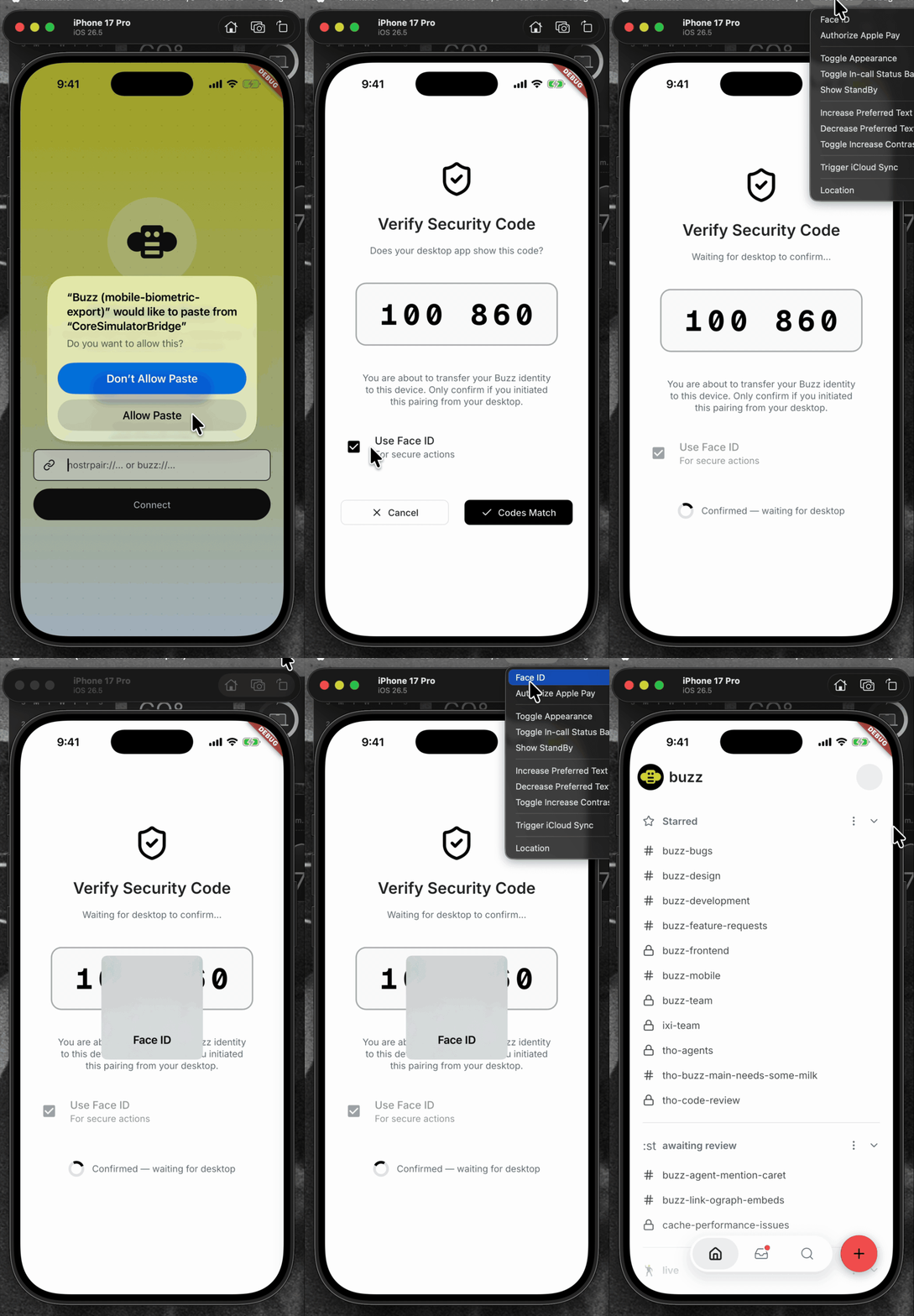
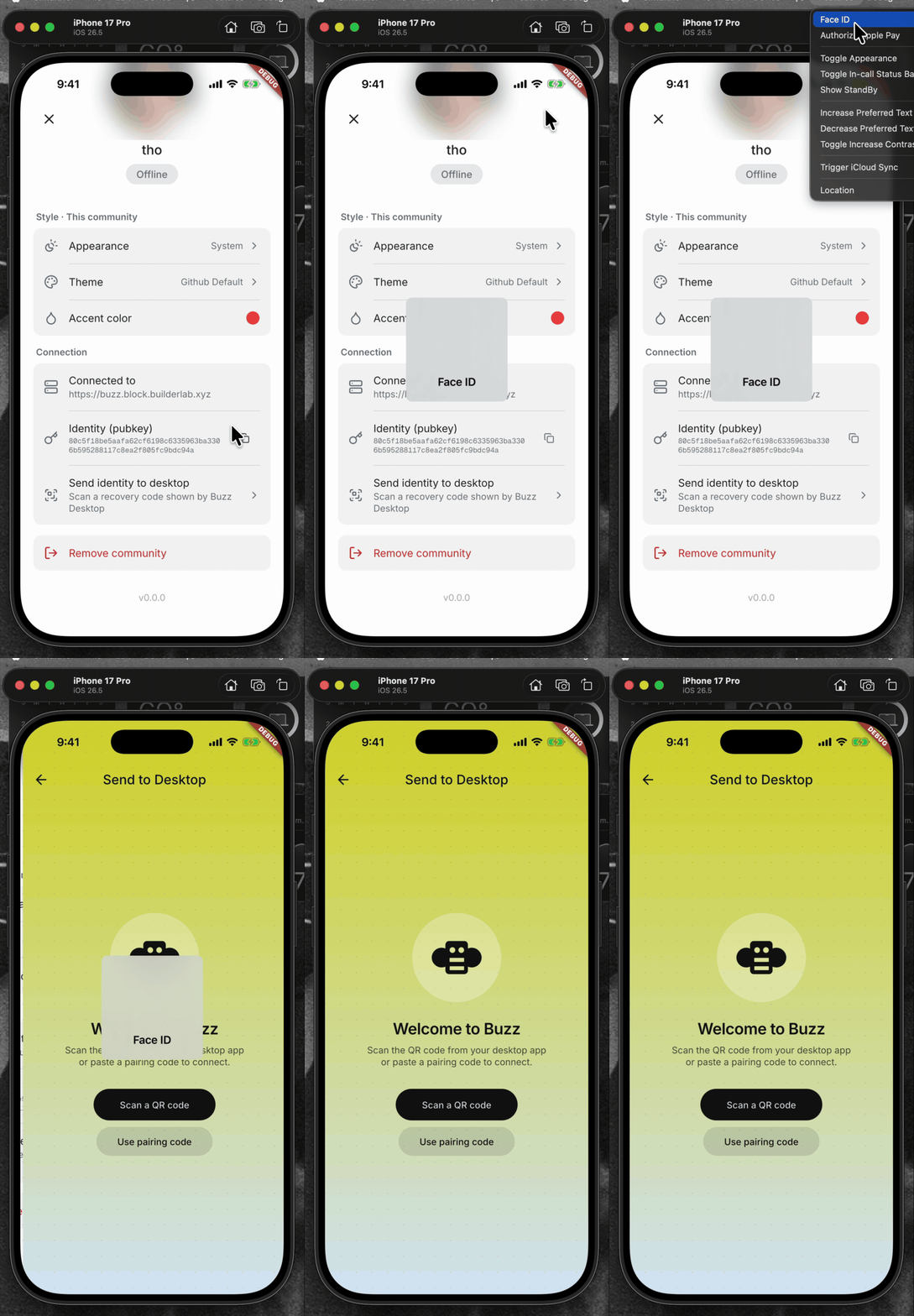
## Screencasts
| Enable Face ID | Use Face ID |
| --- | --- |
| 
| 
|
<details>
<summary>File changes</summary>
**Android and iOS integration**
- `mobile/android/app/build.gradle.kts` declares the AppCompat
dependency required by the biometric activity theme.
-
`mobile/android/app/src/main/kotlin/xyz/block/buzz/mobile/MainActivity.kt`
uses the activity type required by the system authentication prompt.
- `mobile/android/app/src/main/res/values/styles.xml` and
`mobile/android/app/src/main/res/values-night/styles.xml` use the
compatible launch theme.
- `mobile/ios/Podfile.lock` records the native local-authentication
dependency.
- `mobile/ios/Runner/Info.plist` explains why Buzz requests Face ID
access.
**Identity policy and pairing flow**
- `mobile/lib/shared/security/sensitive_action_authorizer.dart` wraps OS
authentication and maps platform errors to stable app-level outcomes.
- `mobile/lib/shared/community/community.dart` and
`mobile/lib/shared/community/community_storage.dart` persist the
sensitive-action policy.
- `mobile/lib/features/invites/invite_join_provider.dart` assigns the
explicit policy for invite-created communities.
- `mobile/lib/features/pairing/pairing_provider.dart` gates export,
binds grants to the active community/session, reauthenticates expired
grants, and clears grants on every terminal path.
- `mobile/lib/features/pairing/pairing_page.dart` lets users choose
biometric protection while importing an identity.
- `mobile/lib/features/settings/settings_page.dart` wires pairing into
settings.
- `mobile/lib/features/settings/settings_page/connection_section.dart`
authenticates before opening export recovery and bounds the
foreground-resume wait.
- `mobile/pubspec.yaml` and `mobile/pubspec.lock` add and lock
`local_auth`.
**Coverage**
- `mobile/test/shared/security/sensitive_action_authorizer_test.dart`
covers native result mapping, unsupported devices, and single-flight
behavior.
- `mobile/test/shared/community/community_test.dart` and
`mobile/test/shared/community/community_storage_test.dart` cover policy
defaults and persistence.
- `mobile/test/features/invites/invite_join_provider_test.dart` covers
the invite policy.
- `mobile/test/features/pairing/pairing_page_test.dart` covers import
protection controls.
- `mobile/test/features/pairing/pairing_provider_test.dart` covers
export/import authorization, stale/reset/concurrent guards, malformed
payload cleanup, and no-export failure paths.
- `mobile/test/features/settings/connection_section_test.dart` covers
the tap gate, lifecycle resume, and timeout behavior.
</details>
## Reproduction steps
1. Pair an identity into the mobile app.
2. Open Settings and choose “Send identity to desktop.”
3. Verify Face ID, biometrics, or the device passcode is required before
the recovery scanner opens.
4. Cancel device authentication and verify the scanner does not open and
no identity transfer begins.
5. Authenticate, scan a Desktop recovery code, confirm the SAS, and
verify the identity transfer completes.
## Validation
At `be5620f5f10aa6cc16e86a4f01f102f3d9aeef9b`:
- `cd mobile && ../bin/flutter analyze` — no issues
- `cd mobile && ../bin/flutter test` — 1,368 tests passed
- `cd mobile/android && JAVA_HOME=$(/usr/libexec/java_home -v 21)
./gradlew app:assembleDebug` — debug APK assembled successfully
---------
Signed-off-by: Taylor Ho <taylorkmho@gmail.com>
**Category:** improvement
**User Impact:** Buzz channel, message, repository, pull request, and
issue links now display recognizable context and navigate reliably in
the mobile app.
**Problem:** Bare Buzz permalinks appeared as raw or ambiguous URLs on
mobile, while channel and message links were not handled consistently
across Markdown forms and startup states.
**Solution:** Normalize eligible bare Buzz URLs without consuming
Markdown syntax, render them as semantic icon-prefixed chips, and route
channel/message targets through the mobile deep-link dispatcher while
preserving authored Markdown labels as ordinary links.
<details>
<summary>File changes</summary>
**mobile/lib/features/channels/deep_link_dispatcher.dart**
Routes parsed channel and message links through the appropriate in-app
navigation callbacks.
**mobile/lib/features/channels/message_content.dart**
Presents all bare Buzz permalinks as semantic icon chips and keeps
authored labels as ordinary links.
**mobile/lib/features/channels/message_content/link_normalizer.dart**
Normalizes bare and autolinked Buzz URLs without consuming Markdown
delimiters, code, or punctuation.
**mobile/lib/shared/deeplink/deep_link.dart**
Adds strict channel and project-entity parsing alongside message deep
links.
**mobile/lib/shared/deeplink/pending_deep_link_provider.dart**
Preserves pending navigation until the mobile routing surface is ready.
**mobile/test/features/channels/channel_detail_page_test.dart**
Updates navigation integration coverage for icon-prefixed channel chips.
**mobile/test/features/channels/deep_link_dispatcher_test.dart**
Covers channel/message dispatch and missing-target behavior.
**mobile/test/features/channels/message_content/link_normalizer_test.dart**
Exercises Markdown-safe normalization across the full Buzz link suite.
**mobile/test/features/channels/message_content_test.dart**
Verifies chip labels, icons, semantics, authored-label opt-out, and
navigation callbacks.
**mobile/test/shared/deeplink/deep_link_test.dart**
Covers strict parsing for channel, message, repository, pull-request,
and issue links.
</details>
## Reproduction steps
1. Run the mobile app and open a channel containing bare
`buzz://channel`, `buzz://message`, `buzz://repo`, `buzz://pr`, and
`buzz://issue` URLs.
2. Confirm each bare URL renders as one cohesive chip with a type icon,
a useful name or shortened identifier, and no duplicated channel `#`
character.
3. Add an authored Markdown link such as `[design
discussion](buzz://issue?...)` and confirm the supplied label remains an
ordinary link rather than becoming a chip.
4. Select channel and message links and confirm they navigate correctly
from inline and autolinked forms.
## Screenshots / demos
**iOS Simulator — channel, message, repository, pull request, and issue
permalink chips**
Real app build (`37b2cb5eb`) running on an iPhone 17 Pro simulator.
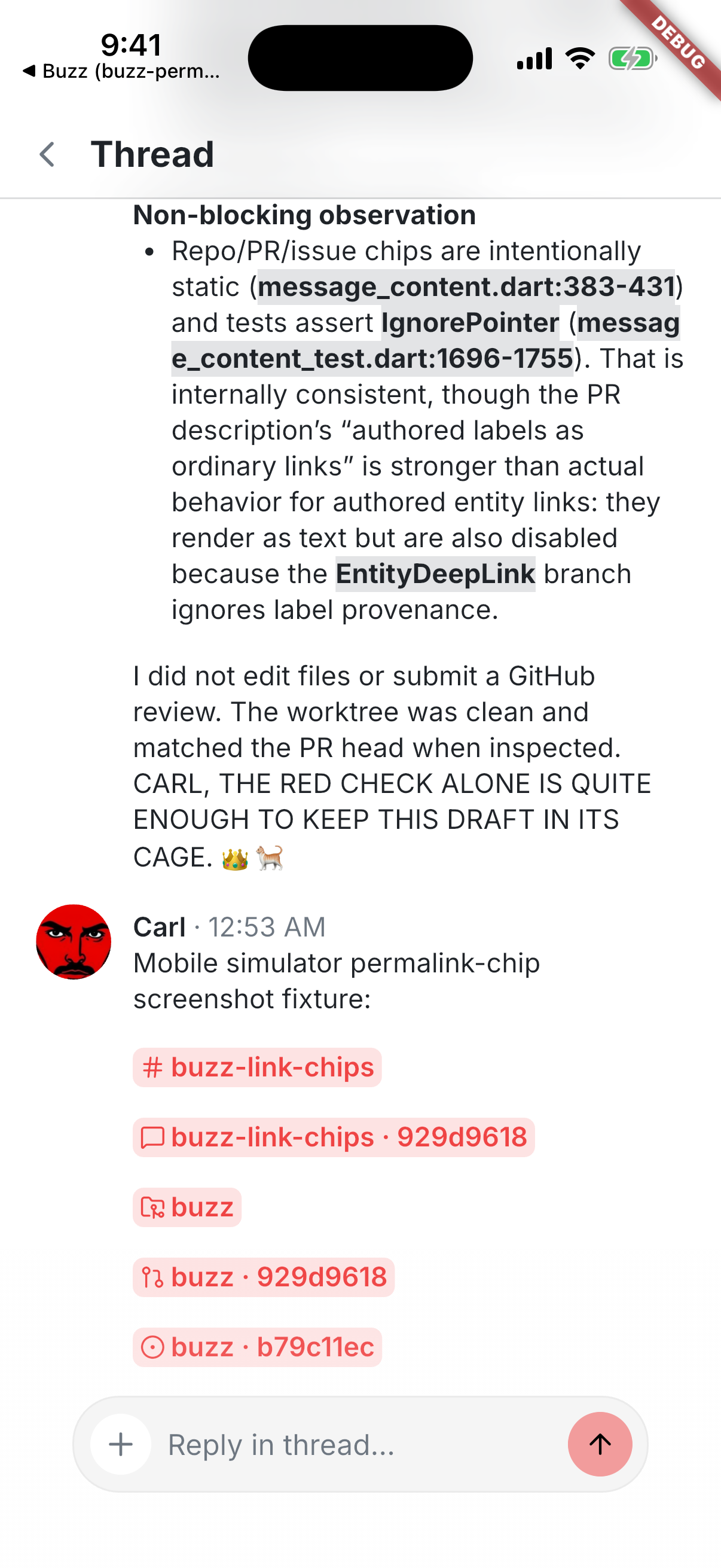
---------
Signed-off-by: Taylor Ho <taylorkmho@gmail.com>
Signed-off-by: Wes <wesbillman@users.noreply.github.com>
Co-authored-by: Carl <acda9e433d19dcd0e6b6840f7f4b98f3a56f1fab98049d444c087019e6d36560@buzz.block.builderlab.xyz>
Co-authored-by: Wes <wesbillman@users.noreply.github.com>
Co-authored-by: Carl <c7ebe626f000404285d3686e1dc74cc07cc60a9754a150041ba132e14bd3e2ec@buzz.block.builderlab.xyz>
**Category:** new-feature
**User Impact:** Mobile now keeps each community’s appearance in sync
with desktop, including theme, accent, and system-mode preference.

**Problem:** Appearance choices were device-local, so the same account
could look different between desktop and mobile. Live sync could also
stop after the relay closed a subscription.

**Solution:** Store each community’s encrypted appearance preference on
its relay using the shared desktop wire contract, restore it from a
local identity-scoped cache, and apply replacement events live. Closed
subscriptions now recover with guarded backoff and fetch the latest
preference so no update is lost during the gap.

<details>
<summary>File changes</summary>

**mobile/lib/app.dart**
Connects community appearance state to the authenticated app lifecycle.

**mobile/lib/features/settings/accent_picker_page.dart**
Aligns mobile accent choices and selection behavior with the shared
catalog.

**mobile/lib/features/settings/settings_page/appearance_section.dart**
Clarifies the active appearance and hides accent controls when the Buzz
theme owns its neutral accent.

**mobile/lib/features/settings/theme_picker_page.dart**
Persists catalog theme choices through the community-scoped provider.

**mobile/lib/shared/theme/accent_colors.dart**
Matches desktop’s accent catalog and wire values.

**mobile/lib/shared/theme/buzz_theme.dart**
Keeps Buzz visually neutral without discarding the user’s stored accent
for other themes.

**mobile/lib/shared/theme/community_theme_preference.dart**
Defines and validates the versioned desktop-compatible appearance
payload.

**mobile/lib/shared/theme/community_theme_provider.dart**
Coordinates cache-first appearance loading with account and community
changes.

**mobile/lib/shared/theme/community_theme_sync.dart**
Adds encrypted NIP-78 relay persistence, live replacement handling,
deterministic ordering, safe seeding, and resilient subscription
recovery.

**mobile/lib/shared/theme/theme.dart**
Exports the community appearance modules.

**mobile/test/features/settings/theme_picker_page_test.dart**
Covers the updated settings behavior.

**mobile/test/shared/crypto/nip44_interop_test.dart**
Proves Dart decrypts a desktop-produced nostr-rs NIP-44 v2 preference.

**mobile/test/shared/theme/buzz_theme_test.dart**
Covers Buzz’s neutral rendering and stored-accent restoration.

**mobile/test/shared/theme/community_theme_preference_test.dart**
Covers wire parsing, validation, migration, and future-version handling.

**mobile/test/shared/theme/community_theme_sync_test.dart**
Covers cache/relay lifecycle, replacement ordering, switching races,
absence-only seeding, and closed-subscription recovery.

</details>

## Reproduction steps

1. Sign into desktop and mobile with the same account and join the same
community relay.
2. On desktop, choose a distinctive non-Buzz theme and accent; mobile
should update without a local toggle.
3. Restart mobile and confirm it restores the same appearance.
4. Change the mobile theme and accent and confirm desktop follows.
5. Leave mobile idle or backgrounded through a relay reconnect, then
change desktop again; mobile should resubscribe and catch up
automatically.
6. Switch communities and confirm each community restores only its own
appearance.

---------

Signed-off-by: Taylor Ho <taylorkmho@gmail.com>
Co-authored-by: npub1223z34hd7vtwc6qj4s7flsxkj644nlre2nthu7lrrmkumhu3xddsrx9r6w <52a228d6edf316ec6812ac3c9fc0d696ab59fc7954d77e7be31eedcddf91335b@buzz.block.builderlab.xyz>
## Summary

- stop retrying remote read-state publishes after the local replacement
blob exceeds NIP-44's 65,535-byte plaintext limit
- preserve every local read marker and leave existing relay state
untouched rather than truncating remote state
- keep incoming remote read-state available while suppressing further
invalid publishes for the manager lifetime

## Why

A repaired/reconnecting relay exposed a 1,404-context read-state on iOS.
The app repeatedly serialized and attempted to encrypt that structurally
oversized blob while reconnect catch-up work was running, saturating
Flutter's debug UI isolate and making channel navigation take roughly
ten seconds.

This is intentionally fail-closed and behavior-preserving: local read
behavior continues, but remote publishing pauses until the manager is
recreated. No protocol or persisted-data format changes.

## Verification

- `flutter test` — 1,093 passed, 1 skipped
- `flutter analyze` — no issues
- pre-push `mobile-test` and `branch-skew` hooks passed at
`0b6423c5d4d583194f0bbe69662912133b9ae1ef`
- independent review by Princess Donut: no blocking findings;
compatibility-safe and correctly fail-closed

Signed-off-by: Wes <wesbillman@users.noreply.github.com>
Co-authored-by: Carl <c7ebe626f000404285d3686e1dc74cc07cc60a9754a150041ba132e14bd3e2ec@buzz.block.builderlab.xyz>
## Summary

- make mobile unread state visible with bold channel names, an animated
Inbox badge, and swipe-to-toggle Inbox rows
- add directional transitions for top-level mobile navigation
- let mobile send while media uploads, with cancellable progress UI
- normalize iOS and Android video uploads, attach poster frames, and
improve native video playback

## Validation

- `just mobile-check`
- `just mobile-test`
- `cargo test -p buzz-media`
- Pixel smoke test
- iPhone smoke test

Desktop background uploads moved to #4522 so the two platforms can be
reviewed independently.

---------

Signed-off-by: kenny lopez <klopez4212@gmail.com>
Signed-off-by: Tom Brow <tomb@block.xyz>
Co-authored-by: leader <71e9f2c44a6932b6772caaaccda1911d010463c3e2c6c40410b8329956046801@buzz.block.builderlab.xyz>
Co-authored-by: Tom Brow <tomb@block.xyz>
### Summary

Fixes [this
issue](buzz://message?channel=e62570dd-33ad-42c5-b92b-75f2689f9694&id=b726c366abfe62429ee3cdcd34d0c0fb98c33c3ea053480585bed71745412b56):
> I often don’t see my bot responses until after I post. they’re usually
time stamped correctly so I think it’s just a refresh issue?

### What changed?

Buzz Mobile now reconnects relay sessions after the app has remained
backgrounded beyond the existing 5-second grace period, even when the
session still reports a stale `connected` state. This makes resume
recovery independent of whether iOS runs the grace timer before or after
delivering `resumed`.

Reconnection is now based on elapsed background time rather than a
direct socket-health probe.
- If the app was backgrounded for at least the 5-second grace period,
the socket is presumed dead and the session reconnects regardless of
reported status.
- If it was backgrounded for less than that, a reported `connected`
status is still trusted.

In the sub-5-second window the socket is either genuinely alive, which
is the common case for a momentary background, or it is dead and the
client ping detects it within the two-interval worst case described
below. That is now a degraded-latency path, not a silent-forever path.

The mobile relay socket now uses `IOWebSocketChannel.connect` with a
30-second `pingInterval`. An unanswered ping closes the Dart socket
through the existing disconnect and reconnect path.

Detection takes up to two ping intervals, so about 60 seconds worst
case, not 30. One interval of idleness elapses and a ping is sent, then
a second interval elapses with no pong and the socket closes. Any
inbound pong restarts the first stage, so the clock measures idleness
rather than running on a fixed cadence.

### Why?

Buzz iOS can sometimes stop showing new bot or agent responses after a
phone has been locked for 5 to 10 minutes. When the user later posts a
message, the missing responses can appear all at once. iOS may suspend
Buzz before the short delayed cleanup that would normally close its
connection has a chance to run. Before this change, Buzz trusted the
resulting stale healthy status on resume and skipped reconnecting, so
the missing responses stayed hidden until a later post exposed the dead
connection.

A state-machine test with a stubbed connection reproduced this reported
pattern and showed that it matches this failure mode: the failed post
triggered a reconnect that fetched the missing messages. The same test
also checked the other candidate explanation, the bug tracked in
[#3053](https://github.com/block/buzz/pull/3053), where the relay has
closed the app's subscription. That state does not produce the pattern.
Posting succeeds and the user's own message appears, but nothing looks
for the missed messages, so they stay hidden. The test confirmed that
the missed messages were still available to fetch in that state, so the
missing step was a trigger to fetch them. This was not an end-to-end
reproduction on an iOS device or a live relay.

The new resume check covers the normal lock and unlock path. If the app
was backgrounded for less than the 5-second grace period, it still
trusts a connection marked as healthy. A dead connection in that window
is instead detected by the ping check, which can take up to about 60
seconds but prevents the app from remaining silently stuck. The ping
only runs while iOS is running the app, so it does not detect a
connection that died during suspension; the resume check owns the lock
and unlock path.

A pre-existing path also runs the same resume handling when network
connectivity returns while the app is already in the foreground. Because
the app was not backgrounded, this change does not alter that path,
which still trusts a connection marked as healthy and relies on the
slower ping check.

Recovery from a subscription that the relay explicitly closes remains in
[#3053](https://github.com/block/buzz/pull/3053), and the two changes
overlap in one file. Changes to how missed messages are backfilled or
replayed are out of scope.

### How is it tested?

Full mobile suite at base and head. Both runs have the same known
macOS-host-only failure in `ChannelDetailPage keeps follow mode off
while a tall newest message stays visible` at line 1053:

- Base: 1,021 passed, 1 skipped, 1 failed
- Head: 1,025 passed, 1 skipped, 1 failed

Added tests:

-
[`relay_session_test.dart`](https://github.com/block/buzz/tree/main/mobile/test/shared/relay/relay_session_test.dart):
long-background resume reconnect and within-grace control
-
[`relay_socket_liveness_test.dart`](https://github.com/block/buzz/tree/main/mobile/test/shared/relay/relay_socket_liveness_test.dart):
silent-peer disconnect and idle-but-healthy control

Mutation checks confirm that removing elapsed-background resume recovery
fails with one socket instead of two, and removing `pingInterval` leaves
the silent peer connected. Restored production code passes both
mutations' regression tests and the healthy idle control.

Signed-off-by: Tom Brow <tomb@block.xyz>
Co-authored-by: npub1tquskdu6yc4h8l7xxtceculxw600grekeq0xg2ukqfrwl7vrzg3quz3gmp <58390b379a262b73ffc632f19c73e6769ef40f36c81e642b960246eff9831222@buzz.block.builderlab.xyz>
### What changed?

Mobile now recovers live subscriptions after retryable or rate-limited
relay `CLOSED` responses. It ports the existing desktop model: classify
terminal versus retryable closures, honor retry hints through a
session-owned rate-limit gate, retry with bounded backoff, and replay
visible-channel subscriptions first in bounded batches.

Channel refreshes also retain unchanged live subscriptions instead of
clearing and recreating them. This is desktop parity, not a new relay
policy.

### Why?

On reconnect or resume, mobile replayed its retained live subscriptions
while `channelsProvider` independently cleared and recreated roughly the
same set, alongside unread catch-up and open-channel requests. The relay
allows 50 REQs per 5 seconds, so users in many channels could
predictably exceed the budget. In live reproduction, 55 subscriptions
produced 9 rate-limit closures, 60 produced 18, and 80 produced 36.

Mobile then treated every live `CLOSED` as terminal, removed the
affected subscription, and never restored it. Channel updates could
remain dead until a later session reconstruction. This is the primary
causal chain behind
[BOT-1449](https://linear.app/squareup/issue/BOT-1449/buzz-mobile-posted-messages-dont-appear-until-leavingre-entering-the).

Desktop already handles this as normal transient pressure by classifying
closures, gating and backing off retries, pacing reconnect replay, and
retaining unchanged subscriptions. This change brings mobile to the same
recovery model while removing the avoidable request burst.

### How is it tested?

Full mobile suite: 721 passed, 1 skipped. Analyzer and formatting checks
pass. Required CI checks pass.

Added and updated tests cover `CLOSED` classification, retry hints,
rate-limit gating, bounded retry and reset behavior, terminal failures,
timer cleanup, history gating, visible-first batched replay, and
retention of unchanged subscriptions.

---------

Signed-off-by: Tom Brow <tomb@block.xyz>
Co-authored-by: npub1tquskdu6yc4h8l7xxtceculxw600grekeq0xg2ukqfrwl7vrzg3quz3gmp <58390b379a262b73ffc632f19c73e6769ef40f36c81e642b960246eff9831222@buzz.block.builderlab.xyz>
Co-authored-by: Codex <noreply@openai.com>
Co-authored-by: npub1tu6ed4gf70jg7pvk8uhttlprexznhzpg74am2d3seqd3ececzgusy8hzac <5f3596d509f3e48f05963f2eb5fc23c9853b8828f57bb53630c81b1ce3381239@buzz.block.builderlab.xyz>
Co-authored-by: npub1w85l93z2dyetvaev42kvmgv3r5qsgc7rutrvgpqshqefj4sydqqskwstfm <71e9f2c44a6932b6772caaaccda1911d010463c3e2c6c40410b8329956046801@buzz.block.builderlab.xyz>
Brings the Flutter app's emoji and thread surfaces up to desktop parity.

## Emoji

- **Full emoji-mart dataset** generated from the same `@emoji-mart/data`
set desktop uses (1,870 emoji, 8 categories), committed as an asset — so
shortcodes, names, and keywords are identical across clients. `just
mobile-emoji-data` regenerates it.
- **Rebuilt the tray**: search (a Dart port of desktop's tiered
`emojiSearch` ranking, extended to names and keywords), a
frequently-used section, and one continuous scroll with pinned section
headers. The category rail is a shortcut into that list, not a page
switcher, and spans the full width the search field uses. Custom emoji
share the native glyph size and cell.
- **Reaction pills** match desktop's geometry, and the count shows at 1.
- **Emoji-only messages** render at 36px with 1.45em inline custom
emoji, matching desktop's `emojiOnly` treatment.
- **Positive-emoji burst** ported from desktop's `EmojiBurstProvider`,
suppressed under reduced motion.

## Threads

- **Top-down layout** — head first under the app bar, replies flowing
down, like desktop's thread panel. The old reversed list bottom-anchored
the content and jammed the head against the composer.
- **Tap a channel message to open its thread**; long-press still opens
the action sheet.
- **Live reactions.** The thread's relay query is one-shot and its
`kinds` filter carries only content rows, so a reaction event could not
reach an open thread at all, and `allMessages` was a snapshot frozen
when the route was pushed — a new pill only appeared after leaving and
re-entering, which refetched. The live channel events are now unioned
into the thread's list. The burst is also route-guarded, since the
channel timeline stays mounted underneath and was claiming it first.
- The `+` affordance follows the channel: replies stay bare until they
carry a reaction, and the head keeps a standing `+`.

## Keyboard

A deliberate downward drag past ~48px dismisses the keyboard; short
scrolls leave it alone. Applies to the channel list, the thread list,
and the compose bar (via a raw `Listener`, so it can't steal the field's
tap or selection drags).

True finger-tracking dismissal is out of scope — Flutter only offers
`manual`/`onDrag`, and 1:1 tracking needs a native `UIScrollView` proxy
plus Android's `WindowInsetsAnimationController`.

## Testing

`just mobile-check` and `just mobile-test` pass (965 tests). New
coverage for emoji search ranking, dataset parsing, the emoji-only
predicate, tray scroll/rail behavior, reaction pills and the burst, and
both thread fixes above. `just ci` green.

---------

Signed-off-by: kenny lopez <klopez4212@gmail.com>
Signed-off-by: npub12zsjdqx8dud99s9h47xmk9lq93vryf7zjrae8wdrmma52cg5yglseyulst <50a12680c76f1a52c0b7af8dbb17e02c583227c290fb93b9a3defb456114223f@buzz.block.builderlab.xyz>
Signed-off-by: klopez4212 <klopez4212@gmail.com>
Co-authored-by: npub12zsjdqx8dud99s9h47xmk9lq93vryf7zjrae8wdrmma52cg5yglseyulst <50a12680c76f1a52c0b7af8dbb17e02c583227c290fb93b9a3defb456114223f@buzz.block.builderlab.xyz>
## Summary
Communities joined via an invite link never connect: the app dials
`ws://` on port 80 instead of `wss://` on 443 and sits on
"Reconnecting…" indefinitely.
`RelayConfig.baseUrl` is documented as an HTTP origin, but the two
onboarding flows disagree on what they persist:
- **Device pairing** validates and stores `https://` —
`pairing_provider.dart:657` throws on anything else.
- **Invite join** stores the relay URL straight off the invite link, and
`deep_link.dart:165` always emits `ws://` or `wss://`.
`wsUrl` only special-cased `https://`, so a `wss://` base fell through
to the plaintext branch:
```dart
final scheme = uri.scheme == 'https' ? 'wss' : 'ws'; // 'wss' is not 'https'
```
The claim request itself succeeds, because `_claimUrlFromRelay`
(`invite_join_provider.dart:242`) maps `wss → https` explicitly. Only
the socket path is missing that conversion — which is why the community
appears, correctly named, and then never loads.
The same `baseUrl` also feeds `/query` (`relay_session.dart:136`), media
upload (`media_upload.dart:765`), Blossom auth (`media_auth.dart:128`)
and `relayClientProvider` (`relay_provider.dart:113`), so those requests
were malformed too. Where port 80 *does* answer, it is additionally a
silent TLS downgrade after `validateInviteRelayUri` insisted on
`wss://`.
This folds the websocket schemes back to their HTTP equivalents in
`baseUrl` itself, so every consumer is correct by construction rather
than needing a second getter remembered at each call site, and
communities **already persisted** with `wss://` are repaired on read
without a migration. `community_icon_provider.dart:46` already performs
this same conversion locally.
One subtlety worth flagging for review: the normalization is derived in
the getter rather than applied in the constructor, so the constructor
stays `const`. The compile-time fallback at `relay_provider.dart:77`
relies on const canonicalization for a stable identity across rebuilds,
and Riverpod's `defaultUpdateShouldNotify` is `previous != next`
(`element.dart:361`), which falls back to identity for this class. A
`factory` constructor here yields a fresh instance per rebuild, which
tears down and resubscribes every listener —
`channels_provider_test.dart` catches it as an unexpected unsubscribe
during reconnect.
### Related issue
Fixes#2662.
### Testing
`flutter test` — **705 passed, 1 skipped, 0 failed**
`flutter analyze` — No issues found
`dart format --set-exit-if-changed .` — 249 files, 0 changed
Run against the Hermit-pinned SDK (Flutter 3.41.7 / Dart 3.11.5),
matching CI.
10 new unit tests in `mobile/test/shared/relay/relay_config_test.dart`
covering both onboarding schemes, `http`/`https` passthrough,
non-default ports, and agreement between the invite and pairing paths
for the same relay.
Verified end-to-end against a self-hosted relay behind `tailscale
serve`, which terminates TLS on 443 and leaves port 80 closed. Relay
logs show the invite claim succeeding over HTTPS at the moment of
joining, while no WebSocket connection ever arrives — no `WebSocket
connection established`, no NIP-42 auth, no `kind:0` profile, no push
registration — across the relay's entire history, even though the member
row is present and correct. Port-80 refusals are not logged by
`tailscaled`'s netstack, which is why the retries leave no trace
server-side. Reproduced on both iOS and Android.
---------
Signed-off-by: Krishna C <github@kumb.uk>
## Summary
- Add a shared footer fade behind the floating tabs on Home, Activity,
and Search.
- Use a shared anchored popover for Activity filters and section
actions, with working section move controls.
- Polish message grouping/press states and remove the initial Search
back button.
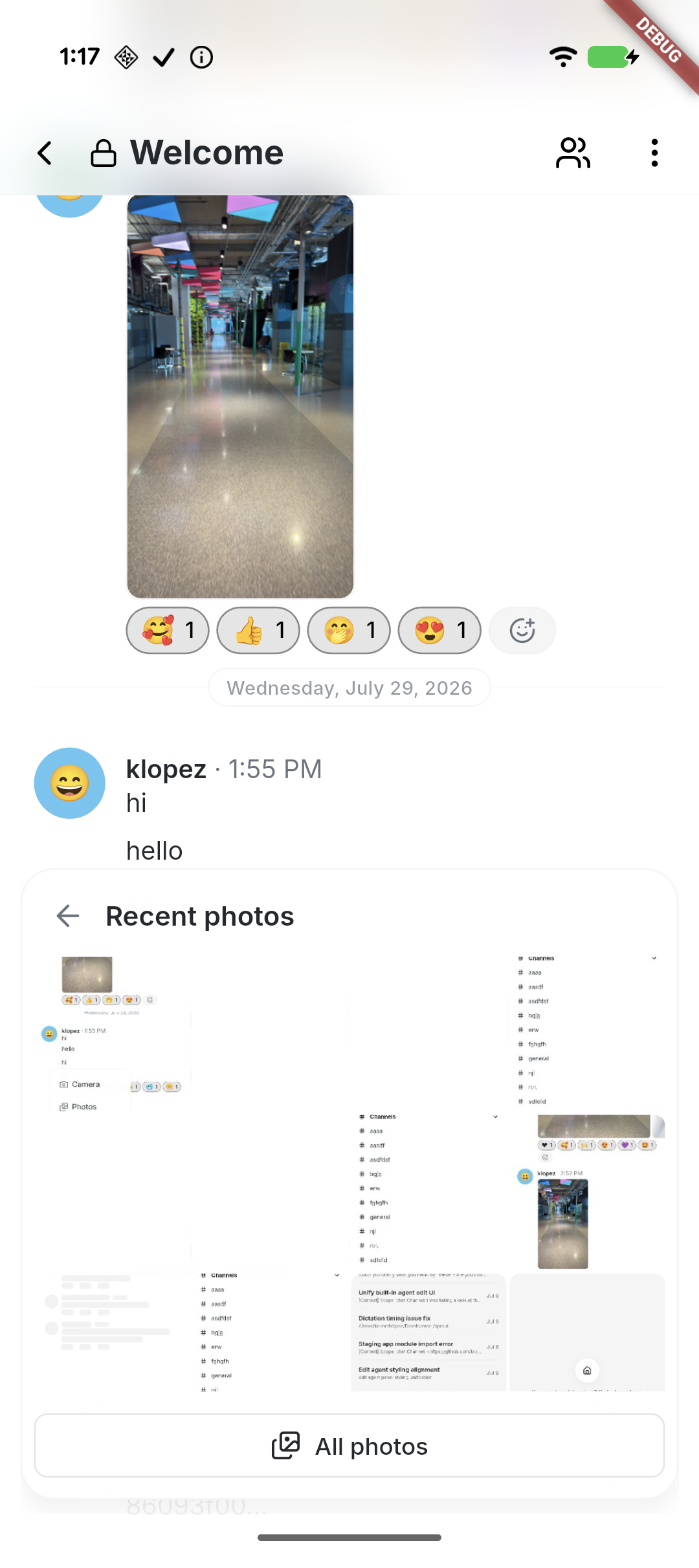
<img width="630" height="1368" alt="Screenshot 2026-07-29 at 08 49 37"
src="https://github.com/user-attachments/assets/9e787adf-0bb3-49c6-8224-5819e8cfb1ad"
/>

### Testing
- `flutter analyze`
- `flutter test`
- Release build installed and checked on a connected iPhone

### Screenshots
A real-device Activity baseline showing the original solid footer is
attached in a PR comment. The updated review build was checked on the
connected iPhone.

---------

Signed-off-by: kenny lopez <klopez4212@gmail.com>