mirror of
https://github.com/block/buzz.git
synced 2026-11-24 18:21:59 +00:00
eebf62b61d22e5fbda482b34fd45f695fe341b15
5 Commits
| Author | SHA1 | Message | Date | |
|---|---|---|---|---|
 Tom Brow |
bf9ce1432e |
feat(mobile): add diagnostic reporting module with crash capture (#9613)
Step one of [mobile diagnostic reporting](https://github.com/block/buzz/blob/main/docs/mobile-diagnostic-reporting.md), first piece: the reporting module, plus capture of crashes and uncaught errors. A build given a `BUZZ_SENTRY_DSN` now reports native crashes, Flutter framework errors and uncaught asynchronous Dart errors to that Sentry project, attributed to the signed-in member's public key. A build without one (every build made from this repository alone) uses a do-nothing reporter and never initializes the SDK, as [ADR 0007](https://github.com/block/buzz/blob/main/docs/adr/0007-diagnostic-reporting-follows-the-destination.md) requires. A destination the SDK cannot parse is treated as none, so a configuration mistake never stops the app from starting. ### What's in it - **One interface** in `mobile/lib/shared/diagnostics/`: report an error, count a networking event, leave a breadcrumb, and set the member. It has a Sentry-backed and a do-nothing implementation. Only this folder imports the SDK. The explicit error reports and the networking counts that use it come in the next PRs. - **Startup** wraps `runBuzzApp` and installs the SDK's crash and error handlers only when a usable destination is set: one with an HTTP(S) host, a public key and a project, which the native SDKs also require. On Android, the manifest removes the SDK's startup performance provider, which would otherwise run before that check. - **Member:** set from the active community's key, changed when the account switches, cleared on sign-out. Adding the Builderlab origin and account subject is left to a later PR. Every report also carries a random per-install identifier the app creates on first launch, as its own `install.id` tag, signed in or not, so a device's reports can be matched to its members. It lives in a file that device backups and transfers skip, so a phone restored from another gets its own: on Android in the app's files directory, excluded in both backup rule sets; on iOS in an Application Support folder that a small native call marks as excluded from backup (not the caches folder, which iOS can clear when storage runs low). Set on the SDK scope, it also reaches native crash and hang reports. With no member set (before sign-in or after sign-out), the SDK also fills the report's user with its own random per-install identifier, on Dart and native reports alike. - **One filter** runs on every Dart report, breadcrumb and count before it leaves the device: - It replaces every error's own text with fixed wording, since an error can quote its input, a server's response body or a URL. The error keeps its type, mechanism type and stack trace. - It drops what the SDK adds about the failing platform call (`mechanism.data`) and the failing widget (`flutter_error_details`), which can quote what is on screen. - It removes URL query strings and fragments, and keeps only tags and count attributes on the allowed list. - It drops every breadcrumb except networking events and the SDK's foreground/background entries. - **SDK options:** personal data, screenshots, view hierarchy, replay and tracing stay off. The SDK's session records stay on, for a crash-free rate. A session begins each time the app starts or returns after 30 seconds or more in the background; the SDK sends a record when it begins, an update each time an error is counted, and a last one when it ends, carrying the start time, error count, outcome, time from start to end, release, environment and the random per-install identifier. Native auto-breadcrumbs, Android's network-change breadcrumbs (VPN state, signal strength, bandwidth; turned off in the manifest, since the Flutter bridge leaves them on), Cocoa's network breadcrumbs (which keep each request's query and reach native crash reports) and print breadcrumbs are off. With print breadcrumbs on, the SDK would replace `debugPrint` in non-debug builds with one that prints nothing. - **Main-thread hangs:** iOS app hang tracking, Android ANR detection and iOS watchdog-termination tracking are set on explicitly, at the SDK's default thresholds. iOS reports the main thread blocked, fully or mostly, for 2 s or more while the app is active, including freezes it recovers from; a hang still going when the system kills the app is sent on the next launch as a fatal hang, and watchdog-termination tracking reports a foreground run that ended with nothing else to explain it. Android reports only system-declared ANRs: on Android 11 and later, the most recent one that ended the process (read on the next launch, when the system kept a thread dump); before 11, after 5 s once the system marks the app not responding. So recoverable freezes are reported on iOS, and on Android only before 11 once the system marks the app not responding. Dart runs on the main thread, so blocking Dart work shows up with the main thread's stack; Dart frames need the Dart debug symbols at the destination, as crashes do. The spec now has a bullet and a user story for this. - **What the filter does not cover:** native crashes and app hangs are captured and sent by the native SDKs, which never call the Dart filter. They carry stack traces and, for a native exception, its reason text. No app code puts content in a native exception today. The spec now says this. - **Reporting never blocks the app or reaches it with an error:** every call returns at once, and a failure inside reporting is dropped with a `debugPrint`. ### Regressions None for builds without a destination, which includes every build from this repository: they run the same startup with one extra synchronous check, and the SDK is never initialized. The SDK still adds to the app's binary size on both platforms. With a destination, the first frame waits for the SDK to start, native SDK included, and for the install ID to be read from (or, on first launch, written to) a small file. On a debug simulator build the first frame came about 0.3 s later (median of 6 cold launches: 768 ms with a destination, 431 ms without), measured before the install ID was added. Device builds will differ. Uncaught errors still reach Flutter's default handling, and the SDK sends in the background. ### Validation Added tests (`test/shared/diagnostics/diagnostic_reporting_test.dart`): - A table of inputs run through the production Sentry options callbacks: SDK HTTP and navigation breadcrumbs are dropped, network breadcrumbs keep only their four attributes, URLs lose their query string and fragment, unknown tags and count attributes are dropped, and the privacy and breadcrumb options stay off. - Errors sent through a real SDK hub, with the SDK's own platform-error processor and Flutter error integration, into an in-memory transport: for a parse failure, a bad argument, a server response and a platform failure, the serialized event keeps the type and stack but none of the error's text; a real framework build error leaves out the widget text. - A release-mode check that `debugPrint` keeps printing with reporting on. - A build with no destination, one the SDK cannot parse, one without a public key or one without an HTTP(S) host starts the do-nothing reporter and the SDK stays disabled. - Reporting calls whose SDK calls throw, either synchronously or asynchronously, never reach the caller. - Hang detection is on and its thresholds equal the SDK's defaults. - An installation keeps one install ID across launches, a new installation gets a new one, and the filter keeps the `install.id` tag. - Signing in, switching accounts and signing out change the member that later reports are attributed to. I checked that each guard is real by removing it: the print-breadcrumb setting, the destination check, the error-text replacement, the `mechanism.data` and `flutter_error_details` removal, the network-breadcrumb setting, the dropped-failure catch and the tag filter each made a test fail. End to end on an iPhone 17 Pro simulator, with a local server standing in as the destination and a throwaway probe (not committed) that made an HTTPS request with a secret in its query, then raised an uncaught Dart error and a framework error with secrets in their text, then crashed natively: - All four reports arrived (two Dart, one framework, one native crash on the next launch), and none of the secrets appeared in any envelope. - Dart reports carried only the foreground/background breadcrumb; the native crash carried none. - As a control, a build with Cocoa's network breadcrumbs switched back on put the request's secret query and fragment into the native crash report, so that setting is what keeps them out. - `debugPrint` lines still appeared in the device log. Hangs, on a fresh iPhone 17 Pro simulator with no debugger attached and the same local server: a throwaway probe busy-looped the main isolate for 5 s after the first frame. The SDK sent an `App Hang Fully Blocked` event ("App hanging between 5.7 and 6.5 seconds", mechanism `AppHang`) carrying the main thread's stack: Flutter engine frames around 12 frames of Dart code. This was a debug build, where Dart is compiled just in time, so those frames have no image to symbolicate against; in release builds they fall in the app's compiled Dart framework and need its debug symbols at the destination. Install ID, rechecked after moving it to its own file, on a fresh simulator with the same local server, launched twice with a probe that raised a Dart error and then crashed natively: both Dart errors and the native crash carried the same `install.id`, while the signed-out user was the SDK's own identifier. The ID file was in the backup-excluded `Library/Application Support/Diagnostics` folder, not in the app's preferences. The merged Android debug manifest has neither of the SDK's startup providers and has the network-change setting off. The NDK preload provider is still merged in, but it does nothing unless its own manifest flag is set, and it isn't. Full mobile suite passes. Dart errors are captured in the main Flutter engine only; the iOS sheets that start their own engine are out of scope for this PR (native crashes while they are open are still caught), as the spec now says. iOS simulator and Android debug builds with a destination set both build; on iOS the SDK resolves through Swift Package Manager. --------- Signed-off-by: Tom Brow <tomb@squareup.com> Signed-off-by: Tom Brow <tomb@block.xyz> Co-authored-by: studio <dc2fc481343672df31a689840c09299972e704dac592e0da6f18486646a7ee3e@localhost> |
||
|
Tom Brow
|
73962435b6 |
Use upstream C secp256k1 for native Nostr signatures (#8398)
Replace the Swift secp256k1 wrapper with a small native adapter over Bitcoin Core libsecp256k1. This is an alternative to the wrapper upgrade in [#8381](https://github.com/block/buzz/pull/8381), not an additional change to merge alongside it. The adapter covers the three Nostr operations Buzz needs: x-only public-key derivation, BIP-340 signing, and signature verification. It compiles pinned, unmodified upstream C source through SwiftPM. There is no build plugin, plugin approval script, or underscored Swift import. The app and notification extension use an explicit C module map and header search path. This trades the third-party Swift wrapper for a Buzz-owned adapter and responsibility for updating the vendored C source. Upstream v0.8.0 source, its license, and update provenance are included. The release Xcode pin remains separate in [buzz-releases#110](https://github.com/squareup/buzz-releases/pull/110). ### Validation - Native package tests passed on Xcode 27.0 and 26.5: 96 XCTest tests and 65 Swift Testing tests per toolchain. - Added tests cover the official BIP-340 vectors for 32-byte Nostr messages, invalid secret keys, and malformed input lengths. - Full unsigned Release app and notification extension build passed on exact Xcode 27.0. - Vendored files were compared byte-for-byte with upstream v0.8.0. - Full local `just ci` passed. - [Hosted full unsigned iOS Release build](https://github.com/block/buzz/actions/runs/38924020583/job/117051237094) passed. [Hosted Native Swift validation](https://github.com/block/buzz/actions/runs/38924020583/job/117051237153) passed, including the complete simulator build and native controls/push navigation tests. - Codex code review and security review completed with no findings. ### Before merge - [x] Tom selected the direct-C approach with vendored upstream source; [the wrapper alternative](https://github.com/block/buzz/pull/8381) is closed. Signed-off-by: Tom Brow <tomb@block.xyz> |
||
|
Tom Brow
|
fea02d174d |
fix(ios): fetch profiles and avatars in notification extension (#8369)
A notification can arrive from someone whose profile the main app has never loaded. The iOS notification extension now fetches and caches sender profiles, channel details, and avatars itself. The main app supplies account configuration and Keychain credentials only. After resolving the message, the extension allows 1.5 seconds for sender and channel details. It uses available stale data when a refresh is slow or fails, delivers once, and lets late results update its private cache. Profiles, channel details, and avatar refresh checks share a one-hour freshness threshold. A verified avatar removal clears the previous image. Account removal prevents further use of that sign-in's cached data. Profile, channel metadata, and membership use separate bounded downloads, so an oversized roster cannot discard the smaller records. Sender enrichment can finish while channel requests are pending. A successful partial channel refresh atomically removes its old counterpart, preventing a mixed group identity or recipient count. Group-specific notification presentation still requires a verified recipient count. The [specification](https://github.com/block/buzz/blob/native-notification-enrichment/docs/native-notification-enrichment.md) describes the display, caching, and account-removal behavior. General persistent image caching in Flutter remains separate. ### Validation [Hosted CI](https://github.com/block/buzz/actions/runs/38780108487) passed on the final commit, including all Flutter shards, Android, the full iOS release and simulator builds, and native controls/push-navigation tests. The [current-commit security review](https://github.com/block/buzz/pull/8369#issuecomment-6197508385) found no issues. The native package passed 159 tests, including new coverage for cache freshness, avatar replacement and removal, sign-in isolation, concurrent storage, late results, single delivery, bounded downloads, and SVG validation. A regression test exposed identical HTTP authentication event IDs for requests in the same second; each request now includes a unique nonce, matching the Dart and CLI clients. Full local CI passed before that small authentication fix. The complete native suite and signed device build passed again on the latest commit, including response-size limits, overlapping avatar downloads, canonical relay-origin matching, independent profile/channel refreshes, account-key changes before and during requests, and a single initial snapshot read across 64 accounts, signed IPv6 avatar authorities, and partial channel refreshes. Focused Flutter regression tests passed 198 tests with three configuration-specific skips; seven avatar widget tests also passed. Flutter analysis is clean, and the notification extension builds for the simulator. On an iPhone SE, the notification displayed the sender name, avatar, channel, and message before the updated main app was opened. Repeat notifications used a byte-identical private cache. Three notifications delivered together displayed the avatar after the authentication fix. The next notification also displayed correctly after terminating the extension process. The existing generic-push design can select the same newest unread message for several pushes; this change does not alter message selection. 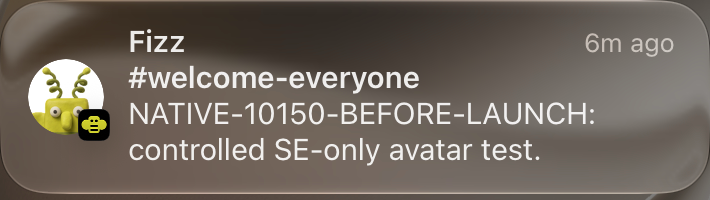 Authenticated HTTP avatar fetching and persistent HTTP cache reuse also passed on the SE. The first notification downloaded a relay thumbnail. After terminating the extension and expiring its separate avatar entry, the next notification displayed the avatar and refreshed that entry without another media request in the relay logs. The main app remained unopened throughout. The original app build and test profile were restored afterward. Automated tests cover slow and failed requests, stale images, removal, and account revocation; those cases have not all been exercised on the phone. ### Before merge - [x] Verify authenticated HTTP avatar fetching and cache reuse on iOS against a working relay media service. <!-- buzz-review-completed --> --------- Signed-off-by: Tom Brow <tomb@block.xyz> |
||
|
Tom Brow
|
c432a111ca |
feat(mobile): push notifications MVP (#6269)
This PR implements MVP, iOS-only,
[NIP-PL](
|
||
|
Wes
|
a444fb9516 |
feat(mobile): scaffold Flutter app with Riverpod & Catppuccin theme (#306)
Co-authored-by: Claude Opus 4.6 (1M context) <noreply@anthropic.com> |
