## Why

Early relay failures can currently appear as a container restart without
a trustworthy in-process account of whether crypto, structured logging,
configuration, relay identity, or the metrics listener failed. Most of
those steps happen before the Prometheus exporter exists, so their
chronology belongs in logs rather than metrics.

Implements the logs-only early-startup slice of #7238. Post-bind
Prometheus exporter supervision is tracked separately in #7284.

## What changed

- create a process lifecycle recorder before the Tokio runtime and emit
a fixed, versioned JSON schema directly to stderr;
- record started and exactly one terminal event for `crypto_init`,
`tracing_init`, `config_load`, `key_load`, `metrics_bind`, and the
aggregate `process_telemetry` phase;
- keep every status and reason bounded and suppress raw errors that
could contain credentials, keys, URLs, or other secrets;
- return typed metrics-install errors so `metrics_bind` can be
classified without logging raw values, while preserving the existing
public `metrics::install` API;
- document the logs-only evidence contract and add real child-process
regressions for success and failure paths.

This PR adds **no startup metric families** and no dashboard contract.
Existing application metrics remain unchanged.

## Verification

Exact head: `8faf7526822a119efa035e58b2b3c59aa67fc81d`

- `cargo fmt --all -- --check`
- `cargo clippy -p buzz-relay --all-targets -- -D warnings`
- relay binary target: 13 passed, 1 PostgreSQL-only test ignored
- real relay child-process lifecycle target: 9 passed
- full relay package library target: 1,023 passed, 89 ignored; the same
six media tests failed at `crates/buzz-relay/src/api/media.rs:1145` with
`Sqlx(PoolTimedOut)` because local PostgreSQL is unavailable
- three independent exact-head reviews found no correctness, security,
compatibility, lifecycle-accounting, logs-only-scope, or test-adequacy
finding

All exact-head GitHub CI gates are green, including lint, unit tests,
PostgreSQL, relay/backend/desktop integration, both Linux server
cross-compiles, Windows/macOS builds, and security checks.

## Staging verification

- exact multi-architecture image:
`dev-sha-8faf7526822a119efa035e58b2b3c59aa67fc81d-run-33708188952-1`
- immutable manifest:
`sha256:26cad28266a6bb0b0e7081eb6091d374e5489f8bb78c475a4a65737dee86cc67`
- image workflow: https://github.com/block/buzz/actions/runs/33708188952
- focused staging deployment:
https://github.com/squareup/builderbot-platform-core-infrastructure/pull/314
- replacement ReplicaSet `buzz-d68764bc7` has two Ready pods with zero
restarts
- Datadog received one complete, contiguous sequence 1-12 from each pod;
both end with `process_telemetry/terminal/succeeded` at 3 ms
- queries scoped to the replacement ReplicaSet return no data for the
removed `buzz_startup_phase_terminal` or
`buzz_startup_phase_duration_seconds` families

The experimental Row 7 was removed from the Buzz Startup & Rollout
Safety dashboard. This logs-only PR deliberately adds no replacement
dashboard row.

---

**Update Sep 3, 12:26 ET:** Clarified the review boundary: this PR does
not close the broader #7238. Later exporter-task termination is
pre-existing runtime behavior and is now explicitly tracked in #7284; no
production code or staged image changed in this update.

Generated with Codex

Signed-off-by: Ravneet Arora <rarora@squareup.com>
## Summary

- show status and huddle emoji beside names in DMs and message rows
- provide accessible tooltips, fallback status emoji, and profile-menu
icon replacement
- add the desktop status editor with preset durations, a ShadCN
calendar, and a capped half-hour time menu

## Validation

- desktop checks, typecheck, and file-size guard
- 5,802 desktop tests
- focused Playwright coverage (3 passed)
- E2E build and native Builderlab staging verification

Updated visual snapshots are attached in the PR comments.

---------

Signed-off-by: kenny lopez <klopez4212@gmail.com>
Signed-off-by: Princess Donut <b238ea756dee4d98afa5883fc7f1de61eeabe65bf700e3a5a5a80db5e42e2c2b@buzz.block.builderlab.xyz>
Co-authored-by: Princess Donut <b238ea756dee4d98afa5883fc7f1de61eeabe65bf700e3a5a5a80db5e42e2c2b@buzz.block.builderlab.xyz>
## Summary

Cuts perceived agent-mention send latency by publishing the message
first and waking the agent afterwards, instead of blocking the send on a
synchronous agent start/deploy round-trip. A send that mentions a
stopped or undeployed managed agent now shows the message immediately;
the wake runs fire-and-forget after the relay accepts the publish. The
already-running-agent send also gets faster via revalidation dedupe and
NIP-11 caching.

## Changes

### Publish-first agent wake

- Wakes for mentioned managed agents are collected during send
preparation and flushed fire-and-forget only after `await send(...)`
resolves. No start can fire — and no "your message was sent" toast can
appear — for a message the relay never accepted; every abort path
(cancel, readiness error, publish rejection, dismissed non-member
prompt) simply drops the queue. Persona-create wakes ride the pending
draft behind the non-member prompt for the same reason.
- Each wake is bound to the tenant scope captured at send time: the new
`useDetachedAgentStart` hook passes `expectedRelayUrl` +
`expectedSignerPubkey` with every start, so a wake that outlives a
community switch fails closed at the backend instead of spawning against
the new tenant. A wake whose scope has not resolved yet (identity query
still loading, blank stored relay URL) is refused with a recoverable
toast rather than fired unscoped.
- In-flight wakes are deduped through a module-level map keyed by
`(relay URL, pubkey)` — the same tenant pair the backend keys on — so
two quick sends or two composers cannot double-spawn a cold agent during
the seconds-long start window. Entries are deliberately retained across
community switches (the key *is* the tenant scope, so a retained entry
can never affect another community, and clearing it let an A→B→A round
trip deploy a provider agent twice) and self-clean when the start
settles.
- Wake-failure toasts are fenced to the community they fired in via a
module-level scope mirror: a start that settles after a community switch
logs instead of rendering community A's failure over community B's UI,
and an A→B→A return re-delivers the warning where it is actionable.
- Membership attach and access-policy writes stay synchronous, so the
harness's first kind-39002 read still sees the channel.

### Replay floor

- The send timestamp travels with the wake as `BUZZ_ACP_REPLAY_FLOOR`,
threaded through both local spawns (`spawn_agent_child`) and provider
deploys (`deploy_to_provider` injects it into `launch.policy_env`), so
the harness's startup watermark replays back past the just-published
triggering message no matter how long the spawn takes. `buzz-acp` clamps
the floor to `[now − 15min, now]`.
- The floor is captured at enqueue time, not flush time — the flush runs
post-publish, so a flush-time stamp could exceed the message's
`created_at` and skip the very message the floor exists to cover.
- On local spawns the caller's floor is asserted *after* the user env
layering (and the ambient parent-process value is stripped
unconditionally), so a saved persona/global/agent env entry cannot
shadow this send's floor — mirroring the shadow-strip the provider path
applies to `launch.env`. Both halves share one `REPLAY_FLOOR_ENV_VAR`
const.

### Send-path latency reductions (already-running agents)

- Mention revalidation is deduped: the publish-boundary pass reuses the
pre-side-effect authorization pass unless an awaited round-trip actually
separated the two (background upload, link-preview settlement, DM
expansion, a real access-policy/membership write, or active-huddle
enrollment). This preserves the #5681 authorization boundary while
making the common send single-pass.
- NIP-11 `self` lookups are cached per relay URL for 5 minutes. Only
verified values are cached — non-2xx and malformed responses stay
retryable — and URL keying keeps community switches from serving another
relay's identity.
- `applyReusableAgentAccessPolicy` now reports its relay write
explicitly (`{ agent, wrote }`) instead of signalling through object
identity, so the revalidation trigger above is load-bearing by
construction.

### File splits

Four files crossed the repository file-size ratchet during this work;
one cohesive unit was extracted from each rather than raising a ceiling
— `runtime/setup_payload.rs`, `commands/agents_create_fields.rs`,
`app_state_accessors.rs`, and `useEnsureAgentMentionsReady.ts`. The
ratchet is green at the tip.

### Review follow-ups

The three concrete findings from the first review round are fixed at the
tip: the pre-publish wake and its false "your message was sent" toast
(fixed by queueing wakes behind the publish), the stale cross-community
failure toast (fixed by the scope-mirror fence), and the A→B→A duplicate
provider deploy (fixed by retaining the tenant-keyed in-flight entries
across switches). The fast-path admission-staleness point is answered in
the review thread: deferred paths already re-validate at the publish
boundary, and the remaining fast-path window is milliseconds against an
irreducible network-transit race.

Mid-branch send-perf instrumentation was added to attribute the residual
spinner latency and reverted once that analysis concluded — it is
net-zero in this diff.

### Deferred follow-ups

Durable mention catch-up via `event_mentions` (option 2 step 3) and
backend deploy-epoch coalescing for the wake paths that do not funnel
through `useDetachedAgentStart` (Agents-panel Start, restore,
inbound-persona deploys) are intentionally left for separate changes.

## Testing

- `cargo test --lib` on desktop/src-tauri: 3054 passed; clippy `-D
warnings` + fmt clean
- Desktop unit tests: 5856 passed (the 5 failures are the pre-existing
`inboxReopenNavigation` / `useRetainedProjectGitViews` baseline, present
on origin/main); `tsc --noEmit` and biome clean
- Full mentions (87), channels (89), and community-rail (25) Playwright
smoke suites against `pnpm build:e2e` bundles, with 3× stress reruns of
each new spec
- The load-bearing regression specs were confirmed red on the pre-fix
code: publish-failure → zero starts and no false toast, the dedupe hold
(1 call vs 2), the fail-closed scope refusal, the rail-switch toast
fence, and the A→B→A retention spec (1 deploy vs 2)
- New unit coverage pins the queue contract (enqueue-time floors,
attach-seam queueing), the scope capture and verbatim relay-URL handoff,
the dedupe map's keying and settle-then-repermit behavior, the unscoped
refusal, the toast-scope mirror, the `{ agent, wrote }` contract, and
the replay-floor env layering on both spawn paths

🤖 Generated with [Claude Code](https://claude.com/claude-code)

---------

Signed-off-by: Matt Toohey <contact@matttoohey.com>
Co-authored-by: Claude Fable 5 <noreply@anthropic.com>
🤖
## Requested rebase published — ef40744b
Rebased onto fetched main **47d068e2109d077414cbf2f4f1c927f6d051037a**,
published **ef40744b3aeb4baaf8c81416e1a644fb5b315f91** with the exact
expected-old `df7fad6a` force-with-lease. No merge.
Manual conflicts were additive: preserve main's exact-key identity
documentation alongside the availability contract, and retain both
Bestie props and the shared availability reader in
`UnifiedAgentsSection`. Range-diff confirms unchanged lifecycle policy:
exact-key action-time authority, Unknown versus Offline, rejected
shutdown retains record/memberships, and separate local/provider/owner
gates. Main's exact-key profile routing survives. Both test-only CI
synchronization repairs (natural toast expiry and bounded stderr wait)
are byte-identical to the prior head. All ten original
authors/messages/DCO/material coauthor trailers are preserved;
configured signing policy was not changed.
Fresh checks on the rebased candidate:
- TypeScript, Biome on 26 changed TypeScript files, differential
file-size gate, and diff whitespace: pass.
- Focused production-hook/card/profile units: **58/58**.
- Fresh E2E build, availability/deletion browser: **11/11**, no retries.
- Main exact-key profile cases plus failed-DM send/startup retries:
**6/6**, no retries.
Previously reviewed full Desktop/buzz-agent package and mutation
evidence is reused for unchanged behavior; no ceremonial full suite, new
native/provider test, or `just ci` pass is claimed. Local configs,
dependency links, and historical artifacts are preserved.
Hosted observation: **MERGEABLE**, **BLOCKED / REVIEW_REQUIRED**, no
new-head formal review. [CI
33699735990](https://github.com/block/buzz/actions/runs/33699735990) is
running (including Rust and Desktop lanes), not a completed success. DCO
and required Security aggregate passed at the observation; the separate
Codex advisory review was skipped. No completed failing check or new
inline feedback observed. Historical approvals are not new-head
approvals. No reviewer/security authorization or merge action was
performed.
---
## Feature summary and retained pre-rebase evidence
## Summary
In Buzz Desktop, an agent could look online just because it had been
started or deployed, even when there was no current sign it was
connected. Cards and profiles now show availability from the agent's
relay presence rather than a saved launch record, so you can distinguish
an online agent from one that was merely deployed.
Agents cards and profiles use presence reported through the shared
server (the relay). A successful presence read with no online agent
shows Offline; failed/disconnected evidence shows unknown, rather than
retaining a misleading cached Online state.
Lifecycle actions remain separate. An offline agent may still have a
Shutdown action because the deployment record exists. Shutdown reports a
**request**, not proof the process stopped. Offline does not imply that
starting a duplicate agent is safe, and Online does not promise a
response.
### Related issue
Independent base: `main`; no stack parent or child among the
replacements. Extracted from
[#7114](https://github.com/block/buzz/pull/7114), retained as historical
source (`98fe33ec`).
[Behavior
contract](f4bb2ed44e/docs/agent-availability.md).
Originating [Buzz
discussion](buzz://message?channel=f7a9536a-1738-4bad-a888-b3ea25010ef1&id=7aa1f0ab23dce514bd8a0221441cf005bf428914621171472b79747c50820848)
· channel `f7a9536a-1738-4bad-a888-b3ea25010ef1`.
### Testing
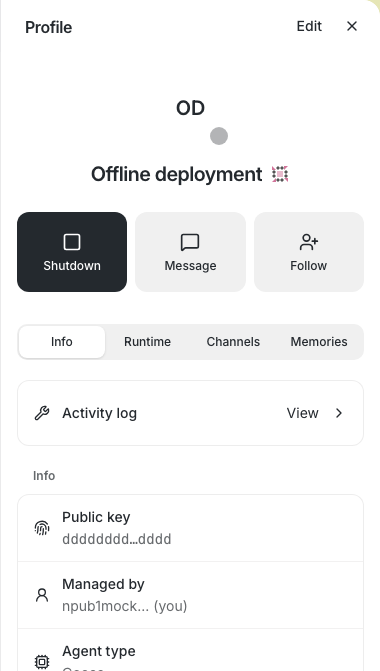
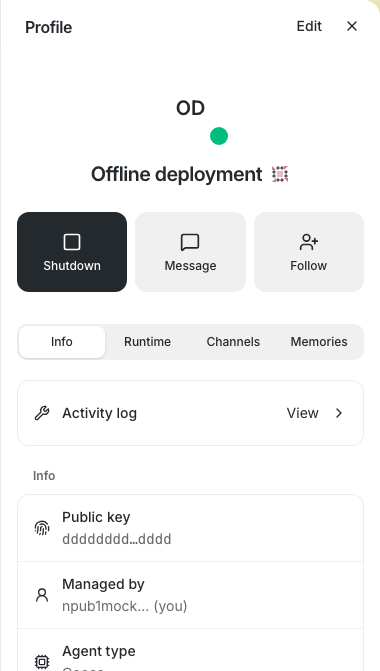
The same saved provider-backed agent, with only authored presence
changing. These are mock-browser states, not a before/after deployment
or live relay transport test; production UI is unchanged by the later
fixture repairs.
**No online presence:** gray dot, existing Shutdown control retained.
**Online presence:** green dot, same lifecycle control.
[Capture
details](https://github.com/block/buzz/pull/7127#issuecomment-5482264824).
To check manually, compare runtime-only transitions with presence
updates, then disconnect/fail the presence read and verify it does not
stay Online. A Shutdown request should not immediately claim confirmed
termination.
#### Historical pre-rebase evidence and limitations (df7fad6a)
Lifecycle production source remains
**`f4bb2ed44e5a989d93c5f51e93c0bbd2dca941be`**. Current published head
is **`df7fad6ae65dda78508317186a95522d1bb22ed9`**: the prior browser
synchronization at `b78d093e` plus an additive two-file Rust
test-harness synchronization described below. No production bytes,
dependency/configuration files, or prior commits were changed; no
rebase. Current live main `0dbd036f5bff33e7ade75e7639f3218d424a6e73` has
identical failing-test/toaster/send-flow source; the causal browser
comparison used latest successfully tested main
`04babf02655440b4dfd37f2e2df605ead0a030d8`.
**Lifecycle/deletion correction:** both Agents and actual profile
deletion now pass the shared exact-key availability reader, not raw
cached data. It reads the canonical query state and connection at action
time, including after awaited channel discovery.
Failed/disconnected/pending evidence and unqueried persona siblings are
unknown; successful missing means Offline only for a requested key.
Successful background refetch cache remains usable; settled failure
revokes it. No second cache or per-row polling was added.
Provider record + channel + Online/Away/**unknown** awaits shutdown
submission before local removal; rejection preserves record/membership
for retry. Established Offline preserves intentional no-request removal.
No route preserves warned local removal. Local agents retain native
stop-before-remove, independent of presence. Profile consent now
describes a shutdown **request**, not remote deletion or guaranteed
termination. Existing ownership and force gates are unchanged.
**Verified, reused exact-candidate validation:** the independently
approved eleven-file patch (SHA-256
`2f69fe12ef0420e62dea1fd8db28cfa22cde5eecaf8080e656310a3e60d0cf86`) was
committed without byte changes. Desktop **5,921 passed, 0
failed/skipped**, including **26 new mounted production hook/IPC
regressions**; rebuilt availability browser suite **11/11 passed, no
retries**, including four actual profile Delete journeys. Desktop check
(existing 4 warnings/5 infos), typecheck, production/protected-feature
artifact matrix, differential file-size/policy and diff checks passed.
No blanket rerun or new full-repository `just ci` is claimed for this
frontend correction.
Production regressions cover cached Online **and Offline**
failure/disconnection, genuine missing/Offline, pending, successful
inflight refetch versus settled error, retained reader, error during
awaited channel discovery, unqueried persona sibling, shutdown
rejection/order/cancel, no route and local authority. Browser fixtures
use safe mock IPC and a retained provider receipt, not a real
deployment. Three restored mutation controls fail: unknown → skip
shutdown (**15** regressions), Agents raw-cache reader (**6**), actual
profile raw-cache caller (**1 browser journey**, false removal on failed
cached Offline). Independent review approved the exact frozen bytes and
added **4/4 cached-empty failure/disconnection probes** across both
callers. This is local independent approval, not formal GitHub/A Team
clearance.
The prior native propagation/poll-count defects remain closed ([earlier
response](https://github.com/block/buzz/pull/7127#issuecomment-5512278755)).
The prior hover-popover correction at `b55423f6` remains covered by the
full 11-journey browser run: pending/failed/disconnected means no badge
or accessible status, genuine missing/Offline retains an Offline badge.
Its earlier fallback-restoration mutation failed as expected (badge
count 1 rather than 0); that historical witness is reused, not rerun.
**Reused unchanged native/system boundary:** local `just ci` at
`c59067d8` passed workspace/Tauri fmt/clippy, static/policy checks, Rust
unit recipe, native workspace **3,159 passed / 20 ignored**, Web build
and **2,019 mobile tests**. No native implementation changed in this
lifecycle correction. These are historical boundary results, not
new-head native/live certification. [Parent
CI](https://github.com/block/buzz/actions/runs/33650549130) passed with
**14 retry-recovered browser flakes**, not retry-free. Old-head
CI/reviews are not current-head clearance.
**Hosted gates:**
[CI33662151103](https://github.com/block/buzz/actions/runs/33662151103)
on `f4bb2ed4` **FAILED**: smoke shard1 had 322 pass, one failure, one
retry-recovered flaky, two skipped. The failed first-DM retry test timed
out on all three attempts because the error toast intercepted Send. That
failure is preserved, not waived; the scoped test repair below is
published as `b78d093e`.
[CI33668171165](https://github.com/block/buzz/actions/runs/33668171165)
on `b78d093e` subsequently **FAILED** the Rust unit budget regression
described below. Both original failures remain visible; neither was
retried to green. Exact `f4bb2ed4` and `b78d093e` APPROVED reviews cover
unchanged reviewed bytes, not formal approval of the new head. Fresh
exact-head CI and the established automated technical rereview are the
next gates for `df7fad6a`. Historical deletion responses remain
([5092381800](https://github.com/block/buzz/pull/7127#issuecomment-5513759316),
[5092391193](https://github.com/block/buzz/pull/7127#issuecomment-5513763497)).
No formal review dismissed. The [security
notice](https://github.com/block/buzz/pull/7127#issuecomment-5482231278)
and latest-push maintainer/codeowner policy remain separate actionable
gates: eligible Block organization members own current-range
authorization. No merge/security authority exercised.
**CI causal repair (`b78d093e`, test only):** the error `Message failed
to send: Mock first DM send failed.` is deliberately injected by the
existing fixture. CI screenshot and retry trace show the bottom-right
Sonner notification over the actual enabled Send button. `fill()` leaves
the pointer parked there; Sonner pauses its 4-second lifetime while
hovered. A fast run can click before animation settles (unchanged local
test passed in 2.7s; two actual tested-main CI cases passed first
attempt in 3.3s), which does not disprove the failure. Independent
controlled browser runs on `f4bb2ed4` and tested main `04babf` both
reproduced the same toast hit-test at Send `(1203,627,32,32)`,
persistent hover beyond 4s, and intercepted ordinary click with no
second send. Moving the real pointer to the editor allows natural expiry
and successful ordinary retry, preserving all original
DM-channel/recipient assertions. This same synchronization already
exists in the neighboring agent-startup-failure test.
The one-file correction keeps the visible error assertion, scopes its
toast locator, moves the pointer back to the editor and observes normal
toast removal (bounded 10s) before retry. No forced click, direct toast
dismissal, mocked clock, CSS override, skipped test, production behavior
change, or new backend mock. Six focused browser executions pass
(first-send/startup-failure, three repeats each, no retries); the
held-toast control fails on original bytes at the Send click while the
exact repaired test passes. Biome and diff checks pass. Reuse unchanged
5,921 Desktop / 11 availability browser / four independent probes above;
no semantic production change warrants repeating those suites. Original
failed CI attempt/retries, local fast pass, deliberate failing control
and all traces remain in `WORK_LOGS/AVAILABILITY_CI_B9210A40`. Browser
evidence is mock-IPC Chromium, not native/live-relay certification. The
UI still temporarily overlays Send while a notification is hovered; the
test exercises its real move-away/expiry recovery, not immediate
click-through.
**Rust CI causal repair (`df7fad6a`, test only):** [original Rust / Unit
Tests failure,
job100375291370](https://github.com/block/buzz/actions/runs/33668171165/job/100375291370)
tested GitHub merge `223dee91a396d8cb4ebf18b9b8559e5a54951235`.
`context_recovery_budget_exhaustion_surfaces_the_error` failed at
`regressions.rs:2756` in **0.091s** because its immediate stderr
snapshot lacked `context recovery budget spent`. ACP context-error
assertions had already passed. The captured prefix shows all three
budgets **32768 → 16384 → 8192 bytes**, above the 4096-byte floor, and
ends during the third attempt. This is **not evidence of floor
exhaustion**. The collector is an independent Tokio task; a stdout
response is not a stderr barrier. Recovery, harness and test blobs were
identical across the compared base/head/merge parents; no production
regression was implicated.
The shared test Harness now provides a bounded event/condition wait,
registering for collector notifications before reading the buffer to
avoid lost wakeups. The budget and adjacent terminal floor assertions
wait for their own diagnostic and retain the matching snapshot. The
budget test still requires the provider's ACP context error and exactly
three recovery rungs, now corroborated by **exactly four provider
calls** and no floor diagnostic. Timeout remains a real failure with
captured stderr. No fixed sleep, weaker assertion, skip,
provider-limit/logging change, dependency/config edit, or production
change.
**Deterministic causal control:** the same real agent/HTTP-provider/ACP
scenario holds only stderr collection behind a one-shot gate until after
stdout responds. The old immediate snapshot fails the original budget
assertion (intentional exit101); the repaired wait explicitly remains
Pending while held, then passes after release. No scheduler-speed
assumption or fixed sleep. This reproduces the observation race under
controlled delay, **not the exact historical CI schedule**. A
missing-diagnostic test proves the wait actually times out. Original
failure and deliberate failing-control logs/patch remain in
`WORK_LOGS/RUST_TRIAGE_06E32D2D` and `WORK_LOGS/RUST_SYNC_BC5758B9`.
**Final candidate validation:** focused recovery **9/9**, floor **1/1**,
absent-diagnostic timeout **1/1** pass. One full touched-package run,
`cargo test --locked -p buzz-agent`: **695 passed, 0 failed, 1 existing
ignored**, including all **54 regressions**. Local nextest was
unavailable, so this uses the repository-supported cargo-test fallback,
not a claim of nextest reproduction. `cargo fmt --check`, package-scoped
Clippy all-targets with `-D warnings`, differential file-size/policy and
diff checks pass. Previously reviewed availability production and the
Desktop/browser evidence above are unchanged and reused; no all-native
blanket rerun. The test-only delta was self-reviewed against collector
ordering, timeout and falsification evidence. Existing production
approval remains valid for those bytes; exact-new-head technical/CI
clearance is not assumed. The required **Security aggregate** is
distinct from optional Codex advisory feedback; no security
authorization, human review contact, or merge was requested.
**Remaining policy limits:** shutdown submission is not harness
acceptance or process termination; confirmed Offline/no-route local
removal may leave a remote process; route discovery is best effort,
membership cleanup uses `Promise.allSettled`, and multi-instance
deletion is sequential/non-atomic. No distributed singleton,
provider-health, tenant-switch cancellation, live relay TTL or packaged
WebView/VoiceOver certification is claimed. The pre-existing DM-header
raw-presence fallback (`ChannelScreenHeader`/`useActiveChannelHeader`)
remains outside this repair and uncertified. Screenshots above remain
historical mock-browser illustrations, not new deletion or native
transport evidence.
---------
Signed-off-by: Logan Johnson <loganj@squareup.com>
Co-authored-by: Larry <627498bd4bd1f281a16431e3c6cce3b5c25b6692798c78672298aefbf2f8f8b5@buzz.block.builderlab.xyz>
## Why

Buzz already reports coarse writer/reader database checkout waits, but
those
signals cannot explain which startup or serving operation is blocked by
pool
pressure. That makes rollout diagnosis and postmortems ambiguous: a
readiness
probe, NIP-42 authentication, authorization check, reconnect history
repair,
event write, and background maintenance can all wait on the same pool
while
appearing identical.

This PR implements Package 2A of the pod-handoff plan: operation-aware
pool
borrow causality. It is observability-only; it does not change
configured pool
sizes, SQL semantics, transaction ordering, or timeout policy. Physical
DNS/TCP/TLS/Postgres authentication and session initialization remain
the
separate Package 2B boundary.

## Metric contract

The final contract separates three questions:

| Question | Metric |
|---|---|
| How long did checkout wait? |
`buzz_db_pool_acquire_duration_seconds{pool_role,operation}` |
| How did the attempt end? |
`buzz_db_pool_acquire_attempts_total{pool_role,operation,outcome}` |
| Who is waiting now for a tracked operation? |
`buzz_db_pool_waiters{pool_role,operation}` |

Outcomes are `success`, `timeout`, `error`, and `cancelled`. Operations
are
`bootstrap`, `readiness`, `tenant_resolution`, `authentication`,
`authorization`, `subscription_history`, `event_write`, and
`maintenance`.

Only these eleven pool/operation pairs are constructible:

```text
writer/bootstrap                 reader/bootstrap
writer/readiness
writer/tenant_resolution
writer/authentication
writer/authorization             reader/authorization
writer/subscription_history      reader/subscription_history
writer/event_write
writer/maintenance
```

The duration histogram intentionally does not carry `outcome`. Result
data
remains available on the terminal counter for historical counts and
rates,
without multiplying the expensive histogram family. Nine finite buckets
plus
`+Inf`, sum, and count produce 12 duration series per valid pair.
Together with
four outcome counters and one waiter gauge, the new-family ceiling is
exactly
187 raw Prometheus series per pod, asserted from the production
exporter.

The existing coarse acquisition families remain temporarily for
dashboard
compatibility while the new series are validated in staging.

The operation-specific waiter family covers the explicitly routed,
deployment-critical operations above; it is not a census of every
possible
SQLx checkout in the process. The dashboard pairs it with SQLx pool
active/idle/max gauges for whole-pool capacity context, and treats a
missing
operation series as unknown rather than healthy zero.

## What changed

### Cancellation-safe acquisition ownership

- Add writer- and reader-specific typed operation APIs so invalid label
pairs
  cannot be constructed and store modules cannot emit reader labels.
- Own every polled acquisition with one RAII terminal guard.
- Record exactly one duration and terminal outcome for success, timeout,
error,
  or cancellation.
- Emit nothing for a future that is created but never polled.
- Balance the operation-specific waiter count exactly once on every
terminal or
  dropped future.
- Periodically refresh every expected waiter pair, including healthy
zero, so
missing telemetry is not presented as zero. Reader pairs are emitted
only
when a distinct read pool is configured; a writer-only pod cannot
fabricate
  healthy reader-zero state.

### Production attribution

Route the deployment-critical acquisition paths through caller-owned
semantic
entry points, including:

- writer and reader bootstrap;
- the real post-#7149 readiness acquisition and deletion-catalog
validation;
- tenant resolution and community lifecycle checks;
- NIP-42 allowlist authentication;
- membership, moderation, invite, operator, Git, agent-owner, and policy
  authorization;
- operator community create/list/archive/unarchive, reverse host/channel
tenant
  resolution, and REQ row-community conformance lookups;
- writer/reader subscription history, feed, thread, and routed fallback
paths;
- primary and command event writes, replaceable events, mention
indexing,
  reaction/channel/member/archive side effects, and thread metadata;
- push matching, usage rollups/leadership, replica-fence startup and
recurring
probes, periodic reconciliation, channel/deletion reapers, partitions,
and
  other bounded maintenance/bootstrap paths.

Shared helpers now accept caller-owned intent or expose named semantic
variants
instead of assigning one misleading operation to every caller. No known
P0 path
uses `other`.

### Readiness and size-one-pool correctness

- Rebase on the post-#7149 readiness implementation and instrument the
actual
`Db::readiness_check` acquisition rather than the superseded ping-only
seam.
- Acquire once for deletion-catalog validation and run its queries on
that
  connection, preserving the shared readiness deadline.
- Scope the channel-roster catalog checkout before the behavior probe so
a
  size-one writer pool cannot self-deadlock during startup verification.

### Exporter, documentation, and CI

- Register metric HELP/type/unit metadata through the production
Prometheus
  builder.
- Configure dedicated checkout buckets at 1ms, 5ms, 10ms, 25ms, 50ms,
150ms,
  500ms, 1s, and 3s.
- Add a production scrape-contract test for exact names, labels,
buckets,
  valid pairs, sensitive-label exclusion, and the 187-series ceiling.
- Add source mutation guards for the P0 semantic entry points and
raw-checkout
  bypasses.
- Add an exact backend-integration CI selector for the production
attribution,
  cancellation, readiness, and size-one-pool PostgreSQL tests.
- Document the frozen label vocabulary, valid combinations, semantics,
and
  cardinality budget in the Helm chart README.

## Dashboard intent

The new Stage 2 row in **Buzz Startup & Rollout Safety** is
deployment-first:

- baseline-versus-candidate attempts, failure rates, cancellation rates,
and
  maximum wait by operation;
- outcome counts and percentages over time by SHA/ReplicaSet;
- acquisition wait heatmap, average, and maximum through the rollout;
- historical waiter pressure beside writer active/idle/max context;
- per-pod postmortem drilldown, including terminated pods;
- a smaller current-waiter table with explicit stale/missing semantics.

Percentile widgets remain disabled until Datadog metadata confirms
percentile
support for the new distribution. Current gauges use no fill,
interpolation, or
`default_zero`; missing means unknown.

## Risk assessment

Moderate. The patch touches many database acquisition call sites, but
preserves
the selected physical pool and executes the same SQL on the acquired
connection. The main risks are incorrect semantic attribution,
cancellation
double-counting, and a helper accidentally acquiring twice. Typed APIs,
production-method PostgreSQL tests, source guards, the raw scrape
contract, and
the size-one-pool regression cover those risks.

No tenant, community, user, pubkey, event, channel, SQL, URL, pod,
version,
ReplicaSet, or request-controlled value is emitted as an application
metric
label. Deployment identity is supplied by infrastructure enrichment.

## Verification

- `cargo fmt --all -- --check` — passed.
- `cargo clippy -p buzz-db -p buzz-relay --all-targets --all-features --
-D warnings`
  — passed.
- `cargo test -p buzz-db` — 122 passed, 0 failed, 263 ignored;
  source-contract integration test: 3 passed, 0 failed.
- Focused relay compatibility, metric-contract, and readiness tests —
passed.
- `scripts/test-postgres-test-discovery.sh` — passed.
- Full `buzz-relay` package run from the identical tree reached 1,015
passes;
the six media-test failures all stopped in their shared local PostgreSQL
setup with `Sqlx(PoolTimedOut)` because Docker/PostgreSQL was
unavailable.
The same six failed in isolation, while every changed exact test passed.
- Exact implementation head:
  `f92910b353086e9edf85918ca5f72190edbbe22f`.
- Exact multi-architecture staging image:
  `dev-sha-f92910b353086e9edf85918ca5f72190edbbe22f-run-33607968668-1`

(`sha256:161712c8ed2e265a15df9b63e02248d5973481f875ff129d7d2ae78a09d487a2`).
- Focused staging GitOps PR:

<https://github.com/squareup/builderbot-platform-core-infrastructure/pull/299>
— merged after renderer, inventory, infrastructure test, Kargo, Semgrep,
and
Intersect gates passed; the source/generated-artifact diff was exactly
two
  image lines.
- Exact GitHub head reports 47 terminal checks: 35 successful and 12
  intentionally skipped. PostgreSQL, unit, lint, security, both server
cross-compiles, backend integration, relay E2E, desktop, mobile, image,
  Helm, Semgrep, zizmor, and DCO gates are green.
- Datadog readback identifies two exact-image pods,
  `buzz-d79c8d8f7-ckv2l` and `buzz-d79c8d8f7-qzqdp`, in ReplicaSet
  `buzz-d79c8d8f7`; both report the full source SHA above.
- Both pods report all eleven allowed pool/operation waiter pairs at
current
zero, with no invalid pair. The acceptance window observed nonzero
success
  receipts for readiness, tenant resolution, authorization, subscription
history, event write, and maintenance, and no timeout, error, or
cancelled
outcome. Maximum observed wait was about 101 ms for maintenance and 50
ms
  for reader subscription history.

The main **Buzz Startup & Rollout Safety** dashboard now has a live
Stage 2
database row with eight widgets and nineteen fully scoped queries. Final
readback preserved all seven top-level groups, found zero under-scoped
Row 6
queries, and confirmed the tracked-operation waiter boundary in the
panel
descriptions.

Generated with Codex.

---------

Signed-off-by: Ravneet Arora <rarora@squareup.com>
Removes the dead relay-side authority ledger introduced by migrations
0041 and 0042, and the dead `require_attested_key` verifier knob from
`buzz-auth`. Both are unreachable by design under NIP-FI spec v2 (#7214,
squash `d4420eb47`), which makes OSS Buzz stateless for identity: the
relay neither stores nor verifies an authority chain.

## What changes

**`migrations/0044_drop_nip_fi_ledger.sql`**
Drops all fifteen NIP-FI ledger tables and their trigger functions using
`CASCADE` to resolve the circular deferred FK between
`identity_bindings` and `identity_lifecycle_history`. Drops proceed in
FK dependency order: selectors → history/bindings →
enrollment_policies/receipts → parallel drop of auth tables. Restores
`community_write_fence_excluded_table` to its pre-0041 body (removes
NIP-FI table names from the exclusion array).

**`schema/schema.sql`**
Removes the NIP-FI section (~1885 lines of tables, functions, and
triggers) and updates `community_write_fence_excluded_table` to match.

**`crates/buzz-db/src/runtime/migration.rs`**
- Updates the `embedded_migrator_contains_consolidated_initial_schema`
sanity check: count 43→44, adds 0044 assertion block (verifies `DROP
TABLE` statements and absence of NIP-FI names from `schema.sql`).
- Removes ~2580 lines of NIP-FI Postgres integration tests (all
`#[tokio::test] #[ignore = "requires Postgres"]` from the 0041/0042
behavioral coverage).
- Removes the `extract_excluded_table_array` drift check (0042 body no
longer matches `schema.sql` by design).
- Adds `migration_0044_drops_populated_nip_fi_ledger_cleanly`: runs
migrations to 0042, seeds rows in `authorization_operation_receipts` and
`authorization_invalidation_domains`, then runs to 0044 and verifies all
fifteen NIP-FI tables are absent.

**`crates/buzz-auth/src/nip_fi/config.rs`**
Removes `require_attested_key: bool` from `IssuerPolicy` — field,
constructor parameter, accessor, and its contribution to
`derive_assertion_policy_id`.

**`crates/buzz-auth/src/nip_fi/verifier.rs`**
`parse_nostr_pubkey_claim` no longer takes a `policy` parameter. The
`None` (absent claim) arm now returns
`Err(VerifierError::ClaimRejected)` unconditionally instead of
conditionally on `policy.require_attested_key()`.

**`crates/buzz-auth/src/nip_fi/verifier/tests.rs`**
- Removes `missing_nostr_pubkey_denies_under_attested_key_policy` (the
sole `require_attested_key: true` call site).
- Removes `false,` from all eleven `IssuerPolicy::new` call sites.
- Injects `nostr_pubkey` by default in `mint_signed_by` (spec v2
requires it unconditionally).
- Updates `valid_access_token_verifies` to assert
`asserted_key().is_some()`.

**`crates/buzz-auth/src/nip_fi/startup/tests.rs` + `jwks/tests.rs`**
Removes `false,` from all `IssuerPolicy::new` call sites and adds
`nostr_pubkey` to all token-minting helpers.

## Verification

- Fresh-DB migration run to head: all migrations apply cleanly in
sequence.
- Populated-0041/0042-DB migration through 0044: seeds rows in live
NIP-FI tables, verifies all fifteen are dropped without error.

Closes the dead-code inventory item from the spec-v2 cleanup plan
(channel `48374f48`). Follows #7214.

---------

Signed-off-by: Will Pfleger <pfleger.will@gmail.com>
Signed-off-by: Duncan <dcfd242e557282d7a1e2cf2e6877522682f1e5c6156dc92ca7d90eaedd3b0f95@buzz.block.builderlab.xyz>
Co-authored-by: Duncan <dcfd242e557282d7a1e2cf2e6877522682f1e5c6156dc92ca7d90eaedd3b0f95@buzz.block.builderlab.xyz>
## Summary
- add the canonical public Databricks `Claude Fable 5.1` model record
- match the existing Fable family contract: adaptive thinking,
`low|medium|high|xhigh|max`, default `high`, Anthropic Messages, and no
normalization
- add generated Rust/TypeScript corpus coverage and canonical Global
Defaults label/persistence coverage
- remove deployment-specific catalog references from the repository

## Scope
This is metadata and regression coverage only. It does not change
model-capability resolution or production frontend logic.

## Validation
- `cargo fmt --check`
- `node --test
desktop/src/features/agents/ui/modelCapabilitiesCorpus.test.mjs`
- `cargo test -p buzz-agent`
- `pnpm build:e2e`
- `pnpm exec playwright test --project=smoke --grep 'defaults render the
Fable 5.1 label without changing the persisted id'` — 1 passed
- repository search for the removed catalog prefix — no matches

Signed-off-by: Kalvin Chau <kalvin@block.xyz>
Co-authored-by: am <6e30cd56c30e030cd31bb0939b94a7c257c9a09d5ba2d92cf2735da45629f248@buzz.block.builderlab.xyz>
## Summary

This PR makes relay readiness failures diagnosable without weakening the
existing fail-closed readiness contract. It distinguishes Postgres pool
acquisition from query execution, Redis pool acquisition,
deletion-catalog validation, and the overall two-second deadline;
exports a bounded Prometheus contract for rollout dashboards; and fixes
the concurrency, shutdown, and listener-boundary semantics needed for
those signals to be trustworthy.

## Why

The previous `/_readiness` implementation exposed only an aggregate
ready/not-ready result. During a rollout, operators could not tell
whether a pod was blocked on:

- acquiring a Postgres connection;
- executing the Postgres readiness query;
- acquiring a Redis connection;
- validating the deletion catalog; or
- the shared readiness deadline.

Adding metrics to the existing handler also exposed three correctness
hazards that this PR resolves:

1. the same handler is mounted on both the public application listener
and the private Kubernetes health listener, so public requests could
otherwise distort rollout telemetry;
2. concurrent probes can finish out of order, allowing an older result
to overwrite newer current-state gauges; and
3. a probe started before SIGTERM can finish afterward, incorrectly
return `200 ready`, and resurrect ready gauges while the process is
draining.

## Behavior

### Readiness evaluation

- Postgres, Redis, and deletion-catalog checks still run under one
shared two-second deadline.
- Postgres distinguishes pool acquisition timeout/error from query
timeout/error.
- Redis distinguishes pool acquisition timeout/error. This does not
claim a Redis command round trip.
- The deletion catalog distinguishes operation timeout/error.
- Multiple failures are reported as `multiple_dependencies_failed`;
exhaustion of the shared deadline is reported as `overall_timeout` when
no more specific completed outcome wins.
- Readiness remains fail-closed: every dependency must succeed for `200
{"status":"ready"}`.

### Ordered publication and shutdown

`ReadinessCoordinator` is process-owned and uses one mutex as the
linearization point for probe generations, current-state publication,
and terminal shutdown.

- Every completed dependency attempt may contribute its truthful counter
and duration observation.
- Only the newest admissible probe generation may publish current-state
gauges.
- An older, slower probe cannot overwrite a newer probe's gauges.
- `begin_shutdown()` and probe commit serialize through the same
coordinator.
- Once shutdown commits, an in-flight probe cannot return ready or
publish ready/current dependency gauges, even if its dependency work
later succeeds.

Shutdown without dependency evaluation records only:

- `buzz_readiness_checks_total{reason="shutting_down"}`; and
- `buzz_readiness_state{check="overall"} = 0`.

It does **not** fabricate dependency failures, dependency state changes,
or zero-duration latency samples. If shutdown wins after an in-flight
evaluation actually ran, those completed dependency attempts may remain
as attempt telemetry, but they cannot overwrite shutdown-dominant
current state.

### Listener and response contract

- The private health listener's `/_readiness` route is the sole
authority for rollout readiness telemetry.
- The public application listener retains `/_readiness` for
compatibility, evaluates the same dependencies, and preserves the
existing response shape, but it emits no `buzz_readiness_*` metrics.
- Ready responses remain `200 {"status":"ready"}`.
- Shutdown responses remain `503 {"status":"shutting_down"}`.
- Failed private-health responses include the bounded `reason` plus
`postgres`, `redis`, and `deletion_catalog` booleans.
- Failed public compatibility responses retain the dependency booleans
but omit the new detailed reason.
- No header, query parameter, path value, or other request-controlled
value becomes a metric label.

## Prometheus contract

The final schema is intentionally capped at **99 raw Prometheus series
per pod**.

| Metric | Type | Labels | Raw series/pod |
|---|---|---|---:|
| `buzz_readiness_checks_total` | counter | `reason` | 12 |
| `buzz_readiness_dependency_checks_total` | counter | `dependency`,
typed `outcome` | 11 |
| `buzz_readiness_check_duration_seconds` | histogram | `check` | 72 |
| `buzz_readiness_state` | gauge | `check` | 4 |
| **Total** |  |  | **99** |

### Closed label sets

`reason`:

```text
ready
shutting_down
postgres_pool_timeout
postgres_pool_error
postgres_query_timeout
postgres_query_error
redis_pool_timeout
redis_pool_error
deletion_catalog_timeout
deletion_catalog_error
overall_timeout
multiple_dependencies_failed
```

Valid `dependency` / `outcome` pairs are enforced by typed enums:

- `postgres`: `success | pool_timeout | pool_error | operation_timeout |
operation_error`
- `redis`: `success | pool_timeout | pool_error`
- `deletion_catalog`: `success | operation_timeout | operation_error`

`check` is `overall | postgres | redis | deletion_catalog`.

The readiness histogram has 15 configured buckets concentrated around
the two-second deadline:

```text
0.001, 0.005, 0.01, 0.025, 0.05, 0.1, 0.25, 0.5,
0.75, 1.0, 1.25, 1.5, 1.75, 2.0, 2.5, +Inf
```

The contract deliberately removes the redundant overall `result` label
and the histogram `outcome` label. Pod, ReplicaSet, version, rollout,
raw error, SQL, URL, tenant, user, community, pubkey, and
request-controlled values are prohibited application labels;
infrastructure enrichment can supply deployment identity outside the
application metric.

## Postgres production seam and CI

The real `Db::readiness_check` path now supports deterministic
production-seam testing while preserving the same acquisition/query
implementation used by the relay. The isolated PostgreSQL lane
automatically discovers and executes three ignored integration tests
covering:

- a held sole connection causing pool timeout, followed by recovery
after release;
- closed-pool acquisition error;
- acquisition success followed by query timeout;
- classified query error;
- cancellation while waiting for a connection;
- cancellation during an in-flight query; and
- eventual pool recovery with waiter/in-flight state balanced.

This prevents the central SQLx/Postgres behavior from being merely
compiled but never executed in CI.

## Tests and verification

- `cargo fmt --all -- --check`
- `./scripts/test-postgres-test-discovery.sh`
- complete `cargo test -p buzz-db`
- focused `cargo test -p buzz-relay readiness`
- real-router `cargo test -p buzz-relay real_health_route_`
- controlled PostgreSQL execution of all three ignored readiness tests
- production health router -> real `GET /_readiness` -> Prometheus
render assertions
- public-router requests proving zero rollout telemetry
- deterministic out-of-order A/B probe tests
- SIGTERM-during-probe tests proving shutdown dominance
- exported metric name/type/exact-label/bucket assertions
- exported raw-series allowlist and 99-series ceiling assertion

The route-to-scrape regression test uses the production Prometheus
builder and verifies the `2`, `2.5`, and `+Inf` readiness buckets. It
fails if the health recording call, health route, public/health
boundary, generation fence, shutdown fence, or bucket override is
removed.

## Risk assessment

**Medium.** This changes the live readiness publication path and adds
synchronization around probe commit/shutdown. The risk is bounded by:

- preserving the existing dependencies and shared two-second deadline;
- keeping readiness fail-closed;
- using a short, process-local mutex only at begin/commit linearization
points, not across dependency awaits;
- retaining the public compatibility endpoint while isolating its
telemetry;
- enforcing typed, low-cardinality labels and an exported series
ceiling; and
- covering the production router, Prometheus exposition, real PostgreSQL
seam, concurrency ordering, and shutdown races.

## Operational notes

- Dashboards should treat `buzz_readiness_state` as the latest sampled
current state, not as an event stream.
- `shutting_down` should be excluded from dependency-failure alerts
because no dependency failure is implied.
- Do not use `default_zero()` for missing current-state data;
missing/stale is unknown, not healthy.
- Use histogram buckets, heatmaps, max, or average until the Datadog
distribution metadata confirms percentiles are enabled; do not title a
widget p95 before that live readback.

## Non-goals

This PR does not add the broader process-startup lifecycle,
worker/listener supervision, shutdown coordinator, WebSocket/huddle
handoff, client recovery telemetry, dashboard mutations, Datadog
configuration changes, or deployment changes. Those remain separate
follow-up work.

## References

- [Staging dev relay image
runbook](https://github.com/block/buzz/blob/main/docs/staging-dev-relay-images.md)
- Readiness telemetry contract: `deploy/charts/buzz/README.md`

---------

Signed-off-by: Ravneet Arora <rarora@squareup.com>
## Summary
Add Pi as a selectable desktop ACP runtime via `pi-acp`, including
discovery guidance and its official logo.
### Related issue
Follow-up to closed#6546.
### Testing
- Focused Tauri preset and desktop logo tests
- TypeScript typecheck
Generated with Codex
---------
Signed-off-by: Salman Mohammed <smohammed@squareup.com>
## What

Consolidates all Databricks OAuth acquisition behind one coordinator on
`PkceOAuthTokenSource`. Every entry point — the four `TokenSource`
methods (`bearer`, `bearer_no_browser`, `refresh_now`,
`interactive_login`) plus the public `acquire_with_intent` — routes
through a single `acquire()`/`acquire_locked()` core that owns browser
and cooldown policy.

Before this, acquisition logic was scattered across those methods with
no coordination: concurrent callers (Desktop discovery, the saved-agent
model picker, managed-runtime inference) could each pop their own
browser, and a just-denied attempt would immediately re-prompt on the
next passive read.

## How

- **Intent policy.** `AuthIntent::{Auto, UserInitiated, Headless}`
decides whether a caller may open a browser and whether it honors the
cooldown. `Headless` never browses; `Auto` browses but honors an
unexpired cooldown; `UserInitiated` browses and bypasses+clears the
cooldown.
- **Two-layer single-flight per cache key.** An in-process registry
(`INFLIGHT`) coalesces same-key, same-intent callers onto one leader's
attempt before the file lock. The slot key is `(lock_path, AuthIntent)`,
so a `UserInitiated` sign-in never inherits an `Auto` leader's result. A
joined result is revalidated against the waiter's own contract. Across
processes, callers serialize on a `flock`-based advisory lock and share
success through the on-disk cache. RAII `Drop` releases both lock and
leader slot.
- **Joiner credential-state reconciliation.** `SlotPublish` carries the
full `CachedToken` on success. Each joiner reconciles its own
independent `state` cell under `state.lock().await` before returning:
adopt when absent, expired, or matching the joiner's rejected
credential; preserve any distinct newer usable credential. On a matching
shared failure, neutralize the joiner's in-memory rejected entry under
lock via `expire_rejected_memory` — durable disk mutation is reserved
for `acquire_locked` under the cross-process file lock. Without this, a
joining source's state remains stale or empty and subsequent plain
`bearer()` calls resurface the rejected or absent credential.
- **Validate-before-persist boundary.** `finish()` is the
candidate-token persistence boundary for refresh and browser results.
Before a token is written to cache or the cooldown is cleared, a bearer
equal to the caller's rejected bytes yields a typed failure.
- **Token neutralization.** When `acquire_locked` enters with `rejected
= Some(bytes)`, it calls `expire_rejected()` under the state lock before
any cache check.
- **Cross-process failure single-flight.** An `AttemptRecord` sidecar
records a monotonically-increasing generation, intent, result code, and
SHA-256 digest of the completing caller's rejected token. Adoption is
temporal (pre-queue snapshot predates current generation) and
digest-matched.
- **Typed outcomes.** `AuthError` with stable `code()`/`from_code()`
replaces display-text matching.
- **Durable cooldown sidecar.** Every failed browser attempt is recorded
next to the cache key. 5-minute expiry.
- **Windows disk persistence disabled.** On non-Unix platforms,
`persist()` is a no-op. Lock, cooldown, and attempt sidecars are active
on all platforms. Tests that seed or assert on the on-disk token cache
are `#[cfg(unix)]`-gated.
- **Injected browser opener** invoked while the localhost callback
listener is live.

## Tests

- `crates/buzz-agent/tests/databricks_auth_coordinator.rs`:
browser/cooldown/classification acceptance matrix with a scripted
`BrowserOpener` and stub OIDC provider. P1 regressions exercise the full
`finish()` → `acquire_locked()` → `acquire_leader()` →
`LeaderGuard::complete()` → joiner wiring:
- `test_inprocess_joiner_reconciles_stale_state_after_shared_success`
(Unix): two real sources both loaded locally-fresh-but-rejected X; after
shared success Y, subsequent plain `bearer()` on both returns Y, not X.
-
`test_inprocess_joiner_neutralizes_rejected_on_matching_shared_failure`
(Unix): B's matching rejected X is force-expired in memory after shared
`RefreshRejected`; subsequent read cannot return X.
- `test_inprocess_joiner_populates_empty_state_no_second_acquisition`
(non-Unix): empty A/B join a browser success; B's subsequent headless
read returns Y without a second browser (no disk fallback on non-Unix
exposes the regression).
- `test_crossprocess_userinitiated_waiter_adopts_predecessor_denial`
(snapshot-marker barrier replacing an earlier sleep for deterministic
generation ordering).
- `auth.rs` in-crate tests: lock-primitive edges, disk-recheck on shared
failure (`#[cfg(unix)]`), and:
- `test_joiner_reconciliation_blocked_until_state_lock_released`:
deterministic direct-poll proof that awaited reconciliation requires
`state.lock().await`. The test task holds B's state mutex and manually
polls a pinned real `acquire()` future — Poll 2 (slot published, mutex
still held) must return `Pending` because `lock().await` blocks; with
`try_lock` instead, Poll 2 returns `Ready`, failing the assertion.
- `test_joiner_preserve_distinct_newer_credential`: deterministic direct
polling parks B at `slot.wait()`, then writes Z directly into B's state
in the same task, then publishes Y and awaits completion. B must return
Y but leave state == Z. Mutation check: unconditional adoption
overwrites Z with Y, failing the state assertion.
- `test_joiner_shared_failure_recovers_disk_replacement` (Unix): the
matching-failure joiner enters the recovery branch — after
`expire_rejected_memory` (in-memory, empty state no-op) it reads a
sibling-written disk replacement via `usable_from_disk` and returns it.
Mutation check: removing the `usable_from_disk` recovery branch returns
`Err(RefreshRejected)`.
- `test_joiner_failure_does_not_write_disk` (Unix): byte-for-byte
disk-invariance regression — a matching-failure joiner calls
`expire_rejected_memory` and must not touch the on-disk cache. An
independent process C may write a valid replacement between A's failure
and B's reconciliation; this guard ensures B's unfenced in-memory
neutralization cannot overwrite C's concurrent disk write. Mutation
check: reverting to `expire_rejected` rewrites the file (`expires_at =
0`), changing the bytes and failing the assertion.
- `test_lock_timeout_leaves_cooldown_sidecar_byte_for_byte_untouched`: a
waiter past its deadline returns `LockTimeout` before entering
`acquire_locked`; the cooldown sidecar bytes are unchanged. Documents a
pre-lock limitation: `LockTimeout` callers do not neutralize state or
sidecars.

## Scope / follow-ups

- **Runtime 401 handling is deferred.** This PR owns acquisition
single-flight and policy.
- **Desktop wiring is Phase 2** (not in this PR's boundary). Confined to
`crates/buzz-agent/`.
- **Windows DACL** is a follow-up once the `windows-sys` binding is
available.

## Stack

Built on [#5534](https://github.com/block/buzz/pull/5534)
(`hayt/databricks-oauth-cache-hardening`), now merged. Retargeted to
`main`.

---------

Signed-off-by: Will Pfleger <pfleger.will@gmail.com>
Signed-off-by: Duncan <dcfd242e557282d7a1e2cf2e6877522682f1e5c6156dc92ca7d90eaedd3b0f95@buzz.block.builderlab.xyz>
Co-authored-by: Duncan <dcfd242e557282d7a1e2cf2e6877522682f1e5c6156dc92ca7d90eaedd3b0f95@buzz.block.builderlab.xyz>
Raise the `buzz-dev-mcp` shell timeout ceiling to 1,200,000 ms (20
minutes) while keeping the omitted-value default at 120,000 ms (2
minutes), and align the two outer timeout layers that bound every MCP
tool call.

## What changed

**`crates/buzz-dev-mcp`** — shell timeout cap raised to 1,200,000 ms;
tool and parameter descriptions updated to match.

**`crates/buzz-agent`** — `BUZZ_AGENT_TOOL_TIMEOUT_SECS` default raised
from 660 s to 1,260 s (20-min cap + 60 s cleanup headroom). The old 660
s default would have killed the MCP server at 11 min, before a 20-min
shell call could finish. README updated.

**`crates/buzz-acp`** — `DEFAULT_IDLE_TIMEOUT_SECS` raised from 900 s to
1,500 s and its doc comment updated (1,200 s max shell + 300 s breathing
room). The old value was documented as "600 s max shell + 300 s" — stale
arithmetic.

## Tests

- Existing boundary tests in `buzz-dev-mcp` (default, exact-cap,
over-cap, `u64::MAX`) all pass.
- `default_idle_timeout_is_1500_seconds` — pinned constant replaces old
900 s assertion.
- `default_tool_timeout_is_1260_seconds` — new pinned constant in
`buzz-agent`.
-
`budget_ordering_invariant_shell_cap_plus_headroom_fits_within_idle_timeout`
— new const assertion in `buzz-acp` that encodes the full three-layer
ordering: shell cap (1,200 s) ≤ agent tool timeout (1,260 s) < ACP idle
timeout (1,500 s) < max turn duration. A future edit that inverts any
tier fails to compile.

---------

Signed-off-by: Alia <d32955ad69077062930cc46cfe2df30ca9aaf6f8e76422681265e9e9af704d78@buzz.block.builderlab.xyz>
Signed-off-by: Will Pfleger <pfleger.will@gmail.com>
Co-authored-by: Alia <d32955ad69077062930cc46cfe2df30ca9aaf6f8e76422681265e9e9af704d78@buzz.block.builderlab.xyz>
Co-authored-by: Hayt <9e1c23a3fd83f61da34420e4e88ff1b16e45cafcc0cd9019eb07d4ecfa8ca9b0@buzz.block.builderlab.xyz>


