mirror of
https://github.com/block/buzz.git
synced 2026-11-24 18:21:59 +00:00
f9b18c7f3a55b5ffcef33686cd766c34257c1956
32 Commits
| Author | SHA1 | Message | Date | |
|---|---|---|---|---|
 Tom Brow |
0636d21479 |
feat(mobile): report push gateway replies the app cannot read (#9806)
Reports push gateway replies the app cannot read, the last explicit
error report from [the diagnostic reporting
spec](https://github.com/block/buzz/blob/main/docs/mobile-diagnostic-reporting.md)
still missing.
The gateway is called from native code (`BuzzDevPushEnrollmentDriver`),
and Dart used to see every native failure as one code. Native now fails
with its own `gateway_response_invalid` code when a reply does not match
the gateway's protocol (bad JSON, a 2xx status other than the one the
gateway sends for that call, or a challenge, installation or delegation
reply with missing or invalid fields), carrying no text from the reply.
Dart reports that as a push gateway response error and rethrows as
before.
- **Not reported:** status mismatches (including 4xx and 5xx), timeouts
and offline failures, which the spec counts as routine; local-state
failures such as an App Attest key mismatch; and a plausible challenge
that has already expired by the device's clock, since a phone whose
clock runs fast would otherwise report on every retry. An expiry no real
challenge could have (zero, negative or a relative TTL) is still
reported. Local enrollment logs keep the fixed name of the failing
route.
- **Attribution:** the report goes through the signing member, so an
enrollment that finishes after a community switch names no one else.
## Validation
- `push_bridge_test.dart`: an unreadable reply is reported once and
enrollment still fails; routine native codes report nothing.
- `BuzzDevPushEnrollmentDriverTests`: bad JSON and an unexpected 2xx
fail as an unreadable reply; a 503 stays a status mismatch; a plausible
but expired challenge is not an unreadable reply, while an expiry of 0,
-1 or 300 is.
- `notification_toggle_test.dart`: an unreadable reply during the
notification journey files one report while the member matches and none
after it changes.
Full-app run on an iPhone 17 Pro simulator at
|
||
|
Will Pfleger
|
9bc5740012 |
fix(mobile): stop notification extension sending cookies to Builderlab (#9741)
Builderlab's hosts set Cloudflare's `__cf_bm` cookie on every response. The notification extension's sessions are `.ephemeral`, which keeps an in-memory cookie store, so after the first response every later request to Builderlab sends the cookie back. The NIP-FI assertion issuer refuses any request carrying a `Cookie` header with 401 `session_required`, so the extension's assertions fail and notifications from communities that require NIP-FI fall back to "Open Buzz to view this message". - `BuzzRelayAssertionIssuer` now turns off cookie storage and sending (`httpCookieStorage = nil`, `httpShouldSetCookies = false`) on the configuration it uses for both the identity-binding check and the assertion request, whatever session it is given. - The extension's per-notification relay session gets the same settings, since the relay is also a Builderlab host. - The issuer gains a `startDownload` seam, matching `BuzzNotificationAvatarLoader`'s, and a `BuzzPushKitTests` test checks that the assertion request carries no `Cookie` header after the identity check's response sets one. Signed-off-by: Will Pfleger <wpfleger@block.xyz> Co-authored-by: Duncan <dcfd242e557282d7a1e2cf2e6877522682f1e5c6156dc92ca7d90eaedd3b0f95@buzz.block.builderlab.xyz> |
||
|
klopez4212
|
83eb59c631 |
fix(mobile): keep open shared sessions in Solo (#9704)
Sharing a Solo session as View only changes its access to open. Mobile incorrectly required private access to recognize Solo, moving these sessions into Channels. Recognize labeled Solo streams independently of visibility, retaining their existing project placement and membership/ownership checks. Apply the same rule to iOS notification classification so reply routing agrees with Flutter. Add regression coverage for open owned/shared Solo sessions and exclusion from Channels. This changes presentation only; access settings remain unchanged. Validation: mobile-install and mobile-check passed; Solo regressions passed in the full Flutter run (5,095 passed, 71 skipped, one failure in community_provider_test.dart: startup and credential replacement discard orphan snapshots and image caches). All 81 BuzzPushKit tests passed. Independent agent review completed with its notification-routing finding fixed. Device workflow and human testing remain pending. To verify: share a Solo session as View only, reopen mobile, and confirm it remains in its Solo project and is absent from Channels. Verify notification replies return to the same conversation. Follow-up to #9348. Pre-push rerun: analysis passed, but the Flutter compiler ran out of disk space and the stalled test process was interrupted. The hook subsequently returned success after 27 crypto-package tests passed; that is not a full Flutter pass. The earlier complete Flutter result above remains the applicable evidence. Signed-off-by: kenny lopez <klopez4212@gmail.com> Co-authored-by: Terp <5856f6900e8e0a4e0ea1f4f8d2ee33e4753d2119bc122f94ecafc660b46c0511@buzz.block.builderlab.xyz> |
||
|
Tom Brow
|
3689241672 |
feat(mobile): reply to a message from its iOS notification (#9439)
On iOS, a notification that shows a channel or DM message now offers
**Reply**. The user types a reply in the notification and sends it
without opening the app.
- The reply goes in a subthread under the notified message (its thread
root is the message's own root, or the message itself when top-level). A
Solo chat takes no thread replies, so there it goes at the chat's top
level.
- It always mentions the notified message's sender, so the person or
agent being answered is notified. Typed `@name` text stays plain, since
a notification has no mention autocomplete.
- It is sent by the app's own send path. iOS starts the Flutter engine
when it wakes the app in the background, and the reply reopens the relay
connection (closed after the background grace period), waiting a bounded
time for it before sending.
- A sent reply marks the conversation read **up to the notified
message** (newer messages stay unread) and clears that notification and
earlier ones from the same conversation.
- An unsent reply (offline, relay error, timeout, a channel the user
isn't in) keeps the typed text as a draft, after any draft already
there, and shows a "Reply not sent" notification that opens the
conversation.
For now only notifications from the community selected in the app offer
Reply: replying must not switch communities, and the app can only reach
the selected one. Forum posts and fallback notifications that show no
message offer none. The design and the options considered are in
`docs/adr/0004-notification-reply.md`.
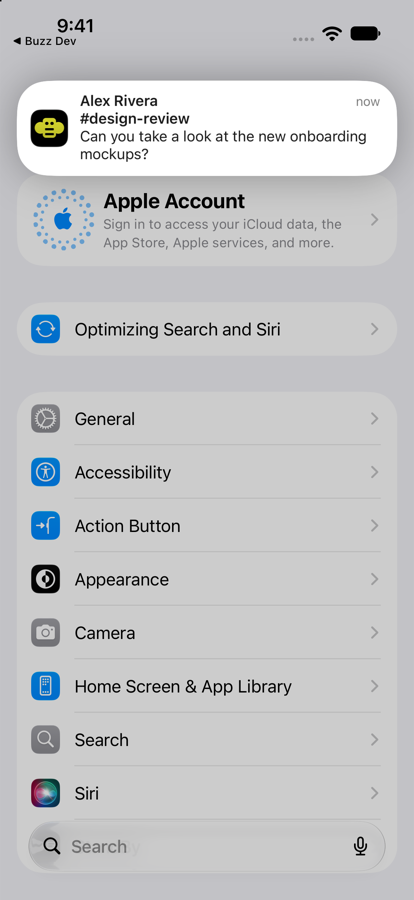
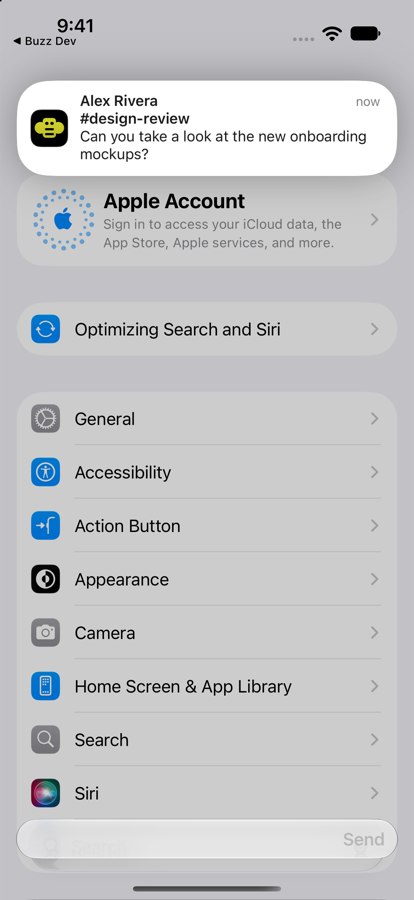
### Before / after
Long-pressing a message notification (synthetic names and text). Before
has no reply field (captured by sending the notification without its new
reply category, which is how main presents it); after shows one with
Send.
| Before | After |
| --- | --- |
|
|
|
### Demo
With the app backgrounded past the relay grace period, replying from the
notification lands the reply in a subthread under the message:
https://github.com/user-attachments/assets/37df7e28-aa46-4521-938e-8af5faa77b83
### Regressions
Nothing existing changes unless the user taps Reply. Notifications gain
a category and a small reply context in `userInfo`; tapping a
notification still opens the conversation as before. The relay reconnect
only happens for a pending reply and then falls back to the normal
background disconnect, so idle background behavior and network use are
unchanged. Reply failures end in a draft and a "Reply not sent"
notification rather than touching other state.
### Validation
- End to end on an iOS 27 simulator against a real community: with the
app backgrounded past the relay grace period, replied from the
notification; the reply appeared in a subthread under the message,
mentioning its sender. The demo above was recorded before the review
fixes (session hold, community fence, origin-community drafts, composer
draft sync); the same run was repeated on the current head,
|
||
|
Tom Brow
|
1059d81fc2 |
fix(ios): end each bold or strikethrough run at its first closing marker (#9559)
Bold and strikethrough runs in iOS push notification bodies now end at their first closing marker, so a message with two bold runs on one line shows both without their markers. Before, the run's optional group was greedy and stretched to the last marker on the line: | Message | Before | After | | --- | --- | --- | | `option **A** or option **B**` | `option A** or option **B` | `option A or option B` | | `~~x~~ and ~~y~~` | `x~~ and ~~y` | `x and y` | | `**😀** and **b**` | `😀** and **b` | `😀 and b` | The fix makes that group lazy (`(?:.*?\S)??`). Found while reviewing the Dart port in [#9556 Dart notification body](https://github.com/block/buzz/pull/9556), which must match these fixtures. That PR takes the same pattern once this one lands. ### Validation - Added tests: three shared rows in `test-fixtures/notification-body.json`, one per row above. All three fail with the old pattern. - All 70 BuzzPushKit tests pass on macOS, including the other 36 fixture rows, which are unchanged. ### Regressions None expected. The pattern still needs non-space characters right inside both markers and still stays on one line. It now stops at the first closing marker where before it reached for the last one. The output changes only where a one-character run is followed by the same marker later on the line, for example `**a** costs 2**3`, which was `a** costs 23` and is now `a costs 2**3`. Worst-case time for unclosed markers is unchanged (measured during review of the Dart port). Signed-off-by: Tom Brow <tomb@squareup.com> Co-authored-by: Tom Brow <tomb@squareup.com> |
||
|
Will Pfleger
|
df21064800 |
feat(auth): tolerate client clocks up to 120 s off (#9485)
Lets clients whose clocks are up to 120 s off sign in to NIP-FI communities and stay connected. **Relay** - NIP-42 AUTH and NIP-98 HTTP Auth accept `created_at` within ±120 s, using a shared `buzz_auth::TIMESTAMP_TOLERANCE_SECS`. This covers relay login, audio admission, bridge, admin, invites, NIP-FI policy and Git. - `DEFAULT_REPLAY_TTL_SECS` goes from 120 to 250 s: a 2 × 120 s window, plus 1 s for the inclusive whole-second bounds, plus a 9 s budget for the clock difference between relay pods. A compile-time assert checks the arithmetic. The 9 s is an operational assumption about NTP-synced pods, and the doc comment says so. No `deploy/` override exists. - Media (kind 24242): - Both modes accept `created_at` up to 120 s in the future and an `expiration` greater than `now − 120`. - Strict: the 120 s age limit and the 60 s lifetime cap. - Permissive: keeps its 3600 s age allowance and has no lifetime cap. - `buzz-auth` and `buzz-media` read the time through a `wall_now()` that tests can pin (a `#[cfg(test)]` thread-local), so boundary tests are exact. - Git transport: comments only. It still reuses one proof per session, so the reuse window now matches ±120 s. **CLI** - The desktop-provider lane asks the desktop app for the assertion every time and keeps no copy, so the desktop's cache owns each token's deadline. It looks the token up again after signing and sends that one, so a provider may hand out a new token on every call. - The direct-mint cache sets its deadline to `min(request_start + (exp − iat), receipt + (exp − local_now))`, on a monotonic clock. `request_start` is when the attempt that got the reply was sent, not the start of the retry loop. - An assertion with no local lifetime left is never returned or sent. The cache asks again, up to 3 times, then fails with an auth error that points at the computer's clock. An assertion without a readable `iat` is refused. `iat` may be fractional (a NumericDate); the lifetime is `max(0, floor(exp − iat))` whole seconds. **Cache reuse (CLI, Flutter, iOS):** each cached token records when it arrived on both the monotonic and the wall clock. It is reused only while `max(monotonic elapsed, wall elapsed)` since arrival is under its budget (`refresh point − receipt`, on the monotonic clock). A negative wall elapsed counts as 0. The monotonic clocks used here stop while the device sleeps, so the wall clock ends reuse after a sleep; setting the wall clock back can't stretch a token, because the monotonic bound still applies. **Mobile** - Flutter `HostedRelayAuth`: the same lifetime rule, on a monotonic clock, for async acquisition and for the synchronous `cachedHeaders` media path. A token with no local lifetime left is never sent: issuance is retried up to 3 times, then fails as `unavailable`. A token without a readable `iat` fails as `invalidResponse`. - Flutter refusal hint: the account client reads `Date` when a 403's headers arrive, before the body (`boundedHttpResponse` gains an `onHeaders` callback). The 403 stays `AccountFailure.denied` even if its body is then lost, late or too large. The hint is stored with the refusal it explains (`HostedRelayAuth.failureClockHint`), cleared when that community next gets a token or the account session changes, and left alone by other communities' issuance. The account client records a 403's hint only for the acquisition whose own request was refused (`BuilderlabAccountClient.observingRefusals`), so an unrelated account call, such as the organization key backup, never supplies a sign-in's hint. When the offset is over 115 s, the reconnect and organization banners add "Your device's clock looks about N minutes off, which can cause this. Check your date and time settings." - iOS `BuzzRelayAssertionIssuer`: the same lifetime rule, on `systemUptime`. An assertion without a readable `iat` is refused. - iOS push enrollment: a new grant's window starts 120 s in the past, so `not_before = now − 120` and `expires_at = now − 120 + lifetime`. A fast phone then neither signs a `not_before` the gateway hasn't reached nor goes over its 30-day maximum. A resumed journal resubmits the installation expiry it already attested, byte for byte. The delegation, which is signed fresh each time, expires at the earlier of that expiry and `not_before + lifetime`, so a journal written by an older client on a fast phone still gets a grant the gateway accepts. The saved grant records the delegation's expiry. - Flutter and iOS already sign a fresh proof with a `nonce` on every issuer attempt, so their retries needed no change. **Specs:** NIP-FA proof bounds (120 s old / 120 s future), plus NIP-FI Git (`±120s`), media freshness, the media read residual and the media trace row. `desktop/` is untouched. Not exercised live: Git clone/push, audio join and push delivery with a skewed client clock. --------- Signed-off-by: Will Pfleger <wpfleger@block.xyz> Signed-off-by: Tom Brow <tomb@squareup.com> Co-authored-by: Hayt <211b96e6a2b7f45fd4047988976c7bbbeeda0c15f3ae7b32eec20834b5a55118@buzz.block.builderlab.xyz> Co-authored-by: Tom Brow <tomb@block.xyz> Co-authored-by: Tom Brow <tomb@squareup.com> |
||
|
Tom Brow
|
2b428f56b8 |
feat(mobile): share into Buzz from the iOS share sheet (#9433)
Lets people share screenshots, screen recordings, photos, URLs and text from any iOS app into Buzz. Today Buzz doesn't appear in the share sheet at all. - **Plain Buzz icon:** opens a new Solo chat with the items in its composer. - **Suggested conversation:** iOS offers channels and DMs the person recently sent top-level messages in. Choosing one opens that conversation with the items in its composer. When the conversation is already open, the share goes to that page's composer instead of opening a second one; if another page covers it, Buzz stays where it is and shows "Go back to that conversation to finish sharing", and the items join the draft when the person goes back. - The share extension has no UI and sends nothing. It copies the items into the app group and opens Buzz, which prefills the normal composer, so drafts, attachments, mentions and failed-send handling all stay the app's (see [the ADR](https://github.com/block/buzz/blob/mobile-share-extension-design/docs/adr/0003-share-hands-off-to-the-conversation.md)). - If the conversation already has a draft, Buzz asks whether to add the shared items to it or replace it. - A share to a conversation that's no longer available (a removed community or channel, or an unreadable share) shows "That conversation isn't available". A share while signed out shows "Sign in to share". Suggestions come from an outgoing `INSendMessageIntent` the app donates after a top-level send or a new Solo chat. The notification extension no longer donates incoming messages, so receiving a message never makes a conversation a suggestion; it still turns the push into a communication notification with the sender's avatar. Both use the same conversation identifier, now the plain community and channel IDs instead of a hash, because the extension needs to hand the identifier back to the app. | Before | After | | --- | --- | | <img alt="Share sheet without Buzz" src="https://github.com/user-attachments/assets/452fac1b-7e87-44c3-a442-099f78d0e07b" width="300"> | <img alt="Share sheet with Buzz" src="https://github.com/user-attachments/assets/54b9775d-29b4-49a5-8ab9-5fda8718a02f" width="300"> | | Buzz icon: new Solo chat | Suggested DM with a draft | After Add | | --- | --- | --- | | <img alt="New Solo chat with the shared photo" src="https://github.com/user-attachments/assets/c5da4d8b-1dd8-4e30-9e92-9dba515b3623" width="250"> | <img alt="Add to your draft prompt" src="https://github.com/user-attachments/assets/2f879f8a-3b9f-48e0-b963-2828e90dc9fe" width="250"> | <img alt="Draft with the shared link and photo added" src="https://github.com/user-attachments/assets/12832006-85c5-4447-98b5-62932552c931" width="250"> | https://github.com/user-attachments/assets/b9d380fa-e802-4ed7-89a8-592a03784c8f ### Regressions - Nothing changes for people who never use the share sheet, except that sending a top-level message or starting a Solo chat now makes one local `INInteraction.donate` call (skipped while the age restriction is on, which still purges every interaction). - Communication notifications look the same. Dropping the incoming donation removes work (and a deletion fence) from the notification extension's time budget. - The share hand-off reuses the existing deep link dispatcher. A share link is a new link type; notification and message links take the same paths as before. ### Validation - Added tests: - Dispatcher hand-off: a share to a suggested channel opens it with the shared text and files; shares to a removed community, an unlisted channel, an unknown manifest version or a missing manifest show the error and delete the pending share; share links accept only the extension's UUID ids. - Composer delivery: with an existing draft, Add appends the shared text on a new line and attaches the file, Replace clears the draft first, and the app group copy is deleted either way. - Notification presenter: specializes the notification from the intent, or falls back to the ordinary content when that throws (replaces the donation and deletion-fence tests). - Full mobile Flutter suite and BuzzPushKit Swift tests pass. - Automated app run on an iPhone 17 Pro simulator (iOS 27, dev relay test community), recorded above: sent a DM, shared a photo from Photos with the Buzz icon from a cold start (new Solo chat with the photo attached), then handed a link and photo to a DM that had a draft and chose Add. Also checked that a share's pending files are deleted after delivery. - Limitation: the iOS simulator never shows share-sheet conversation suggestions (it has no `coreduetd`), so the suggested-DM step in the video is staged by writing the same pending share and link the extension writes. Choosing a real suggestion still needs a check on a device. - Known gaps, all confined to sharing: suggestions have no avatar image yet; a suggestion for a conversation left after signing out shows "isn't available"; choosing Later in the unfinished-chat dialog keeps the share until the next new chat; and a pending share the app never receives (for example when Buzz doesn't open) stays in the app group. ### Before merge - [x] On a real iPhone, choose a suggested conversation in the share sheet and confirm the shared items open in that conversation's composer (the simulator can't show suggestions). Waived before merge: the managed test iPhone shows no share-sheet suggestions for any app, so this will be checked on a personal phone after landing. --------- Signed-off-by: Tom Brow <tomb@squareup.com> Co-authored-by: Tom Brow <tomb@squareup.com> |
||
|
Tom Brow
|
defc2d5ea3 |
fix(mobile/ios): close notification code blocks only at line-ending fences (#9349)
Follow-up to [#9346 notification message text](https://github.com/block/buzz/pull/9346), from [Kyle's review](https://github.com/block/buzz/pull/9346#discussion_r4539634396). A fenced code block that contains three backticks, such as a `"```"` string literal, closed at those backticks. The rest of its code then got the prose rules, so `"**literal**"` lost its asterisks in the notification. A fenced block now closes only at a fence at least as long as its opening fence that ends its line, as in CommonMark and the in-app preview. Along the way, fences the old regex handled loosely are now consistent with the app: a block fenced with four or more backticks keeps its code (and can hold a three-backtick fence), and a block's opening line is dropped as its language even when it contains a backtick. A one-line fenced span (`` ```just ci``` ``) and an unclosed fence running to the end of the text, on one line or several, are unchanged. **What gets better, what doesn't get worse:** code inside a fenced block now shows exactly as written. The change is one regex in the notification body function, and every existing shared case still passes. ### Validation - Added tests: six shared cases in `test-fixtures/notification-body.json`: backticks inside a block don't close it, a closing fence at the end of the last code line closes the block, a four-backtick block keeps its code, a four-backtick block can hold a three-backtick fence, an unclosed one-line fence runs to the end, and an opening line with a backtick is dropped. All 112 BuzzPushKit XCTest cases and the Swift Testing suite pass. - No visible change outside notification text for fenced code, so there are no new screenshots. Human testing is waived; the shared-case run covers the changed behavior. 🤖 Generated with [Claude Code](https://claude.com/claude-code) --------- Signed-off-by: Tom Brow <tomb@squareup.com> Co-authored-by: Tom Brow <tomb@squareup.com> Co-authored-by: Claude Opus 5.5 <noreply@anthropic.com> |
||
|
Tom Brow
|
95dd9d67dd |
feat(mobile/ios): show the message's own text in notifications (#9346)
Expanding a Buzz notification today shows the same stub as the banner: one line of at most 180 characters, with code replaced by `[code]` and links by `[link]`. A long message can only be read by opening the app. The notification body is now the message's own text. It keeps line breaks, the text of code and bare URLs, and drops the Markdown syntax around them (`[text](url)` shows `text`). It is capped at 256 UTF-16 units, which is the most iOS shows even when a notification is expanded. iOS cuts longer bodies mid-word with no ellipsis, so the cap stops at 255 units and adds "…" without splitting a character. A link label, image alt text or bold run may contain code, and a code fence with no closing fence runs to the end of the message. The body is built from at most the first 4096 UTF-16 units of the message, so very long or hostile Markdown stays fast (under 300 ms for a 256 KB message in an optimized build); when that cut drops text, the body also ends with "…". | Before (expanded) | After (expanded) | | --- | --- | | <img width="300" alt="Before" src="https://github.com/user-attachments/assets/7201791f-9556-446a-86d2-a50f024cf9dc"> | <img width="300" alt="After" src="https://github.com/user-attachments/assets/3fa52db8-ebcf-470f-9175-47fe5ef4ed12"> | [ADR 0002](docs/adr/0002-notification-message-text.md) records the rules so other mobile platforms follow them, and the cases in `test-fixtures/notification-body.json` are the contract. The iOS tests run every case, and Android's notification code can run the same file when it lands. **What gets better, what doesn't get worse:** only the body text of message notifications changes. The title, subtitle, grouping, avatars, navigation and dedupe are untouched, and the change lives in one pure function. A notification can now show code and URLs from the message, as the message itself does, and the user's lock-screen preview setting still applies. ### Validation - Added tests: `testPreviewBodyMatchesSharedNotificationBodyCases` runs the 30 shared cases (links, mentions, images, fenced and inline code, code inside link labels and bold runs, Markdown inside code, unclosed and cut fences, whitespace, the cap at 256 and 257 units, emoji and ZWJ sequences at the cap, the 4096-unit input cut). The full BuzzPushKit suite passes: 112 XCTest and 70 Swift Testing tests. - iOS limit measured on an iPhone 17 Pro simulator (iOS 27) with a local notification: the expanded body and its accessibility label both stopped at exactly 256 UTF-16 units (256 ASCII characters, 128 emoji), cut mid-word with no ellipsis. A 40-line body showed about 31 lines. - The screenshots show this function's before and after output for the same message, posted as a local notification. The simulator doesn't run the Notification Service Extension for `simctl push`, so the full push path (relay fetch through to display) was not exercised. An iPad was not measured. - Human testing is waived; the automated run above covered display of the changed body only, since nothing else in the app changes. 🤖 Generated with [Claude Code](https://claude.com/claude-code) --------- Signed-off-by: Tom Brow <tomb@squareup.com> Co-authored-by: Tom Brow <tomb@squareup.com> Co-authored-by: Claude Opus 5.5 <noreply@anthropic.com> |
||
|
Tom Brow
|
58696ff577 |
fix(mobile): show the channel name as the notification subtitle (#9173)
On Apple Watch, a Buzz notification showed the community name ("buzz")
under the sender, taking a line of the small display without saying
where the message came from. iPhone never showed it, because iOS draws
the banner from the communication intent and drops `content.subtitle`.
The Watch renders the plain fields.

The subtitle now carries the conversation name, the same one the intent
uses for its group name:

- Team channels and forums: `#channel`
- Your own Solo chats: the bare name, no `#`
- DMs, and channels not yet in the presentation cache: no subtitle

The name logic moves into one helper so the subtitle and the iPhone
group name can't drift apart. A channel that's known but isn't eligible
for the communication style (for example, an unverified roster) now gets
`#channel` as its plain-banner subtitle in place of the community name.
Losing the community name means the Watch no longer tells communities
apart. That seems like the right trade for most people, who are in one
community.

### Validation

- BuzzPushKit `swift test`: all 110 XCTest and 69 Swift Testing cases
pass. Updated the resolver assertions: `#General` for a cached stream,
both with and without communication styling, and no subtitle for DMs and
uncached channels.
- Not yet exercised on a device or Watch.

🤖 Generated with [Claude Code](https://claude.com/claude-code)

Signed-off-by: Tom Brow <tomb@squareup.com>
Co-authored-by: Tom Brow <tomb@squareup.com>
Co-authored-by: Claude Opus 5.5 <noreply@anthropic.com>
|
||
|
Tom Brow
|
794ee64183 |
fix(ios): mint hosted NIP-FI assertions in the notification extension (#9228)
Share the hosted Builderlab session with the iOS notification extension so it can mint hosted NIP-FI assertions. The extension queries a hosted relay without an assertion first and mints only after a NIP-FI challenge, for a key the account is already bound to. Credential headers never follow redirects, and flag-off builds clear a previously shared session. Signed-off-by: Tom Brow <tomb@squareup.com> Co-Authored-By: Claude Opus 5.5 <noreply@anthropic.com> |
||
|
John Matthew Tennant
|
b894fb02ff |
fix(mobile): show transparent avatars without a black background (#9105)
## Summary Transparent PNG and GIF avatars render on a black background in mobile avatars and iOS notification avatars. Both load the relay's small thumbnail, which was always a JPEG with no alpha channel. [block/buzz#9003](https://github.com/block/buzz/pull/9003) makes relays write a `{sha}.thumb.webp` thumbnail that keeps transparency, alongside the `{sha}.thumb.jpg` that every relay writes. This PR loads the WebP first. - `MediaImage` with `preferThumbnail` tries `.thumb.webp`, then `.thumb.jpg`, then the original. Only a 404 moves on to the next source; any other failure still shows the error widget. Missing thumbnails are remembered as before, so later builds skip straight to the source that exists. - `BuzzNotificationAvatarLoader` follows the same order for notification avatars. Relays without 9003, and images uploaded before it, keep rendering from the JPEG as they do today. ### Screenshots A transparent PNG avatar rendered by `MediaImage` on the same relay, before and after (widget harness on an iOS simulator). | Before | After | | --- | --- | |  |  | ### Related issue AIDA-2308 (internal). The desktop counterpart is [block/buzz-app#2477](https://github.com/block/buzz-app/pull/2477). ### Testing - `missing thumbnails fall back to the JPEG, then the original` (`avatar_image_test.dart`): when the relay 404s every thumbnail, the avatar requests the WebP, then the JPEG, then the original. When the WebP fails with a 500, the avatar shows its fallback and requests neither the JPEG nor the original. - The relay thumbnail journey tests run against a relay that 404s `.thumb.webp`, so they cover the older-relay path end to end. - `BuzzNotificationAvatarLoaderTests` checks the WebP-then-JPEG thumbnail order for relay media, and that non-relay media gets no thumbnails. 🤖 Generated with [Claude Code](https://claude.com/claude-code) Signed-off-by: John Tennant <jtennant@squareup.com> Co-authored-by: Simone <0828be588d5c9c4d092c5b1cf01761d5aef63d6b104807fd8e8284d517dd1a99@buzz.block.builderlab.xyz> Co-authored-by: Claude Opus 5.5 <noreply@anthropic.com> |
||
|
Tom Brow
|
1b9b307176 |
fix(mobile): renew expired assertions for native media and drop retired-session avatars (#9134)
Follow-up to [#9069 media auth](https://github.com/block/buzz/pull/9069), which merged at its approved head. This PR carries the fixes for the last review round on that PR. ### Changes - **Native media reads renew an expired assertion** (Carl's [recommended blocker](https://github.com/block/buzz/pull/9069#discussion_r4485183400)). Voice notes and posterless video previews hand headers to native code. They now use `freshNativeMediaHeadersProvider`, which awaits `HostedRelayAuth.headersForUrl` and so asks for a new assertion once the cached one has expired. Before, while the socket stayed up they sent none and the relay refused the read. If the renewal fails, the read falls back to cached headers and the relay decides. The voice-note player's `headers` callback is now `FutureOr`. Both the iOS authenticated download and the Android native load await it, then recheck their generation, so a cancel during a slow renewal never starts the stale load. - **Notification avatars drop a retired organization session** ([review thread](https://github.com/block/buzz/pull/9069#discussion_r4485125609)). When an avatar download finishes after the organization session that issued its assertion was replaced, BuzzPushKit removes the cached response and refuses the avatar. - **Test:** cached reads never present a signed-out or replaced account's assertion ([optional note](https://github.com/block/buzz/pull/9069#discussion_r4485183412)). Not changed: native reaction-detail avatars still use the cached assertion. After it expires they fall back to initials. ### Validation - Each new test was checked to fail with the code it guards reverted: - `replacedOrganizationSessionRefusesAvatar` (BuzzPushKit): a session replaced mid-download must be refused. - `fresh native media headers renew an expired assertion`: covers renewal and the fallback when renewal fails. - `remote voice notes renew an expired relay assertion`: a journey through `VoiceNoteAttachment`; it fails when the attachment is switched back to the synchronous provider. - `Android defers remote auth until playback starts`: now cancels during a slow renewal and expects no native load. - `an issued assertion serves cached reads for the relay`: now signs out and restores a replacement account. It fails without the account check. - `swift test` (69 tests) passes. The full mobile suite (`just mobile-install mobile-check mobile-test`) passes with these commits on main as of [#9069 media auth](https://github.com/block/buzz/pull/9069). - The automated full-app simulator run from [#9069 media auth](https://github.com/block/buzz/pull/9069) covers the surrounding flows. This change is limited to the header source for voice notes and video previews, and none of the test communities enforce the hosted assertion, so a simulator run would not show the difference. No end-to-end run against a relay that enforces the assertion. 🤖 Generated with [Claude Code](https://claude.com/claude-code) --------- Signed-off-by: Tom Brow <tomb@squareup.com> Co-authored-by: Tom Brow <tomb@squareup.com> Co-authored-by: studio <dc2fc481343672df31a689840c09299972e704dac592e0da6f18486646a7ee3e@buzz.block.builderlab.xyz> Co-authored-by: Claude Opus 5.5 <noreply@anthropic.com> |
||
|
Tom Brow
|
97ede701c0 |
fix(mobile): send hosted relay assertion from native media and tombstone paths (#9069)
Follow-up to https://github.com/block/buzz/pull/9056, from an audit for other places that miss the hosted relay assertion. Hosted and organization relays require `Nostr-Federated-Identity` on every non-exempt HTTP request and WebSocket upgrade. The Dart `HostedRelayHttpClient` adds it, but anything that downloads or connects outside that client has to add it itself. The notification service extension and the iOS emoji picker both missed it, and these places do too: - **Voice notes** (`just_audio`, mainly Android) and **video preview first frames** fetch media natively with only the Blossom `Authorization` header. Both now use `nativeMediaHeadersProvider` from https://github.com/block/buzz/pull/9056. - **Push-lease tombstones**: removing a community, and the durable revocation outbox, open a one-off relay socket with no headers. A hosted relay refuses the upgrade, so the lease is never revoked and the outbox keeps retrying. Both now ask `HostedRelayAuth` for that community's own assertion, because the community being removed may not be the active session. - **Notification avatars** (iOS notification service extension): relay-hosted sender avatars were fetched with Blossom auth only. The loader now takes the same `BuzzRelayAssertionIssuer` the resolver uses for `/query`. Signed requests already refuse redirects. The iOS Me-chat agent picker also fetched avatars with no headers, but https://github.com/block/buzz/pull/9079 removed that native screen, so this PR no longer touches it. ### Validation - Added tests, each checked to fail when the code it guards is reverted: - A queued push-lease revocation and a community-removal tombstone both send `Nostr-Federated-Identity` on the WebSocket upgrade, as background requests. Runs against a local relay socket that handles NIP-42 auth. - A notification avatar on an organization relay is downloaded with the issued assertion (BuzzPushKit). - Issuing for a second community keeps the first one's cached assertion. A background request records no failure, never backs up the key, and its failure never reaches the active community's reconnect waiting on it. - Background issuance never binds an unbound account to its key, bypasses the shared assertion cache (each attempt gets a fresh assertion, and foreground use never inherits one that skipped the key backup), and its failure is never handed to a foreground caller waiting on it. When it can't get an assertion it sends none, so a non-enforcing relay still accepts the tombstone. - A notification avatar whose organization session is replaced mid-download is refused and dropped from the cache (BuzzPushKit). - Voice notes and posterless video previews renew an expired assertion before the native fetch, and fall back to cached headers if renewal fails. A voice-note attachment journey binds the production provider. - Cached reads never present a signed-out or replaced account's assertion. - `flutter analyze` is clean. `swift test` passes for the BuzzPushKit avatar loader tests, and `flutter build ios --simulator --debug` succeeds. - Full mobile suite (`just mobile-check` and `just mobile-test`) passes at 2c84940832. - Automated full-app run on an iOS simulator (debug build of this PR before it was rebuilt on main, signed in to the internal Builderlab community with two more communities saved). Passed: launch and channel list, image attachments and avatars in a channel, New chat sheet kept open for about 80 seconds before the agent list was opened (all agent avatars loaded, so headers are requested per download), dismiss and reopen, background and resume, switching to a second community (its icon and avatars loaded), and removing a community. The native New chat sheet is unreachable in the normal flow on this branch (a new chat opens the Flutter draft page; the native sheet only opens when resuming an unfinished chat), so that check ran with a temporary local bypass that was reverted. Limits: none of these communities requires the hosted relay assertion in this build, so the run shows the Swift-to-Dart header bridge, the per-relay cache and the tombstone path cause no regression, not that the assertion is sent or accepted. No voice note, video preview or deleted message was reachable. Screenshots are omitted because they show internal channel content. - Limitations: no end-to-end run against a hosted relay. Simulator sign-in to a hosted relay needs SSO, so a hosted-relay run needs a device build. 🤖 Generated with [Claude Code](https://claude.com/claude-code) --------- Signed-off-by: Tom Brow <tomb@squareup.com> Co-authored-by: Tom Brow <tomb@squareup.com> Co-authored-by: Claude Opus 5.5 <noreply@anthropic.com> Co-authored-by: studio <dc2fc481343672df31a689840c09299972e704dac592e0da6f18486646a7ee3e@buzz.block.builderlab.xyz> |
||
|
Tom Brow
|
041956ea44 |
fix(ios): saturate the push dedupe cutoff so extreme timestamps can't crash (#9010)
## Context Follow-up to [#8973](https://github.com/block/buzz/pull/8973), from Codex's [review](https://github.com/block/buzz/pull/8973#discussion_r4458876285) of its final head. The push dedupe cutoff subtracts the 15 minute reorder window from the newest shown time. A signed event can carry any `created_at`. One within 900 seconds of `Int.min` made that subtraction overflow and trap, crashing the Notification Service Extension. The claim was never saved, so every later push crashed the same way while the relay kept returning that event. The relay's own drift check normally rejects such timestamps, but the extension shouldn't depend on that. ## Change The cutoff now uses saturating subtraction (`BuzzNotificationCache.presentationCutoff(after:)`), in both the claim check and retention pruning. ## Validation - New test `testExtremeTimestampsDoNotCrashTheClaim` claims messages dated `Int.min`, `Int.min + 1`, now, and `Int.max`. It checks that each behaves like any other message and nothing crashes. With the plain subtraction restored, it crashes with signal 5 (overflow trap). - Full BuzzPushKit suite: 108 XCTest and 66 Swift Testing tests passed. - Automated app test: not run. This is a two-line arithmetic change inside the extension's cache. The live APNs run on [#8973](https://github.com/block/buzz/pull/8973) covers the flow. 🤖 Generated with [Claude Code](https://claude.com/claude-code) Signed-off-by: Tom Brow <tomb@squareup.com> Co-authored-by: Tom Brow <tomb@squareup.com> Co-authored-by: studio <dc2fc481343672df31a689840c09299972e704dac592e0da6f18486646a7ee3e@buzz.block.builderlab.xyz> Co-authored-by: Claude Opus 5.5 <noreply@anthropic.com> |
||
|
Tom Brow
|
bf13f7c83b |
fix(ios): mint NIP-FI assertions in the notification extension (#8982)
Organization relays that enforce NIP-FI (federated identity) require a `Nostr-Federated-Identity` assertion on `/query`. The iOS notification service extension signed its `/query` with NIP-98 only, so the relay answered `401` and every push from an enforcing organization relay showed the generic "You have a new message." body. The app already mints these assertions in Dart from its organization account session, but that session lives in the app's own keychain, and assertions last minutes, so a cached one is useless by the time a push arrives. This change lets the extension mint its own: - **App:** whenever the organization `BuilderlabAccountClient` adopts or clears its session, the app writes or deletes a device-only keychain item in the group it already shares with the extension. The item holds the organization origin, the session credential and the organization's exact relay hosts (from `BUZZ_ORGANIZATION_RELAYS`). Builds without an organization never write it. - **Extension:** for a community whose relay host is one of those exact hosts, `BuzzRelayAssertionIssuer` requests an assertion from the organization issuer (`/api/goose/v1/buzz/identity/assertions`, session credential plus NIP-98 with the community's account key, the same request the app makes), checks it was issued for that key, and caches it in-process until 30 seconds before expiry. Both `/query` paths (message lookup and sender/channel enrichment) send it. Other relays get no header and never see the session. - Signing out awaits removal of the shared copy and fails if removal fails; each restore that finds no session retries the removal. - If issuance fails or the user is signed out, the extension sends the query without the header and the relay refuses it, which keeps today's generic fallback. Not covered here: relay-hosted avatars on enforcing relays still load without the assertion (the notification text and title are unaffected), hosted Builderlab communities, and Android. ### Validation Added tests: - `testOrganizationRelayQueriesCarryMintedAssertion`: against a stub relay that answers `401` without the assertion, two organization pushes resolve with message body and sender name from a single issuance, a non-organization relay gets neither the header nor the session, and after sign-out the notification falls back. Removing the header from the query path makes this test fail. - `testOrganizationAssertionIssuanceFailuresSendNoHeader`: refused, wrong-key, expired and header-injection responses produce no header. Subdomains and other ports of the organization relay host are never sent the session. - `builderlab_account_test.dart`: the shared copy follows exchange, restore and clear; a failed removal fails sign-out, and the next restore retries it. Focused existing validation: the full BuzzPushKit suite, the hosted Dart tests, `flutter analyze`, and an iOS device build of the app and extension. Not yet validated: a live push from the Block relay on a device. ## Before merge Live device push test: waived by Tom (2026-11-03). 🤖 Generated with [Claude Code](https://claude.com/claude-code) --------- Signed-off-by: Tom Brow <tomb@squareup.com> Co-authored-by: Tom Brow <tomb@squareup.com> Co-authored-by: Claude Opus 5.5 <noreply@anthropic.com> |
||
|
Tom Brow
|
7d40a66126 |
fix(ios): stop repeating an old message in push notifications (#8973)
## Context Pushes from the gateway carry no event reference (`crates/buzz-push-gateway/src/model.rs`), so the iOS Notification Service Extension resolves each push by querying the user's NIP-PL lease filters and showing the newest matching message. Any push whose trigger wasn't the newest message (a reaction, an edit or deletion, a community query that failed, or several pushes arriving for one message) showed that same newest message again. Tom saw one message notify four times over three hours. ## Behavior - The extension now remembers which messages it has shown, per community and account, in its existing notification cache (`BuzzNotificationCache`). - Each push shows the newest message not yet shown, across all communities. If every candidate was already shown, it shows the generic "You have a new message." text. - A message more than 15 minutes older than the newest one already shown, in any configured community (including one whose query failed), is treated as already covered. So a stale backlog item can't surface hours later, even from a community where nothing has been shown yet. 15 minutes matches the relay's `created_at` drift bound (`MAX_TIMESTAMP_DRIFT_SECS`), so a sender with a slow clock still gets through. A future-dated `created_at` is capped at the time it was shown, so it can't hold back later messages. - Selection and claim happen in one locked cache call. It reads each community's store once and writes only when it records a claim, so concurrent pushes can't claim against a stale view, and a rejected candidate never rewrites the store. - Retention drops only entries the age check would reject anyway. The rest are capped at the union of the newest 256 by capped time and the newest 256 by `created_at`. So neither a burst of messages nor future-dated entries can evict a message the relay still returns. The field is optional, so existing caches still decode with no version bump. - Only the newest 10 matches per community are fetched, as before. If more than 10 messages arrive before their pushes resolve, the extra pushes show the generic text. - The claim happens before presentation. If presentation then fails, that push shows the generic text and the message isn't offered again, which is better than repeating. - If the cache can't be read, dedupe is skipped (fail open), so new messages are never hidden. If a claim can't be written, the new message is still shown. An already-shown message is still rejected, since rejecting needs no write. A revoked scope is skipped. - Dedupe state lives in the extension's `Caches` directory, which iOS can purge. After a purge, the next push can show the newest message again, once. This is the NSE-only fix. It doesn't change the gateway payload or NIP-PL. ## Validation - New test `testEachPushShowsANewMessageAndNeverRepeatsOne` uses a fresh cache instance per push, to model separate extension processes. It covers: a repeat push giving the generic text; out-of-order resolution (late, then early, then nothing); a stale message outside the window; and the future-date clamp. I checked by mutation that removing any one of the three guards (id check, window, clamp) fails it. - New test `testShownMessagesStayShownAcrossCommunitiesFailuresAndBursts` covers the review findings. It checks that: - an old message isn't shown from a community with nothing shown yet, including when the other community's query fails; - a burst of 100 newer messages doesn't evict a shown mention the relay still returns; - a read-only store neither repeats a shown message nor hides a new one; - a future-dated message isn't shown again after later messages. - New test `testFutureDatedEntriesDoNotEvictAClaimedMessage`: 257 future-dated claims don't evict a just-claimed message. - Mutation checks all fail these tests: a candidate-only watermark, retention by `created_at` only, a 64-entry cap, and pruning by capped time. - Full BuzzPushKit suite on `15913d0`: 106 XCTest and 65 Swift Testing tests passed. - Live relay run (on `baac384`): a scratch test drove the real resolver and cache against a local relay. One key posted messages and another resolved five pushes (not committed): | Push | `main` | This branch | | --- | --- | --- | | 1 (after "Hello 1") | Hello 1 | Hello 1 | | 2 (no new message) | Hello 1 | You have a new message. | | 3 (after "Hello 2", "Hello 3") | Hello 3 | Hello 3 | | 4 (no new message) | Hello 3 | Hello 2 | | 5 (no new message) | Hello 3 | You have a new message. | - Automated app check: built and launched the branch on an iOS 27 simulator. The app started and showed the signed-in home screen. Only the extension uses the changed types. - An independent fresh-context review found no blockers. Its comment suggestions were applied. ### Limitations I couldn't run a real APNs push end to end. Dev-signed builds get no gateway pushes, and `simctl push` on iOS 27 doesn't invoke the Notification Service Extension. The live relay run covers the resolver and cache logic the extension runs. 🤖 Generated with [Claude Code](https://claude.com/claude-code) --------- Signed-off-by: Tom Brow <tomb@squareup.com> Co-authored-by: Tom Brow <tomb@squareup.com> Co-authored-by: studio <dc2fc481343672df31a689840c09299972e704dac592e0da6f18486646a7ee3e@buzz.block.builderlab.xyz> Co-authored-by: Claude Opus 5.5 <noreply@anthropic.com> |
||
|
Tom Brow
|
ff6ab96e42 |
fix(mobile): drop the # from Solo chat names in push notifications (#8955)
## Summary

Push notifications for Solo chats were titled like channels (`#Trip
planning`). The iOS notification extension added `#` to every stream and
forum conversation name, but the app presents Solo chats as personal
chats, not channels.

- `BuzzPushCachedChannel` gains optional `isSolo` and `creatorPubkey`,
derived from relay kind 39000 metadata. `isSolo` uses the same rule as
the app's `Channel.isSolo`: a private stream whose NIP-CL labels (every
`t` after the leading type) include `buzz.solo`. `creatorPubkey` is the
relay-authored `P` tag.
- The resolver uses the bare channel name only for the viewer's own Solo
chats (matching `Channel.isPersonalChat`, which requires `createdBy ==
viewer`). Someone else's Solo chat, and every other channel, keeps
`#name`.
- `isSolo` is optional, so existing App Group caches still decode.
Entries cached before this change have no flag and keep the `#` until
their metadata is refreshed.

## Validation

- `swift test --package-path mobile/ios/BuzzPushKit`: 104 XCTest and 66
Swift Testing tests pass, including two new ones:
- `testOnlyOwnSoloChatConversationNameDropsChannelHash`: a fresh Solo
metadata fetch yields `Trip planning` when the viewer created the chat
and `#Trip planning` when someone else did. Removing the creator check
makes it fail.
- `soloClassification`: only private `stream` channels labelled
`buzz.solo` are marked Solo (open, forum, label-only and unlabelled
private streams are not), and the `P` creator is cached lowercased.
- Live relay check: a local relay with synthetic identities, a Solo chat
("Weekend plans") and a private channel ("design-review"), each with a
second member who posts. The production `BuzzPushNotificationResolver`
(the code the notification extension calls), run against relay-built
kind 39000 metadata, gives:

  | | Solo chat | Channel |
  |---|---|---|
  | main | `#Weekend plans` | `#design-review` |
  | this PR | `Weekend plans` | `#design-review` |

- Not covered: a banner rendered by the notification extension. `simctl
push` delivers to the simulator as a local notification and never
launches the extension, and a real APNs push needs credentials this
machine doesn't have.

## Follow-up after merge

Merging on the live relay check above. Still to do once a dogfood build
includes this change:

- [ ] On-device push check on a BLIMP: a Solo chat push shows the bare
name and a channel push keeps `#name`.
- [ ] Before/after notification screenshots.

🤖 Generated with [Claude Code](https://claude.com/claude-code)

---------

Signed-off-by: Tom Brow <tomb@squareup.com>
Co-authored-by: Tom Brow <tomb@squareup.com>
Co-authored-by: Claude Opus 5.5 <noreply@anthropic.com>
|
||
|
Tom Brow
|
d263e2c7f7 |
fix(mobile): resolve iOS pushes on a fresh connection and retry a stale one (#8722)
## Summary

iOS users were seeing a run of push notifications that just said
"Reconnect to your relay now". That is the push gateway's fixed APNs
body. It shows when the Notification Service Extension (NSE) can't fetch
the message from the relay.

On-device logs from one affected iPhone over a full day showed 12 of 385
NSE runs fail to resolve. Each failed relay `/query`: 10 hit the 8
second timeout and 2 got `NSURLErrorNetworkConnectionLost` (-1005). All
12 ran on a reused pooled connection from `URLSession.shared` in a
long-lived NSE process. That process lived for hours while the network
path changed between VPN and cellular. Of the fresh connections, 0 of
473 failed.

This change:

- Gives each notification its own ephemeral session, so it never
inherits a pooled connection. The session is cancelled when the
extension finishes or expires.
- Retries `/query` once if it times out or loses its connection
mid-request. The retry uses a new session and a freshly signed NIP-98
proof, because the relay rejects a replayed proof. Other failures (HTTP
errors, offline, cancellation) are not retried. The retry is bounded to
one attempt, so the worst case is about 16 seconds, inside the NSE's
roughly 30 second budget.
- Replaces the gateway body with "You have a new message." when the NSE
can't resolve the push. The restricted fallback ("Open Buzz to view this
message.") is unchanged, and so is the gateway payload.

### Related issue

N/A. Reported in Buzz #buzz-mobile.

### Validation

- Added tests in `BuzzPushNotificationResolverTests`:
- A timeout or -1005 is retried once, on a new session and with a
different `Authorization` proof, and resolves.
  - Repeated timeouts stop after 2 attempts.
  - `notConnectedToInternet` is not retried.
- The retry is skipped if the account key changed during the first
attempt.
- `cancel()` (called when the NSE finishes or expires) stops a pending
retry.
- Each new test fails when the behavior it covers is removed: the retry,
the new session, the account recheck, or the cancel guard.
- The full BuzzPushKit `swift test` suite passes.
- A debug simulator build of Runner and the NotificationService
extension succeeded.
- An agent review of the diff found no blockers. Its suggestions to
create the session per `didReceive` and to cancel it on expiry are
included.
- Limitations:
- The NSE target has no unit tests, so the fallback text and the session
lifecycle are covered only by build and review.
- I couldn't send a real push through the NSE. Test phones run a
personal-team bundle that isn't the gateway's APNs topic. In the
simulator, `simctl push` needs notification permission, which the app
only requests after joining a community.
- Under the mobile testing exception, the human-test step does not
apply.

🤖 Generated with [Claude Code](https://claude.com/claude-code)

---------

Signed-off-by: Tom Brow <tomb@squareup.com>
Co-authored-by: Tom Brow <tomb@squareup.com>
Co-authored-by: studio <dc2fc481343672df31a689840c09299972e704dac592e0da6f18486646a7ee3e@localhost>
Co-authored-by: Claude Opus 5.5 <noreply@anthropic.com>
|
||
|
Tom Brow
|
4b21a10c4b |
fix: don't notify workflow owners through their attribution tag (#8694)
A workflow message names its owner in a marked p tag, ["p", owner, "", "owner"], for attribution. #p live, history and push matching, operator listeners, desktop, mobile and the iOS NSE treat that tag as attribution rather than a mention. A workflow that mentions its owner adds a plain p, so the owner is notified only when actually mentioned. NOSTR.md records the #p exception. Co-authored-by: studio <dc2fc481343672df31a689840c09299972e704dac592e0da6f18486646a7ee3e@buzz.block.builderlab.xyz> Signed-off-by: Tom Brow <tomb@squareup.com> |
||
|
Tom Brow
|
b929b2cf84 |
fix(mobile): replace a push enrollment the gateway rejected (#8629)
An iPhone could stop receiving push permanently after the gateway rejected its enrollment, even after a reinstall. Before sending an enrollment, iOS saves the exact signed request in the Keychain and replays those bytes until the gateway answers, so a lost response cannot orphan a committed installation. The saved request was replaced only on `404`. When the gateway rejected it with `401 invalid_attestation` (or `400 invalid_request`), each later attempt replayed the same rejected bytes for the saved request's whole lifetime (up to 30 days). The Keychain survives reinstall, so reinstalling did not help. We saw this on an internal device: in production, its gateway requests failed with repeated `401`s and it never got an installation. The gateway returns `401` before it looks up a committed installation, so replaying the same bytes can never recover one. iOS now replaces a saved request rejected this way with a fresh challenge and App Attest key, once the request is old enough. The first replacement waits an hour, and the wait doubles with each further rejection. Every replacement creates and attests a new key, so without the wait a device the gateway keeps rejecting would create a key on every retry. With it, such a device creates about ten keys over the saved request's 30-day lifetime, yet still recovers on its own once the cause is fixed. Requests saved by earlier builds carry no preparation time and are replaced right away, which recovers devices that are already stuck. Each replacement attempt is saved before any key is generated, and the rejected request stays saved until the fresh request overwrites it. A failed challenge fetch, a failed attestation or an app restart therefore waits instead of creating another key. If the fresh request also fails, the error still propagates and that request is saved for the next attempt. A `404` (the challenge is gone and nothing committed) still replaces right away, as before, so ordinary lost requests recover at once. A `409` or `404` answer to a request marks it as rejected. A conflict with a live installation for the same token consumes the challenge, and a fresh request answered `404` has outlived its own, so either replay then returns `404`. That `404` waits like a rejection, so neither case can create a key on every retry. This covers a request that did commit, whose response was lost and whose replay arrived after its attestation certificate expired. Enrollment then succeeds once the old installation expires. Recovering that installation itself would need the gateway to match an exact replay before checking certificate validity. That is out of scope here. `400` keeps the saved request, as before: it can be a temporary policy rejection (for example a lowered lifetime limit) of a request that did commit. Transient failures (for example `5xx` or network loss) also keep it. Companion gateway PR [#8630](https://github.com/block/buzz/pull/8630) logs which App Attest check rejected a device, so a `401` like this can be diagnosed from gateway logs. ### Validation - Added tests: one table-driven driver test. It loses the first response, then has the replay answered with `400`, `401`, `404` or `503`, at various ages, and the fresh request answered with `201`, `401`, `404` or `409`, or lost. Each row retries twice and checks the saved request and the number of App Attest keys generated. Rows that keep being rejected then check that the wait doubles, and that a replacement whose attestation fails after generating its key records the attempt, so the next retry waits even with a new driver instance. An ordinary `404` replacement whose attestation fails is checked the same way. With the source change reverted, the `401` rows fail. Removing any of these guards also fails the test: the age limit, the doubling, the immediate replacement for older builds' requests, saving each attempt, the `404` and `409` marks, keeping `404` out of the count, or keeping `400`. - The full BuzzPushKit suite passes locally (97 XCTest and 65 Swift Testing tests). - Not exercised on a device. The replay path needs a real device whose saved enrollment the gateway rejects, and the simulator does not support App Attest. 🤖 Generated with [Claude Code](https://claude.com/claude-code) --------- Signed-off-by: Tom Brow <tomb@block.xyz> Co-authored-by: Claude Opus 5.5 <noreply@anthropic.com> |
||
|
Tom Brow
|
73962435b6 |
Use upstream C secp256k1 for native Nostr signatures (#8398)
Replace the Swift secp256k1 wrapper with a small native adapter over Bitcoin Core libsecp256k1. This is an alternative to the wrapper upgrade in [#8381](https://github.com/block/buzz/pull/8381), not an additional change to merge alongside it. The adapter covers the three Nostr operations Buzz needs: x-only public-key derivation, BIP-340 signing, and signature verification. It compiles pinned, unmodified upstream C source through SwiftPM. There is no build plugin, plugin approval script, or underscored Swift import. The app and notification extension use an explicit C module map and header search path. This trades the third-party Swift wrapper for a Buzz-owned adapter and responsibility for updating the vendored C source. Upstream v0.8.0 source, its license, and update provenance are included. The release Xcode pin remains separate in [buzz-releases#110](https://github.com/squareup/buzz-releases/pull/110). ### Validation - Native package tests passed on Xcode 27.0 and 26.5: 96 XCTest tests and 65 Swift Testing tests per toolchain. - Added tests cover the official BIP-340 vectors for 32-byte Nostr messages, invalid secret keys, and malformed input lengths. - Full unsigned Release app and notification extension build passed on exact Xcode 27.0. - Vendored files were compared byte-for-byte with upstream v0.8.0. - Full local `just ci` passed. - [Hosted full unsigned iOS Release build](https://github.com/block/buzz/actions/runs/38924020583/job/117051237094) passed. [Hosted Native Swift validation](https://github.com/block/buzz/actions/runs/38924020583/job/117051237153) passed, including the complete simulator build and native controls/push navigation tests. - Codex code review and security review completed with no findings. ### Before merge - [x] Tom selected the direct-C approach with vendored upstream source; [the wrapper alternative](https://github.com/block/buzz/pull/8381) is closed. Signed-off-by: Tom Brow <tomb@block.xyz> |
||
|
Tom Brow
|
fea02d174d |
fix(ios): fetch profiles and avatars in notification extension (#8369)
A notification can arrive from someone whose profile the main app has never loaded. The iOS notification extension now fetches and caches sender profiles, channel details, and avatars itself. The main app supplies account configuration and Keychain credentials only. After resolving the message, the extension allows 1.5 seconds for sender and channel details. It uses available stale data when a refresh is slow or fails, delivers once, and lets late results update its private cache. Profiles, channel details, and avatar refresh checks share a one-hour freshness threshold. A verified avatar removal clears the previous image. Account removal prevents further use of that sign-in's cached data. Profile, channel metadata, and membership use separate bounded downloads, so an oversized roster cannot discard the smaller records. Sender enrichment can finish while channel requests are pending. A successful partial channel refresh atomically removes its old counterpart, preventing a mixed group identity or recipient count. Group-specific notification presentation still requires a verified recipient count. The [specification](https://github.com/block/buzz/blob/native-notification-enrichment/docs/native-notification-enrichment.md) describes the display, caching, and account-removal behavior. General persistent image caching in Flutter remains separate. ### Validation [Hosted CI](https://github.com/block/buzz/actions/runs/38780108487) passed on the final commit, including all Flutter shards, Android, the full iOS release and simulator builds, and native controls/push-navigation tests. The [current-commit security review](https://github.com/block/buzz/pull/8369#issuecomment-6197508385) found no issues. The native package passed 159 tests, including new coverage for cache freshness, avatar replacement and removal, sign-in isolation, concurrent storage, late results, single delivery, bounded downloads, and SVG validation. A regression test exposed identical HTTP authentication event IDs for requests in the same second; each request now includes a unique nonce, matching the Dart and CLI clients. Full local CI passed before that small authentication fix. The complete native suite and signed device build passed again on the latest commit, including response-size limits, overlapping avatar downloads, canonical relay-origin matching, independent profile/channel refreshes, account-key changes before and during requests, and a single initial snapshot read across 64 accounts, signed IPv6 avatar authorities, and partial channel refreshes. Focused Flutter regression tests passed 198 tests with three configuration-specific skips; seven avatar widget tests also passed. Flutter analysis is clean, and the notification extension builds for the simulator. On an iPhone SE, the notification displayed the sender name, avatar, channel, and message before the updated main app was opened. Repeat notifications used a byte-identical private cache. Three notifications delivered together displayed the avatar after the authentication fix. The next notification also displayed correctly after terminating the extension process. The existing generic-push design can select the same newest unread message for several pushes; this change does not alter message selection. 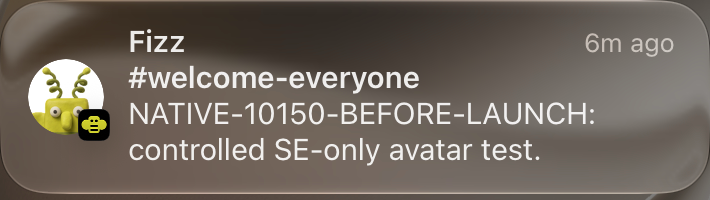 Authenticated HTTP avatar fetching and persistent HTTP cache reuse also passed on the SE. The first notification downloaded a relay thumbnail. After terminating the extension and expiring its separate avatar entry, the next notification displayed the avatar and refreshed that entry without another media request in the relay logs. The main app remained unopened throughout. The original app build and test profile were restored afterward. Automated tests cover slow and failed requests, stale images, removal, and account revocation; those cases have not all been exercised on the phone. ### Before merge - [x] Verify authenticated HTTP avatar fetching and cache reuse on iOS against a working relay media service. <!-- buzz-review-completed --> --------- Signed-off-by: Tom Brow <tomb@block.xyz> |
||
|
Tom Brow
|
8222e99915 |
fix(mobile): keep thread references consistent across push and Inbox (#8332)
Follow-up to [#8294](https://github.com/block/buzz/pull/8294). Malformed trailing thread tags could make a notification open the right thread while Flutter indexed its reply elsewhere; uppercase references could similarly miss lowercase event IDs. Share one validated thread-reference parser between the mobile timeline, Inbox, and feed helper. It ignores malformed markers, keeps the last valid root/reply, and normalizes lookup IDs to lowercase. Native push parsing now uses the same casing. Existing thread fixtures use valid event IDs so they continue exercising real thread relationships. Add RunnerTests coverage for the production native-to-Flutter argument conversion, including buffered cold-start navigation and omitted optional thread IDs, and run it in the native CI lane. ### Validation - New parser and Inbox regressions cover malformed markers and uppercase references. Widget regressions open and highlight the exact reply for valid, uppercase, and trailing-malformed tags. - After integrating [#8106](https://github.com/block/buzz/pull/8106), Flutter analysis and the complete mobile suite pass: 3,337 tests, four existing skips. Integration preserves per-event read predicates and migrates incoming thread fixtures to valid IDs. An unchanged keyboard-history test also failed with main's original parser; recording reads before the scroll transition fixes its timing assumption while retaining visibility assertions. - Native package tests passed (127 tests), and both Runner bridge tests passed on an iOS simulator with Xcode 26.5. Removing the production `threadRootId` assignment made the bridge regression fail; restoring it passed. Native code is unchanged by the main integration. - [Current-head CI passed](https://github.com/block/buzz/actions/runs/38659307247), including Mobile and Mobile Swift. [Codex review](https://github.com/block/buzz/pull/8332#issuecomment-6181458528) and [security review](https://github.com/block/buzz/pull/8332#issuecomment-6181449235) found no issues on the integrated commit. [Owner approval](https://github.com/block/buzz/pull/8332#pullrequestreview-5526812957) covers the exact integrated commit. - Standards and spec reviews found no blockers, including the merge resolutions and test adjustments. Validation is scoped to mobile/native per VISION_MOBILE; unrelated repository-wide checks were stopped, not counted as passing. The bridge test covers serialization and buffering, not end-to-end APNs delivery or app launch. No new physical-device acceptance is claimed; routine post-merge dogfood remains human-owned. --------- Signed-off-by: Tom Brow <tomb@block.xyz> |
||
|
Tom Brow
|
7b9551aba8 |
fix(ios): open push replies in their containing thread (#8294)
Tapping a push notification for a thread reply currently opens the channel at its parent. Preserve the verified event's direct-parent thread ID through the iOS notification payload and Flutter bridge so the tap opens the containing thread and highlights that exact reply, even when newer replies have arrived. This matches Inbox's destination selection for nested replies; broadcast replies still open in the channel. Closest related work: https://github.com/block/buzz/pull/6159 (original push-tap routing). ### Validation - Follow-up [ |
||
|
Tom Brow
|
868e2f8f32 |
refactor(push): one app profile per gateway (#8206)
Buzz push currently selects an application profile, such as `dogfood`, during client registration. We want each gateway to serve one Apple app configured by the operator instead. This removes profile selection from the client, relay, and gateway, while allowing internal and public gateways to use their own Apple identities. This PR implements that model in the Buzz source and upstream deployment chart. Discovery, enrollment, grants, and leases no longer carry an application-profile selector. Each gateway has one configured Apple application and APNs transport. The protocol changes are incompatible with the old registration format, so relays advertise `buzz-push-v1` instead of `nip-pl`. Old clients do not discover the new push capability. Updated clients use separate Keychain records and register again. The [push notes](https://github.com/block/buzz/blob/push-capability-v1/docs/buzz-push.md) describe the experimental contract. Landing this PR is the first step. Publish the matching gateway image and upstream chart, then land the [shared chart update](https://github.com/squareup/cash-helm-charts/pull/5740) and [gateway deployment update](https://github.com/squareup/builderbot-platform-core-infrastructure/pull/1085). Before cutover, stop old gateway instances and check legacy registration state. Migrations refuse to proceed if old gateway installations or active relay leases remain; they do not delete that state. Physical-device verification remains necessary before production activation. ### Validation Gateway and focused Flutter push tests pass, as do the Swift package, simulator build, and native notification/enrichment tests. A local relay advertises `buzz-push-v1` without `nip-pl` or `app_profiles`. The PostgreSQL suite passed 868 tests; its two migration-test failures were corrected and pass a focused rerun together with the gateway cutover guard. Chart rendering and release-contract checks pass. Desktop JavaScript tests, desktop and web builds, native desktop compilation, mobile analysis/tests, and desktop native tests pass. The full Rust unit lane and prescribed `just test` command pass, including workspace integration tests against task-isolated local services. The production overlay now requires an explicitly supplied APNs topic, with omission and rendered-value regression coverage. The corrected Swift checksum assertion passes the complete package suite: 78 XCTest tests and 42 Swift Testing tests. No physical-device enrollment or production cutover is claimed. Local merge validation: the embedded migration test and formatting pass after reserving profile migration 0060 behind rollback migration 0059. The local pre-push Rust lane failed ACP timing/steering tests (`idle_resets_on_stdout_activity`, `keepalive_resets_idle_past_deadline`, and the failed/missing-outcome steering tests). ACP and its dependency manifests are unchanged by this branch; all four pass in an isolated single-thread rerun. The documented local-check exception skips only the Rust pre-push lane for publication; required CI remains mandatory. Mobile and desktop pre-push lanes passed. Combined migration validation: after rollback 0059 landed, the main merge preserves profile migration 0060 and both embedded migration assertions. The focused migration test and formatting pass. The next local push again failed only the unchanged ACP idle/keepalive timing tests (1053 passed, 2 failed, 3 ignored); other lanes passed. Publication uses the same documented local Rust-lane exception; required CI remains mandatory. Follow-up review fix: removed the legacy profile column from the copied-lease fixture. All four event-follow-up contract tests pass on isolated PostgreSQL databases, covering desired and migrated schemas in dual and app-only modes. Formatting passes. Publication retains the prior passing local-lane evidence and uses the authorized pre-push exception for the known unrelated ACP timing failures; required CI remains mandatory. --------- Signed-off-by: Tom Brow <tomb@block.xyz> |
||
|
Tom Brow
|
779af8886c |
fix(mobile): fail open when age checks are unavailable (#7714)
Age-check errors previously blocked Buzz startup. Normal app startup now proceeds immediately; only a valid under-18 response from the current launch request can restrict access. Age check enforcement remains disabled at compile time by default. Builds can opt in with `--dart-define=BUZZ_AGE_GATING_ENABLED=true`. --------- Signed-off-by: Tom Brow <tomb@block.xyz> |
||
|
Tom Brow
|
b8aa0233f9 |
perf(mobile): verify notification cache events in background (#7650)
On iOS, Buzz stores verified profile and channel information for the notification extension. The extension uses this cache to show sender and channel names. Loading profiles or channels also updates the cache. Cache updates currently check event signatures on the UI thread, even when the caller does not wait for the update. This can delay taps and screen updates. This change moves those checks to a background worker. Signature checks, event selection, community boundaries, and the order of native writes are preserved. The worker accepts up to eight batches. When it is busy, later profile requests stay coalesced before fetching; profiles already loaded remain available immediately. Overlapping channel updates trigger a fresh joined-channel cache snapshot after the current export finishes, without delaying or restarting the channel screen. Queue saturation gets up to five retries per operation. Pending updates get their own recovery attempt even if the preceding export fails. Recovery fetches joined-channel data once and retries cache admission without repeating relay reads. It does not fetch the open-channel directory. Verified payloads are split into native-sized writes (256 profiles or 512 paired channels), keeping the same export ordering. Native profile/channel write failures retry the same verified chunk while retaining the export's queue position. All chunks share five retries with 7.75 seconds total backoff; other native errors fail immediately. Terminal failures are recorded, and later successful writes do not hide them. Captured batches keep their original community. Pending channel refetches are retired on a community switch and refreshed when the user returns. The cache remains best effort; prolonged failures can still prevent delivery. Tests through the production APIs reduced UI delay from 27–31 ms to below 0.3 ms for four profiles, and from 59–60 ms to below 0.3 ms for four channel and membership pairs. The native payloads were identical. This does not measure overall screen speed. Validation: 2,225 mobile tests passed (one skipped), along with 18 focused export tests, 12 recovery tests, 39 native Swift tests, 35 focused profile tests, and static analysis. Production regressions cover 13-entity bursts, invalid newer events, community rebuilds, reentrant refreshes, and terminal failures. Regression tests fail when producer recovery controls, terminal-failure draining, or member-only recovery scope are removed. --------- Signed-off-by: Tom Brow <tomb@block.xyz> |
||
|
Tom Brow
|
76f7e5ef0c |
feat(push): make gateway origin configurable (#7261)
Make the push gateway origin configurable across the relay, gateway, mobile client, and deployment chart. This is a fresh deployment. The gateway has only run on personal development infrastructure, and push has no existing enabled users. Legacy migration, configured-to-unconfigured mobile transitions, and rolling upgrades from pre-launch gateway binaries are not supported. Populated pre-launch databases are rejected with an informative error before migrations run; their data is untouched. Mobile builds may omit the gateway URL, leaving push unavailable. Once push is enabled, subsequent builds must retain that configuration. ### Validation - All applicable CI checks pass at `5f546cfaf403f0386f146d213adfb4392f4ec29c`, including Rust, mobile/Swift, desktop/integration, security, image builds, and Helm checks. An unrelated agent cancellation test passed on retry. - PostgreSQL CI passed 384 tests, including the production-entry-point regression for refusing populated pre-launch databases before migrations, fresh initialization, and subsequent initialized deployments. - Focused local validation passed all 10 gateway PostgreSQL tests under the CI discovery filter and all 3 unconfigured-mobile tests. Repository-wide PostgreSQL discovery validation and the complete pre-push hooks passed. - Physical-device APNs/App Attest behavior and deployment to a live cluster were not verified in this work. --------- Signed-off-by: Tom Brow <tomb@block.xyz> Co-authored-by: Codex <noreply@openai.com> |
||
|
Tom Brow
|
f78a32cf03 |
feat(mobile): hard-block under-18 users on the store age signal (#4665)
### What changed? Buzz mobile checks the app-store age signal at launch and hard-blocks the app behind a full-screen 18+ notice when the store says the signed-in person is under 18. No age signal (e.g. declined permission, indeterminate value, unsupported OS versions) results in no block. The age value is never persisted. It is read, used to compute one boolean, and discarded. Nothing is written to disk, and neither the age value nor the range is logged or sent to analytics. Platform notes: - **New dependency `com.google.android.play:age-signals:0.0.4`.** This is the only way to read the Play signal. Its AAR declares `minSdkVersion 23`, below the app's 24, so it forces **no minSdk bump**, and it self-declares its own consent activity, so **no AndroidManifest change** is needed. - **iOS entitlement and linking.** `DeclaredAgeRange` autolinks from the import. `Runner.entitlements` now declares `com.apple.developer.declared-age-range`, and the call remains behind `#available(iOS 26.0, *)`. ### Why? App stores now expose a declared-age range, and Buzz's Terms require users to be 18 or older. This wires the store signal to that rule with the smallest change that is defensible. Absent signals, declined or undeterminable results, and unsupported OS versions allow the app through. A transient native request failure does not become evidence that access is allowed: the app remains gated until a retry produces a result. Only an affirmative under-18 signal produces the permanent restriction screen. ### How is it tested? Added tests: - [`age_signal_provider_test`](https://github.com/block/buzz/tree/main/mobile/test/features/age_gate) covers the 17/18 boundary, open-ended ranges, no-signal, transient recovery, bounded retry exhaustion, malformed payloads, and request-once behavior - [`age_gate_app_test`](https://github.com/block/buzz/tree/main/mobile/test/features/age_gate) proves authenticated content remains unmounted while the signal is pending or retryable, and verifies the retry path - [`age_restriction_page_test`](https://github.com/block/buzz/tree/main/mobile/test/features/age_gate) asserts the block screen offers no bypass affordance - [`community_provider_test`](https://github.com/block/buzz/tree/main/mobile/test/shared/community) verifies age restriction clears push state, persists inactive leases, and retries a failed tombstone - [`AgeSignalPayloadTest`](https://github.com/block/buzz/tree/main/mobile/android/app/src/test/kotlin/xyz/block/buzz/mobile) pins the Android success payload to exactly `{status, ageUpper}` and verifies failures return the distinct retryable platform error ### Deployment note Enable the Declared Age Range capability and regenerate signing profiles carrying the entitlement. This relops/App Store Connect task is not performed by this PR. *🤖 This PR was authored [with an agent](codex://threads/019e5128-536b-73b3-8348-88651123f6da).* | Age restriction screen | | --- | | <img src="https://github.com/user-attachments/assets/5b0f48b1-df9b-4a60-9800-80b33f128535" alt="Age restriction screen" width="320"> | --------- Signed-off-by: Tom Brow <tomb@block.xyz> Co-authored-by: npub12wpjffj7q5qjsky5jvk4ldwlxmse5xll3d8gytk4wqd0c5y7jvwspg37n6 <538324a65e0501285894932d5fb5df36e19a1bff8b4e822ed5701afc509e931d@buzz.block.builderlab.xyz> Co-authored-by: npub1tquskdu6yc4h8l7xxtceculxw600grekeq0xg2ukqfrwl7vrzg3quz3gmp <58390b379a262b73ffc632f19c73e6769ef40f36c81e642b960246eff9831222@buzz.block.builderlab.xyz> Co-authored-by: Codex <noreply@openai.com> |
||
|
Logan Johnson
|
93761e411c |
fix(mobile): render push notification sender identity as npub (#7494)
🤖 ## Summary When an iOS push notification comes from someone the app has no cached name for, the notification title showed the first characters of the sender's raw public key — for example `aa4fc866…`. That fragment is unreadable and doesn't match how the same person appears anywhere else in Buzz. This PR changes that title to the compact form of the sender's npub (npub is the human-readable encoding of a Nostr public key): first 8 and last 4 characters — for example `npub14f8…9nsy`, the same identity shape used across the desktop and mobile apps. - Unnamed senders: raw hex fragment → compact npub. - Named senders: unchanged — a sender the app has a display name for still titles the notification with that name. - Unverifiable sender identities (malformed keys, or lookalike strings that are not literal 64-hex-digit keys) now render a neutral "Someone" instead of partial raw key material. - Everything else about the notification is unchanged: body text, subtitle, thread matching and grouping, deep-link navigation, thread identifiers, and the internal hex public key the resolver matches on. The native iOS notification-service package (`BuzzPushKit`) gains a minimal in-house bech32 codec (bech32 is the checksummed string encoding npubs use) — checksum-validated, 32-byte keys only, and no new external dependency. The hex input branch accepts exactly a 64 ASCII hex digit key before any parsing, so strings that merely parse like hex (for example a run of `+a` pairs) cannot become a displayed identity; this is input validation for presentation. Event signature verification is untouched. ### Related issue Fixes: N/A. Searched existing issues/PRs for push-notification npub identity — closest related: none found. ### Testing At head `3e3f2813b8864b76257ccb50dea3a4b31fa4de0d` (base `44316ff72f5f7de014c66b01cbf534298a70c249`; 4 files, +321/−4): - CI `Mobile Swift` lane, at this exact head — all passed: `swift test` (73 tests, 0 failures), the SwiftPM debug and release builds of `mobile/ios/BuzzPushKit`, and the unsigned iOS release build. - Test coverage: npub encoding cross-checked against independent nostr-rs/NIP-19 vectors; rejection of bad checksums, mixed case, wrong lengths, invalid alphabet, padding, and non-32-byte payloads; resolver boundary matrix — hex/npub/invalid sender keys render compact npub or "Someone" while body, subtitle, sender key, and thread identifier pass through; named senders keep cached display names. ### Task provenance Buzz channel: `1f0e4a3d-7e01-4efe-bb16-843b357f85c9` Task: buzz://message?channel=1f0e4a3d-7e01-4efe-bb16-843b357f85c9&id=86b34eb4bd84a1472419e9af22636c011c0fe273e3c196f967d7a36996e149b6 --------- Signed-off-by: Logan Johnson <loganj@squareup.com> Co-authored-by: Larry <627498bd4bd1f281a16431e3c6cce3b5c25b6692798c78672298aefbf2f8f8b5@buzz.block.builderlab.xyz> |
||
|
Tom Brow
|
c432a111ca |
feat(mobile): push notifications MVP (#6269)
This PR implements MVP, iOS-only,
[NIP-PL](
|