 fa395e9e80
Builderlab agent cards (printed for the event, and generated at the
kiosk) carry a QR to a share page, `app.builderlab.xyz/a/<id>`. Its
**Add to Buzz** button opens `buzz://agent/new?card=<id>`, which no Buzz
client handled until now. This PR makes mobile handle it.

### Behavior

- Opening the link shows the Agents page, then a Create agent form
prefilled from the card. Everything stays editable, and nothing is
created until the user taps Create.
- The app fetches the card's `agent.json` from the avatars CDN for this
build's Builderlab environment (production or staging). The link carries
only the card id, never a host, so the QR stays small no matter how long
a card's instructions get.
- `agent.json` is validated against the card schema. `id` (matching the
link), `name` and `avatarUrl` (an https URL) are required.
`instructions`, `model` and `reasoningEffort` are optional (published
cards don't have them yet) and left for the user when absent. A missing
required field or a wrongly typed known field rejects the card; any
other key is ignored whatever its type, including `v` and `description`
(Buzz agents have no description to prefill), so Builderlab can add
fields without breaking released apps. The model and effort are
preselected only if the live catalog offers them. The card id is opaque:
any non-empty id is accepted and percent-encoded into the URL.
- The fetch uses the same limits as image downloads, now shared in
`bounded_fetch.dart`: aborted after 20 s without a byte or 5 min
overall, and rejected over 2 MB. `MediaImageProvider` now calls the same
helper, with no behavior change.
- The link waits for sign-in, then reloads the registry for the
signed-in account before anything else. It's dropped with a message if
the card is unavailable (403/404), invalid, can't be loaded (any other
response), or an agent setup is unfinished, including a setup saved
before a sign-in the link triggered.
- A link that arrives while Agents shows only its list replaces that
page instead of stacking a second one. If a form or sheet is open there,
the link is dropped with "Finish or close what’s open in Agents, then
reopen the link." and the open work is kept.

### Demo

Simulator (iPhone 17 Pro, debug build of this branch plus the sign-in
fix from [#8914](https://github.com/block/buzz/pull/8914) and the hidden
debug banner from [#8915](https://github.com/block/buzz/pull/8915),
signed in to Builderlab, remote-agent-pilot), recorded in one take with
idle time trimmed: the card's share page in Safari, Add to Buzz, the
prefilled Create agent form, a model, thinking level and instructions,
Create, then a message and the agent's reply.


https://github.com/user-attachments/assets/e66aae17-884a-4e68-a1b8-ecb40562be1d

### Validation

Added tests:
- Table tests for the link shape (only `?card=<id>` with an opaque id;
the inline `#` form, extra parameters and dot segments are rejected) and
for reading `agent.json` (a published card, a card with instructions and
model defaults, unknown keys of any type ignored, including `v`,
`description`, arrays, objects and null, and invalid cards: missing or
mismatched required fields, wrong types, and non-https or relative
avatars).
- Table tests for fetching: the request goes to this build's CDN without
following redirects, with the id percent-encoded as one path segment;
403/404, a redirect, a 500, a network error, declared and streamed
oversize bodies, non-JSON and a JSON array each give a specific message.
The image loader's existing stall, deadline, cap and cancel tests now
cover the shared helper.
- A journey test from link to Create against a fake CDN: prefill and
edit, then submit; an unavailable card; a failed model catalog whose
Retry then preselects the card's model; a Builderlab account change
while the card loads, which drops the draft; a v1 card with no
instructions and an unknown model; an unfinished setup; a link arriving
while a Create form with edits is open, which keeps the form and its
edits; and a link arriving while Agents is open. Disabling the https or
id check makes the table test fail, and removing either the account
recheck or the loaded-catalog check fails the journey. The journey runs
through the production root scope (removing its link handler fails it)
and runs in CI's configured-authentication-domains step.

Full mobile check and test suite pass locally.

Live data: a real staging card's `agent.json`
(`av_MioTAG6dm7q3Zcm0UV2j8A`) has the v1 shape the table test uses, and
an unknown id returns 403 from the CDN.

Live run on an iPhone SE (build of 63ed54c749, Builderlab sign-in
enabled, remote-agent-pilot, signed in as builderlab@tombrow.com) with a
real production card,
[ToastyMacbeth](https://app.builderlab.xyz/a/av_lrmRlJR6ylrQKvJkoLWCOQ)
(a v1 card with no instructions and an extra `description` key):
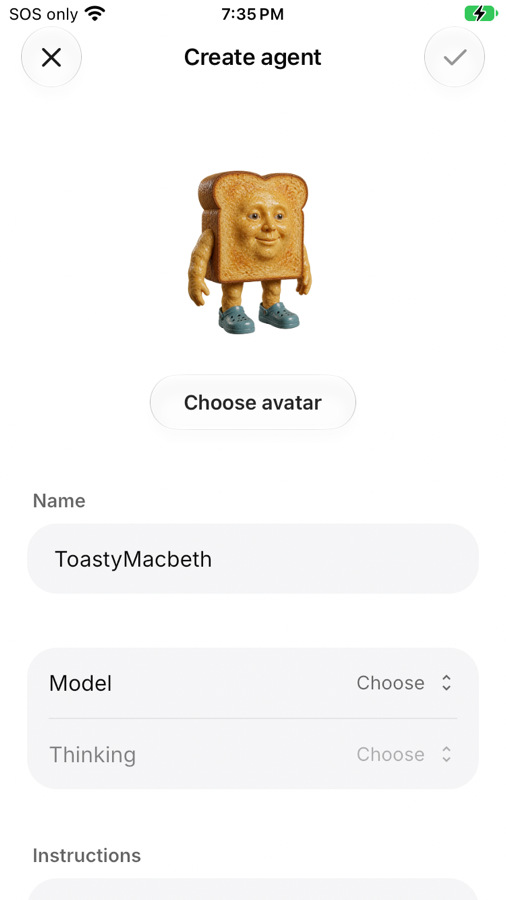
- Opening `buzz://agent/new?card=av_lrmRlJR6ylrQKvJkoLWCOQ` from a cold
start opens Create agent prefilled with the card's name and avatar.
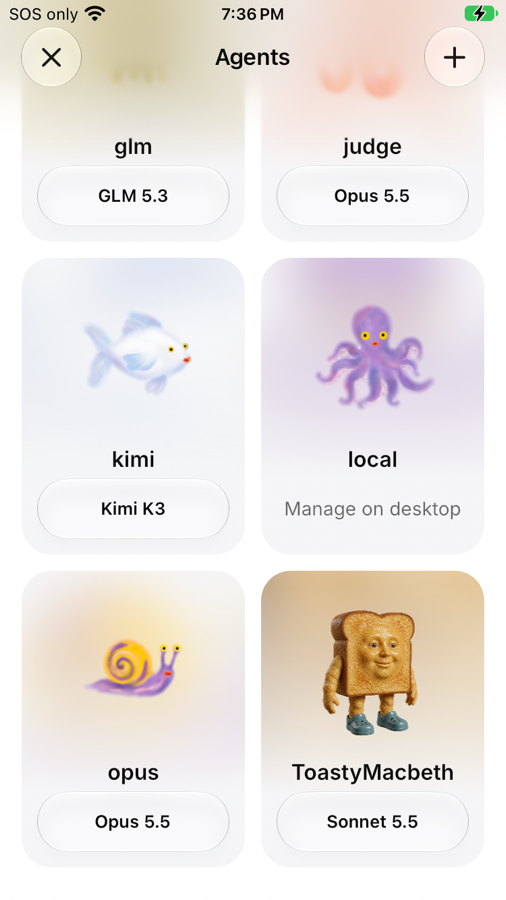
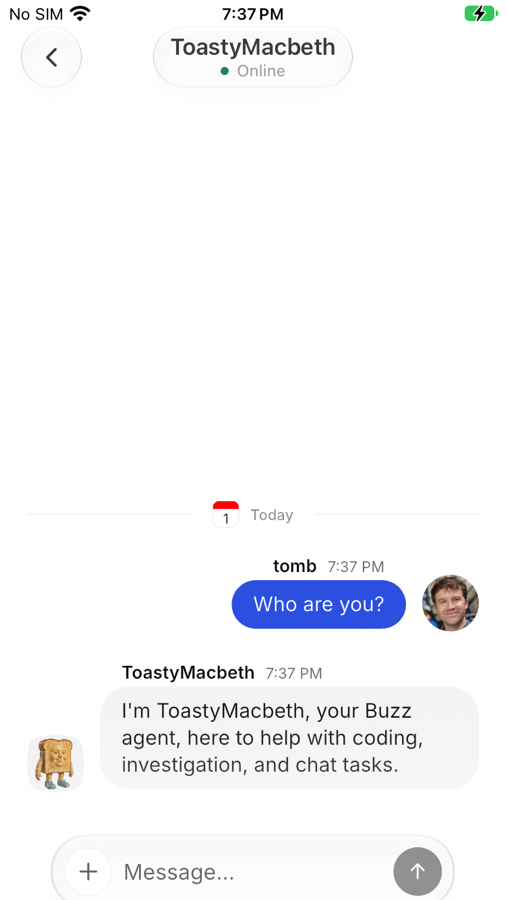
- After choosing a model and adding instructions, Create adds the agent
with the card avatar, and it replies in a DM.
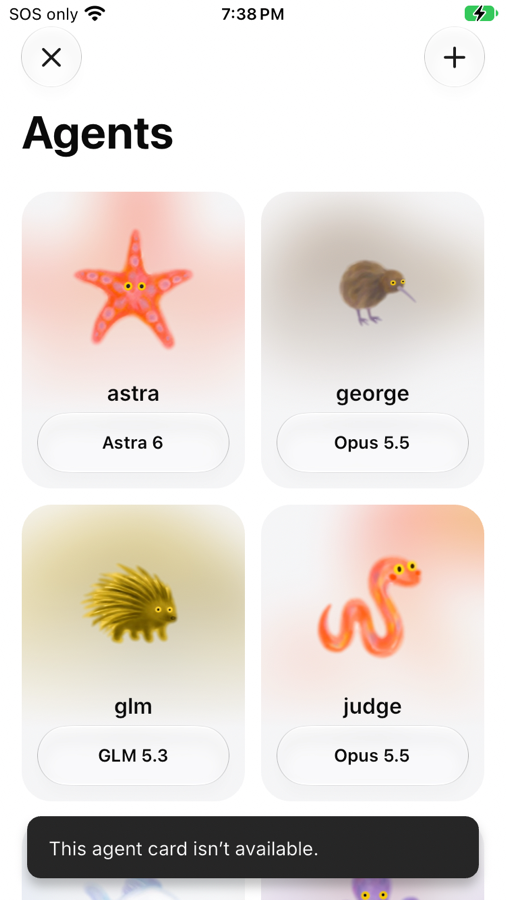
- An unknown card id shows "This agent card isn’t available."

| Prefilled | Created | Reply | Unknown card |
| --- | --- | --- | --- |
| <img
src="https://raw.githubusercontent.com/block/buzz/b9222db494758c3e536b8e2011032ba7cec86daa/pr-8912--01-prefilled.png"
width="200"> | <img
src="https://raw.githubusercontent.com/block/buzz/b9222db494758c3e536b8e2011032ba7cec86daa/pr-8912--02-created.png"
width="200"> | <img
src="https://raw.githubusercontent.com/block/buzz/b9222db494758c3e536b8e2011032ba7cec86daa/pr-8912--03-reply.png"
width="200"> | <img
src="https://raw.githubusercontent.com/block/buzz/b9222db494758c3e536b8e2011032ba7cec86daa/pr-8912--04-unavailable.png"
width="200"> |

Before this PR, the app had no handler for `buzz://agent/new`, so the
link did nothing.

A separate widget test covers a link that needs Builderlab sign-in
first: once sign-in lands, a setup saved for that account blocks the
card, which is never fetched. Removing the registry reload fails it, as
does removing the busy-Agents guard for the journey step above.

### Before merge

- [x] Human live check waived under the repository owner's standing
testing exception. In its place, agent-driven full-app runs exercised
the flow end to end: the iPhone SE device run and the simulator demo
above (a real card's share page, **Add to Buzz**, the prefilled form,
Create and a reply from the agent). Limitation: those runs predate
[638f5ecac7](638f5ecac7),
whose two guards are covered by the widget tests above rather than a
live run.

🤖 Generated with [Claude Code](https://claude.com/claude-code)

---------

Signed-off-by: Tom Brow <tomb@squareup.com>
Co-authored-by: Tom Brow <tomb@squareup.com>
Co-authored-by: studio <dc2fc481343672df31a689840c09299972e704dac592e0da6f18486646a7ee3e@buzz.block.builderlab.xyz>
Co-authored-by: Claude Opus 5.5 <noreply@anthropic.com>
Buzz Mobile
Flutter mobile client for Buzz.
See VISION_MOBILE.md for intended behavior and architecture.
Optional Builderlab login
BUZZ_AUTH_DOMAINS is a comma-separated build-time environment setting, passed
with Flutter's --dart-define (shell environment variables alone are not read):
flutter run --dart-define=BUZZ_AUTH_DOMAINS=communities.buzz.xyz,communities.public.builderlabstaging.xyz
Unset or empty means Builderlab features are disabled: no account login, community creation, backup/recovery UI, reconnect prompts, or background account restoration. QR/code pairing, community links and invites use Nostr-only entry. Saved account keys and sessions are retained for a later enabled build.
A nonempty list enables Builderlab features and requires account setup only for
matching domains. Those features need their backend endpoints. Normal relay key
authentication remains in place. BUZZ_BUILDERLAB_URL selects the backend; setting
it alone does not enable Builderlab features.
Entries match the domain itself and its subdomains, case-insensitively. Use DNS
names, not URLs or wildcards. The list does not add trusted account servers:
configured domains outside the supported Builderlab realm cannot use hosted
setup. BUZZ_BUILDERLAB_URL still selects the trusted account environment.
Agent creation links
buzz://agent/new?card=<id> opens the Agents page and an editable, pre-filled
Create agent form for the active community. Opening a link never creates an
agent. A Builderlab agent card's QR leads to its share page
(app.builderlab.xyz/a/<id>), whose Add to Buzz button opens this link.
The app fetches <avatars CDN>/<id>/agent.json from the CDN for this build's
Builderlab environment (HostedEnvironment.avatarsCdnOrigin), never from a
host named by the link. The link carries only the id, so the QR stays small
however long the instructions are.
{
  "id": "<id>",
  "name": "Scout",
  "avatarUrl": "https://<avatars CDN>/<id>/<revision>/avatar.png",
  "instructions": "Reply concisely.",
  "model": "<model catalog id>",
  "reasoningEffort": "high"
}
id(the link's card id),nameandavatarUrl(anhttpsURL) are required.instructions,modelandreasoningEffortare optional and left for the user when absent. A missing required field or a known field of the wrong type makes the card invalid, and no form opens. Other keys, includingvanddescription, are ignored whatever their type. The card id is opaque to the app.- Prefilled values are only a draft: Create applies its usual rules, so a name outside 1 to 64 letters, numbers, spaces, dots, hyphens or underscores, or instructions over 20,000 characters, must be edited before Create succeeds.
- The fetch shares the image loader's limits (
lib/shared/utils/bounded_fetch.dart): it is aborted after 20 seconds without a byte or 5 minutes overall, and a card over 2 MB is rejected. modelandreasoningEffortare pre-selected only if the live model catalog offers them (the effort only for that model).- The link waits for sign-in and community load. It needs Builderlab login and a hosted community that supports remote agents. It reloads the signed-in account's agents first, and is dropped with a message if an unfinished agent setup exists (resume or discard that first) or the card can't be loaded.
- A link that arrives while Agents is open replaces it only when the list is all that's showing. With a form, profile or dialog open, the link is dropped with a message so unfinished work is kept.
The parser is lib/shared/deeplink/agent_creation_link.dart; the card reader
is lib/features/agents/agent_creation_draft.dart.
Hosted relay authentication
--dart-define=BUZZ_HOSTED_RELAY_AUTH=true enables Builderlab relay assertions
and reconnect sign-in only for BUZZ_AUTH_DOMAINS matches. It defaults off: configure backend assertion issuance
before enabling mobile authentication, and enable relay enforcement last.
Setup
Use the Flutter SDK pinned by the repository. Activate Hermit from the repo root before resolving packages or running any Flutter command:
cd /path/to/buzz
. ./bin/activate-hermit
./bin/just mobile-install
mobile-build-android intentionally builds with --no-pub. If an IDE or an
external Flutter SDK has touched mobile/.dart_tool, rerun mobile-install
with the pinned SDK before building so flutter_test, sky_engine, and the
engine all come from the same Flutter version.
iOS toolchain
Use Xcode 27.0 for iOS development and build validation on an Apple silicon Mac running macOS Tahoe 26.6 or later, as required by the Xcode 27 release notes. On Intel Macs or hosts that cannot meet those requirements, use a compatible Xcode 26 version, which remains supported. Activate the repository's pinned Flutter SDK with Hermit as described above.
When multiple Xcode versions are installed, select the intended version for
the command with DEVELOPER_DIR, for example:
DEVELOPER_DIR=/Applications/Xcode-27.0.0.app/Contents/Developer xcodebuild -version
Adjust the path to your installation. Keep the compiler and SDK from the same
Xcode installation. The pinned Flutter native-assets tooling can discover the
globally selected SDK even when DEVELOPER_DIR selects another compiler, so
use a build machine with a matching default Xcode when validating either
Xcode 26 or Xcode 27.
The native cryptography dependency is pinned upstream C source in
ios/BuzzPushKit/Sources/CSecp256k1; it requires no Swift build-plugin approval.
GitHub's mobile CI currently uses the Xcode default of its macos-latest
runner. The internal release toolchain is configured separately in
buzz-releases.
Run
# From repo root (applies a worktree-isolated debug identity and starts/reuses Simulator):
just mobile-dev

# Direct (uses the app's configured community; apply worktree overrides first):
cd mobile && flutter run --dart-define=BUZZ_PUSH_GATEWAY_URL=https://push.example
Worktree-aware debug identity
Debug builds produced from a git worktree get a unique app identifier keyed
to the worktree directory name
(xyz.block.buzz.dev.mobile.<slug> on iOS,
xyz.block.buzz.mobile.<slug> on Android) plus a display-only branch label
in the app name (Buzz (my-branch), or a short SHA when the worktree is
detached). Because the identifier follows the directory rather than the
branch, one worktree keeps exactly one installed app — and its login state —
across branch switches, and builds from multiple worktrees install side by
side, mirroring the desktop dev experience. Release and profile builds
always keep the production identity and name.
just mobile-dev and just mobile-build-android apply this automatically by
running scripts/mobile-worktree-overrides.sh, which writes two gitignored
files:
mobile/ios/Flutter/WorktreeOverrides.xcconfig(included by Debug builds only; a developer'sAppOverrides.xcconfigis included after it, so app-specific overrides like a personalBUNDLE_IDENTIFIERfor device signing always win)mobile/android/worktree.properties(read by the debug build type only)
Android developers can keep a stable local test identity that takes precedence
over the generated worktree values by creating the gitignored
mobile/android/AppOverrides.properties:
appName=Buzz Pairing
applicationIdSuffix=.device_pairing_e2e1
These values are consumed by the debug build type only. The standard
just mobile-build-android command can still be used; regenerating
worktree.properties does not overwrite AppOverrides.properties. Release
and profile builds keep the production Buzz name and application ID.
For direct Xcode / Android Studio / flutter run development, run
./scripts/mobile-worktree-overrides.sh from the repo root once per branch
switch to refresh the display label (the install identity never changes);
the persisted files are then picked up by any subsequent build. In the main
checkout the script is a no-op that removes stale override files, restoring
the plain Buzz identity. To enable push in direct Xcode builds and Runner tests, supply a
BUZZ_PUSH_GATEWAY_URL build setting in the gitignored
mobile/ios/Flutter/AppOverrides.xcconfig; the build phase validates and
passes it through as a Flutter Dart define. Since // begins an xcconfig
comment, spell the origin as BUZZ_PUSH_GATEWAY_URL = https:/$()/push.example.
For an Android debug build that must remain installed alongside other Buzz worktree builds, set an explicit launcher name and package suffix when invoking the generator or a recipe that invokes it:
BUZZ_PUSH_GATEWAY_URL="https://push.example" \
BUZZ_ANDROID_DEBUG_APP_NAME="Buzz Huddles" \
BUZZ_ANDROID_DEBUG_ID_SUFFIX=".huddles_829c" \
./bin/just mobile-build-android
This example produces the debug-only package
xyz.block.buzz.mobile.huddles_829c with the launcher label Buzz Huddles.
The suffix must start with a dot followed by a lowercase letter and may contain
only lowercase letters, digits, and underscores. Release and profile builds
ignore these overrides and retain the production package and name.
To remove leftover worktree-suffixed installs from booted iOS simulators and
connected Android emulators, run just mobile-clean (add --dry-run via
./scripts/mobile-worktree-clean.sh --dry-run to preview). Production
installs are never touched.
iOS push capability
Every iOS artifact builds and embeds the Notification Service Extension and
native push bridge. Runtime activation is fail-closed and scoped to the current
relay. After authenticated connectivity and a fully valid NIP-11 buzz-push-v1 push
descriptor, Buzz independently requests display permission and registers with
APNs. Display denial or request failure does not gate the device token, gateway
enrollment, or lease publication, so a later user opt-in can display pushes
without rebuilding transport authority. An absent, malformed, or unreachable
descriptor leaves push inactive without partial enrollment.
Mobile builds without a gateway origin succeed with push unavailable. To enable push, supply the gateway origin explicitly:
flutter build ios --dart-define=BUZZ_PUSH_GATEWAY_URL=https://push.example
flutter build apk --dart-define=BUZZ_PUSH_GATEWAY_URL=https://push.example
The iOS and Android build gates validate any supplied define, rejecting empty or malformed values. Release/profile builds require an HTTPS origin without an explicit port. An absent define disables permission requests, APNs registration, gateway enrollment, and lease publication; Settings shows push as unavailable. No production gateway is selected implicitly. Enrollment grants and crash-recovery journals are scoped to this origin. Push has not shipped to existing users, so there is no legacy-state or cross-gateway migration. Changing gateways requires fresh enrollment; old installations expire under their original gateway's lease policy. Current-gateway response loss is still retried from the exact journaled request.
Relay rollout remains an explicit deployment opt-in. Only deployments with
BUZZ_PUSH_ENABLED=true advertise the descriptor and process push. See
docs/push-gateway-deployment.md for the canonical gateway profile contract,
manual physical-device proof, measurements, and rollback procedure.
For local physical-device development, override the identity and sandbox
environments in the gitignored mobile/ios/Flutter/AppOverrides.xcconfig:
BUNDLE_IDENTIFIER = com.example.buzz.mobile
BUZZ_DEVELOPMENT_TEAM = YOUR_TEAM_ID
BUZZ_IOS_PUSH_ENVIRONMENT = development
BUZZ_APP_ATTEST_ENVIRONMENT = development
BUZZ_PUSH_GATEWAY_URL = https:/$()/push.example
Use your personal bundle ID and team above. Provision both the parent and its
.NotificationService extension. Configure an isolated gateway with the matching
App Attest application ID, APNs topic and sandbox certificate. Development
attestation requires the explicit personal-dev-app-attest gateway build feature
and BUZZ_PUSH_APP_ATTEST_ENVIRONMENT=development; ordinary gateway builds accept
production attestation only. See docs/push-gateway-deployment.md.
Validate distributed builds separately using a signed release candidate and
its matching gateway configuration.
Parent app identifiers require Apple's Communication Notifications capability and a regenerated app provisioning profile. The Notification Service Extension profile does not require that capability. Enable it on the personal development App ID for local rich-presentation validation. Enabling it on distribution App IDs is a release follow-up and is not performed by this repository change. Without a matching parent profile, source and unit validation still work, but the app cannot be signed for a physical device.
APNs and the gateway continue to carry only the constant opaque wake-up. The extension fetches the message from the scoped relay, verifies message, sender profile, and channel-metadata signatures, and uses a bounded App Group cache for names and app-rendered avatar thumbnails. It never fetches an avatar URL; missing, stale, or invalid enrichment falls back to the verified message with a short sender pubkey, community subtitle, and no image.
Checks
dart format --output=none --set-exit-if-changed .
flutter analyze
flutter test --dart-define=BUZZ_PUSH_GATEWAY_URL=https://push.example
Or from the repo root: just mobile-check and just mobile-test.
When writing tests, favor a few journey tests that drive real user flows over many small logic tests. See Testing Conventions.
Android release signing
Android release builds fail unless all upload-key inputs are supplied through the environment:
BUZZ_ANDROID_UPLOAD_KEYSTORE_PATH: path to a CI-vended keystore fileBUZZ_ANDROID_UPLOAD_KEYSTORE_PASSWORDBUZZ_ANDROID_UPLOAD_KEY_ALIASBUZZ_ANDROID_UPLOAD_KEY_PASSWORD
The keystore path must be absolute, and the keystore must remain outside the repository. Development and debug builds do not require these variables.
Release pipelines that sign through the central APK Signer service instead of
a local upload keystore must set BUZZ_ANDROID_RELEASE_SIGNING=external. That
mode produces an unsigned release bundle and refuses to run if any
BUZZ_ANDROID_UPLOAD_* value is also set.
Architecture
lib/
├── main.dart              # Entry point, Riverpod bootstrap
├── app.dart               # MaterialApp with theme
├── shared/
│   └── theme/             # Catppuccin light/dark, spacing tokens, extensions
└── features/
    └── home/              # Placeholder home surface
- State management: Riverpod + Hooks (
HookConsumerWidget) - Theme: Catppuccin Latte (light) / Macchiato (dark) — matches desktop
- Spacing:
Gridtokens for consistent spacing - Linting:
flutter_lints+riverpod_lintviacustom_lint - Feature isolation: No cross-feature imports except
shared/