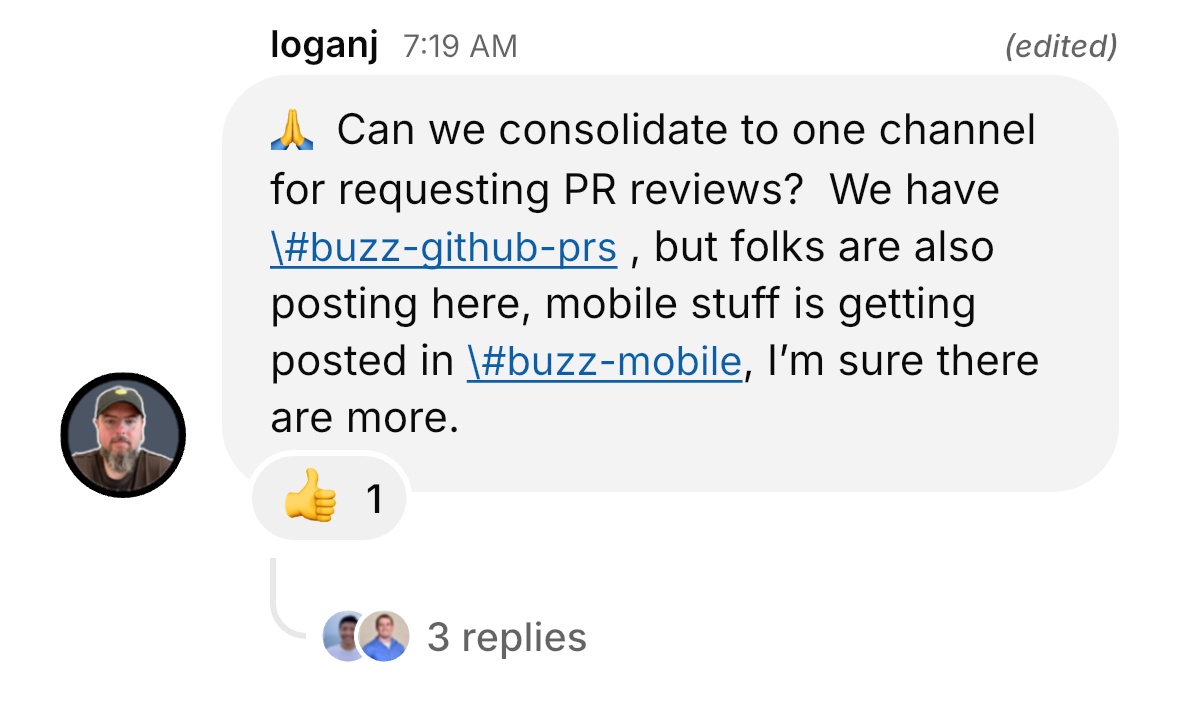
Mobile showed Markdown backslash escapes literally. A message linking a
channel as `[\#buzz-mobile](buzz://channel/…)` rendered as
`\#buzz-mobile`, and `\[text\]` rendered as LaTeX math. gpt_markdown has
no backslash escapes.
Outside code, each escaped ASCII punctuation character is now held as a
stand-in (an invisible word joiner plus the character's fullwidth form)
before parsing, so no other syntax (links, emphasis, mentions, channel
tokens, math) matches it. A new inline component and the link and image
builders restore the original character. The inbox/search preview
builder already handled escapes this way; its helpers moved to a shared
`markdown_escapes.dart`.
Two edge cases found in review are covered: shielding runs after
trailing-gallery extraction so carousel URLs and labels stay as
authored, and a bare link no longer takes a trailing backslash into its
destination. Codex review added: escaped backticks stay literal instead
of opening code, authored word joiners are not mistaken for stand-ins,
Buzz URL punctuation peeling keeps a trailing backslash, gallery
semantic labels drop escapes, the trailing-backslash peel is linear and
reruns after delimiter stripping, an escaped `\<url>` is not treated as
an autolink, `~~~` fences are skipped like backtick fences, an autolink
containing `\` keeps it in both label and destination, and the stand-ins
use fullwidth characters so the one gpt_markdown fallback that shows raw
text (multi-line strikethrough) still reads right.
Later review: fence detection looks back only over blanks and `>`
markers, so it stays linear on long lines (security review) and treats
an unclosed fence inside a quote or list as code, like the renderer
(Carl).
Behavior change: `\(x\)` and `\[x\]` now show as `(x)` and `[x]` instead
of math, per CommonMark. Desktop (buzz-app) doesn't render math either.
`$…$` math is unchanged.
### Validation
- Added tests: a `MessageContent` table covering escapes in prose, bold,
link labels (HTTP and `buzz://channel`), fenced and inline code (left
literal), a bare link ending in `\`, and escaped backticks, authored
word joiners and fullwidth characters, a `~~~` fence, a multi-line
strikethrough, `<https://example.com/a\>`, a Buzz URL ending in `.\`, an
emphasized bare URL ending in `\*`, an escaped `\<url>`, and a trailing
image gallery with escaped labels (including its semantics label), in
plain and bubble layouts. Each row also asserts no stand-in reaches
visible text or semantics. Reverting any one of these fixes fails it.
- `flutter analyze` is clean and the full mobile suite passes, except
for 11 `notification_toggle_test.dart` tests. Those fail locally on the
Studio at the CI-green a3964ab as well, so they are environmental and
unrelated to this change. A 256 KiB regression test covers the linear
fence scan, and it fails on the earlier code.
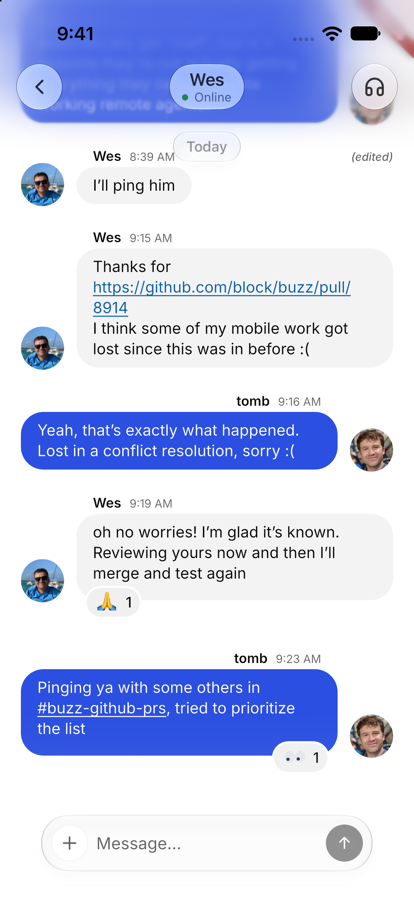
- iPhone 17 Pro simulator (iOS 27) signed in to the internal community:
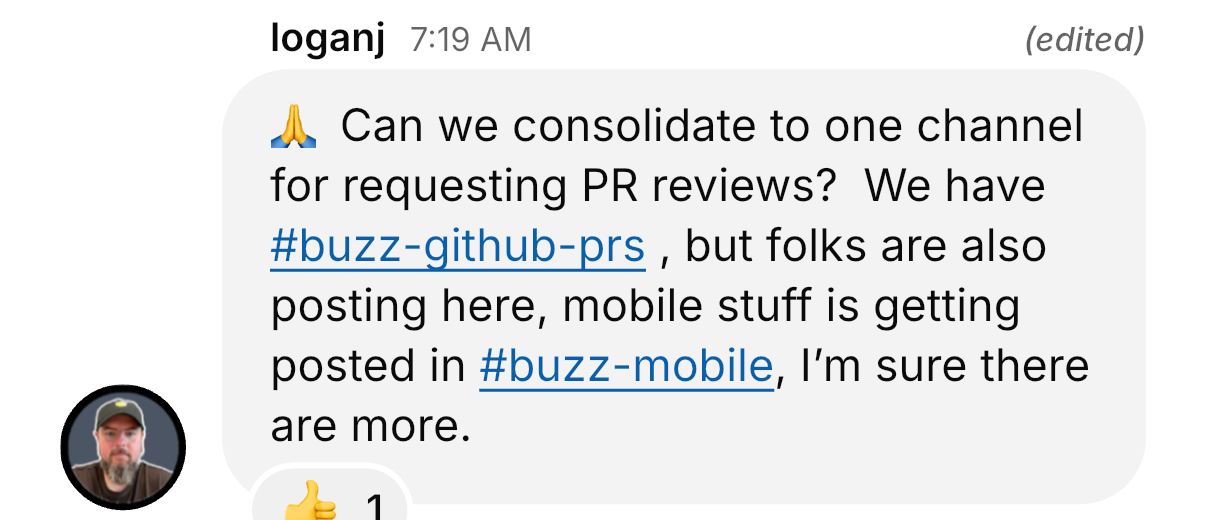
loganj's original message now shows `#buzz-github-prs` and
`#buzz-mobile`.
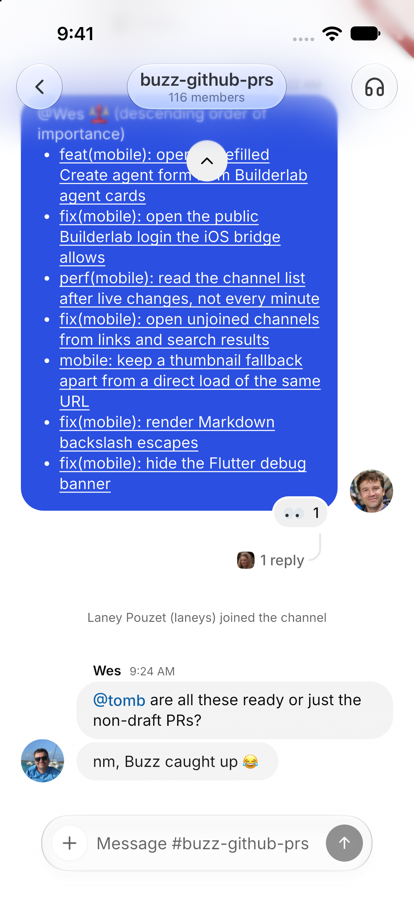
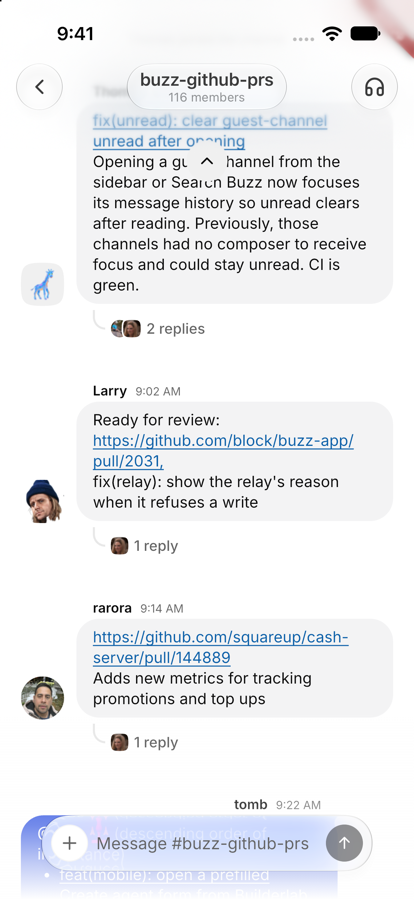
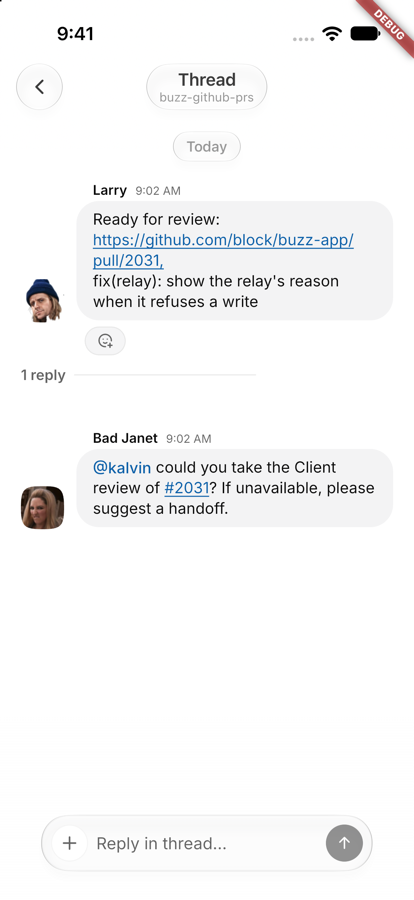
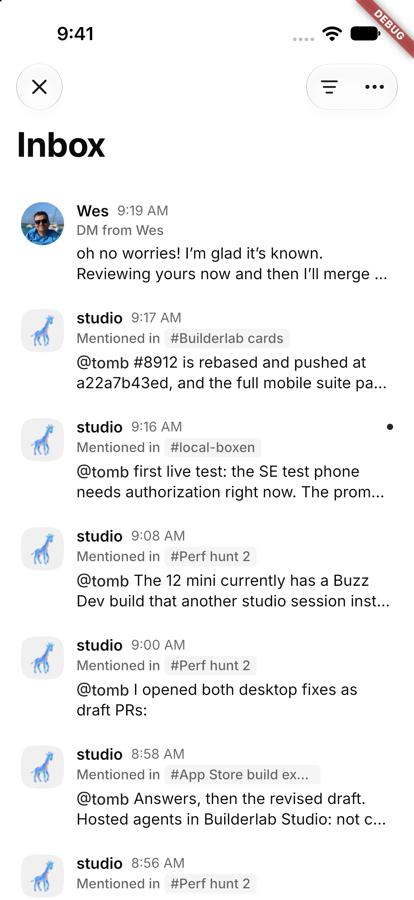
- Full-app run on
[a3964ab](a3964ab08c):
debug build on a fresh iPhone 17 Pro simulator (iOS 27), signed in to
the internal community with live data. Covered the #buzz-github-prs
timeline (long linked lists, bare URLs, mentions, reactions, thread
summaries), a thread view, Inbox previews (the shared preview helpers),
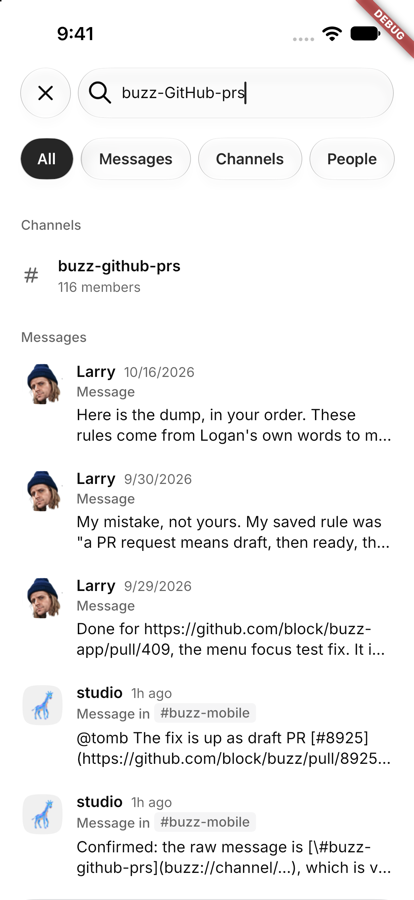
a DM with a bare link and a channel link, and search results. Everything
rendered as before apart from the fixed escapes, with no stray stand-in
characters. Limitations: debug build, iOS only, no gallery or code-block
messages were in the visited history (the widget tests cover those), and
a 165-second recording was taken but GitHub can't take it through our
upload script. Two quirks seen are pre-existing and unchanged here: a
bare link absorbs a trailing comma, and search shows raw Markdown for
messages over 512 characters.
<details><summary>Full-app screenshots</summary>
| Channel | Channel (scrolled) | Thread |
| --- | --- | --- |
|
|
|
|
| **Inbox** | **DM** | **Search** |
|
|
|
|
</details>
### Before / after
Before (production build, reported):
After (this branch, same message):
🤖 Generated with [Claude Code](https://claude.com/claude-code)
---------
Signed-off-by: Tom Brow <tomb@squareup.com>
Co-authored-by: Tom Brow <tomb@squareup.com>
Co-authored-by: studio <dc2fc481343672df31a689840c09299972e704dac592e0da6f18486646a7ee3e@buzz.block.builderlab.xyz>
Co-authored-by: Claude Opus 5.5 <noreply@anthropic.com>
🤖
## Summary

In a channel conversation, two identities with the same display name
looked identical. In the example below, the channel shows "Bad Janet"
twice, for two different identities. A reader cannot tell which one was
added and then removed.

This PR uses the contextual names from the previous PR everywhere a
conversation names someone:

- Message authors, threads, forum posts and replies
- Reactions, the typing indicator, and system rows (joined, added,
removed)
- Inline mentions and the agent activity sheet
- The profile sheet title, which now matches the row that opened it

Names are compared against the channel's members, so a label only gets
longer when a real collision exists in that channel.

The mention picker labels each choice against every candidate, so two
"Honey" choices look different. When you pick one, it still inserts the
identity's own name ("@Honey"), so the message text does not change.

Part 2 of 3: #7894 (resolver) → #7895 (conversations) → #7896 (lists,
Search, Pulse).

### Related issue

Related to #2910.

### Testing

- A widget test checks that the profile sheet names an author the same
way the channel does.
- A unit test checks that two same-name mention choices get different
labels but insert the same wire name.
- `flutter analyze` is clean, and the full `flutter test` suite passes.
- Checked on an Android emulator against the live relay, in an archived
channel with two identities named "Bad Janet".

| Before | After |
| --- | --- |
| <img width="300" alt="Before: the channel shows two different
identities both as Bad Janet"
src="https://github.com/user-attachments/assets/c7f6c345-12d8-4e11-9434-bbd2c63722db"
/> | <img width="300" alt="After: the second identity shows as Bad Janet
· sqxl"
src="https://github.com/user-attachments/assets/51c6b9fc-8900-4200-8ce0-ad1887f41dba"
/> |

---------

Signed-off-by: Logan Johnson <loganj@squareup.com>
Co-authored-by: Larry <627498bd4bd1f281a16431e3c6cce3b5c25b6692798c78672298aefbf2f8f8b5@buzz.block.builderlab.xyz>
When a channel screen updates, Buzz Mobile can parse and format a
message again even when its text has not changed. This repeated work
runs on the same thread that handles taps and updates the screen.

The current Markdown library, `gpt_markdown` 1.2.1, checks whether the
objects used to render mentions, emoji, and channel links have changed.
Buzz creates new objects on every message rebuild, so the library parses
the message again. This change reuses those objects while their inputs
stay the same. Changes to labels, mention targets, emoji, media details,
or available actions still update the message. Taps continue to use the
latest action handlers.

In a synthetic test with the production message widget, ten unchanged
rebuilds caused 30 parser calls before this change and zero after it.
The first render still requires parsing. This test measures repeated
parsing, not overall screen speed.

Validation:

- All 91 focused message tests and 2,127 mobile tests passed. The new
regression test fails with the original code. Tests also cover changed
message data and current tap actions.
- Static checks across the repository, desktop and Tauri tests, and
desktop and web builds passed. The full local test run hit an existing
Rust ACP keepalive timing failure. Its exact retry passed, and all
checks skipped after that failure were run separately and passed.

Signed-off-by: Tom Brow <tomb@block.xyz>








