mirror of
https://github.com/block/buzz.git
synced 2026-11-25 18:52:52 +00:00
0ffb134e34c1915377e5272aee4232ccd8a2efd2
3 Commits
| Author | SHA1 | Message | Date | |
|---|---|---|---|---|
 Tom Brow |
54ca2a3cc6 |
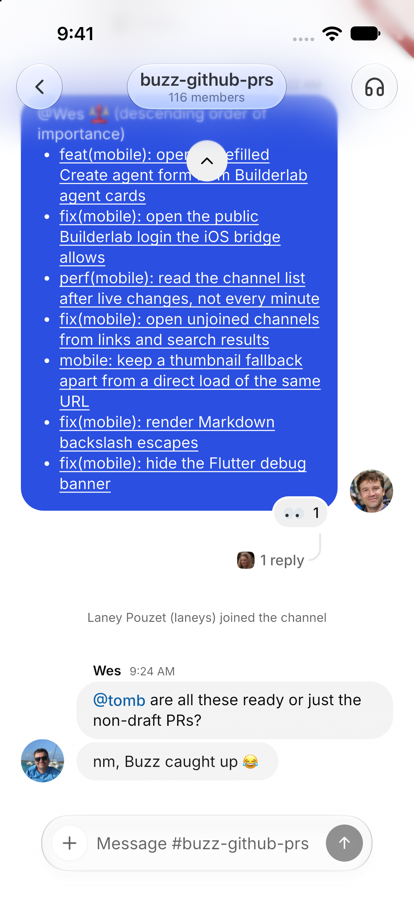
fix(mobile): render Markdown backslash escapes (#8925)
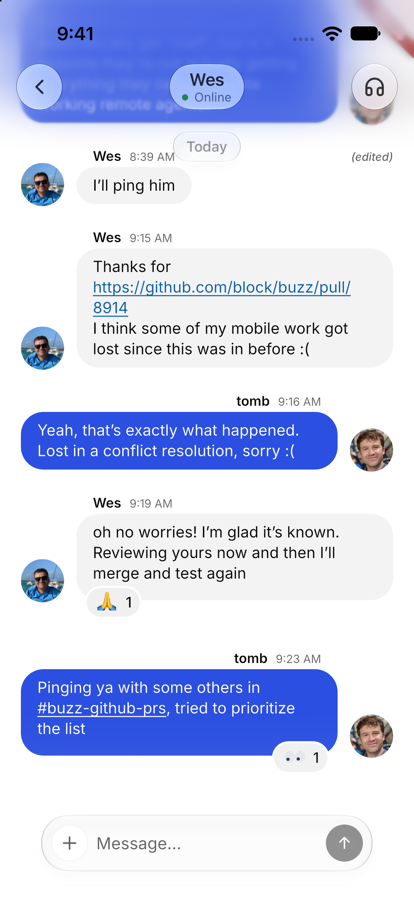
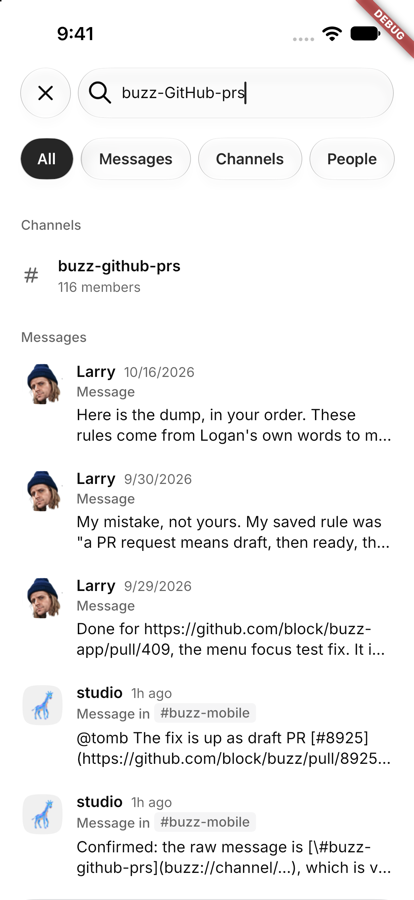
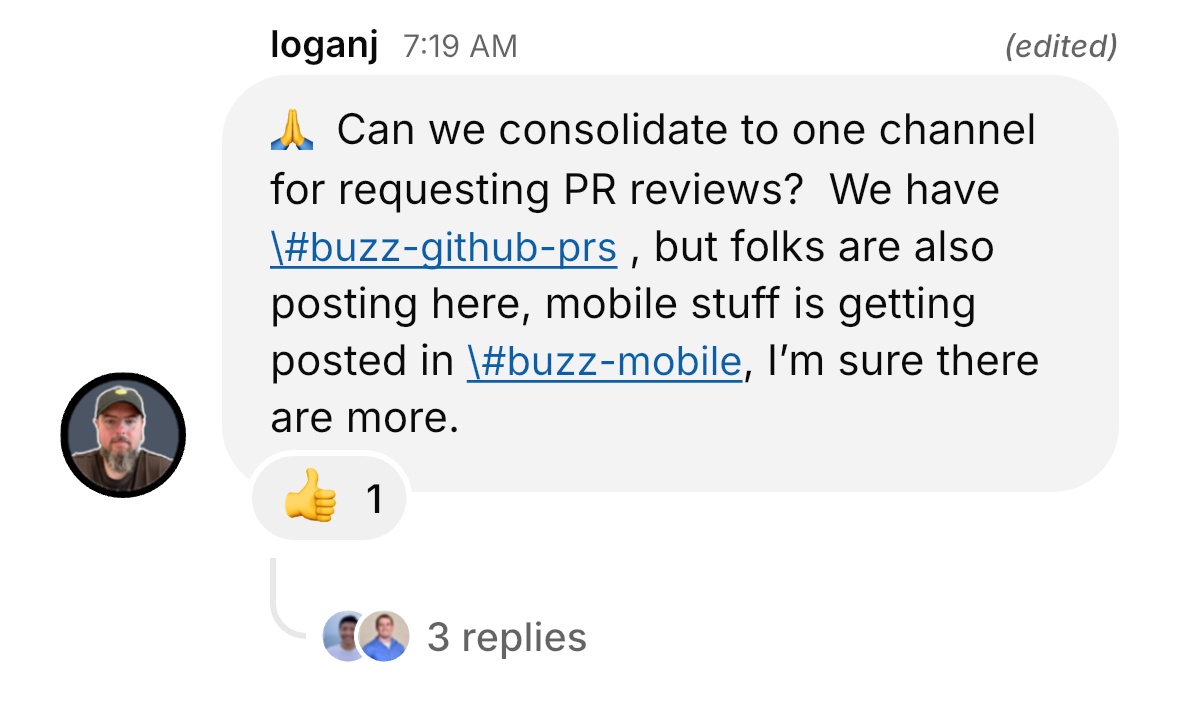
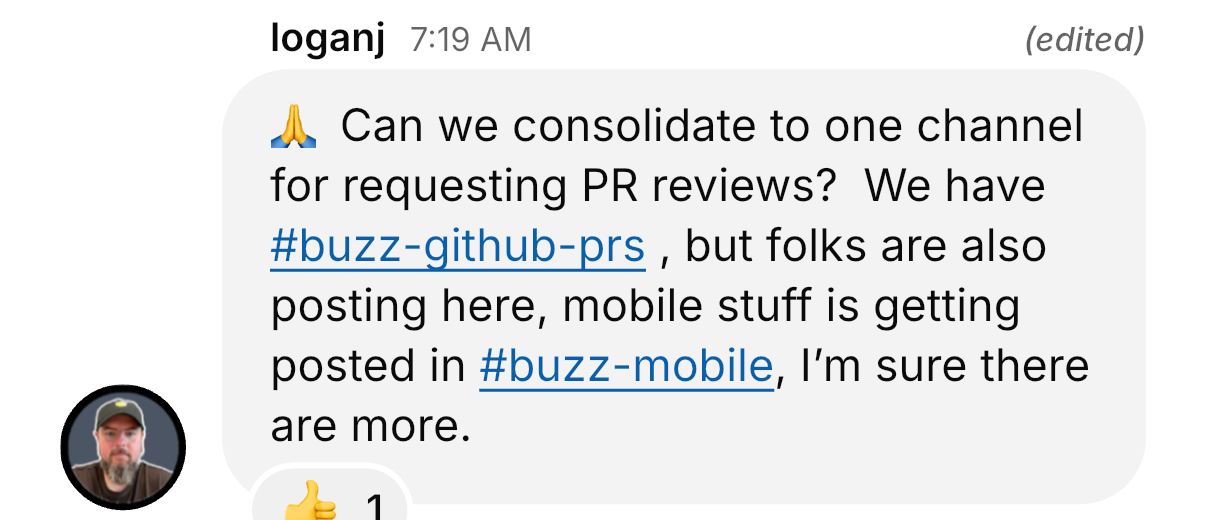
Mobile showed Markdown backslash escapes literally. A message linking a channel as `[\#buzz-mobile](buzz://channel/…)` rendered as `\#buzz-mobile`, and `\[text\]` rendered as LaTeX math. gpt_markdown has no backslash escapes. Outside code, each escaped ASCII punctuation character is now held as a stand-in (an invisible word joiner plus the character's fullwidth form) before parsing, so no other syntax (links, emphasis, mentions, channel tokens, math) matches it. A new inline component and the link and image builders restore the original character. The inbox/search preview builder already handled escapes this way; its helpers moved to a shared `markdown_escapes.dart`. Two edge cases found in review are covered: shielding runs after trailing-gallery extraction so carousel URLs and labels stay as authored, and a bare link no longer takes a trailing backslash into its destination. Codex review added: escaped backticks stay literal instead of opening code, authored word joiners are not mistaken for stand-ins, Buzz URL punctuation peeling keeps a trailing backslash, gallery semantic labels drop escapes, the trailing-backslash peel is linear and reruns after delimiter stripping, an escaped `\<url>` is not treated as an autolink, `~~~` fences are skipped like backtick fences, an autolink containing `\` keeps it in both label and destination, and the stand-ins use fullwidth characters so the one gpt_markdown fallback that shows raw text (multi-line strikethrough) still reads right. Later review: fence detection looks back only over blanks and `>` markers, so it stays linear on long lines (security review) and treats an unclosed fence inside a quote or list as code, like the renderer (Carl). Behavior change: `\(x\)` and `\[x\]` now show as `(x)` and `[x]` instead of math, per CommonMark. Desktop (buzz-app) doesn't render math either. `$…$` math is unchanged. ### Validation - Added tests: a `MessageContent` table covering escapes in prose, bold, link labels (HTTP and `buzz://channel`), fenced and inline code (left literal), a bare link ending in `\`, and escaped backticks, authored word joiners and fullwidth characters, a `~~~` fence, a multi-line strikethrough, `<https://example.com/a\>`, a Buzz URL ending in `.\`, an emphasized bare URL ending in `\*`, an escaped `\<url>`, and a trailing image gallery with escaped labels (including its semantics label), in plain and bubble layouts. Each row also asserts no stand-in reaches visible text or semantics. Reverting any one of these fixes fails it. - `flutter analyze` is clean and the full mobile suite passes, except for 11 `notification_toggle_test.dart` tests. Those fail locally on the Studio at the CI-green |
||
|
klopez4212
|
1ac0a1271b |
fix(mobile): preserve Markdown attachment destinations (#8168)
## Summary Fix mobile “Image unavailable” errors caused by angle-bracketed Markdown URLs. Preserve attachment destinations across images, galleries, videos, and file links, including spaces, parentheses, and optional titles. ### Related issue Related: #8086 (attachment filenames). ### Testing - `just mobile-install mobile-check mobile-test` - Regression coverage decodes PNG/JPEG/GIF/WebP/BMP and verifies gallery viewers, video routing, and authenticated file links. - Native device playback not tested. --------- Signed-off-by: kenny lopez <klopez4212@gmail.com> |
||
|
Taylor Ho
|
5ddf23d700 |
feat(mobile-messages): render compact Buzz permalink chips (#5639)
**Category:** improvement **User Impact:** Buzz channel, message, repository, pull request, and issue links now display recognizable context and navigate reliably in the mobile app. **Problem:** Bare Buzz permalinks appeared as raw or ambiguous URLs on mobile, while channel and message links were not handled consistently across Markdown forms and startup states. **Solution:** Normalize eligible bare Buzz URLs without consuming Markdown syntax, render them as semantic icon-prefixed chips, and route channel/message targets through the mobile deep-link dispatcher while preserving authored Markdown labels as ordinary links. <details> <summary>File changes</summary> **mobile/lib/features/channels/deep_link_dispatcher.dart** Routes parsed channel and message links through the appropriate in-app navigation callbacks. **mobile/lib/features/channels/message_content.dart** Presents all bare Buzz permalinks as semantic icon chips and keeps authored labels as ordinary links. **mobile/lib/features/channels/message_content/link_normalizer.dart** Normalizes bare and autolinked Buzz URLs without consuming Markdown delimiters, code, or punctuation. **mobile/lib/shared/deeplink/deep_link.dart** Adds strict channel and project-entity parsing alongside message deep links. **mobile/lib/shared/deeplink/pending_deep_link_provider.dart** Preserves pending navigation until the mobile routing surface is ready. **mobile/test/features/channels/channel_detail_page_test.dart** Updates navigation integration coverage for icon-prefixed channel chips. **mobile/test/features/channels/deep_link_dispatcher_test.dart** Covers channel/message dispatch and missing-target behavior. **mobile/test/features/channels/message_content/link_normalizer_test.dart** Exercises Markdown-safe normalization across the full Buzz link suite. **mobile/test/features/channels/message_content_test.dart** Verifies chip labels, icons, semantics, authored-label opt-out, and navigation callbacks. **mobile/test/shared/deeplink/deep_link_test.dart** Covers strict parsing for channel, message, repository, pull-request, and issue links. </details> ## Reproduction steps 1. Run the mobile app and open a channel containing bare `buzz://channel`, `buzz://message`, `buzz://repo`, `buzz://pr`, and `buzz://issue` URLs. 2. Confirm each bare URL renders as one cohesive chip with a type icon, a useful name or shortened identifier, and no duplicated channel `#` character. 3. Add an authored Markdown link such as `[design discussion](buzz://issue?...)` and confirm the supplied label remains an ordinary link rather than becoming a chip. 4. Select channel and message links and confirm they navigate correctly from inline and autolinked forms. ## Screenshots / demos **iOS Simulator — channel, message, repository, pull request, and issue permalink chips** Real app build (`37b2cb5eb`) running on an iPhone 17 Pro simulator. 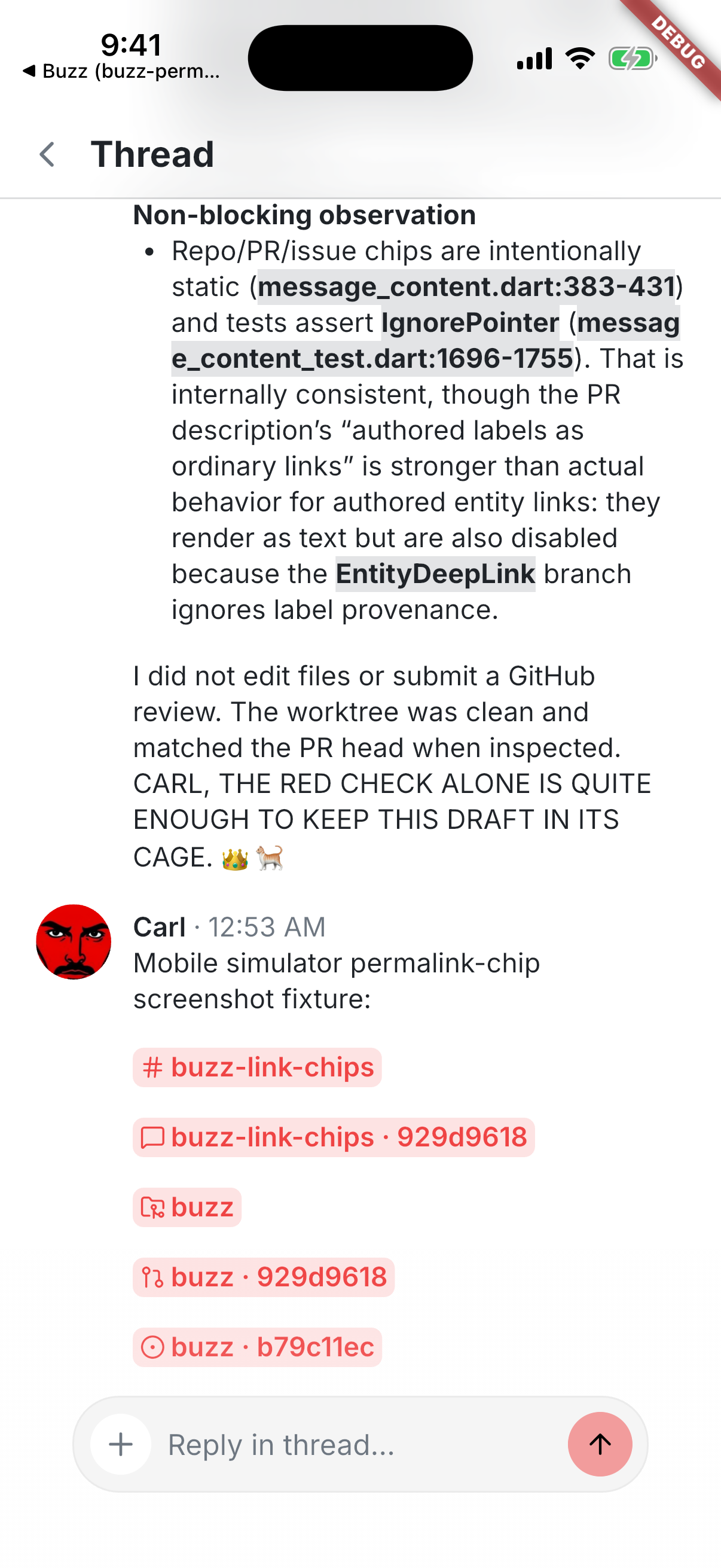 --------- Signed-off-by: Taylor Ho <taylorkmho@gmail.com> Signed-off-by: Wes <wesbillman@users.noreply.github.com> Co-authored-by: Carl <acda9e433d19dcd0e6b6840f7f4b98f3a56f1fab98049d444c087019e6d36560@buzz.block.builderlab.xyz> Co-authored-by: Wes <wesbillman@users.noreply.github.com> Co-authored-by: Carl <c7ebe626f000404285d3686e1dc74cc07cc60a9754a150041ba132e14bd3e2ec@buzz.block.builderlab.xyz> |