mirror of
https://github.com/block/buzz.git
synced 2026-11-24 10:12:19 +00:00
3689241672673c2e2363dc672b2d0cf62c148017
229 Commits
| Author | SHA1 | Message | Date | |
|---|---|---|---|---|
 Tom Brow |
3689241672 |
feat(mobile): reply to a message from its iOS notification (#9439)
On iOS, a notification that shows a channel or DM message now offers
**Reply**. The user types a reply in the notification and sends it
without opening the app.
- The reply goes in a subthread under the notified message (its thread
root is the message's own root, or the message itself when top-level). A
Solo chat takes no thread replies, so there it goes at the chat's top
level.
- It always mentions the notified message's sender, so the person or
agent being answered is notified. Typed `@name` text stays plain, since
a notification has no mention autocomplete.
- It is sent by the app's own send path. iOS starts the Flutter engine
when it wakes the app in the background, and the reply reopens the relay
connection (closed after the background grace period), waiting a bounded
time for it before sending.
- A sent reply marks the conversation read **up to the notified
message** (newer messages stay unread) and clears that notification and
earlier ones from the same conversation.
- An unsent reply (offline, relay error, timeout, a channel the user
isn't in) keeps the typed text as a draft, after any draft already
there, and shows a "Reply not sent" notification that opens the
conversation.
For now only notifications from the community selected in the app offer
Reply: replying must not switch communities, and the app can only reach
the selected one. Forum posts and fallback notifications that show no
message offer none. The design and the options considered are in
`docs/adr/0004-notification-reply.md`.
### Before / after
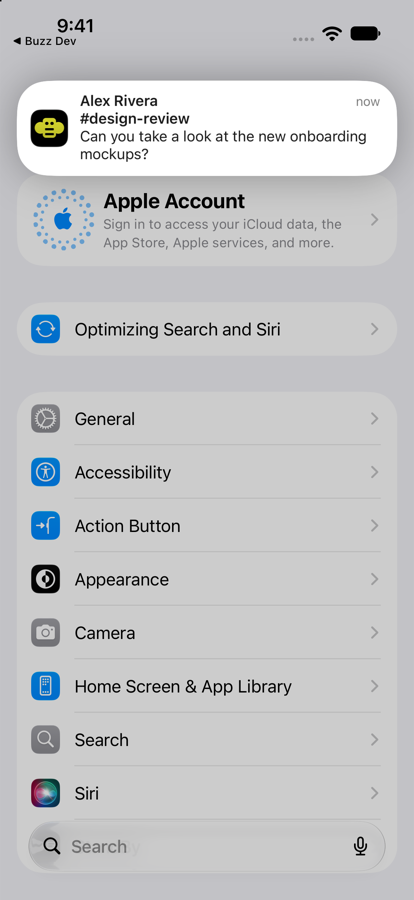
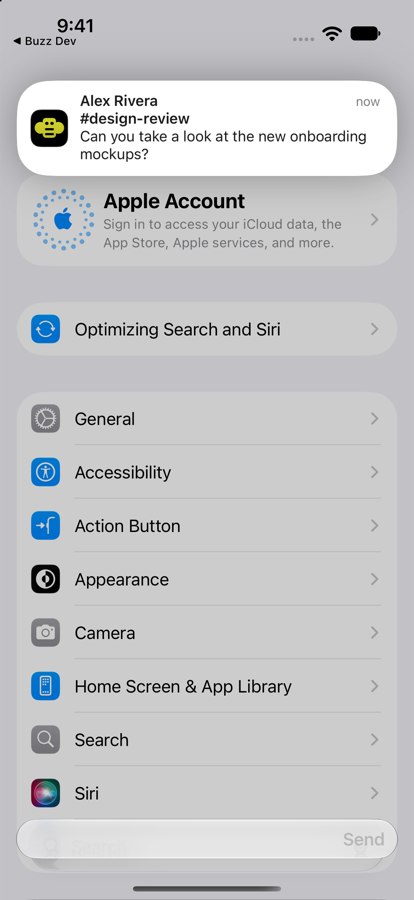
Long-pressing a message notification (synthetic names and text). Before
has no reply field (captured by sending the notification without its new
reply category, which is how main presents it); after shows one with
Send.
| Before | After |
| --- | --- |
|
|
|
### Demo
With the app backgrounded past the relay grace period, replying from the
notification lands the reply in a subthread under the message:
https://github.com/user-attachments/assets/37df7e28-aa46-4521-938e-8af5faa77b83
### Regressions
Nothing existing changes unless the user taps Reply. Notifications gain
a category and a small reply context in `userInfo`; tapping a
notification still opens the conversation as before. The relay reconnect
only happens for a pending reply and then falls back to the normal
background disconnect, so idle background behavior and network use are
unchanged. Reply failures end in a draft and a "Reply not sent"
notification rather than touching other state.
### Validation
- End to end on an iOS 27 simulator against a real community: with the
app backgrounded past the relay grace period, replied from the
notification; the reply appeared in a subthread under the message,
mentioning its sender. The demo above was recorded before the review
fixes (session hold, community fence, origin-community drafts, composer
draft sync); the same run was repeated on the current head,
|
||
|
Tom Brow
|
25b58ab98f |
feat(push-gateway): verify Android Key Attestation (#9562)
## What and why Ticket 3 of the Android push plan ([design PR #9555](https://github.com/block/buzz/pull/9555)). The gateway now verifies Android Key Attestation at enrollment instead of rejecting every Android chain, and rate limits signed installation calls per attested key. Stacked on [#9560](https://github.com/block/buzz/pull/9560) (Android enrollment and FCM wakes). This PR's base is that branch; it will be retargeted once that merges. - **Chain.** It must end at a configured Google attestation root (Google's [published hardware roots](https://developer.android.com/privacy-and-security/security-key-attestation#root_certificate) are built in, pinned by public key), with valid signatures and issuer links, CA issuers above the attestation key certificate, and no SHA-1 signatures. The attestation key certificate itself is exempt from the CA flags, because some factory keyboxes issue it with CA:FALSE and digitalSignature only (Google's Sony Xperia 10 III sample); a Keystore leaf still cannot act as an issuer, since the extension is refused above the leaf. Validity is enforced for Remote Key Provisioning chains; Google tells verifiers to keep trusting the long-expired factory chains, which the revocation list covers instead. The attestation extension must be in the leaf and nowhere else. The leaf key must be EC P-256; it becomes the installation's signing key. - **KeyDescription.** Attestation and KeyMint security levels must be TrustedEnvironment or StrongBox. The challenge must equal SHA-256 of the enrollment transcript. Key properties (generated, EC, P-256, sign-only) and the root of trust come only from the hardware-enforced list. The bootloader must be locked, and the boot state Verified, or SelfSigned with a verified boot key on an operator-configured list. The application id (the one software-enforced value) must name exactly the configured package with a configured signing digest. - **Revocation.** A background task fetches Google's status list at startup and then on its cache lifetime (5 minutes to 1 day), with a 30 second timeout, an 8 MiB size cap, capped exponential backoff and jitter. Any REVOKED or SUSPENDED serial in the chain is rejected. With no list yet, or a list older than the grace period, enrollment fails closed. Enrollment reads an in-memory snapshot and never waits on a fetch. - **Rate limit.** Signed installation calls (delegate, revoke delegation, rotate endpoint, revoke installation, on both platforms) are limited per attested key. A call is counted only after its signature verifies, so forged requests cannot spend another installation's allowance. Counters are in memory per replica, bounded to 100,000 keys. - **Dependencies.** None added. `x509-parser` gains its `verify-aws` feature, which uses the `aws-lc-rs` the crate already depends on. ## Configuration All optional; Android stays off unless the ticket 2 settings are present. Documented in `docs/push-gateway-deployment.md` and `.env.example` with example values only, and passed through `deploy/charts/buzz-push-gateway` (disabled by default, schema-checked, covered by `tests/runtime-options.sh`). - `BUZZ_PUSH_ANDROID_BOOT_KEY_DIGESTS`: SHA-256 digests of verified boot keys accepted with a SelfSigned boot state. Empty by default, so a default gateway accepts stock Android only. - `BUZZ_PUSH_ANDROID_ATTESTATION_ROOTS_PATH`: PEM bundle replacing the built-in roots, for a reviewed root rollout. In the chart, `android.attestationRoots.secretName` and `secretKey` mount it from a Secret; an empty name keeps the built-in roots. - `BUZZ_PUSH_ANDROID_REVOCATION_GRACE_SECONDS`: default 604800 (7 days), minimum 3600. - `BUZZ_PUSH_SIGNED_CALL_WINDOW_SECONDS` and `BUZZ_PUSH_SIGNED_CALL_MAX_CALLS`: defaults 60 and 30. ## Tests - `cargo test -p buzz-push-gateway` (all pass, 18 ignored), `cargo fmt --all --check`, `cargo clippy -p buzz-push-gateway --all-targets -- -D warnings`, and the chart tests (`render.sh`, `release-contract.sh`). - Key Attestation chains are generated in the tests with a test root injected as the configured root, and run through the production verifier. One table rejects: unlocked bootloader, Unverified, Failed, SelfSigned with an unlisted key, boot key only in the software list (two variants), key properties only in the software list, extra key purposes, wrong curve, wrong package, two packages, wrong signing digest, wrong challenge, software-backed key (two variants), unknown root, forged leaf signature, expired provisioned intermediate, extension repeated above the leaf, non-P-256 leaf, a CA:FALSE certificate issuing the attestation key certificate. Another accepts Verified with any boot key, SelfSigned with a listed key, StrongBox and TrustedEnvironment, an expired factory intermediate, and a CA:FALSE, digitalSignature attestation key certificate. Revoked leaf, intermediate and root, a missing list and a stale list are rejected. The status list parser and refresh (backoff, cap, keeping the last list through failures) run against a scripted fake source; no test touches the network. - The per-key rate limit runs through the public router: forged calls do not spend the allowance, the fourth authentic call is refused whatever its kind, and another installation is unaffected. - Break check: disabling the locked-bootloader guard and the rate limit turned `rejected_attestations` and the rate limit test red; restored. ## Not here The app side (ticket 7) generates the Keystore key and sends the chain. The end to end run on a physical Android phone against a test gateway is also still to do. --------- Signed-off-by: Tom Brow <tomb@squareup.com> |
||
|
Will Pfleger
|
b769d5bee8 |
fix(relay): remove an owner's agents with the owner (#9575)
## What this changes When someone is removed from a community, their agents' live sessions already closed, but the agents kept their own membership rows and could reconnect as members. This PR removes those agents with their owner. - **Cascade.** `delete_member_with_acceptances` locks and deletes the target, then locks and deletes the `join_policy_acceptances` and `relay_members` rows of every member of the same community whose `users.agent_owner_pubkey` is the target and whose role is not `owner`. All of it runs in the same transaction, before the roster snapshot is written. Admin removal (kind 9031), self-leave and `buzz-admin remove-member` all go through it. An agent goes with its owner whatever its role, so an admin who removes a member also removes that member's admin-role agent. A direct 9031 target is still limited to `member` for admins. - **Owner recording.** The relay records a verified NIP-OA owner on every admitted sign-in, whatever the relay mode or `allow_nip_oa_auth`: on WebSocket AUTH, and for HTTP in the shared admission step after the denial checks, so `/events`, `/query`, `/count` and member POSTs all record it in one place. Before, it recorded only on open relays, so on closed relays the cascade and owner bans missed agents added directly. A request refused before recording writes nothing. Once the owner-signed tag is verified and the first admission checks pass, the relay may record the owner even if a final check, a cancellation or a token revocation then refuses the sign-in. The record still can't be changed. Over HTTP, a different stored owner refuses the request with 403 (invite creation keeps its `invite_owner_mismatch` code), and storage trouble refuses it with 503. A recorded owner can also manage the agent (channel management, channel-add policy, invites). - **CLI.** `buzz-admin remove-member` publishes clusterwide disconnects (`ConnControl::DisconnectPubkey`) for the target and its recorded agents on every run, including when the member is already gone. If publication fails or no relay server is subscribed, it exits 6 after the removal commits. Rerunning the same command retries the disconnect. - **Spec.** NIP-FI states the rule. ## Rollout limit An agent is covered only if its owner was recorded before the owner is removed. An agent whose owner was removed before the agent signed in with a NIP-OA tag after deploy, or an agent that never signs in with one, stays a member and needs a manual removal. The relay holds no proof of ownership for those agents, so there is nothing to backfill. Supersedes #6098 and #6078. --------- Signed-off-by: Will Pfleger <wpfleger@block.xyz> Co-authored-by: Duncan <dcfd242e557282d7a1e2cf2e6877522682f1e5c6156dc92ca7d90eaedd3b0f95@buzz.block.builderlab.xyz> |
||
|
Luke Tornquist
|
3876720c34 |
buzz-db: drop the five single-table guard triggers (BUZZ-318 phase 2) (#9398)
> [!NOTE] > **Rollout:** #8320 (app guards + catalog expand) is deployed, so the hold is lifted. With `autoMigrate=true`, `0096` runs at startup under a 5s lock timeout, and a failure stops startup. With `BUZZ_AUTO_MIGRATE=false`, deploy this binary first and then run `buzz-admin migrate`. Both orders are safe because the expand tolerates the objects being present or absent. ## What The required stop for `0096` is in `docs/trigger-retirement-deployment.md` (from #9622): a relay build at or after #8320 (`ec778bff`). A build older than that needs the tombstone trigger at startup and readiness. Migration `0096_drop_single_table_guards.sql` drops five triggers and their functions. #8320 moved each invariant into the application writers: | Trigger (table) | Function | |---|---| | `trg_channels_community_id_immutable` (channels) | `channels_community_id_immutable()` | | `communities_deletion_tombstone` (communities) | `enforce_community_tombstone()` | | `community_deletion_request_retargeting_guard` (community_deletion_requests) | `prevent_community_deletion_request_retargeting()` | | `community_deletion_approval_removal_guard` (community_deletion_approvals) | `prevent_community_deletion_approval_removal()` | | `community_deletion_manifest_keys_guard` (community_deletion_manifest_keys) | `protect_community_deletion_manifest_keys()` | Desired state (`schema/`) drops the five functions and four trigger files, plus the channels trigger declaration. The universal write fence on `channels` stays. Both boot paths stay catalog-equivalent: the pgschema-vs-migration parity check now also compares columns, key and FK shapes, and the remaining triggers on all five tables. Executor GUCs stay because `assert_community_write_allowed` still reads them through the universal write fence. `transition_community` and every phase-1 app guard are byte-identical to #8320. `scripts/reconcile-schema-after-pgschema.sql` has no entries for these objects. ## Tests - #8320's six `single_table_guard_*_without_trigger` PG tests no longer need to disable a trigger. They are now plain app-path tests with the same assertions. - New per-test regressions for the desired-template and migration boot paths assert that none of the ten objects exist, including disabled triggers and function overloads. - Deleted assertions that only exercised raw SQL against the triggers: retarget, rewrite and approval mutation, frozen-manifest rewrite, and tombstone DELETE. The app-path coverage for each remains. - The expand regression in #8320 migrates through `0086`, validates serving, readiness and the deletion lifecycle, drops the five guards, then validates again. - Rebased onto main `b568d9bf` after #8696 took `0095`; renumbered to `0096`. Blox gate at `7bda1f45`: fmt, clippy and buzz-db `--lib` pass; the PostgreSQL lane ran 219 tests, all pass. - Gate at `c8bc061c` (on main `051dd2d7`, then numbered `0095`, #9622 folded in): on Blox, `cargo fmt --check`, clippy and the buzz-db `--lib` tests pass. The PostgreSQL lane (migrations, single-table guards, floor retirement, fence and deletion) ran 208 tests: all pass. - Earlier gate at `0840ba49`: CI was green, and the Blox PostgreSQL lane passed 840 of 841 (the one failure, `media_reference_full_query_plans`, is a timing check that fails the same way on main on that host). - The rebase updates main's fence-retirement tests to expect the tombstone trigger gone. ## What got simpler Ten database behavior objects and nine desired-state files are gone (about 150 lines). Each rule has a single owner, the application writer. buzz-review-completed 🤖 Generated with [Claude Code](https://claude.com/claude-code) --------- Signed-off-by: Luke Tornquist <tornquist@squareup.com> Signed-off-by: Tom Brow <tomb@squareup.com> Co-authored-by: Elrond <28d6302a099e5225b02c4155ac4236e4912603df2ab08dbfc2f4fef08ce598c8@buzz.block.builderlab.xyz> Co-authored-by: Claude Opus 5.5 <noreply@anthropic.com> Co-authored-by: Tom Brow <tomb@block.xyz> Co-authored-by: Tom Brow <tomb@squareup.com> Co-authored-by: studio <dc2fc481343672df31a689840c09299972e704dac592e0da6f18486646a7ee3e@buzz.block.builderlab.xyz> |
||
|
Logan Johnson
|
b568d9bf95 |
Retire the 0032 roster trigger in migration 0095 (#8696)
## Summary Migration 0095 drops the 0032 channel roster trigger (`trg_events_guard_channel_roster_snapshot`) and its function (`guard_channel_roster_snapshot()`). The trigger repeats a check that the relay already does in Rust. Every kind:39002 roster writer checks the roster against the channel's membership before it saves it (#8316). Since #8611, no relay requires the trigger at startup. This PR is the last step of the trigger retirement sequence in `docs/database.md`. This PR was split out of #8494 so the migration can roll out by itself. A relay from this PR does not change how it stores or publishes roles, and it has no new startup check. It serves correctly whether or not 0095 has run. #8494 stacks on this PR and must not merge until 0095 has run in every environment. ## Details - **Migration 0095.** `DROP TRIGGER` and `DROP FUNCTION`, with `lock_timeout = '1s'` and `statement_timeout = '5s'` as in 0049. `DROP TRIGGER` takes `ACCESS EXCLUSIVE` on each `events` partition in turn, so event reads and writes block while it runs. A timeout rolls it back with no change, and it can be retried. - **Desired-state schema.** `schema/functions/guard_channel_roster_snapshot.sql` is removed. This was the last trigger on `events`, so `schema/triggers/events.sql` and its include go too, as do the pre-attach trigger drops in `scripts/reconcile-schema-after-pgschema.sql`. - **Operator guide.** #8326 added `docs/trigger-retirement-deployment.md` for migrations 0089–0091. (0092 from #9365 and 0093 from #9560 drop nothing; 0094 from #9598 drops two plain SQL functions and has its own section there.) This PR adds 0095 to it: its row, the two ways an older relay fails, the migrate check, and the parent trigger a pgschema deployment must drop first. The Helm chart README names the required stop and points to that guide. - **Tests.** Tests that compared the trigger with the Rust check, or that disabled the trigger first, now test the Rust check alone. Tests that only exercised the trigger against a simulated pre-#8316 writer are removed. The 0075 invite upgrade test now migrates to 0075 exactly. ## Rollout **Required stop: the stop build in `docs/trigger-retirement-deployment.md`** (a relay build at or after `68785206`, the merge of #8325). That build contains #8316 (the app-side roster check) and #8611 (no startup trigger check), so it covers 0095 too. `relay-v0.3.0` contains #8316 and #8611 but not #8325, so it is no longer enough on its own: any build with 0095 also has 0089–0091. Without the stop, an untagged `main` build between 0032 and #8611 refuses to start once the trigger is gone, and a relay without #8316 can save stale kind:39002 snapshots (`docs/database.md` Rule 5). **Merge gate.** Every push to main publishes relay `:main` images, and the Helm chart defaults to `migrate.autoMigrate=true`. Do not merge this PR until the stop build or later runs on every serving and rollback target. That is the same gate #8326 had for 0089–0091. After that, either way works: - With `autoMigrate=true`, the first relay from this PR applies 0095 at startup. - With `autoMigrate=false`, run `buzz-admin migrate` when convenient. Relays from this PR serve with or without 0095. As with every new migration, an older binary with auto-migration on refuses a database that has 0095 (sqlx `VersionMissing`). A rollback past this release needs auto-migration off (`docs/database.md`). ## What happens next #8494 computes the `member`/`bot` label at read time. The 0032 trigger compares labels with the stored role exactly, so it would refuse those rosters. #8494 adds a startup check that refuses to serve while the trigger is installed. Merge it only after 0095 has run everywhere. ### Testing - `migration_0095_retires_the_roster_trigger`: on a database migrated through 0094, the trigger and function are installed. After the remaining migrations, both are gone, and a raw kind:39002 insert that does not match membership is accepted. It fails if 0095 does not drop them. - `embedded_migrator_contains_consolidated_initial_schema` pins 95 migrations and the 0095 statements, and checks that the desired-state schema no longer installs the function. - `migration_schema_desired_pgschema_reconcile_matches_populated_upgrade`: its fixture drops each retired parent trigger before pgschema runs (pgschema drops partition copies before the parent, which PostgreSQL refuses with 2BP01). It now drops the roster trigger too. - Locally at this head: `cargo check`, `cargo fmt --check`, and 245/245 buzz-db unit tests pass; 760/764 buzz-db Postgres tests pass. The four `event_follow_up_contract` tests fail the same way on `main` locally and pass in CI. CI runs clippy and the full PostgreSQL lane. 🤖 Generated with [Claude Code](https://claude.com/claude-code) --------- Signed-off-by: Logan Johnson <loganj@squareup.com> Co-authored-by: Larry <627498bd4bd1f281a16431e3c6cce3b5c25b6692798c78672298aefbf2f8f8b5@buzz.block.builderlab.xyz> Co-authored-by: Claude Opus 5.5 <noreply@anthropic.com> |
||
|
Ian Oberst
|
c01d3292a1 |
fix(db): hard-delete superseded relay-signed lists (#9586)
## Why

The relay republishes its own lists in full on every change:
- the NIP-43 membership list (kind 13534)
- the NIP-IA archived list (13535)
- NIP-29 group state (39000 metadata, 39001 admins, 39002 members)

Each write soft-deletes the previous head. No reader returns a
soft-deleted row, so each retired copy is dead weight in `events` and
its indexes. On the deployments we measured, these retired copies are
about 40–65% of monthly `events` growth. The NIP-33 path already
hard-deletes superseded NIP-RS read state and mesh status in the
replacing transaction. This PR applies the same rule to the relay-owned
lists.

## What

When a write supersedes a head of kind 13534, 13535, 39000, 39001, or
39002, it deletes the old head instead of soft-deleting it. The delete
runs in the same transaction, under the same scope and lock as before.
The change applies on the 3 paths the relay uses to write these kinds:

- `replace_addressable_event_under_lock` (13535, 39000, 39001, including
`buzz-admin` writes through `replace_addressable_event`). It gates on
the new `hard_deletes_superseded(kind)`. Other kinds on this path (0, 3,
10002, …) keep the soft delete.
- `LockedMemberSnapshot::replace_member_event` (39002).
- `write_nip43_membership_snapshot` (13534).

All 3 paths build their head read and supersede statement with one
function, `replacement_sql(in_channel, hard_delete)`, keyed by
`hard_deletes_superseded(kind)`.

Kind 13535 is now relay-only: ingest rejects a client-submitted 13535
with `restricted: relay-only kind`, as it already does for 13534. NIP-IA
defines 13535 as relay-signed, and every relay, desktop, CLI, and mobile
reader filters on the relay's pubkey. No client in this repository
publishes it.

The 39000–39002 paths already use `superseded_with_mentions_sql!`, so
the old head's mention rows are deleted with it, as before.

The gate checks the kind, not the signer, and every supersede is scoped
to the event's own pubkey. A client-signed 39000–39002 is routed to the
NIP-33 path, which keeps the soft delete. Channel deletion
(`soft_delete_discovery_events`) retires the live heads without a
replacement and still soft-deletes them.

This PR has no migration and no schema change.

## Why this is safe

- **Readers:** relay reads of these kinds filter on `deleted_at IS
NULL`, so a retired head was already invisible. One reader includes
soft-deleted rows: the admin event preview (`get_event_preview`). It
will now report a superseded roster id as absent instead of deleted. A
moderation report against an old version of a channel's metadata (for
example, a name it had before a rename) will show no target content. An
operator can no longer look up an old roster or membership list by id to
audit past membership. `docs/admin/README.md` now documents this for
`GET /api/admin/v1/events/{id}`.
- **Operator repair:** when `buzz-admin`'s group-state reconcile
overwrites a 39000–39002 head, the old row is gone, so an operator can
no longer restore it with `UPDATE … SET deleted_at = NULL`. The relay
rebuilds these lists from `channels` and `channel_members`, so no source
data is lost.
- **Replays:** while the coordinate has a live head, a replay of a
deleted head's id is still rejected, because its `created_at` does not
beat the live head's. With no live head (after channel deletion, for
example), the deleted row no longer makes the replay a duplicate. Only
the relay can submit these events: ingest requires the event's signer to
be the authenticated pubkey, 13534 is relay-only, and the relay's
writers sign a new event on every attempt. The existing tests for
soft-deleted replays seed their own rows and do not change.
- **13534 id uniqueness:** the writer still takes `max(created_at)` over
every stored list. The live head is always the newest, so the next
list's `created_at` still moves past every earlier one.
- **13535 strict stamps (NIP-IA, #9476):** each new archived list is
stamped past the live head, which the writer reads behind the
replacement lock. It never reads retired rows, so deleting them does not
change the next `created_at`.
- **Database objects:** no foreign key references `events`, and none of
these kinds is a push kind. The DELETE runs in the same admitted
community write transaction as the old UPDATE. The only trigger left on
`events` is the BEFORE INSERT kind 39002 roster guard
(`guard_channel_roster_snapshot`), and a DELETE does not fire it.
- **Rolling deploy (docs/database.md Rule 7):** old pods keep
soft-deleting and new pods delete. Both leave exactly one live head per
coordinate, under the same locks.

## Follow-up

Rows that are already soft-deleted stay. Rule 3 does not allow a
migration to delete them. A separate PR will add a
`scripts/maintenance/` repair script: bounded batches, the
community-deletion lock, and a validation query. An operator runs it
after this change is fully rolled out.

Not in this PR: the relay-signed NIP-DV DM visibility snapshot (kind
30622, `publish_dm_visibility_snapshot`) is written on the NIP-33 path
and still soft-deletes its superseded heads. We will measure its share
of `events` growth before we change it.

## QA focus

- **Each roster write keeps exactly one stored row.** Create a channel,
then add and remove members, change roles, and edit the metadata. For
each of 39000, 39001, and 39002, the channel must have exactly one
`events` row (live), not one live row plus retired ones. Do the same for
13534 (relay membership add, remove, and role change) and 13535 (`agents
archive` and unarchive).
- **Other kinds still soft-delete.** Replace a kind 0 profile or kind 3
contact list. The old row must stay, with `deleted_at` set.
- **Mention rows.** After a 39002 or 13535 replacement, `event_mentions`
has no rows for the deleted head's id.
- **Admin event preview.** Opening the id of a replaced roster now shows
the event as absent instead of deleted. Check that this is acceptable in
the admin UI, including a report filed against a channel's metadata
before a rename.
- **13535 `since` cache.** Archive and unarchive several times,
including at the same time. Each new list has a `created_at` later than
the one before. A mobile client that asks `since` its list's
`created_at` + 1 gets the newer list.
- **Client 13535 is rejected.** Publishing a kind 13535 signed by a user
key returns `restricted: relay-only kind`. Archive and unarchive (kinds
9035 and 9036) still work, and the relay still publishes its own 13535.
- **Channel deletion.** Deleting a channel still soft-deletes its live
39000–39002 heads. This path is unchanged.
- **Mixed-version rollout.** With an old and a new relay on one
database, each coordinate keeps exactly one live head. Rows that old
pods soft-deleted stay until the follow-up script runs.
- **Existing soft-deleted rows are not touched.** The disk-space gain
shows only in growth after deploy. The follow-up script cleans up the
backlog.

## Tests

- `only_relay_owned_lists_hard_delete_their_superseded_heads`: checks
the kind set, including the neighbours 13533, 13536, 38999, and 39003,
and negative kinds.
- `superseded_heads_drop_their_mention_rows` (Postgres) now expects the
old head to be gone for the 39002 member snapshot, 13535 (global), and
39000 (in a channel). A kind 3 contact list on the same addressable path
is the control: it must stay soft-deleted.
- `replacement_channel_predicate_is_an_index_condition` (Postgres) now
builds its statements with `replacement_sql`, the same function
production uses, for all 4 scope and retire-mode combinations. Before,
it checked hand-copied SQL. It checks that each `DELETE` seeks by
`channel_id` on every populated partition, as the `UPDATE` does.
- The 39002 and 13534 writers take their statements from
`replacement_sql` and `hard_deletes_superseded`, so the index-condition
test covers each statement production runs.
- `nip_ia_archived_list_is_relay_only` (buzz-core): 13535 is relay-only,
and the 9035 and 9036 requests are not.
- `test_client_submitted_nip_ia_archive_snapshots_are_rejected`
(buzz-test-client e2e, against a running relay): a client-signed 13535
is rejected with `restricted: relay-only kind` over both WebSocket and
HTTP. It shares a helper with the existing 13534 test. Against a relay
built without the 13535 gate, it fails at the WebSocket assertion. The
Relay E2E step in `.github/workflows/_ci-relay.yml` now selects it, next
to the 13534 test.
- `late_owner_link_closes_ownerless_agent_sockets_on_owner_revoke`
(buzz-relay, Postgres) copies selected tables into a private schema. The
13534 writer's supersede now also deletes the old list's
`event_mentions` rows, so the fixture copies `event_mentions` too.
- `every_membership_write_commits_its_list` (Postgres): after each
membership writer runs, the community stores exactly one kind 13534 row.
- `concurrent_archival_publishers_stamp_strictly_increasing_snapshots`
(buzz-relay, Postgres, from #9476) counted the 16 stored kind 13535
rows, superseded ones included. It now pins the head an hour ahead and
asserts that the coordinate stores exactly one row, at the pinned
`created_at` + 16 s. That holds only if each of the 16 publishers stored
exactly one snapshot, one second past the head it replaced. A
same-second replacement leaves the row short of + 16 s, and a publisher
that runs out of attempts still fails its `expect`.
- `a_publisher_that_read_before_an_edit_cannot_replace_it` (buzz-relay,
Postgres) counted retired kind 39000 rows to prove that each publisher
stores a new second. It now asserts that the coordinate stores exactly
one row, at the pinned `created_at` + 2 s. The mutation it guards
against (taking the live `created_at` before the lock) leaves the head
at + 1 s, so the test still catches it.

Commands run:

- `cargo clippy -p buzz-core -p buzz-db -p buzz-relay --all-targets --
-D warnings`
- `cargo test -p buzz-core --lib`
- `cargo nextest run -p buzz-relay --lib`
- `cargo test -p buzz-test-client --test e2e_relay -- --ignored` for the
13534 and 13535 rejection tests, against a local relay built from this
branch
- `cargo test -p buzz-db --lib`
- `cargo test -p buzz-db --test observability_source`
- `scripts/postgres-test-run.sh -p buzz-db -p buzz-relay --lib --tests`
(the CI PostgreSQL lane, run locally)

🤖 Generated with [Claude Code](https://claude.com/claude-code)

Signed-off-by: Ian Oberst <ioberst@block.xyz>
Co-authored-by: Ian Oberst <ioberst@block.xyz>
Co-authored-by: Claude Opus 5.5 <noreply@anthropic.com>
|
||
|
ravarora2
|
8b6bc9beb5 |
Add community-scoped user and agent profile cleanup (#9580)
## Summary
Content, account and media cleanup leave profile records behind. Add
`buzz-admin user-deletions profile-batches` to preview or delete those
records in one community. Preview is the default; explicit `--delete`
applies bounded, retryable transactions.
Every run and retry discovers the human’s current direct agents in that
community. Ownership elsewhere cannot authorize deletion here. If Alice
owns an agent in A but Bob owns it in B, deleting Alice in B preserves
that agent. Each write batch locks and rechecks ownership. All profile
data is removed before identity rows, so an interrupted run resumes
without saved agent keys. The command no longer accepts
`--agent-pubkey`.
The handler removes profile/configuration events and projections,
rebuilds shared archive snapshots with valid signatures, and finally
removes identity rows. Repository announcements/state (30617/30618) and
name mappings remain intact without blocking identity removal; other
authored content still requires prior cleanup. Unresolved dependencies,
changed sources, untrusted signers or excessive plans stop deletion.
This includes historical `replaced-by` references in archive requests
and deltas, even after unarchive removes the current archive row. See
[operator instructions and verification steps](docs/profile-cleanup.md).
Writers must be stopped. Coordinator integration, online admission
fencing, media objects, client caches and final account-erasure
verification remain separate. The command always reports
`account_erasure_complete: false`.
### Related issue
Fixes #9576. Continues the standalone handler pattern from #9363
(content) and #9364 (account). This is an independent PR against main.
### Testing
The latest correction adds a PostgreSQL regression that runs content
cleanup followed by profile preview/delete/retry for human and agent
repository owners. It checks unchanged repository events, mentions, name
mappings and other-community data, and verifies ordinary content still
blocks profile deletion. The merge of main brings in `buzz-deletion
--lib` coverage in the CI unit lane and its fallback, covering the
preview-default parser test without duplicate runs. Account, content,
media and profile command dispatch are all preserved. The
archive-history documentation also now distinguishes planning errors
from printed blockers.
The latest main merge includes the shared dependency-policy correction
from #9609 and the content cleanup lock fix from #9615. On `54bd50299`,
PostgreSQL CI passed 1647 tests and failed 18 because content cleanup
still called the retired SQL lock-key function; this also blocked the
new content→profile regression. The merged upstream fix uses the
existing Rust-built key for both the cleanup lock and the test blocker.
Local test suites and hooks remain skipped at the owner’s request. CI
and review of the updated head are pending. The results below apply to
earlier revisions.
At `92aa9c216`, exercised the rebuilt `buzz-admin` against signed
archive/unarchive events stored in disposable PostgreSQL:
- For kinds 9035 and 8002, test a historical `replaced-by` reference to
the human and then to their owned agent after unarchive.
- Run `profile-batches --pubkey <human> --community <A> --relay-pubkey
<relay>` in preview and `--delete` modes. Both refuse the unresolved
reference; full table dumps remain unchanged.
- Keep that history only in community B. Cleanup in A succeeds,
preserves B, and selects zero work on retry.
- Delete the archive subject in B. Its history is removed while the
replacement identities remain intact.
All four scenarios passed. These are signed database fixtures exercised
through the real CLI; they do not claim live relay admission. The
correction also merges main and preserves content, media and profile
command dispatch.
The initial full database run passed 880/881 tests: the new request
fixture lost its required self-`p` tag during signing. Commit
`ff6689386` preserves that tag; all ten profile regressions now pass.
Further local checks and pre-push hooks were skipped at the owner’s
explicit request. The full corrected database suite has not been rerun;
GitHub CI will validate the new head. At `ff6689386`, the production
code matched the CLI-tested revision; the repository-retention
correction above is newer.
Previous ownership validation follows:
At `090d2a1cf`, exercised the rebuilt `buzz-admin` binary against a
disposable PostgreSQL fixture:
- Run `user-deletions profile-batches --pubkey <human> --community <A>`:
preview left table exports unchanged and selected four profile/identity
mutations.
- Repeat with `--delete --batch-size 2`: all four mutations committed;
retry selected zero work.
- Use the same human and agent keys in another community, with the agent
owned by someone else: only the human was selected, and the agent
remained intact.
This fixture uses placeholder profile signatures and validates
database/CLI behavior. It does not claim live signed-event admission.
The earlier live relay and Desktop results below cover the previous
revision.
Independent agent review covered the previous ownership correction. A
later review found the historical replacement-reference bug; the
historical-reference correction addresses that finding. Fresh review of
this revision is still required. Human command verification has not been
recorded; it is not claimed by the agent-run checks. Follow the local
verification steps in `docs/profile-cleanup.md`; preview must leave data
unchanged, deletion must preserve other-community records, and retry
must select zero work.
<details>
<summary>Historical validation at
|
||
|
Luke Tornquist
|
0a05330740 |
buzz-db: stop calling the dropped lock-key function in SQL (#9615)
## Summary Main's user content cleanup still calls the SQL function `community_deletion_lock_key`. Migration `0094` (#9598) drops it. On any database at `0094`, every user-deletion content batch fails with `42883 function community_deletion_lock_key(uuid) does not exist`. #9363 added this caller after #9396 moved the key to Rust. This PR binds the Rust-built key with `hashtextextended($1, 0)`, as every other caller does. - `content_batches/execute.rs`: the batch's exclusive advisory lock uses the Rust key. - `content_batches/safety_postgres_tests.rs`: the test blocker takes the same lock the same way. - `docs/trigger-retirement-deployment.md`: builds from #9363 up to this PR are not valid stops before `0094`. Rebased onto main `e894d75d`. The renumber and the `update_channel` test-call fixes this PR first carried are already on main through #9616, so they are gone from this PR. Deployed relays are unaffected: the deployed build predates #9363. ## Tests The 17 `user_deletion::content_batches` PostgreSQL tests fail on main at `0094` with the error above. This PR makes them pass. ## What got simpler One fewer SQL-side copy of the lock key. Every caller now builds the key in Rust. 🤖 Generated with [Claude Code](https://claude.com/claude-code) Signed-off-by: Luke Tornquist <tornquist@squareup.com> Co-authored-by: Elrond <28d6302a099e5225b02c4155ac4236e4912603df2ab08dbfc2f4fef08ce598c8@buzz.block.builderlab.xyz> Co-authored-by: Claude Opus 5.5 <noreply@anthropic.com> |
||
|
ravarora2
|
8fb0de8d53 |
Clean up account records and refresh member lists (#9364)
## Summary Add bounded, resumable cleanup for a user’s account records and their current direct agents in each selected community. Preview prints the proposed changes without writing; deletion uses the same selectors through the command and workflow handler. Each run and retry discovers agent ownership again. An agent owned by Alice in one community and Bob in another is cleaned only in Alice’s community. Ownership changes stop the current run, and ownership rows remain available for retries and later handlers. Membership removal rebuilds and signs the current channel lists and community roster in the same transaction as each removal. A failed roster write rolls back that membership removal. The command requires the existing relay signing key when channel or community memberships are present, including users with no channel memberships. Preview does not require a key. The relay, account cleanup and admin reconciliation share the kind 39001/39002 tag builders in `buzz-db`. They preserve the existing identity tags, roster order and role positions. Regular unit-test runs now include `buzz-deletion` through both nextest and the Cargo fallback. **Channel ownership policy:** deletion may remove the last channel owner, including when the human and their agents are all owners. The channel, messages and surviving members remain. A surviving admin can manage the channel and grant ownership. If no owner or admin remains, members can continue normal use, but management recovery requires operator intervention on request. Cleanup does not require a channel ownership handoff or assign a replacement owner. The separate community-owner restriction remains. The content handler now on main advances to account cleanup before the remaining agent stage. Content and account workflow progress goes to stderr so stdout remains one JSON inspection document. The direct account command retains NDJSON stdout. Nullable attribution updates use explicit table and SET clauses so the source-policy guard can inspect them. The handler covers credentials, memberships, read progress, supported personal events and their copies, feedback, and explicit global listener/database-role cleanup. It retains shared records and historical signed lists. Scope files select the human and communities; saved agent keys do not authorize deletion. This remains an offline operator feature: stop relay and external writers before deletion. It does not revoke already-connected sessions. Coordinator integration, remaining handlers and final erasure verification are separate; results always report `account_erasure_complete: false`. The real account workflow still stops at an unimplemented successor. ### Related issue Replaces the account scope of #9354 and #9355 with one focused PR. Those earlier PRs remain intact for reference. Agent cleanup belongs within the business handlers; this change does not integrate the historical standalone agent stage in #8959. ### Testing Exercised the real preview and delete commands in an isolated local relay/database with Alice disconnected and Bob’s desktop app open. Preview left the normalized database dump unchanged. Deletion checks covered all 101 tables and all 30 affected channels; 168 newly signed list events verified. Bob refreshed the member dialog and saw Bob, B1 and Carol, then successfully sent and read a message. A1’s membership in the community where Bob owns it remained intact. The live CLI and desktop evidence above predates the latest follow-up. Independent end-to-end checks at `d45759df2` also verified unchanged preview data, signed channel/community lists after deletion, signing-key preflight, and workflow JSON stdout. The shared-builder follow-up was source-reviewed and formatted; local builds, tests and commit/push hooks were skipped at the author’s request. Validation of the new revision and a repeat of the signed-list end-to-end check are pending. Human testing remains pending. For human verification, use an isolated database and its relay signing key. Preview a community-only member, confirm no writes, then delete and verify the current kind 13534 roster omits them. Run an approved account-stage fixture with `user-deletions run <id> --delete --next-step`; the entire stdout must parse as one JSON document, with batch progress on stderr. Generated with Codex --------- Signed-off-by: Ravneet Arora <rarora@squareup.com> Signed-off-by: soup <757a365d4ee72aedf003a39cd856b16b49a3b940a42fe00402b8f80fbc40e730@buzz.block.builderlab.xyz> Co-authored-by: soup <757a365d4ee72aedf003a39cd856b16b49a3b940a42fe00402b8f80fbc40e730@buzz.block.builderlab.xyz> Co-authored-by: maincourse <37ce551b493d4a998caf030929c47bce0b6a0e43f1178b3a63c4151d7c16b76e@buzz.block.builderlab.xyz> |
||
|
Luke Tornquist
|
e894d75d26 |
buzz-db: fix main (renumber the function drop to 0094, update_channel test call) (#9616)
## Summary Main has two migrations numbered `0093`: - `0093_push_gateway_installation_platform.sql` from #9560 - `0093_drop_plain_sql_functions.sql` from #9598 The file names differ, so GitHub showed no conflict between the PRs. sqlx applies the first version-93 migration and then rejects the second as a changed migration 93. Every migrate run on main fails, including relay startup with auto-migration on. This PR moves #9598's migration to `0094`: - `git mv migrations/0093_drop_plain_sql_functions.sql migrations/0094_drop_plain_sql_functions.sql`. The SQL is unchanged. - `embedded_migrator_contains_consolidated_initial_schema` now expects 94 migrations, with the function drop at version 94. - The Postgres test is renamed to `migration_0094_drops_plain_sql_functions`. It finds the migration by description, so its logic is unchanged. - `docs/trigger-retirement-deployment.md` now names `0094`. #9560's `0093` keeps its number. It reached main first and may already be applied on deployments that auto-migrate. ## Second break on main: `update_channel` call sites Main's buzz-db lib tests also stopped compiling. #9581 added a `sender` argument to `update_channel`, and #8320's cross-community test (`deletion.rs`) landed in parallel with the old three-argument call. This PR passes the channel creator as the sender. The test only renames an open channel, so the private-to-open rule does not apply. ## Deployments No deployment has applied #9598's `0093`: no image built from main after #9598 has rolled out yet. A database that applied #9560's `0093` applies `0094` next. Do not promote any image built from `4e8f8365` (the #9598 merge) or later until this PR merges. ## What got simpler Nothing. This is a renumber and a test call fix only. 🤖 Generated with [Claude Code](https://claude.com/claude-code) --------- Signed-off-by: Luke Tornquist <tornquist@squareup.com> Co-authored-by: Elrond <28d6302a099e5225b02c4155ac4236e4912603df2ab08dbfc2f4fef08ce598c8@buzz.block.builderlab.xyz> Co-authored-by: Claude Opus 5.5 <noreply@anthropic.com> |
||
|
Luke Tornquist
|
4e8f836576 |
buzz-db: drop the community_deletion_lock_key and profile_name_fields functions (contract) (#9598)
## Summary Phase 2 of retiring the two remaining plain SQL functions. Phase 1 moved their work into the relay: - #9396 builds the community deletion lock key in Rust (`deletion::community_deletion_lock_key`, locked with `hashtextextended($1, 0)`). - #9397 reads profile names with inline SQL (`PROFILE_NAME_FIELDS` in `buzz-search`). No relay at or after #9397's merge (`279a31da`) calls either function. This PR drops them: - **Migration 0093** runs `DROP FUNCTION community_deletion_lock_key(UUID)` and `DROP FUNCTION profile_name_fields(TEXT)` under a 5s `lock_timeout`, with no `IF EXISTS` and no `CASCADE`. If anything still depends on a function, the migration fails instead. Migrations 0029 and 0064 stay frozen. No database function calls either one any more: 0090 dropped the fence functions, which were the only SQL callers of the lock key. - **Desired state:** removes both `schema/functions/` files and their `schema.sql` includes. Both boot paths stay catalog-equivalent (`admin_schema_parity_between_desired_state_and_migrations`). - **Tests:** - New `migration_0093_drops_plain_sql_functions`. It migrates to 0092, checks that both functions exist and that serving and deletion catalog validation pass, then runs 0093 and checks that both functions are gone and that validation still passes. This covers new code on either side of the drop. - The migration listing test pins 0093's statements and that it has no `CASCADE`. - `desired_state_catalog_has_no_universal_fence_and_still_boots` now asserts that both functions are absent. - Replaces the Rust-vs-SQL lock key parity test with `community_deletion_lock_key_bytes_are_fixed`, a unit test that maps fixed UUIDs (nil, max, and one with hex letters) to their exact keys. Older replicas and the repair-script key in `docs/database.md` build the same string, so a changed prefix or UUID format must fail a test. - Removes two relay test-schema wrappers (`bridge.rs`, `ingest.rs`) that forwarded `community_deletion_lock_key` to `public`. Writers no longer call it, and the wrapper's `CREATE FUNCTION` would fail once the function is gone. - **Docs:** `docs/trigger-retirement-deployment.md` gets a `0093` section with the required stop. ## Deploy gate **Required stop:** any relay build at or after `279a31da` (#9397's merge, which follows #9396). `relay-v0.3.0` does not contain it. A relay older than that which still serves after 0093 fails every write and deletion that takes the community deletion lock, with `42883 community_deletion_lock_key(uuid) does not exist`, and its profile name search fails with `42883 profile_name_fields(text) does not exist`. 0093 takes no table locks and needs no cleanup. Migration number: #8696 and #9398 also propose `0093`. Whichever lands second renumbers. ## Review-Proven Rules - **RPR #2 (every path):** I checked every reference on `main` and at the stop build `279a31da`. At both, only test code reads either function: no boot, readiness, catalog or runtime query depends on them. Serving and deletion catalog validation pass before and after 0093, in the new test. - **RPR #3 (falsifiable):** removing the `profile_name_fields` drop from 0093 turns `migration_0093_drops_plain_sql_functions` red. - **RPR #3 (lock key bytes):** a changed prefix, `.simple()` UUID formatting, or uppercase formatting each turns `community_deletion_lock_key_bytes_are_fixed` red. ## What got simpler Two database functions, their desired-state files, a cross-language parity test and two test-only SQL wrappers are gone. After this PR, the only functions left in `schema/functions/` are trigger functions. ## Validation Blox gate at `95ac71c8`: - `cargo fmt --all --check`, and `cargo clippy -p buzz-db -p buzz-relay --all-targets -D warnings`. - `buzz-db --lib` unit tests: 216/216, including the migration listing test. - `buzz-db` Postgres tests (`migration::`, `deletion::`, `nip_fi_binding::` postgres_tests): 130/130. These include `migration_0093_drops_plain_sql_functions`, `admin_schema_parity_between_desired_state_and_migrations` and `deletion_surface_parity_between_migration_0029_and_schema_sql`. - `buzz-search` `profile_names*` Postgres tests: 4/4, on a fully migrated database where `profile_name_fields` no longer exists. - The two relay tests whose test-schema wrapper this PR removes: 2/2. - Must-fail check: with the `profile_name_fields` drop removed from 0093, `migration_0093_drops_plain_sql_functions` fails. Second Blox gate at `e1b5513a` (the lock key vector test): - `cargo fmt --all --check`, and `cargo clippy -p buzz-db --all-targets -D warnings`. - `buzz-db --lib` unit tests: 217/217. - Must-fail checks: a changed prefix, `.simple()` and uppercase UUID formatting each fail `community_deletion_lock_key_bytes_are_fixed`. The first gate run found that `deletion_surface_parity_between_migration_0029_and_schema_sql` still expected `community_deletion_lock_key` in `schema.sql`. The second commit fixes that. 🤖 Generated with [Claude Code](https://claude.com/claude-code) buzz-review-completed --------- Signed-off-by: Luke Tornquist <tornquist@squareup.com> Co-authored-by: Elrond <28d6302a099e5225b02c4155ac4236e4912603df2ab08dbfc2f4fef08ce598c8@buzz.block.builderlab.xyz> Co-authored-by: Claude Opus 5.5 <noreply@anthropic.com> |
||
|
Tom Brow
|
026b203c64 |
docs: define mobile diagnostic reporting (#9600)
## Summary Records the vocabulary, the two hard-to-reverse decisions and the spec for diagnostic reporting in the mobile app, before any code is written. Nothing here changes behavior. - `CONTEXT.md`: two new terms. **Diagnostic reporting** is sending crash, error and performance data from a mobile installation to a reporting destination. A **reporting destination** is where a build sends it, chosen at build time by whoever distributes the build. - [ADR 0007](https://github.com/block/buzz/blob/tomb/mobile-diagnostic-reporting-docs/docs/adr/0007-diagnostic-reporting-follows-the-destination.md): a build reports if, and only if, it was given a reporting destination, whatever kind of build it is. It also lists what a report may and may never carry. - [ADR 0008](https://github.com/block/buzz/blob/tomb/mobile-diagnostic-reporting-docs/docs/adr/0008-sentry-for-mobile-diagnostic-reporting.md): the app reports through the Sentry Flutter SDK, with the comparison against Datadog and Bugsnag. - [`docs/mobile-diagnostic-reporting.md`](https://github.com/block/buzz/blob/tomb/mobile-diagnostic-reporting-docs/docs/mobile-diagnostic-reporting.md): the spec for step one. It covers crashes, uncaught errors, error reports for unexpected protocol and decoding failures, and networking measurements by backend and endpoint, all through one reporting module. It sits beside the existing mobile push suppression spec. The term avoids "telemetry" because the repository already uses that word for agent session streams and relay rollout signals. ### Related issue N/A. The Swift Package Manager move that ADR 0008 depends on is #9597. ### Regressions Documentation only. No code, configuration or build changes. ### Validation Checked that every link in the four files resolves within the branch, and that the new glossary anchors match the links that point to them. --------- Signed-off-by: Tom Brow <tomb@squareup.com> Co-authored-by: Tom Brow <tomb@squareup.com> Co-authored-by: judge <7615ec4b7ddf99f0bb48e913297f99f8f772d289a1c9ef54e1d906dd55a93ba8@buzz.block.builderlab.xyz> |
||
|
Tom Brow
|
6b4a398829 |
feat(push-gateway): enroll Android installations and send FCM wakes (#9560)
## What and why Ticket 2 of the Android push plan ([design PR #9555](https://github.com/block/buzz/pull/9555)). The gateway now enrolls Android installations and wakes them through FCM, next to the existing iOS path. Builds on [#9557](https://github.com/block/buzz/pull/9557) (platform-neutral `/v1/deliveries` route), now merged. - **Platform.** The enrollment request has no platform field. The gateway derives it from which attestation is present (App Attest object or Android attestation chain) and records it in a new `push_gateway_installations.platform` column (`ios` or `android`). It lives only in gateway state; the relay never sees it. - **Android enrollment transcript.** Key Attestation fixes the challenge at key generation, so the client signs nothing at enrollment and sends no `key_id`. The attestation challenge must equal SHA-256 of a canonical JSON transcript under domain `buzz.push.enroll.android.v1` with `v`, `audience`, `challenge_id`, `challenge`, `endpoint`, `endpoint_epoch` and `expires_at`. The gateway derives the key id as SHA-256 of the attested 65-byte uncompressed P-256 key. A request whose `key_id` presence doesn't match its platform gets 400. The iOS transcript (`buzz.push.enroll.v1`) is unchanged. - **Signed calls.** iOS keeps App Attest assertions. After enrollment, an Android installation signs every call (delegate, revoke delegation, rotate endpoint, revoke installation) with its attested Keystore key: ECDSA P-256, DER, over the same transcript bytes iOS signs. High-S signatures are accepted since Keystore does not normalize. There is no counter; the single-use challenge inside the transcript is the replay protection. - **FCM sender.** HTTP v1, high priority, data-only, compiled-in payload (no relay-supplied bytes), one constant collapse key, TTL from the delivery expiry. OAuth access tokens come from the service account key (RS256 JWT bearer). Outcomes map onto the existing delivery outcome classes and metrics (`push_gateway_fcm_*`). - **Token refresh.** A cached token keeps serving until it expires. Once it is due for refresh, one background task fetches a new one, so a wake never waits on a refresh while a valid token exists. A failed fetch keeps the current token and backs off 5 s before the next attempt. Only a cold cache (no unexpired token) makes a wake wait on the token request, single-flighted. A 401 discards the cached token only if it is still the one FCM refused, so a late 401 can't drop a newer token. - **Retries.** 429 and `QUOTA_EXCEEDED` retry after at least 60 s (FCM's hint if longer). 500, 502, 503 and 504 retry. - **Attestation seam.** Android Key Attestation verification sits behind a trait. Tests use a test-only verifier compiled under `cfg(test)`, so production configuration cannot select it. The production verifier fails closed: a gateway configured for Android starts but rejects every Android enrollment until ticket 3. - **Migration.** Expand-only `ADD COLUMN platform TEXT NOT NULL DEFAULT 'ios' CHECK (...)`: the deployed gateway's inserts stay valid and existing rows become iOS. `SET LOCAL lock_timeout` (5 s) and `statement_timeout` (30 s) bound the table lock wait and the CHECK validation scan. No triggers, functions, foreign keys or backfills. Mirrored as gateway `0007` and relay `0093` plus `schema/tables/public`, per docs/database.md. ## Configuration All four are optional and must be supplied together (a partial set fails startup). Documented in `docs/push-gateway-deployment.md` and `.env.example` with example values only. - `BUZZ_PUSH_ANDROID_PACKAGE_NAME` - `BUZZ_PUSH_ANDROID_SIGNING_CERT_DIGESTS` - `BUZZ_PUSH_FCM_PROJECT_ID` - `BUZZ_PUSH_FCM_SERVICE_ACCOUNT_PATH` ## Tests - `cargo test -p buzz-push-gateway` (92 passed, 18 ignored; 94 passed with `personal-dev-app-attest`; iOS rows unchanged), `cargo fmt --check`, `cargo clippy -p buzz-push-gateway -p buzz-db --all-targets -- -D warnings`. - New HTTP tests with a fake FCM sender: Android enroll, delegate, deliver, rotate endpoint and revoke; signed-call rows for wrong key, altered transcript and reused challenge; platform derivation and bad attestations. - Postgres (ignored, run locally): gateway migration test (existing and old-gateway inserts become `ios`, bad value rejected); relay `admin_schema_parity_between_desired_state_and_migrations` now covers `push_gateway_installations` columns, indexes and constraints; the `runtime::migration::postgres_tests` set passes single-threaded. - Break check: making signature verification always succeed turned two tests red (the signed-call rejection rows and the signature unit test); restored. - Token cache tests against a local fake token endpoint with a controlled clock: a due refresh keeps serving the valid token even when it fails; a late 401 does not discard a refreshed token; a queued background refresh honors a foreground failure's backoff. The FCM response table covers 429 with and without an error body, and 502/504 HTML pages. - Android enrollment rows: `key_id` present on Android (400), wrong transcript binding, a 65-byte non-point key, an over-long chain, and exact replay. - Break checks for every new guard (no background refresh, blocking while due, failure dropping the token, unconditional 401 clear, no quota floor, no 502/504 retry, the queued-refresh backoff check, Android requiring `key_id`, skipping the P-256 point check): each turned at least one test red; restored. ## Not here (ticket 3) Real Key Attestation verification (Google roots, revocation list, boot state, boot-key list, app identity). Per-key rate limiting is also left for ticket 3, since it did not fall out of this change. The Helm chart does not pass the Android settings yet. --------- Signed-off-by: Tom Brow <tomb@squareup.com> Co-authored-by: Tom Brow <tomb@squareup.com> |
||
|
Logan Johnson
|
50cfc54337 |
Apply the private-to-open rule in update_channel too (#9581)
## Summary - Follow-up to https://github.com/block/buzz/pull/9307, which made the relay refuse to open a private channel that has, or once had, any member other than the sender and the sender's own agents. That rule lived only in the channel metadata edit path (kind:9002). The store's other channel-settings function, `update_channel`, could still open such a channel. - Now both paths apply the same rule, because it runs in the one function that writes channel settings for both. `update_channel` takes the authenticated sender so it can decide the rule. Today only tests call `update_channel`, so nothing user-visible changes; the gap is closed before any real caller arrives. - The user-deletion executor doc now says what the rule needs from a purge: if a purge keeps any of a user's messages in a channel, it must also keep that user's membership row there, marked removed. The relay finds former members only through those rows, so dropping the row would let the channel be opened and its history, those messages included, be made public. ## Details - The check moved out of `apply_channel_metadata_event` into `update_channel_on`, which both paths call. It still runs under the membership lock that a visibility change takes, so members cannot be added between the check and the commit. - One ordering change: a single kind:9002 that opens a private channel with other members, archives it and sets `auto_join` to true now gets the `auto_join` refusal instead of the private-to-open one, because the `auto_join` check now runs first. Both refuse, and nothing is stored either way. - This PR also carries doc-comment wording that was reviewed on https://github.com/block/buzz/pull/9307 but not merged with it: the comments now give the reason, that opening publishes the existing history, so removed members count. - Every call site of `update_channel` is a test, and each now passes the channel owner as sender. ### Related issue Follow-up to https://github.com/block/buzz/pull/9307 (review notes on its store gap and on purge). ### Testing - New Postgres test `update_channel_refuses_opening_a_private_channel_with_other_members`: opening fails for both the owner and the other member as sender, while the other member is current and after they are removed, and the channel stays private. A channel that holds only the owner opens. - The existing kind:9002 test `private_to_open_needs_no_other_members` still passes. Both tests fail when the check is removed. buzz-review-completed 🤖 Generated with [Claude Code](https://claude.com/claude-code) --------- Signed-off-by: Logan Johnson <loganj@squareup.com> Co-authored-by: Larry <627498bd4bd1f281a16431e3c6cce3b5c25b6692798c78672298aefbf2f8f8b5@buzz.block.builderlab.xyz> Co-authored-by: Claude Opus 5.5 <noreply@anthropic.com> |
||
|
ravarora2
|
a8f55e637a |
Add real content cleanup for users and agents (#9363)
## Summary Add one shared content-cleanup handler for a user and their agents in a specified community. Preview is the default; deletion commits bounded batches and preserves other people's replies and reactions. Agent selection requires ownership by this user in the target community. Ownership elsewhere is insufficient. The start record reports missing or conflicting ownership, and every batch rechecks the selected agents before deleting anything. ### Reply preservation and live writes Keep erased placeholders for messages needed by surviving reply chains or reactions. Plain links and quotes may point to a deleted message; their signed source messages stay unchanged. Nested reply ancestry uses the existing parent/root indexes. No new permanent index or schema migration is added. Replies without thread metadata use the existing tags GIN index to search for each selected message ID in lowercase and uppercase. The shared marker parser checks which matches are actual replies. Mixed-case references without thread metadata may be missed; metadata-backed replies use binary IDs and remain covered. Planning and hard-delete rechecks each run the probes in one SQL statement with a one-second timeout and a 10,000-match limit. A reply matching several probes counts several times. Exceeding either bound aborts cleanup. This avoids the broad search through unrelated replies; production-scale performance has not been measured. Each batch revalidates its work under the community lock. Transaction-local timeouts apply before locking, including after reconnect. Planned output is written before locking and receipts after commit. A changed row, owner, or surviving reply aborts the batch; retry replans remaining work. Normal reply insertion retains the added indexed parent-existence check. This changes the live write path and prevents saving a reply whose parent disappeared while the writer waited. Erased messages appear unavailable in moderation lookups instead of carrying an empty author key. ### Included content Supported authored events and owned reaction, subscription and notification records are included. Signer-owned personas (30175), team definitions/catalogs (30176/30178), emoji sets/entries (30030/30180), and project groupings (30621) include shared publications and stored revisions. Deleting a project grouping leaves member repositories, their announcements/state and name mappings intact. ### Testing Local runtime tests and hooks are skipped at the owner's request. Source review, Rust formatting and diff checks were completed. The updated revision requires CI validation; earlier test runs and index benchmarks do not validate this replacement. Regression cases cover ownership conflicts/transfers, missing thread records, nested ancestry, plain links, late replies, lookup limits, reconnects, blocked output, and unavailable moderation targets. No new manual relay or UI test was run for this revision. Account blocking remains unfinished; these changes do not establish complete online account erasure. ### Scope and compatibility **Deferred to a separate follow-up PR to keep this PR smaller:** the following work will extend **the same content cleanup handler** (`purge_content` / `content-batches`), rather than introduce another handler: - Workflow database definitions, runs, traces, approvals, schedules and copied inputs; some source events are already covered here. - Canvas revision events and current canvas text. - Artifact events, revision records and current heads. - Channel topics and purposes. - Gift-wrapped DMs and additional huddle history that require different attribution rules. - Git issues, PRs, patches, comments/status and required repository metadata, subject to preservation rules. Repositories themselves stay. - Remaining stored workflow, delivery and projection copies outside this PR's current coverage. These categories remain unfinished. Deferring them is not a permanent retention decision or a claim of complete content erasure. The follow-up must settle shared-document and mixed-owner workflow behavior and test surviving content. Profiles and managed-agent identity definitions belong to profile cleanup. Memberships, personal preferences and access belong to account cleanup. Media cleanup was implemented separately in #9365 and is now on main. Deletion requests, approvals, progress/history and replay protection stay. The workflow orders account gating, global media cleanup, then per-community content cleanup. Real requests still stop at the unfinished account gate; demos simulate every stage without deletion. Other unfinished real workflow stages fail explicitly. Existing demo requests saved with `purge_db` must be recreated for `purge_content`. Bulk client notifications remain separate work. Open views may retain cached content and counts until refresh. The existing missing reply-count button after refresh and ordinary UI access when the root is deleted are outside this PR. Replaces the content portion of #9355 and #9332. Related prior handler: #8698. Generated with Codex --------- Signed-off-by: Ravneet Arora <rarora@squareup.com> Co-authored-by: maincourse <37ce551b493d4a998caf030929c47bce0b6a0e43f1178b3a63c4151d7c16b76e@buzz.block.builderlab.xyz> |
||
|
ravarora2
|
65b566ca72 |
feat(deletion): clean up media for users and owned agents (#9365)
## Why

User deletion must remove uploads by the user and their owned agents
while preserving files uploaded by anyone else. Attribution can span
communities and survive only in storage, so cleanup must combine
database and storage evidence.

## What

Add one media handler used by both the direct `user-deletions
media-batches` command and the persisted user-deletion workflow. Preview
is read-only by default; deletion requires `--delete`.

The workflow now always runs `gate_user` → `purge_media` → community
stages. The gate and community handlers remain placeholders. Media
failure stays on the same stage for retry; a saved completed media stage
is not executed again on restart.

## How

- Resolve the human and directly owned agents once across communities.
Sharing within that target set does not protect a file.
- Combine candidate discovery from `media_uploaders` and upload audit
history with a sharing check for those hashes. Check outside uploaders
across all communities. Storage-only candidates receive the same
database check in batches.
- Add four nonunique indexes for uploader and hash lookups. Current
membership cannot safely filter historical discovery: departed members
may have no remaining membership row.
- Scan `_uploads/` for candidates, then candidate claims for outside
ownership. List blob and thumbnail versions by each selected `{hash}.`
prefix. A separate `_meta/` listing preserves sidecar coverage when no
matching claim or current membership remains. There is no whole-bucket
listing.
- Finish all discovery before deletion. Read historical claims using
exact `versionId` values. Delete exclusive file versions and markers,
with upload-attribution objects last. Remove target uploader rows after
storage processing succeeds. Shared storage versions and outside
uploader rows remain.
- Stream one JSON document with file identity, keep/delete status,
versions, and outcome counts. Remove per-file owner queries and owner
arrays. Workflow stdout remains inspection JSON; media reporting goes to
stderr.

Database/inventory pages hold at most 500 rows. Storage listings use at
most 1,000 entries per page and 100,000 pages per listing. A disposable
in-memory inventory has a 128 MiB accounting budget and a 250,000-entry
cap, including candidates, filenames, versions, and listing markers.
Accounting includes string bytes, inline data, and a conservative
allowance for tree/allocator overhead; it is not a process RSS limit.
This removes the SQLite dependency without a security-policy exception.
Large jobs may reach capacity sooner than with the former 1 GiB disk
inventory. Exceeding a discovery limit aborts before mutation; no
truncated inventory is used for deletion.

Migration 0092 and the desired schema add the same indexes. The
migration builds missing indexes under short lock/statement budgets and
verifies existing definitions. Large deployments can prebuild
concurrently using the procedure in [the executor
guide](docs/operator-user-deletion-executor.md). Existing relay writes
remain compatible. A stale workflow test call from the merged main
branch also receives its required run-cause argument.

## Risk

This performs real storage deletion. Writers must remain stopped; the
placeholder gate does not prevent uploads. Immutable version IDs are
required for exclusive objects. All results report
`account_erasure_complete: false`. Existing synthetic progress saved
under the older gate-to-community sequence is not migrated into the new
sequence.

Shared storage claims and audit history remain. They can continue
protecting a blob after both uploaders leave; claim retirement is
separate work. Metadata namespace scans remain proportional to their
sizes. Bare blobs with no surviving attribution cannot be assigned to a
user.

## Testing

Before committing the replacement as
`38c60be7f6c3ee3f6942ab89858ce42e2a536c5d`, exercised the actual
`buzz-admin user-deletions media-batches` command against a fresh local
PostgreSQL database and versioned MinIO bucket. Preview preserved all 23
versions and all database rows. Deletion removed 14 exclusive versions,
preserved nine shared/unrelated versions, and removed only five target
uploader rows. Retry removed no further versions; events and
publications remained unchanged.

A standalone probe of the production inventory reached the default byte
budget after 243,148 short-key versions or 90,933 versions with 1 KiB
keys. Peak process RSS was approximately 108 MiB and 124 MiB on macOS;
these measurements describe the probe, not total command memory.

Manually removed `versionId` from the production adapter's request and
ran `cargo test -p buzz-deletion --lib
historical_claim_protects_shared_file_and_bad_claim_aborts_before_deletion`.
The regression failed because the historical outside uploader no longer
protected the file. Restored the adapter before final validation.

Earlier live-lab evidence used the direct command at
`633fdb2a48dce64f904c0077689704f136c722c1`, before this query/storage
update: 38 exclusive files and 300 versions were deleted; 24 shared
files and 10 unrelated files remained. Authenticated downloads returned
404 for all deleted originals and matching hashes for all preserved
originals. That live deletion was not repeated for this update, and does
not attest concurrent-upload safety or complete account erasure.

## Bigger picture

Media tracking:
[BUZZ-415](https://linear.app/squareup/issue/BUZZ-415/delete-user-and-owned-agent-media-and-storage-objects).
Deleted-image UI is separate work:
[BUZZ-727](https://linear.app/squareup/issue/BUZZ-727/show-a-clear-unavailable-state-for-deleted-images-in-chat-and-image).
Related: #9353. This replaces the media portion of #9329 and #9355;
those branches remain intact.

Generated with Codex

---------

Signed-off-by: Ravneet Arora <rarora@squareup.com>
Signed-off-by: dessert <7d616e7e143e5d408159614dccff1371350a1c1bd36c8de838a45ece5aca0aca@buzz.block.builderlab.xyz>
Co-authored-by: dessert <7d616e7e143e5d408159614dccff1371350a1c1bd36c8de838a45ece5aca0aca@buzz.block.builderlab.xyz>
Co-authored-by: salad <7be12d8db721c3c6d5feccf11f8389e39c6b4b717dc6aa7ce30fc80e45e8788f@buzz.block.builderlab.xyz>
|
||
|
Will Pfleger
|
df21064800 |
feat(auth): tolerate client clocks up to 120 s off (#9485)
Lets clients whose clocks are up to 120 s off sign in to NIP-FI communities and stay connected. **Relay** - NIP-42 AUTH and NIP-98 HTTP Auth accept `created_at` within ±120 s, using a shared `buzz_auth::TIMESTAMP_TOLERANCE_SECS`. This covers relay login, audio admission, bridge, admin, invites, NIP-FI policy and Git. - `DEFAULT_REPLAY_TTL_SECS` goes from 120 to 250 s: a 2 × 120 s window, plus 1 s for the inclusive whole-second bounds, plus a 9 s budget for the clock difference between relay pods. A compile-time assert checks the arithmetic. The 9 s is an operational assumption about NTP-synced pods, and the doc comment says so. No `deploy/` override exists. - Media (kind 24242): - Both modes accept `created_at` up to 120 s in the future and an `expiration` greater than `now − 120`. - Strict: the 120 s age limit and the 60 s lifetime cap. - Permissive: keeps its 3600 s age allowance and has no lifetime cap. - `buzz-auth` and `buzz-media` read the time through a `wall_now()` that tests can pin (a `#[cfg(test)]` thread-local), so boundary tests are exact. - Git transport: comments only. It still reuses one proof per session, so the reuse window now matches ±120 s. **CLI** - The desktop-provider lane asks the desktop app for the assertion every time and keeps no copy, so the desktop's cache owns each token's deadline. It looks the token up again after signing and sends that one, so a provider may hand out a new token on every call. - The direct-mint cache sets its deadline to `min(request_start + (exp − iat), receipt + (exp − local_now))`, on a monotonic clock. `request_start` is when the attempt that got the reply was sent, not the start of the retry loop. - An assertion with no local lifetime left is never returned or sent. The cache asks again, up to 3 times, then fails with an auth error that points at the computer's clock. An assertion without a readable `iat` is refused. `iat` may be fractional (a NumericDate); the lifetime is `max(0, floor(exp − iat))` whole seconds. **Cache reuse (CLI, Flutter, iOS):** each cached token records when it arrived on both the monotonic and the wall clock. It is reused only while `max(monotonic elapsed, wall elapsed)` since arrival is under its budget (`refresh point − receipt`, on the monotonic clock). A negative wall elapsed counts as 0. The monotonic clocks used here stop while the device sleeps, so the wall clock ends reuse after a sleep; setting the wall clock back can't stretch a token, because the monotonic bound still applies. **Mobile** - Flutter `HostedRelayAuth`: the same lifetime rule, on a monotonic clock, for async acquisition and for the synchronous `cachedHeaders` media path. A token with no local lifetime left is never sent: issuance is retried up to 3 times, then fails as `unavailable`. A token without a readable `iat` fails as `invalidResponse`. - Flutter refusal hint: the account client reads `Date` when a 403's headers arrive, before the body (`boundedHttpResponse` gains an `onHeaders` callback). The 403 stays `AccountFailure.denied` even if its body is then lost, late or too large. The hint is stored with the refusal it explains (`HostedRelayAuth.failureClockHint`), cleared when that community next gets a token or the account session changes, and left alone by other communities' issuance. The account client records a 403's hint only for the acquisition whose own request was refused (`BuilderlabAccountClient.observingRefusals`), so an unrelated account call, such as the organization key backup, never supplies a sign-in's hint. When the offset is over 115 s, the reconnect and organization banners add "Your device's clock looks about N minutes off, which can cause this. Check your date and time settings." - iOS `BuzzRelayAssertionIssuer`: the same lifetime rule, on `systemUptime`. An assertion without a readable `iat` is refused. - iOS push enrollment: a new grant's window starts 120 s in the past, so `not_before = now − 120` and `expires_at = now − 120 + lifetime`. A fast phone then neither signs a `not_before` the gateway hasn't reached nor goes over its 30-day maximum. A resumed journal resubmits the installation expiry it already attested, byte for byte. The delegation, which is signed fresh each time, expires at the earlier of that expiry and `not_before + lifetime`, so a journal written by an older client on a fast phone still gets a grant the gateway accepts. The saved grant records the delegation's expiry. - Flutter and iOS already sign a fresh proof with a `nonce` on every issuer attempt, so their retries needed no change. **Specs:** NIP-FA proof bounds (120 s old / 120 s future), plus NIP-FI Git (`±120s`), media freshness, the media read residual and the media trace row. `desktop/` is untouched. Not exercised live: Git clone/push, audio join and push delivery with a skewed client clock. --------- Signed-off-by: Will Pfleger <wpfleger@block.xyz> Signed-off-by: Tom Brow <tomb@squareup.com> Co-authored-by: Hayt <211b96e6a2b7f45fd4047988976c7bbbeeda0c15f3ae7b32eec20834b5a55118@buzz.block.builderlab.xyz> Co-authored-by: Tom Brow <tomb@block.xyz> Co-authored-by: Tom Brow <tomb@squareup.com> |
||
|
Luke Tornquist
|
5a45b2cdbe |
docs: name the required stop as a relay build, not a release (#9577)
## Summary `docs/trigger-retirement-deployment.md` (added in #8326) named "the first relay release that contains #8325" as the required stop before migrations 0089–0091. Relay deployments run images built from main, and no tagged relay release contains #8325. So the doc now names any relay build at or after `68785206` (the merge of #8325) as the stop. It also tells deployments on a tagged release, such as `relay-v0.3.0`, to move to a stop build first. This is the follow-up promised in the #8326 review thread. ## Changes - `docs/trigger-retirement-deployment.md`: "stop release" becomes "stop build" throughout. The required-stop section names the commit. The `0089_retire_created_at_floor.sql` comment still says "release". That migration has merged, and editing it would change its sqlx checksum, so it stays as is. ## What got simpler The procedure no longer depends on a release being cut. Operators follow the image they already deploy. ## Testing Docs-only. No code or migration changes. 🤖 Generated with [Claude Code](https://claude.com/claude-code) Signed-off-by: Luke Tornquist <tornquist@squareup.com> Co-authored-by: Elrond <28d6302a099e5225b02c4155ac4236e4912603df2ab08dbfc2f4fef08ce598c8@buzz.block.builderlab.xyz> Co-authored-by: Claude Opus 5.5 <noreply@anthropic.com> |
||
|
Luke Tornquist
|
598fcae0cd |
buzz-db: drop the created_at floor, community write-fence and migration-only NIP-RS triggers (contract) (#8326)
> **Combined contract PR.** This PR now carries all three trigger drops that were stacked as #8326 → #8323 → #8211. Each drop's prerequisite app change has already shipped to production, and none of them depends on another, so they ship as one release with one migration per drop: > - `0089`: `events_created_at_floor` (this PR's original scope, BUZZ-316; phase 1 #8325 is on prod) > - `0090`: the universal community write-fence triggers and functions (from #8323, BUZZ-315; app admission #8219/#8318/#8322) > - `0091`: the migration-only NIP-RS, mention-live and mesh-purge triggers (from #8211, BUZZ-312; prerequisite #8128) > > #8323 and #8211 keep their full write-ups. The commits are cherry-picked unchanged except for the renumbering commit at the tip. #8211's post-rollout cleanup SQL still runs after this deploys. ## Summary Phase 2 of BUZZ-316. This is a destructive contract change. Phase 1, #8325 (merged), added the insert-time application floor check. After phase 1, the app check at every channel-bearing `INSERT INTO events` is the only `created_at` floor guard. This PR removes the database backstop and everything that existed only to verify it: - **Migration 0089** drops the deferred constraint trigger `events_created_at_floor` on `events`. That also removes its partition clones. It then loops over `pg_partition_tree('events')` to drop any child copy that was attached separately, and drops the `events_created_at_floor_guard()` function. Every drop uses `IF EXISTS` and none uses `CASCADE`. The migration sets `lock_timeout` to 5s. Migration 0021 stays byte-for-byte unchanged. - **Desired state:** removes the function file, its `schema.sql` include, the trigger in `schema/triggers/events.sql`, and the eight child-copy drops in `scripts/reconcile-schema-after-pgschema.sql`. Both boot paths stay catalog-equivalent, and `admin_schema_parity_between_desired_state_and_migrations` passes. - **Runtime:** deletes `verify_floor_guard_catalog`, `verify_floor_guard_behavior`, and the boot wrapper that gated the probe on them. Also deletes the writer-pool `buzz.created_at_floor` GUC arming and its `CreatedAtFloor` connection-setup metric step. The setup-series ceiling drops from 71 to 54. `spawn_fence_probe` becomes synchronous and returns `bool`, so the relay's startup error branch goes away. `CREATED_AT_FLOOR_SECS` (960s) stays because the app check and the fence wall both use it. - **Kept:** every other fail-closed probe check. That covers writer-pool isolation and timeouts, partition topology, the activity scan, the heartbeat/epoch checks, and closing on probe error. No other trigger, function, FK, or tenant fence is touched. ## Deploy gate (required) **Required stop:** the new `docs/trigger-retirement-deployment.md` names it (docs/database.md Rule 5). Relay deployments track images built from `main` and no release is being cut, so a docs follow-up rewords it as any relay build at or after `68785206` (#8325's merge). `relay-v0.3.0` has the 0090/0091 prerequisites but not #8325, so a deployment on it must move to such a build first. The doc also covers the auto-migration-off order, the pgschema parent-trigger note, the #8211 cleanup, and rollback. 1. Phase 1 must be running on **every** writer pod and job, with no rollback expected. Pods that are already running never recheck the guard, so a rolling deploy on its own is not enough. 2. Stop out-of-band writers: direct SQL, COPY, restores, seed scripts, and anything that prepares transactions. 3. Hold the replica breaker closed from before the drop until replay catches up and the new scheme is verified. 4. Run the migration off-peak. `DROP TRIGGER` takes `ACCESS EXCLUSIVE` on `events` and every partition, so expect `events` reads and writes to stall for up to the 5s `lock_timeout`. A lock timeout aborts the migration transaction and is safe to retry. Under auto-migrate, the pod fails boot, restarts, and retries. Mixed-version behavior: - **A phase-1 pod that restarts after the drop, default config (`migrate.autoMigrate: true` in the chart):** sqlx finds applied migration 89 missing from its embedded set and returns `VersionMissing(89)`. Boot is fatal and the pod **crash-loops**. A binary rollback is therefore unsafe once 0089 has run. - **The same pod with auto-migrate off:** `verify_floor_guard_catalog` fails, the fence starts closed, and the relay degrades the `ReplicaFenceProbe` startup step. It keeps serving, with cursor reads on the writer. - **This binary against a database that still has the trigger:** boots and runs. It neither requires nor arms the guard. ## Tests `crates/buzz-db/src/runtime/tests/floor_retirement.rs` adds four PostgreSQL tests. CI's nextest filter picks them up through `postgres_tests::`: - the migration drops the parent trigger, its partition clones, and the function, and leaves every other trigger and FK unchanged; - the migration removes a separately attached child copy and can safely run twice; - the desired-state catalog has no floor objects; - the production writer pool no longer arms the GUC, and the probe runs against the retired schema. All four fail when the change is reverted (0/4 pass) and pass with it (4/4). Four tests that only exercised the trigger or the probes are deleted. The outbox durable-failure regression is kept: it now injects an isolated `BEFORE INSERT` failure instead of arming the floor. The phase-1 floor fixture no longer disables a trigger that no longer exists. It still asserts that no enabled floor trigger can mask the app check. With the trigger gone, the floor source policy (`every_production_channel_event_insert_checks_the_floor_and_never_rewrites_it`) is the only guard against a writer that skips the app check or rewrites `created_at`/`channel_id` on an existing row. Phase 1 already makes it scan every crate's `src`. This PR closes two matcher gaps the trigger used to cover: - `UPDATE events SET(created_at, …)` written with no space before the parenthesis; - `INSERT INTO events … ON CONFLICT … DO UPDATE SET channel_id = …`, which names no table but can re-home an existing row below the floor. Each `DO UPDATE` is bound to the INSERT it belongs to, so a watermark upsert that sets `created_at` next to a guarded events insert (the replaceable-event writer's shape) is not flagged. Both gaps have negative fixtures, plus controls for a non-floor-column upsert, `DO NOTHING`, and the watermark shape. The policy also now fails closed on SQL the per-function literal scan could not attribute to a writer (`event_floor_policy_fails_closed_on_sql_it_cannot_attribute`): - `include_str!` is expanded from the file it loads, and `concat!` becomes one literal, with an `{opaque}` placeholder for each non-literal argument. Every delimiter (`()`, `[]`, `{}`) and path prefix (`::core::concat!`) is recognized. - Every SQL literal is checked on its own as well as per function. Anything the policy cannot attribute is a violation: a write target or `SET` column that is a placeholder (`concat!` or `format!`); a `SET` list of floor columns whose `UPDATE` is in another literal; an `UPDATE events` or `DO UPDATE` whose `SET` list continues in another literal or argument (empty, or an item with no `=`, as in `format!("UPDATE events SET {}", …)` or `QueryBuilder::new("UPDATE events SET ").push(…)`); an `INSERT INTO` with no table after it in the literal, or an events INSERT with a placeholder tail; `events` written by `MERGE INTO`/`COPY`; and event-write SQL in a `const`, `static`, or macro body outside any function. A placeholder in a `WHERE` or a value is allowed, so the retention deletes (`concat!` around a predicate macro) and the tenant-severing `UPDATE {table} SET community_id = NULL` pass. - An `include_str!` whose path is not one readable literal and any sqlx `query_file*!` macro are violations. Nothing uses `query_file`. - `PREPARE TRANSACTION` in any production literal, including a dangling `PREPARE`, is a violation (see below). - Function slices are cut to their own item, so a trailing `const` is judged at item level instead of being credited to the function before it. **Prepared transactions.** The fence used to bound a prepared (2PC) transaction by `pg_prepared_xacts.prepared`. That only held because the deferred trigger checked its rows at `PREPARE`; the insert-time check runs earlier, at a time `pg_prepared_xacts` does not expose. So the probe no longer folds `prepared` into the wall: any prepared transaction fails the sample closed (`ProbeError::PreparedTransactions`). No supported writer prepares transactions (now source-policy enforced) and `max_prepared_transactions` defaults to 0, so in supported deployments this never fires. `cluster_global_sample_writer_fails_closed_on_prepared_transaction` asserts 2PC is unavailable at the default setting, and asserts the fail-closed error when the server allows it. CI runs only the default branch; the 2PC-enabled branch and a check-removed falsification run are pinned from the Blox gate. The prepared count is cluster-wide, like the activity scan. ## Verification Head `6ef31ef113` (before the fold). On Blox, fmt, clippy and buzz-db unit pass, and the full buzz-db PostgreSQL lane passes except `media_prebuild_waits_for_old_transactions_during_creation_and_cleanup`, which fails only on the Blox host (it passes in CI). The two `floor_retirement` tests were fixed after that run, so they were rerun on their own and pass at this head. ## What got simpler The change is net −600 lines. Gone are one function, one parent constraint trigger plus its partition clones, two startup probes and their scratch helper, one boot wrapper, the per-connection GUC setup, one metric step, and an async startup branch that could no longer be reached. ## Notes - Migration number: `0089`, the first free number after main's `0088` (workflow run cause). The fence drop (`0090`) and NIP-RS drop (`0091`) follow it in this PR. - Restack: `floor_retirement.rs` now snapshots at `0088` and compares after `0089` alone, then runs the later migrations. The held-writer media prebuild test in `migration.rs` now stops at `0088` while the writer is held, then rolls the writer back before applying the rest. Otherwise a later `DROP TRIGGER` migration in the stack waits on that writer's lock (`55P03`). The floor policy's `SET` list ends at a top-level `WHERE` or `RETURNING` (a subquery's `WHERE` no longer hides later assignments). An `UPDATE` `SET` list that runs to the end of its literal fails closed, and an open events upsert list is read on through later literals (`QueryBuilder` pushes). `events_p*` partitions count as `events` in every check. `replacement_scope!` now leaves `WHERE` to its callers so the policy can see the supersede `UPDATE`'s list end; the SQL is unchanged. - Pre-existing, unrelated to this change: three `buzz-relay` `group_state_postgres_tests` hit `PoolTimedOut` on a clean base too. --------- Signed-off-by: Elrond <28d6302a099e5225b02c4155ac4236e4912603df2ab08dbfc2f4fef08ce598c8@buzz.block.builderlab.xyz> Signed-off-by: Luke Tornquist <tornquist@squareup.com> Co-authored-by: Elrond <28d6302a099e5225b02c4155ac4236e4912603df2ab08dbfc2f4fef08ce598c8@buzz.block.builderlab.xyz> Co-authored-by: Claude Opus 5.5 <noreply@anthropic.com> |
||
|
Phil Azar
|
db7d37107a |
Keep community deletion working across a new tenant table's migration (#9304)
## Why The deletion engine compares the live set of `community_id` tables with an exact list. An expand migration that adds a tenant table therefore breaks community deletion for every community on the release that is deployed. It breaks again after a rollback to that release. #9301's migration 0087 adds three such tables. I reproduced this with the actual `buzz-admin` from #9301's merge-base (`838976d6e`): - Once 0087 is applied, that binary blocks every deletion with `catalog drift (missing=, unknown=identity_retirement_actions,…)`. - A request it approved before 0087 then fails permanently on #9301 too, with `approved structural catalog drifted before fencing`. A short gap between migrating and deploying doesn't make this compatible, so this release has to ship first. ## What - **`PENDING_SCOPED_TABLES`**: tables a later migration adds (the three identity retirement tables). - The catalog check accepts each of them whether it exists or not. - Purge and logical verification handle every one that is present. - The lookup runs inside the transaction that uses it, under the shared schema/destruction lock that migrations take exclusively. - **`APPROVAL_FORWARD_TABLES`**: a bounded exception to the approved-catalog check in `validate_approved_schema`. - A live table missing from the frozen inventory is accepted only if it is on this list. The list names only tables this binary purges and verifies. - A removed frozen table is still rejected before fencing, and so is any other addition. - The frozen manifest and digest are never rewritten. - Unlike `EXPECTED_SCOPED_TABLES`, a table stays on this list after the release that ships it moves it into the required catalog. - **`docs/database.md`**: - The table row for a new tenant table now requires this precursor release instead of "keep the gap short". - The checklist adds the matching step. - A paragraph documents the approval exception. #9301 is rebased onto this branch: it moves the three tables to the required catalog, empties `PENDING_SCOPED_TABLES`, and keeps `APPROVAL_FORWARD_TABLES`. ## Evidence All local runs, at head `21df5ece3` (on main `dd9da3ac6`). **Postgres lane** (`scripts/postgres-test-run.sh -p buzz-db -p buzz-deletion --lib --tests`): 782 passed, 258 skipped. **Store test** `pending_scoped_tables_are_optional_purged_and_verified`: - The catalog is accepted with the tables both absent and present. - An unknown table fails. - Purge deletes one target row per pending table. - A straggler row fails verification and names its table. - The bystander's rows survive. **Executor test** `approval_before_an_expand_migration_completes`: - It is in `external_infra_s3_tests` and needs Postgres, Redis and S3. CI doesn't run it; I ran it locally against MinIO. - It drives `execute_claim` on a request approved before the tables exist, through `RetentionPending`. - Target rows are gone and bystander rows survive. - An unlisted added table blocks the request before fencing. - A request whose frozen inventory includes the pending tables is blocked before fencing once those tables are dropped, with `approved structural catalog drifted`. - The test runs in a scratch database of its own, because it changes the catalog. **Falsification**: each of these mutations makes the executor test fail. - An exact approval comparison (the approved-legacy test fails too). - Swapping the forward list for `EXPECTED_SCOPED_TABLES` (the approved-legacy test fails too). - Purge skipping the pending tables. - Removing the catalog tolerance. - Ignoring removed frozen tables. The other S3 executor tests: `drained_stage…` and `final_storage…` pass. `approved_stage_allows_post_inventory_row_churn_before_fencing` fails here, and it fails the same way on `838976d6e`. **CLI exercise**, kept separate from the store tests. These are real `buzz-admin` binaries on a scratch database with local Redis and MinIO: - R0 is `838976d6e` (pre-feature), R1 is this branch, R2 is #9301 rebased onto it. | Step | Result | |---|---| | R0 migrates to 0086, then submits and approves c1, c2, c3 and c8 | `approved`, with 0 of 36 frozen tables being retirement tables | | R2 migrator applies 0087 and 0088 | at 88 | | Retirement-shaped rows inserted for targets c1, c2, c5, c6 and bystander c4 | 3 rows each | | R0 runs c8 | blocked, unknown identity retirement tables (below the floor) | | Unknown `compat_unknown_scoped` table present: R1 runs c3, then R2 runs c3 | both blocked (`unknown=compat_unknown_scoped`), `fence=none` | | R1 runs R0-approved c1 | `retention_pending` | | R2 runs R0-approved c2 | `retention_pending` | | R2 approves c5 (3 of 39 frozen tables are retirement tables), R1 runs it | `retention_pending` | | Rows afterwards | c1, c2, c5: 0; bystander c4: 3 | | R2 approves c6, the three tables are dropped, R1 runs c6 | blocked, `approved structural catalog drifted before fencing`, `fence=none` | **R1 relay restart after 0087**, with `BUZZ_AUTO_MIGRATE=false`: the relay starts, readiness returns 200, and it serves NIP-11 for a configured community. With auto-migration on, the same restart fails with `migration 87 was previously applied but is missing`. That is the existing Rule 5 limitation, and this PR doesn't fix it. Operators keep auto-migration off through the rollout. **Agent review**: an independent review found one blocker. The executor test changed the shared test database's catalog and left the tables behind. It now uses its own database. The review's optional findings on doc wording, checklist placement and removed-table executor coverage are also addressed. ## Limits - The migration of a later release still has to be applied with the documented migrator, which holds the schema lock. - A human has not tested this yet. 🤖 Generated with [Claude Code](https://claude.com/claude-code) Signed-off-by: Philip Azar <pazar@squareup.com> Co-authored-by: Claude Opus 5.5 <noreply@anthropic.com> |
||
|
Tom Brow
|
0c409e7a6a |
docs: design Android push notifications (#9555)
Design docs for Android push notifications, matching what iOS has today: DM and mention notifications with real message text, grouped per conversation, and tapping one opens it. - **[ADR 0004](docs/adr/0004-push-gateway-hides-device-platform.md):** one push gateway per app distribution serves both platforms, and the relay can't tell an Android installation from an iOS one. - **[ADR 0005](docs/adr/0005-android-push-enrollment-attestation.md):** Android enrollment requires hardware Key Attestation on a locked bootloader, verified offline. Later installation calls are signed with the attested key. - **[ADR 0006](docs/adr/0006-android-notifications-run-app-dart-code.md):** Android builds notifications with the app's own Dart code in a background engine, instead of a native port of the iOS extension. - **[PLANS/ANDROID_PUSH.md](PLANS/ANDROID_PUSH.md):** the spec, plus the tickets it splits into. - **CONTEXT.md:** defines *wake signal* and *push gateway*. The privacy model stays the same: pushes carry a fixed wake signal and nothing about any event. ### Validation A throwaway [prototype](https://github.com/block/buzz/tree/prototype/android-push-headless-dart) checked ADR 0006 against FCM's ~10 s handler budget. It started a headless Dart engine from a killed app, signed in to a local relay and updated a placeholder notification with the real text. | Device | Wake to real text (median, 12 cold runs) | Memory (PSS) | |---|---|---| | Pixel 9a | 0.51 s (worst 0.54 s) | ~45 MB | | Emulator, CPU slowed ~8x | 0.80 s (worst 1.05 s) | ~57 MB | The relay ran on the same machine, so real network latency is still unmeasured. With an unresponsive relay, the placeholder notification stayed and the native watchdog ended the handler. This PR changes documentation only, so no app run applies. ### Regressions None. This PR adds documentation only and changes no behavior. The design keeps iOS push working through the rollout, and the relay learns no more about devices than it does today. --------- Signed-off-by: Tom Brow <tomb@squareup.com> Co-authored-by: Tom Brow <tomb@squareup.com> |
||
|
Tom Brow
|
9398918fa5 |
feat(push-gateway): accept deliveries on a platform-neutral route (#9557)
First slice of the Android push plan ([design PR](https://github.com/block/buzz/pull/9555)). The push gateway should serve every platform from one delivery route, so the relay never learns an installation's platform (see ADR 0004 in the design PR). ### What changes - The gateway accepts deliveries at `POST /v1/deliveries`. `POST /v1/deliveries/apns` keeps working unchanged as an alias until relays have moved over. - `BUZZ_PUSH_GATEWAY_DELIVERY_URL` accepts either path. The deployment guide and NIP-PL describe `/v1/deliveries` as the route to use. `.env.example` and the compose template stay on `/v1/deliveries/apns`, because released relays (`relay-v0.3.0` and older `sha-` images) refuse to start with the new path even with push disabled, and the public gateway doesn't route it yet. A later change moves them over. - Signature binding: the gateway already verified only the method and the signed URL's path (not scheme, host or port). It compared that path to a constant. It now compares it to the route the request arrived on, so a request signed for one route is rejected on the other. Each route accepts only requests signed for its own path. - The lease `transport` value, priority classes and the delivery request body are unchanged, and nothing about the device platform reaches the relay. ### Regressions None expected. iOS keeps working: the alias route behaves exactly as before, and relays configured with the old URL keep signing and sending to it. The signed path check is equivalent on that route, since it now compares against the same path the old constant held. Rollout order matters. Don't point a relay at `/v1/deliveries` until (1) its gateway runs this change and (2) for `push.buzz.xyz`, the edge path allowlist in front of the gateway admits `/v1/deliveries`. Today that edge answers `403 RBAC: access denied` there. The relay also needs a build that includes this parser. An old gateway's 404 or the edge's 403 is a permanent failure for the relay (on a retry, it counts as replay-terminal), so those notifications are dropped, not retried. ### Validation - Gateway delivery tests are table-driven across both routes: path-not-origin binding, signed URL modifiers and non-HTTP schemes, request queries, method and path routing, and new cross-route rows (signed for `/v1/deliveries`, sent to the alias, and the reverse, both rejected). - Relay config tests cover both paths over HTTP and HTTPS, plus rejected variants (trailing slash, query, fragment, credentials, other paths, HTTPS ports). - Ran the gateway crate's tests, the relay crate's unit tests (single-threaded, because the default parallel run of the whole lib hung in untouched tests waiting on shared env locks), formatting and clippy for both crates, and the repository's pre-push checks. - Relay tests that need Postgres were not run locally. --------- Signed-off-by: Tom Brow <tomb@squareup.com> Co-authored-by: Tom Brow <tomb@squareup.com> Co-authored-by: studio <dc2fc481343672df31a689840c09299972e704dac592e0da6f18486646a7ee3e@localhost> |
||
|
Tom Brow
|
934a16f2ff |
feat(mobile): message the Bestie from Siri and Shortcuts (#9517)
Adds a **Message my Bestie** action for Siri and Shortcuts. Siri asks
what to say, confirms with the Bestie's name ("Send “…” to Astra?"), and
posts the message in your DM with the Bestie, without opening Buzz. The
Bestie's reply arrives as a normal notification, in the same DM the Home
star opens.

This is the iOS 16+ App Shortcut from [ADR
0005](https://github.com/block/buzz/blob/mobile-siri-bestie-dm/docs/adr/0005-quick-send-uses-the-system-send-message-action.md).
Follow-ups, not in this PR: the iOS 27 `messages.sendMessage` schema
intent, naming other recipients, a separate "Start a chat with my
Bestie" intent for a new Solo chat, and opening Buzz with a draft when a
send fails.

### How it works

- The App Intent runs without opening the app and hands the text to Dart
over a method channel. It waits up to 20 s for Home to say it is ready,
and runs one send at a time.
- A background launch already starts the Flutter engine and builds Home
([ADR
0004](https://github.com/block/buzz/blob/mobile-siri-bestie-dm/docs/adr/0004-background-work-runs-in-the-app-engine.md)
records the measurement). So a small `QuickSendHost`, which the app
hands Home as an invisible background widget, takes the send. Nothing is
reimplemented natively.
- Before confirming, Swift asks Dart for the saved Bestie's pubkey and
name; the send then goes to exactly that agent, so a choice this phone
hasn't synced yet is caught at the confirmation.
- The send reuses the Home star's lookup for the Bestie DM (opening it
with the relay's find-or-create DM command when it isn't loaded) and
posts with the same `SendMessage` the composer uses.
- If Buzz has been in the background past its 5 s grace period, the
relay session has closed its socket. The send reopens it, then lets the
normal background pause start over.
- A message the relay rate-limits is retried (up to 3 tries); the relay
turned it away, so a retry can't duplicate it. Any other failure isn't
retried, since the message might have landed.
- The confirmation is pinned to the community and account it was shown
in: if Buzz switches either before the message goes out, the send is
refused.
- If the send fails, or Buzz can't tell whether it landed (no answer
from the relay), the message is saved as the Bestie DM's composer draft,
after any draft already there, and Siri says so ("Buzz isn't sure that
sent. Check your Bestie DM before trying again." when the outcome is
unknown). A successful send leaves the draft alone. Limits: if the DM
can't be found or opened, there is nowhere to save it and Siri says the
message wasn't saved, and the app being killed mid-send isn't covered.
- Refusals (no Bestie, offline, empty or too long, switched community)
come back as a short message Siri reads.

### Regressions

- Nothing existing changes behavior: the host only answers this method
channel, and the action does nothing until someone runs it. Its bugs
stay inside the quick send path.
- The Home star's DM lookup moved into `cachedBestieConversation`
unchanged, so the star behaves as before.
- A composer that is open on screen now shows a draft another writer
saved for it (here, a failed quick send) instead of overwriting it with
the next keystroke. It listens without rebuilding, and its own saves are
ignored.
- A background wake pays the cost of starting the app's Dart code, which
iOS already does for this launch.

### Before / after

| Before: no Buzz actions in Shortcuts | After |
| --- | --- |
| <img width="300" alt="Shortcuts Library before"
src="https://github.com/user-attachments/assets/b0870e3d-2823-4c7d-be0e-a242a3fdafd7">
| <img width="300" alt="Shortcuts Library after, listing Buzz Dev under
Apps"
src="https://github.com/user-attachments/assets/8c092006-76b9-4313-a401-68189f5674cf">
|

| Asks what to say | Confirms (names the Bestie) | Sent |
| --- | --- | --- |
| <img width="250" alt="Prompt"
src="https://github.com/user-attachments/assets/a2eaf44a-5287-48b6-9c5a-2aaefc90c0a8">
| Shows "Send “…” to *Bestie's name*?" (capture omitted: it shows an
internal agent name) | <img width="250" alt="Sent"
src="https://github.com/user-attachments/assets/07fe66e3-4480-4d06-be52-623416e567b8">
|

The DM result and a demo video show internal names, so they're shared
internally rather than here.

### Testing

- Added test, `quick_send_test.dart` journey: Home reports ready; Siri's
Bestie lookup is refused with no Bestie, then returns the chosen
Bestie's pubkey and name; a send confirmed for another community is
refused; an empty send is refused without publishing; a send while Buzz
is backgrounded and its socket closed reconnects, opens the DM with the
Bestie, survives a rate-limited first try, posts the message in that DM
tagged to the Bestie, and hands the session back to its background
pause; a second send goes to the same DM and leaves the person's draft
there as it was; a send whose answer is lost is reported as unsure and
kept in that draft after the person's own text, with its mentions; a
socket that drops just before the message goes out keeps it too; leaving
Home reports unready. Removing the rate-limit retry, the community check
or the draft save fails it.
- Extended the composer's share-delivery journey: a draft saved by
another writer while the composer is open shows in the composer and
survives the next keystroke, and survives an ordinary send that was
pending when it arrived and then fails. Removing the composer's listener
or its revision bump fails it.
- iPhone 17 Pro simulator (iOS 27), Builderlab community with a Bestie,
automated with AXe:
- Cold: Buzz terminated, ran the action from Shortcuts, the confirmation
named the Bestie, "Sent.", and the message was in the Bestie DM with its
reply. No Solo chat was created.
- Warm: Buzz in the background for 10 s, ran it again, "Sent.", same DM.
- At-risk flows: sent a typed message from the DM composer, went back to
Home, and the Home star reopened the same DM.
- `just mobile-check mobile-test` passes.


buzz-review-completed

---------

Signed-off-by: Tom Brow <tomb@squareup.com>
Co-authored-by: Tom Brow <tomb@squareup.com>
|
||
|
Tom Brow
|
fc29f6068a |
fix(relay): stamp each NIP-IA archive list strictly after the previous one (#9476)
### Why When an admin archives or unarchives an identity, the relay publishes a new archived identities list (kind 13535). This list replaces the previous one. It contains all the identities that are archived in the community. Clients use it to hide archived agents from pickers and search. The list can be large (about 228 KB on Block's Builderlab), and it seldom changes. Thus the mobile app wants to download it only when it changed. To do this, the app keeps the last list it received, and asks the relay only for a list that is newer than that one (`since` its `created_at` plus one, in [#9445 archive list cache](https://github.com/block/buzz/pull/9445)). This works only if each new list has a `created_at` that is later than the previous list's. Today the relay does not always do this: - The relay calculates the new list's `created_at` as "the current list's `created_at` plus one second". But it reads the current list before it gets the lock that controls replacement. - Thus, when two archive requests occur at the same time, two publishers can read the same current list. Then both sign a list with the same `created_at`. The store keeps the one with the lower event id. - A client that already has the other list does not see the replacement, because it asks only for lists with a later `created_at`. It continues to hide or show the wrong agents until the next archive change or an app restart. - With many concurrent publishers it is worse: a publisher can lose that tie again and again, and then stop with `failed to publish kind:13535 after 8 concurrent replacements`. Then no list contains the latest archive change. ### What changes - New `Db::replace_addressable_event_after_head`. It gets the replacement lock first. Then it reads the current list. Then it signs and stores the new list. Thus only one publisher at a time calculates the next `created_at`, and each list is stamped strictly later than the previous one. - `publish_nipia_archival_list` uses this method. The check that publishes again when the archive state changed during a publish does not change. - NIP-IA now makes this a rule: a relay MUST publish each `kind:13535` with a `created_at` strictly greater than its previous one. Clients MAY then ask only for lists `since` their list's `created_at` plus one. ### Validation New relay test: 16 concurrent publishers all complete, and each stored list (superseded rows included) has a strictly later `created_at`. On main the same test fails, because a publisher uses all its retries. The test needs Postgres and Redis, so it is in `postgres_tests` and runs in the PostgreSQL Tests lane; a missing database or Redis makes it fail, not pass. The existing archive tests pass against a local Postgres, including the stale-publisher test. `just test` passes all 160 steps except one NIP-FI session deadline test (`deadline_refused_permit_still_queues_one_denial_when_cancel_wins`), which this change does not touch and which passes 5 of 5 reruns alone. Clippy passes. ### Regressions None expected. - A publisher now holds the replacement lock a little longer: for one read and one signature. Only archive-list writes for the same community wait on this lock, and archive changes are rare. - The new `Db` method is an addition. `replace_addressable_event` and its callers do not change. - Until this is deployed, relays keep the old behavior. [#9445 archive list cache](https://github.com/block/buzz/pull/9445) accepts that same-second case on its own. **Accepted limitation: a database restore.** The rule holds only while the relay keeps its newest list. If an operator restores the relay from a backup, the relay calculates the next `created_at` from the restored list (`max(restored + 1, now)`). If earlier fast publishes went ahead of the clock, that value can be at or below a `created_at` that a client already has. That client then stays stale until a list passes its cached `created_at`, or the app restarts. This change adds no repair for a restore. --------- Signed-off-by: Tom Brow <tomb@squareup.com> Co-authored-by: Tom Brow <tomb@squareup.com> |
||
|
Jordan Mecom
|
1fb33e4545 |
fix(relay): publish a git push only when refs changed; check the protocol by refinement (#9425)
## Summary This PR is stacked on #9064. It does two things to the Git-on-object-storage code in `buzz-relay`. It replaces the TLA+ model of the push protocol with one that states what the protocol is supposed to implement and checks that it does. It also changes the rule by which the relay decides whether to publish a push, because the new model shows that the rule #9064 introduces still publishes requests in which git accepted nothing. ### Relationship to #9064 The branch is `main`, then the two commits of #9064, then four commits of this PR: the specification work, the publish-rule change, a review fix merged from #9429, and a fix to `check.sh`. A merge of `main` follows them; it was needed because `main` changed `Justfile`, which #9429 also edits, after the branch point. The first two commits are #9064's, replayed onto current `main` without conflicts and otherwise unchanged. The base of this PR stays `main` because #9064's branch is about 200 commits behind it. Once #9064 merges, this branch can be rebased and the diff shrinks to the last four commits. Until then, review the commits after the first two. This PR keeps two of #9064's three changes as they are: the `published_at` stamp that orders kind:30618 events by the manifest chain, and `protect_landed`, which lets a landed conditional write stand when the serving lease lapses after it. It replaces the third, the publish rule. ### The publish rule #9064 publishes when git exits 0 and the status report has an `ok` line or no `ng` line. That handles a push in which one ref is updated and another refused. The report, however, is not evidence of what git did. - git exits 0 for a request that carries no commands, and for a push the pre-receive hook declined. A decline is reported only to a client that negotiated `report-status`. For a request with no commands, and for a decline when the client did not negotiate a report, there is no `ng` line. The relay then writes the pointer and emits a relay-signed kind:30618 event that names the caller as pusher, although the push policy approved nothing. - The report is read from a stream whose framing the client's capabilities determine, so the decision depends on parsing a client-shaped stream. The decision is now taken from the workspace. `push_disposition` compares the refs after receive-pack with the refs the workspace was hydrated from. Unchanged refs are answered with git's own output and nothing is published. Changed refs are published if git exited normally. Changed refs after an abnormal exit fail the request. The snapshot that is compared is the one `cas_publish` publishes, so git's per-ref report is true of the published state. The status-report scanner and its tests are removed, and the ref-name conflict case they covered moves into the table-driven test described below. Three smaller changes follow. The ref-snapshot parser now fails closed: output that was not UTF-8 used to read as an empty ref set and a malformed line was skipped, and either would publish a manifest that lacks refs. `manifest_changed` in `finalize_push` could not be false and is removed. Taking the snapshot before the publish decision moved its resource-limit error (snapshot larger than 4 MiB, or more refs than a manifest may hold) onto a path that answered 500; #9429 restores the 413 the publish path gave before and adds `snapshot_resource_limit_answers_413`. ### What the specification work adds - `docs/spec/GitRefDB.tla` is the specification: a ref database in which a push takes effect in one step, is applied only if authorized and only against the old values it names, and is reported truthfully. - `docs/spec/GitOnObjectStore.tla` is the protocol: several refs, an object graph with reachability, packs, compaction, the pre-receive hook, the publish decision, the default-branch setter, repository creation, and a reader. `git receive-pack` is represented by a stated contract rather than modeled internally. - The correctness statement is `Refines`: every behavior of the protocol is a behavior of the specification. TLC checks it together with the store invariants (fence, reader completeness, closure of published manifests). - `docs/spec/check.sh` pins TLC 1.7.4 by SHA-256 and runs 28 checks. Eight instances must pass. Nineteen seeded design errors must each be detected with the violation named for them. One coverage check confirms that a behavior the properties depend on (git reporting `ok` for a command that changes nothing) is reachable. A name passed to `check.sh` that is not a check is an error, so a misspelled selection cannot report success. - Both earlier publish rules are among the seeded errors: the original rule (exit 0 and no `ng`) and #9064's status-report rule. For each, TLC reports a publication the policy did not approve (`PublishIsAuthorizedChange`) and a violation of `Refines`. - `docs/spec/GitPushPath.qnt`, the Quint model from #9064 that covers the serving lease and the event timestamps, is extended. The publish rule becomes a parameter with three values, a request may carry no commands or come from a client without a status report, and a new invariant, `publicationChangesRefs`, states that a published manifest differs in its refs from the one it replaces. The implemented rule satisfies all four invariants; the status-report rule violates the new one with a zero-command request. - `docs/spec/lean/GitPointer.lean` is a Lean 4 proof, with no dependencies, of the pointer discipline for any number of clients, refs and objects: the fence, closure, that every pointer change is a legal step from the value it replaces, that the length of the pointer's predecessor chain equals the number of pointer writes, and that a successful conditional write implies no intervening write. - `.github/workflows/spec.yml` runs TLC and Lean when a file under `docs/spec/` changes. On this PR's first run the TLC job took 10 minutes 19 seconds and the Lean job 22 seconds. Quint is not run in CI. - `docs/git-on-object-storage.md` is revised to match. The push listing follows the implemented order. The verification section separates definitions, assumptions, results checked by TLC, results proved in Lean, results checked with Quint, evidence about the implementation, and limitations. The invariant names cited by code comments and by migration 0002 are kept as aliases in the TLA+ module. ### Assumptions and limitations The TLC results hold for the bounded instances in `check.sh`, not for arbitrary sizes. The Lean proof is unbounded but covers the pointer discipline only, not the refinement. The Quint results are from random simulation (2,000,000 runs of at most 14 steps) and a bounded symbolic check (8 steps, Apalache); neither is a proof for unbounded runs. All of them rest on the assumptions named in the document: the object store's conditional-write semantics, ETag equality implying body equality, no SHA-256 collision among the values that occur, the stated contract for `git receive-pack`, and the policy endpoint deciding authorization. The correspondence between the models and the Rust code is established by reading the code and by the tests below; it is not mechanized. The document states one assumption that #9064's ordering fix depends on and that no model covers (Assumption C1). A manifest whose parent carries no `published_at` (the empty manifest written when a repository is announced, or a manifest written before the field existed) is stamped with the writing instance's current time plus one second. Its event is selected over the parent's only if that value exceeds the parent event's `created_at`, which was taken from the clock of the instance that emitted it. This holds when one instance handles both, and otherwise when the writing instance's clock is not behind the other's by more than the time elapsed between the two events. The assumption concerns one write per repository. The document lists its removal as a proposed extension, for example by having the first push after an unstamped manifest read the stored event's `created_at` and exceed it. ### Related issue Related to #2621 (CI for the formal models). This adds the TLC job for the git model and a Lean job; it does not cover the Tamarin models or the NIP-PL scripts, so it should not close that issue. ### Testing Run locally on the restacked branch: - `docs/spec/check.sh`: 28 checks, each with the expected result (8 pass, 19 seeded errors violate the named property, 1 coverage witness reached). About three minutes on 16 cores; the largest instance has 6,773,286 distinct states. - `lake build` in `docs/spec/lean` (Lean 4.33.1): succeeds. The safety theorems depend only on `propext`, `Classical.choice` and `Quot.sound`. - Quint 0.33.0, `GitPushPath.qnt`: `quint run --main fixed --invariant safety --max-steps 14 --max-samples 2000000 --seed 0x1` reports no violation; `quint verify --main fixed --invariant safety --max-steps 8` (Apalache 0.62.1) reports no violation; each single-defect module produces the counterexample the document lists. - `cargo fmt --all -- --check` and `cargo clippy -p buzz-relay --all-targets -- -D warnings`: clean. - `cargo nextest run -p buzz-relay --lib -E 'test(/^api: |
||
|
Tom Brow
|
2b428f56b8 |
feat(mobile): share into Buzz from the iOS share sheet (#9433)
Lets people share screenshots, screen recordings, photos, URLs and text from any iOS app into Buzz. Today Buzz doesn't appear in the share sheet at all. - **Plain Buzz icon:** opens a new Solo chat with the items in its composer. - **Suggested conversation:** iOS offers channels and DMs the person recently sent top-level messages in. Choosing one opens that conversation with the items in its composer. When the conversation is already open, the share goes to that page's composer instead of opening a second one; if another page covers it, Buzz stays where it is and shows "Go back to that conversation to finish sharing", and the items join the draft when the person goes back. - The share extension has no UI and sends nothing. It copies the items into the app group and opens Buzz, which prefills the normal composer, so drafts, attachments, mentions and failed-send handling all stay the app's (see [the ADR](https://github.com/block/buzz/blob/mobile-share-extension-design/docs/adr/0003-share-hands-off-to-the-conversation.md)). - If the conversation already has a draft, Buzz asks whether to add the shared items to it or replace it. - A share to a conversation that's no longer available (a removed community or channel, or an unreadable share) shows "That conversation isn't available". A share while signed out shows "Sign in to share". Suggestions come from an outgoing `INSendMessageIntent` the app donates after a top-level send or a new Solo chat. The notification extension no longer donates incoming messages, so receiving a message never makes a conversation a suggestion; it still turns the push into a communication notification with the sender's avatar. Both use the same conversation identifier, now the plain community and channel IDs instead of a hash, because the extension needs to hand the identifier back to the app. | Before | After | | --- | --- | | <img alt="Share sheet without Buzz" src="https://github.com/user-attachments/assets/452fac1b-7e87-44c3-a442-099f78d0e07b" width="300"> | <img alt="Share sheet with Buzz" src="https://github.com/user-attachments/assets/54b9775d-29b4-49a5-8ab9-5fda8718a02f" width="300"> | | Buzz icon: new Solo chat | Suggested DM with a draft | After Add | | --- | --- | --- | | <img alt="New Solo chat with the shared photo" src="https://github.com/user-attachments/assets/c5da4d8b-1dd8-4e30-9e92-9dba515b3623" width="250"> | <img alt="Add to your draft prompt" src="https://github.com/user-attachments/assets/2f879f8a-3b9f-48e0-b963-2828e90dc9fe" width="250"> | <img alt="Draft with the shared link and photo added" src="https://github.com/user-attachments/assets/12832006-85c5-4447-98b5-62932552c931" width="250"> | https://github.com/user-attachments/assets/b9d380fa-e802-4ed7-89a8-592a03784c8f ### Regressions - Nothing changes for people who never use the share sheet, except that sending a top-level message or starting a Solo chat now makes one local `INInteraction.donate` call (skipped while the age restriction is on, which still purges every interaction). - Communication notifications look the same. Dropping the incoming donation removes work (and a deletion fence) from the notification extension's time budget. - The share hand-off reuses the existing deep link dispatcher. A share link is a new link type; notification and message links take the same paths as before. ### Validation - Added tests: - Dispatcher hand-off: a share to a suggested channel opens it with the shared text and files; shares to a removed community, an unlisted channel, an unknown manifest version or a missing manifest show the error and delete the pending share; share links accept only the extension's UUID ids. - Composer delivery: with an existing draft, Add appends the shared text on a new line and attaches the file, Replace clears the draft first, and the app group copy is deleted either way. - Notification presenter: specializes the notification from the intent, or falls back to the ordinary content when that throws (replaces the donation and deletion-fence tests). - Full mobile Flutter suite and BuzzPushKit Swift tests pass. - Automated app run on an iPhone 17 Pro simulator (iOS 27, dev relay test community), recorded above: sent a DM, shared a photo from Photos with the Buzz icon from a cold start (new Solo chat with the photo attached), then handed a link and photo to a DM that had a draft and chose Add. Also checked that a share's pending files are deleted after delivery. - Limitation: the iOS simulator never shows share-sheet conversation suggestions (it has no `coreduetd`), so the suggested-DM step in the video is staged by writing the same pending share and link the extension writes. Choosing a real suggestion still needs a check on a device. - Known gaps, all confined to sharing: suggestions have no avatar image yet; a suggestion for a conversation left after signing out shows "isn't available"; choosing Later in the unfinished-chat dialog keeps the share until the next new chat; and a pending share the app never receives (for example when Buzz doesn't open) stays in the app group. ### Before merge - [x] On a real iPhone, choose a suggested conversation in the share sheet and confirm the shared items open in that conversation's composer (the simulator can't show suggestions). Waived before merge: the managed test iPhone shows no share-sheet suggestions for any app, so this will be checked on a personal phone after landing. --------- Signed-off-by: Tom Brow <tomb@squareup.com> Co-authored-by: Tom Brow <tomb@squareup.com> |
||
|
Kalvin C
|
3c0adc1882 |
fix(mobile): qualify every namesake mention and keep authored mention casing (#9325)
## problem When a message mentions two different identities that share a display name, the mobile composer qualified only the later selection as `@Name (<64-hex>)` and left the first one bare. A qualified occurrence denies the plain name on render, so the first mention rendered as plain text on mobile and desktop. `MessageContent` also displayed every mention in the lowercased binding key rather than its authored spelling. ## change - `mention_bindings.dart`: - `selectedMentionLabel` qualifies a selection whenever another selected identity shares its name, without regard to case. - `namesakeRequalifications` and `renameMentions` qualify earlier plain selections. Each occurrence keeps its authored spelling, and occurrences in code stay as typed. - `compose_bar/helpers.dart` and `compose_bar_widget.dart`: - Selecting a namesake qualifies earlier same-name mentions before the new label is inserted, keeping the caret in place. - Occurrences inside code that the composer styles are skipped: single-backtick spans and closed triple-backtick fences, found by the same walk the editor uses to draw them. A key whose occurrence stays in code remains bound beside its qualified label, so its recipient still sends. - `agent_mention_prefill.dart`: automatic addressing qualifies every same-name agent it inserts. - `message_content.dart`: mentions render in their authored spelling, and bindings still resolve case-insensitively. - `docs/mention-editor.md`: describes the behavior, including that Markdown code forms the composer does not style (tilde fences, indented code) are qualified like prose. ## tests - `mention_bindings_test.dart`: requalification, spelling preservation and code exclusion. - Composer journeys: - picker selections qualify both namesakes and send both keys; - styled code (fences, list fences, spans, spans after bold or italics) stays as typed while surrounding prose is qualified; - a selection left only in code keeps its recipient; - automatic prefill of two same-name agents qualifies both. - `message_content_exact_mentions_test.dart`: authored casing with case-insensitive resolution. - `just mobile-check mobile-test` passes. - Real relay: composed bodies exchanged through a local relay render as correctly targeted chips in desktop and in Flutter `MessageContent`. --------- Signed-off-by: Kalvin Chau <kalvin@block.xyz> Signed-off-by: Tom Brow <tomb@squareup.com> Co-authored-by: Claude Opus 5.5 <noreply@anthropic.com> Co-authored-by: goose-wayne <ae6b377e5b6d090ee22558d19246413a5731628a127e25371111badfd4861535@buzz.block.builderlab.xyz> Co-authored-by: Tom Brow <tomb@squareup.com> Co-authored-by: peon <9ac6794b000690b7e814eb1805ad32405d0bec7d52838de3a86cf967565dacc0@buzz.block.builderlab.xyz> |
||
|
Luke Tornquist
|
279a31daac |
buzz-search: read profile names without the profile_name_fields function (#9397)
## What

This is phase 1 of 2 for retiring the plpgsql function
`profile_name_fields(text)`. Its only caller, profile name search
(`search_profile_names`), now gets `name` and `display_name` from an
inline SQL expression (`PROFILE_NAME_FIELDS` in
`crates/buzz-search/src/query.rs`) instead.

The function's exception handler made unreadable kind:0 content have no
names rather than fail the search. The inline version keeps that
guarantee in two steps:

- **`pg_input_is_valid(content, 'jsonb')`** rejects the soft parse
errors: a `\^@` escape, a lone surrogate, a huge number, and malformed
JSON.
- **A bracket bound for deep nesting.** PostgreSQL's JSON parser is
recursive. Past about 10k levels at the default `max_stack_depth`, it
raises `stack depth limit exceeded`, and `pg_input_is_valid` does not
catch that. I confirmed this on PG 17: depth 10k is fine and 20k raises.
So content with more than 4096 `[` and `{` is never parsed and has no
names. The count bounds the depth. Ingest already rejects kind:0 content
nested deeper than 128 levels (serde_json), so this only matters for
content stored another way.

`OFFSET 0` keeps the parse from being copied into each reference to
`doc`, so each candidate row is parsed once, plus one validity pass. The
plpgsql function also parsed each row once.

**Behavior change (edge only):** a kind:0 with more than 4096 brackets,
even inside strings, is no longer findable by name. Real profiles don't
come close, and a `picture` data URL is base64 with no brackets.

`pg_input_is_valid` needs PostgreSQL 16 or later. CI runs 16, and the
dev compose runs 17.

**Phase 2 (not here):** a migration and desired-state change drops the
function, its `schema/functions/` file and its `schema.sql` entry once
this release has shipped.

## Tests

- `profile_names_survive_unparsable_content` already stores a `\^@`
profile, a lone-surrogate profile, a `1e1000000` profile and a 60k-deep
profile next to a plain one, and requires the search to return only the
plain one. It now also covers the bound itself: a profile with exactly
4096 brackets, all but one inside a string, is still found.
- Must-fail mutants, each run on Blox: bracket bound removed (the search
fails with a stack overflow), validity check removed, bound tightened by
one, and the string-type check loosened.

## What got simpler

Profile search no longer depends on a database function. Name extraction
lives next to the rest of the search SQL it feeds.

## Verification

Blox, at `be0db303ea90033cc2c37ac8f8f07c27f4b08e31` (clean tree):

| Gate | Result |
|---|---|
| `cargo fmt --all --check` | pass |
| `cargo clippy -p buzz-search --all-targets -- -D warnings` | pass |
| `cargo nextest run -p buzz-search --lib` | 4/4 |
| `scripts/postgres-test-run.sh -p buzz-search --tests -E
'test(/profile_names/)'` | 4/4 |
| Must-fail mutants (no bound, no validity check, bound tightened by
one, non-string names allowed) | 4/4 killed |

Probe on PostgreSQL 17.11: `pg_input_is_valid` returns false for `\^@`,
a lone surrogate, `1e1000000` and truncated JSON; nesting depth 10k is
valid; depth 20k raises `stack depth limit exceeded`. CI runs the full
Postgres lanes.

🤖 Generated with [Claude Code](https://claude.com/claude-code)


buzz-review-completed

---------

Signed-off-by: Luke Tornquist <tornquist@squareup.com>
Co-authored-by: Elrond <28d6302a099e5225b02c4155ac4236e4912603df2ab08dbfc2f4fef08ce598c8@buzz.block.builderlab.xyz>
Co-authored-by: Claude Opus 5.5 <noreply@anthropic.com>
|
||
|
Luke Tornquist
|
745f7dac7c |
buzz-db: build the community deletion lock key in Rust (#9396)
## What This is phase 1 of 2 for retiring the SQL function `community_deletion_lock_key(uuid)`. Every relay caller now builds the lock name in Rust, with `buzz_db::deletion::community_deletion_lock_key(CommunityId) -> String`. It then locks with the built-in `hashtextextended($1, 0)`, the same pattern the other advisory locks here use (`channel_ttl_lock_key`, `push_gate_lock_key`). The string is byte-for-byte the one the function hashes (`'buzz-community-deletion:' || target::text`), so the lock is identical. Old and new relays, and the fence functions still in the database (`community_write_allowed`, `assert_community_write_allowed`), keep excluding each other during a rolling deploy. - **Production callers:** exclusive `lock_community_deletion`, shared `lock_community_deletion_shared`, and the bulk shared lock in `bind_nip_fi_issuers_to_active`. The bulk lock now binds a `text[]` of keys, sorted by community id in Rust and locked `WITH ORDINALITY`. That keeps the old `ORDER BY id` lock order, because `Uuid` and Postgres `uuid` both compare bytewise. - **Startup check:** `validate_serving_catalog_on` no longer requires the function to exist, so the phase-2 drop can't make this release refuse to serve or delete. - **Tests and docs:** test lock holders use the helper. `docs/database.md` gives repair scripts the inline expression, which keeps working after the drop. - The test-schema shims in `api/bridge.rs` and `handlers/ingest.rs` stay. Test schemas still copy the fence functions that call the function. **Phase 2 (not here):** a migration and desired-state change drops the function after this release is fully deployed and the fence functions are gone (#8323). It also removes the two test shims. ## Tests - `deletion::postgres_tests::community_deletion_lock_key_matches_the_sql_function` checks that `hashtextextended(rust_key, 0)` equals `community_deletion_lock_key(uuid)` for the nil UUID, the max UUID and 64 random ones. - `migration_schema_fence_objects_are_optional_for_serving_and_deletion` already drops the universal fence objects by hand. It now also drops `community_deletion_lock_key(UUID)`. With both present and absent, it runs the startup and readiness checks, serving leases (shared lock), `bind_nip_fi_issuers_to_active` (bulk shared lock) and `lock_community_deletion` (exclusive lock). Must-fail mutants, each run on Blox against its guarding test: a changed key prefix, the shared, exclusive and bulk locks reverted to the SQL function, and the startup check requiring the function again. ## What got simpler No relay code path calls a database function to build this lock any more. The key has one definition in Rust instead of one in SQL plus about 20 SQL call sites. One fewer object stands between the schema and declarative-only management (`docs/database.md` Rule 1). ## Verification Blox, at `3020a44148d942f1502395640730cd0548a76400` (clean tree): | Gate | Result | |---|---| | `cargo fmt --all --check` | pass | | `cargo clippy -p buzz-db -p buzz-relay --all-targets -- -D warnings` | pass | | `cargo nextest run -p buzz-db --lib` | 214/214 | | `scripts/postgres-test-run.sh -p buzz-db --lib` over `deletion::postgres_tests`, `nip_fi_binding::postgres_tests` and the reaction and channel-member lock tests | 101/101 | | Must-fail mutants (prefix, shared, exclusive, bulk, startup check) | 5/5 killed | CI runs the full Postgres lanes. 🤖 Generated with [Claude Code](https://claude.com/claude-code) buzz-review-completed Signed-off-by: Luke Tornquist <tornquist@squareup.com> Co-authored-by: Elrond <28d6302a099e5225b02c4155ac4236e4912603df2ab08dbfc2f4fef08ce598c8@buzz.block.builderlab.xyz> Co-authored-by: Claude Opus 5.5 <noreply@anthropic.com> |
||
|
Will Pfleger
|
630922a9e1 |
fix(cli): pair for the active community, skip stopped desktops, accept a bare relay host (#9417)
## Summary Fixes to `buzz auth desktop pair` and relay selection: - **`pair` skips desktops that aren't running.** A desktop that exited without removing its advertisement no longer counts toward "several Buzz desktops are running". It uses the same running test as `probe`, where only a transport failure means not running. - **`--relay` is global**, so `buzz auth desktop pair --relay …` works and the flag shows in subcommand help. - **A bare host means `https://`** for `--relay` and `BUZZ_RELAY_URL`. An explicit `http://`, `ws://` or `wss://` stays as typed. - **`pair` with no relay sends `[client]`.** The desktop pairs for its active community and returns the bound relays, which the CLI stores. An older desktop answers `invalid_request`, which the CLI reports as "this Buzz can't pick a community; pass --relay". - **`docs/local-credential-provider.md`**: covers the one-parameter `pair`, `unavailable` when no community is active, the older-provider fallback, skipping stale advertisements, and a lapsed sign-in keeping the pairing instead of revoking it. - The existing `concurrent_pair_and_unpair…` test now fails after 60s instead of hanging when the held pair request never reaches the mock desktop. - The CLI tests that run the real `lsof` same-user check now take turns. A nextest test group, `desktop-same-user-check`, serializes the whole `desktop_provider::` module for the pre-push hook. Most of its tests reach the check, and the few that don't run serially too. A test-only lock around the check does the same in `cargo test`. Waiting for a turn doesn't count against the request timeout. The check and its 5s limit are unchanged. `list_tells_a_stale_advertisement_from_a_rejection` keeps the in-cap `retry_after` of 30 and times from the desktop's first answer, so waiting for a turn isn't counted. The desktop half is block/buzz-app#3386. ## Testing - New tests: `pair_skips_a_desktop_that_is_not_running`, `an_older_desktop_asks_for_a_relay`, `relay_flag_is_global_and_a_bare_host_means_https`, plus updated relay-selection cases. - `cargo test -p buzz-cli --locked -- --test-threads=4` passes: 689 tests, both with default threads and with `--test-threads=4`, and under the pre-push hook's nextest run. --------- Signed-off-by: Will Pfleger <wpfleger@block.xyz> Co-authored-by: Hayt <211b96e6a2b7f45fd4047988976c7bbbeeda0c15f3ae7b32eec20834b5a55118@buzz.block.builderlab.xyz> |
||
|
Tom Brow
|
defc2d5ea3 |
fix(mobile/ios): close notification code blocks only at line-ending fences (#9349)
Follow-up to [#9346 notification message text](https://github.com/block/buzz/pull/9346), from [Kyle's review](https://github.com/block/buzz/pull/9346#discussion_r4539634396). A fenced code block that contains three backticks, such as a `"```"` string literal, closed at those backticks. The rest of its code then got the prose rules, so `"**literal**"` lost its asterisks in the notification. A fenced block now closes only at a fence at least as long as its opening fence that ends its line, as in CommonMark and the in-app preview. Along the way, fences the old regex handled loosely are now consistent with the app: a block fenced with four or more backticks keeps its code (and can hold a three-backtick fence), and a block's opening line is dropped as its language even when it contains a backtick. A one-line fenced span (`` ```just ci``` ``) and an unclosed fence running to the end of the text, on one line or several, are unchanged. **What gets better, what doesn't get worse:** code inside a fenced block now shows exactly as written. The change is one regex in the notification body function, and every existing shared case still passes. ### Validation - Added tests: six shared cases in `test-fixtures/notification-body.json`: backticks inside a block don't close it, a closing fence at the end of the last code line closes the block, a four-backtick block keeps its code, a four-backtick block can hold a three-backtick fence, an unclosed one-line fence runs to the end, and an opening line with a backtick is dropped. All 112 BuzzPushKit XCTest cases and the Swift Testing suite pass. - No visible change outside notification text for fenced code, so there are no new screenshots. Human testing is waived; the shared-case run covers the changed behavior. 🤖 Generated with [Claude Code](https://claude.com/claude-code) --------- Signed-off-by: Tom Brow <tomb@squareup.com> Co-authored-by: Tom Brow <tomb@squareup.com> Co-authored-by: Claude Opus 5.5 <noreply@anthropic.com> |
||
|
Will Pfleger
|
fc8c802253 |
feat(workflow): add owner-only agent mentions for workflow messages (#9227)
Adds owner-only agent mentions, a relay setting,
`BUZZ_WORKFLOW_AGENT_MENTIONS`. Its values are `any`, the default and
today's behaviour, and `owner`. Any other value fails startup. With
`owner`, a workflow message can direct an agent only if the run's cause
and definition allow it. The setting is relay-wide.

**Recording what caused each run.** `workflow_runs` gets `cause_source`
and `cause_pubkey` columns. Migration `0087` adds them with named checks
marked `NOT VALID`, so it does not scan existing rows under its lock;
`0088` validates the checks separately. `create_workflow_run` now takes
a required `RunCause`, so every place that creates a run has to set one:
- **Event trigger:** the cause is the signer of the message, reaction or
diff. For a reaction, that is the reactor, not the author of the message
being reacted to.
- **Cron and interval schedules:** the cause is the timer.
- **Webhook:** the caller is unknown.
- **Manual trigger:** the cause is the invoking pubkey.

Rows written before this change have no cause. A stored source without
the pubkey it requires, or with one it forbids, is read as no cause.

**Deciding eligibility.** A run's messages may direct agents only when
all of these hold:
- the cause is a schedule, or an event or manual trigger whose pubkey is
the workflow owner's;
- every step of the definition that is running is `send_message` or
`delay`. This is an allowlist, so any other action, including one added
later, makes the definition ineligible, even when an `if:` skips that
step;
- the run did not resume after an approval.

Webhook runs and runs with no recorded cause are never eligible. The
executor decides this from `WorkflowConfig::agent_mentions`, and passes
`ActionSink::send_message` the owner's stored step text with a
`may_direct_agents` flag. The sink adds `buzz:workflow-mention` tags
only when the flag is set, and returns `SentMessage { event_id,
agent_mentions_withheld }`, which is true only when it left out a tag
that a member named in both the stored and rendered text would otherwise
have received. Webhook and manual runs start through `execute_run`, so
`execute_from_step` is used only to resume after an approval.

**The gate.** With `owner`, the relay adds `buzz:workflow-mention` only
to messages from eligible runs. Messages from other runs still post with
their plain `p` tags and still notify people. With `any`, mention tags
are added exactly as before.

**Making it visible.** When a `send_message` step leaves the tags out:
- its output in the run trace gets `"agent_mentions": {"withheld": true,
"reasons": [...]}`, listing each reason that applies: `cause` (not
started by the owner or a timer), `steps` (a step other than
`send_message` or `delay`), `resumed` (resumed after an approval). The
key is absent when nothing was withheld. The trace is what the app's run
history shows;
- the relay logs it at info level under the
`buzz_relay::workflow_agent_mentions` target (visible under the default
filter) with the community, workflow, run, step and reasons;
- the counter `buzz_workflow_agent_mentions_withheld_total` increases
once per reason, labelled `reason`.

**Discovery.** The NIP-11 document always carries
`"workflow_agent_mentions": "any" | "owner"`, so a missing field means
an older relay.

`NOSTR.md` now specifies `buzz:workflow-mention` for clients: what the
tag means, the checks an agent makes before acting, that a relay may
leave it out under a policy, and the NIP-11 `workflow_agent_mentions`
field. The relay policy itself is in the new operator guide,
`docs/operator-workflow-agent-mentions.md`: the setting and its values,
what counts as a run's cause for each trigger, which steps are allowed,
the trace key, the log and metric, the NIP-11 field, when to use
`owner`, rollout across pods, and what it doesn't cover. The
`TESTING.md` and `.env.example` entries link to it.

---------

Signed-off-by: Will Pfleger <wpfleger@block.xyz>
Co-authored-by: Duncan <dcfd242e557282d7a1e2cf2e6877522682f1e5c6156dc92ca7d90eaedd3b0f95@buzz.block.builderlab.xyz>
|
||
|
Tom Brow
|
95dd9d67dd |
feat(mobile/ios): show the message's own text in notifications (#9346)
Expanding a Buzz notification today shows the same stub as the banner: one line of at most 180 characters, with code replaced by `[code]` and links by `[link]`. A long message can only be read by opening the app. The notification body is now the message's own text. It keeps line breaks, the text of code and bare URLs, and drops the Markdown syntax around them (`[text](url)` shows `text`). It is capped at 256 UTF-16 units, which is the most iOS shows even when a notification is expanded. iOS cuts longer bodies mid-word with no ellipsis, so the cap stops at 255 units and adds "…" without splitting a character. A link label, image alt text or bold run may contain code, and a code fence with no closing fence runs to the end of the message. The body is built from at most the first 4096 UTF-16 units of the message, so very long or hostile Markdown stays fast (under 300 ms for a 256 KB message in an optimized build); when that cut drops text, the body also ends with "…". | Before (expanded) | After (expanded) | | --- | --- | | <img width="300" alt="Before" src="https://github.com/user-attachments/assets/7201791f-9556-446a-86d2-a50f024cf9dc"> | <img width="300" alt="After" src="https://github.com/user-attachments/assets/3fa52db8-ebcf-470f-9175-47fe5ef4ed12"> | [ADR 0002](docs/adr/0002-notification-message-text.md) records the rules so other mobile platforms follow them, and the cases in `test-fixtures/notification-body.json` are the contract. The iOS tests run every case, and Android's notification code can run the same file when it lands. **What gets better, what doesn't get worse:** only the body text of message notifications changes. The title, subtitle, grouping, avatars, navigation and dedupe are untouched, and the change lives in one pure function. A notification can now show code and URLs from the message, as the message itself does, and the user's lock-screen preview setting still applies. ### Validation - Added tests: `testPreviewBodyMatchesSharedNotificationBodyCases` runs the 30 shared cases (links, mentions, images, fenced and inline code, code inside link labels and bold runs, Markdown inside code, unclosed and cut fences, whitespace, the cap at 256 and 257 units, emoji and ZWJ sequences at the cap, the 4096-unit input cut). The full BuzzPushKit suite passes: 112 XCTest and 70 Swift Testing tests. - iOS limit measured on an iPhone 17 Pro simulator (iOS 27) with a local notification: the expanded body and its accessibility label both stopped at exactly 256 UTF-16 units (256 ASCII characters, 128 emoji), cut mid-word with no ellipsis. A 40-line body showed about 31 lines. - The screenshots show this function's before and after output for the same message, posted as a local notification. The simulator doesn't run the Notification Service Extension for `simctl push`, so the full push path (relay fetch through to display) was not exercised. An iPad was not measured. - Human testing is waived; the automated run above covered display of the changed body only, since nothing else in the app changes. 🤖 Generated with [Claude Code](https://claude.com/claude-code) --------- Signed-off-by: Tom Brow <tomb@squareup.com> Co-authored-by: Tom Brow <tomb@squareup.com> Co-authored-by: Claude Opus 5.5 <noreply@anthropic.com> |
||
|
Brad Seiler
|
8130cd9fc7 |
fix(cli): preserve attachments across successive edits (#9226)
## Summary Editing attachment messages through `buzz messages edit` can remove their files from the effective message. Preserve the latest live imeta set across successive edits and add `--clear-attachments` for explicit removal. Add an SDK builder for complete replacement attachment sets while preserving the existing API. The relay provides a versioned effective-edit lookup on `/query` for kinds 9/40002/40008/45001/45003; media reads fold the same set. It uses the existing normalized-target index, fresh channel authorization, and a primary snapshot. Generic `#e` matching is unchanged. Mixed-case historical edits cannot restore removed files, including when another reference would allow republication. ### Related issue Fixes #3022. Follows #9077. Related open attempts: #3062 and #3065. ### Testing Published head: `c630c4ebf0b20a9618f4844629eec1e666699cbe`, through all mandatory push hooks. The governed-five snapshot passed all four PostgreSQL/HTTP acceptance tests with `RUST_MIN_STACK` unset and 3,333 affected-package tests. The committed test-only array correction passed clippy and the preflight rerun. Independent mutations detected dropped read/lookup kinds, the CLI two-kind split, and preflight ordering, channel and live-edit errors. The published follow-up adds forum preview retention/suppression and a deleted-original preflight fixture; both surviving mutations now fail as intended. Independent review verified the fixes. All four acceptance tests pass; the full DB/relay run had two NIP-FI failures that passed in isolation. The actual standalone MCP workflow passed against this relay and clean local app `5b583b8c69596353bc37e9f3938eca1aabcd081e`: 15 MCP edits, 10 direct publications and 60 member GET/HEAD checks across five isolated blob pairs. Both tested heads are now published. Relay hosted checks report 80 successful and 31 skipped, with none pending or failed; app hosted checks and human upload → edit → clear → edit → GET/HEAD confirmation remain pending. No human acceptance is claimed. ### Rollout The lookup, CLI preservation/clear and media reads use kinds 9/40002/40008/45001/45003. Deploy the relay before releasing the CLI and paired [MCP producer](https://github.com/block/buzz-app/pull/2937). New clients abort without publishing against an unsupported relay. Old CLI edits emit empty imeta and now revoke diff/forum attachments that previously remained readable. Other channel-tagged kinds retain the historical plain-edit path. No additional schema change is needed beyond migration 0086. Readiness remains blocked by mobile edits that omit imeta, the app UI fold that can restore older files, unaudited SDK/direct callers and unmeasured historical exposure. Run `docs/sql/private-media-edit-preflight.sql` for each community; producer updates do not repair signed historical edits. No enforce activation is authorized. `off` skips policy checks, `shadow` changes policy metrics while allowing policy failures, and `enforce` denies inaccessible references. Observe `buzz_media_publication_access_total{mode="shadow",reason="denied"}`. Prefer rolling back the client release while retaining the additive lookup. A relay rollback makes new CLI/MCP edits fail closed; already-published imeta remains valid under the older reference rules. Concurrent edits still use `(created_at,id)` without compare-and-swap. Generated with Codex --------- Signed-off-by: Brad Seiler <seiler@squareup.com> Co-authored-by: Honor <e0bf479eeebe47dde1e35705212a4df70616a7bc834d907ddfb18cf0405f8b1b@seiler-test.communities.public.builderlabstaging.xyz> |
||
|
Tom Brow
|
12f3d51001 |
feat(mobile): one Builderlab per build, internal and public distributions (#9224)
The mobile app can now be built as a public build or an internal build, set explicitly with `BUZZ_DISTRIBUTION=internal|public`. Each build trusts exactly one Builderlab (`BUZZ_BUILDERLAB_URL`), and sends that Builderlab's relay assertions only to the relays in `BUZZ_BUILDERLAB_RELAYS`. The three settings are set together or not at all; with none set, the app is a Nostr-only development build. The decision is recorded in `docs/adr/0001-internal-and-public-mobile-builds.md`, and the terms are defined in `CONTEXT.md`. Before this change, one build supported a public Builderlab and an organization Builderlab at the same time, with two sessions. An organization's members could reach public communities from the organization's app. ### Behavior - **Public build:** QR pairing, email sign-in and multiple communities are unchanged. It has no knowledge of any organization. An organization's relay already rejects clients that can't present its Builderlab's assertion, and the public build relies on that. - **Internal build:** the first screen has a single **Sign in** button that goes straight to the organization's single sign-on and then joins the organization's community. There is no QR pairing, community link or community creation, and the community switcher is hidden. Only the exact relay hosts listed in `BUZZ_BUILDERLAB_RELAYS` are reachable. - **Identity (internal):** a member whose account has no Nostr identity yet gets a new key on first sign-in; the first relay assertion binds it, and the app backs it up to the organization automatically. A member whose account is already bound uses that key from this device, or restores it from the organization's backup. If neither is possible, Sign in says it couldn't restore the identity and saves nothing. - **Sign-out (internal):** a destructive **Sign out** row at the bottom of Settings, the build's only way out. It removes the community, closes Settings and returns to Sign in. The Builderlab session is cleared from storage immediately and can never be reused to sign back in. The relay push-stop keeps the retired credential in memory only, for up to 10 minutes, and uses it only to get an assertion for a key that is already bound. It is a best-effort request. - **Upgrade to an internal build:** a saved public Builderlab session is cleared. Communities on other relays are hidden, not deleted, and their keys stay on the device. - `BUZZ_HOSTED_RELAY_AUTH` is unchanged here. ### Screenshots (internal build) | Sign in | Community menu | Settings | | --- | --- | --- | |  |  |  | Gateway-side push revocation, which needs no Builderlab session, is planned as a separate PR. ### Validation Added tests: - An internal-build journey: one Sign in creates and binds a key, and a retry after a cancelled join reuses it. The app uploads that key's backup itself. Sign out from Settings closes it and returns to the landing, which ends the session, and Sign in then restores the same identity from the backup. Communities on other relays stay stored but hidden. - Internal Sign in for a bound account: the key on this device, a key restored from backup, and no backup (clear error, nothing saved). Each guard was shown to fail when removed. - Organization relay assertions: assertions go only to exact listed hosts, not subdomains. After sign-out, only a push stop for a bound key gets an assertion, and nothing can sign back in. Proven to fail without the fix. - Builderlab build setting parsing. CI runs the internal and public journeys in their own lanes with those settings. The full suite passes in the default configuration. The full suite isn't meant to run under the internal configuration, because most fixtures use relays that an internal build hides. Automated full-app run on an iPhone 17 Pro simulator at the current head: - Public build, upgraded in place over a signed-in install: home loads, a channel opens and a message sends. - Internal build: a fresh install shows only Sign in. With a saved organization community, the community menu has no Switch community, and Settings → Sign out → confirm returns to Sign in. Real single sign-on can't run in the simulator. 🤖 Generated with [Claude Code](https://claude.com/claude-code) --------- Signed-off-by: Tom Brow <tomb@squareup.com> Co-authored-by: Tom Brow <tomb@squareup.com> Co-authored-by: studio <dc2fc481343672df31a689840c09299972e704dac592e0da6f18486646a7ee3e@buzz.block.builderlab.xyz> Co-authored-by: Claude Opus 5.5 <noreply@anthropic.com> Co-authored-by: studio <dc2fc481343672df31a689840c09299972e704dac592e0da6f18486646a7ee3e@localhost> |
||
|
Brad Seiler
|
96af488d96 |
fix(media): revoke private channel attachment reads (#9077)
## Summary Removed private-channel members can currently download attachments if they know the URL. With `BUZZ_MEDIA_READ_MODE=enforce`, fresh GET, HEAD and Range requests check current membership and readable references on the primary database. Removed members receive 404; remaining members retain access, and rejoining restores access. Thumbnail aliases use the parent attachment’s permissions. Publication checks also prevent copied private URLs from granting new access. They cover attachments, link previews, profile pictures, banners, group pictures and emoji. Persona creation and changed-avatar edits, plus team and individual snapshot imports, transfer animated posters and animations under the agent’s signer before profile publication. Failed persona transfers preserve existing local records; import failures appear in the results. Authorization uses bounded queries, a two-second statement deadline and transaction-local JIT suppression. An index on edit targets avoids broad scans. Publications have a 512-reference limit, and capacity waits up to 500 ms before refusal. Protection defaults off. Existing downloaded bytes cannot be recalled. All modes stop creating immutable HTTP cache entries. ### Related issue Related approaches: #7565, #5185, #8451 and #8444. This change evaluates live stored references directly. ### Testing Published head: `3d1aa7431cc495a001a0f13e95e2e422c5a77ab1`, rebased on main `2cd40badb85de059a6916206e133da7a0a88fb2e`. Push hooks were **SKIPPED** with explicit author approval. Current-head HTTP, full package, PostgreSQL migration/media and profile-filter mutation checks are pending; CI is pending. The earlier complete HTTP journey passed at `f20b449262` (identical source tree), with its evidence attributed separately. Earlier failing preview/report-fixture runs are preserved; they do not count as passes. The HTTP journey covers upload/publication, fresh GET/HEAD/Range revocation and rejoin, emoji replacement, edited previews, persona visibility and non-reference decoys. The migration regression forces an index timeout, verifies no 0086 history or media tables, then proves a migrator through the base's 0085 can restart. Human attachment removal/rejoin testing passed on the pinned `1f08a8e0fd2edf19dc94321f7258518149fe1bf6` trial. Native animated persona edits and team/individual import acceptance remain incomplete. That old-snapshot database stays intact and cannot run the reconciled binary; a new trial needs a separate fresh database. ### Rollout prerequisites - Build and verify the reference index before shadow mode. Small databases can auto-migrate through one atomic 0086 migration within the configured timeouts. It builds the index before creating the media tables, so failure records no new migration version. Large deployments must disable auto-migration and prebuild indexes concurrently. - **Enforce remains blocked unless the operator can rule out SDK/CLI attachment edits and the unverified agent-harness edit producer.** SDK/CLI edits still omit attachment metadata. That behavior is deferred, not fixed. Removing this blocker requires latest-effective attachment metadata across successive edits, no restoration of removed files, and an upload → successive edits → GET/HEAD regression. - Validate client signer compatibility and split emoji publications above 512 references before enforce mode. - Complete the human workflows above in an isolated community with enforce enabled. - Follow the [index deployment guide](https://github.com/block/buzz/blob/honor/private-channel-media/docs/private-media-index-deployment.md) and [operator guidance](https://github.com/block/buzz/blob/honor/private-channel-media/docs/operator-private-media.md) for rollout and rollback. The [prebuild timeout finding](https://github.com/block/buzz/pull/9077#discussion_r4486221478) and [avatar-transfer finding](https://github.com/block/buzz/pull/9077#discussion_r4486221458) are implemented and independently reviewed. ### Schema change checklist - [x] Additive expand and code deployment; no backfill or contract phase. Prebuild/verify before shadow under either schema deployment path. - [x] No SQL function, trigger, procedure, rule or foreign key added. Signed events are untouched. - [x] No migration mutates existing rows. - [x] Migration and desired-state schema match. Catalog parity, target parsing, future partition inheritance and upgrade refusal are covered. - [x] Old/new binaries coexist for serving. Suspend community deletion during expansion and while rolled back to a binary with the old deletion catalog. - [x] Keep auto-migration disabled on old binaries after schema expansion; sqlx rejects unknown versions. - [x] Migration lock timeout 1 s; statement timeout 5 s. Small populated databases build inline within those budgets; large deployments use concurrent child-index prebuild/attachment with auto-migration off. Missing, invalid or wrong indexes fail verification. Generated with Codex --------- Signed-off-by: Brad Seiler <seiler@squareup.com> Co-authored-by: Honor <e0bf479eeebe47dde1e35705212a4df70616a7bc834d907ddfb18cf0405f8b1b@seiler-test.communities.public.builderlabstaging.xyz> |
||
|
Brad Seiler
|
2cd40badb8 |
Manage community NIP-FI policy with enable, disable and status (#9176)
## Summary Operators can enable, disable and inspect a community's stored NIP-FI requirement through signed POST/GET `/operator/communities/nip-fi-policy` and `buzz-admin nip-fi-policy`. This replaces the old enable-only endpoint and drops the `nip-fi-upgrade` command added earlier in this PR, along with obsolete compatibility code. Each saved intent binds its desired state and observed generation/state. Every accepted new intent advances the generation, including same-state changes. Committed retries recover history without reapplying policy; stale requests are refused. Current status exposes one pair of reusable `expected_*` preconditions. Historical receipts remain readable after policy changes or target deletion, including old rows with null preconditions. Their UUIDs cannot be reused for new requests. Migration 0085 stays additive; main’s default-channel recovery migration retains version 0084. It preserves old receipt rows and INSERT compatibility. Operator instructions cover use, recovery and client migration: [usage guide]( |
||
|
Brad Seiler
|
446e9e0762 |
Allow operators to set initial NIP-FI policy on create (#9211)
Trusted operators can choose `initial_requires_nip_fi` on create-only community provisioning. True commits required policy (generation 1), validated issuer bindings and the owner with the new community in one transaction. Omitted, null or false preserves optional creation; a non-null field in legacy ensure mode returns coded 400. Missing effective bindings refuses required insertion without leaving a row. The response reports policy read from the stored row. Same-owner create-only replay now accurately reports `existed` instead of `created`; it stays successful and read-only, including after policy disable or issuer-config changes. Different-owner conflict, legacy ensure, bootstrap and the operator authorization gate retain their behavior. This adds no schema changes or server-wide default flag. Upgrade the whole serving relay fleet before callers request true. An old writer may ignore the field and insert an optional row: response checks detect it but cannot undo it, and later lookup remains read-only. Turn caller targeting off before relay rollback. Mode off stores policy but bypasses enforcement, independently of the upgrade gate. ### Related issue Replaces closed #9172. The separate lifecycle API remains in #9176. ### Validation Draft head: `bf16a1e0aba102c3be86f9621bd53d2cae98661c`. Independent source review covers this head. Formatting, diff sanity, Clippy, build, all 14 signed HTTP scenarios and full local `just ci` pass at this head. GitHub reports 59 successful and 38 skipped checks, with none pending or failing in the collected snapshot. At parent `b9d9423a6058387f42c310f5a7e4dbe0c8d8b40f`, all 1,978 package tests and 1,346 PostgreSQL tests passed (PostgreSQL concurrency 2). Four deliberate mutations were detected and restored. Clippy then found seven needless borrows in the new HTTP test; this head removes those borrows only. Earlier validation passed 1,344/1,346 PostgreSQL tests at concurrency 8; the replay assertion was corrected and the timeout disappeared at concurrency 2. Failed-run evidence is retained. At this head, the first mandatory push-hook attempt failed all nine boot-lifecycle tests on child startup deadlines. A subsequent serial run passed all nine (seven PostgreSQL-only cases skipped), with unchanged deadlines and source. The first diagnostic was interrupted during compilation without a result; all evidence is retained. A normal-hook retry was stopped when the author explicitly authorized one push with `--no-verify` for this exact commit. That exception skips local pre-push hooks for publication only; failed hooks and remaining validation still gate readiness. Explicit human runtime confirmation remains a separate acceptance step; agents have not attested it. Generated with Codex Validation update at the same draft head: Clippy, build and all 14 signed HTTP workflow scenarios passed, including atomic required creation, stored-policy replay after disable without a current binding, and refusal without leaving a row. The first live harness run stopped after 12 checks because its SQL helper fetched rows after an UPDATE without RETURNING; that harness query was corrected and the complete workflow passed. Relay source stayed unchanged. The full local `just ci` run failed in `mobile-check`: Dart formatting reported 266 changes among 1,068 files, with unresolved `flutter_lints` configuration warnings. The format check used `--output=none`; the worktree remains clean. Repository validation is therefore not green. That failure is retained as historical evidence; see the successful setup-corrected rerun below. Explicit human runtime confirmation remains separate. Final local validation: after `just mobile-install`, `mobile-check` passed without formatting edits, and full `just ci` completed successfully at `bf16a1e0aba102c3be86f9621bd53d2cae98661c`. Tracked files remained clean after installation and after the complete run. This confirms the earlier mobile formatting failure resulted from missing worktree dependencies. All failed runs remain preserved. GitHub's current ready-for-review state is preserved; no agent added `buzz-review-completed` or attested human runtime acceptance. --------- Signed-off-by: Brad Seiler <seiler@squareup.com> Co-authored-by: Honor <e0bf479eeebe47dde1e35705212a4df70616a7bc834d907ddfb18cf0405f8b1b@buzz.block.builderlab.xyz> Co-authored-by: Honor <e0bf479eeebe47dde1e35705212a4df70616a7bc834d907ddfb18cf0405f8b1b@seiler-test.communities.public.builderlabstaging.xyz> |
||
|
Luke Tornquist
|
a17243d846 |
feat(relay): runtime-tunable history-read and AUTH concurrency caps via feature flags (#9170)
## Goal Give operators a way to relieve database pressure in seconds, without restarting relay pods. Today every concurrency limit is an environment variable, so changing one means a rollout. During an incident, that rollout's restart sets off a reconnect storm of its own. ## What changes **Two runtime-tunable caps.** Each is read from an integer feature flag in a new process-wide evaluation context, and re-read every 5 s: | Flag | Caps | Ceiling | |---|---|---| | `buzz.relay.concurrency.history-reads` | subscription-history reads holding a reader connection (the #9132 gate) | the existing `pool − pool/5` share, which keeps readers free for authorization | | `buzz.relay.concurrency.auth` | verified NIP-42 AUTH frames running their database checks | none (unbounded today) | - **Flags can only tighten.** A positive value is clamped to the ceiling. Zero, a negative value, no value, or a provider that never initialized leaves the gate at its ceiling, which is today's behavior. Once LaunchDarkly has delivered values, they stay in force through a later outage, so a cap tightened during an incident survives a provider blip. - **Lowering never cancels admitted work.** A lowered gate admits nothing new until the work in flight falls under the new limit. - **Visibility:** `buzz_concurrency_limit{gate}` reports the applied limit (`0` means no limit), and each change logs a line. **One resizable gate.** `HistoryReadGate` becomes `buzz_db::ConcurrencyGate`, a FIFO semaphore whose limit can move anywhere in `1..=ceiling`: - Lowering it forgets free permits and records any shortfall as debt. - A permit released while there is debt is retired instead of returned. - Raising it repays debt first, then adds permits. All of this, and admission itself, settles against the debt under one lock, so a newer limit always supersedes an older one; there is no background resize task to race. Tokio hands a released permit to a queued waiter before it runs; if that waiter is then cancelled, tokio returns the permit to the semaphore directly, so admission retires any permit it gets while debt is outstanding. The AUTH cap uses the same type. **AUTH shedding.** The permit is taken after signature verification, so only real logins queue for the database checks. The wait is bounded at 2 s. A shed login gets a bare close with no `OK`, exactly like an auth timeout. I chose this from what each client does on main today: - **`OK false`:** the desktop app retries on an unjittered 60 s ladder. Mobile parks the session until the app resumes. The agent harness fails at startup. - **Bare close:** the desktop app, mobile, the agent harness and the CLI all reconnect on their jittered, capped backoff. On the relay, the shed is visible as access line `denied/concurrency_limit` and as `buzz_auth_outcomes_total{outcome="concurrency_limit"}`. **The feature-flag provider is chosen at startup.** `BUZZ_FEATURE_FLAGS_PROVIDER` takes `static` (the default), `environment` or `launchdarkly`, with `BUZZ_LAUNCHDARKLY_SDK_KEY` and an optional `BUZZ_LAUNCHDARKLY_RELAY_PROXY_URL`: - **Exactly one provider.** The value is parsed into a single provider, so there is no stacking and no fallback, and the evaluator never changes for the life of the process. The variable sits outside the `BUZZ_FEATURE_FLAG_` namespace, so it can never be read as a flag. - **Startup failures.** Local misconfiguration fails startup: an unknown provider, a missing key, or a malformed proxy URL. LaunchDarkly being unreachable, or rejecting the key, does not. The relay starts on declared defaults, the SDK keeps connecting, and `buzz_feature_flags_ready{provider}` shows whether the provider has initialized. A revoked key must not crash-loop every pod over a tuning knob. - **Every build carries the LaunchDarkly adapter.** It stays inert unless selected, so one published image serves every deployment and each deployment's configuration pins its provider. ## Design-doc amendments (`crates/buzz-feature-flags/README.md`) - **Provider selection.** The compile-time "exactly one provider" contract becomes the startup selection above. The only-one guarantee now holds per process instead of per build. - **Startup.** Failing closed now covers local configuration only. - **Guardrails.** "Flags may choose between equivalent implementations only" gains one exception: a flag may set an operational limit as long as it can only tighten it, and shedding under that limit stays retryable. - **Evaluation context.** `EvaluationContext::for_process()` adds a process context, which LaunchDarkly sees as a single `relay`-kind context keyed `relay`. ## What got simpler - **Removed the compile-time provider contract:** the nested fixture crate (with its own 2.8k-line `Cargo.lock`), its 229-line contract test, and the exact-one `compile_error!` guards it required consumers to copy. One startup parse plus a unit test replaces them. - **One gate type serves both caps.** The history-read gate became that generic type instead of gaining a sibling. - **Net change:** about −2.3k lines. ## Review-Proven Rules applied - **#1:** shedding is retryable (`PoolTimedOut` → CLOSED for history, a bare close for AUTH) and never an empty success. Provider failures are logged and surfaced through a gauge. - **#2:** the gate settles every limit change and permit release under one lock. The table test covers lowering while idle, lowering below the count held, lowering then raising before holders leave, lowering then raising past the count held, and restoring the ceiling. - **#3:** the tests drive the production call sites: `Db::get_channel_window_with_session` under a lowered and raised cap (Postgres), and `handle_auth` under a full AUTH gate. The controller test runs the real refresh loop. - **#4:** values are clamped, waits are bounded, and the refresh runs on a fixed interval with skipped missed ticks. - **#9:** AUTH shedding sends clients down their jittered reconnect backoff rather than an unjittered or terminal path (see above). ## Review rework (`92a975c8`, `3f09cb33`) - **Keys renamed** to `buzz.relay.concurrency.*`: LaunchDarkly keys cannot be renamed later, and the flag project may be shared with other services. - **Shutdown:** LaunchDarkly's final flush has no deadline of its own, so `close()` now runs it on a detached thread and waits at most 2 s, after the audit drain. (The blocking pool would not bound it: the runtime waits for blocking tasks when it drops.) - **Refresh loop:** a panicking refresh is caught, logged and counted (`buzz_concurrency_limit_refresh_panics_total`), and the next tick retries, so the caps cannot freeze silently. - **Runbook:** `docs/operator-concurrency-caps.md`, covering how to tighten a cap and the cases in which a tightened cap returns to its ceiling (mistyped or deleted flag, pod started during a provider outage). - **AUTH test:** asserts the second login passes the gate and returns its permit; the gate permit is renamed so it no longer shares a name with the NIP-FI effect permit. Gated on a Linux workstation at `92a975c8` (`3f09cb33` is rustfmt only; `cargo fmt --check` passes there): clippy `-D warnings`, `buzz-feature-flags` (50), `buzz-relay --lib --bins` (1740), the new modules under parallel `cargo test`, and the Postgres AUTH tests (27). Each new test fails under its mutant: the refresh without `catch_unwind`, `close()` with no deadline (hangs until killed), and the AUTH handler with the gate skipped. ## Testing Re-run in full at `3c289134` after review rework, on a Linux workstation: - `cargo fmt --check`; `cargo clippy -p buzz-feature-flags -p buzz-db -p buzz-relay --all-targets --all-features -D warnings`. - `buzz-feature-flags` with and without `launchdarkly` (50 and 24 tests), `buzz-db --lib` (209), and `buzz-relay --lib --bins` (1738), plus a plain parallel `cargo test` of the new relay modules. - Postgres: the `buzz-db` routed-read and history-gate tests (55), and the `buzz-relay` AUTH and connection tests (38). - `a_cancelled_waiter_cannot_reopen_a_lowered_gate` fails with the debt check in `admit` removed. - The new infra-free relay tests are added to the CI unit lane (`Justfile` and `scripts/run-tests.sh`). - E2E against a local relay at `06c39d64`: cap gauges, sequential logins and history under cap 1, a 20-login burst (19 shed with a bare close, all reconnected), and LaunchDarkly misconfiguration and unreachability. 🤖 Generated with [Claude Code](https://claude.com/claude-code) --------- Signed-off-by: Luke Tornquist <tornquist@squareup.com> Co-authored-by: Elrond <28d6302a099e5225b02c4155ac4236e4912603df2ab08dbfc2f4fef08ce598c8@buzz.block.builderlab.xyz> Co-authored-by: Claude Opus 5.5 <noreply@anthropic.com> |
||
|
Brad Seiler
|
4e28176f13 |
fix(relay): close legacy sockets after community FI upgrades (#8991)
## Summary
When a community starts requiring NIP-FI, the periodic community
revalidator now closes its existing legacy root and audio WebSockets
with Close 1008. It reads current policy from the writer by immutable
community ID, with a 500 ms budget per read. Failed reads retry on later
sweeps; late registrations are caught by the next pass.
Enforced FI admissions survive. Optional-shadow admissions remain
legacy. Off and repair mode retain their existing behavior. No client
request or Redis notification is needed.
The default sweep interval is 30 seconds, not a deadline during database
failure, overload or paused processes. Already-running requests and
descendant work may finish. Receipts prove policy acceptance and remain
`pending`. The `pending_reasons` value changes from
`registry_baseline_unverified` to `connection_closure_unverified`;
clients must tolerate unknown reasons. This change does not certify
fleet-wide completion.
### Related issue
[BUZZ-512](https://linear.app/squareup/issue/BUZZ-512), under the
revised eventual-closure scope. Builds on merged #8985 and #8988. The
replacement starts from main and adds no activation schema or migration.
### Rollout and limits
There is no new flag. Count already-required communities before
deployment: each relay closes their legacy sockets on its first
successful sweep. Closures within a community can cause simultaneous
reconnects. Keep new upgrades disabled until every serving relay runs
this version.
Observe `buzz_community_auth_policy_checks_total{outcome}` and
`buzz_community_auth_policy_disconnects_total` per relay, and verify
real idle root/audio Close 1008 probes plus FI reconnects. Counters
record checks and cancellation requests, not fleet completion. A binary
rollback requires no migration and restores the old pending reason, but
loses eventual closure; it does not undo durable policy. See the
[operator
contract](
|
||
|
Luke Tornquist
|
e3a0f3d59d |
feat(cli): send NIP-FI evidence via credential chain and Buzz desktop (#8999)
## Summary

Relays that enforce federated identity (NIP-FI) reject every protected
`buzz` CLI request with `401`. The CLI never sends
`Nostr-Federated-Identity`. This PR gives the CLI a credential chain,
lets it present NIP-FI evidence, and lets it take its identity from Buzz
desktop. Relays without NIP-FI behave exactly as before.

**Credential chain** (`crates/buzz-cli/src/credentials.rs`)
- Raw `Keys` are replaced by `Credentials`, which provide the public
key, signing through nostr's `NostrSigner`, NIP-44, and the NIP-OA auth
tag. NIP-FI evidence comes through `evidence(relay)`.
- The explicit key (`--private-key` / `BUZZ_PRIVATE_KEY`) is the first
link. A later link can add a signer that holds no local key (a desktop
provider, for example) without reshaping callers.
- Operations that need key material rather than a signature are
purpose-bound methods instead of a key accessor:
  - `engram_d_tag` (the NIP-AE HMAC over the conversation key)
- the relay-scoped GIF customer id (random and fixed for the process
when there is no local key)
- `buzz mem` now encrypts, decrypts and derives the `d` tag through the
provider. Invalid ciphertext skips an entry; a signer failure aborts, so
an unavailable credential never reads as empty memory.
`buzz_core::engram` gains the composable steps behind it: `encode_body`,
`event_builder`, `validate_envelope` and `check_d_tag`. `build_event`
and `validate_and_decrypt` are unchanged wrappers, so `buzz-acp` and
desktop callers don't move.
- Agent-management drafts (`agent_management.rs`) encrypt and sign
through the provider.

**Evidence on every protected request**
(`crates/buzz-cli/src/client.rs`)
- A single `authorize` helper gets the NIP-FI assertion first, then
signs the proof just before sending, so a slow mint cannot age it past
NIP-98's 60 s window. It sets these on every protected route:
`Authorization` (NIP-98 or Blossom kind:24242), `x-auth-tag`, and
`Nostr-Federated-Identity: Bearer …`. The routes are `/query`, `/count`,
`/events` (stored and moderation), `/upload`, `/media/upload`,
`/media/*`, `get_authed`, `post_json_authed` and
`post_json_once_authed`.
- Exempt routes (`get_public`) are unchanged.
- The WebSocket publish sends the header on the upgrade via
`connect_authenticated_with_headers`. NIP-42 AUTH signs through the
signer (`buzz-ws-client` now takes `NostrSigner`; `&Keys` callers
compile unchanged).
- An upgrade denial is an HTTP response under NIP-FI.
`WsClientError::upgrade_rejection` returns its status and body, which
map like any other relay error, so a `403` still says whether evidence
or authorization was refused. A denial after NIP-42 (such as a key
mismatch) is a 1008 close; `WsClientError::PolicyClose` keeps its reason
and the CLI reports it as an `auth_error`.
- The WebSocket publish caps each network phase as a whole, writes
included: connect, AUTH challenge (with any Pongs), AUTH send plus OK,
EVENT send plus OK, and a best-effort close. NIP-42 signing between
phases is bounded by the signer. The relay drops a socket not signed in
within 5 s, so a sign-in that is throttled or comes back after the
socket closed reconnects and signs the new challenge, at most 3
connections. Each connection fetches current NIP-FI evidence for its
upgrade, and a throttled sign-in is waited out between connections, so a
dead challenge is never signed. EVENT is signed before connecting and
sent once, after AUTH succeeds. Running out is `unavailable` (exit 2,
`retryable:true`).
- Relay traffic follows no redirects: reqwest strips `Authorization`
across origins but not `x-auth-tag` or `Nostr-Federated-Identity`, so a
3xx is returned as a relay error. Credential header values are marked
sensitive.

**Headless evidence source**
(`crates/buzz-cli/src/federated_identity.rs`)
- Set `BUZZ_FEDERATED_IDENTITY_TOKEN` (your own NIP-FA sign-in session:
a human session for your key, not an agent grant) and
`BUZZ_FEDERATED_IDENTITY_ADAPTER` (the adapter base) to enable it. Both
are env only: command lines are visible to other local users.
- The CLI requests an assertion and the adapter mints it, through `POST
{adapter}/v1/identity/assertions` with a NIP-98 proof in
`Nostr-Authorization` (NIP-FA §Relay assertion).
- It checks the returned pubkey and expiry, parses the assertion as a
compact JWS (three base64url segments, JSON header with `alg`, JSON
payload), and requires its `exp` to equal `expires_at`. It caches one
assertion per process, bound to the relay when credentials are resolved,
and re-mints at the earlier of half-life and 30 s before expiry; the
desktop link caches and refreshes its assertion by the same rule.
Concurrent callers share one mint. An HTTP proof is signed again, after
current evidence, when the assertion changed while it was signed or the
evidence check aged it 30 s or more, up to 3 rounds, then fails as
`unavailable` (retryable).
- Compared with the separate rules before: a 300 s assertion now
refreshes at 150 s (was 270 s) on both links, a 40 s adapter assertion
at 10 s (was 20 s), and a 20 s desktop assertion is kept for 10 s
instead of fetched on every lookup. Desktop assertions now need a
readable JWS header with `alg` and a non-empty signature segment. An
unsupported headless relay URL now fails when credentials are resolved.
- The token goes only to the adapter origin (https, or http on
loopback), never follows a redirect, and never appears in errors or
`Debug`.
- A mint retries network errors, `429` and any `5xx` up to three
attempts with jittered backoff (or the adapter's `Retry-After` on
`429`/`503`, as delta-seconds or any HTTP-date form, capped at 30 s), on
every path (reads, post-once, moderation, stored events, WebSocket). It
then fails as `CliError::Adapter` (`adapter_error`, exit 2,
`retryable:true`). Relay retry loops never repeat it. A stored write
keeps `delivery_unknown` when any earlier attempt may have been
delivered, so a later adapter failure never invites a re-sign. Relay
mutation retries are otherwise unchanged.
- An explicit port 80 relay URL (read numerically from the authority, on
any scheme) is a usage error: `wss://host` means port 443, and NIP-FA
has no relay on port 80.
- A refusal is never retried: a non-transient status with an unreadable
or truncated body is still a refusal.
- Each NIP-FA denial code maps to an `auth_error` with a specific
message.
- These settings belong to the explicit key: without one they are not
read, and when the desktop link wins a warning names them.
- If an enforcing relay answers `401` and no assertion was sent, the CLI
returns an `auth_error` that names both settings, or, for a desktop
user, says to sign in to the community in Buzz. A desktop user's `403`
hint no longer mentions `BUZZ_AUTH_TAG`.

**What got simpler**
- About ten request sites built `Authorization` and `x-auth-tag`
themselves. Five copies of the 401/403 error-mapping block are now one
`relay_error`.
- The `sign_nip98` / `sign_blossom_*` helpers are gone. Proofs are a
three-case `Proof` enum consumed by `authorize`.
- `BuzzClient::keys()` (raw secret access from every command) is
removed. Commands use `public_key()`, `sign_event` or a purpose-bound
credentials method.

**Desktop credential provider**
(`crates/buzz-cli/src/desktop_provider.rs`,
`docs/local-credential-provider.md`)

Buzz desktop is a credential provider in the chain, after an explicit
key:

1. An inherited `BUZZ_CREDENTIAL_PROVIDER` token (set by the desktop for
the agents it launches). It decides the identity: when it is revoked,
not bound to the relay or unreachable, the command fails. A paired
token, which acts as the human, is never tried. That keeps a
well-behaved CLI from acting as the owner by accident; it is not a
boundary against an agent that can run its own commands as the owner's
OS user, and the contract says so with the mitigations.
2. Otherwise, a paired token stored in the OS keychain (`keyring`; macOS
native keychain, Linux Secret Service; no file fallback). A desktop that
answers `denied` or `unavailable` fails the command; only an unreachable
or unconfirmed advertisement is skipped. Revoked entries are forgotten.

New commands: `buzz auth desktop pair` and `buzz auth desktop unpair`.
The help no longer marks `BUZZ_PRIVATE_KEY` as required.

The CLI talks to the desktop over the loopback contract in
`docs/local-credential-provider.md` (NIP-46-shaped envelopes,
`Buzz-Credential-Provider` version header, same-user check on the
listening socket for paired and inherited tokens, via `/usr/sbin/lsof`
on macOS, given 5 s; a check that runs out of time is a retryable
`unavailable`, a wrong owner is refused). Every response's `id` must
match its request, error envelopes included. Paired tokens live only in
the keychain, survive desktop restarts, and are harness-neutral for
agents.

- **Relay binding:** tokens bind the whole relay URL (`http`/`https`
read as `ws`/`wss`, lowercase host, no default port, `/` for an empty
path; path and query count). The CLI sends that URL in `pair` and
`federated_identity`; NIP-FA audience canonicalization is the desktop's.
- **Rate limits:** a `rate_limited` answer refuses before acting, so the
CLI re-sends after `retry_after` (capped at 30 s), up to four times,
except a NIP-42 sign-in, whose wait goes to the WebSocket reconnect. A
re-sent NIP-42, NIP-98 or Blossom proof is re-dated (new id, Blossom
`expiration` moved with it); content events are re-sent exactly. If it
is still throttled, the command fails as `rate_limited` (exit 2,
`retryable:true`), not `auth_error`, whether the throttled call was
NIP-98, event signing, NIP-42 or encryption. Transport failures are
never re-sent, and relay commands are never replayed. A `buzz mem` list
that is throttled partway through completes.
- **Memory:** a `nip44_decrypt` answered with `invalid_request` is
invalid ciphertext, so `buzz mem` skips that entry (NIP-AE filtering);
any other provider failure aborts.
- **Keychain changes:** each change reloads the map under a short
`flock` on `~/.buzz-foundation/cli-pairings.lock` (directory forced to
`0700`, lock opened with `O_NOFOLLOW`) and changes only its own
instance; the lock is never held across the approval wait. An unreadable
entry is refused, never overwritten; `unpair` with no instance clears
it.

### Related

Related:
[block/buzz-app#2260](https://github.com/block/buzz-app/pull/2260) (the
desktop side of the provider contract)

---------

Signed-off-by: Luke Tornquist <tornquist@squareup.com>
Signed-off-by: Will Pfleger <wpfleger@block.xyz>
Co-authored-by: Will Pfleger <wpfleger@squareup.com>
Co-authored-by: Elrond <28d6302a099e5225b02c4155ac4236e4912603df2ab08dbfc2f4fef08ce598c8@buzz.block.builderlab.xyz>
Co-authored-by: Claude Opus 5.5 <noreply@anthropic.com>
Co-authored-by: Will Pfleger <wpfleger@block.xyz>
Co-authored-by: Hayt <211b96e6a2b7f45fd4047988976c7bbbeeda0c15f3ae7b32eec20834b5a55118@buzz.block.builderlab.xyz>
Co-authored-by: Duncan <dcfd242e557282d7a1e2cf2e6877522682f1e5c6156dc92ca7d90eaedd3b0f95@buzz.block.builderlab.xyz>
|
||
|
Brad Seiler
|
66c3d6917d |
feat(protocol): define compact membership discovery (BUZZ-615) (#9117)
## Summary Cold login currently downloads full channel rosters to learn the viewer's memberships. This defines compact discovery in NIP-CL and reserves relay-only kind 39008 for a signed, request-bound response. Full kind-39002 rosters remain compatible. The contract binds a complete snapshot to the community, viewer, NIP-98 request and requested channel types. It defines a primary database cut, overflow errors, lazy-roster precedence, reconnect repair and safe fallback across mixed relay versions. The next PR implements both query modes. This PR does not enable either capability. A separate `membership_public` capability uses relay-only kind 39009 for lookups of any subject’s listed-open forum, stream and workflow memberships. It preserves roles and archived state while excluding private, unlisted, DM and system channels. Signed answers bind requester, subject and public scope; they cannot grant membership or sending permissions. The self-mode contract is unchanged. ### Related issue [BUZZ-615](https://linear.app/squareup/issue/BUZZ-615). No duplicate compact-membership implementation found. Related work: [#8898](https://github.com/block/buzz/pull/8898) protects full-roster signing; [#9060](https://github.com/block/buzz/pull/9060) caches membership lookups. ### Testing McKeon independently reviewed the contract and the fixes to request binding, per-channel race fencing and mixed-version fallback. Content checks parse every JSON example and resolve relative links. Paul’s review fixes remove implementation details from the normative text and move the existing 39009 registration and regression test into this PR. Protocol behavior is unchanged. Runtime validation belongs to the implementation PR. This description does not attest human testing. ### Implementation and operator notes Both kinds are registered in `crates/buzz-core/src/kind.rs`, included in `ALL_KINDS`, and rejected as client-submitted events by the relay-only guard. The dependent implementation uses one primary SQL statement’s MVCC snapshot over active `channel_members` joined to nondeleted channels, supported by the partial `(community_id, pubkey) WHERE removed_at IS NULL` index. Public requests share the existing community/requester `ApiCalls` quota configured by `human_api_calls_per_min`. `BUZZ_MEMBERSHIP_SNAPSHOT_ENABLED` and `BUZZ_MEMBERSHIP_PUBLIC_ENABLED` independently default to false. Deploy support across the fleet with both flags off, then enable capabilities independently. Disable the affected capability to roll back; client fallback and back-off behavior remain specified in NIP-CL. Client opt-in and production-shaped throttled validation follow separately. Generated with Codex --------- Signed-off-by: Brad Seiler <seiler@squareup.com> Co-authored-by: Honor <e0bf479eeebe47dde1e35705212a4df70616a7bc834d907ddfb18cf0405f8b1b@seiler-test.communities.public.builderlabstaging.xyz> |
||
|
Blake McAnally
|
5c91e0d6fe |
feat(relay): add kind 30180 custom emoji entry (#8783)
## Summary

This PR adds kind 30180, `KIND_EMOJI_ENTRY`. One event holds one custom
emoji.
The relay accepts, validates, stores, and replaces these events.
The SDK gets `build_emoji_entry`.
`docs/nips/NIP-CE.md` documents the kind.

This is the relay part of the custom-emoji scale-up (Option C).
It does not change kind 30030 sets, message `emoji` tags, or reaction
`emoji` tags.
It adds no migration and no schema change.

**Read this before you deploy.** Prefix search for kind 30180 works only
on a database whose `events.search_tsv` indexes that kind. See "Search
index" below.

## Design

- `crates/buzz-core/src/kind.rs`: `KIND_EMOJI_ENTRY = 30180`. It is in
`ALL_KINDS`. A compile-time check proves it is parameterized
replaceable. 30180 was free on `origin/main`.
- `crates/buzz-relay/src/handlers/ingest.rs`:
  - The kind needs `UsersWrite`.
  - The kind is global-only. It is never channel-scoped.
- `validate_emoji_entry` runs before storage. It requires exactly one
`d` tag and exactly one `emoji` tag.
  - It rejects any `h` tag.
- It requires `d` to equal the shortcode in the `emoji` tag, and both to
equal the normalized shortcode.
- It requires an `http://` or `https://` URL of at most 2048 bytes. It
uses the SDK check `check_custom_emoji_url`, which is now public.
- It caps `content` at 256 bytes (`MAX_EMOJI_ENTRY_CONTENT_LEN`). A
shortcode is at most 64 bytes, so the cap leaves room.
  - Every rejection starts with `invalid:`.
- `crates/buzz-sdk/src/builders.rs`: `build_emoji_entry(shortcode, url)`
and `emoji_entry_search_text`. The content is the shortcode with `_` and
`-` replaced by spaces.
- Replace semantics use the existing parameterized-replaceable path. A
second publish with the same `(pubkey, d)` leaves one live event. Two
authors with the same `d` keep two events. The NIP tells clients to
prefer the newest event and report the conflict.

### Decisions

- **WebSocket `search_mode`: not changed.** Prefix search works through
`POST /query`, which already reads `search_mode`. This is the smallest
correct change. The `REQ` search path still uses full-word matching. The
NIP says so. A client that needs typeahead uses `POST /query`.
- **Search text.** Postgres `simple` already splits `party_parrot` at
the underscore. It keeps `sad-parrot` as one token and also indexes
`sad` and `parrot`. So the space replacement is not needed for matching
today. It is kept because it is harmless and does not depend on parser
details.
- **Content cap of 256 bytes.** The cap is documented in the NIP and the
code doc comment.

### Search index (important)

The design doc says kind 30030 is not excluded from the full-text index.
That is true for `schema/` (the desired state): it indexes every kind
except a deny list. It is not true for a database that was created by
`migrations/`:

- Migration 0008 gives a fresh install a positive allowlist: kinds 0, 9,
40002, 45001, 45003.
- `scripts/maintenance/nip_rs_search_allowlist.sql` moves a populated
database to the same allowlist.

On an allowlist database, kind 30180 is **stored and resolvable by `#d`,
but not searchable**.
I did not change this. A change to `search_tsv` rewrites the partitioned
`events` table. That needs the reviewed out-of-band procedure in
`docs/database.md` (rules 6 and 5), and this task forbids migrations and
schema files.

Before clients depend on search, a human must check the deployed
expression:

```sql
SELECT pg_get_expr(adbin, adrelid) FROM pg_attrdef d JOIN pg_attribute a
  ON a.attrelid = d.adrelid AND a.attnum = d.adnum
WHERE a.attname = 'search_tsv' AND d.adrelid = 'events'::regclass;
```

If the result lists `kind IN (0, 9, ...)`, add 30180 to the allowlist
through the out-of-band procedure first.

## Spike

I ran this on a throwaway local Postgres 17 (Docker), desired-state
schema from `pgschema`.
The loader inserted 100,000 kind 30180 events from 200 authors through
`Db::replace_parameterized_event`. It used 16 parallel tasks, and it did
not use the network.
The loader was a scratch example. It is not in this PR.
Rows landed in `events_p_future` because the local partitions end at
2026-06. Real deployments have monthly partitions, so scans split across
partitions.

**Insert rate.** 100,000 inserts took 33.9 s (about 2,900 per second) at
the DB layer. The relay adds rate limits on top (see the design doc,
section 2.5).

**`#d` batch of 50 names** (actual relay SQL shape, warm cache, `LIMIT
100`):

| Case | Plan | Execution time |
|------|------|----------------|
| No `authors` | Index scan on `idx_events_parameterized`. It uses
`community_id` and `kind` only. `d_tag` is not a leading key, so it
scans the kind range. | 12 ms warm, 28 ms cold |
| 50 names, all their authors (50 distinct) | Index scan with `pubkey`
and `d_tag` in the index condition | 1.5 ms |
| 50 names, one author | Same index, tight condition | 0.13 ms |

Result: with `authors`, the lookup is fast. Without `authors`, the cost
grows with the number of entries of the kind. At 100,000 rows it is
still tens of milliseconds. No index change is needed now. Re-measure at
1,000,000 rows.

**Prefix search**, `kinds=[30180]`, relevance order (the default),
`LIMIT 50`:

| Query | Matching rows | Execution time (warm) |
|-------|---------------|-----------------------|
| `parr` | 8,169 | 115 ms (124 ms cold) |
| `p` | 15,990 | 219 ms |
| `party par` | 8,169 | 266 ms (cold) |
| `zap blob 999` (rare) | 1 | 0.4 ms |
| `parr` with `search_sort: "newest"` | 8,169 | 0.8 ms |

Result: the GIN index finds matches fast. Relevance order then scores
every matching row (`ts_rank_cd`) and sorts them. The cost grows with
the number of matches, not with `limit`. My synthetic words are few
(24), so each prefix matches many rows. Real names are more varied, but
a one- or two-letter query will still match many rows. The `search_sort:
"newest"` option avoids the scoring and was 150 times faster here.
Clients should use `search_sort: "newest"` for typeahead, or require at
least 3 characters. This is a recommendation for the client work. It
needs no relay change.

**Side effects of bulk insert** (from reading `ingest.rs` and
`handlers/event.rs`):

- Audit log: each accepted event queues one `EventCreated` audit entry.
The audit worker writes them one at a time under an advisory lock. The
queue holds 1000 entries and uses `send().await`, so a bulk run slows
the writer down instead of dropping entries. 96,000 events add 96,000
audit rows.
- Live fan-out: each event is published to the global topic and matched
against open subscriptions in `sub_registry`. A client with an open
filter for kind 30180 receives every event.
- Workflow triggers: each event spawns a task that calls
`workflow_engine.on_event`. That is one trigger lookup per event.
- Push: the DB push enqueue only matches kinds 9, 40002, 45001, and
45003 (`PUSH_MATCH_KINDS`). Kind 30180 does not wake push subscribers.
- No `channel_id`, so the `events_created_at_floor_guard` trigger does
not apply.

## Testing

What ran (all on the final tree):

- `cargo test -p buzz-core -p buzz-sdk -p buzz-relay -p buzz-search`:
pass.
- `cargo clippy -p buzz-core -p buzz-sdk -p buzz-relay -p buzz-search
--all-targets -- -D warnings`: pass.
- `cargo fmt --all --check`: pass.
- `just file-size-check`: pass.
- Postgres lane, desired-state schema (`BUZZ_TEST_SCHEMA_MODE=desired`)
with a local Redis: `cargo test -p buzz-relay --lib handlers::ingest --
--include-ignored`: 205 passed, including the four new tests.

New tests:

- `emoji_entry_validation_table` (no infra): one row for each rule.
- `emoji_entry_is_a_global_users_write_kind` (no infra).
- `emoji_entry_ingest_validates_and_replaces` (Postgres): goes through
`ingest_event`. It rejects a bad shortcode, `d` not equal to shortcode,
an `h` tag, and a non-http URL. It checks that nothing is stored. It
then publishes twice with the same `d` and checks that one live event
remains and that it is the newer one.
- `emoji_entry_prefix_search_finds_by_word_prefix` (Postgres): `parr`
finds `party parrot` and `sad parrot`. `party par` finds one. `joy`
finds `bufo joy`. It fails with a clear message on an allowlist
database.
- SDK: `emoji_entry_happy_path` and `emoji_entry_rejects_bad_input`.

Not run:

- `just test` was not run in full. I ran the relevant Postgres tests
directly.
- `cargo test -p buzz-search --test postgres_fts_integration` fails 23
of 23 on my shared local database. Those fixtures use fixed hostnames
and need the fresh-database lane (`scripts/postgres-test-run.sh`). I did
not change that crate. This is an environment limit, not a result of
this change.
- The new search test fails on a database built by `buzz-admin migrate`
(allowlist). That is the finding above. It passes on the desired-state
schema that the CI lane uses (`postgres-test-run.sh`).
- I ran no live relay and no end-to-end client.

Interop evidence: none for this item. The desktop and mobile constants
are out of scope here. `/home/bloxer/ref/interop.mjs` was not needed
because no TypeScript changed.

Mutation checks (break the guard, confirm a test fails, restore):

| Mutation | Result |
|----------|--------|
| Remove the `validate_emoji_entry` call |
`emoji_entry_ingest_validates_and_replaces` fails |
| Remove the `h` tag check | table test and ingest test fail |
| Remove the `d == shortcode` check | table test and ingest test fail |
| Remove the URL check | table test and ingest test fail |
| Remove the content cap | table test fails |
| Allow more than one `d` tag | table test fails |
| Allow more than one `emoji` tag | table test fails |
| Remove the kind from `required_scope_for_kind` | scope test, ingest
test, and search test fail |
| Remove the kind from `is_global_only_kind` | global test and ingest
test fail |
| SDK: skip shortcode normalization | both SDK tests fail |
| SDK: skip the URL check | `emoji_entry_rejects_bad_input` fails |
| SDK: skip the space replacement | `emoji_entry_happy_path` fails |

One guard has no relay-level test: the space replacement does not change
search results, because Postgres already splits `_`. The SDK test covers
it.

## Manual test steps

You need Docker and a local checkout. Use a local relay only.

1. Start the services and apply the desired-state schema, so that search
indexes kind 30180:

   ```bash
   cd ~/buzz && . ./bin/activate-hermit
docker run -d --name buzz-pg -e POSTGRES_USER=buzz -e
POSTGRES_PASSWORD=buzz_dev -e POSTGRES_DB=buzz -p 127.0.0.1:5432:5432
postgres:17-alpine
   redis-server --daemonize yes --save ""
PGHOST=localhost PGPORT=5432 PGUSER=buzz PGPASSWORD=buzz_dev
PGDATABASE=buzz ./bin/pgschema apply --file schema/schema.sql
--auto-approve
docker exec -i buzz-pg psql -U buzz -d buzz -v ON_ERROR_STOP=1 <
scripts/reconcile-schema-after-pgschema.sql
   ```

   Success: `Changes applied successfully!`.

2. Run the new tests:

   ```bash
export
BUZZ_TEST_DATABASE_URL=postgres://buzz:buzz_dev@localhost:5432/buzz
BUZZ_TEST_SCHEMA_MODE=desired
   cargo test -p buzz-relay --lib emoji_entry -- --include-ignored
   cargo test -p buzz-sdk --lib emoji_entry
   ```

   Success: 4 relay tests and 2 SDK tests pass.

3. Optional, with a local relay (`just relay`) and a local key. Send
these through `POST /events` with the SDK or a small script that calls
`build_emoji_entry("party_parrot", "https://example.com/p.gif")`.
Success: the relay returns `accepted: true`.
- Publish a second entry with the same shortcode. Query `POST /query`
with `{"kinds":[30180],"#d":["party_parrot"]}`. Success: one event, the
newer one.
- Query
`{"kinds":[30180],"search":"parr","search_mode":"prefix","limit":50}`.
Success: the entry is in the result.
- Publish an entry that has an `h` tag or an `ftp://` URL. Success: the
relay returns `invalid:`.

4. Check your target database before you rely on search (the SQL in
"Search index"). Success: the expression does not list an allowlist such
as `kind IN (0, 9, 40002, 45001, 45003)`. If it does, search does not
find kind 30180 yet.

🤖 Generated with [Claude Code](https://claude.com/claude-code)

Signed-off-by: bmcanally <bmcanally@squareup.com>
Co-authored-by: Claude Opus 5.5 <noreply@anthropic.com>
|
||
|
Luke Tornquist
|
9b4b73eb08 |
fix(relay): bound mesh dials and keep failing pods out of the mesh (#8752)
## Problem A rolling deploy can stall relay startup for 30s per dead mesh peer. - A pod publishes its mesh ready record during `mesh_boot` and clears it only on graceful shutdown. If a later fatal startup check kills the pod, the record lingers until it expires. - Dialing that address never gets an answer, so `MeshEndpoint::connect` waits out QUIC's default 30s idle timeout. `reconcile_once` dials candidates one at a time, so every dead peer adds another 30s, both in the boot-time `mesh_initial_reconcile` step and in every later reconcile pass. - The fatal check that killed those pods was the git conformance probe. A transient S3 `500 InternalError` on one racer was treated as a conformance failure. ## Changes 1. **Bounded, concurrent mesh dials** (`buzz-relay-mesh/src/runtime.rs`). Each connect attempt is wrapped in `DIAL_TIMEOUT` (2s; in-cluster handshakes take milliseconds), and a reconcile pass dials its candidates concurrently. A pass with dead peers now costs about one dial timeout instead of 30s per peer. The candidate set is bounded by the membership table. 2. **Conformance probe before mesh boot** (`buzz-relay/src/main.rs`). This only moves an existing block, so a pod that fails the probe exits before it publishes a ready record peers would dial. 3. **5xx racers are unknown outcomes** (`buzz-relay/src/api/git/store.rs`). The race phases already drop socket/send failures from the observer set as "outcome unknown". A 5xx is the backend declining to classify the write, so it now joins them through one shared `racer_outcome_unknown` helper. 4xx answers, including 412, still count as evidence. A backend that 5xxs every racer still fails closed on the two-observer floor. Because a dropped racer's write may still have landed, every `if_match_race` round now reads the pointer back and requires the winner's exact body and ETag. Otherwise a backend that commits a stale write and then answers 5xx would pass in the last round. §Conformance steps 2–3 in `docs/git-on-object-storage.md` now state this drop-and-floor rule. ## What got simpler The two duplicated drop-classification match arms in the probe now share one helper. The probe/mesh fix is a reorder of existing startup steps, not a new mechanism or rollback path. ## Tests - `runtime::tests::reconcile_pass_bounds_dials_to_unresponsive_peers`: three black-hole peers (bound UDP sockets that never read) plus one live peer. The pass must finish within `2 × DIAL_TIMEOUT` (a serial pass would take at least `3 × DIAL_TIMEOUT`, and without the timeout about 30s), the live peer must connect, and each dead peer must end `Disconnected`. - `store::tests::probe_drops_5xx_racers_but_keeps_4xx_as_evidence`: pins the classification boundary (5xx and I/O are unknown; 400/403/412/499 are evidence). - `store::fault_probe::*`: runs `run_conformance_probe` against an in-process S3 fake that injects racer faults at the HTTP boundary, so responses pass through rust-s3's `fail-on-err` mapping and retry. One 5xx racer in either race phase is dropped and admitted (`transport_drops == 1`). Too few classified observers fail closed: one observer in either phase, and all-5xx in `if_none_match_race`. An unexpected 4xx racer fails closed in both phases. A racer whose stale write lands and is then answered 5xx fails closed on the post-round readback (`dropped_racer_whose_stale_write_lands_fails_closed`). A clean fake passes with zero drops. - CI lane: no `api: |
||
|
Luke Tornquist
|
ff15c347c2 |
fix(db): auto-migrate prebuild-guarded indexes on small databases (#8802)
## Problem Migrations `0076`, `0078` and `0081` raise an exception on any table with at least one row unless its index was prebuilt with `CREATE INDEX CONCURRENTLY`. A relay that runs migrations at startup (`BUZZ_AUTO_MIGRATE`, on by default in the Helm chart) and has data in those tables therefore crash-loops on upgrade: ``` migration error: while executing migration 81: error returned from database: prebuild idx_nip_fi_profile_heads_names concurrently; see docs/profile-search.md ``` `0081` (#9019) hits every auto-migrating relay that has published NIP-FI verified profiles. `0076`/`0078` (#8523) hit any relay with artifact data or channel members. Each of these tables is small enough on such relays that a plain index build takes milliseconds. The root cause is `docs/database.md` Rule 6. It told authors that an index on a populated table MUST be built concurrently by an operator ahead of time, so migrations were written to refuse populated tables. With auto-migration that refusal is a crash loop, not a safe stop. ## Fix The migrations are already applied on some databases, so they can't be edited: sqlx would reject the changed checksums. Instead, `run_migrations_locked` builds their missing indexes first. For each entry in `INLINE_INDEX_BUILDS` (`0076`, `0078`, `0081`), it runs migrations through the version before it, then builds any missing index. Each build is a plain `CREATE INDEX` in its own transaction, under the same 1s `lock_timeout` and 5s `statement_timeout` the migrations use. That is the bounded inline build `0049` already does: - **Small populated databases** upgrade the same way empty ones do. - **Large databases** still fail closed. Only a lock or statement timeout (`55P03` / `57014`) gets the "prebuild concurrently" hint, pointing at that migration's own doc. Other errors pass through unchanged. The blocked migration is not recorded. - **Prebuilt indexes** are found with `to_regclass` and skipped before `CREATE INDEX`, so deployments that prebuilt concurrently never request the writer-conflicting lock. - **Invalid prebuilt indexes** are left for the migration to reject, as before. `CONCURRENTLY` is not used in this path. The runner holds the migration advisory lock, and another replica blocked on that lock holds a snapshot that a concurrent build would wait on. ### Rules - `docs/database.md` Rule 6: with `BUZZ_AUTO_MIGRATE` on, every migration must apply its own change on a populated database and must never refuse one because it has rows. A new index is built inline under the migration's budgets. Only deployments that apply migrations out of band (auto-migration off) prebuild concurrently. - Root `AGENTS.md` (step 4) and `migrations/AGENTS.md` repeat the never-refuse rule. - `docs/artifact-sync-deployment.md` and `docs/profile-search.md` describe the startup behavior first and the concurrent prebuild as the out-of-band path. ## Tests - `populated_database_auto_migrates_through_every_migration` (Postgres) migrates to `0075`, seeds artifact rows, and checks four phases: 1. **Lock held:** while a writer lock is held, the `0076` build fails closed. 2. **Index prebuilt:** with the `0076` index prebuilt, the build is skipped. 3. **Partial `0078`:** a blocked `0078` build keeps the builds before it committed. 4. **Verified profile seeded:** with a verified profile head inserted before `0081`, a final startup succeeds. It asserts that the applied versions equal every embedded migration and that all six indexes are valid, ready and live. - `frozen_prebuild_guards_have_inline_builds` (no database) scans `migrations/`. It fails if any migration refuses a populated table (`RAISE EXCEPTION 'prebuild …`) without an inline build, and if a new guard is added. - `migration_execution_cannot_bypass_schema_destruction_lock` allows exactly one production `run_to`, inside `run_migrations_locked`. ## What got simpler - Auto-migrating relays no longer need a manual, operator-only prebuild step for small deployments. That restores the chart README's contract that `helm upgrade` is the whole upgrade procedure. - Rule 6 no longer steers authors toward refusing populated tables, and a test enforces that. - The change adds one table-driven step for three frozen migrations and no new configuration. 🤖 Generated with [Claude Code](https://claude.com/claude-code) --------- Signed-off-by: Luke Tornquist <tornquist@squareup.com> Co-authored-by: Elrond <28d6302a099e5225b02c4155ac4236e4912603df2ab08dbfc2f4fef08ce598c8@buzz.block.builderlab.xyz> Co-authored-by: Claude Opus 5.5 <noreply@anthropic.com> |
||
|
Luke Tornquist
|
aa749a862e |
perf(db): serve single-root thread reply reads from thread_metadata (#9075)
## Summary

A plain thread-reply read, `{kinds:[9], #h:[channel], #e:[root],
limit:100}`, goes through the generic `query_events` path. That path
gathers every event tagging the root into a `MATERIALIZED` CTE, then
sorts it to keep one page. On a root with 500k replies, each page costs
about 514k buffer reads plus a temp-file spill.

This PR serves single-root reply reads from `thread_metadata` instead.
It walks `idx_thread_metadata_window` newest-first, fetches each reply
by primary key, and applies every filter predicate before `LIMIT`. Page
cost scales with the page size, not with the thread.

## What changed

- **Routing (`crates/buzz-db/src/store/event.rs`).** A `query_events`
read takes the new route when it has:
  - one channel,
  - one lowercase-hex `#e` root,
  - kinds limited to 9 and/or 40002,
- no `#p` filter (any number of values; the relay marks such filters
`exact_match`),
- no `authors`, `pubkey` or `ids` selector. The route tests those per
reply, so an author with no reply in a hot thread would walk the whole
thread; the generic read narrows by author first.

  Every other `#e` read stays on the fenced path from #7854.
- **Root check before routing.** `#e` must name a thread root. A cheap
probe looks up the target in `thread_metadata` first. If the target is
itself a reply, the read takes the generic path, which returns its
direct children the NIP-01 way. A reply counts if its row has a root, or
if it is a rootless legacy stub whose own NIP-10 markers resolve to a
reply.
- **COUNT unchanged.** COUNT post-filter fallbacks (`count.rs`,
`bridge.rs`) set the new `EventQuery::exact_match` flag through
`prepare_count_fallback`. Routing is skipped for them, so COUNT still
counts every event that matches under NIP-01.
- **Same predicates on both paths.** The predicate block moved out of
`build_query_events_sql` into `push_event_filters`, which both paths
call. Filters on the route therefore match the generic path, including
the `#e` tag match, `since`/`until`/`before_id` and deletion.
- **Unnamed statements.** Routed reads run as unnamed statements, so
Postgres plans each one with its root and never caches a generic plan.
The benchmark below shows the routed SQL is also fast under a forced
generic plan, so this is a second safeguard.
- **Narrowed semantics, documented.** Messages that name the root only
in a bare `e` tag, a `mention` tag or a lone `root` marker are top-level
under NIP-10. They have no `thread_metadata` row, so the routed read
omits them. Live subscriptions still deliver them. `docs/nips/NIP-CW.md`
gains a "Plain Thread-reply Filters" section describing this. A client
that needs those messages can add another kind to the filter, which
sends the read down the generic path.

## Benchmark (synthetic, Postgres 16, 500k-reply thread)

Median of 5, newest page of 100. "Rare" is a root with 3 replies.
"Generic" forces `plan_cache_mode = force_generic_plan`.

| | main | this PR |
|---|---|---|
| hot root, custom plan | 2802 ms (513k buffers, 46,750 temp blocks
written) | 1.6 ms (407 buffers) |
| hot root, generic plan | 1779 ms | 0.6 ms |
| rare root, custom plan | 1.2 ms | 0.8 ms |
| rare root, generic plan | 61 ms | 0.08 ms |

Author-filtered reads (`authors:[x], limit:1`) on the hot root: an
author with no reply there takes 1.4 ms on the generic path but 1.7 s on
the route, so author and id selectors stay generic.

On both roots, the PR's SQL returns the same rows as main.

## Tests

-
`e_tag_filter_shape_tests::thread_reply_route_admits_only_single_root_message_reads`
checks which reads take the route. Two roots, mixed kinds, no kinds, no
channel, an uppercase root, a `#p` join, an `exact_match` read, and
`authors`/`pubkey`/`ids` selectors all stay generic. The routed SQL is
checked for the `thread_metadata` walk, the `#e` match and the window
ordering, with no `MATERIALIZED`.
- `postgres_tests::thread_reply_reads_use_thread_metadata` (Postgres
lane) covers:
  - mixed 9/40002 replies, a nested reply and a soft-deleted reply,
- a bare-`e` message that the route omits and the generic read (kinds
`[9,40002,7]`) still returns,
  - a lone-`root` message, which the route omits too,
- an `exact_match` read, which returns the same rows as the generic
read,
  - a nested-parent target, which gets its direct child the generic way,
- root stubs and a legacy parent with no row of its own, checked through
the probe,
  - keyset paging,
  - no named prepared statement left behind after repeated runs.
-
`handlers::req::tests::postgres_tests::multi_p_thread_filter_keeps_nip01_results`
(Postgres lane) runs a two-value `#p` thread filter through the real
filter-to-query adapter and checks that a bare reference to the root
still comes back.
- `handlers::req::tests::count_fallback_fetches_one_extra_candidate`
checks that COUNT fallbacks set `exact_match`. It is DB-free and was
missing from the `buzz-relay --lib` allowlist, so this PR adds it to
`just test-unit`.
- Mutation-checked: the Postgres test fails if any of these is broken:
  - routing disabled,
  - persistent statements,
  - the nested-target probe dropped,
  - stubs treated as all replies or as no replies,
  - COUNT allowed to route,
  - the deleted filter dropped.
- Blox gate: `cargo fmt`, clippy (`-p buzz-db -p buzz-relay
--all-targets`), buzz-db lib (nextest and plain parallel `cargo test`),
buzz-relay lib, and the buzz-db and buzz-relay Postgres lanes. One
unrelated artifact-sync scale test timed out under load; it passes alone
and in CI.

## What got simpler

- One predicate builder replaces the inline block, so the two read
shapes cannot drift apart.
- One targeted route replaces the planned extra fence variant (a
keys-only `MATERIALIZED` CTE). That variant was dropped because it
reduced the spill but still scanned every reply.

## Identified debt (not in this PR)

- The bridge `page` extension (`crates/buzz-relay/src/api/bridge.rs`,
`extract_page_offset`, built for the kind:0 directory listing) still
maps to SQL `OFFSET`. The routed read honours it too, for parity. Deep
pages there should move to keyset (`until` + `before_id`).

buzz-review-completed

🤖 Generated with [Claude Code](https://claude.com/claude-code)

---------

Signed-off-by: Luke Tornquist <tornquist@squareup.com>
Co-authored-by: Elrond <28d6302a099e5225b02c4155ac4236e4912603df2ab08dbfc2f4fef08ce598c8@buzz.block.builderlab.xyz>
Co-authored-by: Claude Opus 5.5 <noreply@anthropic.com>
|
||
|
Logan Johnson
|
700e690193 |
feat(db): enforce unique listed channel names with an index (#8787)
## Summary Stacked on https://github.com/block/buzz/pull/8782 (merged), which makes the relay refuse a second open channel with a name that another channel in the community already has. That check lives in relay code, so an older relay, a direct database write or a missed code path can still create a duplicate. This PR adds the same rule to the database: a unique index on channel name, ignoring case, for the channels that show in the channel list. With the index in place, a duplicate fails at the write, whatever wrote it. The relay's own name check from https://github.com/block/buzz/pull/8782 is no longer needed, so this PR removes it. Clients still get the same refusal, `invalid: an open channel named "…" already exists`. The migration builds the index itself, also on a populated `channels` table, so an auto-migrating relay upgrades with no operator index step (the rule from https://github.com/block/buzz/pull/8802). It still refuses to run while duplicate names remain, because the index cannot exist over them. `docs/channel-name-uniqueness-deployment.md` gives the full rollout. ## Details - **The index** (migration `0083_channels_listed_name_unique.sql`): ```sql CREATE UNIQUE INDEX idx_channels_listed_name ON public.channels (community_id, lower(name)) WHERE visibility = 'open' AND NOT unlisted AND channel_type IN ('stream', 'forum') AND deleted_at IS NULL; ``` It covers open, not unlisted streams and forums that are not deleted, archived ones included. Private channels, DMs and unlisted channels may still repeat names. - **The migration builds the index inline, as `0049` does.** When `to_regclass` finds no index, it runs a plain `CREATE UNIQUE INDEX` under `lock_timeout` 1s and `statement_timeout` 5s. On a busy or very large table it fails on those budgets, records nothing, and the relay retries at its next start. When the index already exists (a concurrent prebuild), it skips `CREATE` so it never requests the write-blocking lock. In both cases it then checks that the index is valid, ready and has the exact expected definition. - **One refusal stays: duplicate names.** The migration refuses to run while listed duplicates remain, and its error names the rename script. The renames must go through the relay so clients get the new kind:39000, and a migration must not change rows (`docs/database.md` Rule 3). This is the "fails closed until its repair has run" case in `migrations/AGENTS.md`, so the writer release from https://github.com/block/buzz/pull/8782 and the rename are a required stop. - **Relay.** A write that takes the name of a concurrent, uncommitted write waits for it, and fails if that write commits. So the post-write check and the per-name lock from https://github.com/block/buzz/pull/8782 are removed. The store already maps the index violation to the same "name taken" error. - **Desired-state schema.** `schema/tables/public/channels.sql` has the same index, and the schema parity test compares its live shape between the desired-state schema and the migrations. - **Rollout** (`docs/channel-name-uniqueness-deployment.md`), in order: 1. Deploy https://github.com/block/buzz/pull/8782 and wait until no older relay pod serves. 2. Rename the existing duplicates in each community with that PR's script, while relays keep serving. The script needs `psql` and `python3`, and the operator key must be a member of each community. The doc covers archived communities and communities being deleted. 3. Confirm that no duplicate remains. 4. Only for a deployment that migrates out of band and is too large for the budgets: build the index with `CREATE UNIQUE INDEX CONCURRENTLY` and verify it. 5. Deploy this release. With auto-migration on, the relay applies 0083 at startup. With it off, run `buzz-admin migrate` first, never the file through `psql`. Rollback goes to the https://github.com/block/buzz/pull/8782 release only. Keep the index, and keep auto-migration off. - **Test fixtures.** Tests that inserted two open channels with one name now use distinct names. Tests that migrate a populated database through 0083 no longer prebuild the index. ### Related issue None found. Follows https://github.com/block/buzz/pull/8782. ### Testing - Migration tests (`listed_channel_name_postgres_tests.rs`) start from a database migrated through 0082: - With duplicates, 0083 fails and changes nothing. - After the rename plan is applied, a channel writer that holds its lock makes the inline build fail on the 1s lock budget, with nothing recorded. - With no writer, the populated table migrates with no prebuild, and a raw duplicate insert fails on the index. - An index with a different definition, and an invalid one, are refused. A valid prebuilt index is accepted, and not replaced, while another transaction is writing to `channels`. - The store and relay name tests from https://github.com/block/buzz/pull/8782 pass with the relay check removed: the index refuses the duplicate, and the client still gets `invalid:`. - The rename plan and script tests from https://github.com/block/buzz/pull/8782 run on a database at 0082, the state the script runs in. - Local Postgres runs on `108737dc0`, one fresh database per test as the nextest wrapper does: 38 of 40 buzz-db migration-lane tests pass (both listed-name tests, the migration parity test, the thread-window and invite-upgrade tests that migrate populated databases through 0083). The 2 `event_follow_up` contract tests fail locally the same way on main. All 49 buzz-db channel and channel-member store tests pass. ### Database review checklist - [x] Phase: contract. Before it: https://github.com/block/buzz/pull/8782 (writer release, required stop) and its rename script. Nothing after it. - [x] No trigger, function, procedure, rule or foreign key. - [x] No migration mutates rows. The renames happen before it, through the relay, with the script in https://github.com/block/buzz/pull/8782. - [x] Never refuses a table because it has rows. Fails closed only with duplicates (repair not run) or with an invalid or different index; then 0083 raises and the relay does not start. The release notes must name the release that contains https://github.com/block/buzz/pull/8782 as a required stop. - [x] Rule 4: `migrations/`, `schema/tables/public/channels.sql` and the parity test. A live catalog comparison covers the index. - [x] Deployed relay: the https://github.com/block/buzz/pull/8782 relay answers `invalid:` beside the index (its tests pass with the index present). A relay older than that still writes, but gets a database error, not `invalid:`, for a duplicate. That is why https://github.com/block/buzz/pull/8782 is a required stop. - [x] Timeouts and index build: `lock_timeout` 1s, `statement_timeout` 5s. The migration builds the index inline (plain `CREATE UNIQUE INDEX`, skipped when `to_regclass` finds a prebuilt one). Only out-of-band deployments too large for the budgets prebuild it with `CREATE UNIQUE INDEX CONCURRENTLY` (doc step 4). 🤖 Generated with [Claude Code](https://claude.com/claude-code) --------- Signed-off-by: Logan Johnson <loganj@squareup.com> Co-authored-by: Larry <627498bd4bd1f281a16431e3c6cce3b5c25b6692798c78672298aefbf2f8f8b5@buzz.block.builderlab.xyz> Co-authored-by: Claude Opus 5.5 <noreply@anthropic.com> |
||
|
Brad Seiler
|
64d12e2975 |
BUZZ-511: Honor relay mode for community NIP-FI enforcement (#8988)
## Summary Apply relay mode consistently across protected HTTP, root/audio WebSocket, Git, media and V1 admission. Off requires no NIP-FI, including for stored required communities. Shadow enforces only stored community requirements and observes other communities. Enforce requires NIP-FI for every community. Durable requirements survive all mode changes. Off retains ordinary tenant routing and authentication. It skips FI policy/dependency reads for admission, uses cached WebSocket tenant routing, and loads no FI binding snapshot at startup. Discovery reports `requires_nip_fi=false` and no FI capability in Off. Evaluating modes retain same-row WebSocket binding and immutable HTTP policy tenants, including host remaps, pending deletion and unarchive races. Global Enforce discovery retains its existing compatibility behavior. Host-specific root NIP-11 and `/info` expose the additive `requires_nip_fi` field with no-store. In evaluating modes, an unavailable policy returns 503 and an unknown or non-serving host returns 404. Off uses ordinary routing; a discovery lookup failure returns 404. Stored requirements in Shadow require usable FI dependencies. Admission does not establish activation. BUZZ-512 owns existing-session application, drain and mode-aware readback; its separate revision must report stored requirements as suspended in Off. Production baseline verification and human acceptance remain open. Community status now shares the bounded host cache: 10,000 entries, one-second leases measured before checkout, coalesced fills, and no cached misses or errors. Git reuses one request policy. Root/audio retain the final primary binding check: two reads on a cold successful upgrade, one on a cache hit. Off creates no verifier or JWKS source and reads no FI policy. Proof metrics count stored-required Shadow enforcement. Acceptance locks and validates the community row, takes the matching host advisory lock, and drains optional leases for 1.1 seconds before commit. Reads begun after commit see required across participating relay instances, even without Redis invalidation. The row lock closes single and double remap races. Admissions already in flight remain subject to BUZZ-512 activation fencing. ### Related issue [BUZZ-511](https://linear.app/squareup/issue/BUZZ-511/relay-enforce-per-community-nip-fi-policy-and-publish-compatible). [BUZZ-510 / #8985](https://github.com/block/buzz/pull/8985) is merged; this PR now targets main. The restack retains main’s #8974 denial telemetry and artifact capabilities. Related work includes #8526 tenant lookup errors and #8444 media authorization. ### Rollout and containment Keep `BUZZ_NIP_FI_UPGRADES_ENABLED=false`. [The rollout plan](docs/community-auth-upgrades.md#staging-and-containment) starts in staging with zero required rows and a 30-minute before/after traffic comparison. Initial abort limits include any policy timeout/503, policy-read p99 above 50 ms, writer acquisition p99 above 20 ms or twice baseline, and a five-minute 503 increase above 0.1 percentage point. These are initial limits to validate against measured staging results, not production capacity claims. Verify signed/unsigned free controls, real required root/audio upgrades, dependency failures, restart behavior and discovery before expansion. Also watch binding timeouts/errors and their current generic 404 responses on known serving hosts alongside writer-pool pressure; evaluating root/audio binding has a 500 ms budget; Off uses ordinary cached routing. In Shadow, a pre-511 rollback loses enforcement of accepted community requirements. Stop new upgrade calls, retain accepted policy and receipts, and repair with an enforcing binary or operator-approved containment. Never clear durable policy to restore access. Off deliberately suspends FI enforcement and must be an explicit operator mode choice. No production activation is claimed. All acceptance paths must implement the lease protocol before upgrades are enabled. Keep upgrades disabled through a mixed-version rollout. For rollback, disable new acceptance before removing the protocol while caching pods remain. A cold policy fill uses a six-statement transaction and a 400 ms server timeout within the 500 ms lookup budget. A contended policy fill returns 503. During the drain, archive, deletion, ownership, issuer-binding and competing acceptance writers for that community may wait; ordinary serving reads and writes retain their existing behavior. Host-binding changes retain the existing one-second routing bound. Local and Redis invalidation accelerate refresh; safety does not depend on delivery. Deploy the verified Shadow revocation behavior from #8991 before accepting required communities in Shadow. ### Testing Published review-fix head: `39dfe79b1fc04f10ee3eb94d6ea42cf686bafe1e`, tree `1e2e8d3abd39ee1d6821defe8c8d34de73726e08`. McKeon cleared this cache delta. Full affected auth (291), DB (192), pubsub (31) and relay (1,682) package tests passed, including integration binaries. Two previously documented hardcoded-Redis audit tests remained excluded. All-target clippy, all 1,297 native PostgreSQL tests and the full pubsub Redis suite passed. The full ACP package and `just ci` passed after rebuilding cached test executables that embedded a removed checkout path. No ACP source changed. Tauri's generated lockfile delta was archived and restored; it is excluded from this candidate. Both positive lease regressions passed. Four deliberately broken variants failed at the intended assertions: removing the drain left an optional lease alive after 202.935667 ms; skipping the fill lock failed contention refusal; moving the timestamp after the read failed the anchor check; taking the host lock before the row failed the remap-blocking check. Exact source was restored after each mutation. These are local validation results, not a deployed-fleet acceptance claim. All applicable normal push hooks passed. GitHub reports the exact tested head and tree; the published code has no delta from the reviewed candidate. Earlier mode-correction evidence follows for context. Current mode-correction head: `aa9abf07284b56a88eb78a2014e590f39d705288`, on main `af54258f19ac32667c027f889652bdeb479c8e13`. Its code equals reviewed `f1e7da5fc5`, plus the independently reviewed operator documentation follow-up; all 19 earlier remote patches are preserved. McKeon verified the correction and its mapping to the tested candidate. The mode-correction candidate passed full auth (291) and relay (1,679) package tests, clippy, and four explicit native PostgreSQL policy workflows. There were 623 ignored relay tests and two excluded Redis tests. Real PostgreSQL checks cover an ordinary unsigned caller on a stored-required host in Off with no FI token or dependencies, discovery false, durable policy retained, root/audio upgrades, host remaps and the unarchive race in evaluating modes. The `STORED_OFF` mutation fails the enum truth table only; `OFF_PRIMARY` fails cached upgrade routing. Restored source hashes match. Earlier failed compile/fixture attempts remain recorded. The first normal push hook attempt passed Tauri checks but failed the gateway startup verifier test (82/83 gateway tests passed). The remote remained unchanged. The retry rebuilt gateway artifacts with separate root and Tauri caches, then passed every normal push hook and published this head. No gateway source changes or hook bypasses were needed. Current-head hosted CI is tracked separately. Human acceptance and the staging binding-timeout/404 workflow remain open. The following retained validation and controls are historical and describe behavior before the mode correction; their Off-enforcement statements are superseded by the Summary above. Published head: `9a717fa89725f9430ff4a8bb78cd600affb8836d`, on main `1055f79d048ef22c878d02a7afb04f49c753564f`. CI, three schema checks, 2,136 ordinary tests, all 291 auth tests, 12 Redis tests, all 1,300 native PostgreSQL tests and discovery passed. The required wrapper passed units, then exited 1 at unavailable Docker bootstrap. BUZZ-510 is complete at `95c8d31c835d6f7ff6e432fb1ed248771d4f06dd`: CI, three schema checks, 2,127 ordinary tests, 12 Redis tests, all 1,295 native Postgres tests and discovery passed; its wrapper passed units and failed at unavailable Docker bootstrap. The first native run at historical BUZZ-510 `5380cb72` passed 1,291 tests and failed two event-follow-up queue assertions and the scale-sync case. All three passed serially, then the full 1,294-test run passed with normal concurrency. The original cause remains unresolved; failed runs and resource samples are retained. Standalone BUZZ-511 checks exposed access-slot callers, a Clippy warning and early HTTP 503 attribution that had remained in the child. All are now corrected in the parent. The unchanged real-router refusal regression passed before the latest commit. BUZZ-512's final tree is unchanged by moving these parent prerequisites. The remaining 46-file child delta was audited; no additional parent prerequisite was found. Earlier compile and native failures remain archived. The following earlier-head results and controls are historical; the current-head validation is reported above. At `48388834f99b8d045e243b619904cb3e27b47146`, based on BUZZ-510 `130f14a675edd7cbe6a69d1c9d7818bd1a51f46c` and reconciled main `152441ae0a56b204b42b6faa56a36ad2b98218b1`: - `just ci`: passed. - Four-package ordinary suite: 2,069 passed; full `buzz-auth` package: 291 passed. - Native Redis: 12 passed. Native PostgreSQL: 1,261 passed. PostgreSQL discovery checks passed. - Required `just test`: units passed, then exited 1 because Docker service bootstrap was unavailable. Native service results above are separate. - Real-router remap checks reject an A-only member under B policy, avoid A data after B admission, and advertise B in discovery despite a stale A cache. Removing each tenant pin separately fails its intended witness; restored source passes. An unmapped host cannot reuse a cached tenant. - Deadline witnesses advance their clock during real HTTP signature verification and retain socket primary-lookup barriers. Removing either final enforced or shadow HTTP deadline check separately fails its intended witness; restored source passes both deadlines and the single-resolution control. - Telemetry regression: unsigned dev proofs now expect the earlier NIP-98 `missing` denial; signed mismatched-key proofs retain pairing denial and signer attribution. Removing unsigned-proof rejection fails the exact two-counter assertion. Restored full relay package: 1,654 passed. - Preserved failed runs: two prior bottom-layer desktop gates failed an immediate inventory assertion, repaired with a bounded wait for the same observable arrays and verified with delayed-notification and frozen-provider controls. An earlier BUZZ-511 native run passed 1,242 tests and failed two deadline fixtures that relied on the tenant lookup removed by the policy pin; the test-only adaptation above replaces that seam. These failures remain archived. The first native run on bottom-layer `130f14a6` passed 1,255 tests and failed partition contention; its focused original test and fresh full 1,256-test run passed without source changes. The cause remains unresolved. The first CI run at `d8d88433` failed the old telemetry expectation; the test-only correction above preserves exact denial counts and attribution. Earlier evidence at `dddf05d8be8195d567db0f989f70825b1246a6c1` (historical head): - `cargo nextest run -p buzz-auth -p buzz-db -p buzz-relay --lib --tests`: 2,139/2,139 passed. - `scripts/postgres-test-run.sh -p buzz-db -p buzz-relay --lib --tests --success-output final`: 1,236/1,236 passed with native PostgreSQL 16 and Redis. Docker's legacy `just test` wrapper was unavailable. - `just ci`: passed, including repository checks, tests and client builds. - **Pre-correction behavior (superseded):** Real ES256 assertions through TCP root/audio upgrades: valid evidence upgrades; missing evidence denies in Off/Shadow, including submitted/inventoried/approved deletion stages. Restoring the old query makes the regression fail on an assertion-less Off/submitted/root HTTP 101. - **Pre-correction behavior (superseded):** Deterministic unarchive race: Notify barriers pause an actual archived-host policy miss; the same required row becomes serving before binding. Both root/audio deny missing assertions and admit valid ES256 assertions in Off/Shadow. Ignoring bound-row policy makes this test fail on an assertion-less HTTP 101. - The full rerun exposed an existing cancellation fixture whose synthetic five-second replica fence expired between probes. Refreshing that test fence per operation preserves its timeout assertions; the full suite now passes. - Local probe: 100 serial uncached primary policy reads took 12.33 ms. Production latency is unmeasured. No packaged-app, human or deployed-fleet acceptance run. Live activation awaits BUZZ-512 and the staging verification tickets. Published with the three-layer stack in one atomic push through normal hooks. The published stack includes main `1055f79d048ef22c878d02a7afb04f49c753564f`, including access logging, storage reporting and mobile read-state changes. Access-slot integration and early HTTP refusal attribution belong to BUZZ-511; activation callback refusal close owners belong to BUZZ-512. Every changed layer requires review at its published head and new-head CI. Fresh trunk, remote membership, queue and immutable-lease guards passed before publication. All nine normal pre-push hook lanes passed; no hooks were bypassed. Remote heads, chained bases, membership, ready/draft states and native tracking were verified after publication. Trunk’s merged 0081 is unchanged. The parent upgrade expansion is 0082 and activation is 0083, with contiguous migrator versions, updated documentation and a populated-upgrade fixture starting at 81. Trunk’s storage-test repair supersedes our earlier local repair. Before publication, main advanced three commits from `1055f79d048ef22c878d02a7afb04f49c753564f` to `ba7d7825ea` (desktop deep-link settling and mobile pairing/sign-in). The normal branch-skew guard passed. Those later trunk commits are outside this validated published head; current-trunk CI and delta review remain required before merge. Generated with Codex --------- Signed-off-by: Brad Seiler <seiler@squareup.com> Co-authored-by: Honor <e0bf479eeebe47dde1e35705212a4df70616a7bc834d907ddfb18cf0405f8b1b@seiler-test.communities.public.builderlabstaging.xyz> |
||
|
Luke Tornquist
|
506a588f88 |
refactor(relay): remove database usage-metric queries (#9040)
## Summary The relay no longer runs database aggregate queries to emit usage gauges. Fleet and per-community counts of users, channels, relay members, workflows, git repos, communities, messages, and active users/channels are no longer relay metrics, and neither are the snapshot health gauges that came with them. ### Removed - **Gauges:** `buzz_total_users`, `buzz_total_channels`, `buzz_total_relay_members`, `buzz_total_workflows`, `buzz_total_git_repos`, `buzz_total_active_users`, `buzz_total_messages`, `buzz_total_active_channels`, `buzz_communities_estimated` / `buzz_communities_total`, and every DB-derived `buzz_community_*` series (users, channels, messages, relay members, workflows, git repos, active users, active channels). - **Per-community mode:** `BUZZ_USAGE_METRICS_PER_COMMUNITY=all` and everything it fed: the per-community in-memory gauges, `buzz_community_storage_bytes` / `buzz_community_storage_objects`, `buzz_storage_unmapped_community_bytes`, the community → host map query, and the emission-scope bookkeeping that cleared series for renamed or removed communities. No deployment set it. If one still does, the relay ignores it. - **Health signals:** `buzz_usage_snapshot_available`, `buzz_usage_snapshot_age_seconds`, `buzz_usage_query_skipped_total`, and the `usage_fleet_*` paths of `buzz_db_route_decision`. - **Code and config:** - `buzz-db/src/store/usage.rs`, including its aggregate queries. - The relay's `FleetUsageSchedule` and its cadence/deadline/retry machinery. - The replica-only telemetry route (`Db::route_usage_read`). - `BUZZ_USAGE_METRICS_REPLICA_MAX_AGE_MS` and `DbConfig::usage_metrics_replica_max_age_ms`. If a deployment still sets the env var, the relay now ignores it; startup doesn't fail. - **Reader maintenance pool operation:** `ReaderOperation::Maintenance` and its `close_on_drop` release path existed only for those telemetry reads, so they're removed too. The pool-acquire contract drops from twelve to eleven valid pairs, which lowers the per-pod series ceiling from 216 to 198. - **Dead code:** `Db::active_community_hosts` had no callers. ### Kept - **Leader:** the usage poller's leader lock, plus the leader's invite reaping and fleet storage-snapshot gauges. The session advisory lock (`SessionLeader`, `Db::try_lock_session_leader`) moves to `buzz-db/src/store/leader_lock.rs`, since storage-usage delivery uses it too and it has nothing to do with usage queries. - **In-memory gauges:** pod-local connection, subscription, and online-user gauges. They read process state, not the database. - **Writer maintenance pool operation:** `WriterOperation::Maintenance` stays. Dozens of writer-side maintenance paths across `buzz-db` use it (reapers, retention, the leader lock). The reader variant only ever served the telemetry reads. - **Storage-usage delivery:** unchanged. It reads the storage snapshot for billing, not for metrics. `docs/usage-metrics.md`, `docs/storage-accounting.md`, `.env.example`, and the Helm chart README are updated to match. ## What got simpler This is net deletion (~3.6k lines). One telemetry subsystem is gone: two collection families with independent cadences, availability and age semantics, relay-side deadlines, a dedicated replica routing policy, two config knobs, a per-community emission mode, and a pool-operation variant. Leader election now does only leader work, and it lives in its own module. ## Operational note Dashboards and monitors that read the removed series will go to no data once this rolls out. ## Testing - `cargo fmt --check`, workspace `cargo clippy --all-targets -D warnings`. - `buzz-db` lib, `observability_source`, and doc tests. - `buzz-relay` lib tests. - The Postgres lane for `buzz-db` (lib + tests) and `buzz-relay` (lib). All of these run on a remote workstation at the PR head. 🤖 Generated with [Claude Code](https://claude.com/claude-code) --------- Signed-off-by: Luke Tornquist <tornquist@squareup.com> Co-authored-by: Elrond <28d6302a099e5225b02c4155ac4236e4912603df2ab08dbfc2f4fef08ce598c8@buzz.block.builderlab.xyz> Co-authored-by: Claude Opus 5.5 <noreply@anthropic.com> |
||
|
Brad Seiler
|
a1f79e3aba |
feat(relay): persist NIP-FI upgrades (BUZZ-510) (#8985)
## Summary Record that a community requires NIP-FI and provide an idempotent operator API to enable it and recover the original receipt. Acceptance checks the current owner, host, lifecycle and existing issuer trust in one transaction. It never creates trust. Receipts survive community deletion so an operation UUID cannot be reused. New acceptances default to disabled through `BUZZ_NIP_FI_UPGRADES_ENABLED`. Disabled calls return HTTP 503 `upgrades_disabled`; identical retries and authenticated readback still recover existing receipts. Policy is permanent: stopping new calls or rolling back code does not clear it. Last-issuer removal is refused for required communities, and bulk backfill leaves missing bindings for explicit operator repair. Apply additive migration 0082 before code. Existing communities remain optional. This layer records acceptance and reports only `pending` or `unavailable`; deploy and verify [per-request enforcement](https://github.com/block/buzz/pull/8988) and [session activation](https://github.com/block/buzz/pull/8991) before enabling acceptance. The global enforce floor remains. See [the operator contract](https://github.com/block/buzz/blob/seiler/BUZZ-510/relay-auth-upgrade/docs/community-auth-upgrades.md) for signing, recovery and containment. ### Related issue [BUZZ-510](https://linear.app/squareup/issue/BUZZ-510/relay-persist-community-nip-fi-requirements-and-expose-idempotent). Base of native stack `8989`; retains trunk's enforcement telemetry from [#8974](https://github.com/block/buzz/pull/8974). Includes a separate commit that repairs an observer timing flake in a desktop test required by the repository gate. ### Testing Controlled local regressions detect the old disabled error code and removal of the last issuer with `allow_last=true`; intended source is restored. Full PostgreSQL validation and the updated live relay/admin exercise remain pending. Human acceptance remains open. No deployment or production activation. Generated with Codex --------- Signed-off-by: Brad Seiler <seiler@squareup.com> Co-authored-by: Honor <e0bf479eeebe47dde1e35705212a4df70616a7bc834d907ddfb18cf0405f8b1b@seiler-test.communities.public.builderlabstaging.xyz> |