mirror of
https://github.com/block/buzz.git
synced 2026-10-27 12:40:30 +00:00
427488e2fcb6ef9c5eb3d73e8801f8ba1ab2ad85
2991 Commits
| Author | SHA1 | Message | Date | |
|---|---|---|---|---|
 Diem Nguyen |
427488e2fc |
fix(desktop): surface a missing DATABRICKS_HOST instead of loading models forever (#8504)
## Summary If the `databricks` / `databricks_v2` provider is selected but `DATABRICKS_HOST` isn't set, the Model field stays on "Loading models..." forever and never shows an error. How it happens: 1. Desktop discovers Databricks models in-process only when `DATABRICKS_HOST` is set. Without it, discovery falls back to `buzz-acp models`. buzz-agent then fails at config time with `DATABRICKS_MODEL required` (model is checked first) or `DATABRICKS_HOST required`. 2. `formatModelDiscoveryErrorStatus` maps those errors, and `BUZZ_AGENT_PROVIDER is required`, to a `null` status. The idea was that the field's Required row would explain the problem. 3. `deriveModelDiscoveryPending` treats "no data and no status" as still pending. So a failed discovery with a `null` status looks like it is still loading. The fix: - `formatModelDiscoveryErrorStatus` now always returns a status, and its return type is no longer nullable. A failed discovery therefore always settles. - A missing Databricks host shows: "Set DATABRICKS_HOST to your Databricks workspace URL under Advanced to load Databricks models." - A missing provider shows a muted "Choose a provider to load models." Builds that bake `DATABRICKS_HOST` in never reach this path. ### Screenshots Settings → Agents → Agent defaults, with Buzz Agent + Databricks v2 selected, no `DATABRICKS_HOST`, and model discovery failing with `DATABRICKS_MODEL required`. Captured from the desktop e2e build with the mock bridge. The only difference between the two builds is `personaModelDiscoveryStatus.ts`. | Before | After | |---|---| | 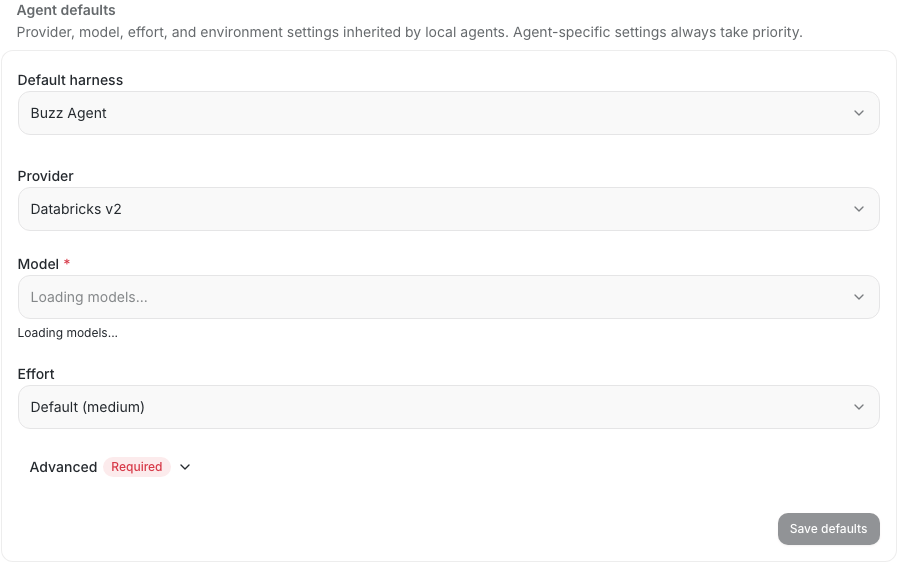 | 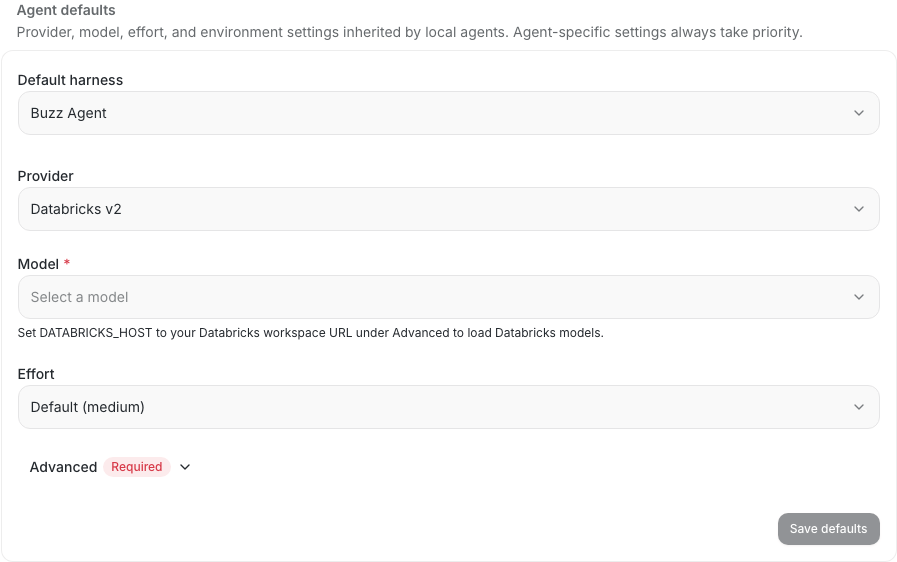 | ### Related issue None found. Searched open PRs that touch `personaModelDiscoveryStatus` / `usePersonaModelDiscovery`, and issues mentioning "loading models". ### Testing - New jsdom test drives the real `usePersonaModelDiscovery` hook with a rejected `DATABRICKS_MODEL required` discovery. It asserts that loading settles and that the status names `DATABRICKS_HOST`. On `main` the test fails (`modelDiscoveryLoading` stays `true`), and it passes with this change. - Updated unit tests in `personaModelDiscoveryStatus.test.mjs`. - `pnpm test` in `desktop/` passes (6834 + 161 tests). `tsc --noEmit` and biome are clean. - Exercised in the desktop e2e build with the mock bridge (screenshots above). Not yet exercised in the real Tauri app. Signed-off-by: Fizz <6be7be23ec5bba868f3e1db5ec86013d76bd1a293dce5b435a192158fec13641@buzz.block.builderlab.xyz> Co-authored-by: Fizz <6be7be23ec5bba868f3e1db5ec86013d76bd1a293dce5b435a192158fec13641@buzz.block.builderlab.xyz> |
||
|
Will Pfleger
|
7e6461242a |
feat(audio-client): accept a client request in connect (#8497)
## Summary Related: [block/buzz-app#1424](https://github.com/block/buzz-app/pull/1424) (native federated sessions; attaches the assertion on Huddle audio once this lands) `buzz_audio_client::connection::connect` took the audio URL as `&str`, so a host had no way to add headers to the WebSocket upgrade. buzz-app needs to send its NIP-FI user assertion (`Nostr-Federated-Identity: Bearer <jwt>`) on the Huddle audio socket. The relay checks NIP-FI when the audio connection upgrades (`audio/handler.rs` → `check_nip_fi_at_upgrade`). This PR widens the parameter to `impl IntoClientRequest + Unpin`, the same bound `connect_async_tls_with_config` already takes. Nothing else changes: TLS, timeouts and the NIP-42 handshake work as before. Existing `&str`/`&String` callers, including `desktop/src-tauri/src/huddle/relay_api.rs`, compile unchanged. --------- Signed-off-by: Will Pfleger <wpfleger@block.xyz> Co-authored-by: Duncan <dcfd242e557282d7a1e2cf2e6877522682f1e5c6156dc92ca7d90eaedd3b0f95@buzz.block.builderlab.xyz> |
||
|
Tom Brow
|
93114b4279 |
fix(mobile): lazily lay out new-DM recipients (#8435)
The new-message picker laid out every recipient inside an outer scroll view. Searching or changing selection could therefore mount the whole directory in one frame. Use a bounded sliver viewport so offscreen recipients stay lazy while the search field and selection chips still scroll above the keyboard. ### Validation - Current-head CI passed, including all Flutter test shards, Android, and native/release Swift jobs. Code and security reviews found no issues. After merging main and retaining both test imports, all 81 channel-page tests and the full mobile check/test suite passed. - Added a 200-person widget regression: the original mounts all 200 rows; the fix keeps fewer than 30 mounted through open, search, selection and removal, and can scroll to the final recipient. Covers no-match and closing too. - Strengthened the keyboard/chip test to verify the eight-recipient limit and that removing a chip makes the ninth recipient reachable. - All 79 channel-page tests passed; the strengthened limit test and Flutter analysis passed. - Native iOS simulator build passed. On a separately cloned paired simulator, verified populated directory/search, eight selected recipients, limit message, removal, no-match, scrolling to the final recipient and close without creating a conversation. Debug/AX instrumentation and a newer Flutter baseline make this functional validation, not a controlled release-speed benchmark. - Normal pre-push mobile checks passed, including formatting, analysis and the full Flutter test suite. Required CI exposed existing formatting in `message_carousel_preview_cases.dart`; a separate formatter-only commit corrects it. - The full local repository gate hit an unrelated Rust failure in `buzz-acp::signals_cancel_startup_turn_and_pending_stdin_without_hanging` (exit status `None` rather than `Some(143)`). No Rust code changed. The gate stopped at unit tests, so later build stages did not run. ### Related issue No duplicate recipient-layout fix found in the existing issue/PR search. ### Before and after The synthetic 200-person picker renders identically before and after (with a reserved keyboard inset). One image represents both; mounted-row assertions establish the performance mechanism separately. 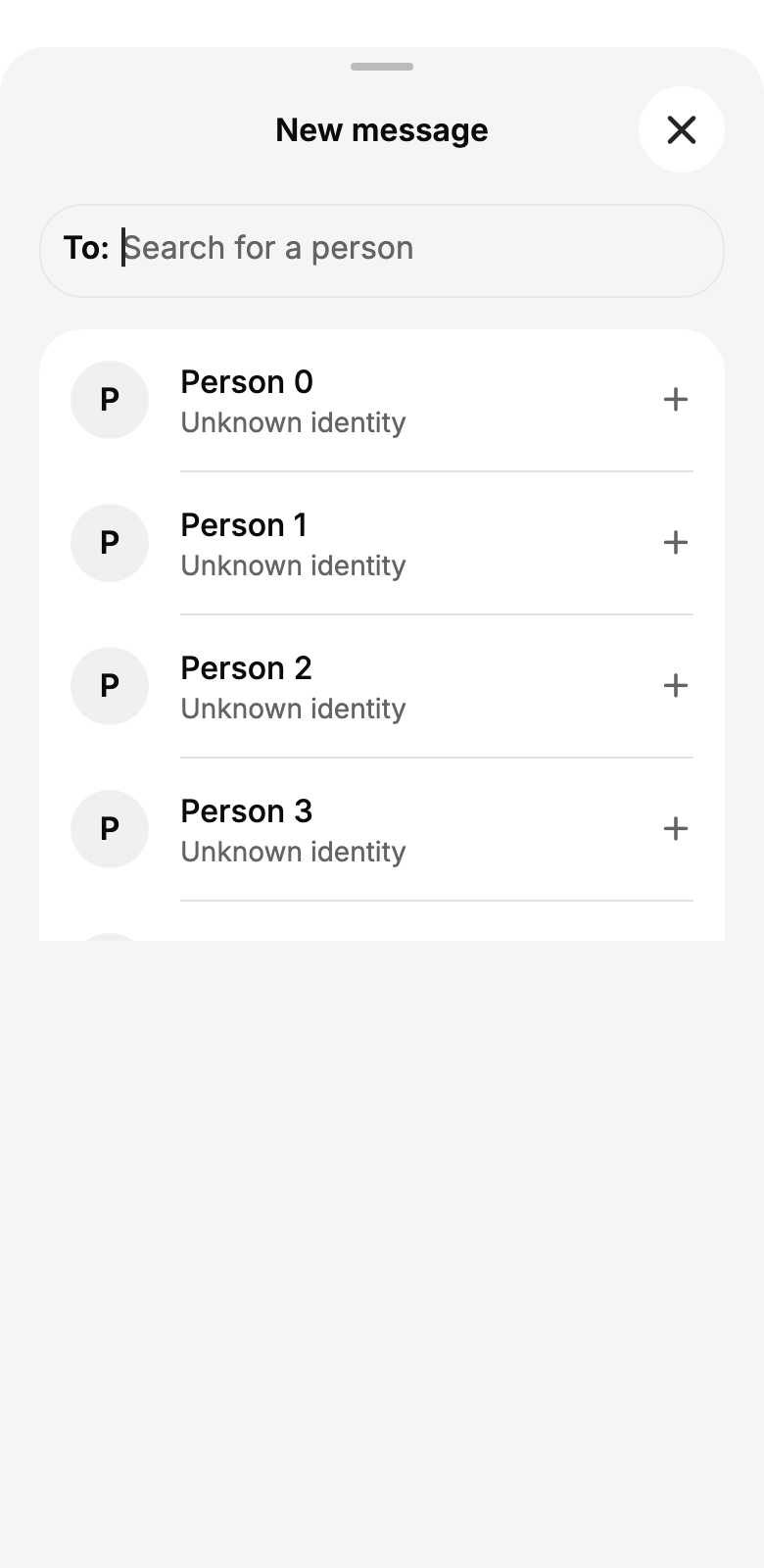 --------- Signed-off-by: Tom Brow <tomb@block.xyz> |
||
|
Tom Brow
|
bf4a163510 |
fix(mobile): lazily lay out channel member groups (#8437)
Opening a large channel member sheet mounted and laid out every person in a grouped column. A captured Debug simulator entrance spent 242 ms in the UI callback, including 223 ms in layout. Build each person and agent as a lazy sliver row while preserving the grouped cards, names, statuses, management menus, and activity actions. Screen-reader row indices continue across both groups. A separate formatting-only commit fixes an existing carousel-test formatter discrepancy. No duplicate member-sheet performance PR or issue found. ### Validation - Added a 200-member widget regression: the original mounts 100 people initially; the fix mounts fewer than 20 nearby rows and reaches the final person and agent. - Added grouping, compact sizing, empty state, member tap identity, accessible indices, and scrolled member/agent menu checks. Existing channel-details “See all” navigation test passes. - Mobile formatting, static analysis, and the full mobile test suite passed on the committed tree. - Synthetic before/after rendering is pixel-identical at the same viewport. - Populated native iOS 26.5 simulator workflow: open members, scroll through people and agents to the end, then close. Final installed build passed this workflow. Debug, accessibility automation, profiler overhead, different Flutter versions, and shared-host load limit timing conclusions. This removes eager offscreen layout; it does not establish a controlled end-to-end speedup or release-device performance. ### Visual check Synthetic member sheet; before and after are pixel-identical at this viewport. 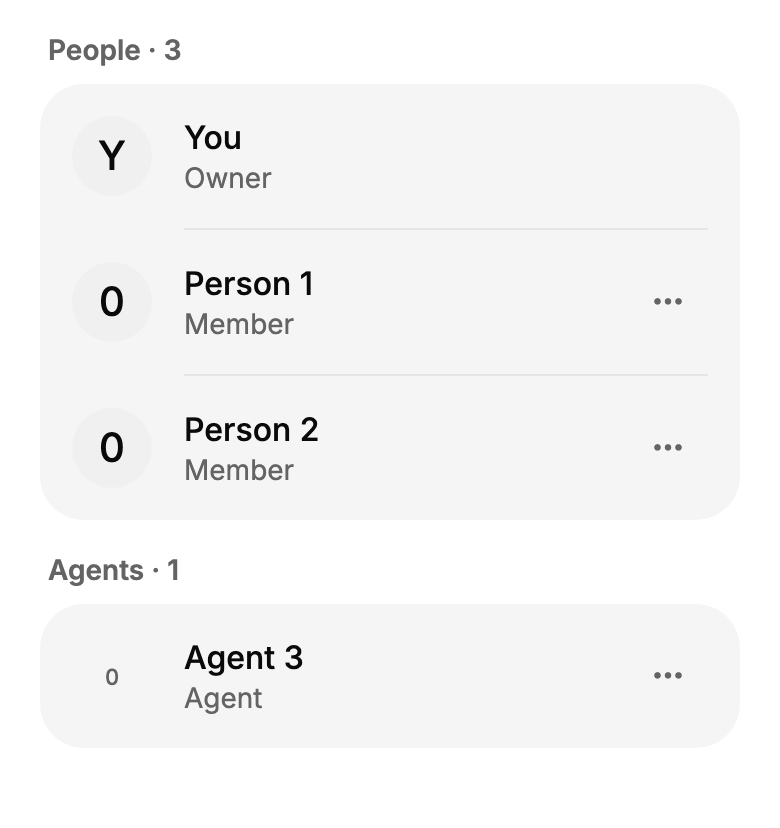 --------- Signed-off-by: Tom Brow <tomb@block.xyz> |
||
|
Tom Brow
|
a93f3282cc |
perf(mobile): retain preference crypto across reconnects (#8442)
Foreground reconnects rebuild preference managers and repeatedly derive the same NIP-44 keys on the UI isolate. Retain the six crypto objects in providers scoped to relay configuration and identity while preserving manager refresh, subscription, and publication behavior. Community changes, key rotation, and sign-out invalidate the retained objects. RelayConfig normalizes the signing key once at its shared accessor, so identity, theme encryption, event signing, and NIP-42 authentication receive the same value, including when an active configuration key has surrounding whitespace. The identity-export authorization snapshot uses the same normalized key for the active-identity check and the outgoing recovery payload. The branch incorporates main's relay-scoped preference managers. ### Validation - Regression exercises six production crypto providers across reconnects, configuration/key changes, and sign-out. Reintroducing a session dependency makes it fail. - Added a loopback WebSocket regression that exercises actual RelaySocket NIP-42 authentication with a padded key and verifies its challenge, relay, pubkey and signature. It fails before shared key normalization. - Added a connected-theme regression for whitespace-padded keys, encryption round-trip, and a valid published event signature. It fails before the normalization fix. - Added padded-key identity export coverage through authorization, SAS confirmation, exactly one normalized payload, and successful completion. Separate relay-change and key-rotation tests verify both fresh and expired grants fail closed. The padded-key regression failed before the fix. - Current head: all 48 focused pairing/crypto/auth tests and mobile analysis passed. All [CI checks](https://github.com/block/buzz/actions/runs/39497098787) passed, including mobile test shards, Android, native Swift tests and release builds. Codex feedback is addressed; Jude approved this exact head after independent regression and mutation checks. Fresh [Codex security review](https://github.com/block/buzz/pull/8442#issuecomment-6300273942) found no concrete issues. - Previous head: 122 config/socket/crypto/theme tests, 44 read-state tests, and all [GitHub CI checks](https://github.com/block/buzz/actions/runs/39491550425) passed, including mobile test shards, Android, native Swift tests and release builds. - Original implementation: native iOS Debug build and full local repository checks passed. A paired simulator background/resume capture had no samples in the targeted crypto constructors or key derivation; an 82 ms UI frame remained. Debug/JIT, profiler overhead and shared-host activity prevent an overall speedup claim. The later normalization change is covered by the production-provider regression above. - Two image decode timing failures occurred in the initial local full suite; direct baseline/patch runs, the subsequent full repository run, and the latest full mobile suite passed. Cold-start credential validation is unchanged: padded persisted keys are rejected by AuthNotifier before RelayConfig is constructed. The normalization regressions cover active configurations and identity export, not broader persisted-key acceptance. <!-- buzz-review-completed --> --------- Signed-off-by: Tom Brow <tomb@block.xyz> |
||
|
Diem Nguyen
|
8bbfe44f77 |
fix(deps): bump webpki crates for RUSTSEC-2026-0381/0382/0383 (#8499)
## Summary On 2026-10-19, RustSec published three advisories against the TLS certificate crates in our lockfiles. Since then, `cargo-deny check` fails on advisories. That breaks `Security Domain / Security` on `main` and on every PR that runs the Rust security job. | Advisory | Crate | Change | |---|---|---| | RUSTSEC-2026-0382 | `rustls-webpki` (distrusted intermediates) | 0.103.15 → 0.103.16 | | RUSTSEC-2026-0381 | `webpki-roots` (distrusted emSign roots) | 1.0.7/1.0.8 → 1.0.10 | | RUSTSEC-2026-0383 | `webpki-root-certs` (same roots) | 1.0.7/1.0.8 → 1.0.10 | This PR bumps all three in `Cargo.lock` and `desktop/src-tauri/Cargo.lock`. Only these packages change. `webpki-roots 0.26.11` stays because `tokio-tungstenite` 0.28/0.29 (via axum and nostr-sdk) still require `^0.26`, and no patched 0.26 release exists. 0.26.11 is a semver-trick shim that bundles no certificates of its own. It re-exports `webpki-roots` 1, which now resolves to the patched 1.0.10. `deny.toml` ignores RUSTSEC-2026-0381 for that shim and explains why. The ignore should come out once those consumers move to `webpki-roots` 1. ### Related issue N/A. I searched for open PRs bumping these crates and found none. ### Testing - `cargo-deny check`: `advisories ok, bans ok, licenses ok, sources ok`. On `origin/main` it reports `advisories FAILED`. - `cargo check --locked -p buzz-ws-client -p buzz-cli -p buzz-relay` passes. - The pre-push hook's Rust unit tests pass. Signed-off-by: Fizz <6be7be23ec5bba868f3e1db5ec86013d76bd1a293dce5b435a192158fec13641@buzz.block.builderlab.xyz> Co-authored-by: Fizz <6be7be23ec5bba868f3e1db5ec86013d76bd1a293dce5b435a192158fec13641@buzz.block.builderlab.xyz> |
||
|
klopez4212
|
ca35114209 |
fix(mobile): simplify and refine the quick actions menu (#8491)
Keeps the mobile + menu focused on Create channel and New direct message, with 8-point facing corners, a 6-point gap, and the active Home/Solo tab fill on iOS. Moves Browse channels directly above the channel list, including its empty state, preserving open-channel discovery, retry, and Join. Adds a cold-start journey through the real channel loader and join action with relay boundaries faked. Validation: mobile formatting/analysis and full mobile test suite; mutation check confirms the new journey fails when directory loading is removed. The original menu styling was tried on a physical iPhone; the replacement Browse entry has widget-journey coverage and has not yet been tried on device. --------- Signed-off-by: kenny lopez <klopez4212@gmail.com> Co-authored-by: Terp <5856f6900e8e0a4e0ea1f4f8d2ee33e4753d2119bc122f94ecafc660b46c0511@buzz.block.builderlab.xyz> |
||
|
Jason Holmes
|
a5767c67de |
fix(sdk): reject malformed mention pubkeys before signing p tags (#6372)
## Summary `buzz_sdk::builders::mention_tags` lowercased whatever string it was handed and pushed it straight into a `p` tag, so malformed mention pubkeys were signed onto real events. A composer that mentioned someone this way looked successful while notifying nobody, and the bad tag propagated to every relay and client that read it. Reproduced before fixing: `""`, `"not-a-pubkey"`, `"zzzz"`, `"../../etc/passwd"`, and 63/65-character strings were all accepted and emitted verbatim as `p` tags by `build_message` and `build_forum_post`. Fixes #6291 ## Acceptance criteria → evidence Following @kiranmagic7's [recommendation on the issue](https://github.com/block/buzz/issues/6291): | # | Criterion | Evidence | |---|---|---| | 1 | Validate in the **private `mention_tags`**, not the public `normalize_mention_pubkeys` | `crates/buzz-sdk/src/builders.rs` — the single changed line inside `fn mention_tags`. `normalize_mention_pubkeys` is untouched, so no public signature changes. | | 2 | Reuse the existing **`check_pubkey_hex`** helper | `let lower = check_pubkey_hex(hex, "mention pubkey")?;` replaces `hex.to_ascii_lowercase()`. No new helper added. | | 3 | Reuse the existing **`SdkError::InvalidInput`** | `check_pubkey_hex` already returns `InvalidInput`; no new error variant is introduced. | | 4 | Cover all **3 builders** | `malformed_mention_pubkeys_are_refused_by_every_builder` asserts against `build_message`, `build_forum_post`, **and** `build_forum_comment` — all three share `mention_tags`. | | 5 | Reject **empty / non-hex / 63-char / 65-char** | Same test's table: `""`, `"not-a-pubkey"`, `"zzzz"`, `"../../etc/passwd"`, `"a"*63`, `"a"*65`, plus `"z"*64` and a 64-char path-like string so a length-only check cannot pass. | | 6 | Preserve valid **uppercase canonicalization** | `valid_mentions_are_canonicalized_and_deduped_across_case` — uppercase hex is accepted and the emitted `p` tag is lowercase, across all three builders. | | 7 | Preserve valid **dedupe** | Same test: the same pubkey in both spellings collapses to exactly one `p` tag. Pre-existing `message_mentions_deduped` still passes. | | 8 | Preserve **`TooManyMentions` precedence** for >50 | `too_many_mentions_takes_precedence_over_validation` — a 51-entry list that also contains a malformed entry still returns `TooManyMentions`. The cap check stays ahead of validation. `mentions_at_the_cap_still_sign` pins that the boundary itself did not move. | | 9 | Inspect **#3036 overlap**; keep the patch narrow | See the compatibility note below. | | 10 | Make these tests actually **gate** | `Justfile` + `scripts/run-tests.sh` — see "Why the runner change is here". | Out of scope by design: switching to `nostr::PublicKey::from_hex`. Its stricter on-curve rule would change every one of `check_pubkey_hex`'s ~26 call sites, which is a repo-wide consistency decision rather than part of this fix. The doc comment records that reasoning. ## Why validation lives in `mention_tags` `mention_tags` is the single choke point every mention reaches, shared by all three builders, and callers can hand those builders an explicit list without ever going through `normalize_mention_pubkeys`. Validating here closes that bypass without breaking the normalizer's public API. This also aligns the SDK with behavior already shipping elsewhere: desktop's own `events.rs::mention_tags` already validates with `check_pubkey` on the identical structural rule (64 ASCII hex). The SDK was the inconsistent one. One malformed entry refuses the whole list rather than being filtered out — a silently dropped mention is precisely the failure being fixed, and filtering would preserve it. ## Why the runner change is here Adding `buzz-sdk` to `just test-unit` and the mirrored `scripts/run-tests.sh` fallback is a CI-behavior change, so it deserves its own justification: **without it the regression tests above would never run in CI.** `buzz-sdk` is a workspace member, so it was getting `clippy` and `check`, but no CI job executed a single one of its tests. This is the exact hazard the `Justfile` already warns about for other crates — *"nothing in CI runs `cargo test --workspace` — workspace membership alone buys clippy/check, not a single executed test."* Verified with a positive/negative control rather than by reading the config: - **Negative control** — with the runner files at pristine `main` and a deliberately panicking `buzz-sdk` test in the tree, `just test-unit` exited **0** and printed "All tests passed!". The crate name never appeared in the log. - **Positive control** — same sabotaged test, with only these two runner edits applied: `just test-unit` exited **1** with `buzz-sdk tests FAILED`. The sabotage test was removed afterward; it is not part of this PR. Both entries are needed because the two lists (nextest path and the no-nextest fallback) must stay in step. This is scoped strictly to making the crate's existing tests execute — no other CI behavior is touched. ## Compatibility with #3036 #3036 (`fix/nip10-reply-p-tags`) also edits `mention_tags`: it adds `parent_author: Option<PublicKey>` to `ThreadRef`, emits a parent-author `p` tag in `thread_tags`, and seeds `mention_tags`'s dedup set from `p` tags already on `tags`. This PR replaces only the `let lower = ...` line inside the loop, so the two changes are compatible in substance. Mechanically, whichever lands second needs the trivial merge fixup: #3036 adds `parent_author: None` to every `ThreadRef` literal, including the ones in the tests added here. One correction to the paragraph above, from an independent merge trial: the fixup is not *only* the `parent_author: None` additions. Merging #3036 into this head also produces one **textual conflict in `crates/buzz-sdk/src/builders.rs`**, confined to the `mention_tags` doc comment — both branches rewrote it, this PR to explain the validation and #3036 to explain the seeded dedup set. The resolution is to keep both blocks; there is no logic conflict, since this PR changes the `let lower = ...` line and #3036 changes the `seen` initializer. For reference, merging #3036 into plain `main` leaves `builders.rs` auto-merging cleanly, so this conflict is specific to the combination. Once the doc comment is resolved and `parent_author: None` is added to the three new `ThreadRef` literals here, `buzz-sdk` compiles and the only failing test is #3036's own `self_reply_drops_the_parent_p_tag` — which fails identically with #3036 merged into `main` **without** this PR, because `build_message` gained `.allow_self_tagging()` in #4975 after #3036's merge base. ## Test plan - [x] `cargo test -p buzz-sdk` — **267 passed, 0 failed** (5 new tests; pre-existing `message_mentions_deduped`, `message_too_many_mentions`, and the three `*_preserves_self_mention_p_tag` tests still green) - [x] `cargo fmt --all -- --check` — clean - [x] `just clippy` (workspace, `-D warnings`) — clean - [x] `just test-unit` — all 10 steps pass, now including `buzz-sdk` - [x] `just file-size-check` — pass - [x] `just desktop-tauri-fmt-check` / `desktop-tauri-check` / `desktop-tauri-test` — pass (2684 tests; `desktop/src-tauri` consumes `buzz-sdk`) - [x] Full `just ci` — the remaining steps are JS/Dart (`desktop-test`, `desktop-build`, `web-build`, `mobile-test`); this change touches only Rust + two runner scripts, so CI covers them here All gate results above were confirmed at commit `5fe5929de39388cada354593ac875d3c42c3d830`. ## Open questions for maintainers Out of draft and ready for review. Two calls I'd like from a maintainer: 1. **Do the runner entries belong here?** Adding `buzz-sdk` to `just test-unit` and `scripts/run-tests.sh` is a CI-behavior change riding along with a bug fix. I kept it because without it the regression tests above never execute in CI (controls in the section above), but I'll split it into its own PR on request. 2. **Is leaving `check_pubkey_hex` alone right for now?** Switching to `nostr::PublicKey::from_hex` would add an on-curve check but changes the contract at all ~26 call sites, which reads as a separate repo-wide decision rather than part of this fix. ### A note on CI The only check reporting here is **DCO Check** (pass). `CI`, `Desktop Release Candidate`, and `Docker image` are all sitting in `action_required` because this PR comes from a fork — a maintainer has to approve the workflow run before they execute. That's the standard first-time-contributor gate, not a failure, and I can't clear it from my side. Every gate result in the test plan above is from local runs at `5fe5929de39388cada354593ac875d3c42c3d830`, so CI has not independently confirmed them yet. Signed-off-by: rust worker <cb8459a6e4c936835834cef03b8331fe806108dd03da97d39c7036a7d710e860@buzz.block.builderlab.xyz> Signed-off-by: Jason Holmes <holmes@squareup.com> Co-authored-by: rust worker <cb8459a6e4c936835834cef03b8331fe806108dd03da97d39c7036a7d710e860@buzz.block.builderlab.xyz> |
||
|
Tom Brow
|
cdc2b129c0 |
fix(mobile): resolve DM display labels once per sort (#8488)
Home's DM sort resolves participant identity names again for every comparator call. This work appeared in a captured 82.163 ms UI frame after foregrounding the full app (Debug/JIT iOS simulator, shared host). Resolve each lowercase display label once per sort, retaining the same label ordering and channel-ID tie-breaker. Sort keys are invocation-local, so later viewer, profile, owner, participant, and community changes cannot reuse stale labels. No matching open mobile sorting PR or issue found. ### Validation - Added synthetic regression coverage for bounded contextual resolution and ordering parity across identity/name/channel changes, ties, unnamed DMs, and empty/singleton lists. The 80-DM fixture performs 80 contextual resolutions instead of the original comparator’s 982; restoring that comparator makes the regression fail. - 133 focused tests passed, including existing Home scrolling/reconnect widget tests and identity-name tests. - Mobile static analysis passed; 3,697 tests passed with 16 existing skips, plus four no-gateway configuration tests. - No new full-app or hardware capture. The existing trace establishes repeated synchronous work, not its release-build magnitude or the cause of every scrolling stall. Signed-off-by: Tom Brow <tomb@block.xyz> |
||
|
Luke Tornquist
|
fcdabcf774 |
docs(db): database target architecture and schema-change rules (#8273)
## Summary Adds `docs/database.md`, which covers two things: - **The target architecture.** `schema/tables/public/` is the declarative source of truth, written within the constraints that out-of-band, online schema tools can apply. Deployments at scale apply schema changes out of band; auto-migration stays supported for smaller and self-hosted deployments, and `migrations/` stays. The database has no triggers, functions, or foreign keys; that behavior lives in the owning application transaction or in durable application work. Data repair runs through the backfill framework in `docs/data-backfills.md`, not through migrations. - **Rules for schema changes made now:** 1. Add no triggers, functions, procedures, rules, or foreign keys, with no exceptions. New tenant-owned tables are fenced by community admission in the application. Startup and deletion validation already tolerate missing fences, but desired-state bootstraps still attach a fence trigger to every `community_id` table, so a new tenant-owned table is blocked until that loop stops (part of the fence-retirement work). The doc includes checklists for adding a tenant-owned table and a provenance-only table. 2. Migrations change schema only. They never mutate existing rows. Until the backfill framework ships, a repair may be a reviewed, idempotent, batched one-off script in `scripts/maintenance/` that takes the community deletion lock and touches only active communities. A repair that writes historical channel events must keep replica routing closed until its WAL has replayed. 3. Update every schema location: `migrations/`, `schema/tables/public/`, the manifest and sibling directories, the pgschema reconcile script where it applies, and both homes of the existing `push_gateway_*` tables (the target is for the gateway to own its tables alone). Never edit a merged migration. Add catalog-level parity tests for what you touch. 4. Every migration must be safe for the relay that is currently deployed, under both supported modes: auto-migration at startup and out-of-band application. Either way the old relay runs against the new schema for a while. Because auto-migration can apply expand and contract in one boot, a contract migration must fail closed when its backfill has not run, and a contract that depends on a writer release (such as dropping a trigger whose work moved into the app) must name that release as a required stop in the release notes, because no row check can prove it. The order is expand, deploy, backfill, then contract. The doc includes a table of changes that break the old relay and the safe form of each. 5. Bound every lock, build `migrations/` indexes concurrently (the declarative schema uses plain `CREATE INDEX`), and keep changes within what out-of-band apply can make online. AGENTS.md (Product Contract), ARCHITECTURE.md (buzz-db), and new path-local `migrations/AGENTS.md`, `schema/AGENTS.md` (a pointer), and `crates/buzz-push-gateway/migrations/AGENTS.md` point to the doc. The path-local files mean agents editing those directories get the rules automatically. AGENTS.md also had a stale claim that migrations are "auto-applied on relay startup". This PR corrects it: `BUZZ_AUTO_MIGRATE` defaults off in the binary and on in the Helm chart, and both modes are supported. ## What got simpler The rules were scattered across `schema/schema.sql` comments, AGENTS.md Common Gotcha #7, the backfill spec, `docs/thread-window-deployment.md`, and test names. They now live in one document, and the rest link to it. No code changes. ## Testing This PR changes documentation only. I checked links and diffs, and every claim in the doc points to code at the base commit: the layout and parity tests in `crates/buzz-db/src/runtime/migration.rs`, `EXPECTED_SCOPED_TABLES` and the serving-catalog check in `crates/buzz-db/src/store/deletion.rs`, and `BUZZ_AUTO_MIGRATE` in `crates/buzz-relay/src/main.rs`. The new `AGENTS.md` files aren't `.sql`, so neither the sqlx migrator nor the schema layout test picks them up; CI's layout, migration-count, and deletion-parity tests pass. At an earlier head, a real relay against isolated PostgreSQL 17 showed that a new unfenced `community_id` table serves normally and makes community deletion report `unknown=<table>`. Since then, the fence requirement at startup was removed on main; the doc now cites `migration_schema_fence_objects_are_optional_for_serving_and_deletion` for that. --------- Signed-off-by: Elrond <28d6302a099e5225b02c4155ac4236e4912603df2ab08dbfc2f4fef08ce598c8@buzz.block.builderlab.xyz> Co-authored-by: Elrond <28d6302a099e5225b02c4155ac4236e4912603df2ab08dbfc2f4fef08ce598c8@buzz.block.builderlab.xyz> |
||
|
klopez4212
|
5fefec604f |
fix(mobile): restore channel icons and align chat colors with desktop (#8478)
## Summary - Restores `#` and lock icons for public and private channels on Home, with matching loading placeholders. - Updates the dark-mode navigation colors to the desktop design-system tokens (read and unread text, section headings). - Replaces the chat color picker with the seven desktop accents (Gray, Chartreuse, Flame, Magenta, Iris, Cobalt, Jade). Saved legacy colors map to the closest one. - Uses white text in your own bubbles, and black where white falls below 4.5:1 (Chartreuse, dark-mode Gray). Links (underlined), quotes, tables and code use the same text color. - Insets code blocks in bubbles evenly, with corners concentric to the bubble and even inner padding. - The swipe-to-reply indicator uses the chosen chat color. ## Testing - `flutter analyze` and `dart format` are clean. The full mobile suite passes (3,705 tests). - Installed and checked on a Pixel 10 and an iPhone Air against a real community. 🤖 Generated with [Claude Code](https://claude.com/claude-code) --------- Signed-off-by: kenny lopez <klopez4212@gmail.com> Co-authored-by: Terp <5856f6900e8e0a4e0ea1f4f8d2ee33e4753d2119bc122f94ecafc660b46c0511@buzz.block.builderlab.xyz> Co-authored-by: Queue <874bf2d815c2c4b459b90438c669c57f2702f3a76bb6e16fa97184259aac3e9e@buzz.block.builderlab.xyz> Co-authored-by: Claude Opus 5.5 <noreply@anthropic.com> |
||
|
Diem Nguyen
|
0b53fc699d |
test(desktop): read only the open effort menu in effort-picker e2e (#8476)
## Summary
`menuValues()` in `claude-effort-picker.spec.ts` read every
`menuitemradio` on the page right after it opened a menu. Dropdown menus
stay mounted for their 100ms exit animation
(`POPOVER_RADIX_MOTION_CLASS`). That means the model menu, which
`pick()` had just closed, could still be in the DOM, and its rows ended
up in the effort list:

```
- Expected  - 0
+ Received  + 6
+   "Default model (Opus)", "Opus", "Claude Sonnet 5", "Haiku", "Claude Opus 4.8", "Custom model...",
    "Adapter default", "max",
```

The helper now waits for the trigger to report `aria-expanded="true"`,
then reads rows only from the menu named in its `aria-controls`. The fix
only touches the test; no product code changes.

### Related issue
The flake was introduced with the spec in #8059. In CI it failed
`Desktop Smoke E2E (2)` on #8473 (all three attempts,
[job](https://github.com/block/buzz/actions/runs/39336482034/job/118347673219))
and failed once before passing on retry on #8474.

### Testing
- **Forced repro.** I temporarily stretched the closed-menu exit
animation to 1500ms using `page.addStyleTag` (not committed):
  - Before: 5/5 failed with the same `toEqual` diff.
  - After: 5/5 passed.
- **Natural repeats.** I ran `--repeat-each` locally with 3–4 workers,
100 runs on each version:
  - Before: 3 failures from the menu-row leak.
  - After: 0.
- Both versions also had the same local-only startup timeouts (`waiting
for getByTestId('open-agents-view')`), which this change doesn't affect.
- **Full spec.** `pnpm exec playwright test --project=smoke
tests/e2e/claude-effort-picker.spec.ts`: 27 passed.
- `biome check` is clean.

Signed-off-by: Fizz <6be7be23ec5bba868f3e1db5ec86013d76bd1a293dce5b435a192158fec13641@buzz.block.builderlab.xyz>
Co-authored-by: Fizz <6be7be23ec5bba868f3e1db5ec86013d76bd1a293dce5b435a192158fec13641@buzz.block.builderlab.xyz>
|
||
|
Ian Oberst
|
ca3be55018 |
fix(relay): advance the partition catch-all by default (#8464)
## Summary

The migrations leave `events` and `delivery_log` with a catch-all
partition that already covers every month from 2026-07. Only catch-all
advancement replaces it with monthly partitions. Advancement was off by
default, so any deployment that left out
`BUZZ_PARTITION_MANAGER_ADVANCE_ENABLED` routed every new row into the
catch-all. An operator then had to repair it by hand: drain the
catch-all, swap it for monthly partitions, and re-attach. This has
already happened in one staging environment.

- **Advancement on by default.**
`BUZZ_PARTITION_MANAGER_ADVANCE_ENABLED` now defaults to `true`, and an
explicit `false` still disables it.
`BUZZ_PARTITION_MANAGER_CREATE_ENABLED=false` remains the kill switch
for all automatic partition DDL.
- **Prompt retry while the current month routes to the catch-all.** If a
startup or periodic pass leaves the current month routed to an empty
catch-all that the maintenance planner would replace, the audit loop
retries on its existing backoff. That is 5 s, doubling to a 60 s cap,
for at most 8 retries (about 5 minutes). After that it returns to
`BUZZ_PARTITION_AUDIT_INTERVAL_SECS`. Before this change, a failed first
pass, such as a lock timeout during a rollout, waited the full 15
minutes.
- The routine monthly advance, where only the last lookahead month falls
into the catch-all, stays on the normal interval. Each attempt queues an
`ACCESS EXCLUSIVE` request on the parent, so it shouldn't be retried
without urgency.
  - The budget resets once the catch-all no longer awaits advancement.
  - A failed attempt keeps the last known state.
- Layouts the planner refuses, such as a catch-all that holds rows, need
an operator, so they are never retried early. Neither is a policy with
create or advance disabled.
- The check is `PartitionTableAudit::awaits_catch_all_advance(policy)`,
plus a `PartitionAudit` helper that applies it to every table. It is
derived from `plan_maintenance`, so it can't drift from the planner's
rules.
- **Fresh-install test.** A new `#[ignore = "requires Postgres"]` test
runs every migration in a dedicated database. It checks that both tables
start out waiting on the catch-all and that create-only maintenance does
not fix them. It then checks that the first pass with advancement
produces canonical monthlies, an empty `{table}_p_future`, trigger
parity and a non-degraded audit, and that a second pass is a no-op.

### Related issue

None found.

### Testing

**Automated:**
- `cargo test -p buzz-db --lib partition`, including `--ignored` against
local Postgres: 21 unit tests and 55 Postgres tests pass.
- `cargo test -p buzz-relay` for the config tests and the partition
schedule tests passes.
- `cargo clippy -p buzz-db -p buzz-relay --all-targets -- -D warnings`
and `cargo fmt --check` are clean.
- Mutation checks on `awaits_catch_all_advance`. Each fails the new unit
test:
  - matching any window month instead of the current month;
  - replacing the planner check with the policy flags alone;
  - short-circuiting the current-month gate.

**Local relay** (`BUZZ_AUTO_MIGRATE=true`, no advance env var):
- **Fresh database:** startup committed `advanced` for both tables,
creating `p2026_07` through `p2027_04` plus `_p_future`.
- **Failed first pass:** I held `LOCK TABLE ONLY communities IN SHARE
ROW EXCLUSIVE MODE` for 4 s across startup. The startup pass failed with
`lock_timeout` at 17:07:20.8, and the first periodic retry committed
`advanced` for both tables at 17:07:29.

🤖 Generated with [Claude Code](https://claude.com/claude-code)

---------

Signed-off-by: Ian Oberst <ioberst@block.xyz>
Co-authored-by: Ian Oberst <ioberst@block.xyz>
Co-authored-by: Claude Opus 5.5 <noreply@anthropic.com>
|
||
|
Luke Tornquist
|
039e1c8d59 |
feat(relay): write the NIP-43 member list in the membership transaction (#8482)
## Summary The relay-signed NIP-43 member list (kind:13534) was published after each membership change had already committed. If that publish failed, or if a change never republished at all (startup `bootstrap_owner`), the list stayed wrong until the background reconcile sweep found and fixed it. #8467 moved that sweep off the startup path. This PR removes the reason the sweep exists. Now every `buzz-db` function that changes `relay_members` writes the new list **in the same transaction**, as its last statement before commit: - It takes the per-community list lock last, reads the members, signs the list, retires the old one and inserts the new one. - If the list write fails, the membership change rolls back and the caller gets an error. - A call that changes nothing (already a member, role mismatch, host exists, limit reached) writes no list. The functions return `MembershipWrite<T> { outcome, snapshot }`. Callers push `snapshot` to live subscribers after commit. That push is the only thing left outside the transaction; if it fails, live clients see the change on their next fetch, and the stored list is already correct. Write paths covered (RPR #2, every write path): `add_relay_member`, `claim_relay_membership`, `claim_relay_invite`, `remove_relay_member`, `remove_relay_member_if_role`, `update_relay_member_role`, `bootstrap_owner` / `provision_owner`, `transfer_ownership`, `backfill_from_allowlist`, and the owner insert in `create_community_with_owner[_and_nip_fi_issuers]`. Community deletion removes the members together with the community, so it writes no list. The relay keypair is passed in explicitly instead of being stored on `Db`, so the compiler finds every caller. ### Behavior changes - **Open relays get an accurate list too.** Provisioning and ownership transfer used to publish only when `require_relay_membership` was on. The write is now unconditional. - **Same-second changes can't reuse an id.** The list's `created_at` is one second past the newest earlier list for that community, including retired ones, or the current time if that is later. Before, adding and then removing a member in the same second could produce an event with the same id as an earlier list. The insert then failed, and the stale list stayed live. A burst of changes can push `created_at` ahead of the clock by up to one second per change; it returns to the clock once the burst ends. - **`buzz-admin add-member` / `remove-member`** no longer build their own list (`publish_membership_list_with_bump` is deleted). They push the list the database wrote. Concurrent CLI runs now serialize on the database lock rather than depending on `run.sh` running one at a time. - **Owner mutations lock the community row `FOR NO KEY UPDATE`.** `transfer_ownership` and `bootstrap_owner` used `FOR UPDATE`. The list insert takes `FOR KEY SHARE` on that row through `events.community_id`'s foreign key, so a repair holding the list lock, or a removal or role update holding a member row, deadlocked with a concurrent owner change. `FOR NO KEY UPDATE` still conflicts with archive, unarchive and deletion admission, so the lifecycle ordering is unchanged. - **Startup delivers its list to other replicas.** When backfill or `bootstrap_owner` changes members at startup, the relay fans the newest list out through pub/sub once its state is ready, so clients connected to other replicas during a rolling deploy see an owner rotation without a refetch. - **New `buzz-admin republish-members`.** Rewrites the community's list from the stored members in one community-write transaction and pushes it live. This replaces the sweep as the repair for a list that is missing or stale: a `relay_members` change made directly in SQL, a restore, or a deployment that turns on `BUZZ_REQUIRE_RELAY_MEMBERSHIP` after running without it. ## Rollout Nothing rewrites a list automatically once the sweep is gone. A community whose list drifted before this deploys stays wrong until its next membership change or until an operator runs `buzz-admin republish-members`. Either deploy #8467 and let its sweep complete one pass first, or run `republish-members` for each community after this deploys. The command repairs only the community that `RELAY_URL` maps to, so on a relay hosting many communities, run it once per community host. ## What got simpler Deleted: - `reconcile_nip43_membership_snapshots`, `spawn_nip43_membership_reconciler`, its leader lock key and #8467's standby retry - the three `nip43_membership_snapshot_needs_reconciliation*` drift reads (one already deprecated) - `publish_nip43_membership_list` / `publish_nip43_membership_locked`, the separate after-commit republish at every call site, and `buzz-admin`'s duplicate publisher - the reconcile metrics `buzz_nip43_membership_reconciliations_total` and `buzz_nip43_membership_reconciliation_failures_total` - the after-commit publish metrics `buzz_nip43_membership_publications_total` and `buzz_nip43_membership_publication_seconds`, and the `publish_nip43_membership_locked` transaction metric label. A failed list write is now a failed membership write and shows up in the caller's existing error handling and the transaction metrics of its write path. - the `BUZZ_NIP43_RECONCILE_INTERVAL_SECS` setting There is now one way the list gets written, and it can't disagree with `relay_members` after commit. **Unused deploy config (outside this repo):** hosted deployments that set `BUZZ_NIP43_RECONCILE_INTERVAL_SECS` can drop it. It is now ignored. Dashboards or alerts on the four deleted metrics will stop receiving data. ## Testing New Postgres tests (`buzz-db`): - `relay_members::every_membership_write_commits_its_list`: for each write path, the returned list is the single live kind:13534 and names exactly the committed members. No-op calls return no list and leave the live list alone. - `relay_members::a_failed_list_write_rolls_back_the_membership_change`: holds the list lock, waits for the join to block on it, cancels that statement, and checks that the member was not added and the previous list is still live. - `relay_members::concurrent_joins_all_land_in_the_list`: 8 concurrent joins; the final list names all 8. - `relay_members::same_second_return_to_an_earlier_membership_writes_a_new_list`: add, remove, add, remove within a second; every list is newer than the last and no id repeats. - `relay_members::owner_transfer_and_list_repair_both_commit` and `relay_members::owner_transfer_and_member_removal_both_commit`: hold a repair (list lock) or removal (member row) open, wait until a transfer blocks behind it, then finish it. Both transactions commit; with `FOR UPDATE` back in place, one of them fails. - `community::create_community_with_owner_is_atomic_and_create_only` and `relay_invite::bounded_claim_exhausts_and_existing_member_retry_does_not_consume` now also check the list. Each new test was checked to fail against a mutation of the new code that brings back the old behavior (details in the thread). Stacked on #8467. Merge order: #8467, then #8468, then this. --------- Signed-off-by: Elrond <28d6302a099e5225b02c4155ac4236e4912603df2ab08dbfc2f4fef08ce598c8@buzz.block.builderlab.xyz> Co-authored-by: Elrond <28d6302a099e5225b02c4155ac4236e4912603df2ab08dbfc2f4fef08ce598c8@buzz.block.builderlab.xyz> |
||
|
Luke Tornquist
|
c99872f749 |
fix(relay): delete the startup NIP-33 d_tag backfill (#8468)
## Summary

Delete the NIP-33 `d_tag` backfill that ran on every relay boot.

On every boot, before the listener opened, the relay ran:

```sql
SELECT DISTINCT community_id FROM events
WHERE kind BETWEEN 30000 AND 39999 AND d_tag IS NULL
```

No index covers `d_tag IS NULL`. The only `d_tag` index is the partial
`idx_events_parameterized`, which is `WHERE d_tag IS NOT NULL`. So this
query scanned every partition of `events`. In production it averaged
about 11s per boot, max 19s
(`buzz_startup_phase_seconds{phase="d_tag_backfill"}`), and found
nothing.

These rows shouldn't exist anymore:
- The backfill was the one-time migration for #246, the change that
added `d_tag`.
- In `crates/buzz-db/src`, every production write path sets the column
for kinds 30000–39999 through `extract_d_tag`: the main insert,
`replaceable.rs`, `channel_members.rs`, `relay_members.rs`, and
`push.rs`. A new source test,
`every_production_event_insert_names_d_tag`, now enforces that.
- The `events` inserts that omit `d_tag` are all test fixtures.

`scripts/backfill-d-tag.sql` is still there as the manual fallback for
any database that predates #246 and somehow never booted a relay since.

### What got simpler

- Removed `Db::backfill_d_tags` and its admission test.
- Removed the source-shape assertion in `observability_source.rs`.
- Removed the `d_tag_backfill` startup phase.
- `StartupStep::ALL` is now a slice, so removing a step no longer means
editing a hand-kept array length.

### Notes

- The `buzz_startup_phase_seconds{phase="d_tag_backfill"}` series stops
reporting.
- **Rebased onto main after #8467 merged.** Both remove a startup phase.
With the fixed-length `ALL` array the two merged cleanly in git into a
17-entry `[Self; 18]`, which doesn't compile. This PR makes `ALL` a
slice.
- **Before merging**, run this read-only query against production and
confirm it returns `0`: `SELECT count(*) FROM events WHERE kind BETWEEN
30000 AND 39999 AND d_tag IS NULL`. It scans every partition, so use a
read replica. If it isn't `0`, run `scripts/backfill-d-tag.sql` first.
The cutover script copies legacy `d_tag` values as-is, so only this
query proves historical data is clean.
- **Self-hosted installs** should run the same check before upgrading.

### Related issue

None found. Companion to #8467, which also targets relay startup time.

### Testing

- New `every_production_event_insert_names_d_tag`
(`crates/buzz-db/tests/observability_source.rs`): every production
`INSERT INTO events` must name `d_tag` in its column list. Dropping
`d_tag` from `push.rs` makes it fail and name the function.
- Runtime E2E against a real relay: boot has no `d_tag_backfill` phase;
kind:30023 replacement via WebSocket and HTTP keeps only the newer
event, an unrelated `d` survives, and an older replay can't win
(confirmed in SQL).
- Stacked on #8467 at `501dfd83`: a fresh two-replica boot runs all
enabled startup phases, with neither `nip43_reconcile` nor
`d_tag_backfill` present. Both replicas pass readiness and return the
same signed message over authenticated HTTP and WebSocket, and outsiders
are denied.
- Blox, at `501dfd83`: `just fmt-check clippy security-review-check
file-size-check` passes. Every `test-unit` step and `just test` pass
except the `buzz-acp` `git_bootstrap` native-git tests, which fail the
same way at base `b6aa5539` on Blox, and one `buzz-agent` catalog timing
test that fails only under full-suite load and passes when run alone.
- `e27139de` adds only a doc comment on
`every_production_event_insert_names_d_tag`, saying which SQL shapes the
text match covers. No code changed, so the results above still apply.

---------

Signed-off-by: Elrond <28d6302a099e5225b02c4155ac4236e4912603df2ab08dbfc2f4fef08ce598c8@buzz.block.builderlab.xyz>
Co-authored-by: Elrond <28d6302a099e5225b02c4155ac4236e4912603df2ab08dbfc2f4fef08ce598c8@buzz.block.builderlab.xyz>
|
||
|
klopez4212
|
c9e35f8ac7 |
fix(mobile): restore Solo chats from channel labels (#8466)
Restore Solo chats and project placement on mobile using `buzz.solo`
labels and creator metadata. Invalidate stale channel details when
identity changes so opening and sending preserve refreshed Solo
identity; shared chats retain ordinary sending. New mobile Solo chats
publish the discovery label, and the personal send guard enforces
ownership even when route hints or legacy placement suggest Solo.
The current desktop producer lives in `block/buzz-app`. [Contract
documentation](
|
||
|
Logan Johnson
|
25bcb791b4 |
fix(relay): show only legacy channel types to reads that name no channel (#8469)
🤖 ## Summary Every Buzz channel has a **type**, such as an ordinary chat channel (`stream`), a forum, a DM or a workflow. A client app can only show the types it was built to understand. This PR makes the relay (the Buzz server) follow one rule everywhere: **a client sees a channel only if it knows that channel's type.** #8406 applied this rule to membership notices. This PR applies it to the reads that list channels without naming one: the channel list, "channels I belong to", the sidebar's unread list and artifact lists. Before, these reads left out one type by name: system channels. Now they return only the four types that every client has always known: `stream`, `forum`, `dm` and `workflow`. Today the result is the same for every user, because `system` is the only other type. ### Backward compatibility: old clients stay safe - A client that was released before a new channel type exists will never receive channels of that type in its lists. It cannot show such a channel correctly, so it does not get one. - Requests that old clients send today return exactly what they returned before. Nothing changes for them now or when a type is added later. ### Forward compatibility: new types can be added safely - Before, the rule was a deny list: "everything except `system`". Each new type would appear in every deployed client by default, unless someone remembered to update five separate checks in the relay. A missed check would show the new type to clients that cannot handle it. - Now the rule is an allow list that is frozen: the four original types. A new type is hidden by default, with no relay change needed. Clients that understand it can request it on purpose, the same way current clients request system channels today. Each new type gets its own opt-in, so adding a type cannot break clients that are already in use. ## Details - One frozen list, `buzz_core::channel::LEGACY_CHANNEL_TYPES`. Membership notices (#8406) now use the same constant, so channel reads and notices cannot drift apart. The duplicate `LEGACY_NOTICE_CHANNEL_TYPES` is removed. - One SQL helper, `legacy_channel_type_sql`, builds `channel_type IN ('stream', 'forum', 'dm', 'workflow')` from that list. It replaces the five `<> 'system'` checks: - `get_accessible_channel_ids` (both halves): the implicit channel scope of any filter without `#h`, for example kind 39000 channel metadata, REQ, COUNT and search; - `get_accessible_channels`: the channel list; - the personal-read sidebar roster; - artifact queries. - A filter that names a channel (`#h`, or `#d` on kinds 39000–39003) reads it under the ordinary rules, whatever its type: the reader is a member, or the channel is open. The uncached named-channel lookup, `get_readable_named_only_channels`, now returns every readable non-legacy channel with its type, not only system channels. Before, a non-member could not read an open later-type channel, and `#d` read nothing. Workflow run reads and thread windows use the same lookup. - The relay keeps each named channel in the scope of the filter that names it only. This also holds when it re-checks membership for a named channel that the cache lacks. - The opt-in to system channels (`#t:["system"]` or `#P` on kinds 39000–39003) adds readable **system** channels only. It never adds a channel of another type, even one that a sibling filter in the same request names. The relay scope type `NamedOnlyChannels` keeps the type with each channel, so the opt-in can tell them apart. - NIP-CL and NOSTR.md state the rule. ### Related issue Follows #8406 (the same rule for membership notices). ### Testing New Postgres tests use a scratch database with a `future_type` value added to `channel_type`, as a later migration would add one: - `reads_that_name_no_channel_leave_out_a_type_added_later`: the channel scope, the channel list and the sidebar roster leave out the later type and keep the legacy types. - `artifacts_of_a_later_channel_type_are_read_only_by_name`: artifact current and history queries and counts without `#h` leave out the later type. With `#h` naming the channel, they return it. - `channels_of_a_later_type_are_read_only_by_name`: production read paths (WS REQ, WS COUNT, HTTP `/query` and `/count`). A member reads a private later-type channel and anyone reads an open one, by `#h` and by `#d`; an outsider cannot read the private one; a read that names no channel returns neither. In one request, a filter that names the channel plus a `#P` or `#t:["system", <label>]` sibling: the sibling does not get it. - `a_named_channel_of_a_later_type_stays_in_its_named_filter`: the membership re-check for a channel joined mid-request, with an unnamed sibling and a `#P` sibling. Only the naming filter gets the channel. Each test fails when its predicate goes back to `<> 'system'`, when the named lookup loads only `system`, or when the opt-in adds every named-only channel. The #8406 notice tests and the system channel Postgres tests pass on this branch. --------- Signed-off-by: Logan Johnson <loganj@squareup.com> Co-authored-by: Larry <627498bd4bd1f281a16431e3c6cce3b5c25b6692798c78672298aefbf2f8f8b5@buzz.block.builderlab.xyz> |
||
|
Luke Tornquist
|
e6c56ee5ee |
fix(relay): take NIP-43 snapshot reconcile off the startup path (#8467)
## Summary

Before the relay opened its listener, it reconciled the NIP-43
membership snapshot for every active community. Each community costs two
writer round trips, one after the other. On a production deployment with
about 80k communities, this one step averaged 174s of a roughly 180s
boot (max 324s). Pods in an availability zone farther from the writer
took 3–4× longer than pods in the writer's zone.

The step doesn't need to block startup. The snapshots live in the shared
database, and the replicas that are already running serve the same
snapshots. A new replica has nothing of its own to repair before it
serves. The sweep before bind did the same work as the background
maintenance sweep; only the metric labels differed.

This PR:

- Removes the NIP-43 sweep that ran before bind.
- Moves the background loop into
`side_effects::spawn_nip43_membership_reconciler`. Its first sweep now
runs as soon as the task starts. Before, the loop skipped its first
tick, so the first maintenance sweep waited a full
`BUZZ_NIP43_RECONCILE_INTERVAL_SECS`.
- Runs that loop on one replica only. The replica holding the
`NIP43_RECONCILE_LOCK_KEY` session advisory lock sweeps; the others
retry the lock every `NIP43_STANDBY_RETRY` (5s, capped at the interval).
This reuses the usage-metrics leader lease (a detached Postgres
session), renamed from `UsageMetricsLeader`/`try_lock_usage_metrics` to
the generic `SessionLeader`/`try_lock_session_leader`.
- Waits a full interval after each sweep (sleep after sweep), so a sweep
longer than the interval never runs straight into the next one.
- `reconcile_nip43_membership_snapshots` is now the only entry point and
keeps its original signature (`-> Result<usize>`). It's no longer
deprecated.

### What got simpler

Deleted:

- `Nip43ReconciliationPurpose` (the `Bootstrap`/`Maintenance` purposes)
and `reconcile_nip43_membership_snapshots_with_purpose`
- `Db::bootstrap_community_hosts` and
`Db::nip43_membership_snapshot_needs_reconciliation_for_bootstrap`
- The startup progress log (`NIP-43 startup reconciliation progress`,
`nip43_progress_due`) and its test
- The `nip43_reconcile` startup phase: `StartupStep::ALL` goes from 19
to 18 steps

The leader lock reuses the existing usage-metrics lease rather than
adding a second leader primitive. `StorageAccountingLeader` is still a
near-duplicate of it; folding that in is left as identified debt.

### Trade-offs

- **Repair before serving.** A newly started replica no longer
guarantees it has repaired stale snapshots before serving. The running
fleet doesn't guarantee that today either: the background sweep is what
repairs drift, and the leader starts it as soon as it takes the lock.
- **Rollout load.** Before, every replica swept before binding, and
every replica also ran the background loop. Now there is one sweeper in
steady state, so writer load from this job drops from one sweep per
replica to one per deployment, and rollouts no longer stack boot sweeps.
Standbys add one lock attempt every 5s each.
- **Leader handoff.** When the leader's process exits (including
SIGKILL), its connection closes, Postgres releases the session lock, and
a standby retries the lock at least every `NIP43_STANDBY_RETRY` (5s) and
sweeps as soon as it gets it. Each attempt also waits for a writer
connection, so under database pressure takeover can take longer than 5s.
Before this, a standby waited a full interval (3600s in production), so
after a rollout replaced the leader nothing swept for up to an hour. If
the leader is lost with its host or network instead, the lock is held
until the database server's TCP keepalive drops the session, and nobody
sweeps meanwhile. The usage-metrics leader already has the same
exposure. The lease is checked only between sweeps, so a leader that
loses its session mid-sweep finishes that sweep while the new leader
starts one; the per-community publication lock keeps that overlap safe.
- **Snapshot window.** A missing or stale kind:13534 snapshot is served
until the leader's sweep reaches that community; before, a booting
replica blocked until it was repaired. Admission reads canonical
`relay_members`, so this window doesn't change who's admitted. It does
affect clients that read the snapshot: desktop onboarding shows the
membership-denied page to a member missing from it, the desktop/mobile
member lists and join alerts lag, and desktop mesh discovery keeps its
existing allowlist when the snapshot is missing. In production the
inline publications that keep it current have not failed since
2026-10-07, and the sweep repaired no snapshots in the last 30 days.
- **Dashboards and alerts.** The
`buzz_startup_phase_seconds{phase="nip43_reconcile"}` series stops
reporting. Anything charting or alerting on it should move to the
sweep's existing counters
(`buzz_nip43_membership_reconciliations_total`,
`buzz_nip43_membership_reconciliation_failures_total`).

### Related issue

None found.

### Merge order

#8468 is stacked on this PR. Both remove a startup phase, and with the
old fixed-length `StartupStep::ALL` array, merging both would have built
a 17-entry `[Self; 18]` that doesn't compile. Merge this PR first; #8468
makes `ALL` a slice.

### Testing

- `background_reconciler_sweeps_immediately` (private scratch database):
spawns the production reconciler with a 24h interval and 24h standby
retry, and requires the first sweep to publish a missing snapshot. Fails
if the skipped first tick is restored.
- `background_reconciler_standby_takes_over_on_short_retry` (private
scratch database): with a 24h interval and 100ms standby retry, nothing
publishes while another session holds the leader lock; once it's
released the standby must publish within 10s. Fails if the standby
sleeps the full interval again (checked by reverting that line).
- `test_usage_metrics_lock_has_single_owner_and_releases_on_drop` covers
the renamed lease.
- `maintenance_sweep_skips_archived_and_deleted_communities` now calls
the single entry point.
- Runtime E2E at `574b28b3`: two real relays sharing one database, 3600s
sweep interval, production 5s standby retry. While the leader was alive,
the standby made only lock attempts (no sweep or snapshot-comparison
reads). SIGKILL of the actual lock holder, 3/3 trials: the survivor took
the lock in 4.81–4.86s and repaired the snapshot within 10ms after that.
Both replicas served authenticated reads while the initial publication
was stalled.
- Blox, at `574b28b3`: `just fmt-check clippy security-review-check
file-size-check` passes. Every `test-unit` step and `just test` (118
suites) passes except the `buzz-acp` `git_bootstrap` native-git tests,
which fail the same way at base `b6aa5539` on Blox (environment, not
this change).

---------

Signed-off-by: Elrond <28d6302a099e5225b02c4155ac4236e4912603df2ab08dbfc2f4fef08ce598c8@buzz.block.builderlab.xyz>
Co-authored-by: Elrond <28d6302a099e5225b02c4155ac4236e4912603df2ab08dbfc2f4fef08ce598c8@buzz.block.builderlab.xyz>
|
||
|
Wes
|
6e6173acd5 |
test(buzz-db): fix two PostgreSQL-lane timing flakes (#8472)
## Summary Two timing flakes in the PostgreSQL lane, one fix each. ### Deletion lock order `abort_serializes_before_fence_without_deadlock` failed on main ([run 39330176879](https://github.com/block/buzz/actions/runs/39330176879)): `post-lock lease verification rejects aborted request: 1`. The test slept 50ms and assumed `abort` had queued on the community advisory lock by then. On a slow runner, `fence` queued first, won the lock, and succeeded. The test now waits until `pg_locks` shows each contender waiting on that community's lock, `abort` first and then `fence`. Postgres grants queued advisory locks in arrival order, so `abort` always wins. The sleeps and their timing guess are gone. ### Saturated-reader fixture `routed_fallback_spends_one_acquire_budget_when_aurora_cache_is_cold` failed this PR's first run ([run 39335038111](https://github.com/block/buzz/actions/runs/39335038111)): `establish the reader's sole connection: PoolTimedOut`. Setup opens the reader's only connection through the production lazy pool, which has a 150ms acquire timeout. On a loaded runner that first connect took longer, so the test failed before reaching the budget it measures. Setup now retries on `PoolTimedOut` within 5s. The pool and its 150ms budget are unchanged for the routed read under test. Test-only. Production code is unchanged. ## Validation - Deletion test against an isolated local Postgres 17 database: 40/40 passes. Saturated-reader test: 15/15. - `cargo fmt --check`, `cargo clippy -p buzz-db --tests -D warnings`, pre-push Rust unit tests: pass. - Three other `store::deletion::postgres_tests` fail locally on unmodified `main` as well (local environment). CI's PostgreSQL lane is the authoritative check for them. 🤖 Generated with [Claude Code](https://claude.com/claude-code) --------- Signed-off-by: Wes <wesbillman@users.noreply.github.com> Co-authored-by: Carl <32a2e2c9d428ee08902cab75d956da2c1d235a22d4766b0dd4138bf6e2e5db1d@buzz.block.builderlab.xyz> Co-authored-by: Claude Opus 5.5 <noreply@anthropic.com> |
||
|
Wes
|
edbfbf08db |
test(mobile): journey-first testing guidance and suite cleanup (#8397)
## Summary This PR does two things. It updates the mobile testing conventions to favor a few journey tests over many small logic tests. It also applies those conventions to the existing mobile suite, one commit per step. ### Testing conventions (`AGENTS.md`, `mobile/README.md`) - Start with one widget journey per user-visible flow, driven through the real widgets, notifiers and coordinators. Assert what the user sees and what is durably saved. - Cover retry, cancel and resume as steps inside the journey, not as separate tests. - Fake only external boundaries (network, relay, OS, browser, storage). - Use focused, table-driven tests only for security and data-loss invariants, protocol or crypto vectors, and pure functions with many input combinations. - When review finds a defect, extend an existing journey or table instead of adding a test per finding. - Delete a lower-level test only once a journey demonstrably catches the same failures. - Every test must fail when the production code it guards is broken. These conventions keep the Review-Proven Rules' safety bar and change only how coverage is organized. ### Suite inventory and plan The suite has 234 Dart test files, about 110k lines and about 2,600 declared tests. Native tests are separate: BuzzPushKit, RunnerTests, NativeControlTests and Android. Line-saving estimates are hypotheses, not a deletion budget. Each deletion needs a replacement that rejects a representative production mutation. 1. **CI and reliability.** Run the native tests CI skipped, make time-dependent tests deterministic, and make tests that could not fail falsifiable. *(done, see below)* 2. **Shared harness.** Add one fake relay (socket plus HTTP boundary, with the real `RelaySessionNotifier`) in `test/helpers/`. Today 38 files each write their own `RelaySessionNotifier` fake. *(done, see below)* 3. **Per-area journeys.** Convert page tests that fake the flow's own notifiers (for example, `channel_detail_page_test` overrides about 60 providers). Fold near-duplicates into tables. Remove constant-pinning, pixel-geometry and call-count tests once a journey covers the outcome. Split `channel_detail_page_test.dart` (17.7k lines). Each area commit reports before/after counts and the mutation it rejects. 4. **CI speed.** Shard by file instead of by test, since every shard currently compiles the whole suite. *(done, see below)* Keep as-is: relay protocol and NIP handling, crypto vectors, auth, push security, persistence and journal invariants, recipient routing, and real-socket transport and cancellation tests. ### Step 1 changes - **Android CI** runs the 23 JVM unit tests, which were never run before. It retries the APK build once, only on SDK or plugin download failures (the cause of 4 recent `main` failures). - **iOS CI** runs all RunnerTests (previously 2 of 99) and the previously uncalled Me-agent accessibility script. The Swift Native lane builds the simulator app once, in the background while the simulator boots and runs the native-control scripts, instead of twice. The lane stays non-required. - **Stale RunnerTests.** Two reaction-details tests still expected the filter list that #8280 replaced; they now cover the toggle list. #8393 moved navigation bar controls onto a shared glass surface and made unknown Tabler symbols assert. The avatar and members-activity tests now find controls on that surface, three tests use real symbol names, and a 240 pt title width pinned to the old control sizes is removed (its gap assertions remain). - **Known bug, not fixed here.** Since #8393 the DM title avatar image is nil, because `makeItem` returns avatar data as a custom-view item. No screen passes a title avatar yet. The test marks it `XCTExpectFailure`. - **Typing retry** and **sections backoff** tests use fake time instead of about 37 s of real sleeps and a `Stopwatch < 100ms` threshold. - **Manage-channel sheet tests** previously asserted inside callbacks that the sheet's `catch (_)` swallows. A wrong saved description made the test loop until killed. The tests now record arguments, assert outside the caught code, and cancel instead of re-presenting endlessly. - **`video_viewer_transport_test` removed.** It exercised only `package:http`. Removing the production `request.sink.close()` already fails `video_viewer_test`. ### Step 2 changes - **`test/helpers/fake_relay.dart`** fakes only the websocket (through the session's socket factory) and the HTTP bridge (through its client). The real `RelaySessionNotifier` still connects from `build()`, handles OK and CLOSED, batches events, backs off and replays subscriptions. - The fake serves the NIP-CW channel window. It can hold OK and live echo independently, reject a chosen publish, and drop the connection. Any request it cannot answer faithfully fails the test at teardown, because the app often catches relay errors and falls back. - **`channel_messages_journey_test`**: history through the channel window, a live message, a send that is pending until OK and stays one row after the echo, a rejected send rolled back, then drop and reconnect with missed and later messages. - **`channel_send_journey_test`**: type and send on `ChannelDetailPage` with no feature-notifier overrides. The row and sending spinner show at once, OK settles them, and a rejected send puts the text back in the composer and shows a snackbar. - Existing per-file relay fakes and `SidebarRelay` are unchanged. Step 3 migrates them area by area. ### Step 4 changes - `scripts/mobile-test-shard.sh` splits the 235 test files across the 3 shards, balanced by line count. `flutter test --total-shards` split tests, so each shard compiled and loaded every file. Locally at 4 workers, one shard took 63 s instead of 73 s and used 40% less CPU. `channel_detail_page_test.dart` (17.7k lines) is now the long pole; splitting it in step 3 shortens the slowest shard. Out of scope here: requiring branches to be up to date before merge (a repository setting), and the onboarding tests in #8375. ## Validation - Mutation checks: - Typing retry bound: test fails. - Sections backoff reset: test fails. - Wrong saved description: fails in about 11 s. The old tests hung instead. - Removed sink close: `video_viewer_test` fails. - Changed Dart files pass locally, and `flutter analyze` is clean. - Android `testDebugUnitTest` passes locally (23 tests). The Me-agent accessibility script passes on a local simulator. - Step 2 mutation checks, each made a journey fail: accepted OK ignored, rejected row not rolled back, optimistic row not added, draft not restored, local message left pending after OK, channel window replaced by the fallback, live subscriptions not replayed after reconnect. - Both journeys run in about 1 s on fake time. - All 99 RunnerTests pass on an iPhone 16 iOS 26.5 simulator, the CI destination, after rebasing on #8398. - The shard script partitions all 235 test files exactly once. 🤖 Generated with [Claude Code](https://claude.com/claude-code) --------- Signed-off-by: Wes <wesbillman@users.noreply.github.com> Co-authored-by: Carl <32a2e2c9d428ee08902cab75d956da2c1d235a22d4766b0dd4138bf6e2e5db1d@buzz.block.builderlab.xyz> Co-authored-by: Claude Opus 5.5 <noreply@anthropic.com> |
||
|
Wes
|
3ec6327618 |
fix(mobile): keep cached state with its community (#8349)
## Summary One identity can be paired with several communities, but mobile keyed several caches by pubkey only. Mobile keeps a single `ProviderScope` and doesn't remount on a community switch, so one community's data showed up in another, and some of it was published to the other community's relay. - **Channel groups**: the second community showed the first community's groups. - **Read marks** (contexts, publishable set, NIP-RS client and slot IDs): the first community's context IDs were merged into, and published to, the second community's read-state slot. - **Inbox done/unread rows and thread follows**: one shared 500-entry cap, so activity in one community evicted another's entries. - **Channel stars and mutes**: union-merged across communities and published to every relay. Every one of these is now keyed by pubkey + normalized community relay, the same way channel sort already is. **Switching communities.** The relay session rebuilds for the new community before the previous community's managers are retired. Each manager (groups, read state, stars, mutes) now checks that the session still serves its own community before it publishes, merges a fetch, or handles a live event. Previously, a pending publish flushed on dispose, or an in-flight fetch, could cross into the next community. **Old pubkey-only entries.** Channel IDs can repeat across communities, so nothing tells us which community an old channel-keyed entry belongs to: - **Groups, stars, mutes and read marks** are dropped on upgrade, and each community restores its own from its relay. Any change that never reached a relay is lost, and a read mark the relay doesn't hold shows as unread once. That's an accepted tradeoff: such changes would be very old by now. - **Inbox, thread follows, and read-state slot and client IDs** seed every community, and the old entry is kept. The inbox and follows entries are event IDs, which only ever match their own community. The slot ID keeps each community publishing to the slot it already has on its relay. This PR also removes the **Pulse** feed (`features/pulse/` and the Nostr filters only it used). Nothing in the app navigates to it anymore, and its providers were among the community-unscoped caches. ### Related issue None found. ### Testing - Each affected store has a regression test through the real provider that switches A → B → A. For groups, read marks, stars and mutes, the test sets a value in A, switches to B while A's change is still pending, and checks two cases: B's data arriving live and B answering A's in-flight fetch. It asserts that nothing sent to B contains A's IDs, B shows only its own value, and A comes back unchanged. Each guard was removed in turn to confirm a test fails without it, except two that the current switch order never reaches: the groups merge guard and the read-state live-event guard. - Upgrade tests cover each kind of old entry: dropped for groups, stars, mutes and read marks, seeded for inbox, follows and slot IDs. - `flutter analyze` is clean, and the full mobile suite passes in the pre-push hook at `89ebfcc12`. - Not yet exercised in the app. 🤖 Generated with [Claude Code](https://claude.com/claude-code) --------- Signed-off-by: Wes <wesbillman@users.noreply.github.com> Co-authored-by: Carl <32a2e2c9d428ee08902cab75d956da2c1d235a22d4766b0dd4138bf6e2e5db1d@buzz.block.builderlab.xyz> Co-authored-by: Claude Opus 5.5 <noreply@anthropic.com> |
||
|
Nur Fatima
|
139f8903d5 |
fix(desktop): set window title to "Buzz" for Windows taskbar (#6317)
## What

The Tauri window title field in tauri.conf.json was an empty string. On
Windows, the taskbar draws its label from the window caption, so the
Buzz entry rendered as an icon with no name.

## How

Set app.windows[0].title to "Buzz" in desktop/src-tauri/tauri.conf.json
(line 19).

This is the only change — one line in one file. The hiddenTitle: true
field on line 26 only affects the macOS title bar and does not interfere
with the Windows taskbar label.

## Before / After

    |                 | Before             | After         |
    |-----------------|--------------------|---------------|
    | Windows taskbar | Icon only, no text | Icon + "Buzz" |

## Testing

    - Verified the JSON is valid after the change
    - hiddenTitle: true is unchanged — macOS behavior is unaffected

Fixes [#6295](https://github.com/block/buzz/issues/6295)

Signed-off-by: Fatima Nur <fatimanur424@example.com>
Co-authored-by: Fatima Nur <fatimanur424@example.com>
|
||
|
Wes
|
dcced2c4f7 |
fix(mobile): preserve saved identity lookup after enumeration fails (#8470)
An account-scoped saved identity could fail to open when secure-storage enumeration succeeded while showing choices, then failed before selection. Retain the discovered storage location and reread/validate that exact record before falling back to inventory lookup. Only public location hints are retained; signing material is read fresh. Follow-up accepted at merge of #8375: https://github.com/block/buzz/pull/8375#pullrequestreview-5577985447. Validation: existing self-hosted widget journey now injects enumeration failure after choices load and verifies the same key is admitted and persisted. Three focused files passed: 37 tests with hosted domains configured; 28 passed and 9 hosted-only skips with default configuration. Changed-file analysis passed. In an isolated clone, removing the location lookup failed that journey; control and restored runs passed. Self-review found no blocking defect. Draft acceptance gate: native/device behavior and human acceptance are not established by widget fixtures. On a disposable saved identity, enter a self-hosted community link, choose the identity, and confirm admission preserves it; cancel/retry as well. Hosted live-backend acceptance remains separate and pending backend availability. No full local suite was manually run; mandatory hooks/CI provide broader coverage. Signed-off-by: Wes <wesbillman@users.noreply.github.com> Co-authored-by: Brain <1a02c72794dcd0f07058a353bc3a81f4028b8c77c92c87fce6d5c8b85970a20b@feedback.communities.buzz.xyz> |
||
|
Wes
|
91b1cc4761 |
perf(mobile): reuse the derived pubkey when signing auth events (#8460)
## Summary Each relay `/query` signs a NIP-98 event, and each relay media image GET signs a Blossom auth event. Both run on the UI isolate. `nostr`'s `Event.from` derives the pubkey from the secret key on every call, which is about a third of the cost of a signature. Both call sites now pass the pubkey that `myPubkeyProvider` already caches for the active key. The provider is derived from the same `relayConfigProvider` state as the key, so the two always match. This is the quick win. Moving signing to native secp256k1 or a worker isolate would remove the rest of the cost, and that would be a separate change. ## Before and after AOT-compiled benchmark on Apple silicon, `nostr` 2.0.0 `Event.from`, three runs of 50 signatures each: | | ms per signature | |---|---| | `main` (pubkey derived) | 8.8 to 9.6 | | this PR (pubkey passed) | 5.9 to 6.4 | A scroll that shows 20 uncached relay-media images now spends about 60 ms less on the UI thread. ## Test There are no new tests. The existing `queryRelay` test runs through the real `relayConfigProvider` and `myPubkeyProvider`, and asserts the signed event's pubkey for one identity. It does not verify the signature or switch identities, and it would still pass with this optimization removed. The media tests build the service directly, so they only cover the fallback where the pubkey is derived. Review traced the pairing instead. Both the key and the pubkey come from `relayConfigProvider`. `_postForEvents` reads both and signs with no await in between, and the media provider watches both. So the key and pubkey change together on community switch and sign-out. ## Validation - `flutter analyze` - Full mobile suite: 3,534 passed. **Human test:** Wes ran #8456, #8460 and #8462 together on the simulator with his real account and confirmed they work. buzz-review-completed 🤖 Generated with [Claude Code](https://claude.com/claude-code) Signed-off-by: Wes <wesbillman@users.noreply.github.com> Co-authored-by: Carl <32a2e2c9d428ee08902cab75d956da2c1d235a22d4766b0dd4138bf6e2e5db1d@buzz.block.builderlab.xyz> Co-authored-by: Claude Opus 5.5 <noreply@anthropic.com> |
||
|
Wes
|
52aa37a929 |
perf(mobile): stop an open chat rebuilding on other channels' events (#8456)
## Summary While a chat is open, a message in any other channel rebuilt every built row of that chat. There were two causes: - **The chat watched the whole channel list.** `channelsProvider` republishes the list on every live event in any channel. The chat page, its message list and the thread page watched all of it. They now watch only their own channel's entry. The `#channel` name map comes from a new `channelIdsByNameProvider`, which notifies only when a channel name or id changes. - **The root `App` rebuilt often, and each rebuild rebuilt every pushed route.** It watched the agent observer and the user-status cache only to keep them alive, and it watched the whole Me unread set. It now listens to the first two and selects only whether Me has unread. Rows still remount when a message arrives in the open channel. That comes from `scrollable_positioned_list` keying rows by index, and it gets its own PR. ## Before and after Setup: - iPhone 18 Pro simulator, debug build. - Local relay with about 120 ms of added round-trip time. - Seeded community: 120 channels, about 5.5k messages, a busy chat of about 1.4k messages. - The same scripted run on `main` at `5730c83f7` and on this branch, counted with local probes that are not part of this PR. - Counts are exact. Debug milliseconds are only useful for comparing the two runs. 10 messages arrive in another channel while the busy chat is open: | | `main` | this PR | |---|---|---| | Chat page rebuilds | 42 | 0 | | Message row rebuilds | 1,218 | 0 | | Frames with build time over 16.7 ms | 42 of 129 | 0 of 10 | | Worst frame build time (debug) | 78 ms | 13 ms | 5 messages arrive in the open chat: 1,300 row rebuilds on `main`, 693 on this PR. Most of the rest are the remounts from the index-keyed list. ## Test A widget test publishes a new channel list where only another channel changed, and fails if any `MessageContent` rebuilds. Reverting the production change makes it fail. ## Validation - `just mobile-check` - Full mobile suite: 3,532 passed. - The simulator run above. **Human test:** Wes ran #8456, #8460 and #8462 together on the simulator with his real account and confirmed they work. buzz-review-completed 🤖 Generated with [Claude Code](https://claude.com/claude-code) --------- Signed-off-by: Wes <wesbillman@users.noreply.github.com> Co-authored-by: Carl <32a2e2c9d428ee08902cab75d956da2c1d235a22d4766b0dd4138bf6e2e5db1d@buzz.block.builderlab.xyz> Co-authored-by: Claude Opus 5.5 <noreply@anthropic.com> |
||
|
Wes
|
db50afd8a7 |
perf(mobile): load the channel list's membership-scoped reads together (#8462)
## Summary At startup and on every community switch, the channel list waits on a chain of relay reads, one round trip after another. Four of those reads need only the membership ids: channel metadata, hidden DMs, member snapshots and Huddle starts. Yet each one waited for the read before it. They now go out together, right after the membership list. Everything that depends on them is unchanged: DM participant names still follow metadata, and the latest-message batch still follows the filtered list. - `Future.wait(eagerError: true)` handles every request's failure and rethrows the first one unchanged, as soon as it happens. Before this change a failed read also stopped the chain. Hidden DMs and Huddle starts still fall back to empty on failure, as before. - The refresh fence checks the combined result once, before any state is written. That's the same fence check each read had before. This keeps the duplicate member-snapshot read. Replacing it with the membership list's events would need a relay-contract check first. ## Before and after Setup: - Simulator, debug build. - Local relay with about 120 ms of added round-trip time. - Seeded community with 120 channels. - 5 cold launches each, after one warm-up launch, on the same build with and without this change. - Timed with local probes that are not part of this PR. All 10 launches loaded 120 channels. | | `main` | this PR | |---|---|---| | Connected → channel list ready (median) | 1,233 ms | 715 ms | | Range | 1,154–1,297 ms | 689–747 ms | ## Test A test parks the metadata, hidden-DM and member-snapshot reads at the same time, then checks that all four reads were sent. If any read waits on another, it stays unsent and the test fails. It fails on `main`, where only metadata goes out, and on a version that sends metadata first and the rest after. Three switch tests park before discovery now, so their names say "during a directory refresh" instead of "after directory success". ## Validation - `flutter analyze` - Full mobile suite: 3,535 passed. - The simulator runs above. **Human test:** Wes ran #8456, #8460 and #8462 together on the simulator with his real account and confirmed they work. buzz-review-completed 🤖 Generated with [Claude Code](https://claude.com/claude-code) --------- Signed-off-by: Wes <wesbillman@users.noreply.github.com> Co-authored-by: Carl <32a2e2c9d428ee08902cab75d956da2c1d235a22d4766b0dd4138bf6e2e5db1d@buzz.block.builderlab.xyz> Co-authored-by: Claude Opus 5.5 <noreply@anthropic.com> |
||
|
Wes
|
bc9e7de904 |
fix(mobile): stop Settings rows blinking while Settings opens (#8463)
## Summary On iOS, opening Settings made the Status, Profile and Notifications cards disappear for most of the slide-up. They came back when the transition finished. Closing Settings did the same thing. **Cause:** Flutter's iOS compositor (`flow/view_slicer.cc`) puts Flutter content that's painted after a platform view and overlaps no native view into the background canvas. During the transition, Home's native nav bar and glass tab bar are still on screen under the full-screen Settings page, so the overlay created for Home's tab bar already covers the whole background. Everything painted after the native presence pill, outside a native view's rect, was hidden behind it. "Send identity to desktop" stayed visible only because it overlaps Home's tab bar. **Fix:** `IosPresenceMenu` mounts its native view only after its route settles (animation completed, nothing covering it). During route transitions, and while the native view is being created, it draws a matching Flutter stand-in: same capsule, colors, SF Pro Text at the same size and weight. ### Related issue N/A, none found. Reported by Wes from a screen recording. ### Testing - Reproduced in an uncommitted harness on an iOS 27 simulator: Home with native nav bar and glass tabs, then `BottomUpPageRoute`, then a Settings-shaped page using the real `IosPresenceMenu`. The cards blank out on every open and close. - A/B in the same harness: the blink goes away if any one of the three is removed (native pill, Home nav bar, Home glass tabs). - With this change, the open and close cycles in the harness show no blank frames. At rest the native pill is mounted again. Its pixels are identical to before, and the stand-in matches it within about 1px of text rasterization. - `settings_overlay_test.dart` now checks that the native pill isn't mounted mid-transition, and that exactly one native view is created after settling. The new assertion fails without the fix. - Pre-push mobile checks passed: analyze, format, full mobile test suite. **Human test:** on iOS, open and close Settings from Home a few times. Every card should stay visible throughout, and the "Online" pill should open the native availability menu once Settings has settled. 🤖 Generated with [Claude Code](https://claude.com/claude-code) --------- Signed-off-by: Wes <wesbillman@users.noreply.github.com> Co-authored-by: Carl <32a2e2c9d428ee08902cab75d956da2c1d235a22d4766b0dd4138bf6e2e5db1d@buzz.block.builderlab.xyz> Co-authored-by: Claude Opus 5.5 <noreply@anthropic.com> |
||
|
Wes
|
b6aa5539e3 |
feat(mobile): account onboarding, key recovery and hosted reconnect (#8375)
## Behavior Adds optional mobile Builderlab sign-in, identity backup/recovery, community discovery/creation, and account-aware reconnect. **Builderlab features are disabled by default:** when `BUZZ_AUTH_DOMAINS` is unset or empty, account login, creation, backup/recovery, reconnect prompts, and background account restoration are hidden/disabled. QR/code pairing, links, and invites retain Nostr-only entry. Saved account state is retained for later opt-in. `--dart-define=BUZZ_AUTH_DOMAINS=communities.buzz.xyz,communities.public.builderlabstaging.xyz` opts those DNS domains and their subdomains into required account setup. The same policy gates pairing, deep links, durable community admission, and reconnect. A nonempty list enables Builderlab features; `BUZZ_BUILDERLAB_URL` alone does not. Enabled flows still require their backend services. Existing Nostr relay authentication remains mandatory. `BUZZ_HOSTED_RELAY_AUTH=true` enables scoped relay assertions and reconnect prompts only for configured authentication domains. Configure assertion issuance and each community's issuer binding before enabling assertions; enable relay enforcement last. Account credentials stay at Builderlab. Wrong-account recovery preserves keys; failed writes are not replayed; authentication is bounded by request deadlines. Hosted flows preserve keys across cancellation/restart, reconcile interrupted creation/invitation acceptance, and support manual nsec file import/export. Account identities are scoped to backend and authenticated subject; reusing an existing local key for an unbound account requires an explicit selection. Recovery reconciles the advertised and recovered inventories before automatic selection. Successful self-hosted admission retires its pending key, and iOS startup removes interrupted export files. Adds authenticated relay `GET /operator/communities/joined` for the companion Builderlab membership endpoint. ## Validation - Follow-up review repair at `66a12ac92`: self-hosted entry presents readable choices and import despite incomplete enumeration, while generation still requires a complete empty inventory; explicit selection uses exact-key lookup. Consuming a value-equal duplicate now advances dispatch. Reconnect requires an existing account binding or a subject-scoped backup receipt before signing an assertion, and pins the subject inside the serialized account request. An empty different account is refused without sending key proof. Focused checks: configured domains 58 passed; default 49 passed, 9 hosted-only skips. Separate isolated mutations fail the incomplete-inventory sheet, exact-key reuse, duplicate dispatch and reconnect journeys (including an empty-account-only bypass); restored controls pass. Evidence uses synthetic storage/network boundaries, not physical Android or live backend association. All mandatory commit/push hooks passed; fresh GitHub CI is pending. - Bounded review repair at `d3cc0003f`: incomplete secure-storage enumeration now blocks automatic identity generation while explicit known-key reads retain their fallback; declined/failed onboarding links release the queue; HTTP 429/5xx keeps Retry regardless of response encoding. Default app-gate coverage exercises a bind link followed by ordinary community entry. Focused checks: configured domains 47 passed; default 38 passed, 9 hosted-only skips. Removing the three production fixes in an isolated source/Git/build copy fails the identity-resolution, declined/failed queue, and Retry journey assertions; clean and restored controls pass. Storage and HTTP failures are synthetic; physical Android and live outage behavior were not exercised. Published after all mandatory commit/push hooks passed (mobile analysis/tests, branch-skew and file-size gates); fresh GitHub CI remains pending. - Existing whole-PR source review cleared the reconnect defects at `fb15d5b82`. - Domain-policy increment: focused environment, entry, app-gate, pairing and onboarding journeys pass with empty and configured domains. Existing pairing provider/page tests pass. Changed Dart files analyze cleanly. - Isolated source/Git/build mutation: forcing paired credentials through hosted login fails the default-build journey; clean and restored controls pass. CI now runs configured-domain journeys in addition to the default-build suite. - Integrated main through `5b433d929` at `0067c069c`, including its pinned Flutter upgrade. Preserved the PR welcome UI with the updated transition API and added Material surfaces around onboarding selection/consent rows. Focused post-merge runs pass in both configurations; all mandatory local push gates passed (mobile analysis/tests, Rust tests, desktop-native checks, branch-skew and file-size checks). - Merge-review repair at `a315bce11`: focused identity/storage/admission and widget journeys pass, including account switching with an empty or already-bound second account, explicit reuse, and self-hosted removal/rejoin with another key. Default-domain journeys pass too (hosted-only cases intentionally skip there). - Isolated source/Git/build mutation checks: bypassing account scoping, reuse consent, pending-key retirement, or recovery inventory reconciliation fails the relevant journey/invariant assertions; clean and restored controls pass. - Native `RunnerTests/IdentityFilePluginTests`: both tests pass on the iPhone 18 Pro iOS 27 simulator with an isolated app identifier. At `24a0dcaac`, the picker journey seeds residue in Library/Caches, matching path_provider_foundation, and verifies plugin startup removes it while preserving an unrelated file. The earlier tmp-only fixture did not exercise the actual export location. This is synthetic native cleanup/picker evidence, not a real terminated-share or live account round trip. - Follow-up: Caches and tmp cleanup; fallback to individually known identity slots when Android bulk enumeration fails; explicit replacement of a refused self-hosted key preserves its original before swapping the retry slot. Configured-domain journeys/invariants: 34 passed; default: 31 passed, 3 hosted-only skips. Isolated enumeration/retry mutations fail with passing controls. Bulk-read fallback preserves but cannot enumerate arbitrary other-account slots until bulk reads recover. - Configured-domain CI exposed a stale pairing-status assertion after account scoping. The repaired test checks the admission mismatch, preserved account/transfer keys, and no admitted community. The configured-domain CI selection passes locally (56 tests); removing the production mismatch guard fails the updated test, with clean/restored controls passing. This is synthetic coordinator evidence, not physical QR acceptance. - Final review repair (`40e1e6101`): native iOS export creation uses atomic complete file protection; normal and restart cleanup remain. Account/policy/claim HTTP uses one 30-second total deadline with request abort and body cancellation. Removed the unrelated NIP-FA spec edit. - Focused account/admission/export tests: 25 pass; configured-domain account/admission/onboarding journeys: 33 pass. Isolated deadline and native-dispatch mutations fail, with passing clean/restored controls. Native export/picker tests: 2 pass on iOS 27 simulator. The real file-protection attribute assertion is physical-device-only because simulator provides no Data Protection attribute; locked-device protection and interrupted real sharing have not been observed. - Opt-in UI: configured-domain CI selection passes (57 tests); default selection passes (7 tests, 10 hosted-only skips); URL-only plus whitespace/empty domains passes (6 tests, 9 hosted-only skips). Changed Dart files analyze cleanly. Independent mutations that unconditionally initialize the coordinator in the app gate, welcome entry, or link form fail the default journey; clean/restored controls pass. - Native welcome screens exercised on iPhone 18 Pro / iOS 27 simulator in default and configured builds: default exposes community link / QR / pairing code only; configured build additionally exposes Builderlab connection and community creation. No live hosted login was exercised in this check. - Delivery at `e48fe73a9`: all mandatory push hooks passed (full mobile analysis/tests, Rust tests, desktop-native checks, branch and file-size checks). GitHub checks had not yet populated at the immediate post-push snapshot. ## Review disposition | Feedback | Disposition | | --- | --- | | Explicit self-hosted entry under unreadable inventory, duplicate invite dispatch, reconnect cross-account binding ([entry](https://github.com/block/buzz/pull/8375#discussion_r4318421622), [queue](https://github.com/block/buzz/pull/8375#discussion_r4318421640), [reconnect](https://github.com/block/buzz/pull/8375#discussion_r4318455512)) | Repaired at `66a12ac92`; evidence above. Reconnect refuses unproven ownership rather than silently establishing a binding. | | Incomplete Android identity inventory, stranded deep-link queue, transient HTTP retry classification ([review](https://github.com/block/buzz/pull/8375#pullrequestreview-5576864143)) | All three repaired in `d3cc0003f`; focused journeys and isolated mutation evidence above. | | Account cross-link, incomplete recovery inventory, committed invite checkpoint, pending local key retirement/replacement | Repaired in the preceding commits; journey and mutation evidence above. | | iOS interrupted key export ([review](https://github.com/block/buzz/pull/8375#pullrequestreview-5575253252)) | Native cleanup plus complete protection at creation implemented. Physical-device lock and real interrupted sharing acceptance remains pending. | | Trickle responses bypass idle timeout; unrelated NIP-FA edit ([review](https://github.com/block/buzz/pull/8375#pullrequestreview-5575764556)) | Total request deadline/abort implemented; spec edit removed. | | Production domains rejected | Ordinary entry now needs no Builderlab configuration. Opt-in account-required domains must still use supported community mappings. | | Lost Android Keystore recovery | Backup exclusions prevent the reviewed stale-restore scenario; genuine key loss still has no in-app recovery/reset and remains deferred. | | Native secp256k1 dependency question | Obsolete against the current base: upstream C integration landed in #8398; no package diff remains here. | | Operator membership endpoint contract | Documentation now states the operator chooses the pubkey; no end-user session binding is implied. Additional handler-level coverage is optional follow-up. | | Optional Android partial document cleanup/activity retention; local work after backup cancellation | Follow-up hardening, not claimed implemented. Cancellation prevents remote backup upload. | | Semgrep crypto inventory notices | Informational inventory, not demonstrated defects. | ## Remaining draft gates Native QR/browser-return acceptance remains unverified for this revision. Optional Builderlab onboarding still needs backend backup-status and joined-community routes, recovery policy/configuration, and real backup/recovery/reconnect acceptance. The empty-domain build removes these services as prerequisites for ordinary pairing; it does not make the optional hosted flows backend-ready. Human acceptance and current CI are still required before merge. Review dispositions retained: production auth-domain configuration must use supported community mappings; enabling `builderlab.xyz` does not add support for `buzz.block.builderlab.xyz`. Recovery after genuinely losing an Android Keystore key remains a follow-up, not a newly implemented capability. Human acceptance steps: build once without `BUZZ_AUTH_DOMAINS` (including with a previously saved account) and confirm no Builderlab controls/restoration while ordinary link and QR/code entry work. Build with supported domains and confirm connection/creation appear; exercise browser return and live backup/recovery/reconnect. On physical iOS, exercise export and interrupted sharing/locked-device protection. Record results before marking review complete. --------- Signed-off-by: Wes <wesbillman@users.noreply.github.com> Co-authored-by: Brain <1a02c72794dcd0f07058a353bc3a81f4028b8c77c92c87fce6d5c8b85970a20b@buzz.block.builderlab.xyz> Co-authored-by: Brain <1a02c72794dcd0f07058a353bc3a81f4028b8c77c92c87fce6d5c8b85970a20b@wes.communities.public.builderlabstaging.xyz> |
||
|
Logan Johnson
|
cc6336d985 |
feat(relay): tag every membership notice with its channel type (#8406)
🤖
## Summary
- When someone is added to or removed from a system channel, the relay
now sends them the usual "you were added / removed" notice. Before, it
sent nothing, so a client could learn about a new system channel only by
rereading every channel.
- **A client sees a notice only if it knows the channel's type.** Every
membership notice now carries its channel type. Clients that do not send
`#t` (every client today) see only the types that existed before system
channels, so they see no change. A type that Buzz adds later is hidden
from them by default.
- The notices are stored like every other membership notice, so a client
that was offline can catch up with `since` instead of rereading all its
channels.
## Details
- Every kind:44100 (added) and kind:44101 (removed) notice now carries
`["t", <channel_type>]`, for example `["t","stream"]` or
`["t","system"]`.
- **One place reads the channel type:** `emit_membership_notification`
in `side_effects.rs`, where the relay signs the notice. A channel's type
is set when it is created and no code path changes it, so the tag stays
correct. If the channel row is missing, the relay sends no notice rather
than an untagged one.
- **The rule (NIP-CL):**
- a filter with `#t` matches a notice only when the notice's type is one
of its `#t` values;
- a filter without `#t` matches only the **legacy types**: `stream`,
`forum`, `dm`, `workflow`. This list is frozen
(`LEGACY_NOTICE_CHANNEL_TYPES`), so a new type never joins it;
- a notice without a `t` tag was stored before this change. It is always
a legacy type, so the relay treats it as one, and replay across the
upgrade stays complete.
- **Fails closed.** The rule lives in two shared places, and both
default to the legacy types. A read path that is not updated behaves as
it does today:
- `filters_match` / `notice_visible` (buzz-core). Live fan-out, the REQ
history post-filter, COUNT, the HTTP bridge and push all match through
it.
- `EventQuery::notice_channel_types` (buzz-db). Its SQL keeps only
visible notices before `LIMIT`, so page limits and COUNT stay exact.
`None` means legacy types. Only `filter_to_query_params` sets it, from
the filter's `#t`.
- A client that knows every current type sends one filter:
`{"kinds":[44100,44101],"#p":[<me>],"#t":["stream","forum","dm","workflow","system"]}`.
NIP-CL and NOSTR.md describe this.
- **Only the target receives a notice.** A notice names the target, the
channel and who made the change, and the relay signs it, so knowing its
id is not permission to read it. 44100/44101 are now in
`RESULT_GATED_KINDS`, the one list used by the `ids` exemption check,
the per-result reader check (WS and HTTP history, push), live fan-out
(same pod and Redis) and COUNT. This also closes the same id lookup for
ordinary channels' notices.
- No migration: 44100/44101 are already excluded from search indexing.
## Testing
- `buzz-core`: a table test covers untagged, `stream`, `system` and a
future type against filters without `#t`, with `#t` for one type, and
with `#t` for every type. Other kinds keep the plain `#t` match.
- Postgres tests (`system_channel_postgres_tests.rs`): live fan-out, REQ
history, COUNT and the HTTP bridge, for a filter without `#t`, a
`#t:["system"]` filter and an all-types filter; an untagged legacy
notice; a non-target with an `ids` filter on each path; and a raw
`EventQuery` that does not set the field.
- I broke each part on purpose and the tests failed: no type tag on the
notice, no rule in `filters_match`, no SQL rule, and no untagged clause
in the SQL.
- End to end: I built a relay container from
|
||
|
Will Pfleger
|
91e7b469b8 |
fix(relay): wait for the peer's Close before dropping any WebSocket (#8426)
🤖 A NIP-42 login refused for a NIP-FI key mismatch could reach the client as an abnormal close (`1006`, no reason) instead of the `NOTICE "restricted: authorization denied"` followed by close `1008` that every other authorization denial produces. The relay did write the NOTICE and the `1008` Close, but the connection task dropped TCP as soon as the writer finished, before the peer finished the close handshake. The client could then lose frames it hadn't read yet. It depends on timing, so it showed up intermittently and is not specific to key pairing. ## Relay route - `recv_loop` now hands back the read half even while a frame handler is still running. Frames are handled one at a time while the connection is live. Once it is cancelled, an in-flight handler (for example a Nostr `CLOSE` waiting on the subscription lock behind a REQ stuck in Redis) is spawned to finish instead of holding the reader. It is never dropped partway, so subscription retirement stays atomic, and cleanup joins it before the expiry barrier and application cleanup. - As soon as the writer finishes, `await_client_close` keeps the transport open until the client's Close arrives or the stream ends. It runs concurrently with joining the heartbeat, auth-timeout, expiry and auth-cancel tasks and the connection's application cleanup (subscriptions released, registry entry removed, presence cleared). Cleanup never waits on the peer, so a nonresponsive client cannot delay registry counts, presence or `has_admitted_connection`. The socket never waits on cleanup, so a stalled Redis (the pool has no wait timeout) or an expiry join blocked on its quiescence barrier cannot hold the socket and its file descriptor open past the bounded wait. The active-connection gauge and the connection permit are released after both finish. - The connection permit (`BUZZ_MAX_CONNECTIONS`) is now taken at the start of `handle_connection`, before the NIP-FI gate and the community-active bootstrap check, and held through the active handler or the refusal drain and its bounded wait. Previously a socket in bootstrap, or refused there, held no permit, so a burst of refusals could open sockets beyond the limit. Over the limit, the socket is still dropped with no frames. `buzz_ws_connections_active` still counts only connections that reached the active handler. ## Huddle-audio route - The relay and audio bootstrap drains share one bounded helper. A socket refused before admission waits after its community registry entry is released. - Every exit of the audio handler gets the bounded peer wait. Exits whose cleanup follows their terminal frames (`room_full`, `room_ended`, version mismatch, archived channel, owner rejection or unreachable, failed commit confirmation) and the normal teardown hand the socket to a background task that waits for the client's Close, so lease releases, `48102` writes and room archiving on Postgres and Redis never hold the socket open. The remaining exits send their frames last, and `handle_active_audio_connection` waits once they return. The wrapper joins the background task before returning, so the audio connection permit is held until the socket ends, as on the relay route. - Audio error exits now follow their existing JSON error with a Close frame: | Exit | Close code | | --- | --- | | `huddle_relay_draining` | `1012` service restart | | `join_rejected` (owner resolution failed), `huddle_owner_unreachable`, failed channel lookup | `1011` internal error | | `huddle_audio_unavailable`, `unsupported_version`, `upgrade_required`, `room_full`, `room_ended`, archived channel, owner rejection, NIP-FI authorization denial | `1008` policy | Audio login failures and authorization refusals outside NIP-FI `authorization_denied` still send only their existing error frame, then get the bounded wait. - The audio read half is an enum, so the hand-off has no `expect()` that can panic. ## Timing - The peer wait is bounded by `WS_TERMINAL_FLUSH_TIMEOUT` (1s), and drains to end-of-stream so a client-initiated Close gets its reply. The terminal writer flush has its own 1s budget, so the worst case for terminal transport work is about 2s per refused or closed socket. - Terminal frame writes (`flush_terminal_frames`, `send_exit_frames_bounded`) still give up on the first failure, but a failed or timed-out send is now logged at `debug` instead of being discarded. - The graceful-shutdown comment in `main.rs` now describes per-stage budgets (restart jitter, restart-Close acknowledgement, terminal flush, peer wait) rather than a per-socket total. The 30s hard drain bounds every socket, and the 35s process shutdown budget fits within the chart's 60s `terminationGracePeriodSeconds`. ## Tests Real-socket tests in the infra-free relay lane of `just test-unit` and `scripts/run-tests.sh` unless marked PostgreSQL: - The key-mismatch login and a session-expiry denial (as a control) both assert NOTICE then `1008` / `authorization denied` on the wire. - A raw-TCP client that never answers Close: the relay holds the socket for at least the bounded wait, has deregistered the connection by the time the socket ends, and ends it on its own under a 10s watchdog. - A raw-TCP client that withholds its Close until the connection has deregistered: the relay ends the socket in under the 1s cap, which fails if cleanup waits on the peer. - A raw-TCP client that never answers while final cleanup is stalled at a test pause point: the socket still ends after the bounded wait. - A raw-TCP client that never answers Close on the relay bootstrap drain, the audio bootstrap drain and an early audio-handler exit: the relay holds each socket for the bounded wait. - On the relay route with a one-slot budget through the real `handle_connection`: a refused bootstrap holds the slot until its socket ends, and a bootstrap stalled on the community check already holds the slot before the AUTH challenge is sent. - An established relay session whose reader is blocked in a Nostr `CLOSE` handler on a held subscription lock when the session expires: the socket ends within the bounded wait while the lock is held, and cleanup completes with the subscription retired once it is released. - An established relay session whose expiry task is stalled behind a held session effect permit: the socket still ends within the bounded wait. - PostgreSQL: an established audio session whose teardown is stalled after its Close, and a stalled archived-channel exit, both end within the bounded wait from the hand-off. - PostgreSQL: a fast refusal (unsupported protocol version) through the real `handle_audio_connection` with a one-slot permit budget keeps the permit taken until that socket ends. - PostgreSQL: `huddle_audio_unavailable` sends its error and then Close `1008` as the very next frame. --------- Signed-off-by: Will Pfleger <pfleger.will@gmail.com> Signed-off-by: Duncan <dcfd242e557282d7a1e2cf2e6877522682f1e5c6156dc92ca7d90eaedd3b0f95@buzz.block.builderlab.xyz> Co-authored-by: Duncan <dcfd242e557282d7a1e2cf2e6877522682f1e5c6156dc92ca7d90eaedd3b0f95@buzz.block.builderlab.xyz> |
||
|
Diem Nguyen
|
e73ba22e15 |
fix(desktop): release the live tail after a single scroll back to bottom (#8465)
## Summary
This fixes the Desktop Smoke E2E failure that turned `main` red at
|
||
|
Will Pfleger
|
af7979e1ca |
test(auth): read the clock once in NIP-FI until test (#8457)
🤖 The exact NIP-FI assertion-lifetime boundary test could fail when its JWT helper read the clock, then ES256 signing crossed a whole-second boundary. The token's `until` claim could land one second beyond the verifier's `now + skew + maximum_age` ceiling even though both were intended to use the same test instant. This changes the test helper to accept a captured instant and uses that instant for both the JWT time claims and `verify_at`. The boundary remains strict: `now + 3630s` is accepted and `now + 3631s` is rejected. No production code changes. Signed-off-by: Will Pfleger <pfleger.will@gmail.com> Signed-off-by: Alia <d32955ad69077062930cc46cfe2df30ca9aaf6f8e76422681265e9e9af704d78@buzz.block.builderlab.xyz> Co-authored-by: Alia <d32955ad69077062930cc46cfe2df30ca9aaf6f8e76422681265e9e9af704d78@buzz.block.builderlab.xyz> |
||
|
Tom Brow
|
dc4cdc4990 |
fix(mobile): reset community notification preferences (#8455)
Community notification choices now use `pushNotificationsEnabledV2`, defaulting ON when absent. This gives every installed community a fresh enabled preference, including communities previously disabled. Subsequent explicit OFF choices persist per community through reloads and reconnects. Previous values are deliberately discarded, not migrated or preserved. There is no migration or compatibility read. Enabled communities enter the existing APNs enrollment and active relay lease publication path when connected to a push-capable relay. iOS still controls notification display authorization. Notification eligibility and lease addressing are unchanged. Related work: [#8425](https://github.com/block/buzz/pull/8425). ### Validation - Extended the settings integration test to load a saved community with the previous preference OFF and no new preference and verify native enrollment plus decrypted active lease publication, then OFF across reconnect and ON again. - The focused model test proves both previous values are ignored and new-key OFF wins even when the previous key says ON. A temporary compatibility-fallback mutation failed this test as expected; the implementation was restored unchanged. - Added storage coverage for independent community choices across reloads; updated existing model round-trip coverage for the new key. - Mobile dependency setup, formatting, analysis, and the full mobile suite passed, including gateway-unconfigured coverage. - Agent review found no blockers. Enrollment coverage uses the real Flutter bootstrap, storage, signing, and lease construction with mocked native and relay boundaries; no physical-device or live APNs delivery test was run. The fresh enabled preference is an intentional product exception to the general zero-notification default in VISION.md. Subsequent user choices and existing eligibility filters remain authoritative. <!-- buzz-review-completed --> --------- Signed-off-by: Tom Brow <tomb@block.xyz> |
||
|
Tom Brow
|
5730c83f7d |
fix(release): keep mobile candidates pinned as branches advance (#8454)
Mobile candidate publication currently fails if the source branch advances after selection, and the operator can report failure even after the correct immutable tag was created. It also prevents releasing an explicitly selected historical baseline. Add `--commit FULL_SHA` and independently verify in the operator and publisher that the selected commit belongs to the selected source branch's history. Compare immutable SHAs, keep the candidate pinned through publication, and verify the resulting annotated tag instead of requiring the branch to remain stationary. Stable-branch review/check protection and immutable-tag permissions remain enforced. Without `--commit`, selection still defaults to the current source tip. ### Validation - Updated operator and publisher contracts pass: historical main/stable selection, branch advancement during publication, unrelated or missing commits, ancestry lookup failure, and unchanged tag/sequence checks. - Removing ancestry enforcement causes the unrelated-history regression to fail. - Live read-only ancestry verification accepts the original 0.24 baseline. Local publication stops at the existing App-permission check; no tag or build was created. - Full local `just ci` passed. Signed-off-by: Tom Brow <tomb@block.xyz> |
||
|
Will Pfleger
|
5b433d9292 |
feat(relay): resolve NIP-FI issuer bindings from the database (#8377)
Stack: #8372 (merged) → this PR → #8399 → #8401 Makes relay login checks read the per-community NIP-FI issuer bindings that #8372 stores. Without this, the relay can't keep up with bb-public, where new communities are created at every signup and a static `BUZZ_NIP_FI_COMMUNITIES` list won't do. **Source switch.** `BUZZ_NIP_FI_COMMUNITY_SOURCE=database` resolves each community's trusted issuers from `community_nip_fi_issuers`, filtered by the issuer registry, instead of the static list. Each community gets its own policy ID: the base ID no longer hashes every community audience, and the final ID hashes the base plus this community's audience, so policy IDs change once (see `docs/operator-nip-fi-bindings.md`). `Config::from_env` refuses to start, in every mode, on an unknown source, on `database` together with `BUZZ_NIP_FI_COMMUNITIES`, and on `database` without `BUZZ_NIP_FI_PROVISION_BINDING`. `BUZZ_NIP_FI_RESOLVER_*` and `BUZZ_NIP_FI_SNAPSHOT_*` are validated in every mode, so a bad value fails the deploy that sets it. In `off` mode no resolver is built and no snapshot is loaded. **Resolver (`nip_fi_resolver.rs`).** - **Snapshot:** each pod loads every binding into memory, capped at `BUZZ_NIP_FI_SNAPSHOT_MAX_ROWS` (going over is a failed load). It refreshes every 30 s, start to start, with jitter that only shortens the delay and backoff after failures. Each attempt is limited by `BUZZ_NIP_FI_SNAPSHOT_REFRESH_TIMEOUT_MS`, which must be shorter than the interval. A refresh whose deadline passes before it publishes publishes nothing. The old snapshot is dropped off the runtime. - **Freshness:** a host in a snapshot loaded under two minutes ago is answered from memory. Any other host, and every host once the snapshot is stale, goes to a live lookup. Every answer carries a deadline two minutes after the read behind it started, and WS, HTTP and audio recheck it just before admitting. - **Live lookups:** bounded and single-flight. In-flight lookups are capped by `BUZZ_NIP_FI_RESOLVER_MAX_INFLIGHT` (default 8, clamped below the database pool size), and the pending hosts and their waiters have fixed caps. Positive answers are used for that admission only. A "not found" is cached for 5 s, up to `BUZZ_NIP_FI_RESOLVER_NEGATIVE_CACHE_MAX` hosts, and only when no snapshot was published and no binding was created while it ran. A lookup that panics still leaves the pending map. - **Removal:** a removed binding stops admitting new connections within 30 s plus the refresh timeout (40 s by default) while refreshes succeed, and within two minutes of the last good load while they fail. Open WebSocket sessions are not rechecked when a binding is removed; they end at their own session deadline. **Shadow mode** resolves through the same path as enforce, including the database lookup and the freshness rules. It keeps the resolved binding's deadline and checks it at the same point as enforce; a binding that goes stale during the tenant lookup is recorded as `stage=deadline, outcome=unavailable`, without changing the legacy response or closing the socket. With `source=database` its `community` metric label is only `bound` or `unmapped`; with `source=env` it keeps the existing per-community audience label, so current shadow dashboards are unchanged. Each request resolves its Host once: the router guard's resolution, failures included, is reused by shadow recording and admission. **Provisioning.** Both operator provisioning paths drop this pod's cached "not found" for the new host after a commit that bound issuers, so the creator's first login looks it up. **Startup and readiness.** With `source=database` and a mode other than `off`, the first snapshot loads before any listener binds, under its own startup phase `nip_fi_snapshot_load`. A failed load exits non-zero, so a pod is never ready without a snapshot. **Operational consequence:** boot already fails when the database is unreachable; what is new is that a snapshot over `BUZZ_NIP_FI_SNAPSHOT_MAX_ROWS` or a load past its timeout also crash-loops new pods. After two minutes the old pods' snapshots go stale and most logins fall through to the 8-slot live lookup, which sheds the rest with 503. The way out is raising the cap or timeout, or `mode=off`. **Metrics.** `buzz_nip_fi_binding_snapshot_*` covers loads, failures, rows and freshness. `buzz_nip_fi_binding_snapshot_loaded_timestamp_seconds` is written on every refresh attempt, so alert on `time() - x > 120` together with `absent(x)`. `buzz_nip_fi_binding_snapshot_rows` against `buzz_nip_fi_binding_snapshot_max_rows` gives the headroom to the row cap. `buzz_nip_fi_resolver_*` covers live lookups and the negative cache. The env vars and alerts are documented in `.env.example`, the chart README and `docs/operator-nip-fi-bindings.md`, which also has the staged off → shadow → enforce rollout for `source=database` with go/no-go signals at each step, and the over-cap and load-timeout failure modes with their ways out. **Regression coverage.** Router-level tests run the database resolver through the real `build_router` for root WS, audio and protected HTTP, in enforce and shadow mode. Over PostgreSQL and Redis, two pods using the env community source (two exact bindings) replay assertions retained from before a disconnect through a real root NIP-42 session, the audio deny-set check and signed NIP-98 requests: they are denied on both pods, and a root session upgraded before the disconnect is refused by the post-registration deny-set check. Postgres tests in `buzz-db` check that archived and quiescing communities, and issuers missing from the registry, never reach the snapshot or the live lookup. Process-level `boot_lifecycle` tests spawn the real relay with `source=database`: an over-cap or timed-out startup load exits non-zero with no health listener bound, and a loadable snapshot lets readiness turn ready. --------- Signed-off-by: Will Pfleger <pfleger.will@gmail.com> Co-authored-by: Hayt <211b96e6a2b7f45fd4047988976c7bbbeeda0c15f3ae7b32eec20834b5a55118@buzz.block.builderlab.xyz> Co-authored-by: Duncan <dcfd242e557282d7a1e2cf2e6877522682f1e5c6156dc92ca7d90eaedd3b0f95@buzz.block.builderlab.xyz> |
||
|
Tom Brow
|
4f1f1b5300 |
test(mobile): remove flaky channel collection assertion (#8440)
Remove the intermittent `departed channel composer and route are collectible` test introduced in [#8419](https://github.com/block/buzz/pull/8419), as requested after its CI failure could not be reproduced in focused macOS and Linux investigation. Keep the Flutter upgrade containing the upstream leak fix and all other tests. No replacement GC-based test is added. ### Validation All 379 remaining channel tests pass, along with formatting and analysis. The broad local gate was stopped during unrelated Rust compilation; no full-gate pass is claimed. Signed-off-by: Tom Brow <tomb@block.xyz> |
||
|
Tom Brow
|
3debf18f14 |
fix(ios): supply missing push notification sound at handoff (#8443)
Temporarily default missing notification sound until the [gateway fix](https://github.com/block/buzz/pull/8431) is deployed. Preserve any sound already provided by APNs. ### Validation Final build 10151: automation verified the push banner on a real iPhone 12 mini against the unchanged staging gateway, and Tom confirmed hearing the sound. iOS build, two existing handoff tests, and normal pre-push passed. ### Before merge - [x] Verify notification delivery and sound on the final iPhone build. Replaces [#8429](https://github.com/block/buzz/pull/8429) with the identical commit to obtain a fresh owner review. The prior review requested tests; this temporary workaround intentionally adds no tests or helper at the author's request. [Prior review response](https://github.com/block/buzz/pull/8429#issuecomment-6256498498). --------- Signed-off-by: Tom Brow <tomb@block.xyz> |
||
|
Tom Brow
|
30ca980b49 |
feat(release): support version-matched mobile stable branches (#8430)
Mobile candidates currently require the current `main` commit, so a stable release branch cannot publish through the existing protected tag workflow. Add optional `--source-branch mobile-vMAJOR.MINOR` selection while preserving `main` as the default. Both the command and App-backed publisher reject a stable branch whose major/minor differs from the requested version. Candidates retain exact-tip checks and immutable annotated tags; the private build pipeline is unchanged. Document the temporary stable-only distribution policy and explicit per-fix backport decisions. No candidate, build, or upload is triggered by this change. No duplicate implementation was found among open release PRs. Stable publication now checks active review and status-check protection in both the operator and publisher. The process permits approved backport PRs and stable-only corrections for regressions caused by earlier backports. Administrator activation and verification of the no-bypass ruleset remain outstanding; non-admin API responses hide the bypass actor list. ### Validation - Full local `just ci` passed during preparation; the final changes affect shell release tooling, its workflow inputs, CI path detection, and documentation. - Publisher contract passed, including version-matched stable sources and mismatched branch rejection. - Operator contract covers default main, a divergent stable commit, missing or mismatched sources, immutable sequencing, and publication races. The final operator contract run passed. - Updated publisher and operator contracts pass, including 17 weakened-policy cases and rejection of unavailable protection. The live, currently unprotected stable branch is rejected. --------- Signed-off-by: Tom Brow <tomb@block.xyz> |
||
|
Tom Brow
|
8f2c7710e9 |
fix(mobile): default community push notifications to on (#8425)
New mobile communities currently require a manual Settings opt-in before push can start. Default that local preference to on for new communities and stored records without a preference. Preserve every saved `true` or `false`, including values written by older clients. Older default-off values are indistinguishable from explicit opt-outs, so this does not migrate them to on. Push still requires a configured gateway, authenticated connectivity, and a valid relay capability. iOS continues to control display authorization through its existing permission prompt. Notification eligibility and subscriptions are unchanged. Settings retains its existing opt-out control for enabled communities even when capability is unavailable. Drafted from the 0.24 baseline; release-branch inclusion is a separate decision. ### Related issue Closest related issue: #3238 (synced defaults). This change is limited to the mobile device-local community preference; no duplicate found. ### Validation - Added or updated coverage for new and missing preferences, saved true/false persistence, opt-out after restart, capability-gated registration, and Settings without a configured gateway. - Full configured mobile suite: 3,499 passed, 4 skipped. Separate no-gateway suite: 4 passed. Flutter analysis passed. - Existing permission-denied and unsupported-relay tests passed as part of the mobile suite. No physical-device or end-to-end APNs validation performed. - Full local repository gate passed (formatting, lint, unit tests, desktop/web builds, Tauri checks/tests, and mobile tests). - Follow-up review edits: restored the original VISION.md wording and shared the default in one private Community constant. All 43 focused community/bootstrap tests passed. <!-- buzz-review-completed --> --------- Signed-off-by: Tom Brow <tomb@block.xyz> |
||
|
Tom Brow
|
305fb7b5cd |
fix(push-gateway): request default notification sound (#8431)
Push banners arrive silently because the gateway's fixed APNs body never requests a sound, even though the iOS app requests sound permission. Add `aps.sound: "default"` to that constant so ordinary alerts request the system sound even if the notification extension is not invoked. Preserve the existing alert text, mutable-content flag, and class-blind, content-free delivery contract; synchronize its normative specification and executable models. Companion client workaround: [#8429](https://github.com/block/buzz/pull/8429). This gateway change also covers the original-payload fallback and requires no mobile source change. Sound remains subject to iOS settings and authorization. It does not bypass Focus or Silent Mode, select critical alerts, or guarantee vibration. Every public-profile wake requests the same sound, including generic/restricted fallback banners. ### Validation - Extended the real HTTP transport test: reproduced missing sound (`null` versus `default`) before the fix, then passed with the fix. All 79 runnable gateway library tests pass; 17 infrastructure/manual tests remain ignored. - Added a guard against drift between the emitted bytes, NIP-PL, and both formal models. Fixed-payload and stateful-delivery models and mutation checks pass. - Inspected the 0.24.0 (7) iOS source: sound permission is requested; ordinary enrichment and restricted fallback copy incoming content. A macOS UserNotifications probe confirms copy retention, but does not test iOS Intents or audible device delivery. - Focused existing native resolver/handoff tests pass (35 tests on macOS). These cover resolution and fallback behavior, not iOS sound playback. - Deployed exact head [ |
||
|
klopez4212
|
bbb5183f33 |
feat(mobile): add swipe-to-reply message gesture (#8436)
## Summary Swipe right on channel and thread messages to open the existing reply destination. Adds a centred accent progress ring, Reply label, threshold haptic/pulse, drag resistance, cancellation, and reduced-motion support. Retreating below readiness re-arms feedback. Includes a separate formatting-only fix required by main’s updated Dart formatter. ### Related issue Related message styling: #8281. No matching swipe-to-reply issue found. ### Testing - Full pre-push checks passed, including mobile analysis/tests and file-size checks. - Widget coverage: routing, repeated threshold crossings, cancellation, resistance, alignment, and centred scaling. - Release preview installed on iPhone with the existing profile/community; Kenny tested and confirmed the interaction. Draft: native preview verification predates the rebase onto main’s Flutter upgrade. No native gesture recording attached. --------- Signed-off-by: Terp <5856f6900e8e0a4e0ea1f4f8d2ee33e4753d2119bc122f94ecafc660b46c0511@buzz.block.builderlab.xyz> Co-authored-by: Terp <5856f6900e8e0a4e0ea1f4f8d2ee33e4753d2119bc122f94ecafc660b46c0511@buzz.block.builderlab.xyz> |
||
|
Will Pfleger
|
7c1a8967e0 |
chore(deny): check buzz-mesh-smoke in the root graph again (#8424)
🤖 Removes the whole-crate `[graph] exclude = ["buzz-mesh-smoke"]` from `deny.toml`, so the root `cargo-deny` check covers `buzz-mesh-smoke` and its `mesh-llm` dependency again. The advisories that crate brings in are ignored one ID at a time instead, each naming its dependency path and when to remove it: - `RUSTSEC-2026-0367` / `0368` / `0369` — `zip` 8.6.0 extraction bugs via `buzz-mesh-smoke` → `mesh-llm` v0.76.2. `mesh-llm` copies entries manually and never calls `ZipArchive::extract`. Remove on the `mesh-llm` release that ships Mesh-LLM/mesh-llm#2471. - `RUSTSEC-2026-0370` / `0371` / `0372` — unmaintained (not vulnerable) `zvariant`, `zbus_names`, `zvariant_derive` via `mesh-llm` → `keyring` 4 → `secret-service` 5 → `zbus` 5. Remove when that stack leaves `zbus` 5. Any new advisory under `mesh-llm` now fails CI instead of being silently excluded. No workflow or lockfile changes; the old beta desktop crate in `desktop/` is not checked. Signed-off-by: Will Pfleger <pfleger.will@gmail.com> Co-authored-by: Hayt <211b96e6a2b7f45fd4047988976c7bbbeeda0c15f3ae7b32eec20834b5a55118@buzz.block.builderlab.xyz> |
||
|
Tom Brow
|
819dd7924f |
fix(mobile): bump Flutter 3.47, resolving memory leak (#8419)
With accessibility semantics active, opening and leaving channels
retained disposed composer overlay states through Flutter’s semantics
traversal map. Those states kept departed route and message trees alive.
This upgrades the pinned Flutter SDK from 3.41.7 to 3.47.7, which
includes [the upstream
fix](
|
||
|
Tom Brow
|
e048f5ac78 |
fix(mobile): bound search result rendering work (#8418)
Global search eagerly mounted every result and parsed entire messages even for two-line previews. Large markdown hits could block the UI while changing categories, updating results, or reopening search. Build result rows lazily and bound long message previews to a literal prefix of at most 512 UTF-16 units without splitting surrogate pairs. Short messages retain rich formatting and mentions. Long snippets show markdown punctuation literally; opening a result still uses the original message. Truncated markdown is never passed to the rich renderer. ### Validation - Added regressions for lazy message/channel/people rows, scrolling to the final result, and a >100 KB markdown hit with a surrogate pair at the preview boundary. All 23 focused search tests pass; full mobile analysis is clean. The original large-hit test consumed a CPU core for over 30 seconds before being terminated. - Native iOS simulator build passed. Diagnostic Debug/JIT captures attributed a 1,033 ms search frame and a separate 12,972 ms result-update callback to widget/markdown work. A verified populated-results run of the final candidate completed category switching, scrolling, and closing, with a longest UI callback of 70 ms. Separate instrumented Debug/JIT runs have uncontrolled host load, warm-up, and live data; they are not release-performance benchmarks. - Full local gate passed through desktop builds/checks, then failed two unchanged native subprocess PID/timeout tests; both passed in isolation. The remaining web build and mobile suite passed. - [Codex review](https://github.com/block/buzz/pull/8418#issuecomment-6243734066) completed on the current head with no findings. [CI](https://github.com/block/buzz/actions/runs/39082758977) passed, including mobile checks, all three test shards, Android, the iOS release build, and native simulator build/tests. ### Preview examples Synthetic widget captures with app fonts, without real community data or native iOS glass controls. | Long message before | Bounded literal preview after | | --- | --- | | 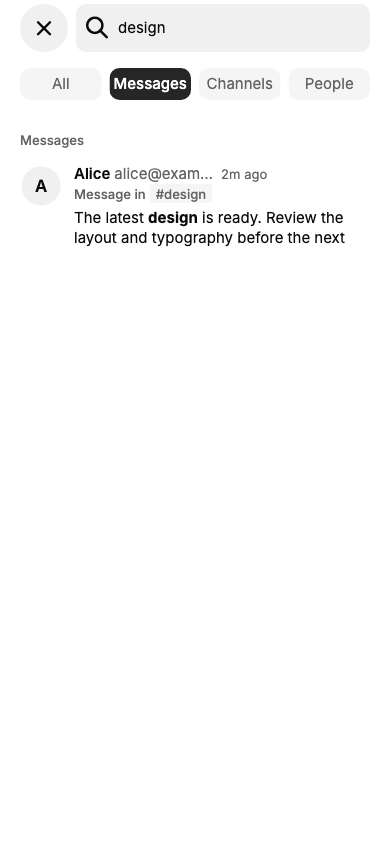 | 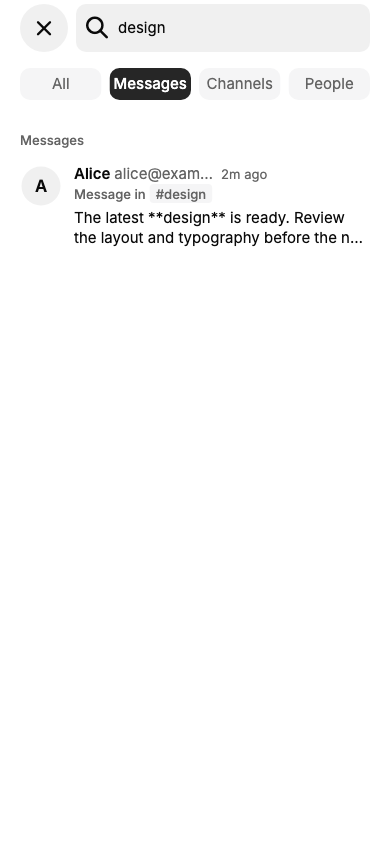 | --------- Signed-off-by: Tom Brow <tomb@block.xyz> |
||
|
klopez4212
|
27b9c827fc |
Polish mobile message layout and navigation controls (#8427)
Align outgoing messages and galleries to the right, reclaim the outgoing avatar gutter, and match desktop calendar dividers with balanced spacing. Standardize navigation and sheet icons at 24 points, restore native Edit/Done styling, and align section menus with trailing channel indicators. Validation: clean analysis; 3,513 mobile tests and push-configuration checks passed; iPhone Release build installed and tested by the owner. Includes regression coverage for message placement, date spacing, gallery direction, and section alignment. --------- Signed-off-by: kenny lopez <klopez4212@gmail.com> Co-authored-by: fin <5856f6900e8e0a4e0ea1f4f8d2ee33e4753d2119bc122f94ecafc660b46c0511@buzz.block.builderlab.xyz> |
||
|
Bradley Axen
|
3ffbfa693c |
feat(relay): start a channel with its members in one create (#8421)
## What
A kind:9007 can now name the channel's first members with `p` tags.
Those members are added in the same database transaction that creates
the channel. Resending a create whose OK was lost is now accepted
instead of refused.
## Why
Starting a new Solo chat today takes about 6–8 sequential relay round
trips before the first message goes out: create, read, add each agent
(kind:9000), read the roster, then send. With members in the create, a
client can start a chat with its agents as two writes: the create, then
the message as soon as the create is OK.
The resend fix makes the create safe for an outbox to retry. Today an
identical resend after a lost OK is refused with `duplicate: channel
already exists`, so the client can't tell success from a real UUID
collision.
## How
- **buzz-db:** `Db::create_channel_with_event` writes the channel, its
owner, its members (role `member`, `invited_by` = creator) and the 9007
event itself in one transaction. A channel row therefore never exists
without its create event. `create_channel_with_id` is unchanged for its
other callers.
- **Validation** (`side_effects::initial_members` and the
`validate_admin_event` 9007 branch):
- Each `p` must be a 32-byte hex pubkey.
- Duplicates and the creator are dropped.
- At most 32 members.
- An `h` tag is required when there are members.
- Each member goes through the same `decide_channel_add_policy` check a
kind:9000 uses, so an agent that refuses third-party adds keeps the
whole create out.
- **Side effects:** each initial member gets the same `member_joined`
system message and member-added notification a kind:9000 would post. The
fallback in `handle_create_group` creates a bare channel when the
pre-created row is missing; it announces no members, because it added
none.
- **Resend:** when the UUID is already taken, the same transaction
checks whether this exact event is the stored create.
- If it is, the create is OK'd as `duplicate:` (it is the same signed
create).
- Anything else, including a changed create from the same author, is
refused and writes nothing, so it can never re-run side effects or
announce members.
- A resend that arrives while the first create is still uncommitted
waits on its channel insert. It is confirmed once the first commits, or
creates the channel itself if the first rolled back. Before this, a
resend in that window was refused, and the app then withdrew a chat that
existed.
- **No compensation:** ingest no longer soft-deletes a pre-created
channel when the event insert fails. The rollback covers it.
- **Announcements:** a failed `member_joined` notice for one initial
member is logged at `error` and the loop continues, so the members after
it still get theirs. A resend writes nothing, so nothing would retry
them.
## Compatibility
A 9007 with malformed `p` tags, or more than 32 of them, used to be
accepted with the tags ignored. It is now rejected with `invalid:`. The
relay's own SDK and CLI builders send no `p` tags on 9007.
## Out of scope
- The kind:9000 OK still doesn't prove the membership change committed:
side-effect failures are logged and OK'd, and a duplicate replay skips
side effects. The new path doesn't depend on kind:9000.
- Events in separate HTTP requests are still unordered. Clients send the
first message after the create's OK.
## Tests
`store::channel::postgres_tests` (buzz-db):
- `a_resend_beside_an_open_create_confirms_it_once_committed`: holds a
create open, checks that the resend waits, commits, and expects `Exists
{ resent: true }` with one owner and one member.
- `a_resend_beside_a_failed_create_creates_the_channel`: the same, but
the first create rolls back.
- `a_create_whose_event_fails_leaves_no_channel`: an event the insert
refuses leaves no channel row, and a retry creates the channel.
- `another_create_for_a_taken_channel_writes_nothing`.
Two mutations, each caught: committing the channel before its event
fails the "leaves no channel" test, and looking up the event before the
channel insert waits fails the "confirmed once committed" test.
`handlers/create_with_members_postgres_tests.rs`, all through the real
ingest path:
- `create_adds_its_p_tags_as_members` checks:
- the roles and the 39002 roster
- exactly one `member_joined` notice
- that the agent can post with no separate add
- `create_respects_the_members_add_policy`: an agent with policy
`nobody` gets an `invalid:` rejection, and no channel is created.
- `resending_a_create_confirms_it`:
- an identical resend is accepted
- a changed create (from the creator or from someone else) is refused
- the roster is unchanged and nobody new is announced
- Unit tests for `initial_members`: dedupe, creator excluded, bad hex,
the 32-member cap, and the missing `h` tag.
Each new test was mutation-checked against the change it covers: no
members, no policy check, refuse every resend, and let a changed creator
create through. Each mutation turns its test red.
Agent exercise on a local relay, over `POST /events` the way the app
sends:
- The 9007 with `p` = agent was accepted in 54–97ms (debug build).
- The kind 9 was accepted 12–15ms after the create's OK.
- The agent was in the 39002 roster, and the operator listener delivered
the mention.
- An identical resend came back `duplicate:` (accepted), and a changed
create was refused.
Local suite runs at
|
||
|
Will Pfleger
|
6f67dcdac4 |
fix(desktop): bump zip to 9 for RUSTSEC-2026-0367/0368/0369 (#8412)
🤖 Bumps the desktop app's direct `zip` dependency from 8 to 9 to clear RUSTSEC-2026-0367, RUSTSEC-2026-0368 and RUSTSEC-2026-0369 on the managed Node.js archive extraction path. zip 9 makes `ZipArchive::name_for_index` and `ZipFile::name` fallible. Managed Node.js zip validation now rejects an entry whose name can't be decoded, and the "unsafe path" error prints the raw entry name lossily. The absolute-path, drive-prefix, traversal and `enclosed_name()` checks are unchanged. The lockfile update is scoped to `zip`; it pulls in newer `zstd`, `lzma-rust2` and `ppmd-rust` that zip 9 requires. **`zip` 8 is still in release builds.** With `--features mesh-llm`, `mesh-llm` v0.76.2 (`mesh-llm-system`, `mesh-llm-plugin-manager`, `mesh-llm-host-runtime`) still depends on `zip` 8.6.0. That goes away when the `mesh-llm` pin moves to a release that includes Mesh-LLM/mesh-llm#2471. Signed-off-by: Will Pfleger <pfleger.will@gmail.com> Co-authored-by: Duncan <dcfd242e557282d7a1e2cf2e6877522682f1e5c6156dc92ca7d90eaedd3b0f95@buzz.block.builderlab.xyz> |
||
|
Will Pfleger
|
bc995041cd |
fix(deps): bump negentropy to 0.5.2 for RUSTSEC-2026-0365 (#8409)
🤖 Bumps `negentropy` (pulled in via `nostr-sdk`) to 0.5.2 to clear RUSTSEC-2026-0365. The `zip` advisories (RUSTSEC-2026-0367/0368/0369) are not covered here because `mesh-llm` still requires `zip` 8. Signed-off-by: Will Pfleger <pfleger.will@gmail.com> Co-authored-by: Duncan <dcfd242e557282d7a1e2cf2e6877522682f1e5c6156dc92ca7d90eaedd3b0f95@buzz.block.builderlab.xyz> |
||
|
Will Pfleger
|
cf1bb8dd13 |
chore(deny): exclude buzz-mesh-smoke from cargo-deny graph (#8413)
🤖 Excludes the test-only `buzz-mesh-smoke` crate from the `cargo-deny` graph via `[graph] exclude` in `deny.toml`. `buzz-mesh-smoke` holds hardware smoke-test examples; nothing from it ships. It is the only root-workspace crate that depends on `mesh-llm`, which brings in `zip` 8.6 (RUSTSEC-2026-0367/-0368/-0369), the `zbus` 5 unmaintained notices (RUSTSEC-2026-0370/-0371/-0372), and `negentropy` via `mesh-llm-client` → `nostr-sdk` (RUSTSEC-2026-0365). None has a usable upstream fix for the pinned `mesh-llm` v0.76.2. The `zip` bump has merged upstream in [mesh-llm#2471](https://github.com/Mesh-LLM/mesh-llm/pull/2471), but no `mesh-llm` release contains it yet (latest is v0.78.1). CI's Security job runs `cargo-deny check` from the repo root, which reads this `deny.toml`, so the exclusion applies there. These advisories remain fatal for any shipped crate that pulls in the same dependencies. No existing advisory ignores were changed. Signed-off-by: Will Pfleger <pfleger.will@gmail.com> Co-authored-by: Hayt <211b96e6a2b7f45fd4047988976c7bbbeeda0c15f3ae7b32eec20834b5a55118@buzz.block.builderlab.xyz> |
||
|
klopez4212
|
3a45e87b25 |
fix(mobile): polish Inbox controls and system notices (#8423)
Use Tabler `filter-2` in Inbox and keep the iOS filter button rounded when its menu closes. Remove shaded containers from chat system notices while preserving spacing, profile links, and reactions. Validation: mobile formatting, analysis, full test suite, and iOS Release build; independent review found no blockers. Kenny verified the icon and menu dismissal on his iPhone. --------- Signed-off-by: Terp <5856f6900e8e0a4e0ea1f4f8d2ee33e4753d2119bc122f94ecafc660b46c0511@buzz.block.builderlab.xyz> Co-authored-by: Terp <5856f6900e8e0a4e0ea1f4f8d2ee33e4753d2119bc122f94ecafc660b46c0511@buzz.block.builderlab.xyz> |