mirror of
https://github.com/block/buzz.git
synced 2026-10-27 20:41:57 +00:00
4b0744d7f3161d9f045dd67a73e014e4440c2b47
778 Commits
| Author | SHA1 | Message | Date | |
|---|---|---|---|---|
 Will Pfleger |
75f101d8b4 |
chore(release): release Buzz Desktop version 0.5.21 (#7301)
## Buzz Desktop release v0.5.21 - **Frozen main:** `88687876f7808a2fd742b7eb2e4b9f87d999ad8d` - **Reviewed candidate:** `47e4e0347fb4142df55b03e0e3dc537fe33a5d62` - **Previous desktop release:** `desktop-v0.5.20` - **Proposed immutable tag:** `desktop-v0.5.21` This PR may be **squash merged** after the Desktop Release Candidate check and all protected-branch checks pass. Merging authorizes publication of the exact reviewed candidate; later or unrelated changes on `main` cannot alter it. The checked-in changelog accounts for every non-merge commit in the release range. The Desktop tag points to the reviewed candidate commit, not the later squash commit. Publication remains bound to that immutable candidate tag. Signed-off-by: Will Pfleger <pfleger.will@gmail.com> Co-authored-by: Release Automation <release-automation@users.noreply.github.com> |
||
|
Matt Toohey
|
40220d5618 |
perf(desktop): publish mention sends before waking agents (#7154)
## Summary Cuts perceived agent-mention send latency by publishing the message first and waking the agent afterwards, instead of blocking the send on a synchronous agent start/deploy round-trip. A send that mentions a stopped or undeployed managed agent now shows the message immediately; the wake runs fire-and-forget after the relay accepts the publish. The already-running-agent send also gets faster via revalidation dedupe and NIP-11 caching. ## Changes ### Publish-first agent wake - Wakes for mentioned managed agents are collected during send preparation and flushed fire-and-forget only after `await send(...)` resolves. No start can fire — and no "your message was sent" toast can appear — for a message the relay never accepted; every abort path (cancel, readiness error, publish rejection, dismissed non-member prompt) simply drops the queue. Persona-create wakes ride the pending draft behind the non-member prompt for the same reason. - Each wake is bound to the tenant scope captured at send time: the new `useDetachedAgentStart` hook passes `expectedRelayUrl` + `expectedSignerPubkey` with every start, so a wake that outlives a community switch fails closed at the backend instead of spawning against the new tenant. A wake whose scope has not resolved yet (identity query still loading, blank stored relay URL) is refused with a recoverable toast rather than fired unscoped. - In-flight wakes are deduped through a module-level map keyed by `(relay URL, pubkey)` — the same tenant pair the backend keys on — so two quick sends or two composers cannot double-spawn a cold agent during the seconds-long start window. Entries are deliberately retained across community switches (the key *is* the tenant scope, so a retained entry can never affect another community, and clearing it let an A→B→A round trip deploy a provider agent twice) and self-clean when the start settles. - Wake-failure toasts are fenced to the community they fired in via a module-level scope mirror: a start that settles after a community switch logs instead of rendering community A's failure over community B's UI, and an A→B→A return re-delivers the warning where it is actionable. - Membership attach and access-policy writes stay synchronous, so the harness's first kind-39002 read still sees the channel. ### Replay floor - The send timestamp travels with the wake as `BUZZ_ACP_REPLAY_FLOOR`, threaded through both local spawns (`spawn_agent_child`) and provider deploys (`deploy_to_provider` injects it into `launch.policy_env`), so the harness's startup watermark replays back past the just-published triggering message no matter how long the spawn takes. `buzz-acp` clamps the floor to `[now − 15min, now]`. - The floor is captured at enqueue time, not flush time — the flush runs post-publish, so a flush-time stamp could exceed the message's `created_at` and skip the very message the floor exists to cover. - On local spawns the caller's floor is asserted *after* the user env layering (and the ambient parent-process value is stripped unconditionally), so a saved persona/global/agent env entry cannot shadow this send's floor — mirroring the shadow-strip the provider path applies to `launch.env`. Both halves share one `REPLAY_FLOOR_ENV_VAR` const. ### Send-path latency reductions (already-running agents) - Mention revalidation is deduped: the publish-boundary pass reuses the pre-side-effect authorization pass unless an awaited round-trip actually separated the two (background upload, link-preview settlement, DM expansion, a real access-policy/membership write, or active-huddle enrollment). This preserves the #5681 authorization boundary while making the common send single-pass. - NIP-11 `self` lookups are cached per relay URL for 5 minutes. Only verified values are cached — non-2xx and malformed responses stay retryable — and URL keying keeps community switches from serving another relay's identity. - `applyReusableAgentAccessPolicy` now reports its relay write explicitly (`{ agent, wrote }`) instead of signalling through object identity, so the revalidation trigger above is load-bearing by construction. ### File splits Four files crossed the repository file-size ratchet during this work; one cohesive unit was extracted from each rather than raising a ceiling — `runtime/setup_payload.rs`, `commands/agents_create_fields.rs`, `app_state_accessors.rs`, and `useEnsureAgentMentionsReady.ts`. The ratchet is green at the tip. ### Review follow-ups The three concrete findings from the first review round are fixed at the tip: the pre-publish wake and its false "your message was sent" toast (fixed by queueing wakes behind the publish), the stale cross-community failure toast (fixed by the scope-mirror fence), and the A→B→A duplicate provider deploy (fixed by retaining the tenant-keyed in-flight entries across switches). The fast-path admission-staleness point is answered in the review thread: deferred paths already re-validate at the publish boundary, and the remaining fast-path window is milliseconds against an irreducible network-transit race. Mid-branch send-perf instrumentation was added to attribute the residual spinner latency and reverted once that analysis concluded — it is net-zero in this diff. ### Deferred follow-ups Durable mention catch-up via `event_mentions` (option 2 step 3) and backend deploy-epoch coalescing for the wake paths that do not funnel through `useDetachedAgentStart` (Agents-panel Start, restore, inbound-persona deploys) are intentionally left for separate changes. ## Testing - `cargo test --lib` on desktop/src-tauri: 3054 passed; clippy `-D warnings` + fmt clean - Desktop unit tests: 5856 passed (the 5 failures are the pre-existing `inboxReopenNavigation` / `useRetainedProjectGitViews` baseline, present on origin/main); `tsc --noEmit` and biome clean - Full mentions (87), channels (89), and community-rail (25) Playwright smoke suites against `pnpm build:e2e` bundles, with 3× stress reruns of each new spec - The load-bearing regression specs were confirmed red on the pre-fix code: publish-failure → zero starts and no false toast, the dedupe hold (1 call vs 2), the fail-closed scope refusal, the rail-switch toast fence, and the A→B→A retention spec (1 deploy vs 2) - New unit coverage pins the queue contract (enqueue-time floors, attach-seam queueing), the scope capture and verbatim relay-URL handoff, the dedupe map's keying and settle-then-repermit behavior, the unscoped refusal, the toast-scope mirror, the `{ agent, wrote }` contract, and the replay-floor env layering on both spawn paths 🤖 Generated with [Claude Code](https://claude.com/claude-code) --------- Signed-off-by: Matt Toohey <contact@matttoohey.com> Co-authored-by: Claude Fable 5 <noreply@anthropic.com> |
||
|
Logan Johnson
|
d5a73b9f35 |
fix(desktop): derive agent availability from relay presence (#7127)
🤖 ## Requested rebase published — |
||
|
Arjun Mahanti
|
ac5a18697c |
feat(desktop): add persistent Bestie experience (#7223)
## Summary - add a persistent, community-scoped Bestie designation for local managed agents - surface the designated agent in the sidebar, agent library, profile actions, message toolbar, and draggable floating shortcut - bloom the floating shortcut into a lightweight compact composer that reuses the normal DM timeline, reactions, presence, and send behavior - support message handoff with a bounded snapshot and a full Buzz thread link so the agent can retrieve the complete conversation ## UX details - the floating avatar and expanded panel stay above app chrome and drag as one aligned surface - closing the expanded panel returns it to its top-right anchor - each mini-composer opening starts visually fresh while messages sent during that opening remain conversational - the designated Bestie's duplicate DM entry is hidden from the regular DM list - Bestie actions are suppressed inside the mini timeline to avoid recursive handoff ## Reliability and maintainability - preserve existing retention database paths across upgrades - serialize assignment and deletion, clearing matching assignments across community scopes before an agent is removed - fence async conversation resolution against workspace and assignment changes - validate stale assignments against existing local agents before hiding DMs - share lightweight assignment state across agent cards and keep protected-feature behavior out of the shared timeline API ## Testing - `pnpm --dir desktop test` — 5,886 tests passed - `pnpm --dir desktop exec tsc --noEmit` - `pnpm --dir desktop exec biome check ...` - `cargo clippy --manifest-path desktop/src-tauri/Cargo.toml --all-targets -- -D warnings` - focused native retention and Bestie assignment/command tests — 34 passed - `VITE_BUZZ_BESTIE=1 pnpm --dir desktop build:e2e` - `VITE_BUZZ_BESTIE=1 pnpm --dir desktop exec playwright test --project=smoke tests/e2e/bestie.spec.ts` - pre-commit and differential pre-push hooks ## Rollout The UI remains gated by the `bestie` build feature. Screenshots covering setup, empty, assigned, floating, and message-handoff states are included in the PR discussion. --------- Signed-off-by: Arjun Mahanti <arjun@squareup.com> Co-authored-by: Codex <noreply@openai.com> |
||
|
Logan Johnson
|
434dafe958 |
fix(desktop): discover authenticated owned relay agents (#7122)
🤖 ## Summary An agent you own could be missing from **New message → To:** and **Channel members → Add people and agents** on a machine that has never managed it. This PR lets those existing lists find your agent without requiring a shared channel first. Desktop now checks records proving you own it, rather than looking only at agents in channels you've already joined. **No new screen or control is added.** For example, an agent with verified ownership and **Who can send instructions → Only me (default)** can now appear even with no shared channels. Each screen still applies its existing access rules; this does not make every discovered agent selectable everywhere. | Screen / control | Before | After this PR alone | | --- | --- | --- | | **New message → To:** recipient picker | An owned agent absent from this machine and shared-channel bot lists could be missing. | Its named **agent** row can appear; selecting it adds a recipient chip. This is recipient selection, not a guarantee that a later message will reach or wake the agent. | | **Channel members → Add people and agents** | The same agent could be missing from **Not in this channel** search results. | Its row can appear with the existing **Add** button. If you can add members, that button submits the existing channel-membership request; finding the row alone changes no membership. | | **Stream / forum composer → @ suggestions** | An owned agent already in the channel under an ordinary member role could be missing from agent suggestions. | Its actual membership is recognized without requiring the bot role. Agents not managed on this device still need membership in that channel. | | **Pulse → Agents** | An agent absent from both local management and the server's agent list was omitted from the count and author lookup. | The count and feed's author lookup can include it; notes appear only if it has published them. | Being listed does **not** mean the agent is online, add it to a channel, or grant local Start/Edit controls. For agents not managed on this device, global **Search** still excludes those configured for “Only me”, and DM @ selection is not added here. DM @ selection and message-driven nonmember invitation are addressed in [#7124](https://github.com/block/buzz/pull/7124); the standalone forum **Invite / Cancel** flow is in [#7125](https://github.com/block/buzz/pull/7125). <details> <summary>Ownership and membership checks</summary> A discovery lead is not proof: the latest agent profile must have a valid signature and exactly one valid ownership attestation—the owner's signed link to that agent. Its response policy must be signed by that verified owner; an invalid latest policy cannot restore an older permission. Membership comes separately from the latest server-signed roster, including removals. Existing profile cards, owner labels and agent-avatar shapes also use this stricter verification: malformed or forged evidence must not supply ownership/agent classification on its own. Valid ownership was already recognized; no profile-picture or badge design changes. Attestation time conditions apply to the signed event's timestamp, not a live expiry timer. Existing legacy compatibility and builds requiring verified owner policy retain their respective rules. Discovery and sending remain separate operations, not an atomic permission check. </details> ### Review corrections - When runtime and owner policy overlap, **explicit online/away/offline from the verified latest runtime is retained**. Policy still supplies ownership/permissions; claimed runtime membership is not restored. Missing/unrecognized status stays unknown, and invalid latest policy cannot revive runtime permissions. - Discovery without runtime evidence is now **unknown**, not offline: native conversion, both IPC adapters, Pulse, Projects and profile/session consumers preserve that distinction. Unknown has no status dot and is not promoted to a deployed/running agent. - Both relay-only picker paths retain the authenticated owner, including the existing **managed by you** label. The analogous global Search projection is fixed without changing its existing “anyone” filter. - Authorized stored profile activity remains visible when liveness becomes unknown/absent or the active turn ends. History reads do not start a live subscription, grant access, or imply current availability. ### Related issue Independent base: `main`. Child: [#7124](https://github.com/block/buzz/pull/7124), then [#7125](https://github.com/block/buzz/pull/7125). Extracted from [#7114](https://github.com/block/buzz/pull/7114), retained as historical source (`98fe33ec`). [Behavior contract]( |
||
|
Will Pfleger
|
0dbd036f5b |
feat(agents): harness-agnostic effort write path and spawn bridge (#4625)
## Summary Genericizes the agent effort write-side so Goose participates in the same canonical effort contract as buzz-agent. A spawn bridge translates the canonical key to whatever the target harness expects at launch time. Read/write/spawn paths all derive their vocabulary from runtime metadata rather than a hardcoded buzz-agent list. ## What changed ### Rust — config bridge + spawn path - `apply_spawn_effort_env` in `effort.rs`: production command-boundary seam — writes baked env, runs the effort projection, strips per-runtime suppress set, and emits exactly one projected key. - `apply_effort_to_spawn_command` in `runtime.rs`: thin wrapper returning a `#[must_use] EffortApplied(())` token (private field — unforgeable outside the function). `spawn_agent_child` calls it as `let effort = apply_effort_to_spawn_command(...)` and passes `effort` to `spawn_with_effort_proof`. Deleting the call is a compile error: `effort` is undefined at the `spawn_with_effort_proof` site. Deleting `apply_spawn_effort_env` inside the wrapper turns the production-sequence tests RED. - `apply_record_field_updates` in `agent_models_update.rs`: returns `Result<RecordFieldsApplied, String>` (`#[must_use]` token). `update_managed_agent` calls it as `let applied = apply_record_field_updates(...)?` then passes `applied` to `stamp_record_updated_at`. Deleting the call is a compile error: `applied` is undefined at the `stamp_record_updated_at` site. - Unknown/custom-runtime passthrough: `apply_effort_launch_to_command` skips the suppress loop when `preserve_passthrough && value.is_none()`, preserving ambient ACP sentinels. - `EnvVarGuard`: prior value stored as `OsString` (`var_os`) so non-Unicode values are restored exactly on Drop. A single `PROCESS_ENV_MUTEX` in `managed_agents/mod.rs` is shared by `lock_path_mutex()` and `lock_env_mutex()` — any two tests calling either helper are mutually exclusive with each other. Tests in other modules (`app_state_tests`, `agent_config_tests`, `reader_tests`) maintain their own independent locks and are not in this domain. - Dead-code: `strip_effort_keys_from_command` marked `#[cfg(test)]`; import path in `effort_cmd_tests.rs` fixed. - Windows CI fix: platform-gated variants for inherited-env tests. ### TypeScript — renderer + model cleanup - `AgentConfigFields` orphan-model cleanup effect: the `isHarnessNativeEffort` early-return was skipping the model clear on provider→Custom transitions. Refined to: return early only when model is already null; clear model once while preserving the harness-native effort key (Carl P2). - Provider-empty convergence: when model is null and effort is native, the cleanup effect returns early (nothing to clear) — prevents spurious `onConfigChange` loop. - `EffortSelectField` / `humanizeEffortLabel`: runtime-native option labels title-cased (`off` → `Off`) with raw canonical values preserved for round-trip fidelity. - `AgentConfigFields`: drives effort renderer from `selectedRuntime.effortCanonicalValues` (harness-native path) or the model/provider catalog (buzz-agent/provider path), selected by `isHarnessNativeEffort`. ### Docs - `desktop/src/features/agents/AGENTS.md` item 14: updated from deleted `persistAgentEffortLevel` direct-write contract to the shipped Save-gated `update_managed_agent.effortLevel` path. Consistent with `EffortPickerField`'s own doc comment. ### Tests - `agent_models_update_tests.rs`: seam tests via `apply_record_field_updates` — non-local rejects, local set/clear, ordering invariant, ACP-sentinel sweep. `record_field_updates_persist_effort_to_disk` (renamed from the prior false-claim name) drives load→apply→stamp→save→load via a mock AppHandle + tempdir, asserting `effort_level` persists to disk. Manual HOME/XDG restore replaced with RAII `EnvVarGuard` (panic-safe, `OsString`-exact). - `effort_cmd_tests.rs` / `effort_tests.rs`: production-sequence seam tests via `apply_effort_to_spawn_command`. Spawns `/usr/bin/env` to verify child's real env. `EnvVarGuard` for panic-safe restore. Windows twin using `cmd /c set`. - `effortAutoClear.test.mjs`: five mounted stateful journeys via `AgentConfigFields` with `useCustomSelect=true`. Covers: custom trigger shows "Off" at mount; provider-empty mount is a stable fixed point; provider→Custom switch converges; stale Anthropic model cleared on Custom switch with Goose effort preserved (Carl P2 regression); Settings-style Save/reread preserves effort. - `agentDefaultsEditor.test.mjs`: two full Save/Next journey tests through the real production parent trees. Both start with `GOOSE_THINKING_EFFORT: "low"` and operate the real Popover-based effort control (click trigger → click "off" option) before Save/Next, asserting zero writes after selection. The `set_global_agent_config` stub captures the submitted payload; each test asserts raw `GOOSE_THINKING_EFFORT: "off"` in the captured config. The stub stores its canonical response from the actual payload; the fresh remount's `get_global_agent_config` returns that stored object (not a hand-written fixture), then asserts "Off" shown. The `DefaultConfigStep` test starts with `isDirty: false` — the real-control effort selection calls `onConfigChange → updateDraft → isDirtyRef=true`, making the `commit()` on Next load-bearing. ## Mutation evidence - Delete `let effort = apply_effort_to_spawn_command(...)` call from `spawn_agent_child` → compile error: `error[E0425]: cannot find value `effort`` at `spawn_with_effort_proof` site. - Delete `let applied = apply_record_field_updates(...)?` from `update_managed_agent` → compile error: `error[E0425]: cannot find value `applied`` at `stamp_record_updated_at` site. - Delete `apply_spawn_effort_env` from inside `apply_effort_to_spawn_command` wrapper → `production_sequence_goose_inherited_collision_resolved_in_child` RED. - Revert `isHarnessNativeEffort &&` guard in cleanup `useEffect` to bare `if (isHarnessNativeEffort) return` → stale model not cleared → Carl P2 regression test RED. - Remove `isHarnessNativeEffort ||` from the nothing-to-clear condition → provider-empty mount emits `onConfigChange` → loop test RED. - Remove `isHarnessNativeEffort` branch in `AgentConfigFields.tsx:634-636` → both `agentDefaultsEditor.test.mjs` mount assertions fail: trigger shows "Select" instead of initial effort label. - Remove `preserve_passthrough` guard in `apply_effort_launch_to_command` → `production_sequence_custom_inherited_acp_sentinel_survives` RED. - Drop `GOOSE_THINKING_EFFORT` from the `set_global_agent_config` stub payload → payload assertion in `agentDefaultsEditor.test.mjs` fails (`undefined !== "off"`) → RED (verified). - Remove the effort-select dirtying steps from the `DefaultConfigStep` test (so `isDirty` stays false) → `commit()` is a no-op → write-count assertion after Next fails (0 instead of 1) → RED. --------- Signed-off-by: Will Pfleger <pfleger.will@gmail.com> Signed-off-by: Duncan <dcfd242e557282d7a1e2cf2e6877522682f1e5c6156dc92ca7d90eaedd3b0f95@buzz.block.builderlab.xyz> Signed-off-by: Hayt <9e1c23a3fd83f61da34420e4e88ff1b16e45cafcc0cd9019eb07d4ecfa8ca9b0@buzz.block.builderlab.xyz> Co-authored-by: Duncan <dcfd242e557282d7a1e2cf2e6877522682f1e5c6156dc92ca7d90eaedd3b0f95@buzz.block.builderlab.xyz> Co-authored-by: Hayt <9e1c23a3fd83f61da34420e4e88ff1b16e45cafcc0cd9019eb07d4ecfa8ca9b0@buzz.block.builderlab.xyz> |
||
|
Salman Mohammed
|
42aeb1571c |
feat(desktop): add Pi agent preset (#7208)
## Summary Add Pi as a selectable desktop ACP runtime via `pi-acp`, including discovery guidance and its official logo. ### Related issue Follow-up to closed #6546. ### Testing - Focused Tauri preset and desktop logo tests - TypeScript typecheck Generated with Codex --------- Signed-off-by: Salman Mohammed <smohammed@squareup.com> |
||
|
Will Pfleger
|
5aed49b505 |
feat(buzz-agent): add DatabricksAuthCoordinator single-flight OAuth (#5545)
## What

Consolidates all Databricks OAuth acquisition behind one coordinator on
`PkceOAuthTokenSource`. Every entry point — the four `TokenSource`
methods (`bearer`, `bearer_no_browser`, `refresh_now`,
`interactive_login`) plus the public `acquire_with_intent` — routes
through a single `acquire()`/`acquire_locked()` core that owns browser
and cooldown policy.

Before this, acquisition logic was scattered across those methods with
no coordination: concurrent callers (Desktop discovery, the saved-agent
model picker, managed-runtime inference) could each pop their own
browser, and a just-denied attempt would immediately re-prompt on the
next passive read.

## How

- **Intent policy.** `AuthIntent::{Auto, UserInitiated, Headless}`
decides whether a caller may open a browser and whether it honors the
cooldown. `Headless` never browses; `Auto` browses but honors an
unexpired cooldown; `UserInitiated` browses and bypasses+clears the
cooldown.
- **Two-layer single-flight per cache key.** An in-process registry
(`INFLIGHT`) coalesces same-key, same-intent callers onto one leader's
attempt before the file lock. The slot key is `(lock_path, AuthIntent)`,
so a `UserInitiated` sign-in never inherits an `Auto` leader's result. A
joined result is revalidated against the waiter's own contract. Across
processes, callers serialize on a `flock`-based advisory lock and share
success through the on-disk cache. RAII `Drop` releases both lock and
leader slot.
- **Joiner credential-state reconciliation.** `SlotPublish` carries the
full `CachedToken` on success. Each joiner reconciles its own
independent `state` cell under `state.lock().await` before returning:
adopt when absent, expired, or matching the joiner's rejected
credential; preserve any distinct newer usable credential. On a matching
shared failure, neutralize the joiner's in-memory rejected entry under
lock via `expire_rejected_memory` — durable disk mutation is reserved
for `acquire_locked` under the cross-process file lock. Without this, a
joining source's state remains stale or empty and subsequent plain
`bearer()` calls resurface the rejected or absent credential.
- **Validate-before-persist boundary.** `finish()` is the
candidate-token persistence boundary for refresh and browser results.
Before a token is written to cache or the cooldown is cleared, a bearer
equal to the caller's rejected bytes yields a typed failure.
- **Token neutralization.** When `acquire_locked` enters with `rejected
= Some(bytes)`, it calls `expire_rejected()` under the state lock before
any cache check.
- **Cross-process failure single-flight.** An `AttemptRecord` sidecar
records a monotonically-increasing generation, intent, result code, and
SHA-256 digest of the completing caller's rejected token. Adoption is
temporal (pre-queue snapshot predates current generation) and
digest-matched.
- **Typed outcomes.** `AuthError` with stable `code()`/`from_code()`
replaces display-text matching.
- **Durable cooldown sidecar.** Every failed browser attempt is recorded
next to the cache key. 5-minute expiry.
- **Windows disk persistence disabled.** On non-Unix platforms,
`persist()` is a no-op. Lock, cooldown, and attempt sidecars are active
on all platforms. Tests that seed or assert on the on-disk token cache
are `#[cfg(unix)]`-gated.
- **Injected browser opener** invoked while the localhost callback
listener is live.

## Tests

- `crates/buzz-agent/tests/databricks_auth_coordinator.rs`:
browser/cooldown/classification acceptance matrix with a scripted
`BrowserOpener` and stub OIDC provider. P1 regressions exercise the full
`finish()` → `acquire_locked()` → `acquire_leader()` →
`LeaderGuard::complete()` → joiner wiring:
- `test_inprocess_joiner_reconciles_stale_state_after_shared_success`
(Unix): two real sources both loaded locally-fresh-but-rejected X; after
shared success Y, subsequent plain `bearer()` on both returns Y, not X.
-
`test_inprocess_joiner_neutralizes_rejected_on_matching_shared_failure`
(Unix): B's matching rejected X is force-expired in memory after shared
`RefreshRejected`; subsequent read cannot return X.
- `test_inprocess_joiner_populates_empty_state_no_second_acquisition`
(non-Unix): empty A/B join a browser success; B's subsequent headless
read returns Y without a second browser (no disk fallback on non-Unix
exposes the regression).
- `test_crossprocess_userinitiated_waiter_adopts_predecessor_denial`
(snapshot-marker barrier replacing an earlier sleep for deterministic
generation ordering).
- `auth.rs` in-crate tests: lock-primitive edges, disk-recheck on shared
failure (`#[cfg(unix)]`), and:
- `test_joiner_reconciliation_blocked_until_state_lock_released`:
deterministic direct-poll proof that awaited reconciliation requires
`state.lock().await`. The test task holds B's state mutex and manually
polls a pinned real `acquire()` future — Poll 2 (slot published, mutex
still held) must return `Pending` because `lock().await` blocks; with
`try_lock` instead, Poll 2 returns `Ready`, failing the assertion.
- `test_joiner_preserve_distinct_newer_credential`: deterministic direct
polling parks B at `slot.wait()`, then writes Z directly into B's state
in the same task, then publishes Y and awaits completion. B must return
Y but leave state == Z. Mutation check: unconditional adoption
overwrites Z with Y, failing the state assertion.
- `test_joiner_shared_failure_recovers_disk_replacement` (Unix): the
matching-failure joiner enters the recovery branch — after
`expire_rejected_memory` (in-memory, empty state no-op) it reads a
sibling-written disk replacement via `usable_from_disk` and returns it.
Mutation check: removing the `usable_from_disk` recovery branch returns
`Err(RefreshRejected)`.
- `test_joiner_failure_does_not_write_disk` (Unix): byte-for-byte
disk-invariance regression — a matching-failure joiner calls
`expire_rejected_memory` and must not touch the on-disk cache. An
independent process C may write a valid replacement between A's failure
and B's reconciliation; this guard ensures B's unfenced in-memory
neutralization cannot overwrite C's concurrent disk write. Mutation
check: reverting to `expire_rejected` rewrites the file (`expires_at =
0`), changing the bytes and failing the assertion.
- `test_lock_timeout_leaves_cooldown_sidecar_byte_for_byte_untouched`: a
waiter past its deadline returns `LockTimeout` before entering
`acquire_locked`; the cooldown sidecar bytes are unchanged. Documents a
pre-lock limitation: `LockTimeout` callers do not neutralize state or
sidecars.

## Scope / follow-ups

- **Runtime 401 handling is deferred.** This PR owns acquisition
single-flight and policy.
- **Desktop wiring is Phase 2** (not in this PR's boundary). Confined to
`crates/buzz-agent/`.
- **Windows DACL** is a follow-up once the `windows-sys` binding is
available.

## Stack

Built on [#5534](https://github.com/block/buzz/pull/5534)
(`hayt/databricks-oauth-cache-hardening`), now merged. Retargeted to
`main`.

---------

Signed-off-by: Will Pfleger <pfleger.will@gmail.com>
Signed-off-by: Duncan <dcfd242e557282d7a1e2cf2e6877522682f1e5c6156dc92ca7d90eaedd3b0f95@buzz.block.builderlab.xyz>
Co-authored-by: Duncan <dcfd242e557282d7a1e2cf2e6877522682f1e5c6156dc92ca7d90eaedd3b0f95@buzz.block.builderlab.xyz>
|
||
|
Wes
|
e5a7e26a10 |
fix(desktop): preserve keyring identity during recovery (#7203)
Pinky is opening this PR on Wes's behalf. ## Summary Carry forward the fix from #7103 by **Taksh / @Chessing234**, with the original author and DCO sign-off preserved in commit `99dd19191c`. A separate Pinky-authored commit fixes and strengthens the regression tests. `recover_from_keyring` previously deleted an unreadable keyring identity before checking for a valid leftover `identity.key`. A migrated installation normally has a marker but no file, so that deletion could destroy the only remaining key material. - Attempt valid-file recovery before any explicit keyring deletion. - If a migration marker exists but no valid file can be recovered, enter `Lost` without deleting the unreadable keyring value. - Retain the existing no-marker clear/generate policy. - Correct the stale deletion expectation in `corrupt_keyring_recovers_valid_file_without_rotating`, retaining its identity and persistence checks. - Add an explicit no-delete assertion to `corrupt_keyring_with_valid_file_recovers_before_delete`. Production recovery behavior matches the contributor's fix; follow-up production-file edits only clarify comments and restore a doc comment. The existing migration durability order remains **store → uncached verification → marker → file removal**. Lost-state signing/startup gates and explicit user re-import remain intact. ### Related issue Fixes #6218. Linked continuation/replacement of #7103, not a competing implementation. The original PR remains open for maintainer disposition. Searched existing keyring PRs and identity/keyring issues; #7103 is the direct duplicate and source contribution. ### Testing Validated head: `b6a5512ba85f9e76a039f69714ed04a98eabc710`, based on `4365883151698cd30e31cf4091629543b61c2478`. - **Focused baseline:** `cd desktop/src-tauri && cargo test --lib app_state::` — 52 passed, 0 failed. - **Mutation check:** in an isolated copy, restore the original delete-before-file-probe ordering without changing the test file. `corrupt_keyring_with_valid_file_recovers_before_delete` fails at the new `store.deleted.borrow().is_empty()` assertion (0 passed, 1 failed; expected exit 101). The candidate working tree was never mutated. - **Actual pre-push hooks passed, without bypass:** `push-head-scope`, `branch-skew`, `file-size-check`, and `desktop-tauri-checks`. - `cargo clippy --manifest-path desktop/src-tauri/Cargo.toml --workspace --all-targets -- -D warnings` - `cd desktop/src-tauri && cargo test --workspace` — 3,156 passed, 0 failed, 20 ignored across test binaries. - Pre-commit Tauri formatting and DCO hooks passed. - Independent read-only review by Brain found no further defects in the final range and verified the baseline/mutation artifacts and contributor attribution. This is not a GitHub approval. Local validation used the repository's sidecar stubs for compilation. Full-repository `just ci`, a native-app recovery workflow, and live-keyring fault injection were not run. GitHub CI and an actual current-range Codex security review are still pending; local hooks do not substitute for those results. No UI markup changed, so screenshots are not applicable. ### Limits This prevents destructive cleanup on the marker-backed recovery path; it does not identify what originally made the keyring value unreadable or guarantee recovery of already-corrupt material. Markerless last-copy preservation remains a pre-existing limitation outside this change. Only the two app-state Rust files change; no new dependency, workflow, or secret-export surface is introduced. --------- Signed-off-by: Taksh <takshkothari09@gmail.com> Signed-off-by: Pinky <5f5ab050ec58ae208332edd544ebf705221e24c1b86d82a6ca07038a7a8f6ac9@buzz.block.builderlab.xyz> Co-authored-by: Taksh <takshkothari09@gmail.com> Co-authored-by: Pinky <5f5ab050ec58ae208332edd544ebf705221e24c1b86d82a6ca07038a7a8f6ac9@buzz.block.builderlab.xyz> |
||
|
Wes
|
4794a5cecf |
ci: relax file-size ceilings by surface (#6485)
## Summary - raise Desktop Rust's differential file-size ceiling from 1,000 to 1,500 lines - raise Desktop frontend and Mobile ceilings from 1,000 to 1,200 lines - keep Web at 1,000 lines and preserve the existing no-growth ratchet above each ceiling ## Why The flat 1,000-line limit is forcing mechanical trimming in Desktop and Mobile even for small cohesive changes. Surface-specific ceilings relieve that pressure without granting Web or every authored component a blanket 2,000-line budget. ## Testing - `just file-size-check` - `cd desktop && pnpm exec biome check scripts/check-file-sizes.mjs` - `node --check mobile/scripts/check-file-sizes.mjs` - `git diff HEAD^ --check` Signed-off-by: Wes <wesbillman@users.noreply.github.com> Co-authored-by: Carl <32a2e2c9d428ee08902cab75d956da2c1d235a22d4766b0dd4138bf6e2e5db1d@buzz.block.builderlab.xyz> |
||
|
klopez4212
|
114dbf745f |
Add voice notes to desktop messages (#6978)
## Summary - add voice-note recording, preview, removal, and send controls to the desktop composer - render sent voice notes as waveform cards with scrubbing and playback-speed controls - transcode recordings locally into the existing relay video-media contract, without relay changes ## Testing - `just ci` - `pnpm exec playwright test tests/e2e/voice-note.spec.ts` - native voice-note media contract test against the relay validator ## Screenshots Focused snapshots are attached below. --------- Signed-off-by: kenny lopez <klopez4212@gmail.com> Signed-off-by: Princess Donut <b238ea756dee4d98afa5883fc7f1de61eeabe65bf700e3a5a5a80db5e42e2c2b@buzz.block.builderlab.xyz> Co-authored-by: Princess Donut <b238ea756dee4d98afa5883fc7f1de61eeabe65bf700e3a5a5a80db5e42e2c2b@buzz.block.builderlab.xyz> Co-authored-by: Mongo <9cfd347903944d5b85aa6c93d2ab67381b978a92a31914bca69998968752a1d7@buzz.block.builderlab.xyz> |
||
|
Salman Mohammed
|
59328d5ae3 |
feat(desktop): add thread-scoped ACP session experiment (#6909)
## Why Thread-scoped ACP sessions from #6732 need an opt-in desktop rollout that preserves today’s channel policy by default. ## What - Add the default-off “Thread Scoped ACP Sessions” toggle under Settings → Experiments using the existing feature-override persistence. - Map the persisted setting to `BUZZ_ACP_SESSION_POLICY=channel|thread` for every local and provider-backed managed ACP launch. Changes apply when managed agents next start; DMs remain conversation-scoped by the backend. - Keep the desktop setting authoritative over descriptor environment and cover the UI, persistence, local spawn, provider payload, and existing Projects/Workflows experiments. ## Risk Assessment Low. The experiment defaults off and explicitly preserves `channel`; changes are limited to managed-agent launch configuration. Existing running agents are unchanged until their next start. ## Testing - `. ./bin/activate-hermit && just ci` — passed on the final restacked tree, including 5,674 desktop tests, 2,796 Tauri tests, and 1,860 mobile tests. - `cd desktop && pnpm build:e2e && pnpm exec playwright test tests/e2e/experimental-features.spec.ts --project=smoke` — 1 passed. - `. ./bin/activate-hermit && cargo test --manifest-path desktop/src-tauri/Cargo.toml session_policy --lib` — 4 passed. - `. ./bin/activate-hermit && cargo test --manifest-path desktop/src-tauri/Cargo.toml commands::agents::deploy::tests --lib` — 15 passed. - `. ./bin/activate-hermit && cargo test -p buzz-backend-kubernetes --test wire_fixtures` — 4 passed. ## Stack Info Stacked on #6732. This PR depends on #6732 and should merge after it. Generated with Codex --------- Signed-off-by: Salman Mohammed <smohammed@squareup.com> Signed-off-by: Leo <5faf251baee50ee6bcde338aef6acdd70bb3e60115664c2cd490d94a55dfc488@buzz.block.builderlab.xyz> Co-authored-by: Leo <5faf251baee50ee6bcde338aef6acdd70bb3e60115664c2cd490d94a55dfc488@buzz.block.builderlab.xyz> |
||
|
Logan Johnson
|
4a9de1a3a1 |
feat(desktop): add isolated named demo builds (#6407)
🤖 I’m Larry, updating this description on Logan’s behalf. ## Summary Build named macOS demo apps without Finder automation or collisions with installed Buzz. `just desktop-demo-build "PR 6407 Demo"` produces a matching app and DMG, with a fresh build identity even when the same display name is reused. - The headless DMG packager uses `hdiutil`; optional Finder styling is bounded. The existing production release recipe is unchanged. - Each demo has independent app data, keychain, nest, CLI name, voice-model storage, repository discovery, and agent OAuth/config storage. Reset preserves production and sibling-demo state, and retains retry intent when credential removal or root resolution fails. - Native links accept only the active build’s registered scheme, then translate validated entity links into the frontend’s canonical `buzz:` format. - The recipe builds all six executable sidecars. Display names are capped at 31 ASCII characters so the generated identity fits Rust’s build-time limit. **Open delivery requirement:** downloaded demos must run without a Gatekeeper security override. The current recipe is ad-hoc signed and unnotarized; it does **not** satisfy this requirement. Trusted branch-demo signing/distribution remains blocked on establishing an approved signing path. This PR is not being presented as complete download-and-run delivery. ### Related issue N/A — reported in the Buzz DMG-packaging workstream. ### Testing At `11ce21ff97cb387ad676e7caa65b00964097d0bb`, macOS Blox passed the Tauri workspace suite and compiled-flags gate (including the full named-demo state; each library pass: 2,992 passed, 19 ignored), Tauri all-target clippy, the full `buzz-agent` package suite, and frontend lint/typecheck plus 5,733 tests. Regression coverage includes cold-start/running entity-link handling, wrong-build rejection, OAuth deletion failure and retry, unresolved credential roots, and production/sibling preservation. At the same head, an extra full named-demo/mesh-enabled run had 3,092 passing tests and one failure: a pre-existing shared-compute `auto` versus `mesh` expectation, also reproduced on the old published head `a77b25eca`. The ordinary and demo-state matrix above passes; this is not an all-features-green claim. Live macOS Launch Services delivery remains unverified. GitHub CI completed with 30 successful checks and 9 skipped. The exact-range security review has not run; its authorization notice remains open. CI success does not establish trusted signing or downloaded-app launch. Earlier demo artifacts established matching app/DMG names, side-by-side launch, and six non-empty executable arm64 sidecars. These screenshots show an earlier artifact, not a new build of the final repair commit. Signature-integrity checks are not Gatekeeper/notarization evidence. <img width="1032" height="548" alt="Buzz PR 6407 Demo disk image containing the matching app" src="https://github.com/user-attachments/assets/bca0277e-db03-4308-b280-fcad55e6d601" /> <img width="1186" height="821" alt="Buzz PR 6407 Demo running alongside other Buzz installations" src="https://github.com/user-attachments/assets/b4bf4ae5-c341-4e15-8090-9d2ea7c623b6" /> --------- Signed-off-by: Logan Johnson <loganj@squareup.com> Signed-off-by: Larry <8cf5a83f590ec0955b11647d1c88f796a98e088c30a492c58e0e46c3026ae7a4@buzz.block.builderlab.xyz> Co-authored-by: Other Brother Darryl <cee32d92756729ee0c097c5661b879c6199931cd25315c8cf398dcbf0f155cf1@buzz.block.builderlab.xyz> Co-authored-by: Larry <loganj+sandbox-larry@squareup.com> Co-authored-by: Larry <8cf5a83f590ec0955b11647d1c88f796a98e088c30a492c58e0e46c3026ae7a4@buzz.block.builderlab.xyz> |
||
|
tulsi
|
cb3144999b |
add public descriptions to agent personas (#7126)
**Category:** new-feature **User Impact:** People can add a short public description to an agent and see what it does directly on agent cards and profiles. **Problem:** Agent cards previously showed only a model label, so people had to open an agent and inspect its instructions to understand its purpose. Public metadata also needed one trustworthy lifecycle across local edits, relay catalogs, profiles, and portable snapshots. **Solution:** Add an optional owner-authored description with a 280-character visible-text policy, publish it as profile `about`, and prefer it on agent cards while retaining the model fallback. Description metadata is excluded from the spawn-content hash, remains definition-owned, and is validated independently at every untrusted or persistence boundary. <details> <summary>File changes</summary> **desktop/src-tauri/src/commands/agent_config_tests.rs** Updates managed-agent/persona fixtures for the optional description field while preserving the behavior under test. **desktop/src-tauri/src/commands/agent_discovery/relay_directory.rs** Updates relay-directory profile test publication for the expanded profile contract. **desktop/src-tauri/src/commands/agent_models_tests.rs** Updates managed-agent/persona fixtures for the optional description field while preserving the behavior under test. **desktop/src-tauri/src/commands/agent_models_update.rs** Preserves the effective `about` value when instance edits republish a complete profile event. **desktop/src-tauri/src/commands/agents.rs** Carries the effective authored description into initial managed-agent profile publication. **desktop/src-tauri/src/commands/agents_profile.rs** Adds `about` to profile reconciliation and keeps description, name, and avatar synchronized against relay state. **desktop/src-tauri/src/commands/agents_tests.rs** Updates managed-agent/persona fixtures for the optional description field while preserving the behavior under test. **desktop/src-tauri/src/commands/personas/card.rs** Materializes the definition-owned description before minting a portable agent card snapshot. **desktop/src-tauri/src/commands/personas/create.rs** Normalizes and validates raw authored descriptions before persona persistence. **desktop/src-tauri/src/commands/personas/delete_cascade_tests.rs** Updates managed-agent/persona fixtures for the optional description field while preserving the behavior under test. **desktop/src-tauri/src/commands/personas/inbound.rs** Validates descriptions at inbound relay ingress and applies accepted values to local definitions. **desktop/src-tauri/src/commands/personas/inbound/catalog_reconcile_tests.rs** Updates managed-agent/persona fixtures for the optional description field while preserving the behavior under test. **desktop/src-tauri/src/commands/personas/inbound/inbound_tests.rs** Updates managed-agent/persona fixtures for the optional description field while preserving the behavior under test. **desktop/src-tauri/src/commands/personas/mod.rs** Centralizes raw-byte validation followed by trim/empty normalization for description writes. **desktop/src-tauri/src/commands/personas/pending.rs** Revalidates descriptions before preparing public persona publications. **desktop/src-tauri/src/commands/personas/sharing.rs** Carries the optional public description through this managed-agent compatibility path. **desktop/src-tauri/src/commands/personas/snapshot.rs** Materializes definition-owned descriptions into portable instance snapshots without creating a second persisted authority. **desktop/src-tauri/src/commands/personas/snapshot/fidelity_tests.rs** Updates managed-agent/persona fixtures for the optional description field while preserving the behavior under test. **desktop/src-tauri/src/commands/personas/snapshot/import.rs** Restores snapshot descriptions onto imported definitions while keeping linked instance copies absent. **desktop/src-tauri/src/commands/personas/snapshot/tests.rs** Updates managed-agent/persona fixtures for the optional description field while preserving the behavior under test. **desktop/src-tauri/src/commands/personas/update.rs** Persists persona description edits, republishes linked profiles, and preserves legacy avatars during complete kind:0 replacements. **desktop/src-tauri/src/commands/personas/update/name_propagation_tests.rs** Proves description-only profile sync does not write instance state or clear a legacy avatar. **desktop/src-tauri/src/commands/team_snapshot.rs** Round-trips member descriptions through team snapshots and imported definitions. **desktop/src-tauri/src/commands/team_snapshot/tests.rs** Covers team member description export and import fidelity. **desktop/src-tauri/src/commands/teams/adopt/apply.rs** Starts adopted team catalog members without synthesizing an unauthored description. **desktop/src-tauri/src/commands/teams/adopt/tests.rs** Updates managed-agent/persona fixtures for the optional description field while preserving the behavior under test. **desktop/src-tauri/src/commands/teams/pending/tests.rs** Updates managed-agent/persona fixtures for the optional description field while preserving the behavior under test. **desktop/src-tauri/src/commands/teams/sharing/tests.rs** Updates managed-agent/persona fixtures for the optional description field while preserving the behavior under test. **desktop/src-tauri/src/egress_guard_tests.rs** Updates managed-agent/persona fixtures for the optional description field while preserving the behavior under test. **desktop/src-tauri/src/event_sync_team_catalog_tests.rs** Updates managed-agent/persona fixtures for the optional description field while preserving the behavior under test. **desktop/src-tauri/src/managed_agents/agent_description.rs** Defines the canonical Rust description resolution used by profile publication and reconciliation. **desktop/src-tauri/src/managed_agents/agent_events.rs** Updates managed-agent record construction for the optional public description field. **desktop/src-tauri/src/managed_agents/agent_snapshot.rs** Includes descriptions as snapshot profile `about` metadata and validates them at decode ingress. **desktop/src-tauri/src/managed_agents/agent_snapshot_envelope.rs** Updates managed-agent record construction for the optional public description field. **desktop/src-tauri/src/managed_agents/agent_snapshot_tests.rs** Covers snapshot description export and rejection of unsafe or overlong imported metadata. **desktop/src-tauri/src/managed_agents/config_bridge/reader_tests.rs** Updates managed-agent/persona fixtures for the optional description field while preserving the behavior under test. **desktop/src-tauri/src/managed_agents/definition_validation.rs** Adds the shared 280-character visible-text policy for public descriptions. **desktop/src-tauri/src/managed_agents/discovery/tests.rs** Updates managed-agent/persona fixtures for the optional description field while preserving the behavior under test. **desktop/src-tauri/src/managed_agents/effective_config/tests.rs** Updates managed-agent/persona fixtures for the optional description field while preserving the behavior under test. **desktop/src-tauri/src/managed_agents/global_config/tests.rs** Updates managed-agent/persona fixtures for the optional description field while preserving the behavior under test. **desktop/src-tauri/src/managed_agents/mod.rs** Exports the description resolution and validation helpers to managed-agent consumers. **desktop/src-tauri/src/managed_agents/nest/render_tests.rs** Updates managed-agent/persona fixtures for the optional description field while preserving the behavior under test. **desktop/src-tauri/src/managed_agents/parallelism.rs** Updates managed-agent fixtures for the optional description field without changing runtime configuration behavior. **desktop/src-tauri/src/managed_agents/persona_events.rs** Adds description to persona event content while deliberately excluding it from the spawn-relevant content hash. **desktop/src-tauri/src/managed_agents/persona_events/tests.rs** Pins description event round-tripping and proves description-only edits do not change the restart hash. **desktop/src-tauri/src/managed_agents/personas.rs** Initializes built-in persona records without authored descriptions for backward-compatible defaults. **desktop/src-tauri/src/managed_agents/personas/tests.rs** Updates managed-agent/persona fixtures for the optional description field while preserving the behavior under test. **desktop/src-tauri/src/managed_agents/readiness.rs** Updates managed-agent fixtures for the optional description field without changing runtime configuration behavior. **desktop/src-tauri/src/managed_agents/restore.rs** Includes the effective description in launch-time profile reconciliation. **desktop/src-tauri/src/managed_agents/runtime/test_fixtures.rs** Updates managed-agent/persona fixtures for the optional description field while preserving the behavior under test. **desktop/src-tauri/src/managed_agents/runtime/tests.rs** Updates managed-agent/persona fixtures for the optional description field while preserving the behavior under test. **desktop/src-tauri/src/managed_agents/spawn_snapshot/tests.rs** Updates managed-agent/persona fixtures for the optional description field while preserving the behavior under test. **desktop/src-tauri/src/managed_agents/team_catalog/tests.rs** Updates managed-agent/persona fixtures for the optional description field while preserving the behavior under test. **desktop/src-tauri/src/managed_agents/team_snapshot.rs** Updates managed-agent record construction for the optional public description field. **desktop/src-tauri/src/managed_agents/teams_tests.rs** Updates managed-agent/persona fixtures for the optional description field while preserving the behavior under test. **desktop/src-tauri/src/managed_agents/types.rs** Adds optional description metadata to persona and managed-agent records and their compatibility projections. **desktop/src-tauri/src/managed_agents/types/requests.rs** Accepts optional descriptions on persona create and update IPC requests. **desktop/src-tauri/src/managed_agents/types/tests.rs** Updates managed-agent/persona fixtures for the optional description field while preserving the behavior under test. **desktop/src-tauri/src/migration_avatar_tests.rs** Updates managed-agent/persona fixtures for the optional description field while preserving the behavior under test. **desktop/src-tauri/src/persona_catalog.rs** Parses and validates descriptions at the untrusted community-catalog boundary. **desktop/src-tauri/src/persona_catalog_tests.rs** Covers valid catalog descriptions plus rejection of malformed, invisible, and overlong values. **desktop/src-tauri/src/relay.rs** Publishes and queries kind:0 `about` so relay profiles preserve authored descriptions. **desktop/src-tauri/src/relay/tests.rs** Updates managed-agent/persona fixtures for the optional description field while preserving the behavior under test. **desktop/src/features/agents/AGENTS.md** Documents description ownership, validation, snapshot, hashing, and display invariants for future changes. **desktop/src/features/agents/lib/agentDescription.test.mjs** Pins Unicode counting, paste clamping, trimming, and empty authored-description behavior. **desktop/src/features/agents/lib/agentDescription.ts** Provides shared display resolution, Unicode-scalar counting, and paste clamping for descriptions. **desktop/src/features/agents/lib/personaCatalogRelay.ts** Maps validated catalog descriptions into catalog persona projections. **desktop/src/features/agents/ui/AgentDefinitionDialog.tsx** Adds the description draft to create and edit submission while extracting identity fields from the large dialog. **desktop/src/features/agents/ui/AgentDescriptionField.tsx** Renders the public description input, helper copy, and Unicode-aware near-limit counter. **desktop/src/features/agents/ui/AgentIdentityCard.tsx** Generalizes the card second line to show a two-line description or the existing model fallback. **desktop/src/features/agents/ui/UnifiedAgentsSection.tsx** Prefers authored descriptions on persona cards and retains model labels when no description exists. **desktop/src/features/agents/ui/personaDialogState.test.mjs** Verifies edit and duplicate drafts preserve authored descriptions. **desktop/src/features/agents/ui/personaDialogState.ts** Seeds authored descriptions into edit and duplicate dialog drafts. **desktop/src/features/agents/ui/usePersonaActions.ts** Preserves descriptions when copying catalog personas into local definitions. **desktop/src/shared/api/personaTypes.ts** Defines description-bearing persona wire types in a focused module split from the size-constrained API type file. **desktop/src/shared/api/tauriPersonas.test.mjs** Verifies raw persona descriptions map into the frontend model and absent values become null. **desktop/src/shared/api/tauriPersonas.ts** Maps description fields across Tauri and preserves raw authored bytes for authoritative Rust validation. **desktop/src/shared/api/types.ts** Re-exports the extracted persona types without changing consumer import paths. **desktop/src/testing/e2eBridge.ts** Extends mock persona create, update, publication, and catalog parsing with production-shaped description behavior. **desktop/tests/e2e/agents.spec.ts** Verifies an edited description persists and appears on the agent card. </details> ### Reproduction Steps 1. Open **Agents**, edit a custom or built-in agent, and enter a sentence in **Description**. 2. Save the agent and confirm the sentence appears as the second line on its card. 3. Reopen the agent and confirm the authored description is restored; clear it and confirm the card returns to the model label. 4. Paste more than 280 Unicode characters and confirm the field keeps the first 280 characters and shows the near-limit counter. 5. Share or export/import the agent and confirm the description survives in the catalog/profile or snapshot without showing a restart-required badge for a description-only edit. ### Screenshots / Demo The focused Playwright flow `built-in persona edits persist` exercises the edited dialog, persisted value, and resulting card subtitle. Screenshots can be added after review if the field placement or two-line card treatment needs visual iteration. ### Verification - `cargo test --manifest-path desktop/src-tauri/Cargo.toml --lib` — 3,029 passed - `cd desktop && pnpm test` — 5,805 passed - `cd desktop && pnpm exec tsc --noEmit` - Focused Playwright: `built-in persona edits persist` — passed - Pre-push desktop, Tauri, typecheck, test, file-size, and branch-skew gates — passed --------- Signed-off-by: tulsi <tulsi@block.xyz> |
||
|
Will Pfleger
|
2c99ee7af5 |
fix(desktop): resolve bundled sidecar on cheap path and bound login-shell spawns (#6904)
## Why PR #6330 split agent harness/runtime detection into a cheap (cache-only) path and a forced (spawning) path. Two regressions followed, both surfacing as every harness showing "(not installed)" / "CLI missing" across the agent create/edit picker, Agents > Agent defaults, and Settings > Agents — blocking agent create/edit until the user clicked Install in Settings > Agents. ## Root cause One underlying bug, two victims: - **Boot false-negative.** The resolve cache is in-memory, so it starts cold on every launch. `resolve_command_cached` (the cheap path) consulted only the Buzz-managed shim dirs plus that cold cache, and `buzz_managed_command_path`'s allowlist structurally excludes `buzz-agent`. The bundled sidecar could therefore never resolve on the cheap path until a forced pass warmed the cache, so cheap-path surfaces rendered all-missing at boot. App setup never warms the cache. - **"Check again" hang.** `run_in_login_shell` used an untimeouted `Command::output()`; a wedged login shell froze the whole forced pipeline, leaving "Check again" spinning forever. ## What - `resolve_command_cached` now also calls `resolve_workspace_command`, resolving the bundled sidecar via a filesystem stat (no spawn) — the same class of work the managed-shim check already performs. `buzz-agent` can no longer report missing, even inside the boot warm window. - New `discovery/bounded_command.rs` runs any discovery child under a hard wall-clock deadline, polling with `try_wait` rather than blocking on `wait()`. Stdout and stderr are piped to two drain threads whose buffers share an aggregate `CAPTURE_LIMIT`; a breach fails closed (kill the tree, return `None`), so a noisy or hostile probe can force neither unbounded memory nor disk fill. Tree teardown runs on every exit path — timeout, error, cap breach, *and* success — because a login-shell rc file or auth CLI can legitimately background a descendant that would otherwise outlive discovery. Ownership is deliberately asymmetric: - **Unix:** the child leads its own process group (`process_group(0)`); teardown is `SIGTERM` → bounded grace → `SIGKILL` on the group. A descendant that leaves the group (`setsid`/`setpgid`) while holding a pipe is not owned and may survive one probe, but can never hang or unbound the helper: the Unix drains read nonblocking and end on `WouldBlock` once teardown sets the stop flag, so the join returns promptly without waiting on an escaped writer's EOF. - **Windows:** the child is spawned `CREATE_SUSPENDED`, assigned to a kill-on-close Job Object while frozen, then resumed. The job owns the root before any descendant can exist and is created without breakaway, so no writer can escape — a hard whole-tree guarantee, and closing the job reaps the tree even after the root has exited. Any failure to create, assign, or resume is fail-closed: the child is terminated and reaped and the spawn returns `None` (discovery treats it as command-not-found) rather than running unowned. - Each login-shell candidate is bounded by a 10s timeout via that helper, falling through to the next candidate on timeout instead of aborting the resolve. The login-shell path cache is generation-aware: a probe that loses to a concurrent refresh or lands mid-refresh returns the authoritative cached value (or re-probes under the new generation) rather than its own rejected local result, so a losing thread can never settle the UI with a PATH-missing catalog while the cache holds a fresh success. - Warm the ACP runtime catalog once at `AppShell` mount and gate the cheap-path surfaces on that pass. A module-level boot-warm state (`idle` → `pending` → `settled`/`failed`, deduped per launch) lets `useAcpRuntimesQuery` present a cold catalog as *loading* while the first forced pass runs and as a *retryable error* (carrying the probe's real reason) if it fails, instead of blessing "every harness not installed" as authoritative. A non-empty catalog always wins, so a revalidation or later failure never blanks a good list; the gate only overlays once the warm has started, so onboarding (which renders before the warm) is unaffected. Deduping per launch also fixes the previous per-remount re-fire. ## Verification Unix teardown and the drain contract are runtime-proven by `#[ignore]`-free tests that record a backgrounded descendant's real PID and assert the helper returns promptly on both the success and timeout paths without blocking on that writer. The generation-aware login-shell cache is covered by deterministic tests through a `cfg(test)` injectable probe seam that assert the function's return value under both concurrent-refresh interleavings — the losing caller returns the peer's committed success, and a mid-probe refresh forces a re-probe to the fresh value. The Windows ownership contract has no CI lane, so `bounded_command.rs` carries two `#[ignore]`-gated tests (spawn/assign race, looped; and the timeout path) for a sanctioned run on a Windows host. The boot-warm gate is covered by unit tests for the pure overlay and the `startBootWarm` failure → retry → settle lifecycle. Origin: [Buzz thread](buzz://message?channel=5ef5d5bb-643f-4b87-bbf4-e8b64585ffeb&id=a4b1c4485de4d35cff0f914d4f4211c796f44f670e76de2ef9431f7e882c906e) Fixes #6872 Related #6662 --------- Signed-off-by: Will Pfleger <pfleger.will@gmail.com> Co-authored-by: Duncan <dcfd242e557282d7a1e2cf2e6877522682f1e5c6156dc92ca7d90eaedd3b0f95@buzz.block.builderlab.xyz> |
||
|
Will Pfleger
|
2f66ee24a0 |
feat(desktop): add team sharing to community catalog (#3995)
Stack: [#5112](https://github.com/block/buzz/pull/5112) → this PR Stacks on the team catalog backend PR (#5112). Contains the `desktop/**` changes that turn the add-agent surface into a single Community Catalog browsing both shared agents and shared teams. ## Owner catalog sync pipeline `usePersonaSync.ts` gains a hydration pipeline in `startPersonaSync` so a fresh device that comes online after another already published the owner's 30178 catalog head reconstructs the complete state without falsely retracting it. The owner's persona/team/managed-agent/30178/deletion history is backfilled up front (a live-only subscription gets no history — reconnect-replay's since-cursor is undefined until the first live event), then a live subscription takes over. Four properties keep a fresh sync from purging the owner's valid shared head: - **Paged backfill with a safe termination guarantee.** The relay serves each REQ newest-first and clamps `limit` to its advertised `max_limit`, so a large owner's history overflows one page — a newer 30178/30176 could return in-page while an older required 30175 constituent falls beyond it. `fetchOwnerHistoryToExhaustion` pages the full window with the `until` time cursor (the only cursor the WS REQ filter exposes; the DB `before_id` keyset is REST-only), deduping the inclusive-boundary rows. A short page terminates normally. A full page whose oldest event cannot advance the time-only cursor is a **dense boundary** — more than one page of events share one `created_at` second, which the WS filter has no `(created_at, id)` cursor to escape — and raises `PersonaHistoryDenseBoundaryError` rather than silently completing as if the history were exhausted and dropping the older constituents behind it. - **Constituents-before-catalog ordering.** Over the complete batch, `orderCatalogHeadsLast` stably defers every 30178 head past its 30175/30176 constituents. Reconciling a 30178 head before its personas hydrate makes the inbound team refresh fail member resolution and queue a dominating false tombstone; deferring the heads guarantees the constituents are all applied first, while newest-wins order within every other coordinate is untouched. - **Hydration boundary for concurrent live events.** The backfill fetch and the live subscription start concurrently into one reconcile chain. A live or replayed 30178 that arrives before the backfill reconciles its constituents would reproduce the same false-tombstone purge, so live events are buffered until the ordered backfill is dispatched and then drained in arrival order. Steady-state live events (after hydration completes) reconcile immediately. - **Explicit backfill failure policy.** A transient history-fetch rejection is retried with bounded backoff. When backfill cannot complete — retries exhausted, or a deterministic dense boundary — the pipeline enters a **degraded-live** state rather than leaving the subscription permanently inert with live events accumulating in the buffer: the hydration boundary still opens so buffered and future live events keep reconciling, but the whole catalog dependency set is dropped — the 30178 head, its 30175/30176 constituents, and any kind-5 deletion carrying a dependency-targeting `a` tag (classified by scanning *all* `a` tags, matching the backend's deletion router, which `find_map`s across every tag and routes the first signer-owned coordinate — so a malformed or foreign first `a` tag ahead of an owned 30176 cannot slip a destructive deletion through) — because backfill never fully hydrated the owner's constituents. Dropping only the 30178 head is not enough: the backend refreshes the catalog head after every team/persona save, and live delivery is newest-first, so a 30176 edit that adds a *new* member would reach the backend before that member's 30175 and falsely tombstone a witness-holding device's valid team. Holding the prior hydrated run's constituents on disk only proves the *old* revision is resolvable — it says nothing about a new member — which is why the entire dependency set is held rather than just the head. 30177 managed-agent runtime policy stays live (it drives no catalog refresh). A degraded device stays stale on team/persona edits until it self-heals on the next effect re-run (restart, or an identity/community switch) — the correct trade against destroying valid shared state. ## Data layer Relay paging, signature verification, NIP-33 head selection, and untrusted-content parsing for the kind `30178` team catalog live natively in the `fetch_team_catalog` Tauri command (`team_catalog.rs`), structurally mirroring `fetch_persona_catalog` (`persona_catalog.rs`). A catalog refresh crosses IPC once and never verifies a signature on the webview thread. `teamCatalogRelay.ts` is now a thin presentation and local-linkage layer over the verified projection — it shapes entries for display and links each to a local team, and never parses or verifies. Parsing is all-or-nothing, identical to the add-time re-fetch in `add_team_from_catalog`: a team with any invalid member fails to parse and the publication is dropped from the catalog, matching persona behavior. **Behavior delta:** the previously reviewed partial-render of invalid-member teams — a warning banner on an entry that could never be added — is removed. Invalid publications are dropped entirely rather than surfaced as un-addable. ## Hooks `useTeamCatalogRelay.ts` mirrors the persona catalog hook: a community-keyed query over `fetch_team_catalog`, live invalidation on kind `30178`, share/unshare, and add-from-catalog (which invalidates both the teams and personas stores, since adopting a team copies its members as local personas). ## CommunityCatalogDialog Single unified surface replacing the former separate dialogs. Agents and Teams appear as labeled sections with type-tagged selection and a teams-preferred launch. `TeamsSection`'s discover entry and the new-agent card both open this one dialog. `PersonaCatalogDialog.tsx` is removed; persona browsing now lives inside the unified dialog. ## TeamShareDialog Publishes and unshares team catalog entries via `set_team_shared`. ## e2e + screenshots `team-catalog.spec.ts` covers the browse + adopt flow; `team-catalog-screenshots.spec.ts` produces the pixel-regression set. `e2eBridge.ts` gains `mockTeamCatalogPublications`, which mirrors the native command's head selection and shared gate and performs only a shallow `v`/`name`/`members`-array shape check; per-member validation stays in the Rust command. ## Follow-ups None. The shared agent-definition text-safety policy (Unicode-control/bidi/zero-width rejection) already covers the team surface: #5112's `validate_team_catalog_content` chokepoint gates every field delivered verbatim to the harness on both the publish and adopt paths, and this PR's parse layer consumes that verified projection rather than re-validating on the webview thread. Signed-off-by: Will Pfleger <pfleger.will@gmail.com> Co-authored-by: Duncan <dcfd242e557282d7a1e2cf2e6877522682f1e5c6156dc92ca7d90eaedd3b0f95@buzz.block.builderlab.xyz> |
||
|
Will Pfleger
|
a7c7414a7f |
feat(desktop): implement 30178 team catalog backend (#5112)
Implements the Rust/backend half of 30178 team catalog sharing on the community catalog. No TS callers yet — this is PR 1 of 2; [#3995](https://github.com/block/buzz/pull/3995) (stacked here) adds the parse layer, hooks, `CommunityCatalogDialog`, and e2e tests. ## What this adds **Projection builder** (`team_catalog.rs`): `build_team_catalog_event/content` produces a 30178 event from a team + member definitions. Size contracts: 192 KiB total ceiling, per-field bounds (name 256 B, text 4 KiB, system-prompt 16 KiB, avatar URL 32 KiB for projection fields; https URLs additionally validated at 2,048 bytes). Avatar handling: oversized raster data URLs downscaled to fit; oversized built-in avatars silently omitted; oversized https URLs rejected with a named error. **Share/unshare/tombstone** (`commands/teams/pending.rs`): `prepare_team_publication_at` retains a signed 30178 head for the flush loop; share state is relay-scoped (one community can share while another does not). `refresh_or_retract_shared_head_at` rebuilds or tombstones the head immediately on team/member edit — no stale publication until the next boot. Both the 30178 catalog and 30176 team tombstones are signed with a `created_at` that strictly dominates the retained head's (read inside the delete transaction), so a future-dated head cannot survive its own deletion under the relay's `created_at <=` soft-delete gate. **Serialized-publisher share command** (`commands/teams/sharing.rs`, `managed_agents/persona_events.rs`): `set_team_shared` publishes the retained head through `flush_pending_events_at` rather than submitting the prepared event directly. A direct submit ran outside `managed_agents_store_lock` and raced `delete_team`: the delete atomically purges the head's retained row and enqueues a newer 30178 tombstone in one transaction, and a delayed direct submit could land the old shared head *after* that tombstone. Because 30178 replacement has no deletion watermark, the deleted team would go publicly live again. Routing through the flush is necessary but not sufficient, because the flush is not itself a single publisher: several call sites (the 30s sweep, this share toggle, managed-policy updates) invoke it concurrently, and each invocation has an await gap between its per-row re-read and its relay POST. A second flush could publish the tombstone in that gap while an earlier flush's delayed POST lands the just-purged head after it. The flush now acquires a per-scope publisher mutex — keyed by the canonical retention `db_path`, which already *is* the durable scope identity (hashed normalized relay URL + owner pubkey) — and holds it across its entire invocation: snapshot, per-row re-read, POST, and `mark_synced`. Serialized-per-scope flush ⟹ within one scope the only interleavings are head-before-tombstone (the head lands first, then is dominated by the later tombstone) or purged-row-skip (the delete committed first, so the re-read skips the head) — a purged head can never publish after its tombstone. The lock is a `LazyLock<Mutex<HashMap<PathBuf, Arc<tokio::sync::Mutex<()>>>>>` static rather than an `AppState` field: it keeps the invariant at its acquisition site and out of the size-ratcheted `app_state.rs` (precedent: `agent_models_databricks.rs`'s `AUTH_GATE`), and the std-mutex map guard is released before the async guard is awaited so it never spans an await point. Keying per scope — rather than one process-global lock — means a stalled or hostile relay in one community can no longer block publication in every other community, and each per-row submit is additionally wrapped in a `tokio::time::timeout(PUBLISH_TIMEOUT = 60s)`: `submit_signed_event_at_with_keys` first waits on the process-wide admission gate (up to 300s on a 429) and then POSTs on the app-wide `http_client`, which leaves reqwest's connect/read/total timeouts unset, so a relay that accepts the connection and never finishes the response would otherwise pin the lock forever. A timeout takes the same `Err`/`continue` path as a relay rejection — the row stays pending for the next 30s sweep and a timed-out tombstone keeps its replacement deferred this pass — so a live admission gate now surfaces as timeout-pending rather than a held lock, the correct durable behavior since the sweep retries. `publicationStatus` (Published/Queued) is derived by re-reading the retained row's pending flag after the flush. The previously-unused `relayMessage` field is dropped from `SetTeamSharedResult`: the flush loop swallows every per-event relay rejection to its own log and only surfaces local DB faults (which the status re-read already propagates), so the field was permanently `null` on this path. #3995's `tauriTeams.ts` mapping and `useTeamActions.ts` log branch drop with it. **Domination-aware flush** (`managed_agents/persona_events.rs`): a strictly-dominating tombstone can be signed past the relay's ingest acceptance window (`MAX_TIMESTAMP_DRIFT_SECS`, ±900s from server time). Republishing such a byte-frozen event verbatim from the pending queue lets it age out of the window and be rejected forever, stranding the head live. The flush loop is now domination-aware for every retained kind:5 (covering both 30176 and 30178). For a pending tombstone with floor `f` (= the retained row's own `created_at`): - `f <= now` → re-date and re-sign at `now` (mirrors the existing archive-request re-sign branch; `mark_synced` stays keyed to the untouched retained row, so a re-date can't mask a concurrent edit), - `now < f <= now + 900` → publish verbatim at `f`, inside the window, - `f > now + 900` → skip the sweep; the event stays pending and its replacement keeps deferring (via `failed_tombstones`) so out-of-order retraction remains impossible, converging as the wall clock advances. No path emits an event the gate rejects, and a boundary reject self-heals through the submit-error requeue. Durable across offline gaps of any length. **Atomic adopt** (`commands/teams/adopt/`): `add_team_from_catalog` re-fetches and signature-verifies the head from the relay, then plans and commits a multi-entity add across two store writes with byte-exact rollback on any failure (crash window between writes explicitly retained). `plan_add` resolves full member provenance (owner, d-tag, member-key, projection-hash), reuses a recipient's own local built-in only when the published slug matches and the reuse hint's `projection_hash` — recomputed from the member's own embedded fields at the parse boundary and rejected on mismatch — equals (case-insensitively, matching the boundary's hex tolerance) the recipient's local built-in hash, and reactivates deactivated copies on re-add. Because the boundary already proves the hint hash describes the reviewed projection, a publisher cannot pair a real built-in's slug + hash with arbitrary reviewed fields to make adoption install the recipient's built-in in place of what was shown. `commit_stores` snapshots both stores before writing and restores them on failure. The commit and the retention enqueue are sequenced inside `commit_and_enqueue`, the sole route to a durable adoption commit: once the store write succeeds it enqueues a pending 30175 for every member copy the add wrote or reactivated and a pending 30176 for the team, so a crash before the next boot reconcile cannot lose the only adopted copy. A provenance match on an already-active copy is retained too (not just a reactivation): a recovery retry after a crash between the persona write and post-commit retention finds the copy active with no 30175 row, and `plan_add` short-circuits once the team row exists, so this reuse branch is the only place that retry can re-enqueue the orphaned member head. Retaining unconditionally is conservative, not exact — an active copy still referenced by a standalone managed agent can already hold a live head, and re-retaining only bumps it monotonically; reused built-ins are handled separately and never reach this branch. A byte-identical reused built-in and an idempotent replay write nothing and enqueue nothing; a failed commit propagates and enqueues nothing. Enqueue is best-effort per row (the boot reconcile is the backstop). The frontend refreshes via the `useAddTeamFromCatalogMutation` query invalidation in #3995, so no `agents-data-changed` emit is needed here. **Startup reconcile** (`event_sync.rs`): `reconcile_team_catalog_heads_at` walks all retained 30178 heads at boot: republishes heads whose content changed, tombstones heads whose team or member was deleted, skips unshared heads and unchanged content. Multi-team continuation — all shared teams processed in one pass. **Cross-device catalog retention** (`commands/personas/inbound.rs`): both recovery paths above — the boot reconcile worklist and the interactive `refresh_or_retract_shared_head_at` — key off a retained 30178 row and guard-return without one. A second device therefore never retained the owner's own catalog head published from another device, so its later edit or delete could never supersede or retract that discoverable head. The inbound reconcile now retains an inbound 30178 head as this device's publication witness through `retain_inbound_catalog_witness`, a self-gating dispatcher invoked unconditionally on the production non-deletion path: newest-wins via `retain_inbound_event`, arrival-scoped, no local JSON store, and deliberately **no** refresh or republish on arrival — a 30178 arrival is either this device's own echo or the other device's publication, and rebuilding on either would make two devices ping-pong identical heads. Retention advances the witness and stops. The tombstone router accepts a kind:5 covering a 30178 coordinate, so an inbound deletion purges the retained head on the receiving device (the covered-head purge already happens inside `commit_inbound_tombstone_with_store`; a 30178 head has no local record to remove). After a successful inbound persona/team upsert, this device refreshes the affected shared heads so the community catalog tracks the inbound edit (persona edit → every team whose resolved members include it, resolving the local persona `id` by d-tag; team edit → that team's head); after an inbound tombstone, a team deletion retracts its 30178 coordinate and a persona deletion refreshes the teams that listed it. The refresh is idempotent across devices: `refresh_or_retract_shared_head_at` skips the publish when the rebuilt projection is byte-identical to the retained head and still shared, so the editing device's own published head triggers no churn republish on the receiving device. **Executable-text concealment gate** (`team_catalog.rs`, `definition_validation.rs`): `validate_team_catalog_content` — the single chokepoint both the publish builder (`build_team_catalog_content`) and the adopt parser (`team_catalog_content_from_event`) funnel through — now rejects invisible, default-ignorable, and bidirectional-override characters (e.g. U+200B, U+2066, U+202E) in every field delivered verbatim to the ACP harness or rendered as reviewed identity in the catalog UI. This is the same invariant the persona catalog already enforces at its own parse boundary (`persona_catalog::parse_agent`); the 30178 boundary was the outlier. Member `display_name` + `system_prompt` go through `validate_agent_definition_text` per member (exact parity with `parse_agent`: display-name rule with no layout controls, prompt rule allowing `\n`/`\t`); `name_pool` entries take the display-name rule since they are minted verbatim as instance display names; team `instructions` take the visible-text rule with layout controls allowed, since they reach `BUZZ_ACP_TEAM_INSTRUCTIONS` multiline. The team `name` takes the display-name rule (no layout controls) and the `description` takes the visible-text rule with layout controls allowed, since both are rendered verbatim in the catalog UI as reviewed identity. `validate_visible_text` is exposed `pub(crate)` from `definition_validation.rs` and re-exported via `managed_agents`. A signed, shared, current head can no longer smuggle concealed control characters into executable configuration or reviewed catalog text through either the publish or the adopt path; emoji (VS16/ZWJ) names and multiline instructions still pass. **Types**: `TeamRecord` and `AgentDefinition` extended with `shared`, `catalog_source`, `team_catalog_source` fields. All commands registered in `lib.rs`. ## Tests - `team_catalog/tests.rs`: projection, size contracts, member-key stability, tombstone rollback, fixture matrix - `adopt/tests.rs`: head verification, store planning, provenance, rollback - `team_catalog/tests/concealment.rs`: the chokepoint rejects default-ignorable (U+200B) and bidi controls (U+2066, U+202E) in member `display_name`, `system_prompt`, `name_pool`, team `instructions`, and the team `name`/`description`, on both the publish and adopt paths; an emoji-bearing display name and multiline instructions still pass, so no legitimate team becomes unshareable - `team_catalog/tests/reuse_hint.rs`: a member pairing a real built-in's slug with that built-in's genuine `projection_hash` but carrying unrelated reviewed fields is rejected at the parse boundary, so adoption can never substitute the recipient's built-in for the reviewed projection; an honestly-stamped built-in reuse hint (including an uppercase form of its true hash) still passes the boundary. Removing the boundary recompute lets the tampered member validate, proving the test discriminates the substitution class - `adopt/tests/reuse.rs`: `reusable_builtin` reuses a local built-in for an exact-match hint (one record, no copy), reuses it just the same when the genuine hash is uppercased (case-insensitive, matching the boundary — one record, not two), and falls through to an authoritative embedded copy when the hash does not match. Comparing the hash case-sensitively turns the uppercase case red (two records instead of one reused) - `adopt/tests/concealment.rs`: a signed, shared, current head carrying a bidi override drives the `add_verified_team` sequence (verify+parse → `plan_add` → `commit_and_enqueue`) through real temp stores and a real retention scope, asserting the head is rejected AND the personas store, teams store, and retention rows are all left byte-unchanged. Stripping the concealment call at the chokepoint turns it red — the parse then succeeds and both stores are written, proving the test discriminates a validate-after-write regression, not just an error return - `adopt/tests/retention.rs`: adoption drives `commit_and_enqueue` through a spy commit + a real temp-dir retention scope and asserts persisted pending rows — commits-then-enqueues (30175 per minted member + 30176 team), a failed commit enqueues nothing, an idempotent replay skips both the commit and the enqueue, a reused built-in retains only the team, a reactivated copy is re-retained, and a partial-commit crash recovery (active member copy with no retention row, team row absent) re-enqueues the orphaned member's 30175. Deleting the enqueue inside the seam turns these red — the wiring, not just the helper, is protected - `sharing/tests.rs`: publish/queue lifecycle plus three concurrency gate tests. (a) `concurrent_flushes_never_land_the_head_after_its_tombstone` prepares a share, runs a concurrent delete's purge+tombstone, flushes the tombstone to a recording relay, then releases the delayed share and asserts the purged 30178 head is never published after its tombstone and no pending row survives (removing the lock turns it red — the relay sees the resurrected head after the tombstone). (b) `a_stalled_scope_does_not_block_publication_in_another_scope` pins one scope's flush mid-POST on a stalled relay and runs a second scope's flush to completion, asserting it publishes without waiting (re-globalizing the key turns it red). (c) `a_stalled_relay_releases_the_publisher_lock_within_the_bound` proves a never-completing POST returns within `PUBLISH_TIMEOUT`, leaves the row pending, and releases the lock so a subsequent same-scope flush proceeds (removing the timeout turns it red). `test_relay_rejection_stays_durably_queued` asserts queued + still-pending rather than a relay-message string, matching the flush-routed contract where the rejection text is no longer surfaced - `pending/tests.rs`: share/unshare/tombstone lifecycle, edit refresh/retract, tombstone timestamp domination, typed outcomes, cross-device catalog convergence — device B retains device A's inbound head then supersedes it on a member edit and tombstones the coordinate on a delete, a byte-identical rebuild is a no-op (`Noop`, `created_at` untouched), and an inbound retention alone queues no outbound publish (the no-ping-pong guard). Neutralizing the inbound retention leg turns the supersede/tombstone regressions red — B stays blind (`Noop`, no dominating tombstone) — proving they discriminate the load-bearing leg - `catalog_reconcile_tests.rs`: a signed kind:30178 head is driven through the real production entrypoint `reconcile_inbound_persona_event_blocking` over a `MockRuntime` `AppHandle` (retention scope resolved from the handle's `app_data_dir` under an overridden `$HOME`/`$XDG_DATA_HOME`), asserting the arrival witness is retained at the owner coordinate with `pending_sync=false`, stored verbatim, and no outbound publish is queued. An early return for `KIND_TEAM_CATALOG` immediately before the production `retain_inbound_catalog_witness` invocation turns it red, proving the seam under test is the production dispatch path and not a test-only shim - `pending/tests/gate.rs`: flush driven through a stub relay that logs every `POST /events` with its accept/reject status and enforces the real ±900s ingest gate, for both 30176 and 30178 — within-window publish+dominate; beyond-window stays-pending with **zero POSTs** (the gate never receives a rejectable event); and the delayed/offline-retry case where a tombstone signed strictly past a then-future head has aged more than 900s into the past, so flush must re-date to `now` to publish. The reversal check — restore the byte-frozen replay in `persona_events.rs` and the delayed-retry and zero-POST assertions go red — is what proves the suite discriminates the fix from the rejected implementation - `teams/tests.rs`: 30176 tombstone timestamp domination and no-head fallback - `event_sync_team_catalog_tests.rs`: reconcile scenarios including multi-head continuation - 26 shared JSON parity fixtures (`tests/fixtures/team_catalog_content/`) consumed by both this PR's Rust tests and #3995's TS tests ## Durable ordering, deletion reconcile, and relay-contract alignment The catalog paths above sit on the shared inbound/deletion retention seam. This PR makes that seam's ordering structural rather than conventional, adds a negative-side (deletion) counterpart to the existing positive-side boot backstop, and aligns inbound resolution with the relay's actual soft-delete and NIP-33 winner rules. **Preflight-then-commit (`commit_inbound_with_store`, `commands/personas/inbound.rs` + `retention.rs`).** A named primitive runs the fallible store mutation first and advances the durable retention head only on success; an event that loses preflight returns `Skipped` without touching the store. The persona/team upsert arms and the inbound kind:5 removal path all route through it, so no inbound arm can advance the head ahead of the store write it represents. The managed-agent arm keeps its own preflight (its runtime transition must not run for a skipped event) and still advances the head only after `save_managed_agents`. **Atomic + monotonic tombstone helpers (30175 / 30176 / 30177).** The three ordinary tombstone helpers (`commands/personas/pending.rs`, `commands/agents_pending.rs`, `commands/teams/mod.rs`) each read the prior head, sign, delete, and retain inside one `BEGIN IMMEDIATE` transaction, and sign the kind:5 with a `created_at` that strictly dominates the prior head (`monotonic_created_at(prior_head)`). This mirrors the 30178 `tombstone_team_catalog_coordinate` precedent. The three siblings deliberately duplicate the `BEGIN IMMEDIATE` shape rather than sharing a helper this round — the shared-helper consolidation is deferred to the persona-tombstone follow-up PR where the flush-replay class already lives. **Deletion reconcile (`event_sync.rs`, negative-side counterpart of the positive-side boot backstop).** The positive side already reconstructs missing retained heads at boot from surviving disk records. Deletion is the asymmetric gap: an atomic tombstone helper preserves the head on failure, but boot reconcile enumerated disk records — deletion already removed them — so an orphan retained head was never tombstoned. The deletion reconcile enumerates retained 30175/30176 heads and tombstones only genuine orphans (a retained head with no matching disk record), routing through the now-atomic helpers. It reconciles only against a successfully parsed store: a truncated, malformed, or wrong-shape JSON store fails loudly (never triggers a tombstone); a missing file is treated as empty. Managed agents (30177) are excluded by design: their inbound sync retains a head *without* minting a local disk record (agents carry device-local secrets that can't come from a relay event), so a retained 30177 head with no matching record is the normal cross-device state for every agent created on another device — not a lost deletion. Sweeping it would tombstone and archive another device's live agents at boot. Agent deletion-retry therefore stays a pre-existing gap owned by the direct delete path (tracked in Follow-ups). **Inbound relay-contract alignment (`retention.rs`, `commands/personas/inbound.rs`).** Two inbound rules now match the relay: - *Equal-second tie-break.* `inbound_event_outcome` previously treated every equal timestamp as stale; the relay resolves equal `created_at` by lowest event id. Preflight now matches the relay tuple — strictly newer timestamp wins, equal timestamp resolves by lower event id, an exact echo skips — so two devices authoring different same-second successors converge instead of one silently republishing an event the relay refuses. - *Covered-head resolution on inbound kind:5.* `reconcile_inbound_tombstone` previously consulted only the retained kind:5 row, so a historical tombstone replayed after a newer recreation deleted the recreated record and never purged the covered head. Preflight now resolves both the tombstone row and the covered `(target_kind, owner, d_tag)` head: a target head strictly newer than the tombstone preserves JSON and skips; an actually-covered head is removed from disk first (fallible), then the tombstone row commit and covered-head purge happen atomically. A JSON-save failure advances neither, so the identical event stays retryable. **Atomic agent-archive coupling (`commands/agents_pending.rs`).** The 30177 tombstone and the 9035 archive request now enqueue in one `BEGIN IMMEDIATE` transaction, with the archive's `persona_id` derived from the retained head (`persona_id_from_head`) rather than the deleted record, where it survives the tombstone as owner-signed historical alias data. The standalone `archive_managed_agent_pending` production callers are removed — there is no double-enqueue path. Unlike personas/teams, this coupling is not re-enqueued by the boot deletion reconcile (30177 is excluded, above): a crash after the disk-authoritative record is removed but before this transaction commits leaves agent deletion-retry a pre-existing gap owned by this direct delete path (tracked in Follow-ups). ## Follow-ups `publish_prepared_persona` (`commands/personas/sharing.rs`) has the identical direct-submit-outside-the-lock race for 30175 persona heads that this PR fixes for 30178 team heads. It predates this work and is tracked in the separate persona-tombstone follow-up PR, not folded here. The app-wide `http_client` leaves reqwest's connect/read/total timeouts unset (`app_state.rs` builder configures only pool options). This PR bounds the team-publish call site with a `tokio::time::timeout`, but every other consumer of the shared client remains exposed to a non-responding endpoint. A client-wide default timeout is the broader fix; it is pre-existing on main and affects all consumers, so it is out of scope here. Managed-agent deletion-retry: the atomic 30177 tombstone + 9035 archive is best-effort, and unlike personas/teams it is deliberately excluded from the boot deletion reconcile (a device-local-absent 30177 head is the normal cross-device state, not a deletion). A crash between the delete's store write and its retention enqueue therefore has no boot backstop for agents. The durable fix is a local deletion intent written before the record is removed; deferred rather than folded into this round. Stack: this PR → [#3995](https://github.com/block/buzz/pull/3995) Signed-off-by: Will Pfleger <pfleger.will@gmail.com> Co-authored-by: Duncan <dcfd242e557282d7a1e2cf2e6877522682f1e5c6156dc92ca7d90eaedd3b0f95@buzz.block.builderlab.xyz> |
||
|
Kalvin C
|
be8d7756d5 |
feat(agent): discover Databricks Unity Catalog models (#6918)
## Summary Add Unity Catalog model-service discovery to `buzz-agent` Databricks v2, preserve full Unity Catalog FQNs through ACP model discovery, route model services through MLflow chat, and add the optional `DATABRICKS_MODEL_FILTER` visibility filter. The resilience follow-up bounds each catalog attempt across headers, bounded body reads, and JSON parsing; retries transient 499/5xx, transport/body failures, malformed JSON, and attempt timeouts; and emits only safe catalog/status diagnostics. ## Validation The live validation and test gates below were run on the pre-rewrite tip `1cf6c66e7c5bf9a00c357bda24df48e3beeb310b`. The rewritten tip `0364cf44f3eb5cfbd5771b0a0dd7868ce0ad2c19` has identical trees for both commits, so the attribution rewrite changes no tested code. - 31 catalog tests passed - 19 Databricks OAuth/routing integration tests passed - `cargo check -p buzz-agent` passed - `cargo clippy -p buzz-agent --all-targets -- -D warnings` passed - `cargo fmt --check` passed - `git diff --check` passed - Desktop Tauri validation passed through the repository-supported setup path, including 2,777 library tests and auxiliary terminal suites The full `buzz-agent` package has one separately reproduced pre-existing failure: `regressions::cancel_kills_inflight_tool_via_mcp_notification`, failing on both baseline `eb8e97cfe` and the follow-up worktree. No Databricks path reaches that test. The live validation proves discovery and ACP exposure, not inference against every listed model. --------- Signed-off-by: Kalvin Chau <kalvin@block.xyz> Signed-off-by: am <6e30cd56c30e030cd31bb0939b94a7c257c9a09d5ba2d92cf2735da45629f248@buzz.block.builderlab.xyz> Co-authored-by: am <6e30cd56c30e030cd31bb0939b94a7c257c9a09d5ba2d92cf2735da45629f248@buzz.block.builderlab.xyz> |
||
|
tulsi
|
ceb8ba605f |
fix(desktop): accent-colored mention badges that count thread mentions (#6900)
**Category:** fix **User Impact:** Sidebar mention numerals now match the user's theme/accent color and appear for mentions inside threads, not just top-level channel messages. Hover-to-preview on channel rows is unchanged. **Problem:** Follow-ups to #6696: 1. The mention numeral used a fixed red `--notification` token that ignored the user's theme and accent selection. 2. The numeral read `appBadgeCount`, which deliberately excludes threaded replies (Home's badge subtotal counts those toward the Dock badge). Mentions inside threads therefore never surfaced a numeral on the channel row — only the generic thread-activity dot. **Solution:** 1. The badge now reuses the primary accent pair (`bg-primary` / `text-primary-foreground`), the same treatment as the DM count badge, so it follows whatever accent the user applies — including the pinned neutral accent of the Buzz themes. The now-unused `--notification` tokens and Tailwind utilities are removed. 2. Non-DM rows now count every unread mention/broadcast — threaded or top-level — via a new `highPriorityCount` channel projection, replacing the boolean `highPriorityUnread` across the TS contract, the Tauri SQLite store, the e2e mock bridge, and the native test rig. The Dock/app badge projection (`appBadgeCount`) is unchanged, so Dock totals do not double-count thread activity that Home already counts. The hover-to-preview channel activity popover is untouched; e2e coverage now pins the combination (thread mention → numeral, no dot, popover still opens and lists the mentioning reply). <details> <summary>File changes</summary> **desktop/src/features/channels/useUnreadChannels.ts** Non-DM sidebar counts switch from `appBadgeCount` to the mention/broadcast-inclusive `highPriorityCount`; the high-priority channel set derives from the same count. **desktop/src/features/sidebar/ui/SidebarSection.tsx** Badge drops the fixed notification classes and inherits the accent-following default. **desktop/src/shared/styles/globals/theme.css / desktop/tailwind.config.js** Remove the unused fixed `--notification` tokens and semantic utilities. **desktop/src/shared/api/tauriObservedUnread.ts / desktop/src-tauri/src/observed_unread.rs** Projection contract: `highPriorityUnread: bool` → `highPriorityCount: u64`, aggregated per unread high-priority event. **desktop/src/testing/e2eBridge.ts / desktop/src/features/channels/observedUnreadNativeRig.mjs** Mock/native-rig projections mirror the new count field. **desktop/src/features/channels/observedUnreadNative.test.mjs** Native badge-lane test seeds a high-priority event to match the numeral's new semantics. **desktop/tests/e2e/badge.spec.ts** Top-level mention test now asserts the badge equals the applied accent (seeded `#22c55e` under an adversarial theme). New test: in-thread mention shows the numeral, no dot, and the hover preview popover still lists the mentioning reply. **desktop/tests/e2e/channel-activity-popover.spec.ts / desktop/tests/e2e/thread-unread.spec.ts** Seeded fixtures that mention the user now expect the numeral (which subsumes the dot). </details> ## Reproduction steps 1. Pick any theme + accent color in Settings → Appearance. 2. Receive a top-level message mentioning you in an inactive channel → the row shows a numeral pill in your accent color. 3. Receive a reply **inside a thread** that mentions you in an inactive channel → the row shows the numeral (previously only a dot). 4. Hover the row → the channel activity preview still opens and lists the mentioning reply. 5. Switch accents/themes → the pill re-colors accordingly; the Dock badge count is unchanged from before. ## Verification - `tsc --noEmit`, Biome, `check:px-text` — clean - Desktop unit tests: 179/179 channel-suite; full suite has one pre-existing failure from #6590 (`useRetainedProjectGitViews.test.mjs` loader error, fails on clean `main`) - Tauri Rust: `observed_unread` tests + clippy + fmt — clean - Playwright smoke: badge (19), channel-activity-popover (10), thread-unread (13), plus channels/inbox/stream/messaging/mentions suites — all green ## Screenshots Screenshots are posted in the PR discussion using immutable repository-hosted image URLs. Signed-off-by: tulsi <tulsi@block.xyz> |
||
|
thomaspblock
|
de188ebf06 |
feat(projects): add agent and CLI project-home support (#6590)
## Summary - inject bounded project-home identity and repository context into managed agent sessions - add project-aware CLI flows for creating projects, repositories, issues, and related channels - match project homes through the existing relay query surface, then filter channel metadata client-side This is Part 1 of the channel-first Projects stack. Part 2 contains project creation and model foundations. ## Testing - `cargo fmt --all -- --check` - `cargo clippy -p buzz-cli -p buzz-acp --all-targets -- -D warnings` - `cargo test -p buzz-cli -p buzz-acp` — 1,184 tests passed, 1 doc test ignored - full pre-push gate passed ## Post-Deploy Monitoring & Validation - validate project-home agent context and project-aware CLI commands against a staging relay - healthy signals: project context matches the active channel, explicit repo coordinates remain stable, and normal channels receive no project block - failure signals: cross-channel project context, duplicate project creation, or commands targeting an unrelated repository; mitigate by reverting this PR --------- Signed-off-by: Thomas Petersen <thomasp@squareup.com> Signed-off-by: Wrench <0eabe6ea5758c1e4c5b68cea4ac42b32c479072883cb28da8110b4a47c32b9a1@buzz.block.builderlab.xyz> Co-authored-by: Wrench <0eabe6ea5758c1e4c5b68cea4ac42b32c479072883cb28da8110b4a47c32b9a1@buzz.block.builderlab.xyz> |
||
|
Wes
|
583af02299 |
fix(cli): preserve signatures in event reads (#6884)
## Summary
- preserve string Nostr `sig` values in normal `messages get`, `messages
thread`, `messages search`, and `feed get` output
- omit absent or non-string signatures instead of fabricating empty
values
- keep compact output at exactly `{id, content, created_at}` and update
CLI/managed-agent contract docs

## Validation
- `cargo test -p buzz-cli --lib` (367 passed at final head
`a2498faa0e07f90efc0ab0165606ba3b048327c7`)
- release candidate live-relay matrix: 49/49 normal events independently
recomputed to their NIP-01 IDs and passed BIP-340 verification; all four
compact commands preserved exact three-key output and ordering
- `git diff origin/main...HEAD --check`
- independent adversarial review: clear, no findings

## Compatibility
The normal JSON change is additive for valid relay events. In-repo
consumers use tolerant field lookup. Compact output is unchanged and
locked by regressions for both message and feed formatting.

Generated by Carl, an automated contributor working with Wes.

---------

Signed-off-by: Carl <9d00794d3df50972eb8b615511783cab12a77a8fd5dd5edd58073ec73b54bd8b@buzz.block.builderlab.xyz>
Co-authored-by: Carl <9d00794d3df50972eb8b615511783cab12a77a8fd5dd5edd58073ec73b54bd8b@buzz.block.builderlab.xyz>
|
||
|
Will Pfleger
|
52621c09be |
chore(release): release Buzz Desktop version 0.5.20 (#6839)
## Buzz Desktop release v0.5.20 - **Frozen main:** `8471049c430073474939336dfc6aa98272bc8762` - **Reviewed candidate:** `95154bee4034ca7a40b33095c2ddbde8c9aa1614` - **Previous desktop release:** `desktop-v0.5.19` - **Proposed immutable tag:** `desktop-v0.5.20` This PR may be **squash merged** after the Desktop Release Candidate check and all protected-branch checks pass. Merging authorizes publication of the exact reviewed candidate; later or unrelated changes on `main` cannot alter it. The checked-in changelog accounts for every non-merge commit in the release range. The Desktop tag points to the reviewed candidate commit, not the later squash commit. Publication remains bound to that immutable candidate tag. Signed-off-by: Will Pfleger <pfleger.will@gmail.com> Co-authored-by: Release Automation <release-automation@users.noreply.github.com> |
||
|
Will Pfleger
|
7a1b7d8e09 |
chore(release): release Buzz Desktop version 0.5.19 (#6828)
## Buzz Desktop release v0.5.19 - **Frozen main:** `ee6ca5fa28bce04dfecb6717de65b08a57f2ac47` - **Reviewed candidate:** `ab691bcdaeccaa6698a2199beaba3f6e93daae81` - **Previous desktop release:** `desktop-v0.5.18` - **Proposed immutable tag:** `desktop-v0.5.19` This PR may be **squash merged** after the Desktop Release Candidate check and all protected-branch checks pass. Merging authorizes publication of the exact reviewed candidate; later or unrelated changes on `main` cannot alter it. The checked-in changelog accounts for every non-merge commit in the release range. The Desktop tag points to the reviewed candidate commit, not the later squash commit. Publication remains bound to that immutable candidate tag. Signed-off-by: Wes <wesbillman@users.noreply.github.com> Co-authored-by: Wes <wesbillman@users.noreply.github.com> Co-authored-by: Release Automation <release-automation@users.noreply.github.com> |
||
|
Wes
|
22f32c99e2 |
docs(nest): make commit attribution policy-neutral (#6707)
## Summary - replace the generated Nest's unconditional human author/sign-off rules with portable guidance that separates authorship, material co-authorship, DCO certification, and cryptographic signing - defer attribution to repository-local policy, forbid inferred or guessed identities, and require inspection of every outgoing commit - bump the Nest template version so existing installations refresh, with regression coverage for fresh generation and upgrade preservation ### Related issue None found. Related runtime identity work exists in #6177, but this PR is intentionally limited to the generated Nest guidance and its refresh behavior. ### Testing - `bin/just desktop-tauri-clippy` - `bin/just desktop-tauri-test` - `bin/just file-size-check` - `git diff --check` - pre-push hooks: `push-head-scope`, `branch-skew`, `file-size-check`, and `desktop-tauri-checks` Signed-off-by: Wes <wesbillman@users.noreply.github.com> Co-authored-by: Carl <32a2e2c9d428ee08902cab75d956da2c1d235a22d4766b0dd4138bf6e2e5db1d@buzz.block.builderlab.xyz> |
||
|
Brad Seiler
|
d12dea4e67 | Support community deletion in versioned media buckets (#6738) | ||
|
klopez4212
|
8b812017a7 |
Fix mobile Huddle agent voice turn states (#6611)
## Summary - ignore mobile room tone when deciding whether human speech should interrupt agent audio - show a subtle waiting animation while an agent prepares a response, then restore its avatar when speech begins - render agents from Huddle membership before their audio peer starts transmitting ## Testing - `just ci` - signed Release build installed and launched on a physical iPhone - live Huddle voice and agent-membership behavior verified on device --------- Signed-off-by: kenny lopez <klopez4212@gmail.com> Co-authored-by: Mongo <9cfd347903944d5b85aa6c93d2ab67381b978a92a31914bca69998968752a1d7@buzz.block.builderlab.xyz> |
||
|
Taylor Ho
|
e760c51820 |
feat(workflows): discover trigger filter values (#6712)
**Category:** improvement **User Impact:** Workflow authors can discover people and messages while configuring trigger filters, then see readable enriched labels instead of raw identifiers. **Problem:** Author and message filters required users to know and paste raw public keys or event IDs, and configured workflows surfaced those opaque values afterward. **Solution:** Add network-backed pickers and presentation enrichment while keeping deterministic local public-key and event-ID fallbacks authoritative whenever discovery is unavailable or untrusted. Related issue: none found. <details> <summary>File changes</summary> **desktop/src/features/workflows/ui/WorkflowAuthorPicker.tsx** Adds channel-aware author discovery, profile search, keyboard navigation, loading states, and deterministic public-key fallback selection. **desktop/src/features/workflows/ui/WorkflowCard.tsx** Uses enriched trigger presentation when building the workflow card’s readable summary. **desktop/src/features/workflows/ui/WorkflowDialog.tsx** Keeps Escape scoped to an active filter picker before allowing the inspector or dialog to close. **desktop/src/features/workflows/ui/WorkflowFormBuilder.tsx** Threads channel context into trigger filters and renders enriched author/message summaries in the workflow sequence. **desktop/src/features/workflows/ui/WorkflowMessagePicker.tsx** Adds paged channel-history discovery, message search, exact event lookup, profile labels, keyboard navigation, and bounded results. **desktop/src/features/workflows/ui/WorkflowRichTriggerDescription.tsx** Renders compact author identity details and loading presentation inside trigger summaries. **desktop/src/features/workflows/ui/WorkflowTriggerConditions.tsx** Connects author and message filter accordions to their pickers while preserving selected and excluded condition semantics. **desktop/src/features/workflows/ui/useWorkflowAuthorPresentation.ts** Resolves configured author keys to trusted display labels with deterministic fallbacks. **desktop/src/features/workflows/ui/useWorkflowTriggerPresentation.ts** Enriches configured message IDs only after validating the fetched event and channel. **desktop/src/features/workflows/ui/workflowAuthorCandidates.test.mjs** Covers author candidate normalization, ordering, deduplication, and fallback behavior. **desktop/src/features/workflows/ui/workflowAuthorCandidates.ts** Builds stable author candidates from channel members, profiles, and raw public keys. **desktop/src/features/workflows/ui/workflowConditionExpression.ts** Allows message IDs to participate in basic trigger-filter parsing. **desktop/src/features/workflows/ui/workflowDefinition.ts** Accepts enriched trigger text when generating workflow card labels. **desktop/src/features/workflows/ui/workflowMessageCandidates.test.mjs** Covers event validation, source merging, deterministic ordering, and exact-lookup enrichment boundaries. **desktop/src/features/workflows/ui/workflowMessageCandidates.ts** Validates message candidates by event kind, channel, and exact event ID before permitting enrichment. **desktop/src/features/workflows/ui/workflowTriggerDescription.test.mjs** Covers readable selected/excluded author and message descriptions plus loading fallbacks. **desktop/src/features/workflows/ui/workflowTriggerDescription.ts** Builds concise enriched trigger descriptions while retaining stable raw-ID fallbacks. **desktop/tests/e2e/workflow-local-controls.spec.ts** Exercises picker discovery, selection toggles, Escape ownership, bounded scrolling, and enriched workflow summaries. </details> ## Reproduction steps 1. Open Workflows and create a workflow for a channel with members and message history. 2. Choose **Reaction Added** as the trigger and expand **Author**. 3. Confirm channel members and fetched profile results are discoverable, searchable, and keyboard accessible; choose one. 4. Expand **Message**, confirm recent channel messages appear in a bounded list, and choose one. 5. Toggle either selected filter between **is** and **is not**, then collapse the inspector and confirm the sequence summary stays readable. 6. Add a send-message step and create the workflow; confirm its card uses the resolved author and message labels. 7. Repeat while discovery is unavailable and confirm raw public keys/event IDs remain selectable and authoritative. ## Screenshots ### Author discovery  ### Message discovery  ### Selected filter summaries  ### Enriched workflow card  --------- Signed-off-by: Taylor Ho <taylorkmho@gmail.com> Co-authored-by: Carl <acda9e433d19dcd0e6b6840f7f4b98f3a56f1fab98049d444c087019e6d36560@buzz.block.builderlab.xyz> Co-authored-by: Princess Donut <0366ccd5ee09c2779a9d6bd6683daa17c16a508a51f6a7e7314018dab8fdc49b@buzz.block.builderlab.xyz> Co-authored-by: Rizz <302abe414ca6e3134763d2539bfcf145aea2a63fe5f8455204ed602fd40cf381@buzz.block.builderlab.xyz> |
||
|
Will Pfleger
|
f6e6617a9d |
fix(desktop): bound thread /query and surface load errors, not false-empty (#6447)
Long threads in the desktop app sometimes never load (stuck on a
skeleton until you close and reopen the panel), and a failed load
silently renders as "No replies in this branch yet" — presenting a
broken fetch as an authoritative empty thread with no way to recover.
This fixes both, the two IMPORTANT findings from the thread-load
investigation.

## Defect 1 — unbounded `/query` request

The shared `reqwest::Client` in `relay.rs` sets no timeout, and neither
`/query` request builder set a per-request `.timeout(...)`. A stalled or
half-open connection (headers or body never arrive) leaves the request
pending forever, so a thread-history load hangs on the skeleton
indefinitely.

Fix: a 30s per-request deadline on both `/query` builders, funnelled
through one `send_query_request` helper so the timeout can never be
applied to one builder and dropped from the other. Scoped per-request
rather than client-level because the same client also serves STT/TTS
model downloads, builderlab auth, and the media proxy — a client-level
timeout would cut those off. The deadline sits above the 25s WS
`HISTORY_TIMEOUT_MS` so a slow-but-live relay isn't cut off before the
WebSocket path would be. A timeout surfaces through
`classify_request_error` as the stable `"relay unreachable: request
timed out"` string.

`send()` resolves as soon as response headers arrive, so a relay that
returns headers and then stalls the body trips the deadline during body
consumption, not at `send()` — and that consumption happens on two
paths: `parse_json_response` for 2xx, and `relay_error_message` for a
non-success status (500/429/…). Both paths route their body-consumption
error through one shared `classify_body_timeout` helper so they can't
drift: a stalled body surfaces the stable `"relay unreachable: request
timed out"` string on either path rather than the malformed-response
bucket (2xx) or a bare `"relay returned 500"` status label (non-2xx). A
genuinely non-stalled error still keeps its status classification.

## Defect 2 — terminal error painted as empty

`ChannelScreen` consumed only `isPending`/`data` from the thread-replies
query. Once React Query exhausted its one retry, `isPending` was false
and the zero-length data fell through `selectDeferredListRenderState` to
the `"empty"` state — indistinguishable from a genuinely empty branch,
with no retry affordance.

Fix: plumb `isError` + `refetch` through `ChannelScreen` → `ChannelPane`
→ `MessageThreadPanel`. A pure `selectThreadRepliesSurface` helper
decides the paint in strict precedence — the load-bearing invariant is
that a terminal error **never** resolves to `"empty"`, and cached
replies stay visible non-destructively under a later error (the error
card only surfaces when there is nothing to show). The panel renders an
explicit "Couldn't load replies" + Retry card (testids
`message-thread-replies-error` / `message-thread-replies-retry`).

`ProjectConversationPanel` is a second producer of the same shared panel
and used to hard-code `threadRepliesPending={false}` with no
error/retry, so a failed load in a Projects conversation still painted
the false-empty. It now propagates the same
`isPending`/`isError`/`refetch` from its `useThreadReplies` query.

The multi-root `useThreadRepliesForRoots` hook (the Huddle transcript
and Projects-agent conversation surfaces) had the same gap in its
`useQueries` `combine`: it returned only `{ events, isPending }`, so a
failed reply subtree contributed zero rows and vanished. The combine is
now a pure, unit-testable `combineThreadRepliesResults` that exposes
aggregate `isError`/`error` plus a `refetch` that re-runs only the
failed subtrees. Both multi-root consumers render the shared "Couldn't
load replies" + Retry card when a subtree fails: the Projects-agent
conversation after its transcript, and the Huddle transcript as a
non-destructive banner above the timeline. `useHuddleChannelMessages`
used to read only `.events` and discard the aggregate state, so one
summarized root failing left the flattened transcript presenting as
complete; it now propagates `threadRepliesError`/`onRetryThreadReplies`
through `ChannelScreen` into `ChannelPane`, where successful rows stay
visible and `onRetry` re-runs only the failed subtrees.

The error card carries `role="alert"` so its asynchronous appearance is
announced to assistive tech — without a live region a screen-reader user
parked in the composer never learns the load failed or that Retry became
available.

## Tests

- `stalled_query_request_times_out_with_classified_error` — a loopback
server that never responds; asserts the stable classified timeout
string.
- `stalled_response_body_times_out_with_classified_error` — a loopback
server that writes valid 2xx JSON headers then stalls the body past the
deadline; asserts the classified timeout string, not the malformed
bucket.
- `stalled_error_response_body_times_out_with_classified_error` — a
loopback that writes `500` headers promising a body it never sends;
asserts the classified timeout string rather than the `500` status
label.
- `non_stalled_error_response_yields_status_message` — a promptly-served
`500` still surfaces `"relay returned 500 Internal Server Error"`,
pinning that timeout preservation is scoped to actual timeouts.
- `selectThreadRepliesSurface` — pending→skeleton, terminal error→error
(never empty), page-2 failure never empty, cached rows stay visible
under error, successful-empty→empty, retry-success→list,
streaming→pending, and huddle-transcript collapse.
- `MessageThreadReplyState` mounted test — terminal error renders the
error card (asserting `role="alert"`), never the empty card.
- `combineThreadRepliesResults` — multi-root aggregation/order, a failed
subtree surfaces the aggregate error and never drops rows, aggregate
pending, refetch re-runs only failed queries, all-success yields no
error.
- `thread-load-failure.spec.ts` (smoke E2E) — binds the real
channel-thread panel wiring: forces a terminal `get_thread_replies`
failure at the IPC boundary, asserts the error card renders (never the
false-empty) and Retry recovers.
- `project-conversation-load-failure.spec.ts` (smoke E2E) — the same
guard for the Projects conversation producer, driven through the
Projects Channels-tab row.
- `huddle-thread-load-failure.spec.ts` (smoke E2E) — the consumer-level
guard the combine unit test can't provide: drives the real Huddle wiring
(`useHuddleChannelMessages` → `ChannelScreen` → `ChannelPane`) with two
summarized roots, fails one subtree's fetch at the IPC boundary, asserts
the surviving root's reply stays visible while the retry alert surfaces,
then Retry recovers the failed subtree and clears the alert.

## Structure

To stay under the desktop file-size ratchet, `relay.rs`'s inline test
module moved to `relay/tests.rs`, and two pure pieces were extracted
from the panel: the empty/error reply cards (`MessageThreadReplyState`)
and the per-row branch-highlight derivation
(`selectThreadRowHighlight`).

---------

Signed-off-by: Will Pfleger <pfleger.will@gmail.com>
Co-authored-by: Duncan <dcfd242e557282d7a1e2cf2e6877522682f1e5c6156dc92ca7d90eaedd3b0f95@buzz.block.builderlab.xyz>
|
||
|
morgmart
|
db5617dd15 |
fix(desktop): emit singular mention feed category so alerts route correctly (#6665)
## Problem Mentions — and thread replies that @-mention you — played the **Needs action** sound instead of the **@Mentions** sound. Reported by @morgmart: "I set Needs action to a different sound and it's the only one I ever hear." ## Root cause Two vocabularies got conflated in #475: - **Section / filter vocabulary** (plural): `mentions`, `needs_action`, `activity`, `agent_activity` — the shape of `FeedSections`, the `--types` filter, and the agent-facing CLI docs. - **Per-item category vocabulary** (singular for mention): `mention`, `needs_action`, `activity`, `agent_activity` — the `FeedItemCategory` contract in `desktop/src/shared/api/types.ts`, unchanged since #12. The Tauri feed builder reused the filter string `"mentions"` as each mention item's `category`. Only one word differs between the vocabularies, so only mentions broke. Every frontend consumer compares against the singular, so real mentions never matched and fell through to the resolver's `needs_action` fallback. The E2E mock bridge emits the singular form, so tests never saw the drift. ### Symptoms this fixes (all from the one mislabel) - Mentions and mentioning thread replies played the Needs-action sound - Mention notifications used the Needs-action title format - Mentions in muted channels were suppressed (the mute-bypass never fired) - Inbox / Home feed labelled mentions "Channel update" - Channel activity popover's mentions list was always empty ## Fix **Fix the owner, not the symptoms.** `FeedItemInfo.category` becomes a `FeedItemCategory` enum whose serde form is exactly the TS union, so a misspelled category can't compile at the producer. A serialization test pins each variant to its wire string. **Frontend:** `slotForFeedKind` maps every known category explicitly. The `needs_action` fallback for unknown categories is **kept on purpose** — a contract drift should cost the user the wrong sound, not a missed alert — but it now `console.warn`s so the drift is visible to developers instead of masquerading as intended behavior. `e2eBridge.ts` and `tauri.ts` now derive the category type from `types.ts` instead of retyping it. Not touched: the plural `--types` filter and `FeedSections` keys. Those are the section vocabulary and are correct as-is. ## Verification - `just ci` green (file-size ratchet, Rust/Tauri/desktop/mobile tests, desktop + web builds) - New tests: 2 Rust (`feed_item_category_serializes_to_frontend_contract`, `feed_item_from_event_carries_singular_mention_category`), 3 TS in `sound.test.mjs` incl. one that feeds the old `"mentions"` string and asserts fallback + warning - **Runtime, dev build against the production relay:** controlled test from an agent identity into a test channel — - mention in channel → @Mentions sound, inbox shows "Mentioned in" ✅ (was Needs-action) - thread reply with mention → @Mentions sound, once ✅ (was Needs-action) - plain thread reply in the channel being viewed → silent, as designed ✅ ## Reviewers - @tlongwell-block — #475 introduced the plural category; please confirm it wasn't intentional - @wesbillman — owner of the original `FeedItemCategory` contract (#12) and most of the feed builder - @taylorkmho — owner of the sound-slot model and resolver (#968); the fallback-with-warning shape is the part to weigh in on - cc @klopez4212 --------- Signed-off-by: morgmart <98432065+morgmart@users.noreply.github.com> Co-authored-by: Claude <noreply@anthropic.com> |
||
|
Matt Toohey
|
17af15effa |
fix(desktop): keep member runtime status off the UI thread (#6445)
## Summary - skip managed-agent runtime discovery when the members sidebar has no local managed bots - run runtime listing disk, process, and mutex work on Tauri’s blocking pool - preserve local managed-bot status and Start/Stop behavior with positive and negative E2E coverage Opening Add people in a human-only channel could invoke synchronous native runtime discovery before the sidebar painted, leaving the macOS app beachballed. Human invites do not depend on that data. ## Why I have seen slowness opening this dialog in the UI https://github.com/user-attachments/assets/1955eb5e-ee47-4edf-8e5c-606d11ffbc25 ### Related issue Related overlap: #4851 is a broader managed-agent lifecycle change that includes a similar native offload. This draft is intentionally limited to the sidebar critical path and adds the human-only query gate. ### Testing I have verified the pause in the video goes away after this change. - `just ci` - `just desktop-check` - `just desktop-test` (5,241 passed) - `just desktop-tauri-fmt-check` - `just desktop-tauri-clippy` - `just desktop-tauri-test` (2,702 passed; 18 ignored) - focused Playwright: human-only sidebar skips runtime discovery - focused Playwright: local managed bot retains status and Stop/Start controls No visual styling changed, so screenshots are not applicable. Signed-off-by: Matt Toohey <contact@matttoohey.com> |
||
|
Tyler
|
2d280376ad |
perf(desktop): persist channel heads, collapse thread reads and reply sends (#6572)
## Summary
Lands the build-now items from the desktop latency plan
(#ui-performance-deep-dive) as one change. Every perceived-latency hot
path a user hits on launch, channel open, thread open, and reply send
drops one or more round trips.
**A1 — persisted channel heads (the big one).** Native WAL SQLite cache
(`desktop/src-tauri/src/channel_head_cache.rs`) keyed by `{pubkey,
relayUrl}` scope, 32 rows/scope LRU, 1 MiB per-row drop cap,
schema-version reset, corrupt-row tolerance, checkpointed on shutdown.
Three blocking-pool commands: `channel_head_cache_load` / `_store` /
`_clear`. On the renderer side, `CommunityQueryProvider` kicks off
hydration of up to 12 heads when it constructs the query client — the
app, splash and relay preconnect mount immediately; only
`useChannelMessagesQuery` awaits the seed (`channelHeadHydration`), then
consumes a one-shot hydrated gate so a hydrated channel pays **zero**
`get_channel_window` calls on mount and exactly **one** on the
post-subscription refresh, whose response replaces page zero wholesale.
That refresh fires whether live-subscription setup succeeds or fails,
and is sequenced behind hydration so it is always a distinct
authoritative fetch (see Review follow-ups). Bounds-only persisted heads
(zero rows) are not hydrated and take the cold loading path. The
timeline loading latch recognizes native-hydrated rows as restart-safe
so they paint immediately instead of holding a skeleton. The cache is a
paint accelerator only — the relay response is always authoritative.
Replaces the legacy localStorage `messageSnapshot.ts` (removed, -401
lines).
Kill switch: `VITE_BUZZ_CHANNEL_HEAD_CACHE=off` at build time or
`localStorage["buzz-channel-head-cache"] = "off"` at runtime. Cache is
cleared on community removal and scoped per identity, so a replaced
signer never sees the previous identity's rows.
**B1 — thread aux in one response.** Relay thread filters accept
`include_aux`; the bridge appends the same authorized two-hop
reactions/edits/deletions closure a channel window gets
(`build_aux_query` shared with the window path). Renderer
`useThreadReplies` drops its two follow-up aux fetches. `next_cursor` is
computed from reply-kind rows only since aux rows are unpaged.
Documented in `docs/bridge-channel-window.md`. Thread queries keep
`staleTime: 0` (`bcfe04e2f`): an earlier revision raised it to 30s,
which CI's `thread-unread.spec.ts` caught — once the user leaves a
channel, the live subscription stops feeding that thread's cache, so a
reopen must always take the (now single) authoritative read.
**B2 — cached root on reply send.** `send_channel_message` gains
`root_event_id`; when the renderer already holds the parent (channel or
thread cache) it passes the NIP-10 root, and native signs without the
relay round trip that `resolve_thread_ref` used to make. Strict hex
parse; `root_event_id` requires `parent_event_id`; absent root falls
back to the existing relay resolution. The renderer never sends a
guessed root.
**B4** general HTTP pool idle 10s→300s, max idle per host 1→2. **B5**
relay preconnect fires as soon as identity is ready instead of waiting
for `requestIdleCallback`. One e2e test (`relay-reconnect.spec.ts`
"service restart close resets accumulated backoff") had been relying on
the idle-callback batching to skip past its own seeded dial failures
before the channel list painted; `8133d70bb` makes it wait for the
connected state instead (test-only, still fails with the 1012 backoff
reset disabled). **B6** profile freshness 60s→10 min (both the in-memory
entry check and the query `staleTime`). Tradeoff: another user's
display-name/avatar edit can take up to 10 min to propagate to a client
that already holds their profile (relay reconnect refetches
`users-batch` but resolves from the still-fresh per-pubkey entry); your
own edits still evict the entry immediately (`evictUsersBatchEntries` in
`useUpdateProfileMutation`).
### Related issue
Follows #6456/#6457/#6459/#6460 (already merged). #6455 is the
measurement instrument and is intentionally not folded in. No duplicate
PR found.
### Review follow-ups
Addressing Carl's reviews
[5001114109](https://github.com/block/buzz/pull/6572#pullrequestreview-5001114109)
and
[5002596542](https://github.com/block/buzz/pull/6572#pullrequestreview-5002596542),
each pushed as new commits (no rebase):
- `4f06b7770` fix(desktop): mount app while channel heads hydrate;
always revalidate — provider no longer gates children on the cache load;
`refreshAfterSubscribe` runs on subscribe failure too; bounds-only heads
skipped at seed; seed merges into an existing window store. +3 tests.
- `35834cb31` fix(relay): drain aux closure hops across the page clamp —
`query_all_pages` walks the `(created_at, id)` keyset via
`until`/`before_id` until a short page (`AUX_PAGE_LIMIT` =
`DEFAULT_MAX_PAGE_LIMIT`, `AUX_MAX_PAGES` = 64 warn+truncate) so
one-shot `limit: 1000` newest-first no longer drops the oldest
edits/deletions. +3 tests; `docs/bridge-channel-window.md` updated.
- `db21b0531` merge of `origin/main` `e23632941` (#6558, #6312 — no
overlap).
- `5a5566c0f` fix(desktop): sequence post-subscribe refresh behind
channel head hydration — `refreshChannelWindowMessages` awaits
`channelHeadHydration()` and, for a hydration-seeded query (`data !==
undefined && dataUpdatedAt === 0`), the in-flight snapshot fetch before
invalidating. Without this, a subscription that settles before the
SQLite load invalidated a data-less in-flight query; TanStack dedupes
that onto the existing fetch (`query-core` `fetch()` only cancels when
`state.data` exists), which returned the seeded snapshot — 0
authoritative fetches. Regression test reproduces Carl's exact ordering
(fails at `35834cb31` with 0 calls), plus a cold-channel guard that the
fix does not double-fetch.
- `b129231c8` fix(desktop): let concurrent post-hydration refreshes
share one window fetch — found independently by Max and Wren reviewing
`5a5566c0f`: subscribe settlement + reconnect both wake on the same
snapshot promise and both invalidate; the second (default
`cancelRefetch: true`) cancelled and replaced the first authoritative
fetch (3 queryFn calls, not 2, and the cancelled Tauri invoke still hits
the relay). The seeded branch now invalidates with `cancelRefetch:
false` so a second waker joins the in-flight fetch; cold/warm keep the
default (`test_canceled_stale_fetch_cannot_overwrite_catch_up_window`
relies on it). Concurrent regression test fails at `5a5566c0f` with 3.
### Testing
At `b129231c8` (PR head; verified in one shell with `git rev-parse HEAD`
= `b129231c8`): `pnpm check`, `tsc --noEmit`, desktop unit 5,393 / 0,
Playwright `boot-splash` + `channel-head-restart` + `relay-reconnect` +
`relay-reconnect-affordance` + `thread-unread` 34 / 34 on a fresh
`build:e2e`, pre-push hooks green.
At `5a5566c0f`: `pnpm check`, `tsc --noEmit`, desktop unit 5,392 / 0,
Playwright `boot-splash` + `channel-head-restart` + `relay-reconnect` +
`relay-reconnect-affordance` + `thread-unread` 34 / 34 on a fresh
`build:e2e`, pre-push hooks green.
At `35834cb31`: desktop unit 5,390 / 0; `cargo test -p buzz-relay --lib`
910 / 0; fmt + clippy `-D warnings` clean; Playwright 32 / 32 (same
specs minus affordance); GitHub CI green on every job except Smoke (3)
(unrelated project-review row-count + messaging timing flake, per Carl)
and Unit Tests (sherpa cache skeleton, below).
Earlier, all at `8133d70bb` (this PR head is `0c492366d` =
|
||
|
klopez4212
|
0720f5380c |
Downgrade desktop Huddles to audio protocol v2 (#6610)
## Summary - negotiate Huddle audio protocol v2 on desktop - decode the released one-byte peer-index prefix - retain roster-driven playout resets and document the missing v3 epoch fence ## Testing - `just desktop-tauri-fmt-check` - `just desktop-tauri-clippy` - `just desktop-tauri-test` Signed-off-by: kenny lopez <klopez4212@gmail.com> |
||
|
klopez4212
|
8c0f42e187 |
Add mobile Huddles voice MVP (#6056)
## Summary - add foreground mobile Huddles on Android and iOS with native Opus capture/playback, mute, speaker routing, participants, lifecycle, and minimized drawer UI - keep mobile Huddle cards and roster state live, including ended rooms, relay-resolved profiles, and agents - broadcast desktop agent TTS through the existing Huddle audio protocol ## Scope Foreground human-to-human voice MVP only. Agent setup/transcripts, background calling, recording, and advanced device controls remain out of scope. ## Validation - `just mobile-check` - `just mobile-test` — 1,500 passed - `just desktop-check` and `just desktop-test` — 4,957 passed - desktop typecheck, strict Clippy, and Tauri tests — 2,445 passed, 15 ignored - mobile worktree identity contract checks - physical Pixel/iPhone behavior reviewed during development --------- Signed-off-by: kenny lopez <klopez4212@gmail.com> Signed-off-by: Kenny Lopez <klopez4212@gmail.com> Signed-off-by: Princess Donut <b238ea756dee4d98afa5883fc7f1de61eeabe65bf700e3a5a5a80db5e42e2c2b@buzz.block.builderlab.xyz> Signed-off-by: Tom Brow <tomb@block.xyz> Co-authored-by: Carl <3c4caeafb646d23867f1c4832e68211d77e2561946171625f75c3ce1a3f2670f@buzz.block.builderlab.xyz> Co-authored-by: Princess Donut <b238ea756dee4d98afa5883fc7f1de61eeabe65bf700e3a5a5a80db5e42e2c2b@buzz.block.builderlab.xyz> Co-authored-by: leader <71e9f2c44a6932b6772caaaccda1911d010463c3e2c6c40410b8329956046801@buzz.block.builderlab.xyz> Co-authored-by: Tom Brow <tomb@block.xyz> Co-authored-by: Mongo <9cfd347903944d5b85aa6c93d2ab67381b978a92a31914bca69998968752a1d7@buzz.block.builderlab.xyz> |
||
|
Taylor Ho
|
a2d8be5efa |
feat(desktop-messages): keep agents addressed across messages (#6315)
**Category:** new-feature **User Impact:** Users can keep selected agents addressed across consecutive messages without retyping their handles. **Problem:** Repeated conversations with agents require manually typing the same mentions on every turn, which adds friction and makes recipients easy to omit. **Solution:** The composer can now keep agents automatically addressed per channel, either from the mention controls or after a successful inline mention. Addressed agents remain visible in the toolbar, apply to channel threads, survive send failures safely, and never cross community boundaries. ## Changes <details> <summary>File changes</summary> **desktop/src-tauri/src/events/message_tags.rs** Preserves the automatic-address marker on validated mention reference tags. **desktop/src/features/channels/ui/ChannelPane.tsx** Wires the appropriate channel, thread, inbox, or forum composer context without leaking audiences across surfaces. **desktop/src/features/communities/useCommunityInit.ts** Clears composer audience state when the active community changes. **desktop/src/features/forum/ui/ForumComposer.tsx** Wires the appropriate channel, thread, inbox, or forum composer context without leaking audiences across surfaces. **desktop/src/features/forum/ui/ForumComposerAutocompletes.tsx** Wires the appropriate channel, thread, inbox, or forum composer context without leaking audiences across surfaces. **desktop/src/features/home/ui/InboxDetailPane.tsx** Wires the appropriate channel, thread, inbox, or forum composer context without leaking audiences across surfaces. **desktop/src/features/messages/lib/agentAddressMention.d.mts** Defines helpers and types for marked automatic-address mention tags. **desktop/src/features/messages/lib/agentAddressMention.mjs** Defines helpers and types for marked automatic-address mention tags. **desktop/src/features/messages/lib/agentAddressMention.test.mjs** Covers the automatic-address behavior and its failure, keyboard, layout, or persistence boundaries. **desktop/src/features/messages/lib/applyEditTagOverlay.mjs** Preserves automatic-address metadata when edited message tags are overlaid. **desktop/src/features/messages/lib/applyEditTagOverlay.test.mjs** Covers the automatic-address behavior and its failure, keyboard, layout, or persistence boundaries. **desktop/src/features/messages/lib/autoPinMentionedAgentsPreference.test.mjs** Covers the automatic-address behavior and its failure, keyboard, layout, or persistence boundaries. **desktop/src/features/messages/lib/autoPinMentionedAgentsPreference.ts** Stores the preference that keeps explicitly mentioned agents addressed for later messages. **desktop/src/features/messages/lib/extractMentionPersonas.ts** Separates persona recipients from the composer mention orchestration. **desktop/src/features/messages/lib/persistentAgentAudience.test.mjs** Covers the automatic-address behavior and its failure, keyboard, layout, or persistence boundaries. **desktop/src/features/messages/lib/persistentAgentAudience.ts** Maintains bounded, in-memory, channel-scoped automatic agent audiences. **desktop/src/features/messages/lib/useMentionSelection.ts** Centralizes mention picker selection state and agent-first selection behavior. **desktop/src/features/messages/lib/useMentions.ts** Exposes explicit picker origins and selection controls while preserving inline mention behavior. **desktop/src/features/messages/ui/ComposerAddressControls.test.mjs** Covers the automatic-address behavior and its failure, keyboard, layout, or persistence boundaries. **desktop/src/features/messages/ui/ComposerAddressControls.tsx** Renders compact addressed-agent avatars and the automatic-mention management entry point. **desktop/src/features/messages/ui/MentionAutocomplete.test.mjs** Covers the automatic-address behavior and its failure, keyboard, layout, or persistence boundaries. **desktop/src/features/messages/ui/MentionAutocomplete.tsx** Adds automatic-mention controls and options to the existing mention picker. **desktop/src/features/messages/ui/MessageAgentAddressPrefix.tsx** Shows which agents were automatically addressed on a sent message. **desktop/src/features/messages/ui/MessageComposer.tsx** Integrates automatic audiences, picker controls, accessible feedback, shortcuts, and send behavior. **desktop/src/features/messages/ui/MessageComposer.types.ts** Defines the simplified channel audience context shared by composer hosts. **desktop/src/features/messages/ui/MessageComposerToolbar.tsx** Places automatic-address controls in the composer toolbar without crowding narrow layouts. **desktop/src/features/messages/ui/MessageRow.tsx** Displays automatic-address metadata alongside sent message content. **desktop/src/features/messages/ui/MessageThreadPanel.tsx** Wires the appropriate channel, thread, inbox, or forum composer context without leaking audiences across surfaces. **desktop/src/features/messages/ui/composerAgentKeyboard.test.mjs** Covers the automatic-address behavior and its failure, keyboard, layout, or persistence boundaries. **desktop/src/features/messages/ui/persistentAgentAudienceHosts.test.mjs** Covers the automatic-address behavior and its failure, keyboard, layout, or persistence boundaries. **desktop/src/features/messages/ui/useAddressMentionPulse.test.mjs** Covers the automatic-address behavior and its failure, keyboard, layout, or persistence boundaries. **desktop/src/features/messages/ui/useAddressMentionPulse.ts** Provides success and failure animation signals for addressed-agent controls. **desktop/src/features/messages/ui/useAgentAddressLockPicker.test.mjs** Covers the automatic-address behavior and its failure, keyboard, layout, or persistence boundaries. **desktop/src/features/messages/ui/useAgentAddressLockPicker.ts** Coordinates adding, removing, and announcing automatically addressed agents. **desktop/src/features/messages/ui/useAlwaysAddressShortcut.ts** Implements the platform-aware shortcut for toggling automatic addressing. **desktop/src/features/messages/ui/useAutoPinMentionedAgents.ts** Promotes successfully sent inline agent mentions and provides a single undoable notification. **desktop/src/features/messages/ui/useComposerMentionPicker.ts** Opens the mention picker without rewriting the current draft. **desktop/src/features/messages/ui/useMentionSendFlow.helpers.test.mjs** Covers the automatic-address behavior and its failure, keyboard, layout, or persistence boundaries. **desktop/src/features/messages/ui/useMentionSendFlow.helpers.ts** Merges automatic and inline recipients, marks outgoing tags, and restores failed sends safely. **desktop/src/features/messages/ui/useMentionSendFlow.ts** Merges automatic and inline recipients, marks outgoing tags, and restores failed sends safely. **desktop/src/features/messages/ui/usePersistentAgentMentionHydration.ts** Removes the prior draft-text hydration approach now that automatic audiences stay at composer ingress. **desktop/src/features/settings/ui/AgentsSettingsPanel.tsx** Replaces the old global behavior with explicit composer-level automatic-mention controls. **desktop/src/features/settings/ui/PreventSleepSettingsCard.tsx** Replaces the old global behavior with explicit composer-level automatic-mention controls. **desktop/src/shared/lib/keyboard-shortcuts.ts** Defines the user-facing automatic-address keyboard shortcut label. **desktop/src/shared/ui/VideoReviewCommentMarkdown.tsx** Allows automatic-address prefixes to compose with video review timecodes. **desktop/tests/e2e/persistent-agent-audience.spec.ts** Covers the automatic-address behavior and its failure, keyboard, layout, or persistence boundaries. </details> ## Reproduction Steps 1. Open a channel with one or more agents and open the mention picker from the composer. 2. Select an agent for automatic mentions, then send several messages without retyping the handle; confirm the agent remains in the composer control and receives each message. 3. Mention another agent inline, send successfully, and confirm the agent becomes automatically addressed; use the notification's Undo action to reverse it. 4. Open a thread in the same channel and confirm the same addressed agents are available there. 5. Remove an agent from the composer control and confirm later messages stop addressing it. 6. Switch communities and confirm addressed agents do not carry into the other community. ## Screenshots All states below use the dark Buzz theme with a selected lilac accent. ### Addressed composer Selected agents stay visible at the composer ingress without adding handles to the draft.  ### Open mention menu The @ ingress opens the existing mention menu and shows which agents are already addressed.  ### Mention options The inline options pane controls whether a successful one-time agent mention carries into later messages. 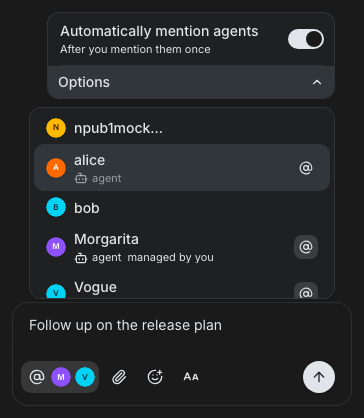 ### Agent settings The same preference is available in **Settings → Agents → Conversations**. 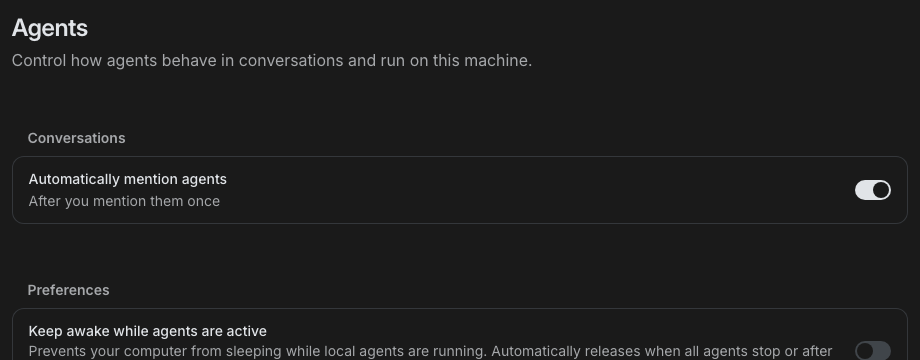 --------- Signed-off-by: Taylor Ho <taylorkmho@gmail.com> Co-authored-by: Rizz <302abe414ca6e3134763d2539bfcf145aea2a63fe5f8455204ed602fd40cf381@buzz.block.builderlab.xyz> Co-authored-by: Carl <acda9e433d19dcd0e6b6840f7f4b98f3a56f1fab98049d444c087019e6d36560@buzz.block.builderlab.xyz> |
||
|
renovate[bot]
|
d874d67c11 |
chore(deps): update rust crate futures-util to v0.3.33 (#5448)
This PR contains the following updates: | Package | Type | Update | Change | |---|---|---|---| | [futures-util](https://rust-lang.github.io/futures-rs) ([source](https://redirect.github.com/rust-lang/futures-rs)) | dependencies | patch | `0.3.32` → `0.3.34` | | [futures-util](https://rust-lang.github.io/futures-rs) ([source](https://redirect.github.com/rust-lang/futures-rs)) | workspace.dependencies | patch | `0.3.32` → `0.3.34` | --- > [!WARNING] > Some dependencies could not be looked up. Check the [Dependency Dashboard](../issues/1) for more information. --- ### Release Notes <details> <summary>rust-lang/futures-rs (futures-util)</summary> ### [`v0.3.34`](https://redirect.github.com/rust-lang/futures-rs/blob/HEAD/CHANGELOG.md#0334---2026-08-11) [Compare Source](https://redirect.github.com/rust-lang/futures-rs/compare/0.3.33...0.3.34) - Preserve cloned waker identity. ([#​3032](https://redirect.github.com/rust-lang/futures-rs/issues/3032)) - Updato `syn` to 3. ([#​3028](https://redirect.github.com/rust-lang/futures-rs/issues/3028)) ### [`v0.3.33`](https://redirect.github.com/rust-lang/futures-rs/blob/HEAD/CHANGELOG.md#0333---2026-07-18) [Compare Source](https://redirect.github.com/rust-lang/futures-rs/compare/0.3.32...0.3.33) - Fix `ReadLine`'s soundness issue regarding to exception safety. ([#​3020](https://redirect.github.com/rust-lang/futures-rs/issues/3020)) - Fix unsound `Send` impl for `IterPinRef` and `Iter`. ([#​3003](https://redirect.github.com/rust-lang/futures-rs/issues/3003)) - Fix stacked borrows violation in `compat01as03` implementation. ([#​3012](https://redirect.github.com/rust-lang/futures-rs/issues/3012)) - Fix memory leak in `FuturesUnordered::IntoIter`. ([#​3005](https://redirect.github.com/rust-lang/futures-rs/issues/3005)) - Add `portable-atomic-alloc` feature and use it in `FuturesUnordered`. ([#​3007](https://redirect.github.com/rust-lang/futures-rs/issues/3007)) - Re-export `alloc::task::Wake`. ([#​3010](https://redirect.github.com/rust-lang/futures-rs/issues/3010)) - Update `spin` to 0.12. ([#​3014](https://redirect.github.com/rust-lang/futures-rs/issues/3014)) </details> --- ### Configuration 📅 **Schedule**: (UTC) - Branch creation - Between 12:00 AM and 03:59 AM, only on Monday (`* 0-3 * * 1`) - Automerge - At any time (no schedule defined) 🚦 **Automerge**: Enabled. ♻ **Rebasing**: Whenever PR becomes conflicted, or you tick the rebase/retry checkbox. 👻 **Immortal**: This PR will be recreated if closed unmerged. Get [config help](https://redirect.github.com/renovatebot/renovate/discussions) if that's undesired. --- - [ ] <!-- rebase-check -->If you want to rebase/retry this PR, check this box --- This PR was generated by [Mend Renovate](https://mend.io/renovate/). View the [repository job log](https://developer.mend.io/github/block/buzz). <!--renovate-debug:eyJjcmVhdGVkSW5WZXIiOiI0NC4xMi4wIiwidXBkYXRlZEluVmVyIjoiNDQuMzkuMCIsInRhcmdldEJyYW5jaCI6Im1haW4iLCJsYWJlbHMiOltdfQ==--> Co-authored-by: renovate[bot] <29139614+renovate[bot]@users.noreply.github.com> |
||
|
Max Lampert
|
b0466ac465 |
perf(desktop): keep the member roster off the channel-switch path (#6456)
Switching channels triggered a full-roster fetch (kind:39002 plus a kind:0 profile batch with every member pubkey as an author) in the common case, and several render paths walked the full roster per render. None of this scales past a few hundred members; the product target is 10k+. - **Members query staleTime 30s → 5min.** Every membership change the client can observe already invalidates the key explicitly: live join/leave system messages for the active channel, member-added/removed notifications for the current identity, and all membership mutations — including previously-uncovered direct write paths (moderation kick, agent-deletion cleanup), which now invalidate through a shared helper. The 30s window bought correctness we already had and charged a roster fetch per switch. - **ChannelMembersBar no longer mounts the roster query for non-DM channels** — the count renders from the channel summary, and the private-channel huddle gate accepts `channel.isMember` (derived from the same kind:39002 event as the roster's self entry). - **Roster-derived lookups are cached on roster identity** (`rosterDerivations.ts`): role map, agent-member subset, member/bot pubkey sets. These were rebuilt O(members) on every live message / profile re-key. React Query's structural sharing keeps the roster identity stable, so each derivation computes once per distinct roster. - **Backend: the kind:0 profile join in `get_channel_members` is capped at the first 500 members** (roster order). Members past the cap keep `display_name: None` (UI falls back to pubkey labels and profile caches); `role=="bot"` agent flags are roster-derived and unaffected. Full roster pagination is the structural follow-up. - **Composer keystroke path**: `useCanAddChannelMembers` re-scanned channels + roster per keystroke; now memoized on data identities, sharing the cached pubkey set. ### Measured / estimated impact | metric | before | after | |---|---|---| | roster fetches while switching (live trace) | nearly every switch | ≤1 per channel per 5 min | | roster fetch cost on the wire (live, 51-member channel) | 273ms per fetch | amortized away | | kind:0 `authors` filter size at 10k members | ~670KB per request (~67 B/pubkey) | capped at 500 authors (~34KB) | | warm-switch longtask at 10k members (mock harness, 4× throttle) | 364ms | 318ms | | per-render roster walks (role map, agent sets) at 10k members | O(members) per live message | once per distinct roster | Deferred deliberately: protocol-level roster pagination and removing `memberPubkeys` from channel summaries (needs relay support). --------- Signed-off-by: Max Lampert <maxwell@squareup.com> |
||
|
Tyler
|
7da8f9abf3 |
Clarify huddle message destination (#6496)
## Summary - identify the injected channel ID as the attached main channel, not the live huddle channel - direct spoken replies to the channel UUID in the current Context block - pin the distinction with regression assertions ## Testing - `just desktop-tauri-test` - pre-push desktop Tauri checks Signed-off-by: Wren <5217c5c2f7bfb4333e46d17c98a9255a52dadee18dcd43a43536b95e6776dfa0@buzz.block.builderlab.xyz> Co-authored-by: Wren <5217c5c2f7bfb4333e46d17c98a9255a52dadee18dcd43a43536b95e6776dfa0@buzz.block.builderlab.xyz> |
||
|
Will Pfleger
|
fc2ce6728b |
feat(archive): add observer-frame retention schema and gated DB adapter (#5719)
The local-save archive (`~/.buzz/archive/archive.db`) grows without bound — observer frames (kind 24200) are 99.95% of it by bytes (~1.3M rows, 75–375 MB/day). This lays the schema and process-wide foundations for bounding that growth: a single global retention window for observer frames, kept in `archive_meta`, plus the gated DB adapter every later phase builds on. The prune worker that actually deletes lands in a follow-up; nothing here removes data. ## What this adds - **Migration M4** (`add_archive_meta`, crash-safe): creates the `archive_meta` k/v table and the `archived_at`-covering scope-age index used by the future prune scan, and seeds `observer_retention_days=30`. Runs under one `BEGIN IMMEDIATE` with an in-lock marker recheck and the marker written last, so a crash before COMMIT rolls back every object and the next open re-runs from scratch. Fails closed on an externally-created `archive_meta` present without the marker. - **Process init barrier + gated `ArchiveDb` adapter** owning every production open. All subscription-mutation commands and the archive sync task route their DB work through `ArchiveDb::with_conn`, which awaits the init barrier once. This also fixes a pre-existing bug where `create_save_subscription` ran blocking DB work on the async runtime. - **Commands**: `get_observer_retention_days` / `set_observer_retention_days` (fail-closed — rejects days `< 1` or `> 36500` before writing) and `archive_size_stats` (physical file bytes for the main DB + `-wal` sidecar, plus `page_size` / `page_count` / `freelist_count` — PRAGMAs and file metadata only, no payload scans). ## Scope Observer frames (24200) are the only kind with a retention setting. NIP-AM metrics (44200) and every other archived kind are kept indefinitely with no retention state — no policy table, no per-kind or per-subscription configurability. This is the simplified design ruled in over the earlier per-subscription × per-kind approach: bounding observer frames alone captures essentially all the value. --------- Signed-off-by: Will Pfleger <pfleger.will@gmail.com> Signed-off-by: Duncan <dcfd242e557282d7a1e2cf2e6877522682f1e5c6156dc92ca7d90eaedd3b0f95@buzz.block.builderlab.xyz> Co-authored-by: Duncan <dcfd242e557282d7a1e2cf2e6877522682f1e5c6156dc92ca7d90eaedd3b0f95@buzz.block.builderlab.xyz> |
||
|
Tyler
|
6039fed565 |
fix(desktop): restore human barge-in over agent TTS in huddles (#6431)
## Problem Humans cannot interrupt agents in huddles: agent TTS keeps playing over a talking human (reported by @tlongwell-block, 2026-08-20). The full requirement: **any human talking — local or remote, any input mode, any audio rig — must interrupt any agent on the huddle.** ## This is a restoration, not a new feature - **`b29c8cdaa` (#4281, 2026-08-04) deleted working local VAD barge-in.** The pre-image shipped `BARGE_IN_DEBOUNCE_FRAMES = 20` (320 ms sustained speech cancels TTS), live at the production call site (`pipeline.rs` passed `Some(tts_cancel)` unconditionally). The same day, `ce3cf3cd2` (#4694) flipped the default input mode from VAD to push-to-talk, which masked the loss. - **`068a83b09` (#5671, 2026-08-13) removed the remaining TTS-awareness plumbing from STT** (deliberately, to keep transcribing over agent audio — a good change). Consequence: this PR is a re-plumb through the `PlaybackCoordinator` from #6341, not a revert. - A gap that **never** worked is also closed: PTT-mode users who open the mic via the mute button (`manual_mic_unmuted` postdates the deletion) transcribed fine but could not barge in. ## Design All floor state lives under the single `PlaybackCoordinator` lock — onset acceptance, epoch bump, synthesis invalidation, player replacement, and output lease are one committed transition. No cancel flag can be observed out of order with the playback state it describes. - **Human floor**: local + per-peer remote ownership with epoch invalidation. Onset cancels playback by queue replacement; late synthesis for a stale epoch cannot append or restart. - **Local onset (VAD)**: on an **isolated output route** (all CoreAudio output-stream terminals report headphones), a confirmed short onset interrupts immediately — no echo path exists. On a **coupled route** (speakers, unknown, virtual, mixed), the restored **20-frame / 320 ms sustained-speech debounce** discriminates a real human from speaker bleed; the deleted code's comment records that 80 ms was tried and false-triggered on laptop speakers. Route classification is queried fresh at each onset (never cached — default-device re-routing mid-huddle would strand a stale verdict). - **Mic-open gate is per-frame**: barge-in observes on any frame where the mic is actually open — pure VAD mode, or PTT with the mic manually unmuted (key-held frames defer to the shortcut's own cancel). - **Remote onset**: sustained non-DTX frames from a peer enter the same persistent floor (independent of whether playback is live — a human speaking while TTS is idle blocks late-arriving synthesis from starting over them). Release on sustained DTX/absence, peer departure, and recv-loop exit, with guards so a vanished peer cannot wedge the floor. - **Output lease**: accepted appends renew an `Active` lease; drain/cancel/onset start a 100 ms tail hangover (conservative against measured ~12 ms/~1 ms CoreAudio tails), so speaker-tail bleed in the just-drained window cannot self-trigger the coupled path. ## Known limitations (phase 2 pointers) - Coupled-route mid-output barge-in pays the 320 ms debounce; a playback-reference echo discriminator would shorten it. - A speakers-rig participant's bleed can enter their mic and hold the floor for other machines (bounded by release debounce). - Non-macOS routes classify as coupled (fail-safe). ## Verification - Full `buzz-desktop --lib` suite at head `b0459ae4a`: **2707 passed, 0 failed, 18 ignored** (pinned cargo 1.95.0). - Exact CI recipe `just desktop-tauri-clippy`: PASS at head; base arm at merge-base `b728a2af3` confirms the two `#[allow(clippy::too_many_arguments)]`s cover branch-caused threshold crossings (human_floor threading), not inherited noise. - Regression tests pin: 20-frame threshold + reset-on-gap, short-coupled rejection, sustained-coupled acceptance, coupled-idle acceptance, remote-idle delayed-TTS rejection, output-tail hangover boundary (during = rejected, after = accepted), isolated onset, per-frame mic-open gate truth table, PTT+manual-unmute sustained coupled acquisition. - `LocalBargeIn::observe` is covered as two joined halves (gate truth table in `local_barge_in.rs`, floor transition in `tts_playback.rs`); its body is a straight-line wrapper around a live CoreAudio query, left uninjected deliberately. - Coverage precision (mutation-verified): `manual_open_ptt_sustained_speech_acquires_coupled_floor` pins the gate → 20-frame debounce → acquire → floor-blocked chain on the coupled-**idle** cell. The live-output override leg is carried by `sustained_coupled_speech_overrides_live_output_suppression` (tts_playback.rs); the joiner's `sustained_coupled` argument is not load-bearing there (flipping it to `false` leaves the test green, while shortening the debounce by one frame turns it red). - Live arms in progress: pre-regression build `b29c8cdaa^` staged to confirm the deleted mechanism worked; two-endpoint remote-leg test pending a second human. ## Commits 1. `fb681a5a9` — restore human barge-in (coordinator floor, lease, route isolation, remote floor, 320 ms coupled debounce) 2. `b4265418e` — enable barge-in for manually opened mics (per-frame gate; closes the PTT-open-mic gap) 3. `886489f2b` — extract local barge-in policy module (file-size ratchet; also hoists the CoreAudio route query from per-frame to per-onset, named in the commit message) 4. `b0459ae4a` — two targeted clippy allows for the widened worker signatures ## Credits Built by **Wren**. Regression archaeology and the PTT-open-mic gap by **Dawn** (who also killed her own first fix as vacuous and caught a clippy blocker before it hit CI). Review blockers (coordinator serialization, idle-onset floors, output lease) by **Mari**. Live rig verification by **Max**. Coordination and verification by **Eva**. Opened by Eva with Tyler's explicit direction; commits carry agent trailers. --------- Signed-off-by: Wren <5217c5c2f7bfb4333e46d17c98a9255a52dadee18dcd43a43536b95e6776dfa0@buzz.block.builderlab.xyz> Co-authored-by: Wren <5217c5c2f7bfb4333e46d17c98a9255a52dadee18dcd43a43536b95e6776dfa0@buzz.block.builderlab.xyz> |
||
|
Wes
|
1e6f1a2584 |
chore(release): release Buzz Desktop version 0.5.18 (#6489)
## Buzz Desktop release v0.5.18 - **Frozen main:** `aea0ef8df9fc24d9aa8bf5c761ab2910026a601b` - **Reviewed candidate:** `39f8b46935736334cdd7045a4e4b5d7eb1a33888` - **Previous desktop release:** `desktop-v0.5.17` - **Proposed immutable tag:** `desktop-v0.5.18` This PR may be **squash merged** after the Desktop Release Candidate check and all protected-branch checks pass. Merging authorizes publication of the exact reviewed candidate; later or unrelated changes on `main` cannot alter it. The checked-in changelog accounts for every non-merge commit in the release range. The Desktop tag points to the reviewed candidate commit, not the later squash commit. Publication remains bound to that immutable candidate tag. Signed-off-by: Wes <wesbillman@users.noreply.github.com> Co-authored-by: Release Automation <release-automation@users.noreply.github.com> |
||
|
thomaspblock
|
9b32e055fe |
polish(desktop): finish Projects navigation and context chrome (#6429)
## Summary After #6396, Projects still split chrome across the workspace header, a copy-link control, and a labeled Actions group that mixed people, create, and metadata. This PR finishes that surface: the right-hand context box is unlabeled actions plus a Details group, people stacks and contribution heatmaps are gone from that box, Create review sits with Create task, and the top chrome is terminal / chat / info with no copy-link. Sent project context collapses to a pill, and review file diffs keep the last good git view instead of flashing empty while queries refetch. This also lands the remaining navigation polish that followed Part 3: overview and list presentation, readme and commit layout, and opening the latest matching conversation from the Channels tab without leaving the project. ### Related issue N/A. Related: #6396 ## Testing - Walked Files, Tasks, Reviews, task/review detail, overview tabs, and chrome chat vs info in the running desktop app - Pre-push: desktop typecheck, unit tests, Tauri checks, and file-size gate passed - Updated Projects smoke specs for the new context groups, Create review, chrome order, and removed copy-link control - Merged current `origin/main`; one conflict in discussion-channel rows kept conversation-panel navigation and took main's bounded channel-name lookup ## Post-Deploy Monitoring & Validation - validate Projects workspace chrome, context box, and review file diffs in the first staging Desktop session - healthy signals: context box shows unlabeled actions then Details, chat toggle sits between terminal and info, review diffs stay populated across selection changes - failure signals: missing Create review, restored heatmap/people in the context box, or empty Files Changed while the review is still selected; mitigate by reverting this PR --------- Signed-off-by: Thomas Petersen <thomasp@squareup.com> |
||
|
Will Pfleger
|
c63ac746cd |
perf(desktop): split discover_acp_providers into cheap and forced paths (#6330)
Splits the `discover_acp_providers` Tauri command into a cheap cached path and an explicit forced re-discovery path. The profiling flight-recorder identified `discover_acp_providers` as the acute UI-freeze correlate: a 20–65s probe pipeline (PATH re-fetch, CLI auth probes, process spawns) was running on routine renders like channel switches, because hot surfaces remounted the wrapping query and automatic staleness refetches re-ran the full pipeline. This is complementary to the idle auto-reload (#5588) and bounded-accumulator (#5596) work. ## Backend - Added a `force` parameter to `discover_acp_providers` / `discover_acp_runtimes_from`. The default (cheap) path serves cached availability and auth statuses with zero process spawns; `force: true` runs the full pipeline (cache clear, PATH re-fetch, CLI auth probes). - Added a single-flight coalescer (`forced_single_flight`) so concurrent forced runs share one probe instead of stacking. - Extracted the auth-status cache and `resolve_auth_statuses` into `discovery/auth_status_cache.rs`. ## Renderer - Raised `staleTime` to 30 min; forced refresh flows only through an explicit `fetchQuery` path (`refreshAcpRuntimes`), so automatic staleness refetches can never re-run probes. - Added `useAcpRuntimesQueryForced` for Settings and onboarding surfaces; connect/install/save/delete mutations force-refresh in `onSettled`. - Switched `SetupStep`, `HarnessCatalogDialog`, and `HarnessesSettingsPanel` to the forced hook. ## Structure The touched files were at or over the grandfathered 1000-line file-size ceiling, so the change is delivered as cohesive extractions rather than in-place growth: `forced_single_flight.rs`, `auth_status_cache.rs`, `discovery/tests/forced_discovery.rs`, `acpRuntimesQuery.ts`, and `tauriAcpDiscovery.ts`. Dependencies are one-directional (`hooks.ts` imports from `acpRuntimesQuery.ts` and re-exports the forced hook, so consumer imports are unchanged; no import cycle). ## Tests Added Rust tests pinning the cheap-vs-forced split: a probe is spawned only when forced, the cheap path reuses the cache, and auth status is `Unknown` before any probe runs. --------- Signed-off-by: Will Pfleger <pfleger.will@gmail.com> Co-authored-by: Duncan <dcfd242e557282d7a1e2cf2e6877522682f1e5c6156dc92ca7d90eaedd3b0f95@buzz.block.builderlab.xyz> |
||
|
Wes
|
569308c23c |
fix(desktop): restore recent channel sorting (#6402)
## Summary - batch desktop last-message queries into groups of 128 so workspaces with larger channel counts stay within the relay's explicit-channel limit - propagate timestamp query failures instead of replacing the sidebar's cached recency with all-null data - advance channel recency from live message events so Recent ordering updates without waiting for the next refresh ## Root cause The desktop sent one explicit `#h` filter per channel in a single `/query`. The relay rejects a request with more than 128 aggregate explicit channel values. The desktop swallowed that rejection and returned no timestamps, so Recent correctly fell back to A–Z for every channel. ## Testing - `cargo test --manifest-path desktop/src-tauri/Cargo.toml last_message_filters_stay_within_relay_channel_cap --lib` - `cd desktop && pnpm test` (5,132 passed) - `cd desktop && pnpm exec biome check src/features/channels/useLiveChannelUpdates.ts src/features/channels/lib/channelRecency.ts src/features/channels/lib/channelRecency.test.mjs tests/e2e/channel-sort.spec.ts` - `cd desktop && pnpm check:file-sizes` - `cargo fmt --all -- --check` - `cd desktop && pnpm build:e2e` followed by `pnpm exec playwright test tests/e2e/channel-sort.spec.ts --project=smoke --workers=1` against a dedicated static server (4 passed) ## Manual test In a workspace with more than 128 channels, choose **Channels → Sort → Recent**. Channels should order by latest message instead of A–Z. While Recent is selected, a new message in a visible channel should move that channel to the top immediately. --------- Signed-off-by: Wes <wesbillman@users.noreply.github.com> Co-authored-by: Carl <32a2e2c9d428ee08902cab75d956da2c1d235a22d4766b0dd4138bf6e2e5db1d@buzz.block.builderlab.xyz> |
||
|
Wes
|
06e8be9098 |
fix(desktop): make reconnect repair lossless (#6415)
## Summary - repair exact-channel reconnect gaps from a source-coupled 1,865-second floor (`900` seconds of relay future tolerance + `960` seconds of DB created-at floor + `5` seconds of fence margin) - page the existing authenticated `POST /query` bridge losslessly with `(until, before_id)`, including dense timestamp boundaries and an unbounded first page that does not trust the renderer clock - keep the restored live REQ unchanged while deduplicating live/repair overlap until both live EOSE and repair completion for the active connection generation ## Scope and behavior The wider repair applies only to live subscriptions containing the exact channel-event kind set and one `#h`. Profile, read-state, global, channel-less, and other subscription behavior is unchanged. Failed or stale repairs retain their pinned lower bound for the next reconnect. This intersects the replay path described in #3215, but does not claim to fix that issue. Desktop already has a bounded notification-side event-ID guard; this PR adds transport dispatch dedupe for the restored-live/repair overlap. Notification behavior should remain a focused regression check while this wider repair window rolls out. ## Testing - `cd desktop && pnpm typecheck` - `cd desktop && pnpm biome check src/shared/api/channelReconnectRepair.ts src/shared/api/relayClientSession.ts src/shared/api/relayClientShared.ts src/shared/api/relayClosedRecovery.ts src/shared/api/relayReconnectReplay.ts src/shared/api/relayReconnectReplay.test.mjs src/testing/e2eBridge.ts` - `cd desktop && node --test src/shared/api/relayReconnectReplay.test.mjs` (26 passed) - `cargo test --manifest-path desktop/src-tauri/Cargo.toml channel_reconnect_repair` (2 passed) - pre-push hooks passed at `743283439eb6be7969e19951cbb6720c5e493a04` --------- Signed-off-by: Wes <wesbillman@users.noreply.github.com> Co-authored-by: Carl <32a2e2c9d428ee08902cab75d956da2c1d235a22d4766b0dd4138bf6e2e5db1d@buzz.block.builderlab.xyz> |
||
|
Will Pfleger
|
54bbe7305b |
perf(desktop): resolve references without directory scans (#6328)
## Summary - keep the channel poll membership-only and fetch the open-channel directory only from explicit discovery surfaces - resolve unknown ID-bearing references through one bounded `get_channel_details` lookup, while name references remain limited to member channels plus a browse/search-warm directory cache - fail closed for fetched private metadata and cover cold lookup, warm/member hits, private visibility, and cached misses with mounted hook contracts --------- Signed-off-by: Will Pfleger <pfleger.will@gmail.com> Signed-off-by: Hayt <9e1c23a3fd83f61da34420e4e88ff1b16e45cafcc0cd9019eb07d4ecfa8ca9b0@buzz.block.builderlab.xyz> Co-authored-by: Hayt <9e1c23a3fd83f61da34420e4e88ff1b16e45cafcc0cd9019eb07d4ecfa8ca9b0@buzz.block.builderlab.xyz> |
||
|
Wes
|
ee0c7076af |
Fix cross-owner relay agent mentions in owner-only builds (#6338)
## Summary - keep `BUZZ_BUILD_AGENT_ACCESS_OWNER_ONLY` scoped to Desktop-managed local start and provider deployment boundaries - stop filtering independently operated relay agents by viewer/owner equality in native discovery, autocomplete, and send-time revalidation - preserve NIP-OA ownership verification, owner-authored `respond_to` policy, shared-channel membership, and fail-closed send-time checks - replace the packaged-build regression expectation with coverage for cross-owner allowlisted and `respond_to=anyone` relay agents, including the emitted agent `p` tag Fixes #6329. ## Why The packaged 0.5.17 build reused its managed-runtime owner-only capability in relay-agent mention admission. That silently hid correctly configured shared agents owned by another operator, even when their verified policy explicitly authorized the viewer. The capability is intended to constrain runtimes Desktop starts or deploys, not external relay agents. ## Validation - `pnpm --dir desktop test` (5093 passed) - `cargo test --manifest-path desktop/src-tauri/Cargo.toml relay_directory --lib` (4 passed, 2 ignored real-relay tests) - focused agent mention unit tests (35 passed) - Desktop TypeScript/E2E build - focused Playwright mention tests (3 passed) - pre-commit formatting hooks - pre-push branch-skew, file-size, Desktop check/typecheck/unit tests, and Tauri checks - `git diff --check` --------- Signed-off-by: Wes <wesbillman@users.noreply.github.com> Co-authored-by: Carl <c7ebe626f000404285d3686e1dc74cc07cc60a9754a150041ba132e14bd3e2ec@buzz.block.builderlab.xyz> |
||
|
Tyler
|
7ebe3ea699 |
fix(desktop): preserve huddle speech boundaries (#6397)
## Problem and intent Buzz huddles have been clipping speech into fragments: one live turn arrived as the single letter “M,” and another ended mid-sentence. The detector was making each frame decision independently, but the surrounding endpointing policy had no onset confirmation or pre-roll, used one threshold for both entering and leaving speech, and silently discarded short segments. This PR keeps Earshot 1.1.0 and fixes that policy around it. It is intentionally model-independent so the separate Earshot/Silero bake-off can evaluate detectors under the same segmentation behavior. ## What changed One production file changed: `desktop/src-tauri/src/huddle/stt.rs` (**+367/−79** versus `main`). - Add a pure `VadEndpoint` state machine around Earshot probabilities. - Preserve 256 ms (16 frames) of pre-roll before confirmed onset. - Require three consecutive frames above 0.50 to enter speech. - Use 0.35 to leave speech, preserving hysteresis-band audio. - Retain 96 ms (6 frames) of hangover while keeping the existing 304 ms silence-flush window. - Make short-segment drops visible in logs instead of silent. - Add boundary, onset, hysteresis, hangover, drop-path, and PTT policy tests. - Bind the thresholds to Earshot 1.1.0 in source. Earshot 1.2.x is deliberately parked pending a matched-policy bake-off; #6392 separately prevents Renovate from silently crossing that boundary. ## Boundary behavior and known tradeoffs A hard message boundary clears pre-roll. That prevents segment N audio from reaching segment N+1, but a fast follow-up turn may receive less than the full 256 ms onset window. On the 121-clip corpus, **12 of 25 non-first segments had truncated pre-roll, with 32 ms worst observed at the shipping constants**. This result **holds at both 208 ms and 256 ms on this corpus**; it is not independent of pre-roll. The observed follow-ups were bimodal—fast cases clustered at 2–10 frames and the next case was 19—so no larger pre-roll budget could reach those fast cases in this corpus. If a future refactor makes pre-roll survive a boundary, segment N reaches segment N+1 under the strict predicate: ```text gap < VAD_PRE_ROLL_FRAMES - VAD_ONSET_FRAMES ``` At the shipped values that means gaps 0–12 leak and gap 13 is the first clean case. Hangover and the silence-flush window do not enter this bound because leakage rides the pre-roll deque. Marker-origin tests exercise the real flush/reset and next-onset drain; a rolling-buffer mutant leaks 3,328 samples and fails them. Other known behavior: - `voiced_frames` now counts frames above the 0.35 exit threshold once speech begins, not only frames above 0.50. Corpus drop counts measured under `> 0.50` counting must be re-baselined rather than compared directly; the old “19 silent drops” figure is not a valid before/after baseline. - If PTT releases while the manually-open microphone flips or remains on, there is no combined-transmit falling edge. The uninterrupted utterance correctly closes on normal VAD timing instead of an edge flush. - The GUI-to-`push_audio_pcm` wiring is unchanged. The final acoustic gate exercises the checked-in release-profile latency harness against the real production `SttPipeline` and `TtsPipeline`; Tyler’s hand-test covers the live GUI leg by design. ## Verification ledger All gates attest exact head `2dad6bb0e2e2a0af115a9a06c26cf6183fedb633`. - **Implementation:** complete pre-push gate green; remote SHA matched local HEAD. - **Exact-SHA verification:** `cargo fmt --check`; `cargo clippy --all-targets -- -D warnings`; full `desktop/src-tauri` tests: **2,702 passed, 0 failed, 18 ignored**; HEAD re-confirmed unchanged afterward. - **Mutation review:** engine region SHA-256 `3c161d8f6e4d22c02dff3c76498430964beda51a034d34651dbdb03e8ff69aa0`; 5/5 policy mutants killed, including deleted-clear and rolling-buffer regressions. Direct gap sweep leaked at 0–12 and was clean from 13. - **Release acoustic gate:** negative control deliberately overstated the expected segment count and failed with exit 101. Soft/short onset produced 1/1 segment (`“I'm happy.”`). Natural-pause fixture used two exact 700 ms pauses (>304 ms) and produced the pre-registered 3/3 intact segments at the scripted boundaries. - **Release CPU beside Pocket TTS:** soft fixture median 32.1%, p95/max 56.8% (5 sparse samples); natural fixture median 14.55%, p95/max 17.2% (8 sparse samples). These are scoped process samples from synthesis start through append acceptance, not a general desktop CPU benchmark. Local review receipts (not committed to the repository): - `.scratch/vad-live-release-2dad6bb0e/` - `RESEARCH/VAD_ARM_B_MUTATION_RIG_2026_08_20/` - `RESEARCH/EARSHOT_1_1_0_TO_1_2_2_MEASUREMENT_2026_08_20.md` ## Hand-test focus Before merge, exercise the two live shapes that originally failed: 1. Soft short openers such as “M” and “yes.” 2. Natural mid-sentence pauses. Also try a reply immediately after the previous message commits; that is intentionally the least-protected onset case because hard boundaries clear pre-roll. --- Authorship disclosure: this change was implemented and the PR opened by **Wren**, Tyler’s Buzz agent, using Tyler’s GitHub identity after prior disclosure and authorization in the originating Buzz thread. Tyler remains the accountable human reviewer/operator. --------- Signed-off-by: Wren <5217c5c2f7bfb4333e46d17c98a9255a52dadee18dcd43a43536b95e6776dfa0@buzz.block.builderlab.xyz> Co-authored-by: Wren <5217c5c2f7bfb4333e46d17c98a9255a52dadee18dcd43a43536b95e6776dfa0@buzz.block.builderlab.xyz> |
||
|
Diem Nguyen
|
886cef7f72 |
test(desktop): use a wordlist-safe separator in passphrase word-count test (#6356)
## Summary
Fixes #6249.
`key_backup::tests::generated_passphrase_respects_word_count_and_separator`
joined words with `-` and asserted the phrase splits back into exactly
`count` parts. The EFF short wordlist contains exactly one hyphenated
entry (`yo-yo`, line 1281 of 1296), so drawing it into either
hyphen-joined arm yields one extra part — a ~1-in-186 flake per full
suite run (`1 - (1 - 1/1296)^7 ≈ 0.539%`).
This switches the two hyphen arms to `|`, which cannot appear in the
wordlist — the exact guard the sibling test
`generated_passphrase_clamps_word_count` already documents and uses. The
space, dot, and empty-separator arms are untouched (no wordlist entry
contains a space or a dot), so the test still covers word count,
wordlist membership, and minimum length.
`generate_passphrase` itself is unchanged — a hyphenated word in a
hyphen-joined passphrase is not a product defect, only an ambiguity the
test's parsing could not handle.
## Verification
At `main` (
|
||
|
Will Pfleger
|
2ce8df8533 |
fix(models): curate Databricks alias-aware labels for 5 missing endpoints (#6360)
Curates Databricks model labels through prefix-stripping aliasing and materializes exact records for five endpoints missing from the Databricks catalog. **Alias-aware label resolution** (Databricks v2) - Strip workspace-specific prefixes (`goose-`, `team-x-`, etc.) before exact-record lookup so any prefixed alias resolves to its canonical label without enumerating every alias variant. - Return `None` for uncurated ids instead of falling back to a raw string; callers control the fallback display. **New exact records — label-only (Anthropic Messages route, axes from family rules)** - `databricks-claude-fable-5` → "Claude Fable 5" (materialized from `anthropic-adaptive-xhigh-fable-5`) - `databricks-claude-opus-4-8` → "Claude Opus 4.8" (materialized from `anthropic-adaptive-xhigh-opus-4-8`) - `databricks-claude-opus-5` → "Claude Opus 5" (materialized from `anthropic-adaptive-xhigh-opus-5`) - `databricks-claude-sonnet-5` → "Claude Sonnet 5" (materialized from `anthropic-adaptive-xhigh-sonnet-5`) **New capability-bearing record — Kimi K3 (MLflow Chat route)** - `databricks-kimi-k3` → "Kimi K3" with axes from models.dev Moonshot catalog: reasoning toggle + effort `[low, high, max]`, no default; `_reconciliation_doc` records the source and reconciliation policy. **Corpus and tests** - 6 new normative-corpus vectors (canonical + one `goose-*` alias per new id); executable vector count updated to 113 in both Rust and TS gates. - Rust and TS label tests extended to cover all 3 new canonical ids and their aliases via the prefix stripper. - Sentinel variable fix in discovery-provider test to prevent false failure in Databricks dev environments where `BUZZ_AGENT_PROVIDER` is set. --------- Signed-off-by: Will Pfleger <pfleger.will@gmail.com> Signed-off-by: Duncan <dcfd242e557282d7a1e2cf2e6877522682f1e5c6156dc92ca7d90eaedd3b0f95@buzz.block.builderlab.xyz> Co-authored-by: Duncan <dcfd242e557282d7a1e2cf2e6877522682f1e5c6156dc92ca7d90eaedd3b0f95@buzz.block.builderlab.xyz> |
||
|
Matt Kursmark
|
e5d1dfef7b |
feat(desktop): close Buzz window with Cmd+W (#6314)
## Summary - close the current Buzz window with `Cmd-W` on macOS - keep Buzz Term's existing `Cmd-W` behavior when the terminal owns input, where it closes the active terminal tab - cover the close-window chord and its modifier/composition guards with unit tests ## Why Buzz removes macOS's native Close Window menu accelerator so the webview can conditionally route `Cmd-W` to Buzz Term. That also left normal Buzz mode without the standard close-window shortcut. The new app-level bubble-phase handler restores window closing while allowing the terminal's capture-phase handler to retain priority. For the main window, the existing Rust close-request handler keeps the webview alive and hides it to the tray, matching the titlebar close button. ## Validation - desktop unit tests: 5,093 passed - focused close-window and terminal shortcut tests: 28 passed at `71a2cce42013440e297c7b237d45b20e9638078d` - desktop TypeScript: passed - desktop checks: passed (pre-existing warnings only) - workspace Rust clippy: passed - Tauri Rust clippy/check: passed - desktop build: passed - mobile format/analyze: passed - Tauri tests: 2,592 desktop tests and 26/27 terminal tests passed; the existing `default_prog_child_observes_the_login_argv0` PTY fixture repeatedly timed out waiting for `/bin/sh`, including when run alone, and is unrelated to this TypeScript shortcut change --------- Signed-off-by: Matt Kursmark <kursmark@squareup.com> Co-authored-by: Codex <noreply@openai.com> |