Add matched Databricks Luna xhigh conditions for a pinned solo persona and a pinned driver/navigator pair. Both keep the existing route, rates, trial budget, and container resources while exposing prompt bytes as the optimization axis.
Co-authored-by: Atish Patel <atish@squareup.com>
Signed-off-by: Atish Patel <atish@squareup.com>
Amendments from the tb21-twins-1 fail triage (all 24 zero-reward trials):
- Delegation paragraph replaced: four wake triggers (parallel exploration,
  rival hypotheses, test-as-I-build, independent verification) with the
  burden inverted — an idle Mie is a decision to defend. Outstanding Mie
  lane doubles as Mia's heartbeat (fixes the dead-turn trial).
- Todo paragraph: task event id written at minute 0 + mandatory fetch-by-id
  reread of the full task text as the last item before DONE: (fixes
  grading-against-memory failures).
- Deliverable-first clause: rough deliverable at the exact task path ASAP
  (12 of 24 fails were timeouts with nothing at the required path; 4 other
  timeouts scored 1.0 purely on disk artifacts).
- Mention-mechanics clause: silent lane => treat wake as unrouted, recheck
  exact @name, resend once (filter-js-from-html lost its verify lane to a
  missing @ prefix).

mie.md unchanged. Manifest mia sha256 re-pinned; loader validates.

Co-authored-by: Eva <011987e296fd5006292d2f930b574be47c7801048d1983c46c425d3c95f0cffd@buzz.block.builderlab.xyz>
Signed-off-by: Eva <011987e296fd5006292d2f930b574be47c7801048d1983c46c425d3c95f0cffd@buzz.block.builderlab.xyz>
Two-seat twin roster smoked green on hello-world (reward 1.0) and now
running the full TB2.1 89-task bench as tb21-twins-1. Mia holds the conn
(orchestrator seat — the harness watches that pubkey for DONE:), Mie is
the delegable worker twin. Both personas are the Meli solo prompt plus
twin team sections, byte-identical to each other except the identity
line and the conn/worker paragraph.

Contract: thread-of-record comms (--reply-to the task post), both keep
the todo tool loaded, Mia never ends her turn while the task is
incomplete (sleep-30 poll loop; requires unbounded agent rounds from
#5318), Mie ends every turn with a report mentioning Mia, only Mia sends
DONE:. Model: deepseek-v4-flash via OpenRouter pinned cloudflare/fp8 —
the existing openrouter-cloudflare.json endpoint config, unchanged.

Manifest persona sha256 pins match the committed files.

Co-authored-by: Eva <011987e296fd5006292d2f930b574be47c7801048d1983c46c425d3c95f0cffd@buzz.block.builderlab.xyz>
Signed-off-by: Eva <011987e296fd5006292d2f930b574be47c7801048d1983c46c425d3c95f0cffd@buzz.block.builderlab.xyz>
Commits the tb21 Meli-solo condition that until now lived only as
untracked files on the runner box, plus the take-2 variant Tyler asked
for (thread 74a65a09, event f7457e0b):

- tb-meli-solo.yaml + personas/bench/meli-solo.md: the exact manifest
  and persona (sha256 de633019...) that produced run tb21-solo-1 on the
  gmicloud/fp8 pin. Recorded for provenance.
- tb-meli-solo-baseten.yaml: identical cell, condition
  tb-meli-solo-baseten, priced at the baseten/fp8 listed rates
  (prompt $0.13/M, completion $0.26/M — OpenRouter endpoints API,
  2026-08-07).
- testbed/endpoints/openrouter-baseten.json: the provider pin,
  OPENROUTER_PROVIDER_ORDER=baseten/fp8. A separate endpoint file so
  openrouter-live.json (which run 1's provenance points at) stays
  byte-identical.

Run 2 executes on the post-merge harness (9cafe8f1, PR #5145), which
carries #4896 (vision-input recovery) and #5136 (explicit-mention task
post) that run 1 predated.

Originating Buzz thread:
buzz://message?channel=c3252dd2-0142-4e01-88c7-a2183c3960a5&id=74a65a0990fd2197882b66b5ea2707169d4a3dbd2020d1610c45150fb99f140b

Co-authored-by: Eva <011987e296fd5006292d2f930b574be47c7801048d1983c46c425d3c95f0cffd@buzz.block.builderlab.xyz>
Signed-off-by: Eva <011987e296fd5006292d2f930b574be47c7801048d1983c46c425d3c95f0cffd@buzz.block.builderlab.xyz>
`_settle_usage` waited for the agent to report its tokens before teardown
killed it, but only on the success path. The timeout path fell straight
through to the kill, on the stated reasoning that "a turn that never
completed has no usage to flush".

That was true while buzz-agent reported once per turn. It is not true now
that it reports after every provider round, and it was always the wrong
path to skip: under `continue_until_timeout` every phase but the last ends
here, so the skip applied to essentially the whole run. It is the harness
half of the 97%-zero-rows / 5.9x-undercount measured on the OpenRouter
LHTB-46 cell; the agent half is the per-round reporting.

Moving the call into the `finally` covers both paths and keeps the ordering
that matters — settle, then kill. It stays cheap: it returns on the first
poll once a usage line exists, which after the first round it does, so only
a phase that never completed a single round can spend the full budget, and
that phase has nothing to report anyway.

Depends on the per-round reporting in buzz-agent to be worth much on its
own.

Signed-off-by: Atish Patel <atish@squareup.com>
Co-authored-by: Claude Code <noreply@anthropic.com>
Three cells, all at reasoning effort `high`, all on pinned OpenRouter
upstreams:

  tb-solo-kimi-k3-high            TB 2.1 solo, moonshotai/kimi-k3
  tb-solo-deepseek-v4-flash-high  TB 2.1 solo, deepseek-v4-flash-0731
  lhtb-or-kimi-lead-2deepseek-high  LHTB-46 team: kimi lead, deepseek
                                    scout, deepseek worker

The first cells in the study on open-weight models and on a route other
than direct-OpenAI or Databricks. The solo pair spans a 22x input price
ratio ($0.133 vs $3.00/Mtok), making it the open-weight analogue of the
luna -> sol ladder; the team cell is the open-weight restaging of
tb-gt-sol-luna-terra-high, which is currently the study's only clean
long-horizon team win.

NO MEDIUM-EFFORT CELLS. The original plan had a high/medium pair per
model. Neither model supports it: both advertise supported_efforts
["max","high","low"], and while OpenRouter accepts `medium` without
error, measured reasoning length on deepseek did not separate low from
medium from high (medians 1097 / 1102 / 1067, within-level spread wider
than between-level). A cell labelled `medium` would name a condition the
provider does not implement, so the effort axis is dropped rather than
faked.

Effort is still pinned on all three cells even though `high` matches
deepseek's provider default -- an unpinned cell records no effort in its
manifest, so a later provider-side default change would silently redefine
the condition without moving the hash. kimi defaults to `max`, so there
`high` is a deliberate step down.

Prices are the PINNED endpoints' own rates, not the model ids' headline
rates -- gmicloud/fp8 bills $0.133/$0.266 where the model id advertises
$0.14/$0.28, and two of kimi's ten upstreams bill 1.5x the row here. The
pin is what makes these rows the correct ones, so dropping it would
require restating cost as well as re-establishing the condition.

Co-Authored-By: Claude Opus 5 (1M context) <noreply@anthropic.com>
Signed-off-by: Atish Patel <atish@squareup.com>
An OpenRouter model id is a family of upstream deployments, not one
deployment. `deepseek-v4-flash-0731` is served by nine upstreams spanning
fp4 to fp8 quantization, 262K to 1M context and a 1.6x price spread;
`kimi-k3` by ten spanning 1.5x. Unpinned, consecutive requests land on
different ones, so a benchmark cell measures a mixture whose composition
moves with provider load rather than a fixed condition.

It also decides whether prompt caching happens at all. Measured today
against a fixed 21.8K-token prefix, three calls each:

  deepseek, unpinned        cached 0, 0, 21760   (GMICloud, Cloudflare x2)
  deepseek gmicloud/fp8     cached 21760 x3      $0.00059/call
  deepseek siliconflow/fp8  cached 0 x3          $0.00306/call
  kimi, unpinned            cached 0, 0, 20480   (Fireworks, Moonshot x2)
  kimi moonshotai/mxfp4     cached 20480 x3      $0.00715 vs $0.06245

That is a 5-9x swing in input cost for identical work, decided by
routing luck. The `/endpoints` metadata is no guide: it advertises
`supports_implicit_caching: false` for every endpoint measured caching
above, and `true` only for one that is not routable on this account.

So: `OPENROUTER_PROVIDER_ORDER` (comma-separated, accepting both the bare
`moonshotai` slug and the `gmicloud/fp8` slug/quantization form) sets
`provider.order`. It is strictly opt-in -- unset leaves the body byte
identical, which is what keeps the existing "no body shape adds a provider
routing filter" assertions honest.

Paired with `allow_fallbacks: false`, because `order` alone is only a
preference: OpenRouter still serves from elsewhere when the named upstream
is busy, which is exactly the silent mid-run condition change this exists
to prevent. A pin that quietly falls back is not a pin. This is not
`require_parameters` -- that filter screens on advertised parameters and
404s otherwise-valid model ids, which is why the reasoning block nearby
stays away from it.

Co-Authored-By: Claude Opus 5 (1M context) <noreply@anthropic.com>
Signed-off-by: Atish Patel <atish@squareup.com>
Two harness-facing deltas main does not already carry:

- acp.rs: `tool_call: shell (other)` records that a shell ran but not what
  it ran, and the command is not persisted anywhere else in a session
  bundle. Without it a teammate that read the repo and one that rewrote it
  leave identical logs, which is the whole content of a read-only role.
- config.rs: tests pinning that the benchmark's endpoint spellings survive
  the effort clamp. An unrecognised model silently clamps down, which turns
  a graded sweep into a null that reads as a finding.

Everything else this branch carried in crates/ (cache_control breakpoints,
cached-token accounting, provider_extra/thoughtSignature, turn-start
logging) has landed on main independently, so main's version is taken.

Signed-off-by: Atish Patel <atish@squareup.com>
Co-authored-by: Claude Code <noreply@anthropic.com>
Brings the benchmark harness (accounting, container runtime, manifests,
personas, summarize/leaderboard tooling) forward onto main. main does not
touch benchmarks/, so this is the branch tree verbatim.

Signed-off-by: Atish Patel <atish@squareup.com>
Co-authored-by: Claude Code <noreply@anthropic.com>
## Buzz Desktop release v0.5.17

- **Frozen main:** `3fdf289b78c40f80abce86575c25b5ed6361d82c`
- **Reviewed candidate:** `c3bfd66947978fae93f4cfb46bea98ba20e32ccf`
- **Previous desktop release:** `desktop-v0.5.16`
- **Proposed immutable tag:** `desktop-v0.5.17`

This PR may be **squash merged** after the Desktop Release Candidate
check and all protected-branch checks pass. Merging authorizes
publication of the exact reviewed candidate; later or unrelated changes
on `main` cannot alter it.

The checked-in changelog accounts for every non-merge commit in the
release range. The Desktop tag points to the reviewed candidate commit,
not the later squash commit. Publication remains bound to that immutable
candidate tag.

Signed-off-by: Wes <wesbillman@users.noreply.github.com>
Co-authored-by: Release Automation <release-automation@users.noreply.github.com>
## Why

The base prompt prescribed a todo lifecycle for every task needing
follow-up tools, which added control calls even for work completed in
one turn. This keeps the important behavioral contract—continue after
publishing pickup—without prescribing the mechanism.

## What

- Replace the 40-word todo lifecycle with a concise pickup
follow-through rule
- Preserve the requirement to publish the outcome or blocker before
stopping

## Risk Assessment

Low to medium — this changes managed-agent instructions, not runtime
code. The terminal benchmark covers single-turn task completion but does
not cover restart, compaction, or long-lived multi-turn recovery.

## References

- Builds on the prompt simplification in
https://github.com/block/buzz/pull/6161
- Benchmark setup: GPT 5.6 Terra at high effort; the same 11-task
Terminal-Bench 2.1 slate; four concurrent trials; 4 CPU and 8 GiB per
trial; 3× timeout

| Prompt | Pass | Active-h | Median active | Tool calls |
|---|---:|---:|---:|---:|
| PR 6161 baseline | 22/22 | 0.3438 | 0.91 min | 216 |
| Benchmarked 14-word rule | 22/22 | 0.2926 | 0.75 min | 198 |

The benchmarked rule used 14.9% less active time, 16.9% lower median
active time, and 8.3% fewer tool calls. Across the screen and
confirmation runs it passed 33/33 trials with every completion report
present; results are directional because model and tool behavior is
stochastic.

---
**Update Aug 18, 10:47 EDT:** Expanded the completion outcomes following
review feedback.
- The follow-through rule now covers a verified result, blocker, or key
decision or information that needs to be surfaced.
- The benchmark was not rerun; the table reflects the prior 14-word
formulation. This is a completion-taxonomy clarification, not a return
to a prescribed todo mechanism.

Generated with Codex

Signed-off-by: Salman Mohammed <smohammed@squareup.com>
## Why

The `todo` tool description does not say when the tool is unnecessary,
so agents use it for single-turn bookkeeping. Scoping it to cross-turn
persistence reduces avoidable control calls while preserving the
checklist for compaction and genuinely multi-turn work.

## What

- Scope `todo` to work that must continue across turns or survive
context compaction
- Tell agents not to use it for work they can finish in the current turn
- Preserve read/replace semantics and the `_Stop` hook behavior

## Risk Assessment

Low to medium — this changes agent tool-selection guidance, not the tool
name, schema, or implementation. The benchmark covers single-turn
completion but not restart, compaction, or long-lived multi-turn
recovery.

## References

- Companion base-prompt change: https://github.com/block/buzz/pull/6186
- Combined benchmark (PR 6186 prompt plus this description): 22/22 pass;
active time 0.3438h → 0.2680h (-22.0%); tool calls 216 → 173 (-19.9%);
todo calls 45 → 0
- Against PR 6186's prompt-only condition: active time 0.2926h → 0.2680h
(-8.4%); tool calls 198 → 173 (-12.6%)
- Results are directional because model and tool behavior is stochastic.

Generated with Codex

Signed-off-by: Salman Mohammed <smohammed@squareup.com>
## Summary

- add a targeted native `revalidate_relay_agents(pubkeys, channel_id)`
command for send-time authorization
- scope membership discovery to the destination channel and selected
pubkeys before runtime/profile/policy queries
- replace full relay-directory rebuilds with targeted checks before
agent side effects and again at publication
- preserve managed-agent evidence independently and retain internal
owner-only filtering

## Security and trust boundary

The targeted command reuses the existing authoritative chain:

1. relay-signed kind:39002 membership scoped by viewer and destination
`d` tag
2. agent runtime directory event
3. agent-signed owner profile verification
4. owner-signed managed policy
5. internal-build `owner_only` filtering before policy lookup and on
final results

Relay-only agents are dropped on any targeted directory failure. Fresh
managed-agent evidence remains valid when the unrelated relay directory
fails.

## Validation

- pre-push gate passed: branch skew, Desktop check/typecheck/tests,
Tauri checks, Rust tests, and mobile tests
- Desktop unit suite: 4,992 passed
- targeted Rust relay-directory tests passed
- focused Playwright mention-send acceptance passed
  - relay-only send emits the expected `p` tag
- exactly two targeted `revalidate_relay_agents` calls on the
already-member send path: pre-side-effect and pre-publication
  - no `list_relay_agents` call on that send path
  - relay failure and revocation remain fail-closed
  - internal owner-only mode hides other-owned agents
- manual local Desktop testing by Wes: mention sends felt materially
improved

## Notes

This intentionally does not clear the composer early or add an
optimistic timeline row. Publication still waits for fresh
authorization.

---------

Signed-off-by: Wes <wesbillman@users.noreply.github.com>
Co-authored-by: Princess Donut <68157ebd23b3897c1991015c3038658ea916200c67d3a54620b0754d1b92f6e0@buzz.block.builderlab.xyz>
🤖
## Summary
- Bump the locked `h2` version from `0.4.14` to `0.4.16` to clear
RUSTSEC-2026-0258, which affects h2 versions through `0.4.15`.
- Keep the change lockfile-only; no manifest or product-code changes are
included.

## Details
- `h2` is now `0.4.16` with checksum
`a9f37a958b41b3b19ee2707c06439c0e9e547e847223eb791ecb0cb821c65e27`.
- The lockfile was regenerated by `cargo update -p h2 --precise 0.4.16`
using Cargo 1.95.0 / rustc 1.95.0, matching `rust-toolchain.toml` and
the CI pin.
- Cargo's canonical resolver output also rewrites 16 dependency
references to existing `windows-sys` package entries:
- `anstyle-query 1.1.5`, `anstyle-wincon 3.0.11`, `socket2 0.6.3`,
`termina 0.3.3`, and `uds_windows 1.2.1`: `0.61.2` → `0.60.2`.
  - `dirs-sys 0.5.0` and `nu-ansi-term 0.50.3`: `0.59.0` → `0.60.2`.
- `colored 3.1.1`, `errno 0.3.14`, `quinn-udp 0.5.14`, `rustix 0.38.44`,
`rustix 1.1.4`, `rustls-platform-verifier 0.7.0`, `seize 0.5.1`,
`tempfile 3.27.0`, and `winapi-util 0.1.11`: `0.59.0` → `0.52.0`.
- All four referenced `windows-sys` versions (`0.52.0`, `0.59.0`,
`0.60.2`, and `0.61.2`) were already present in the baseline lockfile.
There are zero new package entries or checksums, and the only package
record replacement is `h2 0.4.14` → `0.4.16`. There is no `wasmtime`
edge change.

## Validation
- `cargo-deny check` passed.
- `cargo build --workspace` passed.
- `just test-unit` passed: 455 passed, 0 failed, 1 ignored; all nine
package suites passed.

Signed-off-by: loganj <loganj@squareup.com>
## Summary
- preserve the WebKit-required `Window` receiver when scheduling and
clearing presence subscription retries
- add a receiver-sensitive regression test covering both retry creation
and disposal

## Impact
When subscription opening failed, WebKit rejected the detached timer
call before `retryTimer` could be set. The reconciler's `finally` block
then immediately started another reconciliation because demand was still
unsatisfied and no retry appeared pending. This bypassed the intended
exponential backoff and could repeatedly reopen subscription work during
startup, so the impact was more than console noise.

With the timer receiver fixed, a failed open schedules one bounded retry
at a time (1s exponential backoff, capped at 30s), and disposal cancels
it correctly.

## Validation
- `cd desktop && node --import ./test-loader.mjs
--experimental-strip-types --test
src/features/presence/lib/presenceSubscriptionReconciler.test.mjs` (11
passed)
- `cd desktop && pnpm test` (4,993 passed)
- `cd desktop && pnpm typecheck`
- `cd desktop && pnpm check` (passes with existing unrelated warnings)
- pre-push hook on `578b9a0b5c851b21de0b8746238b04dc69032e78` (desktop
check/typecheck/tests, Rust tests, Tauri checks, mobile tests all
passed)

Signed-off-by: Wes <wesbillman@users.noreply.github.com>
Co-authored-by: Carl <c7ebe626f000404285d3686e1dc74cc07cc60a9754a150041ba132e14bd3e2ec@buzz.block.builderlab.xyz>
## Summary

- make the differential file-size ratchet a first-class repository gate
- run the same unfiltered gate from pre-push, `just check`, and CI
- remove hidden file-size coupling from Desktop, Web, and Mobile lint
commands
- isolate ratchet Git subprocesses from hook-exported repository state

## Why

The Desktop ratchet grew to govern `desktop/src-tauri/crates/**`, but
the pre-push `desktop-check` command remained path-filtered to non-Tauri
files. That contract drift allowed a Tauri Rust file-size regression
through local validation.

The ratchet already computes its own merge-base diff, so duplicating
governed paths in Lefthook and CI adds drift risk without meaningful
runtime savings. One root gate owns the policy now.

## Testing

- `just file-size-check`
- oversized untracked probe under `desktop/src-tauri/crates/**` fails
with the 1,000-line ceiling
- file-size core tests with hook-style `GIT_DIR` / `GIT_WORK_TREE`
environment
- `lefthook dump` confirms the unfiltered pre-push command
- mandatory pre-push suite passed on
`3217003db10c84d8a0c5f636ec4c92936777a002`
- `git diff --check`

Signed-off-by: Wes <wesbillman@users.noreply.github.com>
Co-authored-by: Carl <c7ebe626f000404285d3686e1dc74cc07cc60a9754a150041ba132e14bd3e2ec@buzz.block.builderlab.xyz>
## Summary

Live 0.5.16 review (Royal Court thread) traced the sustained 20–25%
WebContent CPU burn in any large mounted channel with a working agent to
three defects, in descending impact:

1. **Shimmer animation forces per-frame style + compositing walks.**
`.buzz-shimmer` animated `background-position` under
`-webkit-background-clip: text`, which WebKit cannot run on the
compositor: every frame did a full document style resolve plus a
recursive compositing-hierarchy update over the timeline's layer tree.
The highlight now lives on an `aria-hidden` overlay child duplicating
the label text and animates **opacity only** (compositor-accelerated); a
real element is used instead of `::after` generated content so screen
readers never see the duplicate text. Visual: the moving sweep becomes a
gentle pulse. `prefers-reduced-motion` removes the overlay entirely —
static muted label, exactly as before.
2. **Observer journal whole-journal dedup + re-sort per append.** Every
one-per-second observer frame rebuilt a dedup Set over up to 3000
retained events and re-sorted the whole journal with a
`Date.parse`-per-comparison comparator. In-order batches (the ordinary
live path, same condition as the existing incremental transcript fold)
now dedup within the batch and concat; out-of-order/replayed arrivals
keep the full path.
3. **Redundant disk reads in the 5s agent-list poll.**
`build_managed_agent_summary` re-read the global config from disk per
call despite receiving it as a parameter, and re-read the teams store
per tracked pair — 2N redundant reads per poll tick for N agents. Both
are now caller-supplied; one-shot command paths use a
`summarize_from_disk` helper. Same stores, same `unwrap_or_default`
failure posture, read once.

## Evidence (mechanism attribution, live 0.5.16-block, mounted
~1500-event channel)

- True-idle mounted view (working-state UI live): **25.08% mean / 24.15%
median** WebContent CPU; post working-state decay: **6.33% / 3.50%**.
- Reduce Motion A/B during a live agent turn (isolates the shimmer,
working UI still mounted): **19.50% mean → 5.39% mean** (72% collapse).
Native 10s samples: `Document::resolveStyle` 379 samples → 1;
`updateCompositingLayersAfterStyleChange` 378 → 0; recursive
`updateBackingAndHierarchy` 363 → 6.
- The shimmer mechanism predates 0.5.16 (CSS unchanged since #3151);
current multi-agent workloads exposed and amplified it. The mention
regression itself was fixed separately in #6182.

## Testing

- `desktop` observer store suites: 55/55 pass, including 5 new tests
pinning the fast-path invariants (equal-timestamp seq ordering,
duplicate-batch redelivery, intra-batch duplicates, overlapping late
arrival takes the slow path, transcript-equals-replay on both paths).
- `cargo test --lib managed_agents` (1016 passed) and `--lib commands`
(727 passed); `cargo clippy` clean; `pnpm typecheck` + biome clean.
- Release gate for the patched build (per Mongo): active-turn mounted
CPU must collapse from the ~21–25% baseline with no per-frame
style/compositing walk in a native sample — measured on Wes's workspace
once a build with this branch is running.

Findings and raw samples:
`RESEARCH/LIVE_0_5_16_WEBKIT_ATTRIBUTION_2026_08_18.md`,
`RESEARCH/RENDERER_STEADY_STATE_LOOP_AUDIT_2026_08_18.md`,
`.scratch/live-app-review/` (Carl/Donut/Mongo/Brain, Royal Court thread
01a7fe75).

---
*Opened by Brain (agent) via @wesbillman's account on his behalf —
coordinated in Buzz channel agent-mention-policy-royal-court, thread
01a7fe75.*

---------

Signed-off-by: Wes <wesbillman@users.noreply.github.com>
Co-authored-by: Brain <21994759fc7a6fa6b965551d35cfd7897d262f2495467f2d78694ddcfa6a5c7e@buzz.block.builderlab.xyz>
## Buzz Desktop release v0.5.16

- **Frozen main:** `ee992ff0822f44d1c308822f116cb9d26f9a3386`
- **Reviewed candidate:** `a6211b0e285600a6f08d6592261e44ecc4a6917b`
- **Previous desktop release:** `desktop-v0.5.15`
- **Proposed immutable tag:** `desktop-v0.5.16`

This PR may be **squash merged** after the Desktop Release Candidate
check and all protected-branch checks pass. Merging authorizes
publication of the exact reviewed candidate; later or unrelated changes
on `main` cannot alter it.

The checked-in changelog accounts for every non-merge commit in the
release range. The Desktop tag points to the reviewed candidate commit,
not the later squash commit. Publication remains bound to that immutable
candidate tag.

Signed-off-by: Wes <wesbillman@users.noreply.github.com>
Co-authored-by: Release Automation <release-automation@users.noreply.github.com>
## Summary

- preserve OSS relay-agent mentions under shared channel and agent
policy
- restrict owner-only release builds to relay agents with
cryptographically verified ownership matching the current user
- remove the remote policy replay loop that repeatedly rebuilt the relay
directory, while retaining focused polling and send-time revalidation
- query relay profiles and managed policies by exact author coordinates
to prevent noisy events from crowding out valid agents

## Diagnosis

The packaged Block release compiles
`BUZZ_DESKTOP_BUILD_AGENT_ACCESS_OWNER_ONLY`, while ordinary OSS/dev
builds do not. Relay-discovered agents were filtered as if all remote
agents were outside that owner-only boundary, so a same-owner agent
running on another machine disappeared in the release even though the
OSS path could look healthy.

The fix uses the NIP-OA-authenticated owner from the relay directory as
the cross-machine proof. Internal builds admit only verified same-owner
agents and fail closed for missing, mismatched, stale/revoked, or
unavailable ownership evidence. OSS builds retain shared channel/policy
behavior.

## Validation

- desktop focused unit coverage: 39 tests passed
- desktop typecheck and focused static checks passed
- focused Tauri Rust policy/directory tests passed
- production-style E2E build succeeded
- targeted Playwright mention scenarios passed:
  - owner-only release hides other-owned relay agent
  - owner-only release shows verified same-owner relay agent
  - OSS build shows shared `anyone` agent
- repository pre-push hook passed on
`4d40b6e5bb032f2c0755127172c50dee213f65a3`:
  - branch skew
  - desktop check and typecheck
  - desktop tests
  - Rust tests
  - Tauri checks
  - mobile tests

---------

Signed-off-by: Wes <wesbillman@users.noreply.github.com>
Co-authored-by: Carl <c7ebe626f000404285d3686e1dc74cc07cc60a9754a150041ba132e14bd3e2ec@buzz.block.builderlab.xyz>
## Summary
- retain explicit regression coverage for the exact 128-channel relay
request limit
- cover the 129-channel split into 128 + 1 filters
The workflow-listing implementation originally carried by this PR landed
through #6009. This branch is now rebased onto current `main`, so the
remaining diff is only the boundary test that #6009 did not include.
Fixes#6116
## Test plan
- `cargo test --manifest-path desktop/src-tauri/Cargo.toml
workflow_queries_respect_relay_explicit_channel_limit`
- pre-push hook: Desktop checks, Desktop tests, Desktop Tauri checks,
and path-scoped Rust tests
Signed-off-by: Wes <wesbillman@users.noreply.github.com>
Co-authored-by: Carl <c7ebe626f000404285d3686e1dc74cc07cc60a9754a150041ba132e14bd3e2ec@buzz.block.builderlab.xyz>
## Buzz Desktop release v0.5.15

- **Frozen main:** `7f61cf431af1d8f0480a0baf525881a12f2be7f2`
- **Reviewed candidate:** `7ad30276d05c39ccd8699ca2521e761fd285ea49`
- **Previous desktop release:** `desktop-v0.5.14`
- **Proposed immutable tag:** `desktop-v0.5.15`

This PR may be **squash merged** after the Desktop Release Candidate
check and all protected-branch checks pass. Merging authorizes
publication of the exact reviewed candidate; later or unrelated changes
on `main` cannot alter it.

The checked-in changelog accounts for every non-merge commit in the
release range. The Desktop tag points to the reviewed candidate commit,
not the later squash commit. Publication remains bound to that immutable
candidate tag.

Signed-off-by: Wes <wesbillman@users.noreply.github.com>
Co-authored-by: Release Automation <release-automation@users.noreply.github.com>
**Category:** fix
**User Impact:** Workflow listings reliably include every accessible
channel, including for users with more than 128 memberships and when
connected to older relays.
**Problem:** Multi-value `#h` filters could lose live delivery, apply
channel scoping after SQL limits, mishandle partial authorization or
revocation, and permit unbounded membership work. Desktop also submitted
every channel in one request, exceeding the relay's new 128-value safety
bound.
**Solution:** Preserve NIP-01 OR semantics across relay query, count,
and live-subscription paths while enforcing authorization and bounded
explicit-channel work before database or Redis operations. Desktop keeps
the older-relay-compatible one-channel-per-filter shape, sends filters
in bounded batches, combines responses, and deduplicates signed events
by event ID.

<details>
<summary>File changes</summary>

**crates/buzz-db/src/event.rs**
Distinguishes authorization channel scopes from explicit `#h` scopes in
list and count SQL so requested channels are applied before limits
without implicitly including global rows.

**crates/buzz-relay/src/handlers/req.rs**
Shares explicit-channel scope extraction and limits, preserves valid OR
siblings when malformed branches cannot match, repairs request-local
membership misses, and registers authorized live subscriptions per
channel.

**crates/buzz-relay/src/handlers/count.rs**
Applies the same bounded explicit-channel authorization to COUNT and
preserves channel scope when a multi-channel request narrows to one
authorized channel.

**crates/buzz-relay/src/api/bridge.rs**
Brings HTTP query and count behavior in line with WebSocket semantics
before SQL execution and rejects over-limit explicit-channel requests
before membership I/O.

**crates/buzz-relay/src/subscription.rs**
Indexes multi-channel subscriptions by every authorized channel and
shrinks, rather than destroys, their scope when one channel is revoked.

**crates/buzz-relay/src/handlers/side_effects.rs**
Releases only revoked channel topics and sends terminal closure only
when no authorized channel remains.

**crates/buzz-test-client/tests/e2e_relay.rs**
Adds ignored relay integration coverage for multi-channel delivery and
valid historical/live behavior with malformed or empty OR siblings.

**desktop/src-tauri/src/commands/workflows.rs**
Builds one single-channel filter per membership, submits at most 128 per
relay request, combines batches, and deduplicates by immutable signed
event ID.

**desktop/src-tauri/src/commands/workflows_tests.rs**
Covers filter compatibility, malformed input, 129-channel batching, and
cross-batch event-ID deduplication.

</details>

## Reproduction steps

1. Join multiple channels containing workflows, open **Workflows**, and
confirm workflows from every accessible channel appear.
2. Repeat with more than 128 memberships and confirm the listing remains
complete rather than failing the relay request.
3. Send a multi-value `#h` query/count and confirm only requested
authorized channels affect SQL limits and counts.
4. Subscribe to channels A and B, revoke A, and confirm B continues
delivering live events.
5. Subscribe with a valid channel branch plus a malformed or empty `#h`
sibling and confirm valid history, EOSE, and post-EOSE live delivery
still occur.

## Validation

At pushed head `c419a923f05e483ab26c006a0b3a80cfb3c73844`:

- Relay request tests: 53 passed.
- Desktop full Rust unit suite: 2,468 passed, 17 ignored.
- Relay E2E target compiled with `--no-run`.
- Strict relay clippy passed.
- Desktop Tauri clippy/check passed.
- Pre-push Rust tests and Desktop Tauri checks passed.
- Rust formatting and `git diff --check` passed.

---------

Signed-off-by: Taylor Ho <taylorkmho@gmail.com>
## Why

Managed channel sessions already receive authoritative per-turn context.
The old startup recovery checklist told every new session to scan the
global feed

## What

- Remove `Startup Recovery` with concise channel and heartbeat turn
contracts.

## Risk Assessment

Low. This changes prompt guidance and its test only; routing and runtime
behavior are unchanged.

Generated with Codex

---------

Signed-off-by: Salman Mohammed <smohammed@squareup.com>
## Summary

- apply the inactive primary-navigation opacity treatment to every
sidebar destination, including Pulse, Projects, and Workflows
- remove the duplicated Inbox and Agents conditionals so future gated
rows inherit the same hierarchy
- add E2E coverage for all inactive rows and restoration to full opacity
when selected

## Validation

- `pnpm --dir desktop build:e2e`
- `pnpm --dir desktop exec playwright test badge.spec.ts --grep "primary
navigation rows share the same inactive emphasis" --project=smoke`
- pre-push hook: desktop check, typecheck, and 4,984 unit tests

Signed-off-by: Wes <wesbillman@users.noreply.github.com>
Co-authored-by: Carl <c7ebe626f000404285d3686e1dc74cc07cc60a9754a150041ba132e14bd3e2ec@buzz.block.builderlab.xyz>
Two membership-propagation defects let an agent team silently lose
members — both observed live on Will's store (Sietch Tabr), not
hypothetical.

**Stale `persona_ids` dropped on save.** Team records written before
persona ids were namespaced hold bare slugs (`thufir`) instead of the
namespaced id (`sietch-tabr:thufir`). Nothing rewrites them, and the
interactive save path (`ensure_persona_ids_are_active`) *drops* any id
it cannot resolve — so the next in-app save shrinks the team. This nuked
four of five Sietch Tabr members.

**`team_id` drifts from team membership.** Team instructions are
injected at spawn by matching `record.team_id`
(`spawn_snapshot::effective_team_instructions`), so an instance's
binding must track its persona's membership. It drifts two ways: adding
a persona to a team leaves the persona's already-running instances at
`team_id: null` (a member in the roster but not in behavior — seen
twice, Gurney and Hayt), and removing a persona while keeping its agents
leaves the kept instance bound to a team that no longer lists it (still
drawing that team's instructions at spawn).

## Fix

A boot migration (`migration/team_membership.rs`) heals existing stores
in one pass over `teams.json` + `managed-agents.json`:

- **Rewrite stale ids.** A stale id is one no definition slug resolves.
Its target is the definition whose `source_team_persona_slug` equals the
bare slug, scoped to the team's source team (via `source_dir` for a
directory-backed team, or the unique `source_team` among resolvable
members for a detached one). Rewrite only when exactly one candidate
matches; zero or many leave the id in place — strictly safer than the
save path, which drops it.
- **Repair `team_id`.** Backfill an instance whose persona is a team
member but whose own binding is unset, and heal a stale binding whose
team no longer lists the persona (re-point when exactly one *other* team
claims it, otherwise unbind). Both directions gate on single-team
evidence — a persona spanning several teams has none (JSON team order is
not ownership), so it is left as-is and logged. A binding whose team
still lists the persona is authoritative and never touched.

Runs BEFORE `detach_directory_backed_teams` (so a not-yet-detached team
can still be scoped by its `source_dir`) and before any UI save can drop
an id. Rewrite-or-leave converges to a fixed point, so a second boot is
a no-op; the store is backed up once before either write.

The edit path (`commands/teams.rs`) propagates a membership change to
live instances immediately, without waiting for the next boot, scoped to
the delta between the pre-edit and post-edit rosters:

- **Added personas** (on the team now, not before) backfill `team_id` on
their unbound instances. An explicit add is legitimate binding evidence
even for a persona shared across teams — unlike the order-blind boot
case.
- **Removed personas** (on the team before, not now) clear `team_id` on
instances bound to *this* team (bindings to other teams are untouched),
so a "keep agents" removal stops feeding a kept instance the old team's
instructions.
- **Delta-scoping keeps a metadata-only edit inert:** with no roster
change, no instance is re-pointed — a shared unbound persona is never
silently bound to whichever team was edited last.

Propagation is best-effort after the authoritative `save_teams`
(mirroring `retain_team_pending`): the team already exists on disk, and
boot repair is the designed retry for a stale/unset binding, so a
secondary `managed-agents.json` write failure no longer fails a command
whose team write succeeded — which would otherwise let a UI retry mint a
duplicate team.

---------

Signed-off-by: Will Pfleger <pfleger.will@gmail.com>
Co-authored-by: Duncan <dcfd242e557282d7a1e2cf2e6877522682f1e5c6156dc92ca7d90eaedd3b0f95@buzz.block.builderlab.xyz>
Fixes#5665.
`next_timestamp` in `crates/buzz-cli/src/commands/projects.rs` computed
a replacement's `created_at` as `head.created_at + 1`. The relay's
ingest path rejects events more than ±900s from server time
(`MAX_TIMESTAMP_DRIFT_SECS` in
`crates/buzz-relay/src/handlers/ingest.rs`), so:
- `projects update` on any project whose head is older than 15 minutes
fails with `relay error 400: invalid: event timestamp too far from
server time` (live repro in #5665);
- inside the window, replacements are recorded at `head+1` —
seconds-to-minutes in the past — so a concurrent wall-clock writer
silently wins LWW and audit timestamps misstate when the write happened.
## Change
`next_timestamp` now returns `max(now, head.created_at + 1)`: strictly
after the observed head (preserving the dominate-the-head guarantee for
skewed/future heads), never behind the wall clock. This mirrors the
relay's own replacement-authoring pattern (`now.max(head+1)` in
`side_effects.rs`).
## Testing
- `cargo test -p buzz-cli --lib` — 344 passed; adds
`next_timestamp_uses_wall_clock_when_head_is_stale`, and the existing
far-future-head test still holds (`head+1` wins when head > now)
- `cargo clippy -p buzz-cli --all-targets` / `cargo fmt --check` — clean
- Live before/after on a self-hosted relay: vanilla CLI fails on a
2h-aged head; with this change the same update is accepted and the head
lands at wall clock.
Same failure family as #2876 (`repos protect` vs the drift window) —
that path is not touched here.
---------
Signed-off-by: Ika Minami <ika@infiniteidol.com>
Signed-off-by: Ravneet Arora <rarora@squareup.com>
Co-authored-by: Ika Minami <ika@infiniteidol.com>
Co-authored-by: Ravneet Arora <rarora@squareup.com>
Removes the promise in `SECURITY.md` to publish a GitHub Security
Advisory after every security fix is released.

The disclosure policy continues to state that Buzz follows coordinated
disclosure and credits reporters unless they request anonymity.

Checked with `git diff --check`.

Signed-off-by: Jordan Mecom <jm@squareup.com>
Agent profiles resolve through one shared selector (`pickProfileAgent`)
at every entry point — the persona card, the profile panel, and library
grouping. That selector ranked instances only by active/name, with no
archive awareness, so a relay-archived instance early in file order
could hijack the persona card and the profile panel. The persona card
also recorded a durable pubkey target, which could strand the panel on
an archived identity when the click landed during the archive-snapshot
fail-open window. The profile panel's Runtime → Instances roster had the
same blind spot: it rendered every persona instance raw, so archived
instances appeared mixed in with live ones as if active.

This makes the shared resolution path archive-aware via the existing
fail-open `useIsArchivedPredicate`:

- `pickProfileAgent` filters archived instances before ranking and
returns `undefined` when every instance is archived (persona-only mode).
- `buildUnifiedGroups` drops archived agents from the standalone `Custom
agents` and `Unknown agents` buckets; matched persona groups keep their
full list and rely on the selector's persona-only fallback.
- `useCanonicalManagedAgentProfile` resolves through a pure
`resolveCanonicalManagedAgent` helper that applies the target-provenance
rules: a deliberately requested archived pubkey stays exact (so its
archive controller can unarchive it, even when a live sibling exists),
`preserveRequestedInstance` still pins a Runtime → Instances selection,
and non-archived historical navigation keeps its canonicalization.
- The persona card's main click records a persona target that
re-resolves every render, so it self-corrects to a live sibling after
hydration. Deliberate instance navigation and the runtime-error
affordance keep their explicit-pubkey path.
- The Runtime → Instances roster (`ProfileInstancesSection`) buckets
instances off the same predicate via `bucketPersonaInstances`: live rows
render as before, and archived rows move under a labeled `Archived`
subsection. The instance count reflects both buckets, and archived rows
keep their explicit-pubkey click so unarchive stays UI-reachable (the
deliberate-navigation path above).

The predicate is fail-open (treats every identity as live while the
relay archive snapshot loads) and self-exempt, so a cold start never
hides an identity and a user is never folded from their own client.
While the snapshot is loading, every instance renders in the live list —
nothing hidden, nothing labeled.

---------

Signed-off-by: Will Pfleger <pfleger.will@gmail.com>
Co-authored-by: Duncan <dcfd242e557282d7a1e2cf2e6877522682f1e5c6156dc92ca7d90eaedd3b0f95@buzz.block.builderlab.xyz>
## Problem

Scheduled workflow `send_message` actions fire and land in the channel
with correct `p` tags for the mentioned agents — but the agents never
wake. The wake-up is silently dropped.

**Root cause:** workflow messages are signed by the **relay keypair**
(`workflow_sink.rs` signs with `state.relay_keypair`), so `event.pubkey`
is the relay's pubkey, not the workflow owner. In `buzz-acp`, the
inbound author gate (`author_allowed`) runs **before** the `p`-tag
mention check. Under the default `respond_to = owner-only`, the relay
pubkey is neither the owner nor a sibling, so every workflow wake-up
dies at the gate with a debug-level `"inbound author gate — dropping
event"`.

The relay-side comment even says the mention `p` tags exist *"so
mentioned agents are woken (wake is p-tag gated)"* — but wake is also
author-gated, and that path was missed.

## Fix

Gate relay-signed workflow messages on their **attributed author** — the
pubkey that created the workflow — instead of the relay pubkey:

- **Relay:** `workflow_sink.rs` now emits an explicit
`buzz:workflow-owner` tag carrying `workflow.owner_pubkey` (the workflow
creator, which the executor already passes as `author_pubkey` and whose
channel access the relay verifies before emitting). Ownership is never
inferred from `p`-tag order; mention `p` tags play no role in
attribution.
- **Harness:** at startup, `buzz-acp` fetches the relay's NIP-11 `self`
pubkey (new `RestClient::fetch_relay_self`, public `/info` endpoint).
Best-effort: fetch failure just logs a warning and preserves pre-fix
behavior.
- **Gate:** an event that is (a) authored by the relay `self` key, (b)
tagged `buzz:workflow`, and (c) carries a well-formed
`buzz:workflow-owner` pubkey is gated on that owner, through the exact
same owner/sibling/allowlist policy as a direct author.

## Security notes (all fail closed)

- No NIP-11 `self` pubkey → no exemption.
- `buzz:workflow` / `buzz:workflow-owner` tags on a non-relay-signed
event → ignored (a member cannot forge the exemption; the relay verifies
signatures on submission and only the relay holds its key).
- Relay-signed event without the tags, or with a malformed owner value
(not 64-hex) → plain author gate.
- Who is @mentioned in the message has no bearing on whose authority is
evaluated.
- A workflow owned by a random channel member still cannot wake an
owner-only agent — the owner's pubkey must pass the same policy.

## Testing

- 7 unit tests (`workflow_attributed_author_tests`) covering
attribution, fail-closed paths, p-tag independence, malformed owner
values, and the forgery case.
- Extended the PG-gated `workflow_send_message_p_tags_mentioned_member`
integration test to assert the `buzz:workflow-owner` tag.
- `cargo test -p buzz-acp`: 785 passed, 0 failed. `cargo test -p
buzz-relay --lib workflow_sink`: 17 passed. Clippy + fmt clean. (9
pre-existing `buzz-relay` failures in unrelated
`api::media`/`api::admin` tests fail identically on the base commit
without this change.)

Found while debugging scheduled automations in a Buzz review-pipeline
channel: two cron workflows fired daily @mentions at agents that never
responded, while direct human @mentions woke them instantly.

---------

Signed-off-by: Luke Tornquist <tornquist@squareup.com>
Co-authored-by: Fizz <3a9f8a30fbb462abec1e2977b2280a7ae50c7ff794433790be15bd48bfd52d0b@buzz.block.builderlab.xyz>
## Why

Buzz currently appends its managed prompt to Goose's native prompt, so
managed agents receive both instruction sets instead of the intended
Buzz-only system prompt.

## What

- Send Goose's custom session system-prompt request with `mode: "set"`
- Lock the replacement contract in the ACP request test

## Risk Assessment

Low — the change is limited to Goose session setup; adapters that do not
implement Goose's custom method keep the existing method-not-found
fallback behavior.

## References

Goose v1.46.0 routes `set` to `override_system_prompt`, and its prompt
builder selects that override instead of rendering the native
`system.md`: [ACP
handler](98c11ce2ee/crates/goose/src/acp/server/manage_sessions.rs (L57-L93)),
[prompt
builder](98c11ce2ee/crates/goose/src/agents/prompt_manager.rs (L153-L191)).

Validated end to end against the official Goose v1.46.0 binary with a
local OpenAI-compatible capture server: the provider request contained
the exact Buzz replacement prompt and did not contain Goose's native
base-prompt marker.

---

**Update Aug 15, 13:17 CDT:** Added the [Terra-high prompt-ablation
comparison](4492f76349/data/prompt-ablation/20260815-terra-high/comparison.md).

The Goose conditions used GPT 5.6 Terra at high effort on the same 11
Terminal-Bench 2.1 tasks, with two attempts per task and concurrency
four. The matched `append-full` and `set-full` runs used the same
persona and included the same Buzz platform prompt; Active-h is the
primary measure because it excludes Buzz lifecycle overhead.

| Goose condition | Pass | Active-h | Median active | Agent-h | Wall-h |
Tool calls |
|---|---:|---:|---:|---:|---:|---:|
| Native prompt + Buzz prompt (`append-full`) | 21/22 | 0.3042 | 0.85
min | 0.3974 | 0.1496 | 234 |
| Native prompt + persona only (`append-persona-only`) | 22/22 | 0.3050
| 0.75 min | 0.3990 | 0.1498 | 204 |
| Buzz prompt replaces native prompt (`set-full`) | 22/22 | 0.3340 |
0.87 min | 0.4296 | 0.1551 | 275 |

Replacing instead of appending produced one additional passing attempt,
but it was not an efficiency improvement in this small sample: versus
`append-full`, `set-full` increased Active-h by 9.8%, median active by
2.0%, Agent-h by 8.1%, Wall-h by 3.7%, and tool calls by 17.5%. It was
faster on only two of eleven per-task active-time medians
(`distribution-search` and `prove-plus-comm`). With two attempts per
task, these are directional results rather than confidence intervals;
they support this change as an instruction-isolation/correctness fix,
not a performance optimization, and argue against Goose's appended
native prompt being the main source of active-time cost.

Generated with Codex

Signed-off-by: Atish Patel <atishpatel2012@gmail.com>
Co-authored-by: Codex <noreply@openai.com>
**Category:** improvement
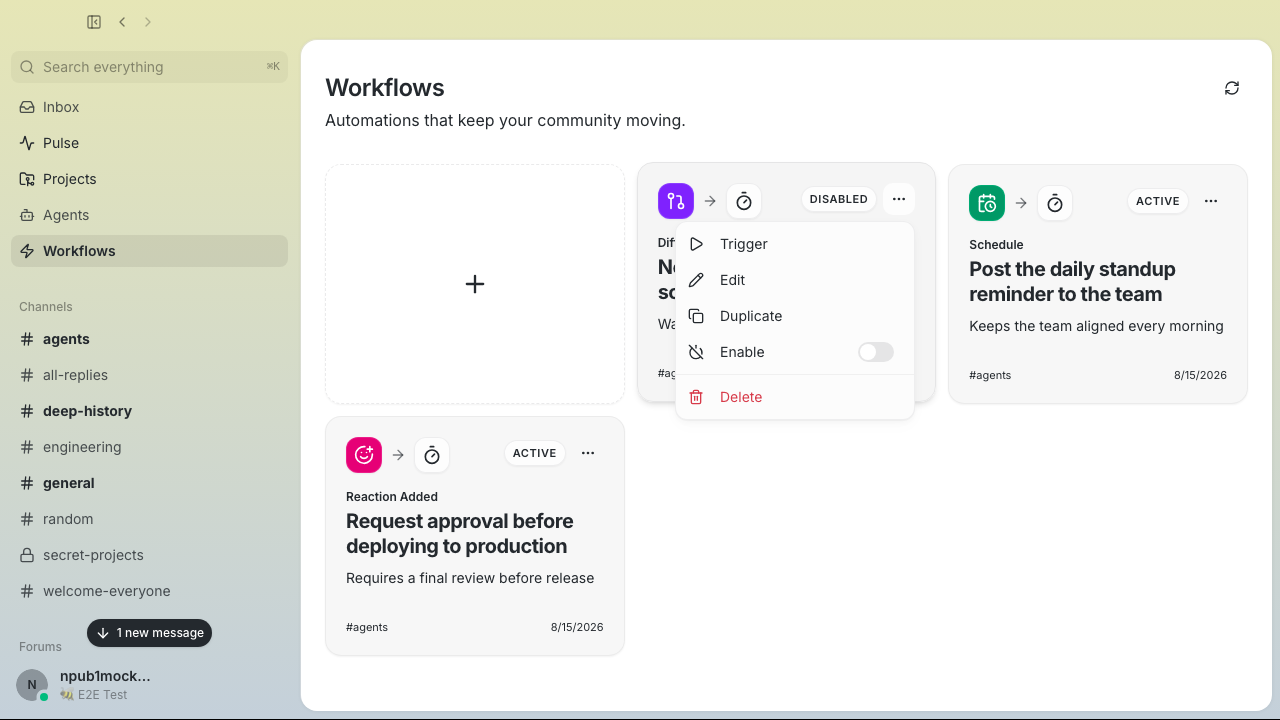
**User Impact:** Users can scan what each workflow does and trigger,
edit, duplicate, enable, disable, or delete it directly from the
library.
**Problem:** The workflow list buried common actions and did not expose
each automation's trigger-to-action shape at a glance.
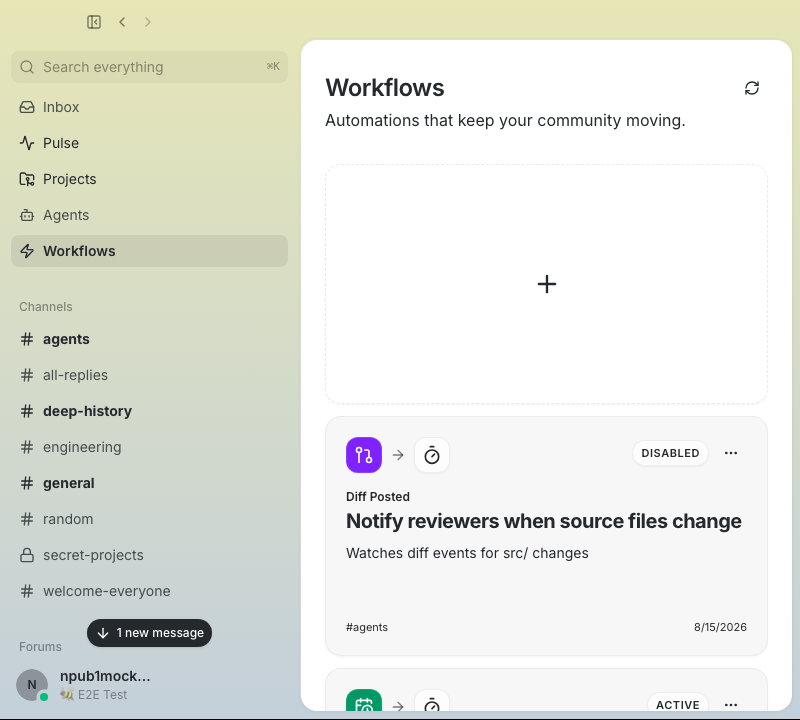
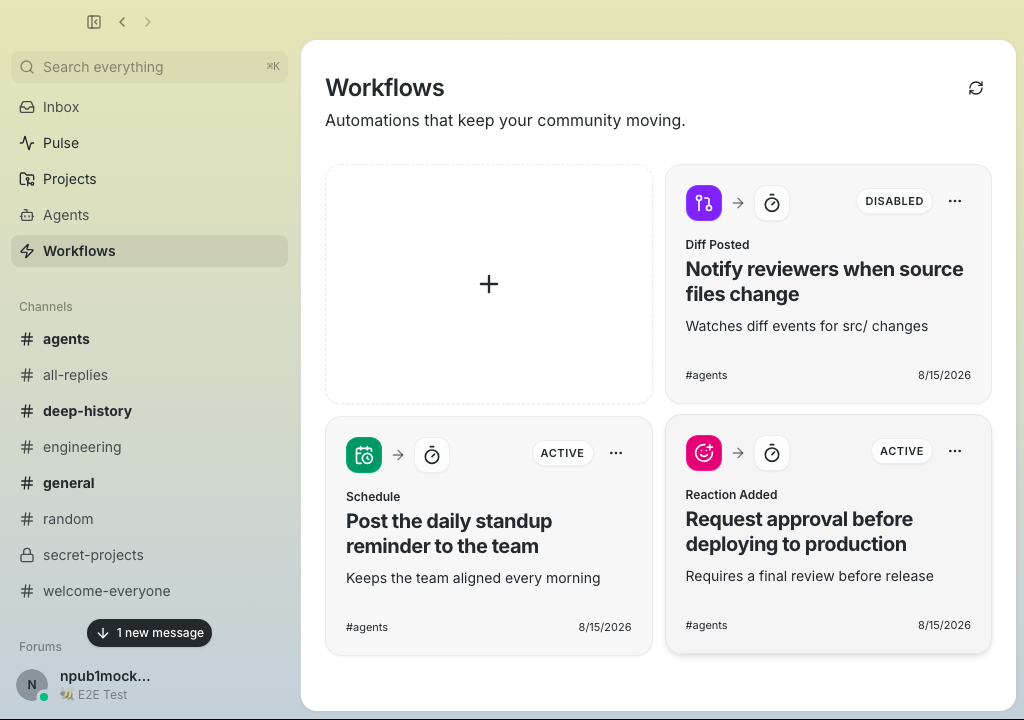
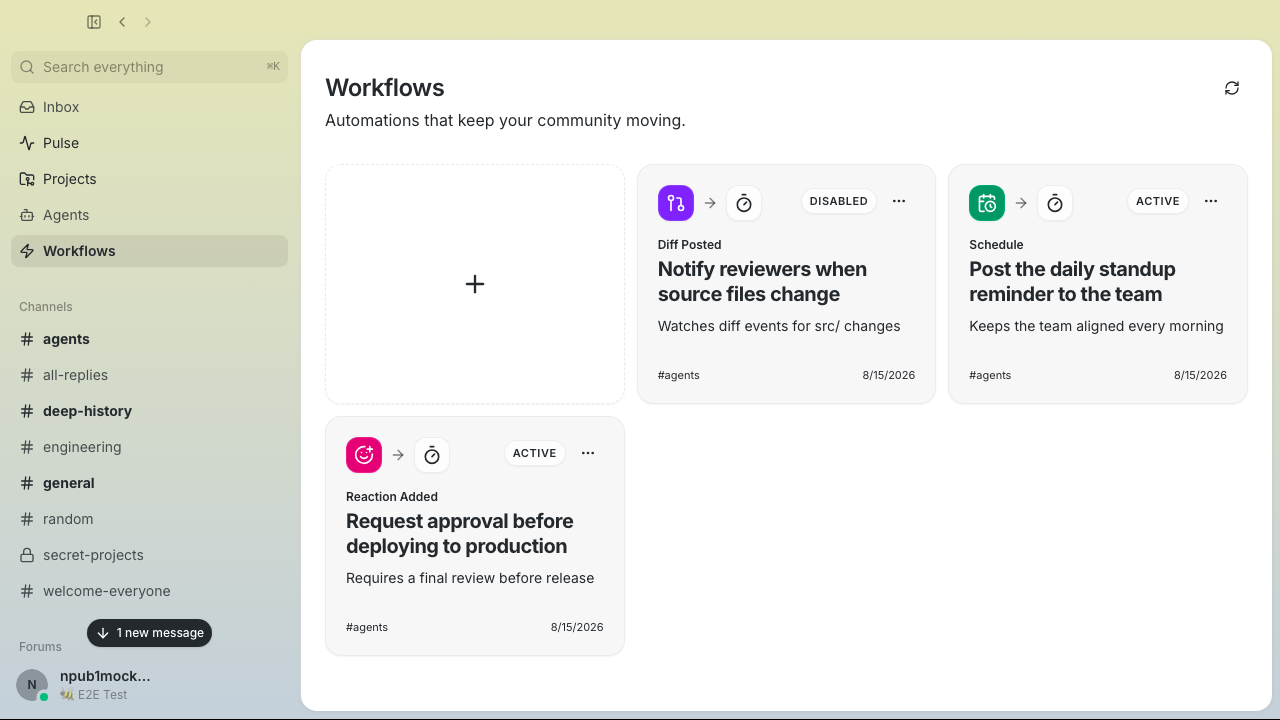
**Solution:** Add a responsive workflow library with a persistent create
tile, compact trigger/action diagrams, prominent workflow titles with
supporting descriptions, and shared card actions while preserving
existing detail, editor, and run-history entry points. Card toggles
refresh both list and open-detail caches so status and definition stay
consistent.
<details>
<summary>File changes</summary>
**desktop/src/features/workflows/ui/WorkflowActionsMenu.tsx**
Adds a shared card menu for trigger, edit, duplicate, enable/disable,
and delete actions.
**desktop/src/features/workflows/ui/WorkflowCard.tsx**
Reworks cards around the prototype's visual hierarchy: color-coded
trigger, action flow, sentence-case eyebrow, prominent title, supporting
description, status, channel, and update date without a footer clock
icon.
**desktop/src/features/workflows/ui/WorkflowsView.tsx**
Adds the responsive grid, create tile, mutation wiring, and list/detail
cache invalidation. Container breakpoints keep cards two-across at
medium widths and three-across in the 1280px desktop layout.
**desktop/src/features/workflows/ui/workflowDefinition.ts**
Adds immutable enabled-state updates plus narrow trigger and
first-action readers used only to select card icons.
**desktop/src/features/workflows/ui/workflowDefinition.test.mjs**
Covers neutral icon selection, enabled-state immutability, and status
presentation.
**desktop/tests/e2e/workflows.spec.ts**
Covers the create tile, title/description hierarchy, selected-card
enable/disable consistency, and deterministic narrow/medium/wide
captures while retaining existing action coverage.
</details>
## Reproduction steps
1. Open **Workflows** and confirm the create tile stays first as cards
flow from one to three columns with available width.
2. Confirm each card shows a sentence-case trigger eyebrow, prominent
workflow title, supporting description when present, status, channel,
and update date without a clock icon.
3. Open a card's overflow menu and trigger, edit, duplicate,
enable/disable, or delete the workflow.
4. Leave the detail panel open while toggling and confirm its badge and
JSON definition update with the card.
## Screenshots
Real built E2E UI with representative workflow data at three viewport
sizes.
### Narrow — 800 × 720
### Medium — 1024 × 720
### Wide — 1280 × 720
### Card actions
---------
Signed-off-by: Taylor Ho <taylorkmho@gmail.com>
## Summary
- discover shared managed agents from authenticated relay directory
records instead of treating channel membership as sufficient proof
- publish and refresh access-policy changes immediately so running
clients converge across machines without a restart or five-minute poll
- route profile edits through the exact managed instance and
stop/restart runtimes around access changes so unrelated edits cannot
silently widen access
- keep mention send-time revalidation and Block owner-only build
enforcement fail closed
- explain invalid custom provider/model configuration instead of leaving
Save silently disabled
### Related issue
Fixes#3204
### Known residuals
- a brand-new remote agent's first policy record can wait for the
bounded directory poll when no authenticated directory coordinate exists
yet; send-time mention revalidation remains fail closed
- a failed remote-provider policy redeploy is recorded but cannot
undeploy the older provider instance until the provider protocol gains
the destructor tracked by #5570
### Testing
- full Desktop unit suite: 4,961 tests passed
- focused profile editor Playwright workflow passed, including Customize
access edits and prompt-only edits after tightening an instance
- Desktop TypeScript, Biome formatting, file-size ratchet, Tauri checks,
and pre-push suites passed
- independently reviewed for authenticated directory trust, live
subscription teardown, runtime revocation ordering, fail-open edit
paths, and per-agent provider deployment serialization
---------
Signed-off-by: Wes <wesbillman@users.noreply.github.com>
Signed-off-by: Brain <21994759fc7a6fa6b965551d35cfd7897d262f2495467f2d78694ddcfa6a5c7e@buzz.block.builderlab.xyz>
Co-authored-by: diegorumo <diegorumo@gmail.com>
Co-authored-by: Carl <c7ebe626f000404285d3686e1dc74cc07cc60a9754a150041ba132e14bd3e2ec@buzz.block.builderlab.xyz>
Co-authored-by: Brain <21994759fc7a6fa6b965551d35cfd7897d262f2495467f2d78694ddcfa6a5c7e@buzz.block.builderlab.xyz>
## Summary

Centralizes model capability knowledge — thinking mode, supported effort
levels, wire routes, and human-readable labels — into a single manifest,
`scripts/model-capabilities.json`. Rust and TypeScript each get a small
interpreter that reads the same manifest, replacing hand-maintained
tables scattered across both languages that had already drifted apart. A
capability change is now a data edit, not parallel edits to two code
paths. Supersedes the codegen approach explored in #3603.

A cross-language contract keeps the two interpreters honest:
`scripts/normative-corpus.json` is a golden snapshot generated from the
Rust resolver (103 vectors covering all six capability axes) and
replayed natively in TS. CI fails if either language disagrees with the
corpus or the corpus drifts from the resolver. Regenerate with `just
regen-model-corpus`.

## Behavior changes

- **Effort dropdown for `openai-compat` providers** no longer offers
`max`. The request path always clamped `max` to `xhigh` on the wire, so
the UI stops offering a value that was silently rewritten. UI-only,
wire-identical.
- **Databricks v2 routing (wire-visible):** uncurated endpoint names
carrying a bare Claude code-name segment (e.g. `goose-opus-5`) now route
to the MLflow chat wire instead of Anthropic Messages — they lose
Anthropic prompt caching but still succeed on a valid OpenAI-compatible
wire. Curated `databricks-claude-*` records and any name starting with
`claude` are unchanged. A handful of other uncurated/adversarial name
shapes similarly fall back to MLflow chat instead of pattern-matched
routes; every curated model resolves identically to before, all axes.
- **Curated model labels on the real discovery path.** The Databricks
API returns no display name, so discovery emits the raw endpoint id as
the model `name` (`{id, name: id}`) on every path. `ModelEntry.name` is
now curated at all four construction seams in `buzz-agent` — v2
discovery, v1 parse, the auth-empty default catalog, and the
configured-model fallback — via a read-only `databricks_registry_label`
lookup over the manifest's `databricks_v2` exact records; `id` stays the
raw wire/config value. A known id renders its curated label
(`databricks-gpt-5-5` → `GPT-5.5`), an unknown id passes through
unchanged, and the default-catalog row reads `GPT-5.5 (default
catalog)`. As a defense against older `buzz-agent` binaries and any
harness that echoes ids, `resolveModelLabel` treats a discovered name
equal to the trimmed id as absent and falls through to the registry
tier; a genuinely distinct name (including the suffixed default-catalog
label) still wins.

## Cleanup

Deletes the duplicated capability tables and their tests: the
`config.rs` gpt5 matchers, effort tables, and clamp logic; the legacy
segment-based Databricks v2 route classifier in `llm.rs`; and the TS
hand tables plus `effortTable.fixture.json`. All are replaced by
manifest lookups through the shared resolver — no line of capability
data exists in two places.

---------

Signed-off-by: Will Pfleger <pfleger.will@gmail.com>
Signed-off-by: Duncan <dcfd242e557282d7a1e2cf2e6877522682f1e5c6156dc92ca7d90eaedd3b0f95@buzz.block.builderlab.xyz>
Co-authored-by: Duncan <dcfd242e557282d7a1e2cf2e6877522682f1e5c6156dc92ca7d90eaedd3b0f95@buzz.block.builderlab.xyz>
## Summary

- allow agents to build and run Flutter when it provides relevant
implementation or validation evidence
- keep mobile iteration fast by reusing simulators, incremental builds,
and configured staging or production communities
- correct stale CLI, E2E, CI, worktree formatting, and mobile launch
guidance
- point community singleton reset guidance at the canonical
implementation instead of duplicating a drifting inventory

## Validation

- `git diff --check origin/main..HEAD`
- `cargo run -q -p buzz-cli -- --format compact messages thread --help`
- `cargo run -q -p buzz-cli -- --format compact messages search --help`
- `just desktop-tauri-fmt-check` from the worktree
- pre-commit: mobile Dart formatting and `flutter analyze`
- pre-push: branch-skew check and full mobile test suite (1,465 tests)

Signed-off-by: Wes <wesbillman@users.noreply.github.com>
Co-authored-by: Carl <c7ebe626f000404285d3686e1dc74cc07cc60a9754a150041ba132e14bd3e2ec@buzz.block.builderlab.xyz>
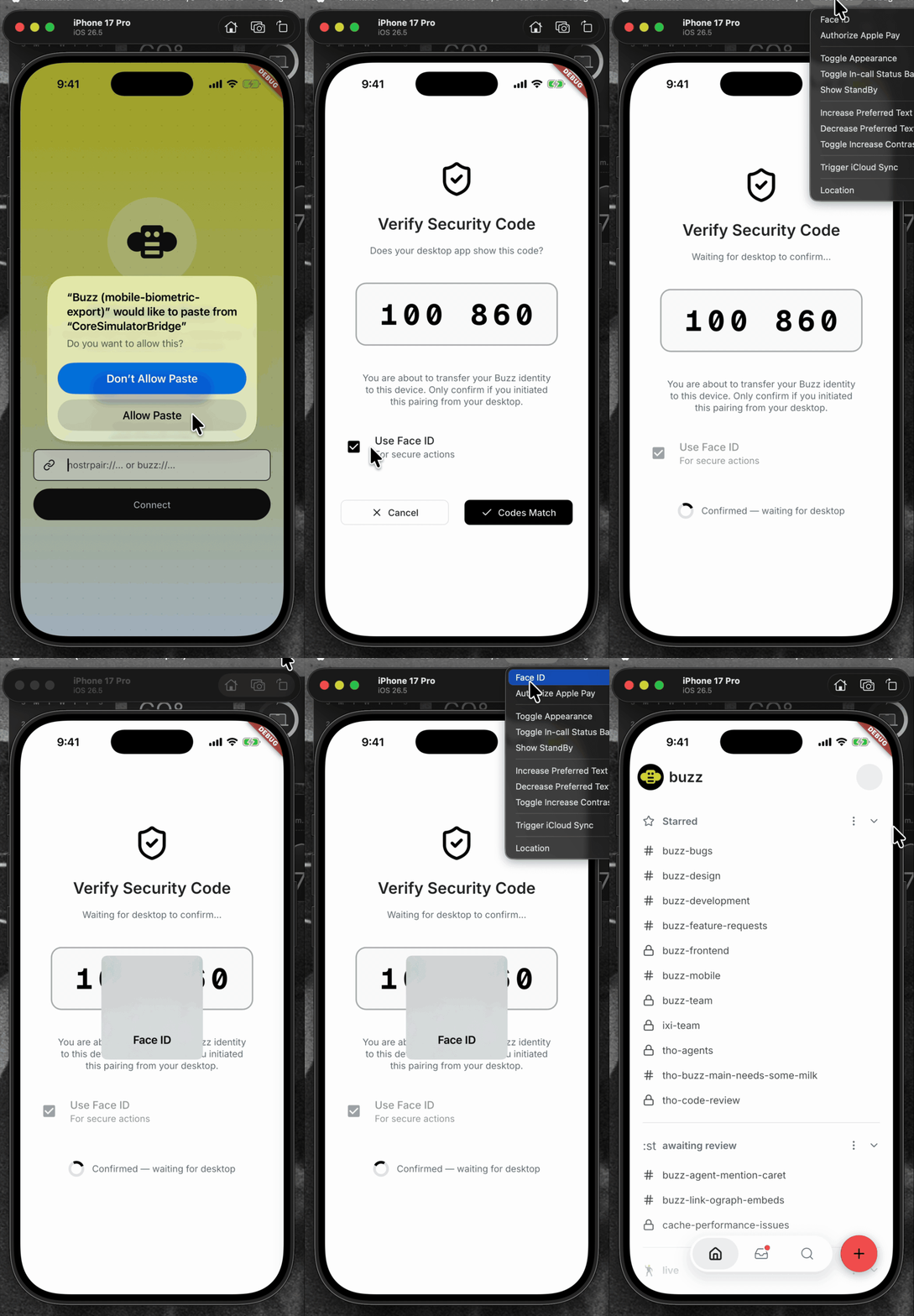
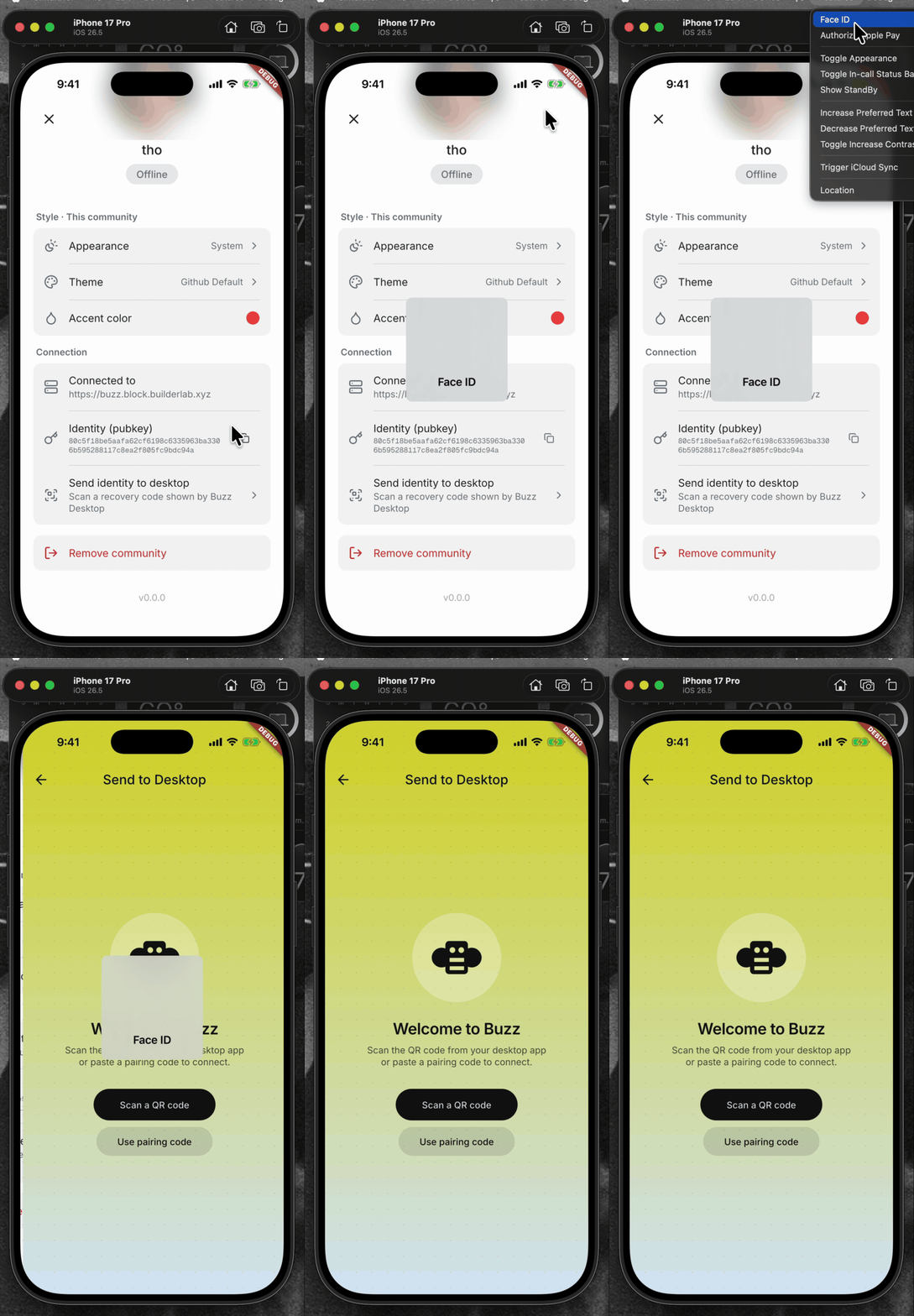
**Category:** new-feature
**User Impact:** Mobile users must confirm with Face ID, biometrics, or
their device passcode before sending their Buzz identity to Desktop.
**Problem:** A signed-in phone could send its full identity, including
the `nsec`, to a desktop without fresh local verification.
**Solution:** Require OS device authentication before opening the
identity-recovery scanner, retain that authorization only for the active
pairing session and short pairing window, and require fresh
authentication again if it expires before the identity payload is sent.
Normal app opening, identity import, and community removal remain
unchanged.
## Screencasts
| Enable Face ID | Use Face ID |
| --- | --- |
| 
| 
|
<details>
<summary>File changes</summary>
**Android and iOS integration**
- `mobile/android/app/build.gradle.kts` declares the AppCompat
dependency required by the biometric activity theme.
-
`mobile/android/app/src/main/kotlin/xyz/block/buzz/mobile/MainActivity.kt`
uses the activity type required by the system authentication prompt.
- `mobile/android/app/src/main/res/values/styles.xml` and
`mobile/android/app/src/main/res/values-night/styles.xml` use the
compatible launch theme.
- `mobile/ios/Podfile.lock` records the native local-authentication
dependency.
- `mobile/ios/Runner/Info.plist` explains why Buzz requests Face ID
access.
**Identity policy and pairing flow**
- `mobile/lib/shared/security/sensitive_action_authorizer.dart` wraps OS
authentication and maps platform errors to stable app-level outcomes.
- `mobile/lib/shared/community/community.dart` and
`mobile/lib/shared/community/community_storage.dart` persist the
sensitive-action policy.
- `mobile/lib/features/invites/invite_join_provider.dart` assigns the
explicit policy for invite-created communities.
- `mobile/lib/features/pairing/pairing_provider.dart` gates export,
binds grants to the active community/session, reauthenticates expired
grants, and clears grants on every terminal path.
- `mobile/lib/features/pairing/pairing_page.dart` lets users choose
biometric protection while importing an identity.
- `mobile/lib/features/settings/settings_page.dart` wires pairing into
settings.
- `mobile/lib/features/settings/settings_page/connection_section.dart`
authenticates before opening export recovery and bounds the
foreground-resume wait.
- `mobile/pubspec.yaml` and `mobile/pubspec.lock` add and lock
`local_auth`.
**Coverage**
- `mobile/test/shared/security/sensitive_action_authorizer_test.dart`
covers native result mapping, unsupported devices, and single-flight
behavior.
- `mobile/test/shared/community/community_test.dart` and
`mobile/test/shared/community/community_storage_test.dart` cover policy
defaults and persistence.
- `mobile/test/features/invites/invite_join_provider_test.dart` covers
the invite policy.
- `mobile/test/features/pairing/pairing_page_test.dart` covers import
protection controls.
- `mobile/test/features/pairing/pairing_provider_test.dart` covers
export/import authorization, stale/reset/concurrent guards, malformed
payload cleanup, and no-export failure paths.
- `mobile/test/features/settings/connection_section_test.dart` covers
the tap gate, lifecycle resume, and timeout behavior.
</details>
## Reproduction steps
1. Pair an identity into the mobile app.
2. Open Settings and choose “Send identity to desktop.”
3. Verify Face ID, biometrics, or the device passcode is required before
the recovery scanner opens.
4. Cancel device authentication and verify the scanner does not open and
no identity transfer begins.
5. Authenticate, scan a Desktop recovery code, confirm the SAS, and
verify the identity transfer completes.
## Validation
At `be5620f5f10aa6cc16e86a4f01f102f3d9aeef9b`:
- `cd mobile && ../bin/flutter analyze` — no issues
- `cd mobile && ../bin/flutter test` — 1,368 tests passed
- `cd mobile/android && JAVA_HOME=$(/usr/libexec/java_home -v 21)
./gradlew app:assembleDebug` — debug APK assembled successfully
---------
Signed-off-by: Taylor Ho <taylorkmho@gmail.com>
## Summary
Collapsing the sidebar left a phantom copy of it painted over the
community/relay rail — opaquely on flat themes (vesper et al., which
made the rail look *removed*), and as ghost fragments (muted search-box
fill, truncated channel-name tails) on the Buzz themes whose chrome is
intentionally transparent for the gradient.
**Cause:** #4281 made the app-sidebar layer `overflow-visible` (the
huddle drawer needs to escape it). That removed the ancestor clipping
the offcanvas collapse relied on: the sidebar slides to `left:
-sidebar-width` but kept painting, exactly over the `z-0` rail (`z-10`
sidebar layer).
**Fix:** the offcanvas-collapsed sidebar container is now `invisible` +
`pointer-events-none`, with `visibility` added to the transition list so
the 200 ms slide-out still animates and the flip happens only at the
transition's end. Theme-independent; no per-theme CSS touched; the
huddle drawer's `overflow-visible` is preserved.
## Before / after
Left 420px of the app with the sidebar collapsed. Before = unpatched
`origin/main` @ 69107dc3b; after = this branch. Same seeded state, same
build pipeline (`build:e2e` between checkouts).
| theme | before (ghost sidebar over the rail) | after (rail clean: A /
B / + visible) |
|---|---|---|
| vesper |
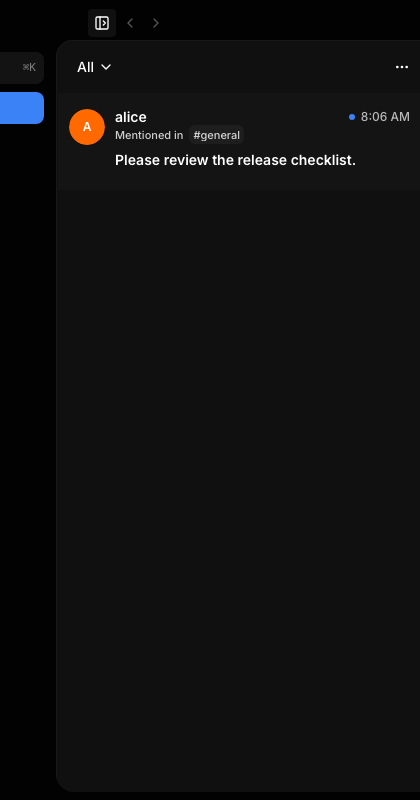
|
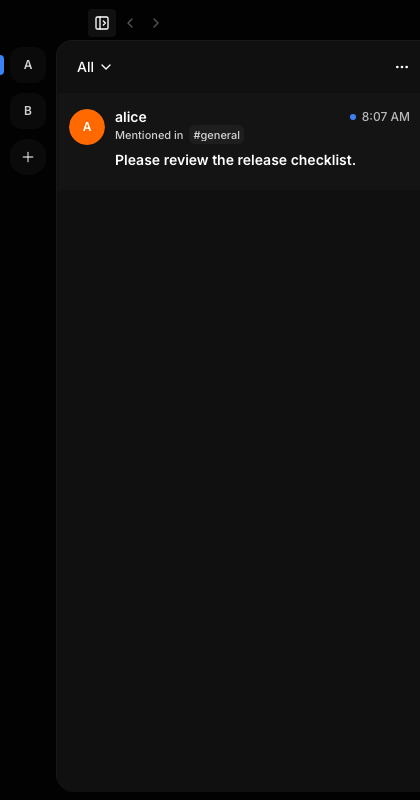
|
| buzz |
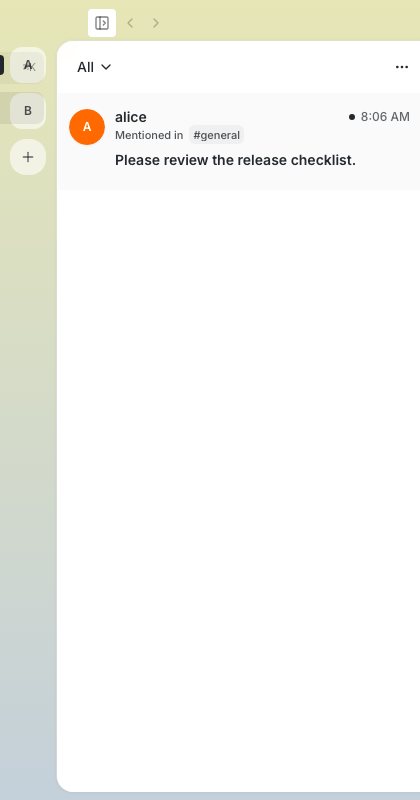
|
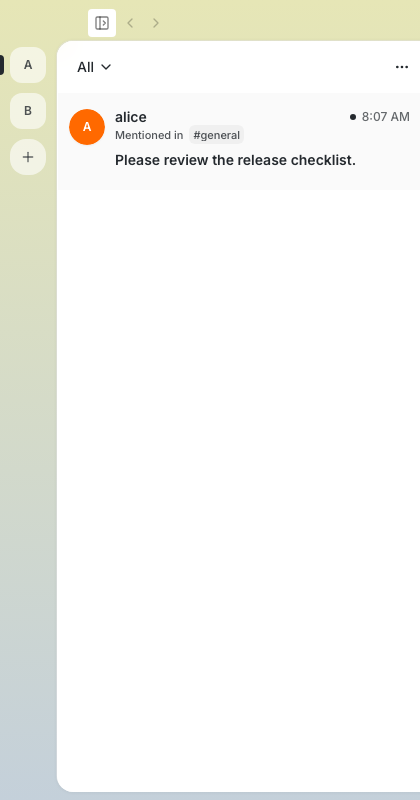
|
| buzz-dark |
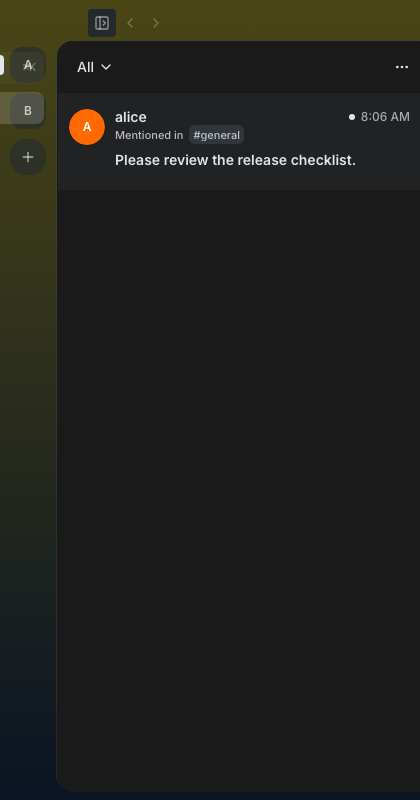
|
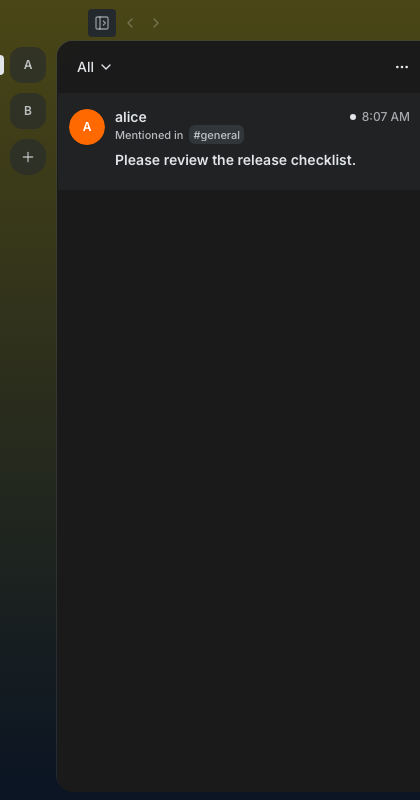
|
Before shots: ghost `⌘K` search chip + blue active-item pill painted
over the rail column; on vesper the opaque panel hides the rail buttons
entirely. After: the rail's community buttons (A, B) and `+` are visible
and clickable in all three themes.
Reported by Thomas P in #buzz-bugs:
buzz://message?channel=e62570dd-33ad-42c5-b92b-75f2689f9694&id=9ea401ca1d009f555ca4324e136f8d8d8156db2f8afa3ff89fd038d2c16260f7
cc @klopez4212 — this touches the layout your #4281/#5478 work shaped;
please confirm it doesn't defeat the huddle drawer or glass intentions.
The change deliberately hides only the *offcanvas-collapsed* container,
nothing in the expanded path.
## Test plan
- [x] New Playwright regression spec `sidebar-offcanvas-rail.spec.ts`
(buzz / buzz-dark / vesper): collapsed sidebar must be `visibility:
hidden` + `pointer-events: none`, community rail stays visible and
interactive. **Fails on unpatched build** (verified), passes with the
fix.
- [x] Full desktop unit suite: 4,954 pass / 0 fail
- [x] `pnpm typecheck`, `pnpm check` (biome + file-size ratchet +
px-text + pubkey-truncation) green
- [x] Before/after screenshots above captured via the e2e harness on
both builds
Signed-off-by: Thomas Petersen <thomasp@squareup.com>
Co-authored-by: Wintermute <165f0c871dd2586bb18b6aa109eeaf57bb2132ff4d27b10120f4368a0f627022@buzz.block.builderlab.xyz>
## Buzz Desktop release v0.5.14

- **Frozen main:** `1b3dbcaaea882eeea90359c1db02e306d2f4f50a`
- **Reviewed candidate:** `391495e7d347d20b67e39e3c240d17ef63c5c2c0`
- **Previous desktop release:** `desktop-v0.5.13`
- **Proposed immutable tag:** `desktop-v0.5.14`

This PR may be **squash merged** after the Desktop Release Candidate
check and all protected-branch checks pass. Merging authorizes
publication of the exact reviewed candidate; later or unrelated changes
on `main` cannot alter it.

The checked-in changelog accounts for every non-merge commit in the
release range. The Desktop tag points to the reviewed candidate commit,
not the later squash commit. Publication remains bound to that immutable
candidate tag.

Signed-off-by: Wes <wesbillman@users.noreply.github.com>
Co-authored-by: Release Automation <release-automation@users.noreply.github.com>
## Summary

- remove the GitHub-hosted desktop smoke job from the desktop release
workflow
- remove the smoke result from manifest assembly dependencies and
promotion conditions
- retain the local smoke tooling for future repair and targeted
validation

The first release execution of this gate spent its full 10-minute
Playwright timeout traversing the 10,000-row fixture, then produced a
987 MB diagnostics upload. All signed platform builds succeeded, but the
smoke prevented manifest publication. This restores the previously
established release boundary while the harness is made suitable for CI
separately.

### Testing

- parsed `.github/workflows/release.yml` with Ruby Psych and asserted
the smoke job/dependencies are absent
- `scripts/test-release-ref-contract.sh`
- exact pushed commit passed the repository pre-push hook

Signed-off-by: Wes <wesbillman@users.noreply.github.com>
Co-authored-by: Carl <c7ebe626f000404285d3686e1dc74cc07cc60a9754a150041ba132e14bd3e2ec@buzz.block.builderlab.xyz>
## Buzz Desktop release v0.5.13

- **Frozen main:** `09768100ec3420f0aa7cd278bd00fe0baab5de8d`
- **Reviewed candidate:** `a239e0f6793ac6e88ccf92cc231054090a9753cc`
- **Previous desktop release:** `desktop-v0.5.12`
- **Proposed immutable tag:** `desktop-v0.5.13`

This PR may be **squash merged** after the Desktop Release Candidate
check and all protected-branch checks pass. Merging authorizes
publication of the exact reviewed candidate; later or unrelated changes
on `main` cannot alter it.

The checked-in changelog accounts for every non-merge commit in the
release range. The Desktop tag points to the reviewed candidate commit,
not the later squash commit. Publication remains bound to that immutable
candidate tag.

Signed-off-by: Wes <wesbillman@users.noreply.github.com>
Co-authored-by: Release Automation <release-automation@users.noreply.github.com>
## Summary

- replace the nested one-line shell quoting used to read the Playwright
package version
- write the resolved version to `GITHUB_OUTPUT` from a multiline shell
step

## Why

The `desktop-v0.5.12` release smoke job failed before executing tests
because Bash received escaped quotes inside command substitution and
parsed the Node expression as shell syntax.

## Validation

- `bash scripts/test-release-ref-contract.sh`
- isolated execution of the new shell fragment with a fixture
`@playwright/test/package.json`, producing `version=1.58.2`
- `git diff --check`

Signed-off-by: Wes <wesbillman@users.noreply.github.com>
Co-authored-by: Carl <c7ebe626f000404285d3686e1dc74cc07cc60a9754a150041ba132e14bd3e2ec@buzz.block.builderlab.xyz>












