mirror of
https://github.com/block/buzz.git
synced 2026-11-24 10:12:19 +00:00
c75d812f809a1d452bcf2b274de986b7e1dd428e
3496 Commits
| Author | SHA1 | Message | Date | |
|---|---|---|---|---|
 Wes |
c75d812f80 |
test(mobile): match the resumeSince override in the search journey (#9546)
## Summary `main` fails to compile `mobile/test/features/search/search_channels_journey_test.dart`. #9090 added `bool resumeSince = true` to `RelaySessionNotifier.subscribeWithStatus` and updated the existing overrides, while #9513 (merged just before it) added a `_RenamingSession` override without that parameter. Each passed CI alone; together `flutter analyze` reports `invalid_override` at `:933`, and the test shard that loads the file fails. This adds the missing parameter to `_RenamingSession.subscribeWithStatus`. Test-only, one line. ### Related issue None found. ### Testing - Reproduced on a clean checkout of `02535e1b5`: `flutter analyze` on the file reports the single `invalid_override`. - With this change on `02535e1b5`: `just mobile-install mobile-check mobile-test` passes (analyze clean, 4916 tests passed, 71 skipped, plus 27 package tests). Signed-off-by: Wes <wesb@block.xyz> Co-authored-by: Mantis <530af7635ef7d0e1a5189d234338db88cb4ef1ede7119b4ebb4fb05c3eafe3b1@buzz.block.builderlab.xyz> |
||
|
klopez4212
|
a82d596fc2 |
mobile: show account communities in the switcher and sync saved destinations (#9262)
## Summary Switch Community currently shows only device-saved communities, leaving account destinations behind a separate Find step. It now merges saved communities with supported account destinations directly, keeps Add Community, and removes the redundant Find action from that Add route. Initial onboarding and identity recovery keep their discovery entry. Find lists supported account addresses before hosted identity setup; hosted selection still performs binding, backup, and admission, while external selection opens the existing identity flow. Mobile also saves QR/address additions and explicit removals through Builder Lab's existing known-communities account APIs. A per-account local journal retries transient failures, survives restarts, pauses in the background, and fences requests against account changes. External secure addresses use the existing self-hosted entry flow; account destinations never imply membership or bypass admission. Remote list omissions do not delete local identities. Explicit additions store an account owner and revision atomically with local credentials. Legacy/unclaimed destinations remain local-only until explicitly added while signed in; signing into another account never claims retained destinations. Restart reconciliation lets a committed re-add supersede an older removal even if the retry-journal write failed. Local deletion and its credential-free account-removal intent commit in one storage write, independent of the account-only retry journal. Removing one of several local identities owned by the same account at an address retains its account destination until that account’s last identity is removed. Another account’s saved identity does not block removal or lose its credentials during recovery. Offline edits retain the stored account subject without treating it as network authorization. Discovery-only intent survives browser callbacks, app restart, and retry. Onboarding recovery controls have a Material ancestor in the actual route. Pending status is fenced to the current subject; interrupted older removals offer explicit local completion, and denied requests offer browser reauthentication. Same-host ports have distinct labels and confirmations, and unsupported hosted ports are excluded. This changes the mobile client and its public-build CI test list only: no relay endpoints, events, migrations, or backend deployment. ### Related issue No duplicate found among open known-communities/switcher issues and PRs. Related picker editing work: #6632 (renaming communities). ### Testing Validated after merging main (`02535e1b53`) at `c4ee037f7e710962f176540abf88d26e98c2823c`. Wes’s follow-up fixes cover push-revocation commit ordering, same-account removal confirmation, and recovery after completed hosted admission. The merge also preserves main’s toolbar and session protections; a test override now accepts the updated relay subscription parameter. - Formatting, static analysis, and differential file-size checks pass. - Prior full CI and security review passed on `3adb117aae`; security checks also passed on `cf3836ecb`. Fresh CI and security review are required for this head. - Mutation checks fail when either the initiating-account removal guard or the rendered-status subject fence is removed; both guards were restored before final validation. - CI explicitly runs the public-only account discovery and synchronization journeys. - Added journeys cover paused removal across A→B, offline restart, journal read/write failures, duplicate local identities in either removal order, delayed status reads across accounts, real browser handoff after denial, unbound external discovery, and local same-host port removal. - Earlier journeys cover pairing acknowledgement and restart after journal-write failure, same-subject setup completion, offline/rejected removal with reopen/retry, and fresh external-only/mixed account entry. - Regression coverage includes discovery deduplication and retry, hosted and external selection, Add without Find, account-only removal, shared authentication/removal persistence, restart recovery, latest-intent ordering, account changes, and retry pause/resume. - `just mobile-check`, `just file-size-check`, and `just mobile-test`: 4,954 default-build tests passed (71 skipped), plus 27 crypto-package tests. - Full public-account suite: 5,012 passed, 12 skipped, one pre-existing failure in `fullscreen_onboarding_test.dart` ("Home stays hidden until community choice and admission"). The same assertion was reproduced on clean base `8cce12f591`: expected both communities imported, actual only the selected community. - Follow-up regression journeys cover both A/B same-address removal orderings, recovery preserving B’s saved key, the production onboarding widget composition, and retained discovery intent with callback/retry plus normal-sign-in controls. - Native/live-account and human testing remain outstanding. The tests use fake network/storage boundaries; live account API behavior, cross-device synchronization, native accessibility, and timeout/late-server-commit ordering still require integration verification. - The three expanded recovery/removal journeys pass and each fails when the corresponding fix is removed. A durably journaled revocation now finishes the confirmed removal even if the account changes during journaling; pre-journal account mismatches still abort. Confirmation copy counts only same-account identities. Explicit account recovery retires a completed join target while preserving in-progress targets. ### Preview Sample-data Flutter widget renders: saved-only and combined lists. These illustrate the picker layout, not a device session or live account sync. | Saved-only | Combined | | --- | --- | |  |  | ### Manual verification 1. Sign into a public account with a community saved on another device. Open Switch Community; verify it appears alongside local choices and Add. 2. Select a hosted and an external community; verify the existing identity/admission flow opens. Add should not offer Find again. 3. Add a community by QR/address, then check the account list on desktop. Remove it on mobile and verify the account entry disappears while other devices retain their local credentials. 4. Repeat removal offline, restart, then reconnect/resume. Verify the queued removal reaches the account service without switching identities. 5. On a fresh device, verify external-only and mixed account lists offer external entry. Check two ports on the same host remain distinguishable. 6. Sign out of account A and into B; retained A destinations must not upload to B. Explicitly add a B destination and verify it syncs. 7. Reject or interrupt account removal; verify visible pending/failure status. A denied session must open browser sign-in through “Sign in again” and retry after exchange; setup-required accounts retain their setup action. 8. Keep two local identities owned by the same account at one address; removing the first must keep the account entry, and removing the last must queue account removal. Repeat with A and B at that address; removing A must preserve B’s saved credentials and still sync A’s removal. 9. Restart offline with a stored account, add/remove an external community, then reconnect as the same account and verify convergence. Explicit sign-out must not claim new local-only entries. 10. Start Find my communities, restart during browser authentication, then return or retry. External destinations must appear before hosted identity setup; normal sign-in must retain its identity checks. --------- Signed-off-by: kenny lopez <klopez4212@gmail.com> Signed-off-by: Tom Brow <tomb@squareup.com> Co-authored-by: Terp <5856f6900e8e0a4e0ea1f4f8d2ee33e4753d2119bc122f94ecafc660b46c0511@buzz.block.builderlab.xyz> Co-authored-by: Tom Brow <tomb@block.xyz> Co-authored-by: Tom Brow <tomb@squareup.com> Co-authored-by: studio <dc2fc481343672df31a689840c09299972e704dac592e0da6f18486646a7ee3e@localhost>mobile-v1.2.0-rc.5 |
||
|
Tom Brow
|
02535e1b53 |
perf(mobile): stop replaying stored read state on every resume (#9090)
Every time the mobile app reconnects (for example after more than 5 seconds in the background), the read-state live subscription asked the relay for up to 500 stored read-state events. That re-downloaded every read-state slot on the account, then the snapshot fetched the same events again right after. On a heavy account (28 slots) that replay alone was about 1.4 MB per resume. The live subscription now uses `limit: 0`, so it only delivers changes. It still opens before the snapshot, so the snapshot covers anything published in between. The subscription can also go live after `subscribe` has returned: on a cold start with slow AUTH, `subscribe` returns on its 500 ms fallback before the REQ is registered, after a transient CLOSED (rate limit, capacity) the session reopens it on the same socket, and a reconnect replays it. With `limit: 0` nothing replays marks published in that gap, so the manager reads the snapshot every time the subscription reports ready, as the channel list's `limit: 0` subscription already does. The session keeps live subscriptions across reconnects and replays them on the new socket, so a reconnect no longer resubscribes: the replay's ready reads the snapshot, once per reconnect. The manager opens a new subscription only after losing one (a terminal CLOSED or a failed subscribe), on the next reconnect. All snapshot reads outside a publish go through one sync loop. Initialize and each ready ask that loop for a snapshot. A request made before the current pass starts its read joins that read, and a request made during the read runs one more pass, so a ready can't be swallowed by a read already in flight. This needs no generation or ready-transition checks, at the cost of an occasional extra read (for example a cold start whose ready lands after the 500 ms fallback, when the first read has already started). Snapshot reads are numbered in start order, including a publish's own read, and only a read newer than every settled one decides whether the last snapshot succeeded. An older read finishing late cannot clear the retry a newer failed read needs. A failed read waits for the next trigger: the publish it schedules, which reads the snapshot in full after a failure, or a later ready, resume or reconnect. A publish with nothing to send skips its snapshot ([#9093 skip redundant publish](https://github.com/block/buzz/pull/9093)) only when the last snapshot succeeded, so after a failed resume snapshot the next publish still retries it. A publish snapshot now notifies readers of the marks it merged, since unchanged slots publish nothing whose echo would. ### Accepted gap If the snapshot fails (timeout, discovery or HTTP error) on a device with no local journal, read state stays local until the next successful snapshot, which every resume, reconnect, subscription recovery and publish retries. Falling back to a stored replay on failure would close the gap, but it adds a late subscription path for a rare failure that already heals on its own. ### Validation - Added test: `live subscription replays nothing and opens before the snapshot`. It fails without the change (`limit` 500). - Added test: `a clean reconnect through the real session replays one REQ and reads the snapshot once, and a lost subscription is reopened` drives the real `RelaySessionNotifier` with a recording socket: the connected listener runs, then the session's replay, then EOSE. It fails against the previous revision of this PR (two `l-2` REQs and two snapshot reads per reconnect). After a terminal CLOSED, the next reconnect opens a new subscription and reads the snapshot. - Added test: `readies during a held snapshot read share one more read`. - Added test: `a mark published while the live subscription retries is read once it recovers` puts the subscription into retry, lets another device publish a mark, then reports it ready. It fails without the read on ready. - Added test: `a failed late-ready read is retried by the next publish`. It fails without the retry. - Added test: `a reconnect while the first snapshot downloads is not swallowed by the cold-start connect` lets the cold-start connect queue behind initialize, then reconnects while the first read is still downloading and has a peer publish a mark. It fails against the previous revision of this PR (the queued pass swallowed the reconnect) and passes with the sync loop. - Added test: `an older snapshot finishing late keeps a newer failed read's retry` holds a publish's snapshot read, fails a newer read, then lets the older one finish. It fails against the previous revision of this PR (the older success cleared the retry) and passes with the read ordering. - Added test: `a mark published before a slow cold-start REQ goes live is read then` lets `subscribe` return before ready, publishes a mark, then reports ready. It fails without the read on ready. - `a publish after a failed snapshot retries it, then skips again` replaces the earlier skipped-publish test and fails without the snapshot check. It also checks that the retried snapshot's new marks notify readers, which fails without the notify. - Read-state suite (95 tests), `flutter analyze` and the full mobile suite pass. - iPhone 12 mini, Profile build with [#9089 gzip snapshot](https://github.com/block/buzz/pull/9089) applied, Home backgrounded 12 s and resumed, websocket bytes received in the 15 s after resume: | | Websocket in | Read-state replay | | --- | --- | --- | | Before (gzip fix only) | 2,087 KB | 1,458 KB (28 events) | | After (gzip fix + this) | 575 KB | none | The table counts websocket bytes only. Each resume reads the read-state snapshot once over HTTP, before and after this change. Automated app run on the same phone: Home, a large channel and search resumed after the reconnect grace period, with no read-state errors logged. Read marks were not compared across devices. 🤖 Generated with [Claude Code](https://claude.com/claude-code) --------- Signed-off-by: Tom Brow <tomb@squareup.com> Co-authored-by: Tom Brow <tomb@squareup.com> Co-authored-by: studio <dc2fc481343672df31a689840c09299972e704dac592e0da6f18486646a7ee3e@buzz.block.builderlab.xyz> Co-authored-by: Claude Opus 5.5 <noreply@anthropic.com> |
||
|
Tom Brow
|
1a5c6939c5 |
perf(mobile): save the open-channel directory and catch it up (#9513)
Search and invite recovery read a community's open-channel directory (every open, listed channel's kind 39000 metadata) from the relay, and match names on the device. Until now the app kept that directory in memory for 30 seconds only, so every search session after that, and the first search after every launch, downloaded the whole directory again. This follows [#9466 directory-only search load](https://github.com/block/buzz/pull/9466) and [#9457 directory keeps message times](https://github.com/block/buzz/pull/9457), which made each of those downloads cheaper; this one makes most of them unnecessary. Now the directory is saved in a file per community and account, next to the image cache, and search reads it from there: - **What's saved.** Only the latest revision of each open, listed, non-DM channel. The relay's directory read also returns the user's own private, unlisted and DM channels; those are never held or saved as the directory, and a channel whose latest revision is no longer discoverable drops out. - **First read.** The first time search opens, the app downloads the whole directory, as before, and saves it. - **Catch-up.** When search opens later, it shows the saved copy at once. At most once a minute, it asks the relay in the background only for directory changes since the newest saved one, or since the last read started by the device clock if that is earlier (less a minute of overlap), and merges them in. The relay can stamp a busy channel's metadata minutes ahead of wall time, so the newest saved stamp alone could skip channels created meanwhile. A catch-up that brings back nothing new saves nothing and leaves the list alone, and a search opened while a background read is still running shares it rather than starting another. - **Offline open.** A search opened before the session connects shows the saved copy and runs its check on the next connect. - **Daily full read.** Once the last full read is a day old (or dated in the future, by a clock since set back), the next check downloads the whole directory in the background and replaces the saved copy, which drops channels that became private or unlisted or were deleted. A catch-up can't see those: the relay never serves them to a non-member. - **Gone on open.** Opening a saved result that the relay no longer serves (private or deleted) drops it from the directory at once, and no directory read already in flight (background check, list refresh or Retry) brings it back. A restore from disk never overrides a full read already running, and a background read never displaces one. - **Invite recovery** still downloads the whole directory, as on main: it needs fresh memberships, and its read also refreshes the saved copy. - **Cleanup.** Signing out of a community, replacing its account, or leaving it deletes the file. The saved events omit signatures (the relay signed them; the copy is a cache of what it served). The file's JSON is encoded and decoded off the UI isolate, and an unavailable caches directory (or one that takes over 3 seconds) just means no saved copy. A file that is unreadable, from another version, or over 20,000 channels or 16 MiB is discarded and read again from the relay. There is no relay change. `CONTEXT.md` gains an "Open-channel directory" entry. ### Validation | Workflow (small community, 63 open channels) | Directory bytes before | Directory bytes after | | --- | --- | --- | | First search after install | 39.5 KB (2 requests) | 39.5 KB (2 requests) | | Search again 2 minutes later | 39.5 KB (2 requests) | 0.6 KB (2 requests) | | Relaunch, then search | 39.5 KB (2 requests) | 0.6 KB (2 requests) | Measured on an iOS simulator signed in to a test community, with a temporary local counter on each relay query response (not part of this PR), main at [ |
||
|
Tom Brow
|
5b92e02e2a |
fix(mobile): sign out from Settings in every build, keeping keys on the device (#9421)
Public and Nostr-only builds had no way to sign out. The only route was
Switch community → Edit, remove every community, then tap Back to get a
"Sign out of BuilderLab?" prompt. Removing a community that way also
deletes its key from the phone, even when the user never exported or
backed it up.
Settings now ends with **Sign out** in every build (internal builds
already had it). After confirming:
- Each community's key is first copied into this device's saved
identities, the same thing internal Sign out already did. Sign-in offers
them again, so signing out never destroys a key that may exist nowhere
else. If saving fails, nothing is removed.
- In a public build, the Builderlab session ends next, before anything
is removed. The Sign in landing that follows never shows the old
session, and nothing started there can be cancelled by it. If the
session or a pending browser sign-in can't be cleared, including a saved
session not yet restored after launch, Sign out stops with an error and
keeps every community. Ending the session never waits behind a pending
account request, such as a stalled session check at launch, and no such
request can restore the session once it finishes later. This path never
shows the hosted setup page over Settings. The removed communities'
push-lease tombstones still publish afterwards: the outbox authenticates
them with the push-stop credential the session leaves behind for 10
minutes, including a saved session that was never restored (an offline
launch), even when a first cleanup attempt failed partway.
- Every community is removed, the active one last, so removing the
others never switches to (and connects) another community on the way
out.
- A Sign out failure now shows its error in Settings. The row used
Settings' outer context, so the snackbar went to the page underneath.
Nothing else changes: the switcher, per-community Remove and the
onboarding landing's Back → "Sign out of BuilderLab?" path behave as
before. Internal Sign out keeps its behavior (one community, key kept,
the landing then ends the organization session). The only new UI is one
row at the bottom of Settings.
| Before | After |
| --- | --- |
| <img width="300" alt="before"
src="https://github.com/user-attachments/assets/f49f7869-3401-4e05-aa7b-debe7a7d425c">
| <img width="300" alt="after"
src="https://github.com/user-attachments/assets/99731c6a-035e-447b-987a-7fa0d8e767cc">
|
Demo (public build, simulator): Sign out → confirm → back at the Buzz
landing, signed out of Builderlab.
https://github.com/user-attachments/assets/da64082b-3b73-46d0-8578-771fca7dec22
### Validation
- Added tests: `settings_sign_out_test.dart`, a Settings journey with
two communities whose keys aren't backed up. Cancelling keeps
everything. Confirming removes both (active last) and both keys end up
in saved identities. The root swaps Settings for the real
`OnboardingAppEntry` as the app does. The authenticated root is wrapped
in the real `HostedAppGate`, and no route may be pushed while Sign out
runs. In a public build it fails three ways, each showing the error in
Settings and removing nothing: a saved session that isn't restored yet
can't be deleted, a restored one can't be deleted, and a pending browser
sign-in can't be cleared. Then, with revocations held pending, the
landing appears with the session already gone and no "Signed in as", and
releasing the revocations changes nothing. It runs in the default lane
and in the CI public-build lane (added to `_ci-clients.yml`). Confirmed
it fails when the key save is removed, when the session ends after the
landing appears, when sign-out goes through the flow's published stages,
when a failed clear is detected only by a missing in-memory session,
when a browser cleanup failure is swallowed, and when the error goes to
the page underneath.
- `organization_relay_auth_test.dart`: a push stop still gets an
assertion after signing out a saved session that was never restored,
including a failed cleanup followed by a successful retry (fails without
the fix).
- Sign-out never waits on a pending account request: the Settings
journey holds `/v1/auth/me` during the final sign-out and checks that
its later completion restores nothing (without the fix, Sign out stalls
and both communities stay). `builderlab_account_test.dart` covers a
session check already pending, one that starts while the session is
being deleted, an exchange queued before the sign-out, and an account
request during the removal that must not share the credential with the
notification extension again.
- Focused existing validation: `internal_build_entry_test.dart` with the
internal-build defines passes.
- Full `just mobile-test` (4,848 passed, 74 skipped) and `just
mobile-check` are clean.
- Automated app run at
([d36150c](
|
||
|
Tom Brow
|
44c8206bea |
fix(mobile): wrap inline Markdown links with their sentence (#9462)
A link inside a sentence used to be drawn as its own little widget, so a long label jumped to a line of its own and the words after it started yet another line. Plain links are now text in the sentence: a long label breaks mid-label, and the words after it continue on the same line. Tap still opens the link, a finger on it still tints it, and a hold still opens the link sheet (Open, Copy, Share) instead of the message menu. Buzz chips (channel and message links), audio attachments and repository links keep their current widget look. | Before | After | | --- | --- | | <img alt="before" src="https://github.com/user-attachments/assets/e77aa97a-6ac5-43b9-bc44-cc43fb169c8f" width="300"> | <img alt="after" src="https://github.com/user-attachments/assets/4c76bb23-e6df-4244-bf7e-e1753b727d7b" width="300"> | A finger on a text link tints it, across every line of a wrapped label: <img alt="Pressed tint on a wrapped link" src="https://github.com/user-attachments/assets/1cde5a1a-39aa-4bc7-90f8-8d95b15ee852" width="400"> https://github.com/user-attachments/assets/021dd099-d24b-4370-bf75-e60f273e2a92 ### Regressions One tradeoff, accepted so links can wrap: - **VoiceOver users lose Copy and Share on text links.** VoiceOver still opens the link, but a text span can only expose a tap to accessibility, so the link sheet (Copy, Share) can't be reached on text links with VoiceOver. Chips and repository links keep it. A link nothing can open (such as mailto) shows its sheet on a tap, so it isn't dead for VoiceOver users. Nothing else gets worse. The pressed tint is a translucent paint-only layer drawn on top of the message's Markdown over the link's text boxes, so inline code and table header backgrounds can't hide it, so a press repaints that message and rebuilds nothing; a tint that spans a wrapped label covers both lines, and it stays inside what's visible (a long link in a scrolled table cell tints only inside the table). Each message reuses one recognizer per link across rebuilds and disposes them when its text changes or the message goes away, and a scroll that starts on a link cancels the hold, so it never opens the sheet. Only plain links change shape (including any inline code inside a link label, which now taps and holds as part of the link); chips, media and code outside links are untouched. ### Validation Added tests: - A long link label in a narrow message breaks across lines, and the following words continue on the line where it ends. - Holding a link and then sliding off it before the hold delay opens nothing (no sheet, no message menu, no open). - Pressing a text link tints it, and lifting or sliding off clears the tint; lifting a second finger keeps the tint. - A pressed link in a horizontally scrolled table cell is tinted inside the table and nothing past its edge. - Tapping a link nothing can open (mailto), by finger or screen reader activate, shows Copy and Share. - A pressed link in inline code (plain and in a bubble) or in a table header shows its tint (these fail with the tint drawn underneath). - Code inside a link label taps and holds as part of the link; a hold across an edit that removes the link does nothing; a second finger mid-hold doesn't restart it. Existing link tests (tap, hold sheet, copy and open from the sheet, message menu beside a link, swipe to reply from a link, attachment links) now find links inside their paragraph. They all pass, along with the full mobile suite and analyze. Automated simulator run (iPhone 17 Pro, internal community, synthetic message): pressing a wrapped link tinted all three of its lines; holding a text link opened its sheet; holding the text right after it opened the message menu; tapping the second line of a wrapped link opened it in Safari; a scroll starting on a link scrolled the list and opened nothing. --------- Signed-off-by: Tom Brow <tomb@squareup.com> Co-authored-by: Tom Brow <tomb@squareup.com> Co-authored-by: studio <dc2fc481343672df31a689840c09299972e704dac592e0da6f18486646a7ee3e@localhost> |
||
|
Tom Brow
|
934a16f2ff |
feat(mobile): message the Bestie from Siri and Shortcuts (#9517)
Adds a **Message my Bestie** action for Siri and Shortcuts. Siri asks
what to say, confirms with the Bestie's name ("Send “…” to Astra?"), and
posts the message in your DM with the Bestie, without opening Buzz. The
Bestie's reply arrives as a normal notification, in the same DM the Home
star opens.

This is the iOS 16+ App Shortcut from [ADR
0005](https://github.com/block/buzz/blob/mobile-siri-bestie-dm/docs/adr/0005-quick-send-uses-the-system-send-message-action.md).
Follow-ups, not in this PR: the iOS 27 `messages.sendMessage` schema
intent, naming other recipients, a separate "Start a chat with my
Bestie" intent for a new Solo chat, and opening Buzz with a draft when a
send fails.

### How it works

- The App Intent runs without opening the app and hands the text to Dart
over a method channel. It waits up to 20 s for Home to say it is ready,
and runs one send at a time.
- A background launch already starts the Flutter engine and builds Home
([ADR
0004](https://github.com/block/buzz/blob/mobile-siri-bestie-dm/docs/adr/0004-background-work-runs-in-the-app-engine.md)
records the measurement). So a small `QuickSendHost`, which the app
hands Home as an invisible background widget, takes the send. Nothing is
reimplemented natively.
- Before confirming, Swift asks Dart for the saved Bestie's pubkey and
name; the send then goes to exactly that agent, so a choice this phone
hasn't synced yet is caught at the confirmation.
- The send reuses the Home star's lookup for the Bestie DM (opening it
with the relay's find-or-create DM command when it isn't loaded) and
posts with the same `SendMessage` the composer uses.
- If Buzz has been in the background past its 5 s grace period, the
relay session has closed its socket. The send reopens it, then lets the
normal background pause start over.
- A message the relay rate-limits is retried (up to 3 tries); the relay
turned it away, so a retry can't duplicate it. Any other failure isn't
retried, since the message might have landed.
- The confirmation is pinned to the community and account it was shown
in: if Buzz switches either before the message goes out, the send is
refused.
- If the send fails, or Buzz can't tell whether it landed (no answer
from the relay), the message is saved as the Bestie DM's composer draft,
after any draft already there, and Siri says so ("Buzz isn't sure that
sent. Check your Bestie DM before trying again." when the outcome is
unknown). A successful send leaves the draft alone. Limits: if the DM
can't be found or opened, there is nowhere to save it and Siri says the
message wasn't saved, and the app being killed mid-send isn't covered.
- Refusals (no Bestie, offline, empty or too long, switched community)
come back as a short message Siri reads.

### Regressions

- Nothing existing changes behavior: the host only answers this method
channel, and the action does nothing until someone runs it. Its bugs
stay inside the quick send path.
- The Home star's DM lookup moved into `cachedBestieConversation`
unchanged, so the star behaves as before.
- A composer that is open on screen now shows a draft another writer
saved for it (here, a failed quick send) instead of overwriting it with
the next keystroke. It listens without rebuilding, and its own saves are
ignored.
- A background wake pays the cost of starting the app's Dart code, which
iOS already does for this launch.

### Before / after

| Before: no Buzz actions in Shortcuts | After |
| --- | --- |
| <img width="300" alt="Shortcuts Library before"
src="https://github.com/user-attachments/assets/b0870e3d-2823-4c7d-be0e-a242a3fdafd7">
| <img width="300" alt="Shortcuts Library after, listing Buzz Dev under
Apps"
src="https://github.com/user-attachments/assets/8c092006-76b9-4313-a401-68189f5674cf">
|

| Asks what to say | Confirms (names the Bestie) | Sent |
| --- | --- | --- |
| <img width="250" alt="Prompt"
src="https://github.com/user-attachments/assets/a2eaf44a-5287-48b6-9c5a-2aaefc90c0a8">
| Shows "Send “…” to *Bestie's name*?" (capture omitted: it shows an
internal agent name) | <img width="250" alt="Sent"
src="https://github.com/user-attachments/assets/07fe66e3-4480-4d06-be52-623416e567b8">
|

The DM result and a demo video show internal names, so they're shared
internally rather than here.

### Testing

- Added test, `quick_send_test.dart` journey: Home reports ready; Siri's
Bestie lookup is refused with no Bestie, then returns the chosen
Bestie's pubkey and name; a send confirmed for another community is
refused; an empty send is refused without publishing; a send while Buzz
is backgrounded and its socket closed reconnects, opens the DM with the
Bestie, survives a rate-limited first try, posts the message in that DM
tagged to the Bestie, and hands the session back to its background
pause; a second send goes to the same DM and leaves the person's draft
there as it was; a send whose answer is lost is reported as unsure and
kept in that draft after the person's own text, with its mentions; a
socket that drops just before the message goes out keeps it too; leaving
Home reports unready. Removing the rate-limit retry, the community check
or the draft save fails it.
- Extended the composer's share-delivery journey: a draft saved by
another writer while the composer is open shows in the composer and
survives the next keystroke, and survives an ordinary send that was
pending when it arrived and then fails. Removing the composer's listener
or its revision bump fails it.
- iPhone 17 Pro simulator (iOS 27), Builderlab community with a Bestie,
automated with AXe:
- Cold: Buzz terminated, ran the action from Shortcuts, the confirmation
named the Bestie, "Sent.", and the message was in the Bestie DM with its
reply. No Solo chat was created.
- Warm: Buzz in the background for 10 s, ran it again, "Sent.", same DM.
- At-risk flows: sent a typed message from the DM composer, went back to
Home, and the Home star reopened the same DM.
- `just mobile-check mobile-test` passes.


buzz-review-completed

---------

Signed-off-by: Tom Brow <tomb@squareup.com>
Co-authored-by: Tom Brow <tomb@squareup.com>
|
||
|
Tom Brow
|
a4cac9a2d1 |
fix(mobile): slide a closing chat away instead of cutting to the list (#9511)
On iPhone, tapping back from a chat (or finishing a back swipe) cut straight to the chat list with no slide. This affects every chat opened in a compact conversation pane: Home channels and DMs, Solo chats, Search and Inbox. ### Cause Since the nested conversation navigator landed, popping a detail clears the pane's selection when the pop starts (Flutter reports the removed page right away, before the reverse transition). The pane then put the detail navigator offstage and stopped its tickers in that same frame, so the reverse slide ran invisibly and the list appeared at once. ### Fix The pane counts mounted detail routes. A popped route keeps its content mounted until its reverse transition ends, so the detail stays onstage and ticking until then. The selection still clears at the start of the pop, so nothing else about the pop changes (the list is uncovered and its toolbar returns as before). ### Regressions - Wide layouts (iPad, Duo) are unchanged: their detail was always onstage. - No extra rebuilds: the count drives only the detail's visibility and tickers, so opening or switching chats builds the chat screen as often as before (checked with a build-count test in compact and wide layouts). - Reopening a chat while the previous one slides away behaves as before: the new chat covers the list. ### Validation - Added steps to the existing iPhone back test: the chat is still on screen mid-pop after the back button and after a completed back swipe, then gone once settled; reopening mid-pop shows the reopened chat. The mid-pop step fails without the fix. - Full mobile suite, analyze and format. One unrelated media-placeholder test (`message_skeleton_geometry_test.dart`) failed once while two iOS builds loaded the machine, and passed on rerun. - Simulator run (iPhone 17 Pro, debug build, signed-in test community): Home list, open a Solo chat, back button, reopen, back swipe. Before on the left, after on the right. https://github.com/user-attachments/assets/a5b88c2b-dc86-4345-8a88-29142a0bf7dc buzz-review-completed --------- Signed-off-by: Tom Brow <tomb@squareup.com> Co-authored-by: Tom Brow <tomb@squareup.com> Co-authored-by: studio <dc2fc481343672df31a689840c09299972e704dac592e0da6f18486646a7ee3e@buzz.block.builderlab.xyz> |
||
|
Will Pfleger
|
69742376a9 |
Revert "feat(relay): agents cannot write in DMs except with their own… (#9500)
…er (#9371)"
This reverts commit
|
||
|
Tom Brow
|
fc29f6068a |
fix(relay): stamp each NIP-IA archive list strictly after the previous one (#9476)
### Why When an admin archives or unarchives an identity, the relay publishes a new archived identities list (kind 13535). This list replaces the previous one. It contains all the identities that are archived in the community. Clients use it to hide archived agents from pickers and search. The list can be large (about 228 KB on Block's Builderlab), and it seldom changes. Thus the mobile app wants to download it only when it changed. To do this, the app keeps the last list it received, and asks the relay only for a list that is newer than that one (`since` its `created_at` plus one, in [#9445 archive list cache](https://github.com/block/buzz/pull/9445)). This works only if each new list has a `created_at` that is later than the previous list's. Today the relay does not always do this: - The relay calculates the new list's `created_at` as "the current list's `created_at` plus one second". But it reads the current list before it gets the lock that controls replacement. - Thus, when two archive requests occur at the same time, two publishers can read the same current list. Then both sign a list with the same `created_at`. The store keeps the one with the lower event id. - A client that already has the other list does not see the replacement, because it asks only for lists with a later `created_at`. It continues to hide or show the wrong agents until the next archive change or an app restart. - With many concurrent publishers it is worse: a publisher can lose that tie again and again, and then stop with `failed to publish kind:13535 after 8 concurrent replacements`. Then no list contains the latest archive change. ### What changes - New `Db::replace_addressable_event_after_head`. It gets the replacement lock first. Then it reads the current list. Then it signs and stores the new list. Thus only one publisher at a time calculates the next `created_at`, and each list is stamped strictly later than the previous one. - `publish_nipia_archival_list` uses this method. The check that publishes again when the archive state changed during a publish does not change. - NIP-IA now makes this a rule: a relay MUST publish each `kind:13535` with a `created_at` strictly greater than its previous one. Clients MAY then ask only for lists `since` their list's `created_at` plus one. ### Validation New relay test: 16 concurrent publishers all complete, and each stored list (superseded rows included) has a strictly later `created_at`. On main the same test fails, because a publisher uses all its retries. The test needs Postgres and Redis, so it is in `postgres_tests` and runs in the PostgreSQL Tests lane; a missing database or Redis makes it fail, not pass. The existing archive tests pass against a local Postgres, including the stale-publisher test. `just test` passes all 160 steps except one NIP-FI session deadline test (`deadline_refused_permit_still_queues_one_denial_when_cancel_wins`), which this change does not touch and which passes 5 of 5 reruns alone. Clippy passes. ### Regressions None expected. - A publisher now holds the replacement lock a little longer: for one read and one signature. Only archive-list writes for the same community wait on this lock, and archive changes are rare. - The new `Db` method is an addition. `replace_addressable_event` and its callers do not change. - Until this is deployed, relays keep the old behavior. [#9445 archive list cache](https://github.com/block/buzz/pull/9445) accepts that same-second case on its own. **Accepted limitation: a database restore.** The rule holds only while the relay keeps its newest list. If an operator restores the relay from a backup, the relay calculates the next `created_at` from the restored list (`max(restored + 1, now)`). If earlier fast publishes went ahead of the clock, that value can be at or below a `created_at` that a client already has. That client then stays stale until a list passes its cached `created_at`, or the app restarts. This change adds no repair for a restore. --------- Signed-off-by: Tom Brow <tomb@squareup.com> Co-authored-by: Tom Brow <tomb@squareup.com> |
||
|
Sanket Kanjalkar
|
5780bd7d94 |
perf(acp): avoid repeated observer batch serialization (#9483)
Replaces #9413 with the packing optimization refreshed against main on a branch in this repository. ## Summary Busy agent activity streams repeatedly build and serialize a growing JSON batch just to check whether the next event fits. Reuse cached event sizes, measure the newest outer envelope, and build the batch payload once per completed frame. Preserve the wire format, greedy packing, per-channel order, channel barriers, byte budget, and one-frame-per-second relay cadence. Exact-limit coverage checks escaping, UTF-8, optional metadata, and array separators. Move the queue tests into a separate module to satisfy the file-size rule; their test names stay unchanged. ### Related issue Related to #7987. This builds on the merged fitting/locking work in #9381 and retention limits in #9436. Closest earlier batching work: #4917. No duplicate packing fix found among open PRs. ### Testing The ignored probe fills the production queue before timing, drains every event, and checks complete FIFO delivery, frame byte limits, and empty byte accounting. ```sh CARGO_INCREMENTAL=0 CARGO_PROFILE_RELEASE_LTO=thin CARGO_PROFILE_RELEASE_CODEGEN_UNITS=4 \ cargo test --release -p buzz-acp --lib observer::packing_tests::publish_queue_drain_probe -- \ --exact --ignored --nocapture BUZZ_OBSERVER_PROBE_EVENTS=100 cargo test --release -p buzz-acp --lib \ observer::packing_tests::publish_queue_drain_probe -- --exact --ignored --nocapture ``` Five alternating fresh release processes per arm and workload compared baseline `59ae028a3` with candidate `237b928b9` on macOS arm64, Rust 1.98.1. Both arms used `opt-level=3`, thin LTO and four codegen units, with incremental compilation and compiler-cache wrappers off. Each executable was rebuilt separately and its probe identity verified. Medians: | Events | Before | After | Frames in both arms | | --- | ---: | ---: | ---: | | 100 | 6.760 ms | 0.108 ms | 1 | | 10,000 | 1,597.509 ms | 7.844 ms | 30 | The one-event control measured 2.04 → 2.21 microseconds. The timed region covers packing only; ingestion, validation, encryption, publish pacing, relay delivery, and rendering are excluded. These local results do not establish an overall app latency improvement. No timing threshold was added to CI. Native and deployed-relay latency, independent review, and human verification remain pending. Keep this PR in draft. Generated with AI assistance Signed-off-by: Sanket Kanjalkar <sanketk@squareup.com> Co-authored-by: Codex <codex@openai.com> |
||
|
Matt Toohey
|
ff030e1af9 |
docs(readme): point desktop readers at block/buzz-app and describe where each client lives (#9493)
## Summary

Points README readers at
[block/buzz-app](https://github.com/block/buzz-app) for the desktop app
and describes this repo as the home of the relay and the mobile client.

- Replaces the "Buzz 1.0 is at buzz-app" callout with a "Where to find
things" table listing the desktop app, mobile client, and relay with
their homes.
- Drops the packaged desktop-build download table, the `BUZZ_RELAY_URL`
launch note, and the "I work at Block" internal-build section; "I just
want to try the app" now links to buzz-app.
- Adds an "I want to work on the mobile app" path linking to
`mobile/README.md`.
- Reframes Quick start around the relay (`just relay` instead of `just
dev`) and updates the common dev commands and architecture diagram so
they no longer assume the desktop app lives here.

Documentation-only change; no code touched.

🤖 Generated with [Claude Code](https://claude.com/claude-code)

---------

Signed-off-by: Matt Toohey <contact@matttoohey.com>
Co-authored-by: Claude Fable 5.2 <noreply@anthropic.com>
mobile-v1.2.0-rc.4 |
||
|
Matt Toohey
|
97188e90c6 |
test(cli,db): freeze the assertion test clock and give pool release tests a test-lane acquire budget (#9442)
## Summary Two Rust tests failed on loaded CI runners because their timing budget came from the wall clock or from a production timeout, not from the behavior they assert. Each fix changes only test code or `cfg(test)` code. Commits (cherry-picked unchanged from a local flake-fix series): - `test(cli): freeze the test clock in the assertion refresh tests` - `test(db): give the pool release Postgres tests a test-lane acquire budget` ### Root cause and fix per test **`federated_identity::tests::short_and_long_assertions_refresh_at_the_earlier_point`** and its twin in `desktop_provider` (`crates/buzz-cli`): failed in CI with `assertion left == right failed: lifetime 300`, left 2, right 1, at `federated_identity.rs:634`. - CI sighting, 11 November 2026, "Rust / Unit Tests", run 43122921918 attempt 1 (on #9342; the rerun passed): - https://github.com/block/buzz/actions/runs/43122921918/job/130868244938 - Root cause: under `cfg(test)`, `cached_assertion::unix_now()` was the wall clock plus a thread-local skew. The mock stamps `exp = unix_now() + lifetime`, then `CachedAssertion::get` computes `refresh_at(unix_now(), exp)` after the HTTP round trip, and the next call checks `unix_now() < refresh`. The test needed those reads to agree to the second. When the wall clock crossed a second boundary between them, the refresh point moved 1 s earlier, `advance(refresh - 1)` landed exactly on it, and the assertion was minted one step early. - Fix: a thread-local `FROZEN` base beside `SKEW`, and `test_clock::freeze(at)` to pin it. Under `cfg(test)`, `unix_now()` returns `FROZEN.unwrap_or(real_now) + SKEW`, so `advance` and its existing callers in `client.rs` behave as before. Both tests freeze the clock at the top of their loop body. The mock adapter runs on the same current-thread runtime, so `exp`, `refresh_at` and the check share one "now". Production code paths are unchanged. - Verification: each test run 1,440 times, 24 in parallel, before and after. `federated_identity`: 4 failures before, 0 after. `desktop_provider`: 1 failure before, 0 after. - Not seen in CI: the `desktop_provider` twin. It passed in the job above and is fixed here because it has the same race and failed locally. **`runtime::postgres_tests::pool_release_postgres_tests::silence_after_release_hook_does_not_strand_sqlx_ping`** (`crates/buzz-db`): panicked at `pool_release_postgres_tests.rs:204:10` with ``called `Result::unwrap()` on an `Err` value: PoolTimedOut`` after 0.85 s. - CI sighting, 10 November 2026, "PostgreSQL Domain / PostgreSQL Tests", run 42851548618 attempt 1 (on #8317; the rerun passed): - https://github.com/block/buzz/actions/runs/42851548618/job/129969964659 - Root cause: the test built its pool from the production `Db::read_pool_options`, whose 150 ms `READER_ACQUIRE_TIMEOUT` also bounded `connect_with`'s eager first dial (and `fresh_query`'s). On a busy runner the cold dial through `PausingProxy`, SCRAM and the reader `after_connect` hook overran it, so the test panicked at the initial `connect_with(...).unwrap()` before the release-hook recovery path it asserts ever ran. Production is not exposed: the relay dials the reader pool lazily, so that budget only governs request-time acquires, which fall back to the writer by design. - Fix: a 30 s `TEST_LANE_ACQUIRE_TIMEOUT` on both pool builders in this file: the reader test's `PoolOptions`, and `writer_pool`'s `DbConfig`, whose eagerly dialed 3 s default is the same exposure #9273 fixed for buzz-admin. `test_before_acquire(false)`, `after_connect` and `after_release` stay as in production, and recovery still completes at sqlx's 5 s return deadline inside the test's 10 s `await_capacity` budget. No assertions change. - Verification, against a local Postgres: 10 rounds of `pool_release_postgres_tests --ignored --test-threads=6` per binary. Before, 2 of 10 rounds failed at `:204:10` with `PoolTimedOut`, the CI signature. After, 0 of 10. Under 28 CPU busy loops, with before and after runs interleaved: 6 of 10 failed before, 0 of 10 after. - Not done here: `reader_pool_postgres_tests.rs` already carries its own 5 s test budget on `read_pool_options` for the same reason. This PR does not unify the two constants. One sighting of each failure was found in the CI runs from 7 to 12 November 2026 that were searched. ### Related issue N/A (flake fixes). No existing issue was found, and no open PR touches these tests or the four files changed here. ### Testing Human testing is still required. This PR does not carry `buzz-review-completed`; the author has not yet run these tests themselves on this branch. The repetition counts above were measured when the fixes were written, before this branch was split out. They were not repeated on this branch. #### Local checks on this branch The branch is one commit behind `main`; that commit changes only mobile and docs files, none of them touched here. Ran and passed at push time, on a checkout of this branch's head (`42b3faccc`): the organization push check, `branch-skew`, `push-head-scope`, `file-size-check` and git-lfs. Did not run: - The `rust-tests` and `desktop-tauri-checks` pre-push lanes. They were excluded from the push (`LEFTHOOK_EXCLUDE`) because the machine ran out of disk part-way through them on an earlier attempt. That attempt did not complete, so it proves nothing either way about this branch. - The desktop and mobile pre-push lanes (`desktop-check`, `desktop-typecheck`, `desktop-test`, `mobile-checks`). This diff touches no desktop or mobile file. - `cargo fmt --check`, `cargo clippy`, `just ci`, and the PostgreSQL lane. CI's Unit Tests and PostgreSQL Tests jobs are the gate for this branch. A green run does not prove the flakes are gone: both failures need a loaded runner. 🤖 Generated with [Claude Code](https://claude.com/claude-code) --------- Signed-off-by: mtoohey <mtoohey@squareup.com> Signed-off-by: Matt Toohey <contact@matttoohey.com> Co-authored-by: Claude Fable 5.1 <noreply@anthropic.com> |
||
|
Matt Toohey
|
94c154e225 |
test(desktop): unmount every TerminalSubstrate tree before the window closes (#9440)
## Summary `desktop/src/features/terminal/TerminalSubstrate.test.mjs` can pass every test and then run the Desktop JS job out of memory several minutes later. This moves the React Testing Library unmount from `beforeEach` to `afterEach`, so no tree is still mounted when the jsdom window closes. Only the test file changes (6 insertions, 2 deletions). Commit (cherry-picked unchanged from a local flake-fix series): - `test(desktop): unmount every TerminalSubstrate tree before the window closes` ### CI sighting One sighting was found in the CI runs from 7 to 12 November 2026 that were searched: - 9 November 2026, "Desktop Domain / Desktop JS", run 42706004493 attempt 1 (on #9227; the rerun passed): - https://github.com/block/buzz/actions/runs/42706004493/job/129463488242 In that job the suite reported 6,950 of 6,951 passing. The log shows `An update to TerminalSubstrate inside a test was not wrapped in act(...)` at 21:54:33Z, then `FATAL ERROR: Ineffective mark-compacts near heap limit Allocation failed - JavaScript heap out of memory` at 22:02:17Z, and the file is reported as failed at file level (`test at src/features/terminal/TerminalSubstrate.test.mjs:1:1`) after 504.6 s. ### Root cause The file called `cleanup()` only in `beforeEach`, so the last test's tree was still mounted when `after(() => dom.window.close())` ran. If ThemeProvider's asynchronous palette update landed after that close, it re-rendered the substrate, the splash effect's palette guard passed, and `requestAnimationFrame` on the closed window started a fresh jsdom interval that nothing cleared. That 60 Hz loop repainted the banner into the test's recording `getContext` stub indefinitely, and `paintLog` grew until the heap limit. No individual test hangs, so a per-test timeout would not catch it. ### Fix `afterEach(() => cleanup?.())` unmounts every tree, including the last, before `after()` closes the window. The `beforeEach` call became redundant and is removed. No assertions change, and no timeouts, retries or sleeps are added. ### Related issue N/A (flake fix). No existing issue or PR for this failure was found. Three open PRs touch the same test file (#5057, #5485, #7777); none of them changes where `cleanup` runs. ### Testing Human testing is still required. This PR does not carry `buzz-review-completed`; the author has not yet run this test themselves on this branch. #### Verification of the fix (before this branch was split out) - The test file, 5 consecutive runs: 25 of 25 tests passed each time in about 6.8 s, with no `act` warning. - The CI out-of-memory failure was not reproduced with the real test file. Its mechanism was reproduced in a scratch harness with the same stubs: without cleanup before the window close, 3 of 3 runs left the palette unresolved at close, added 11,556 `paintLog` entries per 100 ms, kept one live timer, and never exited. With cleanup before the close, 3 of 3 runs added no entries, left no timers, and exited on their own. #### Local checks on this branch The push ran the repository's full pre-push hook set from a checkout of this branch's head (`7f4117340`), with no lanes excluded and without `--no-verify`. The branch is one commit behind `main`; that commit changes only mobile and docs files, none of them touched here. Ran and passed: - `branch-skew`, `push-head-scope` and `file-size-check` - `desktop-check` (`pnpm check`) - `desktop-typecheck` (`pnpm typecheck`) - `desktop-test` (`pnpm test`, the full desktop unit suite, which includes `TerminalSubstrate.test.mjs`) Did not run: - `rust-tests`, `desktop-tauri-checks` and `mobile-checks`. The hook selects lanes by changed path, and this branch changes no Rust, Tauri or mobile file. - Desktop builds and the Playwright E2E suites, which are CI-only. - `just ci`. - The 5-run repetition and the scratch harness above were not repeated on this branch. A green run does not prove the flake is gone: the failure needs the palette update to land after the window closes. 🤖 Generated with [Claude Code](https://claude.com/claude-code) Signed-off-by: mtoohey <mtoohey@squareup.com> Signed-off-by: Matt Toohey <contact@matttoohey.com> Co-authored-by: Claude Fable 5.1 <noreply@anthropic.com> |
||
|
Tom Brow
|
abca3cd2ab |
fix(mobile): drop the iOS share extension from the build until it's signed (#9489)
iOS release builds of main fail at export with "No profiles for
`xyz.block.buzz.dogfood.mobile.ShareExtension` were found"
([buzz-mobile-releases build
62](https://buildkite.com/cash/buzz-mobile-releases/builds/62)). [#9433
iOS share sheet](https://github.com/block/buzz/pull/9433) added a
ShareExtension target, and the release signing setup has no app ID or
provisioning profile for it yet.

This unhooks the ShareExtension target from the Xcode project (target,
embed step and build settings) so the app builds and signs as it did
before #9433. Nothing else changes:

- The extension's sources stay in `mobile/ios/ShareExtension/`, so
restoring it once the profiles exist is a revert of this commit.
- The app's share hand-off code and outgoing share suggestions stay.
Without the extension, Buzz just doesn't appear in the share sheet, as
before #9433, and the hand-off never runs.

### Regressions

- Sharing into Buzz from the iOS share sheet goes away until the
profiles are registered. That's the point of this PR.
- The app still donates `INSendMessageIntent` after a send. iOS only
shows those as share suggestions for an app whose share extension
declares the intent, so they stay invisible until the extension returns.

### Validation

- iOS simulator debug build of the app succeeds with the target removed.
- No other target referenced ShareExtension (it had no target
dependencies).
- Automated full-app run skipped: this only removes a build target, and
the app code is unchanged.

Signed-off-by: Tom Brow <tomb@squareup.com>
Co-authored-by: Tom Brow <tomb@squareup.com>
mobile-v1.2.0-rc.3 |
||
|
Will Pfleger
|
599f368540 |
chore(release): release Buzz Desktop version 0.5.30 (#9491)
## Buzz Desktop release v0.5.30 - **Frozen main:** `bf422ac8e1a34893e15c91bfc86a74d990547feb` - **Reviewed candidate:** `dece76e7e28875b0fd24875fcb802150ef1abec0` - **Previous desktop release:** `desktop-v0.5.29` - **Proposed immutable tag:** `desktop-v0.5.30` This PR may be **squash merged** after the Desktop Release Candidate check and all protected-branch checks pass. Merging authorizes publication of the exact reviewed candidate; later or unrelated changes on `main` cannot alter it. The checked-in changelog accounts for every non-merge commit in the release range. The Desktop tag points to the reviewed candidate commit, not the later squash commit. Publication remains bound to that immutable candidate tag. Signed-off-by: Will Pfleger <wpfleger@block.xyz> Co-authored-by: Release Automation <release-automation@users.noreply.github.com> |
||
|
Tom Brow
|
bf422ac8e1 |
perf(mobile): parse each event's thread reference once (#9460)
Every time code asked an event for its parent or thread root
(`threadReference`, `parentEventId`), `parseThreadReference` walked its
tags again and ran a 64-character hex regex over each `e` tag. The
channel store asks that many times per event:

- `_trimReplyOverlay` runs on every live event merged into the window
and re-parsed every overlay event, twice.
- `_reconcilePageSummaries` called `cachedThreadReplyIds(root)` once per
row of a fetched page, and each call re-parsed every cached reply (twice
per reply) to find that root's replies. A 200-row page did 200 full
passes.

Now:

- `parseThreadReference` keeps its result per tag list in an `Expando`.
Event tags are never changed after an event is built (nothing in `lib`
mutates a `NostrEvent`'s tags), so the cached value always matches.
- `_reconcilePageSummaries` indexes cached replies by root once, then
reads each row's count from that map. `cachedThreadReplyIds` keeps its
signature and result and shares the same code.

### Validation

Full mobile test suite and `flutter analyze` pass. Existing
thread-summary, reply-overlay and thread-reference tests cover the
unchanged results.

On the iPhone 12 mini (profile build, Builderlab), same scripted run on
`main` and on this branch: open three threads from Activity, back out
after each.

| Dart CPU in thread-reference code | main | this branch |
| --- | --- | --- |
| First thread (not cached yet) | 5 ms | 2 ms |
| Second thread (loads the channel window) | 27 ms, plus 18 ms trimming
the reply overlay | 3 ms, plus 2 ms |
| Third thread | 10 ms | 0 ms |

The threads opened and showed the same replies in both runs, and the run
covered a channel window load, live events arriving while a thread was
open, and backing out to Home.

### Regressions

None expected. Results are identical; the cache holds one small record
per live tag list and is released with the event.

Signed-off-by: Tom Brow <tomb@squareup.com>
Co-authored-by: Tom Brow <tomb@squareup.com>
Co-authored-by: studio <dc2fc481343672df31a689840c09299972e704dac592e0da6f18486646a7ee3e@buzz.block.builderlab.xyz>
mobile-v1.2.0-rc.2 |
||
|
Tom Brow
|
c97c85d8fa |
perf(mobile): load only the directory when search opens (#9466)
Opening search on a list that is already loaded refreshed the whole
channel list to get the open-channel directory: the membership rosters
(kind 39002), member channel metadata, hidden DMs, Huddle starts, DM
names and the latest messages of every joined channel, then the
directory pages. Only the directory was what search needed; everything
else was already in the list and kept current by live updates.
Search now reads only the directory pages and merges them into the
current list: every channel you are not a member of is rebuilt from the
fresh directory (latest revision per channel, open and non-DM only, the
same rules as a full refresh), and joined channels keep their entries
untouched. When the list has not loaded yet, the full refresh runs as
before.
Races:
- A directory-only load is fenced by scope alone (community, identity,
disposal), not by the list-refresh generation, so it neither retires an
in-flight membership refresh nor is retired by one. A community or
identity switch retires it: its response is discarded and it no longer
owns its loading status, so returning to the first community (before or
after the old request ends) lets search load the directory again.
- Directory loads are ordered among themselves: only the newest one
writes the directory and its load status, so an older full refresh
cannot overwrite a newer search load and vice versa.
- A list refresh that merged an older directory and then installs after
a search load landed re-merges the newer directory, so the open channel
search just found does not disappear.
- A list refresh no longer resets a live directory-only load's status to
idle (that reset existed because a refresh used to discard the in-flight
directory, which it no longer does for this kind of load). A load
retired by a scope switch is not live, so the reset still applies to the
status it left behind.
## Results
iPhone 12 mini, profile build, Builderlab account. Typing a query into
search on a loaded list, more than 30 seconds after the last directory
load (two runs each, same numbers both times):
| | HTTP per search | What it read |
| --- | --- | --- |
| main | 3.59 MB | rosters 1.53 MB, channel metadata and directory 1.26
MB, latest messages 0.80 MB |
| This change | 1.26 MB | directory pages only |
Unjoined open channels still appear in results with their Open badge.
## Regressions
The tradeoff we accept: on a search open, joined channels' member
counts, unread badges and latest-message times are not re-read; they
show what the last full refresh found, as updated by live events since.
Live join and leave notices, metadata changes and new messages still
apply as they arrive, and the next ordinary refresh (launch, reconnect,
resume, pull to refresh) re-reads everything. The case that differs is a
change that live delivery missed on a healthy connection (for example a
roster change made while a live chunk was briefly refused): before,
opening search happened to repair it; now the next ordinary refresh
does.
Nothing else changes: open channels are listed under the same visibility
rules, a failed directory load still reports its error to search and
keeps the cached discovery, and the first load is unchanged.
## Testing
- Full mobile suite passes; `flutter analyze` clean.
- New tests: a search load on a loaded list issues only directory
queries (no roster, member metadata, hidden-DM, Huddle or message
reads), lists the new open channel, drops one that became private and
keeps the joined channel object unchanged; a membership refresh during
the load is kept and does not reset its status; a list refresh that
merged the directory before a search load landed keeps the newer
directory; a community switch discards the response; returning to the
first community, both while the old request is in flight and after it
ended, loads the directory again.
- Automated device run on the iPhone 12 mini: launch, two search
sessions typing a query, results list joined and unjoined open channels,
close and reopen search. Rerun on
|
||
|
Tom Brow
|
5f1cd67985 |
perf(mobile): stop rebuilding Home's channel list when a route covers it (#9459)
Opening any route or sheet above Home (search, a message's action menu, a profile sheet, Activity, Settings) rebuilt Home's whole channel list twice: once when the route started covering Home and once when it finished. On a phone the open channel sits inside Home's conversation pane, so a sheet over a channel (long-press menu, profile) did the same. `HomePage` and `ChannelsPage` read `ModalRoute.of(context)` in their own builds, which depends on every part of the route's state (whether it's current, whether it's offstage, and so on). `ChannelsPage` also depended on the whole `DuoToolbarScope`, whose `active` flag flips whenever a route covers the pane, through `frostedAppBarHeight`. Every channel row and the Solo section depended on `ConversationPaneScope` for the selected channel, and that scope notified all of them when its route-dependent `active` flag flipped. Each of those rebuilt a fresh channel inventory, including Solo rows that had scrolled away, which resubscribed their typing feeds for 30 seconds. Now: - Home's native controls (Activity bell, tab bar, Duo rail) read the route in a small `_NativeControlsGate` leaf, so only they rebuild when Home is covered. - `ChannelsPage` mirrors route currency into its header suppression notifier from a `_RouteCurrencySync` leaf above the header, so the header still switches in the same frame. The two "wait until this route is current again" loops read the same notifier. - `DuoToolbarScope` is an `InheritedModel` with a strip-only lookup, `maybeStripOf`. The frosted header's height and `ChannelsPage` use it, so `active` changes no longer reach them. Every other reader keeps `maybeOf` and its current behavior. - `ConversationPaneScope`'s `active` flag lives in its own private inherited widget, read only by `isActiveOf`. Rows that only need the controller no longer rebuild when it flips. - Opening a channel looks up the conversation pane instead of depending on it. ### Validation New test: opening and closing a sheet above Home rebuilds neither `HomePage`, `ChannelsPage` nor any channel row. It fails without this change. Full mobile test suite, `flutter analyze` and the file-size check pass. On the iPhone 12 mini (profile build, Builderlab): Same scripted run on `main` and on this branch (search opened and closed 3 times, then a message's long-press menu and a profile sheet over an open channel): | | main | this branch | | --- | --- | --- | | Widget builds per search open | 126 to 350 | 56 to 60 | | Build time per search open | 79 to 90 ms | 29 to 41 ms | | Build time, long-press menu open | 64 ms | 17 ms | | Typing subscriptions reopened by the sheets | 9 (about 80 KB of messages downloaded) | 0 | The menu, profile sheet, channel header and Home's tab bar and Activity button behaved the same in both runs. ### Regressions None expected. The native controls and header switch from the same route state as before, in the same frame. A `DuoToolbarScope` strip change still reaches the header and the channel list. --------- Signed-off-by: Tom Brow <tomb@squareup.com> Co-authored-by: Tom Brow <tomb@squareup.com> Co-authored-by: studio <dc2fc481343672df31a689840c09299972e704dac592e0da6f18486646a7ee3e@buzz.block.builderlab.xyz> Co-authored-by: studio <dc2fc481343672df31a689840c09299972e704dac592e0da6f18486646a7ee3e@localhost> |
||
|
Tom Brow
|
3764a2e4d5 |
perf(mobile): ask typing subscriptions only for the typing window (#9454)
Every channel that shows a typing indicator (the open channel, and each Solo row on the home list) subscribes for typing and message events with `limit: 10` and no `since`, so each subscribe replays that channel's last 10 stored messages. The handler then ignores every one of them that is older than the 8 second typing window, so the replay only costs bytes. On an iPhone 12 mini signed in to Builderlab, seven Solo rows made this about 66 KB of kind 9 messages on each cold start, and again on each resubscribe. The subscription now asks only for events inside the typing window (`since` = now minus 8 s), which are the only ones the handler can act on. ### Validation New test: the typing subscription asks for history starting 8 s before it subscribes. It fails without this change. Full mobile test suite and `flutter analyze` pass. On the iPhone 12 mini (profile build with this change, signed in to Builderlab), stored and live events on the typing subscriptions in the first minute or more after a cold start: | | Subscriptions | Kind 9 messages | Typing events | | --- | --- | --- | --- | | Before (60 s) | 7 | 74 (66.6 KB) | 26 (15.6 KB) | | After (80 s) | 8 | 2 (1.5 KB) | 29 (17.8 KB) | Typing events are mostly live ones from agents working in Solo chats, so they stay about the same. The automated run covered a cold start to the home list and its Solo rows. ### Regressions - A device clock running more than 8 s fast can make the relay skip a message that would have ended an indicator. That indicator still clears when its 8 s window ends, and the handler already drops events it considers older than the window, so the same skew loses the same events today. Signed-off-by: Tom Brow <tomb@squareup.com> Co-authored-by: Tom Brow <tomb@squareup.com> Co-authored-by: studio <dc2fc481343672df31a689840c09299972e704dac592e0da6f18486646a7ee3e@buzz.block.builderlab.xyz> |
||
|
Tom Brow
|
11ea8c928e |
perf(mobile): skip avatar URL parsing for non-HTTP URLs (#9448)
Every avatar build checks its URL: `parseAnimatedAvatarUrl` scans for the `#buzz-anim=` fragment and parses both halves, and `usesInsetAgentArtwork` also runs `Uri.tryParse` and a regex. For an ordinary URL that's a few microseconds. Some profile pictures are `data:image/png;base64,...` URLs, though, and those cost about 0.7 ms per check for 100 KB on a Mac, because the fragment search and `Uri` normalization read the whole string. Channel screens, the native navigation bar payload and the DM header portrait run these checks on every build, so a channel with such members pays for them frame after frame. Both functions can only answer yes for an HTTP(S) URL, so they now first look at the first six characters and return early unless the URL starts with `http:` or `https:` (in any case). A data URL is turned away without reading the rest of it. The authority is still checked by `Uri` as before, which also accepts backslashes there (`https:\\host`). ### Validation Added test pinning the answers this check must keep: an `https://` preset poster is inset artwork in any case and with backslash authorities (`https:\\`, `https:/\`, `https:\/`), while `http://`, a leading space, a data URL, an empty string and null are not; an animated avatar URL still is. Existing animated avatar tests (including a data-URL poster with a `#buzz-anim=` fragment) pass; full mobile test suite and `flutter analyze` pass. On an iPhone 12 mini signed in to Block's Builderlab (instrumented profile build), opening a channel whose members include two data-URL avatars (100 KB and 150 KB): over the first 7 seconds, the CPU profile spent 69 ms in these checks before this change and none with it (0 of 647 samples). ### Regressions None expected. Every URL the new check turns away already got the same answer before: `_isHttpUrl` and the preset check both need scheme `http` or `https`, which `Uri` only reports for a string that starts with `http:` or `https:` (it lowercases the scheme, so case doesn't matter, and a leading space already parsed to no scheme). Reviewers compared the old and new functions on several thousand generated URLs (case, whitespace, IDN, punycode, backslash forms) and found no differences. --------- Signed-off-by: Tom Brow <tomb@squareup.com> Co-authored-by: Tom Brow <tomb@squareup.com> Co-authored-by: studio <dc2fc481343672df31a689840c09299972e704dac592e0da6f18486646a7ee3e@buzz.block.builderlab.xyz> |
||
|
Tom Brow
|
5e52fa9831 |
perf(mobile): download the identity archive list only when it changed (#9445)
Every reconnect refetches the community's identity archive list (kind 13535) so the agent pickers stay current. On Block's Builderlab that list is about 228 KB, and it is downloaded again on every resume even though it rarely changes. The provider now remembers the last verified list per community and relay authority, and asks the relay only for a newer one (`since` the known list's `created_at` plus one). When nothing newer exists it reuses the known list, as the same set instance so watchers (mention candidates, search, the Agents page, channel details, the members sheet) don't rebuild. A newer list replaces it after the same verification as before. A list that fails any check, including its signature, yields no archived identities and drops the remembered one. ### Validation Provider tests: a refresh with an unchanged list sends `since`, keeps the known set and leaves the hidden set's listeners untouched; a newer list replaces it and becomes the new baseline; every invalid list (wrong signer, missing `-` marker, bad signature) starting from a warm cache drops the remembered list, so a following empty answer hides nobody. Each new step fails with its fix reverted. The existing verification, community-switch and deadline tests pass with the relay fake now honoring `since`. Full mobile test suite (4803 passed) and `flutter analyze` pass. On an iPhone 12 mini signed in to Block's Builderlab (instrumented profile build), a resume after 60 s in the background downloaded the 228 KB list each time before this change. ### Regressions **Accepted tradeoff: a same-second list can be missed.** The cursor assumes each list the relay publishes is stamped strictly later than the previous one. The relay nearly always does this (`publish_nipia_archival_list` stamps past the current head and republishes on drift), but two lists published within one second can share a `created_at`, and NIP-IA then keeps the one with the lower id. If the app already holds the other one, it misses the replacement until a later list arrives (the next archive or unarchive) or the app restarts. Meanwhile a just-archived or just-unarchived agent can show wrongly in pickers and search, never in history. We accept this for the bandwidth and resume-time win; a relay follow-up that stamps each list under the replacement lock and makes the rule a NIP-IA MUST removes the case. The same bound applies if a relay's database is restored to an older list: the app keeps its newer one until the relay publishes a list newer than it, or the app restarts. A failed or timed-out fetch still hides nobody, as before. --------- Signed-off-by: Tom Brow <tomb@squareup.com> Co-authored-by: Tom Brow <tomb@squareup.com> |
||
|
Tom Brow
|
9e40bf5d79 |
perf(mobile): don't treat a Control Center pull as a resume (#9443)
Pulling down Control Center or Notification Center, answering a system alert, or glancing at the app switcher moves the app to `inactive` and straight back to `resumed`. The app never leaves the foreground and the socket stays connected, but every resume listener treated it as a return from the background. Each glance re-read the channel list (memberships, metadata, unread catch-up), the four settings documents (mutes, stars, sections, sort) and the Me groups, and tore down and rebuilt the community presence subscription. On a heavy Builderlab account that is about 2.6 MB per glance. This adds `appForegroundProvider`, which follows the app lifecycle but ignores `inactive`. The resume refreshes and both presence providers watch it instead of the raw lifecycle, so they run only when the app actually comes back from the background. Camera capture keeps watching the raw lifecycle, since it has to release the camera while the app is inactive. ### Validation Added tests: the channel sync journey test now pulls the app through `inactive` and back without leaving the foreground and expects no membership read; it fails without this change (2 reads instead of 1). The existing resume and background cases in that test still pass unchanged. A second step lets a failed list read's retry come due while the app is `inactive`; it is read then, not left for a resume that no longer comes (it fails without the read gate change, 8 reads instead of 9). Full mobile test suite passes. On an iPhone 12 mini signed in to Block's Builderlab (instrumented profile build), pulling Control Center down and dismissing it: | | Downloaded after dismissing it | | --- | --- | | Before | 2.6 MB (rosters 1.5 MB, latest messages 0.7 MB, channel metadata 183 KB, settings, presence resubscribe) | | After | 6.5 KB (live typing and presence only) | The same run covered cold start, 5 minutes idle on Messages, and a resume after 60 s in the background; the resume still refreshed the channel list, read state and settings documents as before (2.8 MB HTTP, 2.1 MB WebSocket). ### Regressions None expected. A real return from the background still goes through `hidden`/`paused` first, so it triggers every refresh it did before. The only behavior change is for `inactive` alone: no refetch, and the user's presence no longer flips through a republish of `online`. A channel-list read that comes due during `inactive` (a membership notice or a retry) now runs then instead of waiting for a resume, since the socket is still connected. A missed live event during a Control Center glance is still caught by the next real resume or reconnect, as before for any time in the foreground. --------- Signed-off-by: Tom Brow <tomb@squareup.com> Co-authored-by: Tom Brow <tomb@squareup.com> Co-authored-by: studio <dc2fc481343672df31a689840c09299972e704dac592e0da6f18486646a7ee3e@localhost> |
||
|
Tom Brow
|
15c65c76d9 |
fix(mobile): keep a superseded roster read out of the offline snapshot (#9452)
The channel member list keeps a snapshot of the last roster it read, which it shows while the relay is disconnected. When two roster updates arrive close together, the member list starts a read for each. If the first read answered after the second, it still wrote its older roster over the snapshot. The live list stayed correct, but once the app went offline it showed the older roster: for example, a member just removed, or a bot role just changed, came back. A read that a later read has replaced no longer writes the snapshot. The snapshot cache numbers each read of a channel's roster, and only the latest read for that channel may write. A read that ends because nothing is watching the list any more (the user leaves the screen mid-read, or a one-off lookup such as sending a message) still writes, since its roster is the newest one. ### Validation New tests, which fail without this change: - Two roster updates arrive, the second read answers first and the first answers after it, with a roster, with no roster event, or with an empty roster. Once disconnected, the member list still shows the newer roster. - A roster update arrives and the user leaves before its read answers. Once disconnected, the member list shows that newer roster. (This passes on main and guards against fencing on disposal, which an earlier version of this PR did.) The rest of the channel management tests pass unchanged. Full mobile test suite and `flutter analyze` pass. The race itself needs two roster reads to answer out of order and then a disconnect, which a device run can't reliably produce. An automated run on an iPhone 12 mini signed in to Block's Builderlab (profile build of this head) covered the roster paths it touches: cold start, searching for and opening buzz-mobile, its details (86 members) and its member list (49 people, roles shown), scrolling it, backgrounding the app for 60 seconds, resuming, and reopening the member list, which loaded the same roster. ### Regressions None. A replaced read's result was already discarded for the live list; now it is also kept out of the offline snapshot. Reads that nothing replaced write the snapshot as before. --------- Signed-off-by: Tom Brow <tomb@squareup.com> Co-authored-by: Tom Brow <tomb@squareup.com> Co-authored-by: corey <2dafccf60ea6d431a568f6d67fc60016c1b2a51e415e09dc8b213b8e3606cf54@buzz.block.builderlab.xyz> Co-authored-by: studio <dc2fc481343672df31a689840c09299972e704dac592e0da6f18486646a7ee3e@buzz.block.builderlab.xyz> Co-authored-by: perfie <1fc92b08616bef6025a30fa24528ba2417d2a0c82f2c67b62e7f912089235028@buzz.block.builderlab.xyz> |
||
|
Tom Brow
|
99e65b6c22 |
perf(mobile): read channel bot roles from the member list (#9451)
Every channel view read the channel's member roster (kind 39002) twice: once for the member list (`channelMembersProvider`) and once for bot roles (`channelBotPubkeysProvider`, which feeds agent mention styling). Both sent the same `kinds:[39002] #d:[channel] limit:1` query, and both re-ran it on every roster update. Screens that show messages from several channels did this per channel: opening Activity read 10 rosters twice each. Bot roles now come from `channelMembersProvider`, so each channel's roster is fetched once. While the relay is disconnected, bot roles now come from the member list's last loaded roster instead of going empty, so agent mentions keep their styling offline. ### Validation New test: watching both the member list and bot roles for a channel fetches the roster once and both report the bot. It fails without this change (two fetches). The existing bot-role tests (live updates, subscription cleanup, working bots) pass unchanged. The channel page test for a bot-role replay used a fixed member list alongside live bot roles, which can no longer differ; it now reads both from its fake relay. Full mobile test suite and `flutter analyze` pass. On an iPhone 12 mini signed in to Block's Builderlab (instrumented profile build), opening Activity right after launch read 10 channel rosters once each (25.7 KB) instead of twice (51.5 KB), and opening a channel read its roster once instead of twice. Agent messages kept their agent styling. The same automated run covered cold start, opening and scrolling Activity, scrolling the home list, opening buzz-mobile-tomb-review (a channel with agent members) and returning home. ### Regressions None expected. Bot roles now refresh when the member list does (on roster updates and after a reconnect) rather than on every relay session state change, which only drops redundant refetches. Signed-off-by: Tom Brow <tomb@squareup.com> Co-authored-by: Tom Brow <tomb@squareup.com> Co-authored-by: studio <dc2fc481343672df31a689840c09299972e704dac592e0da6f18486646a7ee3e@buzz.block.builderlab.xyz> |
||
|
Tom Brow
|
3dcdf1c056 |
perf(mobile): read Activity once per reconnect (#9455)
Activity watched the whole relay session state, so it rebuilt, and downloaded its whole feed again, for every socket state on the way back from a reconnect: disconnected, reconnecting (once per attempt) and connected. Only the last of those reads could subscribe live; the others were thrown away. On an iPhone 12 mini signed in to Builderlab, every resume after the background grace period read the 25 KB feed three times. Activity now reads again once per new connection, the way the profile provider already does: it listens for the session becoming connected and rebuilds then. Losing the connection no longer rebuilds it, so the feed it already shows stays until the reconnect read replaces it. ### Validation New test: a disconnected, two reconnecting and a connected state read the feed once. It fails without this change (four reads). Full mobile test suite and `flutter analyze` pass. On the iPhone 12 mini (profile build with this change, signed in to Builderlab), 60 s in the background, then the first 20 s after resuming: | | Activity feed reads | Bytes | | --- | --- | --- | | Before | 3 | 74.8 KB | | After | 1 | 25.0 KB | After the resume, Activity's live subscriptions opened again, and opening Activity showed the mention posted just before the resume. The automated run covered a cold start, the home list, a 60 s background, the resume and opening Activity. ### Regressions - While the relay is unreachable, Activity keeps showing the feed it last read instead of reading over HTTP on each socket state. Once the socket connects again it reads and subscribes as before. Signed-off-by: Tom Brow <tomb@squareup.com> Co-authored-by: Tom Brow <tomb@squareup.com> Co-authored-by: studio <dc2fc481343672df31a689840c09299972e704dac592e0da6f18486646a7ee3e@buzz.block.builderlab.xyz> |
||
|
Tom Brow
|
04af7081c8 |
fix(mobile): offer role controls for agents (#9475)
Mobile hides every role control for a channel member whose role is
`bot`. On relays running [#8494 bot role from
owner](https://github.com/block/buzz/pull/8494), any agent with a
recorded owner is reported as `bot` whenever it holds an ordinary role.
So if an admin demotes an owned agent from admin to member, the
refreshed roster says `bot` and mobile no longer offers "Make channel
admin": the demotion can't be undone from mobile.

This change gives agents the same role controls as people, matching
desktop:

- The member profile actions offer "Make channel admin" for `bot`
members. "Change to member" still appears only for admins and guests, so
an agent that is already ordinary isn't offered it.
- The members sheet shows the Role selector for agents, with Member
selected for `bot` (the two are permission-equivalent). The row label
still reads "Agent".

**Rollout:** ship this in a mobile release before relays with #8494
deploy.

Review discussion: [buzz-mobile-tomb-review-work
thread](buzz://message?channel=95213a25-483a-458b-9bc3-71891fa5aef6&id=4714950ee67bf04464a59c1deb3470972c0809c7be780183da6b4a2e77243714).

### Regressions

None expected. The relay already accepts admin, member and guest for
agents (owned agents can hold admin today), so the newly shown actions
submit role changes it accepts. On current relays an agent added as
`bot` now also shows these controls; tapping Member on its selector is a
no-op because Member is already selected.

### Validation

Changed tests: the profile-actions role table now expects "Make channel
admin" for `bot`; the promote, demote journey continues with the
refreshed role coming back as `bot` and expects promotion to be offered
again; the members-sheet agent row expects the Role selector with Member
selected.

Full mobile suite: 4,828 passed, 70 skipped, 1 failed. The failure,
`video_controls_test.dart` "iOS timeline requests native Liquid Glass
and fades with the toolbar", is unrelated media-viewer code; it passed
when rerun on its own, and the pre-push hook's full mobile run passed.

Simulator check against a live relay: an agent added with the `bot`
role, viewed by the channel owner in its member profile.

| Before | After |
| --- | --- |
| <img alt="before"
src="https://github.com/user-attachments/assets/2503ae98-b198-46c3-85c9-0b85dae2c4ae"
width="300"> | <img alt="after"
src="https://github.com/user-attachments/assets/82abf55a-de56-45aa-86c5-7917877e388e"
width="300"> |

Signed-off-by: Tom Brow <tomb@squareup.com>
Co-authored-by: Tom Brow <tomb@squareup.com>
Co-authored-by: studio <dc2fc481343672df31a689840c09299972e704dac592e0da6f18486646a7ee3e@buzz.block.builderlab.xyz>
mobile-v1.2.0-rc.1 |
||
|
Tom Brow
|
b6db61faa0 |
perf(mobile): stop rebuilding the native nav bar on every scrolled frame (#9458)
On iOS, `FrostedAppBar` built its native `IosNavigationBar` inside the `ValueListenableBuilder` for the page's scroll offset, so every scrolled frame rebuilt the bar. Each rebuild `jsonEncode`s the whole native payload to see whether it changed, and that payload carries the header's avatars: base64 image data, and the data URLs of people whose profile picture is one (100 KB or more each). The bar already follows the offset itself, through its own listener that sends `scroll` to UIKit, so none of that work was needed. The bar is now built once per `FrostedAppBar` build, outside the offset builder. Scrolling still rebuilds the positioned frame around it (its height follows the large title), but passes the same bar widget, so Flutter skips it. ### Validation New test: scrolling a `FrostedScaffold` page leaves the same `IosNavigationBar` instance in the tree. It fails without this change. Full mobile test suite, `flutter analyze` and the file-size check pass. On the iPhone 12 mini (profile build, Builderlab), opening a busy channel whose header shows member avatars, and scrolling history with 10 swipes (about 30 seconds): | | `IosNavigationBar.build` (CPU samples) | BUILD total | LAYOUT total | UI frame time total | | --- | --- | --- | --- | --- | | Before | 1,581 ms | 3,304 ms | 3,514 ms | 7,013 ms | | After | 0 ms (no samples) | 591 ms | 748 ms | 4,718 ms | The remaining long frames (up to 130 ms) are older history loading in, and are the same before and after. The automated run covered a cold start, search, opening the channel from a search result, and scrolling its history. ### Regressions None expected. The bar's inputs don't depend on the offset; only the frame's height and animation duration do, and those still update per frame. Signed-off-by: Tom Brow <tomb@squareup.com> Co-authored-by: Tom Brow <tomb@squareup.com> Co-authored-by: studio <dc2fc481343672df31a689840c09299972e704dac592e0da6f18486646a7ee3e@buzz.block.builderlab.xyz> |
||
|
Tom Brow
|
93bbd452a7 |
perf(mobile): keep verified-name batches open as people are added (#9450)
Verified names are read in subscriptions of up to 128 people. Each time
someone new was tracked, the batches were rebuilt from the whole tracked
list, so the last partial batch got a new identity, was closed, and was
reopened with everyone in it plus the newcomer. Profiles show up a few
at a time (search results, channel members, mentions), so the same
records were read again and again. Past 1,024 tracked people, each
newcomer evicts the oldest, which shifts every batch boundary, so every
batch was closed and all 1,024 records were read again.
Now an open batch stays open as long as all its people are still
tracked. Newly tracked people get a batch of their own. A batch that
loses someone to eviction, or that the relay retried, is replaced as
before, and so is a batch whose person was evicted and tracked again
before the batch was re-checked, so their check mark and cached name are
re-read. Once four batches are smaller than 128, the next addition
merges the smallest of them with the newcomers until they fill a batch
(at least one, so no fifth small batch appears). The subscription count
stays within four of the minimum, and a merge re-reads at most 128 plus
the largest small batch.
People already checked also stay checked while a newcomer's batch opens;
before, the reopened batch briefly unchecked them.
### Validation
New tests: tracking one more person opens a batch with only that person,
and the people already checked stay checked throughout; with four small
batches of 64 open, one more person merges two of them into a full batch
and leaves the other two open; a large addition past four small batches
still retires one; tracking one more person at the 1,024 limit re-reads
only the batch that lost the oldest person; a person evicted and tracked
again before the sync is re-read and checked; and a re-tracked person
keeps their verified name when the cached-name limit trims it. Existing
batch, eviction, retry and reconnect tests pass unchanged (one comment
updated). Full mobile test suite and `flutter analyze` pass.
On an iPhone 12 mini signed in to Block's Builderlab (instrumented
profile build of
|
||
|
Tom Brow
|
9fc2b33320 |
perf(mobile): read only changed custom emoji sets on reconnect (#9446)
Once anything has read the custom emoji palette (opening any channel does), every reconnect refetches every member's kind 30030 emoji set. On Block's Builderlab that is 123 sets, about 1 MB, on every resume, though the sets rarely change. The provider also watched the whole session state, not just its status. The palette now keeps the sets it has read per author and, on a reconnect, asks only for sets written since shortly before the previous read (`since` reaching back `relayCrossDeviceSkewSeconds`, the window the unread catch-up already uses for events other devices write). A newer set replaces the known one for its author, with the relay's order for a same-second tie (the lower event id wins); the palette is the union as before, recomputed only when a set changes, so a reconnect that brings nothing new republishes the identical list and rebuilds nothing. A community or account switch (a new relay client) starts over with a full read. Two side benefits: the loaded palette stays visible while disconnected (before, it was empty until the full read finished, so `:shortcode:`s in visible messages briefly showed as text on resume), and the palette no longer refetches on every reconnect attempt during backoff, only on status changes. ### Validation Added test: the first read has no `since`; a reconnect with nothing new sends a `since` and keeps the palette as the identical list; a new member's set and a replaced set both arrive in the window and update it; a same-second replacement wins with a lower id and is ignored with a higher one. It fails without this change. Existing emoji picker tests pass; full mobile test suite and `flutter analyze` pass. On an iPhone 12 mini signed in to Block's Builderlab (instrumented profile build): after opening a channel, a resume after 60 s in the background downloaded the 1 MB of sets again (kind 30030, 123 events). With this change the same resume sent the read with a `since` and got no events back, so the 1 MB was not downloaded again; the first read when opening the channel is unchanged (123 sets, 1 MB). ### Regressions A set removed with a NIP-09 deletion (rather than replaced) stays in the palette until the app restarts, since a deletion isn't a newer set. Buzz clients edit a set by replacing it (desktop removes a shortcode by republishing the set), so that only affects other clients, and desktop's emoji directory keeps deleted sets the same way. A set written by a device whose clock is more than 30 minutes behind is missed until restart, the same bound the unread catch-up accepts. --------- Signed-off-by: Tom Brow <tomb@squareup.com> Co-authored-by: Tom Brow <tomb@squareup.com> Co-authored-by: studio <dc2fc481343672df31a689840c09299972e704dac592e0da6f18486646a7ee3e@localhost> |
||
|
Tom Brow
|
237a39fe76 |
perf(mobile): keep latest-message times on a directory load (#9457)
Opening search loads the channel directory when it is older than 30 seconds. That load reruns the whole channel list read, including each channel's latest messages (up to 20 per channel, 1 per DM), even though the list is already showing and its live subscriptions keep those times current. On an iPhone 12 mini signed in to Block's Builderlab, the latest-message part was about 700 KB of every search open. A directory load now skips the latest-message read when a channel list is already loaded and keeps the loaded times, the same as the background list reads already do. The first load, when no list is showing yet, still reads them. Both reads still fetch latest messages for member channels the list did not already show (for example a DM opened on another device), so those get a time instead of sorting last in Recent; before, background list reads left them without one. If that read hits the relay deadline, the list is marked for a full read and retried with backoff, as a timed-out full read was before. ### Validation New test: with a loaded list, a directory load sends no latest-message requests, adds the directory channel and keeps the member channel's latest-message time. It fails without this change. A second test: a DM first listed by a directory load, holding only our own message (which unread catch-up skips), gets its latest-message time. It fails without the newly-listed read. Its deadline row (the read that first lists the DM times out) checks that the backoff retry dates the DM; it fails if either the revalidation flag or the retry is removed. Full mobile test suite, `flutter analyze` and the file-size check pass. To stay under the 1200-line limit, `_advanceLastMessageAt` moved unchanged into `channel_unread_catch_up.dart`. On the iPhone 12 mini (profile build, signed in to Builderlab), opening search 90 seconds after a cold start and typing "buzz": | | Latest messages | All relay HTTP | | --- | --- | --- | | Before | 704 KB | 3.56 MB | | After | 0 | 2.86 MB | The automated run covered a cold start, the home list, opening search, channel results for the query, and closing search back to the home list with the same order. ### Regressions - A directory load with a loaded list no longer refreshes cached DM display names; the next full list read (pull to refresh, cold start, or a channel action) still does, as for background list reads. - A latest-message time the live subscriptions missed (for example while the socket was down) is not corrected by opening search; the next full list read corrects it. --------- Signed-off-by: Tom Brow <tomb@squareup.com> Co-authored-by: Tom Brow <tomb@squareup.com> Co-authored-by: studio <dc2fc481343672df31a689840c09299972e704dac592e0da6f18486646a7ee3e@buzz.block.builderlab.xyz> |
||
|
Tom Brow
|
a540e7bd30 |
perf(mobile): don't refetch profiles that are already on the wire (#9447)
`UserCacheNotifier.preload` skipped profiles already queued but not ones already on the wire. Opening a channel preloads the same people from several places (compose bar, DM header, member list); a preload that arrives while the first batch is in flight queues those people again, and the next batch downloads their profiles a second time. On Block's Builderlab, opening one channel sent the same 77-author kind 0 request twice, 521 KB each. A preload now leaves out profiles whose batch is in flight and waits for that batch instead. Only profiles that are neither cached, queued nor in flight start a new batch. ### Validation Added test: while a batch for `a` and `b` is on the wire, preloads for `b` and for `b, c` send one more request, for `c` only, and all three preloads complete once their profiles arrive. It fails without this change (the second request asks for `b` again). Existing user cache tests pass; full mobile test suite and `flutter analyze` pass. On an iPhone 12 mini signed in to Block's Builderlab (instrumented profile build), opening two channels in a row: before this change the second channel downloaded its 77 members' profiles twice (1,019 KB of kind 0 events), and the first downloaded its 43 twice (50 KB). With it, each downloaded them once: 509 KB and 25 KB. ### Regressions None expected. A caller whose profiles are in flight now waits for that batch instead of a new one, so it resolves no later than before; a failed in-flight batch reports failure to it, as its own batch would have. --------- Signed-off-by: Tom Brow <tomb@squareup.com> Co-authored-by: Tom Brow <tomb@squareup.com> Co-authored-by: studio <dc2fc481343672df31a689840c09299972e704dac592e0da6f18486646a7ee3e@localhost> |
||
|
Tom Brow
|
d1a8c3607d |
perf(mobile): use HTTP/2 on Android through app-wide Cronet engines (#9435)
Follows #8897 (iOS HTTP/2), now on main. ## What Android gets the same app-wide shared sessions as iOS, backed by Cronet (`cronet_http`) instead of `NSURLSession`: - One Cronet engine per traffic class (API, media), so requests to a host multiplex over one HTTP/2 connection and gzip is inflated natively, off the Dart isolate. - HTTP/2 on, HTTP cache off, QUIC off. QUIC would be a separate behavior change, and `cronet_http`'s changelog lists DNS failures with QUIC on cellular. - Streamed uploads (media and voice notes) stay on `dart:io` on Android: `CronetClient` reads a request body into memory before sending it, which would break upload progress and copy large attachments in full. - If no Cronet provider is available (no Google Play services), the engine fails to build and the app keeps `dart:io`, as today. - Transport error classification covers Cronet failures alongside `NSURLSession` ones, so invite and pairing errors keep their friendly messages. ## Measurements Android emulator (API 36, arm64), profile builds of this branch and main, signed in to the Feedback community. 8 cold starts per build, alternating builds in blocks of 4. Times are for relay `/query` requests started in the first 8 s. | | main (`dart:io`) | this branch (Cronet) | |---|---|---| | First query response | 6.99 s | 1.99 s | | Startup burst settled | 8.36 s | 2.78 s | | Burst after the first connection | 1.44 s | 0.77 s | | Query latency after the first connection, median / p90 | 165 / 1567 ms | 106 / 158 ms | **Unexplained stall:** most of main's startup gap is a ~5 s stall before its first response on every cold start. Its cause is unconfirmed; my guess is `dart:io` loading its CA store on the emulator, which HTTP/2 itself wouldn't fix, so the first two rows likely overstate the win on real devices. The rows after the first connection exclude the stall and are the fairer comparison. I also tried emulated EDGE throttling, but the emulator's throttle did not slow its traffic, so there are no slow-link numbers yet. ## Regressions None found. Devices without Play services keep `dart:io`. Cleartext `http://` requests keep the handle's own `dart:io` client, as on iOS. ## Testing - Full mobile suite passes (`flutter test`, 4784 tests). - Automated app run on the emulator: onboarding, Feedback nsec import, channel and DM list load, and 16 cold starts with request timing. Media loading wasn't separately exercised. - No visible UI change, so no screenshots. --------- Signed-off-by: Tom Brow <tomb@squareup.com> Co-authored-by: Tom Brow <tomb@squareup.com> |
||
|
Tom Brow
|
36fa0fe318 |
perf(mobile): subscribe to presence only for people on screen (#9444)
The mobile app subscribed to every presence event in the community, though it only shows presence for people on screen. It now subscribes only to the people it tracks. ### Validation **Impact:** on an iPhone 12 mini signed in to Block's Builderlab, 5 minutes idle on Messages: | | Presence downloaded | All WebSocket traffic | | --- | --- | --- | | Before | 2.9 MB (8153 events) | 3.1 MB | | After | 3.6 KB (10 events) | 66 KB | That's about 35 MB per hour saved at Builderlab's presence rate (about 27 events per second). Measured on an instrumented profile build of the first revision, [ |
||
|
Ian Oberst
|
359839f70b |
feat(db): label advisory-lock metrics with the locked event kind (#9472)
## Why

On one deployment,
`buzz_db_advisory_lock_wait_seconds{lock_type="replacement"}` added up
to about 245,000 seconds of wait in 7 days. The metric cannot say which
coordinates wait. Replacement locks serialize writers of one `(kind,
pubkey[, d_tag | channel])` coordinate. Relay-owned lists (kinds 13535,
39000–39002) go through the same generic replacement paths as user
replaceables (kinds 0, 3, 10002, 30078, …). The 13534 membership list
takes its coordinate lock under `lock_type="membership"`. Before we
change how these lists are stored, we need to know which kinds the wait
comes from.

## What

- `buzz_db_advisory_lock_wait_seconds` and
`buzz_db_advisory_lock_acquisitions_total` get a `kind` label.
- Locks keyed by an event coordinate record that coordinate's kind,
through the new `observe_event_lock(lock_type, kind, …)`. This covers
all 4 replacement call sites (parameterized replace,
`take_replacement_lock` for addressable replace and group-state
snapshots, the kind:39002 member snapshot, and workflow deletion) and
the kind:13534 membership-list lock. The 13534 lock keeps
`lock_type="membership"`, so totals by `lock_type` do not change.
- All other locks record `kind="none"`, and their call sites do not
change. `observe_advisory_lock` has a `debug_assert` that rejects
`LockType::Replacement`, so a replacement lock cannot lose its kind by
mistake.
- `buzz_core::kind::registered_kind_label(kind)` gives the label value:
the decimal kind when it is in `ALL_KINDS`, otherwise `other`.

## Change to the #6700 label contract

#6700 says no database metric carries event kinds, and
`observability_source.rs` enforces this with a blanket ban on `"kind"
=>`. This PR makes one narrow exception: the two advisory-lock metrics.

- **Bounded:** the value set is the kind registry, not request data. Of
the 135 registered kinds, 39 are replaceable or addressable and can
reach a replacement lock. Any other kind a client sends becomes `other`.
Non-replacement locks are always `none`. New series in the worst case:
39 kinds × 4 outcomes, for the histogram and the counter.
- **Not sensitive:** no community, pubkey, coordinate, or d-tag is
attached. The kind of a replacement lock does not expose any of those.
- **The guard is narrowed, not removed:** `"kind" =>` must appear
exactly twice, inside the advisory-lock observer `observe_lock`, whose
kind must come from `registered_kind_label` inside `observe_event_lock`.
It is still forbidden everywhere else in `observability.rs` and in the
datastore tracing macro. The #7195 guard that forbids a literal
`"other"` in `observability.rs` is unchanged, because the fallback lives
in `buzz-core`.

## Dashboards and alerts

Both metrics gain a label, so existing selectors keep working:
`lock_type="replacement"` still matches every replacement series,
because Prometheus and Datadog selectors match on a subset of labels. A
consumer is affected only if it depends on the exact label set:

- Recording rules or panels that read a series without aggregating it
now get one series per kind. Aggregate with `sum by (lock_type, outcome)
(...)` to keep the old shape.
- Vector matching with `on(lock_type, outcome)` or `ignoring(...)` now
has more series on one side. Aggregate before the join.

To read the new attribution, group by `kind`, for example `sum by
(lock_type, kind) (rate(buzz_db_advisory_lock_wait_seconds_sum[5m]))`.
No consumer in this repository depends on the exact label set.

## Tests

- `buzz-core`: `registered_kind_label_bounds_unregistered_kinds` checks
that a registered kind passes through and that an unregistered or
negative kind becomes `other`.
- `buzz-db` recorder test: checks the replacement series for a
registered kind (`13534`) and an unregistered kind (`other`), and the
`kind="none"` series for a membership lock, on both metrics.
- `kindless_observer_rejects_replacement_locks`: the `debug_assert`
guard panics.
- `membership_list_lock_records_the_roster_kind` (Postgres): a 13534
list write records exactly one `membership` acquisition with
`kind="13534"`.
- `group_state_replacement_takes_its_lock_once` (Postgres): now counts
acquisitions only under the written kind. It expects `kind="39000"` for
the group-state snapshot path and `kind="0"` for
`replace_addressable_event`, so if `take_replacement_lock` drops or
swaps the kind, the count becomes 0 and the test fails.
- `observability_source.rs`: the narrowed guard described above.

Commands run:

- `cargo clippy --workspace --all-targets -- -D warnings`
- `cargo test -p buzz-core --lib`
- `cargo test -p buzz-db --lib`
- `cargo test -p buzz-db --test observability_source`
- `scripts/postgres-test-run.sh -p buzz-db --lib --tests` (the CI
PostgreSQL lane, run locally)

## Local relay check

The relay ran from this branch against an isolated database. `/metrics`
showed one series per locked kind after each write:

- `users set-profile`: `replacement`, `kind="0"`
- `users set-status`: `replacement`, `kind="30315"`
- `channels create`: `replacement`, `kind="39000"`, `"39001"`, `"39002"`
- `channels add-member`: `replacement`, `kind="39002"`
- `agents archive`: `replacement`, `kind="13535"`
- `moderation ban`: `replacement`, `kind="30622"`, plus `membership`,
`kind="none"`
- Invite mint and claim
(`e2e_relay::test_invite_mint_and_claim_admits_new_pubkey`):
`membership`, `kind="13534"`
- Background loops: `deletion` and `partition_maintenance`,
`kind="none"`

`buzz_db_advisory_lock_wait_seconds_count` matched
`buzz_db_advisory_lock_acquisitions_total` for every series. The author
also tested it against the local relay.

buzz-review-completed

🤖 Generated with [Claude Code](https://claude.com/claude-code)

Signed-off-by: Ian Oberst <ioberst@block.xyz>
Co-authored-by: Ian Oberst <ioberst@block.xyz>
Co-authored-by: Claude Opus 5.5 <noreply@anthropic.com>
|
||
|
Wes
|
59ae028a36 |
fix(mobile): require Builderlab consent for existing identities (#8823)
Existing mobile identities entering the Builderlab hosted flow now require confirmation before the app reserves the account’s identity slot, binds the identity, or uploads its secret key. Cancelling leaves saved community keys usable and allows another identity to be selected, including after restart. Imported keys remain tentative until approval; paired keys remain safely retained outside the account slot. The confirmation shows the receiving account’s verified email and public key, explains that Builderlab can decrypt the backup and signed-in account users can recover it, and discloses that the app cannot change the linked identity later. **Cancel setup** stops future work without claiming to undo earlier binding or an upload whose acknowledgement was lost. The user can sign out; missing account identification blocks confirmation. Browser-initiated binding uses **Link and continue**, with explicit bind-only wording and no upload. Fresh keys generated in the current hosted attempt use ordinary onboarding without an extra backup prompt. Interrupted attempts without a confirmed backup ask again; approval is deliberately not persisted or carried across retries, cancellation, restart, account changes, or a replaced flow. Confirmed matching backup receipts skip the backup prompt. Cloud recovery and organization-managed backup are separate flows and are not changed here; this PR does not resolve server-side consent or recovery-authorization policy. Updated against main through `ce42853982` (#9418). Integration commit `dfb29fe5e7` includes the landed Hickory security fix and the shared workflow-test/runner repair. The consent implementation is unchanged from Carl’s reviewed `e11025ebed`; the CI merge preserves its configured public consent journeys. Validation at `e11025ebed`: 96 focused tests across eight files passed with public hosted domains configured; Flutter analysis passed. In an isolated source/Git/build copy, removing pre-adoption consent, bypassing the upload gate, and removing stale-confirmation checks each failed the consent journeys; restoring the code passed. Carl’s independent source review found no blockers. Mandatory hooks and hosted mobile CI passed, including both consent journeys in the configured public lane. Integration validation at `dfb29fe5e7`: 99 focused tests passed; one additional fullscreen-onboarding test failed its background community-admission assertion. An isolated clean-main control at `ce42853982` reproduces the same failure with the same expected/actual values. All consent journeys passed. Required commit and push hooks passed, including mobile analysis and the broader default mobile suite. Hosted CI is green at `dfb29fe5e7` ([run 43320753801](https://github.com/block/buzz/actions/runs/43320753801)). Security and the previously failing Rust/workflow gates now pass. The Mobile Checks log confirms both consent journeys executed successfully; that run has no pending checks. Review follow-up `ac9ac9be35`, integrated with main `279a31daac` at current head `1acfd2dff6`, is test-only: the browser journey now restores a saved account key without a receipt, cancels without binding, restarts and requires explicit approval before `/verify`. Both consent journeys passed again after integration using the updated CI settings. Disabling only the production bind gate in an isolated source/Git/build copy now fails the added step; restoring it passes. Mandatory commit/push hooks passed. Hosted CI is green at `1acfd2dff6` ([run 43343333843](https://github.com/block/buzz/actions/runs/43343333843)); no failing or pending checks remain. The Mobile Checks log confirms both consent journeys executed successfully, including the extended browser-binding journey. Carl’s latest review on `dfb29fe5e7` found no production blockers; its recommended test gap is addressed by this follow-up. Native-device and human acceptance have not been recorded here; the author’s ready-for-review setting is preserved. Try it: with two saved self-hosted keys, connect to Builderlab, select A, cancel, restart, then select B. Check the receiving account and key before approval. Repeat with an imported/paired key and a browser bind link; cancel must not reserve or bind the new selection. After an interrupted upload, cancellation must describe that earlier effects may remain. Confirm that ordinary brand-new onboarding has no extra backup step. --------- Signed-off-by: Wes <wesbillman@users.noreply.github.com> Co-authored-by: Brain <1a02c72794dcd0f07058a353bc3a81f4028b8c77c92c87fce6d5c8b85970a20b@buzz.block.builderlab.xyz> |
||
|
Tom Brow
|
a2d4ba0267 |
feat(mobile): use HTTP/2 on iOS through app-wide URLSessions (#8897)
On iOS, Buzz's HTTP traffic now uses HTTP/2. Dart's `dart:io` client speaks only HTTP/1.1, so every feature's client opened its own connections to the relay, which sits behind Cloudflare and offers HTTP/2. On a slow link those extra handshakes, and the HTTP/1.1 head-of-line queueing, are a large share of cold-start time. ### What changes - iOS HTTP goes through two app-wide `NSURLSession`s via [cupertino_http](https://pub.dev/packages/cupertino_http) (`lib/shared/http/app_http_client.dart`): one for API traffic (relay queries, NIP-11, account, admission, pairing) and one for media (image/video/voice downloads and uploads). Requests to a host multiplex over one connection per session. Media has its own session so image bytes can't starve queries on a shared HTTP/2 connection: in prototype measurements with a single shared session, the channel-list batch query finished *later* than on HTTP/1.1. - Callers keep owning and closing their clients; on iOS `close()` leaves the shared session open. Both sessions are ephemeral with no URL cache and no cookies, so apart from the protocol (and native gzip, inflated off the Dart isolate) behavior matches `dart:io`. - Android, and tests, keep `http.Client()` unchanged, including `http.runWithClient` overrides. - Because closing a client no longer cancels a request on a shared session, the relay query client (both `/query` posts and bounded snapshot reads) and the dev push-lease fetch abort their request on timeout instead. - Non-`https` requests (`http://` media and community icons from other clients, local dev relays) stay on the handle's own `dart:io` client, because App Transport Security would block cleartext loads through URLSession. An HTTPS URL that redirects to `http://` is the one case that newly fails on iOS (URLSession follows the redirect and ATS blocks the downgrade); we accept that rather than follow redirects in Dart. - URLSession failures arrive as `NSErrorClientException`, not `SocketException`, so pairing and invite-join error messages now also recognize `NSURLErrorDomain` offline, TLS and timeout codes. - cupertino_http 3.0.1+ requires native_toolchain_c 0.19 and hooks 2.x, so `buzz_secp256k1` moves to those. Its build hook compiles unchanged. ### What gets better, and what doesn't get worse - **Better:** on a slow link, requests reuse one warm connection per session instead of paying TCP+TLS setup each time, so they complete where `main` times out (see the table). On Wi-Fi, small queries are slightly faster. - **Not worse:** request semantics, caching (none) and cookies (none) match `dart:io`; Android and tests are untouched; timed-out requests are aborted so they can't keep using bandwidth on the shared connection; offline errors keep their friendly messages. The accepted regression is HTTPS-to-HTTP redirects on iOS, above. WebSockets stay on `dart:io`. Android (Cronet) is a possible follow-up using the same seam. ### Validation Added tests: shared-session handles don't close the session; off iOS the transport honors `http.runWithClient`; NSURLError code classification; timed-out relay queries and bounded snapshot reads abort their request; cleartext requests stay off the shared session. Focused existing validation: full mobile suite (the only failures are 11 push/notification tests that fail identically on `main` on the same machine), `flutter analyze`, `buzz_secp256k1` package tests (27/27), and an iOS release build. On-device A/B on an iPhone 12 mini against the internal prod relay over WARP, comparing cold starts of `main` and this branch (profile builds with local-only request timing, 3 cold starts each): | | `main` | this branch | |---|---|---| | Wi-Fi: first query done (median) | 0.31s | 0.25s | | Wi-Fi: small-query latency (median) | 0.22s | 0.18s | | NLC Edge: requests completed in 90s | 0, 0, 0 (29–30 failed) | 12, 14, 16 (5–7 failed) | | NLC Edge: first request done | never | 6.3–7.0s | On Wi-Fi the two are about even. Under Edge, every HTTP/1.1 request on `main` hit its timeout while still opening a connection, and each retry started a fresh TCP+TLS handshake. The branch reuses one connection, so queries complete. Connection counts weren't measured on the device, since no proxy was in the path. Cold-cache demo on an iOS simulator (this branch, app caches and cached prefs wiped before launch): avatars, community icons, channel lists, public channel images, a DM image and custom emoji, video playback, reactions, and an image and video upload with progress all load. The DM image and clip are synthetic test media. https://github.com/user-attachments/assets/039d1a25-46f2-4e0e-b147-f96d0cfabd40 buzz-review-completed (agent review and device validation done; the human-test step is not applicable under Tom's standing exception for mobile changes) --------- Signed-off-by: Tom Brow <tomb@squareup.com> Co-authored-by: Tom Brow <tomb@squareup.com> Co-authored-by: studio <dc2fc481343672df31a689840c09299972e704dac592e0da6f18486646a7ee3e@buzz.block.builderlab.xyz> Co-authored-by: Claude Opus 5.5 <noreply@anthropic.com> |
||
|
Jordan Mecom
|
1fb33e4545 |
fix(relay): publish a git push only when refs changed; check the protocol by refinement (#9425)
## Summary This PR is stacked on #9064. It does two things to the Git-on-object-storage code in `buzz-relay`. It replaces the TLA+ model of the push protocol with one that states what the protocol is supposed to implement and checks that it does. It also changes the rule by which the relay decides whether to publish a push, because the new model shows that the rule #9064 introduces still publishes requests in which git accepted nothing. ### Relationship to #9064 The branch is `main`, then the two commits of #9064, then four commits of this PR: the specification work, the publish-rule change, a review fix merged from #9429, and a fix to `check.sh`. A merge of `main` follows them; it was needed because `main` changed `Justfile`, which #9429 also edits, after the branch point. The first two commits are #9064's, replayed onto current `main` without conflicts and otherwise unchanged. The base of this PR stays `main` because #9064's branch is about 200 commits behind it. Once #9064 merges, this branch can be rebased and the diff shrinks to the last four commits. Until then, review the commits after the first two. This PR keeps two of #9064's three changes as they are: the `published_at` stamp that orders kind:30618 events by the manifest chain, and `protect_landed`, which lets a landed conditional write stand when the serving lease lapses after it. It replaces the third, the publish rule. ### The publish rule #9064 publishes when git exits 0 and the status report has an `ok` line or no `ng` line. That handles a push in which one ref is updated and another refused. The report, however, is not evidence of what git did. - git exits 0 for a request that carries no commands, and for a push the pre-receive hook declined. A decline is reported only to a client that negotiated `report-status`. For a request with no commands, and for a decline when the client did not negotiate a report, there is no `ng` line. The relay then writes the pointer and emits a relay-signed kind:30618 event that names the caller as pusher, although the push policy approved nothing. - The report is read from a stream whose framing the client's capabilities determine, so the decision depends on parsing a client-shaped stream. The decision is now taken from the workspace. `push_disposition` compares the refs after receive-pack with the refs the workspace was hydrated from. Unchanged refs are answered with git's own output and nothing is published. Changed refs are published if git exited normally. Changed refs after an abnormal exit fail the request. The snapshot that is compared is the one `cas_publish` publishes, so git's per-ref report is true of the published state. The status-report scanner and its tests are removed, and the ref-name conflict case they covered moves into the table-driven test described below. Three smaller changes follow. The ref-snapshot parser now fails closed: output that was not UTF-8 used to read as an empty ref set and a malformed line was skipped, and either would publish a manifest that lacks refs. `manifest_changed` in `finalize_push` could not be false and is removed. Taking the snapshot before the publish decision moved its resource-limit error (snapshot larger than 4 MiB, or more refs than a manifest may hold) onto a path that answered 500; #9429 restores the 413 the publish path gave before and adds `snapshot_resource_limit_answers_413`. ### What the specification work adds - `docs/spec/GitRefDB.tla` is the specification: a ref database in which a push takes effect in one step, is applied only if authorized and only against the old values it names, and is reported truthfully. - `docs/spec/GitOnObjectStore.tla` is the protocol: several refs, an object graph with reachability, packs, compaction, the pre-receive hook, the publish decision, the default-branch setter, repository creation, and a reader. `git receive-pack` is represented by a stated contract rather than modeled internally. - The correctness statement is `Refines`: every behavior of the protocol is a behavior of the specification. TLC checks it together with the store invariants (fence, reader completeness, closure of published manifests). - `docs/spec/check.sh` pins TLC 1.7.4 by SHA-256 and runs 28 checks. Eight instances must pass. Nineteen seeded design errors must each be detected with the violation named for them. One coverage check confirms that a behavior the properties depend on (git reporting `ok` for a command that changes nothing) is reachable. A name passed to `check.sh` that is not a check is an error, so a misspelled selection cannot report success. - Both earlier publish rules are among the seeded errors: the original rule (exit 0 and no `ng`) and #9064's status-report rule. For each, TLC reports a publication the policy did not approve (`PublishIsAuthorizedChange`) and a violation of `Refines`. - `docs/spec/GitPushPath.qnt`, the Quint model from #9064 that covers the serving lease and the event timestamps, is extended. The publish rule becomes a parameter with three values, a request may carry no commands or come from a client without a status report, and a new invariant, `publicationChangesRefs`, states that a published manifest differs in its refs from the one it replaces. The implemented rule satisfies all four invariants; the status-report rule violates the new one with a zero-command request. - `docs/spec/lean/GitPointer.lean` is a Lean 4 proof, with no dependencies, of the pointer discipline for any number of clients, refs and objects: the fence, closure, that every pointer change is a legal step from the value it replaces, that the length of the pointer's predecessor chain equals the number of pointer writes, and that a successful conditional write implies no intervening write. - `.github/workflows/spec.yml` runs TLC and Lean when a file under `docs/spec/` changes. On this PR's first run the TLC job took 10 minutes 19 seconds and the Lean job 22 seconds. Quint is not run in CI. - `docs/git-on-object-storage.md` is revised to match. The push listing follows the implemented order. The verification section separates definitions, assumptions, results checked by TLC, results proved in Lean, results checked with Quint, evidence about the implementation, and limitations. The invariant names cited by code comments and by migration 0002 are kept as aliases in the TLA+ module. ### Assumptions and limitations The TLC results hold for the bounded instances in `check.sh`, not for arbitrary sizes. The Lean proof is unbounded but covers the pointer discipline only, not the refinement. The Quint results are from random simulation (2,000,000 runs of at most 14 steps) and a bounded symbolic check (8 steps, Apalache); neither is a proof for unbounded runs. All of them rest on the assumptions named in the document: the object store's conditional-write semantics, ETag equality implying body equality, no SHA-256 collision among the values that occur, the stated contract for `git receive-pack`, and the policy endpoint deciding authorization. The correspondence between the models and the Rust code is established by reading the code and by the tests below; it is not mechanized. The document states one assumption that #9064's ordering fix depends on and that no model covers (Assumption C1). A manifest whose parent carries no `published_at` (the empty manifest written when a repository is announced, or a manifest written before the field existed) is stamped with the writing instance's current time plus one second. Its event is selected over the parent's only if that value exceeds the parent event's `created_at`, which was taken from the clock of the instance that emitted it. This holds when one instance handles both, and otherwise when the writing instance's clock is not behind the other's by more than the time elapsed between the two events. The assumption concerns one write per repository. The document lists its removal as a proposed extension, for example by having the first push after an unstamped manifest read the stored event's `created_at` and exceed it. ### Related issue Related to #2621 (CI for the formal models). This adds the TLC job for the git model and a Lean job; it does not cover the Tamarin models or the NIP-PL scripts, so it should not close that issue. ### Testing Run locally on the restacked branch: - `docs/spec/check.sh`: 28 checks, each with the expected result (8 pass, 19 seeded errors violate the named property, 1 coverage witness reached). About three minutes on 16 cores; the largest instance has 6,773,286 distinct states. - `lake build` in `docs/spec/lean` (Lean 4.33.1): succeeds. The safety theorems depend only on `propext`, `Classical.choice` and `Quot.sound`. - Quint 0.33.0, `GitPushPath.qnt`: `quint run --main fixed --invariant safety --max-steps 14 --max-samples 2000000 --seed 0x1` reports no violation; `quint verify --main fixed --invariant safety --max-steps 8` (Apalache 0.62.1) reports no violation; each single-defect module produces the counterexample the document lists. - `cargo fmt --all -- --check` and `cargo clippy -p buzz-relay --all-targets -- -D warnings`: clean. - `cargo nextest run -p buzz-relay --lib -E 'test(/^api: |
||
|
Evan Broderick
|
642ce4165c |
fix(mobile): show shared chats under Solo (#9348)
## Summary Mobile puts agent-created and shared Solo chats under Team because it checks who created the chat. Show unarchived Solo chats the viewer belongs to under Solo and exclude them from Team. Preserve membership checks, guest read-only access, legacy chats, and owner-only composing. This changes mobile classification; it needs no relay changes or data migration. **Desktop:** <img width="557" height="695" alt="Screenshot 2026-11-11 at 10 00 07 AM" src="https://github.com/user-attachments/assets/d338fa19-7b6f-4b52-a3a6-061025216ed3" /> **Mobile (missing solo chats created by agents):** <img width="423" height="754" alt="Screenshot 2026-11-12 at 11 19 47 AM" src="https://github.com/user-attachments/assets/18b5da75-38e9-4cca-906c-d0a949cc8cbb" /> ### Code Changes Separate Solo list and unread classification from owner-only composing. Add regression coverage for shared and agent-created chats, Team exclusion, membership/archive filters, legacy chats, and ordinary sending from Solo. ### Related issue Related: #8963 adds mobile access controls and Solo sharing. This PR fixes the separate Solo/Team placement mismatch. No duplicate found in searches for mobile Solo issues and PRs. ### Testing Independent agent review found no blockers. Device testing could not be completed. Android emulators stalled at launch, iOS Simulator sign-in was blocked, and iPhone installation required capabilities unavailable to the Personal Team. Shared Solo placement and sending remain unverified in an authenticated app; before/after screenshots remain pending. Remaining manual checks: - Have an agent create a Solo chat and include the viewer as a member. - Confirm it appears once under Solo and is absent from Team. - Open it, send a message, and confirm owner-only Solo settings are absent. Generated with Codex --------- Signed-off-by: Evan Broderick <ebroderick@squareup.com> Signed-off-by: Tom Brow <tomb@squareup.com> Co-authored-by: coder <e509b66797ba43fd355dc12801a0c1ba376b06924147c65abdafa7ababcf8e2e@buzz.block.builderlab.xyz> Co-authored-by: Tom Brow <tomb@block.xyz> Co-authored-by: Tom Brow <tomb@squareup.com> Co-authored-by: studio <dc2fc481343672df31a689840c09299972e704dac592e0da6f18486646a7ee3e@buzz.block.builderlab.xyz> |
||
|
Matt Toohey
|
8436d226c8 |
chore(release): release Buzz Desktop version 0.5.29 (#9456)
## Buzz Desktop release v0.5.29 - **Frozen main:** `41587e0284f277d13e5d3a40b169c1dcd54d2894` - **Reviewed candidate:** `69826ed72499fc3adb49c17a4e63302f4d256e26` - **Previous desktop release:** `desktop-v0.5.28` - **Proposed immutable tag:** `desktop-v0.5.29` This PR may be **squash merged** after the Desktop Release Candidate check and all protected-branch checks pass. Merging authorizes publication of the exact reviewed candidate; later or unrelated changes on `main` cannot alter it. The checked-in changelog accounts for every non-merge commit in the release range. The Desktop tag points to the reviewed candidate commit, not the later squash commit. Publication remains bound to that immutable candidate tag. Signed-off-by: Will Pfleger <wpfleger@block.xyz> Co-authored-by: Will Pfleger <wpfleger@block.xyz> Co-authored-by: Release Automation <release-automation@users.noreply.github.com> |
||
|
Tom Brow
|
41587e0284 |
feat(mobile): render messages with gpt_markdown 1.3.4 plusparse (#8945)
Message Markdown on mobile moves from gpt_markdown 1.2.1's legacy regex
pipeline to the CommonMark parser that 1.3 added ("plusparse"). Before
this, passing `inlineComponents` (now deprecated, removed in 2.0.0) kept
every message on the legacy pipeline.
### What changes for users
Rendering moves closer to desktop (react-markdown + remark-gfm):
- `_italic_` and `__bold__` work, backslash escapes and HTML entities
decode, and `[a [b] c](url)` labels are correct.
- Inline code follows CommonMark pairing: `"```npm install```"` in a
sentence is inline code, and four-backtick fences work.
- Setext headings, reference links, footnotes, `~~~` fences, `1)` lists
and CommonMark list/quote continuation render.
- HTML comments are hidden, as on desktop.
- `\[`, `\]`, `\(` and `\)` stay literal, as on desktop. Plusparse
hard-codes them as LaTeX delimiters, so they're written as entities
before rendering.
- Side effect: an unfenced `__init__` now renders as bold "init", and a
line over `---` becomes a heading, same as desktop.
Device benchmark (iPhone SE, profile build, 600 synthetic messages, 3
launches per build): scrolling spends 9% less time building, and frames
with more than 8 ms of build drop from 63 to 22. Jumping onto unbuilt
messages is 11% cheaper, and raster time is unchanged.
App size: the release app grows about 4.6 MB uncompressed (80.6 to 85.2
MB), mostly Dart code from the new math and highlighting packages.
### Before and after
Synthetic messages that reproduce differences found in real channel
history, rendered through `MessageContent` on main and on this branch:


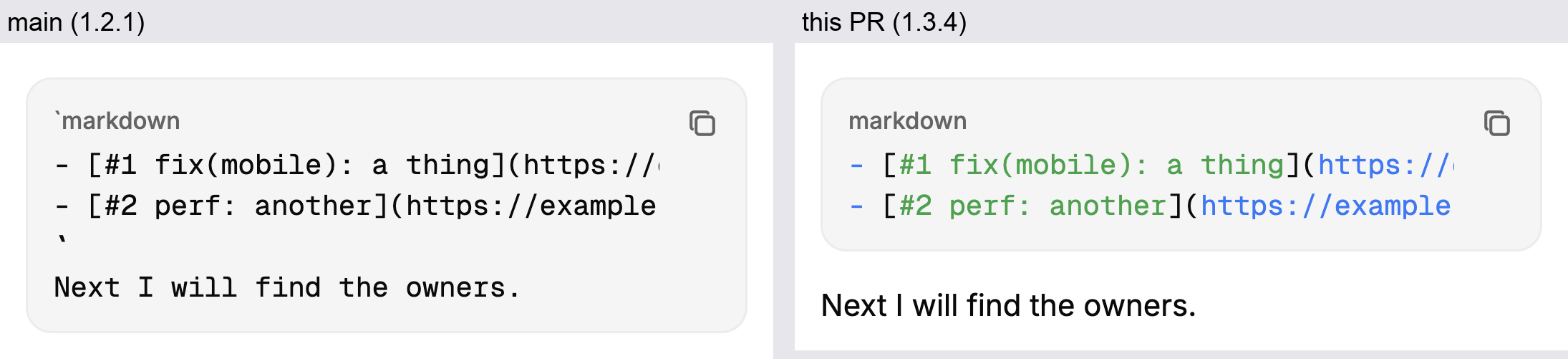





### Demo
A scroll through synthetic messages covering common formatting
(headings, lists, quotes, links, highlighted code, a table, a task list,
escapes), recorded on an iPhone 17 Pro simulator running this branch:
https://github.com/user-attachments/assets/bdc9680c-d20b-41ec-8e1a-a5b51c602f9d
### How
- Mentions, custom emoji and `#channel` tokens are `InlinePattern`s.
Links go through `inlineLinkBuilder` into the existing `_buildLink`, so
chips, media links and taps are unchanged.
- Removed workarounds the parser makes unnecessary:
- the render-path escape shielding from #8925
- the `_MarkdownEscapeMd`, `_MarkdownLabelEntityMd` and `_MessageLinkMd`
components
- the zero-width prefix before a leading `#channel`
Plain-text previews and gallery helpers keep their own escape handling.
`normalizeBareLinks` stays because attachment and gallery detection
depend on its output. Bubble segmentation unescapes a link destination
itself before its imeta lookup, since content no longer arrives
shielded.
- Kept desktop parity where plusparse differs from GFM:
- a table typed directly under a caption line gets a blank line inserted
before it, since plusparse can't start a table mid-paragraph
- `> [!NOTE]` quotes render as quotes (`alertBuilder` returns
`asBlockQuote()`), since desktop has no alerts
- `mapMarkdownProse` now ends an unclosed backtick run at its paragraph.
Before, it could pair with a run in a later block and flip code and
prose for the rest of the message.
- Synthesized autolink labels escape backslashes instead of using
`\`, which the parser leaves undecoded in a URL-shaped label.
- Repo/PR/issue chips keep their own semantics node.
- Forum card previews clip at their 120 px cap instead of overflowing:
blocks now lay out as a column.
- Pinned to exactly 1.3.4. 1.4.0 renders HTML by default and themes
through the separate `material_ui` package, which would need a theme
bridge.
### Validation
- Full mobile suite passes and analyze is clean at
|
||
|
Sanket Kanjalkar
|
bd031a05af |
fix(acp): bound observer retention by bytes (#7987) (#9436)
Replaces #9366 on a branch in this repository and resolves its conflicts
with main.
## Summary
The ACP observer kept up to 1,000 raw events in both replay and live
buffers. Large valid messages could retain gigabytes before downstream
trimming ran.
Fit telemetry before either buffer retains it. Cap replay at 4 MiB of
serialized JSON and keep the existing live window. Its per-event limit
bounds live JSON below 64 MiB.
Preserve the CPU and locking improvements from #9381: prepare large
payloads and copy snapshots outside the replay lock. Finalize sequence
and timestamp with publication. Account for that final metadata,
including sequence digit-width changes, in the byte limit.
The tradeoffs are extra work per emit, shorter replay history for large
events, and elided oversized telemetry. Agent protocol messages remain
unchanged.
### Related issue
Fixes #7987. Existing publisher byte limits act downstream of these
buffers.
### Testing
The opt-in probe exercises the real in-process emit, snapshot and
stalled-subscriber paths:
```sh
CARGO_INCREMENTAL=0 CARGO_PROFILE_RELEASE_LTO=thin CARGO_PROFILE_RELEASE_CODEGEN_UNITS=4 \
cargo test --release -p buzz-acp --lib observer::tests::retention_probe -- --exact --ignored --nocapture
```
Compared baseline `a314975ce` with candidate `c2df3cb56` on macOS arm64,
Rust 1.98.1. The baseline observer, fitter, workspace manifest and
lockfile match the candidate's parent `8f3f4e266`. Both arms use
`opt-level=3`, thin LTO and four codegen units, with incremental
compilation and compiler-cache wrappers off. This profile is fixed for
the comparison; this PR does not change build settings.
Values are medians of three fresh-process runs per version and workload,
in alternating order. Peak RSS comes from `/usr/bin/time -l` around each
test executable; compilation is excluded. Each version was rebuilt
separately and its executable and workload identity verified.
| Workload | Peak RSS before → after | Emit time per event before →
after |
| --- | --- | --- |
| 10,000 × 1 KiB | 14.0 → 14.1 MiB | 0.47 → 0.89 µs |
| 1,000 × 60,000 bytes | 199.4 → 80.8 MiB | 8.54 → 22.53 µs |
| 1,000 × 1 MiB | 3,025.8 → 26.4 MiB | 123.50 → 307.89 µs |
For the 1 MiB workload, replay JSON fell from 1,000.2 MiB to 3.997 MiB.
Live JSON fell from 1,000.2 MiB to 5.91 MiB. Replay retained 676 fitted
events; the live subscriber received all 1,000.
Emit time includes payload construction. Peak RSS includes snapshot and
receive copies made by the probe. JSON budgets are not exact heap
limits. These local measurements show the memory/CPU tradeoff;
concurrent producer throughput and native app latency were not
benchmarked. See [the probe
instructions](
|
||
|
Sanket Kanjalkar
|
471ca6b1ae |
Tune release codegen for faster/smaller binaries (#9434)
Replaces #9424 with the same release-profile change on a branch in this repository so the review workflows can run. ## Summary Reduce release codegen units from 16 to 4 and enable thin link-time optimization (LTO). Local measurements show about **7% smaller binaries**, with a **14% increase in dependency-cached release rebuild time** (+3.1 seconds). Clean release build time was roughly flat. `codegen-units = 4` seems like a good balance. With thin LTO fixed, one unit cut stripped sizes a further 7–10%, but increased clean build time by 38% and cached release rebuild time by 67.5%. CPU and Activity trials showed no clear speedup. Fewer codegen units let LLVM optimize larger portions of each crate together. Lower counts typically favor runtime performance and smaller binaries over compilation speed. Thin LTO also enables optimization across crate boundaries. Runtime gains depend on the workload. Release keeps `opt-level = 3`, the highest numeric optimization level and Cargo's existing default. Development builds stay unchanged. Keep the custom `ci` profile at 16 codegen units with LTO off, preserving its existing settings. Sprig keeps its separate size-focused profile. CI jobs that use ordinary `--release` will use the new settings. These measurements cover `buzz` and `buzz-acp`, not the desktop bundle. The desktop app has its own Cargo workspace; its bundled CLI picks up this change after a pin update. Our end-to-end runtime trials were broadly flat; the measurements below demonstrate the size and build-time tradeoff. ### Related issue N/A — no duplicate release LTO/codegen PR found. This PR contains only the profile change and is independent of #9413. ### Testing #### Baseline versus four codegen units Compared identical source and lockfile at `b4de4479485fc3d57628ed509ed40c4278e63132`, using Rust 1.98.1 on an Apple M5 Max (18 cores, 128 GiB RAM). Both arms used `opt-level=3`, disabled incremental compilation and no compiler-cache wrapper. The baseline used LTO off and 16 codegen units; the candidate used thin LTO and four. | Median / artifact | Baseline | Thin LTO, 4 units | Change | | --- | ---: | ---: | ---: | | Clean release build (2 runs each) | 47.98 s | 46.71 s | -2.7% | | Dependency-cached release rebuild (3 each) | 22.55 s | 25.68 s | +13.9% | | No-op release build (5 each) | 0.469 s | 0.461 s | Roughly unchanged | | `buzz` executable | 14.516 MiB | 13.580 MiB | -6.4% | | `buzz-acp` executable | 14.580 MiB | 13.487 MiB | -7.5% | Build command: `cargo build --offline --locked --release -p buzz-acp -p buzz-cli --timings`. Set `CARGO_INCREMENTAL=0`, `CARGO_PROFILE_RELEASE_LTO=false|thin` and `CARGO_PROFILE_RELEASE_CODEGEN_UNITS=16|4` for each arm, with separate `CARGO_TARGET_DIR` directories. Clean runs used empty build directories in sequential ABBA order, with downloaded dependencies and filesystem caches warm. Rebuilds cleaned only `buzz-acp` and `buzz-cli` outside the timed region. Sizes are Cargo-built executables before the desktop packager's stripping step. Stripping copies with `xcrun strip -S -x` kept the size benefit: `buzz` fell from 12.550 to 11.805 MiB (-5.9%), and `buzz-acp` from 12.360 to 11.501 MiB (-7.0%). This does not measure a signed desktop installer. Both release executables passed `--help` smoke checks. Profile inspection confirmed the custom `ci` and `sprig` settings are unchanged. #### One codegen unit versus four A separate follow-up compared four versus one on `a314975ce7bf9aa00baebfef874b6e69474a95cf`, which includes the merged observer CPU/locking changes (#9381). Both arms used thin LTO, `opt-level=3`, the same Rust 1.98.1 toolchain and hardware, and identical source and lockfile. This is a separate source snapshot from the first comparison; the tables should not be combined into a three-arm comparison. | Median / artifact | Thin LTO, 4 units | Thin LTO, 1 unit | Change | | --- | ---: | ---: | ---: | | Clean release build (2 runs each) | 45.93 s | 63.35 s | +37.9% | | Dependency-cached release rebuild (3 each) | 22.38 s | 37.48 s | +67.5% | | Stripped `buzz` | 11.789 MiB | 10.923 MiB | -7.3% | | Stripped `buzz-acp` | 11.485 MiB | 10.320 MiB | -10.1% | | Activity p95 latency (median of 5 runs each) | 952 ms | 961 ms | No clear change | Both sets of binaries were stripped identically with `xcrun strip -S -x`. Repeat the build command above with `CARGO_PROFILE_RELEASE_LTO=thin` and `CARGO_PROFILE_RELEASE_CODEGEN_UNITS=4` or `1`, retaining the same cache and ordering controls. All 60 CPU trials and 10 Activity trials passed. The CPU cases exercised production packing and queue ingestion functions; their differences were within run variation. Activity exercised real ACP subprocesses, observer publication, signing/encryption, the browser broker and production UI against a modeled relay. All 500 markers rendered exactly once, and all 2,250 heavy events were delivered. Its one-second publication interval limits visible latency; these local results are not production percentiles. Generated with AI assistance --------- Signed-off-by: Sanket Kanjalkar <sanketk@squareup.com> Co-authored-by: Codex <codex@openai.com> |
||
|
Kalvin C
|
1fc6a71ef9 |
feat(desktop): add dismissible banner pointing to the new buzz app (#9379)
## Summary The Buzz 1.0 desktop app now lives in [block/buzz-app](https://github.com/block/buzz-app). This adds a banner to the 0.X desktop app that tells users, and lets them download the new app's installer without leaving the app. - A full-width banner sits under the top chrome: "A new Buzz app is here! This version is being retired, so grab the new one whenever you get a chance." - **Upgrade** downloads the installer for this machine inside the app. A dialog shows the progress, then the saved file's name and folder with **Show in Finder** (worded per platform) and **Done**. The file goes to the Downloads folder and is revealed in the file manager. It is never opened, mounted or run. - **Cancel**, Escape or the dialog's close button stops a running download and removes the partial file. - When no installer can be resolved for this machine (unsupported platform, or the manifest fetch fails or is slow), **Upgrade** opens `https://buzz.xyz` in the browser instead. - **More info** opens the [upgrade guide](https://github.com/block/buzz-app/blob/main/docs/upgrading.md) in the browser. - Dismissing (×, labelled "Remind me later") stores a timestamp in `localStorage`. The banner is read once per mount, so it comes back on the next launch (or community switch) once 24h have passed. - It is hidden in the huddle room window. ## Demo https://github.com/user-attachments/assets/1f1916e8-f32d-4ec0-8e60-fe7c85dd4a57 Recorded on macOS (Apple Silicon) from a native debug build with the real Rust backend: a full download, **Done**, then a second download cancelled part-way. - The network is throttled through a local proxy so the progress stays visible. Unthrottled, the installer arrives in about two seconds. - The app was launched with a scratch home folder, so the path in the dialog is a scratch path, and the Finder window that the reveal opens is left out of the recording. - Presses are accessibility presses, marked with an orange ring. The OS cursor is not shown. ## How the download works - **Which installer:** a Tauri command reports this install's key (`macos-arm64`, `macos-x64`, `windows-x64`, `linux-appimage` or `linux-deb`). The webview reads the matching entry from the [buzz-app download manifest](https://raw.githubusercontent.com/block/buzz-app/download-feed/downloads.json) once per banner mount. - **Validation:** Rust re-validates the URL on every call. It must be `https://github.com/block/buzz-app/releases/download/<tag>/<file>`, with a restricted tag and file-name character set and the extension this machine installs. The webview names a URL and nothing else. - **Redirects:** a dedicated HTTPS-only client follows at most 5 redirects, and only to `github.com`, `objects.githubusercontent.com` or `release-assets.githubusercontent.com`. - **Limits:** 512 MiB, 15 s to connect, 30 s for headers, 30 s without a byte, 60 min in total. One download at a time. - **Saving:** the body is written to `<name>.<random>.part` in the Downloads folder, then renamed to `<name>` (or `<name> (1)` and so on) without ever replacing an existing file. The partial file is removed on failure, on cancel and at app exit. A partial left by a crash or force-quit is removed on the next launch. - **Downloaded-from-the-internet marking:** macOS gets the `com.apple.quarantine` attribute a browser would write, and Windows gets the Mark of the Web (`Zone.Identifier`). If the mark cannot be written, the download fails and the file is not kept. - **Failures:** the dialog says what went wrong in plain words. Transient failures lead with **Try again**. Failures a retry cannot fix lead with **Download in browser**, which opens the validated installer URL. ## Testing - Unit: `deprecationBannerVisibility.test.mjs`, `newAppInstaller.test.mjs` (manifest and URL rules), `newAppInstallerDownload.test.mjs` (dialog state), and a jsdom test of the download hook. - Rust: `new_app_installer_tests.rs` covers URL validation, the redirect policy, limits, naming without overwrite, cancel and shutdown cleanup, launch cleanup, and the quarantine and Mark of the Web values. CI runs this crate's tests on Linux and on `windows-latest`, so the Mark of the Web test writes a real alternate data stream there. The quarantine test runs on macOS only, which CI builds but does not test. - Smoke: `tests/e2e/deprecation-banner.spec.ts` drives the banner, the download dialog, each failure's actions, cancel and the keyboard paths against the mock bridge. - Native, macOS arm64 debug build: the download was saved with `com.apple.quarantine` set and revealed in Finder; cancel removed the partial; the download kept running while the window was hidden; SIGTERM and a menu quit mid-download removed the partial; after a force kill the next launch removed it. Not verified by hand: - The Windows and Linux flows in a running app, including SmartScreen on Windows. - The Gatekeeper prompt when opening the downloaded DMG, and the macOS Downloads-folder consent prompt, which need a signed build. 🤖 Generated with [Claude Code](https://claude.com/claude-code) --------- Signed-off-by: Kalvin Chau <kalvin@block.xyz> Signed-off-by: Matt Toohey <contact@matttoohey.com> Co-authored-by: Claude Opus 5.5 <noreply@anthropic.com> Co-authored-by: Matt Toohey <contact@matttoohey.com> |
||
|
Tom Brow
|
3d3f9cf153 |
fix(mobile): keep publishing presence while the app is open (#9441)
Mobile stopped publishing presence on November 1. The heartbeat in
`PresenceNotifier` only runs while something holds `presenceProvider`,
and its last always-mounted watcher was the app-bar `ProfileAvatar`,
deleted as dead code in [#8880 dead code
cleanup](https://github.com/block/buzz/pull/8880). Since then the app
sends "online" only while Settings is open, stops when Settings closes,
and never sends "away" when backgrounded. Other people see a phone user
as offline (or stuck on whatever Settings last sent).
This keeps the provider alive from the signed-in shell, next to the
other app-wide `ref.listen` keep-alives in `app.dart`.
Found during a combined performance and network hunt on a physical
iPhone SE running main ([
|
||
|
Tom Brow
|
2b428f56b8 |
feat(mobile): share into Buzz from the iOS share sheet (#9433)
Lets people share screenshots, screen recordings, photos, URLs and text from any iOS app into Buzz. Today Buzz doesn't appear in the share sheet at all. - **Plain Buzz icon:** opens a new Solo chat with the items in its composer. - **Suggested conversation:** iOS offers channels and DMs the person recently sent top-level messages in. Choosing one opens that conversation with the items in its composer. When the conversation is already open, the share goes to that page's composer instead of opening a second one; if another page covers it, Buzz stays where it is and shows "Go back to that conversation to finish sharing", and the items join the draft when the person goes back. - The share extension has no UI and sends nothing. It copies the items into the app group and opens Buzz, which prefills the normal composer, so drafts, attachments, mentions and failed-send handling all stay the app's (see [the ADR](https://github.com/block/buzz/blob/mobile-share-extension-design/docs/adr/0003-share-hands-off-to-the-conversation.md)). - If the conversation already has a draft, Buzz asks whether to add the shared items to it or replace it. - A share to a conversation that's no longer available (a removed community or channel, or an unreadable share) shows "That conversation isn't available". A share while signed out shows "Sign in to share". Suggestions come from an outgoing `INSendMessageIntent` the app donates after a top-level send or a new Solo chat. The notification extension no longer donates incoming messages, so receiving a message never makes a conversation a suggestion; it still turns the push into a communication notification with the sender's avatar. Both use the same conversation identifier, now the plain community and channel IDs instead of a hash, because the extension needs to hand the identifier back to the app. | Before | After | | --- | --- | | <img alt="Share sheet without Buzz" src="https://github.com/user-attachments/assets/452fac1b-7e87-44c3-a442-099f78d0e07b" width="300"> | <img alt="Share sheet with Buzz" src="https://github.com/user-attachments/assets/54b9775d-29b4-49a5-8ab9-5fda8718a02f" width="300"> | | Buzz icon: new Solo chat | Suggested DM with a draft | After Add | | --- | --- | --- | | <img alt="New Solo chat with the shared photo" src="https://github.com/user-attachments/assets/c5da4d8b-1dd8-4e30-9e92-9dba515b3623" width="250"> | <img alt="Add to your draft prompt" src="https://github.com/user-attachments/assets/2f879f8a-3b9f-48e0-b963-2828e90dc9fe" width="250"> | <img alt="Draft with the shared link and photo added" src="https://github.com/user-attachments/assets/12832006-85c5-4447-98b5-62932552c931" width="250"> | https://github.com/user-attachments/assets/b9d380fa-e802-4ed7-89a8-592a03784c8f ### Regressions - Nothing changes for people who never use the share sheet, except that sending a top-level message or starting a Solo chat now makes one local `INInteraction.donate` call (skipped while the age restriction is on, which still purges every interaction). - Communication notifications look the same. Dropping the incoming donation removes work (and a deletion fence) from the notification extension's time budget. - The share hand-off reuses the existing deep link dispatcher. A share link is a new link type; notification and message links take the same paths as before. ### Validation - Added tests: - Dispatcher hand-off: a share to a suggested channel opens it with the shared text and files; shares to a removed community, an unlisted channel, an unknown manifest version or a missing manifest show the error and delete the pending share; share links accept only the extension's UUID ids. - Composer delivery: with an existing draft, Add appends the shared text on a new line and attaches the file, Replace clears the draft first, and the app group copy is deleted either way. - Notification presenter: specializes the notification from the intent, or falls back to the ordinary content when that throws (replaces the donation and deletion-fence tests). - Full mobile Flutter suite and BuzzPushKit Swift tests pass. - Automated app run on an iPhone 17 Pro simulator (iOS 27, dev relay test community), recorded above: sent a DM, shared a photo from Photos with the Buzz icon from a cold start (new Solo chat with the photo attached), then handed a link and photo to a DM that had a draft and chose Add. Also checked that a share's pending files are deleted after delivery. - Limitation: the iOS simulator never shows share-sheet conversation suggestions (it has no `coreduetd`), so the suggested-DM step in the video is staged by writing the same pending share and link the extension writes. Choosing a real suggestion still needs a check on a device. - Known gaps, all confined to sharing: suggestions have no avatar image yet; a suggestion for a conversation left after signing out shows "isn't available"; choosing Later in the unfinished-chat dialog keeps the share until the next new chat; and a pending share the app never receives (for example when Buzz doesn't open) stays in the app group. ### Before merge - [x] On a real iPhone, choose a suggested conversation in the share sheet and confirm the shared items open in that conversation's composer (the simulator can't show suggestions). Waived before merge: the managed test iPhone shows no share-sheet suggestions for any app, so this will be checked on a personal phone after landing. --------- Signed-off-by: Tom Brow <tomb@squareup.com> Co-authored-by: Tom Brow <tomb@squareup.com> |
||
|
Kalvin C
|
3c0adc1882 |
fix(mobile): qualify every namesake mention and keep authored mention casing (#9325)
## problem When a message mentions two different identities that share a display name, the mobile composer qualified only the later selection as `@Name (<64-hex>)` and left the first one bare. A qualified occurrence denies the plain name on render, so the first mention rendered as plain text on mobile and desktop. `MessageContent` also displayed every mention in the lowercased binding key rather than its authored spelling. ## change - `mention_bindings.dart`: - `selectedMentionLabel` qualifies a selection whenever another selected identity shares its name, without regard to case. - `namesakeRequalifications` and `renameMentions` qualify earlier plain selections. Each occurrence keeps its authored spelling, and occurrences in code stay as typed. - `compose_bar/helpers.dart` and `compose_bar_widget.dart`: - Selecting a namesake qualifies earlier same-name mentions before the new label is inserted, keeping the caret in place. - Occurrences inside code that the composer styles are skipped: single-backtick spans and closed triple-backtick fences, found by the same walk the editor uses to draw them. A key whose occurrence stays in code remains bound beside its qualified label, so its recipient still sends. - `agent_mention_prefill.dart`: automatic addressing qualifies every same-name agent it inserts. - `message_content.dart`: mentions render in their authored spelling, and bindings still resolve case-insensitively. - `docs/mention-editor.md`: describes the behavior, including that Markdown code forms the composer does not style (tilde fences, indented code) are qualified like prose. ## tests - `mention_bindings_test.dart`: requalification, spelling preservation and code exclusion. - Composer journeys: - picker selections qualify both namesakes and send both keys; - styled code (fences, list fences, spans, spans after bold or italics) stays as typed while surrounding prose is qualified; - a selection left only in code keeps its recipient; - automatic prefill of two same-name agents qualifies both. - `message_content_exact_mentions_test.dart`: authored casing with case-insensitive resolution. - `just mobile-check mobile-test` passes. - Real relay: composed bodies exchanged through a local relay render as correctly targeted chips in desktop and in Flutter `MessageContent`. --------- Signed-off-by: Kalvin Chau <kalvin@block.xyz> Signed-off-by: Tom Brow <tomb@squareup.com> Co-authored-by: Claude Opus 5.5 <noreply@anthropic.com> Co-authored-by: goose-wayne <ae6b377e5b6d090ee22558d19246413a5731628a127e25371111badfd4861535@buzz.block.builderlab.xyz> Co-authored-by: Tom Brow <tomb@squareup.com> Co-authored-by: peon <9ac6794b000690b7e814eb1805ad32405d0bec7d52838de3a86cf967565dacc0@buzz.block.builderlab.xyz> |
||
|
Tom Brow
|
bf3bdd0eae |
fix(mobile): match browser GIF timing in the iOS reaction sheet (#9437)
The two follow-ups from the pre-review of [#9432 GIF frame timing](https://github.com/block/buzz/pull/9432), rebased onto main now that it has landed. **iOS reaction details sheet.** The sheet decodes custom emoji natively (`NativeMessageImageLoader.decode`) and timed each frame as `max(0.02, delay)`, so with [#9432 GIF frame timing](https://github.com/block/buzz/pull/9432) a GIF with 0 or 1 cs delays plays at 100 ms per frame in the timeline chip but 20 ms per frame in the sheet opened from it. The decoder now shows frames of 10 ms or less for 100 ms, as browsers and `MediaImageProvider` do, and keeps longer frames as written. The 20 ms floor goes with it: browsers keep 11 to 19 ms frames as written too. **Provider-level test.** The existing tests call `withBrowserFrameTiming` directly, so removing the provider's call to it left the suite green. A new test resolves a GIF through `MediaImageProvider` with a mock HTTP client and pumps the scheduler's app frames at explicit timestamps: the 10 ms first frame is still showing at 50 ms and is replaced at 100 ms. ### Regressions None expected. The sheet already summed the frame delays into one `UIImage.animatedImage` duration, so only the per-frame value changes, and only for frames of 10 ms or less, which ran at 20 ms before. Still images and longer frames decode as before. The Dart test drives frame callbacks with explicit timestamps rather than waiting on wall-clock time. ### Validation Added tests: `NativeMessageImageLoaderDecodeTests` in RunnerTests (a 0, 1, 2, 5 cs GIF decodes to a 0.27 s animation; a one-frame GIF stays still) and `withBrowserFrameTiming is applied to the frames MediaImageProvider plays` in `media_image_test.dart`, which fails when the provider's call is removed (the second frame shows at 50 ms). Full mobile suite: 4,780 tests passed. `flutter analyze`: no issues. RunnerTests `NativeMessageImageLoaderDecodeTests` and `NativeReactionDetailsTests`: all five pass on an iPhone 17 simulator (Xcode build-for-testing of the Debug simulator app). No full-app run: the change is one delay value in a decoder and is covered by the unit tests above. Signed-off-by: Tom Brow <tomb@squareup.com> Co-authored-by: Tom Brow <tomb@squareup.com> Co-authored-by: judge <7615ec4b7ddf99f0bb48e913297f99f8f772d289a1c9ef54e1d906dd55a93ba8@sprout-oss.stage.blox.sqprod.co> |
||
|
Kalvin C
|
0bbcf3e7c2 |
fix(mobile): play short-delay animation frames at browser speed (#9432)
Some animated custom emoji play far faster on mobile than on desktop. Browsers show any animation frame with a delay of 10 ms or less for 100 ms. Firefox started this ([bug 207059](https://bugzilla.mozilla.org/show_bug.cgi?id=207059)). Chromium copied it (decoder comment: "use a duration of 100 ms for any frames that specify a duration of <= 10 ms"), and so did WebKit ([changeset 73295](https://trac.webkit.org/changeset/73295/webkit)). Flutter uses the delay as written ([flutter/flutter#130684](https://github.com/flutter/flutter/issues/130684)), so a GIF with 0 or 1 centisecond delays runs at the display refresh rate on mobile and at 10 fps on desktop. `MediaImageProvider` now wraps multi-frame codecs so frames of 10 ms or less get 100 ms. Every other frame keeps its own delay. Still images are passed through unchanged. Custom emoji, avatars and attachments all render through this provider. **Tests:** `flutter test test/shared/relay/media_image_test.dart` passes (24/24), and `flutter analyze` reports no issues on the changed files. The new test decodes a GIF with delays of 0, 1, 2 and 5 cs and expects 100, 100, 20 and 50 ms. It fails when the wrapper is removed. 🤖 Generated with [Claude Code](https://claude.com/claude-code) Signed-off-by: Kalvin Chau <kalvin@block.xyz> Co-authored-by: Claude Opus 5.5 <noreply@anthropic.com> |
||
|
Luke Tornquist
|
279a31daac |
buzz-search: read profile names without the profile_name_fields function (#9397)
## What

This is phase 1 of 2 for retiring the plpgsql function
`profile_name_fields(text)`. Its only caller, profile name search
(`search_profile_names`), now gets `name` and `display_name` from an
inline SQL expression (`PROFILE_NAME_FIELDS` in
`crates/buzz-search/src/query.rs`) instead.

The function's exception handler made unreadable kind:0 content have no
names rather than fail the search. The inline version keeps that
guarantee in two steps:

- **`pg_input_is_valid(content, 'jsonb')`** rejects the soft parse
errors: a `\^@` escape, a lone surrogate, a huge number, and malformed
JSON.
- **A bracket bound for deep nesting.** PostgreSQL's JSON parser is
recursive. Past about 10k levels at the default `max_stack_depth`, it
raises `stack depth limit exceeded`, and `pg_input_is_valid` does not
catch that. I confirmed this on PG 17: depth 10k is fine and 20k raises.
So content with more than 4096 `[` and `{` is never parsed and has no
names. The count bounds the depth. Ingest already rejects kind:0 content
nested deeper than 128 levels (serde_json), so this only matters for
content stored another way.

`OFFSET 0` keeps the parse from being copied into each reference to
`doc`, so each candidate row is parsed once, plus one validity pass. The
plpgsql function also parsed each row once.

**Behavior change (edge only):** a kind:0 with more than 4096 brackets,
even inside strings, is no longer findable by name. Real profiles don't
come close, and a `picture` data URL is base64 with no brackets.

`pg_input_is_valid` needs PostgreSQL 16 or later. CI runs 16, and the
dev compose runs 17.

**Phase 2 (not here):** a migration and desired-state change drops the
function, its `schema/functions/` file and its `schema.sql` entry once
this release has shipped.

## Tests

- `profile_names_survive_unparsable_content` already stores a `\^@`
profile, a lone-surrogate profile, a `1e1000000` profile and a 60k-deep
profile next to a plain one, and requires the search to return only the
plain one. It now also covers the bound itself: a profile with exactly
4096 brackets, all but one inside a string, is still found.
- Must-fail mutants, each run on Blox: bracket bound removed (the search
fails with a stack overflow), validity check removed, bound tightened by
one, and the string-type check loosened.

## What got simpler

Profile search no longer depends on a database function. Name extraction
lives next to the rest of the search SQL it feeds.

## Verification

Blox, at `be0db303ea90033cc2c37ac8f8f07c27f4b08e31` (clean tree):

| Gate | Result |
|---|---|
| `cargo fmt --all --check` | pass |
| `cargo clippy -p buzz-search --all-targets -- -D warnings` | pass |
| `cargo nextest run -p buzz-search --lib` | 4/4 |
| `scripts/postgres-test-run.sh -p buzz-search --tests -E
'test(/profile_names/)'` | 4/4 |
| Must-fail mutants (no bound, no validity check, bound tightened by
one, non-string names allowed) | 4/4 killed |

Probe on PostgreSQL 17.11: `pg_input_is_valid` returns false for `\^@`,
a lone surrogate, `1e1000000` and truncated JSON; nesting depth 10k is
valid; depth 20k raises `stack depth limit exceeded`. CI runs the full
Postgres lanes.

🤖 Generated with [Claude Code](https://claude.com/claude-code)


buzz-review-completed

---------

Signed-off-by: Luke Tornquist <tornquist@squareup.com>
Co-authored-by: Elrond <28d6302a099e5225b02c4155ac4236e4912603df2ab08dbfc2f4fef08ce598c8@buzz.block.builderlab.xyz>
Co-authored-by: Claude Opus 5.5 <noreply@anthropic.com>
|