mirror of
https://github.com/block/buzz.git
synced 2026-10-29 13:31:44 +00:00
ec918bb75f7ca0528dbc3cc6b329167fbd40d2a0
2638 Commits
| Author | SHA1 | Message | Date | |
|---|---|---|---|---|
 morgmart |
ec918bb75f |
desktop-new: build screens from the ramps, cut 54 colour roles to 15
Registers all eight palette ramps as Tailwind classes, so a screen writes `bg-purple-9` or `text-red-12` directly. This reverses the rule the colour guard used to enforce, and the reversal turns on one fact: every step in this palette is authored per mode, so `neutral-4` is one value in light and another in dark and a component naming it behaves correctly in both. That is what makes a raw step safe here and unsafe in stock Tailwind, where `neutral-200` is a single literal. Once a step is mode-aware, a role whose light and dark values are the same step is a name in front of a number, and a name in front of a number hides the decision instead of recording it. `bg-accent` was `purple-9`; `text-error` was `red-12`. Nineteen roles were exactly that. The fifteen that remain each earn the name: the four structural surfaces take a different step per mode, so no class can express them; the emphasis roles enforce a rule a ramp cannot state, which is that there are three levels of text and one border weight; the glass materials are a bundled treatment; and `--text-on-accent` follows its fill rather than the mode. Also fixes a namespace collision that had shipped a real defect. `--color-x` is not one utility, it is all of them — one declaration defines `bg-x`, `text-x`, `border-x` and `ring-x` from a single value — so `text-danger` resolved to the saturated fill (red-9) instead of the text step. Three error messages rendered at APCA Lc 34 on a dark panel against a target of 60, and `check-contrast` passed the whole time because it measured `--text-danger`, a token no class could reach. Text roles now register as `--text-color-*`, matching the `--border-color-*` split that fixed the same bug for borders. Guards updated to enforce the new rule rather than the old one: `check-color` now rejects a role whose two modes agree and names the class to write instead, and `check-contrast` measures the ramp steps screens actually use, so deleting a role cannot leave it auditing a name nobody types. `registry.test.ts` binds the documented token list to the stylesheet, and `pnpm census` reports every role's readers without failing a build. Signed-off-by: Morgan Martin <morganmartin@squareup.com> Signed-off-by: morgmart <98432065+morgmart@users.noreply.github.com> |
||
|
morgmart
|
ce94bb1599 |
desktop-new: delete the proving-ground dashboard
It was meant to stress the design system by putting many decisions next to each other. It did surface one real finding - the neutral hover step is tuned for hovering a filled component, not a bare row, so the same token is too weak for a quiet button and too strong for a bare row - but the page was ~85% bespoke CSS routed around the shared components, so most of what it showed was its own scaffolding rather than the system. The app itself is the better proving ground. Removing this rather than carrying a mockup whose defects have to be triaged separately from the product's. Signed-off-by: morgmart <98432065+morgmart@users.noreply.github.com> |
||
|
morgmart
|
4100246b75 |
desktop-new: ignore vite.local.config.ts
A local Vite config can wrap the committed one to append a personal dev-only plugin. Ignoring it makes that structurally uncommittable rather than something to remember not to stage. Signed-off-by: morgmart <98432065+morgmart@users.noreply.github.com> |
||
|
morgmart
|
adc6639c06 |
desktop-new: cards carry no default fill
A card sits on the panel and is grouped by a hairline. Fill is reserved for bg-hover, and only where the card is clickable, so a filled card always means you are pointing at this rather than merely this is a box. The region tiles were using bg-inset, which means pushed in - an input or a code block - the opposite gesture from grouping, and read as a grid of empty text fields inside a filled panel. No new role is needed: a card with no default fill has nothing to name. Signed-off-by: morgmart <98432065+morgmart@users.noreply.github.com> |
||
|
morgmart
|
efb443a2cb |
desktop-new: delete the categorical tints, add a proving-ground dashboard
Two changes, both about finding out whether the colour system actually works. Deleted the six categorical tint roles. Evidence: zero component usage — not one reference outside the token file and the registry. They were hand-picked literals of exactly the kind the palette exists to prevent, and the open question 'how many categorical colours does the product need, and does a person choose one or does the product assign it' is unanswered, so naming them now was guessing. The eight palette hues stay; a categorical role gets named when a feature needs to distinguish things. That deletion turned a guard check vacuous, which is its own finding: the drift check named four specific pairs (--tint-purple vs --accent-tint, etc.) and would have passed silently forever once those tokens were gone. Replaced with the general rule — no two family steps may resolve to the same palette step — which catches the same class for any future family without naming pairs. Falsified by pointing --danger-tint at the purple ramp. Added /proving-ground: a fictional fleet-monitoring dashboard, deliberately nothing to do with Buzz. Specimen pages are honest but sympathetic — one component at a time, on a chosen backdrop, at a chosen size. A dashboard puts forty decisions next to each other, which is where a missing role shows up. It is also the surface a generated theme has to be judged on: 'Neon Tokyo' can look fine as twelve swatches and be unusable as a page. Built only from role tokens, and it held: no new roles were needed, contrast passes both modes, and the layout works at 1440 and 620. Page-local parts live in the feature rather than shared/ui on purpose — this page exists to find out what repeats, so promoting its pieces first would be guessing. Signed-off-by: morgmart <98432065+morgmart@users.noreply.github.com> |
||
|
morgmart
|
cef97be05b |
desktop-new: add a palette layer beneath the colour families
The colour system had three layers, and the middle one held two different kinds of thing under one name. --neutral-1..12 is a real scale; --accent-2 and --danger-9 are five specific jobs (tint, tint-hover, border, fill, text) wearing ramp-style numbering. So --accent-2 read as 'a light purple' when it meant 'the surface an accent tint sits on'. Underneath it was 114 hand-picked hex values with nothing enforcing that two tokens doing the same job agreed. They drifted: --accent-2 and --tint-purple were the same purple in light mode and two different purples in dark. I introduced that yesterday and did not notice. Four layers now: 0 palette --palette-purple-3 every hue, 12 steps, authored per mode 1 families --accent-tint the five jobs a hue does, named not numbered 2 roles --bg-accent-tint what a thing is in the interface 3 components bg-accent-tint Tailwind utilities Dark stops being freehand. A family points at a palette step and .dark redefines the whole palette, so 50 hand-picked dark values are simply gone. This also answers a concrete trap. Tailwind's purple gets MORE saturated as it descends (950 is 87% saturation), so a dark tint drawn from its bottom end reads as oversaturated, and the only way to reach a muted deep purple was to write purple-950/50 in a component. That value is correct — it composites to within a few percent of the palette step now in use — but as an expression it has no name, no light/dark pair, and nothing the contrast guard can measure. The palette's dark ramps are authored for dark surfaces, so it is a step you pick. New scripts/check-color.mjs enforces it: rejects opacity modifiers on colour utilities, color-mix() and alpha rgb()/hsl() in component code, components reaching past the role layer, and the layering itself — palette steps must be literals, family steps must reference the palette, two tokens doing one job must resolve to one step, and dark must not restate families. Falsified by reintroducing the original drift and each other failure mode in turn. Values are Radix Colors (MIT), transcribed rather than depended on; Radix is not on Block's Tech Radar so this is a values-only copy with no package. Its twelve-step contract is the one this system already described in comments, step for step. Two documented divergences, both found by the contrast guard: family text takes step 12 rather than the 11 Radix names 'low-contrast text' (Radix sizes 11 for WCAG 4.5:1; every hue's 11 measured Lc 55-61 against our Lc 60 target), and dark neutral surfaces stay hand-authored because they were sized against the real panel stack. The colour page now renders the palette, so picking a step is visual. Signed-off-by: morgmart <98432065+morgmart@users.noreply.github.com> |
||
|
morgmart
|
7b8c73b95f |
desktop-new: purple accent, rename tile to chip, redesign from Figma
Accent hue is now Tailwind purple. The ramp is a slot, so this is five values in tokens.css and every role follows; steps 2 and 3 are purple-100/200 exactly because the chip design was drawn against them and the tint pair is what a person sees most. Dark mode cannot use those two — near-white reads as a light surface on a dark panel — so it holds the hue at dark violets instead. Renamed InlineTile to InlineChip throughout, plus shared/tiles to shared/chips, tileNode to chipNode, and every token, class, and identifier. A chip is what this is. Redesigned to match Figma 700-2782: - One treatment for every kind: accent tint behind primary text. Kinds are told apart by sigil and, where the label is ambiguous, an icon — not by colour. This replaces the earlier per-kind colour split, which spent palette on a distinction the sigil already makes. - Label is primary text, not accent text; the tint does the colour work. - Two new kinds the design draws: message and link, both icon-led with no sigil. AUTHORABLE_CHIP_KINDS records that v1's picker still offers only person, agent, and channel; the others arrive by another route. - Dropped avatar and status dot. The design has neither, and neither was earning its place at text size. - Unresolved is now a real state: neutral fill, lesser text, and never a control, because there is nothing to open. - Chip inset and gap intentionally sit below the 4px spacing floor (3px inset, 4px gap) — a chip hugs its label. Recorded on the tokens. Eight new rendered-contract tests bound to the real specimen page: sigils and selective icons, assistive naming, unresolved-is-never-a-control, read-only claims no stop, activation reports the address, truncation, never breaking across a line, and hover deepening the tint without moving the text. Signed-off-by: morgmart <98432065+morgmart@users.noreply.github.com> |
||
|
morgmart
|
c05b85c421 |
desktop-new: tile address model and shared InlineTile
Implements the foundation the composer sits on: a reference is an address (kind + identity), never the letters of a name. One shared InlineTile serves both the composer and the conversation, mounted in the editor through a React node view. - shared/tiles/address.ts: kind + id, canonical buzz:// form, parse/format. - shared/tiles/faceResolver.ts: resolves the displayed face from an address at render time, so a rename never edits anyone's draft or enters undo history. Community-scoped cache with an explicit reset. - shared/ui/InlineTile.tsx: the one component, person/agent/channel kinds. - features/composer/tileNode.ts: the document node. Stores only the address. - New semantic tokens: --space-tile-inset, --space-tile-gap, --radius-tile. - Specimen page at /design/components/inline-tile covering kinds, in-sentence use, read-only, unresolved, truncation, and activation. Findings while building, all now covered by tests: - A React node view REPAIRS a caret boundary. With static markup, Home before a leading tile landed after it; with the node view both Home and ArrowLeft land correctly. Only the pointer click on a leading tile's left edge still fails — now the single known caret gap, still marked test.fail(). - useSyncExternalStore needs a reference-stable snapshot. Building a fresh unresolved face per call was an infinite render loop that unmounted the whole editor. Unresolved faces are cached like resolved ones. - An unresolved tile must not announce an abbreviated identity to a screen reader. TileFace now carries , and the accessible name says "Unresolved person" rather than reading the stand-in aloud. Falsifiability checked by breaking each protection in turn: selectable:false, the address text projection, and the community reset each turn tests red. Signed-off-by: morgmart <98432065+morgmart@users.noreply.github.com> |
||
|
morgmart
|
179af349f1 |
desktop-new: composition-input spike for inline composer tiles
Answers the blocking question in the Desktop New plan before the composer is designed: does staged character input (ja/ko/zh) survive beside an inline atom tile? It does. Twelve tests, Chromium composition driven through CDP Input.imeSetComposition plus a WebKit pass. Measured findings: - Composition beside a tile is safe in every position; a committed composition leaves the tile address byte-identical. No fence needed. - selectable:false is load-bearing. With selectable:true an arrow key selects the tile and the next keystroke replaces it. - atom:true is redundant for a contentless node (isAtom = isLeaf || spec.atom) and kept as documentation of intent. - Whole-tile deletion works natively; no custom Backspace handler required. - One real gap: the caret position before a leading tile. ArrowLeft reaches it, Home and a pointer click do not, in both engines. Those two tests carry test.fail() until the caret-boundary layer lands. The harness is temporary and deleted when the real composer lands. Signed-off-by: morgmart <98432065+morgmart@users.noreply.github.com> |
||
|
morgmart
|
ef1b407e02 |
feat(desktop-new): establish visual component foundation
Signed-off-by: morgmart <98432065+morgmart@users.noreply.github.com> |
||
|
morgmart
|
2d4d36e086 |
feat(desktop-next): build channel-backed Sessions workspace
Signed-off-by: morgmart <98432065+morgmart@users.noreply.github.com> |
||
|
morgmart
|
8dc0610f5d |
Merge remote-tracking branch 'origin/main' into morgan/desktop-next-sessions
* origin/main: Add generic information-flow control core (#7293) feat(buzz-acp): update base prompt; add buzz context and skills to Pi agents (#7335) fix(desktop): restore mention chip identity icons (#7338) Persist video playback speed preference (#7336) Verify ACP relay events before prompt routing (#7010) fix(buzz-acp): bound busy-owner hold to prevent cross-channel starvation (#7337) feat(desktop): invite owned agents from standalone forums (#7125) fix(desktop): authorize remote mentions at publication (#7124) fix(acp): rename system tag to agent-instructions (#7332) fix(desktop): bind duplicate mention selections to exact recipients (#7133) refactor(relay): extract NIP-29 membership authorization (#7285) chore(release): release Buzz Desktop version 0.5.22 (#7308) feat(desktop): preserve mentions across copy and paste (#7228) test(desktop): await Bestie drag and profile hover endpoints (#7294) Collapse contiguous join messages (#7262) Signed-off-by: morgmart <98432065+morgmart@users.noreply.github.com> |
||
|
Jordan Mecom
|
4d447b9c20 |
Add generic information-flow control core (#7293)
Adds a dependency-free `ifc-core` crate implementing reader-set confidentiality labels and monotonic per-computation flow state. - Defines flow ordering, join, and meet over caller-supplied principal universes. - Fails closed for unknown or cross-universe input and checks reader widening at egress. - Includes property tests for lattice laws and monotonic taint, plus the design paper that motivates the broker integration. The crate deliberately contains no Buzz, Nostr, channel, membership, or grant policy; those remain in the Buzz adapter. --------- Signed-off-by: Jordan Mecom <jm@squareup.com> |
||
|
Salman Mohammed
|
4beffef697 |
feat(buzz-acp): update base prompt; add buzz context and skills to Pi agents (#7335)
## Summary - launch Pi through a private Buzz wrapper so managed Pi agents receive Buzz's base prompt plus the configured thread/channel session model via `--system-prompt` - load the Buzz workspace skill directory with Pi's repeatable `--skill` flag, making `~/.buzz/.agents/skills/buzz-cli` available alongside Pi's normal global skill discovery - report Pi and `pi-acp` installation states separately so setup guidance points to the missing component `pi-acp` does not currently consume the ACP `session/new` system prompt, but its normal new-session and restore paths do honor `PI_ACP_PI_COMMAND` as the executable used to launch Pi. Buzz reserves that variable and sets it to a private generated launcher. The launcher invokes `pi` from Buzz's effective `PATH`, adds `--system-prompt <file>` and `--skill <workspace>/.agents/skills`, and forwards `pi-acp`'s RPC and session arguments unchanged. This keeps the integration entirely in `block/buzz`, without changes to Pi or `pi-acp`. ### How PI_ACP_PI_COMMAND works in `pi-acp` `PI_ACP_PI_COMMAND` selects one executable; it does not accept arguments. Therefore: ```bash # Does not work PI_ACP_PI_COMMAND="pi --skill ~/.buzz/.agents/skills" ``` Buzz does not expose this variable as user configuration. It creates a private launcher and sets `PI_ACP_PI_COMMAND` only on the `pi-acp` child. Conceptually, that launcher executes: ```sh #!/bin/sh exec pi \ --system-prompt "$PRIVATE_SYSTEM_PROMPT" \ --skill "$HOME/.buzz/.agents/skills" \ "$@" ``` ### Related issue Follow-up to #7208. No duplicate issue or open PR found. ### Testing - `just ci` - `cargo test -p buzz-acp pi_launcher` - `cargo test --manifest-path desktop/src-tauri/Cargo.toml managed_agents::env_vars::tests` - `cargo test --manifest-path desktop/src-tauri/Cargo.toml managed_agents::discovery::presets::tests` - pre-push branch checks No screenshots: the UI change is state-dependent setup guidance only. --- **Update Sep 4, 13:35:** Made `PI_ACP_PI_COMMAND` entirely Buzz-owned. - Managed agent configuration now rejects the variable as a user override. - Buzz always launches `pi` from its effective `PATH` and rejects inherited values before creating its private launcher. - Removed the custom Pi executable discovery path and its internal environment alias. --- **Update Sep 4, 14:03:** Reject inherited `PI_ACP_PI_COMMAND` values instead of replacing them. - Pi startup now fails with an actionable message telling the user to unset the variable. - Removed the Pi-specific exception from the generic ACP environment injection path. Generated with Codex --------- Signed-off-by: Salman Mohammed <smohammed@squareup.com> |
||
|
Logan Johnson
|
4afef8649a |
fix(desktop): restore mention chip identity icons (#7338)
## Summary Restore the missing **@ glyph for people and robot icon for agents** after #7133, and incorporate the requested compact public-key display. - Wrapping mention chips render their existing bounded icon-bearing leading fragment. - Readonly chips show bound keys using the same `8 leading…4 trailing` formatter as the channel member list: `Scout (150b20bd…15dc)`. - Full literal labels and exact keys remain authoritative in metadata, profile targets, title/accessible-name attributes, editor text, saved bodies and recipient tags. Display abbreviations are never used for recipient lookup. - Copy/paste restores the full literal label for a complete compact chip; partial selections remain plain text. Two keys sharing the same abbreviation still round-trip to their separate exact recipients. - No recipient-resolution, authorization, wire-format, composer, or CSS changes. Existing labels, icons, cloud markers and ordinary mentions remain intact. ## Verification Published candidate `9365ab9bc9d9c5d10802580cd576f8e378ff492f`, based on main `e09f715c9d0ee2cb7bf8a39061e601f3a502f588`: - **6,444 desktop unit tests passed** on this candidate's final source tree. - **44 mock-Chromium tests passed, zero retries in the final run** across mention recipients, clipboard and cloud provenance: exact recipient selection, ambiguity rejection, send/edit/reopen, forwarding, full/partial copy, mismatched-key rejection, matching-abbreviation collisions and 100%/150% narrow-window geometry. - TypeScript, desktop Biome/check guards, protected-feature production build and E2E build passed. - The compact-renderer regression fails with the formatting call removed. Original missing-icon and hidden-text accessibility regressions have red/green evidence. - Fresh self-review traced rendering, full-key metadata, copy classifier, paste normalization and identity trust. The same display formatter owns the accepted compact form on both clipboard sides. Iteration exposed an existing team-insertion separator flake (passed final full run) and two new fixture assumptions: non-member sends require invitation, and Chromium rich paste may retain an NBSP separator. Tests now exercise invitation and normalize only that separator when comparing the captured full body and exact tags; no product change was needed for either. Earlier local repository-wide `just ci` completed in two invocations because its initial call hit the ten-minute tool limit during Tauri compilation. Unchanged native/mobile/backend evidence is reused; the desktop delta received the full checks above and new remote CI. Native VoiceOver, real Tauri selection, dark theme and non-Chromium observation were not performed. Browser artifacts exercise real frontend with mocked Tauri/relay boundaries, not an installed release. ## Review and visual evidence Current-head CI and automated review must complete after this update; the old `2997bfb5` green results do not establish this new head. Required human review remains separate from agent approvals. No merge/install/restart authorization. Before/after icon evidence: https://github.com/block/buzz/pull/7338#issuecomment-5544575866 Updated compact-key screenshots are posted below. The editor intentionally retains the full literal address; only readonly chip display is abbreviated. Origin: buzz://message?channel=3355d33a-b72a-423a-b064-a58275f9a8af&id=38b3a27e689f5a9604e273d45f4e3122fceba76081e7bcd3bbdbf439524a5a18 --------- Signed-off-by: Logan Johnson <loganj@squareup.com> Co-authored-by: Larry <627498bd4bd1f281a16431e3c6cce3b5c25b6692798c78672298aefbf2f8f8b5@buzz.block.builderlab.xyz> |
||
|
morgmart
|
5d107836c6 |
Persist video playback speed preference (#7336)
## Summary - persist the selected desktop video playback speed as a device-level preference - apply the shared preference to inline and review video players, including after a reload - cover persistence, validation, cross-window updates, and the end-to-end playback flow ## Verification - `node --test desktop/src/shared/lib/videoPlaybackSpeedPreference.test.mjs` - `cd desktop && pnpm exec tsc --noEmit` - `cd desktop && pnpm check:px-text` - `cd desktop && pnpm test` - `cd desktop && pnpm build:e2e && pnpm exec playwright test --project=smoke video-attachment.spec.ts` - pre-push: desktop check, file-size check, typecheck, and 6,416 desktop tests --------- Signed-off-by: morgmart <98432065+morgmart@users.noreply.github.com> |
||
|
Jordan Mecom
|
e09f715c9d |
Verify ACP relay events before prompt routing (#7010)
## What changed Verify every Nostr EVENT received by buzz-acp immediately after deserialization. Events with an invalid NIP-01 ID or Schnorr signature are dropped before subscription routing, deduplication, replay-watermark updates, membership handling, or either harness queue. ## Safety Signature verification runs on the blocking pool so cryptographic work does not block the relay task. A verification failure drops only that event and keeps the connection available for subsequent valid traffic. The existing observer-control verification remains as defense in depth. Regression tests cover valid delivery; changed content, ID, signature, pubkey, tags, and timestamp; a forged owner shutdown command with a recomputed ID; forged membership notifications; and forged observer-control events. ## Testing cargo test -p buzz-acp cargo clippy -p buzz-acp --all-targets -- -D warnings just ci --------- Signed-off-by: Jordan Mecom <jm@squareup.com> |
||
|
Will Pfleger
|
b17c0776b7 |
fix(buzz-acp): bound busy-owner hold to prevent cross-channel starvation (#7337)
## Problem #6732 added a busy-owner hold to the ACP harness: when a scope's recorded session owner (`session_owners`) is checked out on **any** turn, `dispatch_pending` holds the scope's batch instead of dispatching it. The hold was added to keep one provider session per thread — but it is unconditional: it applies to `Conversation` scopes too, and it has no time bound. Under the default `session_policy=channel`, every channel collapses to a single `Conversation` scope, so once two channels' sessions land on the same worker (pass 2 of `try_claim` picks the first idle worker by index, so this happens quickly after any restart), channel A's mention starves behind channel B's in-flight turn — for up to the full `max_turn_duration` (7200s by default) — while other workers sit idle. The only signal is a DEBUG-level log, and the 👀 seen-reaction is added at queue admission *before* the hold decision, so the user sees the agent acknowledge the mention and then nothing. Observed in production on the first day of the v0.5.22 rollout: three separate incidents where a mention got 👀 but no turn started until an unrelated channel's turn ended on the shared worker (in the worst case the blocking turn sat in a single tool call for 6+ minutes). ## Fix One new seam, `AgentPool::hold_decision`, replaces the raw `should_hold_for_busy_owner` check in `dispatch_pending` (the predicate itself is unchanged and remains the inner check): - **`Conversation` scopes never hold.** Channel-policy channels and all DMs dispatch immediately; a busy owner means forking onto an idle worker, exactly the pre-#6732 behavior. This removes the cross-channel head-of-line blocking entirely for the default policy. - **`Thread` scopes hold for a bounded window.** `HOLD_BUSY_OWNER_TIMEOUT` (10s) is measured from the first time the batch is held (`held_since` stamp); once elapsed, the batch stops holding and forks a fresh session on an idle worker, rebuilding thread context from the relay. This preserves #6732's session-continuity intent for the momentary-busy case while capping the worst-case wait. No new timer is needed: held batches are requeued with preserved timestamps and re-evaluated on every dispatch trigger (turn end, relay event, 30s maintenance tick), so the effective worst-case re-check gap on a fully silent system is one maintenance tick. - **Holds are observable.** Holding logs at INFO and a hold expiry logs at WARN (previously DEBUG-only), and both emit observer-feed events (`busy_owner_hold`, `busy_owner_hold_forked`) with the scope, owner index, and held duration. `held_since` is derived state and is cleared on every removal path: dispatch/fork (inside `hold_decision`), `invalidate_channel_sessions`, `invalidate_scope_session`, and `switch_idle_agent_model`. ## Accepted trade-offs - A fork after an expired hold leaves the old owner's now-orphaned thread session in its session map until natural rotation/invalidation — benign, and identical to pre-#6732 fork semantics (`loadSession: false`; sessions are worker-pinned, so migration is not an option). - Under sustained pool exhaustion the hold stamp is cleared on the fork attempt and re-stamped next cycle, so the bound is effectively "timeout after a worker frees up," not absolute wall clock. ## Tests - New table test `hold_decision_covers_variant_session_busy_and_timeout` over the full input space (scope variant × idle-session presence × owner busyness × elapsed vs. window). The `Conversation` + busy-owner row is the cross-channel regression guard; the past-window row guards the bound. Both were mutation-checked: removing the variant gate or the timeout branch fails the suite. - `busy_session_owner_holds_batch_instead_of_forking_session` extended with the Hold → ForkAfterHold transition, the `Conversation` dispatch guard, and `held_since` pruning on channel invalidation. - Scope-invalidation and idle-model-switch tests extended to cover `held_since` cleanup alongside the existing `session_owners` assertions. Signed-off-by: Will Pfleger <pfleger.will@gmail.com> |
||
|
morgmart
|
f8f07a3b33 |
fix(desktop-next): make coloured text legible on tint hovers, and widen the audit
A second pass over the colour system, checking the surfaces the first audit did not cover. The gap was tint hovers. DESIGN.md says a tint carries meaning and takes coloured text, but the audit only measured text against the four neutral surfaces — so `--bg-*-tint-hover`, the hardest surface in each coloured family, was never checked. Four pairings were below target: light danger (Lc 56.6) and warning (59.2), and dark accent and info (58.4 each). All four passed WCAG AA, which is why nothing else caught them. Size step 11 against the tint hover rather than the neutral panel, the same rule already applied to the neutral ramp: light danger-11 #b91c1c -> #a80008, light warning-11 #a16207 -> #9c5e00, dark accent-11 and info-11 #8fbaff -> #95c0ff. Minimum moves in OKLCH holding hue and chroma, so the hues do not shift. The audit now covers every tint and tint hover in all five families. Verified by falsification: reverting any one of the four fails the check. Two findings that are deliberately not changes: Hairline dividers stay at 1.2-1.8:1. WCAG's 3:1 non-text rule covers boundaries needed to identify a control or its state, not grouping lines; Radix ships 1.29 and Apple 1.26 for the same job. Raising them would draw the box the fill already implies. Recorded in DESIGN.md, along with the note that a control's own outline is a different question when the input layer lands. `--ring-focus` is an accent against accent: legible on every neutral surface at 3.0-3.5:1, but 1.1:1 on `bg-accent`, where it vanishes. Not yet reachable — the token is unregistered and unused — so the constraint is documented at the token instead of being solved speculatively: the component layer that introduces focus owns a surface-coloured offset, and there is no second ring token. Glass surfaces were checked by compositing each translucent value over the app gradient's own stops; all clear the target in both modes, which the relit neutral ramp is what earns. Signed-off-by: morgmart <98432065+morgmart@users.noreply.github.com> |
||
|
Logan Johnson
|
e7e29937a1 |
feat(desktop): invite owned agents from standalone forums (#7125)
## Summary In Desktop's standalone Forums, selecting an owned agent from another device could leave a post or reply unsendable if the agent had not joined the forum. This adds **Invite / Cancel** to the send flow so you can resolve membership without leaving your draft. - **Invite** checks response policy and your permission to add members, adds the agent to the forum, waits for refreshed membership, then rechecks authorization before posting to the original destination. Membership is forum-wide, not limited to one post. - **Cancel / Escape** keeps the text, attachments and selected recipients for retry. Unlike chat's **Do nothing / Send anyway**, this dialog has no reference-only send choice. Invite is disabled while pending; Cancel remains available. - Leaving the source post/reply cancels its pending invitation, even if you return. Errors remain visible, focus returns to the initiating editor when appropriate, and late completion cannot resume a cancelled post or interfere with a newer attempt. - A rejected send restores text, uploaded media and exact selected recipients to the source draft only if no newer edit, deletion, upload intent or send supersedes it. Clipboard verification settles before recipient capture, with stale edits/navigation fenced out. ### Related issue Targets `main` after #7124 merged. This PR reuses its publication checks and draft protection; the five forum commits have been replayed unchanged onto the merged parent. Owned-agent discovery (#7122) is already merged. Split from #7114. Forum creation/templates, channel-less Notes and local-agent management are unchanged. Duplicate-name binding from #7133 is already merged and retained by this stack. Inviting does not start a remote agent or promise that it is online or will reply. ### Testing Forum composer lifecycle tests, including clipboard-settlement cases, and TypeScript/changed-file formatting checks passed after the restack. Earlier invitation, focus and transport-recovery browser coverage is retained, not claimed as a fresh full browser run on this head. See [live CI](https://github.com/block/buzz/pull/7125/checks) for current-head results. Browser evidence uses mock IPC; no full local `just ci` pass or native/live-relay validation is claimed. To try it: open a forum post or reply, select an owned nonmember agent and send. Cancel, then retry without reselecting; Invite should add that agent before posting. Deny the add to check the visible error and retained draft. Navigate away/back during a pending invitation or rejected send; no stale publication or overwrite of a newer draft should occur. 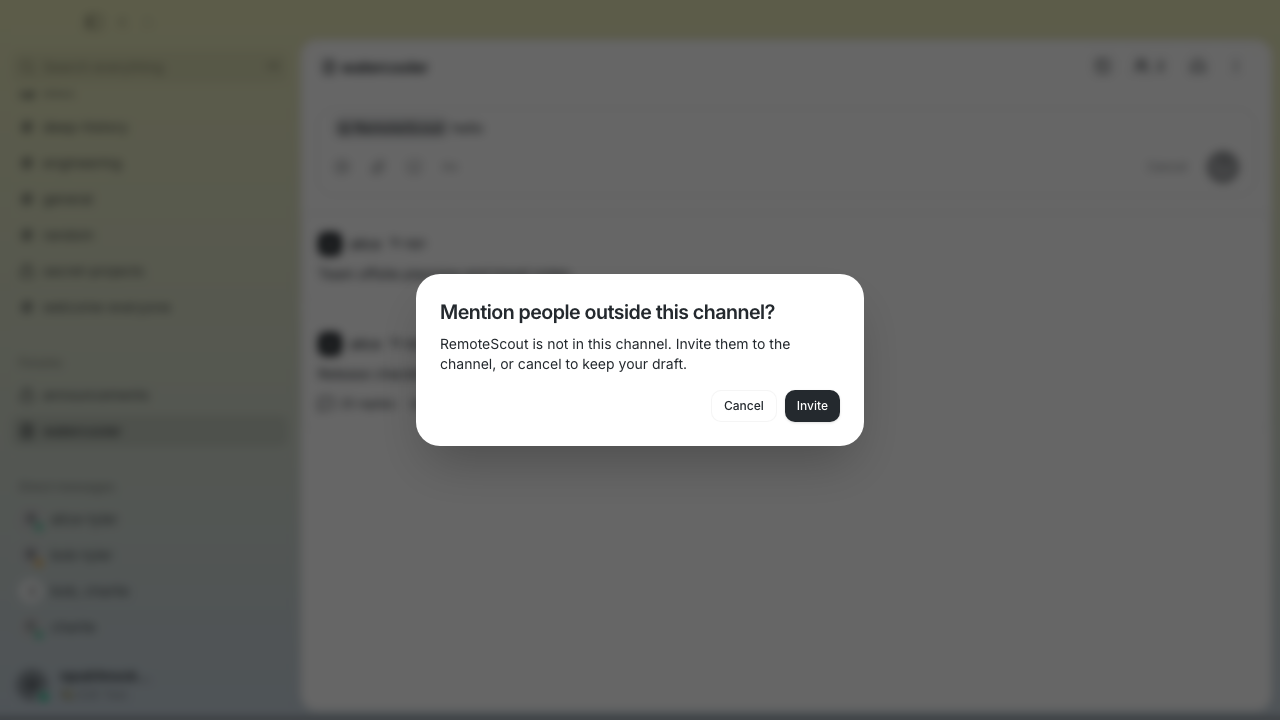 *Earlier mock-browser capture, not current-head runtime proof. [Error and successful-post captures](https://github.com/block/buzz/pull/7125#issuecomment-5513883462); no before-state/native capture available.* **Limits:** cancellation cannot undo accepted membership changes or dispatched posts; authorization and publication are not atomic. Recovery is same-window, subject to browser storage limits, and is not a durable in-flight send journal: reload/crash can lose a pending snapshot. Cross-window coordination and in-flight upload custody are unchanged. The parent's legacy member-agent compatibility does not establish ownership for nonmember invitations. --------- Signed-off-by: Logan Johnson <loganj@squareup.com> Co-authored-by: Larry <627498bd4bd1f281a16431e3c6cce3b5c25b6692798c78672298aefbf2f8f8b5@buzz.block.builderlab.xyz> |
||
|
Logan Johnson
|
d595806fc3 |
fix(desktop): authorize remote mentions at publication (#7124)
🤖
## Summary
In Buzz Desktop, you could own an agent running on another device but be
unable to mention it in a channel where it had not yet joined: it was
filtered out before you could invite it. A selected agent could also
disappear from the message's recipients when permissions changed. This
lets you select an eligible agent in the existing **@ menu**, invite it
from the message composer, and send to that agent—or see an error and
keep your draft rather than silently sending without it.
#### Where the experience changes
| Screen / control | Before → after |
| --- | --- |
| A channel's **Message #…** composer, or a message's **Reply in thread
to …** composer | Type `@` (or use the existing @ button), choose your
agent, write the message and press **Send message**. An owned agent not
yet in the channel can now reach the existing **“Mention people outside
this channel?”** dialog when its response settings allow you to address
it. |
| That dialog's **Invite** button | Previously the membership
requirement could block the agent before the invitation. Now Invite
checks permission to add it, adds it as an agent member of the
**channel** (not just the thread), then rechecks membership and response
permission before sending the waiting message. An agent already in the
channel needs no invitation. |
| Existing direct message, or the new-message screen with the **To:**
field | A mention is checked against the conversation the message will
actually enter, including a newly created direct message, rather than
the old or not-yet-created destination. This does not add an Invite
control to direct messages. |
| Editing a message / sending attachments | The selected agent remains
part of the send or edit attempt through attachment upload and the final
permission check. Lost permission produces a visible error instead of
dropping that recipient. |
**Invite is not the only chat choice.** The existing **Do nothing**
button sends the message *without inviting or notifying the nonmembers*;
their names remain references in the text. Where you cannot invite, that
choice is labelled **Send anyway**. To abandon the send instead, dismiss
the dialog with Escape. Invitation actions are disabled while
preparation is pending, preventing duplicate clicks.
**Leaving and returning must not resurrect a cancelled send.** Switching
threads or leaving the composer cancels its pending invitation, even if
you return to the same thread. Cancellation before dispatch sends no
message; an accepted membership change cannot be automatically undone.
An ordinary send without a pending invitation remains bound to its
original destination rather than following you into another
conversation.
**Failed sends must not overwrite your next draft.** If you leave a
thread, return and replace or deliberately clear its draft while an
older send is pending, the older failure cannot restore deleted text,
recipients or files; success cannot erase the newer draft—even if its
text is identical. An untouched draft cleared automatically for sending
remains recoverable on failure. This protection also covers reopening
the composer and starting a newer send.
The channel timeline also keeps its existing **new-messages / Jump to
latest** button available when newer messages are waiting to be
displayed. For example, after sharing a reply to the channel and closing
the thread panel, you can click the catch-up button to reveal buffered
messages. Closing the thread does **not** guarantee the shared row
appears automatically or force you away from reading history.
### Related issue
Built on [#7122](https://github.com/block/buzz/pull/7122), base branch
`split/owned-agent-discovery`, which lets Desktop find and verify owned
agents independently of this device. Current integration head:
`1144465d00273cf74b7c22544ae5a3299bd98560`, built on exact published
root `3a56d17824522580fe04cae463b54f4c7ba66021`. Root #7122 has its own
CI and security gates; this PR must not land ahead of that dependency.
Finding an agent is not channel membership, online status or a promise
of a reply. This PR changes what the existing message controls can do
with those agents; it adds no profile, presence, cloud marker or remote
start/stop UI.
Standalone forum post/reply **Invite / Cancel** is added separately in
[#7125](https://github.com/block/buzz/pull/7125); here those composers
only gain visible authorization errors. Same-name selection/binding
fixes ([#7133](https://github.com/block/buzz/pull/7133)) and mention
spacing ([#7128](https://github.com/block/buzz/pull/7128)) are not
included.
Extracted from [#7114](https://github.com/block/buzz/pull/7114)
(historical source `98fe33ec`). [Behavior and draft-recovery
contract](
|
||
|
Salman Mohammed
|
ce9decb235 |
fix(acp): rename system tag to agent-instructions (#7332)
## Summary Rename the paired persona prompt boundary from `<system>` to `<agent-instructions>` in both modern and legacy ACP delivery paths. Update Desktop diagnostics to label the new boundary as Agent Instructions while keeping archived `<system>` captures readable. `system` is confusing (esp with system role) and agent instructions is what shows up in the UI today <img width="767" height="298" alt="Screenshot 2026-09-04 at 11 37 54 AM" src="https://github.com/user-attachments/assets/4e34ac06-db50-461e-a555-ce17885b0031" /> ### Related issue Follow-up to #6701. No duplicate open issue or PR found. ### Testing - `cargo test -p buzz-acp` - `cargo clippy -p buzz-acp --all-targets -- -D warnings` - `node --import ./desktop/test-loader.mjs --experimental-strip-types --test desktop/src/features/agents/ui/agentSessionTranscriptHelpers.test.mjs desktop/src/features/agents/ui/agentSessionTranscript.test.mjs` - `pnpm --dir desktop typecheck` - Pre-push hook: 6,237 Desktop tests, 3,164 Tauri tests, and all 13 Rust unit-test lanes passed Generated with Codex Signed-off-by: Salman Mohammed <smohammed@squareup.com> |
||
|
Logan Johnson
|
ee883d73fb |
fix(desktop): bind duplicate mention selections to exact recipients (#7133)
## Summary Selecting two people or agents named Scout could replace the first recipient with the second even though the message still looked right. This binds each selection to its exact identity: the first keeps `@Scout`, and a conflicting selection gets `@Scout (<full public key>)`. Removing one no longer removes or redirects the other. - Reuse the existing **@ suggestion list**; team selection and automatic agent addressing reserve and reuse distinct labels too. Typing an ambiguous name manually shows an instruction to use the picker and preserves the draft without publishing—in chat, edits and standalone forums. - Share literal mention matching across recipient extraction, removal, display and editing so a shorter name cannot claim another recipient's longer or qualified label. - Rebuild authored references when a message is edited, and use the latest authorized snapshot when reopening or forwarding. Rendering/editing can recover qualified identities only from the message's recorded references, not from a key typed into its body. Unresolvable historical names remain literal rather than guessed recipients. - Wrap full-key labels within narrow/zoomed layouts while keeping their complete accessible label and ordinary mention icons. Edit activation waits for the action menu's focus cleanup before focusing the editor. ### Related issue Targets `main`; mention spacing (#7128) is already merged. Split from #7114. This is independent of the #7124 → #7125 remote-invitation stack and does not expand agent eligibility or invitation permissions. The separate Enter-selection suffix issue remains tracked in #7253. ### Testing The desktop unit suite and focused mock-Chromium checks passed on the published integration candidate, including pending-paste selection, edit/forwarding, copy and narrow-layout cases; formatting, types and frontend builds passed. On `0b3b18c0`, 64 focused trust/paste/selection unit tests and six mock-Chromium tests passed with zero browser retries, including actual timeline chip copy → fresh channel paste → send and mismatched-key rejection; TypeScript, changed-file Biome and an isolated E2E build passed. The broader browser run had copy failures before the focused repairs and is not claimed as wholly green. See [live CI](https://github.com/block/buzz/pull/7133/checks) for current-head results. No full local `just ci` pass, native/live-relay or cross-browser validation is claimed. To try it: select two same-name recipients, remove one, send, then edit/reopen and forward; only the intended identities should remain. Type an ambiguous name without choosing a suggestion and check that sending retains the draft with an error. Inspect full-key labels in a narrow window at 150% text size, and open Edit and type immediately. 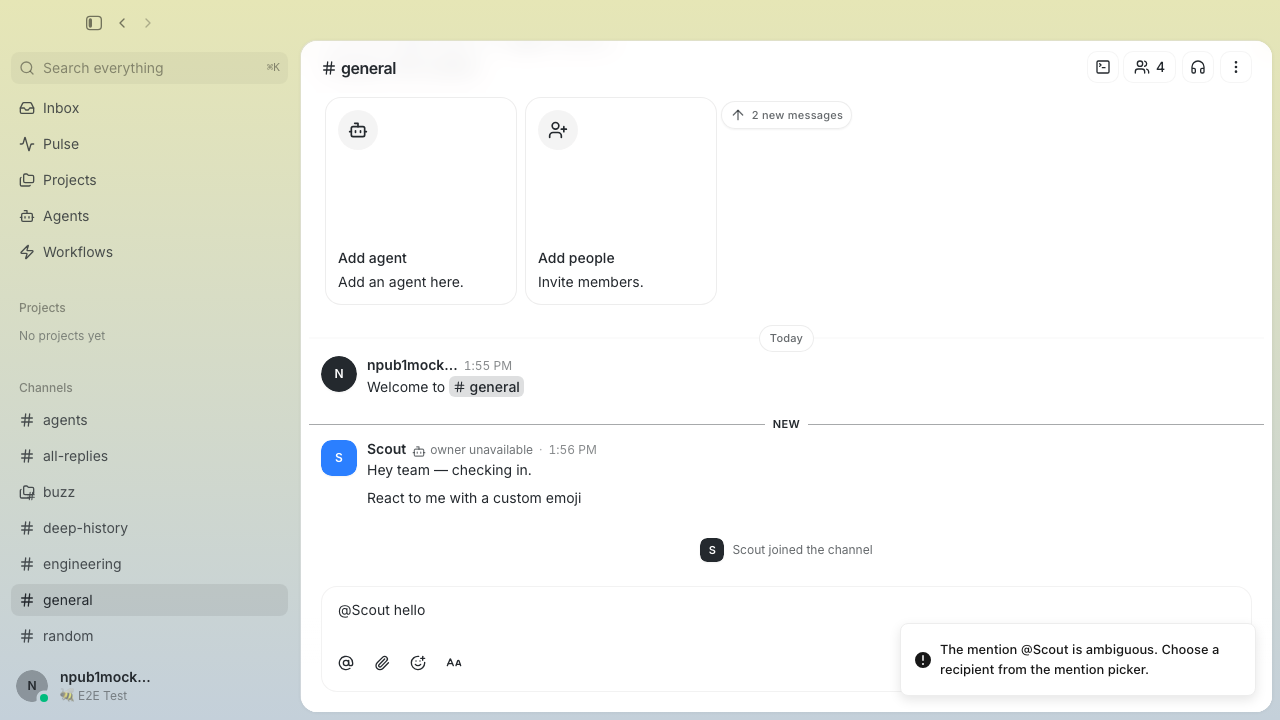 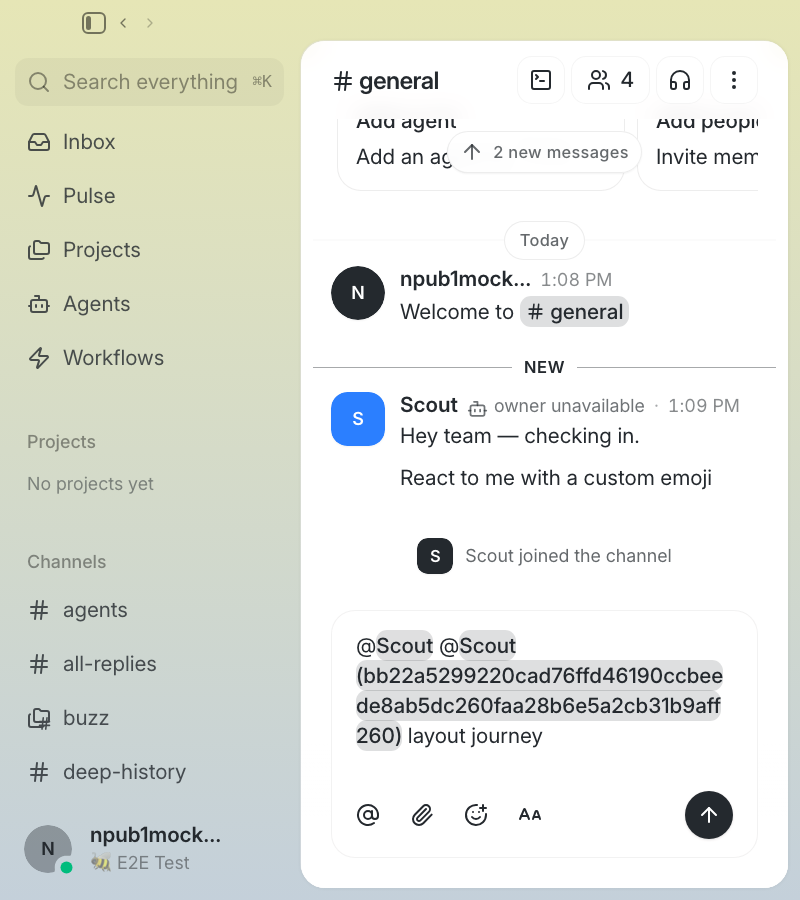 *Earlier mock-browser captures, not current-head runtime proof. No new before-state capture; screenshots alone do not prove recipient delivery.* **Clipboard trust:** generated full-key-qualified mentions now retain their exact recipient after copy/paste when the full key matches the clipboard record and community directory/profile state independently vouches for the base alias, including numeric collision suffixes. A qualifier alone does not establish trust. Arbitrary historical labels still cannot always be reconstructed. --------- Signed-off-by: Logan Johnson <loganj@squareup.com> Co-authored-by: Larry <627498bd4bd1f281a16431e3c6cce3b5c25b6692798c78672298aefbf2f8f8b5@buzz.block.builderlab.xyz> Co-authored-by: Bad Janet <150b20bdf6130418df9239dd1bd082c71612c8d653b47c277200365b9be215dc@buzz> |
||
|
Luke Tornquist
|
cd02b693aa |
refactor(relay): extract NIP-29 membership authorization (#7285)
## Why NIP-29 membership authorization for kinds 9000, 9001, and 9022 was embedded in a large async handler, requiring Postgres and Redis to test and repeating the last-owner rule across five call sites. This addresses [TheSentinel454/buzz#24](https://github.com/TheSentinel454/buzz/issues/24) without adding the broader state/repository abstraction suggested there because HTTP and WebSocket writes already share ingestion. ## What - Extract pure, typed membership authorization decisions while leaving database reads and mutations in `validate_admin_event`. - Preserve existing client-visible errors and independent database last-owner safeguards. - Collapse five last-owner policy restatements into one predicate and share the identical self-departure policy. - Include the relay decision modules in `just test-unit`, so these tests execute in CI. ## Risk Assessment Medium-low. This touches production relay authorization, but intentionally preserves wire behavior and database defense in depth; exhaustive decision tables and relay-backed tests cover the affected paths. ## Simplification This removes repeated policy from the orchestration path and makes the rule set directly testable without introducing a repository trait or second transport path. ## Verification Verified at `15255a090797f85874921120003c645962fefaed`: - `just test-unit` — all 10 package summaries passed. An initial run hit two unrelated timing-sensitive `buzz-acp` failures; the complete retry passed 905/905 in that package. - `cargo fmt --all -- --check` - `cargo clippy --workspace --all-targets -- -D warnings` - `just file-size-check` — 10/10 policy tests passed. - `just security-review-check` — 13/13 tests passed. - Push preflight — `push-head-scope`, `branch-skew`, `file-size-check`, `rust-tests`, and `desktop-tauri-checks` passed. - Blox Postgres relay lane — 84/84 at the byte-identical source patch; full live `e2e_relay` behavior matched the clean base (45 pass and the same pre-existing kind:9002 failure on each). Generated with Claude Code --------- Signed-off-by: tornquist <tornquist@squareup.com> Co-authored-by: Claude Opus 5 <noreply@anthropic.com> Co-authored-by: Codex <noreply@openai.com> |
||
|
Will Pfleger
|
01bacb8df3 |
chore(release): release Buzz Desktop version 0.5.22 (#7308)
## Buzz Desktop release v0.5.22 - **Frozen main:** `75f101d8b4f5b4b26f9891b73b87c67fedac25a0` - **Reviewed candidate:** `9ceb1f79bbc21785a0a075c40aecb3c058b1ea15` - **Previous desktop release:** `desktop-v0.5.20` - **Proposed immutable tag:** `desktop-v0.5.22` This PR may be **squash merged** after the Desktop Release Candidate check and all protected-branch checks pass. Merging authorizes publication of the exact reviewed candidate; later or unrelated changes on `main` cannot alter it. The checked-in changelog accounts for every non-merge commit in the release range. The Desktop tag points to the reviewed candidate commit, not the later squash commit. Publication remains bound to that immutable candidate tag. Signed-off-by: Will Pfleger <pfleger.will@gmail.com> Co-authored-by: Release Automation <release-automation@users.noreply.github.com> |
||
|
Matt Toohey
|
b1f6b7ef77 |
feat(desktop): preserve mentions across copy and paste (#7228)
Copying a message out of the timeline lost the mention. The rendered chip drops the `@` for display, so the clipboard carried "John Smith" — two ordinary words no composer could bind back to a pubkey. Pasting into another channel produced dead text, and sending it tagged nobody. ## What changed Every Buzz copy now writes two clipboard flavors in one transaction: - **`text/plain`** — readable anywhere, sigils restored, no pubkeys. This is what TextEdit, Slack, and every other external app receive. - **`text/html`** — the same content with each mention wrapped in a span carrying `data-mention-pubkey` / `-label` / `-kind`. On paste, the composer harvests those records, registers each `name → pubkey` with the existing mention machinery, and inserts the content: the chip re-lights and the send path recovers the identity the author tagged. A marker attribute records what the plain flavor holds, so a Markdown copy pastes through the text pipeline and a rendered copy through the HTML one. **Covered surfaces:** timeline selection copy, thread-panel selection copy, forum post/reply selection copy, "Copy message", and composer copy/cut — plus paste in both the channel and forum composers. ## Trust boundary Clipboard HTML is untrusted, and the branch treats it that way: - Records are capped (50), labels bounded (200 chars), and a pubkey must be 64 hex before it can become a `p` tag. - **Only mentions the paste actually shows are registered.** An empty `<span data-mention-pubkey=… -label="Jane Doe">` would otherwise rebind that display name for the rest of the composer session, so a later hand-written @Jane Doe would chip-light convincingly against the attacker's key. Each branch registers only the records whose label appears in the text *it* inserts, matched with `getMentionOffsets` — the same matcher the send-time extractor uses. - **The visibility gate reads only what ProseMirror will insert.** `DOMParser` hard-drops `script`, `style`, `title`, `noscript`, `object`, and `head` content, so `visible<style>@Jane Doe</style>` beside an empty chip span used to smuggle a binding past the gate. Those elements are stripped before either output is derived. - **A partial chip never gains a sigil.** A selection crossing a chip boundary falls through to the browser's default copy, which serializes the full identity attributes around a slice of the text — pasting that invented "@Smith" out of "John Smith". Paste now leaves a fragment as plain text, tolerating only what a whole chip picks up in transit (restored sigil, author casing, U+00A0 swaps, and the label cap's own ellipsis). Both clipboard sides share one `matchChipTextToLabel` helper, in the module that owns the label attributes, so copy and paste cannot drift on what counts as a whole chip. ## Notes - Mention matching reuses `getMentionOffsets`, so code spans and fences are excluded and the longest display name wins. - The plain flavor inlines chip boxes before reading `innerText`; a chip is a flex container, so the browser's own copy split "@John Smith" onto its own line. - `MarkdownMention` and `MacEmacsTextShortcuts` are extracted verbatim from `markdown.tsx` and `useRichTextEditor.ts` to keep both files under the size gate. ## Testing - ~40 unit tests over the flavor builder/parser, the visibility filter, the ignored-tag sweep, and the chip-match verdicts. - A Playwright spec (`desktop/tests/e2e/mention-clipboard.spec.ts`) driving real copy/cut/paste DOM events: timeline and "Copy message" of a multi-word non-member mention pasted into another channel and sent with the original pubkey in its `p` tag; the forum copy → forum reply round trip; composer copy/cut; plain flavor asserted to contain no 64-hex string; the boundary-crossing drag; and the hidden-record and `<style>` smuggling vectors. - Every regression test is bound to a production seam and fails with its guard removed. - `just ci` / pre-push lanes green (5927 desktop unit tests, typecheck, lint, file-size gate). --------- Signed-off-by: Matt Toohey <contact@matttoohey.com> Co-authored-by: Claude Fable 5 <noreply@anthropic.com> |
||
|
morgmart
|
b7dbe90001 |
fix(desktop-next): relight the dark text ramp and enforce contrast in CI
Three fixes, and a guard so they cannot regress silently. `text-on-warning` pointed at `var(--neutral-12)`, which is near-black in light mode and near-white in dark. The warning fill is the same amber in both, so dark mode put #f5f5f5 on #eab308: APCA Lc 34, WCAG 1.76:1. It is a literal now — a paired-text token follows its fill, never the mode. The dark neutral text steps were too dim. `text-secondary` (#8f8f8f) measured Lc 38–41 and `text-tertiary` (#6e6e6e) Lc 23–26 against an Lc 60 body target, while passing WCAG AA at 4.4–5.6:1 — legal, and visibly murky. Raise dark neutral-9 to #a6a6a6 and neutral-10 to #c1c1c1, sized against bg-float (#2a2a2a), the lightest dark surface and so the binding case. Light neutral-9 moves #a3a3a3 -> #909090 for the same reason at the meta target. Both ramps stay monotonic, and bg-inverse-hover (the other consumer of neutral-10) still carries its paired text at Lc 70. This is APCA's polarity asymmetry doing real work: light-on-dark needs more separation than the same WCAG ratio implies, so the dark ramp's text steps sit above where mirroring the light ramp would put them. `text-disabled` stays below target deliberately — low contrast is the signal that a control is unavailable, and WCAG exempts inactive controls for the same reason. Raising it would make disabled read as enabled. Recorded as the one exception, with that reason. The guard is the durable part. `scripts/check-contrast.mjs` measures every text role against every surface it can sit on, in both modes, and fails the build below target. It parses `tokens.css` and resolves each `var()` chain rather than holding a copied list of values, so it cannot drift from the system it audits. `scripts/apca.mjs` is the algorithm, asserted against the published reference values on every run so a bad edit to the maths fails loudly rather than quietly shifting every verdict. Verified by falsification: reverting either fix fails the check, and perturbing one APCA exponent trips the reference assertion. Also corrects an earlier misreading: the two `.dark` blocks are not duplicate declarations. The first holds the dark ramp, the second overrides surface roles so the panel lifts off pure black. That is the intended layering. Signed-off-by: morgmart <98432065+morgmart@users.noreply.github.com> |
||
|
Logan Johnson
|
4b0744d7f3 | test(desktop): await Bestie drag and profile hover endpoints (#7294) | ||
|
morgmart
|
972edc6fa6 |
fix(desktop): deepen the default accent so its white label text is legible
The default accent was #3b82f6, and white label text on it measures WCAG 2 3.68:1 — below the 4.5:1 AA minimum for normal text. That applied to every primary button and active sidebar row in a fresh install, not to a setting someone had opted into. Move it to #2563eb, one step deeper: WCAG 5.17:1 and APCA Lc 80, so it now passes both standards. Radix, Bootstrap, and Tailwind's blue-600 all sit in this range, which is where a blue has to be to carry white text. Darkening the fill is the fix rather than switching the label to black. Black on the old hue scores WCAG 5.71 and would "pass", but measures APCA Lc 40 — perceptually unreadable, and visibly worse. This is the documented WCAG 2 flaw on saturated blue: the formula underweights the blue channel and ignores polarity. Apple ships white on #0088ff–#3daefc in Messages at WCAG 2.4–3.5 for the same reason. DESIGN.md now records the position (judge with APCA, report WCAG, constrain the fill rather than degrade the text) so it is a decision with evidence rather than a preference. Retiring a hex is not only cosmetic: it leaves the old value in people's storage, where it is no longer in ACCENT_COLORS and therefore fails the community-theme allowlist — parseCommunityThemePreference would return null and discard the user's syntax theme and follow-system flag along with the accent. Both storage paths now migrate the retired value instead: the community preference maps it on parse, and the local accent upgrades on read (all three read sites go through one helper). A regression test covers the migration and asserts an arbitrary hex is still rejected, so the migration cannot become a general escape hatch; removing the mapping fails that test. The communityThemeSync fixture moves to a current accent — it covers coordinate logic, and a retired hex there would be rewritten mid-assertion for reasons unrelated to what it tests. Verified: 6112 desktop tests pass, tsc clean, biome clean. Signed-off-by: morgmart <98432065+morgmart@users.noreply.github.com> |
||
|
morgmart
|
4c2e417b37 |
style(desktop-next): wrap the token table into three equal columns
The value column had been holding a single unbroken gradient literal, which under the default `auto` layout claimed most of the table's width and pushed the other two columns into a scroll. Switch to `table-fixed` with an explicit colgroup so the thirds hold regardless of content, and let cells wrap instead of scrolling — the horizontal scroll container is gone. The value uses `break-all` rather than `break-words`: a gradient is one token with no spaces to break at, so word-boundary wrapping still overflows. The swatch stays pinned to the first line while the value wraps beside it, so the kind label moves under the value rather than competing with it for the same line. Verified equal columns and zero overflowing cells at 380, 480, 700, 1024, and 1280px. Signed-off-by: morgmart <98432065+morgmart@users.noreply.github.com> |
||
|
morgmart
|
69149c7a1b |
feat(desktop-next): add a token table, and declare four missing paired-text roles
The colour page explains the system but never lists the tokens themselves, so there is nowhere to answer "what does bg-inset actually paint". Add /design/color/table: every token in one table — the name you type, the base token it resolves through, and the value it paints. The values are read from the live CSS rather than typed into the registry. A hex column written by hand is a second source of truth for the same fact: edit a ramp and the documentation is silently wrong. This needs two different reads, because neither answers both questions — getComputedStyle returns the resolved value (#ffffff) and has already lost the indirection, while walking document.styleSheets finds the declared value (var(--neutral-1)), which is the only place the chain still exists. So CSSOM for what a token points at, computed style for what colour that is. It re-resolves on scheme change, which is visible in dark mode where bg-panel points at neutral 3 rather than neutral 1. The table immediately found a real defect. The registry has documented text-on-danger, text-on-success, text-on-warning, and text-on-info since the status groups were generated, but tokens.css never declared them — all four resolved to nothing, so text on a danger button fell back to inherited near-black on red. Declare them and register them with Tailwind. text-on-warning is neutral-12, not white: the warning fill is amber (#eab308) and white on it fails contrast. Also spell it "Color" in the nav, per the product's US English. The route is now /design/color, with the table nested under it. The file is color_.table.tsx — the trailing underscore keeps the URL while opting out of nesting, because otherwise /design/color becomes a layout route whose component must render an Outlet, and ColourPage does not, so the parent page rendered in place of the table. Component and type names still say Colour; renaming those is a separate change from what the interface says. Signed-off-by: morgmart <98432065+morgmart@users.noreply.github.com> |
||
|
Luke Tornquist
|
2ac0aa1dd1 | Collapse contiguous join messages (#7262) | ||
|
morgmart
|
bd627f675d |
Merge remote-tracking branch 'origin/main' into morganm/design-system
* origin/main: chore(release): release Buzz Desktop version 0.5.21 (#7301) fix(scripts): copy global-agent-config.json in buzz-adopt-prod-agents (#7303) feat(relay): add early startup lifecycle logs (#7258) docs(nip-fi): add Blossom kind-24242 media possession-proof exception (#7278) fix(desktop): wrap message tables within the available pane (#7279) 🤖 fix(desktop): harden smoke E2E tests against Bestie overlay and toast timing (#7270) Show status and huddle indicators beside names (#7112) Add mobile voice notes (#7121) perf(desktop): publish mention sends before waking agents (#7154) Signed-off-by: morgmart <98432065+morgmart@users.noreply.github.com> |
||
|
Will Pfleger
|
75f101d8b4 |
chore(release): release Buzz Desktop version 0.5.21 (#7301)
## Buzz Desktop release v0.5.21 - **Frozen main:** `88687876f7808a2fd742b7eb2e4b9f87d999ad8d` - **Reviewed candidate:** `47e4e0347fb4142df55b03e0e3dc537fe33a5d62` - **Previous desktop release:** `desktop-v0.5.20` - **Proposed immutable tag:** `desktop-v0.5.21` This PR may be **squash merged** after the Desktop Release Candidate check and all protected-branch checks pass. Merging authorizes publication of the exact reviewed candidate; later or unrelated changes on `main` cannot alter it. The checked-in changelog accounts for every non-merge commit in the release range. The Desktop tag points to the reviewed candidate commit, not the later squash commit. Publication remains bound to that immutable candidate tag. Signed-off-by: Will Pfleger <pfleger.will@gmail.com> Co-authored-by: Release Automation <release-automation@users.noreply.github.com> |
||
|
Will Pfleger
|
8e7b275cb0 |
fix(scripts): copy global-agent-config.json in buzz-adopt-prod-agents (#7303)
## What Extend `scripts/buzz-adopt-prod-agents.sh` to copy `agents/global-agent-config.json` from the prod app-data store to dev as part of the existing atomic bundle commit, and document what the script cannot copy (baked build-time defaults). ## Why `global-agent-config.json` holds the owner's global agent defaults (`env_vars`, `provider`, `model`, `preferred_runtime`). Previously the script carried the dev copy across verbatim — it was absent from the bundle drop list and not in `RECORD_FILES`. After a `just reset`, the dev build inherited stale global defaults (or none at all) instead of mirroring prod, inconsistent with how all other bundle files are handled. The "WHAT THIS DOES NOT DO" header lacked any mention of baked build-time defaults, which are a separate (and common) source of prod/dev parity confusion. ## Changes - **`RECORD_FILES`** — add `global-agent-config.json`. The file has no volatile fields (`GlobalAgentConfig` struct = `env_vars`/`provider`/`model`/`preferred_runtime`), so it joins the verbatim-copy path already used by `teams.json` — no new transform. - **Stage-seed block** — add `global-agent-config.json` to the `rm -rf` drop list so the prod overlay replaces it cleanly; remove its stale mention in the "carried verbatim" comment. - **Docs/comments** — update "4-file bundle" → "5-file bundle" in the DMG concurrent-run warning and the step 2 comment; list the file explicitly in the step 2 header comment. - **"WHAT THIS DOES NOT DO" header** — add a bullet explaining that baked build-time agent defaults (`BUZZ_BUILD_BUZZ_AGENT_PROVIDER` / `BUZZ_BUILD_AGENT_ENV` via `option_env!` in `build.rs`) are compiled into the binary, not stored in app-data. Includes the correct `just production` invocation pattern and a `.env` warning. - **Preflight symlink checks and dry-run output** iterate `RECORD_FILES` and pick up the new entry automatically — no other changes needed. Verified: `bash -n` clean, `shellcheck` clean, `--dry-run --force` shows `[dry-run] stage global-agent-config.json (0600)` in the expected position. --------- Signed-off-by: Will Pfleger <pfleger.will@gmail.com> Co-authored-by: Duncan <dcfd242e557282d7a1e2cf2e6877522682f1e5c6156dc92ca7d90eaedd3b0f95@buzz.block.builderlab.xyz> |
||
|
morgmart
|
61e3792118 |
refactor(desktop-next): take colour and type specimens out of cards
A swatch on a grey fill is being judged against a surface the product will never reproduce, and the dividers between swatches were redundant — each colour already separates itself. Same for type specimens: a box around a size sample changes the contrast you are evaluating it in. Roles and specimens now sit directly on the page, separated by space alone. The distinction is between two list shapes rather than a preference: `Rows` keeps dividers for uniform rows where the eye needs a line to track along (the size and tracking ramps, the audit table); `Specimens` has neither container nor divider for entries that carry their own visible difference. The swatch keeps its hairline. `bg-panel` is white on a white page, so without it the most-used role in the system renders as nothing — that is a genuine boundary, not decoration, and it is what makes the no-container treatment safe in both modes. Signed-off-by: morgmart <98432065+morgmart@users.noreply.github.com> |
||
|
morgmart
|
30847f42ff |
feat(desktop-next): add the type system, fix unreachable border roles
The design system site rendered black borders and dividers while the tokens said `#d4d4d4`. The border roles were declared in layer 2 and never registered with Tailwind, so `border-primary` silently resolved to `--color-primary` — the *text* colour — and every hairline drew at text contrast. Tailwind's `--color-*` is a single namespace and text/borders share the emphasis names while holding different values, so borders now register as `--border-color-*`. Add typography as the second foundation, same three layers as colour: a nine-step size ramp plus leading, tracking, and weight ramps in layer 1; ten public roles in layer 2, each carrying its whole setting via Tailwind v4's `--text-<name>--<property>` convention, so `text-body` alone produces correctly set text and two supposedly identical labels cannot drift apart. Inter Variable and JetBrains Mono, both already shipped in every current Buzz client. Every size derives from one virtual rem, so keyboard zoom and the font-size preference work by construction. Soften the documentation surface to match where the product is going: regions separated by soft fills rather than outlines, hairlines only for genuine boundaries and never above `border-secondary`, no page-wide gradient behind reading columns, and no all-caps labels anywhere. The `/design/typography` page renders from the registry, so it cannot drift from the system. Add `scripts/check-type.mjs` enforcing the four rules a token cannot express — no arbitrary sizes (px or rem), no `uppercase`, no hand-applied tracking, no size role paired with a weight or leading utility. Also collapse the nav to a wrapped row below `lg`; the fixed 256px column overflowed the viewport under 420px. Signed-off-by: morgmart <98432065+morgmart@users.noreply.github.com> |
||
|
ravarora2
|
88687876f7 |
feat(relay): add early startup lifecycle logs (#7258)
## Why Early relay failures can currently appear as a container restart without a trustworthy in-process account of whether crypto, structured logging, configuration, relay identity, or the metrics listener failed. Most of those steps happen before the Prometheus exporter exists, so their chronology belongs in logs rather than metrics. Implements the logs-only early-startup slice of #7238. Post-bind Prometheus exporter supervision is tracked separately in #7284. ## What changed - create a process lifecycle recorder before the Tokio runtime and emit a fixed, versioned JSON schema directly to stderr; - record started and exactly one terminal event for `crypto_init`, `tracing_init`, `config_load`, `key_load`, `metrics_bind`, and the aggregate `process_telemetry` phase; - keep every status and reason bounded and suppress raw errors that could contain credentials, keys, URLs, or other secrets; - return typed metrics-install errors so `metrics_bind` can be classified without logging raw values, while preserving the existing public `metrics::install` API; - document the logs-only evidence contract and add real child-process regressions for success and failure paths. This PR adds **no startup metric families** and no dashboard contract. Existing application metrics remain unchanged. ## Verification Exact head: `8faf7526822a119efa035e58b2b3c59aa67fc81d` - `cargo fmt --all -- --check` - `cargo clippy -p buzz-relay --all-targets -- -D warnings` - relay binary target: 13 passed, 1 PostgreSQL-only test ignored - real relay child-process lifecycle target: 9 passed - full relay package library target: 1,023 passed, 89 ignored; the same six media tests failed at `crates/buzz-relay/src/api/media.rs:1145` with `Sqlx(PoolTimedOut)` because local PostgreSQL is unavailable - three independent exact-head reviews found no correctness, security, compatibility, lifecycle-accounting, logs-only-scope, or test-adequacy finding All exact-head GitHub CI gates are green, including lint, unit tests, PostgreSQL, relay/backend/desktop integration, both Linux server cross-compiles, Windows/macOS builds, and security checks. ## Staging verification - exact multi-architecture image: `dev-sha-8faf7526822a119efa035e58b2b3c59aa67fc81d-run-33708188952-1` - immutable manifest: `sha256:26cad28266a6bb0b0e7081eb6091d374e5489f8bb78c475a4a65737dee86cc67` - image workflow: https://github.com/block/buzz/actions/runs/33708188952 - focused staging deployment: https://github.com/squareup/builderbot-platform-core-infrastructure/pull/314 - replacement ReplicaSet `buzz-d68764bc7` has two Ready pods with zero restarts - Datadog received one complete, contiguous sequence 1-12 from each pod; both end with `process_telemetry/terminal/succeeded` at 3 ms - queries scoped to the replacement ReplicaSet return no data for the removed `buzz_startup_phase_terminal` or `buzz_startup_phase_duration_seconds` families The experimental Row 7 was removed from the Buzz Startup & Rollout Safety dashboard. This logs-only PR deliberately adds no replacement dashboard row. --- **Update Sep 3, 12:26 ET:** Clarified the review boundary: this PR does not close the broader #7238. Later exporter-task termination is pre-existing runtime behavior and is now explicitly tracked in #7284; no production code or staged image changed in this update. Generated with Codex Signed-off-by: Ravneet Arora <rarora@squareup.com> |
||
|
Will Pfleger
|
752cbfc037 |
docs(nip-fi): add Blossom kind-24242 media possession-proof exception (#7278)
Adds the media/Blossom possession-proof exception section to
\`docs/nips/NIP-FI.md\`.

## What this changes

Encodes the condition set confirmed by Thufir's security review
(2026-09-03) as normative MUSTs in NIP-FI. Kind-24242 Blossom auth
events are admitted as the NIP-FI pairing possession proof for **media
routes only** — a named, bounded exception with an explicit precedent
fence against expansion.

### Scope fence

Kind-24242 proofs are valid only on:

| Proof type (`t` tag) | Valid route | Method |
|---|---|---|
| `upload` | `PUT /upload` (and temporary alias `PUT /media/upload`
until removed) | PUT |
| `get` | `GET /media/{hash…}`, `HEAD /media/{hash…}` | GET, HEAD |

All other protected routes MUST reject kind-24242 proofs.

### Upload proofs

Exactly one `x` tag over consumed body bytes; temporal check precedes
body consumption.

### Read proofs (the relaxation Will approved)

Host-wide MAY: no `x` required. Exactly one `server` tag matching the
resolved tenant host is a MUST. Optional `x` must match parent hash if
present.

Named residual (verbatim in spec): within at most 60 seconds from
minting (plus 5s future-skew), a captured full header set allows reading
any media blob on exactly one tenant host — read-only,
membership-checked, revocable, not state-changing, not cross-tenant.

### Freshness (Thufir option 2)

- `created_at <= now + 5s` (bounded future skew)
- `now - created_at <= 60s`
- Exactly one `expiration`, valid at admission, satisfying `expiration
<= created_at + 60s`

### Transport/cardinality

Exactly one each of `Authorization` (Nostr scheme), `t`, `expiration`,
`server`; `x` at most once; reject any duplicate, malformed, or
conflicting instance.

### Per-request pairing

Full assertion verification, exact key equality between assertion
`nostr_pubkey` and kind-24242 signer, deny-map enforcement on every
request. Stub gap named.

### Compliance note

PR #7264 implementation is explicitly non-compliant until the bounded
hardening task lands (named gaps: multi-tag acceptance, 3600s window,
optional `server`).

## Behavioral oracle

`FI-TRACE-HTTP-INGRESS` extended to cover kind-24242 admission and
denial cases.

## Scope

Docs-only. No code changes. The code hardening is a separate follow-on
task.

---------

Signed-off-by: Will Pfleger <pfleger.will@gmail.com>
Co-authored-by: Duncan <dcfd242e557282d7a1e2cf2e6877522682f1e5c6156dc92ca7d90eaedd3b0f95@buzz.block.builderlab.xyz>
|
||
|
Logan Johnson
|
6cf514ed90 |
fix(desktop): wrap message tables within the available pane (#7279)
## Summary - Let Markdown tables use the available message width instead of their maximum-content width, inheriting the renderer's existing `wrap-anywhere` handling for long tokens and links. - Top-align header cells as well as body cells. Give cells a `min-w-24` readability floor so short labels do not collapse into one-letter columns; retain the existing table-local scrollbar when many columns genuinely cannot fit. - Preserve semantic table markup, links, inline code, and surrounding message layout. Add three browser regressions through the real message renderer (channel, narrow thread, and many-column overflow). ### Related issue Fixes #5313. No matching open table-readability PR found. Owner-authorized task channel: `819b36d5-7371-4ed0-bf9b-d461d723779e` Source: buzz://message?channel=819b36d5-7371-4ed0-bf9b-d461d723779e&id=3bf2d1bd5df28fcb481e71159dc1be2b3888918b05f67e270354fbfea65a8c90 ### Testing Original production candidate: `4427f2e6f9ef85a01a267fe9eabd1cf13cacfb78`; base: `7a9a5233d9d755e715be0c585cf7850e935d28cf`. - `pnpm -C desktop check` — passed. - `pnpm -C desktop test` — 6,110 passed, none skipped. - `pnpm -C desktop typecheck` — passed. - `BUZZ_PROTECTED_BUILD_OUTPUT=<isolated-production-directory> pnpm -C desktop build` — passed. - `pnpm -C desktop build:e2e --outDir <isolated-candidate-directory>` — passed. - `just file-size-check` and `git diff --check` — passed. - Chromium / mock Tauri bridge: all 3 new Playwright tests passed against the fixed candidate build. Both wrapping tests fail on the unchanged base build, while the overflow-fallback test passes. Each browser run used a unique output directory and a non-reused local server pinned to its build directory. - At 883px channel message width: table scroll width **1,395 → 883px**. At 292px thread message width: **1,395 → 292px**. All cells top-aligned; long tokens/URLs wrap, link destinations and code text remain intact, short labels stay on one line, and document width remains 1,280px. - Focused fresh-frame review checked actual before/after screenshots and the complete diff. It caught one-letter label wrapping in an early width-only candidate; the final cell-width floor and regression assertion address that finding. Limitations: native Tauri/WebKit and relay-backed integration were not exercised for this CSS-only delta. Repository-wide `just ci` was attempted but exceeded the local command budget during unrelated Rust compilation; it is **not** reported green. The full affected TypeScript package gates above passed on the exact candidate. Production/E2E builds retain existing chunk-size and mixed static/dynamic import warnings. Before/after screenshots are posted below using the repository's screenshot publication script. No merge, production installation, or runtime restart is requested. ### CI-driven test-only follow-up Current head: `925d964b6cf31ba704d74baf73769110774b2789`. Smoke shard 3 exposed an older test in `messaging.spec.ts:457` that still required three columns of ordinary prose to overflow horizontally ([failure log](https://github.com/block/buzz/actions/runs/33771325404/job/100702242706)). This expectation contradicts the intended wrapping change. Updated its name and assertion to require containment; the separate many-column local-scroll test is unchanged. No production code or harness settings changed in this follow-up. - Affected browser validation: **4/4 passed** (updated existing prose/narrow table case plus the three new channel/thread/overflow cases). - Reused the immutable `4427f2e6` E2E build on a fresh non-reused server; production source is unchanged at the current head. The package/build checks above remain evidence for that unchanged production tree, not a claim of rerunning the full suite at the new SHA. - Targeted Biome check, file-size gate, and `git diff --check` passed. - Current-head CI: https://github.com/block/buzz/actions/runs/33773490446 - Prior unrelated Bestie baseline failure and reproduction: https://github.com/block/buzz/pull/7279#issuecomment-5528077181 - Security authorization and review must target the **current** head, not the old screenshot/build SHA. A Block organization member must comment exactly `@buzz-security-review 925d964b6cf31ba704d74baf73769110774b2789`. --------- Signed-off-by: Logan Johnson <loganj@squareup.com> |
||
|
Will Pfleger
|
7a9a5233d9 |
🤖 fix(desktop): harden smoke E2E tests against Bestie overlay and toast timing (#7270)
## What Two remaining E2E hardening fixes from the Desktop Smoke flake pattern introduced by `ac5a18697` (Bestie — added `VITE_BUZZ_BESTIE=1` to `.env.e2e` and mounted `BestieGlobalOverlay` globally). The toast/DM-retry fix landed independently in main via #7127 (`input.hover()` + bounded `toHaveCount` wait); that hunk is dropped from this PR. ## Fixes ### `agent-control-regressions.spec.ts:240` — Stop does not accept an unconfirmed or foreign-channel result **Cause:** Playwright 1.60.0's `page.clock.install()` fakes all timers including `requestAnimationFrame`. The test called it before opening the settings menu. With RAF frozen, the `DropdownMenuContent`'s `zoom-in-95 duration-150` CSS enter-animation never advances — Playwright's stability check observes a continuously-changing bounding box until the 30s test timeout. **Fix:** Re-sequence so the menu is opened on real time first. After `openAgentActivity`, open the trigger, assert visibility/enabled, call `waitForAnimations(page)` to settle the enter-animation (real `setTimeout`, no fake clock installed yet), then install the clock. The `fastForward(8_001)` correlation timeout still works because it's scheduled after the clock is active. Pointer actionability preserved — normal `stop.click()` (no `force`) fails with pointer-interception under a covering surface. ### `message-feedback-snapshots.spec.ts:97` — profile hover uses the channel hover surface **Cause:** `channel.hover()` triggers a CSS `transition-colors` animation. With the Bestie `LayoutGroup` mounted, `evaluate()` captures a mid-transition background value that never matches the profile card's settled token. **Fix:** `waitForAnimations(page)` after `channel.hover()` and before reading `channelHoverColor`. ## Evidence - Target specs pass: stop-turn 8/8, profile-hover passes. - Full `agent-control-regressions.spec.ts` (7 tests) green. - `just desktop-typecheck` clean at pushed head `0fbfe2a9f`. - No production code changed. Signed-off-by: Will Pfleger <pfleger.will@gmail.com> Co-authored-by: Hayt <9e1c23a3fd83f61da34420e4e88ff1b16e45cafcc0cd9019eb07d4ecfa8ca9b0@buzz.block.builderlab.xyz> |
||
|
klopez4212
|
c6ca9d94d9 |
Show status and huddle indicators beside names (#7112)
## Summary - show status and huddle emoji beside names in DMs and message rows - provide accessible tooltips, fallback status emoji, and profile-menu icon replacement - add the desktop status editor with preset durations, a ShadCN calendar, and a capped half-hour time menu ## Validation - desktop checks, typecheck, and file-size guard - 5,802 desktop tests - focused Playwright coverage (3 passed) - E2E build and native Builderlab staging verification Updated visual snapshots are attached in the PR comments. --------- Signed-off-by: kenny lopez <klopez4212@gmail.com> Signed-off-by: Princess Donut <b238ea756dee4d98afa5883fc7f1de61eeabe65bf700e3a5a5a80db5e42e2c2b@buzz.block.builderlab.xyz> Co-authored-by: Princess Donut <b238ea756dee4d98afa5883fc7f1de61eeabe65bf700e3a5a5a80db5e42e2c2b@buzz.block.builderlab.xyz> |
||
|
klopez4212
|
6f5ec4a731 |
Add mobile voice notes (#7121)
## Summary - add iOS and Android voice-note recording and preview directly in the mobile composer - add waveform playback, scrubbing, speed controls, haptics, and one-shot playback in chat - package recordings in a canonical H.264/AAC MP4 envelope on both platforms so existing relays accept them - preserve the shared composer interaction and attachment-card treatment across mobile platforms Mobile counterpart to #6978. ## Testing - `just ci` - `just mobile-check` - `just mobile-test` (2,026 tests) - Android debug build compiled, installed, launched, and Voice note verified in the attachment menu on Pixel 10 - signed iOS device build installed on iPhone --------- Signed-off-by: kenny lopez <klopez4212@gmail.com> Signed-off-by: Princess Donut <b238ea756dee4d98afa5883fc7f1de61eeabe65bf700e3a5a5a80db5e42e2c2b@buzz.block.builderlab.xyz> Signed-off-by: Kenny Lopez <klopez4212@gmail.com> Signed-off-by: Carl <3c4caeafb646d23867f1c4832e68211d77e2561946171625f75c3ce1a3f2670f@buzz.block.builderlab.xyz> Co-authored-by: Princess Donut <b238ea756dee4d98afa5883fc7f1de61eeabe65bf700e3a5a5a80db5e42e2c2b@buzz.block.builderlab.xyz> Co-authored-by: Carl <acda9e433d19dcd0e6b6840f7f4b98f3a56f1fab98049d444c087019e6d36560@buzz.block.builderlab.xyz> Co-authored-by: Carl <3c4caeafb646d23867f1c4832e68211d77e2561946171625f75c3ce1a3f2670f@buzz.block.builderlab.xyz> |
||
|
Matt Toohey
|
40220d5618 |
perf(desktop): publish mention sends before waking agents (#7154)
## Summary Cuts perceived agent-mention send latency by publishing the message first and waking the agent afterwards, instead of blocking the send on a synchronous agent start/deploy round-trip. A send that mentions a stopped or undeployed managed agent now shows the message immediately; the wake runs fire-and-forget after the relay accepts the publish. The already-running-agent send also gets faster via revalidation dedupe and NIP-11 caching. ## Changes ### Publish-first agent wake - Wakes for mentioned managed agents are collected during send preparation and flushed fire-and-forget only after `await send(...)` resolves. No start can fire — and no "your message was sent" toast can appear — for a message the relay never accepted; every abort path (cancel, readiness error, publish rejection, dismissed non-member prompt) simply drops the queue. Persona-create wakes ride the pending draft behind the non-member prompt for the same reason. - Each wake is bound to the tenant scope captured at send time: the new `useDetachedAgentStart` hook passes `expectedRelayUrl` + `expectedSignerPubkey` with every start, so a wake that outlives a community switch fails closed at the backend instead of spawning against the new tenant. A wake whose scope has not resolved yet (identity query still loading, blank stored relay URL) is refused with a recoverable toast rather than fired unscoped. - In-flight wakes are deduped through a module-level map keyed by `(relay URL, pubkey)` — the same tenant pair the backend keys on — so two quick sends or two composers cannot double-spawn a cold agent during the seconds-long start window. Entries are deliberately retained across community switches (the key *is* the tenant scope, so a retained entry can never affect another community, and clearing it let an A→B→A round trip deploy a provider agent twice) and self-clean when the start settles. - Wake-failure toasts are fenced to the community they fired in via a module-level scope mirror: a start that settles after a community switch logs instead of rendering community A's failure over community B's UI, and an A→B→A return re-delivers the warning where it is actionable. - Membership attach and access-policy writes stay synchronous, so the harness's first kind-39002 read still sees the channel. ### Replay floor - The send timestamp travels with the wake as `BUZZ_ACP_REPLAY_FLOOR`, threaded through both local spawns (`spawn_agent_child`) and provider deploys (`deploy_to_provider` injects it into `launch.policy_env`), so the harness's startup watermark replays back past the just-published triggering message no matter how long the spawn takes. `buzz-acp` clamps the floor to `[now − 15min, now]`. - The floor is captured at enqueue time, not flush time — the flush runs post-publish, so a flush-time stamp could exceed the message's `created_at` and skip the very message the floor exists to cover. - On local spawns the caller's floor is asserted *after* the user env layering (and the ambient parent-process value is stripped unconditionally), so a saved persona/global/agent env entry cannot shadow this send's floor — mirroring the shadow-strip the provider path applies to `launch.env`. Both halves share one `REPLAY_FLOOR_ENV_VAR` const. ### Send-path latency reductions (already-running agents) - Mention revalidation is deduped: the publish-boundary pass reuses the pre-side-effect authorization pass unless an awaited round-trip actually separated the two (background upload, link-preview settlement, DM expansion, a real access-policy/membership write, or active-huddle enrollment). This preserves the #5681 authorization boundary while making the common send single-pass. - NIP-11 `self` lookups are cached per relay URL for 5 minutes. Only verified values are cached — non-2xx and malformed responses stay retryable — and URL keying keeps community switches from serving another relay's identity. - `applyReusableAgentAccessPolicy` now reports its relay write explicitly (`{ agent, wrote }`) instead of signalling through object identity, so the revalidation trigger above is load-bearing by construction. ### File splits Four files crossed the repository file-size ratchet during this work; one cohesive unit was extracted from each rather than raising a ceiling — `runtime/setup_payload.rs`, `commands/agents_create_fields.rs`, `app_state_accessors.rs`, and `useEnsureAgentMentionsReady.ts`. The ratchet is green at the tip. ### Review follow-ups The three concrete findings from the first review round are fixed at the tip: the pre-publish wake and its false "your message was sent" toast (fixed by queueing wakes behind the publish), the stale cross-community failure toast (fixed by the scope-mirror fence), and the A→B→A duplicate provider deploy (fixed by retaining the tenant-keyed in-flight entries across switches). The fast-path admission-staleness point is answered in the review thread: deferred paths already re-validate at the publish boundary, and the remaining fast-path window is milliseconds against an irreducible network-transit race. Mid-branch send-perf instrumentation was added to attribute the residual spinner latency and reverted once that analysis concluded — it is net-zero in this diff. ### Deferred follow-ups Durable mention catch-up via `event_mentions` (option 2 step 3) and backend deploy-epoch coalescing for the wake paths that do not funnel through `useDetachedAgentStart` (Agents-panel Start, restore, inbound-persona deploys) are intentionally left for separate changes. ## Testing - `cargo test --lib` on desktop/src-tauri: 3054 passed; clippy `-D warnings` + fmt clean - Desktop unit tests: 5856 passed (the 5 failures are the pre-existing `inboxReopenNavigation` / `useRetainedProjectGitViews` baseline, present on origin/main); `tsc --noEmit` and biome clean - Full mentions (87), channels (89), and community-rail (25) Playwright smoke suites against `pnpm build:e2e` bundles, with 3× stress reruns of each new spec - The load-bearing regression specs were confirmed red on the pre-fix code: publish-failure → zero starts and no false toast, the dedupe hold (1 call vs 2), the fail-closed scope refusal, the rail-switch toast fence, and the A→B→A retention spec (1 deploy vs 2) - New unit coverage pins the queue contract (enqueue-time floors, attach-seam queueing), the scope capture and verbatim relay-URL handoff, the dedupe map's keying and settle-then-repermit behavior, the unscoped refusal, the toast-scope mirror, the `{ agent, wrote }` contract, and the replay-floor env layering on both spawn paths 🤖 Generated with [Claude Code](https://claude.com/claude-code) --------- Signed-off-by: Matt Toohey <contact@matttoohey.com> Co-authored-by: Claude Fable 5 <noreply@anthropic.com> |
||
|
morgmart
|
7cde504d7b |
feat(desktop-next): scaffold new client with the colour system and a design system route
Starts a second desktop client rather than reworking the existing one, so the design system can be built from scratch without unpicking 476 raw colour usages and 72 hover values first. The existing desktop/ client is untouched. What lands: - The colour system in three layers: private ramps hold values, public roles hold meanings, components only ever use roles. Tailwind's default palette is deleted with --color-*: initial, so a raw palette class is a build error. - A machine-readable token registry, so the design system documentation renders from the system itself and cannot drift from it. - /design — foundations, vocabulary, and the growth procedure, with a live light/dark toggle. Typography, spacing, radius, and motion are stubs that state what is still to decide rather than pretending to a system. - DESIGN.md for the judgement tokens cannot express, and AGENTS.md for the rules an agent needs before writing any UI. Accent is a slot rather than a colour: nothing above the ramp knows the hue, so it can change, become a preference, or vary per theme without touching a component. Every dark value is authored rather than observed, because the design exploration it derives from is light-only. Signed-off-by: morgmart <98432065+morgmart@users.noreply.github.com> |
||
|
Logan Johnson
|
5073e075d7 |
fix(desktop): unify owned-agent cloud provenance markers (#7129)
Unify presentation-only cloud provenance across agent identity surfaces. Keep successful local-inventory and verified-ownership gates; preserve main availability and mention spacing behavior. Co-authored-by: Larry <627498bd4bd1f281a16431e3c6cce3b5c25b6692798c78672298aefbf2f8f8b5@buzz.block.builderlab.xyz> Signed-off-by: Logan Johnson <loganj@squareup.com> |
||
|
Logan Johnson
|
d5a73b9f35 |
fix(desktop): derive agent availability from relay presence (#7127)
🤖 ## Requested rebase published — |
||
|
Logan Johnson
|
44d19f59a5 |
fix(desktop): preserve spacing after multi-word mentions (#7128)
🤖
## Summary
In Buzz Desktop, choosing a multi-word name and immediately continuing a
sentence could swallow the space after the mention: `Hey @Alice
Chenhello`. This keeps the separator, so the same action produces `Hey
@Alice Chen hello` without moving the caret or repairing the name by
hand.
The editor recognizes the complete selected label, including its
internal spaces, and settles the autocomplete caret after the trailing
separator. Deliberately moving left or clicking inside the label still
lets you edit there; this is not a rule that forces every caret to the
end of a mention.
### Related issue
Independent base: `main`. Child:
[#7133](https://github.com/block/buzz/pull/7133), whose disambiguated
labels also contain spaces. Extracted from
[#7114](https://github.com/block/buzz/pull/7114), retained as historical
source (`98fe33ec`).
[Behavior
contract](
|
||
|
Will Pfleger
|
c328202cb0 |
docs(nip-fi): document Git smart-HTTP credential exemption (#7268)
Amend NIP-FI HTTP ingress with an explicit Git smart-HTTP credential-helper exemption. The exception covers method binding, endpoint-URL binding, and the `payload` tag requirement for `info/refs`, `git-upload-pack`, and `git-receive-pack`, while preserving per-request NIP-FI assertion, key pairing, and deny-map enforcement. The spec records Git's credential-protocol limitation, the required compensating controls, and the rule that this exception is limited to these endpoints and is superseded by per-request signing. Related: [PR #7264](https://github.com/block/buzz/pull/7264) Signed-off-by: Will Pfleger <pfleger.will@gmail.com> |
||
|
Will Pfleger
|
47d068e210 |
feat(cli): add buzz gifs command group and NIP-30 emoji tags on messages (#7259)
## What Two new agent-facing capabilities in `buzz-cli`: ### 1. `buzz gifs` command group (agent KLIPY picker path) Agents can now search and share GIFs via the relay's authenticated KLIPY proxy without holding a provider credential. ```bash buzz gifs search # trending GIFs buzz gifs search --query "celebration" # search GIFs buzz gifs share --slug <slug> # report selection to provider Recents ``` Output is a JSON array of GIF objects. Paste the `cdn_url` field directly into `buzz messages send --content` — sending a GIF is a plain message containing the CDN URL, no special send-path handling. **Implementation details:** - Gates on NIP-11 `supported_extensions` containing `buzz-gif` and `gif.provider == "klipy"` - Uses relay-relative paths from the NIP-11 `gif` descriptor — no hardcoded paths; safe-path validation mirrors `desktop/src/features/gifs/api.ts` - New `post_json_authed` helper in `BuzzClient` handles NIP-98-signed JSON POSTs and 204 No Content responses - `customer_id` derived as `SHA-256(secret_key_bytes || '\0' || relay_url_bytes)[..16]` → 32 hex chars: stable, relay-scoped, not computable from public data, no storage needed - `locale` defaults to `$LANG` (stripped of encoding suffix) or `en_US` ### 2. NIP-30 custom emoji tags on outgoing messages `buzz messages send` now automatically attaches `["emoji", shortcode, url]` tags for any `:shortcode:` patterns in the content that resolve in the workspace palette — identical to the desktop composer behavior. ```bash buzz messages send --channel <uuid> --content "hello 👋 everyone 🎉" # → event carries ["emoji", "wave", "..."] and ["emoji", "tada", "..."] tags ``` **Implementation details:** - Hand-rolled single-pass scanner (no new dependency) implementing `:([a-z0-9_-]+):` case-insensitively with canonical lowercase output — mirrors `desktop/src/shared/lib/customEmojiTags.ts` exactly - Zero extra relay round-trips when content contains no `:` character; one `query` when candidates exist but none match - Palette fetch reuses the existing `union_custom_emoji` logic from `commands/emoji.rs` - `build_message` in `buzz-sdk` gains a new `emoji_tags: &[Vec<String>]` parameter (additive — all existing callers pass `&[]`); NIP-30 tag attachment lives in the SDK alongside `imeta` tags - MCP send path (`buzz-acp`) continues to pass `&[]` and is not affected; the MCP gap is noted in a comment ## Files changed | Crate | File | Change | |-------|------|--------| | `buzz-cli` | `src/commands/gifs.rs` | New — search + share handlers, NIP-11 gating, tests | | `buzz-cli` | `src/commands/mod.rs` | `pub mod gifs` | | `buzz-cli` | `src/lib.rs` | `Gifs(GifsCmd)` variant, dispatch arm, inventory test update | | `buzz-cli` | `src/client.rs` | `post_json_authed` helper | | `buzz-cli` | `src/commands/emoji.rs` | `scan_shortcodes` + `resolve_emoji_tags_for_content` + tests | | `buzz-cli` | `src/commands/messages.rs` | Emoji scan + tag injection in `cmd_send_message` + seam tests | | `buzz-cli` | `README.md` | `buzz gifs` section + emoji-in-messages note | | `buzz-sdk` | `src/builders.rs` | `build_message` gains `emoji_tags` param + tests | | `buzz-acp` | `src/pool.rs` | Update `build_message` call site (`&[]`) | | `buzz-acp` | `src/setup_mode.rs` | Update `build_message` call site (`&[]`) | | `countdown-bot` | `src/main.rs` | Update `build_message` call site (`&[]`) | Relates to: https://buzz.block.builderlab.xyz — buzz-team channel thread on agent GIF/emoji support --------- Signed-off-by: Will Pfleger <pfleger.will@gmail.com> Co-authored-by: Duncan <dcfd242e557282d7a1e2cf2e6877522682f1e5c6156dc92ca7d90eaedd3b0f95@buzz.block.builderlab.xyz> |