 8f8c4dfade
Adds a relay admin console under Settings — the single surface for relay-level operator work — replacing the previously unreachable moderation section. Operators authenticate with their own Nostr key over NIP-98 — no browser extension, no bearer token — to view deployment-wide moderation reports and product feedback, resolve/dismiss/escalate/reopen reports, update feedback status, and manage the operator/moderator staffing roster. ## Nav reachability The old `moderation` section id was defined in `settingsSections` but never wired into any group in `settingsNavGroups`, so the sidebar never rendered it — unreachable since #1617. This PR replaces it with a `relay-admin` section wired into the Communities nav group, pointing at the relay admin console, and drops the separate `admin-console` section id so a single surface owns relay-level trust & safety. The Relay admin nav entry is always visible. Auth gates the panel itself; the nav entry is a door, not a credential — hiding it behind discovery state would strand an operator whose relay transiently fails NIP-11 discovery with no path back to the connection settings. ## Discovery and connection On mount the console reads the connected relay's NIP-11 document for the optional `admin_api` field. When a valid origin is discovered **and its host matches the connected relay's host** (case-insensitive, host identity only), it is automatically saved and probed — the panel renders immediately with no Save step required. A cross-host advertisement is pre-fill only: it populates the manual origin field under Advanced and is never saved or probed without an explicit Save, so a relay cannot direct an unconsented NIP-98 signature at a third-party origin; residual exposure on the same-host path is bounded by NIP-98's URL/method/payload binding. Saving is only required for manual origin changes. The advertised origin is untrusted input: revalidated through `AdminOrigin::parse`, falling back to manual entry when absent or invalid. A saved manual origin always takes precedence over discovery. ## Auth and transport (Rust, `src-tauri/src/commands/admin/`) - `AdminOrigin` value object: validates scheme + host + optional port, rejects credentials/path/query/fragment; `http://` only for loopback. The relay side normalizes its configured admin host at config load and compares inbound `Host`/`Origin` hosts case-insensitively. - `AdminRoute` closed enum: no IPC surface accepts arbitrary URLs, so the NIP-98-signed URL is byte-identical to the fetched URL. - Dedicated no-redirect `reqwest` client as an SSRF guard: a relay `3xx` is an error and the NIP-98 header never crosses origins. - `admin_probe` signs `GET /probe` and returns a typed state (`nip98Authorized` / `nip98Denied` / `disabled` / `notAdminApi` / `networkOrIntercepted`). The response body is validated against the full relay contract — `nip98Authorized` only when the complete NIP-98 invariant holds, `disabled` only on a coherent disabled-mode body; any incoherent or unrelated JSON classifies as `notAdminApi`, so the console never fails open at the network boundary. Unknown fields are tolerated for forward compatibility. - NIP-98 signing via `AppState::signing_keys()`, one retry on `401` with a fresh signed event; response size bounded by a `Content-Length` preflight and a streaming byte counter; per-pubkey origin storage with atomic `0o600` writes. ## Relay admin console The console is gated behind the relay `OPERATOR`/`MODERATOR` roles from #3777; every `/api/admin/v1/*` route returns `403` to anyone else. Community self-administration (`community-members` / Invites) and in-channel enforcement (the 9040–9043 signed commands) are a separate axis and are untouched. The previously-duplicate community report queue (`ModerationQueueCard`, `moderationQueue.ts`, and three dead hooks) was unreachable dead code and is deleted in its own commit; `useBanMemberMutation` and the rest of `features/moderation/hooks.ts` remain in use by the members sidebar and message menu. ## Console UI (TypeScript, `src/features/admin-console/`) - `AdminConsoleSettingsCard`: discovery + probe flow, honest copy for every probe state, manual origin under an `Advanced` disclosure at the bottom. The role (operator/moderator) is rendered in the connection status line as plain text ("Connected as operator") — no badge-shaped elements above the tab row. The origin provenance (relay config / database) appears inside the Advanced card as small muted text. Section title changed to `Admin`. - `AdminConsolePanel` with Reports / Feedback / Staffing tabs (Staffing gated on `role === "operator"`); reports and feedback grouped by community for cross-community triage. - **Reports**: always requests `scope=all` so the existing resolve/cancel/reopen controls can reach every status (`open`, `processing`, `resolved`, `dismissed`, `escalated`). The relay's omitted-scope default is `escalated`-only (the platform-safety backstop); `scope=all` is explicit and scoped to this console. Full action matrix per `target_kind` (event → delete/kick/ban/timeout/dismiss/escalate; pubkey → ban/timeout/dismiss/escalate; blob → dismiss/escalate); kick is suppressed when the report carries no `channelId`. A `processing` row stays navigable — enforcement state lives in the detail view. A `failed` action (always pre-mutation) offers a single **Cancel & reopen** via `POST /reports/{id}/cancel` with `{actionId}` fencing; there is no client-side retry. `pending`/`enforcing` actions belong to the relay recovery worker and offer no button; a `409` reloads detail. Lists refetch on back-navigation after a mutation. - **Report failure UX**: `reportErrorMessage()` strips 4xx/5xx status prefixes and surfaces the relay's own error reason in the toast (e.g. relay returns `"400: you cannot report this content"` → toast shows `"you cannot report this content"`). Self-report blocking UI removed — the relay has no self-report gate, and the failure was purely client-side error surfacing. - **Reason audience disclosure**: the Reason (optional) field shows exact copy under the input based on selected action — Delete discloses that reason is sent verbatim to the affected user and posted publicly in the room; Kick/Ban/Timeout disclose affected-user only; Dismiss/Escalate disclose reporter only. These mirror the actual relay notice paths. - **Enforcement history**: the report detail carries the governing action even after the report leaves `processing` — a report enforced then reopened is `open` yet still shows its `succeeded` action as executed history alongside the resolve form; a reopen does not un-happen a ban. The resolve form gates on `open` status alone. - **Reopen**: terminal reports (`resolved`/`dismissed`/`escalated`) can be returned to `open` for re-triage via `POST /reports/{id}/reopen`. Reopen never reverses applied enforcement, and the copy says so. - **Feedback**: list, detail, and status control (`new`/`reviewed`/`archived`) with a generation-fenced attachment viewer. A purged source community severs provenance to `null` rather than deleting the row; severed rows bucket under a "source community removed" heading. - **Staffing**: Add is create-only with display names resolved via `useUsersBatchQuery` and npub cross-fade on hover (`HoverStaffingIdentity`). An entered key that already appears in the authoritative roster (config, owner-fallback, or DB) is rejected locally with an inline duplicate-key message and no request is issued; a `409 Conflict` from add, role change, or remove surfaces the relay's parsed error body via `adminErrorMessage(e)` — distinguishing config-backed key conflicts from last-operator conflicts without HTTP-status inference. Roster with `config`/`owner_fallback`/`db` source labels; config-backed entries disable remove client-side. In-place role change via `<select>` calling `putAdminOperator`; the relay responds with the effective `OperatorEntry` (`pubkey`, `effectiveRole`, `sources`) in the same shape as the roster list. Read-only badge for config-managed entries. - **Timeout expiry**: `useTimeoutState` clears the store when derived state is `INACTIVE` but the store is still active; the 1s tick is scoped to entries with a known `expiresAtMs` and owned by `ComposerTimeoutBanner` (mounted only while a timeout is active), while `ChannelPane` subscribes to the boolean `useTimeoutActive()` — the pane re-renders when a timeout starts or ends, not every second. `useMembersSidebarModeration` ticks `nowMs` only while the sidebar is open, the viewer can moderate, and some member has a future `mutedUntil`; the tick after the last expiry stops the interval. - Staffing refreshes the principal after a self-demotion or self-removal: `AdminConsolePanel` passes `onSelfMutation` to `StaffingTab`, which re-probes the saved origin so the role badge and tab visibility update without a manual re-probe. - Staffing mutation failures, including both 409 variants (config-backed key vs. last operator), surface the relay's parsed error via `adminErrorMessage`, so the last-operator recovery guidance is shown. - Mutations confirm via `sonner` toasts; failures surface the relay's parsed error `message`, not raw JSON. The `disabled` auth mode renders read-only. ## Mutation idempotency Resolve and reopen carry a per-attempt `requestId`. On first submit the whole command (`{requestId, action, reason, expirationSecs}`) is frozen; after an ambiguous failure (409, 5xx, transport error, truncated response) the snapshot is retained, action/reason/duration controls are locked, and the retry sends the exact same payload byte-for-byte. A definitive pre-commit rejection (non-409 4xx with `bodyComplete: true`) discards the snapshot, unlocks controls, and the corrected submit uses a fresh payload. On success the toast derives from the authoritative `AdminReportResolution` (`activeAction.action` when present; otherwise `status` for decision-only outcomes) — never from the mutable form selection. The native mutation commands — including operator delete — reject with a typed `AdminMutationError` carrying the relay's HTTP status (`relayStatus`, `null` when no verdict exists) and a `bodyComplete` flag that is `true` only when the full response body was read. ## Restriction routes contract change `GET /members/restrictions` and `DELETE /members/{pubkey}/ban|timeout` now take `communityHost` instead of `communityId`; the relay resolves the tenant itself and returns `400 unknown_community_host` for an unmapped host. This is a breaking contract change with no compatibility shim: the relay must run this build before a desktop that uses it, scripts sending `communityId` must switch, and rolling the relay back breaks the desktop Restrictions UI. `docs/admin/README.md` documents the three routes in the route inventory and carries the migration note. Restriction calls also carry the relay the list was loaded from, and the native side rejects a mismatch before building any URL. ## Hardening - Saved admin origins are stored per pubkey and per relay host. The host slug parses the relay URL, keeps the port-drop for DNS names, and encodes IPv6 hosts canonically, so two IPv6 relays never share a file and no IPv6 slug can match a DNS slug. - NIP-11 admin discovery has its own 10s request deadline and reads `/info` success and error bodies through the bounded reader with a 64 KiB cap (`Content-Length` is only a pre-check). - `PUT /operators` builds its `OperatorEntry` response from the validated body (`effectiveRole = role`, `sources = ["db"]`) instead of re-reading the roster, so a concurrent change can't turn a committed write into a `403`. Related: #3777 (relay `OPERATOR`/`MODERATOR` role model + NIP-98 auth + `admin_api` NIP-11 advertisement — provides the runtime and the discovery field this console consumes) Related: [builderbot-platform-core-infrastructure#140](https://github.com/squareup/builderbot-platform-core-infrastructure/pull/140) (prod admin ingress allowlist and NIP-98 rollout) ## Screenshots Captured headless at `197f0ba0c` against the mock bridge (1280×720). ### Setup **Origin setup — Advanced disclosure open, idle state** 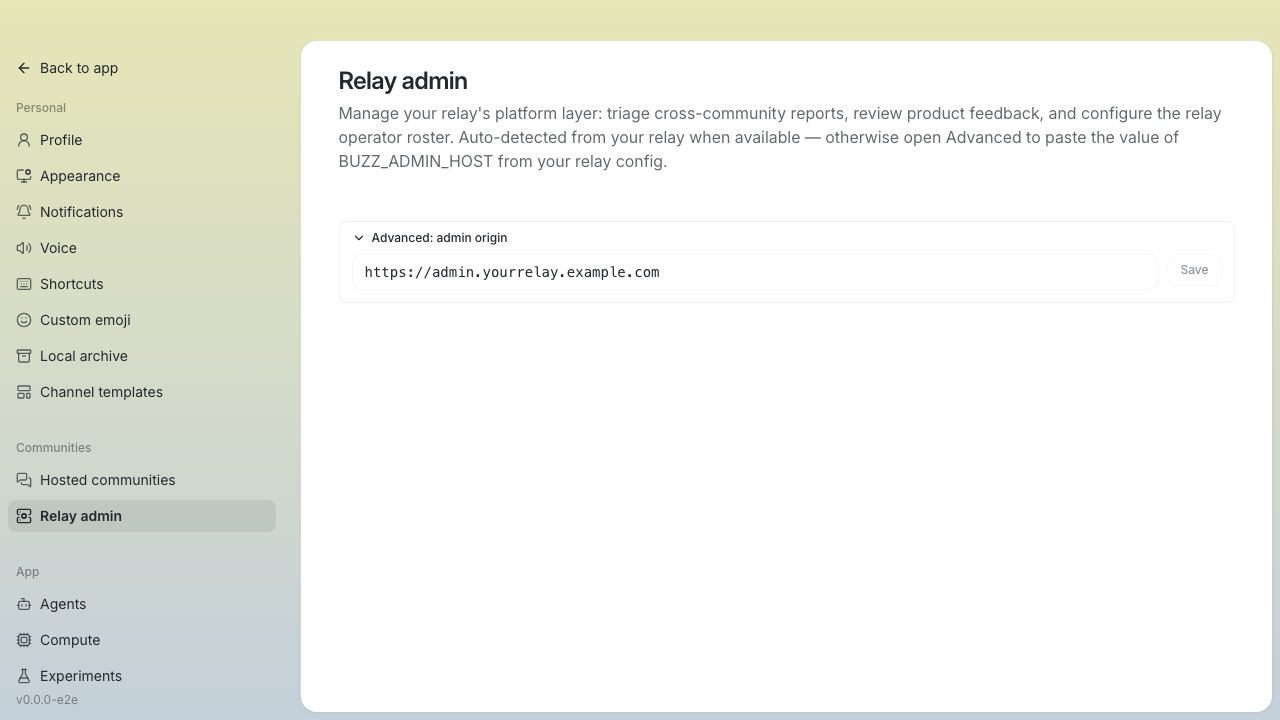 **Authorized console — all three tabs** 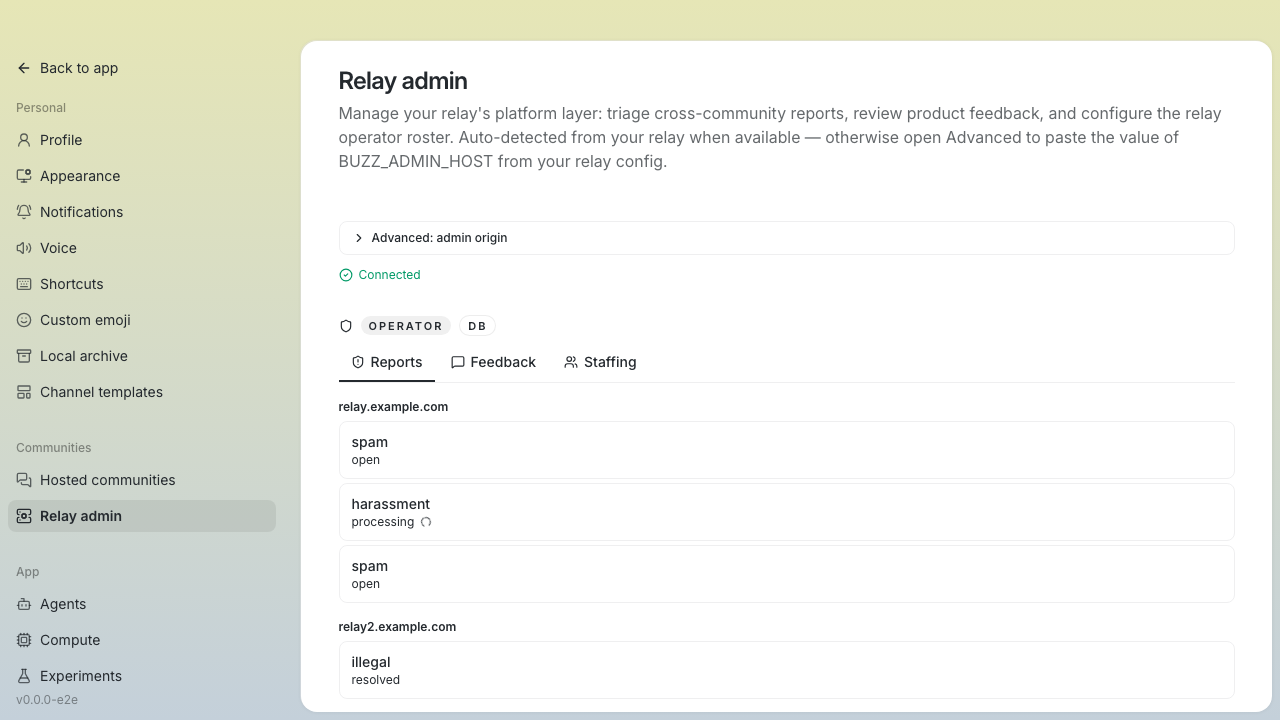 ### Reports **Reports queue — open, processing, resolved across two relay groups** 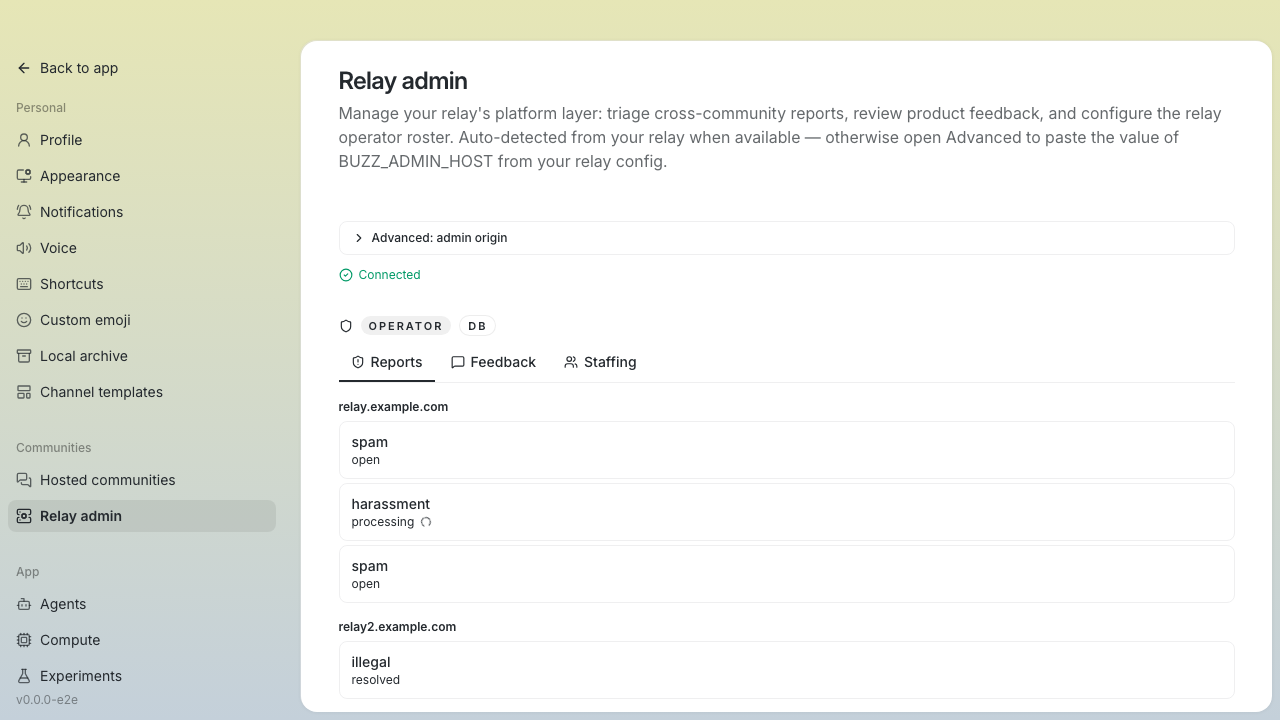 **Open report detail — reporter, target, message snapshot, resolve form** 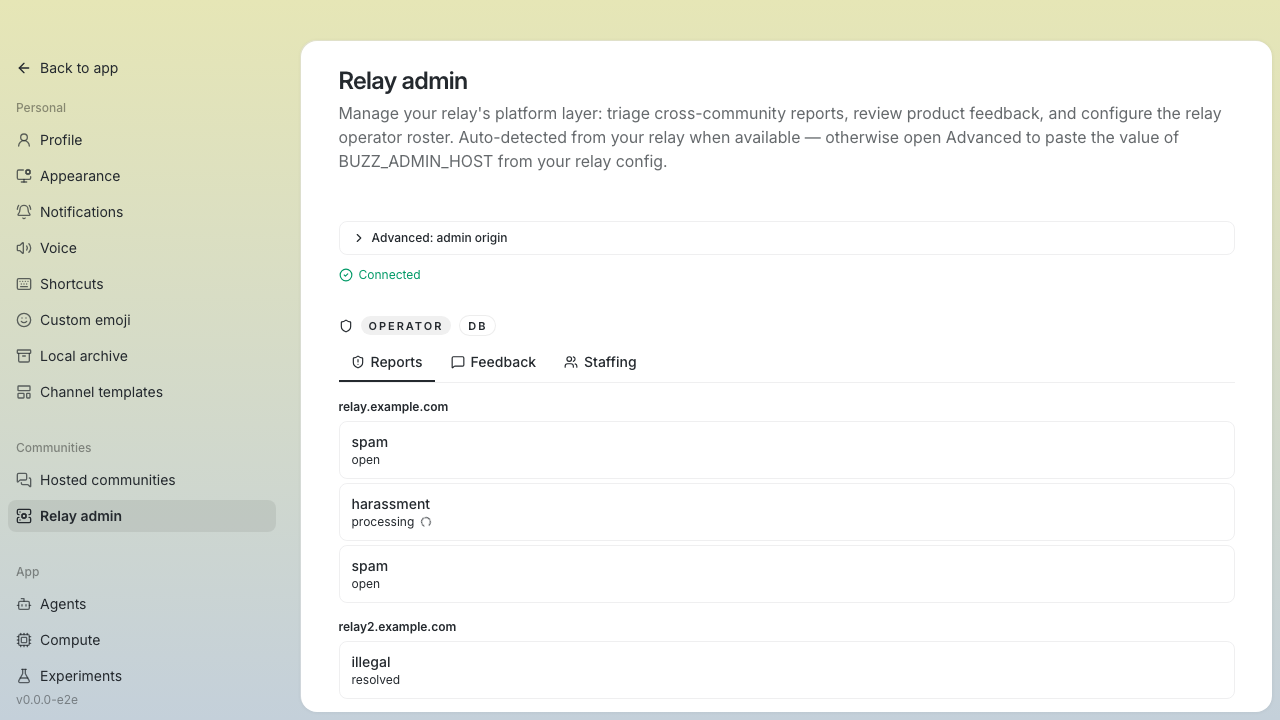 **Processing report — PROCESSING/HARASSMENT, ban enforcing state** 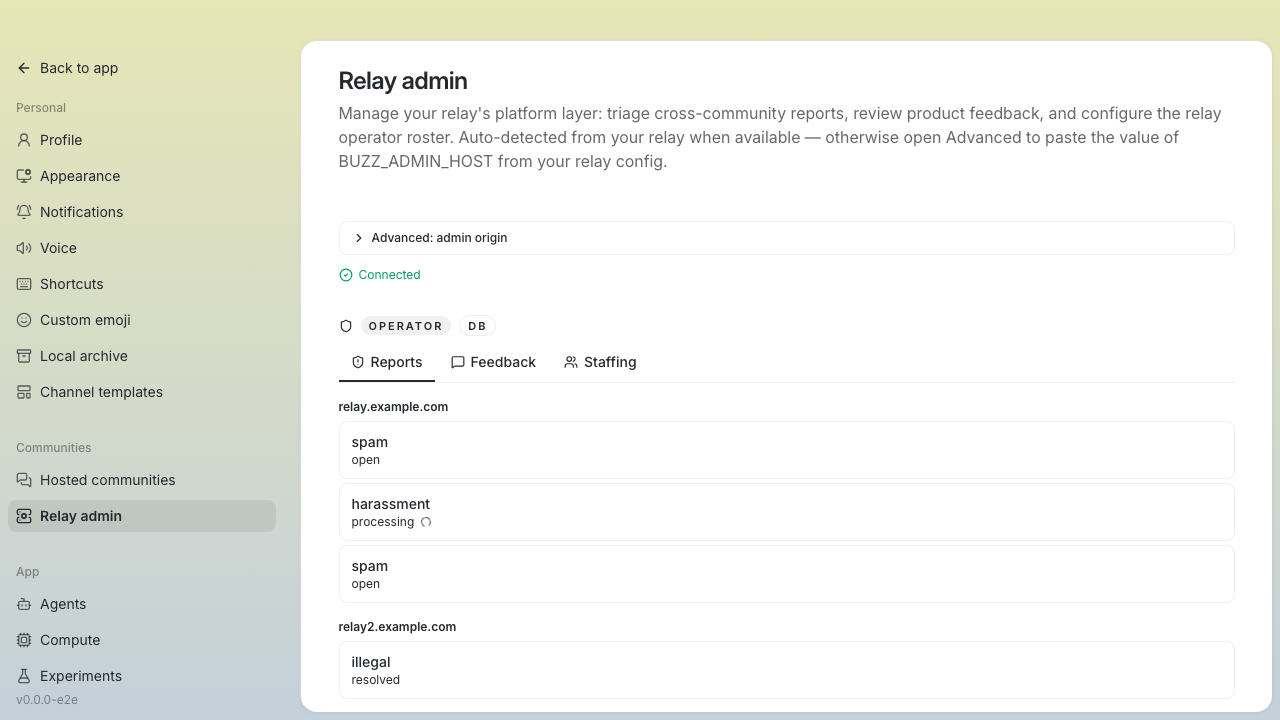 **Resolve form — Delete selected, audience disclosure copy** 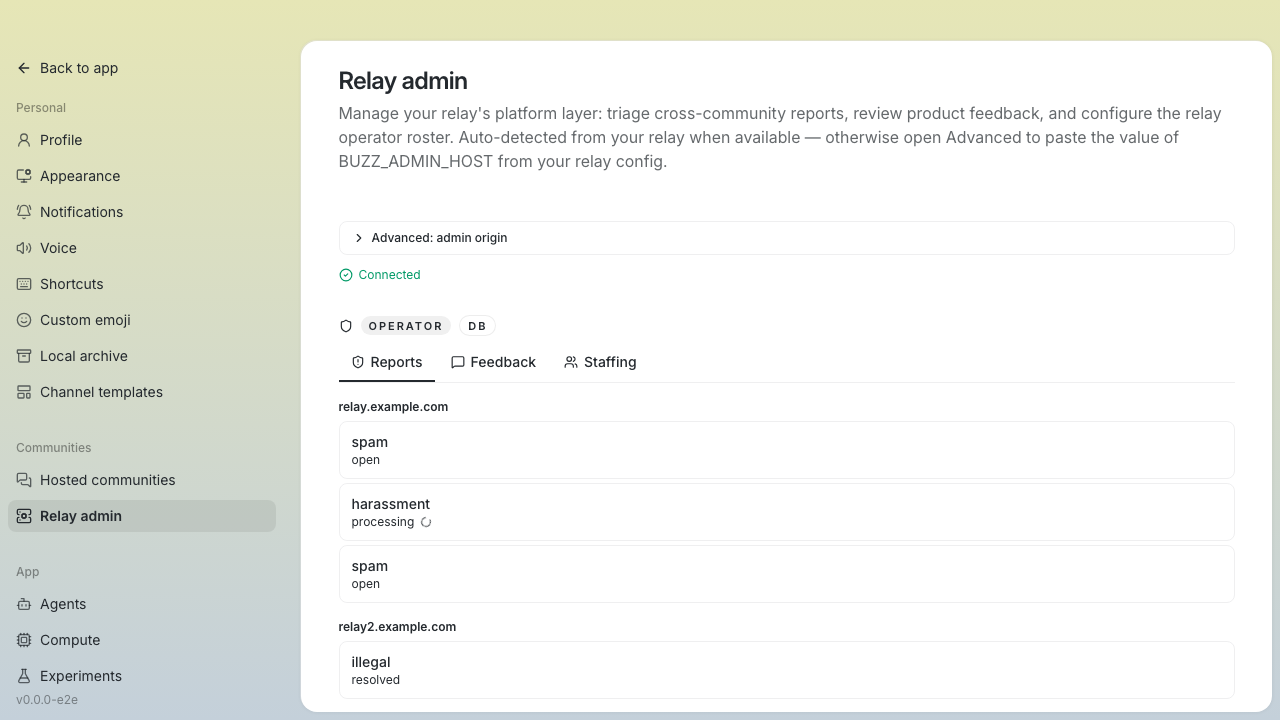 **Resolved report — enforcement history block** 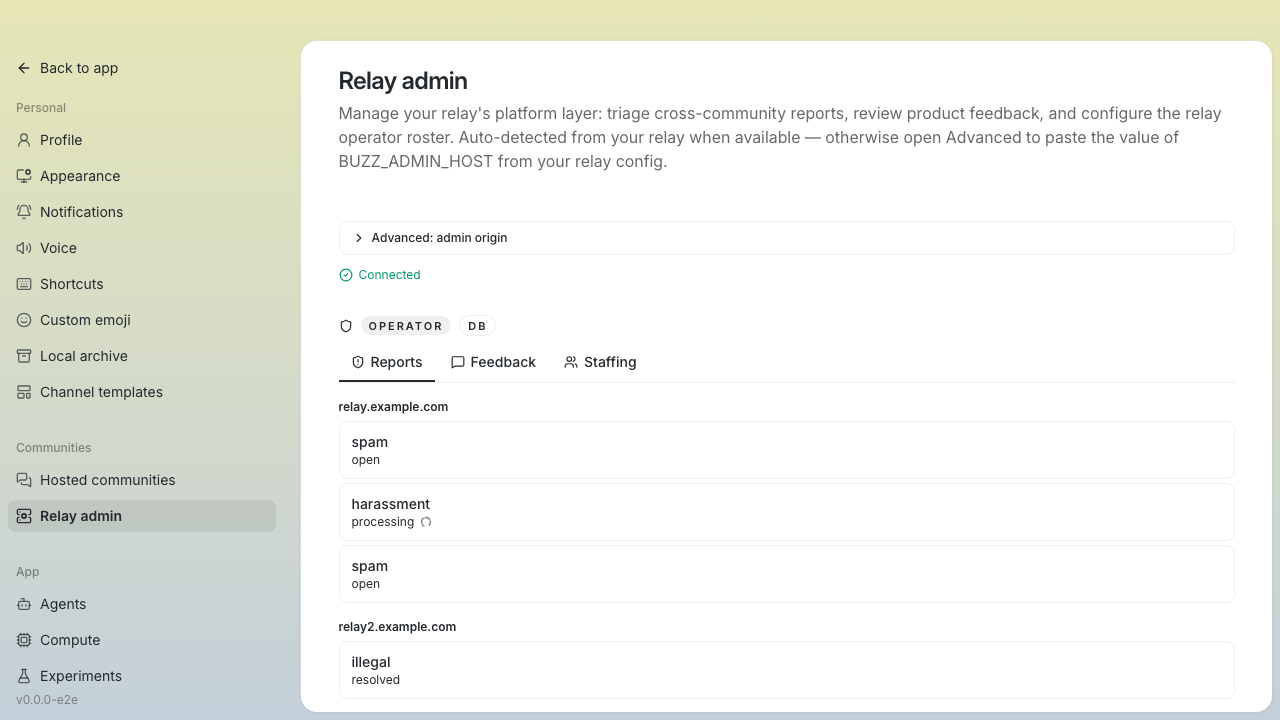 ### Feedback **Feedback list — community grouping with status badges** 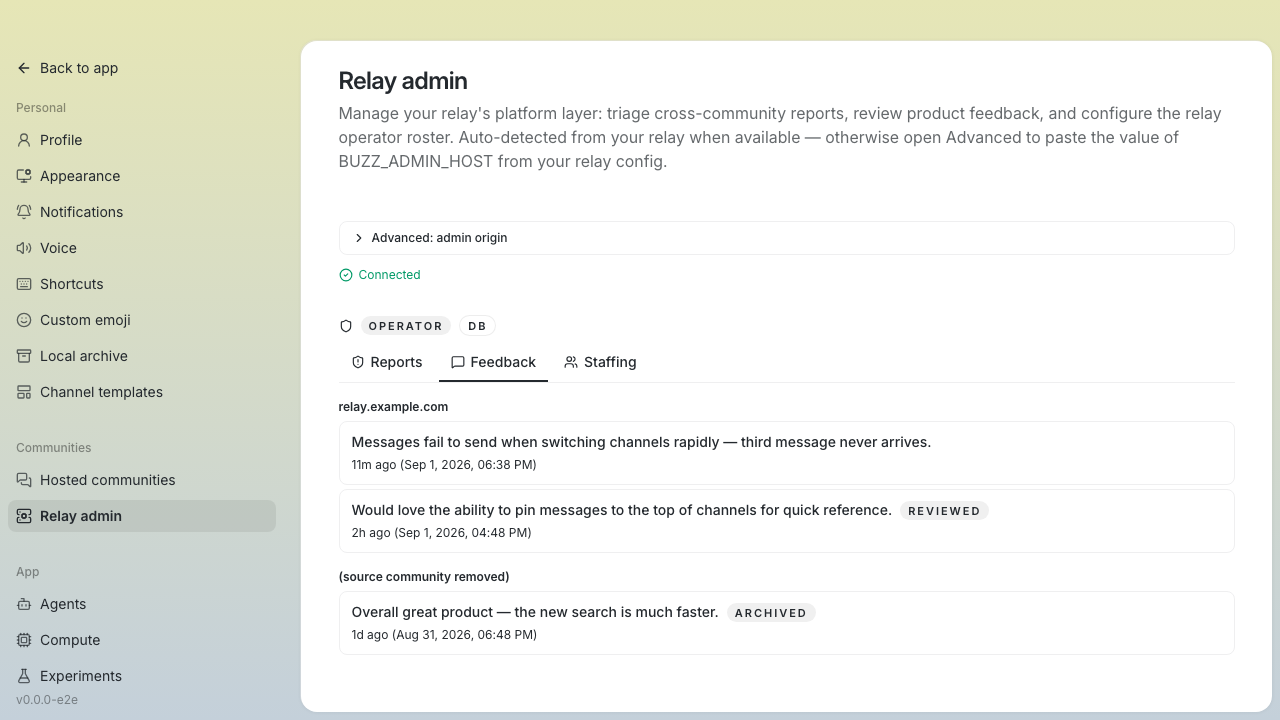 **Feedback detail — mutable status control (operator mode)** 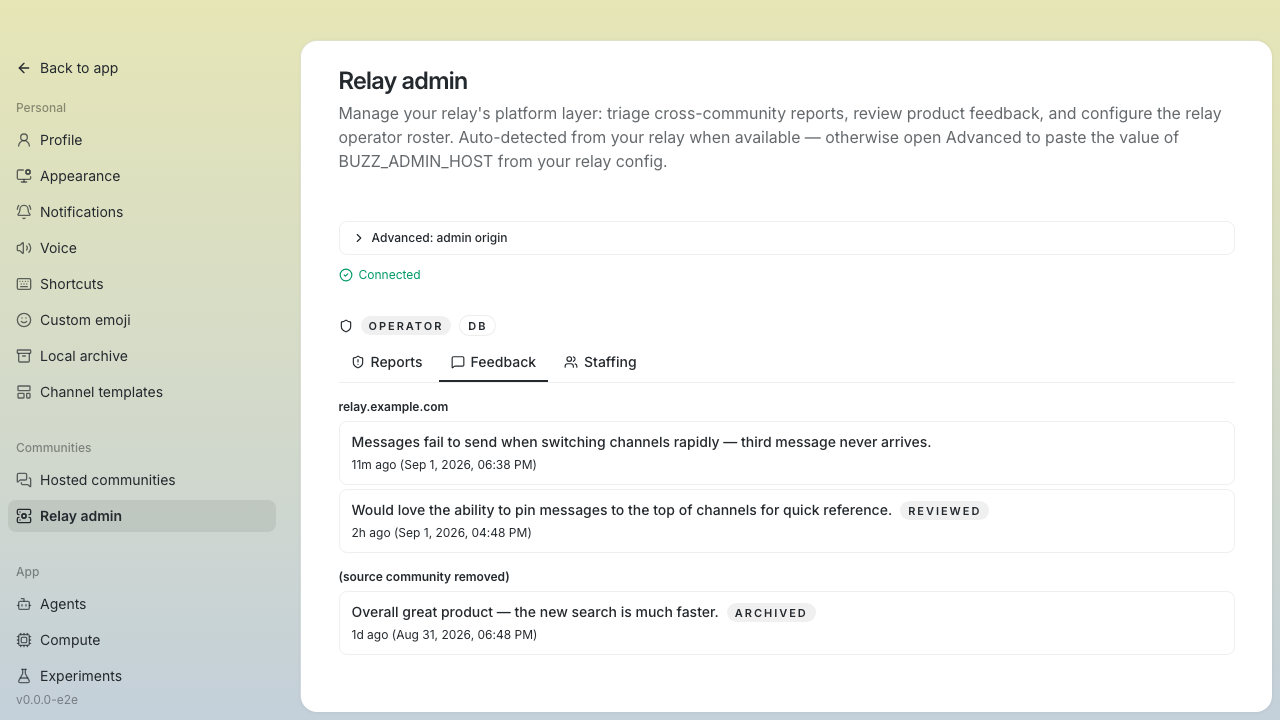 **Feedback detail — passive status badge (read-only/disabled mode)** 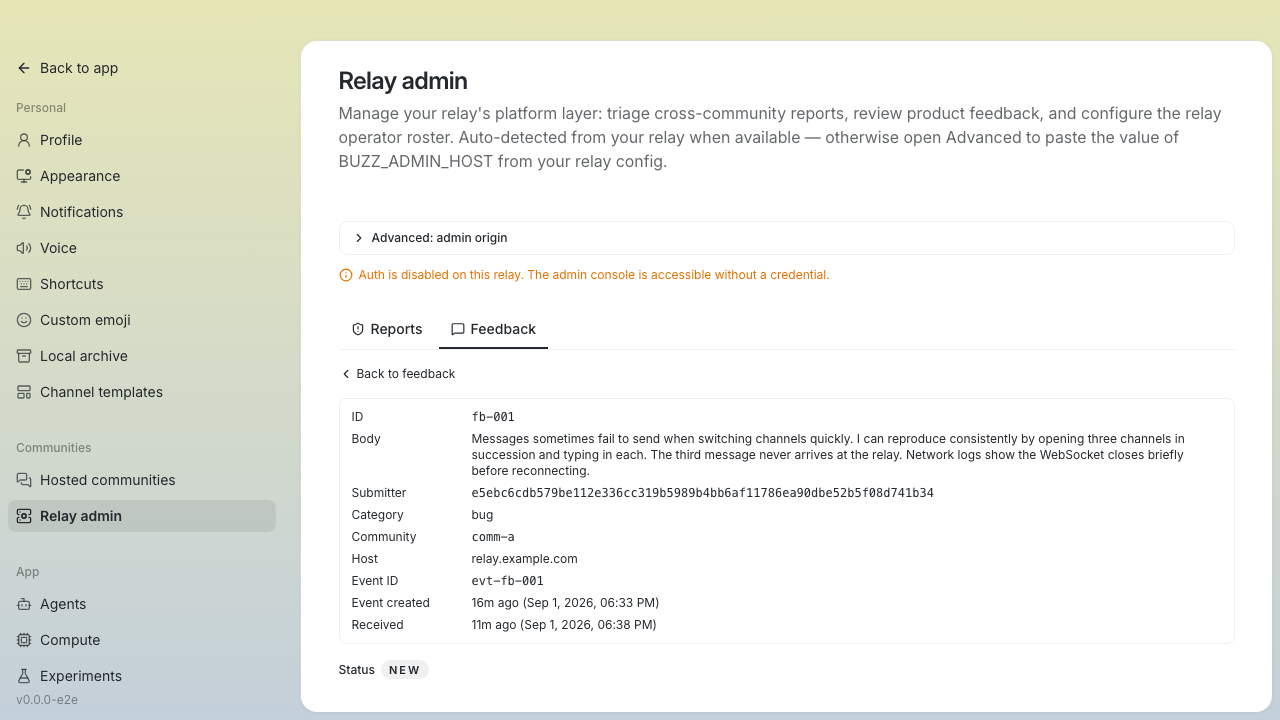 ### Staffing **Staffing roster — config/owner\_fallback/db source labels** 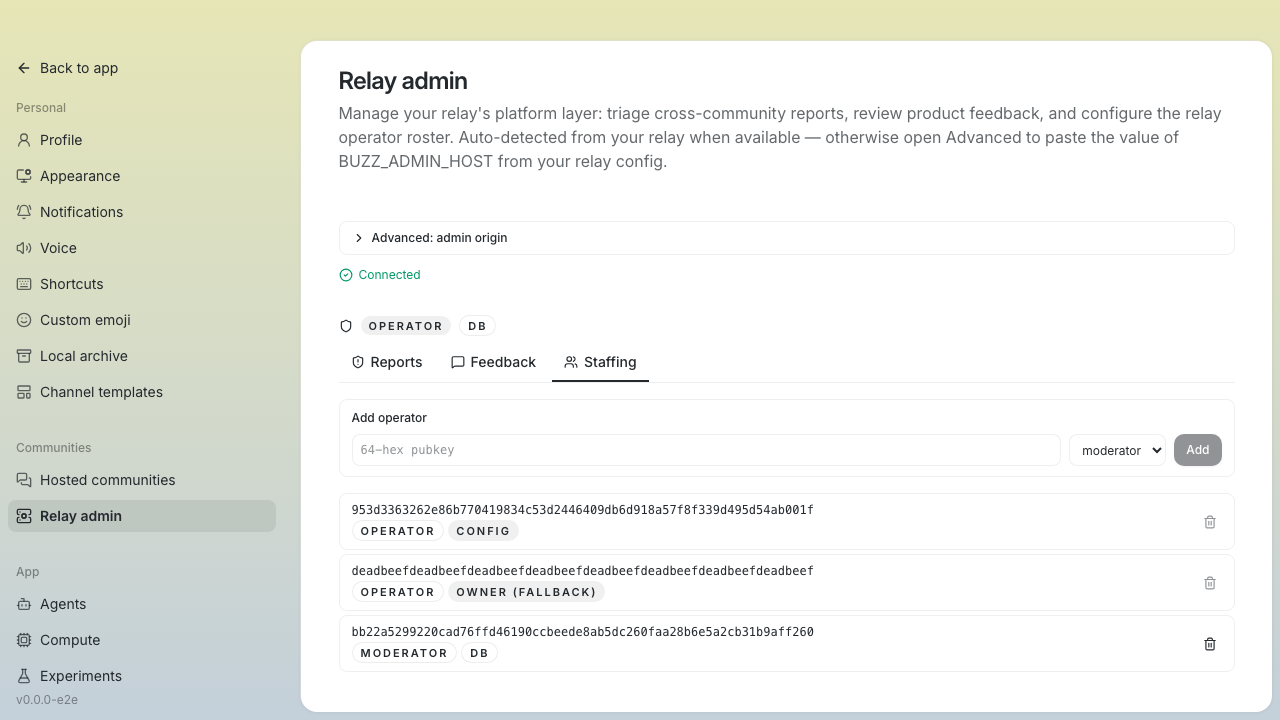 **Add form — new pubkey filled, ready to submit** 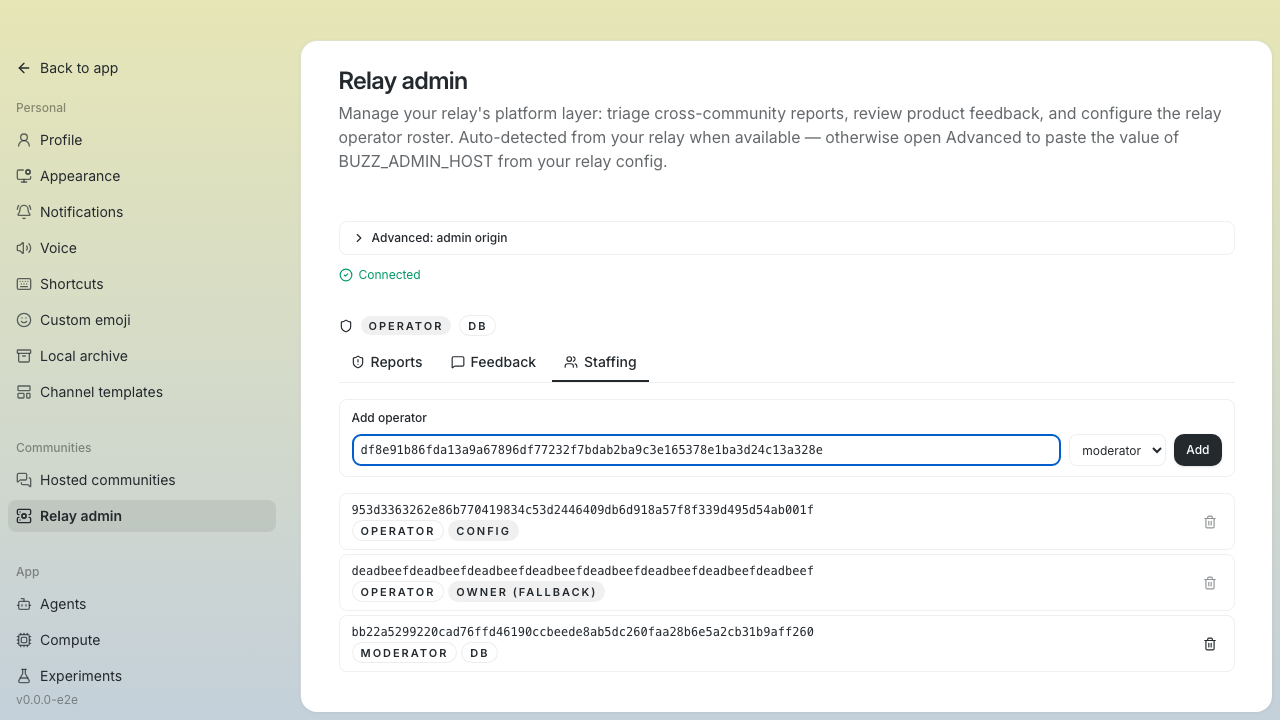 **Duplicate rejection — inline error for existing principal** 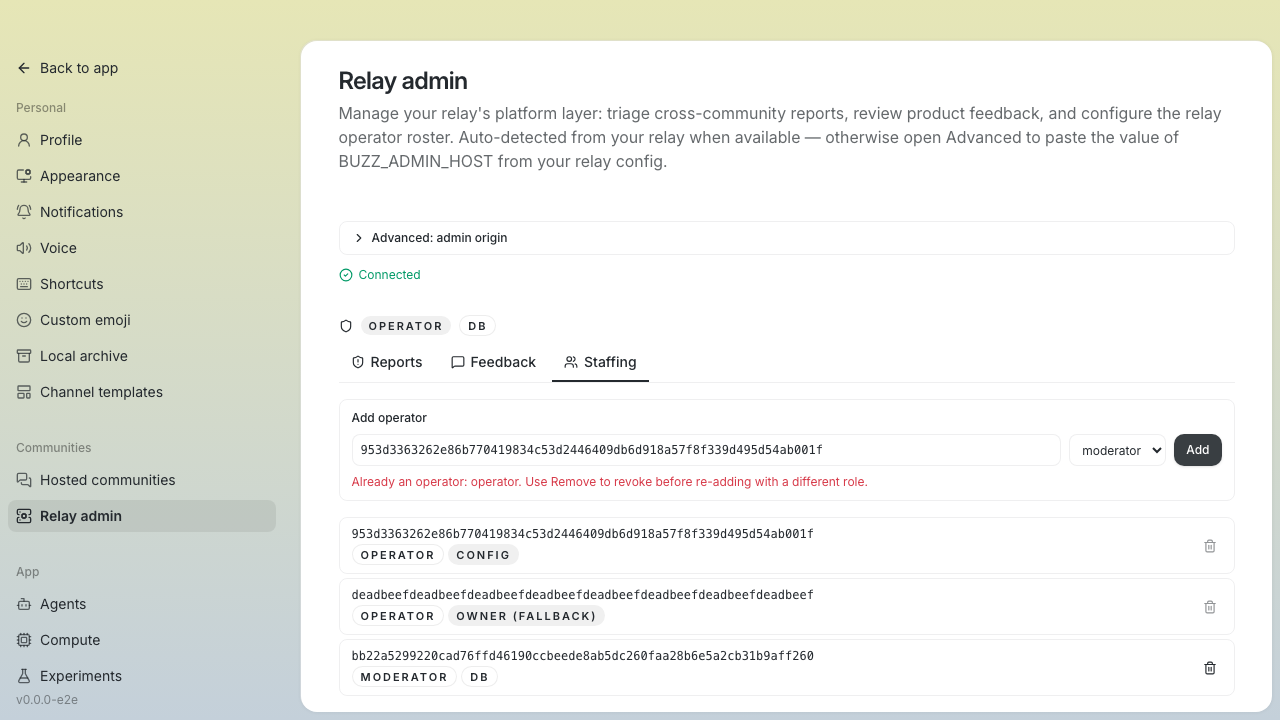 --------- Signed-off-by: Will Pfleger <pfleger.will@gmail.com> Signed-off-by: Will Pfleger <wpfleger@block.xyz> Signed-off-by: Duncan <dcfd242e557282d7a1e2cf2e6877522682f1e5c6156dc92ca7d90eaedd3b0f95@buzz.block.builderlab.xyz> Signed-off-by: Alia <d32955ad69077062930cc46cfe2df30ca9aaf6f8e76422681265e9e9af704d78@buzz.block.builderlab.xyz> Co-authored-by: Duncan <dcfd242e557282d7a1e2cf2e6877522682f1e5c6156dc92ca7d90eaedd3b0f95@buzz.block.builderlab.xyz> Co-authored-by: Alia <d32955ad69077062930cc46cfe2df30ca9aaf6f8e76422681265e9e9af704d78@buzz.block.builderlab.xyz>













Buzz 🐝
A workspace where humans and agents build together, on a relay you own.
Vision · Sovereign · Forge · Agents · Architecture · Releasing · Apache 2.0

People and agents building together in the same room.
What is this, really?
Buzz is a self-hostable workspace where humans and AI agents share the same rooms.
A Buzz community is the workspace a user reaches by URL. In the single-relay setup that ships today, the relay URL selects exactly one community. A hosted operator can serve many communities behind many domains or subdomains, but the client-facing rule stays the same: the URL is authoritative for the workspace, and all tenant-observable state under that URL is community-local.
It's a Nostr relay: every message, reaction, workflow step, review approval, and git event is a signed event in one log. Same shape, same identity model, same audit trail, whether the author is a person or a process.
In practice it feels like a team workspace. Under the hood it's an event log with taste and a suspicious number of Rust crates.
Yes, it's another AI-adjacent developer tool. We're sorry. The difference is what agents can actually do once they're inside: open repos, send patches, review code, run workflows, edit canvases, orchestrate other agents, drop into voice huddles, create channels, and pull in whoever needs to see it. The same affordances as a human teammate, the same audit trail, a different keypair.
Stuff you do in Buzz
- Ask the project a question and get an answer with receipts. Agents search six months of history and post the threads, not vibes.
- Let an agent triage a bug without giving it the keys to the kingdom. Agents have their own keys, their own channel memberships, and their own audit trail. Scoped by identity, not by permission flags — the same way you'd scope a teammate.
- Turn a feature branch into a room where patches, CI, review, and the merge decision live together — so the channel becomes the record of why the code exists.
- Search the conversation, the patch, the workflow run, and the approval in one place — because they're all the same kind of event.
- Let an agent run the workspace, not just talk in it. Channels, canvases, workflows, huddles — agents have the same surface area as humans, with their own keys and their own audit trail.
A look inside
 Agents are members, not bots. Add an agent to a channel the same way you add a person. |
 Spin up a room in seconds. Name it, describe it, make it private. |
 Media you can talk about. Leave comments pinned to specific frames. |
|
Why Buzz is better
One community. One identity model. One event log. Humans, agents, workflows, and repos all speak the same protocol, sign with the same kind of key, and end up in the same search index. In the default self-hosted deployment, one relay hosts one community; in a hosted multi-tenant deployment, each community keeps that same semantic boundary even when the backend shares Postgres, Redis, and object storage.
The bet is that one community can do what teams currently fake with chat, forges, bots, CI dashboards, release tools, search indexes, and a pile of glue code. Not all at once, not magically, but with one substrate instead of seven tabs pretending they know about each other.
Agents are part of the room, not haunted cron jobs.
Three little stories
Incident memory. It's 2am. You type "have we seen this error before?" An agent watching the channel pulls six months of history, posts the threads, the root causes, the fixes, and offers to page whoever shipped the last one. The whole exchange — question, answer, evidence — stays in the channel.
Branch as room. You open a feature branch. A channel appears. Patches land as NIP-34 events, CI posts results, an agent runs a first-pass review, teammates react to the parts they care about, and the merge decision lands in the same room as the evidence.
A release that writes itself. A workflow fires on a tag. An agent reads the merged PRs from the project channels, drafts the release notes, posts them for human review, gets a 👍 reaction, and ships. Every step signed. Every step searchable.
Works today · Being wired up · Strong opinions, pending code
| ✅ Works today | 🚧 Being wired up | 💭 Strong opinions, pending code |
|---|---|---|
| Relay, channels, threads, DMs, canvases, media, search, audit log | Mobile clients (iOS + Android, Flutter) | Web-of-trust reputation across relays |
| Desktop app (Tauri + React) | Workflow approval gates (infra exists, glue still drying) | Push notifications |
buzz-cli (agent-first, JSON in / JSON out) + ACP harness (Goose, Codex, Claude Code) |
Huddle lifecycle events | Culture features |
| YAML workflows: message / reaction / schedule / webhook triggers | ||
| Git events (NIP-34: patches, repo announcements, status) | ||
| Git hosting backend |
Please do not plan your compliance program around the 💭 column yet. The VISION docs are the long version of what we think this becomes.
Getting started
New to Buzz? Pick the path that matches you.
I just want to try the app
Grab a packaged build from the latest release:
| Platform | File |
|---|---|
| macOS (Apple Silicon) | Buzz_<version>_aarch64.dmg |
| macOS (Intel) | Buzz_<version>_x64.dmg |
| Linux (x86_64) | Buzz_<version>_amd64.AppImage or Buzz_<version>_amd64.deb |
| Windows (x64) | Buzz_<version>_x64-setup_alpha-unsigned.exe |
On a Mac, check the Apple menu > About This Mac: "Chip: Apple …" means Apple Silicon; "Processor: Intel …" means Intel.
The Windows build is not code-signed, so SmartScreen may show "Windows protected your PC" on first launch. If available, click More info, then Run anyway.
By default the app connects to ws://localhost:3000. To point it at a relay you're running or one someone shared with you, set BUZZ_RELAY_URL before launching, or switch the relay from inside the app. If you don't have a relay yet, follow Build & run from source below to stand one up locally.
I want my own hosted relay
To run a relay for your team without managing servers, you can deploy one to Railway in a click:

See here for details.
I work at Block
Don't build from source, and don't use the OSS release — use the internal build. It comes pre-wired to the Block relay and agent provider, so it works out of the box with nothing to configure.
Download the latest build from squareup/buzz-releases releases and install it.
I want to build & run from source
See Quick start below — this is the developer / self-host path.
Quick start
You'll need Docker and Hermit (or Rust 1.88+, Node 24+, pnpm 10+, just).
Once:
git clone https://github.com/block/buzz.git && cd buzz
. ./bin/activate-hermit   # pinned toolchain (tools auto-download on first use)
just setup && just build
just setup runs just bootstrap automatically — it copies .env.example to .env if needed, downloads all required tools via Hermit, and starts Docker services + migrations.
Every day:
. ./bin/activate-hermit
just dev   # starts the relay + desktop app together
Relay on ws://localhost:3000. Desktop app pops up. You're in.
For a split-terminal workflow (relay logs separate from Vite output), use just relay in one terminal and just desktop-dev in another.
Want a single-node / VPS relay instead of the local-dev stack? Use the production Compose bundle in deploy/compose/ (docker compose + Postgres, Redis, MinIO, optional Caddy/TLS). The root docker-compose.yml is for day-to-day development only.
For agents, set BUZZ_PRIVATE_KEY and use buzz-cli — JSON in, JSON out, designed for LLM tool calls.
Windows prerequisites
The agent shell tool runs commands under bash. On macOS and Linux that's already there; on Windows you need to bring it.
Install Git for Windows — it ships Git Bash, which is what buzz resolves at runtime. Once it's installed, everything works the same as on other platforms.
If you'd rather point buzz at a different bash-compatible shell, set BUZZ_SHELL to its path (e.g. BUZZ_SHELL=C:\path\to\bash.exe). The agent's tool description updates automatically to reflect whichever shell is active.
Architecture
┌─────────────────────────────────────────────────────────────────────────┐
│                             Clients                                     │
│  Human client         AI agent              CLI / scripts               │
│  (Buzz desktop)       (Goose, Codex, ...)   (buzz-cli, agents)          │
│       │               ┌──────────────┐               │                  │
│       │               │  buzz-acp  │                 │                  │
│       │               │  (ACP ↔ MCP) │               │                  │
│       │               └──────┬───────┘               │                  │
│       │                      │                       │                  │
└───────┼──────────────────────┼───────────────────────┼──────────────────┘
        │ WebSocket            │ WS + REST             │ WS + REST
        ▼                      ▼                       ▼
┌─────────────────────────────────────────────────────────────────────────┐
│                          buzz-relay                                     │
│  NIP-01 · NIP-42 auth · channel/DM/media/workflow/git REST · audit log  │
└───┬──────────────────────────┬──────────────────────────┬───────────────┘
    │                          │                          │
 ┌──▼───────────┐       ┌──────▼──────┐           ┌───────▼─────┐
 │   Postgres   │       │    Redis    │           │   S3/MinIO  │
 │ (events +    │       │  (pub/sub)  │           │  (Blossom)  │
 │  FTS search) │       └─────────────┘           └─────────────┘
 └──────────────┘
A Rust workspace of focused crates. Single source of truth: the relay. See ARCHITECTURE.md for the full breakdown.
Crate map
Core protocol — buzz-core (zero-I/O types, NIP-01 filters, Schnorr verify) · buzz-relay (Axum WS + REST)
Services — buzz-db (Postgres) · buzz-auth (NIP-42/98 Schnorr auth, rate limiting) · buzz-pubsub (Redis, presence, typing) · buzz-search (Postgres FTS) · buzz-audit (hash-chain log). Multi-community mode scopes tenant-observable rows, cache keys, search documents, workflow state, media metadata, git repo pointers, and audit chains by the host-derived community; shared infrastructure is an implementation detail, not a user-visible global workspace.
Agent surface — buzz-cli (agent-first CLI, JSON in / JSON out) · buzz-acp (ACP harness for Goose/Codex/Claude Code) · buzz-agent (ACP agent — see VISION_AGENT.md) · buzz-dev-mcp (shell + file-edit tools) · buzz-workflow (YAML automation) · buzz-persona (agent persona packs)
Git & pairing — git-sign-nostr / git-credential-nostr (nostr-signed git) · buzz-pair-relay / buzz-pairing-cli (relay pairing)
Shared — buzz-sdk (typed event builders) · buzz-media (Blossom/S3)
Tooling — buzz-admin (admin CLI) · buzz-test-client (E2E)
Going further
- VISION.md · VISION_SOVEREIGN.md · VISION_PROJECTS.md · VISION_AGENT.md — the four vision docs
- ARCHITECTURE.md — system design, kind ranges, subsystem boundaries
- TESTING.md — multi-agent E2E test suite
- CONTRIBUTING.md · CODE_OF_CONDUCT.md · SECURITY.md · GOVERNANCE.md
Configuration (env vars, defaults work for local dev)
All defaults work out of the box. Override via .env. Full reference in .env.example.
Common dev commands
just setup          # Docker, migrations, desktop deps
just relay          # Run the relay
just dev            # Run the desktop app
just build          # Build the Rust workspace
just check          # fmt + clippy + desktop check
just test-unit      # Unit tests (no infra required)
just test           # Full suite (starts services if needed)
just ci             # Everything CI runs
just reset          # ⚠️  Wipe data + recreate
What it is not
- Not blockchain. Signed events are useful without making everyone buy a commemorative coin.
- Not an AI replacement plan. Buzz works best when humans stay in the loop and agents stay in the room.
- Not finished. We will tell you what works and what doesn't.
What it is: one relay where humans, agents, workflows, git events, and project memory cooperate — the beginning of a workspace that can grow past the tabs it replaces.
Buzz 🐝
Apache 2.0 · Built by Block, Inc.