 8f8c4dfade
Adds a relay admin console under Settings — the single surface for relay-level operator work — replacing the previously unreachable moderation section. Operators authenticate with their own Nostr key over NIP-98 — no browser extension, no bearer token — to view deployment-wide moderation reports and product feedback, resolve/dismiss/escalate/reopen reports, update feedback status, and manage the operator/moderator staffing roster. ## Nav reachability The old `moderation` section id was defined in `settingsSections` but never wired into any group in `settingsNavGroups`, so the sidebar never rendered it — unreachable since #1617. This PR replaces it with a `relay-admin` section wired into the Communities nav group, pointing at the relay admin console, and drops the separate `admin-console` section id so a single surface owns relay-level trust & safety. The Relay admin nav entry is always visible. Auth gates the panel itself; the nav entry is a door, not a credential — hiding it behind discovery state would strand an operator whose relay transiently fails NIP-11 discovery with no path back to the connection settings. ## Discovery and connection On mount the console reads the connected relay's NIP-11 document for the optional `admin_api` field. When a valid origin is discovered **and its host matches the connected relay's host** (case-insensitive, host identity only), it is automatically saved and probed — the panel renders immediately with no Save step required. A cross-host advertisement is pre-fill only: it populates the manual origin field under Advanced and is never saved or probed without an explicit Save, so a relay cannot direct an unconsented NIP-98 signature at a third-party origin; residual exposure on the same-host path is bounded by NIP-98's URL/method/payload binding. Saving is only required for manual origin changes. The advertised origin is untrusted input: revalidated through `AdminOrigin::parse`, falling back to manual entry when absent or invalid. A saved manual origin always takes precedence over discovery. ## Auth and transport (Rust, `src-tauri/src/commands/admin/`) - `AdminOrigin` value object: validates scheme + host + optional port, rejects credentials/path/query/fragment; `http://` only for loopback. The relay side normalizes its configured admin host at config load and compares inbound `Host`/`Origin` hosts case-insensitively. - `AdminRoute` closed enum: no IPC surface accepts arbitrary URLs, so the NIP-98-signed URL is byte-identical to the fetched URL. - Dedicated no-redirect `reqwest` client as an SSRF guard: a relay `3xx` is an error and the NIP-98 header never crosses origins. - `admin_probe` signs `GET /probe` and returns a typed state (`nip98Authorized` / `nip98Denied` / `disabled` / `notAdminApi` / `networkOrIntercepted`). The response body is validated against the full relay contract — `nip98Authorized` only when the complete NIP-98 invariant holds, `disabled` only on a coherent disabled-mode body; any incoherent or unrelated JSON classifies as `notAdminApi`, so the console never fails open at the network boundary. Unknown fields are tolerated for forward compatibility. - NIP-98 signing via `AppState::signing_keys()`, one retry on `401` with a fresh signed event; response size bounded by a `Content-Length` preflight and a streaming byte counter; per-pubkey origin storage with atomic `0o600` writes. ## Relay admin console The console is gated behind the relay `OPERATOR`/`MODERATOR` roles from #3777; every `/api/admin/v1/*` route returns `403` to anyone else. Community self-administration (`community-members` / Invites) and in-channel enforcement (the 9040–9043 signed commands) are a separate axis and are untouched. The previously-duplicate community report queue (`ModerationQueueCard`, `moderationQueue.ts`, and three dead hooks) was unreachable dead code and is deleted in its own commit; `useBanMemberMutation` and the rest of `features/moderation/hooks.ts` remain in use by the members sidebar and message menu. ## Console UI (TypeScript, `src/features/admin-console/`) - `AdminConsoleSettingsCard`: discovery + probe flow, honest copy for every probe state, manual origin under an `Advanced` disclosure at the bottom. The role (operator/moderator) is rendered in the connection status line as plain text ("Connected as operator") — no badge-shaped elements above the tab row. The origin provenance (relay config / database) appears inside the Advanced card as small muted text. Section title changed to `Admin`. - `AdminConsolePanel` with Reports / Feedback / Staffing tabs (Staffing gated on `role === "operator"`); reports and feedback grouped by community for cross-community triage. - **Reports**: always requests `scope=all` so the existing resolve/cancel/reopen controls can reach every status (`open`, `processing`, `resolved`, `dismissed`, `escalated`). The relay's omitted-scope default is `escalated`-only (the platform-safety backstop); `scope=all` is explicit and scoped to this console. Full action matrix per `target_kind` (event → delete/kick/ban/timeout/dismiss/escalate; pubkey → ban/timeout/dismiss/escalate; blob → dismiss/escalate); kick is suppressed when the report carries no `channelId`. A `processing` row stays navigable — enforcement state lives in the detail view. A `failed` action (always pre-mutation) offers a single **Cancel & reopen** via `POST /reports/{id}/cancel` with `{actionId}` fencing; there is no client-side retry. `pending`/`enforcing` actions belong to the relay recovery worker and offer no button; a `409` reloads detail. Lists refetch on back-navigation after a mutation. - **Report failure UX**: `reportErrorMessage()` strips 4xx/5xx status prefixes and surfaces the relay's own error reason in the toast (e.g. relay returns `"400: you cannot report this content"` → toast shows `"you cannot report this content"`). Self-report blocking UI removed — the relay has no self-report gate, and the failure was purely client-side error surfacing. - **Reason audience disclosure**: the Reason (optional) field shows exact copy under the input based on selected action — Delete discloses that reason is sent verbatim to the affected user and posted publicly in the room; Kick/Ban/Timeout disclose affected-user only; Dismiss/Escalate disclose reporter only. These mirror the actual relay notice paths. - **Enforcement history**: the report detail carries the governing action even after the report leaves `processing` — a report enforced then reopened is `open` yet still shows its `succeeded` action as executed history alongside the resolve form; a reopen does not un-happen a ban. The resolve form gates on `open` status alone. - **Reopen**: terminal reports (`resolved`/`dismissed`/`escalated`) can be returned to `open` for re-triage via `POST /reports/{id}/reopen`. Reopen never reverses applied enforcement, and the copy says so. - **Feedback**: list, detail, and status control (`new`/`reviewed`/`archived`) with a generation-fenced attachment viewer. A purged source community severs provenance to `null` rather than deleting the row; severed rows bucket under a "source community removed" heading. - **Staffing**: Add is create-only with display names resolved via `useUsersBatchQuery` and npub cross-fade on hover (`HoverStaffingIdentity`). An entered key that already appears in the authoritative roster (config, owner-fallback, or DB) is rejected locally with an inline duplicate-key message and no request is issued; a `409 Conflict` from add, role change, or remove surfaces the relay's parsed error body via `adminErrorMessage(e)` — distinguishing config-backed key conflicts from last-operator conflicts without HTTP-status inference. Roster with `config`/`owner_fallback`/`db` source labels; config-backed entries disable remove client-side. In-place role change via `<select>` calling `putAdminOperator`; the relay responds with the effective `OperatorEntry` (`pubkey`, `effectiveRole`, `sources`) in the same shape as the roster list. Read-only badge for config-managed entries. - **Timeout expiry**: `useTimeoutState` clears the store when derived state is `INACTIVE` but the store is still active; the 1s tick is scoped to entries with a known `expiresAtMs` and owned by `ComposerTimeoutBanner` (mounted only while a timeout is active), while `ChannelPane` subscribes to the boolean `useTimeoutActive()` — the pane re-renders when a timeout starts or ends, not every second. `useMembersSidebarModeration` ticks `nowMs` only while the sidebar is open, the viewer can moderate, and some member has a future `mutedUntil`; the tick after the last expiry stops the interval. - Staffing refreshes the principal after a self-demotion or self-removal: `AdminConsolePanel` passes `onSelfMutation` to `StaffingTab`, which re-probes the saved origin so the role badge and tab visibility update without a manual re-probe. - Staffing mutation failures, including both 409 variants (config-backed key vs. last operator), surface the relay's parsed error via `adminErrorMessage`, so the last-operator recovery guidance is shown. - Mutations confirm via `sonner` toasts; failures surface the relay's parsed error `message`, not raw JSON. The `disabled` auth mode renders read-only. ## Mutation idempotency Resolve and reopen carry a per-attempt `requestId`. On first submit the whole command (`{requestId, action, reason, expirationSecs}`) is frozen; after an ambiguous failure (409, 5xx, transport error, truncated response) the snapshot is retained, action/reason/duration controls are locked, and the retry sends the exact same payload byte-for-byte. A definitive pre-commit rejection (non-409 4xx with `bodyComplete: true`) discards the snapshot, unlocks controls, and the corrected submit uses a fresh payload. On success the toast derives from the authoritative `AdminReportResolution` (`activeAction.action` when present; otherwise `status` for decision-only outcomes) — never from the mutable form selection. The native mutation commands — including operator delete — reject with a typed `AdminMutationError` carrying the relay's HTTP status (`relayStatus`, `null` when no verdict exists) and a `bodyComplete` flag that is `true` only when the full response body was read. ## Restriction routes contract change `GET /members/restrictions` and `DELETE /members/{pubkey}/ban|timeout` now take `communityHost` instead of `communityId`; the relay resolves the tenant itself and returns `400 unknown_community_host` for an unmapped host. This is a breaking contract change with no compatibility shim: the relay must run this build before a desktop that uses it, scripts sending `communityId` must switch, and rolling the relay back breaks the desktop Restrictions UI. `docs/admin/README.md` documents the three routes in the route inventory and carries the migration note. Restriction calls also carry the relay the list was loaded from, and the native side rejects a mismatch before building any URL. ## Hardening - Saved admin origins are stored per pubkey and per relay host. The host slug parses the relay URL, keeps the port-drop for DNS names, and encodes IPv6 hosts canonically, so two IPv6 relays never share a file and no IPv6 slug can match a DNS slug. - NIP-11 admin discovery has its own 10s request deadline and reads `/info` success and error bodies through the bounded reader with a 64 KiB cap (`Content-Length` is only a pre-check). - `PUT /operators` builds its `OperatorEntry` response from the validated body (`effectiveRole = role`, `sources = ["db"]`) instead of re-reading the roster, so a concurrent change can't turn a committed write into a `403`. Related: #3777 (relay `OPERATOR`/`MODERATOR` role model + NIP-98 auth + `admin_api` NIP-11 advertisement — provides the runtime and the discovery field this console consumes) Related: [builderbot-platform-core-infrastructure#140](https://github.com/squareup/builderbot-platform-core-infrastructure/pull/140) (prod admin ingress allowlist and NIP-98 rollout) ## Screenshots Captured headless at `197f0ba0c` against the mock bridge (1280×720). ### Setup **Origin setup — Advanced disclosure open, idle state** 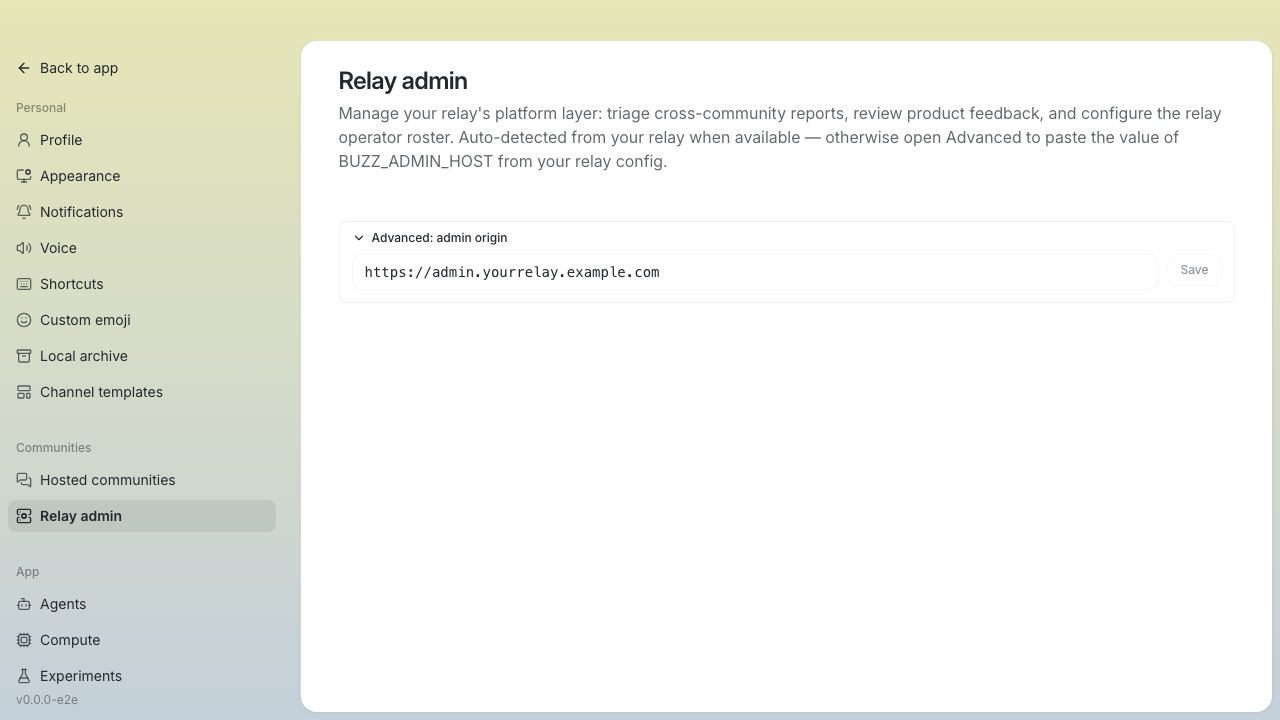 **Authorized console — all three tabs** 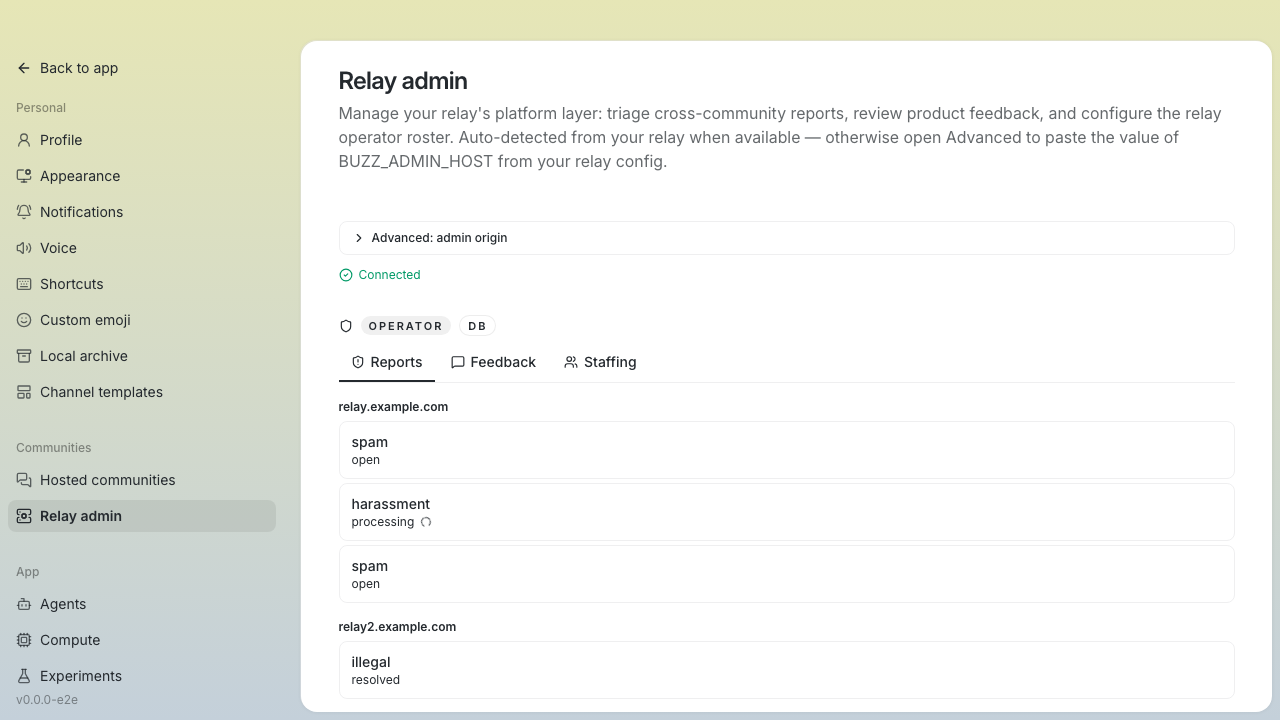 ### Reports **Reports queue — open, processing, resolved across two relay groups** 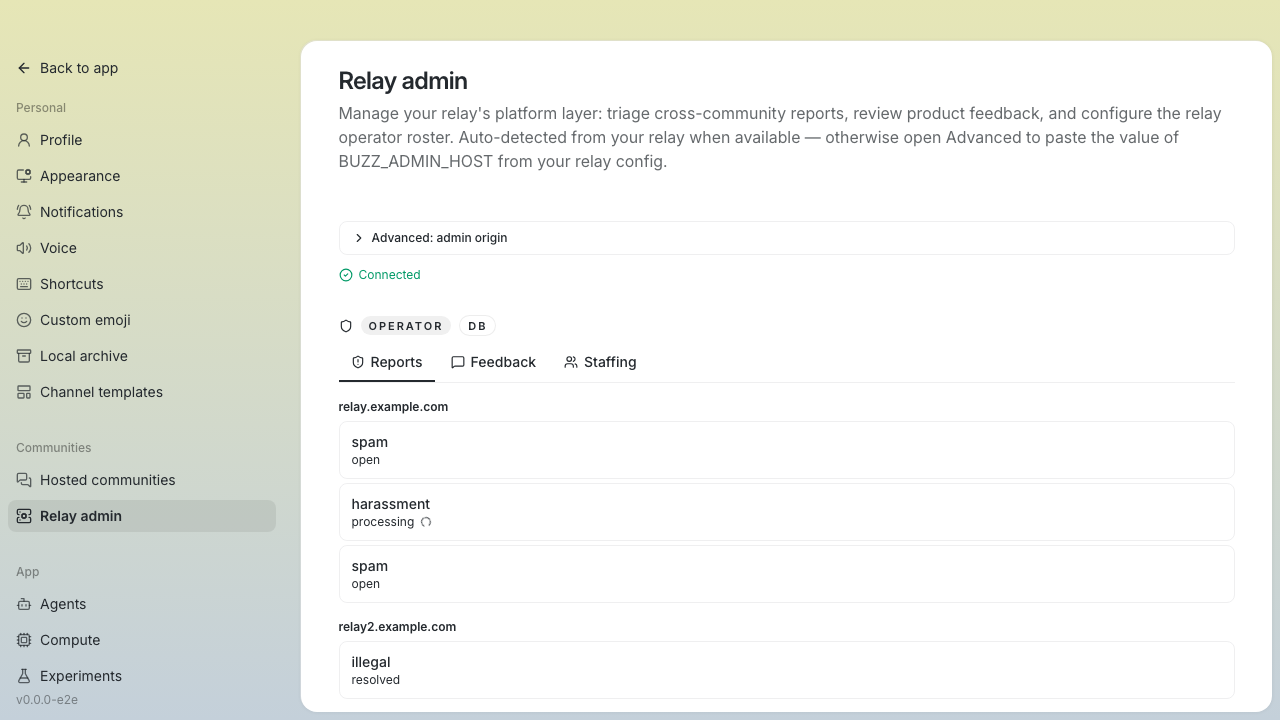 **Open report detail — reporter, target, message snapshot, resolve form** 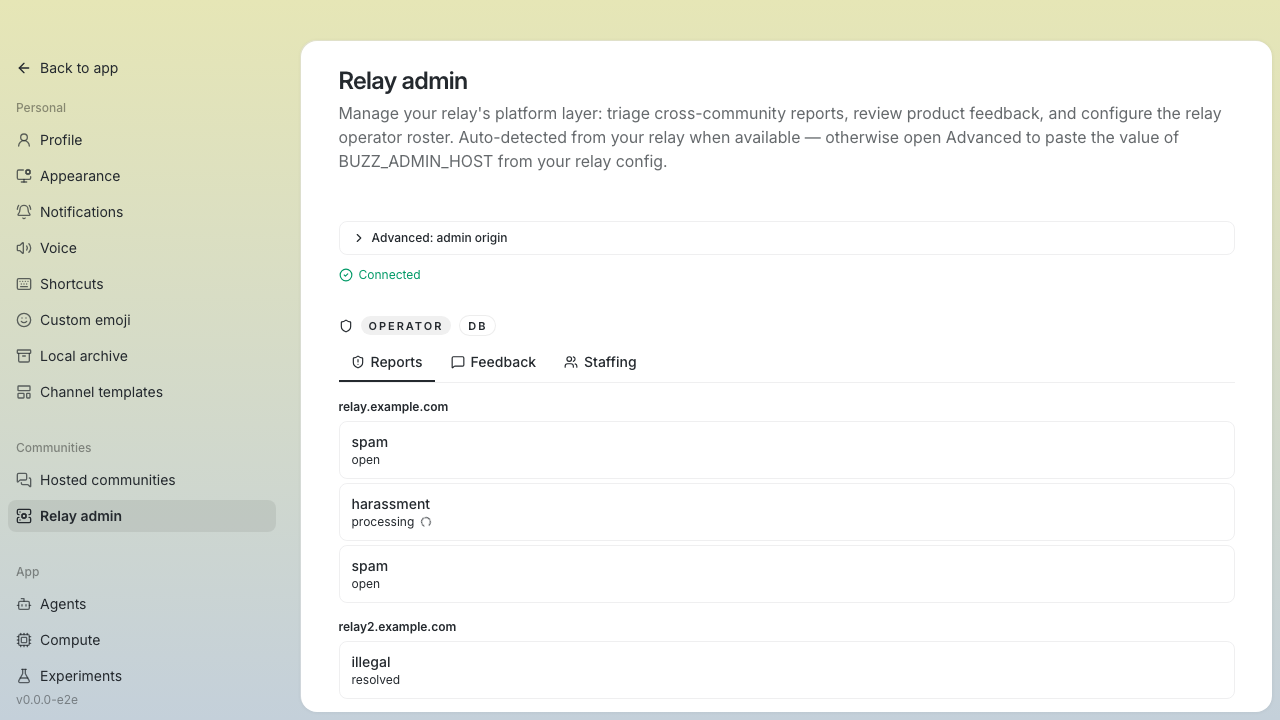 **Processing report — PROCESSING/HARASSMENT, ban enforcing state** 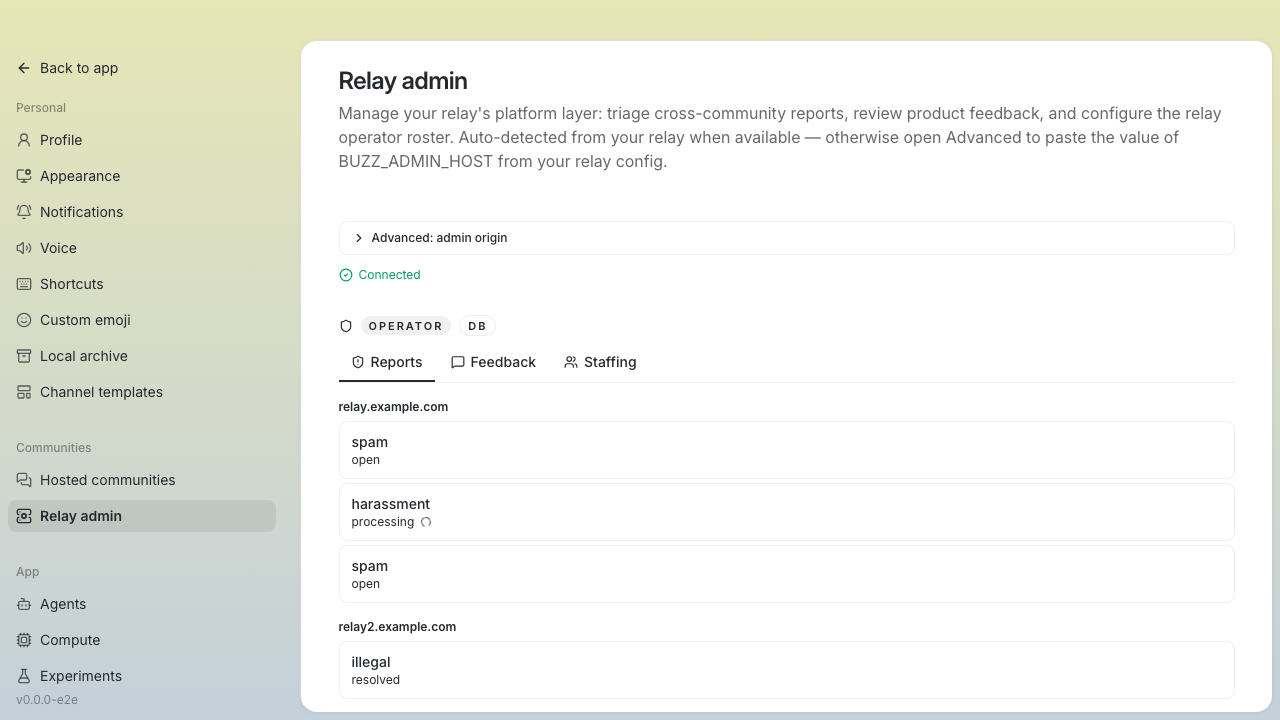 **Resolve form — Delete selected, audience disclosure copy** 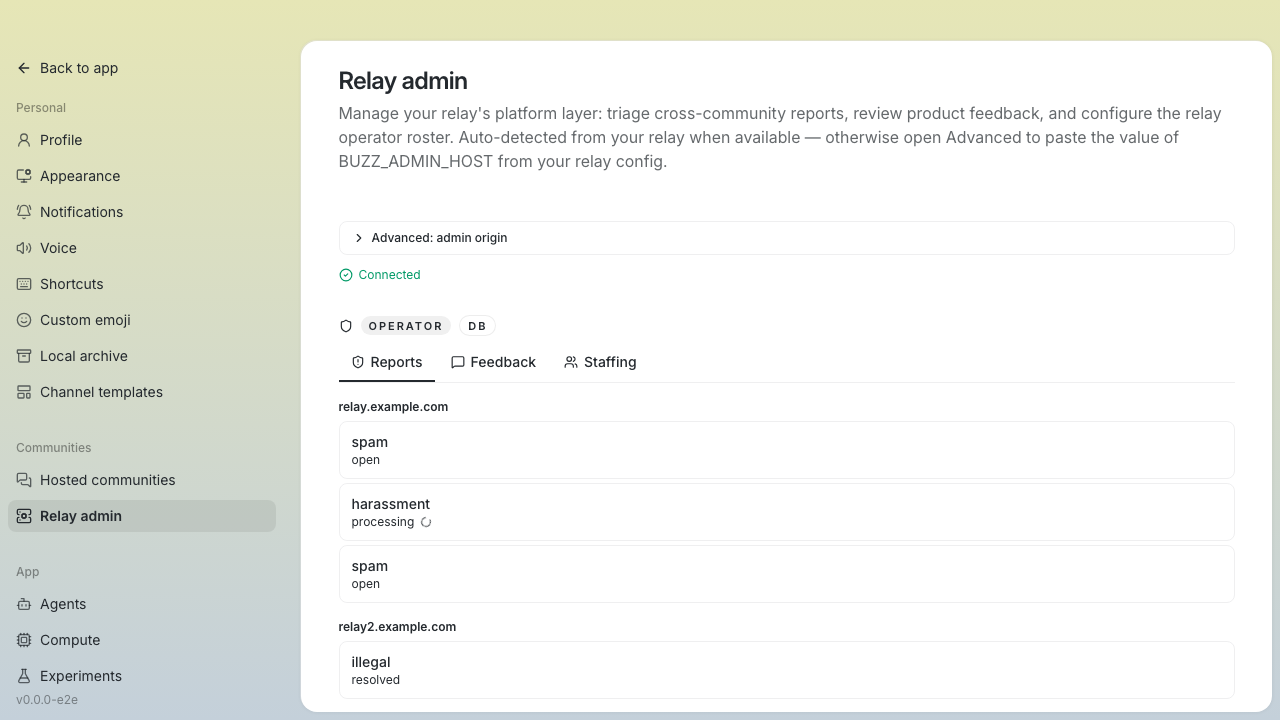 **Resolved report — enforcement history block** 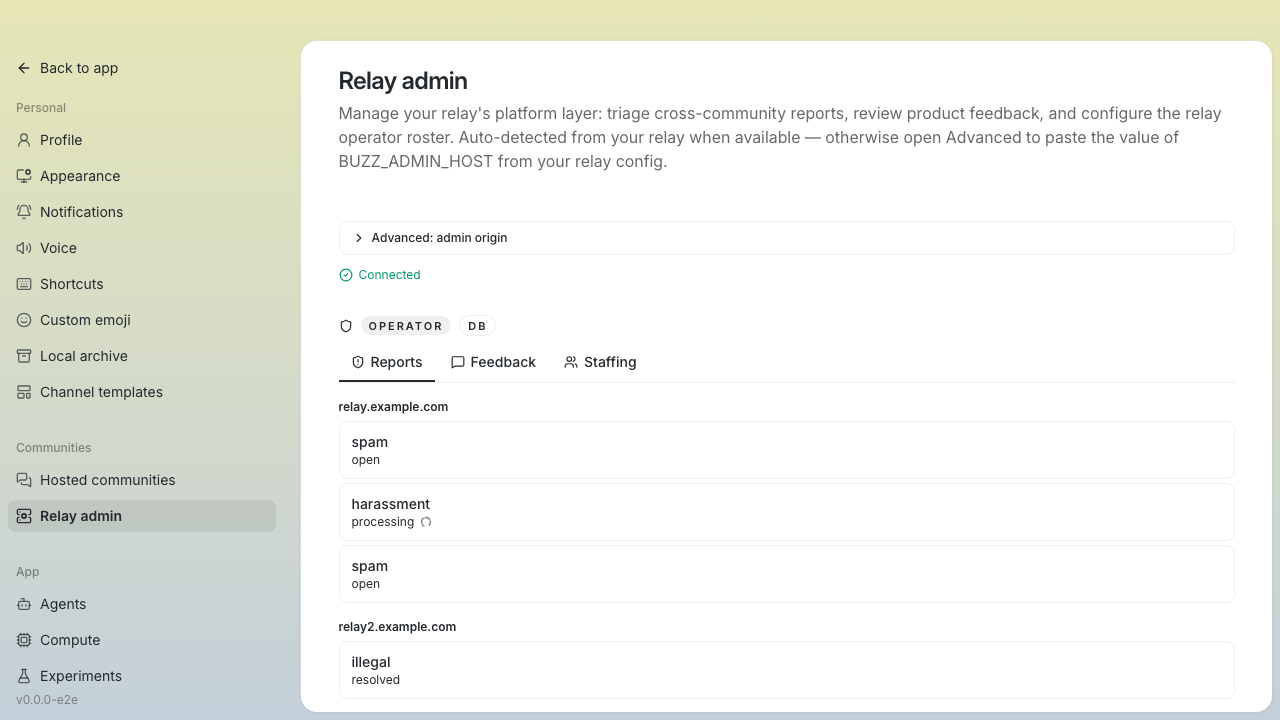 ### Feedback **Feedback list — community grouping with status badges** 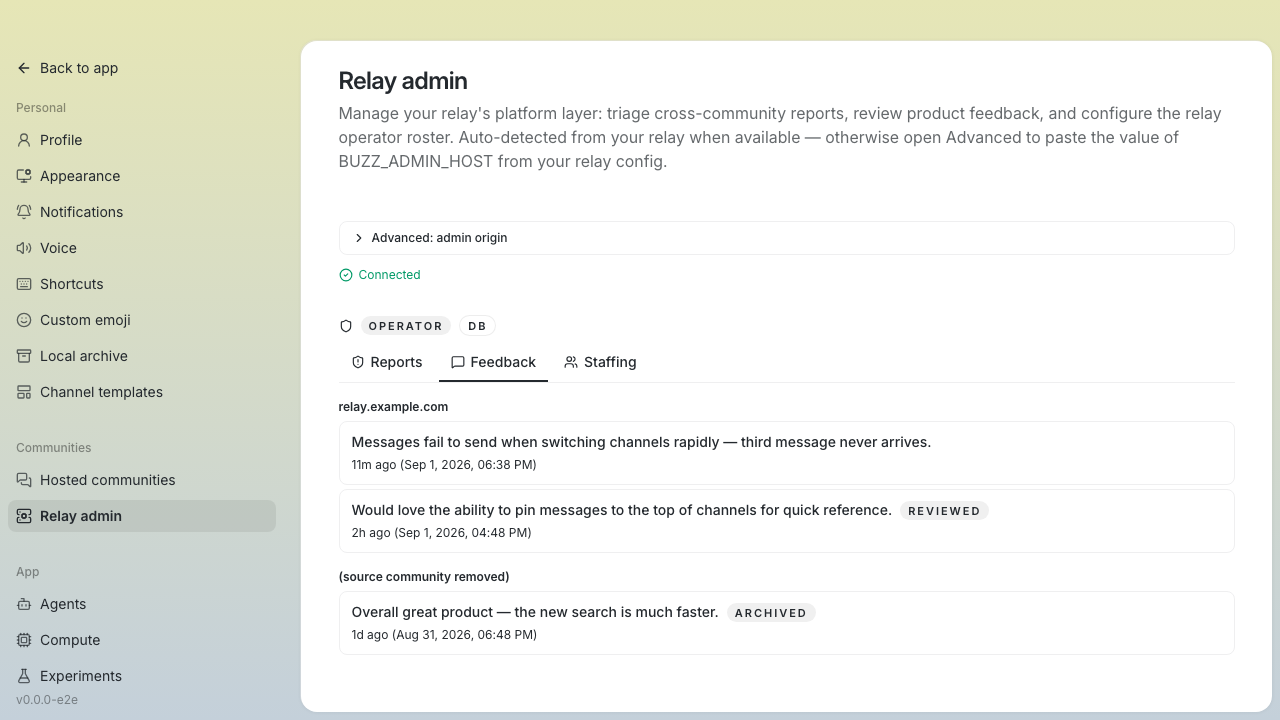 **Feedback detail — mutable status control (operator mode)** 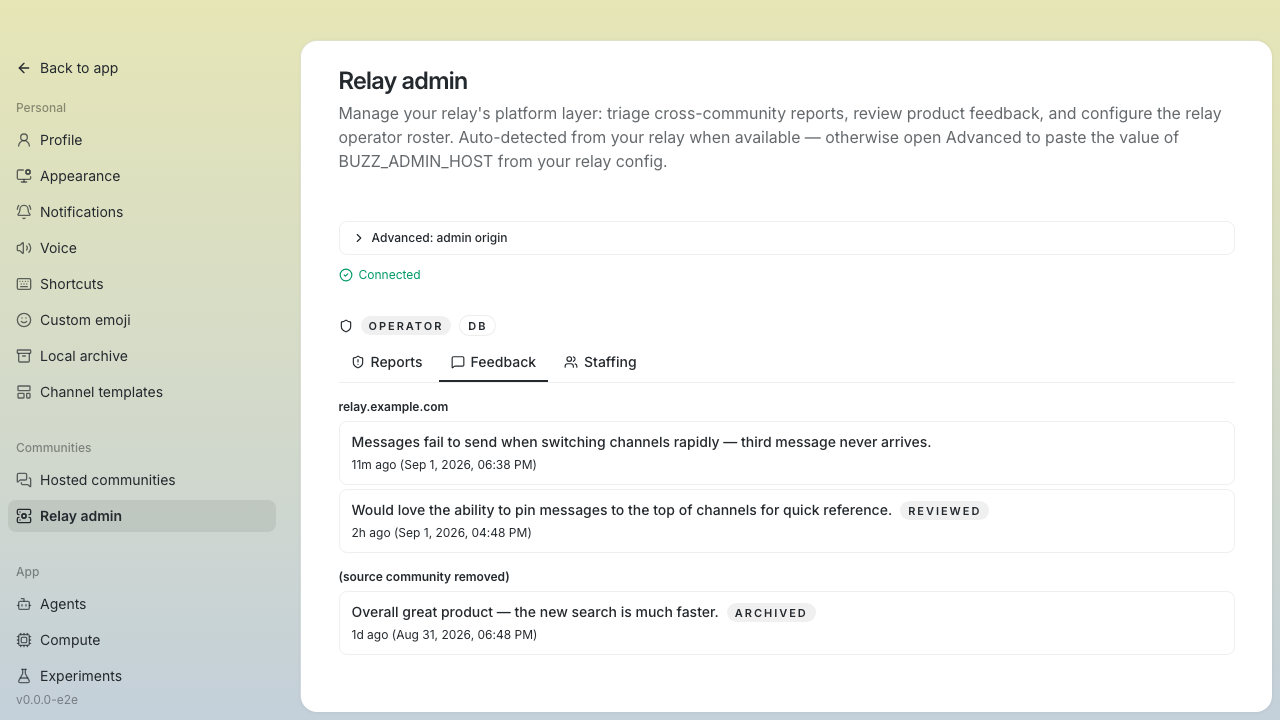 **Feedback detail — passive status badge (read-only/disabled mode)** 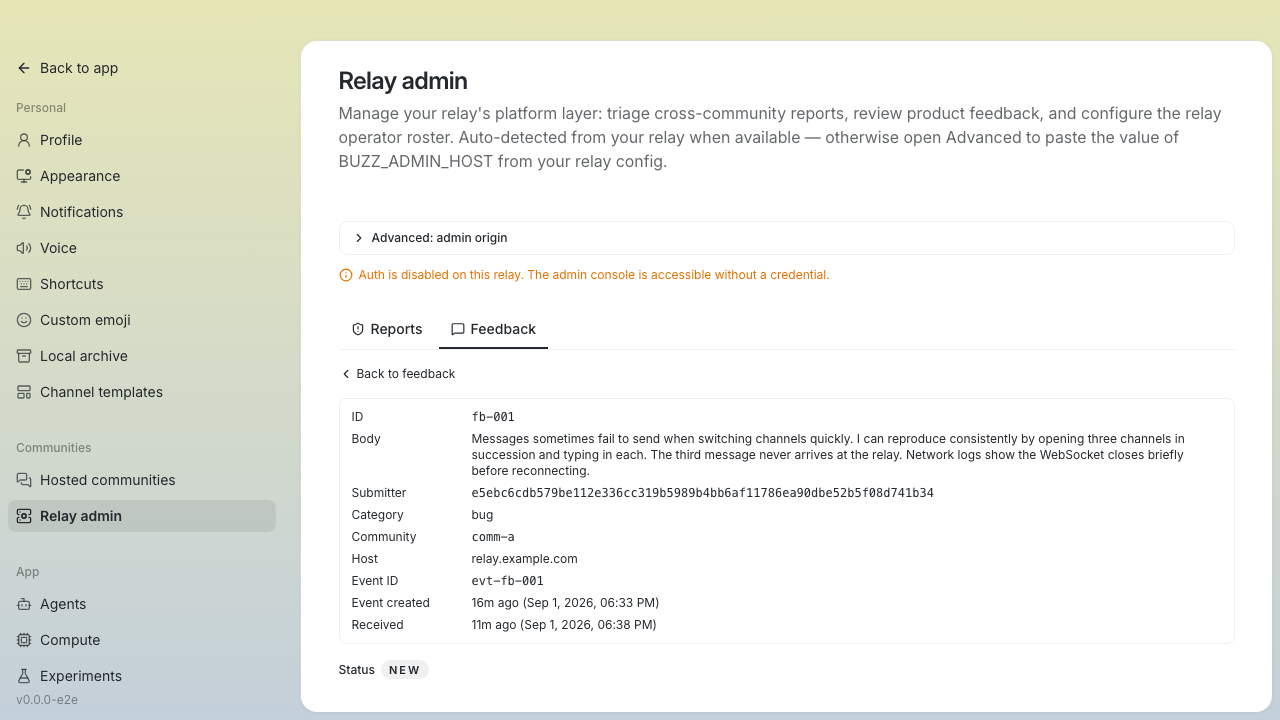 ### Staffing **Staffing roster — config/owner\_fallback/db source labels** 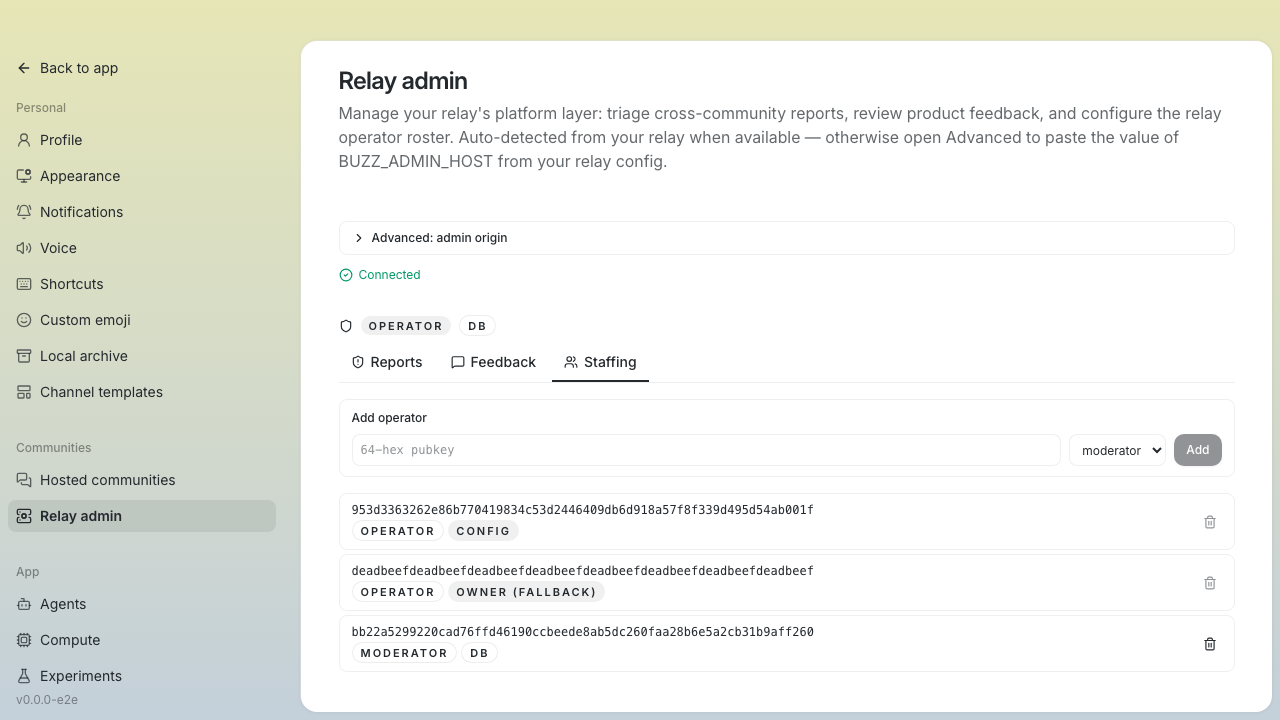 **Add form — new pubkey filled, ready to submit** 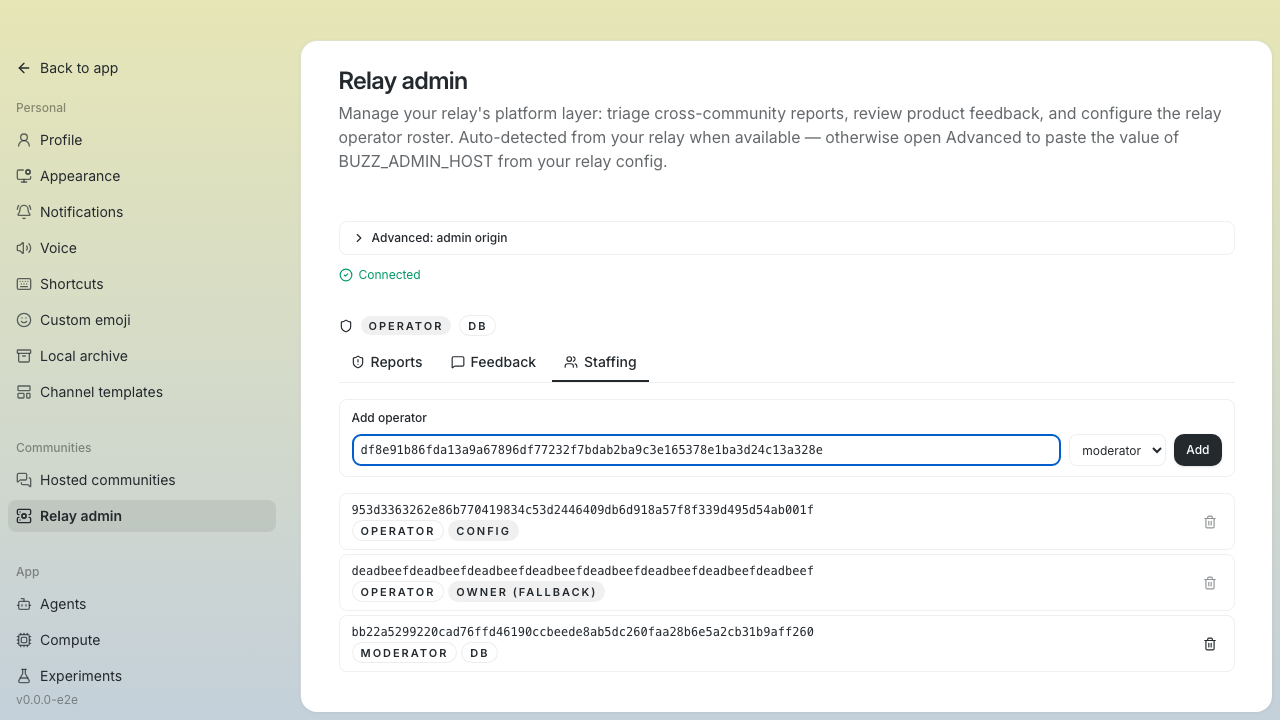 **Duplicate rejection — inline error for existing principal** 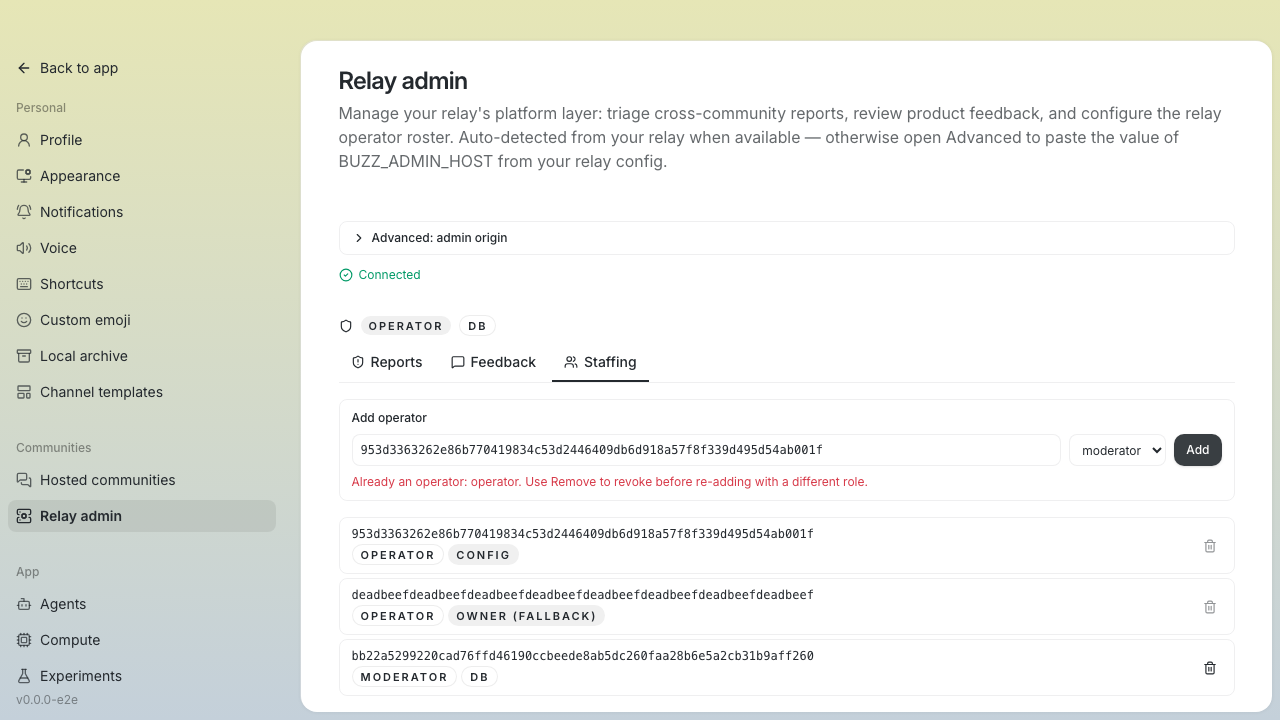 --------- Signed-off-by: Will Pfleger <pfleger.will@gmail.com> Signed-off-by: Will Pfleger <wpfleger@block.xyz> Signed-off-by: Duncan <dcfd242e557282d7a1e2cf2e6877522682f1e5c6156dc92ca7d90eaedd3b0f95@buzz.block.builderlab.xyz> Signed-off-by: Alia <d32955ad69077062930cc46cfe2df30ca9aaf6f8e76422681265e9e9af704d78@buzz.block.builderlab.xyz> Co-authored-by: Duncan <dcfd242e557282d7a1e2cf2e6877522682f1e5c6156dc92ca7d90eaedd3b0f95@buzz.block.builderlab.xyz> Co-authored-by: Alia <d32955ad69077062930cc46cfe2df30ca9aaf6f8e76422681265e9e9af704d78@buzz.block.builderlab.xyz>













21 KiB
Deployment moderation dashboard
Buzz can expose a private, deployment-wide moderation dashboard from the existing relay process. It shows open moderation reports and recent product feedback.
Configure BUZZ_ADMIN_HOST to activate the dashboard. A private ingress limits
access to the operator VPN or approved source IPs.
Required configuration:
BUZZ_ADMIN_HOST=admin.example.com
BUZZ_ADMIN_WEB_DIR=/srv/buzz/admin-web
Plus one of the authentication modes below.
Authentication
The admin API requires explicit authentication configuration. Setting only
BUZZ_ADMIN_HOST activates the dashboard in the default nip98 mode. Configure
the mode with BUZZ_ADMIN_AUTH, which accepts nip98 (default when unset) or
disabled.
BUZZ_ADMIN_TOKEN is no longer recognised: token authentication was removed.
Setting it is ignored with a startup warning, so a stale token variable cannot
silently run a deployment on a removed auth path — remove it from the environment
and use nip98 (or disabled behind a network boundary).
NIP-98 mode (BUZZ_ADMIN_AUTH=nip98, default)
Every /api/admin/v1 request must carry a NIP-98 HTTP Auth header containing a
signed kind-27235 event. The signer's pubkey is resolved against a two-tier
principal model — Operator or Moderator — that grants capabilities
accordingly.
BUZZ_ADMIN_AUTH=nip98
RELAY_OPERATOR_PUBKEYS=<64-char hex pubkey>[,<64-char hex pubkey>...]
- A malformed
RELAY_OWNER_PUBKEYalongsidenip98is a startup error (see owner fallback below). RELAY_OPERATOR_API_ORIGINis not required to run the admin console. That origin is only used by the community-provisioning endpoints (POST /operator/communities), which share theRELAY_OPERATOR_PUBKEYSallowlist. When the pubkeys are set but the origin is not, the relay boots with aWARNand provisioning requests fail closed at request time until the origin is set — the admin console is unaffected.
Auto-discovery via NIP-11
When BUZZ_ADMIN_HOST is set, the relay advertises the admin API origin in its
NIP-11 relay-information document under an optional admin_api field:
{ "admin_api": "https://admin.example.com" }
The value is the canonical origin scheme://host[:port] (no path), with the
scheme derived by the same loopback rule as u-tag verification (http for
localhost/127.x/[::1], else https). The field is omitted entirely when no
admin surface is configured. Clients (such as the desktop console) read this to
auto-discover the admin endpoint instead of requiring manual URL entry. IPv6
admin hosts must be bracketed ([::1], [::1]:3000); an unbracketed literal is
a startup error.
Each request requires:
Authorization: Nostr <base64(JSON event)>
The event must be kind 27235, have a u tag matching the exact request URL
(including any query string, e.g.
https://admin.example.com/api/admin/v1/reports?status=open), a method tag
matching the HTTP method, a valid Schnorr signature, and a created_at within
±60 seconds of now. Body-bearing mutations (POST, PUT, PATCH) additionally
require a payload tag containing the SHA-256 hex digest of the raw request
body. A deployment-scoped replay guard rejects reused event IDs; Redis failure
fails closed.
Any auth failure (bad event, bad signature, expired, replay, unrecognised pubkey,
missing/incorrect payload tag on mutations, duplicate Authorization header)
returns 401 with WWW-Authenticate: Nostr. The dashboard's first-load probe
treats any non-200 response as nip98 mode (only a 200 selects disabled
mode), so a credential is always required unless the relay explicitly serves the
unauthenticated surface.
The dashboard requires a NIP-07 browser extension (such as nos2x or Alby). If no extension is detected, the dashboard shows an installation screen. Once an extension is present, each API request is automatically signed with the principal's nostr key without any prompts.
Principal model: Operator and Moderator
The signer's pubkey is resolved to a principal with an effective role and a source that describes how the grant was established:
| Resolution order | Role | Source |
|---|---|---|
Pubkey is in RELAY_OPERATOR_PUBKEYS (config) |
Operator | config |
Pubkey equals RELAY_OWNER_PUBKEY and RELAY_OPERATOR_PUBKEYS is empty |
Operator | owner_fallback |
Pubkey has a row in the relay_operators DB table |
Operator or Moderator | db |
| No grant found | — | 403 |
Config always outranks DB: a DB row for a config-backed pubkey is ignored and
never demotes the config grant. None never falls through as a role.
Owner fallback is an implicit Operator grant for self-hosters that do not yet
have an operator configured. It activates only when the configured
RELAY_OPERATOR_PUBKEYS list is empty, and it is evaluated from config at
request time — staffing the roster cannot make it flap. Once any pubkey is added
to RELAY_OPERATOR_PUBKEYS, the fallback deactivates. A malformed
RELAY_OWNER_PUBKEY is a startup error (not warn-and-ignore): once the owner key
can be a break-glass root, silently discarding it would be a lockout.
Capabilities by role
| Capability | Operator | Moderator |
|---|---|---|
| Read reports, feedback, attachment bytes | ✓ | ✓ |
| Resolve reports (dismiss, escalate, delete, kick, ban, timeout) | ✓ | ✓ |
| Update feedback status | ✓ | ✓ |
Manage operator roster (GET/PUT/DELETE /operators) |
✓ | ✗ |
Capability checks are server-authoritative; the desktop console hides Staffing tab controls for Moderators as a UX convenience only.
Roster management
Operators manage the roster via the staffing endpoints (GET/PUT/DELETE /operators/{pubkey}). Staffing operations are only available in nip98 mode.
Config-backed pubkeys (RELAY_OPERATOR_PUBKEYS, owner fallback) cannot be
modified through the API — PUT or DELETE against a config-backed pubkey
returns 409 Conflict. A DB moderator row for a config-backed Operator pubkey is
ignored; it never demotes the config grant.
GET /operators returns every effective principal with its effectiveRole and
all contributing sources (config, owner_fallback, db).
Last-operator protection. When no config-backed operator is effective —
RELAY_OPERATOR_PUBKEYS is empty and owner fallback is inactive — the roster is
staffed entirely by DB operator rows. A demotion or delete that would remove
the final DB operator is rejected transactionally with 409 Conflict ("add a
replacement operator first"); the row is left unchanged. The safe way to hand
off sole authority is the add-first transfer: PUT the replacement operator,
then demote or delete the outgoing one. Config-backed operators are unaffected —
while any config operator or owner fallback is effective, the DB roster may be
emptied freely because config still guarantees an operator.
Disabled mode (BUZZ_ADMIN_AUTH=disabled)
Operators whose admin API is already protected at the network layer — for example by a corporate VPN such as WARP+Okta — can disable request authentication entirely:
BUZZ_ADMIN_AUTH=disabled
Only the exact value disabled is accepted.
In this mode the relay logs a WARN on every startup:
BUZZ_ADMIN_AUTH=disabled — the admin API is unauthenticated; the operator has
asserted that access is controlled at the network layer
The Host/Origin checks remain active as defense-in-depth. The dashboard
detects that no credential is needed on first load (probe returns 200) and
renders directly.
This mode relies entirely on the operator's network controls. If the admin API is reachable by untrusted clients, the entire moderation and feedback dataset is exposed. Use nip98 mode instead.
When using a reverse proxy in this mode, document the requirement and consider a proxy-injected shared secret or signed identity header for additional assurance.
Mode selection and error behaviour
BUZZ_ADMIN_AUTH accepts exactly nip98 or disabled. Any other non-empty
value is a startup error (typo-proofing). BUZZ_ADMIN_TOKEN is no longer
recognised and its presence is ignored with a startup warning regardless of the
other variables:
| Combination | Result |
|---|---|
BUZZ_ADMIN_TOKEN set (with or without BUZZ_ADMIN_HOST) |
warn + ignore |
BUZZ_ADMIN_AUTH=nip98 with a malformed RELAY_OWNER_PUBKEY |
startup error |
BUZZ_ADMIN_AUTH junk value |
startup error |
BUZZ_ADMIN_AUTH without BUZZ_ADMIN_HOST |
warn + ignore |
Content Security Policy
Every admin-host response that carries the dashboard itself — the SPA document
on each admin route, the hashed /assets/* bundle, and admin-host 404s — is
served with a Content Security Policy response header, ADMIN_CSP in
crates/buzz-relay/src/router.rs:
default-src 'none'; script-src 'self'; style-src 'self'; connect-src 'self'; img-src 'self' blob:; object-src 'none'; base-uri 'none'; frame-ancestors 'none'; form-action 'self'
It blocks inline and third-party script and restricts subresource and request
destinations to the same origin, which closes the direct paths an injected
script would use to exfiltrate credentials or data. It does not constrain
top-level navigation, so it is a containment layer, not a substitute for
keeping script off the origin. blob: is permitted for images only, for
attachment previews. It is a response header rather than a <meta> tag because
frame-ancestors is ignored in meta — that directive is the dashboard's
authoritative frame protection, superseding the X-Frame-Options: DENY the JSON
API sends. The policy applies to the admin host only; the public web bundle
keeps its own headers.
The exact admin Host and matching browser Origin are still required in both
auth modes, but they are defense-in-depth, not the primary access control. HTTPS
and a private ingress remain required: in nip98 mode the signed credential
travels in the Authorization header; in network-layer mode the VPN/firewall
boundary is the only access control.
When the UI runs in a separate pod, proxy /api/admin/v1/* to the relay while
preserving the admin Host header and (in nip98 mode) the client's
Authorization header. A NetworkPolicy grants the admin pod access to that
relay path.
Operator migration
Upgrading from a pre-auth release (Buzz prior to the introduction of this
BUZZ_ADMIN_HOST requirement): any deployed relay with BUZZ_ADMIN_HOST set
boots in nip98 mode after upgrade unless BUZZ_ADMIN_AUTH=disabled is set.
Choose the mode that fits your deployment:
- Nostr principal model (default): set
BUZZ_ADMIN_AUTH=nip98(or leave it unset) and populateRELAY_OPERATOR_PUBKEYSwith at least one operator pubkey (or rely on owner fallback ifRELAY_OWNER_PUBKEYis already set) in your deploy config, then roll the new version. In a single config rollout, both setBUZZ_ADMIN_AUTH=nip98and add the operator pubkey(s) — never split these across separate rollouts, as a mode-flip without operators configured leaves no-one able to authenticate. - Network-layer mode (e.g. Block's
bb-publicbehind WARP+Okta): setBUZZ_ADMIN_AUTH=disabledin your deploy config, then roll the new version.
Upgrading from a token-mode release: token authentication was removed.
Remove BUZZ_ADMIN_TOKEN from the environment — leaving it set is ignored with
a startup warning — and adopt nip98 (populate RELAY_OPERATOR_PUBKEYS) or
disabled before rolling the new version.
Upgrading from the previous BUZZ_ADMIN_INSECURE_NO_AUTH=true variable:
replace it with BUZZ_ADMIN_AUTH=disabled. Behavior is identical; the old
variable is no longer recognised.
Member restriction routes now take communityHost, not communityId:
GET /members/restrictions and DELETE /members/:pubkey/ban|timeout name the
community by the relay host the client connected to, so the relay resolves
its own tenant (see Member restriction routes).
There is no compatibility shim:
- Roll the relay with this change before any desktop build that uses it. A new desktop against an old relay cannot list or lift restrictions.
- Scripts that call these routes with
communityIdmust switch tocommunityHost. - Rolling the relay back to a
communityIdbuild breaks the desktop Admin → Staffing → Restrictions UI until the relay is rolled forward again.
Relays without BUZZ_ADMIN_HOST are completely unaffected, except that a
lingering BUZZ_ADMIN_TOKEN now logs a startup warning and must be removed.
Any non-browser client of /api/admin/v1 (monitoring probes, scripts, cron
jobs) must sign each request with a NIP-98 Authorization: Nostr header after
the upgrade, unless the deployment runs in disabled mode. The dashboard handles
itself. If a reverse proxy strips or rewrites Authorization headers, the
dashboard breaks post-upgrade in nip98 mode — check proxy configuration before
rolling.
Local development
For local review, run just admin-seed before just admin. just admin
defaults to BUZZ_ADMIN_AUTH=disabled, so the dashboard renders without a
credential. The seed command also uploads real image and diagnostic fixtures to
local MinIO. Feedback search and filters run over the bounded browser result
set. The feedback status control (new/reviewed/archived) is
server-backed: in nip98 mode it PATCHes the relay and adopts the returned
status, so every operator sees the same state; in disabled mode it renders as
a read-only badge because the server rejects mutations.
Routes
Read routes (Operator and Moderator)
GET /api/admin/v1/probeGET /api/admin/v1/reportsGET /api/admin/v1/reports/:idGET /api/admin/v1/feedbackGET /api/admin/v1/feedback/:idGET /api/admin/v1/feedback/:id/attachments/:sha256
Action routes (Operator and Moderator)
-
POST /api/admin/v1/reports/:id/resolveBody:{"action": "delete|kick|ban|timeout|dismiss|escalate", "expirationSecs": <number>, "reason": "<string>", "requestId": "<uuid>"}expirationSecsrequired fortimeout, rejected for all others. Target/channel are always derived from server-owned report provenance. Response:{"status": "<terminal>", "activeAction": <action | null>}. Enforcement actions return the governing action record;dismiss/escalatereturnnull.reasonis PUBLIC. Fordelete/kick/ban/timeoutthe string is broadcast verbatim to the channel as the removal tombstone's public reason and sent verbatim to the affected user in a moderation DM. It is not sanitized, redacted, or mapped to a code. Never put private, internal, or report-derived context inreason— write only text that is safe for the room and the actioned user to read. -
POST /api/admin/v1/reports/:id/reopenBody:{"requestId": "<uuid>", "reason": "<string>"}Returns a terminal report (resolved,dismissed, orescalated) toopenand records a durablereopenaudit row. Idempotent onrequestId: a retry after the report has been reopened (and possibly re-resolved) returns the same200without re-reopening. Returns{"status": "open"}on success,409if the report is not in a terminal state,404if it does not exist. -
POST /api/admin/v1/reports/:id/cancelBody:{"actionId": "<uuid>"}Cancels a pre-mutationfailedenforcement action, returning the report toopen. Cancel is the only recovery path for a failed action.actionIdfences the cancel to exactly the action the client observed. Returns{"status": "open", "activeAction": <cancelled action>}— the embedded record is the last look at that action, since a subsequent detail read (report back toopen) servesactiveAction: null. Returns409if the action is not cancellable (already cancelled, superseded, or past the mutation point) — treat as "refresh detail". -
PATCH /api/admin/v1/feedback/:idBody:{"status": "new|reviewed|archived"}
Member restriction routes (Operator and Moderator)
All three name the community by communityHost: the relay's own host
authority (host, plus port when non-default), which the relay resolves to its
tenant through the same binder that scopes live connections. The caller's
local community ids are never accepted. A host the relay serves no community
for returns 400 with error unknown_community_host, never an empty result.
GET /api/admin/v1/members/restrictions?communityHost=<host>[&limit=<1-200>][&cursor=<token>]Lists active bans and timeouts, newest first. Response:{"items": [...], "nextCursor": "<token>" | null}.limitdefaults to 200; pass the prior page'snextCursorascursorto continue.400on a missing or unknown host, an out-of-rangelimit, or a malformedcursor.DELETE /api/admin/v1/members/:pubkey/ban?communityHost=<host>Lifts an active ban.204on success,409if no active ban exists. Mutation: requiresnip98mode.DELETE /api/admin/v1/members/:pubkey/timeout?communityHost=<host>Clears an active timeout.204on success,409if no active timeout exists. Mutation: requiresnip98mode.
Staffing routes (Operator only)
GET /api/admin/v1/operatorsReturns every effective principal with itseffectiveRoleand all contributingsources(config,owner_fallback,db).PUT /api/admin/v1/operators/:pubkeyBody:{"role": "operator|moderator"}Returns409if the target is config-backed.DELETE /api/admin/v1/operators/:pubkeyReturns409if the target is config-backed.
Report reads accept optional communityId, status, reportType, targetKind,
after, before, scope, and limit parameters. Limits are capped at 200. Feedback is
a bounded newest-first summary from the existing product-feedback repository.
Escalation-scoped default
GET /reports with no status parameter returns only escalated reports — the
escalation backstop the operator queue is meant to hold per VISION_MODERATION,
where the severe class is the platform's to review rather than the community's.
An explicit status=<open|resolved|dismissed|escalated> filter is always honored
as given. Full visibility across every status stays available for platform-safety
and legal review via scope=all, which lists reports regardless of status;
scope accepts only all and is ignored when an explicit status is present.
Reports whose category is illegal bypass community triage entirely: they are
ingested with status=escalated rather than open, so the severe class reaches
the operator backstop without waiting for a community admin to forward it (per
VISION_MODERATION, that class was never the community's to hold). Every other
category still lands open. Auto-escalation only sets the queue status — it
records no moderator decision and stamps no resolver, so an auto-escalated report
is indistinguishable downstream from an admin-escalated one: the reopen route
returns it to open on the same terms, keyed only on status, never on how the
report became escalated.
Feedback attachment boundary
Feedback attachment bytes are available only through the feedback-scoped read
route (GET /api/admin/v1/feedback/:id/attachments/:sha256, listed under Read
routes above).
The route uses the same credential requirement (NIP-98 event, or network-layer
boundary in disabled mode), private-ingress, exact admin Host, and same-origin
boundary as the JSON API. It is not a generic media endpoint. The relay loads
the feedback row, derives its community from server-owned provenance, verifies
that host resolution still maps to the row's community_id, and requires the
requested SHA-256 to match both the x field and source-community /media/ URL
in that row's persisted imeta tag. It then reads the tenant-scoped media
sidecar before accessing the shared content-addressed blob. Unknown feedback,
unreferenced hashes, malformed paths, and cross-community substitutions all
collapse to 404.
Product feedback is deployment-global operator evidence: when its source community
is purged, the row's community_id is severed to NULL (the row survives, its
provenance does not). List and detail reads still return such rows with
communityId and communityHost as null. Their attachments, however, were
purged with the tenant, so the attachment route fails closed to 404 for any
severed feedback — there is no tenant to bind and no tenant-scoped media to serve.
Only GET and HEAD are routed. Community /media/* reads always require
Blossom authorization and relay membership; the browser receives no reusable
signed URL. Responses are uncached, nosniff,
governed by a restrictive CSP, streamed from object storage, and non-previewable
content retains attachment disposition. Successful reads produce a structured
trace containing feedback ID, community ID, and attachment hash, but no feedback
body or attachment URL.
The human trust boundary is the chosen auth mode plus the private admin ingress. Disabled mode provides no per-operator identity; anyone admitted to the dashboard can read attachments for feedback records they can access. NIP-98 mode provides per-operator attribution and individual revocability. Per-person identity in disabled mode requires authenticated operator identity at ingress/application level (for example an Okta-injected identity header).