mirror of
https://github.com/block/buzz.git
synced 2026-10-27 12:40:30 +00:00
2745a419a836fb6bc4753f0caf3c9cf9c9a4d274
2935 Commits
| Author | SHA1 | Message | Date | |
|---|---|---|---|---|
 Luke Tornquist |
2745a419a8 |
buzz-db: tolerate absent universal write-fence objects (expand) (#8322)
## What This is the expand step for retiring the 32 universal `community_write_fence_*` triggers and their SQL functions (BUZZ-315). Relay pods auto-migrate at boot (`BUZZ_AUTO_MIGRATE`). The drop migration therefore runs while the previous release is still serving, and that release must not depend on the objects it drops. Today the app depends on them in four places, and this PR removes all four from its own code paths. Seven in-SQL `community_write_allowed` predicates in fleet sweeps and push (`push_enqueue.rs`, `channel.rs`, `event.rs`, `push.rs`, `relay_invite.rs`, `workflow.rs`) are #8318's scope. The release is independent of the fence functions only with both this PR and #8318. **It changes no schema.** The objects stay and keep working until the follow-up drop PR. | Old dependency | Now | |---|---| | Startup and readiness (`validate_serving_catalog_on`) require `community_write_allowed`, `assert_community_write_allowed`, `enforce_community_write_fence` and all 32 triggers | No longer required. Still required: the tenant tables, `community_deletion_lock_key` and the enabled community tombstone trigger. | | Serving-lease admission runs `SELECT assert_community_write_allowed($1)` | Uses `guard_community_write`, the same shared lock and state check as ordinary serving writes, in the same transaction as the lease `INSERT`. Fenced or missing communities still map to `AccessDenied`. | | Live scoped-table discovery calls `community_write_fence_excluded_table()` | Uses a Rust `EXCLUDED_SCOPED_TABLES` list. A unit test pins it equal to the SQL list while both exist. | | The deletion executor compares the live `fenced_tables` against the frozen inventory | Only tenant-table equality is compared. Inventories **still record** live fences, so an older executor that validates an inventory frozen by this release still matches. The digest still covers the full frozen manifest. | `lock_community_deletion_shared` now refuses transactions that are not READ COMMITTED, so every lock-then-read admission gets the check: `guard_community_write`, serving-lease finalization (`guard_transaction_with_serving_lease`), lease renewal/verification, owner preparation and owner-mutation admission. The old SQL assertion did this check for the lease path, and the trigger backed up the rest. The isolation level comes back from the existing `pg_advisory_xact_lock_shared` statement, so the hot path makes no extra round trip. The refusal comes before any lifecycle-state read. ## Mixed versions | Combination | Why it is safe | |---|---| | Previous release, this DB | No schema change, so all old checks still see the 32 fences. | | This release, DB with fence objects | Extra objects are tolerated, and the trigger backstop still applies. | | This release **plus #8318**, DB without fence objects | Serving, readiness, lease admission and deletion proven by `migration_schema_fence_objects_are_optional_for_serving_and_deletion`, which drops them inline. Without #8318, serving and deletion still work, but the push matcher, exhausted-job reaper, invite retention, ephemeral reaper and startup d_tag backfill fail with `42883 community_write_allowed(uuid) does not exist` (seen in deploy-stack E2E). | | Older executor, inventory frozen by this release | `fenced_tables` is still populated from the live catalog (32). | This PR does not depend on #8318 to merge and can ship alongside it, but it is not drop-safe alone. The drop PR (#8323) needs #8219, #8318 and this PR deployed on every pod, and every rollback image after the drop must include #8318. ## Tests - `store::deletion::postgres_tests::migration_schema_fence_objects_are_optional_for_serving_and_deletion` migrates to 0060. It then runs the following with the fence objects present, then again after dropping them inline: - serving startup - readiness - the deletion catalog check - `inventory_schema` - lease acquire/release - `AccessDenied` for quiescing, fenced, tombstoned and missing communities - `store::deletion::postgres_tests::deletion_lock_admission_rejects_pinned_snapshot_isolation` checks that REPEATABLE READ and SERIALIZABLE are refused by both `guard_community_write` and `guard_transaction_with_serving_lease`. The lease case uses a never-acquired lease, so if the isolation check is skipped it fails as stale instead. - `buzz-deletion` `postgres_tests::approved_legacy_fence_inventory_accepts_current_catalog` checks that a legacy digest with 32 fences validates against a live catalog with none, and that an unknown tenant table is still rejected. - `store::deletion::tests::scoped_table_exclusions_match_sql_during_transition` checks exclusion-list parity. - `store::deletion::postgres_tests::serving_lease_acquire_waits_for_fence_lock_then_refuses` holds the exclusive deletion lock and checks that lease acquisition stays pending. It then commits `fenced` and requires `AccessDenied` with no lease row persisted. Removing the lease path's `guard_community_write` call fails this test, while the other four lease/admission tests above still pass. - `buzz-deletion` `serving_guard_heartbeats_long_operation_through_quiescing` now requires `AccessDenied` for a lease acquired during quiescing, rather than any error. Each test was confirmed to fail when its fix is removed (rc 100, 0/1): the isolation refusal, the three validators restored to the base version, the fence-list comparison restored, and one name dropped from the Rust list. ## What got simpler The lease path loses its special SQL assertion and its error-code translation and reuses the ordinary app guard. The serving and deletion catalog checks each lose one requirement. No new abstraction. The `fenced_tables` reader stays only for mixed-version executors; the drop PR deletes it. **Identified debt (pre-existing, outside this diff):** `runtime::postgres_tests::writer_pool_rejects_non_read_committed_database_default` hangs on clean `177551dda` too. ## Verification (Blox, tree identical to this commit) | Gate | Result | |---|---| | `cargo fmt --all -- --check` | pass | | `cargo clippy --workspace --all-targets -- -D warnings` | pass | | `cargo nextest run -p buzz-db --lib` | 167/167 | | `scripts/test-postgres-test-discovery.sh` | pass | | `scripts/postgres-test-run.sh -p` buzz-admin / audit / deletion / push-gateway / relay / search / workflow | all rc 0 (4, 7, 12, 11, 402, 20, 2) | | `scripts/postgres-test-run.sh -p buzz-db` | 510 pass, 1 fail: the pre-existing hang above, interrupted | | Round 2 (this head): `-p buzz-db` / `-p buzz-deletion` | 511 pass + the same pre-existing hang interrupted / 12/12 | The new PG tests are selected by the `postgres-ci` filter `(test(/postgres_tests::/) or binary(/^postgres_/)) and not test(/(^|::)external_infra[^:]*::/)`. buzz-review-completed --------- Signed-off-by: Elrond <28d6302a099e5225b02c4155ac4236e4912603df2ab08dbfc2f4fef08ce598c8@buzz.block.builderlab.xyz> Co-authored-by: Elrond <28d6302a099e5225b02c4155ac4236e4912603df2ab08dbfc2f4fef08ce598c8@buzz.block.builderlab.xyz> |
||
|
Brad Seiler
|
2d0f78c6e1 |
feat(auth): support explicit mesh JWKS transport (#8382)
## Summary Allow an issuer to opt into mesh HTTP for its JSON Web Key Set (JWKS). Public HTTPS remains the default. This supports deployments whose service mesh authenticates and protects the key endpoint. The sealed source contract selects transport and contributes to policy identity. Mesh mode requires a DNS hostname and checks every resolved address against an explicit allow-list before pinning one address. Both modes disable proxies, reject redirects, cap responses, and enforce a whole-fetch deadline. The relay cannot verify mesh security: operators must enforce mutual TLS, endpoint authorization, and egress restrictions. ### Related issue No duplicate mesh-JWKS issue or PR found. Existing NIP-FI relay enforcement: #7224. No deployment change is included. ### Testing - At `eccb8cb19420abda44cf6e5e62b1361e2843bd1d`: full auth package and auth/relay all-target clippy passed. Full relay package passed: 1,457 library tests, 37 binary tests, and 9 boot tests; 446 tests were ignored. - At prior head `113939838cd81d5e8d0b0f8783c42ffaae44a4d3`: the full relay library suite failed the demo echo test (1,455 passed, 1 failed, 440 ignored). Independent checks reproduced that timeout at base `d61fe2071d2b3d8e56dd931947f16bfe0d6173fe`; the receive-cancellation defect is outside this change. A later pass does not establish that defect is fixed. - Three falsifying mutations at `eccb8cb194` were caught: mixed DNS answers, proxy bypass, and whole-fetch deadline. The full locked auth package passed after restoring the exact source. - At `eccb8cb194`, `cargo build --locked --release -p buzz-relay -p buzz-cli -p buzz-admin` passed with command-local `CARGO_PROFILE_RELEASE_STRIP=none`. This avoids a macOS loader error without a source, lockfile, or project-profile change. - Earlier hooks failed the ACP signal test and Tauri login-shell PATH test. The ACP failure also reproduced on unmodified main `93ffc37c`. Main merged without conflict. The full Tauri package then passed with `RUST_TEST_THREADS=1`: 3,422 library tests and 3 integration tests, 19 ignored. All pre-push hooks passed with that same command-local setting; no hook or test was skipped. - At `eccb8cb194`, isolated `just test` passed all 107 runner steps. The monolithic `just ci` run timed out after 1,120 seconds; all recipes passed across that run and separate `just desktop-tauri-test`, `just web-build`, and `just mobile-test` invocations. No monolithic pass is claimed. - Exact-head release live-local checks passed: loopback HTTP mesh JWKS warm; valid assertion 101; expired/wrong issuer/wrong audience 403; valid signed disconnect 200; wrong command audience 403. Redirect-only JWKS returned assertion 503 without a request to its target. Both omitted/default and explicit public transport rejected HTTP at startup. - A separate NIP-FI-off release CLI smoke test created an open channel, sent an accepted message, read it back, and fetched its thread. The assertion probe closes after upgrade; it does not prove a complete NIP-42 session. Local loopback tests do not prove deployment mesh authentication, endpoint authorization, egress controls, or real `240/4` routing. Generated with Codex ## Human Testing valid assertion / configured community audience: HTTP 101 (expected 101) expired assertion: HTTP 403 (expected 403) wrong issuer: HTTP 403 (expected 403) wrong community audience: HTTP 403 (expected 403) valid command JWT / configured command audience: HTTP 200, body=b'{"disconnected": true}' (expected 200) valid command signature / wrong audience: HTTP 403 (expected 403) --------- Signed-off-by: seiler <seiler@squareup.com> Signed-off-by: Local Builder <1c476cb1127ea270cb900bdc3891060140bdd1173f91498030ee9b4db01c2f20@buzz.block.builderlab.xyz> Co-authored-by: Codex <noreply@openai.com> Co-authored-by: Local Builder <1c476cb1127ea270cb900bdc3891060140bdd1173f91498030ee9b4db01c2f20@buzz.block.builderlab.xyz> |
||
|
Tom Brow
|
2de484baf7 |
docs(ios): document Xcode 27 development setup (#8400)
Document Xcode 27.0 as the recommended iOS development toolchain while retaining Xcode 26 compatibility. Explain per-command selection, the known Flutter native-assets compiler/SDK mismatch on hosts with multiple Xcode versions, and where CI and release toolchains are configured. The compatibility changes are already merged in [#8379](https://github.com/block/buzz/pull/8379) and [#8398](https://github.com/block/buzz/pull/8398). Related open work is [#8330](https://github.com/block/buzz/pull/8330); this PR changes documentation only. The release version bump remains separate in [buzz-releases#110](https://github.com/squareup/buzz-releases/pull/110). ### Validation - Ordinary unsigned Release build passed on [main at |
||
|
klopez4212
|
c8ea4fb4eb |
feat(mobile): polish Home navigation and Solo workspace (#8393)
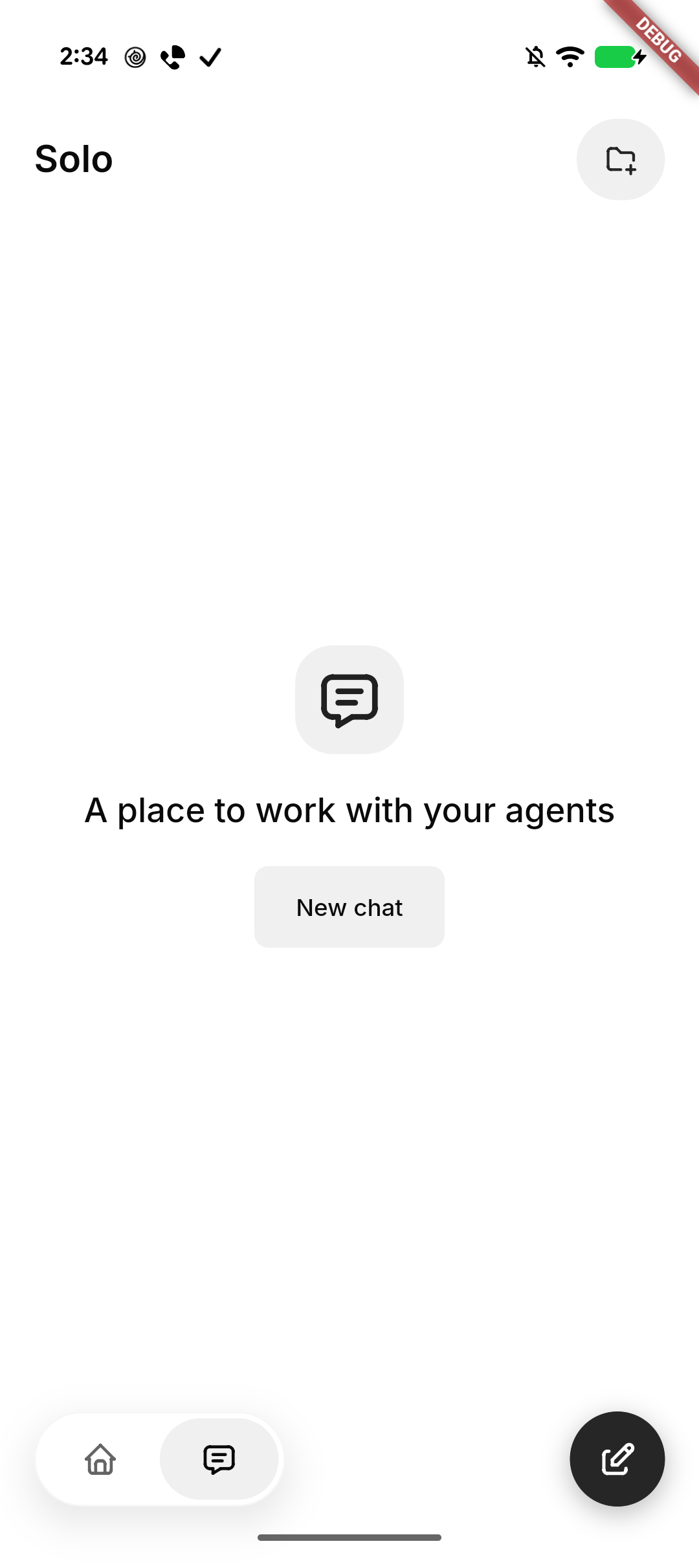
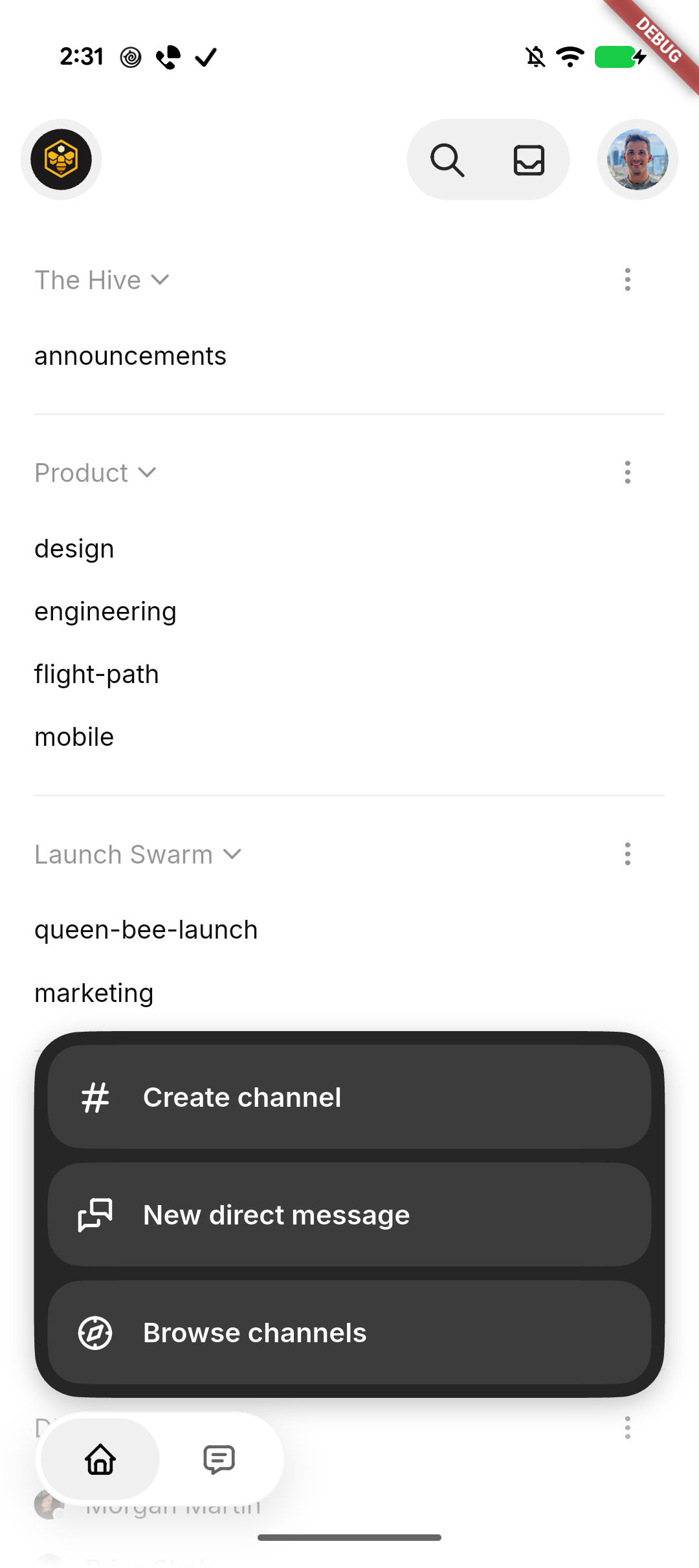
## Summary Polish mobile Home and Solo: group Search/Inbox beside a separate profile avatar, move Inbox and Settings to bottom-up pages with Close controls, and place tabs opposite the plus/compose action. Morph plus to compose clockwise when entering Solo and reverse counterclockwise when returning Home, with a directional quarter-turn of the icon inside a level button and a subtle scale pulse, respecting reduced motion. Align Search’s Close control with Inbox, simplify its placeholder, and initialize selected filter contrast correctly. Collapse the plus menu when leaving Home. Center Solo’s native-glass New chat empty state and keep it stationary behind the keyboard. Standardize Tabler icons and neutral backgrounds, retain SF Back/Close on iOS, use native Liquid Glass headers, tab container, and actions (solid grey selected tab, slightly darker on iOS) on iOS and black actions on Android, and smooth the expanded menu corners. Repair native header safe-area/return layout and compose movement after cancellation. ### Related issue None found for this UI refinement; follows #8337. ### Testing - Formatting, analysis, full mobile suite: 3,487 passed, 4 skipped; 3 push-configuration tests passed. File-size checks passed. - Base UI built and installed on Pixel and iPhone in place. Pixel navigation/New chat cancellation checked. Subsequent glass and rotation refinements are previewed on iPhone; motion feel awaits human confirmation. - Draft pending human confirmation of the final Settings entrance/return behavior on iPhone. ### Pixel snapshots | Solo | Expanded actions | | --- | --- | | <img src="https://raw.githubusercontent.com/block/buzz/16dc0f8af971e63d788fee20974997fab925dec9/docs/screenshots/mobile-home-solo/pixel-solo.png" width="280" alt="Solo empty state with New chat" /> | <img src="https://raw.githubusercontent.com/block/buzz/16dc0f8af971e63d788fee20974997fab925dec9/docs/screenshots/mobile-home-solo/pixel-actions.png" width="280" alt="Expanded channel actions with smooth corners" /> | --------- Signed-off-by: kenny lopez <klopez4212@gmail.com> Co-authored-by: Terp <5856f6900e8e0a4e0ea1f4f8d2ee33e4753d2119bc122f94ecafc660b46c0511@buzz.block.builderlab.xyz> |
||
|
Tom Brow
|
73962435b6 |
Use upstream C secp256k1 for native Nostr signatures (#8398)
Replace the Swift secp256k1 wrapper with a small native adapter over Bitcoin Core libsecp256k1. This is an alternative to the wrapper upgrade in [#8381](https://github.com/block/buzz/pull/8381), not an additional change to merge alongside it. The adapter covers the three Nostr operations Buzz needs: x-only public-key derivation, BIP-340 signing, and signature verification. It compiles pinned, unmodified upstream C source through SwiftPM. There is no build plugin, plugin approval script, or underscored Swift import. The app and notification extension use an explicit C module map and header search path. This trades the third-party Swift wrapper for a Buzz-owned adapter and responsibility for updating the vendored C source. Upstream v0.8.0 source, its license, and update provenance are included. The release Xcode pin remains separate in [buzz-releases#110](https://github.com/squareup/buzz-releases/pull/110). ### Validation - Native package tests passed on Xcode 27.0 and 26.5: 96 XCTest tests and 65 Swift Testing tests per toolchain. - Added tests cover the official BIP-340 vectors for 32-byte Nostr messages, invalid secret keys, and malformed input lengths. - Full unsigned Release app and notification extension build passed on exact Xcode 27.0. - Vendored files were compared byte-for-byte with upstream v0.8.0. - Full local `just ci` passed. - [Hosted full unsigned iOS Release build](https://github.com/block/buzz/actions/runs/38924020583/job/117051237094) passed. [Hosted Native Swift validation](https://github.com/block/buzz/actions/runs/38924020583/job/117051237153) passed, including the complete simulator build and native controls/push navigation tests. - Codex code review and security review completed with no findings. ### Before merge - [x] Tom selected the direct-C approach with vendored upstream source; [the wrapper alternative](https://github.com/block/buzz/pull/8381) is closed. Signed-off-by: Tom Brow <tomb@block.xyz> |
||
|
Luke Tornquist
|
c0ab789499 |
feat(buzz-db): retire the channel-TTL trigger (#8210)
## Summary This drops the channel-TTL event trigger. The application already refreshes ephemeral-channel deadlines in the event transaction (`event_follow_up::refresh_channel_ttls`, from #8135), so the trigger only repeats that work. This PR originally retired both follow-up triggers. #8352 has since retired the push-match trigger in migration 0063, so after the rebase this PR covers only the TTL half. Migration `0065_retire_channel_ttl_trigger.sql`: - `SET LOCAL lock_timeout = '5s'` (the same bound as 0063) - drops `events_refresh_channel_ttl` and `refresh_channel_ttl_after_event_insert()` Dropping the trigger on the partitioned parent also drops its partition clones. Published migrations, including 0022 and 0024, stay checksum-frozen. The same objects are removed from `schema/` (`schema/functions/…`, `schema/triggers/events.sql`, `schema/schema.sql`) and from the pgschema reconcile script. After this, migrated and desired-state databases have no event follow-up triggers. Tests: - `follow_up_retirement_tests.rs` (renamed from `push_retirement_tests.rs`): the push-retirement upgrade test now stops at 0063. A new test upgrades 0064 → 0065 and checks that the TTL trigger is gone from the parent and every partition, that the function is gone, and that the published checksums haven't changed. - `event_follow_up_postgres_tests.rs`: the contract now has two arms. `AppOnly` is the shipped schema, where both triggers are absent. `Dual` reconstructs the historical overlap of both triggers. The `PushRetired` arm (the push trigger dropped, the TTL trigger kept) was the shipped state before this PR. Its tests are removed because `Dual` and `AppOnly` together cover it. - `embedded_migrator_contains_consolidated_initial_schema` pins the 0065 statements and checks that both objects are absent from the desired schema. **Deploy gate:** do not run 0065 against a database still served by a relay older than #8135. After 0065, raw SQL writers no longer refresh TTL deadlines. `docs/push-gateway-deployment.md` is updated to match. ### What got simpler The trigger and the app no longer both refresh TTL deadlines; the app is now the only producer. One plpgsql function and one trigger are gone from both schema paths, and 8 per-partition drops are gone from the reconcile script. The follow-up contract drops from three arms to two. ### Related issue BUZZ-313 (Linear), part of the trigger-retirement work. ### Testing Head is `4f7d0baf0`. Results below are at `678927730` unless noted. `678927730..4f7d0baf0` changes only one test in `crates/buzz-db/src/store/event.rs`, described in the first bullet. - **Fixed test, `permanent_channel_event_commits_do_not_lock_the_channel_row`** (`4f7d0baf0`). - **Why it changed:** after 0065, its raw-pool inserts no longer ran any TTL refresh, so the test passed whatever `refresh_channel_ttls` did. This was raised in review. - **What it does now:** it inserts through the production `AdmittedTx` path and keeps the barrier and the tuple-lock probe. It commits all N transactions while an external transaction holds `FOR SHARE` on the channel row. It also asserts that no `buzz_db_channel_ttl_refresh_failures_total` is counted. - **Mutation check:** with `SELECT … FOR UPDATE` injected into `refresh_channel_ttl`, the new test fails (`must not wait on the channel row`, timeout at 10s). The old test passes under the same mutation. - **Blox:** fmt and `buzz-db` clippy pass. - **GitHub CI at `4f7d0baf0`:** every required check passes (56 pass, 0 fail). CI builds the merge ref with `main` `93ffc37cb`. - **New and renamed tests, checked by name in the CI logs at `4f7d0baf0`.** These pass in PostgreSQL Domain / PostgreSQL Tests ([117033725006](https://github.com/block/buzz/actions/runs/38915998692/job/117033725006)): - `permanent_channel_event_commits_do_not_lock_the_channel_row` - `migration_schema_ttl_retirement_drops_every_partition_trigger_and_keeps_checksums` - `migration_schema_push_retirement_preserves_ttl_and_published_checksums` - `event_insert_ttl_refresh_handles_permanent_ephemeral_duplicate_and_activation_race` - `{desired,migration_schema}_event_follow_up_contract_{dual,app_only}` (four tests) `embedded_migrator_contains_consolidated_initial_schema` passes in Rust / Unit Tests ([117024125423](https://github.com/block/buzz/actions/runs/38915998692/job/117024125423)). No `*_push_retired` test runs anywhere. - **Blox gates at `678927730`** (private PG16 + Redis, on a workstation shared with other sessions): - `cargo fmt --check`, workspace `clippy -D warnings` and `buzz-db --lib` all pass. - The `buzz-admin`, `buzz-audit`, `buzz-deletion`, `buzz-push-gateway`, `buzz-search` and `buzz-workflow` Postgres packages pass. - `buzz-db`: 517 of 519 tests passed. The 2 that hung, both `writer_pool_*` tests, were killed. `buzz-relay`: 413 of 426 passed. The 13 failures are covered below. - **Uncontended reruns at `4f7d0baf0`** on a fresh, idle workstation (PG16.15, `competing=0` for every arm): - **`writer_pool_rejects_non_read_committed_database_default` predates this PR.** It timed out 3/3 at head and 3/3 at `main` `93ffc37cb`, with a 300s timeout per run. - **`writer_pool_metrics_stop_after_session_timeout_setup_failure` also predates this PR.** It timed out 2/3 at head and 2/3 at `main`, and passed in the remaining run on each side. - Both tests pass in CI. The gate accepts them as a named exception for this PR, as a pre-existing hang on the PG16 test environment. - **`buzz-db`:** 518 of 519 tests passed. The single failure is `writer_pool_rejects_non_read_committed_database_default`, killed after it hung (the exception above). - **`buzz-relay`: still open.** 413 of 426 tests passed. The same 13 `handlers::group_state_postgres_tests` failed as on the shared box, each panicking at once in its fixture's `ensure community` step with `Sqlx(PoolTimedOut)`. Contention does not explain them. The fixture's community setup is in `buzz-db`, which this PR changes. A head/`main` comparison of the full `buzz-relay` package on the same idle box is running to find out whether this predates the PR. All 13 pass in CI at this head. - **E2E (Gimli, Blox)** at `050e593af`. `050e593af..678927730` changes only tests and docs; the migration, schema and runtime code are byte-identical. Gimli's audited verdict: **EXERCISED AND WORKS**, for DB and relay runtime only. Gimli ran it at `050e593af`; this head's runtime is byte-identical but was not freshly executed. - **Upgrade:** a real relay startup took the schema from 0064 to 0065. That removed the TTL function and the trigger from the parent table and from all 8 partitions. Checksums for migrations 1–64 are unchanged. - **Lock-timeout rollback:** with a real lock held, the migration failed with `55P03` at 5.0007s and the schema rolled back fully to 64. Once the lock was released, a retry applied 65. - **Fresh desired schema:** after pgschema plus reconcile, the retired objects are absent. - **Real signed kind-9 sends:** on both schema paths, these refreshed ephemeral-channel deadlines to about +600s. Permanent channels stayed NULL. - **Raw SQL insert:** at 64 it refreshed the deadline. After 65 it left the deadline unchanged, on both the upgraded and the fresh schema. - **Not covered:** native or device testing, and deploy. - **Review:** Legolas found 0 P0 and 0 P1. His three optional P2s are fixed in `678927730`. - **No human app test:** this is a DB-only change. - **Migration numbering:** #8237 and #8372 also add a `0065_*` migration. Whichever PR merges second must renumber. --------- Signed-off-by: Elrond <28d6302a099e5225b02c4155ac4236e4912603df2ab08dbfc2f4fef08ce598c8@buzz.block.builderlab.xyz> Co-authored-by: Elrond <28d6302a099e5225b02c4155ac4236e4912603df2ab08dbfc2f4fef08ce598c8@buzz.block.builderlab.xyz> |
||
|
Will Pfleger
|
dff0d16b2a |
docs(nips): define agent-key assertions in NIP-FA and NIP-FI (#8384)
Defines how an enterprise identity adapter issues assertions for agent keys and how a NIP-FI relay admits them. - **NIP-FA:** adapters issue agent-key assertions only under an owner-authorized grant, created through the owner's own authentication; revoking the owner invalidates every earlier grant. The "agent keys" out-of-scope bullet is removed. - **NIP-FI:** new `Agent keys` subsection under the assertion contract (`nostr_owner_pubkey` claim, the verifier returns the owner, owner recording for the session or request, ban/deny checks on both keys, owner-derived authorization), `agent_assertions` discovery field, owner deny-set check in WebSocket and HTTP admission, owner-matching disconnect close scan, and the updated out-of-scope delegation lines. --------- Signed-off-by: Will Pfleger <pfleger.will@gmail.com> Co-authored-by: Hayt <211b96e6a2b7f45fd4047988976c7bbbeeda0c15f3ae7b32eec20834b5a55118@buzz.block.builderlab.xyz> |
||
|
Logan Johnson
|
93ffc37cbd |
feat(mobile): find people by name through the relay's name-only profile search (#8333)
🤖 ## Summary In the mobile app, searching for "wes" did not find Wes. People search matched text anywhere in a profile, including the image data of a shared default avatar. Many agent profiles use that avatar, so they filled the results and the real Wes never appeared. Now every people search in the app uses the relay's new name search: the Search page, adding channel members, new messages, and @mention suggestions. It matches only a profile's name and display name and puts exact names first. The desktop app (block/buzz-app#1084), agent tools (block/buzz-app#1124) and the CLI (#8331) make the same change. Compatibility: a relay without the new search answers 404 or 405. That search uses the old search, and so do later searches on the same relay for five minutes; then the app tries the new search again, so a relay that is upgraded while the app runs is used soon after. A query or result count that the new search cannot take also uses the old search. Other errors are shown as before. Order: search results keep the relay's ranking, so "Wes" comes before "Abe Wes". Before, the Search page and the member and new-message pickers sorted results by name. The list with no query is still alphabetical. Each screen still applies its own filters. Not in scope: the community invite screen accepts only an npub and has no name search, so this PR does not change it. ### Related issue Relay endpoint: #8301. This PR does not depend on it; either can merge first. ### Testing - Relay session tests: the name query goes to the new search with a signed request; a 404 falls back and stays on the old search until the retry time; a 405 falls back; other errors do not fall back; an unsupported result count uses the old search. - Updated tests for add members and @mention search, and a test that search results keep the relay's order while the browse list stays alphabetical. - `just mobile-check` and the relay, channel, mention, invite and search tests (1,962) pass. - No screenshots: results look the same; only which people are found changes. --------- Signed-off-by: Logan Johnson <loganj@squareup.com> Co-authored-by: Larry <627498bd4bd1f281a16431e3c6cce3b5c25b6692798c78672298aefbf2f8f8b5@buzz.block.builderlab.xyz> |
||
|
Tom Brow
|
46159fcf91 |
fix(ios): respect app minimum in generated CocoaPods targets (#8379)
Xcode 27 rejects generated CocoaPods targets with deployment versions
below iOS 15, even though the app already requires iOS 16. Raise lower
explicit pod deployment targets to the existing iOS 16 minimum during
installation, preserving targets that require a newer version.
### Validation
On main at
|
||
|
Bradley Axen
|
d039d9a2d5 |
fix(relay): confirm requested channels in one membership query (#8378)
## What A request that names channels with `#h` used to check each channel missing from the cached access set with its own `is_member` query. These checks ran one after another, so the database cost of a request grew with the number of channels it named. That cost is why the relay capped explicit `#h` values at 128, and why mobile splits large communities into many requests ([#8342](https://github.com/block/buzz/pull/8342)). This PR makes the check one query, and then raises the cap. - **One membership query.** WS REQ, WS COUNT, and HTTP `/query` and `/count` now share `confirm_requested_channel_access`. It checks every unconfirmed channel with one `membership_pairs` statement (`channel_id = ANY($2)`), so one request costs one query, whatever number of channels it names. `membership_pairs` uses the same SQL rules as `is_member`: deleted channels and removed members don't count, and it runs on the writer pool. - **Hash-set lookups.** Comparing the requested channels with the accessible set no longer costs requested × accessible comparisons. This covers `apply_channel_scope_to_query`, the system-channel scope helpers, the COUNT and bridge loops, and `#h` dedupe. - **`MAX_EXPLICIT_CHANNEL_VALUES` goes from 128 to 2048.** Huddle liveness used the same constant to limit session IDs. It now has its own constant, `MAX_HUDDLE_LIVENESS_SESSIONS`, which stays at 128, because each linked session still costs a separate mesh-directory lookup. Authorization rules are unchanged: - A scoped token still sets the upper limit. A channel outside the token is never checked. - Channels already cached and readable system channels are skipped. - Repaired channels are added in request order, each once, so `keep_repaired_system_channels_named` still sees the same repaired tail. - A database error still closes the request (or returns 500 over HTTP). One difference: the old loop could leave a partial repair if a later query failed, and that can no longer happen. ## Not in this PR - **Client chunk sizes.** `desktop/src/shared/api/relayClientShared.ts:39` and `mobile/lib/shared/relay/nostr_filters.dart:8` stay at 128. They can go up only after every relay they talk to runs this change. - **Per-connection limit on live channel scope.** Each authorized channel in a live WS subscription still gets a fan-out index entry for each kind, plus a Redis topic retain. Real membership limits this, not the cap. Still, an account in at least 2048 channels could now register up to 1024 × 2048 channel scopes on one connection; before, the most was 1024 × 128. If we want to keep the old worst case, the fix is a limit on the total channel scope per connection, not per REQ. ## Testing - `cargo clippy -p buzz-relay --tests` and `cargo fmt` are clean. - `cargo test -p buzz-relay --lib`: 1449 passed, 6 failed. All 6 are in `api::media::tests` and fail because the local Postgres on :5432 has no `buzz` role. Nothing in this change touches them. - I ran the Postgres lane (`scripts/postgres-test-run.sh`) for the bridge, req, count, group-state, and system-channel tests on local PG14: 55 passed. That includes the new `named_channels_missing_from_the_cache_are_confirmed_together`, which checks that the reader's channels missing from the cache are added in request order, each once, and that a stranger's channel stays out. - Not done yet: a live run against a local relay sending a REQ with more than 128 `#h` values. 🤖 Generated with [Claude Code](https://claude.com/claude-code) Signed-off-by: Bradley Axen <baxen@squareup.com> Co-authored-by: murderbot <3754f8729004d95654c46dbab3129e4ab9ef05cc2534e2a3fbfc155983bd637b@buzz.block.builderlab.xyz> Co-authored-by: Claude Opus 5.5 <noreply@anthropic.com> |
||
|
Wes
|
66d5354586 |
fix(mobile): split channel history batches at the relay channel cap (#8342)
## Problem The relay rejects any request that names more than 128 explicit channels in aggregate (`MAX_EXPLICIT_CHANNEL_VALUES`, `crates/buzz-relay/src/handlers/req.rs`). Mobile sent every active channel in one batch: - **Latest-message and unread catch-up batches** were rejected with `400 too many explicit channels` and fell back to websocket requests four at a time. For 144 active channels that took about 5 s each. - **The Huddle backing-channel query** (one filter with every membership) was closed as `restricted: too many explicit channels` and returned no results, so that visibility filter was effectively disabled. On a first pairing with a large community, these serialized fallbacks consumed most of the community switcher's 20 s landing budget. That's one cause of "This community is taking longer to load." ## Change - `_fetchChannelHistoryBatch` splits filters into requests whose combined `#h` values stay within `kMaxExplicitChannelValues`, four at a time. A deadline in any request still makes the whole batch unavailable. Requests that fail for other reasons are collected, and one websocket fallback runs over their filters after every request settles, so a batch never has more than four relay requests in flight. - `_fetchHuddleStarts` splits its parent channel IDs into REQs within the same cap, also four at a time. ## Evidence iPhone 18 Pro simulator (iOS 27, debug build) on a community with 411 memberships and 144 active channels, with temporary stage timing that is not part of this PR. Eight cold launches before and after: | Median since app start | Before | After | | --- | --- | --- | | Channel rows painted | 8.3 s | 4.0 s | | Unread catch-up complete | 14.4 s | 5.1 s | The Huddle query now returns successfully instead of being closed. ## Tests The fake relay session now rejects over-cap requests the way the relay does, and answers Huddle starts only for the requested parent channels. - `channel batches stay within the relay explicit-channel cap` (129 channels): every history batch and Huddle filter is within the cap, and a Huddle backing channel in the over-cap tail stays hidden. Fails when either split is removed. - `channel batches keep four relay requests in flight` (513 channels, query bridge down): peak in-flight requests are 4 for latest-message, unread catch-up and Huddle, and the fallback covers every channel. The previous version of this branch measured 16, 16 and 5. - Full mobile suite via the pre-push hook (`just mobile-check && just mobile-test`): passes. 🤖 Generated with [Claude Code](https://claude.com/claude-code) --------- Signed-off-by: Wes <wesbillman@users.noreply.github.com> Co-authored-by: Carl <32a2e2c9d428ee08902cab75d956da2c1d235a22d4766b0dd4138bf6e2e5db1d@buzz.block.builderlab.xyz> Co-authored-by: Claude Opus 5.5 <noreply@anthropic.com> |
||
|
Logan Johnson
|
7852b1670c |
fix(search): normalize profile name tiers in one place (#8334)
🤖 ## Summary Profile name search (`POST /profiles/search`, added in #8301) sorts results into tiers: an exact name first, then a name that starts with the query, then a name with a later word that starts with it. This PR stacks on #8301 and fixes two review items. **Tier normalization in one place.** Before this change, the query was lower-cased in Rust (`to_lowercase`), and the names were lower-cased in SQL (`lower()`). These can disagree. Under a `C` collation, PostgreSQL's `lower()` changes only ASCII letters, while Rust also lower-cases letters like `É`. So a search for `Émile` did not put the profile named `Émile` in the exact tier. Now the query and both name fields go through the same SQL expression: lower-case, collapse whitespace runs to one space, then trim. The query is bound once and both sides compare equal by construction. The trim also moved after the collapse, so surrounding whitespace that the regex turns into a space is now trimmed too. **Ranking wording.** The doc comment and `docs/profile-search.md` said "ties keep the NIP-50 order". That was wrong. Ties are ordered by `ts_rank_cd` over the two name fields only (not the whole profile, as in NIP-50), then newest first, then event id. Out of scope, not changed here: matching names that contain escaped Unicode or newlines, and any new name index. ## Related issue Review on #8301: https://github.com/block/buzz/pull/8301#pullrequestreview-5524491230 ## Testing - New case in `profile_names_match_name_words_only`: profiles `Émile` and a newer `Émilee`, query `Émile`. The exact match must come first. - Ran the Postgres integration tests against a `postgres:17-alpine` database created with `--locale=C`: - this branch: `profile_names_match_name_words_only` and `profile_names_survive_unparsable_content` pass; - #8301 code with the new case: `profile_names_match_name_words_only` fails (`Émilee` sorts before `Émile`). - Nine other tests in that file fail locally on both this branch and #8301 because they reuse one database (duplicate community hosts). CI gives each test its own database. - `cargo fmt --check`, `cargo clippy -p buzz-search --all-targets -D warnings`, and `cargo test -p buzz-search`: clean. - The pre-push hook's `rust-tests` and `desktop-tauri-checks` passed. Signed-off-by: Logan Johnson <loganj@squareup.com> Co-authored-by: Larry <627498bd4bd1f281a16431e3c6cce3b5c25b6692798c78672298aefbf2f8f8b5@buzz.block.builderlab.xyz> |
||
|
Logan Johnson
|
f148c0f22c |
feat(relay): add profile search over name and display_name only (#8301)
🤖 > **Review as a pair with block/buzz-app#1084** (the app change that uses this endpoint). Either can merge first: the app falls back to the old search on relays without this endpoint. ## Summary Searching for a person by name over the relay's general search returns profiles that only *mention* the text somewhere else: in an avatar image embedded as text, in the bio, or in the verification address. A search for "wes" could fill every result page with profiles whose avatar data happens to contain "Wes", and never return the person actually named Wes. This adds a relay endpoint, `POST /profiles/search`, that looks only at a profile's **name** and **display name**. Every other profile field is ignored. **Matching and paging are the same as the relay's existing full-text profile search** (NIP-50 search over kind:0 profiles with `search_mode: "prefix"`). A client can switch to this endpoint without a visible change in which people a query finds: - Each query word must match a whole word of the name; the last word can be a prefix. Words can be in any order, so "johnson wes" finds "Wes Johnson". Case is ignored. - Pages work the same way: up to 100 results per page, up to page 1000. - The results are exactly the old results minus profiles that match only outside their names. The order is better for people search: exact name first, then names that start with the query, then names with a later word that starts with it, then other matches. Ties are ordered by `ts_rank_cd` over the two name fields only (not the whole profile, as in NIP-50), then newest first, then event id. The response is a JSON array of the original signed profile events (Nostr kind:0), so clients can verify them as they do today. The buzz-app client change is block/buzz-app#1084. ## Details - Request: `{"query": "wes", "limit": 20, "page": 1}`. `query` is 1–100 characters after trimming; `limit` is 1–100 (default 20); `page` is 1–1000 (default 1); unknown fields are rejected with 400. - The search reuses the full-text search's own query builder (`buzz-search`), so the word rule cannot drift from it. The existing full-text index on events stays the access path; the name check runs only on rows the index already matched. There is no new index. One small migration (`0061`) adds the function `profile_name_fields()`; it reads no table data, so it runs instantly. - Only current profiles count: a replaced profile stops matching. Profiles that are not a JSON object, or whose name fields are not strings, never match. Content that PostgreSQL cannot read as `jsonb` (for example a `\^@` escape or very deep nesting) also never matches, and it cannot make the search fail for everyone else. - The handler loads the matched events through the normal routed event read and applies the same reader visibility check as other reads, in search order. - Access uses the same checks as the relay's GIF search endpoint: a signed HTTP request (NIP-98), identity admission (NIP-FI), rate limit, replay protection, and relay membership. That code moved out of `gifs.rs` into one shared helper in `bridge.rs`; GIF behavior is unchanged. - The route is added to the existing protected-route and NIP-FI shadow/enforce route tables. Docs: `docs/profile-search.md`. - Two test-only lines get `sadscan:disable` comments, as other fixtures already do: an existing public ES256 test key in `router.rs`, and the local Postgres test URL in the search integration test. ### Related issue None found. ### Testing - Postgres test for the search query (`profile_names_match_name_words_only`): only name fields match (avatar data URL, `about`, `nip05`, `banner`, non-string names and non-object content are excluded); words in any order and across both name fields; whole words only for completed words; ranking order; pages split without overlap or gaps; replaced profile; other community; `%` literal. - Postgres end-to-end test through the router: an admitted member gets only the name-matching signed event, and the returned event still verifies. - Request validation unit tests; existing GIF admission tests and router route-table tests pass. - Local end-to-end run with buzz-app#1084 against a relay built from this head, with about 195 seeded profiles. For every query tried, the endpoint's results were a subset of the full-text search's results; the only profiles missing were avatar-only matches. --------- Signed-off-by: Logan Johnson <loganj@squareup.com> Co-authored-by: Larry <627498bd4bd1f281a16431e3c6cce3b5c25b6692798c78672298aefbf2f8f8b5@buzz.block.builderlab.xyz> |
||
|
klopez4212
|
b1d60f98e2 |
Bring synced Solo chats and projects to mobile (#8337)
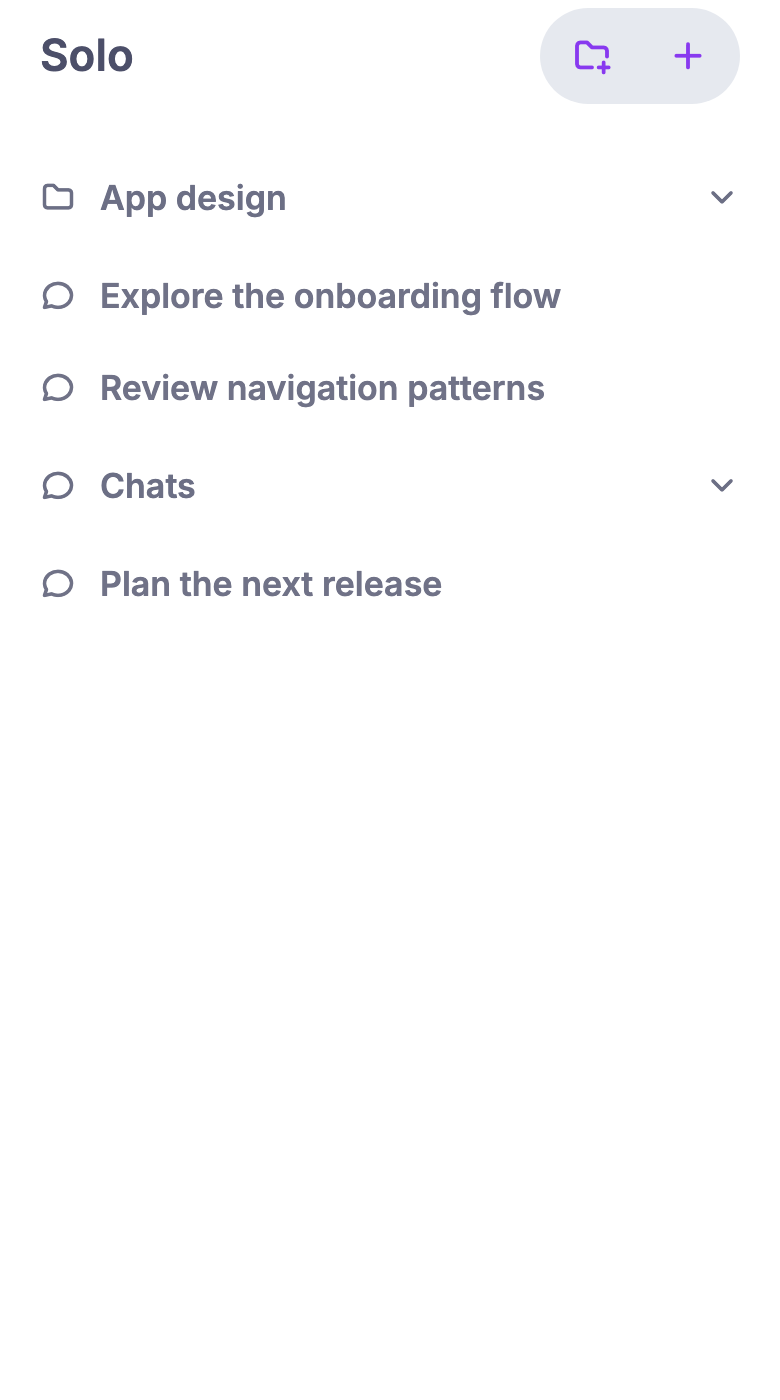
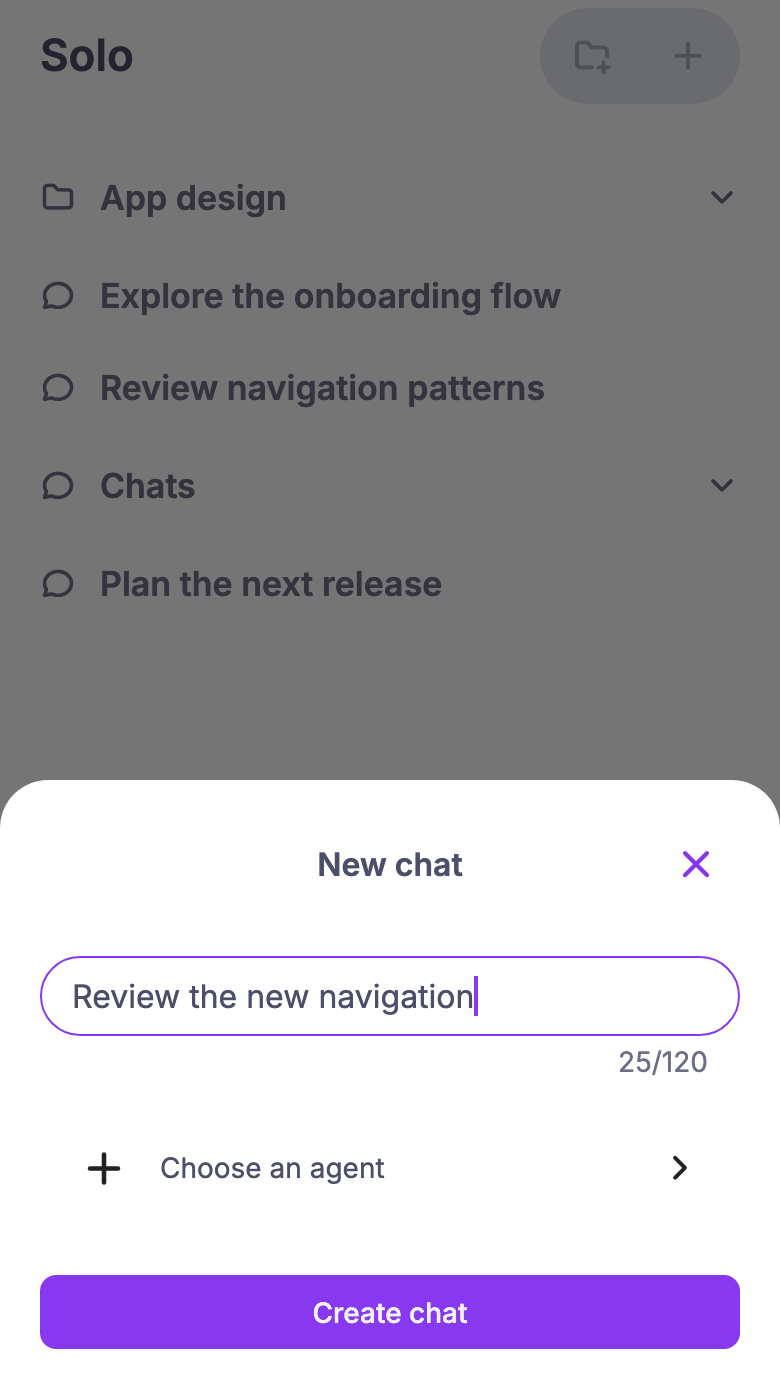
## Summary Bring desktop Solo chats and project organization to mobile, with synced collapsible sections, shared unread highlights and tab badges, agent selection, shared search, native iOS creation sheets, and inline typing bubbles that transition into replies. Resolve Solo placement for every chat entry route, retain encrypted organization snapshots for offline reading, and let users resume or discard unfinished chat and project setup without deleting existing messages. ### Related issue Related: #6565; expandable agent transcripts remain separate work. ### Testing - Fresh Solo read state seeds each active chat from its captured initial last-message timestamp before exposing row/section/tab unread state. Baselines survive intervening channel updates and reset across identity/community boundaries while surviving read-state readiness changes. Regressions cover multiple chats, events before read-state readiness and during/after seeding, and identity changes; removing either the seed or the display gate fails them. - Chat completion reconciles a retained Solo-save journal even when placement is already confirmed. False/throwing cleanup regressions ensure the outer intent remains until reconciliation and only one placement is published. Typing terminal-close loops remain bounded; the retry budget resets after an uninterrupted eight-second health interval or transport reconnect. - Typing retry budgets reset after sustained recovery; invalid Solo updates retain cached rows with a retry warning that survives failed refreshes. Project names use the editors’ 120-grapheme limit, including emoji and combining characters. Regression coverage exercises repeated recovery, invalid live/refresh heads, and character-limit boundaries. - Rebased onto current main, preserving the newer Search controls, Huddle timeline filtering, and message-media layout. - Failed project journal writes reload storage before claiming recovery and reopen the entered name for retry. Typing subscription rejections are caught; terminal closures clear stale indicators and retry with a bounded backoff, canceled on disposal. Regression tests cover both false/throwing storage writes and initial/late subscription rejection. - Explicit ordinary destinations skip optional Solo lookup waits. Generic destinations perform one bounded lookup in the destination (search no longer duplicates it); an unavailable classification falls back to ordinary sending per the product owner's explicit choice. Positively identified Solo destinations use Solo providers. - Terminal Solo subscription closure preserves cached rows and exposes live-update Retry. Page coverage verifies warning visibility, usable rows during recovery, and a subsequent terminal close. Removing the warning or the immediate ordinary-route guard fails its regression. - Generic channel entries share an ordinary default when Solo classification is unavailable, per the requested product behavior. Known Solo placement takes precedence; callers can explicitly require unresolved placement to remain blocked. Bounded initial lookup preserves known Solo deep-link routing. - Dirty newest snapshots and offline-save warnings survive transport reconnects; Retry persists that same event even if the relay returns an older head. Community changes replace the service, and agent-directory reconnect refresh remains intact. - Pending-save discard reloads failed removals. Repeated reconnect testing confirms typing subscriptions are released on provider rebuild and disposal; removing the existing cleanup fails the regression. - Ordinary Home/create routes explicitly preserve private-channel sending during Solo failures; identified Solo sends use the Solo sender and explicit unresolved routes remain fail-closed. Solo unread replies beyond the initial 200-event page are loaded through the oldest-unread boundary. - Chat/project/agent cleanup reloads failed removals, retains same-process recovery, and protects replaced records. False/throw regressions verify retries do not duplicate creation or membership. Route, unread, and cleanup guard-removal mutations each fail their regression. - Ordinary channels, DMs, and forums remain sendable when optional Solo sync fails; explicit unresolved placement stays blocked. Controlled cache races retain the newest verified snapshot, keep usable chats visible, and retry offline persistence without stale writes. Both protection-removal regressions fail as expected. - Confirmed journal cleanup checks false/throwing removal and exact-record identity. Interrupted agent choices are visible immediately, identify the saved agent, and cover Resume/Later/Discard with accessible name/key-fallback controls. - Notification deep links preserve the contiguous history cursor; same-second messages infer the newest agent consistently. Failed offline-cache writes surface Retry, with false/throwing storage failures and offline restart covered. - Composite history cursors cover 350 same-second events plus older history; removing the ID cursor makes the regression fail. Agent changes now journal before granting access, with restart/failure and Resume/Later/Discard widget coverage. Signed malformed profiles remain isolated. - Native iOS avatar tests passed on the simulator: visible-row loading, three-request concurrency, streamed byte limits, response validation, downsampling/pixel limits, cancellation, and visible avatar updates. - Solo and Home share observed-event/read-marker logic. Widget coverage verifies unread rows, collapsed-section indicators, the tab badge before first Solo visit, message/thread reads, forced unread, and filtering archived/nonmember/unplaced chats. - Chat intent is saved before ownership and organization preflight; tests cover interrupted ownership lookup and a disconnect while the native creation form is open. - Mobile analysis, formatting, file-size checks, and full mobile tests passed at `1d4c41354`. - Project creation persists its encrypted name/UUID before connectivity checks or relay reads. Restart tests cover Resume/Later/Discard, scope isolation, stale-intent rejection, and lost acknowledgements. Removing the pre-network save makes all four production-flow regressions fail. - Regression coverage includes notification/Activity routing, inline replies, unknown-placement send protection, restart recovery/discard, and encrypted offline cache isolation/refresh. - Earlier feature build exercised on a physical iPhone with existing account/community data; review follow-ups have not been reinstalled on the device. UIKit agent-row accessibility checks passed on an iOS simulator. - Earlier cross-platform `just ci` stopped on the existing `buzz-acp` test `signals_cancel_startup_turn_and_pending_stdin_without_hanging` (process exit-code assertion); no Rust production changes are included in this PR. ### Remaining review limitation Agent discovery is bounded to 10 pages / 1,000 profiles with automatic retries disabled. Owner-scoped discovery remains open because the current relay ignores `#auth` filters; supporting that query requires a relay change. ### Snapshots Sample data, shared Flutter/Android surface. Native iOS uses platform sheets and controls. | Solo: projects and chats | New chat | Choose an agent | | --- | --- | --- | | <img src="https://raw.githubusercontent.com/block/buzz/d9b29aa079a3b9a88e8ed89b70df8d6af06fa41b/pr-8337--01-solo.png" width="240" alt="Solo with collapsible projects and chats" /> | <img src="https://raw.githubusercontent.com/block/buzz/d9b29aa079a3b9a88e8ed89b70df8d6af06fa41b/pr-8337--02-new-chat.png" width="240" alt="New chat form" /> | <img src="https://raw.githubusercontent.com/block/buzz/d9b29aa079a3b9a88e8ed89b70df8d6af06fa41b/pr-8337--03-agent-picker.png" width="240" alt="Agent selection list" /> | --------- Signed-off-by: kenny lopez <klopez4212@gmail.com> Signed-off-by: Logan Johnson <loganj@squareup.com> Co-authored-by: Terp <5856f6900e8e0a4e0ea1f4f8d2ee33e4753d2119bc122f94ecafc660b46c0511@buzz.block.builderlab.xyz> Co-authored-by: Logan Johnson <loganj@squareup.com> Co-authored-by: Larry <627498bd4bd1f281a16431e3c6cce3b5c25b6692798c78672298aefbf2f8f8b5@buzz.block.builderlab.xyz> |
||
|
Kalvin C
|
cdfc38ecbd |
feat(search): add newest-first sort to bridge search (#8371)
## Summary Adds an opt-in newest-first order to bridge search, so clients can offer "Most recent" alongside relevance. - `buzz-search`: `SearchQuery` gains `sort: SearchSort`. `Relevance` keeps the existing `ts_rank_cd` ordering. `Newest` orders hits by `created_at DESC, id`, and `page` steps through that order. Newest skips the exact-profile-lexeme prioritization, which only applies to relevance ranking. - Bridge `POST /query`: search filters accept `search_sort: "newest"`. When the field is missing or has another value, results stay in relevance order. Community scope, channel intersection and per-hit authorization are unchanged. - NIP-11 lists `buzz-search-sort` in `supported_extensions`. Clients only send the field to relays that advertise it, so they never get relevance results labelled as newest. - WebSocket NIP-50 search stays relevance-only. `NOSTR.md` documents the bridge extension. ### Related issue N/A ### Testing - New Postgres integration test `newest_sort_pages_by_time_then_id_within_scope`. It pages a channel in newest order, including an equal-timestamp tie split across a page boundary and a newer hit outside the channel scope. It checks that the pages join up in `(created_at desc, id asc)` order and that relevance still ranks the strongest match first. - Unit tests: - `bridge_search_sort_extension_selects_newest_only_when_named` - `advertises_nip_cl_and_search_sort_extensions` - Ran the buzz-search Postgres integration suite, the relay `nip11` and `bridge_search` unit tests, `cargo fmt --check`, and `cargo clippy -p buzz-search -p buzz-relay --all-targets -D warnings` on Linux. - Local relay exercised through signed `POST /query`: - NIP-11 lists `buzz-search-sort`. - Relevance and newest return different orders. - Newest pages 1–3 return 25 hits with no gaps or duplicates, including same-second ties across page boundaries. - A non-member gets no hits from a private channel; a member gets all of them. - Client integration is in a companion block/buzz-app change. It was exercised end to end against this relay through the production broker: switching sort, paging, scope changes and capability fallback. Deployment note: clients only offer newest sorting after a relay with this change advertises `buzz-search-sort`. --------- Signed-off-by: Kalvin Chau <kalvin@block.xyz> Co-authored-by: Claude Opus 5.5 <noreply@anthropic.com> |
||
|
Tom Brow
|
fea02d174d |
fix(ios): fetch profiles and avatars in notification extension (#8369)
A notification can arrive from someone whose profile the main app has never loaded. The iOS notification extension now fetches and caches sender profiles, channel details, and avatars itself. The main app supplies account configuration and Keychain credentials only. After resolving the message, the extension allows 1.5 seconds for sender and channel details. It uses available stale data when a refresh is slow or fails, delivers once, and lets late results update its private cache. Profiles, channel details, and avatar refresh checks share a one-hour freshness threshold. A verified avatar removal clears the previous image. Account removal prevents further use of that sign-in's cached data. Profile, channel metadata, and membership use separate bounded downloads, so an oversized roster cannot discard the smaller records. Sender enrichment can finish while channel requests are pending. A successful partial channel refresh atomically removes its old counterpart, preventing a mixed group identity or recipient count. Group-specific notification presentation still requires a verified recipient count. The [specification](https://github.com/block/buzz/blob/native-notification-enrichment/docs/native-notification-enrichment.md) describes the display, caching, and account-removal behavior. General persistent image caching in Flutter remains separate. ### Validation [Hosted CI](https://github.com/block/buzz/actions/runs/38780108487) passed on the final commit, including all Flutter shards, Android, the full iOS release and simulator builds, and native controls/push-navigation tests. The [current-commit security review](https://github.com/block/buzz/pull/8369#issuecomment-6197508385) found no issues. The native package passed 159 tests, including new coverage for cache freshness, avatar replacement and removal, sign-in isolation, concurrent storage, late results, single delivery, bounded downloads, and SVG validation. A regression test exposed identical HTTP authentication event IDs for requests in the same second; each request now includes a unique nonce, matching the Dart and CLI clients. Full local CI passed before that small authentication fix. The complete native suite and signed device build passed again on the latest commit, including response-size limits, overlapping avatar downloads, canonical relay-origin matching, independent profile/channel refreshes, account-key changes before and during requests, and a single initial snapshot read across 64 accounts, signed IPv6 avatar authorities, and partial channel refreshes. Focused Flutter regression tests passed 198 tests with three configuration-specific skips; seven avatar widget tests also passed. Flutter analysis is clean, and the notification extension builds for the simulator. On an iPhone SE, the notification displayed the sender name, avatar, channel, and message before the updated main app was opened. Repeat notifications used a byte-identical private cache. Three notifications delivered together displayed the avatar after the authentication fix. The next notification also displayed correctly after terminating the extension process. The existing generic-push design can select the same newest unread message for several pushes; this change does not alter message selection. 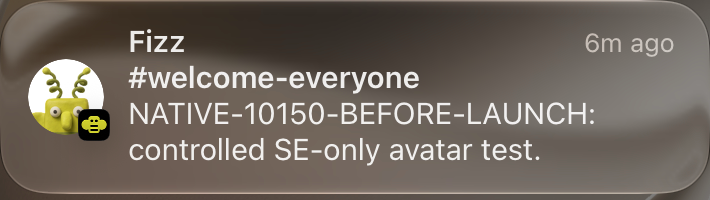 Authenticated HTTP avatar fetching and persistent HTTP cache reuse also passed on the SE. The first notification downloaded a relay thumbnail. After terminating the extension and expiring its separate avatar entry, the next notification displayed the avatar and refreshed that entry without another media request in the relay logs. The main app remained unopened throughout. The original app build and test profile were restored afterward. Automated tests cover slow and failed requests, stale images, removal, and account revocation; those cases have not all been exercised on the phone. ### Before merge - [x] Verify authenticated HTTP avatar fetching and cache reuse on iOS against a working relay media service. <!-- buzz-review-completed --> --------- Signed-off-by: Tom Brow <tomb@block.xyz>mobile-v0.23.0-rc.1 |
||
|
klopez4212
|
d61fe2071d |
Use native UIKit scrolling for iOS photo carousels (#8361)
Builds on the mobile polish merged in #8359; this PR now targets `main`. On iOS, inline photo galleries now use a UIKit collection view for dragging, deceleration, and snapping. Photo taps retain the existing full-screen viewer and reply/more actions; gallery scrolling continues to fade the message avatar. The final photo stops at the full message gutter rather than the smaller gap between photos. Android keeps the current Flutter carousel. Visible cells subscribe to continuing frames from Flutter's existing authenticated image providers, preserving animated GIF/APNG/WebP media. Request IDs fence late frames and cancel subscriptions on reuse/disappearance/disposal. A four-slot bound includes retired unresolved loads until their transport terminates. Shared media fetches now use abortable HTTP requests with a 30-second deadline through response-body completion, so stalled requests release their slots without leaving live transports behind; native eager precaching is disabled so it cannot bypass that bound. Frame conversion coalesces to the newest pending frame. Native cells expose photo labels and positions to VoiceOver, support RTL, and preserve the selected photo during resizing. Validation: - Mobile formatting and analysis passed. - Native simulator regression checks passed for geometry, RTL, snapping, taps, frame replacement, cancellation, and resizing. The native CI lane now runs the carousel executable. - Full mobile suite and pre-push gates passed, including two-frame GIF delivery, delayed-provider bounds/cancellation, real HTTP stalled-header/body recovery with four requests maximum, disposal, and unconfigured-push tests. - Signed iPhone Release build of the frame/subscription implementation passed. Physical iPhone testing covered the earlier carousel/gutter revision; the new animation/cancellation changes have local Flutter and native simulator coverage, not a new physical-device journey. Preview-only signing overrides preserve its bundle/Keychain group; production entitlements are unchanged. Local provisioning excludes production push/App Attest capabilities. - Full `just ci` was started but stopped after unrelated Rust/desktop compilation consumed about 5 GB; broad CI is incomplete. Device build required local Xcode 27 workarounds: iOS 16 deployment target and a generated swift-secp256k1 cache compatibility edit. Neither changes repository source. --------- Signed-off-by: kenny lopez <klopez4212@gmail.com> Co-authored-by: Terp <5856f6900e8e0a4e0ea1f4f8d2ee33e4753d2119bc122f94ecafc660b46c0511@buzz.block.builderlab.xyz> |
||
|
klopez4212
|
9296660d1e |
Match mobile reply links to desktop connectors (#8362)
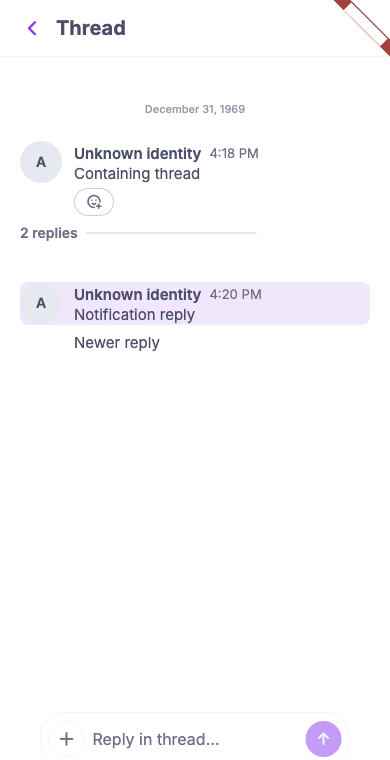
## Summary Reply summaries now appear below mobile message bubbles as inset avatar/count links with the same rounded connector used on desktop. Reaction trays keep their overlap with the bubble; connector clearance adjusts when reactions are present. Channel and nested reply summaries share the same 20px avatar stack, capped at three, with a 44px minimum tap target and accessible thread-opening label. ### Related issue Follows merged #8359 and now targets `main`. This diff contains only the reply-link changes. No matching duplicate was found in the open issue/PR search for reply connectors. ### Testing - Full mobile formatting, analysis, and tests passed before stacking: 3,348 tests plus 3 push-configuration tests, 4 skips. - Normal pre-push checks passed on the rebased head against main: formatting, analysis, full mobile tests, and repository file-size checks. - Before stacking, installed and launched the preview on Pixel 10 and iPhone Air with existing app data. Ten profile/community/draft preference values remained unchanged on each. Verified both connector spacing variants and thread opening on Pixel; the owner tried and approved the preview. iPhone screenshot verification was unavailable. - The rebased build has not been reinstalled on devices. Device evidence above is from the approved preview before rebasing. Before: channel replies were filled pills beside reactions; nested replies used a separate larger avatar row. After, as verified in the device preview:  Signed-off-by: kenny lopez <klopez4212@gmail.com> Co-authored-by: Terp <5856f6900e8e0a4e0ea1f4f8d2ee33e4753d2119bc122f94ecafc660b46c0511@buzz.block.builderlab.xyz> |
||
|
klopez4212
|
42b395cdef |
Polish mobile bubbles, mentions, galleries, and huddle cards (#8359)
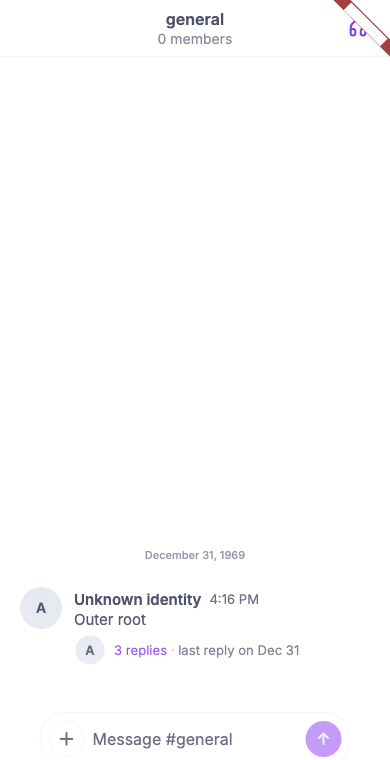
Builds on the merged themes work in #8358 and inherits its appearance and chat-color settings. Polishes mobile conversations with uniform rounded bubbles, desktop-style text-only mentions and agent icon, aligned gallery counts, fading gallery avatars, and standard iOS scrolling. Huddles use rounded cards with attached reaction trays, without duplicate start/end notices; other activity rows stay centered with smaller text. Validation: mobile checks, the full mobile test suite, and the gallery regression test passed. Release build installed on iPhone. Full `just ci` could not finish: desktop compilation exhausted local disk space. ### Snapshots Flutter-rendered light and dark previews using seeded sample messages. | Light | Dark | | --- | --- | | 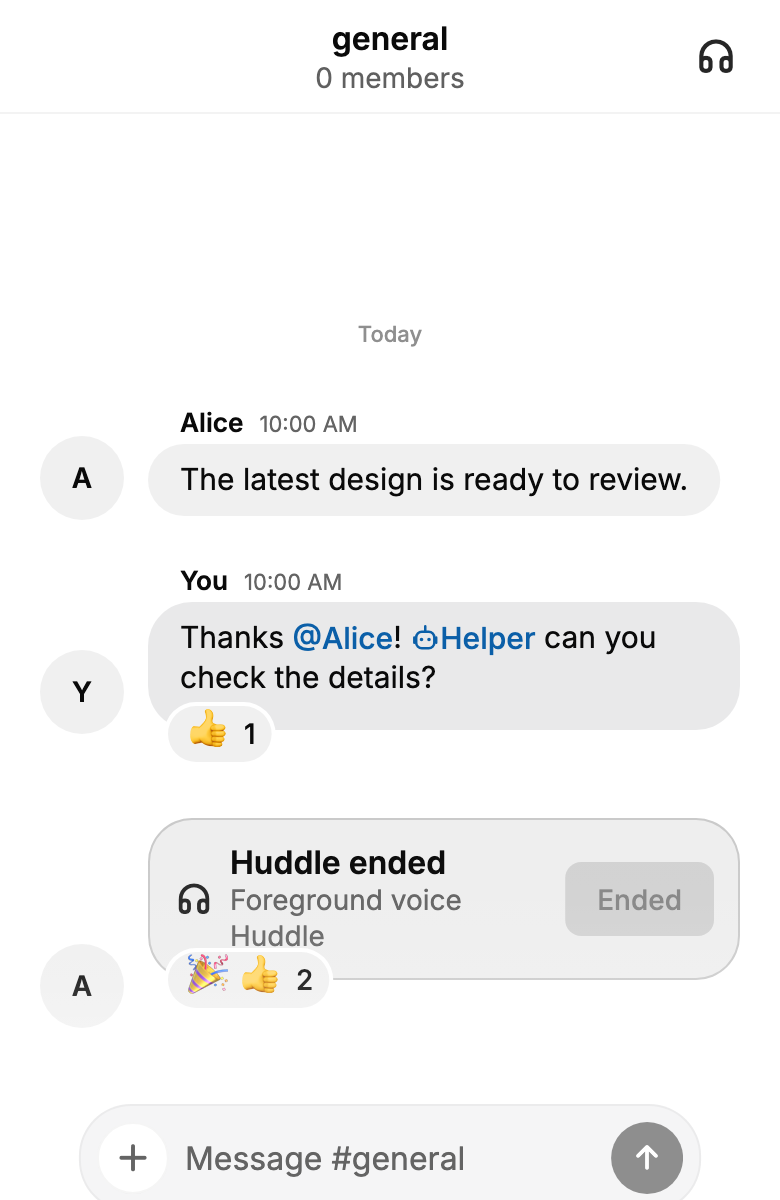 | 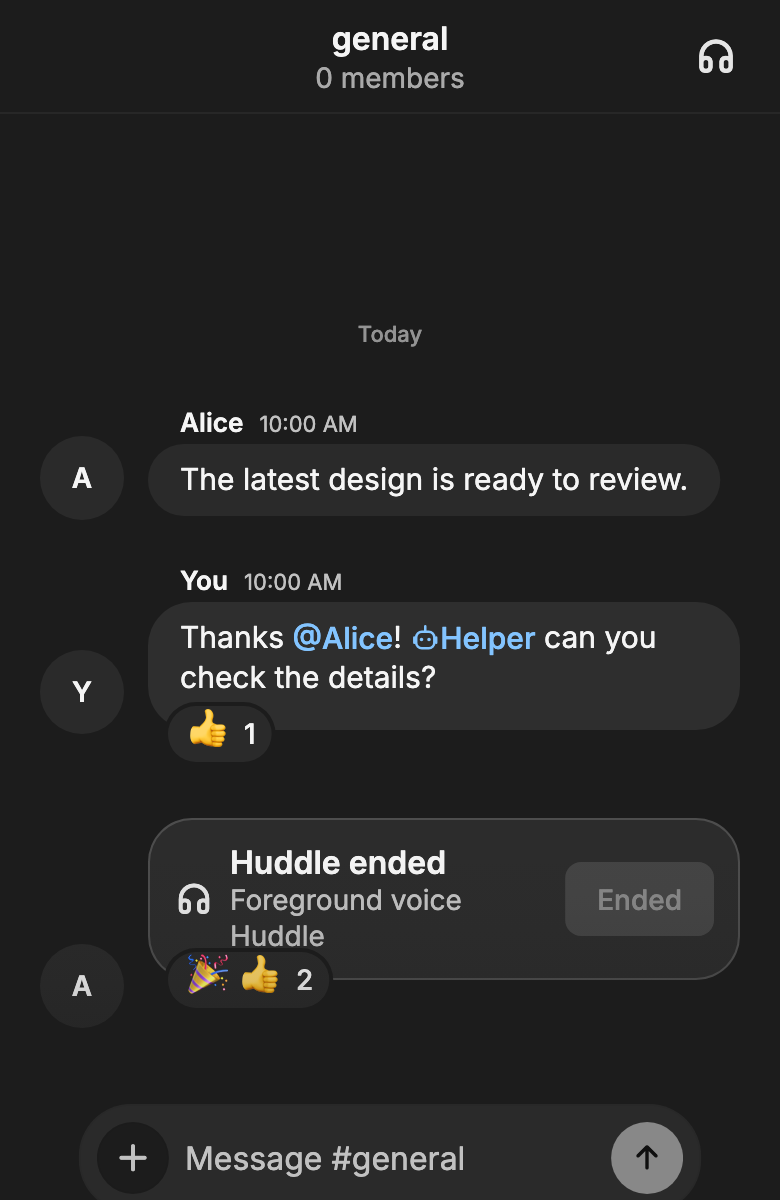 | --------- Signed-off-by: kenny lopez <klopez4212@gmail.com> |
||
|
Will Pfleger
|
9092950620 |
docs(nip-ap): narrow relay support and allow offline start (#8368)
🤖 Two corrections to NIP-AP's agent and team config section. **Relay support.** A client now needs only NIP-CL system channels and labels plus NIP-AR artifacts before storing config on the relay. The four other required advertisements are dropped: read-only guests, a retention exemption, complete-history artifact sync, and telling a never-used artifact address apart from a fully redacted one. No relay advertises them, so a conforming client could never store config on the relay. The retention exemption stays in "History" as the relay's obligation. Without a never-used signal an empty lookup is still `unavailable`, never `absent`, so clients fail closed. **Offline start.** When the relay can't be reached (a transport failure, not a read that returned an answer), a client may start the agent from the last revision it confirmed as present. It still must block if the relay's most recent answer showed that the config is invalid, deleted, redacted, archived, or no longer accessible, and it never uses another source. **Consistency.** "Editing" no longer assumes every relay's guest role is read-only. "Artifact state" points its no-substitution rule at the new offline exception. Related: #8295 --------- Signed-off-by: Will Pfleger <pfleger.will@gmail.com> Co-authored-by: Hayt <211b96e6a2b7f45fd4047988976c7bbbeeda0c15f3ae7b32eec20834b5a55118@buzz.block.builderlab.xyz> |
||
|
Tom Brow
|
6766174673 |
chore(push): retire push notification database trigger (#8352)
Buzz must schedule mobile push notifications when it saves an eligible message. The relay, the server that receives and stores messages, now does this in application code. An older database trigger still exists. This trigger is a rule that runs automatically when a message is saved. This PR removes the old trigger and its supporting database function. The relay remains responsible for scheduling notifications. Migration 0063 makes this change in existing databases; updated setup scripts apply it to new databases. The change does not turn on push notifications. Production migration and deployment need separate approval. Before deployment, verify the release images and all pending database migrations. If push needs to be stopped after release, disable it with the feature flag and keep the qualified application version and database schema. Do not downgrade the application image. ### Validation - Local checks passed: 519 isolated database integration tests, 166 database unit tests, 17 source-policy tests, and the relay push-runtime tests. - Tests verify that the migration removes the old trigger, preserves earlier migration records, and lets the application schedule push work correctly. A concurrency test exercises the real application path; deliberately removing its lock makes the test fail. - [Current-head CI passed on retry](https://github.com/block/buzz/actions/runs/38752849383/attempts/2). The first attempt had one database-connection timeout during test setup; the failed jobs passed when rerun on the unchanged commit. - Initial local CI and push checks hit unrelated ACP test failures, which passed when run separately. Only the Rust-test push hook was skipped under the repository's local-check exception; other applicable hooks passed. ### Before merge - [x] Migration 0063 is available and the push trigger remains on [main at |
||
|
Tom Brow
|
5397ea49e2 |
fix(push): verify extended App Attest proofs with a focused owned module (#8329)
## Summary Apple SDK 27.1 device captures include authenticator extension data that the current verifier rejects. Replace the general appattest dependency with a private gateway module that verifies the complete original bytes, frames enrollment and assertions separately, and accepts well-formed optional extensions without SDK-specific length or flag allowlists. The module retains established signature, P-256, CBOR, and certificate-chain libraries. App identity, exact enrollment environment, credential/key binding, nonce, challenge, and increasing-counter checks remain enforced. Bounded parsing rejects ambiguous duplicate keys, truncation, trailing data, and oversized inputs. Fixture helpers are test-only. Adapted code retains both upstream MIT notices and source provenance. Category/version properties remain authenticated observations under the chosen compatibility-release policy. This does not implement Apple's additional distribution-category/version enforcement; introducing those restrictions requires a separately defined deployment policy. The [verification contract](https://github.com/block/buzz/blob/app-attest-owned-verifier/docs/app-attest-compatibility.md) records this and other limits. Related: https://github.com/block/buzz/pull/8020 addresses assertion extension handling. This change also covers enrollment extensions, credential-key parsing, and certificate validation. ### Validation - Gateway suites: 77 default tests and 79 personal-development tests passed, plus startup policy and Clippy. - Added signed enrollment/certificate, generated CBOR mutation, maximum-counter, and PostgreSQL race/replay coverage. All 12 isolated Postgres tests passed. Apple's historical fixture is tested structurally, not accepted as a current enrollment. Positive synthetic leaf certificates are generated at test time. - Protected SDK 26.5/27.1 enrollments and assertions pass the verifier, including the same key across SDK upgrades; development enrollment rejects under production policy. Captures are personal-development identities, not supported production-identity evidence. - Full local CI passed Rust tests and reached 6,828 passing desktop JS tests before an unchanged 10 ms focus-timer test failed; its five-test file passed in isolation. The pre-push native suite had 3,421 passes and an unchanged 300 ms child-PID test failure, also passing in isolation. Prior ACP timing flakes and these unrelated hook exceptions do not waive required CI. - Windows CI exposed a missing system OpenSSL installation for the test fixture generator. The test dependency now builds bundled OpenSSL; all 30 focused App Attest tests pass locally. [Current-head CI](https://github.com/block/buzz/actions/runs/38636062347) passed, including Windows Rust, PostgreSQL, and desktop integration tests. - [Prior-head Codex review](https://github.com/block/buzz/pull/8329#issuecomment-6177515598) found no major issues. Carl subsequently identified a dropped credential-length workaround; fixed in [ |
||
|
klopez4212
|
a5dfdd6d55 |
Align mobile appearance and channels with desktop (#8358)
Aligns mobile with desktop's neutral palette and six chat colors. Appearance now offers Light, Dark, and System instead of themes, while preserving community preferences and the single Home and Chat preview pair. Chat colors survive local preference reloads without historical-index remapping, and the Chat preview shows the draft outgoing bubble color. Channel and section icons are removed, section chevrons sit beside names, and section dividers use 7% opacity. DM avatars remain. Validation: `just mobile-check`, 35 focused tests, and the full mobile suite passed (3,351 tests; 4 skipped). Updated light/dark previews were rendered and visually checked. The earlier release was verified on iPhone; this follow-up has not been reinstalled. The earlier repository-wide lint passed, but full `just ci` was stopped for low disk space. Hosted CI is running for the new head. **Intentional design parity:** Section labels and chevrons retain desktop’s `--text-unavailable` colors: light `#959595`, dark `#595959`. Verified against `block/buzz-app` main at `0201b54c496120a44e020834663dc534cae9a79f`. These colors do not meet 4.5:1 text contrast on the mobile section surfaces; the product decision for this PR is to preserve desktop parity and leave them unchanged. Kenneth explicitly accepts this known contrast tradeoff for this PR/release and requests that reviewers treat it as a scoped product exception rather than a blocker. This does not claim WCAG compliance or change the repository-wide accessibility target. Any future contrast adjustment should be coordinated across desktop and mobile. ### Snapshots Channel list: physical iPhone. Appearance and chat colors: Flutter-rendered previews. | Channels | Light | Dark | Chat colors | | --- | --- | --- | --- | | 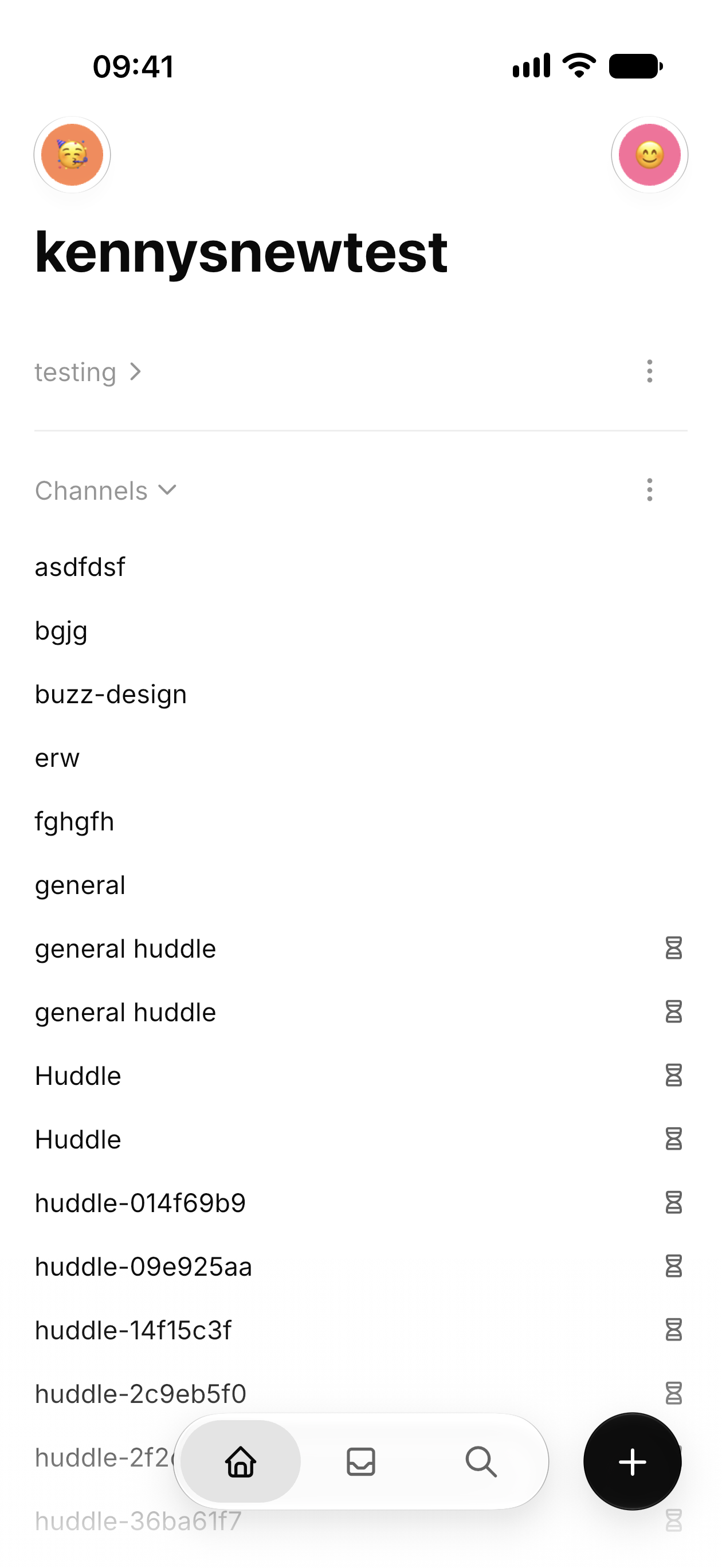 | 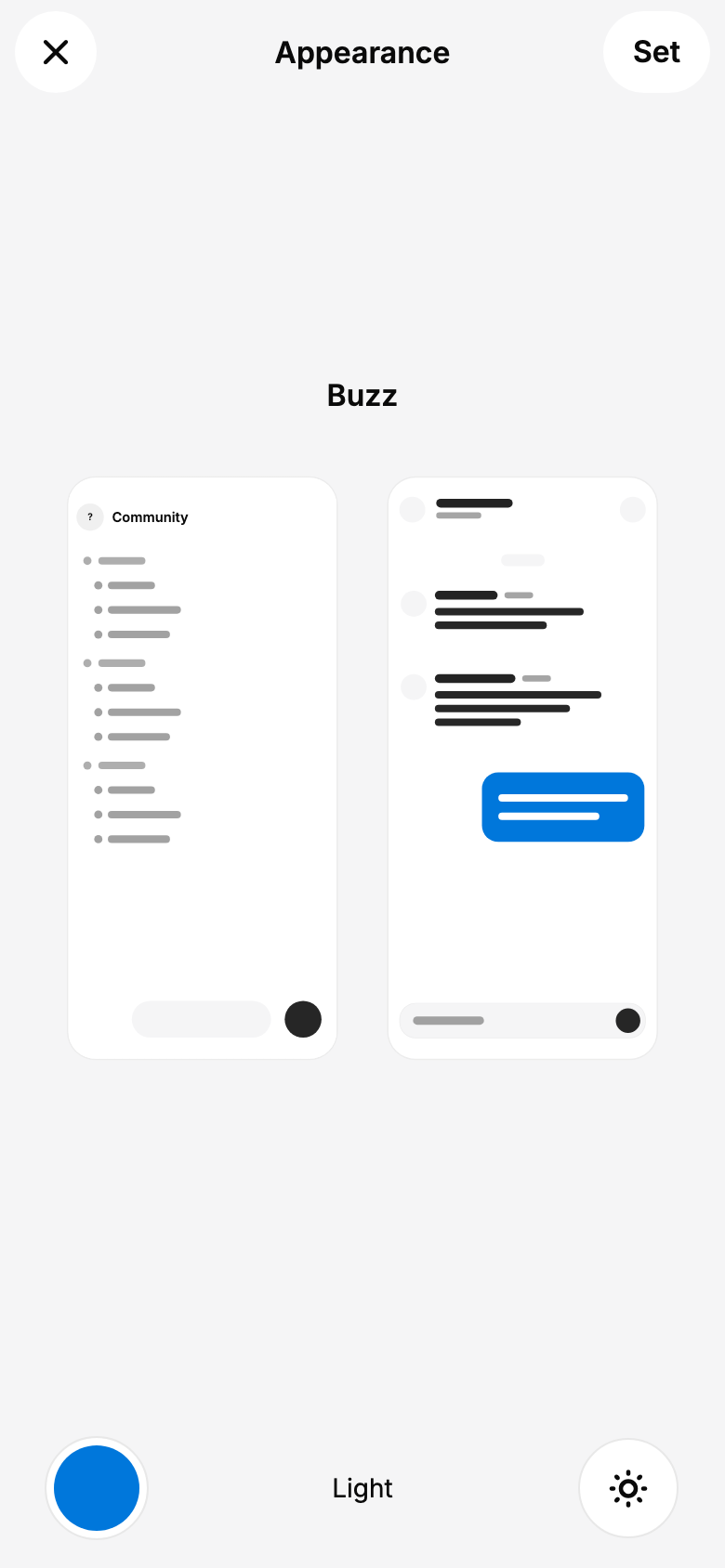 | 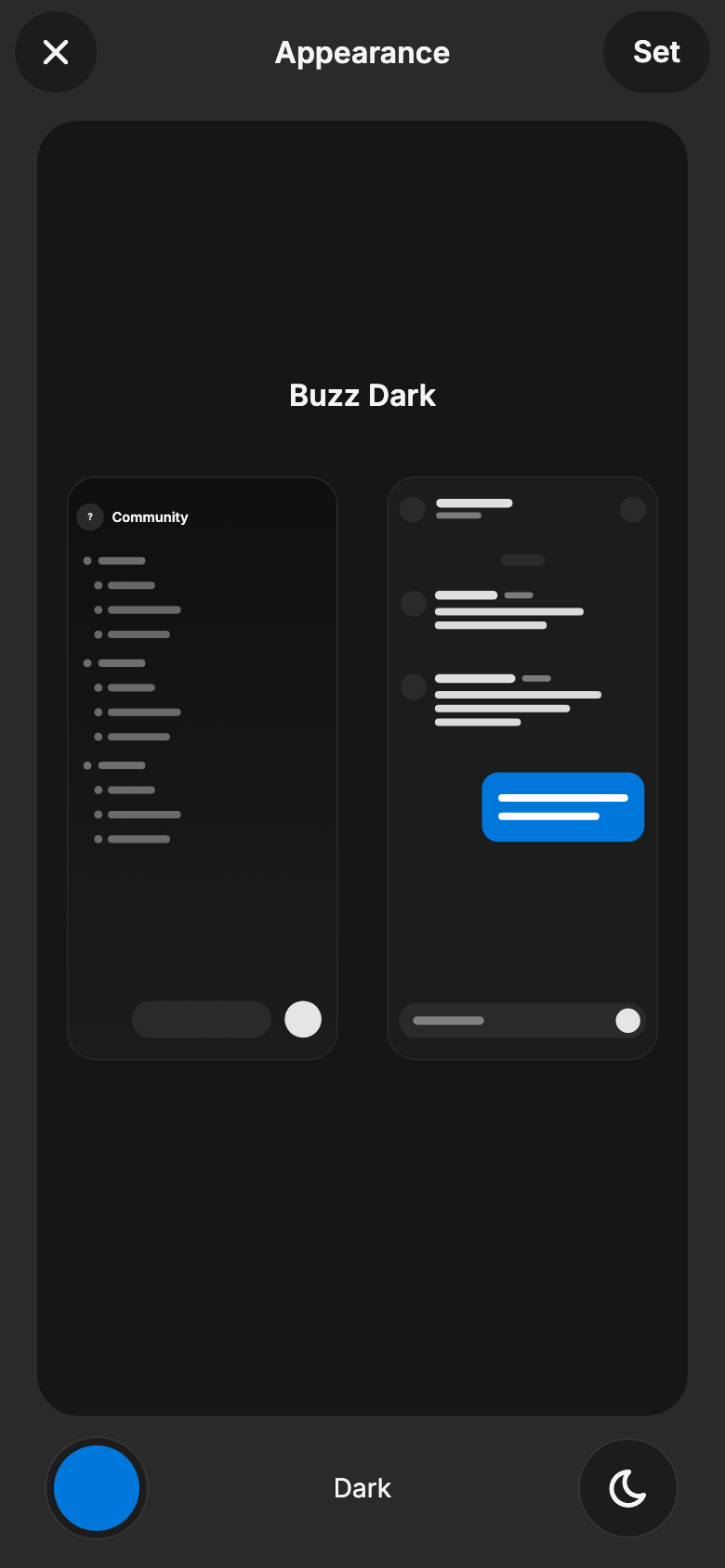 | 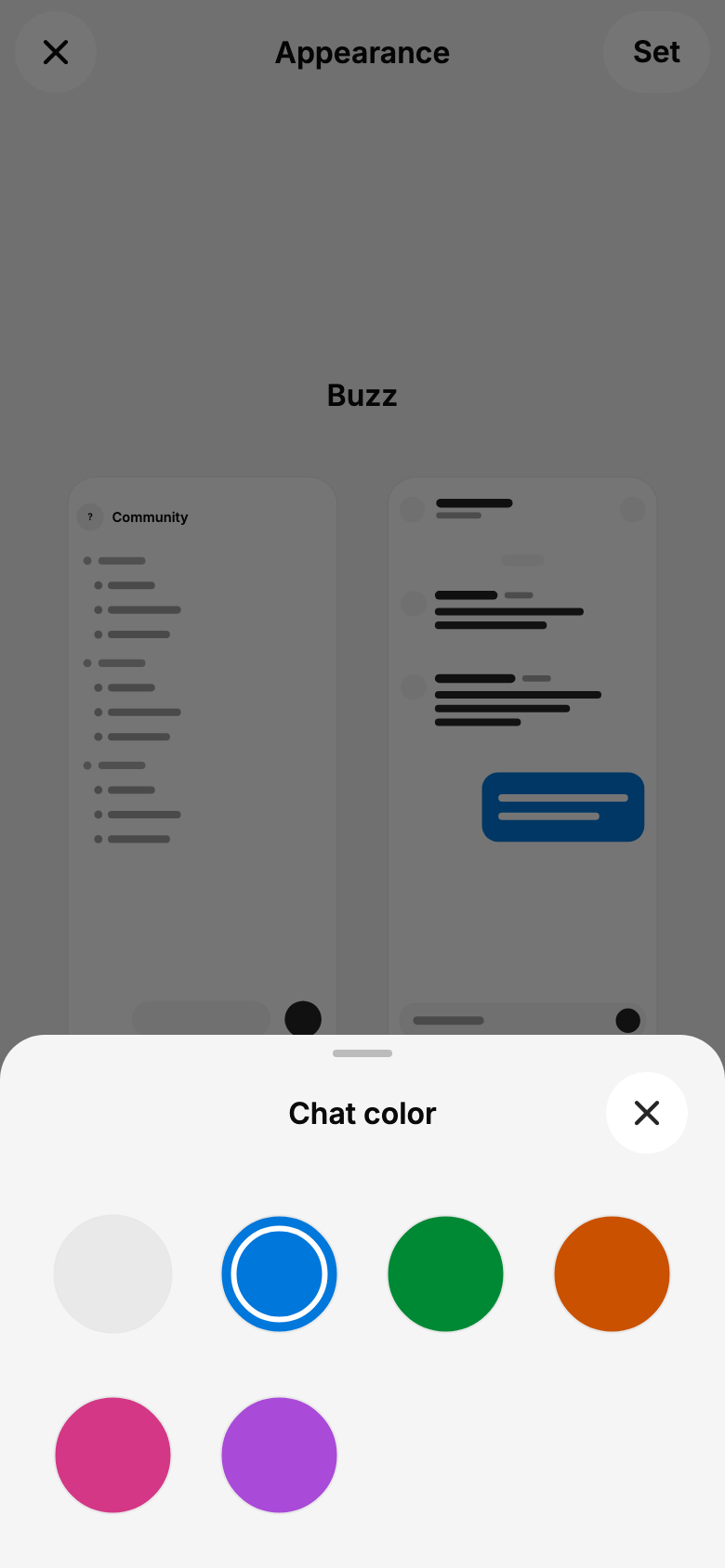 | --------- Signed-off-by: kenny lopez <klopez4212@gmail.com> |
||
|
Logan Johnson
|
d28f6b2f70 |
feat(relay): let channel-state filters opt in to system channels (#8182)
🤖 ## Summary After part 2, a client can read a system channel only if it already knows the ID. This PR lets a client find system channels on purpose, with an ordinary Nostr filter and no new filter key. A filter on the channel-state kinds (39000–39003) now also returns the system channels the reader can read when it has either: - `#t:["system"]`, the channel type tag that every channel-state event already carries; or - any `#P`, the creator tag from #8174. Asking for the channels of a named creator returns a small result, so it does not fill generic channel lists. The filter then matches as usual. Existing clients send neither on these kinds, so they still never see a system channel. | Reader wants | Filter | |---|---| | My system channels | `{kinds:[39002], #p:[me], #t:["system"]}`, then their kind:39000 by `#d` | | Open system channels | `{kinds:[39000], #t:["system"]}` | | One creator's labeled channel, system or not | `{kinds:[39000], #P:[creator], #t:[label]}` | Private system channels stay hidden from non-members, as for any private channel. Values in one tag filter combine with OR, so `#t:["system", label]` means `system` **or** the label; use `#P` plus the label instead. Part 3 of 3, stacked on part 2. ### Related issue None found. ### Details - The opt-in is decided per filter in `handlers/system_channels.rs` and applies on REQ, COUNT and the HTTP bridge. It applies only when every kind in the filter is 39000–39003. - A label alone is not an opt-in. - `NOSTR.md` documents the system channel query rules. - **Spec.** NIP-CL says how a filter asks for system channels. - The relay information document (NIP-11) now lists `"nip-cl"` in `supported_extensions`. Clients use this to tell if a relay supports labels and system channels, and refuse those calls on a relay that does not. NIP-CL documents this. ### Testing - End-to-end relay test: `#t:["system"]` finds both system channels for a member and only the open one for a non-member; 39002 `#p:[me]` with `#t:["system"]` lists the member's system channels; `#P` includes a creator's system channels; creator plus label returns exactly one channel with `limit: 1` and excludes another creator's channel with the same label; a label alone does not return the system channel; COUNT and HTTP `/query` and `/count` agree. - The test fails when the opt-in is disabled. - Unit tests for which filters opt in. ### Stack These are two stacks. Merge them in this order. Client support (creating, labeling and finding these channels) will be in block/buzz-app, not the buzz SDK and CLI. **Stack 1: channel labels and creator lookup (#8174–#8176)** 1. #8174 channel type and creator tags, and the channel creation time 2. #8175 channel labels 3. #8176 database-side label and creator match, and the rule for choosing one channel **Stack 2: system channels (#8180–#8182)**, stacked on stack 1 because it uses labels and the creator tag 4. #8180 the system channel type 5. #8181 leave system channels out of reads that do not name them 6. #8182 channel-state filters opt in to system channels ← this PR --------- Signed-off-by: Logan Johnson <loganj@squareup.com> Co-authored-by: Larry <627498bd4bd1f281a16431e3c6cce3b5c25b6692798c78672298aefbf2f8f8b5@buzz.block.builderlab.xyz> |
||
|
Logan Johnson
|
cdf03f618a |
feat(relay): leave system channels out of reads that do not name them (#8181)
🤖 ## Summary After part 1, a system channel is still returned by every query that returns ordinary channels, so existing clients would show it as a chat. This PR makes the relay leave system channels out of every read that does not name them. Clients do not need to filter, so clients that know nothing about system channels stay correct. | Query | Before | After | |---|---|---| | A query that does not name a channel (no `#h`), COUNT, full-text search, the HTTP `/query` and `/count` routes, artifact queries (`{"artifact": ...}`), the sidebar | Includes system channels | Leaves them out | | "Channels I belong to" (kind:39002 `#p:[me]`) | Includes them | Leaves them out | | A filter that names the channel with `#h`, or with `#d` on kinds 39000–39003 | Ordinary read rules | Unchanged: members can read it, and anyone can read it if it is open | Push notifications and "you were added to a channel" notifications (kinds 44100/44101) skip system channels, because a client that received one would show the channel. A client that is given a system channel's ID, for example in a pasted link, can still open it. Naming the ID is the opt-in. This keeps system channels ordinary NIP-29 groups. Part 2 of 3, stacked on part 1. ### Related issue None found. ### Details - The rule lives in one place: `get_accessible_channel_ids`, the set of channels a query may read when it does not name one. It is the union of the reader's memberships and every open channel; both halves now exclude `channel_type = 'system'`. Because the filter is in SQL before `LIMIT`, pages stay full. - A filter that names a system channel adds it to that filter's scope only (`handlers/system_channels.rs`). A sibling filter in the same request keeps the implicit set, so naming one system channel cannot widen another filter. - Thread windows and the workflows API name their channel, so they follow the same named-channel rule. - Artifact queries have their own read check in SQL. It reads a system channel only when the query's `#h` names it. - When a request re-checks membership for a named channel that its first lookup missed, a confirmed system channel joins only the filters that name it. Before, a reader who joined a system channel during the request could have it added to a sibling filter's scope. - The system-channel lookup runs only when a filter names a channel outside the implicit set, so ordinary queries do not pay for it. - **Spec.** NIP-CL lists the reads that leave system channels out, and says when a filter names one. `AGENTS.md` notes this for `get_channels`. ### Testing - End-to-end relay test (Postgres and Redis) with a private system channel, an open system channel and an ordinary channel, as a member and as a non-member: REQ without `#h`, NIP-50 search, COUNT, HTTP `/query`, HTTP search, HTTP `/count`, the channel list, and 39002 `#p:[me]` return only the ordinary channel. Named reads by `#h` and `#d` follow member-or-open on REQ, COUNT, search and HTTP. - Relay test: adding a member to a system channel sends no kind:44100; an ordinary channel still does. - Both tests fail when the SQL exclusion or the named-channel scope is removed. - Database test: an artifact in an open system channel is missing from `{"artifact":"current"}` and present with `#h:[<system channel>]`, for a member and a non-member. It fails without the channel-type condition. - Relay test: the membership re-check confirms a system channel that the system-channel lookup missed. The channel goes to the filter that names it, and a sibling filter's scope does not include it. It fails without the fix. - Unit tests for the per-filter scope. They now run in `just test-unit` and `scripts/run-tests.sh`. ### Stack These are two stacks. Merge them in this order. Client support (creating, labeling and finding these channels) will be in block/buzz-app, not the buzz SDK and CLI. **Stack 1: channel labels and creator lookup (#8174–#8176)** 1. #8174 channel type and creator tags, and the channel creation time 2. #8175 channel labels 3. #8176 database-side label and creator match, and the rule for choosing one channel **Stack 2: system channels (#8180–#8182)**, stacked on stack 1 because it uses labels and the creator tag 4. #8180 the system channel type 5. #8181 leave system channels out of reads that do not name them ← this PR 6. #8182 channel-state filters opt in to system channels --------- Signed-off-by: Logan Johnson <loganj@squareup.com> Co-authored-by: Larry <627498bd4bd1f281a16431e3c6cce3b5c25b6692798c78672298aefbf2f8f8b5@buzz.block.builderlab.xyz> |
||
|
Wes
|
b77ba86262 |
perf(mobile): cut test wall time and run mobile CI lanes in parallel (#8347)
## Problem Mobile pushes and PRs are slow. - **Pre-push takes ~133s on a mobile-only change.** About 115s of that is `flutter test`, and the finish time is set by a few files that wait on real clocks. - `push_presentation_export_test` (75s) and `push_presentation_recovery_test` (19s) sleep through the full 7.75s retry backoff. - `channel_messages_provider_test` (70s) sleeps through recount and ownership retry backoff on real time. - **The required Mobile CI job takes ~15–16 min.** It runs tests (390–430s on a 4-vCPU runner, 2 test files at a time) and then the Android debug APK build (~400s, no Gradle cache) back to back. - **Mobile Swift takes 18–21 min.** The unsigned release build (~4.5 min) waits behind the simulator tests. Pre-commit is ~3s and isn't part of the problem. ## Change **Tests** (each one still asserts what it did before) - **Push exports.** Production retries wait through `debugPushPresentationRetryWait`, which defaults to `Future.delayed`. The export and recovery tests skip the real waits and assert the exact 250ms → 4s backoff schedule instead. Export fixtures sign each event once per file. - **`channel_messages_provider_test`.** Every test runs on `fakeAsync`. A file-local `test` wrapper keeps the 90 call sites unchanged. Timers fire in their real order, and a test that waits on work outside fake time fails instead of hanging. Raising the production retry bound (`attempt < 2` → `3`) still fails the 5 exhausted-retry tests. - **`signed qualified caller`.** This test mounts the page 48 times and opens the profile sheet twice per mount. It now disables the sheet animation; it asserts which pubkey and labels show, not motion. **CI** - **Mobile runs as five parallel matrix lanes:** checks (format, analyze, unconfigured push test, recipe test), three `flutter test --total-shards=3` shards, and the Android build. The required `Mobile` gate still reads the combined result. - **Android restores a Gradle cache,** which is saved only on pushes to `main`. - **Mobile Swift builds the unsigned release** in a parallel lane beside the native build, tests and simulator checks. ## Validation Measured locally on an 18-core Mac with warm caches: | | Before | After | |---|---|---| | `flutter test` (full suite) | 115s | 74s | | Summed per-test time | 411s | 307s | | `push_presentation_export_test` | 75s | 38s | | `channel_messages_provider_test` | 70s | 22s | | Pre-push, mobile-only push | 133s | 95s | - The CI lane timings come from this PR's own run. - `actionlint` passes, and so do `scripts/test-ci-required-context-isolation.sh` and `scripts/ci-required-gates.test.mjs`. - The pre-push hook (format, analyze, full `flutter test`) passed on push. ## Not in this PR - `channel_detail_page_test` (~55s) is now the local long pole. Splitting it into shard files would let it run in parallel, but it is one 16k-line library with `part` files, so that is a separate refactor. - Caching Hermit and pub on macOS would cut ~100s of setup from each Mobile Swift lane. 🤖 Generated with [Claude Code](https://claude.com/claude-code) Signed-off-by: Wes <wesbillman@users.noreply.github.com> Co-authored-by: Carl <32a2e2c9d428ee08902cab75d956da2c1d235a22d4766b0dd4138bf6e2e5db1d@buzz.block.builderlab.xyz> Co-authored-by: Claude Opus 5.5 <noreply@anthropic.com> |
||
|
Wes
|
7b11c6147d |
test: fix recurring CI flakes in desktop and Postgres lanes (#8343)
Fixes the CI flakes that failed most often across `main` and unrelated branches from Oct 5 to Oct 14. The counts come from 150 failed `CI` runs. Every change except the nextest config is test-only. | Flake | Runs hit | Root cause | Fix | |---|---|---|---| | `probe_codex_acp_version_…descendant_holds_pipe_open` | 5 | The test writes its script in-process and then execs it. If a sibling test spawns a process in that window, the child inherits the open write fd and Linux rejects the exec with `ETXTBSY`. The probe swallows that error as `None`. | Write probe scripts from a short-lived `/bin/sh` (`write_executable_script`) | | `empty-edit-delete.spec.ts` (`:51`, `:74`, `:95`) | 11 | The seeded `mock-general-welcome` id isn't hex, so `formatTimelineMessages` can't overlay its edit. The post-subscribe window refetch then reverts the row. | Emit a per-test message with a real id after the exact channel subscription is live | | `huddle-transcription.spec.ts:798` | 9 | The composer's delayed initial autofocus (TipTap `focus()` runs in rAF) lands after the voice popover opens and dismisses it. | Wait for `message-input` focus before opening the popover | | `voice-note.spec.ts:906` | 6 | The fixture `ping.mp3` is about 1s long, so playback can end before `paused === false` is observed. | Loop the fixture audio | | `workflows.spec.ts:291` | 5 | The `Message text` fill runs before the inspector swaps to the new step, so it fills the trigger's condition instead. | Scope the fill to the step inspector after its `Action` menu appears | | `cluster_global_probe_commits_tokens_and_sessions_prove_coverage` | 3 | The `max-threads = 1` group only serializes these tests with each other. Other tests' sessions still mask cluster-wide `pg_stat_activity` (`MaskedActivity`). | `threads-required = "num-test-threads"` | | `test_usage_metrics_lock_has_single_owner_and_releases_on_drop` | 1 (this PR) | The test retries the lock right after dropping the leader. Postgres releases a session advisory lock only after the backend notices the disconnect, so the retry can run first. | Poll for the successor, bounded at 5s | ### Validation - **ETXTBSY:** a Linux experiment with Rust 1.95 using the same write→chmod→spawn pattern under concurrent spawns hit `ETXTBSY` 4–7% of the time. Using the `sh` writer, it hit 0 of 6,000. I did not catch it inside the full suite locally, so this fix is based on the mechanism, not an in-suite repro. All 11 probe tests pass on Linux and macOS. - **empty-edit-delete:** the baseline failed 16 of 45 runs (`--repeat-each`, 6 workers, no retries). The spec fix alone brings that to 4/45. The remaining failures come from a separate product race, described below. - **huddle:** the baseline failed 5 of 10 runs. With the fix, 60 of 60 passed without retries. - **nextest:** checked with a throwaway crate on 0.9.136. A grouped test with `num-test-threads` ran alone, even with `max-threads = 1`. - I have not stress-run the voice-note and workflows fixes; they rely on CI. ### Not in this PR - **Product bug in `useChannelLinks`:** the debounced `#channel` autocomplete close lets Enter accept a stale suggestion for about 120ms. That accounts for the remaining `empty-edit-delete` failures, and it affects users too. With the spec fix plus a synchronous close, the spec passed 120 of 120 runs. This needs a product decision, so it's held for a separate PR. - **Composer autofocus race:** the delayed autofocus can close an overlay the user just opened. The real fix is to revalidate when the delayed focus runs. Overlaps #6530. - **`thread-head-stale-edit.spec.ts:55`:** a forced click on a pointer-events-none action bar is suspected, but I couldn't reproduce it. - **Remaining ETXTBSY exposure:** about 40 other Rust tests write and then exec scripts, and 17 specs still edit the non-hex seed message. Root-cause lanes by Princess Donut, Mongo and Mordecai. Carl integrated and verified them. 🤖 Generated with [Claude Code](https://claude.com/claude-code) --------- Signed-off-by: Wes <wesbillman@users.noreply.github.com> Co-authored-by: Carl <32a2e2c9d428ee08902cab75d956da2c1d235a22d4766b0dd4138bf6e2e5db1d@buzz.block.builderlab.xyz> Co-authored-by: Princess Donut <5d97ac8c272fa949af56c71e586146b1706e5c4c3daa125db5b4625e12e0686c@buzz.block.builderlab.xyz> Co-authored-by: Mongo <81cabd2ca1792494372ed410283c00770c0cf35afca052e940fa522883212b45@buzz.block.builderlab.xyz> Co-authored-by: Mordecai <f314b6033b6e13df94c8e9e1187d3666b6b9ce54e66ee986e31cdaa909e8dcbc@buzz.block.builderlab.xyz> Co-authored-by: Claude Opus 5.5 <noreply@anthropic.com> |
||
|
Tom Brow
|
8222e99915 |
fix(mobile): keep thread references consistent across push and Inbox (#8332)
Follow-up to [#8294](https://github.com/block/buzz/pull/8294). Malformed trailing thread tags could make a notification open the right thread while Flutter indexed its reply elsewhere; uppercase references could similarly miss lowercase event IDs. Share one validated thread-reference parser between the mobile timeline, Inbox, and feed helper. It ignores malformed markers, keeps the last valid root/reply, and normalizes lookup IDs to lowercase. Native push parsing now uses the same casing. Existing thread fixtures use valid event IDs so they continue exercising real thread relationships. Add RunnerTests coverage for the production native-to-Flutter argument conversion, including buffered cold-start navigation and omitted optional thread IDs, and run it in the native CI lane. ### Validation - New parser and Inbox regressions cover malformed markers and uppercase references. Widget regressions open and highlight the exact reply for valid, uppercase, and trailing-malformed tags. - After integrating [#8106](https://github.com/block/buzz/pull/8106), Flutter analysis and the complete mobile suite pass: 3,337 tests, four existing skips. Integration preserves per-event read predicates and migrates incoming thread fixtures to valid IDs. An unchanged keyboard-history test also failed with main's original parser; recording reads before the scroll transition fixes its timing assumption while retaining visibility assertions. - Native package tests passed (127 tests), and both Runner bridge tests passed on an iOS simulator with Xcode 26.5. Removing the production `threadRootId` assignment made the bridge regression fail; restoring it passed. Native code is unchanged by the main integration. - [Current-head CI passed](https://github.com/block/buzz/actions/runs/38659307247), including Mobile and Mobile Swift. [Codex review](https://github.com/block/buzz/pull/8332#issuecomment-6181458528) and [security review](https://github.com/block/buzz/pull/8332#issuecomment-6181449235) found no issues on the integrated commit. [Owner approval](https://github.com/block/buzz/pull/8332#pullrequestreview-5526812957) covers the exact integrated commit. - Standards and spec reviews found no blockers, including the merge resolutions and test adjustments. Validation is scoped to mobile/native per VISION_MOBILE; unrelated repository-wide checks were stopped, not counted as passing. The bridge test covers serialization and buffering, not end-to-end APNs delivery or app launch. No new physical-device acceptance is claimed; routine post-merge dogfood remains human-owned. --------- Signed-off-by: Tom Brow <tomb@block.xyz> |
||
|
Will Pfleger
|
349f566e93 |
docs(nip-ap): store agent and team config as NIP-AR artifacts (#8295)
🤖 Stores agent and team config as [NIP-AR](https://github.com/block/buzz/blob/main/docs/nips/NIP-AR.md) artifacts in private [NIP-CL](https://github.com/block/buzz/blob/main/docs/nips/NIP-CL.md) system channels, replacing the owner-encrypted `kind:44300` instruction versions. - **Config channels.** Each agent has an agent config channel holding `buzz.agent.settings` and `buzz.agent.instructions`. Each team has a team config channel holding one `buzz.team` artifact with the team name, team instructions and a `team` tag carrying the exact team id, and no member list. The owner creates both kinds as private system channels with no TTL. Each carries a family label (`agent-config` / `team-config`) and a subject label: the agent pubkey, or `team-` plus a hash of the team id, which clients check against the `team` tag. Discovery queries by creator and subject label. Agents find their teams through a `39002` query that opts in to system channels. The oldest matching channel wins, and channels that aren't selected are never deleted. - **Ownership and teams.** An agent's owner is its relay-verified NIP-OA owner, and a team's owner is its channel's creator. Changing an owner isn't supported. A team's members are the owner's agents in the team config channel. Changes to who is on a team follow the channel's role rules, including add policies, owner/admin-only role changes, and last-owner protection against leaving, removal and demotion. Guests are read-only. Every non-guest member can edit config, including humans and agents that aren't on the team. Edits keep unrecognised JSON fields and tags, and a client whose create collides fetches and edits the existing artifact instead of picking a new `d`. - **Artifact states.** A config artifact is present, invalid, absent, deleted, or unavailable. An artifact is absent only when the relay confirms its address was never used. Redacting every revision does not make an address unused. Only an absent artifact lets a client fall back to local instructions or a definition prompt. Invalid, deleted, and unavailable states block the start. - **History and launch.** History is kept until the owner purges it or a moderator removes a revision. Config channels must be exempt from age-based retention, and keeping only the latest revision is not allowed. A revert is an `op=update` with a full snapshot and keeps the team's name. The instruction resolution order and per-team launch sections are unchanged. - **Limits and lifecycle.** Config content is at most 131,072 bytes after encoding (settings: 65,535), and the signed event must fit the relay's limits. Content is never truncated. Settings exclude credentials, local paths and device state. An unsupported setting is an error, never a silent default. Deleting an agent archives its channel and blocks new launches until it's unarchived. Deleting a team archives its channel. - **Relay prerequisites.** Clients keep config local unless the relay supports system channels, artifacts, read-only guests, the retention exemption, sync with complete history, and telling an artifact address that has never been used apart from one whose revisions have all been redacted. - **Removed.** `kind:44300` and its relay rules, deletion rules and owner-encryption text. `30175`, `30177`, `30178` and the team id format are unchanged. Depends on the NIP-CL label and system-channel stack (#8176, #8180–#8182). --------- Signed-off-by: Will Pfleger <pfleger.will@gmail.com> Co-authored-by: Hayt <211b96e6a2b7f45fd4047988976c7bbbeeda0c15f3ae7b32eec20834b5a55118@buzz.block.builderlab.xyz> |
||
|
Bradley Axen
|
8b60dcf8e3 |
feat(relay): deliver full signed events to operator listeners (#8309)
## Summary

Operator-listener mention notifications now carry the full signed event,
so a listener such as kgoose can wake an agent without first fetching
the event (one signed round trip less on time-to-first-reply).

Because the notification now carries message content, two mitigations
come with it, as agreed in #buzz-security:

1. **Each target signs its own registration.** `POST
/operator/listener/pubkeys` takes `{"registrations": [proof, …]}`. Each
proof is a kind `24245` event signed by the target pubkey, with exactly
one `p` tag (the listener pubkey) and one `u` tag
(`{RELAY_OPERATOR_API_ORIGIN}/operator/listener/pubkeys`), and a
`created_at` within ±60s. The old unsigned `{"pubkeys": […]}` POST body
is rejected with 400. `DELETE` is unchanged.
2. **Only notify a target that can read the event.** Before each
delivery the relay re-checks, on the writer, that:
   - the registration still exists;
   - the event isn't deleted;
   - neither the target nor its recorded NIP-OA owner is banned;
- the target passes the relay-membership gate (with the owner path when
`allow_nip_oa_auth` is on);
   - the channel is open, or the target is an active member.

A delivery that fails the check retries with backoff instead of being
dropped, because a mention can commit just before the target is added to
the channel. It fails permanently, with no HTTP request, once attempts
are exhausted.

The payload is now `v: 2`: the v1 fields plus `event`, the full signed
NIP-01 event.

There's no migration. Existing registrations stay in place and age out
under the 30-day retention; only a configured listener could have
created them. Listeners must sign proofs to register new targets, so
receivers have to accept `v: 2`.

Companion kgoose change: squareup/cash-server#136794 signs registrations
with the agent key. The kgoose receiver in squareup/cash-server#136004
currently accepts only `v: 1` and bodies up to 4 KB, so it needs to
accept v2 and a larger body.

## Testing

- Unit tests:
- proof verification (forged signer, wrong kind, stale or future, other
or ambiguous listener, other or missing endpoint);
  - signed-only request bodies;
  - delivery payload carries a verifiable event;
- unreadable or failed loads retry, then fail, without an HTTP request.
- Postgres tests:
- every access predicate (open, member and non-member private,
channel-less, closed community with target or owner membership, owner
ban, removed member, deleted channel or event, removed registration);
- the route test (signed registration accepted; a proof for another
listener and the unsigned body both rejected).
- Mutation runs confirmed that the membership, owner, ban and
reader-visibility guards each fail a test when removed.
- Local relay exercise with a fake listener:
- signed registration returned 200; unsigned, stale and wrong-listener
proofs returned 400;
- open-channel mentions delivered v2 with an event whose id and
signature verify independently;
- a private-channel mention of a non-member retried without delivering,
then delivered once the target was added.

🤖 Generated with [Claude Code](https://claude.com/claude-code)

---------

Signed-off-by: Bradley Axen <baxen@squareup.com>
Co-authored-by: murderbot <3754f8729004d95654c46dbab3129e4ab9ef05cc2534e2a3fbfc155983bd637b@buzz.block.builderlab.xyz>
Co-authored-by: Claude Opus 5.5 <noreply@anthropic.com>
|
||
|
Will Pfleger
|
e645918c63 |
fix(relay): match pushed-down tags by position, not containment (#8335)
🤖 The relay pushes several tag filters into SQL as JSONB containment (`tags @> [[name, value]]`). Containment ignores element position, so a tag like `["x","e",<id>]` or `["meta","t",v]` satisfies `#e:[<id>]` or `#t:[v]`, and `#t:["t"]` matches `["t","other"]`. Because the predicate runs before `LIMIT`, a newer event that only matches by containment can take a `limit: 1` slot; the exact NIP-01 post-filter then drops it and the real match is never returned. Where no post-filter follows, the decoy is returned or counted outright. `push_exact_tag_match` in `buzz-db/src/store/event.rs` keeps containment as the GIN-indexed prefilter (one array-bound `tags @> ANY(...)`, so the e-tag planner shape is unchanged) and adds a positional `EXISTS (... tag->>0 = name AND tag->>1 = ANY(values))`. It now backs every `EventQuery` tag pushdown: | Pushdown | Before | Effect of over-match | |---|---|---| | `#e` (`e_tags`, query and COUNT) | containment | REQ `limit` slot theft; COUNT has no post-filter and counted decoys; thread aux closure returned decoy reactions/replies | | artifact `#d` (`d_tag_values`) | containment | `limit` slot theft on NIP-AR identity lookups | | `custom_tag` (bridge `#buzz-channel`) | containment | no post-filter: a decoy project/repository was returned for its channel | | shared-gated visibility (`shared_gated_reader`) | containment of `["shared","true"]` | a private event tagged `["x","shared","true"]` took a page slot before `event_visible_to_reader` dropped it, so the page came back short. Never a visibility leak: the post-filter stays in place | **Bridge `/count` honors `#buzz-channel`.** `POST /query` scoped project/repository reads by `#buzz-channel`, but `POST /count` ignored it, so a count for one channel counted matching projects in every channel the reader can see. `/count` now sets the same `custom_tag` on both its channel-scoped and access-scoped paths, and the COUNT SQL builder pushes `custom_tag` down exactly like the query builder, so `/count` and `/query` select the same events on both the fast count and the post-filtered fallback. Left unchanged: the retention-free purge predicate for mesh status (`tags @> [["k","buzz-mesh-status"]]`). It mirrors the migration 0019 trigger, has no `LIMIT`, and only affects how the author's own deleted event is purged. REQ `#t` outside group-state kinds is still post-filtered only. --------- Signed-off-by: Will Pfleger <pfleger.will@gmail.com> Co-authored-by: Hayt <211b96e6a2b7f45fd4047988976c7bbbeeda0c15f3ae7b32eec20834b5a55118@buzz.block.builderlab.xyz> |
||
|
Logan Johnson
|
9ade5d1ad1 |
feat(mobile): write catch-up and visible-message read marks like the web app (#8106)
🤖 ## Summary When you read a channel or thread on the phone, the web and desktop app (buzz-app) should show it as read too, and the reverse. buzz-app no longer saves a "read" mark for each ordinary message. It saves one "caught up to here" mark per channel and per thread, and keeps per-message marks only for mentions, DMs, broadcasts and replies. Mobile already reads those marks. This PR makes mobile write them, so reading on the phone clears unread on other devices and saved read state stays small. What changes on the phone: - Reaching the bottom of a channel, and staying there for 300 ms, marks it caught up. Reaching the end of a thread does the same for that thread. - A message you see fully on screen, away from the bottom, is marked read on its own. - Mentions, DMs, broadcasts and thread replies you see keep their own read marks, as in buzz-app. - Automatic reading never marks the whole channel read. Only the explicit **Mark read** action does that. DMs and forums are the exception: opening one marks it all read, as mobile does today. - Reaching the bottom of a channel you marked unread ends that manual unread. Unseen mentions and replies stay unread. - Activity rows clear when you have read every message in the row, not just the newest. ### Related issue None found. buzz-app makes the same DM and manual-unread changes in https://github.com/block/buzz-app/pull/616. ### Testing - Unit tests cover the new write rules, Activity rows and the size limit on saved read state. - Widget tests cover reading on the channel page and the thread page, opening a DM, and reaching the bottom of a channel you marked unread. - No visual changes. ## Details **Read marks.** "Caught up" is saved as `activity:<channel>` for a channel and `thread-activity:<root>` for a thread. A caught-up mark reads only ordinary top-level messages (channel) or that thread's replies (thread). A per-message mark is `msg:<id>`. **Caught-up time.** The mark is set to the time of the bottom row, and never later than the current time. The time of a newer reply is not used. So a top-level message that arrives late, with an earlier timestamp, stays unread. A clock that runs fast, on this phone or the sender's, cannot mark messages read before they arrive. **Nested threads.** A thread opened on a nested reply shows only one branch. Reaching its end writes per-message marks only, so unread messages in other branches stay unread. **Reading delay.** The 300 ms reading delay now restarts only when messages arrive or leave. Before, any page rebuild restarted it, for example a typing indicator. **Activity rows.** A row that groups several events is done only when each event is read. Each event is checked against the channel mark, its own `msg:` mark, and its thread marks if it is a reply. Opening a row goes to the oldest unread event. **Publishing.** Mobile no longer republishes per-message marks it got from other devices. buzz-app removes those once a caught-up mark covers them. Broad marks (channel, thread, caught-up) are still republished, so they stay available after the fetch window. The published blob is capped at buzz-app's 40 KiB limit. Channel marks are kept first, then thread marks, then caught-up marks, then the newest per-message marks. Before, a blob over the encryption limit (about 64 KiB) turned off sync for the rest of the session. **DMs and manual unread.** Opening a DM reads it through the newest loaded message, replies included, as mobile does today. Reaching the bottom of a channel ends a manual unread. Manual unread on mobile is local to this session, so ending it does not change what other devices see. **Compatibility.** Older desktop builds read only channel and per-message marks. They may show extra unread for channels read on the phone. **Follow-ups, not in this PR** - Unread catch-up fetches start after the channel mark and are capped at 1,000 events. In a busy channel, an old unread mention can drop out of the badge. The fetch should also start from the caught-up mark, or load more pages. - Each mark triggers its own save and rebuild. They could be batched. - Broadcast replies are counted slightly differently from buzz-app. - buzz-app can also move its caught-up mark past the current time. --------- Signed-off-by: Larry <627498bd4bd1f281a16431e3c6cce3b5c25b6692798c78672298aefbf2f8f8b5@buzz.block.builderlab.xyz> Co-authored-by: Larry <627498bd4bd1f281a16431e3c6cce3b5c25b6692798c78672298aefbf2f8f8b5@buzz.block.builderlab.xyz> |
||
|
Logan Johnson
|
71d7aa0436 |
feat(relay): add the system channel type (#8180)
🤖 ## Summary Buzz uses channel membership to decide who can read what, and every channel a person belongs to shows up in their client as a chat. So there is no way to make a group that exists only for access control, for example "only this agent and its owner can read the agent's config". Such a channel would appear in both people's sidebars, search results and unread counts. This stack adds a **system channel**: an ordinary channel that queries leave out unless they ask for it. This first PR adds the type itself. - `kind:9007` (create channel) with `["channel_type", "system"]` creates a system channel. - It is private unless the creator sends `["visibility", "open"]`. - While it is private, its channel metadata event (kind:39000) carries the NIP-29 `hidden` marker, which means "hide this group's metadata from non-members". Until now the relay set `hidden` only for DMs. On its own this PR does not yet hide system channels from queries. Part 2 does that. Part 1 of 3, stacked on #8176 (the channel labels and creator lookup stack, which this feature uses). ### Related issue None found. ### Details - Migration 0062 adds `system` to the `channel_type` Postgres enum. No new columns. - `buzz_core::channel::ChannelType::System`, and `system` is now a reserved label name (labels cannot equal a channel type name). - `buzz-admin` reconcile writes `hidden` with the same rule as the relay. Usage metrics count system channels. - **Rollback.** A relay older than this change cannot read `channel_type = 'system'`. Do not roll back past it while system channels exist. - **Spec.** NIP-CL gets a "System channels" section. `ARCHITECTURE.md` lists the `System` type. ### Testing - Relay test: a system channel is private and `hidden` by default; opening it removes `hidden`; its first `t` tag is `system`. - Migration embed and usage-metrics tests. ### Stack These are two stacks. Merge them in this order. Client support (creating, labeling and finding these channels) will be in block/buzz-app, not the buzz SDK and CLI. **Stack 1: channel labels and creator lookup (#8174–#8176)** 1. #8174 channel type and creator tags, and the channel creation time 2. #8175 channel labels 3. #8176 database-side label and creator match, and the rule for choosing one channel **Stack 2: system channels (#8180–#8182)**, stacked on stack 1 because it uses labels and the creator tag 4. #8180 the system channel type ← this PR 5. #8181 leave system channels out of reads that do not name them 6. #8182 channel-state filters opt in to system channels --------- Signed-off-by: Logan Johnson <loganj@squareup.com> Co-authored-by: Larry <627498bd4bd1f281a16431e3c6cce3b5c25b6692798c78672298aefbf2f8f8b5@buzz.block.builderlab.xyz> |
||
|
Logan Johnson
|
a3909acc67 |
feat(relay): match label and creator filters before the page limit (#8176)
🤖 ## Summary After parts 1 and 2, a client can ask for "channels with label X" or "channels created by key K". But the relay applied these tag filters after it read one page of the newest channel events. So a request such as `{kinds:[39000], #t:["workspace"], limit:10}` could return fewer than 10 channels, or none, while matching channels existed. This PR moves the label and creator match into the database query, before the page limit. Part 3 of 3, stacked on part 2. ### Related issue None found. ### Details - Applies only when every kind in the filter is a relay-signed channel-state kind (39000–39003). Other kinds keep today's behavior. - The database match uses JSONB containment on `tags`, which is GIN-indexed. Containment can match a little too much (for example, a tag that contains both strings in another position), never too little. So the relay still checks each returned event with the normal Nostr filter rules, and `COUNT` requests keep that check too. - The same match is applied to the query path and the count path. - **Spec.** NIP-CL now says that `#t` and `#P` match before `limit`. - **Choosing one channel.** The relay does not make labels unique, so two creates for one label can both succeed, for example when two processes of one agent start at the same time. NIP-CL gets a "Choosing one channel" section: a client that needs one channel per creator and label looks it up with `#P` + `#t`, creates it only if none exists, and otherwise uses the oldest one (the lowest `created_at` tag, then the lowest channel ID). Every reader that follows this rule picks the same channel, even after an edit. ### Testing - Relay test: many channels, one match, small `limit`. The request returns the match for both `#t` and `#P`. This test fails without the change. - Unit test: `#t` and `#P` reach the database query only for channel-state kinds. - Relay test: one creator sends two creates for the same label at once. Both channels exist, a `#P` + `#t` lookup finds both, and the oldest-channel rule picks the same one in either order, even after the older channel's metadata is re-published by an edit. ### Stack These are two stacks. Merge them in this order. Client support (creating, labeling and finding these channels) will be in block/buzz-app, not the buzz SDK and CLI. **Stack 1: channel labels and creator lookup (#8174–#8176)** 1. #8174 channel type and creator tags, and the channel creation time 2. #8175 channel labels 3. #8176 database-side label and creator match, and the rule for choosing one channel ← this PR **Stack 2: system channels (#8180–#8182)**, stacked on stack 1 because it uses labels and the creator tag 4. #8180 the system channel type 5. #8181 leave system channels out of reads that do not name them 6. #8182 channel-state filters opt in to system channels --------- Signed-off-by: Logan Johnson <loganj@squareup.com> Co-authored-by: Larry <627498bd4bd1f281a16431e3c6cce3b5c25b6692798c78672298aefbf2f8f8b5@buzz.block.builderlab.xyz> |
||
|
Logan Johnson
|
2f79374f48 |
feat(relay): channel labels (#8175)
🤖
## Summary
A plugin or agent often needs to tag its own channels and then find them
again, for example "my attention-config channel" or "all channels of
this workspace". Today a channel has no labels: the relay ignores any
`t` tags in create or edit requests. This PR adds channel labels.

- A create request can carry up to 8 labels as `["t", "<label>"]` tags.
- An edit request with `t` tags replaces the label set. `["t", ""]`
alone clears it, the same convention as `["ttl", ""]`. Only owners and
admins can change labels, as for the name.
- The relay publishes each label as a `t` tag on the channel's state
events, after the channel type tag.

Part 2 of 3, stacked on part 1.

### Related issue
None found.

### Details
- **Rules.** A label uses 1–64 characters from `a-z`, `0-9`, `.`, `:`
and `-`. The relay refuses a label equal to a channel type name
(`stream`, `forum`, `dm`, `workflow`, `system`), so a label cannot make
a channel look like another type.
- **No trust from labels.** Any admin can set a label. Only the
relay-written creator tag (part 1) says who made a channel.
- **Storage.** New migration `0061_channel_labels.sql` adds
`channels.labels TEXT[] NOT NULL DEFAULT '{}'`. Channels without labels
look and behave as before.
- **Readers.** The CLI and `buzz-acp` read the channel type from the
first `t` tag. Before this PR they used the last one, which would now be
a label.
- **Spec.** NIP-CL gets a "Channel labels" section with these rules.

### Testing
- Relay tests: labels at creation appear after the type tag, edit
replaces and clears them, invalid labels are refused, and members who
are not admins cannot change them.
- Unit tests for the label rules: allowed characters, length, reserved
type names, the 8-label cap and the clear marker.
- `buzz-acp` test: the channel type comes from the first `t` tag, not a
label.

### Stack
These are two stacks. Merge them in this order. Client support
(creating, labeling and finding these channels) will be in
block/buzz-app, not the buzz SDK and CLI.

**Stack 1: channel labels and creator lookup (#8174–#8176)**

1. #8174 channel type and creator tags, and the channel creation time
2. #8175 channel labels ← this PR
3. #8176 database-side label and creator match, and the rule for
choosing one channel

**Stack 2: system channels (#8180–#8182)**, stacked on stack 1 because
it uses labels and the creator tag

4. #8180 the system channel type
5. #8181 leave system channels out of reads that do not name them
6. #8182 channel-state filters opt in to system channels

---------

Signed-off-by: Logan Johnson <loganj@squareup.com>
Co-authored-by: Larry <627498bd4bd1f281a16431e3c6cce3b5c25b6692798c78672298aefbf2f8f8b5@buzz.block.builderlab.xyz>
mobile-v0.22.0-rc.2 |
||
|
Will Pfleger
|
b3795236cc |
fix(relay): reject unreadable write targets as missing (#8249)
🤖 A sender who cannot use or read a referenced event, artifact or workflow now gets exactly the response it would get for an ID that does not exist. #8197 (merged) set this rule for deletions; this applies it to the other writes that look up a target, plus the workflow read and webhook endpoints. Artifact `create` and workflow definition saves are the exceptions, described below. Access is checked before any message that depends on the target, readability goes through `event_visible_to_reader` (including #8197's private-deletion rule), and soft-deleted targets keep matching missing ones. | Path | Checks, in order | Response for any unusable target | |---|---|---| | Reaction (kind 7) | target lookup → `event_visible_to_reader` → every channel gate for the derived channel, including archived | `invalid: reaction target event not found` | | Edit (kind 40003) | target in the edit's `h` channel and readable → author / agent-owner check, including an author since removed from a private channel | `invalid: edit target not found or not editable by you` | | Forum vote (kind 45002) | target in the vote's `h` channel and readable → kind check | `invalid: vote target event not found` | | Report by event (kind 1984 `e`) | `event_visible_to_reader` → token channel scope → channel membership or open | `invalid: report target event not found` | | Reply (NIP-10 and workflow `send_message` replies) | parent in the reply's channel and readable | `reply parent not found` | | Artifact update / delete / restore / move | head exists and is homed in `h` (move: in the source the sender can write) → revision, type, deleted and root checks | `conflict: artifact head unavailable` | | Workflow trigger (kind 46020) | workflow exists and sender is its owner | `invalid: workflow not found or not triggerable by you` | | `GET /workflows/{id}/runs` and `/runs/{run_id}/approvals` | workflow exists, has a channel, and the caller can read it | `404 {"error":"workflow not found"}` | | `POST /hooks/{id}` | workflow exists and the provided secret matches its stored secret → definition and trigger-type checks | `404 {"error":"workflow not found"}` | Two of these reject writes that used to be accepted: a reaction to an event the sender cannot read (such as someone else's author-only event), and a report on an event the reporter cannot read. Reports by pubkey and by blob are unchanged. In an archived channel, writes whose channel comes from their target (reactions and deletions) get that target's not-found response, and an artifact move out of an archived source channel gets `conflict: artifact head unavailable` like any other source the sender cannot write; every other write keeps `invalid: channel is archived`. A webhook call with an absent or wrong secret, or to a workflow without a webhook secret, now gets `404` instead of `401`/`400`. Artifact `create` and workflow definition saves still report a taken ID, as NIP-AR allows for artifacts. Removed messages, none of which any client depends on from these endpoints: `edit target event not found`, `must be event author to edit`, `target event belongs to a different channel`, `target event has no channel`, `parent event belongs to a different channel`, `parent event has no channel association`, `artifact home changed`, `workflow is not accessible`, `workflow is not channel-scoped`, the webhook's `authentication failed` and `webhook secret required but not configured`, `forbidden: not authorized to trigger this workflow` for non-owners (it remains for an owner whose channel authority lapsed), and `restricted: not a channel member` for an edit by an author removed from a private channel. `e2e_existence_oracle` checks each event write over HTTP and WS, and the workflow read and webhook endpoints over HTTP, against missing, soft-deleted, other-channel, private-channel, archived, author-only and wrong-kind targets as applicable, with a positive control per path. It runs in the Backend Integration job alongside `e2e_author_only_deletion`. `removed_author_edit_does_not_reveal_target` checks that a removed author's edits of their remaining message, their deleted message and a missing ID get identical answers. In the PostgreSQL suite, `head_outside_authorized_channel_matches_missing_head` covers the artifact transaction, `workflow_reply_to_unusable_parent_matches_missing` covers workflow replies through `RelayActionSink::send_message`, `scoped_token_report_does_not_reveal_target` and `scoped_token_reaction_does_not_reveal_target` cover channel-scoped tokens, and `channelless_workflow_runs_read_as_missing` covers the runs read for a workflow with no channel. --------- Signed-off-by: Will Pfleger <pfleger.will@gmail.com> Co-authored-by: Hayt <211b96e6a2b7f45fd4047988976c7bbbeeda0c15f3ae7b32eec20834b5a55118@buzz.block.builderlab.xyz> |
||
|
klopez4212
|
a83ea69b72 |
fix(mobile): replay native navigation state when returning Home (#8314)
Restore the iOS navigation bar after any covering route pops, including opaque custom Settings and community routes. Use the shared app RouteObserver and didPopNext, then replay scroll depth and request native layout after Flutter paints the uncovered view. Voice recording retains the same observer through its existing alias. Regression coverage uses the real HomePage with both MaterialPageRoute and opaque PageRouteBuilder, at scrolled and top-of-list positions. The custom-route case fails before this change. Validation: 107 focused tests and analysis passed. Full mobile runs stalled under local disk pressure, so full-suite validation is incomplete. On-device verification of this follow-up remains pending. --------- Signed-off-by: kenny lopez <klopez4212@gmail.com> |
||
|
klopez4212
|
231a469de5 |
Refresh mobile message bubbles, reactions, and activity cards (#8281)
## Summary Refresh mobile conversations with left-aligned grouped bubbles without tails, tighter consecutive-message spacing, distinct sender colors, theme-aware incoming backgrounds, and compact overlapping reaction trays. Attach reply counts beside reactions with up to three participant avatars; keep outgoing mentions and links readable in both themes. Coordinate a 500 ms composer-to-message transition with spring contraction and an anchored avatar. Message ownership follows the signing identity so profile reloads cannot recolor outgoing bubbles. Center channel activities without timestamps or icons, keep names tappable, and show two affected members plus a **See all** sheet. Hide legacy purpose activities, match media corners to bubble groups, and add iOS status-bar scroll-to-top. This is an independent mobile PR; no desktop changes or color picker. ## Validation - Full `just mobile-check` passed; `just mobile-test` passed 3,275 tests with 4 skips, plus 3 unconfigured-gateway checks. - Fixed message-widget lint warnings and a stale notification fixture that blocked analysis. Made the video-controller disposal test wait for lifecycle events instead of fixed delays. Mobile pre-push checks are enabled. - Physical iPhone previews were installed throughout development. The latest bubble, reply-avatar, contrast, and spacing updates were installed and launched on the physical iPhone. Final motion and status-bar behavior still need device visual verification; Android has automated coverage but no physical-device verification. --------- Signed-off-by: kenny lopez <klopez4212@gmail.com> |
||
|
Tom Brow
|
7b9551aba8 |
fix(ios): open push replies in their containing thread (#8294)
Tapping a push notification for a thread reply currently opens the channel at its parent. Preserve the verified event's direct-parent thread ID through the iOS notification payload and Flutter bridge so the tap opens the containing thread and highlights that exact reply, even when newer replies have arrived. This matches Inbox's destination selection for nested replies; broadcast replies still open in the channel. Closest related work: https://github.com/block/buzz/pull/6159 (original push-tap routing). ### Validation - Follow-up [ |
||
|
Logan Johnson
|
ea24a3ee3d |
fix(ci): remove Detect Changed Paths timeout and deletion test race (#8300)
🤖 ## Summary This PR removes two CI flakes that failed relay-stack runs on 2026-10-13. Both passed when rerun. - **Detect Changed Paths timeout.** This first CI job had a 2-minute limit. Its steps take about 75 seconds, but GitHub sometimes finishes the job minutes after the last step. In three runs, every step had finished, but GitHub still cancelled the job at the limit, and all later jobs failed. The limit is now 10 minutes. - **PostgreSQL deletion test.** `approval_boundary_blocks_claim_until_exact_inventory_is_approved` sometimes could not claim an approved deletion request. This was a race in the test, not a product bug. How the test race happens: - The test sends an UPDATE that the database must reject. Then it claims the same row. PostgreSQL sends the error to the client before it rolls back the statement and releases its row lock. sqlx returns as soon as it gets the error. - The claim runs on another pooled connection with `FOR UPDATE ... SKIP LOCKED`. It can skip the row while the lock is still held, and return no claim. - The test now runs the rejected UPDATE on its own connection. Then it sends `SELECT 1` on that connection before it claims. That round trip completes only after PostgreSQL has finished the rollback. Production code does not change. A claim that skips a row locked by another transaction is correct behavior. I checked the other tests in this file. Only this test has a rejected write on the request row immediately before a `SKIP LOCKED` claim. In the other tests, a blocking `approve` call runs before the claim. ### Related issue N/A. No existing PR found. Failing runs: [timeout #8174](https://github.com/block/buzz/actions/runs/38468285648/job/115540525751), [timeout #8176](https://github.com/block/buzz/actions/runs/38468321774/job/115541550557), [timeout #8182](https://github.com/block/buzz/actions/runs/38468329504/job/115541197994), [deletion test #8182](https://github.com/block/buzz/actions/runs/38468329504/job/115550003726). ### Testing - I confirmed the order in the PostgreSQL 17 source: `EmitErrorReport()` (which flushes to the client) runs before `AbortCurrentTransaction()` in `tcop/postgres.c`. A BEFORE UPDATE trigger locks the row first (`GetTupleForTrigger` in `commands/trigger.c`). - I could not reproduce the failure locally: 0 failures in 410 runs, including runs on a CPU-limited PostgreSQL container. The fixed test passes against PostgreSQL 17. Signed-off-by: Logan Johnson <loganj@squareup.com> Co-authored-by: Larry <627498bd4bd1f281a16431e3c6cce3b5c25b6692798c78672298aefbf2f8f8b5@buzz.block.builderlab.xyz> |
||
|
Ian Oberst
|
2270b66e14 |
test(buzz-db): drop partition scratch schemas on panic (#8293)
## Summary

The partition Postgres tests dropped their scratch schema with a
`drop_schema` call at the end of each test body. When a test panicked,
that call never ran, so the schema leaked into the shared database,
along with any `{schema}_*` sibling schemas or reader role the test
created. A reviewer on #7993 hit this locally: the leaked schema plus a
database-wide catalog query made later runs fail. CI hides it because
the test wrapper gives each process its own database.

`scratch_pool` / `scratch_pool_with_max_connections` now return `(pool,
ScratchSchema)`. The guard owns the admin pool and schema name and
cleans up on `Drop`:

- **Fresh thread and connection.** `Drop` runs on the test's runtime
thread, which can't drive the test's pools while it blocks, so cleanup
runs on its own thread with its own runtime and connection.
- **Terminates the test's backends first.** Both pools record each
connection's backend pid. A test that panics mid-transaction keeps its
locks, because the rollback would only run on the blocked runtime.
Without this step `DROP SCHEMA` waits on those locks.
- **Drops `{name}` plus every schema and role named `{name}_*`.** This
replaces the per-test sibling-schema and `DROP ROLE` cleanup. The reader
role is now named `{schema}_reader`.
- **Bounded.** `lock_timeout = '10s'`. Failures print a warning and
never panic inside `Drop`.

The 52 call sites are migrated mechanically. Test-only change.

### Related issue

Follow-up from review on #7993. No existing issue found.

### Testing

- New `scratch_schema_is_dropped_when_a_test_panics_holding_a_lock`: the
test body creates a sibling schema, takes `ACCESS EXCLUSIVE` on a
scratch table in an open transaction, and panics. The test then asserts
no `{name}` / `{name}_*` schema remains.
- Proved it can fail: with the backend-termination step disabled,
cleanup hits the lock timeout and the test fails, reporting both leaked
schemas.
- Partition Postgres lane: `scripts/postgres-test-run.sh -p buzz-db
--lib -E 'test(partition)'`, 53/53 passed.
- The same filter run directly against the shared `buzz` database: 53/53
passed, then 0 `partition_audit_test_%` schemas and 0
`partition_audit_%` roles remained.
- `cargo clippy -p buzz-db --tests` clean. Pre-push hooks passed.

🤖 Generated with [Claude Code](https://claude.com/claude-code)

---------

Signed-off-by: Ian Oberst <ioberst@block.xyz>
Co-authored-by: Ian Oberst <ioberst@block.xyz>
Co-authored-by: Claude Opus 5.5 <noreply@anthropic.com>
|
||
|
Luke Tornquist
|
99c5fc8bba |
ci(docker): publish qualified, sortable push gateway main tags (#8305)
## Summary This PR makes two changes to the push gateway image job (`push-gateway-merge` in `docker.yml`). Together they let staging auto-promote the gateway the same way it already auto-promotes the relay: 1. **Publish only after same-SHA CI qualification.** `push-gateway-merge` now needs `qualify` as well as `push-gateway-build`. This is the same gate the relay's `merge` job already uses: a successful `ci.yml` push run on the exact source SHA. Before this change, the gateway image was published even when main CI was red. That was safe while staging pinned the gateway by hand. It isn't safe once the newest main image deploys automatically. 2. **Publish the sortable `:main-<YYYYMMDDHHmmss>-<sha7>` tag on main pushes.** It's the same `type=raw` line the relay matrix gained in #8240. It uses the same `enable=` guard, so it applies only to `push` on `refs/heads/main`. A Lexical selector on `^main-\d{14}-[0-9a-f]{7}$` can then pick the newest gateway build from the tag list alone. `:sha-<7>` has no ordering. `:main`, `:sha-<7>`, and the release semver tags don't change. The gateway has no debug variant, so no `debug-main-*` tag is published. **Tradeoff:** a gateway image now appears only after `qualify` finishes, which takes as long as main CI. If main CI fails, no gateway image is published for that commit, and that includes `:main` and `:sha-<7>`. The relay already behaves this way, and it's the behavior we want for anything that auto-deploys. **What got simpler:** the relay and gateway images now share the same publication gate and the same tag set. Downstream tooling no longer needs a special case for the gateway's unqualified, unordered tags. **What stays different:** the relay's `merge` job also attests the `deployment-eligibility/v1` predicate (`docs/deployment-identity.md`); the gateway publishes no such attestation. That's intentional for now: the staging promotion guard selects the gateway by package and `main-*` tag and does not verify attestations, so the gateway warehouse must not be wired to require one. If promotion ever starts verifying eligibility, the gateway needs the same attestation first. ### Related issue N/A (staging rollout tooling). The downstream promotion-guard and warehouse changes land separately. The warehouse switches on only after this tag has been published. ### Testing - `scripts/test-relay-image-eligibility-workflow.sh` now pins both properties of the `push-gateway-merge` job (it runs in CI under "Relay image eligibility contract"). Both checks match whole active lines, so a commented-out copy can't satisfy them. - At `9b8c49600` it passes. - With the live `needs` line replaced by `needs: [push-gateway-build]` and a commented-out `# needs: [push-gateway-build, qualify]` left behind, it fails. - With the gateway `main-*` line commented out, it fails. - With `needs` reverted to `push-gateway-build`, it fails with `push gateway image must publish only after same-SHA CI qualification`. - With the `main-*` tag line removed, it fails with `push gateway image must publish the sortable main-<commit UTC>-<7> tag on main pushes`. - `scripts/test-release-ref-contract.sh` now counts the sortable `main-*` tag line on all three image legs (relay, relay-debug, gateway) instead of two. It passes at `9b8c49600`. - `bin/actionlint .github/workflows/docker.yml` is clean at `f6c03b6b5`. - PR runs don't push images. The first real `main-*` gateway tag appears on the first main push after merge, and I'll check the registry for it on that manifest. --------- Signed-off-by: Elrond <28d6302a099e5225b02c4155ac4236e4912603df2ab08dbfc2f4fef08ce598c8@buzz.block.builderlab.xyz> Co-authored-by: Elrond <28d6302a099e5225b02c4155ac4236e4912603df2ab08dbfc2f4fef08ce598c8@buzz.block.builderlab.xyz> |
||
|
Diem Nguyen
|
e68977f270 |
docs: link the Buzz feedback community and @buzzdotxyz on X (#8324)
## Summary Adds a **Community** section to the README so people know where to connect: the [Buzz feedback community](https://feedback.communities.buzz.xyz/invite/v2.yC8ZZIz5vwWCZYo2RRheuY1a0IKZRTXvxTmK7vIFIIY), our main public discussion forum, and [@buzzdotxyz on X](https://x.com/buzzdotxyz). There's no official Buzz Discord yet, so this PR leaves Discord out on purpose. ### Related issue N/A. Companion PR: block/buzz-app#1091. ### Testing Docs-only change. Both URLs return HTTP 200, and the diff is the README alone. --------- Signed-off-by: Fizz <6be7be23ec5bba868f3e1db5ec86013d76bd1a293dce5b435a192158fec13641@buzz.block.builderlab.xyz> Co-authored-by: Fizz <6be7be23ec5bba868f3e1db5ec86013d76bd1a293dce5b435a192158fec13641@buzz.block.builderlab.xyz> |
||
|
Logan Johnson
|
67c4fe5e17 |
fix(deps): bump rustls to 0.23.46 for RUSTSEC-2026-0346 and -0347 (#8319)
🤖 ## Summary The required Security check now fails on every branch, including main. The dependency audit (`cargo-deny`) reports two new advisories for rustls 0.23.45, the TLS library behind the relay, CLI and desktop connections: - **RUSTSEC-2026-0346:** printing a TLS client session value with `Debug` (for example, in a log line) shows its TLS secret. - **RUSTSEC-2026-0347:** when a server rejects Encrypted Client Hello (ECH, which hides the server name a client asks for), data the client buffered can go to the outer server. rustls 0.23.46 fixes both. This PR moves the root and desktop lockfiles to it, so the Security check passes again. ### Related issue None found. #8277 fixed an earlier advisory in the same way. ### Testing - `cargo-deny check` passes: "advisories ok, bans ok, licenses ok, sources ok". - `cargo tree --locked` resolves both lockfiles without more changes. Only the rustls version and checksum change. A plain `cargo update -p rustls` also moved unrelated `syn` and `getrandom` edges, so this PR leaves those out. Signed-off-by: Logan Johnson <loganj@squareup.com> Co-authored-by: Larry <627498bd4bd1f281a16431e3c6cce3b5c25b6692798c78672298aefbf2f8f8b5@buzz.block.builderlab.xyz> |
||
|
Luke Tornquist
|
d25384a4f3 |
buzz-db: admit every fenced-table writer in app code (#8219)
## Summary This makes every serving writer of a community-write-fenced table take community admission in application code. That's the "Dual enforcement" step of the Supported Writer Contract in `ARCHITECTURE.md`. Admission means the shared community deletion lock plus the active/not-deleted check from `deletion::guard_community_write`. It's taken before the transaction's first tenant write or row lock and held until commit. The 32 `community_write_fence_*` triggers, the six fence SQL functions and `validate_serving_catalog` are unchanged. They stay authoritative. Removing them is a separate migration that will be checked table by table. ## Changes - **New admission entry point.** `begin_community_write_transaction` (`runtime/mod.rs`) builds an `AdmittedTx` for non-event writers. It sits next to the existing event-write entry points and shares their implementation. - **Writers moved onto it:** - `api_tokens`, `archived_identities`, `channels`, `channel_members` (including DM and admin paths), `community_bans`, `git_repo_names` - `moderation_actions` and `moderation_reports`, `personal_read_accounts` and `personal_read_frontiers`, `pubkey_allowlist` - `push_leases`, `push_match_queue`, `push_wake_outbox` - `relay_invites`, `relay_members` (including the new-community owner bootstrap and the startup `pubkey_allowlist` backfill), `join_policy_acceptances` - `thread_metadata`, `users`, `workflows`, `workflow_runs`, `workflow_approvals`, `scheduled_workflow_fires` - Personal-read helpers now require `&mut AdmittedTx`. - **`buzz-audit`.** An append now passes admission first, then takes a transaction-scoped audit-chain lock (`pg_advisory_xact_lock`). This replaces the session lock and the `catch_unwind` unlock cleanup. The relay audit worker retries a `lock_timeout` on either lock and keeps the entry; an admission refusal is terminal, as the trigger's refusal was. - **Fleet-wide statements.** These keep `community_write_allowed(...)` in the same SQL statement, because there's no single community to admit up front: - scheduled-fire prune - invite expiry - push matcher claim and exhausted-job cleanup - startup `d_tag` backfill - channel TTL cleanup - **Relay-member removal.** `remove_relay_member` and `remove_relay_member_if_role` run `delete_member_with_acceptances` inside their admitted transaction. The helper no longer opens its own transaction, so the member lock, the `join_policy_acceptances` delete and the member delete all hold admission until commit. `delete_workflow` and `delete_workflow_for_owner` are gone on `main`, and the coordinate deletion path they used to back was already admitted. - **Unchanged exceptions.** The deletion-executor generation exception and the serving-lease path work as before. - **Tables with no production writer.** `delivery_log` and `subscriptions` are only written by a historical cutover script and a test fixture. Their triggers stay. - **No cross-community moves.** No production `community_id` move exists on a fenced table. The only `SET community_id = NULL` is the deletion-executor purge. So no dual-community lock ordering was needed. ## What got simpler - Per-store ad-hoc writer helpers are gone: `begin_event_write_transaction` and `acquire_event_write_connection` in `channel.rs`, and `begin_operation_transaction` in `push.rs`. - Audit append drops the session advisory unlock, the `catch_unwind`/`resume_unwind` panic handling, `log_inner` and the `futures-util` dependency. ## Notes for reviewers - **New crate dependency.** `buzz-audit` now depends on `buzz-db` only to call the free function `buzz_db::deletion::guard_community_write`. `ARCHITECTURE.md` names this as the one sanctioned subsystem edge, and its audit section is updated to match. - **Hot paths.** `ensure_user` first checks whether the user exists and returns without admission when it does (no write happens). Only a real insert takes admission. `touch_api_token` has no production caller today. - **No-op writers stay read-only.** The startup allowlist backfill returns early on plain reads when the legacy table is gone, it has no rows for the community, or the community already has members, so a quiescing deployment community still starts. It re-checks under admission before inserting. - **Owner mutations.** When admission refuses a transfer or a provisioning and a deletion request exists, both report `DeletionPending`, as before. For a transfer, the operator API keeps its coded `deletion_lifecycle_conflict` 409. For provisioning, it keeps the existing uncoded 409, `owner_conflict: community deletion is pending`. - **Per-community worker loops.** `claim_due_push_wakes` and similar now return `AccessDenied` for a community that goes quiescing between the active-host scan and the claim. The worker logs it at `debug` and the next scan skips the community. - **Kick side effects.** `membership_removal_fence` admits before the membership lock to keep the lock order of `add_member`. A community that leaves `active` between the kick and the fence skips live subscription eviction; the membership cache is already invalidated and fan-out re-checks membership. This is documented on the function. ## Testing - **New refusal tests.** 19 tests: the 18 in `store::admission_postgres_tests`, plus `audit_append_requires_application_admission_with_triggers_bypassed`. Each runs with ordinary triggers disabled (`session_replication_role = replica`), checks that a raw fenced insert would succeed, and asserts that the writer is refused for both `quiescing` and `fenced` communities. Active writes still succeed. - **The tests catch a missing check.** Measured in review at `6fc073c3f`: with the guard in `AdmittedTx::admit` bypassed, 25 tests fail. That includes 16 of the 18 database admission tests. The audit test stays green there, because audit calls `guard_community_write` directly. - **Affected PG suites, with triggers on:** 183/183 passed across 16 store suites, push 18/18 run isolated, audit 7/7. The existing artifact, reaction and replaceable admission tests pass. - **Review fixes, each checked to fail without its fix:** - `allowlist_backfill_requires_application_admission` and `owner_mutations_report_pending_deletion_when_admission_refuses` fail with the old `relay_members.rs`. - `empty_allowlist_backfill_skips_admission` fails (`AccessDenied … write-fenced (quiescing)`) without the allowlist-rows early return. - `audit_worker_retries_admission_lock_timeout_until_original_entry_is_appended_once` holds the community deletion lock exclusive and fails without the admission retry arm. - The existing audit-chain retry test now looks for the transaction-scoped lock and passes. - The two owner-revoke mini-schema tests (`bridge.rs`, `ingest.rs`) now include `communities` and `community_deletion_lock_key`, which admission reads; both failed without that. - **Static checks:** `cargo fmt --check` and workspace `cargo clippy --all-targets -D warnings` pass. - **Not run locally:** the `mobile-check` step of `just ci` (the build machine couldn't reach pub.dev, and clean base fails the same way) and the full `just test` lane. CI on this PR covers both. `mesh_demo::demo_join_forwarded_arm_round_trips_echo` fails on the build machine at base `394d4a434` as well; it uses no database. Refs BUZZ-314. --------- Signed-off-by: Elrond <28d6302a099e5225b02c4155ac4236e4912603df2ab08dbfc2f4fef08ce598c8@buzz.block.builderlab.xyz> Co-authored-by: Elrond <28d6302a099e5225b02c4155ac4236e4912603df2ab08dbfc2f4fef08ce598c8@buzz.block.builderlab.xyz> |
||
|
Logan Johnson
|
8bb49a1b6a |
feat(relay): publish channel type and creator on every channel-state event (#8174)
🤖 ## Summary Clients cannot tell who created a channel, and only the channel-metadata event says what type of channel it is. This PR makes every relay-signed channel-state event carry both facts, so a client can find "the channel that this key created" with one ordinary Nostr filter. - Channel metadata, admin list and member list events (kinds 39000, 39001 and 39002) now all carry the channel type as their first `t` tag, then the creator as a `P` tag. - The creator comes from the relay's own record of who signed the channel's create request. No client can set it, and it does not change when ownership moves. - Channel metadata (kind:39000) also carries `["created_at", <unix seconds>]`, the time the channel was created. The event's own `created_at` changes on every edit, so before this a client could not tell which of two channels is older. This is part 1 of a 3-part stack (channel labels and creator lookup). The system channels stack (#8180–#8182) builds on it. ### Related issue None found. ### Details - **Why `P`.** Several Nostr specs (NIP-22, NIP-34, NIP-72) use uppercase `P` for the author of the root object, and lowercase `p` for people involved. Lowercase `p` is already used on these events for members and DM participants, and a filter matches tag values, not their meaning, so `#p` would mix them. - **Trust.** A client that trusts a channel because of its creator must also check that the relay key signed the event. - **Order.** The type `t` tag comes first, so clients that read the first `t` tag still get the type after part 2 adds labels as more `t` tags. - **Creation time.** The relay reads it from `channels.created_at`, so an edit does not change it. #8176 uses it to pick one channel when two creates race. - `buzz-admin reconcile` writes the same tags when it rebuilds these events. `NOSTR.md` documents the tags. - **Spec.** New `docs/nips/NIP-CL.md` defines these tags, the trust rule and lookup by creator. Later PRs in both stacks add their parts to it. `NOSTR.md` links to it. ### Testing - Relay tests in `group_state_postgres_tests.rs`: each of the three kinds carries the type first, then the creator; the creator stays the same after an ownership transfer; kind:39000 carries the stored creation time, and still does after an edit. - Unit test for the shared tag builder that both the relay and `buzz-admin reconcile` use. ### Stack These are two stacks. Merge them in this order. Client support (creating, labeling and finding these channels) will be in block/buzz-app, not the buzz SDK and CLI. **Stack 1: channel labels and creator lookup (#8174–#8176)** 1. #8174 channel type and creator tags, and the channel creation time ← this PR 2. #8175 channel labels 3. #8176 database-side label and creator match, and the rule for choosing one channel **Stack 2: system channels (#8180–#8182)**, stacked on stack 1 because it uses labels and the creator tag 4. #8180 the system channel type 5. #8181 leave system channels out of reads that do not name them 6. #8182 channel-state filters opt in to system channels --------- Signed-off-by: Logan Johnson <loganj@squareup.com> Co-authored-by: Larry <627498bd4bd1f281a16431e3c6cce3b5c25b6692798c78672298aefbf2f8f8b5@buzz.block.builderlab.xyz> |
||
|
Luke Tornquist
|
52d13efc08 |
fix(buzz-db): delete workflow and membership children explicitly (#8212)
## What Workflow deletion and relay-member removal relied on `ON DELETE CASCADE` to remove child rows. Both paths now delete their own children inside the same transaction, so a later migration can drop those foreign-key actions without changing behavior. **Workflow deletion** (`store/workflow/deletion.rs`, the coordinate path used by NIP-09 deletes of workflow definitions): - Locks the target workflow row with `SELECT … FOR UPDATE`, under the same owner and coordinate predicate as before. A concurrent run or fire insert has to lock that row for its foreign key, so the child deletes see every committed child. - Deletes scheduled fires first. A new fire has to lock the workflow row, and a cron attach locks the fire before the run, so deleting fires before the run lock keeps the lock order consistent and avoids a deadlock. - Then locks the workflow's runs `FOR UPDATE` in `id` order. An approval that names another workflow but references one of these runs key-share locks only the run, so the workflow lock alone doesn't exclude it. - `delete_workflow_with_children` then deletes approvals (for the workflow or any of its runs), then runs, then the workflow, and returns its `channel_id`. **Relay-member removal** (`store/relay_members.rs`): `remove_relay_member` and `remove_relay_member_if_role` share a new `delete_member_with_acceptances` helper. It locks the member row under the existing predicate (any non-owner, or an exact role), deletes `join_policy_acceptances`, then deletes the member, in one transaction. The `RemoveResult` outcomes are unchanged. **Removed:** `delete_workflow` (no callers) and `delete_workflow_for_owner` (test-only), plus their `Db` wrappers. The community-confinement test now drives the production coordinate deletion. ## Tests - `test_support::retire_foreign_key_delete_actions` rewrites every `CASCADE`, `SET NULL` and `SET DEFAULT` foreign key in the test's own per-test database as `NO ACTION`, which is the target schema of the follow-up migration. It asserts that none remain. All triggers stay live, including foreign-key checks and the community write fence. It refuses to run unless `current_database()` has the per-test wrapper's exact shape (`buzz_nt_` plus 24 hex digits), which excludes the run's `_desired` template. It checks the name only. - `workflow_deletion_removes_children_without_cascades` and `member_removal_deletes_acceptances_without_cascades` run the production paths on that schema and require every child row to be gone. One approval references another workflow but this workflow's run, which pins the `run_id` branch. The owner, role-mismatch and not-found outcomes still hold. - `workflow_deletion_waits_for_and_removes_concurrent_run` and `member_removal_waits_for_and_removes_concurrent_acceptance` hold a child insert open in a second transaction, wait until the removal is blocked on a lock, and then commit. The removal must succeed with no children left. - `workflow_deletion_waits_for_concurrent_fire_attach_without_deadlock` holds a fire row the way the cron attach does, then attaches a run to it while the deletion waits. Both must succeed. - `workflow_deletion_waits_for_and_removes_concurrent_cross_workflow_approval` does the same with an approval for another workflow that references this workflow's run. - The bridge test schema now includes `join_policy_acceptances`. ## What got simpler Two delete paths no longer depend on implicit constraint actions, and two unused workflow-delete functions are gone. This is the first step of retiring the `CASCADE` and `SET NULL` foreign keys. **Identified debt (later PRs):** `channel_members` and `personal_read_frontiers` (no hard-delete path found yet for their parents), the deletion `manifest_keys` cascade, the `SET NULL` actions on `executor_heartbeats` and `product_feedback`, and the `users` self-reference. That last one is a composite `(community_id, agent_owner_pubkey)` `ON DELETE SET NULL` that would try to null the `NOT NULL` `community_id`. Also, a scheduled fire for workflow B can link to a run of A (that FK is already `NO ACTION`), which would block A's run delete; the scheduler always attaches a run to its own workflow's fire, so this needs same-workflow enforcement in the cascade work. ## Verification Head `081be4c0d`, tree `ab649487`, on a Linux cloud workstation: fmt, buzz-db and workspace clippy, source policy and buzz-db lib pass; the six new tests pass; buzz-db PostgreSQL passes 490/490 and buzz-relay PostgreSQL 378/378. A sixth mutation, moving the fire delete back after the run lock, makes `workflow_deletion_waits_for_concurrent_fire_attach_without_deadlock` fail with `40P01` (deadlock detected). Previous head: Head `787c7c42d`, tree `6b9cf5d5`, on a Linux cloud workstation: fmt, buzz-db and workspace clippy, source policy and buzz-db lib pass; the new tests pass 5/5; buzz-relay PostgreSQL passes 378/378; buzz-db PostgreSQL passes 488/489, the one failure being `parent_contention_times_out_without_blocking_the_other_table` in `store/partition/`, which this PR doesn't touch and which passes on its own at the same tree. A fifth mutation, removing the run lock, makes the new cross-workflow approval test fail with the reviewer's exact 23503 on `workflow_approvals_community_id_run_id_fkey`. Previous head `00cba2f4a`, tree `2f89fed4`, base `e9269cbdf`. Results from a Linux cloud workstation: - fmt, buzz-db and workspace clippy, the source policy and buzz-db lib all pass. - The buzz-db PostgreSQL suite passes 488/488. - The buzz-relay PostgreSQL suite passes 378/378. Each of four mutations makes exactly one of the new tests fail with the foreign-key violation you'd expect (23503): - swapping the fires and runs deletes - deleting approvals by `workflow_id` only - removing the workflow row lock - removing the member row lock GitHub CI is green at this head. buzz-review-completed --------- Signed-off-by: Elrond <28d6302a099e5225b02c4155ac4236e4912603df2ab08dbfc2f4fef08ce598c8@buzz.block.builderlab.xyz> Co-authored-by: Elrond <28d6302a099e5225b02c4155ac4236e4912603df2ab08dbfc2f4fef08ce598c8@buzz.block.builderlab.xyz> |
||
|
Jarrod Sibbison
|
8599efb6a3 |
feat(relay): allow HTTP operator listener delivery URLs (#8287)
## Summary Operator listener configuration currently rejects HTTP URLs, preventing delivery to sibling services over internal HTTP connections. Accept HTTP and HTTPS delivery URLs while retaining the existing pubkey, duplicate-route, and URL restrictions. Add configuration coverage for internal hostnames and custom ports, verify signed delivery through the real HTTP client, and include the listener suite in both unit-test runners. Shared NIP-98 signing and push gateway code are unchanged. ### Related issue Related: #7934 refactors operator listener delivery tests. No matching open issue found. ### Testing - `cargo test -p buzz-relay --lib operator_listener`: 13 passed, including signed HTTP delivery and redirect rejection. - `cargo fmt --all -- --check`, shell syntax, Justfile parsing, and diff whitespace checks passed. - `just test`: passed. - `just ci`: stopped at mobile analysis with an existing undefined `buzzDevPushAppProfile` in `mobile/test/features/settings/notification_toggle_test.dart:81`. Workspace and native desktop formatting/Clippy, desktop frontend checks, and web checks passed. The mobile file is unchanged by this PR. Locally verified with a spiked listener client Signed-off-by: jsibbison-square <jsibbison@squareup.com> |
||
|
Will Pfleger
|
43b88c3a76 |
docs(nips): allow NIP-FA session token on the adapter origin (#8198)
🤖 NIP-FA limited the adapter session token to the NIP's own endpoints, which stopped a client from reusing the same login for the adapter operator's other APIs on that host. This changes the rule to the adapter's origin (the scheme, host, and port of `{adapter_base}`). The token still never goes to a relay or any other origin, and the rest of the security bullet is unchanged. Signed-off-by: Will Pfleger <pfleger.will@gmail.com> Co-authored-by: Alia <d32955ad69077062930cc46cfe2df30ca9aaf6f8e76422681265e9e9af704d78@buzz.block.builderlab.xyz> |
||
|
Ian Oberst
|
85b7331784 |
fix(relay): partition audit observability follow-ups (#7994)
> [!IMPORTANT]
> **The alert rules changed in c3a314e71.** If you reviewed the alert
guidance earlier, please look again.
> - **The two range-based rules now apply only to live pods.** A range
selector such as `[30m]` keeps reading a terminated pod's samples until
they leave the window. So `BuzzPartitionAuditNotRunning` could fire for
about 10 minutes after normal pod turnover, and
`BuzzPartitionAuditFailing` could keep firing for up to an hour after
the pod was gone. Each rule now adds `and <counter>`, which requires the
counter to be exported right now:
>   ```yaml
>   expr: |
> sum without (outcome) (increase(buzz_partition_audit_runs_total[30m]))
== 0
>       and sum without (outcome) (buzz_partition_audit_runs_total)
>   ```
>   ```yaml
>   expr: |
>     increase(buzz_partition_audit_failures_total[1h]) >= 2
>       and buzz_partition_audit_failures_total
>   ```
> - **The audit counters start at 0.** When the relay starts, it exports
every `buzz_partition_audit_runs_total{table, outcome}` series and
`buzz_partition_audit_failures_total` at 0, before the first audit.
`increase()` ignores a new series' first sample. Before this change, it
could miss the first periodic failure, or read a table's first
`degraded` run as a stopped loop. This change is also what makes the
`and <counter>` gate work: the counters now exist for a relay's whole
life.
>
> The doc's old claim that pod turnover can't leave an alert firing was
true only of the instant-selector stale rule. The doc now explains the
difference.

## Why

These are the observability follow-ups deferred from #6515 ("fix(db):
audit partition catalog before creation"):

- **Timestamp-age alerts go silent** ([review
comment](https://github.com/block/buzz/pull/6515#discussion_r4127212141)).
Partition gauges are set only when a table audits successfully, and the
exporter evicts idle gauges after 2,700 s by default. After sustained
failures, `buzz_partition_audit_last_success_timestamp_seconds`
disappears. A table that has never audited successfully never has it. An
alert on `time() - last_success` then has no input.
- **Startup fallback failures are not counted** ([review
comment](https://github.com/block/buzz/pull/6515#discussion_r4127212158)).
When the startup fallback audit fails, it logs an error but does not
increment `buzz_partition_audit_failures_total`. Periodic failures do.
- **Repaired environments are always `degraded`**.
`PartitionTableAudit::degraded()` counts every legacy leaf, even one
wholly in the past. The `bb-block-staging` audit of the repaired catalog
reports `degraded` only because of `events_p2026_07_08_legacy`
`[2026-07-01, 2026-09-01)`. With this rule, every repaired environment
stays `degraded`, so nobody can alert on the outcome.
- **Partition config tests can see a poisoned env** ([review
comment](https://github.com/block/buzz/pull/6515#discussion_r4137416297)).
Two partition config tests take only `ENV_MUTEX`. A NIP-FI test running
in the same process can make them see its deliberately invalid
environment.

Partition health is still diagnostic only, through
`/_status.partition_catalog` and metrics. Nothing here affects
`/_readiness`. Handling concurrent creation (#6515 item 4) is out of
scope and stays with the catch-all advancement work.

## What

- **Success timestamp survives failures.** Each failed table audit
refreshes `buzz_partition_audit_last_success_timestamp_seconds` with
`increment(0.0)`, which leaves the value unchanged. It still resets the
exporter's idle tracking, the same mechanism as
`refresh_legacy_active_gauge_recency`. Sustained failures therefore keep
the last success exported and its age rising. A table that has never
succeeded exports `0`. A failed audit still never makes the last success
look fresh.
- **Alert guidance.** New `docs/partition-catalog-monitoring.md` covers
the metrics, how long each series lives, and the audit outcomes. It
notes that `runs_total` has no `unsafe` outcome. It gives three alert
rules:
- timestamp age, which also covers never-successful tables and sustained
failures;
- `sum without (outcome)
(increase(buzz_partition_audit_runs_total[30m])) == 0` for a stopped
audit loop. Counters are never idle-evicted, and this rule fires before
the stopped loop's timestamp is evicted, so there is no false resolve;
  - an aggregate failure-counter rule.

Both range-based rules also require their counter to be exported right
now (`and <counter>`), so a terminated pod's leftover samples can't
raise or hold an alert.
- **Zero counter baselines.** `try_install` exports each
`buzz_partition_audit_runs_total{table, outcome}` series (`ok`,
`degraded`, and `error` for both tables) and
`buzz_partition_audit_failures_total` at 0 before the startup audit, the
same way the auth series already start at 0. A failure in the startup
audit itself can still happen before the first scrape. The doc says so;
the stale rule covers that case.
- **Failure counter.** `buzz_partition_audit_failures_total` now counts
failed explicit audit attempts: the startup fallback audit and each
periodic audit. Both paths go through one helper,
`counted_partition_audit`. A failed `ensure_future_partitions` call,
such as a DDL error that the fallback then recovers, is not counted by
itself. A single attempt never counts twice.
- **Historical legacy leaves.** A legacy leaf is historical when its
finite upper bound is at or before the current month start. It is still
reported under `children` as `legacy_leaf`, but it no longer degrades
the table. A legacy leaf that still covers the current month or any
lookahead month stays degraded. All other degradation causes are
unchanged. The verdict now lives in `PartitionAuditReport::outcome()`,
which `buzz-admin partition-audit` uses. The JSON outcome names and exit
codes are the same as before.
- **Test hygiene.** Both partition config tests now use `env_guards()`.

## How it was tested

- `cargo fmt --all -- --check` and `cargo clippy -p buzz-db -p
buzz-relay -p buzz-admin --all-targets -- -D warnings`.
- New unit tests:
- The repaired incident layout with an injected clock: `degraded` in
August 2026 and `ok` on 2026-09-01T00:00Z, when the upper bound equals
the current month start, and on 2026-09-15. The legacy leaf is still in
the serialized report. The `outcome` label on the run counter follows
the verdict.
- A table test of the legacy-leaf predicate: the upper bound before, at,
and one second after the month start; lookahead and beyond-horizon
leaves; historical leaves with trigger drift; anomalous and `DEFAULT`
children; no audited month.
- Outcome precedence (error, then unsafe, then degraded) and the
`buzz-admin` exit-code mapping.
- Startup: a failed fallback counts once, a successful fallback after a
DDL failure counts nothing, and a successful ensure never runs the
fallback. Each periodic failure counts once. Against an unreachable
database, startup counts one aggregate failure while each table still
records two `error` runs.
- On the production exporter, never-successful audits leave run counters
and a `0` success timestamp for both tables.
- On the production exporter, all six run-counter series and the failure
counter read 0 before any audit. After one failed audit, `error` reads 1
and `ok`/`degraded` stay at 0. Removing the initialization fails this
test.
- PostgreSQL lane (`scripts/postgres-test-run.sh`) with new or extended
tests:
- The repaired layout is not degraded in September. The same catalog is
degraded in August.
- With a 1 s idle timeout, a failed audit leaves the success timestamp
unchanged, and sustained failures keep it exported past the idle
timeout. When audits stop, the timestamp is evicted but the run counters
remain. The next success exports a fresh timestamp.
- Mutation check: removing the failure-path refresh fails both alert
fixtures.
- These fixtures check the emitted series. They do not evaluate the
rules themselves, including the `and <counter>` gate. `promtool` isn't
available locally or in CI, and the doc points to `promtool test rules`
for that.
- `scripts/test-postgres-test-discovery.sh`.
- `config::` and `nip_fi_config::` tests run together in one process
five times.

## Related

This PR conflicts textually with #7993 (catch-all advancement) in
`crates/buzz-db/src/store/partition.rs` and
`crates/buzz-relay/src/main.rs`. Whichever PR merges second will be
rebased onto the other.

🤖 Generated with [Claude Code](https://claude.com/claude-code)

---------

Signed-off-by: Ian Oberst <ioberst@block.xyz>
Co-authored-by: Ian Oberst <ioberst@block.xyz>
Co-authored-by: Claude Opus 5.5 <noreply@anthropic.com>
|