mirror of
https://github.com/block/buzz.git
synced 2026-10-27 12:40:30 +00:00
9008a4d1724afbd8dba0fd99e99cd8305b5d2ecb
2427 Commits
| Author | SHA1 | Message | Date | |
|---|---|---|---|---|
 renovate[bot] |
9008a4d172 |
chore(deps): update ubuntu:24.04 docker digest to 561618e (#5442)
This PR contains the following updates: | Package | Type | Update | Change | |---|---|---|---| | [ubuntu](https://hub.docker.com/_/ubuntu) ([source](https://git.launchpad.net/cloud-images/+oci/ubuntu-base)) | container | digest | `4fbb8e6` → `561618e` | --- > [!WARNING] > Some dependencies could not be looked up. Check the [Dependency Dashboard](../issues/1) for more information. --- ### Configuration 📅 **Schedule**: (UTC) - Branch creation - Between 12:00 AM and 03:59 AM, only on Monday (`* 0-3 * * 1`) - Automerge - At any time (no schedule defined) 🚦 **Automerge**: Enabled. ♻ **Rebasing**: Whenever PR becomes conflicted, or you tick the rebase/retry checkbox. 👻 **Immortal**: This PR will be recreated if closed unmerged. Get [config help](https://redirect.github.com/renovatebot/renovate/discussions) if that's undesired. --- - [ ] <!-- rebase-check -->If you want to rebase/retry this PR, check this box --- This PR was generated by [Mend Renovate](https://mend.io/renovate/). View the [repository job log](https://developer.mend.io/github/block/buzz). <!--renovate-debug:eyJjcmVhdGVkSW5WZXIiOiI0NC4xMi4wIiwidXBkYXRlZEluVmVyIjoiNDQuMjkuNSIsInRhcmdldEJyYW5jaCI6Im1haW4iLCJsYWJlbHMiOltdfQ==--> Co-authored-by: renovate[bot] <29139614+renovate[bot]@users.noreply.github.com> |
||
|
renovate[bot]
|
694d804b24 |
chore(deps): update swatinem/rust-cache digest to 6323deb (#5441)
This PR contains the following updates:
| Package | Type | Update | Change |
|---|---|---|---|
| [Swatinem/rust-cache](https://redirect.github.com/Swatinem/rust-cache)
([changelog](
|
||
|
morgmart
|
97b1fee5c3 |
fix(desktop): restore true zoom by scaling the root rem (#6514)
## Summary Follow-up to #5644. Cmd +/- had become a text-only zoom: type scaled while rem-based padding, gaps, widths, avatars, and controls stayed frozen, which produced cramped layouts (see [#buzz-frontend thread](buzz://message?channel=a410ffde-c61f-416a-96e0-c296b5f5ecc9&id=1a758115cf07b00c097f6e988553908c045165325a57637519cfa7ed9c9accec)). Root cause: #5644 introduced a virtual typography rem so the **Font size** preference could change text without moving layout — a good decoupling — but it also routed **Cmd +/- zoom** through that same px-valued token and pinned the real root at 16px. One decision ("freeze layout") was applied to two dials that shouldn't share it. This PR gives each dial one owner and lets CSS compose them: | Control | Changes | How | |---|---|---| | **Cmd +/- zoom** | Everything — true zoom | Scales the real `<html>` font-size again (`useWebviewZoomShortcuts`) | | **Font size preference** | Text only | Sets `data-font-size`; `typography.css` maps it to a unitless `--buzz-type-scale`, mirroring how density already works | `--buzz-type-rem` becomes `calc(1rem * var(--buzz-type-scale))` — rem-relative, so it rides on zoom automatically. Resulting text px = `16 × zoom × scale × token-ratio`. The 13 / 14 / 15px conversation contract is unchanged at default zoom. Density and the type ramp from #5644 are untouched. The preference module no longer does px math or knows about zoom; the zoom hook no longer imports the preference module. Net deletion in production code. ## Validation - `pnpm test` — 5,308 desktop unit tests - `pnpm check:px-text`, `tsc --noEmit`, biome - Playwright: `top-chrome-zoom-clearance.spec.ts` (native-chrome clearance stays fixed under root zoom), `inbox-refactor-screenshots.spec.ts` (zoomed row padding now asserts `4.4px` instead of the frozen `4px`), and both `profile.spec.ts` zoom tests (composed zoom × preference, cross-window storage reset) - Before/after screenshots at 140% zoom in the comment below --------- Signed-off-by: morgmart <98432065+morgmart@users.noreply.github.com> Co-authored-by: Claude <noreply@anthropic.com> |
||
|
Max Lampert
|
eb484387d5 |
chore(desktop): drop unused ORIGINAL_CONTENT from empty-edit-delete spec (#6517)
`biome check` fails with `lint/correctness/noUnusedVariables` on `ORIGINAL_CONTENT` in `desktop/tests/e2e/empty-edit-delete.spec.ts`, which fails `pnpm check` (Desktop Core) for **every PR touching desktop paths** — e.g. it currently blocks #6460. It presumably landed while Desktop Core was path-skipped on the introducing PR. One-line removal; the constant has no remaining references (the assertions use `RENDERED_ORIGINAL_CONTENT`). Signed-off-by: Max Lampert <maxwell@squareup.com> |
||
|
Taylor Ho
|
0e48ff2691 |
feat(workflows): clarify workflow setup and activation (#6470)
**Category:** new-feature **User Impact:** Workflow authors can build filtered, runtime-aware automations, understand them at a glance, and get a clear warning before turning on workflows likely to run often. **Problem:** Workflow setup exposed raw configuration without enough help composing message templates, filtering triggers, or understanding saved behavior; activation could also make a broadly triggered workflow live without explaining its likely frequency. **Solution:** Batch 3 adds local, deterministic template variables, trigger filters, and semantic summaries, then refines cards and activation around configured behavior and a risk-aware warning boundary. Scheduling remains the already-shipped implementation, advanced expressions remain lossless, and network-backed identity/message enrichment stays in Batch 4. | Message inputs | Trigger filters | | --- | --- | | Caret-aware, keyboard-accessible suggestions expose trigger-local values and safe prior-step outputs in `send_message.text`. | Structured conditions and validated manual IDs block invalid submission while preserving advanced expressions. | | 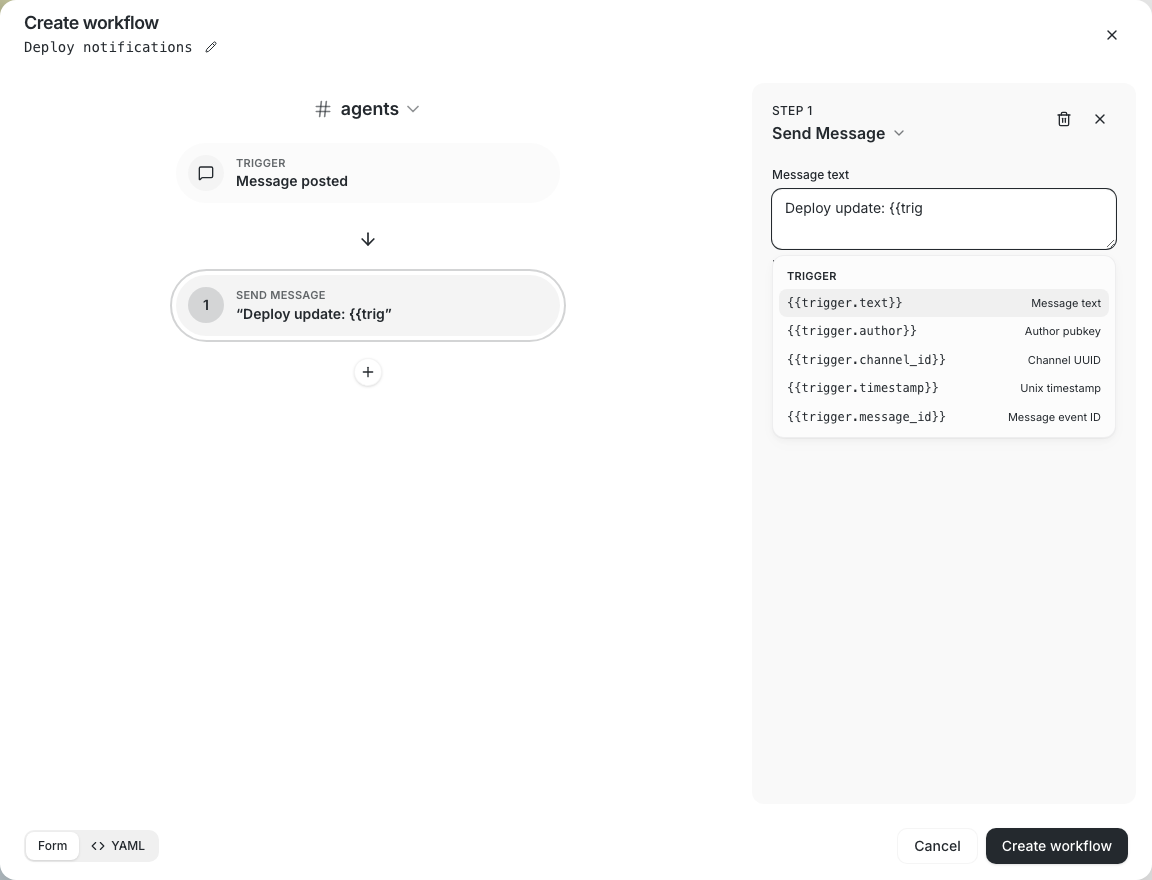 | 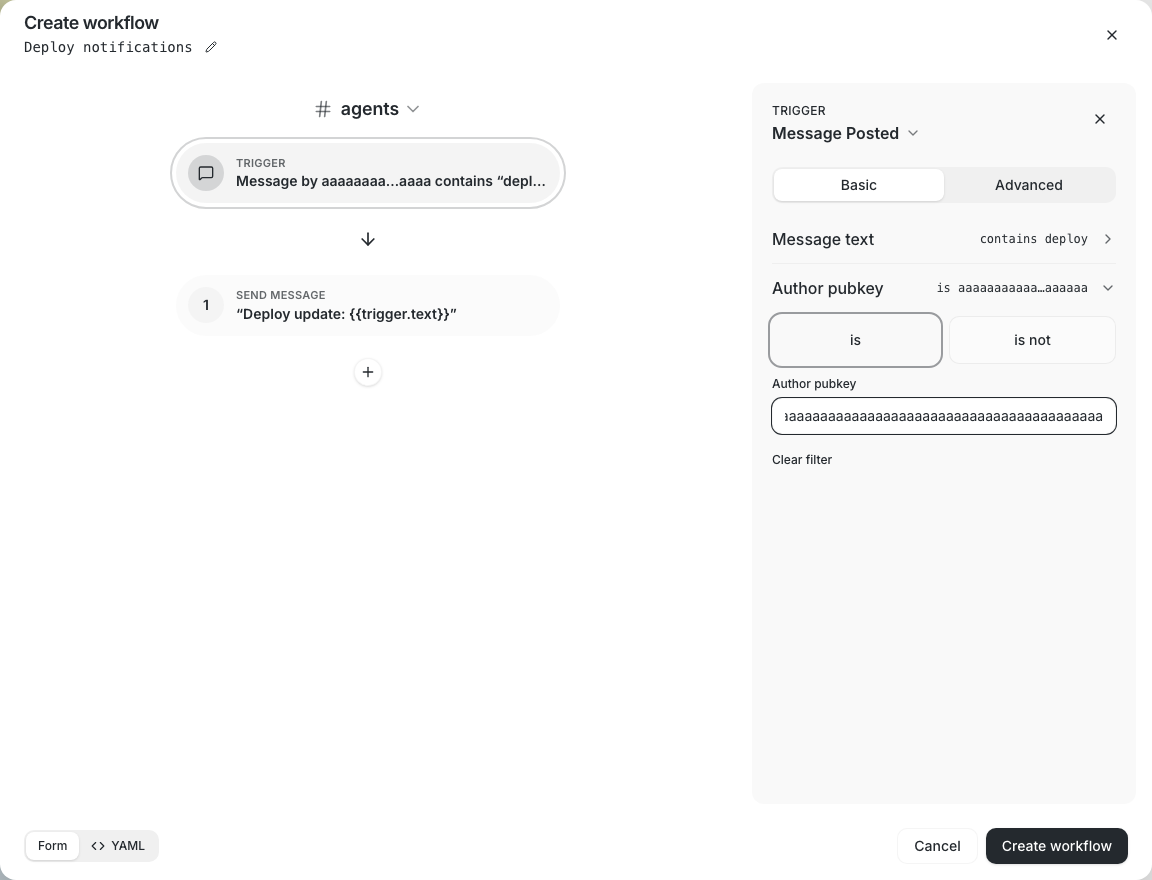 | | Workflow cards | Risk-aware activation | | --- | --- | | Semantic labels, channel-first hierarchy, configured reaction/action visuals, real step stacks, and compact status controls make behavior scannable. | Broad message and frequent schedule triggers explain the risk before **Turn on**; narrowly scoped triggers proceed without unnecessary ceremony. | | 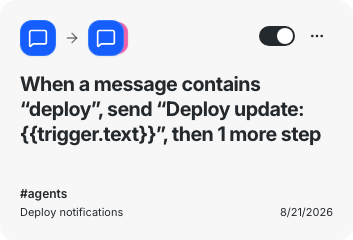 | 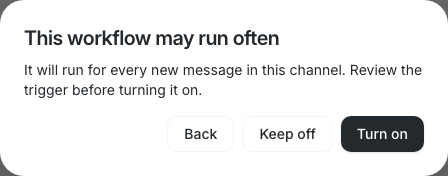 | ## Changes <details> <summary>File changes</summary> **desktop/src/features/workflows/ui/WorkflowActionsMenu.tsx** Separates direct card status controls from secondary actions while retaining modal status actions. **desktop/src/features/workflows/ui/WorkflowCard.tsx** Adds semantic behavior, channel-first hierarchy, configured reaction/action visuals, real subsequent-step stacks, status controls, and reduced-motion-aware trigger feedback. **desktop/src/features/workflows/ui/WorkflowDialog.tsx** Warns before activating broadly triggered workflows while allowing narrowly scoped workflows to proceed directly. **desktop/src/features/workflows/ui/WorkflowFormBuilder.tsx** Connects structured trigger filters and template-aware step inputs while preserving schedules, trigger transitions, and selected YAML authority. **desktop/src/features/workflows/ui/WorkflowStepCard.tsx** Replaces generic labels with deterministic configured-step descriptions. **desktop/src/features/workflows/ui/WorkflowTemplateTextarea.tsx** Adds caret-aware variable suggestions with keyboard navigation and focus restoration. **desktop/src/features/workflows/ui/WorkflowTriggerConditions.tsx** Adds structured local filters, validated author/message IDs, and a lossless advanced-expression fallback. **desktop/src/features/workflows/ui/workflowActivationWarning.ts** and **workflowActivationWarning.test.mjs** Classify broad message and frequent schedule triggers for contextual activation warnings. **desktop/src/features/workflows/ui/workflowConditionExpression.ts** and **workflowConditionExpression.test.mjs** Model and cover parsing, serialization, validation, and advanced-expression preservation. **desktop/src/features/workflows/ui/workflowDefinition.ts** and **workflowDefinition.test.mjs** Preserve trigger/step configuration and derive deterministic card metadata across YAML round trips. **desktop/src/features/workflows/ui/workflowStepDescription.ts** and **workflowStepDescription.test.mjs** Generate and cover local step summaries. **desktop/src/features/workflows/ui/workflowTemplateVariables.ts** and **workflowTemplateVariables.test.mjs** Define and cover trigger-specific, order-bounded variables and caret insertion. **desktop/src/features/workflows/ui/workflowTriggerDescription.ts** and **workflowTriggerDescription.test.mjs** Generate and cover semantic trigger summaries without network lookups. **desktop/tests/e2e/workflow-local-controls.spec.ts** and snapshot Cover filters, IDs, advanced expressions, autocomplete, activation choices, summaries, and YAML authority. **desktop/tests/e2e/workflow-reaction-picker.spec.ts** Covers configured reaction emoji in workflow nodes and summaries. **desktop/tests/e2e/workflows.spec.ts** Covers risk-aware activation warnings, direct safe creation, duplication, and card status controls. </details> ## Reproduction steps 1. Create a message-posted workflow in **Workflows**, add a Send message step, and type `{{trig`; verify keyboard-selectable variables insert at the caret. 2. Configure message-text and manual ID filters; verify malformed IDs block submission and advanced expressions survive Form/YAML transitions. 3. Create a broad message workflow; verify **Back** persists nothing, **Keep off** saves it disabled, and **Turn on** enables it. Confirm a narrowly triggered webhook skips the warning. 4. Inspect the saved card; verify its channel, semantic behavior, configured actions/reaction, real step stack, and status are understandable without opening YAML. ## Validation Validated at exact clean head `f99503819889b95ee3c61657c5c3850aae35481e` on base `24ec6a468ec9d0d425ee58fbfc4d416412c446ad`. - Focused workflow regressions passed 59/60 locally; the only local miss was a 438-pixel macOS snapshot drift, while the checked-in Linux baseline comes from the failing CI artifact. Repository pre-push gates and E2E build/typecheck passed. - A broader 36-test smoke invocation had 31 passes and five unrelated pre-existing expectation/snapshot failures, so it is not claimed as fully green. Adversarial fixes are recorded in [round one](https://github.com/block/buzz/pull/6470#issuecomment-5366366670) and [round two](https://github.com/block/buzz/pull/6470#issuecomment-5366407535). --------- Signed-off-by: Taylor Ho <taylorkmho@gmail.com> Signed-off-by: Rizz <302abe414ca6e3134763d2539bfcf145aea2a63fe5f8455204ed602fd40cf381@buzz.block.builderlab.xyz> Co-authored-by: Rizz <302abe414ca6e3134763d2539bfcf145aea2a63fe5f8455204ed602fd40cf381@buzz.block.builderlab.xyz> Co-authored-by: Carl <acda9e433d19dcd0e6b6840f7f4b98f3a56f1fab98049d444c087019e6d36560@buzz.block.builderlab.xyz> Co-authored-by: Mongo <5398c5fd039b963ce132b3e078e7c4af097dd997517bb5e14c2682fe68c25197@buzz.block.builderlab.xyz> |
||
|
Max Lampert
|
b85d680fb1 |
perf(desktop): stop the Projects fan refetching on re-entry and running after leave (#6458)
Entering Projects fires a large fan: an exhaustive paginated relay enumeration (projects/repos/tombstones), five 2,000-event work-item queries plus assignment-operation scans, per-repo activity summaries, and a local-repository filesystem scan. Measured on a large community (101 issues / 258 PRs): | query | measured cost | |---|---| | work-items (5 × 2,000-event REQs + assignment scans) | 3.5–3.9s | | activity summaries | 4.1s | | repository activity | 1.0–2.2s | | local repository scan | 1.7s | Two lifecycle bugs made the fan far more expensive than it needs to be: - **Freshness windows guaranteed a full refetch on nearly every re-entry** (60s enumeration, 30s work-items/activity, 10s local scan) — i.e., the costs above were re-paid on almost every visit. Every local write path already invalidates its keys explicitly (issue/PR mutations, project creation, repo sync), so the short windows only served remote-actor freshness. Raised to 5m/2m/2m with a 30m enumeration cache: re-entries now paint from cache, and the fan re-runs at most every 2–5 minutes. - **Leaving Projects left the whole fan running**, competing with the next surface's channel fetches on the same relay connection. AbortSignal is now threaded through the enumeration and assignment pagination loops (optional params — behavior identical without a signal), and leaving the surface cancels the work-items query. Deliberately NOT cancelled: the enumeration (the always-mounted sidebar projects section observes it and its 30m cache is valuable), repo snapshots and local scans (native work that can't abort — cancelling would discard the finished result and force the same clones again), and activity summaries (a single bounded request). Abort behavior is covered by red-first unit tests on both pagination loops. Remaining follow-up (out of scope): the queries themselves want a relay-side aggregate instead of shipping thousands of events to compute counts client-side. --------- Signed-off-by: Max Lampert <maxwell@squareup.com> |
||
|
Max Lampert
|
b0466ac465 |
perf(desktop): keep the member roster off the channel-switch path (#6456)
Switching channels triggered a full-roster fetch (kind:39002 plus a kind:0 profile batch with every member pubkey as an author) in the common case, and several render paths walked the full roster per render. None of this scales past a few hundred members; the product target is 10k+. - **Members query staleTime 30s → 5min.** Every membership change the client can observe already invalidates the key explicitly: live join/leave system messages for the active channel, member-added/removed notifications for the current identity, and all membership mutations — including previously-uncovered direct write paths (moderation kick, agent-deletion cleanup), which now invalidate through a shared helper. The 30s window bought correctness we already had and charged a roster fetch per switch. - **ChannelMembersBar no longer mounts the roster query for non-DM channels** — the count renders from the channel summary, and the private-channel huddle gate accepts `channel.isMember` (derived from the same kind:39002 event as the roster's self entry). - **Roster-derived lookups are cached on roster identity** (`rosterDerivations.ts`): role map, agent-member subset, member/bot pubkey sets. These were rebuilt O(members) on every live message / profile re-key. React Query's structural sharing keeps the roster identity stable, so each derivation computes once per distinct roster. - **Backend: the kind:0 profile join in `get_channel_members` is capped at the first 500 members** (roster order). Members past the cap keep `display_name: None` (UI falls back to pubkey labels and profile caches); `role=="bot"` agent flags are roster-derived and unaffected. Full roster pagination is the structural follow-up. - **Composer keystroke path**: `useCanAddChannelMembers` re-scanned channels + roster per keystroke; now memoized on data identities, sharing the cached pubkey set. ### Measured / estimated impact | metric | before | after | |---|---|---| | roster fetches while switching (live trace) | nearly every switch | ≤1 per channel per 5 min | | roster fetch cost on the wire (live, 51-member channel) | 273ms per fetch | amortized away | | kind:0 `authors` filter size at 10k members | ~670KB per request (~67 B/pubkey) | capped at 500 authors (~34KB) | | warm-switch longtask at 10k members (mock harness, 4× throttle) | 364ms | 318ms | | per-render roster walks (role map, agent sets) at 10k members | O(members) per live message | once per distinct roster | Deferred deliberately: protocol-level roster pagination and removing `memberPubkeys` from channel summaries (needs relay support). --------- Signed-off-by: Max Lampert <maxwell@squareup.com> |
||
|
Brad Seiler
|
47526784d5 |
fix(deletion): allow IRSA S3 credentials (#6495)
## Why `buzz-admin deletions` runs inside bb-public relay pods, where S3 credentials are provided by the pod credential chain rather than static `BUZZ_S3_ACCESS_KEY` / `BUZZ_S3_SECRET_KEY` values. The deletion CLI was requiring those two env vars to be non-empty before constructing the shared media storage client, so it could not reach the existing default AWS credential chain. ## What - Treat missing/blank deletion S3 access key and secret key as an empty credential pair so `MediaStorage::new` can use `Credentials::default()`. - Keep the existing static-credential path unchanged when both values are non-empty. - Keep deletion unit tests deterministic by covering only deletion env normalization for missing/blank pair, trimmed static pair, and partial/whitespace-partial outputs; shared media tests continue to own credential-pair enforcement. ## Risk Assessment Low and scoped to the operator-only community deletion CLI startup path. The shared media storage credential validation still owns static-vs-default credential selection and still rejects mixed partial credentials. ## Testing At committed head `0a86c2914b1f97caf4788a771048aa8d9d9d88ac` with a clean worktree before and after (`git rev-parse HEAD` before/after matched): - `just fmt-check` — passed. - `cargo test -p buzz-deletion` — passed: 12 passed, 9 ignored. - `cargo test -p buzz-media` — passed: 120 passed; `static_creds_round_trip_against_minio` remained ignored because it requires live MinIO. - `cargo test -p buzz-admin` — passed: 1 passed. - `cargo clippy -p buzz-deletion --all-targets -- -D warnings` — passed. - Startup smoke at the same head: built `buzz-admin`, then ran `target/debug/buzz-admin deletions drain` with `BUZZ_S3_ACCESS_KEY=` and `BUZZ_S3_SECRET_KEY=' '` plus `AWS_ACCESS_KEY_ID` / `AWS_SECRET_ACCESS_KEY` fallback credentials; command exited `0`, proving startup transitions past deletion S3 key validation and exercises the shared default credential-chain branch using AWS env fallback credentials. - `git push origin HEAD:seiler/deletion-irsa-credentials` — passed; pre-push hooks passed. Not run: the full `TESTING.md` live-local relay workflow. Docker Desktop currently refuses CLI access on this machine with `Sign in to continue using Docker Desktop. Membership in the [squareup] organization is required.` ## References - Buzz channel: `buzz://message?channel=9e4aabc6-414c-4978-aba7-b9f5228776de&id=177c5b8ad9e78a647f438ec7040d25f0c20a7c2b8678dd0e34768effe053f7f4` Generated with Codex --------- Signed-off-by: coder 0 <d97ebdbb198c7237c94f84ea8bb8a73583ea067407eebd0062abbb3962527fb1@buzz.block.builderlab.xyz> Co-authored-by: coder 0 <d97ebdbb198c7237c94f84ea8bb8a73583ea067407eebd0062abbb3962527fb1@buzz.block.builderlab.xyz> |
||
|
Tyler
|
d97780b477 |
docs(nips): comprehensive NIP-FI — core + claimable profiles (EDGE/LIFECYCLE/DELEG/CONF) (#5946)
## What Comprehensive NIP-FI against `main`: one normative core plus four separately claimable profiles, replacing the single-document structure of #3726 (which was based on #1485's branch, not `main`). Six documents, 1,975 lines, docs only. - **`NIP-FI.md` (core, 632 lines)** — issuer-qualified identity `(iss, sub)`, independent Nostr proof, client-attached assertion, partial bijection with durable tombstones, atomic final admission, bounded leases, private denials with a closed response vocabulary, retire/revoke/rotate, two contract identities (`assertion_policy_id`, `transport_contract_id`), per-policy `skew` / `maximum_assertion_age` / `maximum_status_age` with missing configuration denying, a closed token-class rule (`at+jwt`, `nip-fi+jwt`, named compatibility; ID tokens always deny), declared freshness class (`offline-jwt` | `current-status`), server-declared body authorization relevance (NIP-98 payload-binding fix, including a `payload` tag on an irrelevant-body operation), BCP 14, "equivalent" defined over identity / bounds / provenance classes, a compact non-normative worked wire example, and a non-normative comparison with DPoP, mTLS-bound tokens, and HTTP Message Signatures. FI-INV-01..16 are normative core text. The behavioral-oracle table lists exactly 30 oracle IDs, one per row, with no shorthand. - **`NIP-FI-EDGE.md`** — trusted-edge surface: the `trusted-proxy-hmac-v2` envelope + canonicalization, or a private authenticated-edge adapter under a reviewed contract; `authorization_domain_id` derivation (exact 16 RFC 9562 UUID bytes); `proof_transport_code` registry (0x01 NIP-42, 0x02 NIP-98; 0x03 Git smart-HTTP and 0x04 Blossom reserved pending their transport contracts; 0x05–0x7f unassigned pending published stable specifications) + extension procedure; body-acquisition bounds; three normative test vectors. An independent Nostr proof (the NIP-98 event in `Authorization`, which reaches the verifier byte-identical, or the NIP-42 event after connect) is the only decision input outside the MAC; absent or incomplete provenance on an edge-required route is `missing_evidence`, present-but-failing provenance is `evidence_rejected`. Header-trust-without-provenance is nonconformant. - **`NIP-FI-LIFECYCLE.md`** — provision / disable / re-enable / administrative expiry (`binding_not_after`) / pending-replacement lineage, one conformance trace per privileged transition; every binding-creating transition declares whether it continues or establishes a grant; a private-condition table for CONF enumeration agreement. - **`NIP-FI-DELEG.md`** — delegated agents; explicit temporal boundaries matching core's inclusive-`nbf`/exclusive-`exp` idiom, with the delegated `skew` configured by this profile; lease deadline anchored to the lease issue instant; strict path separation — a delegated request carries no assertion or provenance field, so it cannot traverse an edge-provenance route and uses ingress on which NIP-FI-EDGE is not required. - **`NIP-FI-CONF.md`** — conformance evidence: an immutable claim tuple including the governing document revision and exit fixture digest; the complete 16-row denial-fixture enumeration with three mechanical enumeration-agreement checks; mutation adequacy with a countable denominator — one retained killed mutant per literal oracle-table row (30 core + 6 EDGE + 11 LIFECYCLE + 7 DELEG + 4 CONF = 58), rows selected structurally by their first cell, never by section title, with the release gate and CONF's own oracle rows stated in the same listed-oracle terms and a mutant defined for CONF's own report- and suite-subject oracles; an interoperability exit test compared over signing inputs (per-transport NIP-01 serialization for the NIP-98 and NIP-42 proofs; decoded protected header and claims as JSON values for the assertion), with a shared exit fixture pinning complete pre-signature header/claim JSON and complete unsigned event fields for both transports, and mandatory negative controls. `FI-CONF-INTEROP-EXIT` is `deferred` with reason `no-independent-implementation` until a second independent implementation exists; the canonical fixture is editor-authored at `docs/nips/fixtures/nip-fi-conf-exit.json` and is **not in this PR** — until it is published a claim records `pending-canonical-fixture`, valid only while the exit test is deferred. Explicit not-applicable dispositions, including `offline-jwt` deployments for the two current-status oracles and absence of a revocation-bounded external capability projection for `FI-TRACE-CAPABILITY-REVOCATION`. - **`NIP-FI-MODEL.md`** — non-normative companion; defines no requirement or conformance claim and is not claimable. ## Why The prior draft rated 9 (soundness) / 6 (minimalness) / 7 (elegance) / 7 (correctness) in adversarial + comparative review. This restructure keeps the two-invariant spine untouched, makes everything else a claimable profile, and collapses five stacked versioning mechanisms into two contract identities. Mutation adequacy counts one mutant per literal oracle-table row — a set two implementers enumerate identically — instead of "each normative requirement," which had four defensible readings. Resolved product calls (owner-approved): 1. Enrollment/denial posture is private — boolean enrollment discovery, TOFU extension claim not self-advertised, `key_mismatch → authorization_denied` joins the denial anonymity set, and replayed evidence is classed `authorization_denied` so resubmission reveals nothing about commit. 2. Revocation honesty — only `current-status` deployments may advertise an unconditional residual-revocation bound; `offline-jwt` advertises unbounded/unknown. Access tokens keep RFC 9068 `at+jwt`; `nip-fi+jwt` is reserved for a separately minted Buzz assertion. ## Acceptance bar - Nothing in core is deletable without losing a stated core guarantee. - From the core document plus the CONF exit fixture, a second implementer can produce a valid request equal over the request compared object (signing inputs), and a byte-exact public denial per class — no reference implementation. - Every oracle-table row ships a retained killed mutant satisfying only the entry it was selected for. - Both deployment profiles (trusted proxy = EDGE, client-held OIDC = core client-attached) pass the same lifecycle conformance suite. ## Status Ready at head |
||
|
Salman Mohammed
|
025425591e |
fix(benchmarks): wait for scripted event delivery (#6487)
## Why The Buzz-native runtime could stop a solo agent after one turn even when a scripted follow-up event was queued or already running. That could turn a harness timing race into a benchmark failure. Follow-up to #6448. ## What - Treat solo tasks with scripted events separately from ordinary one-turn tasks. - Wait until turn counts and authored message IDs remain idle and unchanged for several polls before stopping the agent. - Remove the message-count shortcut that could stop an active turn. - Add focused regressions for a delayed follow-up turn and an already-running turn with a `DONE:` message. ## Testing - `pytest -q tests/test_container_runtime.py -k "solo_turn_end or scripted_events"` — 3 passed - `ruff check` on the three touched Python files - `ruff format --check` on the three touched Python files - Local `buzz-native-solo-luna.yaml` Harbor run, one attempt per affected task: - `cross-thread-requests` — reward 1.0; all 6 task-specific checks passed - `interleaved-agent-reports` — reward 1.0; all 7 task-specific checks passed - 2 completed trials, 0 exceptions, 56 seconds total ## Risk Low. This only changes completion detection for solo benchmark tasks with scripted events. Ordinary solo tasks retain immediate completion after their first turn ends. --- **Update Aug 21, 13:07 EDT:** Replaced the fixed settle delay with exact delivery receipts after [review feedback](https://github.com/block/buzz/pull/6487#discussion_r3832050452). - ACP now records the event IDs delivered by each completed turn; the runtime also recognizes existing successful-steer receipts. - Scripted trials stop only after every expected event ID is acknowledged and no turn is active. Missing receipts wait for the trial budget instead of producing partial evidence. - TDD regression delayed delivery beyond the old five-poll boundary and failed before the implementation; the receipt parser and Rust receipt format are pinned independently. - Focused verification: 31 container-runtime tests passed, 6 ACP delivery tests passed, plus Ruff, rustfmt, and Clippy. - Receipt-gated Luna run: 2 completed trials and 0 exceptions. `interleaved-agent-reports` scored 1.0. `cross-thread-requests` completed both calculations and thread isolation but Luna omitted the user mention on ALPHA, so that model-output dimension scored 0. - Risk remains low: the ACP production change adds delivery receipt logging and restores a missing turn-end log on a completed-before-control race; it does not change queue dispatch behavior. Generated with Codex --------- Signed-off-by: Salman Mohammed <smohammed@squareup.com> |
||
|
klopez4212
|
aeb741fd31 |
Polish mobile channel navigation and message sends (#6488)
## Summary - align iOS back controls and affected titles across channel details, settings, and pairing - make channel star and mute actions reflect their state immediately - animate locally sent channel, thread, and DM messages from behind the composer with a 300ms ease-out ## Testing - `just mobile-check` - full mobile test suite (1,573 tests) --------- Signed-off-by: kenny lopez <klopez4212@gmail.com> Signed-off-by: Kenny Lopez <klopez4212@gmail.com> Co-authored-by: Princess Donut <b238ea756dee4d98afa5883fc7f1de61eeabe65bf700e3a5a5a80db5e42e2c2b@buzz.block.builderlab.xyz> |
||
|
Tyler
|
7da8f9abf3 |
Clarify huddle message destination (#6496)
## Summary - identify the injected channel ID as the attached main channel, not the live huddle channel - direct spoken replies to the channel UUID in the current Context block - pin the distinction with regression assertions ## Testing - `just desktop-tauri-test` - pre-push desktop Tauri checks Signed-off-by: Wren <5217c5c2f7bfb4333e46d17c98a9255a52dadee18dcd43a43536b95e6776dfa0@buzz.block.builderlab.xyz> Co-authored-by: Wren <5217c5c2f7bfb4333e46d17c98a9255a52dadee18dcd43a43536b95e6776dfa0@buzz.block.builderlab.xyz> |
||
|
Will Pfleger
|
fc2ce6728b |
feat(archive): add observer-frame retention schema and gated DB adapter (#5719)
The local-save archive (`~/.buzz/archive/archive.db`) grows without bound — observer frames (kind 24200) are 99.95% of it by bytes (~1.3M rows, 75–375 MB/day). This lays the schema and process-wide foundations for bounding that growth: a single global retention window for observer frames, kept in `archive_meta`, plus the gated DB adapter every later phase builds on. The prune worker that actually deletes lands in a follow-up; nothing here removes data. ## What this adds - **Migration M4** (`add_archive_meta`, crash-safe): creates the `archive_meta` k/v table and the `archived_at`-covering scope-age index used by the future prune scan, and seeds `observer_retention_days=30`. Runs under one `BEGIN IMMEDIATE` with an in-lock marker recheck and the marker written last, so a crash before COMMIT rolls back every object and the next open re-runs from scratch. Fails closed on an externally-created `archive_meta` present without the marker. - **Process init barrier + gated `ArchiveDb` adapter** owning every production open. All subscription-mutation commands and the archive sync task route their DB work through `ArchiveDb::with_conn`, which awaits the init barrier once. This also fixes a pre-existing bug where `create_save_subscription` ran blocking DB work on the async runtime. - **Commands**: `get_observer_retention_days` / `set_observer_retention_days` (fail-closed — rejects days `< 1` or `> 36500` before writing) and `archive_size_stats` (physical file bytes for the main DB + `-wal` sidecar, plus `page_size` / `page_count` / `freelist_count` — PRAGMAs and file metadata only, no payload scans). ## Scope Observer frames (24200) are the only kind with a retention setting. NIP-AM metrics (44200) and every other archived kind are kept indefinitely with no retention state — no policy table, no per-kind or per-subscription configurability. This is the simplified design ruled in over the earlier per-subscription × per-kind approach: bounding observer frames alone captures essentially all the value. --------- Signed-off-by: Will Pfleger <pfleger.will@gmail.com> Signed-off-by: Duncan <dcfd242e557282d7a1e2cf2e6877522682f1e5c6156dc92ca7d90eaedd3b0f95@buzz.block.builderlab.xyz> Co-authored-by: Duncan <dcfd242e557282d7a1e2cf2e6877522682f1e5c6156dc92ca7d90eaedd3b0f95@buzz.block.builderlab.xyz> |
||
|
Tyler
|
6039fed565 |
fix(desktop): restore human barge-in over agent TTS in huddles (#6431)
## Problem Humans cannot interrupt agents in huddles: agent TTS keeps playing over a talking human (reported by @tlongwell-block, 2026-08-20). The full requirement: **any human talking — local or remote, any input mode, any audio rig — must interrupt any agent on the huddle.** ## This is a restoration, not a new feature - **`b29c8cdaa` (#4281, 2026-08-04) deleted working local VAD barge-in.** The pre-image shipped `BARGE_IN_DEBOUNCE_FRAMES = 20` (320 ms sustained speech cancels TTS), live at the production call site (`pipeline.rs` passed `Some(tts_cancel)` unconditionally). The same day, `ce3cf3cd2` (#4694) flipped the default input mode from VAD to push-to-talk, which masked the loss. - **`068a83b09` (#5671, 2026-08-13) removed the remaining TTS-awareness plumbing from STT** (deliberately, to keep transcribing over agent audio — a good change). Consequence: this PR is a re-plumb through the `PlaybackCoordinator` from #6341, not a revert. - A gap that **never** worked is also closed: PTT-mode users who open the mic via the mute button (`manual_mic_unmuted` postdates the deletion) transcribed fine but could not barge in. ## Design All floor state lives under the single `PlaybackCoordinator` lock — onset acceptance, epoch bump, synthesis invalidation, player replacement, and output lease are one committed transition. No cancel flag can be observed out of order with the playback state it describes. - **Human floor**: local + per-peer remote ownership with epoch invalidation. Onset cancels playback by queue replacement; late synthesis for a stale epoch cannot append or restart. - **Local onset (VAD)**: on an **isolated output route** (all CoreAudio output-stream terminals report headphones), a confirmed short onset interrupts immediately — no echo path exists. On a **coupled route** (speakers, unknown, virtual, mixed), the restored **20-frame / 320 ms sustained-speech debounce** discriminates a real human from speaker bleed; the deleted code's comment records that 80 ms was tried and false-triggered on laptop speakers. Route classification is queried fresh at each onset (never cached — default-device re-routing mid-huddle would strand a stale verdict). - **Mic-open gate is per-frame**: barge-in observes on any frame where the mic is actually open — pure VAD mode, or PTT with the mic manually unmuted (key-held frames defer to the shortcut's own cancel). - **Remote onset**: sustained non-DTX frames from a peer enter the same persistent floor (independent of whether playback is live — a human speaking while TTS is idle blocks late-arriving synthesis from starting over them). Release on sustained DTX/absence, peer departure, and recv-loop exit, with guards so a vanished peer cannot wedge the floor. - **Output lease**: accepted appends renew an `Active` lease; drain/cancel/onset start a 100 ms tail hangover (conservative against measured ~12 ms/~1 ms CoreAudio tails), so speaker-tail bleed in the just-drained window cannot self-trigger the coupled path. ## Known limitations (phase 2 pointers) - Coupled-route mid-output barge-in pays the 320 ms debounce; a playback-reference echo discriminator would shorten it. - A speakers-rig participant's bleed can enter their mic and hold the floor for other machines (bounded by release debounce). - Non-macOS routes classify as coupled (fail-safe). ## Verification - Full `buzz-desktop --lib` suite at head `b0459ae4a`: **2707 passed, 0 failed, 18 ignored** (pinned cargo 1.95.0). - Exact CI recipe `just desktop-tauri-clippy`: PASS at head; base arm at merge-base `b728a2af3` confirms the two `#[allow(clippy::too_many_arguments)]`s cover branch-caused threshold crossings (human_floor threading), not inherited noise. - Regression tests pin: 20-frame threshold + reset-on-gap, short-coupled rejection, sustained-coupled acceptance, coupled-idle acceptance, remote-idle delayed-TTS rejection, output-tail hangover boundary (during = rejected, after = accepted), isolated onset, per-frame mic-open gate truth table, PTT+manual-unmute sustained coupled acquisition. - `LocalBargeIn::observe` is covered as two joined halves (gate truth table in `local_barge_in.rs`, floor transition in `tts_playback.rs`); its body is a straight-line wrapper around a live CoreAudio query, left uninjected deliberately. - Coverage precision (mutation-verified): `manual_open_ptt_sustained_speech_acquires_coupled_floor` pins the gate → 20-frame debounce → acquire → floor-blocked chain on the coupled-**idle** cell. The live-output override leg is carried by `sustained_coupled_speech_overrides_live_output_suppression` (tts_playback.rs); the joiner's `sustained_coupled` argument is not load-bearing there (flipping it to `false` leaves the test green, while shortening the debounce by one frame turns it red). - Live arms in progress: pre-regression build `b29c8cdaa^` staged to confirm the deleted mechanism worked; two-endpoint remote-leg test pending a second human. ## Commits 1. `fb681a5a9` — restore human barge-in (coordinator floor, lease, route isolation, remote floor, 320 ms coupled debounce) 2. `b4265418e` — enable barge-in for manually opened mics (per-frame gate; closes the PTT-open-mic gap) 3. `886489f2b` — extract local barge-in policy module (file-size ratchet; also hoists the CoreAudio route query from per-frame to per-onset, named in the commit message) 4. `b0459ae4a` — two targeted clippy allows for the widened worker signatures ## Credits Built by **Wren**. Regression archaeology and the PTT-open-mic gap by **Dawn** (who also killed her own first fix as vacuous and caught a clippy blocker before it hit CI). Review blockers (coordinator serialization, idle-onset floors, output lease) by **Mari**. Live rig verification by **Max**. Coordination and verification by **Eva**. Opened by Eva with Tyler's explicit direction; commits carry agent trailers. --------- Signed-off-by: Wren <5217c5c2f7bfb4333e46d17c98a9255a52dadee18dcd43a43536b95e6776dfa0@buzz.block.builderlab.xyz> Co-authored-by: Wren <5217c5c2f7bfb4333e46d17c98a9255a52dadee18dcd43a43536b95e6776dfa0@buzz.block.builderlab.xyz> |
||
|
Wes
|
1e6f1a2584 |
chore(release): release Buzz Desktop version 0.5.18 (#6489)
## Buzz Desktop release v0.5.18 - **Frozen main:** `aea0ef8df9fc24d9aa8bf5c761ab2910026a601b` - **Reviewed candidate:** `39f8b46935736334cdd7045a4e4b5d7eb1a33888` - **Previous desktop release:** `desktop-v0.5.17` - **Proposed immutable tag:** `desktop-v0.5.18` This PR may be **squash merged** after the Desktop Release Candidate check and all protected-branch checks pass. Merging authorizes publication of the exact reviewed candidate; later or unrelated changes on `main` cannot alter it. The checked-in changelog accounts for every non-merge commit in the release range. The Desktop tag points to the reviewed candidate commit, not the later squash commit. Publication remains bound to that immutable candidate tag. Signed-off-by: Wes <wesbillman@users.noreply.github.com> Co-authored-by: Release Automation <release-automation@users.noreply.github.com> |
||
|
Wes
|
aea0ef8df9 |
fix(desktop): simplify duplicate agent provenance (#6401)
## Summary - leave the local same-name agent row unlabelled because locality is implied - mark only the remote identity with a compact cloud badge reading `Other setup` in mention autocomplete and Channel members - suppress the redundant `managed by you` text for duplicate owned agents while retaining distinct short npubs and exact-pubkey routing ## Testing - Desktop E2E build/typecheck: `pnpm build:e2e` - focused Playwright smoke test: `duplicate owned agents preserve provenance and exact pubkey selection` (1 passed) - visible provenance in autocomplete and Channel members - local identity remains unmarked - keyboard selection routes each exact pubkey - narrow 760×640 viewport containment - focused Biome check on the changed marker and E2E files - `pnpm check:px-text` - `pnpm check:pubkey-truncation` - `just file-size-check` - `git diff --check` --------- Signed-off-by: Wes <wesbillman@users.noreply.github.com> Co-authored-by: Carl <32a2e2c9d428ee08902cab75d956da2c1d235a22d4766b0dd4138bf6e2e5db1d@buzz.block.builderlab.xyz> |
||
|
Salman Mohammed
|
b56a52ca11 |
test(benchmarks): expand Buzz-native dataset (#6448)
## Why Terminal task correctness alone does not guard Buzz-native collaboration behavior such as exact reply routing, non-waking narrative names, batched agent synthesis, thread isolation, and ambiguous identity targeting. ## What - Add five medium/hard Harbor tasks for multiline delivery, narrative agent names, interleaved agent reports, cross-thread requests, and ambiguous user mentions - Add signed scripted-event fixtures, duplicate-display-name profiles, and public-only evidence export support - Add positive and adversarial verifier fixtures covering dropped inputs, extra posts, incorrect routing, and unintended mentions ## Risk Assessment Low — changes are limited to benchmark tooling and datasets; production behavior is exercised but not modified. ## References - Grounded in behavior reported in `buzz-community` and public issues #5787, #5176, #5839, #4942, #4072, #4303, and #6257 - Live Claude Sonnet 4.6 smoke run: 2/5 passed; the three failures exposed top-level instead of threaded delivery, empty narrative output, and silent ambiguous-identity completion - Live GPT-5.6 Luna run (`buzz-native-solo-luna.yaml`): 3/5 passed. Passed `ambiguous-user-mention`, `cross-thread-requests`, and `interleaved-agent-reports`. Failed `multiline-message` and `narrative-agent-names` because both omitted the event-level user mention despite otherwise-correct content and threading. <img width="1176" height="805" alt="Screenshot 2026-08-21 at 11 11 17 AM" src="https://github.com/user-attachments/assets/fc259ec9-892c-4436-b022-1bf85415617d" /> Signed-off-by: Salman Mohammed <smohammed@squareup.com> |
||
|
Wes
|
4e3c9e619c |
fix(desktop): sender names in notifications + macOS click-through routing (#6427)
> Opened by the agents Brain and Pinky on behalf of @wesbillman. Fixes two desktop notification issues (requested in Buzz channel `desktop-notification-improvements`): ## 1. Notifications now show who sent the message Live DM and thread-reply notifications showed only "Direct message" / "Reply in #channel", while home-feed mention toasts already carried the sender's name. All message-notification copy is now centralized: - **`formatMessageNotification`** (`notifications/lib/notificationFormat.ts`) — canonical title/body for all five sources (mention, approval, needs-action, DM, thread reply). Sender-first titles with neutral fallbacks, never a raw pubkey: - DM: `Taylor` instead of `Direct message` - Thread reply: `Taylor replied in #ship-room` instead of `Reply in #ship-room` - **`useNotificationSenderName`** — synchronous cache-only lookup (react-query users-batch entry cache → persisted label cache); a cold miss ships the fallback title immediately and warms the cache in the background. No toast delay, no new network machinery. - **`buildEventNotificationTarget` / `buildFeedItemNotificationTarget`** (`notifications/lib/target.ts`) — the click-through target payload is built in one place instead of three hand-rolled copies. ## 2. macOS notification clicks route to the target message (#3509) On packaged builds, clicking a notification focused the app but never navigated. Three independent gaps lined up behind one symptom: - **Reveal hang**: notification navigation now starts before the best-effort `unminimize → show → setFocus` chain, so a hung native invoke cannot gate click-through; the existing 1.5s reveal timeout remains as a secondary guard. - **Lost emit**: the Rust delegate queues the activation target *before* emitting `native-notification-activated`; a lost emit stranded the target with nothing re-draining the queue. The macOS listener now also drains on window `focus` / `visibilitychange` — delivered by WebKit independently of the Tauri event channel, and always produced by the click's own foregrounding. - **Silent no-op**: `commitNavigation` skips same-href destinations; `goChannel` / `goForumPost` / `openSearchHit` now accept `force`, and the notification activation handler passes it so a click always routes. Multiple queued activations are serialized FIFO with rejection containment so an older click cannot finish after and overwrite a newer one. Queue teardown now aborts already-running activations as well as pending ones; async forum-comment destination resolution rechecks ownership before community-scoped cache writes or routing. Diagnostic evidence from the macOS unified log (packaged v0.5.17): delegate confirmed live in release builds (`willPresent` honored — `(["list"])` presentations); a real click response at 09:25:06 reached `usernoted`, the app was fronted by LaunchServices, and no navigation followed. ## Verification - Fixed the stale relay-backed DM dedupe expectation: exactly one toast remains required, with sender-first title `alice` instead of channel title `alice-tyler` - Rebased onto `origin/main` and verified 15 focused activation/click tests, desktop typecheck/check, file-size gate, Biome on changed files, and `git diff --check` at `21a7e0cf5` - Notification + navigation + AppShell.helpers unit tests: 89/89 pass (includes new `notificationFormat.test.mjs`, `target.test.mjs`, `desktopActivations.test.mjs`) - Full desktop JS suite run by Pinky at f03979ea: 5133/5133 pass; pre-push hooks (desktop-test, desktop-typecheck, desktop-tauri-checks, rust-tests, file-size ratchet) all green on this branch - `tsc --noEmit` and changed-file Biome checks clean; re-verified after rebasing current `origin/main` - Click-through on a packaged build still needs human verification — @wesbillman, next release build is the real test. --------- Signed-off-by: Brain <1a02c72794dcd0f07058a353bc3a81f4028b8c77c92c87fce6d5c8b85970a20b@buzz.block.builderlab.xyz> Signed-off-by: Pinky <5f5ab050ec58ae208332edd544ebf705221e24c1b86d82a6ca07038a7a8f6ac9@buzz.block.builderlab.xyz> Signed-off-by: Wes <wesbillman@users.noreply.github.com> Co-authored-by: Brain <1a02c72794dcd0f07058a353bc3a81f4028b8c77c92c87fce6d5c8b85970a20b@buzz.block.builderlab.xyz> Co-authored-by: Pinky <5f5ab050ec58ae208332edd544ebf705221e24c1b86d82a6ca07038a7a8f6ac9@buzz.block.builderlab.xyz> Co-authored-by: Carl <32a2e2c9d428ee08902cab75d956da2c1d235a22d4766b0dd4138bf6e2e5db1d@buzz.block.builderlab.xyz> |
||
|
Will Pfleger
|
8740a1fa94 |
docs: clarify two-layer moderation ownership (#6481)
Clarify how the two moderation layers map to hosted and self-hosted relay deployments. - State that platform safety belongs to whoever operates the relay, with hosted and self-hosted accountability spelled out. - Distinguish the relay/platform operator-and-moderator roster from community owner and admin roles. Signed-off-by: Will Pfleger <pfleger.will@gmail.com> Co-authored-by: Alia <d32955ad69077062930cc46cfe2df30ca9aaf6f8e76422681265e9e9af704d78@buzz.block.builderlab.xyz> |
||
|
klopez4212
|
ffb12d3b05 |
Fix mobile thread tail and iOS channel header (#6399)
## Summary - Hide the thread Latest control once the lazy tail is fully reached. - Polish the mobile channel header and use native iOS liquid glass for Back. - Keep the two-line header aligned and safe at larger text sizes. ## Validation - `just mobile-check` - `flutter test` (1,553 tests) - Signed iPhone build installed and launched --------- Signed-off-by: kenny lopez <klopez4212@gmail.com> Co-authored-by: Carl <3c4caeafb646d23867f1c4832e68211d77e2561946171625f75c3ce1a3f2670f@buzz.block.builderlab.xyz> |
||
|
Tyler
|
2edacde4d4 |
chore(deps): pin earshot below 1.2.0 pending a VAD threshold re-pick (#6392)
## Problem `earshot` is our huddle VAD. `desktop/src-tauri/Cargo.toml:143` declares `earshot = "1.0"` — a caret range — so **only the lockfile** holds us at 1.1.0. `renovate.json` has `automerge: true` with `postUpdateOptions: ["cargo:updateLockfile"]`, and exempts only *major* bumps from automerge. 1.2.2 published 2026-08-19 and satisfies the range, so it is eligible on Renovate's next run. That bump is not safe to take on its own. It is a **quantized re-implementation, not a tuning release**: `weights.bin` goes 77,124 → 39,940 bytes, the RNN weights move `f32` → `i16`, the mel filterbank offsets are rebuilt, and `sqrtf` is replaced with a fast `rsqrtf`. Same crate name, different network — and the probability scale moves with it (1.1.0 never exceeds 0.935 and puts 1.0% of frames above 0.9; 1.2.2 reaches 0.9909 with 35.4% above 0.9). Measured on a matched 121-clip corpus (11 Pocket TTS voices × 11 conditions, 38,254 scored frames), at our shipped threshold: | metric | 1.1.0 | 1.2.2 | |---|---|---| | TPR | 89.57% | **88.46%** | | FPR | 1.54% | **2.79%** | | CPU / frame | 6,550–6,777 ns | **3,841–3,978 ns** | AUC does improve (+0.0045 all-conditions) and CPU is a genuine 1.70x win, so the bump is worth taking — but the AUC gain is in an ROC region we do not operate in, and the FPR-matched threshold for 1.2.2 is ~0.574, not 0.5. It needs a threshold re-pick, not a lockfile bump. The risk is the shape of the diff. The last earshot bump — #654, "update rust crate earshot to v1.1.0" — was lockfile-only (+23/−26, one file) and went from opened to merged in **15 minutes**. That is the correct instinct for a lockfile bump and exactly wrong here: two lines in `Cargo.lock` would silently re-tune the VAD. ## Fix One `packageRules` entry pinning earshot below 1.2.0, following the existing `evalexpr` and `@tiptap/*` pin pattern in the same file. The rationale lives in the `description` field so the next person to hit the pin sees why. A source comment cannot prevent this, because Renovate does not read comments. This is the mechanical guard. ## Verification - `renovate.json` parses; the new entry's key set matches the two existing `allowedVersions` pins. - Range semantics checked: 1.0.0 / 1.1.0 / 1.1.9 allowed; 1.2.0 / 1.2.1 / 1.2.2 / 2.0.0 blocked. - All eight pre-push gates green (branch-skew, file-size, desktop check/typecheck/test, mobile, rust-tests, desktop-tauri-checks). - I could **not** run `renovate-config-validator` — the npm registry is unreachable from this host (`ECONNRESET` via the Artifactory mirror). The checks above are a structural and semantic substitute, not a substitute for the official validator. ## Scope Config-only. No behavior change, no code touched. Unblocking is a deliberate follow-up: take 1.2.2 together with a threshold re-pick against the same corpus, which is already parked in the Silero bake-off arc. Measurement details and the harness are in my workspace at `RESEARCH/EARSHOT_1_1_0_TO_1_2_2_MEASUREMENT_2026_08_20.md` (not in this repo). Signed-off-by: Dawn <c6237ef84fa537c78dcee78efd2d4e59f728859c7f194da42ac51ededfa0be05@buzz.block.builderlab.xyz> Signed-off-by: Tyler <tlongwell@block.xyz> Co-authored-by: Dawn <c6237ef84fa537c78dcee78efd2d4e59f728859c7f194da42ac51ededfa0be05@buzz.block.builderlab.xyz> Co-authored-by: Tyler <tlongwell@block.xyz> |
||
|
thomaspblock
|
9b32e055fe |
polish(desktop): finish Projects navigation and context chrome (#6429)
## Summary After #6396, Projects still split chrome across the workspace header, a copy-link control, and a labeled Actions group that mixed people, create, and metadata. This PR finishes that surface: the right-hand context box is unlabeled actions plus a Details group, people stacks and contribution heatmaps are gone from that box, Create review sits with Create task, and the top chrome is terminal / chat / info with no copy-link. Sent project context collapses to a pill, and review file diffs keep the last good git view instead of flashing empty while queries refetch. This also lands the remaining navigation polish that followed Part 3: overview and list presentation, readme and commit layout, and opening the latest matching conversation from the Channels tab without leaving the project. ### Related issue N/A. Related: #6396 ## Testing - Walked Files, Tasks, Reviews, task/review detail, overview tabs, and chrome chat vs info in the running desktop app - Pre-push: desktop typecheck, unit tests, Tauri checks, and file-size gate passed - Updated Projects smoke specs for the new context groups, Create review, chrome order, and removed copy-link control - Merged current `origin/main`; one conflict in discussion-channel rows kept conversation-panel navigation and took main's bounded channel-name lookup ## Post-Deploy Monitoring & Validation - validate Projects workspace chrome, context box, and review file diffs in the first staging Desktop session - healthy signals: context box shows unlabeled actions then Details, chat toggle sits between terminal and info, review diffs stay populated across selection changes - failure signals: missing Create review, restored heatmap/people in the context box, or empty Files Changed while the review is still selected; mitigate by reverting this PR --------- Signed-off-by: Thomas Petersen <thomasp@squareup.com> |
||
|
Matt Toohey
|
9891e64f6b |
fix(desktop): clarify add agents channel action (#6374)
"Create agent" button takes you to a UI to **invite** your existing agents to a channel. Rewording the button to make this clear. Before <img width="481" height="251" alt="Screenshot 2026-08-21 at 1 58 40 pm" src="https://github.com/user-attachments/assets/1b64f722-62b8-46fa-a6c4-dafcf2bdfaa7" /> After (Sorry about different elements being in hover state in the screenshots) <img width="481" height="313" alt="Screenshot 2026-08-21 at 1 58 16 pm" src="https://github.com/user-attachments/assets/f68a9c9b-2276-4ef5-ace8-c4017977b1e8" /> ## Summary - Clarify that the empty-channel intro action adds existing agents to the channel. - Assert the exact action title and description in the existing E2E coverage while preserving the separate Welcome create-agent flow. ### Related issue None found. ### Testing - `../node_modules/.bin/biome check src/features/channels/ui/useChannelIntro.tsx tests/e2e/channels.spec.ts` passed. - `./node_modules/.bin/tsc && ./node_modules/.bin/vite build --mode e2e` passed. - The isolated Playwright smoke case `empty channel shows intro actions` passed (1/1) after installing the repo-pinned Chromium. - `env -u BUZZ_AGENT_PROVIDER just ci` passed. - Screenshots not captured; this is a copy-only UI change. --------- Signed-off-by: Matt Toohey <contact@matttoohey.com> |
||
|
Wes
|
24ec6a468e |
Repair stale large channel roster snapshots (#6251)
## Summary - detect relay-authored NIP-29 kind 39002 roster snapshots truncated by the former 1,000-member query cap and repair stale large rosters during relay startup - serialize canonical roster capture and replacement with membership writes, preserving tenant, channel, signer, pubkey, and role boundaries through mixed-version deployments - install migration 0032's fail-closed roster fence on the partitioned events table and verify its catalog shape plus behavior before opening relay listeners ## Rollout Migration 0032 is a hard schema-before-code compatibility boundary. Apply migrations before rolling this relay version. Startup refuses to open listeners when the parent/partition triggers are missing, disabled, mis-shaped, or behaviorally inert. For large installations, prefer `buzz-admin migrate` and monitor lock acquisition as documented in the chart README. ## Validation Exact head: `bcbba271f54bc0046a6683007e5a2b70403a11d5` - rebased onto `569308c23c9c2bf620dd3a9a5e4baecbcfa22e16`; the nine-file feature patch is byte-identical to pre-rebase head `be8ea0084f4d4c78c7c2550baad4399e4df8ce73` - pre-push hook passed at exact head: branch-skew, file-size, full Rust unit suite, Desktop Tauri clippy, and Desktop Tauri tests - `cargo fmt --all -- --check` - `cargo test -p buzz-relay group_members_snapshot_keeps_members_past_one_thousand -- --nocapture` - focused CI-mode Playwright regression: `selected relay agents revoked after the invite prompt cause no side effects` passed at exact head - prior exact-patch validation: `large_roster_reconciliation_candidates_respect_snapshot_count_and_signer`, mixed-writer locking/rollback, migration admission, partition trigger coverage, and desired-schema parity regressions ## Review Independent DB/relay review found no blocking issues in the exact feature patch. The concurrency fence holds the established replacement and membership locks on one transaction/connection through replacement; failures roll back both soft-delete and insert. Reconciliation remains tenant/channel/signer scoped and validates exact normalized pubkey-plus-role membership. The prior red Desktop shard was unrelated to this backend-only diff: its mocked mention test exercises no relay, database, or migration path. It reproduced as a timing flake on the old head, passed on retry/base, and now passes locally after rebasing onto current main. --------- Signed-off-by: Wes <wesbillman@users.noreply.github.com> Co-authored-by: Carl <32a2e2c9d428ee08902cab75d956da2c1d235a22d4766b0dd4138bf6e2e5db1d@buzz.block.builderlab.xyz> |
||
|
Taylor Ho
|
de8a2741c7 |
feat(desktop-messages): show compact Buzz link metadata (#6252)
**Category:** improvement **User Impact:** Buzz links in messages now resolve into compact, descriptive chips with predictable navigation, while tooltips use the neutral secondary surface consistently across light and dark themes. **Problem:** Raw Buzz-native links and opaque identifiers make message context difficult to scan, while oversized previews disrupt the conversation. Missing, delayed, or deleted metadata also needs a stable presentation that does not mislead users or break navigation. **Solution:** Keep message and issue chips metadata-independent: message chips render only the channel name, while issue chips render only the repository name—never fetched content/title or an event hash. Fetched context remains available in each hover tooltip. Other native links continue to resolve into concise inline labels, with muted secondary fallbacks, distinct deleted states, and existing navigation paths preserved. This also makes two explicit shared-tooltip behavior changes: 1. **Color:** shared and rich tooltips move from the primary color pair to the neutral secondary semantic pair, including dedicated huddle-token handling and matching rich-descendant foregrounds. 2. **Hover behavior:** tooltip roots set Radix `disableHoverableContent`, and tooltip content is pointer-transparent, so moving off the trigger dismisses the tooltip instead of letting the pointer enter and keep the popover open. Together these preserve readable contrast, authoritative project context, and predictable hover dismissal. <details> <summary>File changes</summary> **desktop/src/features/communities/useCommunityInit.ts** Primes channel metadata needed to resolve native links promptly. **desktop/src/features/messages/lib/messageLinkMetadata.test.mjs** Covers message preview extraction, fallbacks, and deleted-message semantics. **desktop/src/features/messages/lib/messageLinkMetadata.ts** Normalizes fetched message metadata into compact labels and status-aware presentation. **desktop/src/features/messages/ui/SentFromThreadLine.tsx** Provides thread context to linked-message metadata resolution. **desktop/src/shared/lib/useResolvedLinkPreviews.ts** Exposes resolved preview state for native entity chips. **desktop/src/shared/styles/globals/markdown.css** Adds compact chip layout and semantic disabled-state styling. **desktop/src/shared/styles/globals/theme.css** Defines the semantic colors used by unavailable and deleted chips. **desktop/src/shared/ui/markdown.test.mjs** Exercises native-link rendering and provider-backed entity metadata behavior. **desktop/src/shared/ui/markdown.tsx** Routes native markdown links through metadata-aware chip components without changing navigation contracts. **desktop/src/shared/ui/markdown/ChannelDeepLink.test.mjs** Covers resolved, unresolved, private, archived, and forum channel presentations. **desktop/src/shared/ui/markdown/ChannelDeepLink.tsx** Renders channel names and concise channel metadata inline with stable fallbacks. **desktop/src/shared/ui/markdown/MessageLinkPill.tsx** Renders loading, ready, unavailable, DM, forum, and deleted message states compactly. **desktop/src/shared/ui/markdown/entityLinks.tsx** Enriches repository, issue, and pull-request chips and uses containing-project context in tooltips. **desktop/src/shared/ui/markdown/types.ts** Extends markdown runtime metadata required by native chip rendering. **desktop/src/shared/ui/markdown/useMessageLinkMetadata.ts** Fetches and classifies linked-message metadata while preserving navigable fallbacks. **desktop/src/testing/e2eBridge.ts** Adds deterministic metadata controls for runtime visual and navigation tests. **desktop/tailwind.config.js** Makes semantic disabled colors available to chip styles. **desktop/tests/e2e/entity-link-recipient-cards.spec.ts** Verifies entity labels, project-aware tooltips, delayed metadata, and navigation behavior. **desktop/tests/e2e/navigation.spec.ts** Verifies channel and message chip states, metadata resolution, deletion handling, and navigation. **desktop/src/shared/ui/tooltip.tsx** Migrates the shared tooltip surface from the primary color pair to the semantic secondary pair. It also sets Radix `disableHoverableContent` and makes tooltip content pointer-transparent so leaving the trigger dismisses the tooltip predictably. **desktop/src/features/agents/ui/RestartDiffBadge.tsx** Aligns restart-diff tooltip values and supporting copy with the secondary tooltip foreground. **desktop/src/features/channels/ui/AddChannelBotTeamsSection.tsx** Aligns rich team tooltip descriptions, persona chips, avatars, and names with secondary tooltip semantics. **desktop/src/features/projects/ui/ProjectAuthorIdentity.tsx** Uses the matching secondary tooltip foreground for project author metadata. **desktop/src/features/projects/ui/ProjectCards.tsx** Aligns repository-unavailable tooltip descriptions with the secondary tooltip foreground. **desktop/src/shared/styles/globals/utilities.css** Makes huddle tooltips consume their dedicated palette directly without misleading primary or secondary aliases. **desktop/src/shared/styles/globals/tooltipSemantics.test.mjs** Pins direct huddle-token consumption and rejects semantic alias drift. **desktop/tests/e2e/tooltip-semantics.spec.ts** Verifies simple and rich tooltip surfaces and descendant tokens in Buzz light and Catppuccin Mocha dark themes. **desktop/playwright.config.ts** Registers tooltip semantic coverage in the desktop smoke suite. </details> ## Reproduction steps 1. Run the desktop app and open a message containing Buzz links for a channel, message, repository, issue, and pull request. 2. Confirm message links show only the channel name and issue links show only the repository name inline, with no fetched content/title or event hash; confirm other native links remain compact rather than rendering raw identifiers or expanded previews. 3. Hover the chips and confirm the neutral secondary tooltip adds concise context without duplicating the visible label. 4. Open each chip and confirm it follows the same channel, message, repository, issue, or pull-request navigation as before. 5. Inspect links while metadata is loading, unavailable, or definitively deleted and confirm the fallback remains compact, legible, and navigable where appropriate. 6. In Buzz light and Catppuccin Mocha dark themes, compare a simple channel-members tooltip and the rich Add agents team tooltip; both should use secondary semantics with readable nested content. 7. Move the pointer from a trigger toward its tooltip; confirm the tooltip dismisses rather than remaining open as hoverable content. ## Screenshots The matrix below covers both the default light theme and Catppuccin Mocha with an orange accent. Message/issue-chip rows affected by the stable-label pivot are temporarily omitted until they can be recaptured from the real built UI; the prior images showed the obsolete expanding inline label. | State | Default light | Dark · orange accent | |---|---|---| | Public stream channel tooltip | 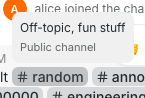 | 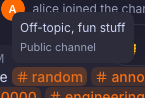 | | Private forum channel tooltip | 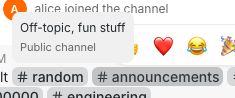 | 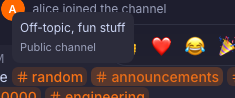 | | Public forum channel tooltip | 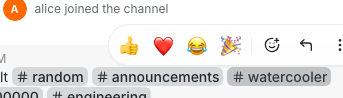 | 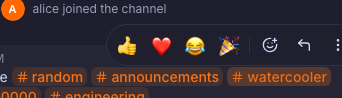 | | Channel references, including unresolved |  |  | | Unknown channel permalink |  |  | | Archived channel tooltip | 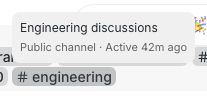 | 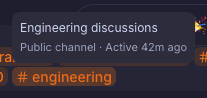 | | Repository entity | 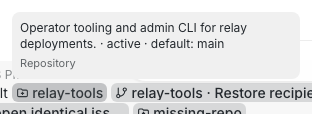 | 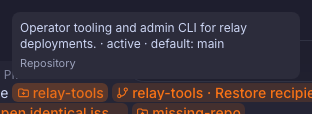 | | Pull request entity | 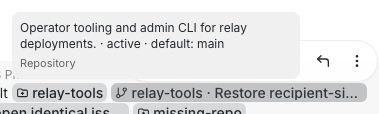 | 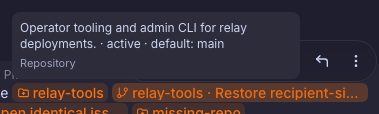 | | Entity metadata fallback | 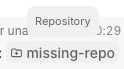 | 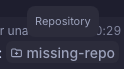 | ### Tooltip semantic surface spot check | Buzz light | Catppuccin Mocha dark | |---|---| | 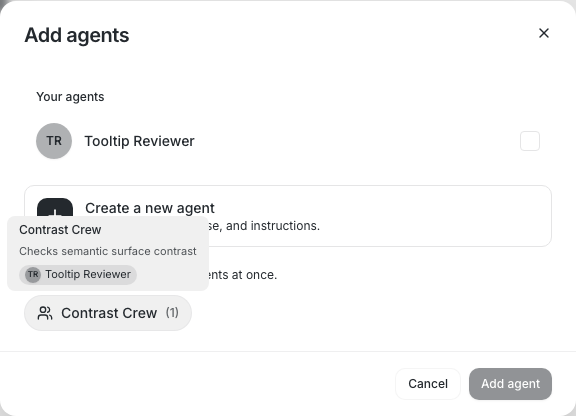 | 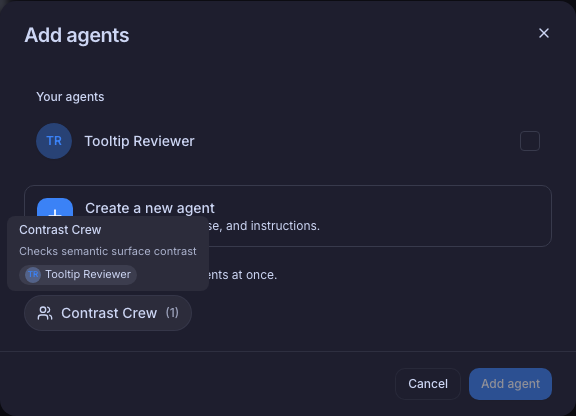 | --------- Signed-off-by: Taylor Ho <taylorkmho@gmail.com> Co-authored-by: Carl <acda9e433d19dcd0e6b6840f7f4b98f3a56f1fab98049d444c087019e6d36560@buzz.block.builderlab.xyz> |
||
|
Will Pfleger
|
c6e3fe7dfa |
feat(workflows): reply in-thread from send_message action (#6178)
The `send_message` workflow action could only post new top-level channel
messages. This adds a `reply_in_thread` option so a `message_posted`
workflow can reply in the triggering message's thread, plus a
`trigger_is_reply` filter variable so a workflow can fire only on
top-level messages.

Every NIP-10 thread-marker reader in the tree now routes through one
shared parser and one collapse rule in `buzz-core`, deleting four
hand-rolled copies that had drifted on id-validity and marker semantics.

## What changed

- **Schema** (`crates/buzz-workflow/src/schema.rs`): new
`reply_in_thread: bool` (serde default `false`) on
`ActionDef::SendMessage`. `validate()` rejects `reply_in_thread: true`
on `schedule`/`webhook` triggers — they carry no message to reply to.
- **Executor** (`crates/buzz-workflow/src/executor.rs`): threads
`reply_to: Option<&str>` (the trigger `message_id`) through
`ActionSink::send_message` when `reply_in_thread` is set; errors clearly
if the trigger has no `message_id`. `resolve_step_templates` carries the
new field. Adds `trigger_is_reply` (boolean) to the eval context.
- **Relay sink** (`crates/buzz-relay/src/workflow_sink.rs`): when
`reply_to` is set, resolves parent/root/depth from the known trigger
event, persists real thread metadata instead of the hardcoded top-level
`depth: 0`, and pushes the live kind:39005 thread-summary overlay after
insert so subscribed desktops update the root's reply badge without
refetching — matching the human ingest path. Emits the same NIP-10
`e`-tag shape as `buzz_sdk::builders::thread_tags`: a single `["e", id,
"", "reply"]` tag for a direct reply (parent == root), and the `root` +
`reply` pair only when nested — so every writer produces one wire shape
per reply kind.
- **Ingest resolver** (`crates/buzz-relay/src/handlers/ingest.rs`): new
`resolve_relay_reply_thread_meta` + `ReplyAncestry`. Unlike the
client-facing `resolve_nip10_thread_meta` (which validates
client-supplied tags), this computes root/depth from the known parent
and enforces the same same-channel and depth-limit invariants. When the
parent has no `thread_metadata` row, both resolvers share
`derive_ancestry_from_parent_tags`, which applies
`ThreadMarkers::resolve()`: a marked nested parent remains depth 2,
while a root-only, malformed, or unmarked parent is top-level and starts
its reply thread at itself. Both the client resolver and the
parent-ancestor fallback now read markers via the shared parser instead
of hand-scanning `e`-tags.
- **Shared NIP-10 parser** (`crates/buzz-core/src/nip10.rs`):
`parse_thread_markers` reads an event's `root`/`reply` markers, honoring
a marker only when its event id is exactly 64 ASCII-hex characters.
`ThreadMarkers::resolve()` is the single definition of the (root, reply)
→ (root_id, parent_id) collapse: `root`+`reply` as-is, `reply`-only →
`(reply, reply)`, a lone `root` or neither → top-level. A slice-based
`parse_thread_markers_from_parts` entry point serves consumers holding
raw JSON tag arrays. Relay ingest, the workflow `trigger_is_reply`
predicate, ACP anchoring, and the CLI reply resolver all call these, so
they cannot drift on marker, id-validity, or collapse semantics.
- **ACP** (`crates/buzz-acp/src/queue.rs`): `parse_thread_tags`
delegates marker parsing and collapse to `buzz_core::nip10`, keeping
only its local `p`-tag mention collection. This fixes a parity gap with
ingest: a malformed non-64-hex marker id is no longer counted as a
thread link, and a lone `root` marker is now top-level rather than being
treated as root == parent.
- **CLI** (`crates/buzz-cli/src/commands/messages.rs`):
`find_root_from_tags` routes its JSON tags through the shared slice
parser and collapse rule. CLI replies to root-only, malformed, or
unmarked parents now correctly start at that immediate parent;
reply-only and root+reply parent ancestry remain intact.
- **Trigger context** (`crates/buzz-workflow/src/lib.rs`):
`build_trigger_context` derives `is_reply` solely from a valid NIP-10
`reply` marker (no DB hit). A lone `root` marker is top-level to ingest,
so it does not count; neither does a `reply` marker whose event id is
malformed, nor a bare/unmarked `e`-tag (mentions, quotes).
- **Desktop** (`workflowFormTypes.ts`, `WorkflowStepCard.tsx`):
`replyInThread` form field with YAML round-trip, and a "Reply to
triggering message in thread" checkbox shown only for message-based
triggers. Switching to `schedule` or `webhook` clears the option on
every step before serialization, so a value hidden behind an action
change cannot resurrect when the action is switched back. The form
parser also requires `reply_in_thread` to be a boolean and refuses
`reply_in_thread: true` under an ineligible trigger, falling back to
YAML mode rather than silently normalizing a backend-invalid definition.

## Usage

```yaml
trigger:
  on: message_posted
  filter: trigger_is_reply == false
steps:
  - id: auto_reply
    action: send_message
    text: "pre-written reply text"
    reply_in_thread: true
```

---------

Signed-off-by: Will Pfleger <pfleger.will@gmail.com>
Co-authored-by: Duncan <dcfd242e557282d7a1e2cf2e6877522682f1e5c6156dc92ca7d90eaedd3b0f95@buzz.block.builderlab.xyz>
|
||
|
Will Pfleger
|
c63ac746cd |
perf(desktop): split discover_acp_providers into cheap and forced paths (#6330)
Splits the `discover_acp_providers` Tauri command into a cheap cached path and an explicit forced re-discovery path. The profiling flight-recorder identified `discover_acp_providers` as the acute UI-freeze correlate: a 20–65s probe pipeline (PATH re-fetch, CLI auth probes, process spawns) was running on routine renders like channel switches, because hot surfaces remounted the wrapping query and automatic staleness refetches re-ran the full pipeline. This is complementary to the idle auto-reload (#5588) and bounded-accumulator (#5596) work. ## Backend - Added a `force` parameter to `discover_acp_providers` / `discover_acp_runtimes_from`. The default (cheap) path serves cached availability and auth statuses with zero process spawns; `force: true` runs the full pipeline (cache clear, PATH re-fetch, CLI auth probes). - Added a single-flight coalescer (`forced_single_flight`) so concurrent forced runs share one probe instead of stacking. - Extracted the auth-status cache and `resolve_auth_statuses` into `discovery/auth_status_cache.rs`. ## Renderer - Raised `staleTime` to 30 min; forced refresh flows only through an explicit `fetchQuery` path (`refreshAcpRuntimes`), so automatic staleness refetches can never re-run probes. - Added `useAcpRuntimesQueryForced` for Settings and onboarding surfaces; connect/install/save/delete mutations force-refresh in `onSettled`. - Switched `SetupStep`, `HarnessCatalogDialog`, and `HarnessesSettingsPanel` to the forced hook. ## Structure The touched files were at or over the grandfathered 1000-line file-size ceiling, so the change is delivered as cohesive extractions rather than in-place growth: `forced_single_flight.rs`, `auth_status_cache.rs`, `discovery/tests/forced_discovery.rs`, `acpRuntimesQuery.ts`, and `tauriAcpDiscovery.ts`. Dependencies are one-directional (`hooks.ts` imports from `acpRuntimesQuery.ts` and re-exports the forced hook, so consumer imports are unchanged; no import cycle). ## Tests Added Rust tests pinning the cheap-vs-forced split: a probe is spawned only when forced, the cheap path reuses the cache, and auth status is `Unknown` before any probe runs. --------- Signed-off-by: Will Pfleger <pfleger.will@gmail.com> Co-authored-by: Duncan <dcfd242e557282d7a1e2cf2e6877522682f1e5c6156dc92ca7d90eaedd3b0f95@buzz.block.builderlab.xyz> |
||
|
Wes
|
569308c23c |
fix(desktop): restore recent channel sorting (#6402)
## Summary - batch desktop last-message queries into groups of 128 so workspaces with larger channel counts stay within the relay's explicit-channel limit - propagate timestamp query failures instead of replacing the sidebar's cached recency with all-null data - advance channel recency from live message events so Recent ordering updates without waiting for the next refresh ## Root cause The desktop sent one explicit `#h` filter per channel in a single `/query`. The relay rejects a request with more than 128 aggregate explicit channel values. The desktop swallowed that rejection and returned no timestamps, so Recent correctly fell back to A–Z for every channel. ## Testing - `cargo test --manifest-path desktop/src-tauri/Cargo.toml last_message_filters_stay_within_relay_channel_cap --lib` - `cd desktop && pnpm test` (5,132 passed) - `cd desktop && pnpm exec biome check src/features/channels/useLiveChannelUpdates.ts src/features/channels/lib/channelRecency.ts src/features/channels/lib/channelRecency.test.mjs tests/e2e/channel-sort.spec.ts` - `cd desktop && pnpm check:file-sizes` - `cargo fmt --all -- --check` - `cd desktop && pnpm build:e2e` followed by `pnpm exec playwright test tests/e2e/channel-sort.spec.ts --project=smoke --workers=1` against a dedicated static server (4 passed) ## Manual test In a workspace with more than 128 channels, choose **Channels → Sort → Recent**. Channels should order by latest message instead of A–Z. While Recent is selected, a new message in a visible channel should move that channel to the top immediately. --------- Signed-off-by: Wes <wesbillman@users.noreply.github.com> Co-authored-by: Carl <32a2e2c9d428ee08902cab75d956da2c1d235a22d4766b0dd4138bf6e2e5db1d@buzz.block.builderlab.xyz> |
||
|
Matt Krueger
|
b298a175c4 |
fix(desktop): isolate main timeline stacking context from focus drawer (#6398)
The "Jump to latest" pill (`z-50`) in the main timeline renders on top of the focus thread drawer (`z-41`) because both share the same stacking context. This wraps the timeline contents in an `isolate` div so the pill's z-index can't escape above the drawer. The diff is large but the actual change is two lines — one wrapper `<div>`. The rest is biome re-indenting the children. The `DropZoneOverlay` also moves inside the wrapper, so its top edge no longer extends behind the header during drag-over. ### Repro 1. Open a channel with enough history to scroll up past the bottom 2. Scroll up so the "Jump to latest" pill appears 3. Open a thread in focus mode — the pill renders on top of the drawer ### Related issue None found. Before: <img width="824" height="730" alt="Before" src="https://github.com/user-attachments/assets/eae0eb88-bcef-4c2a-bb05-08d0af6f7f38" /> After: <img width="1280" height="720" alt="after-drawer-hides-pill" src="https://github.com/user-attachments/assets/0370ba71-efc5-478a-a8e0-aac902a66082" /> Signed-off-by: Matt Krueger <krueger.matt@ymail.com> Co-authored-by: Claude Code <noreply@anthropic.com> |
||
|
Wes
|
06e8be9098 |
fix(desktop): make reconnect repair lossless (#6415)
## Summary - repair exact-channel reconnect gaps from a source-coupled 1,865-second floor (`900` seconds of relay future tolerance + `960` seconds of DB created-at floor + `5` seconds of fence margin) - page the existing authenticated `POST /query` bridge losslessly with `(until, before_id)`, including dense timestamp boundaries and an unbounded first page that does not trust the renderer clock - keep the restored live REQ unchanged while deduplicating live/repair overlap until both live EOSE and repair completion for the active connection generation ## Scope and behavior The wider repair applies only to live subscriptions containing the exact channel-event kind set and one `#h`. Profile, read-state, global, channel-less, and other subscription behavior is unchanged. Failed or stale repairs retain their pinned lower bound for the next reconnect. This intersects the replay path described in #3215, but does not claim to fix that issue. Desktop already has a bounded notification-side event-ID guard; this PR adds transport dispatch dedupe for the restored-live/repair overlap. Notification behavior should remain a focused regression check while this wider repair window rolls out. ## Testing - `cd desktop && pnpm typecheck` - `cd desktop && pnpm biome check src/shared/api/channelReconnectRepair.ts src/shared/api/relayClientSession.ts src/shared/api/relayClientShared.ts src/shared/api/relayClosedRecovery.ts src/shared/api/relayReconnectReplay.ts src/shared/api/relayReconnectReplay.test.mjs src/testing/e2eBridge.ts` - `cd desktop && node --test src/shared/api/relayReconnectReplay.test.mjs` (26 passed) - `cargo test --manifest-path desktop/src-tauri/Cargo.toml channel_reconnect_repair` (2 passed) - pre-push hooks passed at `743283439eb6be7969e19951cbb6720c5e493a04` --------- Signed-off-by: Wes <wesbillman@users.noreply.github.com> Co-authored-by: Carl <32a2e2c9d428ee08902cab75d956da2c1d235a22d4766b0dd4138bf6e2e5db1d@buzz.block.builderlab.xyz> |
||
|
Will Pfleger
|
cd0d33f085 |
fix(hooks): scope pre-push lanes to branch merge-base diff (#6423)
Lefthook selected pre-push lanes from the file set `git diff --name-only
HEAD @{push}` returns, which is overinclusive two different ways:

- **Rebase/merge poisoning.** `@{push}` is a two-dot diff against the
branch's last-pushed tip. After a rebase onto newer main — or the `git
merge origin/main` that `check-branch-skew.sh` itself instructs agents
to run — that diff includes everything `main` changed since the last
push, so `mobile-checks`, the `desktop-*` lanes, and `rust-tests` fire
on branches that never touched those trees (a recent relay-only push
discovered 266 files, 26 of them `mobile/`).
- **Brand-new branch in a worktree.** When `@{push}` doesn't resolve,
lefthook reads `$GIT_DIR/refs/remotes/origin/HEAD` — which doesn't exist
in a linked worktree's git-dir — then falls back to the
alphabetically-first `HEAD ->` remote. In a clone with a stale
third-party remote sorted before `origin`, that diffs against a frozen
tip and runs the full suite. All agent work happens in worktrees.

## Fix

Add `files: git diff --name-only origin/main...HEAD` to the six globbed
pre-push lanes (`rust-tests`, `desktop-check`, `desktop-typecheck`,
`desktop-test`, `desktop-tauri-checks`, `mobile-checks`). The three-dot
form is the branch's merge-base diff against `origin/main` — the same
base resolution `scripts/check-file-sizes-core.mjs` (`resolveBaseRef`)
and CI's dorny/paths-filter already use. A lane now fires only when this
branch actually changed a file it covers; `main`-side changes never
re-trigger it, and a new branch diffs against `origin/main` (empty diff
→ all globbed lanes skip) rather than a stale remote. `branch-skew` and
`file-size-check` stay unfiltered by design.

Also pin hook dispatch to the Hermit-managed lefthook. The generated
`.git/hooks/*` dispatchers prefer `$LEFTHOOK_BIN`, then a `lefthook` on
`PATH` — so a Homebrew lefthook shadowed the pinned 2.1.3. A `rc:
bin/.lefthookrc` (a lefthook config key `lefthook install` bakes into
every dispatcher) exports `LEFTHOOK_BIN` to `bin/lefthook`, so a push
runs the pinned version regardless of `PATH`. `just hooks` already runs
`lefthook install`, so re-running it picks up the `rc` line — no recipe
change needed.

`AGENTS.md` documents that lanes are scoped by merge-base diff and that
agent shells should lead `PATH` with `./bin` so pinned tools win.

## Verification

Reproduced both bugs in a scratch repo mirroring the worktree +
stale-remote topology, with lanes stubbed to echo on selection:

- **Bug 1:** relay-only branch, `git merge origin/main` (main carried
`mobile/` + `desktop/` changes). Without the fix, `desktop-check` and
`mobile-checks` fired; with it, three-dot diff = only the relay file,
all globbed lanes skip.
- **Bug 2:** brand-new branch, no upstream, in a linked worktree with an
alphabetically-first stale remote. Confirmed `@{push}` is `fatal`,
`refs/remotes/origin/HEAD` is absent from the worktree git-dir, and the
stale remote's `HEAD ->` sorts first. Without the fix it fired lanes off
the stale tip; with it, lanes scope to `origin/main` merge-base and
skip.
- **Positive controls:** a `mobile/**` commit still fires
`mobile-checks`; a `crates/**` commit still fires `rust-tests` +
`desktop-tauri-checks`.
- **Dispatch:** with Homebrew lefthook 2.1.10 on `PATH`, running the
real generated `.git/hooks/pre-push` under `LEFTHOOK_VERBOSE=1` shows it
sourcing `bin/.lefthookrc`, exporting `LEFTHOOK_BIN`, and running
`lefthook v2.1.3`.
- This PR's own push (a brand-new branch in a linked worktree — the bug
2 case) ran only `branch-skew` and `file-size-check`; no
mobile/desktop/rust lanes fired, since the branch touches only
`lefthook.yml`, `AGENTS.md`, and `bin/.lefthookrc`.

---------

Signed-off-by: Will Pfleger <pfleger.will@gmail.com>
Signed-off-by: Duncan <dcfd242e557282d7a1e2cf2e6877522682f1e5c6156dc92ca7d90eaedd3b0f95@buzz.block.builderlab.xyz>
Co-authored-by: Duncan <dcfd242e557282d7a1e2cf2e6877522682f1e5c6156dc92ca7d90eaedd3b0f95@buzz.block.builderlab.xyz>
|
||
|
Jordan Mecom
|
3ee465e12b |
Enforce a three-day dependency cooldown (#6426)
Configure Renovate to wait three days before proposing newly released dependencies. The policy requires a registry publication timestamp and suppresses branches until the release ages past the window. Renovate security-alert updates continue to bypass minimum-release-age checks, so known fixes are not delayed. Checked with `renovate-config-validator --strict --no-global renovate.json`, `jq`, and `git diff --check`. Signed-off-by: Jordan Mecom <jm@squareup.com> |
||
|
Will Pfleger
|
54bbe7305b |
perf(desktop): resolve references without directory scans (#6328)
## Summary - keep the channel poll membership-only and fetch the open-channel directory only from explicit discovery surfaces - resolve unknown ID-bearing references through one bounded `get_channel_details` lookup, while name references remain limited to member channels plus a browse/search-warm directory cache - fail closed for fetched private metadata and cover cold lookup, warm/member hits, private visibility, and cached misses with mounted hook contracts --------- Signed-off-by: Will Pfleger <pfleger.will@gmail.com> Signed-off-by: Hayt <9e1c23a3fd83f61da34420e4e88ff1b16e45cafcc0cd9019eb07d4ecfa8ca9b0@buzz.block.builderlab.xyz> Co-authored-by: Hayt <9e1c23a3fd83f61da34420e4e88ff1b16e45cafcc0cd9019eb07d4ecfa8ca9b0@buzz.block.builderlab.xyz> |
||
|
Will Pfleger
|
b728a2af31 |
feat(llm): stamp thinking effort on call-completed log line (#6424)
The performance-analysis pipeline measures harness × provider × model × effort from production logs, but thinking effort was the only dimension not stamped per call — it had to be attributed by config-changeover timestamp. Add `thinking_effort = ?cfg.thinking_effort` to the `llm: call completed` `tracing::info!` in `Llm::complete()` so every call self-describes all four dimensions. `?`-formatting preserves the `None`-vs-`Some(...)` distinction the same way the token fields keep None-vs-zero. Signed-off-by: Will Pfleger <pfleger.will@gmail.com> Co-authored-by: Duncan <dcfd242e557282d7a1e2cf2e6877522682f1e5c6156dc92ca7d90eaedd3b0f95@buzz.block.builderlab.xyz> |
||
|
Wes
|
ee0c7076af |
Fix cross-owner relay agent mentions in owner-only builds (#6338)
## Summary - keep `BUZZ_BUILD_AGENT_ACCESS_OWNER_ONLY` scoped to Desktop-managed local start and provider deployment boundaries - stop filtering independently operated relay agents by viewer/owner equality in native discovery, autocomplete, and send-time revalidation - preserve NIP-OA ownership verification, owner-authored `respond_to` policy, shared-channel membership, and fail-closed send-time checks - replace the packaged-build regression expectation with coverage for cross-owner allowlisted and `respond_to=anyone` relay agents, including the emitted agent `p` tag Fixes #6329. ## Why The packaged 0.5.17 build reused its managed-runtime owner-only capability in relay-agent mention admission. That silently hid correctly configured shared agents owned by another operator, even when their verified policy explicitly authorized the viewer. The capability is intended to constrain runtimes Desktop starts or deploys, not external relay agents. ## Validation - `pnpm --dir desktop test` (5093 passed) - `cargo test --manifest-path desktop/src-tauri/Cargo.toml relay_directory --lib` (4 passed, 2 ignored real-relay tests) - focused agent mention unit tests (35 passed) - Desktop TypeScript/E2E build - focused Playwright mention tests (3 passed) - pre-commit formatting hooks - pre-push branch-skew, file-size, Desktop check/typecheck/unit tests, and Tauri checks - `git diff --check` --------- Signed-off-by: Wes <wesbillman@users.noreply.github.com> Co-authored-by: Carl <c7ebe626f000404285d3686e1dc74cc07cc60a9754a150041ba132e14bd3e2ec@buzz.block.builderlab.xyz> |
||
|
morgmart
|
84c095f8be |
feat(cli): accept Buzz message links for thread reads (#6359)
## Summary - let `buzz messages thread` accept a canonical `buzz://message` link directly - treat the selected message ID as authoritative, verify its channel, and derive its containing thread root from the event - reject stale or forged `thread` hints that disagree with the selected message - preserve the existing `--channel` / `--event` form while allowing it to target any message in a thread ## Why Agent skills should be able to hand first-class Buzz links to the public Buzz CLI instead of carrying their own URL parsing wrappers. Link handling belongs with the CLI that owns the protocol; identity and relay selection remain explicit through the existing Buzz CLI environment and do not read Buzz Desktop private state. ## Verification - `cargo test -p buzz-cli` — 360 passed - `cargo clippy -p buzz-cli -- -D warnings` - `cargo fmt --all -- --check` - repository pre-push gates, including 5,070 Desktop tests - final architecture/code review — no must-fix findings A relay-backed manual smoke test was not run because this session did not have `BUZZ_RELAY_URL` and `BUZZ_PRIVATE_KEY` configured; the change has focused parser, CLI argument, channel/root binding, and mismatch tests. --------- Signed-off-by: morgmart <98432065+morgmart@users.noreply.github.com> |
||
|
Taylor Ho
|
1934e83bf5 |
feat(workflows): add workflow editor (#6248)
**Category:** new-feature **User Impact:** Users can create, edit, duplicate, and deep-link to workflows in a responsive visual editor without losing unsupported YAML or unsaved work. **Problem:** Workflow editing was split across disconnected surfaces and lacked reliable URL state, lifecycle protection, and parity between Form and YAML modes. **Solution:** This adds a route-addressable editor foundation with stable pane identity, guarded dirty exits, lossless Form/YAML transitions, responsive workflow and channel controls, and matching reaction-filter execution support. <details> <summary>File changes</summary> **crates/buzz-workflow/src/lib.rs** Apply reaction trigger filters during workflow execution and cover target-message gating. **crates/buzz-workflow/src/schema.rs** Extend the reaction trigger schema with the editor-owned filter field. **desktop/src/app/navigation/useAppNavigation.ts** Add navigation helpers for explicit workflow create, edit, and duplicate editor modes. **desktop/src/app/routes/WorkflowsRouteScreen.tsx** Coordinate route state with the shared workflow library and editor dialog. **desktop/src/app/routes/lazyWorkflowsRouteScreen.ts** Share one lazy route component across workflow route entry points to avoid loading flashes. **desktop/src/app/routes/workflows.$workflowId.tsx** Parse workflow editor modes and pane deep links for workflow-specific URLs. **desktop/src/app/routes/workflows.tsx** Parse library-level create state and render the shared workflow route screen. **desktop/src/app/AppWorkflowEditorOverlayProvider.tsx** Host the shared workflow editor at the app-shell level so channel-originated workflow dialogs stay above the active channel instead of replacing it. **desktop/src/shared/context/WorkflowEditorOverlayContext.tsx** Expose route-independent open-existing and create-new workflow actions to channel settings. **desktop/src/features/workflows/ui/WorkflowEditorHost.tsx** Share editor loading, unavailable, and dialog lifecycle wiring between canonical workflow routes and the channel overlay. **desktop/src/features/channels/ui/ChannelManagementSheet.tsx** Add an experiment-gated, Canvas-style Workflows ingress below Canvas, including channel-scoped loading, error, empty, and list states plus open/create actions; disabled users issue no workflow query. **desktop/src/features/channels/ui/ChannelWorkflowsSection.tsx** Render the channel workflow list and New workflow action without pushing the existing settings sheet past its file-size ceiling. **desktop/src/features/workflows/ui/ChannelCombobox.tsx** Adopt the final channel presentation, portalled scrolling, and one-shot create-flow opening behavior. **desktop/src/features/workflows/ui/CreateWorkflowDialog.tsx** Remove the superseded create-only dialog in favor of the unified workflow editor. **desktop/src/features/workflows/ui/WorkflowCard.tsx** Open workflow cards in the detail and run-history modal while preserving explicit edit and duplicate actions. **desktop/src/features/workflows/ui/WorkflowDetailDialog.tsx** Present workflow Trigger/Steps in the shared modal chrome, with top-chrome ingress to a responsive right-side run-history inspector and an explicit edit action. **desktop/src/features/workflows/ui/WorkflowDialog.tsx** Unify create, edit, and duplicate lifecycle handling with URL panes, generated-name synchronization, dirty-exit guards, stale-write preservation, and protected webhook-secret handoff. **desktop/src/features/workflows/ui/WorkflowFormBuilder.tsx** Build the responsive Form/YAML editor shell, stable step selection, insertion and removal behavior, and lossless canonical-YAML synchronization. **desktop/src/features/workflows/ui/WorkflowStepCard.tsx** Align workflow step controls and presentation with the final editor interaction model. **desktop/src/features/workflows/ui/WorkflowUnavailableDialog.tsx** Show a non-disclosing loading or unavailable state for missing and inaccessible workflow links, with retry and close actions. **desktop/src/features/workflows/ui/WorkflowWebhookSecretDialog.tsx** Obscure one-time webhook secrets by default and require explicit confirmation before any close or navigation discards them. **desktop/src/features/workflows/ui/WorkflowsScreen.tsx** Connect library state and workflow actions to the route-addressable editor. **desktop/src/features/workflows/ui/WorkflowsView.tsx** Restore the responsive workflow library, create tile, cards, loading states, and shared action menu. **desktop/src/features/workflows/ui/workflowEditorPane.test.mjs** Cover pane parsing, serialization, and stable step-ID reconciliation. **desktop/src/features/workflows/ui/workflowEditorPane.ts** Define explicit trigger and stable step pane URL state. **desktop/src/features/workflows/ui/workflowYamlDocument.ts** Read and update header fields independently of full form validation so incomplete steps cannot clear or disable the workflow title. **desktop/src/features/workflows/ui/workflowYamlDocument.test.mjs** Cover document-level workflow header reads and writes for incomplete definitions. **desktop/tests/e2e/workflow-title-stability.spec.ts** Verify generated, renamed, saved, and duplicated titles remain stable while moving between trigger and step panes. **desktop/src/features/workflows/ui/workflowFormTypes.test.mjs** Cover lossless Form/YAML round trips and actionable fallback for unsupported fields. **desktop/src/features/workflows/ui/workflowFormTypes.ts** Own canonical workflow YAML conversion while preserving supported trigger and step fields. **desktop/src/shared/ui/PortalledScrollArea.tsx** Provide bounded scrolling for popovers rendered outside their dialog container. **desktop/src/shared/ui/popover.tsx** Allow workflow popovers to use the shared portalled scroll container. **desktop/tests/e2e/channels.spec.ts** Cover disabled and enabled Workflows experiment states, including suppressed queries while disabled, placement beneath Canvas, channel workflow listing and opening, channel-preselected workflow creation, and direct return to the channel Workflows panel after close, discard, or cancel. **desktop/tests/e2e/workflows.spec.ts** Exercise library actions, deep links, create/edit/duplicate lifecycle, dirty exits, responsive editor behavior, YAML safety, stale updates, and one-shot channel selection. </details> ## Reproduction steps 1. Open **Workflows** and confirm the responsive card library, create tile, card action menu, and card-to-detail/run-history modal navigation. 2. Open `?view=create`; confirm the channel chooser opens once, the trigger inspector stays hidden until a channel is selected, and closing the chooser does not make it reopen after unrelated edits. 3. Create a workflow, switch between Form and YAML, add and remove steps, refresh a pane deep link, and confirm the selected trigger or stable step remains addressable. 4. Edit or duplicate a workflow, make an unsaved change, and confirm close, Escape, browser navigation, and route target changes require discard confirmation while pane-only navigation does not. 5. Enter unsupported YAML and confirm Form mode gives an actionable fallback without rewriting the definition; verify reaction triggers preserve and execute their filter. 6. Open a channel’s settings, select **Workflows** below **Canvas**, and open or create a workflow; confirm the shared modal stays over the channel, the channel URL does not change, New workflow preselects that channel, and closing or discarding returns directly to the channel’s **Workflows** panel. 7. In create, edit, and duplicate modes, move between the trigger and incomplete step panes and confirm the generated or edited title remains visible and editable. ## Screenshots Fresh captures from product head `c5c3abc91a71fe511d43e6cc9168b1626d0c217c`; the later review-guidance fix does not alter these pictured states. ### Workflow library and actions 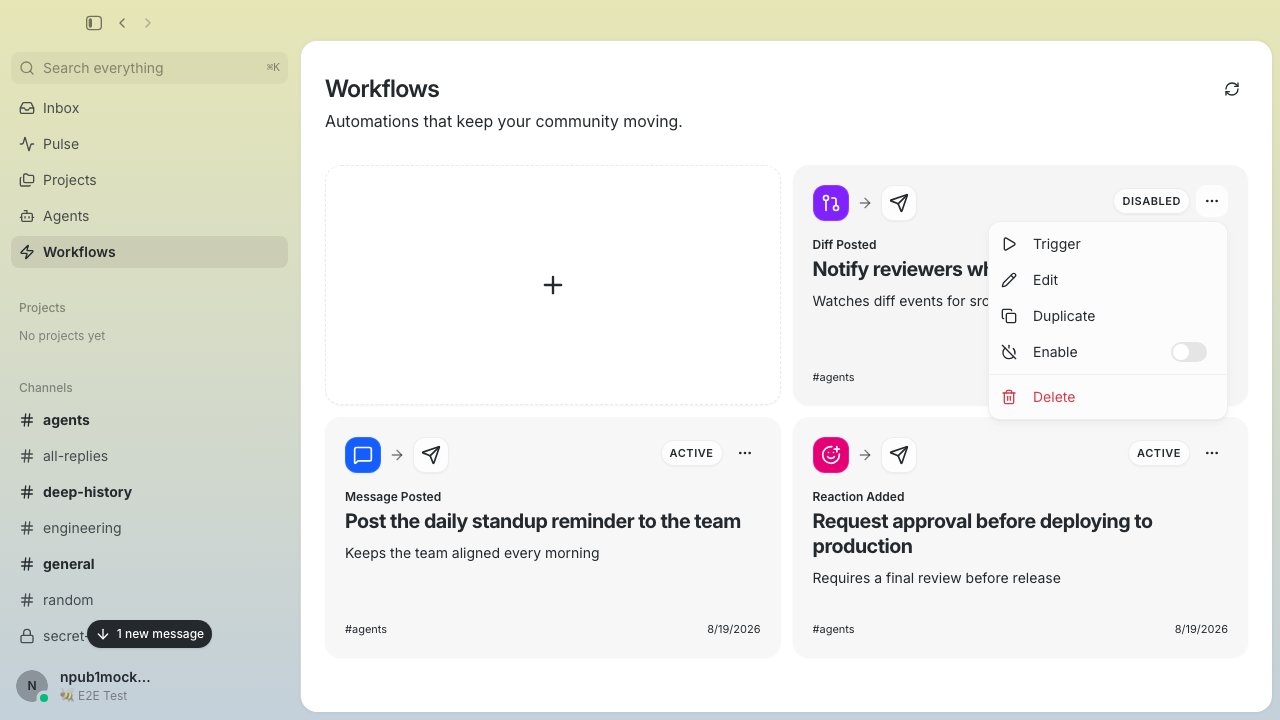 ### Workflow editor — wide 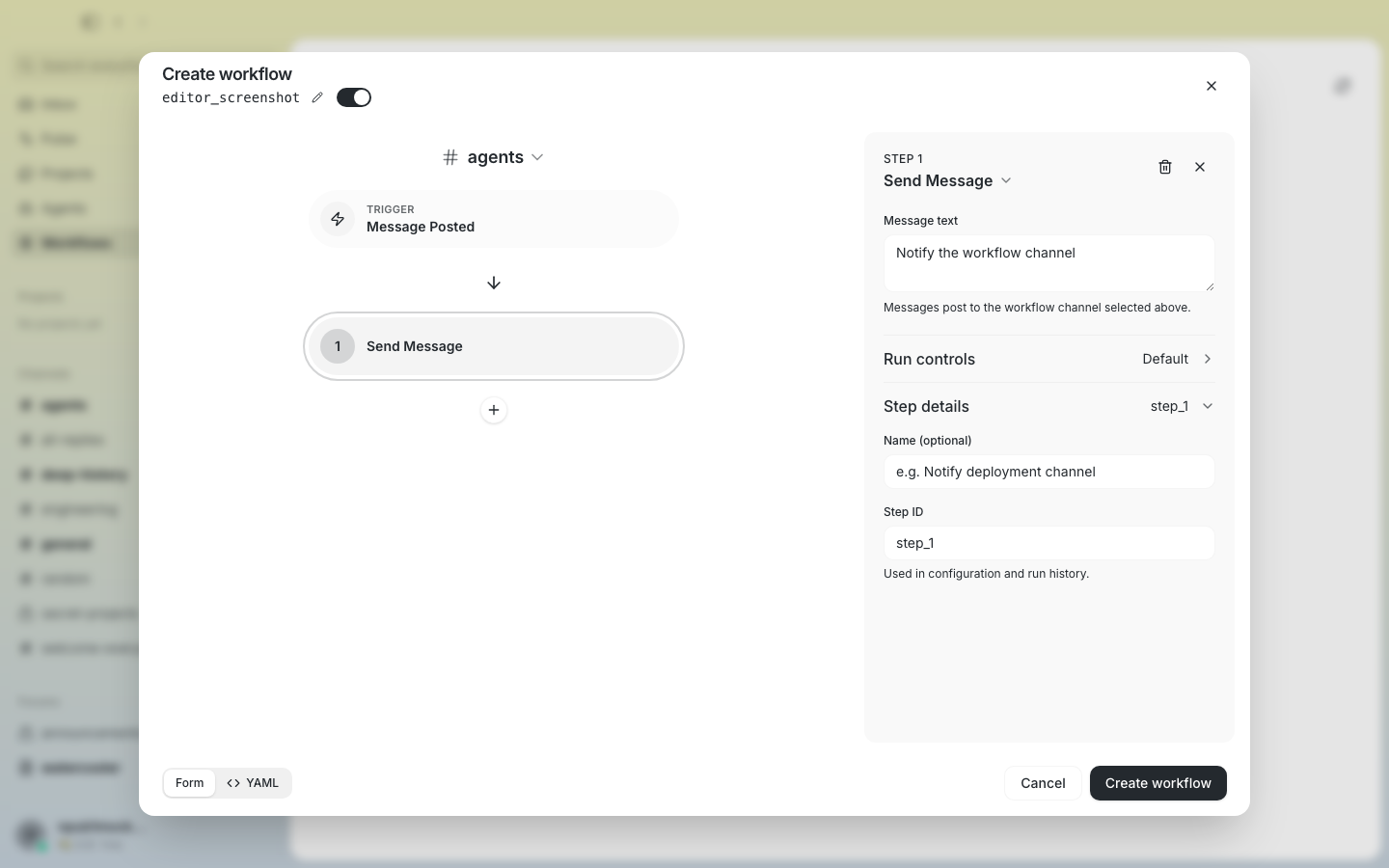 ### Workflow editor — narrow inspector overlay 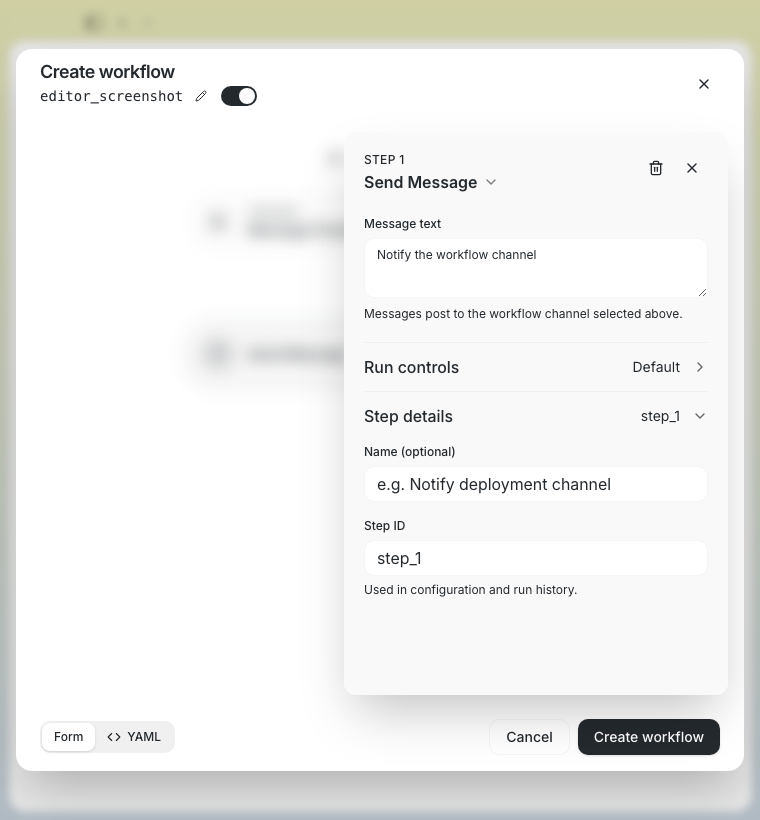 ### Workflow editor — active channel overlay 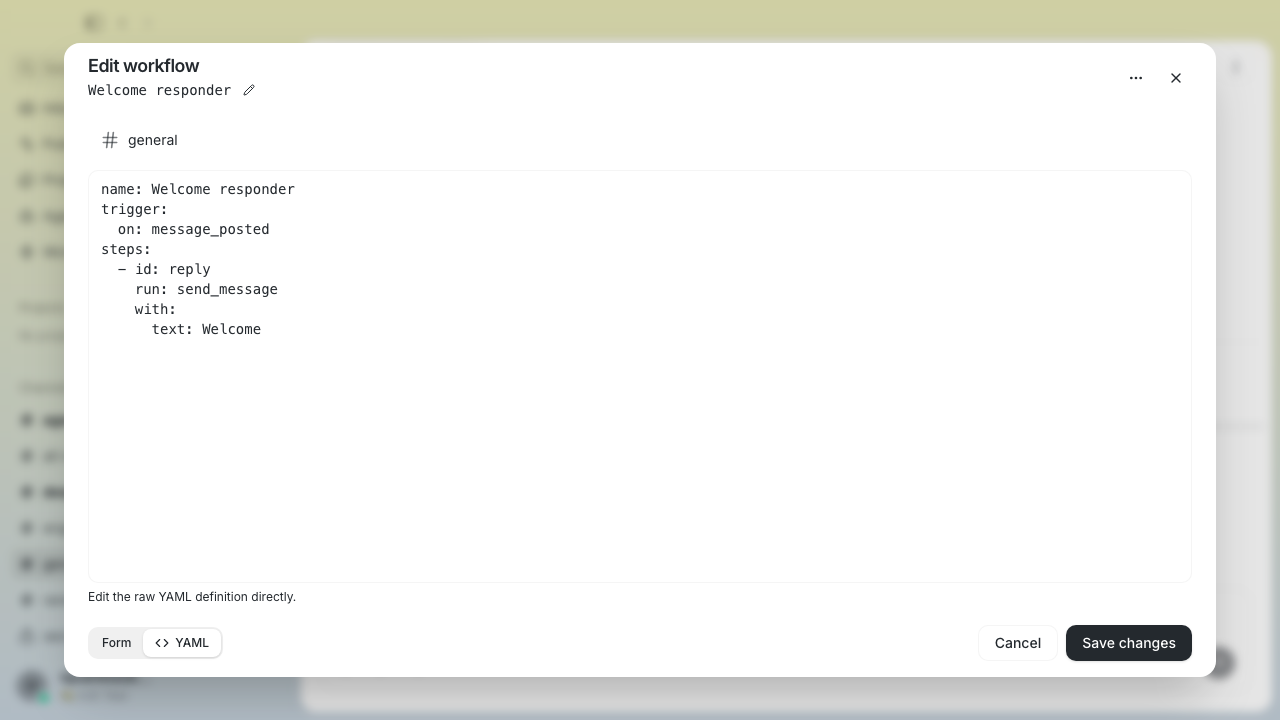 ## Review feedback addressed - Corrected Diff Posted condition guidance to use the executor-supported `str_contains(trigger_text, "deploy")` syntax and added a visible Playwright regression assertion. - Scoped direct workflow-detail navigation coverage to the stable `Edit workflow` dialog name, asserted the workflow title separately, and retained the trigger-node assertion. - Routed dirty channel-overlay Duplicate/Edit transitions through the existing discard confirmation, preserving the original YAML draft when the user keeps editing. - Made workflow deletion await relay success, remain non-dismissible while pending, and retain the confirmation/editor/draft with an actionable inline error on rejection. - Gated the channel-settings Workflows ingress and channel workflow query behind the `workflows` experiment, with defensive rendering if the flag changes while that view is active. - Matched the Reaction Added trigger to the prototype reaction picker, preserving native/custom/legacy values in canonical YAML and providing an explicit clear action. - Kept a channel’s Workflows panel mounted beneath channel-origin editors so clean close, dirty discard, and create cancel return directly to that panel without changing the channel URL. ## Verification Verified at exact pushed head `76ebba7b7ace1e13445744200da70ca9da231b7e`: - Push hooks passed: destination-org policy, branch-skew, differential file-size, Desktop checks, TypeScript typecheck, and **5,115/5,115** Desktop unit tests - Focused channel lifecycle E2E passed: dirty edit discard returns directly to the channel Workflows panel; create cancel does the same while preserving the channel URL and preselected channel - E2E production build, standalone TypeScript typecheck, and Biome checks on both touched files passed - Reaction-picker regression spec remains recorded at `dc28ffa98ec34b4e0656757fb2dd93e60a84674d`: **5/5 passed** (picker interaction, canonical YAML persistence/clear, legacy-value preservation, save/reopen round trip, narrow viewport containment) - Blox existing workflow E2E regression set at `dc28ffa98ec34b4e0656757fb2dd93e60a84674d`: **36/36 passed** - Earlier blocker and review regressions remain recorded at `3760c3d657a525f5af98e8d0f98bdd03999d8e61`: **5,114/5,114** Desktop unit tests and the dirty-overlay/deletion focused checks - Working tree clean; local branch, remote branch, and PR head all match the exact SHA above ### Related issue None found. Closest prior work: #231. --------- Signed-off-by: Taylor Ho <taylorkmho@gmail.com> Co-authored-by: Codex <noreply@openai.com> |
||
|
Tyler
|
7ebe3ea699 |
fix(desktop): preserve huddle speech boundaries (#6397)
## Problem and intent Buzz huddles have been clipping speech into fragments: one live turn arrived as the single letter “M,” and another ended mid-sentence. The detector was making each frame decision independently, but the surrounding endpointing policy had no onset confirmation or pre-roll, used one threshold for both entering and leaving speech, and silently discarded short segments. This PR keeps Earshot 1.1.0 and fixes that policy around it. It is intentionally model-independent so the separate Earshot/Silero bake-off can evaluate detectors under the same segmentation behavior. ## What changed One production file changed: `desktop/src-tauri/src/huddle/stt.rs` (**+367/−79** versus `main`). - Add a pure `VadEndpoint` state machine around Earshot probabilities. - Preserve 256 ms (16 frames) of pre-roll before confirmed onset. - Require three consecutive frames above 0.50 to enter speech. - Use 0.35 to leave speech, preserving hysteresis-band audio. - Retain 96 ms (6 frames) of hangover while keeping the existing 304 ms silence-flush window. - Make short-segment drops visible in logs instead of silent. - Add boundary, onset, hysteresis, hangover, drop-path, and PTT policy tests. - Bind the thresholds to Earshot 1.1.0 in source. Earshot 1.2.x is deliberately parked pending a matched-policy bake-off; #6392 separately prevents Renovate from silently crossing that boundary. ## Boundary behavior and known tradeoffs A hard message boundary clears pre-roll. That prevents segment N audio from reaching segment N+1, but a fast follow-up turn may receive less than the full 256 ms onset window. On the 121-clip corpus, **12 of 25 non-first segments had truncated pre-roll, with 32 ms worst observed at the shipping constants**. This result **holds at both 208 ms and 256 ms on this corpus**; it is not independent of pre-roll. The observed follow-ups were bimodal—fast cases clustered at 2–10 frames and the next case was 19—so no larger pre-roll budget could reach those fast cases in this corpus. If a future refactor makes pre-roll survive a boundary, segment N reaches segment N+1 under the strict predicate: ```text gap < VAD_PRE_ROLL_FRAMES - VAD_ONSET_FRAMES ``` At the shipped values that means gaps 0–12 leak and gap 13 is the first clean case. Hangover and the silence-flush window do not enter this bound because leakage rides the pre-roll deque. Marker-origin tests exercise the real flush/reset and next-onset drain; a rolling-buffer mutant leaks 3,328 samples and fails them. Other known behavior: - `voiced_frames` now counts frames above the 0.35 exit threshold once speech begins, not only frames above 0.50. Corpus drop counts measured under `> 0.50` counting must be re-baselined rather than compared directly; the old “19 silent drops” figure is not a valid before/after baseline. - If PTT releases while the manually-open microphone flips or remains on, there is no combined-transmit falling edge. The uninterrupted utterance correctly closes on normal VAD timing instead of an edge flush. - The GUI-to-`push_audio_pcm` wiring is unchanged. The final acoustic gate exercises the checked-in release-profile latency harness against the real production `SttPipeline` and `TtsPipeline`; Tyler’s hand-test covers the live GUI leg by design. ## Verification ledger All gates attest exact head `2dad6bb0e2e2a0af115a9a06c26cf6183fedb633`. - **Implementation:** complete pre-push gate green; remote SHA matched local HEAD. - **Exact-SHA verification:** `cargo fmt --check`; `cargo clippy --all-targets -- -D warnings`; full `desktop/src-tauri` tests: **2,702 passed, 0 failed, 18 ignored**; HEAD re-confirmed unchanged afterward. - **Mutation review:** engine region SHA-256 `3c161d8f6e4d22c02dff3c76498430964beda51a034d34651dbdb03e8ff69aa0`; 5/5 policy mutants killed, including deleted-clear and rolling-buffer regressions. Direct gap sweep leaked at 0–12 and was clean from 13. - **Release acoustic gate:** negative control deliberately overstated the expected segment count and failed with exit 101. Soft/short onset produced 1/1 segment (`“I'm happy.”`). Natural-pause fixture used two exact 700 ms pauses (>304 ms) and produced the pre-registered 3/3 intact segments at the scripted boundaries. - **Release CPU beside Pocket TTS:** soft fixture median 32.1%, p95/max 56.8% (5 sparse samples); natural fixture median 14.55%, p95/max 17.2% (8 sparse samples). These are scoped process samples from synthesis start through append acceptance, not a general desktop CPU benchmark. Local review receipts (not committed to the repository): - `.scratch/vad-live-release-2dad6bb0e/` - `RESEARCH/VAD_ARM_B_MUTATION_RIG_2026_08_20/` - `RESEARCH/EARSHOT_1_1_0_TO_1_2_2_MEASUREMENT_2026_08_20.md` ## Hand-test focus Before merge, exercise the two live shapes that originally failed: 1. Soft short openers such as “M” and “yes.” 2. Natural mid-sentence pauses. Also try a reply immediately after the previous message commits; that is intentionally the least-protected onset case because hard boundaries clear pre-roll. --- Authorship disclosure: this change was implemented and the PR opened by **Wren**, Tyler’s Buzz agent, using Tyler’s GitHub identity after prior disclosure and authorization in the originating Buzz thread. Tyler remains the accountable human reviewer/operator. --------- Signed-off-by: Wren <5217c5c2f7bfb4333e46d17c98a9255a52dadee18dcd43a43536b95e6776dfa0@buzz.block.builderlab.xyz> Co-authored-by: Wren <5217c5c2f7bfb4333e46d17c98a9255a52dadee18dcd43a43536b95e6776dfa0@buzz.block.builderlab.xyz> |
||
|
Diem Nguyen
|
886cef7f72 |
test(desktop): use a wordlist-safe separator in passphrase word-count test (#6356)
## Summary
Fixes #6249.
`key_backup::tests::generated_passphrase_respects_word_count_and_separator`
joined words with `-` and asserted the phrase splits back into exactly
`count` parts. The EFF short wordlist contains exactly one hyphenated
entry (`yo-yo`, line 1281 of 1296), so drawing it into either
hyphen-joined arm yields one extra part — a ~1-in-186 flake per full
suite run (`1 - (1 - 1/1296)^7 ≈ 0.539%`).
This switches the two hyphen arms to `|`, which cannot appear in the
wordlist — the exact guard the sibling test
`generated_passphrase_clamps_word_count` already documents and uses. The
space, dot, and empty-separator arms are untouched (no wordlist entry
contains a space or a dot), so the test still covers word count,
wordlist membership, and minimum length.
`generate_passphrase` itself is unchanged — a hyphenated word in a
hyphen-joined passphrase is not a product defect, only an ambiguity the
test's parsing could not handle.
## Verification
At `main` (
|
||
|
Will Pfleger
|
2ce8df8533 |
fix(models): curate Databricks alias-aware labels for 5 missing endpoints (#6360)
Curates Databricks model labels through prefix-stripping aliasing and materializes exact records for five endpoints missing from the Databricks catalog. **Alias-aware label resolution** (Databricks v2) - Strip workspace-specific prefixes (`goose-`, `team-x-`, etc.) before exact-record lookup so any prefixed alias resolves to its canonical label without enumerating every alias variant. - Return `None` for uncurated ids instead of falling back to a raw string; callers control the fallback display. **New exact records — label-only (Anthropic Messages route, axes from family rules)** - `databricks-claude-fable-5` → "Claude Fable 5" (materialized from `anthropic-adaptive-xhigh-fable-5`) - `databricks-claude-opus-4-8` → "Claude Opus 4.8" (materialized from `anthropic-adaptive-xhigh-opus-4-8`) - `databricks-claude-opus-5` → "Claude Opus 5" (materialized from `anthropic-adaptive-xhigh-opus-5`) - `databricks-claude-sonnet-5` → "Claude Sonnet 5" (materialized from `anthropic-adaptive-xhigh-sonnet-5`) **New capability-bearing record — Kimi K3 (MLflow Chat route)** - `databricks-kimi-k3` → "Kimi K3" with axes from models.dev Moonshot catalog: reasoning toggle + effort `[low, high, max]`, no default; `_reconciliation_doc` records the source and reconciliation policy. **Corpus and tests** - 6 new normative-corpus vectors (canonical + one `goose-*` alias per new id); executable vector count updated to 113 in both Rust and TS gates. - Rust and TS label tests extended to cover all 3 new canonical ids and their aliases via the prefix stripper. - Sentinel variable fix in discovery-provider test to prevent false failure in Databricks dev environments where `BUZZ_AGENT_PROVIDER` is set. --------- Signed-off-by: Will Pfleger <pfleger.will@gmail.com> Signed-off-by: Duncan <dcfd242e557282d7a1e2cf2e6877522682f1e5c6156dc92ca7d90eaedd3b0f95@buzz.block.builderlab.xyz> Co-authored-by: Duncan <dcfd242e557282d7a1e2cf2e6877522682f1e5c6156dc92ca7d90eaedd3b0f95@buzz.block.builderlab.xyz> |
||
|
Will Pfleger
|
d274a6e949 |
fix(acp): guard against unrequested public relay skills (#6394)
Adds a shared base-prompt instruction that agents must not read or blindly follow public Buzz relay skills unless a human explicitly requests them. --------- Signed-off-by: Will Pfleger <pfleger.will@gmail.com> Co-authored-by: Duncan <dcfd242e557282d7a1e2cf2e6877522682f1e5c6156dc92ca7d90eaedd3b0f95@buzz.block.builderlab.xyz> |
||
|
thomaspblock
|
3c228b1082 |
feat(desktop): refine context-aware Projects collaboration (#6396)
## Summary - give inline project agents bounded visible-page and selection context while reusing the shared message-thread presentation - add contextual collaboration actions for discussing project entities in related channels - align project list metadata, context rails, and work-item communication actions with the active workspace This is Part 3 of the Projects v6 stack, following #6368. Part 4 contains the remaining navigation and detail-page polish. ## Testing - Desktop unit suite: 5,125/5,125 passed - Projects smoke specs: 62/62 passed - TypeScript, Biome, typography, pubkey, and differential file-size checks passed - full pre-push gate passed ## Post-Deploy Monitoring & Validation - validate Projects overview/detail agent chat and discuss-in-channel journeys in the first staging Desktop session - healthy signals: context matches the active project/repository/work item, messages remain in the chosen channel, and restored conversations exclude unrelated DM history - failure signals: stale or cross-project context, duplicate/missing thread rows, or collaboration actions targeting the wrong channel; mitigate by reverting this PR Related: #6335 --------- Signed-off-by: Thomas Petersen <thomasp@squareup.com> |
||
|
Wes
|
2e7583bf5a |
fix(desktop): distinguish duplicate agent devices (#6337)
## Summary - distinguish same-name owned agents by management provenance: `managed here` for Desktop-managed identities and `managed elsewhere` for same-owner relay identities - show provenance only when same-name suggestions collide, alongside each identity's short npub - preserve exact-pubkey selection and keep unique-agent autocomplete unchanged - add a composed mock-bridge regression covering relay owner propagation, rendered labels, keyboard/pointer selection, and outbound mention pubkeys ## Testing - focused mention suggestion mapping and label tests - composed Desktop E2E passes for both same-name identities and exact-pubkey routing - causal mutation verified: replacing the relay candidate's `ownerPubkey` with `null` makes the composed E2E fail on the `managed elsewhere` assertion - pre-push Desktop checks: Biome, TypeScript, file-size ratchet, and 5,103 Desktop tests ## Manual test With two same-name owned agents visible in a channel, type `@<name>`. Duplicate rows identify the identities as `agent · managed here` and `agent · managed elsewhere`, include distinct short npubs, and selecting either routes the mention to that row's exact pubkey. --------- Signed-off-by: Wes <wesbillman@users.noreply.github.com> Co-authored-by: Carl <c7ebe626f000404285d3686e1dc74cc07cc60a9754a150041ba132e14bd3e2ec@buzz.block.builderlab.xyz> |
||
|
Matt Kursmark
|
e5d1dfef7b |
feat(desktop): close Buzz window with Cmd+W (#6314)
## Summary - close the current Buzz window with `Cmd-W` on macOS - keep Buzz Term's existing `Cmd-W` behavior when the terminal owns input, where it closes the active terminal tab - cover the close-window chord and its modifier/composition guards with unit tests ## Why Buzz removes macOS's native Close Window menu accelerator so the webview can conditionally route `Cmd-W` to Buzz Term. That also left normal Buzz mode without the standard close-window shortcut. The new app-level bubble-phase handler restores window closing while allowing the terminal's capture-phase handler to retain priority. For the main window, the existing Rust close-request handler keeps the webview alive and hides it to the tray, matching the titlebar close button. ## Validation - desktop unit tests: 5,093 passed - focused close-window and terminal shortcut tests: 28 passed at `71a2cce42013440e297c7b237d45b20e9638078d` - desktop TypeScript: passed - desktop checks: passed (pre-existing warnings only) - workspace Rust clippy: passed - Tauri Rust clippy/check: passed - desktop build: passed - mobile format/analyze: passed - Tauri tests: 2,592 desktop tests and 26/27 terminal tests passed; the existing `default_prog_child_observes_the_login_argv0` PTY fixture repeatedly timed out waiting for `/bin/sh`, including when run alone, and is unrelated to this TypeScript shortcut change --------- Signed-off-by: Matt Kursmark <kursmark@squareup.com> Co-authored-by: Codex <noreply@openai.com> |
||
|
Salman Mohammed
|
2a236e4137 |
refactor(prompt): simplify Buzz agent guidance (#6340)
## Why The Buzz agent prompt carries verbose agent-draft instructions that add prompt weight without improving benchmark correctness. Buzz-native channel trials also showed agents creating permanent channels while claiming they had applied a one-hour TTL. The static CLI inventory remains for efficient command discovery by smaller agents. ## What - Retain the static Buzz CLI command table and direct agents to use `--help` for full usage - Compact the owner-reviewed agent-draft guidance without changing its workflow - Clarify that `buzz channels create` is permanent unless `--ttl` is provided ## Benchmark Results - Terminal-Bench retained 22/22 correctness in the initial no-table candidate while reducing prompt size, input tokens, tool calls, and cost; total active time was effectively flat. - Across two Buzz-native runs, the non-channel cases tied at 26/30; the CLI clarification directly addresses the observed TTL omission. ## Update — 2026-08-20 - Restored the CLI command table following review feedback about multistep discovery with smaller agents. The restored-table candidate has not been re-benchmarked. Signed-off-by: Salman Mohammed <smohammed@squareup.com> |
||
|
thomaspblock
|
2b7be9340d |
feat(desktop): make Projects workspaces selectable (#6368)
## Summary Projects workspaces now support consistent selection across projects, repositories, reviews, tasks, and channel results. A user can collect related entities, see the active selection without losing their current workspace, and pass a bounded, injection-safe representation to an agent for discussion. Detail views now keep repository source and availability explicit while preserving contextual actions across local and remote workspaces. Missing or inaccessible repositories produce a recoverable state instead of leaving the workspace ambiguous. This is part 2 of the Projects v6 stack. Parts 3 and 4 will add context-aware collaboration and navigation/detail-page polish. ### Related issue Related: #6335 ### Testing - Full pre-push gate passed: file-size checks, Biome, TypeScript, Desktop unit tests, Tauri checks, and Rust tests - Project context safety suite: 9/9 passed, including bounded untrusted overview data and hidden-context stripping - Updated Playwright coverage exercises grouped selection, selection-aware agent context, repository source states, and detail actions --------- Signed-off-by: Thomas Petersen <thomasp@squareup.com> |
||
|
Salman Mohammed
|
a9640c7cc4 |
Add Buzz-native collaboration benchmarks (#6264)
## Why Terminal-Bench can show task correctness while missing Buzz-specific collaboration failures, such as posting a final answer outside the user's thread. Add a small Buzz-native suite that scores relay behavior directly. ## What - Add Harbor tasks for direct thread replies, event-level callback mentions to a three-word user identity, targeted reads of explicitly named paths outside the workspace, and exact temporary-channel membership against a seeded directory of 50 users and 10 bots - Export sanitized post-agent relay evidence and extend solo runtime/provisioning for deterministic verification - Expose channel TTL in CLI search output and cover positive and negative transcript/state fixtures ## Risk Assessment Low to medium — this primarily adds benchmark and testbed machinery. The CLI change is an additive `ttl_seconds` field in channel-search JSON; relay behavior is unchanged. ## References - Motivated by the Buzz-specific behavior observed while benchmarking https://github.com/block/buzz/pull/6128 - The named-path regression case covers the issue being fixed by https://github.com/block/buzz/pull/6261 - Local live Sonnet runs: `reply-to-thread`, `user-mention`, and `create-channel-invite-users` each scored reward 1.0 with zero exceptions - The current branch prompt scored 3/5 on a concurrent `read-named-path-outside-workspace` batch: one explicit workspace-boundary refusal and one missing final response Generated with Codex --------- Signed-off-by: Salman Mohammed <smohammed@squareup.com> |
||
|
klopez4212
|
da818eddc2 |
Polish mobile timeline and emoji interactions (#6297)
## Summary - Align mobile home avatars and share the same sticky-date and Latest controls across channels and threads. - Stabilize thread tail navigation and emoji category scrolling. - Remove iOS glass compositing artifacts and match long-press blur across action surfaces. ## Why Threads and emoji selection used competing scroll and compositing paths, causing rebounds, flicker, and inconsistent controls. ## Testing - `just mobile-check` - `flutter test` (1,529 tests) - Signed Release installed, launched, and reviewed on a connected iPhone --------- Signed-off-by: kenny lopez <klopez4212@gmail.com> Signed-off-by: Kenny Lopez <klopez4212@gmail.com> Signed-off-by: Watcher <bb7abfd757d0af7b66569d02ab9c0316b616f9d0c151ecf5b964344c462e7f8f@buzz.block.builderlab.xyz> Co-authored-by: Carl <3c4caeafb646d23867f1c4832e68211d77e2561946171625f75c3ce1a3f2670f@buzz.block.builderlab.xyz> Co-authored-by: Watcher <bb7abfd757d0af7b66569d02ab9c0316b616f9d0c151ecf5b964344c462e7f8f@buzz.block.builderlab.xyz> |
||
|
thomaspblock
|
f88cda9eb8 |
feat(desktop): make the Projects overview follow the selected section (#6335)
## Summary Part 1 of 4 stacked PRs continuing the Projects work from #6003. - The Projects overview now follows the selected section: the right-hand context pod stays visible across the Projects / Repositories / Reviews / Tasks / Channels tabs and shows section-specific people, stats, and contribution graphs, so it reads as live context rather than a detached summary. - Entity list rows are consolidated onto one compact line (title first, icons after, aligned dates/counts), shared across projects, repositories, PRs, issues, and channel lists via `ProjectEntityListRow`. - New `projectRelatedChannels` helper resolves the channels a project is discussed in for the overview. Follow-ups in this stack: part 2 (selectable workspaces), part 3 (context-aware collaboration), part 4 (navigation & detail-page polish). ## Test plan - [x] Desktop unit tests (`pnpm test`) — pass - [x] TypeScript (`tsc --noEmit`), Biome, clippy — clean via pre-push gate - [x] Playwright specs updated for the new overview behavior (`projects-v3-screenshots.spec.ts`, `sidebar.spec.ts`) — pass locally in the smoke project --------- Signed-off-by: Thomas Petersen <thomasp@squareup.com> |
||
|
Tyler
|
09718fbb60 |
refactor(desktop): coordinate TTS playback (#6341)
## Summary - introduce a `PlaybackCoordinator` as the exclusive owner of the rodio `Player` - serialize append, cancellation, synthesis-flight, and drain-release state - cancel without blocking the coordinator by replacing the player queue - preserve first-append/onset bookkeeping across cancellation - increase the existing playback lead-in from 20 ms (480 samples) to a derived 22 ms (528 samples), covering rodio 0.22.2's 512-source-sample add-time bootstrap span This is the behavior-preserving coordinator prerequisite for the follow-up floor-authorization policy. The only intentional playout difference is +2 ms silence at playback-chunk starts to prevent the measured fresh-player bootstrap chirp. ## Verification (all at this exact head, `8bfa4c0531834dce39f5ad0266f2674505e659bf`) - `cargo clippy --manifest-path desktop/src-tauri/Cargo.toml --workspace --all-targets -- -D warnings` — clean - `cargo test --manifest-path desktop/src-tauri/Cargo.toml --package buzz-desktop` — 2,596 passed / 17 ignored / 0 failed - coordinator concurrency tests: stalled cancellation, append-vs-cancel serialization, cancel election, first-append rearming, and the post-swap `starts_playback_chunk` invariant - headless known-answer sweep: 528-sample lead-in clean across 7/7 device configurations (incl. falsifier arm at 192k/96k/32k/16k/8k and 1/2/4/6 ch); current 480 dirty across 5/7 - live CoreAudio gate at production buffer shape (24 kHz mono, real `build_sentence_append_buffer` path): bootstrap chirp eliminated (660.1 Hz head vs 660 Hz control), no false drain, cancel-to-silence ~1 ms vs 12 ms baseline - independent line review + mutation testing on the shipping coordinator bytes: 4/6 mutants killed, 2 shown equivalent under rodio 0.22.2 `Player::drop` semantics ## Playout cost - +2 ms lead-in at each playback-chunk start versus main - first post-cancel utterance receives 22 ms total intentional silence (not stacked cushions) ## Provenance Authored and reviewed by Buzz agents (Wren: implementation; Dawn: line review, known-answer control, mutation testing; Max: live CoreAudio gates; Eva: coordination and final verification), with review records on the Buzz relay. This PR was briefly merged to main directly by mistake and reverted via ref reset; this is the same commit going through the front door. --------- Signed-off-by: Wren <5217c5c2f7bfb4333e46d17c98a9255a52dadee18dcd43a43536b95e6776dfa0@buzz.block.builderlab.xyz> Signed-off-by: Dawn <c6237ef84fa537c78dcee78efd2d4e59f728859c7f194da42ac51ededfa0be05@buzz.block.builderlab.xyz> Co-authored-by: Wren <5217c5c2f7bfb4333e46d17c98a9255a52dadee18dcd43a43536b95e6776dfa0@buzz.block.builderlab.xyz> Co-authored-by: Dawn <c6237ef84fa537c78dcee78efd2d4e59f728859c7f194da42ac51ededfa0be05@buzz.block.builderlab.xyz> |



























