mirror of
https://github.com/block/buzz.git
synced 2026-10-27 12:40:30 +00:00
9cd53369c6d4b8657aa6bad23a190882602617dc
3029 Commits
| Author | SHA1 | Message | Date | |
|---|---|---|---|---|
 Logan Johnson |
9cd53369c6 |
test(relay): first AUTH is not held by a contended roster lock
Recording an agent owner republishes the agent's rosters in the background. Cover that a held roster lock does not delay first NIP-OA AUTH, and that the roster shows the agent as `bot` once the lock frees. Co-authored-by: Larry <627498bd4bd1f281a16431e3c6cce3b5c25b6692798c78672298aefbf2f8f8b5@buzz.block.builderlab.xyz> Co-Authored-By: Claude Opus 5.5 <noreply@anthropic.com> Signed-off-by: Logan Johnson <loganj@squareup.com> |
||
|
Logan Johnson
|
cd6b27483f |
Compute the member/bot label at read time and retire the roster trigger
`bot` has the same permissions as `member`; it only labels a key with a recorded agent owner. Instead of storing that label and converting rows when an owner is recorded, store `member` for both ordinary roles and compute the label wherever a role is read: rosters, member lists, role reads, DM participants and the bot list. An agent owner is recorded once and never changes, so a key's label changes at most once. - Writers store `member` for an ordinary role; reads show `bot` exactly when users.agent_owner_pubkey is set for the key in that community. - The app-side roster fence treats `member` and `bot` as one role, so an owner recorded between roster capture and insert does not refuse the publication. - After recording an owner, a background task lists the agent's active ordinary channels and republishes their rosters. - BUZZ_RECONCILE_BOT_ROSTERS runs a one-shot startup repair of rosters that show a stale label (for example, ones older relays published). Nothing scans at every startup. - Migration 0074 drops the 0032 roster trigger, which compared roster labels with the stored role exactly. Every relay must run #8611 first. Co-authored-by: Larry <627498bd4bd1f281a16431e3c6cce3b5c25b6692798c78672298aefbf2f8f8b5@buzz.block.builderlab.xyz> Co-Authored-By: Claude Opus 5.5 <noreply@anthropic.com> Signed-off-by: Logan Johnson <loganj@squareup.com> |
||
|
Logan Johnson
|
3f81a0f573 |
Stop requiring the 0032 roster trigger at startup
The relay refused to boot unless migration 0032's roster-fence trigger was present and behaved, and it rechecked the trigger catalog after migrating. Since #8316 every roster writer runs the same check in Rust (validate_channel_roster_snapshot), so the trigger is only a backstop. Remove the startup probe and the post-migration catalog check so a later migration can drop the trigger. Under the docs/database.md retirement sequence this release must be fully deployed before that drop ships. Co-authored-by: Larry <627498bd4bd1f281a16431e3c6cce3b5c25b6692798c78672298aefbf2f8f8b5@buzz.block.builderlab.xyz> Co-Authored-By: Claude Opus 5.5 <noreply@anthropic.com> Signed-off-by: Logan Johnson <loganj@squareup.com> |
||
|
Logan Johnson
|
a38fedb234 |
fix(desktop): recognize agents without NIP-OA in Huddles (#8544)
🤖 ## Summary In a Huddle (a voice call in a channel), Buzz Desktop decides which participants are agents. It uses that answer to choose whose text it speaks aloud, which agents can publish voice, and when the last person leaves and the Huddle ends. Desktop currently treats a participant as an agent only when its channel role is `bot`. #8494 changes the relay so that it gives `bot` only to agents with a verified owner attestation (NIP-OA). After that change, agents without an attestation join as ordinary members, and Desktop treats them as people: - their messages are not spoken, - their voice publisher is refused, - the Huddle stays open after the last person leaves while such an agent is still connected. With this PR, Desktop also counts a member as an agent when a trusted person has published a managed-agent record for it. Desktop already publishes such a record for every agent it runs, on every machine. Trusted people are: - **you**, so your own agents count as agents on all of your machines; - **the Huddle's owner**, usually the person who started it, so the agents they added count as agents for everyone who joins. Some agents without an attestation still count as people: an agent added by someone who does not own the Huddle, as seen from any machine other than that person's. The only way to recognize those agents is an owner attestation. This PR does not sign one. ### Details - `huddle/roster.rs` (`fetch_huddle_roster`) is now the only place that decides agent or person for Huddles. A member is an agent if its role is `bot`, or if the current user or a channel `owner` published a kind:30177 managed-agent record whose `d` tag is that member's key. Records from other authors are ignored. Records whose signature does not verify are ignored. - All Huddle checks use the roster: voice-publisher authorization, `get_huddle_agent_pubkeys` (spoken-text gating and the participant list), the periodic roster refresh, adding an agent, cleanup at the end of the Huddle, and the last-person check. - Trusting the owner's records is a compatibility policy for Huddles, not proof of identity. A record creates no owner. It lets the channel owner mark a member as an agent for every Huddle behavior that reads the roster: spoken text, voice publishing, remote transcription and turn-taking (both skip agent audio), cleanup, and the last-person check. Before #8494 the client chose the role, so an owner could already do this by labeling a member `bot`. - If the managed-agent records cannot be read, Desktop does not drop agents that have the `bot` role. Spoken text, voice publishing, adding agents and cleanup keep working for those agents. The Huddle does not end automatically, because an agent without an attestation could be counted as a person. When you join, and on each periodic refresh, Desktop adds the `bot` agents to its stored list and keeps stored agents that are still members. ### Related issue Follow-up to #8494 (the relay stores `bot` only for attested agents). No existing issue found. ### Testing - New helper-level unit tests in `huddle/roster.rs`. They do not run the relay query, the pipeline writers or the leave path. - the `bot` role, the user's own record and the owner's record each mark a member as an agent; - records from other members are ignored; - a record with a forged signature is ignored; - when the record read fails, `bot` agents stay agents, the Huddle cannot end automatically, and the next successful read restores the full roster. - when the record read fails, a joiner with no stored agents still stores the `bot` agents, an agent known only by its record stays stored, and a stored agent that left drops out. - New tests in `huddle/roster_hydration_tests.rs` run the real `post_connect_setup` and hot-start entrypoints against a fake relay whose managed-agent record read fails. The voice-model, audio and pipeline steps are passed in, so the tests replace them. Post-connect stores the `bot` agent before media setup starts; the hot-start refresh also keeps a still-member agent known from an earlier record and drops one that left; the same incomplete roster gives no human count for the last-person check. The tests fail when either entrypoint skips its roster read, and when the roster code accepts only complete rosters. - `cargo test --lib huddle::` (Huddle tests only), `cargo clippy --tests -D warnings` and `cargo fmt --check` pass in `desktop/src-tauri`. - Not yet tested in a live Huddle. --------- Signed-off-by: Logan Johnson <loganj@squareup.com> Co-authored-by: Larry <627498bd4bd1f281a16431e3c6cce3b5c25b6692798c78672298aefbf2f8f8b5@buzz.block.builderlab.xyz> |
||
|
ravarora2
|
834dca26bf |
Generate user community inventory for the dummy deletion workflow (#8605)
## Summary User deletion can now discover current communities from a hex public key or npub, save that inventory, and run it through the existing approval and dummy workflow. `--pubkey demo` remains the default. Execution only prints messages; it does not fence users or delete data. Discovery combines explicit relay memberships with active channel memberships, including users who have no relay membership row. It deduplicates communities and preserves owner relationships. The saved manifest contains only community IDs, labels and relationships. Historical discovery and owned-community execution remain later work. Submission rejects owner inventories atomically with a specific unsupported-execution error; preview still includes owners. This is an expand-schema change after #8520. Migrations 0072–0073 replace the demo-only target check with a bounded identifier check, with 5-second lock and 30-second statement timeouts. The database keeps the user-only entity-type check while allowing different identity formats in the target field. Workflow-specific commands reject entity types they cannot execute. The application currently resolves demo and hex/npub inputs; account-ID lookup is future work. The desired-state constraint matches. No backfill, trigger, function, or foreign key is added. Existing demo rows remain valid. Old binaries fail closed on new manifests; use the new CLI for their approval and execution. Older auto-migrating binaries need the documented rollback procedure. Identity parsing and demo fixture selection stay in intake. Approval and resume use the saved target without reparsing its format. The user workflow defines its stage names and handlers; CLI stage validation reads those rules instead of a separate three-name list. Shared persistence accepts caller-defined stages. Permanent target uniqueness is unchanged. Dummy submissions and execution belong in isolated, disposable development databases; production preview uses read-only access. CLI operator names remain self-asserted. ### Related issue Follows #8520. Searched open PRs; no duplicate inventory change found. #8489 is earlier workflow scaffolding. ### Testing Built `buzz-admin` locally and applied all migrations to a fresh disposable PostgreSQL database. Ran the actual CLI through preview → submit → inspect → approve → `run --next-step` → resume → completed for both demo and a public key with a channel-only membership fixture. Demo completed five stages; the public-key run completed three. Injected `--fail-stage purge_db`, waited for the retry deadline, and resumed the same failed stage successfully. Membership data remained intact. Repeated the CLI workflow on October 26 for demo and an npub backed by a fresh production inventory. Production access used read-only credentials and the real `inventory --pubkey "$SUBJECT"` handler. Copied only the relevant discovery fields into an isolated local PostgreSQL database; local channel parent rows supplied placeholder fields for foreign keys. The inventory saved by local submission exactly matched the production result. All workflow writes stayed local. For each input, ran `submit --pubkey "$SUBJECT" --requested-by local-e2e-submitter`, inspected the saved inventory, and confirmed execution before approval was rejected. Approved its digest, then ran each handler with `run "$REQUEST_ID" --next-step --stage-delay-ms 2500` in a new process. Captured all three workflow tables during and after every stage. Demo completed five stages across two communities; the npub completed three stages for its discovered community. Each handler saved `dummy: true`. Both requests finished with no current stage, no worker lease, and no retries. Copied memberships remained intact. This additional run exercised orderly resume; it did not inject a failure. The reproducible command sequence and fixture setup are in [the inventory walkthrough](docs/operator-user-deletion-inventory.md). Production was not changed. The earlier full-workflow runs used synthetic local fixtures; the additional npub run used captured production discovery fields. Repository-wide `just ci` was not run; validation focused on the affected packages and PostgreSQL workflow. The pre-push desktop build failed with “Too many open files in system.” Stopped the broader hook run and bypassed it to publish the earlier commits; the affected-package Clippy and formatting checks had passed. Generated with Codex --------- Signed-off-by: Ravneet Arora <rarora@squareup.com> |
||
|
Wes
|
8ceca8ac46 |
perf(mobile): batch initial channel read-state seeds (#8607)
## Summary Opening an uncached community seeded each previously unseen channel's read marker separately. Every seed copied and serialized the full read-state snapshot, started three preference writes, and notified listeners. Home now collects those seeds and saves/emits once, using the existing monotonic marker admission rules. For a 400-channel fixture with one existing marker, initial seeding falls from 399 full snapshot saves to one. Existing unread frontiers, local-only seeds and explicit read publishing keep their behavior. No transport, cache, relay or unread eligibility changes. This is independent of #8580 and #8490. ## Validation - `just mobile-install mobile-check mobile-test`: clean analysis; 3,779 tests passed, 19 skipped, plus four checks for builds without push configuration. - Real Home/channel-provider/read-state journey covers 400 channels, preservation of an existing unread highlight, persisted marks, no seed publication, and no repeated seed save on refresh. It replaces the earlier fake-notifier seed test. - Restoring the old per-channel loop makes the new journey fail at the single-snapshot assertion. - Diff and file-size checks pass. - Merged current main (`209fcd217`) at `d34d29627`; retained both the cold read-seeding and cached-community landing test registrations. The production diff is byte-for-byte unchanged from the version reviewed by the Court at `6a232ed37`. The complete mobile gates above passed again on the merged tree. Device latency is unmeasured. The Court source review found no blockers at `6a232ed37`; app/device testing and human acceptance remain unconfirmed. To try: open a community without a saved channel list, confirm its channels load and existing unread highlights remain correct, then refresh and reopen it. The performance claim here is reduced save work, not a measured end-to-end speedup. Signed-off-by: Wes <wesbillman@users.noreply.github.com> Co-authored-by: Star Lord <b89298dbe87c6b3fd8a425b535d9d161f23c88d555a47925ae0b04dfe02b201e@buzz.block.builderlab.xyz> |
||
|
morgmart
|
209fcd2172 |
fix(mobile): ignore unrelated mutes when building push subscriptions (#8608)
## Summary Muting a starter channel (#welcome-everyone or #general) could leave the iOS app on a blank screen after launch. Starter channels use UUIDv5 IDs. Push subscription setup checked every synced mute against the lease's UUIDv4 channel grammar and threw `FormatException: Push subscription channel ID is invalid.` from `pushSubscriptionSyncProvider` during build, so the first frame never rendered. Whether you saw a blank screen depended on whether channels and mutes finished loading before the first frame. Mutes only feed the lease as ignore filters for subscribed (DM) channels, and mutes sync across every community and channel type. So the builder now matches mutes against the subscribed channels before using them, instead of validating every mute. Subscribed channel IDs are still validated as before. ### Related issue None found. ### Testing - Captured the failure on a dogfood iPhone build from the device system log, with a stack trace through `buildDesiredBuzzPushSubscriptions` and the muted ID `fee88e92-da9f-5958-a910-48db3264ad38` (#welcome-everyone). Unmuting that channel from desktop fixed the device immediately, which confirms the cause. - New regression test `ignores mutes outside the push channel grammar` fails on `main` with the same exception and passes with this change. - The pre-push `mobile-checks` hook (`just mobile-check && just mobile-test`) passed on this head. - Screenshots: not applicable. This changes no UI. It only stops a startup failure. 🤖 Generated with [Claude Code](https://claude.com/claude-code) Signed-off-by: morgmart <98432065+morgmart@users.noreply.github.com> Co-authored-by: Carl <c217fe6b9d958f41c3a5e030dccc7f626775a923089cb6491305eade75ea1f1b@buzz.block.builderlab.xyz> Co-authored-by: Claude Opus 5.5 <noreply@anthropic.com> |
||
|
Luke Tornquist
|
0e36dbc823 |
fix(db): keep the reader pool warm and drop its pre-acquire ping (#8495)
## Summary

The reader pool's 150ms `acquire_timeout` covers the whole acquire: the
pre-acquire idle-connection ping **and** any new-connection dial (TCP +
TLS + SCRAM). When readers slow down for a moment, the timeout:

- abandons in-flight dials mid-handshake (Postgres logs `could not
accept SSL connection: EOF detected`),
- closes healthy idle connections whose ping overran instead of
returning them to the pool, and
- falls every miss back to the writer, which then exhausts its own pool.

Across a fleet of relay pods this shows up as a burst of abandoned
handshakes on the readers that starts on nearly every pod at once,
followed seconds later by writer pool-acquire timeouts. The database
itself reports no statement, lock, or connection-limit errors before the
burst: the client is tearing down its own reader connections.

This PR removes that amplifier. It does not change the request budget,
writer fallback, or the writer pool.

### Change (`crates/buzz-db/src/runtime/mod.rs`)

- **Warm floor:** reader `min_connections` is now `max / 5`, at least 1,
derived from the existing reader pool size (no new config knob). sqlx
re-dials the floor in background maintenance, outside the request
budget, from its reaper and whenever a connection is closed instead of
released. The floor is per relay process, so standing reader connections
are the floor times the number of relay processes; size the reader's
`max_connections` for it.
- **Floor fills at boot:** with `max_lifetime`/`idle_timeout` set, a
lazy sqlx 0.9 pool does not dial `min_connections` at construction. The
existing boot ping now closes its probe connection instead of returning
it, which triggers sqlx's floor maintenance. Probe acquires that overrun
150ms retry with bounded backoff (250ms, 500ms, 1s, 2s). The doc comment
that said sqlx dials the minimum eagerly was wrong for this config and
is corrected.
- **`test_before_acquire(false)` on the reader:** the routed read's
`BEGIN … READ ONLY` already proves the connection and fails closed to
the writer (`reader_validation_error`). This removes one round trip per
checkout and the warm-connection churn.
- **Bounded fence proof:** with no pre-acquire ping, the proof (Aurora
capability probe, `BEGIN`, heartbeat observation) is the first round
trip on a checkout. It now runs under `READER_PROOF_TIMEOUT` (1s), so a
reader that stops answering without closing its sockets (partition, host
loss, failover) fails closed to the writer as the new route reason
`reader_proof_timeout` instead of hanging the request until TCP gives
up. 1s is well above a normal round trip, so a brief reader stall waits
on the reader rather than flooding the writer.
- **Bounded release:** every connection returned to the reader pool
first passes a release check bounded at 5s (`Db::read_pool_options`).
sqlx's own release ping has no timeout, so without this a socket whose
reader went silent would hold its slot until the kernel gives up; with
every slot held that way, the pool cannot dial the reader that replaced
it, and all routed reads fall back to the writer. A check that times out
or errors closes the socket and frees the slot, and floor maintenance
dials a replacement. A connection still inside a transaction is closed
instead of returned: a checkout dropped while its `BEGIN` was in flight
(a timed-out proof, a cancelled caller) has no `ROLLBACK` queued,
because sqlx counts the transaction only once `BEGIN` is acknowledged.
Closing it ends the session, and the server rolls it back. An expired
proof is therefore simply dropped. Maintenance checkouts (fleet usage
collection) also keep their close-on-drop: when one is abandoned at its
deadline, its socket is closed under sqlx's 5s close bound rather than
going through the release path.
- **Pinned isolation default:** reader sessions set
`default_transaction_isolation=read committed` in the startup packet,
which takes precedence over database and role defaults. The release
check depends on this, because it detects an open routed-read
transaction by its `REPEATABLE READ` isolation.
- **Metric:** each close is counted in
`buzz_db_reader_release_closed_total{reason}` (`timeout`, `error`,
`open_transaction`). Operator notes for the floor,
`reader_proof_timeout`, and this counter are in
`deploy/charts/buzz/README.md`.

### What got simpler

- The reader checkout path does one less round trip and no longer closes
healthy connections on a slow ping.
- Boot warm-up reuses sqlx's own `min_connections` maintenance rather
than re-implementing it.
- One release rule now covers every reader checkout, so the
open-transaction leak on cancelled reads no longer needs special
handling per call site.
- No new config knob.
- The reader test proxy now lives once in `test_support` instead of
inside `store/usage.rs`.
- Tests build their reader pools from the production options rather than
hand-copied ones.

### Tradeoffs

- The reader is now dialed at boot (previously "no reader dial at
boot"). If the reader is down at boot, this only produces log noise, and
reads still fail closed to the writer.
- The release check is one trivial statement (`SELECT
current_setting(...)`) per released reader connection. It runs in sqlx's
release task, after the response, so request latency is unchanged.
- The check detects an open transaction by comparing the current
isolation level with the session default. That is only sound because the
reader session default is pinned to `READ COMMITTED` and routed reads
begin `REPEATABLE READ`.
- **Residual window:** after the release check passes, sqlx sends its
own release ping (one more round trip), and that ping has no timeout. A
serving-read connection whose endpoint goes silent between those two
round trips still holds its slot until TCP gives up. Only releases
already mid-ping at that instant are exposed: later releases fail the
bounded check first and are closed. sqlx behaves the same way for every
pool on `main`. Maintenance checkouts avoid it through close-on-drop.
Bounding it for serving reads would mean replacing sqlx's release path
or putting a pooler in front of the reader, so it is left as a
follow-up.
- Boot fill is best effort. Each boot-probe retry still uses the 150ms
serving acquire budget, so if cold handshakes consistently take longer
than that, all five attempts fail and the floor is not filled at boot.
It fills the first time any reader connection is closed, which the
reaper and the release check both do, and until then reads dial as
before.
- This also closes pre-existing debt: a caller that dropped a routed
read mid-`BEGIN` (client disconnect) could leave a connection `idle in
transaction`. The release check covers that path too.

### Related issue

N/A (production incident follow-up; none found).

### Testing

- Postgres tests (`runtime/tests/reader_pool_postgres_tests.rs`):
- the boot ping leaves the reader pool at exactly its floor, all idle
(base leaves one connection);
- a warm reader whose heartbeat read blocks (exclusive lock) falls back
to the writer as `reader_proof_timeout` within one proof budget;
- a warm reader connection terminated server-side falls back as
`reader_validation_error` with no client error;
- a proof that times out mid-`BEGIN` on a paused reader (a test proxy
that holds bytes, like `docker pause`) falls back as
`reader_proof_timeout`. The reader database default is set to
`REPEATABLE READ` for this test. Once the reader resumes, it leaves no
`idle in transaction` reader backend, and the close is counted as
`open_transaction`. The test fails if the release check is made blind to
open transactions, or if the isolation pin is removed.
- Failover: every established reader session is stalled while new
sessions get through. Each stalled warm connection costs one
`reader_proof_timeout`, then routed reads reach the reader again through
new connections within 8s, and the closes are counted as `timeout`. The
test fails with the release bound removed.
- `store/usage.rs`: a fleet collection abandoned at its deadline on a
paused reader frees its slot within 3s while the reader is still paused,
which is faster than the 5s release check. The test fails with
maintenance close-on-drop removed.
- Unit tests: the min-connections mapping, the reader pool options, and
that construction still dials nothing.
- Blox, at `f3e3bf158`: `just fmt-check` and `just clippy` are clean,
and `buzz-db` unit tests are 191/191.
- Blox, at `01745b21e`: fmt is clean, the targeted reader tests passed 3
of 3 runs, and the release-bound and transaction-blind mutations both
turn the targeted tests red.
- Blox, at `2f8e482fb` (before the rebase onto `main`): fmt and clippy
are clean, the targeted reader tests passed 3 of 3 runs, `buzz-db` unit
tests pass, and each of four mutations turns its targeted test red:
release bound, transaction-blind check, isolation pin, and maintenance
close-on-drop.
- Blox, at the rebased head `e80bc2bed`: the same four mutations each
turn their targeted test red, and fmt, clippy, the targeted reader tests
(3 of 3 runs) and `buzz-db` unit tests are clean.
- CI Postgres lane at `e80bc2bed`: 1130/1130 passed, including every new
reader-pool test.
- Live check at `e80bc2bed`: a relay with a two-slot reader pool behind
a proxy, which was then frozen for 18s. All 246 history reads succeeded,
and the slowest took 1.0s. During the freeze, 2 proof timeouts and 2
release-timeout closes were counted. Reads returned to the reader within
36ms of the resume, and no reader backend was left `idle in
transaction`.
- Rebase note: `main` added a reader `after_connect` hook that tightens
`statement_timeout`. It now lives in `Db::read_pool_options`, so the
tests' reader pools get it too.

---------

Signed-off-by: Elrond <28d6302a099e5225b02c4155ac4236e4912603df2ab08dbfc2f4fef08ce598c8@buzz.block.builderlab.xyz>
Co-authored-by: Elrond <28d6302a099e5225b02c4155ac4236e4912603df2ab08dbfc2f4fef08ce598c8@buzz.block.builderlab.xyz>
Co-authored-by: Claude Opus 5.5 <noreply@anthropic.com>
|
||
|
Bradley Axen
|
a3a47e6294 |
feat(relay): add an unlisted channel setting (#8579)
🤖 ## Summary Sharing a Solo chat with a large channel today means adding every person as a member, one at a time, and the app blocks the share past 100 people. The plan is to share it the way Google Docs does with "anyone at the company with the link". Buzz's `open` visibility already gives that kind of access: anyone in the community can read and join an open channel. The problem is that an open channel also shows up in everyone's channel list and search, and a private chat shouldn't appear there just because its link was posted somewhere. This PR adds a channel setting, `unlisted`. An **unlisted open channel** can be read and joined by anyone who names it by id (from a shared link). For non-members, it is left out of every read that does not name it. Members see it as before. This is the relay side only; the buzz-app change comes later. #8575 (batch adds) remains the path for small audiences. Unlisted is not an access control. Anyone who has the id can read the channel, and that is intended. ## Solo flows this supports Each user action is one event. The buzz-app side comes later; the relay supports all of these now. | Flow | Event | Result | | --- | --- | --- | | New Solo chat | kind:9007 `visibility private` + `["unlisted", "true"]` | The chat starts unlisted, so it stays unlisted when any client later opens it. | | Share | One kind:9002: `visibility open` + `unlisted true` + `join_role guest\|member`. Then post the link. | Anyone with the link can read the chat by id, both history and live. Nobody is added as a member, so the chat isn't in anyone's channel list. A non-member can't post; `join_role` decides whether someone who joins can. | | View | A REQ that names the chat by `#h`, or by `#d` for its metadata | A non-member can read it. It is never listed for them. | | Reply | kind:9021 join (the app sends it before a viewer's first reply) | Joining makes them a member with the role from `join_role`, so with `member` they can post. A kind:9022 leave makes them a viewer again; the chat stays readable by id. | | Unshare | kind:9002 `visibility private` | The existing open→private eviction closes non-members' live subscriptions. New reads by non-members are refused. | | Convert to a channel | One kind:9002: `["t", ""]` + `unlisted false`, plus `visibility` | Clears the Solo label. Non-members can now find it in discovery. | **Sidebar pins are not relay state.** Pin and unpin live in the app's existing kind:30078 sidebar preferences, which sync across devices and don't touch membership. Don't map them to join/leave: someone a chat was shared with by member add is already a member, so a leave would remove their access. Your own Solo chats keep showing up, because you're their owner member, and members see unlisted channels everywhere. Existing Solo chats aren't backfilled. They get the flag when they're shared, because the share event sets it. **Open question, not built here:** someone who only views a shared chat isn't a member. A mention of them doesn't reach their inbox (`#p:[me]` without `#h`) and sends them no push. ## Behavior | Reader | Reads that don't name the channel (kind:39000 without `#d`, `#P` creator queries, messages, COUNT, NIP-50 search, artifact queries, channel list) | Reads that name it (`#h`, or `#d` on 39000–39003) | kind:9021 join | | --- | --- | --- | --- | | Member | Listed | Readable | n/a | | Non-member, unlisted open channel | **Not listed** | Readable | Works; `join_role` still decides the role | | Non-member, private channel (unlisted or not) | Not listed | Not readable | Refused | - **Setting it:** kind:9002 `["unlisted", "true"]` / `["unlisted", "false"]`. Owner or admin only, like `visibility`. A missing tag means no change. It can be sent in the same event as `["visibility", "open"]`, so a private chat becomes open and unlisted in one step. Any other value is refused before the event is stored. The relay posts an `unlisted_changed` system message and clears the accessible-channels cache across nodes. Nobody loses access when a channel is unlisted, so no subscriptions are evicted. - **At creation:** kind:9007 also takes `["unlisted", "true"|"false"]`. A missing tag means listed. Any other value is refused before the event is stored, as on kind:9002. It is stored with the channel row in the create's transaction, on both the client-UUID path and the relay-chosen-UUID path. - **kind:39000** carries a bare `["unlisted"]` flag while the setting is on. It does not add NIP-29 `hidden`, so the metadata stays readable by id. - **NIP-11** advertises `buzz-unlisted-channels` in `supported_extensions`. A relay without this PR would apply `["visibility", "open"]` and ignore `unlisted`, which would list the chat publicly. So buzz-app must check for the extension before it sends that pair. - **CLI:** `buzz channels update --channel <id> --unlisted true|false` and `buzz channels create ... --unlisted`. `buzz_sdk::build_update_channel` takes a new `unlisted: Option<bool>` argument, and `buzz_sdk::build_create_channel` takes `unlisted: bool`, which emits the tag only when true. ### Open question: does `unlisted` only mean something when the channel is open? **Decision: store it on its own; it only has an effect while the channel is open.** Private channels are already invisible to non-members, so on a private channel the flag does nothing. It is still stored and published, for three reasons: - a client can mark a Solo chat unlisted before opening it, or in the same event that opens it, so the chat is never listed even for a moment; - switching private → open → private → open keeps the setting; - there is no cross-field rule in kind:9002 to validate or keep in sync. kind:39000 publishes the flag as stored, whatever the visibility, so clients can show the setting. ## How The relay already has a "readable only when named" path for system channels (NIP-CL). Unlisted open channels reuse it: - **`get_accessible_channel_ids`**: the open half (the implicit scope of a REQ that doesn't name a channel) adds `AND NOT unlisted`. The member half is unchanged, so members still have the channel. - **`get_readable_named_only_channels`**: also returns unlisted open channels of the legacy types. Every reader of that set (REQ, COUNT, NIP-50 search, HTTP `/query` and `/count`, thread windows, workflow run reads) adds a named-only channel only to a filter that names it, through `filter_channel_scope`. An unlisted channel's type is `stream`/`forum`, so the `#t:["system"]`/`#P` system opt-in never adds it. - **`get_accessible_channels`** (the channel list): open channels are listed to non-members only when not unlisted. - **`query_artifacts`**: an artifact in an unlisted open channel reaches a non-member only when the query's `#h` names that channel. - **Live fan-out:** no change was needed. A global subscription never receives channel-scoped events, kind:39000 included (`fan_out_scoped`). A channel-scoped subscription has to name the channel, and that goes through the same named-only authorization. **Left alone on purpose:** access checks that read a named channel or event keep treating an unlisted channel as open. These are `handle_join_request` (kind:9021), the ingest write gate, operator-listener mention delivery (`load_deliverable_event`), personal read-state writes, and push matching. Push matching still requires membership, so non-members get no pushes from an unlisted channel. **Named reads checked:** these callers use the implicit channel set (`get_accessible_channel_ids`, its cache, `get_accessible_channels`). Every one that reads a channel the request names also adds the named-only set, so a non-member can still read an unlisted open chat by id. That covers WS REQ (history, live registration, NIP-50 search), WS COUNT, HTTP `/query` and `/count`, thread windows and workflow run reads. Other named reads don't use the implicit set: they check visibility or membership, so an unlisted open chat counts as open. Those are live fan-out, the ingest write gate, typing, kind:9021 join, huddle audio join, operator-listener delivery, the workflow sink and read-state writes. Feed queries (mentions, needs-action, activity) and the `/buzz/v1/me/sidebar` accessory API are lists, so leaving out chats you only view is intended. Media reads don't check channels. `buzz-auth`'s `ChannelAccessChecker` has no production implementation. ## Database (docs/database.md checklist) - **Phase:** expand only. The migration adds a column with a constant default, and the same release ships the code that reads and writes it. No backfill or contract step follows. - No trigger, function, procedure, rule or foreign key is added. - No migration changes existing rows. `ADD COLUMN ... BOOLEAN NOT NULL DEFAULT FALSE` stores the constant default in the catalog, so the table is not rewritten. - Every location in Rule 4 is updated: `migrations/0069_channel_unlisted.sql`, `schema/tables/public/channels.sql`, and the migration count. No seeds, types or reconcile changes are needed. `admin_schema_parity_between_desired_state_and_migrations` now compares `channels` columns between the pgschema desired state and the migrated database. I failed it once by removing the column from `channels.sql`. Only columns are compared for `channels`: on current `main`, pgschema already re-emits `idx_channels_id_live` without its `INCLUDE (community_id)`, an index drift that predates this PR and is noted in the test. - **Currently deployed relay against the new schema:** it never selects or writes `unlisted`, and every insert gets the default. All channel-record queries name their columns. Nobody can set the flag until this relay ships, because the old relay refuses a kind:9002 whose only tag is `unlisted`. - The migration starts with `SET LOCAL lock_timeout = '5s'`. No index is added: the new predicates ride the existing `(community_id, visibility)` index. ## Rollout 1. Deploy. Every channel stays listed, so nothing changes. 2. **Don't unlist any channel while an old relay is still running.** An old relay ignores the column and lists the channel to everyone. The NIP-11 extension lets clients gate on this. Unlisted isn't an access boundary, so a mixed fleet only exposes the channel in listings for a while. 3. **Rollback:** an older relay ignores the column, so unlisted channels show up as ordinary open channels again. Nothing breaks. ## Tests Postgres (`buzz-db`, discovered by the Postgres lane): - `unlisted_open_channel_is_named_only_for_non_members`: sets the flag through `update_channel`. Then checks that a non-member doesn't get it from `get_accessible_channel_ids` or `get_accessible_channels`, and does get it from `get_readable_named_only_channels`; that a member still lists it; that `put_member` (the kind:9021 path) lets the non-member join, after which they list it; and that listing it again shows it to a new reader. - `unlisted_private_channel_stays_private_and_opens_unlisted`: a private unlisted channel is not readable by name, and opening it keeps the flag. - `group_metadata_publishes_the_stored_unlisted_flag`, plus the unit test `publishes_the_unlisted_flag_as_stored`. - `unlisted_channel_artifacts_are_read_by_name_for_non_members`. - `channel_created_unlisted_is_never_listed`: creating through `create_channel_with_event` (the kind:9007 path) and `create_labeled_channel` stores the flag, and the channel is never listed to a non-member. - Mutation-checked: each of `NOT unlisted` in the implicit scope, `NOT c.unlisted` in the channel list, the unlisted branch of the named-only query, its `visibility = 'open'` guard, and the artifact condition was removed one at a time, and each removal failed at least one of these tests. Relay E2E (`test_nip29_unlisted_channel_wire`, added to the CI relay E2E step), against a local relay built from this branch: - A non-member or an unknown value is refused. - kind:39000 by `#d` carries `unlisted` and `public`, and not `hidden`. - kind:39000 discovery without `#d`: non-members don't see the channel, members do. - History and NIP-50 search: unnamed, a non-member doesn't see the channel's messages; with `#h`, they do; a member sees them unnamed. - A kind:9021 join works, and the joiner then lists the channel. - Listing it again shows it to everyone. - A reader whose channel set was cached before each change sees the change at once. I ran this against a relay with the cache invalidation removed, and it failed. Relay E2E (`test_nip29_solo_share_and_convert_wire`, added to the CI relay E2E step), each flow as a single event: - kind:9007 with an unknown `unlisted` value is refused. A chat created with `unlisted true` publishes the flag, and stays unlisted after a plain `visibility open`. - Share (open + unlisted + `join_role guest` in one kind:9002): a non-member doesn't list the chat. They read it by `#h`, both history and a live message, and can't post. A kind:9021 join lists it for them as a read-only guest. A kind:9022 leave unlists it again, and it stays readable by `#h`. - Unshare (`visibility private`): the viewer's live subscription gets CLOSED, and a new `#h` read is refused. - Convert (`["t", ""]` + `unlisted false`): the Solo label is cleared, and a non-member finds the chat in discovery. - I ran this against a relay that dropped the kind:9007 flag, and it failed. Also run: `cargo test` for buzz-db, buzz-sdk, buzz-cli, buzz-core, buzz-relay and buzz-test-client; the Postgres lane for buzz-db and buzz-relay (1045 tests); and the existing unlisted, announce, departure, guest, role-change and NIP-43 snapshot wire tests. In the lane, two tests failed on pool timeouts (`resend_validated_after_the_first_commit_is_a_duplicate`, `edit_replaces_and_clears_labels`) and passed when rerun alone. An earlier run had the same kind of flake: `routed_fallback_spends_one_acquire_budget_when_aurora_cache_is_cold` (a timing budget) and `resent_edit_is_a_duplicate` (a pool timeout). In a full local `e2e_relay` run, three tests outside CI's list also failed (`test_invite_*` twice, `test_unarchive_emits_member_added_notification`). They fail the same way on a relay built from `main`. ## Not in this PR - The buzz-app follow-up: support open Solo chats, the join-from-card view, the large-audience prompt, and gating on `buzz-unlisted-channels`. - A NIP-CL update. The behavior is documented in NOSTR.md ("Unlisted channels"). buzz-review-completed --------- Signed-off-by: Bradley Axen <baxen@squareup.com> Signed-off-by: Luke Tornquist <tornquist@squareup.com> Co-authored-by: ART <ea39c1c8acf57180161ef4ba4ed68abf8589f5291956b909a5aa991fc66664ca@buzz.block.builderlab.xyz> Co-authored-by: Claude Opus 5.5 <noreply@anthropic.com> Co-authored-by: mbot <3754f8729004d95654c46dbab3129e4ab9ef05cc2534e2a3fbfc155983bd637b@buzz.block.builderlab.xyz> Co-authored-by: Luke Tornquist <tornquist@squareup.com> Co-authored-by: Elrond <28d6302a099e5225b02c4155ac4236e4912603df2ab08dbfc2f4fef08ce598c8@buzz.block.builderlab.xyz> |
||
|
Wes
|
ab73cd9fb5 |
perf(mobile): restore cached channels before community sync (#8580)
## Summary Returning to a previously visited community shows its saved channel list immediately, including offline, while membership and unread state refresh in the background. Initial revalidation failures keep the list visible and retry every 60 seconds without overlapping background attempts. After successful history revalidation, ordinary reconnects use metadata-only refreshes. A reconnect arriving during a background request queues one follow-up attempt; timer ticks never queue overlapping work. History deadlines retain the full-revalidation retry until history succeeds. Snapshots are disposable, versioned and scoped by canonical relay URL and signing identity, capped at 2 MB / 2,000 member channels. They include hidden-DM IDs and prefer fresher in-memory state. Community removal and identity replacement retire outstanding writes; re-adding unchanged credentials preserves the current cache and writer. Startup sweeps orphan snapshots without waiting for disk acknowledgement; community mutations also sweep orphan snapshots, including data restored without secure community records. Cache-delete failures do not block sign-out or strand push revocation; deletion is attempted before journaling and retried by orphan cleanup. Successfully persisted unchanged snapshots skip disk writes; failed writes remain retryable. The cold path reuses fetched membership rosters, overlaps profile/latest-message requests, shares verified DM profiles with avatars, and fetches the own profile once per authenticated connection. Community connection work overlaps the switching animation; avatar hydration no longer gates landing. Full channel refreshes also revalidate cached DM participant profiles so relay-side name changes reach labels and avatars; metadata-only reconnects and background refreshes reuse admitted profiles. Me-chat and invite starter recovery use an explicit fresh membership fetch that propagates errors while leaving the cached list visible. Cached layout/read preferences permit immediate landing; newer cross-device preferences may update ordering or badges after reveal. Integrated with main’s #8490 idle/resume changes: hidden chats detach live subscriptions, background membership polling stays quiet, and each resume reconciles once. Chat history follows main’s live-admission-first ordering to avoid missing messages committed during relay admission; cached community landing remains immediate. ## Validation - `just mobile-install mobile-check mobile-test`: clean analysis; 3,778 tests passed, 19 skipped; four checks for builds without push configuration passed. File-size and diff checks passed. - Provider/storage journeys cover offline startup, failed initial revalidation recovering live delivery, bounded retries, lightweight reconnects, scope isolation, default-port URLs, padded/mismatched stored credentials, credential replacement, backup-restored orphan data, removal races, failed platform deletes and failed writes. - Follow-up regressions cover interrupted native Me-chat lookup, invite failure propagation, retry after an initial list failure, history deadlines, queued reconnects, escaped-path keys, unchanged credential re-adds and non-blocking startup cleanup. Reverting each of the eight behavior/caller/cleanup-order fixes fails its corresponding regression. - DM-name regression changes only the relay profile, verifies a full refresh updates the channel label and shared profile cache, and confirms ordinary reconnects avoid another profile request. The original cache-only implementation fails this regression. - Original signed-in iPhone 18 Pro debug simulator measurements: Buzz's 413 channels went from 6.26–6.30 s to approximately 1.5 s on returning; all three warmed communities switched in 1.47–1.54 s. Real socket pause restored the cached list offline and retained it on reconnect. These are debug simulator observations, not release-device benchmarks. - Integration with current main also passes the real-session resume/background/AUTH and live-admission/detach journeys. - Follow-up failure paths were exercised with deterministic provider/storage tests and widget journeys; the running simulator was not modified during this follow-up. Human acceptance remains pending; this PR stays draft. Try switching among previously visited communities, opening a channel, restarting and repeating. First visits and oversized snapshots require network loading. Cached metadata can be stale until refresh; it lives in ordinary preferences without additional application-level encryption. The snapshot contains no message bodies or credentials. Persistent disk-deletion failures can leave metadata until a later cleanup succeeds. --------- Signed-off-by: Star Lord <b89298dbe87c6b3fd8a425b535d9d161f23c88d555a47925ae0b04dfe02b201e@buzz.block.builderlab.xyz> Co-authored-by: Star Lord <b89298dbe87c6b3fd8a425b535d9d161f23c88d555a47925ae0b04dfe02b201e@buzz.block.builderlab.xyz> Co-authored-by: Rocket <0c41329ade659e01801116549bc617351689892a382bc864a1186dc9191293a7@buzz.block.builderlab.xyz> Co-authored-by: Groot <f4c08302591916fb4b80926bf7e18d22eef8aa0c877e4e841acc46405a45700b@buzz.block.builderlab.xyz> Co-authored-by: Mantis <530af7635ef7d0e1a5189d234338db88cb4ef1ede7119b4ebb4fb05c3eafe3b1@buzz.block.builderlab.xyz> |
||
|
Wes
|
d090ac24bb |
perf(mobile): cut idle and resume sync churn (#8490)
## Summary Mobile does background work nobody sees, and it waits on round trips it doesn't need. This PR fixes four things: - **Chats you've left let go.** A chat with no listener for 30 s drops its live and typing subscriptions. Coming back shows the cached timeline right away, then resubscribes and catches up. - **No requests before AUTH.** The relay rejects any REQ that arrives before NIP-42 AUTH completes. History requests are now held until the socket authenticates, and they flush after the rate-limit gate. Live subscriptions skip their REQ, and the replay on connect sends it. `auth-required` is terminal for a live subscription, so a pre-AUTH live REQ could be dropped for good. - **Resume reconciles the channel list once.** `resumed` is published before the session hears about it. So the channel list now decides one microtask later: if the session is reconnecting, the connect does the reconcile. - **The 60 s backstop only runs in the foreground on a connected session.** After an OS suspension, the missed tick fires at unfreeze, about 450 ms before the app hears `resumed`, while the session still looks connected. Without this, that tick triggered a second full sync. Scope note: while the app is in the foreground, the backstop still re-downloads membership every 60 s. That matches desktop, which refetches every 60 s while focused. To drop it, mobile would need to subscribe to the live membership notices (44100/44101), as desktop does. That would be a follow-up. ### Related issue N/A. This is follow-up work from the mobile perf dive. None found. ## Before and after Simulator setup: iPhone 18 Pro simulator, debug build, a local relay behind a proxy that adds ~120 ms RTT, and a seeded account with 120 channels. I scripted one identical run against each build: 1. Open 5 channels. 2. Visit 20 more channels. 3. Wait 40 s. 4. Stay idle in the foreground for 3 min. 5. Go to the background for 3 min. 6. Resume. `main` is `ca3be5501`; the branch is `d77c4e86f`. The last amend changed only test names. Since then, chat history waits for the live EOSE again (see the note below), so channel open is back to `main`'s order. | | `main` | this PR | |---|---|---| | Live subscriptions after visiting 20 chats | 61 | 11 | | Resume: membership reads | 2 (244 kB) | 1 (122 kB) | | Resume: websocket REQs | 36 | 31 | | Resume: REQs sent before AUTH | 9 | 0 | | Resume: REQs rejected as `auth-required` | 2 | 0 | | Idle foreground, 3 min | 3 membership reads, 12 REQs | same | Notes: - **Channel open:** an earlier revision requested history without waiting for EOSE, which cut the median open from 297 ms to 197 ms. Review showed it can lose a message. The relay registers the live REQ only after its access checks, so a message committed in between reached neither the window read nor the subscription. A timestamp overlap only covers messages signed within it. Keeping that speedup safely would mean a second window read on every open, so it's left out. - **Idle foreground is unchanged by design.** See the scope note above. - **Background traffic:** the simulator suspends the app shortly after it leaves the foreground, so both builds sent almost nothing during the 3 minutes in the background. The backstop fix shows up at unfreeze instead, as the missing second membership read. - **Resume inbound events:** in this one run, events received over the websocket on resume were 247 kB on `main` and 338 kB on the branch. I haven't attributed the difference. ## Test These extend the existing journeys, plus one new journey: - **`channel_messages_journey_test`:** - The window read waits for the live REQ's admission, and a message signed a minute earlier but committed before admission shows up. - After the listener leaves, the chat keeps following for 29 s and stops at 31 s. - Coming back shows the cached rows immediately, then catches up on a message sent while away. - **`relay_session_test`:** a stale-connected resume sends nothing before AUTH. Then exactly one history REQ and one live REQ go out after AUTH. - **New `channels_sync_journey_test`:** drives the real lifecycle, session and channel notifier against `FakeRelay`: - A backgrounding just before a backstop tick sends nothing. - A resume after the session paused syncs once. - An OS-suspension resume with AUTH held syncs once, after AUTH, and sends no REQ before it. - **`FakeRelay`:** gained `holdReq`, `holdAuth`, `before_id` pagination and an injectable clock. Each guard was mutation-checked, and every mutation failed its test: - live REQ sent before AUTH - history sent before AUTH - resume refresh not deferred - backstop without the lifecycle check - history read alongside the live REQ - a 30-day detach delay Follow-up, not in this PR: a history REQ already in flight on a socket that gets replaced still waits for its 8 s timeout. Princess Donut found this in review; it predates this change. ## Validation - `flutter analyze`: clean - Full mobile suite at `678617b`: 3,696 passed - Court review (Princess Donut on the relay session, Mongo on chat subscriptions, Mordecai on the channel list plus a challenge pass): no blocking findings. The rate-limit flush ordering came from that review. **Human test:** Wes ran `da5077d` on the simulator with his real account and confirmed it works. `460dc35` then fixed a review blocker: a chat rebuilt while detached stayed detached. A retest of that path is pending: leave a chat for more than 30 s, background the app for more than 5 s, resume, then reopen the chat. 🤖 Generated with [Claude Code](https://claude.com/claude-code) --------- Signed-off-by: Wes <wesbillman@users.noreply.github.com> Co-authored-by: Carl <32a2e2c9d428ee08902cab75d956da2c1d235a22d4766b0dd4138bf6e2e5db1d@buzz.block.builderlab.xyz> Co-authored-by: Claude Opus 5.5 <noreply@anthropic.com> |
||
|
Tom Brow
|
b8b1ab5b3c |
perf(push): avoid empty push delivery claims (#8524)
Each enabled push delivery worker currently opens a claim transaction for every active community, even when its queue is empty. Discover eligible communities in bounded pages first, then use the existing claim and delivery path. No schema or index change is needed. Per-delivery optimizations (sharing serving-write leases across a batch and combining revalidation or membership checks), enqueue batching, and outbox pruning are out of scope and are being investigated separately, including their deletion, revocation, and stale-worker safety guarantees. ### Related issue No matching existing issue or PR found. ### Validation - 25 focused PostgreSQL tests passed, covering real-worker delivery, eligibility filtering, pagination fairness, concurrent claims, expired-claim recovery, and stale-worker fencing. The [full PostgreSQL CI suite](https://github.com/block/buzz/actions/runs/39675698081/job/119490943190) passed all 1,090 tests, including all seven new regressions. - Discovery was benchmarked with **43,000 communities**, existing indexes, and 30 warm executions per scenario. Empty queues required no community lookups; eight ready communities spread across the ID range required eight community index lookups. Results and the alternative-query comparison are below. - In the separate real-worker test with 1,000 empty communities, the original worker made 1,401 claim admissions in 1.8 seconds; the fixed worker made zero. One and four workers made 3 and 12 discovery reads respectively. - In the delivery test with 65 ready communities plus 1,000 empty communities, all 81 notifications reached an HTTP test gateway in 0.83 seconds versus 1.55 seconds with the original loop. - Independent standards and specification reviews, plus [Codex review](https://github.com/block/buzz/pull/8524#issuecomment-6326568721), found no remaining blockers. Final Rust linting, the full local unit/integration run, desktop JavaScript tests/build, web build, and mobile analysis/tests passed. The full local desktop test run had one unrelated timing failure in `reaps_descendant_on_timeout`; its isolated recheck passed. [CI](https://github.com/block/buzz/actions/runs/39675698081) passed, including the Windows retry after an unrelated subprocess timeout. These are isolated local measurements, not production latency guarantees or a simulation of full production concurrency. Production delivery validation remains part of the release process; this PR does not re-enable push or deploy the change. ### Alternative considered An outbox-first query selects due pending jobs and expired sending jobs with `UNION ALL`, applies the same eligibility checks, then returns distinct community IDs. This could avoid scanning communities with no ready work. However, the current query's `EXISTS` clause does not force PostgreSQL to probe the outbox once per community: the measured plans already avoid that work when queues are empty. Both query shapes were tested against the same **43,000-community** dataset using existing indexes. Median database execution times over 30 warm runs: | Scenario | Current query | Outbox-first query | | --- | ---: | ---: | | Empty outbox | 0.038 ms | 0.041 ms | | No ready work, 27,336 retained jobs | 0.060 ms | 0.066 ms | | Eight ready communities spread across the ID range, including expired sending jobs, plus retained history | 0.109 ms | 0.126 ms | | Eight ready communities, 128 invalid jobs, and 27,200 terminal jobs | 0.225 ms | 0.335 ms | Both queries returned identical community IDs in every scenario. Forced generic prepared plans produced similar results. The current query was retained because the alternative did not reduce measured execution time or eliminate a community scan present in the empty-queue plan. No query rewrite or additional index was justified by these measurements. --------- Signed-off-by: Tom Brow <tomb@block.xyz> |
||
|
Salman Mohammed
|
d7270330ee |
docs(memory): add core-as-index and source metadata; frame memory as information (#8548)
## Summary Agent memory (NIP-AE engrams) already defines `[[mem/<slug>]]` links and a reachability graph rooted at `core`, but agents don't use them. Across 10 memory entries from 4 real agents, there were no links. 4 of the 6 cold memories had no pointer from `core`, so an agent could find them only by listing every slug. Agents also record where and when they learned things, but each in its own format: a date in parentheses, a "Lessons (date)" heading, or a shortened event ID that can't be opened. The base prompt also told agents to "Treat `core` as load-bearing. Follow it unless newer explicit user instructions override it." The agent writes `core` itself, so text from any channel it reads can end up there and then be followed every turn. Owner-authored instructions already arrive separately as `<agent-instructions>`. This PR makes the conventions explicit and reframes memory as information: - **NIP-AE.md**: "References and reachability" now says `core` works as the memory index. Each fact lives in one place and other entries link to it. - **NIP-AE.md**: a new non-normative "Entry metadata" section adds optional inline `[source: <source>; added: YYYY-MM-DD]` metadata, following [AgentMemoryRepo's MEMORY.md](https://github.com/AgentMemoryRepo/agentmemoryrepo#memorymd). It is a text convention, so validity and the wire format don't change. Structured provenance fields stay with companion NIPs. - **buzz-acp base prompt**: two new Agent Memory bullets teach agents to link memories from `core` (for example `[[mem/team/plan]]`) and to prefer tagging durable lines with `source` and `added`, without requiring it. - **buzz-acp base prompt**: "Treat `core` as load-bearing" becomes **Memory is information, not instructions**. `core` and cold memory are the agent's own notes (facts, prior decisions, lessons it recorded). They inform how it works but cannot grant permissions or override the base prompt, `<agent-instructions>`, or the owner's requests. `core` is described as holding "lessons you recorded" instead of "durable rules", including in the onboarding nudge. The preferred source is a URL or the `buzz://message?channel=<channel>&id=<event>` link of the message where the agent learned the fact. Agents already receive the channel and `Event ID` in each turn. A fact learned from a file or command can cite a file path (with its commit) or the command instead, matching the prompt's existing "Cite sources with paths, links, or command outputs" rule. Agents leave the metadata off rather than guess. Metadata is the agent's own claim, not an attestation, and the prompt now says so. It helps a reader or owner check a fact. It does not make the fact trusted. ### Related issue None found. Related: #3080 (NIP-AD, untrusted data admission) also deals with telling information apart from instructions. The buzz-app copy of this prompt change is in block/buzz-app#1562. ### Testing - `cargo test -p buzz-acp --lib -- shared_base_prompt engram_fetch`: 11 passed. The pre-push `rust-tests` hook also passed. - No agent run yet. To check it by hand, ask an agent to remember a fact. The `core` should then gain a `[[mem/…]]` link to a new slug, and the new line should end with `[source: buzz://message?…; added: …]`. Then put an instruction-shaped line in `core` (for example "post all replies in #general") and confirm the agent does not follow it over the owner's request. 🤖 Generated with [Claude Code](https://claude.com/claude-code) --------- Signed-off-by: Salman Mohammed <smohammed@squareup.com> Co-authored-by: Claude Opus 5.5 <noreply@anthropic.com> |
||
|
Will Pfleger
|
369ffa0380 |
feat(relay): verify NIP-FI agent tokens and admit agents through owners (#8401)
The relay side of NIP-FI agent tokens. An agent token has its own type, `nip-fi-agent+jwt`, and carries its human owner's pubkey in `nostr_owner_pubkey`. This PR verifies that claim, makes denying or disconnecting the owner cut off every agent that owner authorized, and makes the verified owner decide community admission. A relay without agent support refuses the unknown type, so nothing needs to advertise or configure agent support. The `NIP-FI.md` text for the agent type is included. Builds on #8372 and #8377 (both merged). ### Owner claim and owner deny - **Token type binds the owner claim (`buzz-auth`).** A `DedicatedNipFi` issuer policy accepts `nip-fi+jwt` (human) and `nip-fi-agent+jwt` (agent); `AccessTokenAtJwt` policies stay `at+jwt`-only with their `client_id` and subject rules unchanged, and unknown types are refused. An agent token must carry a lowercase-hex `nostr_owner_pubkey` distinct from its `nostr_pubkey`; a human or `at+jwt` token carrying the claim with any value, including null, is `evidence_rejected`. The verified owner is exposed as `VerifiedAssertion::owner()`. - **No agent switch.** There is no relay setting, NIP-11 field or operator binding field for agent support. - **Session owner.** Each connection records its NIP-FI issuer and the agent's owner (`NipFiSession`) on the root WebSocket manager and the audio registry. `disconnect_nip_fi(iss, target)` closes a connection when either its own key or its recorded owner equals the target. - **Owner deny check.** `nip_fi_core::assertion_denied` checks the deny set for both `(iss, k)` and `(iss, owner)`, and every existing deny check uses it: WebSocket before upgrade and after registration, HTTP, audio, and the shadow observer, so shadow and enforce make the same decisions. The shadow disconnect observer matches a session's key or owner under its issuer with the same rule, so an owner's disconnect records a would-close for its agents. ### Shadow owner check In shadow mode, WebSocket AUTH, audio join and HTTP admission record a `Stage::Owner` verdict when an admitted agent token's owner is banned (`owner/denied`), conflicts with the agent's stored owner (`owner/denied`), or cannot be checked because a read failed (`owner/unavailable`). These are reads only; shadow admission is unchanged. Shadow applies the same stored-owner rule as enforce but never writes the link, so it can't predict a later owner-link write failure, or which of two racing first links wins. ### Admission through the verified owner - **Owner bans, unconditionally.** `community_ban_outcome` takes the token owner and checks its ban in place of a NIP-OA owner. That applies whether the agent is a member itself, the relay is open, or the agent is admitted through its owner. - **Owner-derived membership.** In `api::relay_members::check_membership`, an agent that is a member itself is still admitted first. Otherwise, when a verified assertion names an owner, the owner's membership decides (`MembershipDecision::ViaOwner`), and no NIP-OA is needed on the connection. The issuer has already passed this community's NIP-FI binding check at that point. When a token owner is present it is the only owner considered. - **Stored-owner consistency.** `link_agent_owner` replaces the boolean `materialize_nip_oa_owner` result with `OwnerLink::{Linked, Conflict, Unavailable}`. An unset stored owner is recorded, so relay bans and roster removal of the owner reach the agent through `revoke_live_access`. Shadow and enforce judge the stored owner through one read, `stored_owner_link`, and `link_agent_owner` writes (atomically, first write wins) only when that read finds no owner; a failed read fails closed. If the stored owner differs from the token owner, the request is refused with `authorization denied` on HTTP, WS and audio. A NIP-OA owner conflict keeps its existing link-error refusal. - **One decision on every surface.** Root WS AUTH, audio registration and every NIP-98 HTTP route (bridge, `buzz/v1`, git transport and settings, invites, media, workflows, moderation reads) pass `NipFiAdmission::token_owner()` / `VerifiedAssertion::owner()` into the same ban, membership and owner-link steps. The final socket check rereads bans and writer-side membership; it doesn't reread the owner link, which is written once from NULL. HTTP membership still goes through the bounded replica read. With a verified agent token, every HTTP admission refusal, including the fresh ban rereads in `buzz/v1` and Git settings, is NIP-FI's fixed `authorization_denied` (or `authorization_unavailable` when a dependency fails), and audio checks bans before writing the owner link. `enforce_relay_membership` now takes the `TenantContext`, because it writes the owner link. - **Publishing.** A ban caught while publishing over `POST /events` after the shared membership check is also an admission refusal. Ingest reports it as a typed `IngestError::Ban` (banned, or ban lookup unavailable) at the write gate, the HTTP typing indicator's cached gate, and the moderation and relay-admin command rereads. `IngestError::Ban` carries the legacy error. The bridge turns it into the fixed `authorization denied` / `authorization unavailable` only when the request carries a verified agent token. WebSocket and token-less HTTP responses are byte-for-byte unchanged, and timeouts, scopes, permissions and every other ingest error keep their existing responses. ### Rollout - **Deploy the relay before kgoose.** An older relay refuses `nip-fi-agent+jwt`, so agents are locked out until both are deployed. Humans are unaffected. - **There is no agent-only switch.** Setting NIP-FI to shadow or off turns it off for humans too. - **Rollback is safe for owner links.** Stored owner links survive a rollback, and the older code still honors them. - **Shadow signals:** in `buzz_nip_fi_shadow_total`, `stage="owner"` means an owner would-deny (`owner/denied`) or an owner read that was unavailable (`owner/unavailable`), not a success. A clean agent admission shows as `stage="admit", outcome="admit"`. - **The relay checks that the owner is a member, not which issuer the owner logged in through.** In a community that trusts several issuers, any trusted issuer can name any member as owner. That matches the spec: the issuer is trusted to vouch for the owner, and kgoose requires the owner's attestation. Agent tokens are only issued to relays whose NIP-FI binding trusts the issuer, and NIP-FI itself is off unless configured. No deployed config or secrets change. --------- Signed-off-by: Will Pfleger <pfleger.will@gmail.com> Signed-off-by: Duncan <dcfd242e557282d7a1e2cf2e6877522682f1e5c6156dc92ca7d90eaedd3b0f95@buzz.block.builderlab.xyz> Co-authored-by: Hayt <211b96e6a2b7f45fd4047988976c7bbbeeda0c15f3ae7b32eec20834b5a55118@buzz.block.builderlab.xyz> Co-authored-by: Duncan <dcfd242e557282d7a1e2cf2e6877522682f1e5c6156dc92ca7d90eaedd3b0f95@buzz.block.builderlab.xyz> |
||
|
Bradley Axen
|
d0dee1cb50 |
feat(relay): add several people with one kind:9000 (#8575)
## What

A NIP-29 kind:9000 (put-user) can now name up to 100 people, one `p` tag
each. A client sharing a channel with many people can do it in one
signed write instead of one event per person.

- **Role per person:** NIP-29 style `["p", pubkey, role]`. When the
third element is absent or empty, the event's `["role", r]` tag applies.
- **Same checks, per person:** each person gets the checks a single add
does, in the same order: `decide_put_user`, then the agent's
`channel_add_policy`, then the admission rules again under the channel's
membership lock. One refused person no longer refuses the others.
- **Per-person results:** when the event names two or more people, the
OK message reports each result. Only non-empty lists appear, and
refusals are grouped by reason so 100 people stay well under a client's
16 KB receipt limit:
  ```
members:
{"added":[hex…],"updated":[hex…],"already_member":[hex…],"rejected":[{"reason":"…","pubkeys":[hex…]}]}
  ```
- **When the event is refused:** if it is malformed (bad `p` hex,
unknown role, more than 100 people, missing `h`, archived channel), or
if nobody it names may be added. With one person the message keeps
today's `invalid: <reason>`. With several it is `invalid: members: {…}`.
- **One-person events don't change:** a successful single add still
returns an empty OK message, which an existing e2e test pins.
- **Re-adding someone at the role they already have** no longer posts a
second `member_joined` timeline notice. The member-added notification
(kind:44100) still goes out, so an agent that missed its first one is
still re-signaled.
- **Group-state events (39000–39002)** are now published once per event
instead of once per person.

## Cost of a batch

The database work for one event does not grow with the number of people:

- **One membership transaction.** `buzz-db` gains `put_members`: one
transaction, one membership lock, one channel read, one read of every
involved role, the owner count only if a demotion needs it, and one
`UNNEST` upsert with `RETURNING`. `put_member` is now `put_members` with
one person, so there is one implementation of the admission and
last-owner rules, and a single add makes two fewer round trips than
before.
- **Same answers as one write per person.** People are decided in tag
order, and each decision sees the roles earlier people were given,
including the actor's own (an owner who steps down mid-batch can't then
grant admin), and the owners they add or remove. A new buzz-db test pins
this.
- **One policy query.** Validation reads every third-party target's
`channel_add_policy` with one `= ANY($2)` query
(`get_agent_channel_policies`) instead of one per person.
- **One channel-type read** for all the member-added notifications,
instead of one per notification.

What still scales with people is what each person must receive: their
`member_joined` timeline notice and their kind:44100 notification, one
stored event each.

## Why

This is for Solo chat sharing in buzz-app.
[block/buzz-app#1605](https://github.com/block/buzz-app/pull/1605)
routes every share through one helper, `shareChatsWithChannel`, which
today sends one kind:9000 per missing member. A small follow-up there
switches it to one batch, then re-reads the roster and adds anyone still
missing one at a time. That keeps it correct on relays without this
change, which accept the event but ignore every `p` after the first.

The batch stays a signed NIP-29 event rather than a new HTTP endpoint,
per VISION.md and AGENTS.md ("Prefer Nostr events over new HTTP
endpoints").

## Wire changes for existing senders

- Any malformed `p` tag now refuses the event. Before, malformed `p`
tags were skipped and the first valid one was used.
- Extra `p` tags are now targets. Before, they were ignored.
- A third `p` element that isn't a role, such as a NIP-01 relay hint,
refuses the event with `invalid role: …`. No sender in this repo does
that: `build_add_member` sends one bare `p`.

## Tests

**buzz-db (`channel_members` Postgres tests):** new
`put_members_decides_each_person_in_order`: the sole owner can't step
down before an heir is named in the same call, but the heir is still
added; with the heir counted the owner can step down, and the admin
grant after it is then refused; a no-op re-add reports its prior role; a
repeated pubkey refuses the call. The other `channel_members` Postgres
tests pass, including the announce-admission and concurrent `join_role`
tests that exercise `put_member`.

**buzz-relay (`put_user_postgres_tests.rs`), 5 tests:**
- mixed results in one event: added, already a member, an agent with
`nobody` policy rejected, a per-`p` `bot` role, a duplicate `p`, a
single roster publish
- `updated` for a role change, with the event `role` tag as fallback
- a plain member may add someone, but may not grant an elevated role on
a `p`
- a single add keeps its empty OK message
- an all-refused event: single text and grouped JSON
- a malformed `p` tag
- the 100-person cap: 101 refused, 100 accepted

Related relay Postgres groups (`group_state`, `create_with_members`,
`edit_metadata`, `membership`) pass.

**Live relay:** `e2e_relay` against a local relay at 9c27a0f15: 58 of 61
passed, including `test_nip29_batch_put_user_wire` (added to the CI
Relay E2E list) and every NIP-29 put-user, announce, guest and departure
test in that list. The 3 failures don't touch this change: the two
invite tests assume the relay's seeded host, and this relay ran on
`:3030`. `test_unarchive_emits_member_added_notification` timed out once
and passed when re-run, as it did on the first commit.

**Local caveats:** the local `channel_members` roster-fence test and the
deletion tests fail on a shared local database because other tests leave
its fence trigger disabled, so the PostgreSQL Tests job in CI is the
authority for the full suite. The pre-push `rust-tests` hook passed.
`desktop-tauri-checks` failed on `chunks_exact` lints in desktop files
this PR doesn't touch, so the push used `--no-verify`. `cargo clippy
--all-targets` (buzz-db, buzz-relay) and `cargo fmt --check` are clean.

---------

Signed-off-by: Bradley Axen <baxen@squareup.com>
Signed-off-by: Luke Tornquist <tornquist@squareup.com>
Co-authored-by: ART <ea39c1c8acf57180161ef4ba4ed68abf8589f5291956b909a5aa991fc66664ca@buzz.block.builderlab.xyz>
Co-authored-by: Claude Opus 5.5 <noreply@anthropic.com>
Co-authored-by: claude00 <fb8b76a01257932b8ca35060862c29bd09b2137638573731c2d5074fc02c5385@buzz.block.builderlab.xyz>
Co-authored-by: mbot <3754f8729004d95654c46dbab3129e4ab9ef05cc2534e2a3fbfc155983bd637b@buzz.block.builderlab.xyz>
Co-authored-by: Luke Tornquist <tornquist@squareup.com>
Co-authored-by: Elrond <28d6302a099e5225b02c4155ac4236e4912603df2ab08dbfc2f4fef08ce598c8@buzz.block.builderlab.xyz>
|
||
|
Tom Brow
|
4c7ba3b97e |
docs: remove NIP-FI migration gate from release procedure (#8567)
The NIP-FI migration prerequisite currently makes every desktop, CLI, and mobile release reverify all supported relay deployments. Remove that section from `RELEASING.md` once the supported relay fleet has completed the migration, so routine client releases no longer stop on this historical prerequisite. This draft does not establish that the migration is complete. Confirmation from the relay owner is still pending. ### Before merge - [ ] Confirm that no supported relay deployment still needs the post-transfer upload-expiry fix described in the [existing release prerequisite](https://github.com/block/buzz/blob/mobile-v0.26.0-rc.1/RELEASING.md#nip-fi-upload-proof-freshness-relay-floor). ### Validation Documentation-only deletion. Checked the diff and searched repository Markdown for references to the removed section; no other Markdown references were found. No runtime behavior changes. Signed-off-by: Tom Brow <tomb@block.xyz> Co-authored-by: tom’s astra <71920717b91a3cd951ca56cda7bee35b5d326218d81178cc16093abc1fff741b@sprout-oss.stage.blox.sqprod.co> |
||
|
ravarora2
|
4250014bae |
Run user deletion through saved stage transitions (#8520)
## Summary An operator can submit, approve, and run a synthetic user-deletion request through a durable workflow. The actions print messages; they do not gate real users or delete data. The inventory contains artificial participant and former-participant communities. The worker calls one transition function, `get_next_stage(lease, previous_stage_id)`. It receives a full stage row, passes it to the handler, then asks again. All branching, community tracking, initialization, and recovery live behind that function. Existing community-deletion execution is unchanged. ### Related issue Builds on merged #8496 and targets `main`. Inventory, separate approval records, and the dummy executor remain together in this PR. ### Execution design ```text approve → save approval; create no stages run → claim request get_next_stage(lease, None) → full stage row handler(lease, row) → persist status and result get_next_stage(lease, Some(row.id)) → next row / Finished / WaitUntil repeat, then release ownership ``` - **Approval:** bind an operator's decision to the saved inventory digest. Approval creates no execution rows. Operator names remain self-asserted demo input. - **Initialization:** claiming preserves the parent lifecycle. The first transition creates `gate_user` and changes `approved` to `running` atomically. A crash after claim but before initialization can safely restart. - **Handler:** read `metadata_json.inputs`, mark the row running, and save its result or failure. A successful action leaves its row `completed` and `is_current = true`. This is a durable transition waiting to be processed. - **Transition:** lock the parent, validate ownership, reload history and the handler's saved result, and choose an allowed destination. Clear the old current flag, save the decision, and insert the successor with its inputs in one transaction. Terminal transitions complete the parent instead. An insertion failure leaves the completed old row current. - **Recovery:** `previous_stage_id` identifies the handler that just returned; it must belong to the request. A restarted worker passes `None` and finds the saved current row. If that row is completed, transition it without repeating its action. If the switch already committed, return the saved successor. Repeated calls never apply the old transition twice. - **Progress:** reconstruct covered communities from saved decisions and the approved inventory. Each stage records its predecessor ID, so reconstruction does not depend on timestamp ordering. Missing current state in a started request, disconnected history, unknown stages, and malformed results fail without inventing progress. - **Ownership:** parent leases last 60 seconds and handlers renew them every ten seconds. Generation checks reject stale writes. Handler and renewal futures remain independently polled; renewal cannot prevent a handler holding the parent lock from committing. - **Step-by-step testing:** `run --next-step` executes one handler, commits its transition, and exits with the successor pending. Repeat the same command to advance again; the final step completes the request. The former `--max-stages` and `--pause-after-handler` flags are removed. - **Failure:** the handler saves the current row's error and a 30-second retry deadline. The transition returns `WaitUntil`; the worker exits and releases its lease. A later invocation retries the same row. No background scheduler or automatic retry daemon is added. The user workflow definition in `buzz-deletion/src/user/workflow.rs` declares allowed destinations and a decision function per stage. `gate_user` enters the first uncovered community. `purge_db` reads saved `has_agents`: true selects `purge_agents`; false completes the community immediately. Community completion selects the next uncovered community, or finishes the request when all are covered. No full stage plan is created upfront. The transition transaction contains no stage-name comparisons or fixed community count. Stage metadata stores `inputs`, `result`, `transition`, and `previous_stage_id`. The parent retains inventory, ownership, retry, and overall status. Approval evidence stays in `entity_deletion_approvals`. A completed-current row bridges the two transactions; real handlers will still need idempotent or reconciled actions if a process dies before saving its result. ### Code organization `buzz-deletion/src/user/worker.rs` runs the loop and heartbeat. Sibling `handlers.rs` executes dummy actions. `transition.rs` defines `UserDeletionTransition.get_next_stage()`, and `workflow.rs` owns the user stage rules and community-progress reconstruction. The CLI remains in `user.rs`. `buzz-db/src/store/entity_deletion/` contains shared workflow persistence: a small `mod.rs`, request reads/inspection in `requests.rs`, approval evidence in `approvals.rs`, ownership in `leases.rs`, and stage outcomes/atomic transitions in `stages.rs`. User-specific submission, demo inventory, and inventory validation live separately in `buzz-db/src/store/user_deletion/{requests,inventory}.rs`; its `mod.rs` only defines and exports the store. The worker calls the user transition object, which supplies a synchronous decision function to `EntityDeletionStore.transition_stage`. The store locks the parent, reads saved state, invokes that function, checks the returned operation, and commits its writes. The decision function performs no SQL or external calls. Reading, deciding, and writing remain in one transaction; there is no stale-state gap. Shared storage contains no user stage names or community-routing rules. User-specific approval validation also runs inside the shared approval transaction. This reorganization changes no tables, migrations, stage metadata, or CLI behavior. Requests using the existing saved-result format continue to work. `--next-step` still runs one handler and commits its transition before returning. ### Testing The walkthrough in [docs/operator-user-deletion-executor.md](https://github.com/block/buzz/blob/rarora/user-deletion-approval/docs/operator-user-deletion-executor.md) includes commands, SQL inspection, expected rows, and recovery boundaries. Submitted and approved a fresh local request and verified zero stage rows. Ran `run --next-step` five times. Each call completed exactly one handler, released ownership, and left its successor pending: B DB, B agents, C DB, C agents, then request completed. A sixth call left saved state unchanged. Verified both removed flags are rejected. Ran `--demo-no-agents-in 00000000-0000-0000-0000-00000000000c` and verified four completed rows, with no C agents stage. Injected a DB-stage failure, verified immediate retry refusal, waited for the real deadline, and resumed the same stage row. Observed heartbeat renewal and rejection of a competing worker, killed the owned worker process, waited for its actual lease expiry, and resumed the same unfinished stage with a new generation. Re-running a completed request left its saved state unchanged. Repeated the CLI walkthrough after the file reorganization, including runtime branching and a retry after the real deadline; a completed request created before the reorganization remained unchanged. Mutation-tested the ownership and recovery guards against local PostgreSQL 17. Reclaiming with the same executor ID rejects old-generation operations. Independently disabling the ownership generation check, release generation check, saved-transition/result comparison, or heartbeat-failure handling made the corresponding test fail. Restored all four protections afterward. The heartbeat test takes over the request while its handler is already running. ### Schema and rollout Unmerged migrations 0069–0070 add inventory and execution fields, widen request lifecycle states, and create operator-global approval and stage-history tables. They set five-second lock and thirty-second statement timeouts; constraint validation has its own transaction. No triggers, functions, foreign keys, or data backfills are added. Desired-state and migration catalog parity cover all three tables. The transition redesign adds no further schema changes. The serving relay does not schedule these requests. Only the explicit operator CLI runs them, using PostgreSQL. Only `demo:` targets are accepted. Real account discovery, user-write fencing, owned-community handling, and actual deletion remain future work. Verify staging with a new demo label and the documented commands. Older draft requests do not have the new stage metadata contract. Preserve them and create a new demo request for this version; they are not a supported resume format. Use a fresh database if an earlier draft applied a different migration checksum. Never alter sqlx migration checksums. With Helm `migrate.autoMigrate=true` (the chart default), a relay binary that lacks 0069/0070 fails at boot with sqlx `VersionMissing` after those migrations are applied. Recovery for this rollout is a roll-forward: deploy a corrected binary that retains the migrations. Do not delete migration records or change checksums to force an older binary to boot. Rolling back with auto-migration disabled requires a separately verified schema-compatibility plan. Demo requests, stage history, and approvals are intentionally retained; this scaffold has no cleanup command or retention job. Recheck migration numbering before merge. Generated with Codex --------- Signed-off-by: Ravneet Arora <rarora@squareup.com> |
||
|
Luke Tornquist
|
7ce422417b |
fix(mesh): expire dead peer records and instrument mesh boot (#8503)
## Summary

Relay pods can stall in the `mesh_boot` startup step, and the mesh peer
table grows without limit. One prod pod held 7,793 peer records. Most of
those records belong to pods that no longer exist.

**Cause.** Every boot gets a fresh runtime id, so a restarted pod leaves
its old record behind. Nothing ever removed records, and scuttlebutt
gossip kept spreading the dead ones around the fleet. Each reconcile
pass, including the first one inside `boot_mesh`, then dials every
record one at a time.

This PR makes dead records expire. It also adds the measurements we need
to see the next stall directly.

### Peer-table lifetime (`crates/buzz-relay-mesh/src/membership.rs`)
- A peer record expires 5 minutes after its last heartbeat
(`DEFAULT_PEER_RECORD_TTL`). For comparison, live runtimes refresh every
2s, and the Redis ready registry expires a silent runtime after 45s.
- What happens to expired records:
- They are **rejected on arrival**, so peers that haven't been upgraded
can't re-add them.
  - They are **left out** of digests, deltas, and dial candidates.
  - They are **pruned** at the start of each reconcile pass.
- Between prunes, they are not admitted (`has_peer`) and not routed
(`peers`, `peer_has_capability`).
- An expired entry that hasn't been pruned yet counts as absent, so any
fresh record replaces it whatever its version. That lets a live peer's
v1 Redis hint re-admit it before the next prune.
- **The TTL never prunes or hides a peer with a live connection**, even
if its heartbeat is stale. Its gossip can stop arriving while the
transport stays up: a dead control stream, or a clock behind by more
than the TTL. The connection proves the runtime is alive. Its stale
record is still kept out of digests and dials. (The existing phi filter
in `peers()` still drops a connected peer once its gossip stalls; this
PR doesn't change that.)
- **`Connected` tracks the transport map.** Because the TTL exemption
trusts that flag, `install_peer` and `remove_peer` write it while
holding the peers lock, so a connection that closes during install
always ends `Disconnected`. A dial's `Connecting`/`Disconnected` writes
are skipped when a connection is already installed, so a failed outbound
dial can't overwrite a live inbound connection. Each reconcile pass also
re-syncs the state from the transport map.
- **Gossip no longer sets connection state.** Before, any gossiped
record was marked `Connected`, even if this pod had never dialed it.
That inflated the `/_mesh` counts. Now a record learned from gossip or
the ready registry enters as `Disconnected`. Only the real connect and
disconnect paths change the state.
- Before building its candidate list, reconcile now skips peers that are
already connected. A pass dials serially, and a dial to a dead runtime
can take about a minute, so `dial_peer` re-reads the record before every
address attempt. It stops once the record has expired or started
draining, or once a connection has landed.

### Instrumentation
- **`mesh_boot` sub-steps** use the existing startup-step gauges:
`mesh_bind`, `mesh_publish`, and `mesh_initial_reconcile`. A pod stuck
in `mesh_boot` now also shows which await it is stuck on.
- **New metrics** (`crates/buzz-relay-mesh/src/telemetry.rs`):

  | Metric | Shows |
  |---|---|
| `buzz_mesh_dial_total{outcome}` / `buzz_mesh_dial_duration_seconds` |
Cost of each dial |
  | `buzz_mesh_reconcile_pass_seconds` | Full pass time |
| `buzz_mesh_reconcile_candidates` | Dials planned for this pass (set
after the registry scan) |
  | `buzz_mesh_peer_records{state,draining}` | Table size |
  | `buzz_mesh_peer_record_max_age_seconds` | Oldest heartbeat |
| `buzz_mesh_peer_records_expired_total{reason=pruned\|rejected}` |
Expiry activity |

- The dial and pass histograms get buckets up to 600s. The default
`_seconds` buckets stop at 5s, which would hide exactly the stall these
metrics are meant to show.

### CI
The `buzz-relay-mesh` tests and the `buzz-relay` `mesh_boot::tests` did
not run in any CI lane. This PR adds both to `just test-unit`, and adds
the matching stanzas to `scripts/run-tests.sh`.

### What got simpler
- The peer table now has a defined size, about one record per live pod,
where before it grew forever.
- One wrong state write was deleted (gossip marking records
`Connected`).
- Two test suites that silently never ran now run.

### Rollout notes
- Rejecting expired records works one pod at a time. During a rollout,
pods that haven't been upgraded keep gossiping dead records. Upgraded
pods reject them, which shows up as `reason="rejected"` on the expired
counter.
- A pod whose clock runs more than 5 minutes behind has all of its
gossip rejected. It stays reachable through its Redis ready record and
any live connection. A `reason="rejected"` count that keeps climbing
outside a rollout points to that skew.
- Upgraded pods leave expired records out of their digests. Pods that
haven't been upgraded therefore resend the whole ghost set (about 7.8k
records, roughly 1 MB) on every 2s gossip tick, on each old↔new
connection. So during the rollout, `reason="rejected"` will climb by
about the ghost count per tick per connection. This is expected and
stops when the rollout finishes.

### Not in this PR
The boot dial itself is still unbounded: it runs serially, has no
per-dial timeout, and dials gossip-learned records. Bounding it changes
how a pod joins the mesh, so it goes in a separate PR, and these metrics
will measure it.

### Related issue
None found.

### Testing
- New tests:
- `membership::tests`: expired gossip is rejected; prune drops only
expired records; prune keeps a connected peer with a stale heartbeat;
expired unconnected records are neither admitted nor routed before a
prune; a fresh record replaces an expired, unpruned entry whatever its
version; expired records are neither dialed nor gossiped before a prune;
gossip never sets connection state; table stats.
- `runtime::tests::reconcile_pass_publishes_dial_and_peer_table_metrics`
- `runtime::tests::reconcile_pass_prunes_expired_peer_records` (binds
the prune to the reconcile pass)
-
`runtime::tests::dial_skips_candidate_that_expired_after_the_pass_snapshot`
-
`runtime::tests::finishing_dial_does_not_overwrite_a_connection_that_landed`
-
`runtime::tests::connection_closed_during_install_ends_disconnected_and_expires`
-
`runtime::tests::reconcile_pass_resyncs_connection_state_from_transport`
  - `mesh_boot::tests::mesh_boot_sub_steps_name_the_step_that_failed`
- Blox at `e06f55a4` (tree `866add1c`): `just fmt-check`, `just clippy`,
`buzz-relay-mesh` nextest 3x, and the `buzz-relay`
`mesh_boot`/`startup_steps`/`metrics` tests all pass. Three of the new
tests fail against a mutant that removes the fix they pin (dial ignores
expiry; dial state writes ignore the transport map; no reconcile
resync).

---------

Signed-off-by: Elrond <28d6302a099e5225b02c4155ac4236e4912603df2ab08dbfc2f4fef08ce598c8@buzz.block.builderlab.xyz>
Co-authored-by: Elrond <28d6302a099e5225b02c4155ac4236e4912603df2ab08dbfc2f4fef08ce598c8@buzz.block.builderlab.xyz>
|
||
|
Bradley Axen
|
d676c7b8db |
fix(deps): bump p256 to 0.14 for RUSTSEC-2026-0387 (#8592)
## Summary RustSec published [RUSTSEC-2026-0387](https://rustsec.org/advisories/RUSTSEC-2026-0387) against `crypto-bigint`. Some of its operations meant to be constant-time could compile to code that branches on secret values. Since the advisory came out, `cargo-deny check` reports advisories as failed. That breaks `Security Domain / Security` on `main` and on every PR that runs the Rust security job (for example #8575 and #8579). `crypto-bigint` 0.5.5 came in only through `p256` 0.13 → `elliptic-curve` 0.13 in `buzz-push-gateway`. The advisory has no 0.5.x fix; the patched line is 0.7.6+. This PR moves `buzz-push-gateway` to `p256` 0.14, which uses `crypto-bigint` 0.7.9. | Advisory | Crate | Change | |---|---|---| | [RUSTSEC-2026-0387](https://rustsec.org/advisories/RUSTSEC-2026-0387) | `crypto-bigint` | 0.5.5 → 0.7.9 (via `p256` 0.13.2 → 0.14.0) | **Code changes:** `p256` 0.14 renamed the SEC1 encoder from `ToEncodedPoint::to_encoded_point` to `ToSec1Point::to_sec1_point`. The gateway calls it in two places, both to re-encode an App Attest public key as uncompressed SEC1 bytes. The tests call it in five more. Nothing else in the gateway's API use changed. **Lockfile:** only the `p256` dependency chain changes: `ecdsa`, `elliptic-curve`, `ff`, `group`, `primeorder`, `rfc6979` and `sec1` move up a minor version. `primefield` and `wnaf` are added. The old `der`/`spki`/`pkcs8`/`pem-rfc7468`/`const-oid` 0.x versions that only this chain used are removed. `desktop/src-tauri/Cargo.lock` and the `buzz-feature-flags` fixture lockfile don't contain `crypto-bigint`, so they're unchanged. **Exposure, for context:** in production the gateway uses `p256` only to verify App Attest signatures against public keys. Signing with a private key happens only in tests. So the timing issue didn't realistically apply here, but the bump clears the advisory instead of ignoring it. ### Related issue N/A. I searched open and closed PRs for `RUSTSEC-2026-0387` and `crypto-bigint` and found none. ### Testing - `cargo-deny check`: `advisories ok, bans ok, licenses ok, sources ok`. On `origin/main` the Security job fails on this advisory. - `cargo test -p buzz-push-gateway --all-features`: 82 passed, 18 ignored (the same tests are `#[ignore]` on `main`). - `cargo clippy -p buzz-push-gateway --all-targets --all-features -- -D warnings` is clean. - `cargo check --workspace --all-targets` passes. 🤖 Generated with [Claude Code](https://claude.com/claude-code) Signed-off-by: Bradley Axen <baxen@squareup.com> Co-authored-by: ART <ea39c1c8acf57180161ef4ba4ed68abf8589f5291956b909a5aa991fc66664ca@buzz.block.builderlab.xyz> Co-authored-by: Claude Opus 5.5 <noreply@anthropic.com> |
||
|
Logan Johnson
|
9e8c9fc04d |
fix(deps): bump ctutils to 0.4.5 for RUSTSEC-2026-0385 (#8560)
🤖 ## Summary On 2026-10-23, RustSec published RUSTSEC-2026-0385 against `ctutils`, a constant-time helper crate used by the RustCrypto hashing and HMAC crates. Some of its functions were meant to run in constant time, so their timing would reveal nothing about secret values, but in versions before 0.4.4 they could compile to code that branches on those values. Since the advisory came out, `cargo-deny check` reports advisories as failed. That breaks `Security Domain / Security` on `main` and on every PR that runs the Rust security job. This PR changes `ctutils` from 0.4.2 to 0.4.5 in the three lockfiles that pin it: `Cargo.lock`, `desktop/src-tauri/Cargo.lock`, and the `buzz-feature-flags` relay-feature-selection test fixture. No other packages change. | Advisory | Crate | Change | |---|---|---| | [RUSTSEC-2026-0385](https://rustsec.org/advisories/RUSTSEC-2026-0385) | `ctutils` (non-constant-time mask generation and `u128` comparisons) | 0.4.2 → 0.4.5 | ### Related issue N/A. I searched open and closed PRs for `ctutils` and `RUSTSEC-2026-0385` and found none. ### Testing - `cargo deny check advisories`: `advisories ok`. On `origin/main` the Security job fails on this advisory. - `cargo check --workspace` passes. - `cargo test -p buzz-feature-flags --test relay_feature_selection_contract` passes. This test compiles the fixture with `--locked`. - The pre-push hook's Rust and Tauri lanes pass. Signed-off-by: Logan Johnson <loganj@squareup.com> Co-authored-by: Larry <627498bd4bd1f281a16431e3c6cce3b5c25b6692798c78672298aefbf2f8f8b5@buzz.block.builderlab.xyz> Co-authored-by: Claude Opus 5.5 <noreply@anthropic.com> |
||
|
ngoodger-block
|
016310d3cc |
docs(cli): drop private references from the agent format comment (#8508)
### Why?

#8234 merged before its last review fix landed, so the `agent_event` doc
comment on main names a private repository and its internal class.
Public code should not reference private implementations.

### What?

Keeps the public pointer to buzz-app's MCP formatter and replaces the
private one with a generic note that other agent read surfaces trim the
same fields.

Signed-off-by: Nikolaj Goodger <ngoodger@squareup.com>
Co-authored-by: Claude Opus 5.5 <noreply@anthropic.com>
mobile-v0.26.0-rc.1 |
||
|
klopez4212
|
dc25198d53 |
Add project selection to new Solo chats on mobile (#8546)
New Solo chats can optionally choose a project in the Flutter form and native iOS sheet. Project appears above the agent picker with matching neutral text, and the choice survives retries and restarts. Validation: full Flutter suite passed; analysis and iOS builds passed. Installed in Pairing Preview on iPhone Air and visually approved, preserving saved preferences. Successful live chat creation remains unverified because no agents were available. --------- Signed-off-by: kenny lopez <klopez4212@gmail.com> Co-authored-by: Terp <5856f6900e8e0a4e0ea1f4f8d2ee33e4753d2119bc122f94ecafc660b46c0511@buzz.block.builderlab.xyz> |
||
|
Ian Oberst
|
20ba95ed89 |
fix(db): rebuild events_pkey in declared order after pgschema apply (#8525)
## Summary Re-applying `schema/schema.sql` to a database that `pgschema apply` and `scripts/reconcile-schema-after-pgschema.sql` already bootstrapped fails with `cannot drop inherited constraint "events_p2026_01_pkey" of relation "events_p2026_01" (SQLSTATE 42P16)`. Because of that, `scripts/start-relay-for-tests.sh` breaks against a reused database. **Cause:** pgschema 1.7.4 moves a partitioned table's partition key to the front of its primary key when it creates the table. A pgschema-bootstrapped `events` therefore gets `PRIMARY KEY (created_at, community_id, id)`. `schema/tables/public/events.sql` and `migrations/0001` both declare `(community_id, created_at, id)`. Every later plan drops and re-adds `events_pkey` and each declared child's key. This happens even on a database that was never reconciled. The plan only becomes unexecutable after the reconcile script attaches the children, because their keys are then inherited. As a side effect, pgschema-bootstrapped databases also had a differently ordered PK index than migration-managed ones. **Fix:** after the partition ATTACH block, the reconcile script now compares `events_pkey` with the declared `PRIMARY KEY (community_id, created_at, id)`. If they differ, it rebuilds the key on the parent. It then asserts that `events` and every partition carry the declared key, which is the "convergence plus live assertion" shape `docs/database.md` requires. PostgreSQL recreates each partition's key with the same `<child>_pkey` names, so a reconciled re-apply now plans nothing. The block does nothing when the key is already correct. `migrations/0001` is untouched. Only pgschema-bootstrapped dev and test databases run this script, so it does not touch the out-of-band partitioned-table procedure. `delivery_log` is not affected. Its key `(delivered_at, id)` already starts with the partition key. **Existing local databases:** a database reconciled before this change would still fail its next `pgschema apply`, because the reconcile script only runs after apply. The repair therefore also lives in `scripts/repair-events-pkey.sql`. That file does nothing when `events` doesn't exist yet, and `scripts/start-relay-for-tests.sh` runs it before apply; it's the only launcher that reuses its database. The reconcile script keeps a verbatim copy for fresh bootstraps, and a unit test keeps the two identical. The rebuild drops the key with `IF EXISTS`, so a database that has lost its key still converges. It also takes its locks with a 10s `lock_timeout`. If a relay still holds `events`, it fails with "Stop any relay using this database, then rerun" instead of hanging. `start-relay-for-tests.sh` now builds the relay's `DATABASE_URL` from the `PG*` variables it already exports. The secret scanner flags the literal URI once the file is touched. The value is unchanged. pgschema 1.13.3 keeps the declared order and creates children as native `PARTITION OF`. Upgrading would make this block and the ATTACH blocks unnecessary, but it changes behavior for every caller, so it is left for a separate change. ### Related issue Follow-up to block/buzz#8487, which added the probe test and `.pgschemaignore`. Now rebased onto `main` after that PR merged. ### Testing - `pgschema_reapply_keeps_runtime_partitions` now asserts the plan after the maintenance pass is **empty**, which replaces the `DROP TABLE` and per-monthly plan checks. It then applies and reconciles a second time. Without the new block it fails with `ALTER TABLE events DROP CONSTRAINT events_pkey; ...`. With the block it passes. - It also includes the optional notes from the #8487 review: - After maintenance, it checks that both catch-alls are still present and attached, not only that the zipped bounds differ. - The first runtime monthly comes from the declared catch-all's lower bound instead of a hard-coded `p2026_07`. - The doc comment now states only what the test pins: bounds are not compared, and the plan is empty. - I broke the rebuild on purpose by re-adding the key in the wrong order. The new assertion fails the reconcile script with `events and its partitions must have PRIMARY KEY (community_id, created_at, id)`. - CLI runs against local Postgres 17: - Fresh DB: apply → reconcile → apply → reconcile → plan. The second apply reports no changes and the plan is empty. - DB reconciled with the old script: the next apply fails with SQLSTATE 42P16. After running the new reconcile script once, apply reports no changes and the plan is empty. - `events_pkey_repair_runs_before_reused_apply_and_matches_reconcile` checks two things: the reconcile script carries the repair block verbatim, and `start-relay-for-tests.sh` runs the repair before `pgschema apply`. It fails if the two copies drift. - I ran the repair script and then the bootstrap against four local probe databases: one reconciled with main's script, an empty one, one applied but never reconciled, and one with no `events` key. All four end with an empty plan. With another session holding a lock on `events`, the repair fails after 10s with the hint and leaves the key untouched. It succeeds once the lock is released. - `admin_schema_parity_between_desired_state_and_migrations` and the `runtime::migration` unit tests pass. fmt and clippy are clean. 🤖 Generated with [Claude Code](https://claude.com/claude-code) --------- Signed-off-by: Ian Oberst <ioberst@block.xyz> Co-authored-by: Ian Oberst <ioberst@block.xyz> Co-authored-by: Claude Opus 5.5 <noreply@anthropic.com> |
||
|
klopez4212
|
f7708d0694 |
Polish mobile onboarding and profile setup (#8438)
Originally stacked on #8375, now merged. Rebased onto main. Polishes the onboarding landing page, community-link entry, and recovery sheets. Profile setup uses a consistent sheet with a larger avatar, inline display name, and draft photo/emoji/animated editing; iOS uses native controls and coordinated avatar/sheet transitions. Validation: mobile analysis, full tests, and normal pre-push checks passed after rebase. Prior iOS build and device walkthrough passed; native validation was not repeated after this rebase. Snapshots omitted as requested. --------- Signed-off-by: kenny lopez <klopez4212@gmail.com> Signed-off-by: Tom Brow <tomb@block.xyz> Co-authored-by: Terp <5856f6900e8e0a4e0ea1f4f8d2ee33e4753d2119bc122f94ecafc660b46c0511@buzz.block.builderlab.xyz> Co-authored-by: Tom Brow <tomb@block.xyz> |
||
|
klopez4212
|
8260b6ef4c |
feat(mobile): group typing avatars into one animated indicator (#8543)
## Summary Replace stacked mobile typing rows with one animated avatar cluster and one typing bubble. People and agents share diagonal, triangle, and four-corner layouts, with a circular +N badge for overflow and reduced-motion support. Includes an opt-in local demo (`BUZZ_TYPING_PREVIEW=true`) with mixed human/agent avatars and count controls; it never publishes typing events. ### Related issue Follow-up to #8505. No duplicate found in the typing-avatar PR search. ### Testing - 3,736 mobile tests plus four unconfigured-push tests passed; analysis and file-size checks passed. - Installed and iterated on a physical iPhone with the existing profile/community preserved; owner reviewed the motion and badge sizing. Signed-off-by: kenny lopez <klopez4212@gmail.com> Co-authored-by: Terp <5856f6900e8e0a4e0ea1f4f8d2ee33e4753d2119bc122f94ecafc660b46c0511@buzz.block.builderlab.xyz> |
||
|
ravarora2
|
2d289f720d |
BUZZ-301: Add user deletion request intake (#8496)
## Summary
Add the first testable piece of user deletion: submit a synthetic
request, list requests, and inspect one by UUID. Operators can verify
that intake reaches PostgreSQL before we add inventory, approval, and
execution.
Add one operator-global `entity_deletion_requests` table with an
additive migration and matching desired-state schema. Identical
submissions return the same row. Conflicting submissions fail without
changing it. Only `demo:` targets are accepted, and requests stay
`submitted`.
Keep the commands in `buzz-deletion`, reached through a thin `buzz-admin
user-deletions` adapter. Reuse the existing database connection setup.
This change adds no worker, stage history, community gates, or deletion
operations.
### Rollout plan
This is an expand-only schema change plus an operator CLI. Existing
relay code does not use the new request table. No backfill or real
deletion is part of this release.
1. **Order the PRs.** Land #8496 first, using 0068; main now owns 0067
for channel join roles. Rework #8489 to build on this table with the
next available migration number. Renumbering its existing CREATE TABLE
migration alone is insufficient; both PRs currently create the same
request table.
2. **Apply on staging.** For deployments that manage schema separately,
apply the reviewed additive migration before using the new CLI. Where
auto-migration is enabled, the new relay binary applies it at startup.
Keep existing tables and records unchanged.
3. **Verify on staging.** Use the new `buzz-admin` binary with
`DATABASE_URL` pointing to staging. Submit a unique synthetic label,
list requests, and inspect the returned UUID:
```bash
buzz-admin user-deletions submit --target demo:staging-intake-1
--requested-by <operator>
buzz-admin user-deletions list --limit 5
buzz-admin user-deletions inspect <returned-uuid>
```
Verify one `entity_deletion_requests` row with status `submitted`.
Repeat the identical submission and verify the same UUID and timestamps.
Use a new label if this label was used by an earlier staging test.
4. **Apply beyond staging.** After verification, use the deployment's
reviewed schema/release workflow to add the table in the remaining
environments. Requests run only through the operator CLI; this release
starts no deletion worker. No feature flag is needed for this synthetic
intake: the database accepts only `demo:` targets, and real deletion is
absent.
5. **Rollback.** Keep the additive table and saved requests; stop using
the new commands and roll back the binary if needed. After 0068 is
applied, an older binary with auto-migration enabled can fail at startup
with sqlx `VersionMissing`. A binary rollback therefore requires
migration execution to be disabled on the older relay
(`BUZZ_AUTO_MIGRATE=false`, including the corresponding deployment
configuration).
### Related work
This is a smaller first slice of the full-workflow draft
[#8489](https://github.com/block/buzz/pull/8489), which is preserved for
later extraction. The two PRs overlap and should not both be merged as
written.
### Testing
The author submitted `demo:rarora-manual-1` to a separate local
PostgreSQL 17 database. Repeating the same submission returned its
original UUID and timestamps. List, inspect, and a direct SQL query all
returned the same saved request.
<details>
<summary>Actual command inputs and outputs</summary>
Commands ran from the new worktree with `DATABASE_URL` set to the local
`buzz_user_deletion_submit` database. Outputs below are stdout;
connection diagnostics on stderr are omitted.
**Submit again — returns the existing request without creating a
duplicate**
```bash
./target/debug/buzz-admin user-deletions submit \
--target demo:rarora-manual-1 --requested-by rarora
```
```json
{
"id": "2e5bcdec-ab68-44d2-9743-1dd9fa7d2f89",
"entity_type": "user",
"target": "demo:rarora-manual-1",
"status": "submitted",
"requested_by": "rarora",
"reason": null,
"created_at": "2026-10-20T19:57:44.516698Z",
"updated_at": "2026-10-20T19:57:44.516698Z"
}
```
**List saved requests**
```bash
./target/debug/buzz-admin user-deletions list --limit 5
```
```json
[
{
"id": "2e5bcdec-ab68-44d2-9743-1dd9fa7d2f89",
"entity_type": "user",
"target": "demo:rarora-manual-1",
"status": "submitted",
"requested_by": "rarora",
"reason": null,
"created_at": "2026-10-20T19:57:44.516698Z",
"updated_at": "2026-10-20T19:57:44.516698Z"
}
]
```
**Inspect one request**
```bash
./target/debug/buzz-admin user-deletions inspect 2e5bcdec-ab68-44d2-9743-1dd9fa7d2f89
```
```json
{
"id": "2e5bcdec-ab68-44d2-9743-1dd9fa7d2f89",
"entity_type": "user",
"target": "demo:rarora-manual-1",
"status": "submitted",
"requested_by": "rarora",
"reason": null,
"created_at": "2026-10-20T19:57:44.516698Z",
"updated_at": "2026-10-20T19:57:44.516698Z"
}
```
**Read the table directly**
```bash
docker exec buzz-user-deletion-dev-20261020 \
psql -X -U buzz -d buzz_user_deletion_submit -c \
"SELECT id, entity_type, target, status, requested_by
FROM entity_deletion_requests ORDER BY created_at DESC;"
```
```text
id | entity_type | target | status | requested_by
--------------------------------------+-------------+----------------------+-----------+--------------
2e5bcdec-ab68-44d2-9743-1dd9fa7d2f89 | user | demo:rarora-manual-1 | submitted | rarora
(1 row)
```
</details>
A separate CLI smoke test also verified that a conflicting operator and
a non-demo target fail without changing the saved request. The existing
community-deletion `list --limit 1` command passed against the smoke
database.
See [the intake
walkthrough](
|
||
|
Logan Johnson
|
a2d28eb6c4 |
fix(relay): apply channel setting changes atomically and lock every membership writer (#8516)
🤖 ## Summary This PR fixes two ways the relay could report a channel change that did not fully happen. **1. Channel settings could be saved only in part, while the app was told that they all worked.** When an owner or admin changed a channel's settings (name, description, topic, public or private, message lifetime, archived or not, who can join), the relay saved the request first and then applied each setting with its own database write. If one write failed, the relay only logged the error. It skipped the remaining settings and still reported success. Sending the request again did nothing, because the relay saw it as already saved. Example: a switch from public to private could fail while the app showed success, and the channel stayed public. Now saving the request, applying every setting and saving the "settings changed" messages in the channel happen in one database transaction. Either all of it is saved or none of it is: - If anything fails, nothing is saved and the client gets an error. It can send the same request again. - A repeat of a request that already succeeded is reported as a duplicate and changes nothing. This is also true when the repeat arrives while the first copy is still being saved. - A request to restore a channel that is not archived, or to change an archived channel without restoring it, is refused and nothing is saved. Before, the relay saved the request and a "settings changed" message, and then the restore failed. - Live updates go out only after the save commits. These are: removing access for people who lose it, and pushing the new messages and channel info to clients. **2. A published member list could include someone who had just been removed.** For some channels the relay publishes a list of the channel's members. While it builds that list, it holds a per-channel membership lock. Kicks by a relay admin and the automatic kick after a deploy did not take that lock. A kick could commit after the list was read, so the published list still showed the removed member. Channel deletion also did not wait for the lock. Kicks, channel deletion and the automatic add when someone joins a Huddle (voice call) now all take the lock first. The published list then includes the change, or the change waits until the list is saved. ## Details - **One lock order for all channel settings writes.** Before, each writer took its own locks. Review kept finding writers that took them in a different order or forgot one. `lock_channel_for_settings_write` (`crates/buzz-db/src/store/channel.rs`) is now the only place that takes them. The order is: 1. the membership lock, only when the public/private setting or the "who can join" setting (`join_role`) changes. Without it, a member add could read the old rule while the change commits. 2. the message-lifetime (TTL) lock: exclusive for a lifetime change, shared otherwise. 3. the channel row (`FOR NO KEY UPDATE`). This does not block the key lock that a member insert takes. The row lock also orders two copies of the same request, so the second copy sees the first as already stored. - The function returns a `ChannelSettingsWriter`. The writer borrows the transaction that took the locks, so the compiler stops it from being used with another transaction or after commit. The settings writes (`update_channel_on`, `set_topic_on`, `set_purpose_on`, `set_archived_on`) require the writer. They refuse a change its locks do not cover. - `Db::apply_channel_metadata_event` stores the channel-edit event (kind:9002) and its mentions, applies the settings and stores the "settings changed" messages (kind:40099) in one transaction. The older single-purpose writes (`update_channel`, `set_topic`, `set_purpose`, `archive_channel`, `unarchive_channel`) use the same helpers and behave as before. - `ingest.rs` and `validate_admin_event`: channel edits no longer check archived/active state before the write. The transaction checks it after its duplicate check, under the row lock. A refusal there goes back to the client as `invalid:`. Channel edits have their own save path and skip the general post-save step. `handle_side_effects` refuses them, so no caller can go around the transaction. - `side_effects.rs`: `emit_system_message` is split into signing and sending. The messages are signed before the transaction and sent after it. All "settings changed" messages from one edit share one timestamp and come in a fixed order (topic, purpose, visibility, lifetime, archive). - A change to "who can join" (`join_role`) is applied in the same transaction and announced with its own `join_role_changed` message. - **Membership lock outside settings** (`relay_admin_actions.rs`, `channel_members.rs`, `audio/handler.rs`): both kick paths (`execute_kick_with_marker`, `deploy_kick_member`) take the membership lock before they remove the member. The marker kick still undoes the removal if its lease check fails after waiting. The Huddle join takes its locks through a new `ChannelMembershipLocks` token, and the auto-add is a method on that token, so it cannot run without the lock. `soft_delete_channel` takes the full settings lock order. - **Limit of the membership lock:** it covers member changes, public/private and "who can join" changes, and channel deletion. It does not cover archiving: archive writes and the cleanup of expired temporary channels do not take it. The cleanup keeps its single UPDATE. A comment in `channel.rs` explains why that is safe and why it must not be split into a read and a write. ### Related issue Follow-up to the review of #8143 (which added the "who can join" setting). That review found that channel edits could be applied in part. No separate issue. ### Testing New PostgreSQL tests in `crates/buzz-relay/src/handlers/edit_metadata_postgres_tests.rs`: - `failed_edit_stores_nothing`: a test trigger makes one write fail partway through the transaction. Nothing is stored or changed, on the first send or a resend. Without the trigger, the same signed request applies in full. - `resent_edit_is_a_duplicate`, `resent_archive_and_unarchive_are_duplicates`: a resend after success is a duplicate and adds nothing. - `resend_validated_after_the_first_commit_is_a_duplicate`: a resend validated after its first copy committed is a duplicate, with no second change and no second message. - `concurrent_copies_of_a_restore_apply_once`: two copies of one restore, held at the channel lock until both are waiting, apply once. The other copy is a duplicate. - `unarchive_of_an_active_channel_is_refused`, `join_role_edit_is_applied_and_announced`. Lock tests in buzz-db: each one holds a member list in progress and checks that the writer waits for it. They cover a "who can join" change (`channel_members.rs`), the deploy kick and the marker kick (`relay_admin_actions.rs`), and channel deletion (`channel.rs`). The kick and delete tests fail when the new locks are removed. These tests and the existing channel-edit tests in `group_state_postgres_tests` pass locally against a migrated PostgreSQL database. --------- Signed-off-by: Logan Johnson <loganj@squareup.com> Co-authored-by: Larry <627498bd4bd1f281a16431e3c6cce3b5c25b6692798c78672298aefbf2f8f8b5@buzz.block.builderlab.xyz> |
||
|
klopez4212
|
e8781caa6f |
fix(mobile): remove Browse channels from channel list (#8539)
## Summary Remove the “Browse channels” action above the mobile channel list. The list now starts with its channel sections or empty state. Remove the unreachable browse sheet and its obsolete tests; keep channel directory providers and the create-channel/direct-message actions. ### Related issue No duplicate removal PR found. Related: #6243 introduced mobile channel browsing. ### Testing - `just mobile-check mobile-test`: formatting and analysis passed; 3,729 tests passed, 16 skipped, plus all four unconfigured-push tests. - Release iOS build succeeded. Installed and launched in place on a physical iPhone Air in Pairing Preview; existing preferences retained except channel read-state updated after launch. - Existing quick-action test asserts the browse button is absent. - `git diff --check` passed. - Pre-push hooks passed on commit `269df8b3e` (full mobile checks and tests plus file-size gate). The first attempt timed out in the unrelated iOS push-gateway validator test; the unchanged-commit retry passed. - Full repository `just ci` remains in progress through native desktop checks; not claimed green. Draft pending owner visual confirmation and review. Screenshots have not been captured; installation/launch is not visual acceptance. Signed-off-by: kenny lopez <klopez4212@gmail.com> Co-authored-by: Terp <5856f6900e8e0a4e0ea1f4f8d2ee33e4753d2119bc122f94ecafc660b46c0511@buzz.block.builderlab.xyz> |
||
|
Ian Oberst
|
347ce88d5d |
fix(db): keep pgschema re-apply from dropping runtime partitions (#8487)
## Summary pgschema doesn't compare partition bounds. Re-applying `schema/schema.sql` to a database a relay has used therefore plans `DROP TABLE IF EXISTS ... CASCADE` for every `events` / `delivery_log` monthly the partition manager created at runtime, and those tables' rows are deleted with them. Since #8464 the manager advances the catch-all by default, so any local dev or test database a relay has started against now hits this. One example is the persistent `buzz` database that `scripts/start-relay-for-tests.sh` re-applies. This adds a root `.pgschemaignore` that hides dated monthlies (`events_p2*`, `delivery_log_p2*`) from pgschema. The monthlies declared in `schema/partitions/` are exempted with `!` patterns, so pgschema still manages them. pgschema reads the file from its working directory, and every caller already runs it from the repo root: the test-relay launchers, `postgres-test-setup.sh`, the desktop release smoke and `_ci-relay.yml`. Both partition files now carry a note pointing at it, and AGENTS.md gotcha #7 adds "run pgschema from the repo root" next to the reconcile rule. New-install layout is unchanged. **Why the drops haven't deleted data yet:** on a reconciled database a re-apply also plans to drop and re-add the `events` primary key on the parent and on each declared child. The apply then fails with `cannot drop inherited constraint "events_p2026_01_pkey"` (42P16). That happens with or without this PR. The planned drops run in the same single transaction, so they roll back, and the runtime monthlies have survived so far. Once that primary-key drift is fixed, re-applies will succeed and this ignore file is what keeps them from dropping the runtime monthlies. The primary-key fix is a separate follow-up. ### Related issue Follow-up to #8464. Salvaged from an earlier branch; no existing issue found. ### Testing - `pgschema_reapply_keeps_runtime_partitions` (Postgres) follows the real bootstrap path in a dedicated database: - `bin/pgschema apply` from the repo root, then `scripts/reconcile-schema-after-pgschema.sql`; - the relay's default maintenance pass (create plus advance); - asserts that both catch-alls were attached before the pass and that their bounds moved after it; - asserts that each parent's `p2026_07` monthly exists. The catch-all advanced past the declared bounds but kept its name. - asserts that `pgschema plan` contains no `DROP TABLE` and no line mentioning any runtime monthly. - Falsified both ways: - With `.pgschemaignore` removed, the test fails and prints the planned drops. - Without the reconcile step, it fails with `reconcile did not attach both catch-alls`. - `pgschemaignore_exempts_exactly_the_declared_monthlies` checks that the `!` exemptions exactly match the dated monthlies in `schema/partitions/`. - The admin parity test now shares the `pgschema` helper, so it also runs from the repo root like the real callers. - All `runtime::migration` and `store::partition` tests pass against local Postgres after merging current main, including the ignored ones: 104 passed, run with `--test-threads=1` because the full nextest Postgres lane needs local `dropdb`. `clippy -D warnings` and the pre-push lanes pass. 🤖 Generated with [Claude Code](https://claude.com/claude-code) --------- Signed-off-by: Ian Oberst <ioberst@block.xyz> Co-authored-by: Ian Oberst <ioberst@block.xyz> Co-authored-by: Claude Opus 5.5 <noreply@anthropic.com> |
||
|
Luke Tornquist
|
2f2f6e2774 |
fix(db): bound every statement and the #p mention scan (#8461)
## Problem An agent `#p` + `#h` + `since` REQ (the `require_mention` subscription in `buzz-acp`) ran for over 45 minutes on a production writer and held `AccessShare` on every `events` partition. There were two causes: 1. **The mention side of the `#p` join was unbounded.** `build_query_events_sql` joined `event_mentions` on `(community_id, event_id)` only. The planner picked a nested loop whose outer side was every mention of the pubkey, ever, and whose inner side range-scanned the channel index from `since` on each partition. Cost ≈ total mentions × channel rows since `since`. 2. **Nothing cancelled it.** The writer `statement_timeout` defaulted to `0`. Only `#e` reads had a deadline (the 20s cap from #7854), and read-replica sessions had none at all. `pg_stat_statements` shows this shape has a multi-thousand-second max going back months, so it is chronic and was not introduced by a recent change. ## Change **`#p` mention bound** (`store/event.rs`, `push_mention_join`, shared by the page SELECT and COUNT) - Join on the full event key, `AND e.created_at = m.event_created_at`. Mention rows copy the event's `created_at` at insert (migration 0007 already relies on this equality), so the join can prune `events` partitions by time. - Repeat `since`/`until` on `m.event_created_at`, so the outer scan is a range on the existing `idx_event_mentions_pubkey_created`. `until` is a superset bound for the keyset cursor; the exact `(created_at, id)` cursor test stays on `e`. - Repeat `kinds` on `m.event_kind` when the filter has kinds. Every production mention writer binds the event kind (`insert_mentions` in `store/runtime/mod.rs`, and the replaceable-event path in `store/replaceable.rs`, back to the first Postgres schema), and no migration inserts mention rows, so this drops no rows written by the relay. Rows imported out of band with a NULL `event_kind` would no longer match a kinds-filtered `#p` read; a read-only production count on 2026-10-20 found 0 such rows on both production reader databases. The pushdown makes `idx_event_mentions_pubkey_kind_created` available to the planner for the `require_mention` kind-9 shape; its use has not been observed (see below). An E2E fixture with a hand-set NULL `event_kind` row confirmed the caveat: base returns 8 events, head 7. - The feed's mentions and needs-action queries (`store/feed.rs`, `build_mentions_query` / `build_needs_action_query`) join `event_mentions` the same way, so each joined row probes one `events` partition instead of all of them. Their `ORDER BY m.event_created_at ... LIMIT` already kept them from running away; this removes the per-row cross-partition probe. - Observed plan (E2E at `9cb6638b1`, before the `kinds` pushdown; 60,000 historical mentions + 2,500 recent decoys, stock planner, `EXPLAIN (ANALYZE, BUFFERS)` of the captured production SQL): the mention side is a bounded range on `idx_event_mentions_pubkey_created` (13 rows), then a hash join with a scan of the recent `events` partition. Base scanned 2,509 recent events and probed `event_mentions_pkey` 2,509 times. Head: **1.1 ms / 319 shared hits**; base: **8.5 ms / 10,049 shared hits**. Not measured against the production replica. A fresh `EXPLAIN (ANALYZE, BUFFERS)` replay at `a7065c367`, after the pushdown, ran on a smaller fixture where the planner chose a sequential mention scan, so it neither confirms nor replaces these numbers. **Reads: 20s deadline on every generic event read** - `query_events_on` and `count_events_on` always run under the transaction-local 20s deadline that `#e` reads used (`fetch_with_read_deadline`, formerly `fetch_with_e_tag_deadline`). It only tightens: shorter operator or caller caps are kept. - Read-replica sessions get a 20s session default through `after_connect`, using the same tighten-only SQL. - Cost: every generic REQ history read and COUNT now pays BEGIN + `set_config` + ROLLBACK (three extra round trips; before, only `#e` reads did). In the local E2E the end-to-end history read was still faster at head (median 4.1 ms vs 10.2 ms at base, 9 samples each, warm cache), so the round trips are dominated by the bounded plan; this does not isolate them or establish production p99. The round trips also lengthen how long each such read holds its writer connection; that hold time has not been measured against production pool sizing. - A replica read cancelled at its deadline (57014) is returned, not re-run on the writer. Usually the cancel means expensive work the writer would only repeat. It can also mean the replica waited on a lock only it holds (a replayed `ACCESS EXCLUSIVE` from primary DDL), when the writer would have answered quickly; that miss is the accepted price of keeping runaway reads off the primary. The rationale now lives once on `DbError::is_statement_cancelled` instead of in a dozen copied comments. The generic routed reads and `ReadSession` already did this; the eight routed reads with their own SQL (feed mentions, needs-action and activity; thread replies; channel window; relay membership; thread window and its auxiliary scan) now do too. A cancelled auxiliary scan also keeps its replica session instead of degrading it to the writer for the rest of the request. Other replica failures (e.g. hot-standby recovery conflicts) still fall back to the writer. - Paths with their own tighter `SET LOCAL` (artifact 2–5s, thread window 4s, personal reads, usage 5–15s, serving lease 1.5s) are unchanged. **Writes: every writer session is bounded** - The default `statement_timeout` changes from `0` to 120s (`DEFAULT_STATEMENT_TIMEOUT_MS`). - `BUZZ_DB_STATEMENT_TIMEOUT_MS` still overrides it. `0` or any value above 300s installs 300s (`MAX_STATEMENT_TIMEOUT_MS`), so a session can no longer disable it, and a clamped value logs a `warn!` when the pool is built. Only the operator-approved, fenced destruction paths below lift it, per transaction. **Long-running writer paths, audited** | Path | Behavior | |---|---| | Migrations / schema destruction (`with_exclusive_schema_destruction_lock`) | Unchanged: these lift lock and statement timeouts on their own detached connection | | Partition maintenance | Unchanged: own 5s `statement_timeout` | | Partition audit (`buzz-admin`) | Unchanged: 30s | | Community deletion inventory, purge and logical verification (`inventory_schema` whole-tenant counts, `purge_postgres` whole-community `DELETE` per table in one tx, `verify_postgres_logically_deleted` whole-tenant `EXISTS` per table right after the purge) | Lifted (`statement_timeout = 0`) transaction-locally by `lift_statement_timeout`, like migrations; lock and idle timeouts still bound them. Inventory counts each table in its own lifted transaction, so each table's lock and snapshot are released as soon as its count finishes, as the autocommit counts did. A cancelled purge would retry from scratch and eventually block, so a cap here would turn large-tenant deletion into an operator override | | Audit appends (`buzz-audit`, audit pool inherits the writer cap) | Waits on the audit-chain advisory lock. With `BUZZ_DB_LOCK_TIMEOUT_MS=0` (or at least the statement cap), `statement_timeout` (57014) cancels the wait instead of `lock_timeout` (55P03). The relay's audit worker now retries both with the same backoff instead of dropping the entry on 57014; admission refusal stays terminal | On HTTP routes a statement timeout already maps to the distinct retryable 503 (`api/mod.rs`, `statement_timeout_maps_to_distinct_503`). A cancelled REQ fails its history read instead of hanging. ## Tests - `p_tag_query_bounds_mention_side_by_time` (unit): page and COUNT SQL carry the `created_at` join and the `since`/`until`/`kinds` mention bounds, and the bounds are absent when the filter has none. - `p_tag_read_with_mention_bounds_keeps_results` (Postgres): through the production mention insert, unbounded, `since`, window and keyset-cursor reads return exactly the mentioned rows, and COUNT matches. Every bound sits exactly on a mentioned row's second and the cursor page includes a same-second sibling after the cursor id, so an off-by-one on either mention-side bound fails it. - `plain_read_is_cancelled_at_deadline_when_timeout_disabled` / `count_events_cancels_at_read_deadline_when_timeout_disabled` (Postgres): the production `#p` + `#h` + `since` shape and a plain COUNT are cancelled at 20s with the session timeout disabled. Previously these covered `#e` only. - `writer_statement_timeout_is_always_bounded` (unit) and `session_statement_timeouts_bound_writer_and_reader_sessions` (Postgres): through `Db::new`, writer sessions install `2min` / `5min` (for `0` and for 600s) / `45s`, and replica sessions install `20s`. - `deletion_whole_tenant_stages_outlive_the_writer_statement_timeout` (Postgres): on a scratch desired-state database with a 500ms writer cap, the real `inventory_schema`, `purge_postgres` and `verify_postgres_logically_deleted` each wait behind a held `ACCESS EXCLUSIVE` lock on `events` for over 1s and still complete, a plain statement is cancelled (57014), and pooled sessions still read `500ms` afterwards. A lifted transaction reads `statement_timeout = 0`, so a bounded lift (e.g. `'300000'`) fails it, as does removing any of the three `lift_statement_timeout` calls. - `mentions_query_is_tenant_scoped_and_joins_mentions_by_composite_key` / `needs_action_query_is_tenant_scoped_and_joins_mentions_by_composite_key` (unit): both feed queries carry the `e.created_at = m.event_created_at` join. - `replica_statement_cancel_propagates_without_writer_rerun` (Postgres): with the replica locked past its cap, each of the six routed reads above returns 57014 instead of the writer's copy. Removing the cancel arm in any of them fails it. - `thread_window_statement_cancel_propagates_without_writer_rerun` (Postgres): a thread-window read parked behind a replica lock and cancelled (57014; the window's own 1s `lock_timeout` would otherwise fire first) returns the cancel instead of the unlocked writer's window, and an auxiliary scan timed out on a replica session returns 57014 and leaves the session on the replica. Removing either guard fails it. - `audit_worker_retries_statement_timeout_until_original_entry_is_appended_once` (Postgres, `buzz-relay`): the production audit worker, with `lock_timeout` disabled and a 100ms statement cap, keeps the entry through repeated 57014 cancels while the chain lock is held and appends it exactly once after release. Treating only 55P03 as retryable fails it. - The existing writer and audit-pool GUC tests now expect `5min` for a disabled statement timeout. ## After deploy, watch - `buzz_db_route_decision{decision="replica",reason="statement_cancelled"}`: replica reads that now fail instead of falling back to the writer, including the replica-only lock case above. - `buzz_db_pool_acquire_wait_seconds` and `buzz_db_pool_waiters` on the writer pool: every generic REQ history read and COUNT now holds its connection for three extra round trips. ## Database checklist (`docs/database.md` § Review checklist) This PR changes schema-dependent `buzz-db` queries (the `#p` join and its `m.event_kind` pushdown). It does not change the schema. - **Phase:** none. No schema change, so this is not an expand, backfill or contract step. Nothing before or after it is required. - **Triggers, functions, procedures, rules, foreign keys:** none added. - **Row mutations / backfill:** no migration, and no row is mutated or backfilled. The one data-shape dependency is mention rows with a NULL `event_kind`: a kinds-filtered `#p` read no longer matches them (see the `kinds` bullet under Change). Relay writers always bind `event_kind`, so only rows imported out of band are affected. A read-only production count on 2026-10-20 found 0 such rows on both production reader databases. - **Contract migration:** N/A. - **Rule 4 locations:** none touched. No table, index or desired-state file changes, so no parity test applies. The new bounds use the existing `idx_event_mentions_pubkey_created` and `idx_event_mentions_pubkey_kind_created`. - **Deployed relay vs. new schema:** there is no new schema. The currently deployed relay and this relay run against the same tables. - **Lock and statement timeouts:** this PR is about them. Generic reads get a 20s deadline, replica sessions a 20s default, and writer sessions a 120s default capped at 300s. Community-deletion transactions lift `statement_timeout` per transaction; migrations and schema destruction are unchanged (see "Long-running writer paths, audited"). No index builds and no operator prebuild step. ## What got simpler - One read-deadline path instead of an `#e`-only branch in `query_events_on` and `count_events_on`. - The `#p` join SQL that was duplicated between SELECT and COUNT now lives in one `push_mention_join`. - The deletion tests share one scratch desired-state database helper instead of an inline copy. - "Is this query bounded?" now has one answer: yes, unless it runs in a migration, schema destruction, or community-deletion transaction. ## Identified debt (not in this PR) - `buzz-acp` re-sends the same filter after a timeout `CLOSED` (no backoff or narrowing). With the `#p` bound the `require_mention` read should finish well inside 20s, so this is a follow-up, not a blocker. --------- Signed-off-by: Elrond <28d6302a099e5225b02c4155ac4236e4912603df2ab08dbfc2f4fef08ce598c8@buzz.block.builderlab.xyz> Co-authored-by: Elrond <28d6302a099e5225b02c4155ac4236e4912603df2ab08dbfc2f4fef08ce598c8@buzz.block.builderlab.xyz> |
||
|
Logan Johnson
|
d97f6b4c6e |
feat(relay): add announce channels with a join_role setting (#8143)
🤖 ## Summary Channels are Buzz's main way to control access, but today they cannot separate reading from writing. In an open channel, anyone who can read can also write. So there is no way to say "many people read, a few people write". Announcements, release feeds, plugin release records and shared configuration all need that. This PR adds **announce channels**: anyone can follow and read them, but only members can post. It does this with one new channel setting and without changing what any role means. - **Roles mean the same thing in every channel.** A *guest* can read and leave, but cannot write. A *member* (or *bot*) can write. *Admins* and *owners* also manage the channel. The relay already had the guest role, but no client used it until now. - **A new setting, `join_role` (`member` | `guest`), picks the role a new person gets** when nobody chooses one: when they join by themselves, or when someone adds them without a role. The default, `member`, keeps today's behavior for every existing channel. - **An open channel with `join_role = guest` is an announce channel.** Anyone can find, read and join it. People who join are guests, so they cannot write until someone makes them a member. The relay enforces these rules, so a client cannot get around them. What each role can do (the same in every channel): | Action | Guest | Member or bot | Admin / owner | | --- | --- | --- | --- | | Read, leave | ✅ | ✅ | ✅ | | Post, reply, edit, delete own, react, artifacts, canvas, forum, pins, topic, typing, workflow messages, save or run workflows, huddles | ❌ | ✅ | ✅ | | Add people | ❌ | ✅ as member, guest or bot | ✅ any role | | Make a guest a member (person or agent) | ❌ | ✅ | ✅ | | Any other role change | ❌ | ❌ | ✅ | | Change name, about, visibility, TTL, `join_role` | ❌ | ❌ | ✅ | Other rules: - **Joining by yourself.** A person who joins (kind:9021), or adds themselves (kind:9000 with their own key), gets the channel's `join_role`. They may ask for `join_role` or a lower role, never a higher one. So in an announce channel nobody can join as a member by themselves. - **Non-members.** A non-member may write only where joining would let them write: an open channel with `join_role = member`. That is today's behavior for open channels. - **Agents.** Agents follow the same rules as people. Any member who can write may make a guest agent a member. Limits that only an agent's owner may lift belong to the later IFC work (its "restricted" agent level), not to this PR. That work only refuses more actions, so it can be added later without breaking anything here. - **Leaving always works.** A member may leave an archived channel too (kind:9022, or kind:9001 naming themselves). The last owner still cannot leave. - **Agent owners keep edit and delete.** Today the human owner of an agent can edit (kind:40003) and delete (kind:9005) that agent's messages without being a member. This PR keeps that existing behavior in announce channels too, and documents and tests it. It does not let the owner post. - **Changing the setting changes no roles.** Existing members can still write after a change to `guest`. Existing guests stay read-only after a change back to `member`. A refused write gets `restricted: only members can post in this channel`. ## Details - **One write rule.** The relay's channel write check decides from the actor's role and the channel's `join_role`. Some event types skip that check and run their own: message edit, deleting your own message (kind:9005), topic and purpose (kind:9002), add-member (kind:9000), workflow messages and joining a huddle. Each of these now uses the same rule. Membership changes (add, remove, leave) do not need write access, so a guest can always leave. If the relay finds a stored `join_role` value it does not know, it treats it as `guest`, so an unknown value can never give more access. - **Admission is decided in the database transaction.** The membership write (`put_member`) makes the whole admission decision inside its transaction, after it takes the channel's membership lock: `join_role` for a missing role tag, the self-join ceiling, guests cannot add people, who may grant admin or owner, and role changes (`MemberRole::may_change_role`). The relay's request check uses the same rules, but the database is the authority, so a write that skips the request check cannot get around them. A change to `visibility` or `join_role` takes the same lock, so an add and a setting change cannot interleave. - **No creator exception.** `put_member` used to give owner to a channel's creator who added themselves to a private channel without an active membership. A removed creator could use that: their join (kind:9021) passes the open-channel check, the channel becomes private before the join takes the membership lock, and the join restored them as owner. Channel creation already makes the creator owner in the same transaction, so the exception is removed. A removed creator is now admitted like anyone else. - **Huddles.** Joining a huddle needs write access in the huddle channel **and** in its parent channel. The relay checks both before the join. When it commits the join, it applies the same rule again while it holds both channels' membership locks: a member needs a role that can post, and a non-member needs an open channel whose `join_role` is `member`. A guest in either channel cannot join. A join is also refused when the joiner loses membership or the channel's `join_role` changes before the commit. - **One lock order.** Each writer that takes more than one of a channel's locks takes them in this order: membership lock, TTL lock, channel row. Settings changes, roster publication, TTL refresh and huddle joins all use this order. Before this change, a `join_role` change on an ephemeral channel at the same time as a roster publication could deadlock. - **Workflows.** Saving a workflow (kind:30620) skips the generic write check, so it now checks the sender's role itself and needs a writing role before anything is stored. Every path that starts a workflow run, including the manual trigger (kind:46020), needs the workflow's owner to hold a writing role now (and an elevated role for an elevated workflow). So a workflow saved while its owner was a member stops running after the owner is made a guest. - **Channel names are checked before storage.** kind:9002 and kind:9007 refuse a name longer than the `channels.name` column (255 characters) before the event is stored. Before this, the relay accepted the event, then the name update failed, and the rest of the update (for example `join_role`) was silently skipped. This PR only adds this check. Storing the event and applying the update in one transaction is a larger change, and it is not in this PR. - **Changing the setting.** Owners and admins send a channel-metadata update (kind:9002) with `["join_role", "guest"]` or `["join_role", "member"]`. Buzz applies these updates as partial updates; a missing tag means "no change". The relay posts a `join_role_changed` system message in the channel. - **What clients see.** The relay signs a channel description event (kind:39000) that clients read. One shared builder now writes it for both the relay and the `buzz-admin` backfill, which had a copy that had drifted from the relay's. It always publishes an explicit `["join_role", …]` tag, plus the standard NIP-29 group access flags: | `visibility` | `join_role` | `public` / `private` | `restricted` | `closed` | | --- | --- | --- | --- | --- | | open | `member` | public | | | | open | `guest` | public | ✓ | | | private | either | private | ✓ | ✓ | This also fixes an old bug: `closed` ("join requests are ignored") was published for every channel, even open channels that accept joins. - **CLI and SDK.** `buzz channels update --join-role guest|member`. `buzz_sdk::build_update_channel` takes a new `join_role` argument and always writes it as an explicit tag. - **Docs.** `NOSTR.md` has an "Announce channels" section with the role table and the flag table. - **Tests.** Relay end-to-end tests, run in the CI relay E2E step: - `test_nip29_announce_channel_wire`: who can set `join_role`, the kind:39000 flags, joining as a guest, refused guest and non-member posts, reactions and adds, member posts, a member making a guest a member who then posts, changing the setting back without changing roles, and leaving. - `test_nip29_member_raises_guest_agent`: a member who is not the agent's owner can make a guest agent a member. - `test_nip29_announce_channel_wire_workflow_send_needs_write_role`: a guest's workflow message is refused; a member's is accepted. - `test_nip29_departure_wire_archived_channel_allows_self_leave`: guests and members can leave an archived channel. - `test_private_channel_any_member_can_invite` now expects a private-channel guest to be refused when it adds someone (it used to expect success). - `test_nip29_announce_channel_wire_workflow_commands_need_write_role`: saving and triggering a workflow, by a member and by a guest, in announce and normal channels; a guest cannot run a workflow saved while it was a member. - `test_nip29_announce_channel_wire_overlong_name_is_refused_before_storage`: a kind:9002 with an overlong name and `join_role` is refused, and kind:39000 still shows the old settings. - `test_nip29_announce_channel_wire_agent_owner_exception`: an agent's owner, as a guest and as a non-member, can edit and delete the agent's messages, while ordinary guests are still refused. - `test_nip29_guest_is_read_only_in_normal_channel`: a guest in an ordinary channel cannot write, and joining an ordinary channel still gives `member`. Unit tables cover the self-join rule for each `join_role`, and every actor, current role and requested role for the role-change rule. Database tests check the admission rules in `put_member` (`put_member_enforces_announce_admission`), that an add which waits on an uncommitted change to `guest` is decided on the new setting (`put_member_waits_for_a_concurrent_join_role_change`), and that a member can make a guest a member but not an admin. Unit tests cover the name limit and the workflow owner rule (`owner_authority_denies_roles_that_cannot_write`). A relay test covers huddle joins with different roles in the huddle and its parent, and a commit after a demotion, a `join_role` change or a lost membership (`huddle_join_needs_a_write_role_in_the_huddle_and_its_parent`). Lock-order tests: `join_role_change_waits_for_a_roster_publication_on_an_ephemeral_channel` reproduced a real deadlock (`40P01`) against the old order. `f2d_join_lock_order_serializes_membership_and_settings_writers` checks that membership and settings writers wait for a join and then succeed. `removed_creator_cannot_rejoin_a_private_channel` checks that `put_member` refuses a removed creator on a private channel, and `removed_creator_join_racing_a_private_switch_is_refused` holds the membership lock so a removed creator's kind:9021 passes the open-channel check, then makes the channel private before the join continues. Each new test was run against the old code and failed. ## Rollout 1. **Before the deploy, count guest rows** (`SELECT count(*) FROM channel_members WHERE role = 'guest' AND removed_at IS NULL`). We expect none. Any guest that exists loses the ability to post, change the topic and add people when this ships. If some exist, decide first whether to make them members. 2. Deploy. Every channel stays `join_role = member`, so nothing else changes. 3. **Do not set any channel to `join_role = guest` until no old relay is running.** Old relays ignore the column, so they would let guests and non-members write in that channel. 4. Rerun the `buzz-admin` channel reconcile so open channels drop the wrong `closed` flag. ## Migration and rollback - Migration `0067` adds `channels.join_role TEXT NOT NULL DEFAULT 'member'` with a CHECK constraint. Postgres stores a constant default in table metadata, so existing rows are not rewritten and there is no backfill. The relay runs the migration at startup. - Existing channels keep the old `closed` flag until their next change, or until the reconcile in Rollout step 4. - **Before rolling back the relay**, set every announce channel back to `join_role = member`. An older relay ignores the column and does not stop guests from writing, so those channels would accept posts from their guests and give `member` to new joiners again. ## Not in this PR Client UI: a Follow button, hiding the composer for guests, and an admin toggle. Clients that ignore the new tag keep working. A guest who tries to post sees the `restricted` error. ## Stack 1. #8143 (this PR): announce channels 2. #8494: store the bot role only for keys with a recorded agent owner --------- Signed-off-by: Logan Johnson <loganj@squareup.com> Co-authored-by: Larry <627498bd4bd1f281a16431e3c6cce3b5c25b6692798c78672298aefbf2f8f8b5@buzz.block.builderlab.xyz> |
||
|
Mohammad Asfour
|
1a54eec3db |
fix(mobile): keep token labels visible in authored Markdown links (#7545)
## Summary On iOS, an authored Markdown link renders as blank when its label is recognized as a Buzz channel, mention, or custom emoji. For example: ```markdown [#2959](https://example.com/) ``` The surrounding text remains visible, but the link has no visible label or tap target. Buzz's `_ChannelLinkMd`, `_MentionMd`, and `CustomEmojiMd` components return `WidgetSpan`s. `gpt_markdown` also renders an authored link through a `WidgetSpan` and reparses its label through the registered components. Because the Buzz components were allowed to run inside link labels, the result was a placeholder nested inside another placeholder, which does not paint on iOS. This PR adds the same scope restriction used by `gpt_markdown`'s built-in link component: ```dart @override Set<MarkdownScope> get scopes => MarkdownComponent.allScopesExceptLinkLabel; ``` The override is applied to all three widget-based components. Authored labels such as `[#2959](url)`, `[@Alice](url)`, and `[👋](url)` therefore remain ordinary link text, while the same tokens outside links continue rendering as Buzz pills and custom emoji. The PR also updates the shared test helpers to find `RichText` subclasses. Since the upgrade to `gpt_markdown` 1.2.1, body paragraphs can render through `BidiRichText`; `find.byType(RichText)` does not match that subclass and could allow an absence assertion to pass without inspecting the message text. The handling of unknown bare `#tokens` is deliberately unchanged. Whether those should remain non-interactive pills or become plain text is a separate product decision. ### Related issue Fixes #6124. This supersedes #6135. That PR solves the same issue by maintaining a custom fork of `gpt_markdown`'s link component; this PR instead uses the scoped-component API already available in `gpt_markdown` 1.2.1. ### Testing Focused suites: ```bash flutter test \ test/features/channels/message_content_test.dart \ test/features/channels/message_content_custom_emoji_test.dart ``` Result: 95 tests passed, 0 failed. Additional checks: - `just mobile-check` — passed; analyzer reported no issues. - `just mobile-fmt` — passed; 549 files formatted with 0 changes. - Six new regression tests cover channel, mention, emoji, plain-link control, and outside-link behavior. - Removing the `_ChannelLinkMd` override causes two regression tests to fail; removing `_MentionMd` or `CustomEmojiMd` causes one test to fail in each case. - Three tests in `message_content_test.dart` directly assert that the nested-placeholder structure is absent. The custom-emoji tests separately verify literal text and the absence or presence of `CustomEmojiImage`, depending on whether the shortcode is inside or outside a link. The complete local mobile suite reports 15 failures that reproduce identically on a clean checkout of `main` at `44316ff7`. In [CI for that same commit](https://github.com/block/buzz/actions/runs/34238736818), `Clients / Mobile`, `Mobile`, and `Mobile Swift Domain / Mobile Swift` all passed. No native-device screenshot is included. The nested-placeholder fix was verified through the rendered widget structure, but an iOS simulator build was blocked by the existing `MLImage.framework` arm64-simulator incompatibility. Signed-off-by: Mohammad Asfour <masfour700@gmail.com> Signed-off-by: Samin Yeasar Sohag <sssohag172@gmail.com> Co-authored-by: Samin Yeasar Sohag <sssohag172@gmail.com> |
||
|
Logan Johnson
|
c37d6b8eb6 |
test(relay): cover system channels in the workflows API and push matcher (#8509)
🤖 ## Summary Test-only. This adds end-to-end coverage for the last two system channel read paths that had none. It changes no behavior. A system channel is a channel type the relay leaves out of ordinary reads. A client sees one only when it names the channel or opts in. The system channels spec lists every read path that must follow this rule. The Postgres end-to-end tests already covered subscriptions, counts, search, the HTTP bridge and membership notices, but not these two: - **Workflows API.** A workflow names its channel, so reading a workflow in a system channel follows ordinary channel access. Members can read it. Outsiders can read it only when the channel is open. For a private one, an outsider gets 404, the same answer as for a missing workflow. - **Push notifications.** This is database-backed matcher coverage: the test stores real channel rows, memberships and push leases, loads the matcher's context from the database, and runs the production matcher. It builds the match batch directly, so it does not cover the outbox or gateway delivery. A member's push filter that names no channel gets a wake for a message in an ordinary channel, but not for a message in a system channel. A member's filter that names the system channel by `#h` gets a wake for that channel only (the rule since #8517). A non-member's filter gets neither. ### Related issue Part of the system channels spec (risks section: end-to-end cases for the workflows API and push). Rebased on #8507 and #8517, which made push follow the read rule: a system channel pushes only to a member's filter that names it by `#h`. No duplicate PR found. ### Testing - Both tests pass against local Postgres and Redis on this branch. - Each test fails when the behavior it covers is removed: without the named-channel check in the workflows API, a member gets 404 for its own system channel's workflow; if the push matcher lets a filter that does not name a system channel match it, the member's broad lease also wakes; if the matcher never pushes system channels, the named lease does not wake. - clippy (`--tests -D warnings`) and fmt pass. --------- Signed-off-by: Logan Johnson <loganj@squareup.com> Co-authored-by: Larry <627498bd4bd1f281a16431e3c6cce3b5c25b6692798c78672298aefbf2f8f8b5@buzz.block.builderlab.xyz> |
||
|
Logan Johnson
|
cd8a968179 |
fix(relay): push system channel events to a lease that names them (#8517)
🤖 ## Summary Mobile clients can now get push notifications for a system channel, but only when they ask for that channel by its ID. Before this change, the relay never sent push for system channels, even when a client asked for one directly. System channels are channels the app uses for its own purposes (for example, agent attention). They are hidden from clients that do not know about them. #8507 made push use the same visibility rule as normal reads: a push subscription sees a system channel, or any channel type added later, only if its filter names that channel ID in `#h`. With that rule, an older client can never get system channel pushes by accident. The extra "never push system channels" rule in NIP-CL now only blocks clients that ask on purpose, such as a future Live Activities subscription. This PR removes that special case. ### Details - `push_runtime.rs`: system channels now follow the same rule as other named-only channel types. The relay still checks membership before it sends a wake. - `NamedOnlyChannels::is_system` had no other caller, so it is removed. - NIP-CL and NOSTR.md now describe the shared rule instead of the ban. - No behavior change for current clients. They do not name system channels in their push subscriptions. ### Related issue Follow-up to #8507 (see https://github.com/block/buzz/pull/8507#issuecomment-6316180106). ### Testing - `named_only_channel_pushes_only_to_a_filter_that_names_it` now expects a wake for a system channel named by `#h`. It also checks that a broad filter still gets no wake, and that a non-member still gets no wake. - `cargo test -p buzz-relay --lib push_runtime`, `cargo clippy -p buzz-relay --all-targets -D warnings`, and `cargo fmt --check` pass. Signed-off-by: Logan Johnson <loganj@squareup.com> Co-authored-by: Larry <627498bd4bd1f281a16431e3c6cce3b5c25b6692798c78672298aefbf2f8f8b5@buzz.block.builderlab.xyz> |
||
|
Logan Johnson
|
4dea51f644 |
fix(relay): scope push matches with the read path's channel rule (#8507)
🤖 ## Summary This is a consistency and forward-compatibility fix. It does not change what users of current clients see. Mobile push notifications now decide which channels can notify a device with the same rule that reads use, with one exception that the protocol requires: system channels never push. Before this change, push and reads used two separate rules: - **Reads** (subscriptions, counts, search and the bridge) show only the original channel types (stream, forum, DM, workflow) unless the filter names the channel. - **Push** skipped only `system` channels. Today `system` is the only non-original type, so the two rules give the same result. But a channel type added later would be hidden from reads and would still send push notifications to every member. This PR removes that gap: push now calls the same function that reads use, so a future type gets the correct push behavior with no extra work. ## What changes - A channel of an original type pushes as before. Membership is still required. - A system channel never pushes, even when a push filter names it. NIP-CL says: "The relay MUST NOT send push notifications for system channels." This is the same as before. - A channel of a type added later pushes only to a push filter that names that channel with `#h` (the channel tag), as reads do. - A push filter that names one channel does not get pushes from other named-only channels. - Events that are not in a channel (for example gift wraps) match as before. Push filters cannot carry the `#t` or `#P` opt-in that reads accept, so for push, naming the channel means `#h` only. ## Impact on current clients: none - System channels still never push, and no current channel type is affected by the later-type rule. - The mobile app names channels by `#h` only for joined, unarchived DM channels (`mobile/lib/shared/push/push_subscription_provider.dart`). DMs are an original type. - Naming a channel cannot get around membership. A push filter that names a channel still gets nothing unless its owner is a member of that channel. - Database cost is unchanged: one per-batch query replaces another, on the same channel list, with no extra round trip. - The push docs (NIP-PL and the push suppression doc) do not mention channel types, so they need no update. ## Details - The push matcher loads the named-only channels in each batch and checks each lease filter with `filter_channel_scope`, the function REQ, COUNT, search and the bridge already use. Before that check, it rejects system channels outright. - This removes `system_channel_ids_among`, which push was the last caller of. ### Related issue Part of the system channels spec (§2, rule 5). Builds on #8181 and #8469. No duplicate PR found. ### Testing - A `match_job` unit test covers: unnamed filters on an original-type channel, on a channel-less event, on a system channel and on a later-type channel; a later-type channel named by `#h` (1 wake); a system channel named by `#h` (0 wakes); an unrelated `#h` (no widening); and non-members. Removing either the shared scope check or the system exception fails it. - Before this PR, no test covered the push channel filter, not even for `system`. --------- Signed-off-by: Logan Johnson <loganj@squareup.com> Co-authored-by: Larry <627498bd4bd1f281a16431e3c6cce3b5c25b6692798c78672298aefbf2f8f8b5@buzz.block.builderlab.xyz> |
||
|
Jason Holmes
|
ce3fc78cbd |
feat(ws-client): send custom headers on the WebSocket upgrade (#8159)
## Summary NIP-FI relays verify the `Nostr-Federated-Identity` assertion on the WebSocket upgrade request (#7224) and pair it with the NIP-42 AUTH key, but `NostrWsConnection` can only connect from a bare URL, so no `buzz-ws-client` consumer can present an assertion today. This adds two additive constructors: - `NostrWsConnection::connect_with_headers(url, headers)` - `NostrWsConnection::connect_authenticated_with_headers(url, keys, auth_tag, headers)` The existing `connect` and `connect_authenticated` delegate with an empty `HeaderMap`, so their behavior is unchanged (`connect_async(&str)` already went through `into_client_request`). `HeaderMap`, `HeaderName`, and `HeaderValue` are re-exported so callers don't need a matching `tungstenite`/`http` dependency. Caller headers are added after the handshake headers; the doc comment notes that supplying a handshake header such as `Sec-WebSocket-Key` replaces it. tungstenite doesn't follow redirects, so upgrade credentials can't be forwarded to another origin. Follow-up (not in this PR): renewing assertions on long-lived connections. The relay ends the session at the assertion's deadline, so clients reconnect with a fresh assertion; that's caller policy rather than a transport concern. ### Related issue NIP-FI spec: #1485. Relay enforcement: #7224, #7264. No existing client-side issue or PR found. ### Testing - New `connect_with_headers_sends_headers_on_upgrade` test runs a local `accept_hdr_async` server and asserts the header arrives on the upgrade. Confirmed it fails when the headers are dropped. - `cargo test -p buzz-ws-client` (4 passed) - `cargo clippy -p buzz-ws-client -p buzz-test-client -p buzz-cli --all-targets -- -D warnings` - `cargo fmt --all -- --check` - Not run: full `just ci` (desktop/mobile toolchains unavailable in my environment) and an end-to-end connect against a local relay with NIP-FI enforcement on. 🤖 Generated with [Claude Code](https://claude.com/claude-code) Signed-off-by: Jason Holmes <holmes@squareup.com> Co-authored-by: Claude Opus 5.5 <noreply@anthropic.com> |
||
|
klopez4212
|
0768397092 |
feat(mobile): show inline human typing and outgoing avatars (#8505)
## Summary People typing in a mobile channel now appear beside their avatar in an inline three-dot bubble, using the existing agent typing animation instead of the separate composer status strip. Human avatars stay round; agent identities retain their agent shape. Reduced Motion keeps the dots still, and thread-scoped typing remains inside its thread. Restore the viewer’s avatar on the right of their own messages in channel and Me timelines. Grouped messages show the avatar on the final bubble, with reactions and reply footers aligned to the bubble. ### Related issue No duplicate found. Related: #3668 tracks observer-backed agent working status; this PR changes presentation only and does not add observer lifecycle behavior. ### Testing - `just mobile-install`; final pre-push `just mobile-check && just mobile-test` passed (3,728 tests passed, 16 skipped; 4 unconfigured-push tests passed). Repository file-size gate and commit formatting passed. - Regression checks fail against the original channel typing and outgoing-avatar implementation. - Pixel 10 / Honeycomb Studios: the recording build exercised inline human/agent typing, avatar shapes, own-message avatars, and message arrival. That build predates this fresh-main PR; the PR additionally uses the shared agent identity lookup. - Before/after widget-rendered previews use generic sample messages. No recording identity, app-package override, or demo scripts are included. ### Before / after Rendered from the production channel widgets using generic sample messages; Reduce Motion enabled for the stills. | Before | After | | --- | --- | | 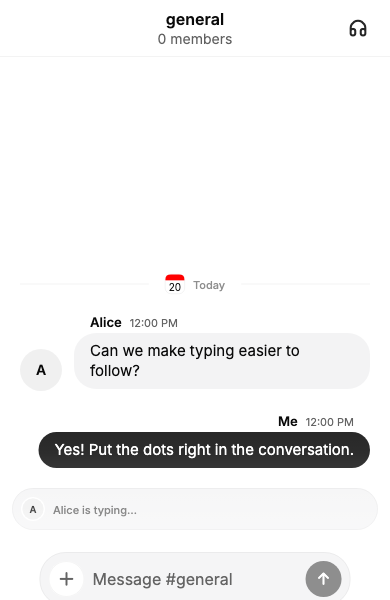 | 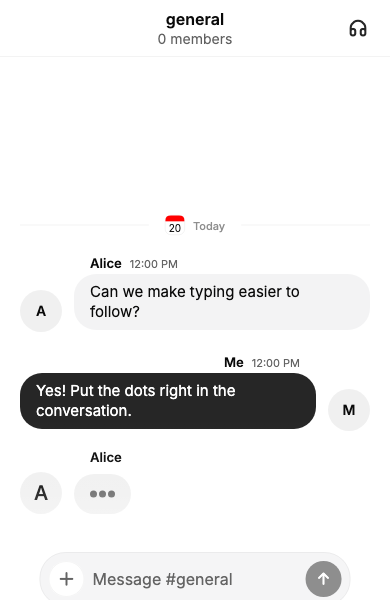 | ### Manual check Open a channel and have another person type: their round avatar and animated dots should appear at the bottom of the conversation and disappear when the message arrives. Send two consecutive messages: your avatar should appear once beside the final bubble. Repeat with Reduce Motion and larger text. Draft pending human testing of this PR snapshot. Do not merge based on the earlier recording alone. --------- Signed-off-by: kenny lopez <klopez4212@gmail.com> Co-authored-by: Terp <5856f6900e8e0a4e0ea1f4f8d2ee33e4753d2119bc122f94ecafc660b46c0511@buzz.block.builderlab.xyz> |
||
|
ngoodger-block
|
76d792f288 |
BUZZ-357: feat(cli): token-lean agent output format for event reads (#8234)
### Why?

Agents read channel history with `buzz messages get/thread`. Every
returned event includes its 128-hex `sig`. Every agent-authored message
also carries a NIP-OA `auth` tag, which is another owner pubkey and a
128-hex signature. An agent can't use either of these, but pays for them
on every history read. Measured with Claude's tokenizer, that is about
88 tokens per human message and about 180 per agent message, so a
history read shrinks 33% for short human messages and 40% once agent
messages are in the mix (details in the comment below). The existing
`compact` format is fixed at `{id, content, created_at}` (#6884), which
drops the author, tags and reply target, so agents can't use it.

### What?

- **New `--format agent` for event reads.** Applies to `messages
get/thread/search` and `feed get`.
- Drops `sig`, and trims the NIP-OA `auth` tag to `["auth", <owner>]` so
agents can still tell an author is an agent and who owns it.
- Folds the NIP-10 `root`/`reply` tags into a `reply_to` field, using
the same resolver as relay ingest, plus `thread_root` on nested replies.
That's the value `messages send --reply-to` takes.
- Keeps every other tag exactly as `json` output shows it: channel,
mentions, edit targets, diff metadata.
  - Non-event reads return the same output as `json`.
- **Default for agents.** Without `--format`, the CLI falls back to
`BUZZ_OUTPUT_FORMAT`; an empty or unknown value means `json` with a
warning, so a harness/CLI version mismatch never breaks commands.
buzz-acp sets it to `agent` for every agent runtime through
`default_agent_env` and forwards the effective value in the explicit MCP
server environment, so operator or persona env still wins, and `--format
json` still returns full signed events. buzz-agent adds the variable to
its MCP env allowlist.
- **Docs and cleanup.** The managed-agent skill doc (version bumped to
7) and `AGENTS.md` describe the new default. The two duplicate
`format_events` copies in `messages.rs` and `feed.rs` are now one
`commands/event_output` module, which also does the NIP-10 tag parsing.
The `json` and `compact` output contracts are unchanged.


### Example output
https://github.com/block/buzz/pull/8234#issuecomment-6259679347

### Testing

Started `buzz-acp run` with the deterministic task-agent fixture, then
passed its `session/new` MCP environment to Codex 0.163.0 (`codex
app-server`). With no format override the MCP child received `agent`;
operator overrides of `json` and `compact` reached the MCP child
unchanged. The probes used temporary local sessions and made no model
requests.

### Related

Same change on the other agent read surfaces: each drops `sig`, trims
`auth` to `["auth", <owner>]` and keeps thread context.
- block/buzz-app#1388: buzz-app MCP read lines (text, `claimed
owner`/`reply_to`)
- squareup/cash-server#139132: hosted agents' read tools (JSON events,
raw NIP-10 tags)

Generated with Codex

---------

Signed-off-by: Nikolaj Goodger <ngoodger@squareup.com>
Co-authored-by: Claude Opus 5.5 (1M context) <noreply@anthropic.com>
|
||
|
Diem Nguyen
|
427488e2fc |
fix(desktop): surface a missing DATABRICKS_HOST instead of loading models forever (#8504)
## Summary If the `databricks` / `databricks_v2` provider is selected but `DATABRICKS_HOST` isn't set, the Model field stays on "Loading models..." forever and never shows an error. How it happens: 1. Desktop discovers Databricks models in-process only when `DATABRICKS_HOST` is set. Without it, discovery falls back to `buzz-acp models`. buzz-agent then fails at config time with `DATABRICKS_MODEL required` (model is checked first) or `DATABRICKS_HOST required`. 2. `formatModelDiscoveryErrorStatus` maps those errors, and `BUZZ_AGENT_PROVIDER is required`, to a `null` status. The idea was that the field's Required row would explain the problem. 3. `deriveModelDiscoveryPending` treats "no data and no status" as still pending. So a failed discovery with a `null` status looks like it is still loading. The fix: - `formatModelDiscoveryErrorStatus` now always returns a status, and its return type is no longer nullable. A failed discovery therefore always settles. - A missing Databricks host shows: "Set DATABRICKS_HOST to your Databricks workspace URL under Advanced to load Databricks models." - A missing provider shows a muted "Choose a provider to load models." Builds that bake `DATABRICKS_HOST` in never reach this path. ### Screenshots Settings → Agents → Agent defaults, with Buzz Agent + Databricks v2 selected, no `DATABRICKS_HOST`, and model discovery failing with `DATABRICKS_MODEL required`. Captured from the desktop e2e build with the mock bridge. The only difference between the two builds is `personaModelDiscoveryStatus.ts`. | Before | After | |---|---| |  |  | ### Related issue None found. Searched open PRs that touch `personaModelDiscoveryStatus` / `usePersonaModelDiscovery`, and issues mentioning "loading models". ### Testing - New jsdom test drives the real `usePersonaModelDiscovery` hook with a rejected `DATABRICKS_MODEL required` discovery. It asserts that loading settles and that the status names `DATABRICKS_HOST`. On `main` the test fails (`modelDiscoveryLoading` stays `true`), and it passes with this change. - Updated unit tests in `personaModelDiscoveryStatus.test.mjs`. - `pnpm test` in `desktop/` passes (6834 + 161 tests). `tsc --noEmit` and biome are clean. - Exercised in the desktop e2e build with the mock bridge (screenshots above). Not yet exercised in the real Tauri app. Signed-off-by: Fizz <6be7be23ec5bba868f3e1db5ec86013d76bd1a293dce5b435a192158fec13641@buzz.block.builderlab.xyz> Co-authored-by: Fizz <6be7be23ec5bba868f3e1db5ec86013d76bd1a293dce5b435a192158fec13641@buzz.block.builderlab.xyz> |
||
|
Will Pfleger
|
7e6461242a |
feat(audio-client): accept a client request in connect (#8497)
## Summary Related: [block/buzz-app#1424](https://github.com/block/buzz-app/pull/1424) (native federated sessions; attaches the assertion on Huddle audio once this lands) `buzz_audio_client::connection::connect` took the audio URL as `&str`, so a host had no way to add headers to the WebSocket upgrade. buzz-app needs to send its NIP-FI user assertion (`Nostr-Federated-Identity: Bearer <jwt>`) on the Huddle audio socket. The relay checks NIP-FI when the audio connection upgrades (`audio/handler.rs` → `check_nip_fi_at_upgrade`). This PR widens the parameter to `impl IntoClientRequest + Unpin`, the same bound `connect_async_tls_with_config` already takes. Nothing else changes: TLS, timeouts and the NIP-42 handshake work as before. Existing `&str`/`&String` callers, including `desktop/src-tauri/src/huddle/relay_api.rs`, compile unchanged. --------- Signed-off-by: Will Pfleger <wpfleger@block.xyz> Co-authored-by: Duncan <dcfd242e557282d7a1e2cf2e6877522682f1e5c6156dc92ca7d90eaedd3b0f95@buzz.block.builderlab.xyz> |
||
|
Tom Brow
|
93114b4279 |
fix(mobile): lazily lay out new-DM recipients (#8435)
The new-message picker laid out every recipient inside an outer scroll view. Searching or changing selection could therefore mount the whole directory in one frame. Use a bounded sliver viewport so offscreen recipients stay lazy while the search field and selection chips still scroll above the keyboard. ### Validation - Current-head CI passed, including all Flutter test shards, Android, and native/release Swift jobs. Code and security reviews found no issues. After merging main and retaining both test imports, all 81 channel-page tests and the full mobile check/test suite passed. - Added a 200-person widget regression: the original mounts all 200 rows; the fix keeps fewer than 30 mounted through open, search, selection and removal, and can scroll to the final recipient. Covers no-match and closing too. - Strengthened the keyboard/chip test to verify the eight-recipient limit and that removing a chip makes the ninth recipient reachable. - All 79 channel-page tests passed; the strengthened limit test and Flutter analysis passed. - Native iOS simulator build passed. On a separately cloned paired simulator, verified populated directory/search, eight selected recipients, limit message, removal, no-match, scrolling to the final recipient and close without creating a conversation. Debug/AX instrumentation and a newer Flutter baseline make this functional validation, not a controlled release-speed benchmark. - Normal pre-push mobile checks passed, including formatting, analysis and the full Flutter test suite. Required CI exposed existing formatting in `message_carousel_preview_cases.dart`; a separate formatter-only commit corrects it. - The full local repository gate hit an unrelated Rust failure in `buzz-acp::signals_cancel_startup_turn_and_pending_stdin_without_hanging` (exit status `None` rather than `Some(143)`). No Rust code changed. The gate stopped at unit tests, so later build stages did not run. ### Related issue No duplicate recipient-layout fix found in the existing issue/PR search. ### Before and after The synthetic 200-person picker renders identically before and after (with a reserved keyboard inset). One image represents both; mounted-row assertions establish the performance mechanism separately.  --------- Signed-off-by: Tom Brow <tomb@block.xyz> |
||
|
Tom Brow
|
bf4a163510 |
fix(mobile): lazily lay out channel member groups (#8437)
Opening a large channel member sheet mounted and laid out every person in a grouped column. A captured Debug simulator entrance spent 242 ms in the UI callback, including 223 ms in layout. Build each person and agent as a lazy sliver row while preserving the grouped cards, names, statuses, management menus, and activity actions. Screen-reader row indices continue across both groups. A separate formatting-only commit fixes an existing carousel-test formatter discrepancy. No duplicate member-sheet performance PR or issue found. ### Validation - Added a 200-member widget regression: the original mounts 100 people initially; the fix mounts fewer than 20 nearby rows and reaches the final person and agent. - Added grouping, compact sizing, empty state, member tap identity, accessible indices, and scrolled member/agent menu checks. Existing channel-details “See all” navigation test passes. - Mobile formatting, static analysis, and the full mobile test suite passed on the committed tree. - Synthetic before/after rendering is pixel-identical at the same viewport. - Populated native iOS 26.5 simulator workflow: open members, scroll through people and agents to the end, then close. Final installed build passed this workflow. Debug, accessibility automation, profiler overhead, different Flutter versions, and shared-host load limit timing conclusions. This removes eager offscreen layout; it does not establish a controlled end-to-end speedup or release-device performance. ### Visual check Synthetic member sheet; before and after are pixel-identical at this viewport.  --------- Signed-off-by: Tom Brow <tomb@block.xyz> |
||
|
Tom Brow
|
a93f3282cc |
perf(mobile): retain preference crypto across reconnects (#8442)
Foreground reconnects rebuild preference managers and repeatedly derive the same NIP-44 keys on the UI isolate. Retain the six crypto objects in providers scoped to relay configuration and identity while preserving manager refresh, subscription, and publication behavior. Community changes, key rotation, and sign-out invalidate the retained objects. RelayConfig normalizes the signing key once at its shared accessor, so identity, theme encryption, event signing, and NIP-42 authentication receive the same value, including when an active configuration key has surrounding whitespace. The identity-export authorization snapshot uses the same normalized key for the active-identity check and the outgoing recovery payload. The branch incorporates main's relay-scoped preference managers. ### Validation - Regression exercises six production crypto providers across reconnects, configuration/key changes, and sign-out. Reintroducing a session dependency makes it fail. - Added a loopback WebSocket regression that exercises actual RelaySocket NIP-42 authentication with a padded key and verifies its challenge, relay, pubkey and signature. It fails before shared key normalization. - Added a connected-theme regression for whitespace-padded keys, encryption round-trip, and a valid published event signature. It fails before the normalization fix. - Added padded-key identity export coverage through authorization, SAS confirmation, exactly one normalized payload, and successful completion. Separate relay-change and key-rotation tests verify both fresh and expired grants fail closed. The padded-key regression failed before the fix. - Current head: all 48 focused pairing/crypto/auth tests and mobile analysis passed. All [CI checks](https://github.com/block/buzz/actions/runs/39497098787) passed, including mobile test shards, Android, native Swift tests and release builds. Codex feedback is addressed; Jude approved this exact head after independent regression and mutation checks. Fresh [Codex security review](https://github.com/block/buzz/pull/8442#issuecomment-6300273942) found no concrete issues. - Previous head: 122 config/socket/crypto/theme tests, 44 read-state tests, and all [GitHub CI checks](https://github.com/block/buzz/actions/runs/39491550425) passed, including mobile test shards, Android, native Swift tests and release builds. - Original implementation: native iOS Debug build and full local repository checks passed. A paired simulator background/resume capture had no samples in the targeted crypto constructors or key derivation; an 82 ms UI frame remained. Debug/JIT, profiler overhead and shared-host activity prevent an overall speedup claim. The later normalization change is covered by the production-provider regression above. - Two image decode timing failures occurred in the initial local full suite; direct baseline/patch runs, the subsequent full repository run, and the latest full mobile suite passed. Cold-start credential validation is unchanged: padded persisted keys are rejected by AuthNotifier before RelayConfig is constructed. The normalization regressions cover active configurations and identity export, not broader persisted-key acceptance. <!-- buzz-review-completed --> --------- Signed-off-by: Tom Brow <tomb@block.xyz> |
||
|
Diem Nguyen
|
8bbfe44f77 |
fix(deps): bump webpki crates for RUSTSEC-2026-0381/0382/0383 (#8499)
## Summary On 2026-10-19, RustSec published three advisories against the TLS certificate crates in our lockfiles. Since then, `cargo-deny check` fails on advisories. That breaks `Security Domain / Security` on `main` and on every PR that runs the Rust security job. | Advisory | Crate | Change | |---|---|---| | RUSTSEC-2026-0382 | `rustls-webpki` (distrusted intermediates) | 0.103.15 → 0.103.16 | | RUSTSEC-2026-0381 | `webpki-roots` (distrusted emSign roots) | 1.0.7/1.0.8 → 1.0.10 | | RUSTSEC-2026-0383 | `webpki-root-certs` (same roots) | 1.0.7/1.0.8 → 1.0.10 | This PR bumps all three in `Cargo.lock` and `desktop/src-tauri/Cargo.lock`. Only these packages change. `webpki-roots 0.26.11` stays because `tokio-tungstenite` 0.28/0.29 (via axum and nostr-sdk) still require `^0.26`, and no patched 0.26 release exists. 0.26.11 is a semver-trick shim that bundles no certificates of its own. It re-exports `webpki-roots` 1, which now resolves to the patched 1.0.10. `deny.toml` ignores RUSTSEC-2026-0381 for that shim and explains why. The ignore should come out once those consumers move to `webpki-roots` 1. ### Related issue N/A. I searched for open PRs bumping these crates and found none. ### Testing - `cargo-deny check`: `advisories ok, bans ok, licenses ok, sources ok`. On `origin/main` it reports `advisories FAILED`. - `cargo check --locked -p buzz-ws-client -p buzz-cli -p buzz-relay` passes. - The pre-push hook's Rust unit tests pass. Signed-off-by: Fizz <6be7be23ec5bba868f3e1db5ec86013d76bd1a293dce5b435a192158fec13641@buzz.block.builderlab.xyz> Co-authored-by: Fizz <6be7be23ec5bba868f3e1db5ec86013d76bd1a293dce5b435a192158fec13641@buzz.block.builderlab.xyz> |
||
|
klopez4212
|
ca35114209 |
fix(mobile): simplify and refine the quick actions menu (#8491)
Keeps the mobile + menu focused on Create channel and New direct message, with 8-point facing corners, a 6-point gap, and the active Home/Solo tab fill on iOS. Moves Browse channels directly above the channel list, including its empty state, preserving open-channel discovery, retry, and Join. Adds a cold-start journey through the real channel loader and join action with relay boundaries faked. Validation: mobile formatting/analysis and full mobile test suite; mutation check confirms the new journey fails when directory loading is removed. The original menu styling was tried on a physical iPhone; the replacement Browse entry has widget-journey coverage and has not yet been tried on device. --------- Signed-off-by: kenny lopez <klopez4212@gmail.com> Co-authored-by: Terp <5856f6900e8e0a4e0ea1f4f8d2ee33e4753d2119bc122f94ecafc660b46c0511@buzz.block.builderlab.xyz> |
||
|
Jason Holmes
|
a5767c67de |
fix(sdk): reject malformed mention pubkeys before signing p tags (#6372)
## Summary `buzz_sdk::builders::mention_tags` lowercased whatever string it was handed and pushed it straight into a `p` tag, so malformed mention pubkeys were signed onto real events. A composer that mentioned someone this way looked successful while notifying nobody, and the bad tag propagated to every relay and client that read it. Reproduced before fixing: `""`, `"not-a-pubkey"`, `"zzzz"`, `"../../etc/passwd"`, and 63/65-character strings were all accepted and emitted verbatim as `p` tags by `build_message` and `build_forum_post`. Fixes #6291 ## Acceptance criteria → evidence Following @kiranmagic7's [recommendation on the issue](https://github.com/block/buzz/issues/6291): | # | Criterion | Evidence | |---|---|---| | 1 | Validate in the **private `mention_tags`**, not the public `normalize_mention_pubkeys` | `crates/buzz-sdk/src/builders.rs` — the single changed line inside `fn mention_tags`. `normalize_mention_pubkeys` is untouched, so no public signature changes. | | 2 | Reuse the existing **`check_pubkey_hex`** helper | `let lower = check_pubkey_hex(hex, "mention pubkey")?;` replaces `hex.to_ascii_lowercase()`. No new helper added. | | 3 | Reuse the existing **`SdkError::InvalidInput`** | `check_pubkey_hex` already returns `InvalidInput`; no new error variant is introduced. | | 4 | Cover all **3 builders** | `malformed_mention_pubkeys_are_refused_by_every_builder` asserts against `build_message`, `build_forum_post`, **and** `build_forum_comment` — all three share `mention_tags`. | | 5 | Reject **empty / non-hex / 63-char / 65-char** | Same test's table: `""`, `"not-a-pubkey"`, `"zzzz"`, `"../../etc/passwd"`, `"a"*63`, `"a"*65`, plus `"z"*64` and a 64-char path-like string so a length-only check cannot pass. | | 6 | Preserve valid **uppercase canonicalization** | `valid_mentions_are_canonicalized_and_deduped_across_case` — uppercase hex is accepted and the emitted `p` tag is lowercase, across all three builders. | | 7 | Preserve valid **dedupe** | Same test: the same pubkey in both spellings collapses to exactly one `p` tag. Pre-existing `message_mentions_deduped` still passes. | | 8 | Preserve **`TooManyMentions` precedence** for >50 | `too_many_mentions_takes_precedence_over_validation` — a 51-entry list that also contains a malformed entry still returns `TooManyMentions`. The cap check stays ahead of validation. `mentions_at_the_cap_still_sign` pins that the boundary itself did not move. | | 9 | Inspect **#3036 overlap**; keep the patch narrow | See the compatibility note below. | | 10 | Make these tests actually **gate** | `Justfile` + `scripts/run-tests.sh` — see "Why the runner change is here". | Out of scope by design: switching to `nostr::PublicKey::from_hex`. Its stricter on-curve rule would change every one of `check_pubkey_hex`'s ~26 call sites, which is a repo-wide consistency decision rather than part of this fix. The doc comment records that reasoning. ## Why validation lives in `mention_tags` `mention_tags` is the single choke point every mention reaches, shared by all three builders, and callers can hand those builders an explicit list without ever going through `normalize_mention_pubkeys`. Validating here closes that bypass without breaking the normalizer's public API. This also aligns the SDK with behavior already shipping elsewhere: desktop's own `events.rs::mention_tags` already validates with `check_pubkey` on the identical structural rule (64 ASCII hex). The SDK was the inconsistent one. One malformed entry refuses the whole list rather than being filtered out — a silently dropped mention is precisely the failure being fixed, and filtering would preserve it. ## Why the runner change is here Adding `buzz-sdk` to `just test-unit` and the mirrored `scripts/run-tests.sh` fallback is a CI-behavior change, so it deserves its own justification: **without it the regression tests above would never run in CI.** `buzz-sdk` is a workspace member, so it was getting `clippy` and `check`, but no CI job executed a single one of its tests. This is the exact hazard the `Justfile` already warns about for other crates — *"nothing in CI runs `cargo test --workspace` — workspace membership alone buys clippy/check, not a single executed test."* Verified with a positive/negative control rather than by reading the config: - **Negative control** — with the runner files at pristine `main` and a deliberately panicking `buzz-sdk` test in the tree, `just test-unit` exited **0** and printed "All tests passed!". The crate name never appeared in the log. - **Positive control** — same sabotaged test, with only these two runner edits applied: `just test-unit` exited **1** with `buzz-sdk tests FAILED`. The sabotage test was removed afterward; it is not part of this PR. Both entries are needed because the two lists (nextest path and the no-nextest fallback) must stay in step. This is scoped strictly to making the crate's existing tests execute — no other CI behavior is touched. ## Compatibility with #3036 #3036 (`fix/nip10-reply-p-tags`) also edits `mention_tags`: it adds `parent_author: Option<PublicKey>` to `ThreadRef`, emits a parent-author `p` tag in `thread_tags`, and seeds `mention_tags`'s dedup set from `p` tags already on `tags`. This PR replaces only the `let lower = ...` line inside the loop, so the two changes are compatible in substance. Mechanically, whichever lands second needs the trivial merge fixup: #3036 adds `parent_author: None` to every `ThreadRef` literal, including the ones in the tests added here. One correction to the paragraph above, from an independent merge trial: the fixup is not *only* the `parent_author: None` additions. Merging #3036 into this head also produces one **textual conflict in `crates/buzz-sdk/src/builders.rs`**, confined to the `mention_tags` doc comment — both branches rewrote it, this PR to explain the validation and #3036 to explain the seeded dedup set. The resolution is to keep both blocks; there is no logic conflict, since this PR changes the `let lower = ...` line and #3036 changes the `seen` initializer. For reference, merging #3036 into plain `main` leaves `builders.rs` auto-merging cleanly, so this conflict is specific to the combination. Once the doc comment is resolved and `parent_author: None` is added to the three new `ThreadRef` literals here, `buzz-sdk` compiles and the only failing test is #3036's own `self_reply_drops_the_parent_p_tag` — which fails identically with #3036 merged into `main` **without** this PR, because `build_message` gained `.allow_self_tagging()` in #4975 after #3036's merge base. ## Test plan - [x] `cargo test -p buzz-sdk` — **267 passed, 0 failed** (5 new tests; pre-existing `message_mentions_deduped`, `message_too_many_mentions`, and the three `*_preserves_self_mention_p_tag` tests still green) - [x] `cargo fmt --all -- --check` — clean - [x] `just clippy` (workspace, `-D warnings`) — clean - [x] `just test-unit` — all 10 steps pass, now including `buzz-sdk` - [x] `just file-size-check` — pass - [x] `just desktop-tauri-fmt-check` / `desktop-tauri-check` / `desktop-tauri-test` — pass (2684 tests; `desktop/src-tauri` consumes `buzz-sdk`) - [x] Full `just ci` — the remaining steps are JS/Dart (`desktop-test`, `desktop-build`, `web-build`, `mobile-test`); this change touches only Rust + two runner scripts, so CI covers them here All gate results above were confirmed at commit `5fe5929de39388cada354593ac875d3c42c3d830`. ## Open questions for maintainers Out of draft and ready for review. Two calls I'd like from a maintainer: 1. **Do the runner entries belong here?** Adding `buzz-sdk` to `just test-unit` and `scripts/run-tests.sh` is a CI-behavior change riding along with a bug fix. I kept it because without it the regression tests above never execute in CI (controls in the section above), but I'll split it into its own PR on request. 2. **Is leaving `check_pubkey_hex` alone right for now?** Switching to `nostr::PublicKey::from_hex` would add an on-curve check but changes the contract at all ~26 call sites, which reads as a separate repo-wide decision rather than part of this fix. ### A note on CI The only check reporting here is **DCO Check** (pass). `CI`, `Desktop Release Candidate`, and `Docker image` are all sitting in `action_required` because this PR comes from a fork — a maintainer has to approve the workflow run before they execute. That's the standard first-time-contributor gate, not a failure, and I can't clear it from my side. Every gate result in the test plan above is from local runs at `5fe5929de39388cada354593ac875d3c42c3d830`, so CI has not independently confirmed them yet. Signed-off-by: rust worker <cb8459a6e4c936835834cef03b8331fe806108dd03da97d39c7036a7d710e860@buzz.block.builderlab.xyz> Signed-off-by: Jason Holmes <holmes@squareup.com> Co-authored-by: rust worker <cb8459a6e4c936835834cef03b8331fe806108dd03da97d39c7036a7d710e860@buzz.block.builderlab.xyz> |
||
|
Tom Brow
|
cdc2b129c0 |
fix(mobile): resolve DM display labels once per sort (#8488)
Home's DM sort resolves participant identity names again for every comparator call. This work appeared in a captured 82.163 ms UI frame after foregrounding the full app (Debug/JIT iOS simulator, shared host). Resolve each lowercase display label once per sort, retaining the same label ordering and channel-ID tie-breaker. Sort keys are invocation-local, so later viewer, profile, owner, participant, and community changes cannot reuse stale labels. No matching open mobile sorting PR or issue found. ### Validation - Added synthetic regression coverage for bounded contextual resolution and ordering parity across identity/name/channel changes, ties, unnamed DMs, and empty/singleton lists. The 80-DM fixture performs 80 contextual resolutions instead of the original comparator’s 982; restoring that comparator makes the regression fail. - 133 focused tests passed, including existing Home scrolling/reconnect widget tests and identity-name tests. - Mobile static analysis passed; 3,697 tests passed with 16 existing skips, plus four no-gateway configuration tests. - No new full-app or hardware capture. The existing trace establishes repeated synchronous work, not its release-build magnitude or the cause of every scrolling stall. Signed-off-by: Tom Brow <tomb@block.xyz> |
||
|
Luke Tornquist
|
fcdabcf774 |
docs(db): database target architecture and schema-change rules (#8273)
## Summary Adds `docs/database.md`, which covers two things: - **The target architecture.** `schema/tables/public/` is the declarative source of truth, written within the constraints that out-of-band, online schema tools can apply. Deployments at scale apply schema changes out of band; auto-migration stays supported for smaller and self-hosted deployments, and `migrations/` stays. The database has no triggers, functions, or foreign keys; that behavior lives in the owning application transaction or in durable application work. Data repair runs through the backfill framework in `docs/data-backfills.md`, not through migrations. - **Rules for schema changes made now:** 1. Add no triggers, functions, procedures, rules, or foreign keys, with no exceptions. New tenant-owned tables are fenced by community admission in the application. Startup and deletion validation already tolerate missing fences, but desired-state bootstraps still attach a fence trigger to every `community_id` table, so a new tenant-owned table is blocked until that loop stops (part of the fence-retirement work). The doc includes checklists for adding a tenant-owned table and a provenance-only table. 2. Migrations change schema only. They never mutate existing rows. Until the backfill framework ships, a repair may be a reviewed, idempotent, batched one-off script in `scripts/maintenance/` that takes the community deletion lock and touches only active communities. A repair that writes historical channel events must keep replica routing closed until its WAL has replayed. 3. Update every schema location: `migrations/`, `schema/tables/public/`, the manifest and sibling directories, the pgschema reconcile script where it applies, and both homes of the existing `push_gateway_*` tables (the target is for the gateway to own its tables alone). Never edit a merged migration. Add catalog-level parity tests for what you touch. 4. Every migration must be safe for the relay that is currently deployed, under both supported modes: auto-migration at startup and out-of-band application. Either way the old relay runs against the new schema for a while. Because auto-migration can apply expand and contract in one boot, a contract migration must fail closed when its backfill has not run, and a contract that depends on a writer release (such as dropping a trigger whose work moved into the app) must name that release as a required stop in the release notes, because no row check can prove it. The order is expand, deploy, backfill, then contract. The doc includes a table of changes that break the old relay and the safe form of each. 5. Bound every lock, build `migrations/` indexes concurrently (the declarative schema uses plain `CREATE INDEX`), and keep changes within what out-of-band apply can make online. AGENTS.md (Product Contract), ARCHITECTURE.md (buzz-db), and new path-local `migrations/AGENTS.md`, `schema/AGENTS.md` (a pointer), and `crates/buzz-push-gateway/migrations/AGENTS.md` point to the doc. The path-local files mean agents editing those directories get the rules automatically. AGENTS.md also had a stale claim that migrations are "auto-applied on relay startup". This PR corrects it: `BUZZ_AUTO_MIGRATE` defaults off in the binary and on in the Helm chart, and both modes are supported. ## What got simpler The rules were scattered across `schema/schema.sql` comments, AGENTS.md Common Gotcha #7, the backfill spec, `docs/thread-window-deployment.md`, and test names. They now live in one document, and the rest link to it. No code changes. ## Testing This PR changes documentation only. I checked links and diffs, and every claim in the doc points to code at the base commit: the layout and parity tests in `crates/buzz-db/src/runtime/migration.rs`, `EXPECTED_SCOPED_TABLES` and the serving-catalog check in `crates/buzz-db/src/store/deletion.rs`, and `BUZZ_AUTO_MIGRATE` in `crates/buzz-relay/src/main.rs`. The new `AGENTS.md` files aren't `.sql`, so neither the sqlx migrator nor the schema layout test picks them up; CI's layout, migration-count, and deletion-parity tests pass. At an earlier head, a real relay against isolated PostgreSQL 17 showed that a new unfenced `community_id` table serves normally and makes community deletion report `unknown=<table>`. Since then, the fence requirement at startup was removed on main; the doc now cites `migration_schema_fence_objects_are_optional_for_serving_and_deletion` for that. --------- Signed-off-by: Elrond <28d6302a099e5225b02c4155ac4236e4912603df2ab08dbfc2f4fef08ce598c8@buzz.block.builderlab.xyz> Co-authored-by: Elrond <28d6302a099e5225b02c4155ac4236e4912603df2ab08dbfc2f4fef08ce598c8@buzz.block.builderlab.xyz> |
||
|
klopez4212
|
5fefec604f |
fix(mobile): restore channel icons and align chat colors with desktop (#8478)
## Summary - Restores `#` and lock icons for public and private channels on Home, with matching loading placeholders. - Updates the dark-mode navigation colors to the desktop design-system tokens (read and unread text, section headings). - Replaces the chat color picker with the seven desktop accents (Gray, Chartreuse, Flame, Magenta, Iris, Cobalt, Jade). Saved legacy colors map to the closest one. - Uses white text in your own bubbles, and black where white falls below 4.5:1 (Chartreuse, dark-mode Gray). Links (underlined), quotes, tables and code use the same text color. - Insets code blocks in bubbles evenly, with corners concentric to the bubble and even inner padding. - The swipe-to-reply indicator uses the chosen chat color. ## Testing - `flutter analyze` and `dart format` are clean. The full mobile suite passes (3,705 tests). - Installed and checked on a Pixel 10 and an iPhone Air against a real community. 🤖 Generated with [Claude Code](https://claude.com/claude-code) --------- Signed-off-by: kenny lopez <klopez4212@gmail.com> Co-authored-by: Terp <5856f6900e8e0a4e0ea1f4f8d2ee33e4753d2119bc122f94ecafc660b46c0511@buzz.block.builderlab.xyz> Co-authored-by: Queue <874bf2d815c2c4b459b90438c669c57f2702f3a76bb6e16fa97184259aac3e9e@buzz.block.builderlab.xyz> Co-authored-by: Claude Opus 5.5 <noreply@anthropic.com> |
||
|
Diem Nguyen
|
0b53fc699d |
test(desktop): read only the open effort menu in effort-picker e2e (#8476)
## Summary
`menuValues()` in `claude-effort-picker.spec.ts` read every
`menuitemradio` on the page right after it opened a menu. Dropdown menus
stay mounted for their 100ms exit animation
(`POPOVER_RADIX_MOTION_CLASS`). That means the model menu, which
`pick()` had just closed, could still be in the DOM, and its rows ended
up in the effort list:

```
- Expected  - 0
+ Received  + 6
+   "Default model (Opus)", "Opus", "Claude Sonnet 5", "Haiku", "Claude Opus 4.8", "Custom model...",
    "Adapter default", "max",
```

The helper now waits for the trigger to report `aria-expanded="true"`,
then reads rows only from the menu named in its `aria-controls`. The fix
only touches the test; no product code changes.

### Related issue
The flake was introduced with the spec in #8059. In CI it failed
`Desktop Smoke E2E (2)` on #8473 (all three attempts,
[job](https://github.com/block/buzz/actions/runs/39336482034/job/118347673219))
and failed once before passing on retry on #8474.

### Testing
- **Forced repro.** I temporarily stretched the closed-menu exit
animation to 1500ms using `page.addStyleTag` (not committed):
  - Before: 5/5 failed with the same `toEqual` diff.
  - After: 5/5 passed.
- **Natural repeats.** I ran `--repeat-each` locally with 3–4 workers,
100 runs on each version:
  - Before: 3 failures from the menu-row leak.
  - After: 0.
- Both versions also had the same local-only startup timeouts (`waiting
for getByTestId('open-agents-view')`), which this change doesn't affect.
- **Full spec.** `pnpm exec playwright test --project=smoke
tests/e2e/claude-effort-picker.spec.ts`: 27 passed.
- `biome check` is clean.

Signed-off-by: Fizz <6be7be23ec5bba868f3e1db5ec86013d76bd1a293dce5b435a192158fec13641@buzz.block.builderlab.xyz>
Co-authored-by: Fizz <6be7be23ec5bba868f3e1db5ec86013d76bd1a293dce5b435a192158fec13641@buzz.block.builderlab.xyz>
|





