mirror of
https://github.com/block/buzz.git
synced 2026-10-28 04:51:40 +00:00
f76231be5277f751ff3e9603ea620be87a24d7e5
2354 Commits
| Author | SHA1 | Message | Date | |
|---|---|---|---|---|
 Eva |
f76231be52 |
docs(nip-fi): make the global-control obligation oracle-detectable
The gate-satisfiability repair left the two global controls (deny-everything, allow-everything) as normative prose no listed oracle could detect: FI-CONF-MUTATION required mutants and survivor handling only, FI-CONF-CLAIM-COMPLETE caught omitted mutant evidence only, and the release gate names mutants and the denial-fixture control only. A report omitting both global controls satisfied every listed oracle outcome -- by this document's own untestable-prose rule, a defect. FI-CONF-MUTATION gains one clause: the deny-everything and allow-everything global controls fail every oracle Mutation adequacy requires of them, with retained evidence. "Requires of them" inherits the centralized deferred-exit exclusion, so a one-implementation deferred claim stays satisfiable -- the controls run over every other listed oracle -- and the observation obligation attaches with the run. Verified by enumeration of the report space (control evidence presence, exit status, exit observation): the prior row accepts all 12 control-omission reports; the amended row accepts exactly the two intended shapes (deferred without the impossible exit observation, passed with it) and rejects omission, partial evidence, and claims of the impossible observation. Positive control: a clause ignoring the deferred exclusion re-breaks one-implementation satisfiability. Oracle census unchanged at 58. Co-authored-by: Eva <011987e296fd5006292d2f930b574be47c7801048d1983c46c425d3c95f0cffd@buzz.block.builderlab.xyz> Signed-off-by: Eva <011987e296fd5006292d2f930b574be47c7801048d1983c46c425d3c95f0cffd@buzz.block.builderlab.xyz> |
||
|
Eva
|
0863c736d6 |
docs(nip-fi): defer every impossible interop-exit obligation, not just the result
The R6 fix let FI-CONF-INTEROP-EXIT be recorded as deferred while no independent second implementation exists, but four unchanged rules still demanded evidence only the two-party run can produce: the per-oracle mutant with failing output (Mutation adequacy), the release-gate mutant clause, the FI-CONF-MUTATION row's universal quantifier, and the deny-everything global control that must observe every positive oracle fail. The exact condition permitting deferral made all four obligations impossible to discharge, so the release gate stayed unsatisfiable with one implementation -- the same defect class R6 was fixing, one layer down. The repair is one centralized rule in Mutation adequacy: while FI-CONF-INTEROP-EXIT is validly deferred it remains in claim completeness but is excluded from that section's mutation and global-control obligations, which attach with the run and must be discharged before either implementation's interoperable conformance claim is accepted. The release gate and the FI-CONF-MUTATION row point at that rule rather than restating it, and FI-CONF-CLAIM-COMPLETE rejects mutant-evidence omission for any other oracle, so misuse of the exemption is itself oracle-detected. The claim tuple's exit-fixture-digest element also carried an obligation no single implementation could meet: CONF said the canonical fixture "is published" at docs/nips/fixtures/nip-fi-conf-exit.json, but the file does not exist yet and every claim must record its digest. The fixture sentence becomes a publication requirement bound to the first run, and while the file is unpublished a claim records the reserved value pending-canonical-fixture, valid only alongside a deferred exit result; publication changes the tuple element and therefore creates a new claim. Verified by exhaustive enumeration of the gate over second-implementation presence, exit status, exit mutant evidence, control observation, ordinary-oracle gaps, smuggled deferrals, and fixture-digest state (128 states): the prior text accepts no one-implementation claim; the three-site repair without the global-control shape still accepts none; this text accepts exactly the two intended deferred-claim shapes and rejects all six modeled abuse states. Positive control: an over-broad exemption that waives ordinary mutants under deferral is accepted by a deliberately broken gate and rejected by this one. With a second implementation present, deferral is invalid and every obligation is restored. Oracle census unchanged at 58. Co-authored-by: Eva <011987e296fd5006292d2f930b574be47c7801048d1983c46c425d3c95f0cffd@buzz.block.builderlab.xyz> Signed-off-by: Eva <011987e296fd5006292d2f930b574be47c7801048d1983c46c425d3c95f0cffd@buzz.block.builderlab.xyz> |
||
|
Eva
|
b0aafc41e7 |
docs(nip-fi): classify every revalidation dependency and reread status at final admission
The equivalence catch-all sent every unclassified field to identity-class byte-equality, but the provenance class named only snapshot version and verification-key identity. The remaining revalidation_dependencies members -- binding, lifecycle, local-policy, and resource versions; status source and version; proof and replay witnesses; the confidential JWS handle -- defaulted to byte-equality, making "changed dependencies require current revalidation to an equivalent result" unsatisfiable on any version bump and the concurrent-enrollment recompute never equivalent. Both readings failed closed; this was an availability and interoperability defect. The repair classifies every revalidation_dependencies member: bounds-class if it is a deadline, provenance-class otherwise, with the identity-class catch-all narrowed to assertion-content fields. Provenance-class ignoring is conditional on successful current revalidation, so it is safe only for members final admission actually rereads -- and the reread list at final admission named status nowhere, while the per-use check already checks status versions. Under the guards as literally written, demoting status to provenance-class would have let final admission admit with upstream status inactive: the one dependency the residual-revocation bound exists to close. Status joins the final-admission reread list. Verified by a bounded model of the composed system in two encodings (strict = inferred guards, literal = written guards only), 8748 reachable states per arm: baseline classification reads 0 authority extensions / 127 unsatisfiable in both encodings; the reclassification without the status reread reads 64 extensions under the literal encoding, all rooted in status_active=False; with the status reread, 0 extensions and 0 unsatisfiable in both encodings. Controls: a deadline demoted to provenance-class is detected (128 states, still detected against the fixed reread set), and a per-member sweep is structurally blind to the status defect -- only promoting a predicate's whole detector group exposes it. Delegated leases carry their own dependency list in NIP-FI-DELEG and were not remodelled; this classification governs the direct-path equivalence rule it amends. Co-authored-by: Eva <011987e296fd5006292d2f930b574be47c7801048d1983c46c425d3c95f0cffd@buzz.block.builderlab.xyz> Signed-off-by: Eva <011987e296fd5006292d2f930b574be47c7801048d1983c46c425d3c95f0cffd@buzz.block.builderlab.xyz> |
||
|
Eva
|
56e74141e7 |
docs(nip-fi): resolve contradictions between the spec, its own rules, and the deployed wire
External line-by-line review against the implementation found compositions no internal-consistency pass could see: rules that contradict each other across documents, and registry text that denies the wire the deployed proxy actually signs. Every reading failed closed, but a correct implementation could not be built from the text alone. Fixes, one per defect: - EDGE strip rule no longer removes the NIP-98 proof: requirement 1 named "authorization" among the fields every trusted edge strips, while core reserves the Authorization header for the NIP-98 proof that must reach final admission. The rule now names the three NIP-FI fields plus other edge profiles' fields, explicitly preserves Authorization, and a negative conformance sentence makes stripping or rewriting it nonconformant. - Proof-transport codes 0x03 (Git smart-HTTP session) and 0x04 (Blossom media) are reserved with fixed meanings: the deployed proxy emits both inside the MAC input, and the registry declared them unassigned, so a conforming verifier denied every Git and Blossom envelope. Allocation completes when each transport contract is published; until then the codes are valid only under an explicit shared proxy/verifier contract and are not portable interoperability. - Replay moves from evidence_rejected to authorization_denied: replay status is committed per-principal server state, so classing it as evidence rejection contradicted the supplied-evidence privacy rule and let an attacker resubmit captured evidence to learn whether the original request committed. The CONF fixture table mirrors the move. - The current-status witness match now requires issuer equality: the witness tuple carried iss but the match rule checked only subject and session, so on a shared status source an issuer-B witness could satisfy a pre-revocation issuer-A assertion. The stale-status oracle gains the mismatch arm. - The interoperability exit test is deferrable while no independent implementation exists (machine-readable reason, re-evidenced when the second implementation claims), and the canonical shared exit fixture gains provenance: editor-authored, published at docs/nips/fixtures/nip-fi-conf-exit.json with its SHA-256 digest. A required gate no implementation could ever pass was, by this document's own standard, a defect in the document. - The "RFC 9068 access token" class is renamed at+jwt access token at all three sites: it selects on typ and aud and validates under this document's claim contract, not the full RFC 9068 profile. - EDGE states the unbound-body-metadata rule directly instead of by cross-document inference, and the negative matrix gains the Content-Type/Content-Encoding mutation row. - Absent or incomplete edge provenance maps to missing_evidence; present but failing provenance maps to evidence_rejected. The CONF fixture table gains the absent-provenance row; rows are renumbered, which is safe because CONF itself requires that no text reference rows by number. - A payload tag on an authorization-irrelevant body is validated identically, closing a verifier divergence the text left open. Oracle census is unchanged at 58 (30 core, 6 EDGE, 11 LIFECYCLE, 7 DELEG, 4 CONF): the two table additions are a negative-matrix row and a denial-fixture row, neither in the oracle denominator. One review item (equivalence classification of revalidation dependencies) is deliberately not in this commit pending model verification that the reclassification opens no authority-extension path. Co-authored-by: Eva <011987e296fd5006292d2f930b574be47c7801048d1983c46c425d3c95f0cffd@buzz.block.builderlab.xyz> Signed-off-by: Eva <011987e296fd5006292d2f930b574be47c7801048d1983c46c425d3c95f0cffd@buzz.block.builderlab.xyz> |
||
|
Max
|
4f913a8132 |
docs(nip-fi): close discovery and conformance gaps
Co-authored-by: Max <d8473ee32b973aa31a21a65adddcc4b69cc2a8a4dee8121ecd51926e0cddbc02@buzz.block.builderlab.xyz> Signed-off-by: Max <d8473ee32b973aa31a21a65adddcc4b69cc2a8a4dee8121ecd51926e0cddbc02@buzz.block.builderlab.xyz> |
||
|
Dawn
|
17d455a9bf |
docs(nip-fi): scope administrative expiry to the grant and stop rotation clearing it
Two defects found by running a bounded state model of the composed core + LIFECYCLE machine in two encodings -- one holding every guard the documents state plus the guards a careful implementer would infer, one holding only the guards actually written. Both were invisible to four line-by-line readers because reading supplies the missing rule unconsciously. Defect 1: administrative expiry was escapable by rotation. LIFECYCLE said an expired binding "remains durable and occupies both sides of the core partial bijection", so it stays in the relation -- and core Rotate replaces one exact "active" binding with "a fresh binding version" while no document said the replacement inherits binding_not_after. Reading the expired binding as active let rotation authority alone clear a bound only expiry authority had set; reading it as inactive removed it from TargetEligible, letting ProvisionBinding double-bind the identity or bind the administratively terminated key to a different identity, violating FI-INV-01 -- the invariant LIFECYCLE was leaning on. FI-LC-ADMIN-EXPIRY did not detect either: core Rotate is authorized and version-checked, so the escape satisfied the oracle's own wording. Defect 2: nothing in the six files said what binding_not_after is a bound *on*. Two reviewers resolved it in opposite directions -- one grant-scoped, one identity-scoped -- and the readings differ by 25,200 reachable states. The identity-scoped reading also makes RetirePair followed by ordinary enrollment an escape, which under the grant-scoped reading is a legitimately new grant. Repairs: - Core Rotate states that it continues one grant onto a new key and preserves every profile-defined administrative bound as an opaque field core neither interprets nor clears. - LIFECYCLE declares the bound grant-scoped, names the transitions that establish a new grant carrying no prior bound, and points identity-scoped deadlines at the capability projection in authoritative local-policy state, which already carries the revocation-bound machinery such a deadline needs. Encoding one here instead would put an authorization-relevant deadline in a store with no revocation bound. - LIFECYCLE defines a binding with a reached bound as active for every core relation and eligibility test, closing the TargetEligible horn. - Binding-creating transitions must declare continuation or establishment; the two cases partition that set with no remainder, so a future profile cannot add a creator whose bound semantics are undefined. - FI-LC-ADMIN-EXPIRY gains the rotation-must-not-clear arm and the negative arm that retire-then-enroll yields an unbounded binding and is conformant, so the oracle no longer admits the violation it exists to catch. Verification of the shipped bytes, not the intent: re-encoding the model from this text gives 0 grant-scoped escapes (17,184 before) and 0 FI-INV-01/FI-INV-03 regressions over 282,528 states across all three enrollment policies. Each clause was mutated separately and each goes red only for its own clause -- dropping the Rotate carry restores 21,216 escapes, and dropping the active definition admits both FI-INV-01 violations. A clause that cannot be made to fail is not a guard. Co-authored-by: Tyler Longwell <tlongwell@squareup.com> Signed-off-by: Tyler Longwell <tlongwell@squareup.com> |
||
|
Eva
|
513e03b069 |
docs(nip-fi): fix pinned NIP source links and identifier-classification contradiction
Review findings from Mari and Quinn on #5946 at
|
||
|
Eva
|
2511d1baff |
docs(nip-fi): align the worked example with the repaired exit contract
The non-normative worked example still promised that the NIP-FI-CONF exit fixture pins complete byte-exact values. After the compared-object repair, CONF deliberately does not pin byte-exact minted requests: it pins the request compared objects (signing inputs and semantic JSON values) and excludes signature octets. Restating the removed contract is exactly the stale-restatement defect this batch closed; align the phrase. Co-authored-by: Eva <011987e296fd5006292d2f930b574be47c7801048d1983c46c425d3c95f0cffd@buzz.block.builderlab.xyz> Signed-off-by: Eva <011987e296fd5006292d2f930b574be47c7801048d1983c46c425d3c95f0cffd@buzz.block.builderlab.xyz> |
||
|
Dawn
|
15d3fb2e0d |
docs(nip-fi): close the denominator contract in its own oracle
The denominator rewrite changed the body and left every summary of it behind. Three sites still promised the deleted requirement-level contract: the global-controls paragraph, the release gate, and -- worst -- the FI-CONF-MUTATION row itself, which is one of the four CONF entries the denominator counts. The gate contradicted the body it gates, so the original ambiguity survived inside the oracle that claims to close it. FI-CONF-INTEROP-EXIT likewise still demanded byte-identical requests the section above had already stopped requiring. All four now say listed oracle and compared object. The exit test promised a request on the WebSocket upgrade and defined a signing-input object only for NIP-98. Define the NIP-42 half alongside it, compared against its own transport's NIP-01 serialization, and pin the complete unsigned event fields for both transports in the fixture. The assertion object compared a protected header the fixture never pinned; pin the complete protected-header and claim-set JSON values. Correct a false premise: signatures were said to differ because ES256 and BIP-340 each draw fresh randomness. Deterministic ECDSA and fixed-aux BIP-340 are conforming and need not differ. The conclusion is unchanged -- conforming implementations may disagree on octets, so an object requiring equal octets fails conforming pairs -- but the reason now matches the algorithms as specified rather than as commonly configured. Give FI-TRACE-CAPABILITY-REVOCATION a lawful N/A. Core makes it conditional on a configured revocation-bounded external projection, while Applicability required every unlisted oracle, so a deployment with no such projection had no disposition it could honestly claim. Same defect class the offline-jwt fix closed for the current-status oracles, one oracle over. All findings are Wren's, verified against the cited lines before editing. A rewrite that changes a contract has to grep for every restatement of the old one; the body moved and the summaries did not, which is exactly the drift this document exists to make impossible. Co-authored-by: Tyler Longwell <tlongwell@squareup.com> Signed-off-by: Tyler Longwell <tlongwell@squareup.com> |
||
|
Dawn
|
f29e2092b6 |
docs(nip-fi): make the conformance denominator countable
CONF's mutation adequacy said "each normative requirement in core," which admits four readings with a 3x spread. Make the denominator the listed oracle, selected structurally: rows whose first cell is one complete literal oracle ID, in core and each claimed normative profile. Selecting by section title would silently drop EDGE's five oracles, whose table lives under "Discovery and conformance"; core's heading is "Core behavioral oracles" and no two of the tables agree. Verified 30/5/11/7/4 = 57 rows, zero shorthand, zero duplicates, zero orphans, at a8fab1ad0. The exit test required byte-exact requests from two implementations. ES256 and BIP-340 draw fresh randomness per signature and nothing here pins JSON member order, so no conforming pair could ever pass. Compare signing inputs instead: the NIP-01 serialization for the proof, decoded header and claim set as JSON values for the assertion. Shipping pre-minted bytes would have stopped testing whether an implementer can mint from the document at all. Add the governing document revision and exit fixture digest to the claim tuple: evidence means different things under different text, and a claim that does not name what it was judged against is unfalsifiable once the specification moves. Exempt the synthetic exit fixture from the redaction rule it otherwise contradicts, and give offline-jwt deployments a lawful N/A for the two current-status oracles, which have no witness to test. Subtraction: the enumeration-agreement subsystem hand-copied core's denial symbols into CONF prose, then spent four checks and two rationale paragraphs guarding the copy. Read the set from core instead and the copy's guards have nothing to guard: seven checks collapse to three. Promotion detection is kept by folding disjointness into check 3 rather than restoring a check -- found because a six-mutant matrix showed the reduced set letting a promoted allowlist entry survive, falsifying a sentence I had just written. All six mutants now killed, green on the conforming document. Also fold three paragraphs restating one rule about unpinned header fields into one. Net +24 lines on CONF. The row splits and the two new tuple elements are not recoverable by deleting text that carries a guarantee, and compressing identifiers to reach a target would trade a real property for a number. Co-authored-by: Tyler Longwell <tlongwell@squareup.com> Signed-off-by: Tyler Longwell <tlongwell@squareup.com> |
||
|
Eva
|
edc66ef8d8 |
docs(nip-fi): add the promised worked wire example
The PR description promises a worked wire example in core; none existed. Add one compact non-normative section: a protected HTTP POST under client-attached with NIP-98 proof and a relevant body, showing how the two evidence fields, body binding, and the admission phases compose on the wire. Byte-exact values remain the province of the NIP-FI-CONF exit fixture; the example elides credentials so it cannot be mistaken for a conformance vector. Twenty-six lines, kept deliberately smaller than the alternative of striking the promise would save in credibility. Co-authored-by: Eva <011987e296fd5006292d2f930b574be47c7801048d1983c46c425d3c95f0cffd@buzz.block.builderlab.xyz> Signed-off-by: Eva <011987e296fd5006292d2f930b574be47c7801048d1983c46c425d3c95f0cffd@buzz.block.builderlab.xyz> |
||
|
Eva
|
ffc4e654c7 |
docs(nip-fi): close temporal, allocation, and denominator ambiguities
Three defects from the independent review lap, each fixed by making the text impossible to read two ways: DELEG evidence boundaries used 'live' (undefined) and declared equality at either temporal boundary expired, which is incoherent for a lower bound and contradicted core's own inclusive-nbf/exclusive-exp idiom. State both comparisons explicitly, matching core: now < mandatory_expiry and not_before <= now + skew. The delegated lease deadline mixed a configured duration into a minimum of absolute instants. Anchor it: lease issue instant plus the configured delegated maximum. EDGE allocated proof-transport codes 0x03/0x04 to Git and Blossom profiles that do not exist, violating the table's own allocation rule (a published stable specification with validation, binding, freshness, replay, and vectors). Unassign both; the unassigned range now starts at 0x03. Core's oracle table compressed six pairs of oracle IDs with slash shorthand that has no consistent expansion rule: three pairs read replace-last, three read keep-prefix, so no reader can infer the grammar. Split all six into one row per literal ID. The table now lists exactly 30 rows, one complete ID each, making the oracle set mechanically enumerable as the mutation-adequacy denominator CONF will reference. Every prose citation resolves to a table row; no shorthand remains. Review findings: Wren (DELEG boundaries, delegated maximum, EDGE codes, shorthand ambiguity), Dawn (denominator enumerability measurement). Co-authored-by: Eva <011987e296fd5006292d2f930b574be47c7801048d1983c46c425d3c95f0cffd@buzz.block.builderlab.xyz> Signed-off-by: Eva <011987e296fd5006292d2f930b574be47c7801048d1983c46c425d3c95f0cffd@buzz.block.builderlab.xyz> |
||
|
Dawn
|
d123e4e0bb |
docs(nip-fi): make the conformance oracles derivable
Two of the seven enumeration checks were red on the conforming document. Check 7 compared a set of rows against a set of symbols, and two core-attributed rows name no symbol, so it could not pass at any head. Check 5's head clause admitted the one row its own qualifier excluded. A check that is red on a conforming document detects nothing: it cannot be observed to flip, so every mutant reads as caught. Both are corrected and the requirement to run the checks green before scoring a mutant is now written where the checks live. Address the allowlist and the anonymity set by symbol instead of row number. This table is required to grow, and a profile appending one row renumbers the positional references: the allowlist would name the wrong condition and a new denied condition would fall outside the byte-identity requirement without any check firing. State the three readings the compared object left to convention. An independently written conforming implementation diverges on each by language default: a canonicalizing HTTP library emits Www-Authenticate, a server that sets no Content-Length frames the body as chunked, and a JSON encoder spaces its separators. Header names match case-insensitively per RFC 9110 Section 5.1, the compared body is the content per Section 6.4, and the Nostr message is compact JSON per NIP-01's serialization rules. Content-Length stays unpinned; framing is the sender's choice and pinning it would widen the object for no privacy gain. An exit test whose result depends on an unstated convention is the same defect as an oracle no pair can satisfy, one layer down. Co-authored-by: Dawn <c6237ef84fa537c78dcee78efd2d4e59f728859c7f194da42ac51ededfa0be05@buzz.block.builderlab.xyz> Signed-off-by: Dawn <c6237ef84fa537c78dcee78efd2d4e59f728859c7f194da42ac51ededfa0be05@buzz.block.builderlab.xyz> |
||
|
Dawn
|
d163ad172f |
docs(nip-fi): make conformance oracles satisfiable
The denial-fixture enumeration named four core denial symbols; core now denies six. Correct the count and names, reattribute binding_required to core, and widen row 9 to cover any unrecognized enrollment policy, which core's terminal else also catches. Add enumeration-agreement checks so a future core symbol cannot silently falsify the sentence again, including two that guard the prose-only allowlist itself: promoting an allowlisted condition to a real symbol satisfies the attribution check rather than failing it, so only a minimality check makes that rot visible. Replace the interoperability compared object with what core pins: status, body, and the values of only the header fields core names. Comparing ordered header names failed every conforming pair. State that the anonymity comparison stays wider, so a private reason code in an unnamed header is still a defect. Parameterize the exit test by a shared fixture. Independence is a claim about code, not inputs: two implementations given different issuers, keys or clocks cannot produce equal bytes however correct both are. Co-authored-by: Dawn <c6237ef84fa537c78dcee78efd2d4e59f728859c7f194da42ac51ededfa0be05@buzz.block.builderlab.xyz> Signed-off-by: Dawn <c6237ef84fa537c78dcee78efd2d4e59f728859c7f194da42ac51ededfa0be05@buzz.block.builderlab.xyz> |
||
|
Max
|
6b450122ac |
docs(nip-fi): close assertion and lifecycle semantics
Co-authored-by: Max <d8473ee32b973aa31a21a65adddcc4b69cc2a8a4dee8121ecd51926e0cddbc02@buzz.block.builderlab.xyz> Signed-off-by: Max <d8473ee32b973aa31a21a65adddcc4b69cc2a8a4dee8121ecd51926e0cddbc02@buzz.block.builderlab.xyz> |
||
|
Wren
|
1211a71591 |
docs(nip-fi): close core interoperability gaps
Co-authored-by: Wren <5217c5c2f7bfb4333e46d17c98a9255a52dadee18dcd43a43536b95e6776dfa0@buzz.block.builderlab.xyz> Signed-off-by: Wren <5217c5c2f7bfb4333e46d17c98a9255a52dadee18dcd43a43536b95e6776dfa0@buzz.block.builderlab.xyz> |
||
|
Max
|
99d9155e6f |
docs(nip-fi): require domain and issuer separation
Co-authored-by: Max <d8473ee32b973aa31a21a65adddcc4b69cc2a8a4dee8121ecd51926e0cddbc02@buzz.block.builderlab.xyz> Signed-off-by: Max <d8473ee32b973aa31a21a65adddcc4b69cc2a8a4dee8121ecd51926e0cddbc02@buzz.block.builderlab.xyz> |
||
|
Wren
|
8fad46d5cb |
docs(nip-fi): close direct enrollment denials
Co-authored-by: Wren <5217c5c2f7bfb4333e46d17c98a9255a52dadee18dcd43a43536b95e6776dfa0@buzz.block.builderlab.xyz> Signed-off-by: Wren <5217c5c2f7bfb4333e46d17c98a9255a52dadee18dcd43a43536b95e6776dfa0@buzz.block.builderlab.xyz> |
||
|
Dawn
|
7dfaa74aa6 |
docs(nips): specify FI conformance evidence profile
Defines what counts as evidence that an implementation has the behavior core and the profiles require: the immutable claim unit, evidence and anti-evidence rules, the complete per-private-condition denial fixture enumeration, mutation adequacy, and the two-implementation interoperability exit test. Three rules carry the weight. Denial fixtures are enumerated per private condition rather than per public class, because a per-class suite compares a class against itself and passes trivially. Mutation adequacy requires each normative requirement to have a singly-applied, attribution-checked, reachability-witnessed mutant killed by its named oracle, because naming an oracle proves a requirement is claimed, not that the oracle can fail. The exit test requires byte-exact request and per-class denial bytes produced from the documents alone by two independent implementations. FI-TRACE-TOFU-THEFT takes a configuration witness only: under the private posture ruling no discovery output distinguishes enrollment mode, so a discovery witness for that oracle cannot exist. Co-authored-by: Dawn <c6237ef84fa537c78dcee78efd2d4e59f728859c7f194da42ac51ededfa0be05@buzz.block.builderlab.xyz> Signed-off-by: Dawn <c6237ef84fa537c78dcee78efd2d4e59f728859c7f194da42ac51ededfa0be05@buzz.block.builderlab.xyz> |
||
|
Max
|
528c847262 |
docs(nips): tighten FI assertion security semantics
Co-authored-by: Max <d8473ee32b973aa31a21a65adddcc4b69cc2a8a4dee8121ecd51926e0cddbc02@buzz.block.builderlab.xyz> Signed-off-by: Max <d8473ee32b973aa31a21a65adddcc4b69cc2a8a4dee8121ecd51926e0cddbc02@buzz.block.builderlab.xyz> |
||
|
Wren
|
8f6b5c7685 |
docs(nips): define federated identity core
Co-authored-by: Wren <5217c5c2f7bfb4333e46d17c98a9255a52dadee18dcd43a43536b95e6776dfa0@buzz.block.builderlab.xyz> Signed-off-by: Wren <5217c5c2f7bfb4333e46d17c98a9255a52dadee18dcd43a43536b95e6776dfa0@buzz.block.builderlab.xyz> |
||
|
Perci
|
0c283a558d |
docs(nips): specify trusted edge profile
Co-authored-by: Perci <5a968df9a7494b4e019b9ecf739e088ba61097b4312124e9a88ae5b42e3f5f3e@buzz.block.builderlab.xyz> Signed-off-by: Perci <5a968df9a7494b4e019b9ecf739e088ba61097b4312124e9a88ae5b42e3f5f3e@buzz.block.builderlab.xyz> |
||
|
Max
|
9f2cb82ff3 |
docs(nips): specify FI binding lifecycle profile
Co-authored-by: Max <d8473ee32b973aa31a21a65adddcc4b69cc2a8a4dee8121ecd51926e0cddbc02@buzz.block.builderlab.xyz> Signed-off-by: Max <d8473ee32b973aa31a21a65adddcc4b69cc2a8a4dee8121ecd51926e0cddbc02@buzz.block.builderlab.xyz> |
||
|
Eva
|
19dce1ade6 |
docs(nips): skeleton for comprehensive NIP-FI restructure (core + 4 profiles)
Pins the file layout for the approved 9/9/9/9 blueprint: a ~350-line normative core plus separately claimable EDGE / LIFECYCLE / DELEG / CONF profiles and a non-normative model companion. Slice owners replace stub content; the skeleton exists so parallel authors share one layout. Co-authored-by: Eva <011987e296fd5006292d2f930b574be47c7801048d1983c46c425d3c95f0cffd@buzz.block.builderlab.xyz> Signed-off-by: Eva <011987e296fd5006292d2f930b574be47c7801048d1983c46c425d3c95f0cffd@buzz.block.builderlab.xyz> |
||
|
Jordan Mecom
|
85bacea52b |
Remove GitHub security advisory commitment (#6144)
Removes the promise in `SECURITY.md` to publish a GitHub Security Advisory after every security fix is released. The disclosure policy continues to state that Buzz follows coordinated disclosure and credits reporters unless they request anonymity. Checked with `git diff --check`. Signed-off-by: Jordan Mecom <jm@squareup.com> |
||
|
klopez4212
|
076081bfc6 |
Rename Bumble agent to Pollen (#5864)
## Summary - Rename the built-in Bumble agent to Pollen across desktop, onboarding, docs, and test fixtures. - Migrate existing stock definitions and instances in place while preserving customized fields and the stable persona coordinate. - Reserve the Pollen name by removing it from Fizz's generated-name pool. ## Validation - Pre-push desktop checks, typecheck, 4,791 frontend tests, Tauri clippy, and 2,432 native tests - Desktop E2E build --------- Signed-off-by: kenny lopez <klopez4212@gmail.com> Signed-off-by: Kenny Lopez <klopez4212@gmail.com> Signed-off-by: Wes <wesbillman@users.noreply.github.com> Co-authored-by: Carl <3c4caeafb646d23867f1c4832e68211d77e2561946171625f75c3ce1a3f2670f@buzz.block.builderlab.xyz> Co-authored-by: Wes <wesbillman@users.noreply.github.com> Co-authored-by: Carl <c7ebe626f000404285d3686e1dc74cc07cc60a9754a150041ba132e14bd3e2ec@buzz.block.builderlab.xyz> |
||
|
Will Pfleger
|
d12d825778 |
fix(desktop): resolve agent profiles through one archive-aware selector (#5706)
Agent profiles resolve through one shared selector (`pickProfileAgent`) at every entry point — the persona card, the profile panel, and library grouping. That selector ranked instances only by active/name, with no archive awareness, so a relay-archived instance early in file order could hijack the persona card and the profile panel. The persona card also recorded a durable pubkey target, which could strand the panel on an archived identity when the click landed during the archive-snapshot fail-open window. The profile panel's Runtime → Instances roster had the same blind spot: it rendered every persona instance raw, so archived instances appeared mixed in with live ones as if active. This makes the shared resolution path archive-aware via the existing fail-open `useIsArchivedPredicate`: - `pickProfileAgent` filters archived instances before ranking and returns `undefined` when every instance is archived (persona-only mode). - `buildUnifiedGroups` drops archived agents from the standalone `Custom agents` and `Unknown agents` buckets; matched persona groups keep their full list and rely on the selector's persona-only fallback. - `useCanonicalManagedAgentProfile` resolves through a pure `resolveCanonicalManagedAgent` helper that applies the target-provenance rules: a deliberately requested archived pubkey stays exact (so its archive controller can unarchive it, even when a live sibling exists), `preserveRequestedInstance` still pins a Runtime → Instances selection, and non-archived historical navigation keeps its canonicalization. - The persona card's main click records a persona target that re-resolves every render, so it self-corrects to a live sibling after hydration. Deliberate instance navigation and the runtime-error affordance keep their explicit-pubkey path. - The Runtime → Instances roster (`ProfileInstancesSection`) buckets instances off the same predicate via `bucketPersonaInstances`: live rows render as before, and archived rows move under a labeled `Archived` subsection. The instance count reflects both buckets, and archived rows keep their explicit-pubkey click so unarchive stays UI-reachable (the deliberate-navigation path above). The predicate is fail-open (treats every identity as live while the relay archive snapshot loads) and self-exempt, so a cold start never hides an identity and a user is never folded from their own client. While the snapshot is loading, every instance renders in the live list — nothing hidden, nothing labeled. --------- Signed-off-by: Will Pfleger <pfleger.will@gmail.com> Co-authored-by: Duncan <dcfd242e557282d7a1e2cf2e6877522682f1e5c6156dc92ca7d90eaedd3b0f95@buzz.block.builderlab.xyz> |
||
|
Luke Tornquist
|
54f11219ef |
fix(acp): gate relay-signed workflow messages on their attributed author (#6129)
## Problem Scheduled workflow `send_message` actions fire and land in the channel with correct `p` tags for the mentioned agents — but the agents never wake. The wake-up is silently dropped. **Root cause:** workflow messages are signed by the **relay keypair** (`workflow_sink.rs` signs with `state.relay_keypair`), so `event.pubkey` is the relay's pubkey, not the workflow owner. In `buzz-acp`, the inbound author gate (`author_allowed`) runs **before** the `p`-tag mention check. Under the default `respond_to = owner-only`, the relay pubkey is neither the owner nor a sibling, so every workflow wake-up dies at the gate with a debug-level `"inbound author gate — dropping event"`. The relay-side comment even says the mention `p` tags exist *"so mentioned agents are woken (wake is p-tag gated)"* — but wake is also author-gated, and that path was missed. ## Fix Gate relay-signed workflow messages on their **attributed author** — the pubkey that created the workflow — instead of the relay pubkey: - **Relay:** `workflow_sink.rs` now emits an explicit `buzz:workflow-owner` tag carrying `workflow.owner_pubkey` (the workflow creator, which the executor already passes as `author_pubkey` and whose channel access the relay verifies before emitting). Ownership is never inferred from `p`-tag order; mention `p` tags play no role in attribution. - **Harness:** at startup, `buzz-acp` fetches the relay's NIP-11 `self` pubkey (new `RestClient::fetch_relay_self`, public `/info` endpoint). Best-effort: fetch failure just logs a warning and preserves pre-fix behavior. - **Gate:** an event that is (a) authored by the relay `self` key, (b) tagged `buzz:workflow`, and (c) carries a well-formed `buzz:workflow-owner` pubkey is gated on that owner, through the exact same owner/sibling/allowlist policy as a direct author. ## Security notes (all fail closed) - No NIP-11 `self` pubkey → no exemption. - `buzz:workflow` / `buzz:workflow-owner` tags on a non-relay-signed event → ignored (a member cannot forge the exemption; the relay verifies signatures on submission and only the relay holds its key). - Relay-signed event without the tags, or with a malformed owner value (not 64-hex) → plain author gate. - Who is @mentioned in the message has no bearing on whose authority is evaluated. - A workflow owned by a random channel member still cannot wake an owner-only agent — the owner's pubkey must pass the same policy. ## Testing - 7 unit tests (`workflow_attributed_author_tests`) covering attribution, fail-closed paths, p-tag independence, malformed owner values, and the forgery case. - Extended the PG-gated `workflow_send_message_p_tags_mentioned_member` integration test to assert the `buzz:workflow-owner` tag. - `cargo test -p buzz-acp`: 785 passed, 0 failed. `cargo test -p buzz-relay --lib workflow_sink`: 17 passed. Clippy + fmt clean. (9 pre-existing `buzz-relay` failures in unrelated `api::media`/`api::admin` tests fail identically on the base commit without this change.) Found while debugging scheduled automations in a Buzz review-pipeline channel: two cron workflows fired daily @mentions at agents that never responded, while direct human @mentions woke them instantly. --------- Signed-off-by: Luke Tornquist <tornquist@squareup.com> Co-authored-by: Fizz <3a9f8a30fbb462abec1e2977b2280a7ae50c7ff794433790be15bd48bfd52d0b@buzz.block.builderlab.xyz> |
||
|
Atish Patel
|
5b3f0375a2 |
fix(acp): replace Goose native system prompt (#5964)
## Why Buzz currently appends its managed prompt to Goose's native prompt, so managed agents receive both instruction sets instead of the intended Buzz-only system prompt. ## What - Send Goose's custom session system-prompt request with `mode: "set"` - Lock the replacement contract in the ACP request test ## Risk Assessment Low — the change is limited to Goose session setup; adapters that do not implement Goose's custom method keep the existing method-not-found fallback behavior. ## References Goose v1.46.0 routes `set` to `override_system_prompt`, and its prompt builder selects that override instead of rendering the native `system.md`: [ACP handler]( |
||
|
Taylor Ho
|
edc4a09aaa |
feat(workflows): add responsive library card actions (#6008)
**Category:** improvement **User Impact:** Users can scan what each workflow does and trigger, edit, duplicate, enable, disable, or delete it directly from the library. **Problem:** The workflow list buried common actions and did not expose each automation's trigger-to-action shape at a glance. **Solution:** Add a responsive workflow library with a persistent create tile, compact trigger/action diagrams, prominent workflow titles with supporting descriptions, and shared card actions while preserving existing detail, editor, and run-history entry points. Card toggles refresh both list and open-detail caches so status and definition stay consistent. <details> <summary>File changes</summary> **desktop/src/features/workflows/ui/WorkflowActionsMenu.tsx** Adds a shared card menu for trigger, edit, duplicate, enable/disable, and delete actions. **desktop/src/features/workflows/ui/WorkflowCard.tsx** Reworks cards around the prototype's visual hierarchy: color-coded trigger, action flow, sentence-case eyebrow, prominent title, supporting description, status, channel, and update date without a footer clock icon. **desktop/src/features/workflows/ui/WorkflowsView.tsx** Adds the responsive grid, create tile, mutation wiring, and list/detail cache invalidation. Container breakpoints keep cards two-across at medium widths and three-across in the 1280px desktop layout. **desktop/src/features/workflows/ui/workflowDefinition.ts** Adds immutable enabled-state updates plus narrow trigger and first-action readers used only to select card icons. **desktop/src/features/workflows/ui/workflowDefinition.test.mjs** Covers neutral icon selection, enabled-state immutability, and status presentation. **desktop/tests/e2e/workflows.spec.ts** Covers the create tile, title/description hierarchy, selected-card enable/disable consistency, and deterministic narrow/medium/wide captures while retaining existing action coverage. </details> ## Reproduction steps 1. Open **Workflows** and confirm the create tile stays first as cards flow from one to three columns with available width. 2. Confirm each card shows a sentence-case trigger eyebrow, prominent workflow title, supporting description when present, status, channel, and update date without a clock icon. 3. Open a card's overflow menu and trigger, edit, duplicate, enable/disable, or delete the workflow. 4. Leave the detail panel open while toggling and confirm its badge and JSON definition update with the card. ## Screenshots Real built E2E UI with representative workflow data at three viewport sizes. ### Narrow — 800 × 720 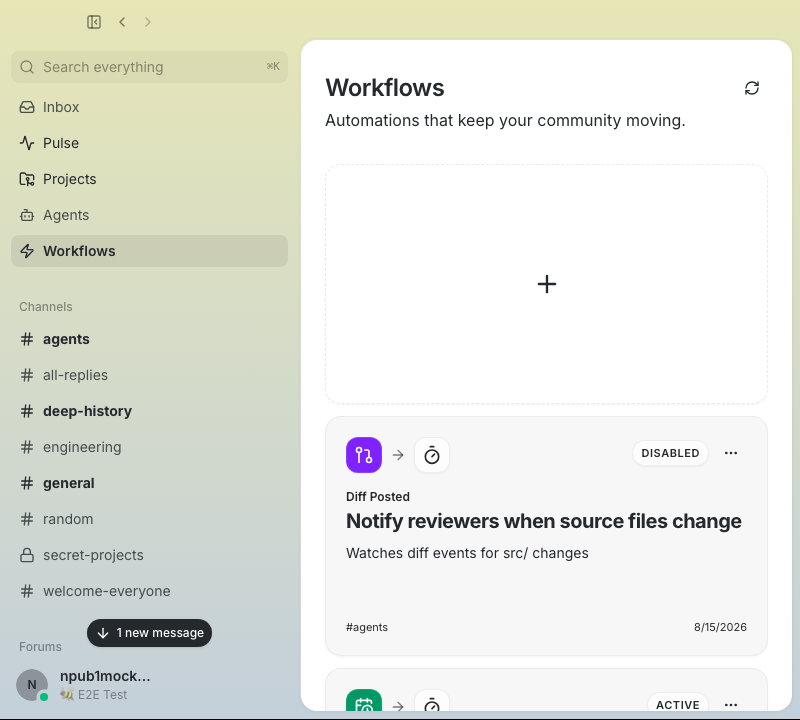 ### Medium — 1024 × 720 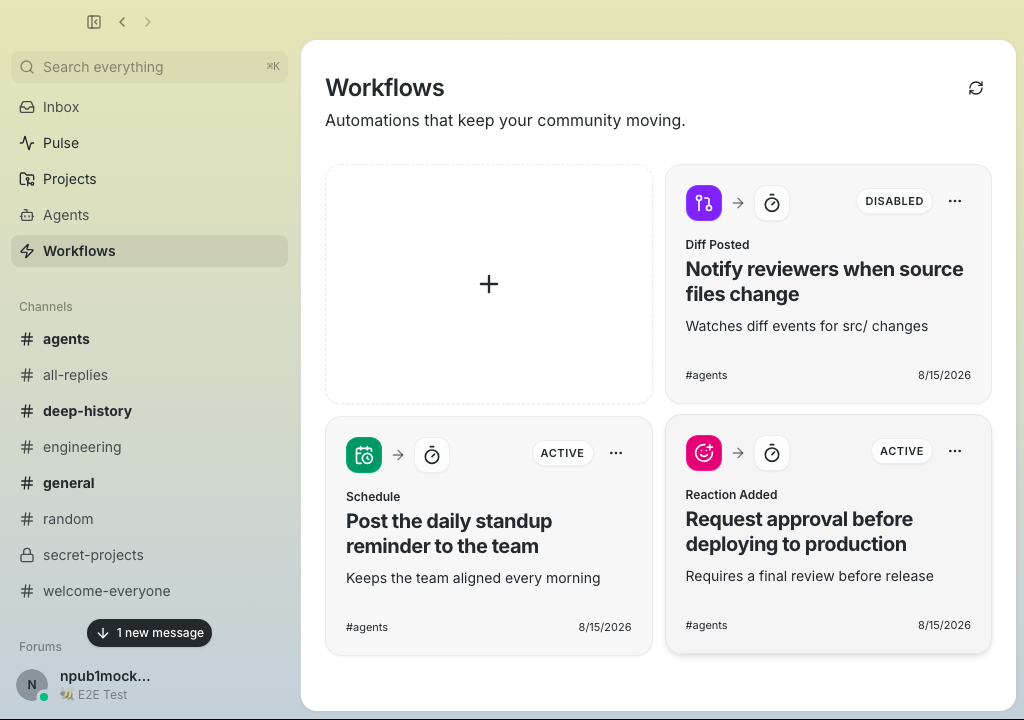 ### Wide — 1280 × 720 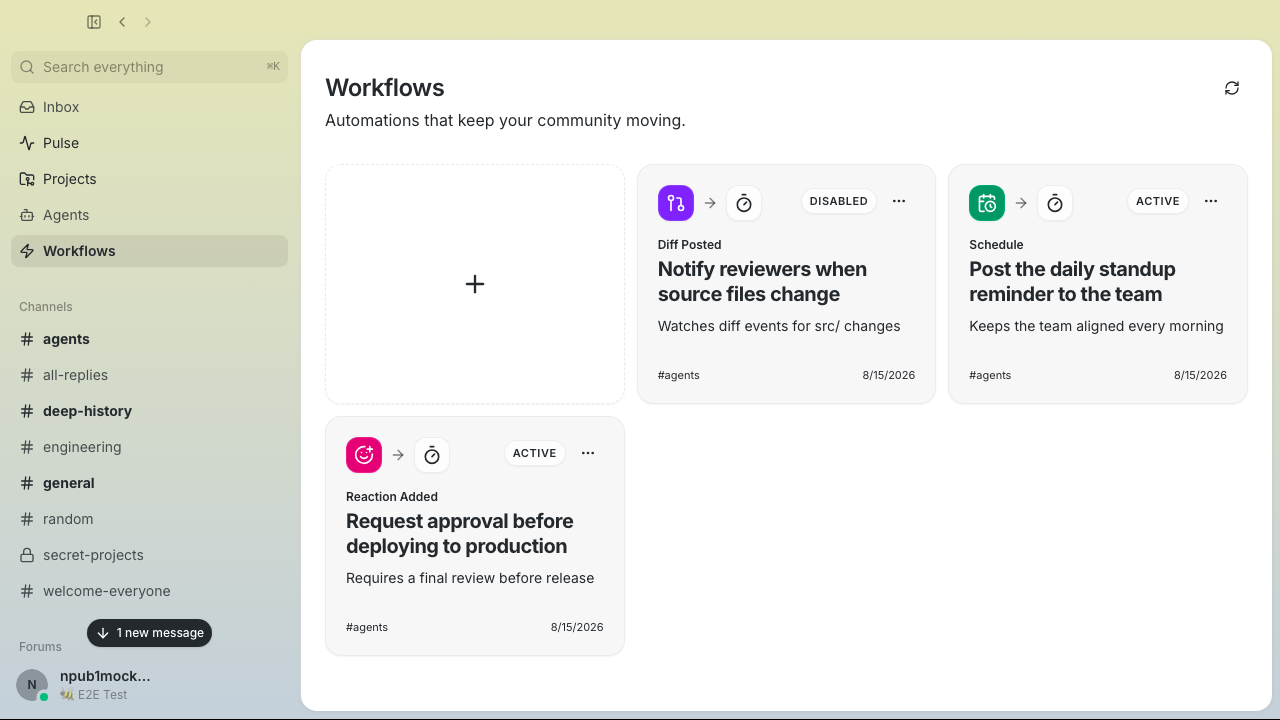 ### Card actions 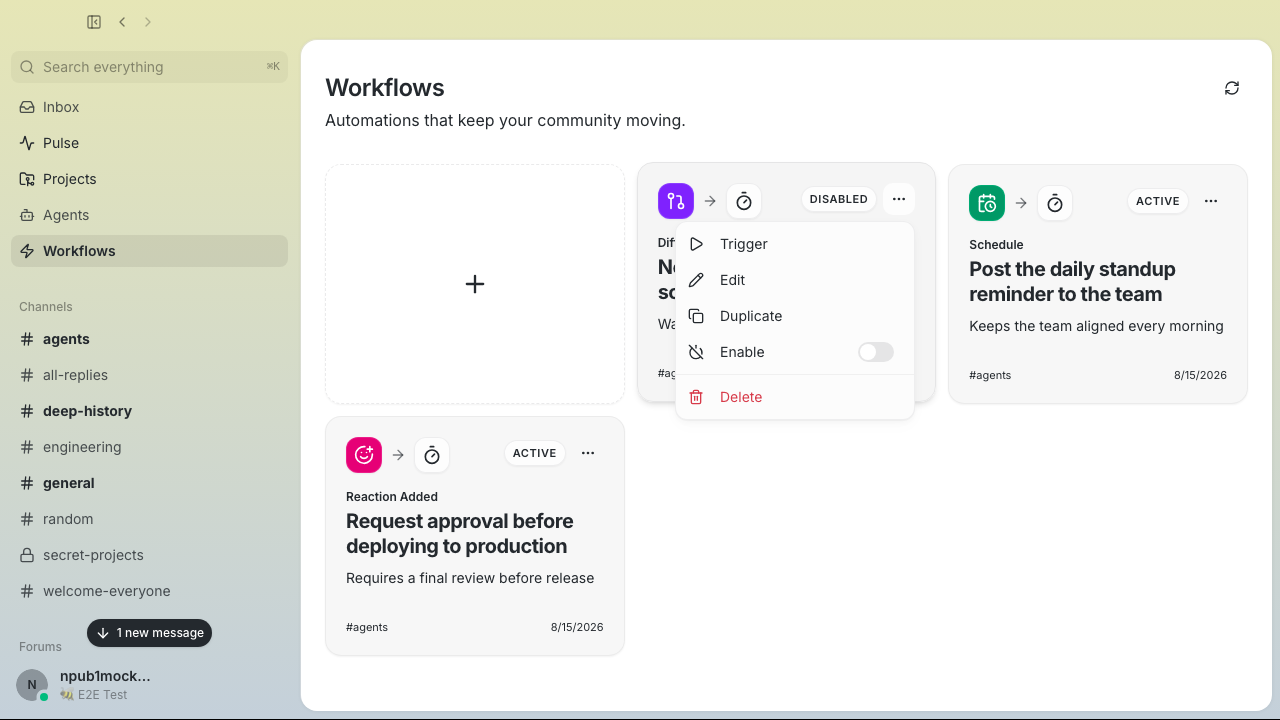 --------- Signed-off-by: Taylor Ho <taylorkmho@gmail.com> |
||
|
Wes
|
f716eef437 |
fix(desktop): enforce shared agent access across devices (#6086)
## Summary - discover shared managed agents from authenticated relay directory records instead of treating channel membership as sufficient proof - publish and refresh access-policy changes immediately so running clients converge across machines without a restart or five-minute poll - route profile edits through the exact managed instance and stop/restart runtimes around access changes so unrelated edits cannot silently widen access - keep mention send-time revalidation and Block owner-only build enforcement fail closed - explain invalid custom provider/model configuration instead of leaving Save silently disabled ### Related issue Fixes #3204 ### Known residuals - a brand-new remote agent's first policy record can wait for the bounded directory poll when no authenticated directory coordinate exists yet; send-time mention revalidation remains fail closed - a failed remote-provider policy redeploy is recorded but cannot undeploy the older provider instance until the provider protocol gains the destructor tracked by #5570 ### Testing - full Desktop unit suite: 4,961 tests passed - focused profile editor Playwright workflow passed, including Customize access edits and prompt-only edits after tightening an instance - Desktop TypeScript, Biome formatting, file-size ratchet, Tauri checks, and pre-push suites passed - independently reviewed for authenticated directory trust, live subscription teardown, runtime revocation ordering, fail-open edit paths, and per-agent provider deployment serialization --------- Signed-off-by: Wes <wesbillman@users.noreply.github.com> Signed-off-by: Brain <21994759fc7a6fa6b965551d35cfd7897d262f2495467f2d78694ddcfa6a5c7e@buzz.block.builderlab.xyz> Co-authored-by: diegorumo <diegorumo@gmail.com> Co-authored-by: Carl <c7ebe626f000404285d3686e1dc74cc07cc60a9754a150041ba132e14bd3e2ec@buzz.block.builderlab.xyz> Co-authored-by: Brain <21994759fc7a6fa6b965551d35cfd7897d262f2495467f2d78694ddcfa6a5c7e@buzz.block.builderlab.xyz> |
||
|
Will Pfleger
|
1b7e5ac1be |
feat(model-capabilities): drive model capabilities and labels from one manifest (#5597)
## Summary Centralizes model capability knowledge — thinking mode, supported effort levels, wire routes, and human-readable labels — into a single manifest, `scripts/model-capabilities.json`. Rust and TypeScript each get a small interpreter that reads the same manifest, replacing hand-maintained tables scattered across both languages that had already drifted apart. A capability change is now a data edit, not parallel edits to two code paths. Supersedes the codegen approach explored in #3603. A cross-language contract keeps the two interpreters honest: `scripts/normative-corpus.json` is a golden snapshot generated from the Rust resolver (103 vectors covering all six capability axes) and replayed natively in TS. CI fails if either language disagrees with the corpus or the corpus drifts from the resolver. Regenerate with `just regen-model-corpus`. ## Behavior changes - **Effort dropdown for `openai-compat` providers** no longer offers `max`. The request path always clamped `max` to `xhigh` on the wire, so the UI stops offering a value that was silently rewritten. UI-only, wire-identical. - **Databricks v2 routing (wire-visible):** uncurated endpoint names carrying a bare Claude code-name segment (e.g. `goose-opus-5`) now route to the MLflow chat wire instead of Anthropic Messages — they lose Anthropic prompt caching but still succeed on a valid OpenAI-compatible wire. Curated `databricks-claude-*` records and any name starting with `claude` are unchanged. A handful of other uncurated/adversarial name shapes similarly fall back to MLflow chat instead of pattern-matched routes; every curated model resolves identically to before, all axes. - **Curated model labels on the real discovery path.** The Databricks API returns no display name, so discovery emits the raw endpoint id as the model `name` (`{id, name: id}`) on every path. `ModelEntry.name` is now curated at all four construction seams in `buzz-agent` — v2 discovery, v1 parse, the auth-empty default catalog, and the configured-model fallback — via a read-only `databricks_registry_label` lookup over the manifest's `databricks_v2` exact records; `id` stays the raw wire/config value. A known id renders its curated label (`databricks-gpt-5-5` → `GPT-5.5`), an unknown id passes through unchanged, and the default-catalog row reads `GPT-5.5 (default catalog)`. As a defense against older `buzz-agent` binaries and any harness that echoes ids, `resolveModelLabel` treats a discovered name equal to the trimmed id as absent and falls through to the registry tier; a genuinely distinct name (including the suffixed default-catalog label) still wins. ## Cleanup Deletes the duplicated capability tables and their tests: the `config.rs` gpt5 matchers, effort tables, and clamp logic; the legacy segment-based Databricks v2 route classifier in `llm.rs`; and the TS hand tables plus `effortTable.fixture.json`. All are replaced by manifest lookups through the shared resolver — no line of capability data exists in two places. --------- Signed-off-by: Will Pfleger <pfleger.will@gmail.com> Signed-off-by: Duncan <dcfd242e557282d7a1e2cf2e6877522682f1e5c6156dc92ca7d90eaedd3b0f95@buzz.block.builderlab.xyz> Co-authored-by: Duncan <dcfd242e557282d7a1e2cf2e6877522682f1e5c6156dc92ca7d90eaedd3b0f95@buzz.block.builderlab.xyz> |
||
|
Wes
|
f956e6fe06 |
docs: refresh agent development guidance (#6049)
## Summary - allow agents to build and run Flutter when it provides relevant implementation or validation evidence - keep mobile iteration fast by reusing simulators, incremental builds, and configured staging or production communities - correct stale CLI, E2E, CI, worktree formatting, and mobile launch guidance - point community singleton reset guidance at the canonical implementation instead of duplicating a drifting inventory ## Validation - `git diff --check origin/main..HEAD` - `cargo run -q -p buzz-cli -- --format compact messages thread --help` - `cargo run -q -p buzz-cli -- --format compact messages search --help` - `just desktop-tauri-fmt-check` from the worktree - pre-commit: mobile Dart formatting and `flutter analyze` - pre-push: branch-skew check and full mobile test suite (1,465 tests) Signed-off-by: Wes <wesbillman@users.noreply.github.com> Co-authored-by: Carl <c7ebe626f000404285d3686e1dc74cc07cc60a9754a150041ba132e14bd3e2ec@buzz.block.builderlab.xyz> |
||
|
Taylor Ho
|
d8281b9c93 |
feat(mobile): require device authentication for identity export (#5116)
**Category:** new-feature **User Impact:** Mobile users must confirm with Face ID, biometrics, or their device passcode before sending their Buzz identity to Desktop. **Problem:** A signed-in phone could send its full identity, including the `nsec`, to a desktop without fresh local verification. **Solution:** Require OS device authentication before opening the identity-recovery scanner, retain that authorization only for the active pairing session and short pairing window, and require fresh authentication again if it expires before the identity payload is sent. Normal app opening, identity import, and community removal remain unchanged. ## Screencasts | Enable Face ID | Use Face ID | | --- | --- | | 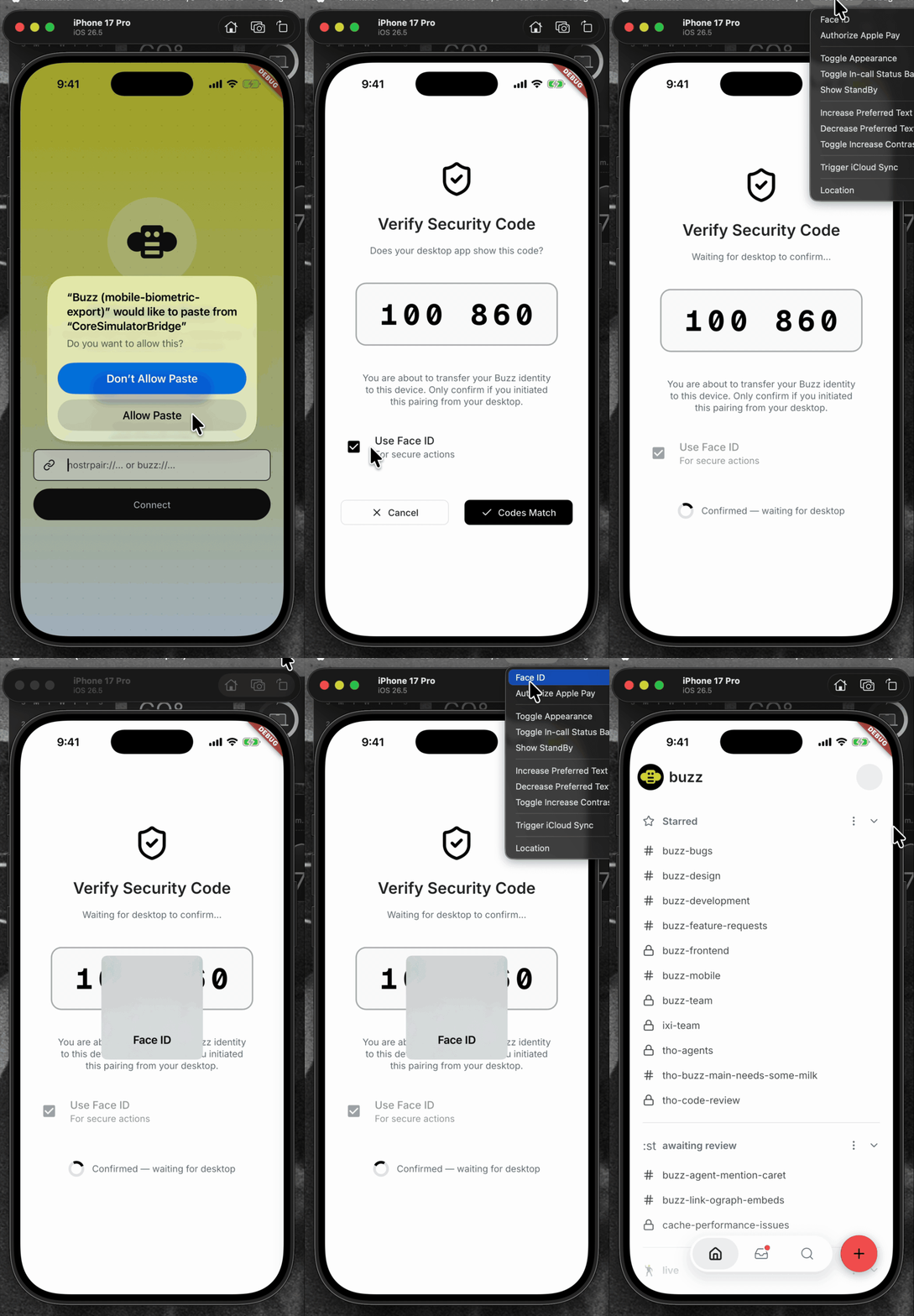 | 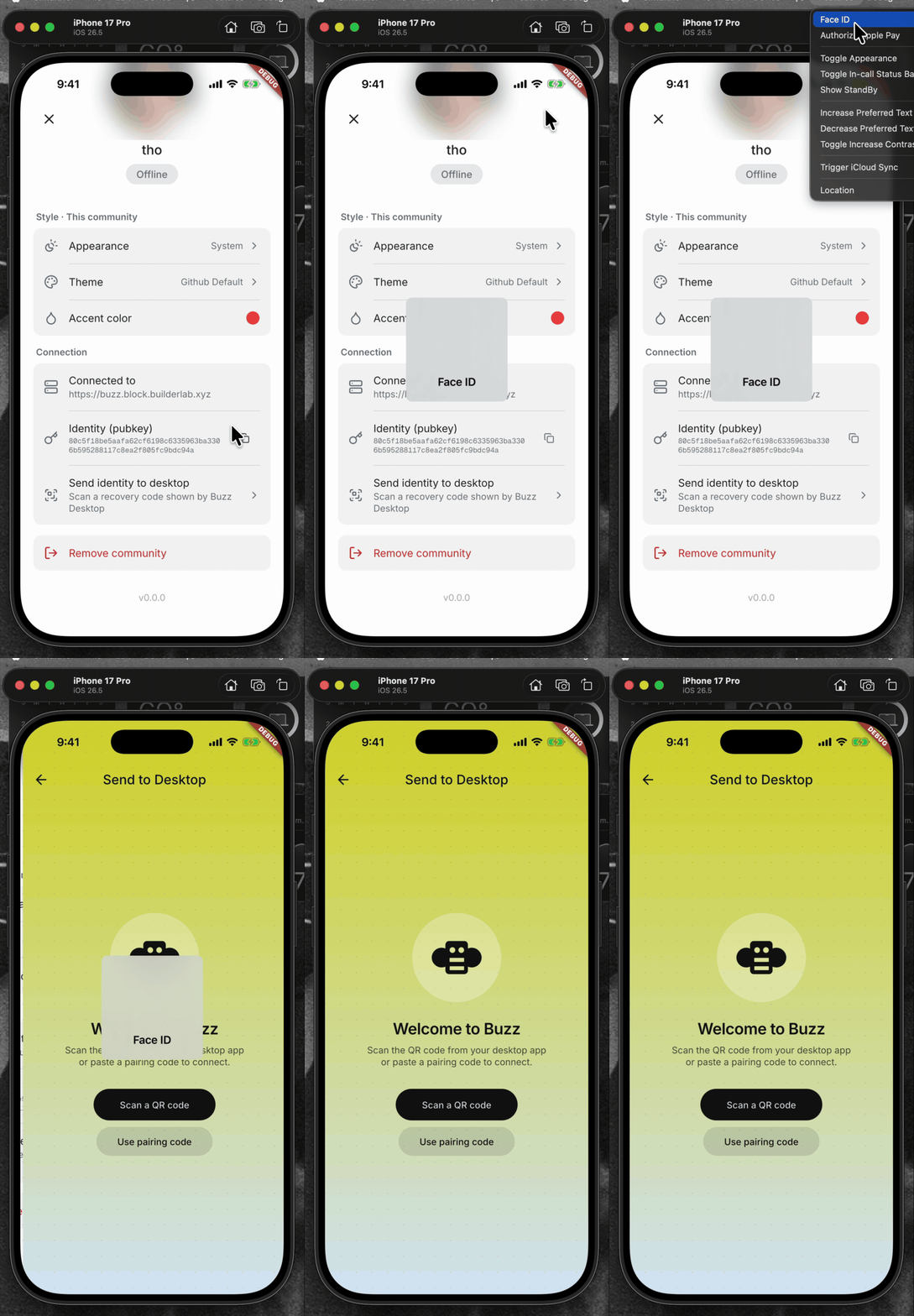 | <details> <summary>File changes</summary> **Android and iOS integration** - `mobile/android/app/build.gradle.kts` declares the AppCompat dependency required by the biometric activity theme. - `mobile/android/app/src/main/kotlin/xyz/block/buzz/mobile/MainActivity.kt` uses the activity type required by the system authentication prompt. - `mobile/android/app/src/main/res/values/styles.xml` and `mobile/android/app/src/main/res/values-night/styles.xml` use the compatible launch theme. - `mobile/ios/Podfile.lock` records the native local-authentication dependency. - `mobile/ios/Runner/Info.plist` explains why Buzz requests Face ID access. **Identity policy and pairing flow** - `mobile/lib/shared/security/sensitive_action_authorizer.dart` wraps OS authentication and maps platform errors to stable app-level outcomes. - `mobile/lib/shared/community/community.dart` and `mobile/lib/shared/community/community_storage.dart` persist the sensitive-action policy. - `mobile/lib/features/invites/invite_join_provider.dart` assigns the explicit policy for invite-created communities. - `mobile/lib/features/pairing/pairing_provider.dart` gates export, binds grants to the active community/session, reauthenticates expired grants, and clears grants on every terminal path. - `mobile/lib/features/pairing/pairing_page.dart` lets users choose biometric protection while importing an identity. - `mobile/lib/features/settings/settings_page.dart` wires pairing into settings. - `mobile/lib/features/settings/settings_page/connection_section.dart` authenticates before opening export recovery and bounds the foreground-resume wait. - `mobile/pubspec.yaml` and `mobile/pubspec.lock` add and lock `local_auth`. **Coverage** - `mobile/test/shared/security/sensitive_action_authorizer_test.dart` covers native result mapping, unsupported devices, and single-flight behavior. - `mobile/test/shared/community/community_test.dart` and `mobile/test/shared/community/community_storage_test.dart` cover policy defaults and persistence. - `mobile/test/features/invites/invite_join_provider_test.dart` covers the invite policy. - `mobile/test/features/pairing/pairing_page_test.dart` covers import protection controls. - `mobile/test/features/pairing/pairing_provider_test.dart` covers export/import authorization, stale/reset/concurrent guards, malformed payload cleanup, and no-export failure paths. - `mobile/test/features/settings/connection_section_test.dart` covers the tap gate, lifecycle resume, and timeout behavior. </details> ## Reproduction steps 1. Pair an identity into the mobile app. 2. Open Settings and choose “Send identity to desktop.” 3. Verify Face ID, biometrics, or the device passcode is required before the recovery scanner opens. 4. Cancel device authentication and verify the scanner does not open and no identity transfer begins. 5. Authenticate, scan a Desktop recovery code, confirm the SAS, and verify the identity transfer completes. ## Validation At `be5620f5f10aa6cc16e86a4f01f102f3d9aeef9b`: - `cd mobile && ../bin/flutter analyze` — no issues - `cd mobile && ../bin/flutter test` — 1,368 tests passed - `cd mobile/android && JAVA_HOME=$(/usr/libexec/java_home -v 21) ./gradlew app:assembleDebug` — debug APK assembled successfully --------- Signed-off-by: Taylor Ho <taylorkmho@gmail.com> |
||
|
thomaspblock
|
78cbffeb64 |
fix(desktop): hide the offcanvas-collapsed sidebar so it stops painting over the community rail (#5947)
## Summary Collapsing the sidebar left a phantom copy of it painted over the community/relay rail — opaquely on flat themes (vesper et al., which made the rail look *removed*), and as ghost fragments (muted search-box fill, truncated channel-name tails) on the Buzz themes whose chrome is intentionally transparent for the gradient. **Cause:** #4281 made the app-sidebar layer `overflow-visible` (the huddle drawer needs to escape it). That removed the ancestor clipping the offcanvas collapse relied on: the sidebar slides to `left: -sidebar-width` but kept painting, exactly over the `z-0` rail (`z-10` sidebar layer). **Fix:** the offcanvas-collapsed sidebar container is now `invisible` + `pointer-events-none`, with `visibility` added to the transition list so the 200 ms slide-out still animates and the flip happens only at the transition's end. Theme-independent; no per-theme CSS touched; the huddle drawer's `overflow-visible` is preserved. ## Before / after Left 420px of the app with the sidebar collapsed. Before = unpatched `origin/main` @ 69107dc3b; after = this branch. Same seeded state, same build pipeline (`build:e2e` between checkouts). | theme | before (ghost sidebar over the rail) | after (rail clean: A / B / + visible) | |---|---|---| | vesper | 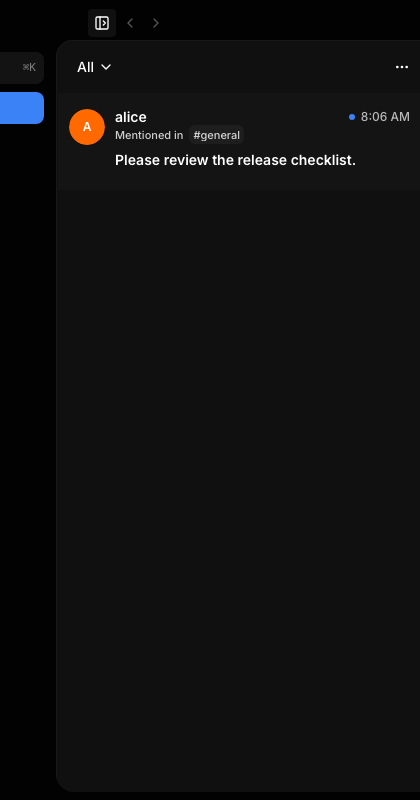 | 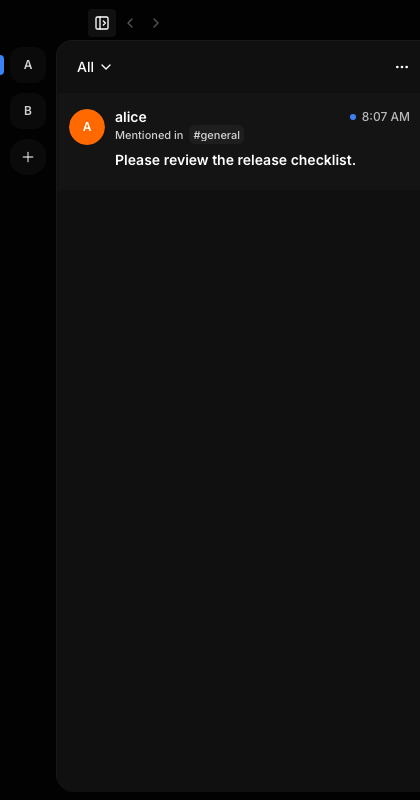 | | buzz | 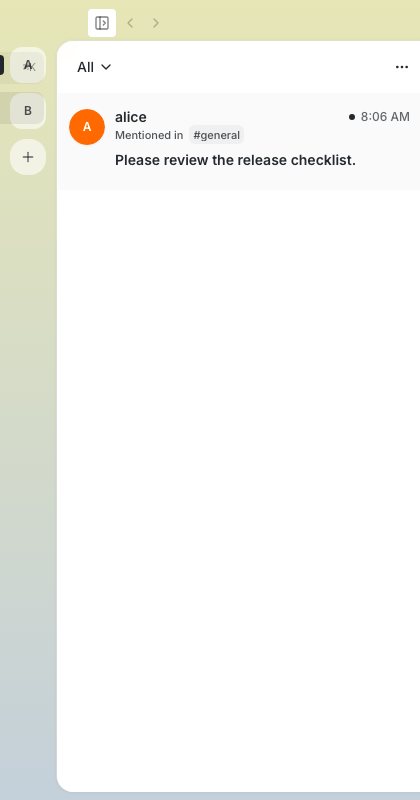 | 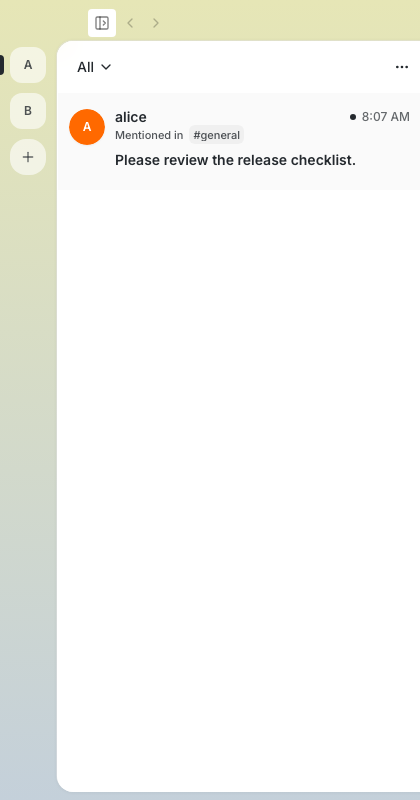 | | buzz-dark | 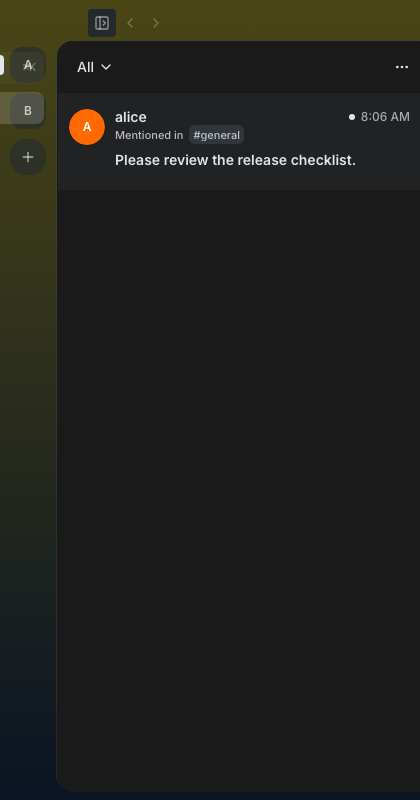 | 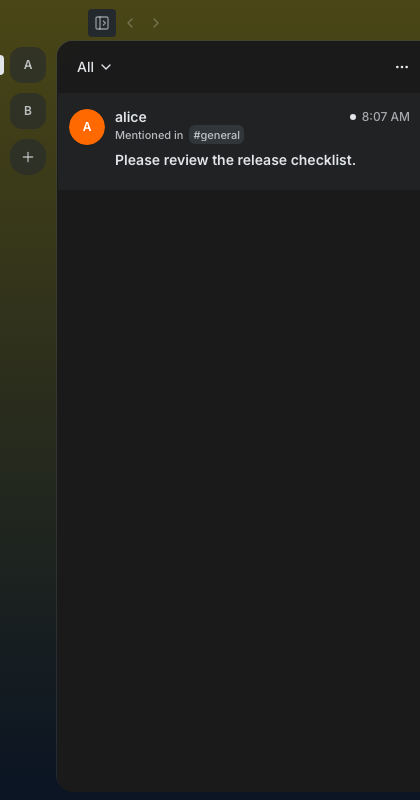 | Before shots: ghost `⌘K` search chip + blue active-item pill painted over the rail column; on vesper the opaque panel hides the rail buttons entirely. After: the rail's community buttons (A, B) and `+` are visible and clickable in all three themes. Reported by Thomas P in #buzz-bugs: buzz://message?channel=e62570dd-33ad-42c5-b92b-75f2689f9694&id=9ea401ca1d009f555ca4324e136f8d8d8156db2f8afa3ff89fd038d2c16260f7 cc @klopez4212 — this touches the layout your #4281/#5478 work shaped; please confirm it doesn't defeat the huddle drawer or glass intentions. The change deliberately hides only the *offcanvas-collapsed* container, nothing in the expanded path. ## Test plan - [x] New Playwright regression spec `sidebar-offcanvas-rail.spec.ts` (buzz / buzz-dark / vesper): collapsed sidebar must be `visibility: hidden` + `pointer-events: none`, community rail stays visible and interactive. **Fails on unpatched build** (verified), passes with the fix. - [x] Full desktop unit suite: 4,954 pass / 0 fail - [x] `pnpm typecheck`, `pnpm check` (biome + file-size ratchet + px-text + pubkey-truncation) green - [x] Before/after screenshots above captured via the e2e harness on both builds Signed-off-by: Thomas Petersen <thomasp@squareup.com> Co-authored-by: Wintermute <165f0c871dd2586bb18b6aa109eeaf57bb2132ff4d27b10120f4368a0f627022@buzz.block.builderlab.xyz> |
||
|
klopez4212
|
69107dc3bf |
Polish mobile message threads and composer (#5645)
## Summary - refine mobile message metadata, search spacing, and Activity filter semantics - add channel-parity Latest navigation and stable tail following to threads - synchronize Android composer/keyboard geometry and keep Latest spacing stable across IME transitions ## Validation - `bin/just mobile-check` - `bin/just mobile-test` (1,276 tests) - Pixel 10 install/launch and channel/thread keyboard, Latest, tail, and back-navigation review - signed iPhone install/launch workflow ## Snapshots See the review snapshots below. --------- Signed-off-by: kenny lopez <klopez4212@gmail.com> Signed-off-by: Kenny Lopez <klopez4212@gmail.com> Signed-off-by: Princess Donut <b238ea756dee4d98afa5883fc7f1de61eeabe65bf700e3a5a5a80db5e42e2c2b@buzz.block.builderlab.xyz> Co-authored-by: Fast Fizz <2df81cb51f05a9d5387ef24d7b9ecb8fcdfcd1c70ffabc67061c9596e1b5b1c4@buzz.block.builderlab.xyz> Co-authored-by: Princess Donut <b238ea756dee4d98afa5883fc7f1de61eeabe65bf700e3a5a5a80db5e42e2c2b@buzz.block.builderlab.xyz> |
||
|
Wes
|
82f7ed1532 |
chore(release): release Buzz Desktop version 0.5.14 (#5917)
## Buzz Desktop release v0.5.14 - **Frozen main:** `1b3dbcaaea882eeea90359c1db02e306d2f4f50a` - **Reviewed candidate:** `391495e7d347d20b67e39e3c240d17ef63c5c2c0` - **Previous desktop release:** `desktop-v0.5.13` - **Proposed immutable tag:** `desktop-v0.5.14` This PR may be **squash merged** after the Desktop Release Candidate check and all protected-branch checks pass. Merging authorizes publication of the exact reviewed candidate; later or unrelated changes on `main` cannot alter it. The checked-in changelog accounts for every non-merge commit in the release range. The Desktop tag points to the reviewed candidate commit, not the later squash commit. Publication remains bound to that immutable candidate tag. Signed-off-by: Wes <wesbillman@users.noreply.github.com> Co-authored-by: Release Automation <release-automation@users.noreply.github.com> |
||
|
Wes
|
1b3dbcaaea |
ci(release): remove desktop smoke gate (#5914)
## Summary - remove the GitHub-hosted desktop smoke job from the desktop release workflow - remove the smoke result from manifest assembly dependencies and promotion conditions - retain the local smoke tooling for future repair and targeted validation The first release execution of this gate spent its full 10-minute Playwright timeout traversing the 10,000-row fixture, then produced a 987 MB diagnostics upload. All signed platform builds succeeded, but the smoke prevented manifest publication. This restores the previously established release boundary while the harness is made suitable for CI separately. ### Testing - parsed `.github/workflows/release.yml` with Ruby Psych and asserted the smoke job/dependencies are absent - `scripts/test-release-ref-contract.sh` - exact pushed commit passed the repository pre-push hook Signed-off-by: Wes <wesbillman@users.noreply.github.com> Co-authored-by: Carl <c7ebe626f000404285d3686e1dc74cc07cc60a9754a150041ba132e14bd3e2ec@buzz.block.builderlab.xyz> |
||
|
Wes
|
51beba6038 |
chore(release): release Buzz Desktop version 0.5.13 (#5912)
## Buzz Desktop release v0.5.13 - **Frozen main:** `09768100ec3420f0aa7cd278bd00fe0baab5de8d` - **Reviewed candidate:** `a239e0f6793ac6e88ccf92cc231054090a9753cc` - **Previous desktop release:** `desktop-v0.5.12` - **Proposed immutable tag:** `desktop-v0.5.13` This PR may be **squash merged** after the Desktop Release Candidate check and all protected-branch checks pass. Merging authorizes publication of the exact reviewed candidate; later or unrelated changes on `main` cannot alter it. The checked-in changelog accounts for every non-merge commit in the release range. The Desktop tag points to the reviewed candidate commit, not the later squash commit. Publication remains bound to that immutable candidate tag. Signed-off-by: Wes <wesbillman@users.noreply.github.com> Co-authored-by: Release Automation <release-automation@users.noreply.github.com> |
||
|
Wes
|
09768100ec |
fix(ci): read Playwright version without nested shell quoting (#5910)
## Summary - replace the nested one-line shell quoting used to read the Playwright package version - write the resolved version to `GITHUB_OUTPUT` from a multiline shell step ## Why The `desktop-v0.5.12` release smoke job failed before executing tests because Bash received escaped quotes inside command substitution and parsed the Node expression as shell syntax. ## Validation - `bash scripts/test-release-ref-contract.sh` - isolated execution of the new shell fragment with a fixture `@playwright/test/package.json`, producing `version=1.58.2` - `git diff --check` Signed-off-by: Wes <wesbillman@users.noreply.github.com> Co-authored-by: Carl <c7ebe626f000404285d3686e1dc74cc07cc60a9754a150041ba132e14bd3e2ec@buzz.block.builderlab.xyz> |
||
|
Tyler
|
263c9bf76c |
fix(desktop): restore the agent trading-card mint button (#5900)
## Problem PR #5574's profile-panel redesign dropped `ProfileSummaryView`'s `onCreateCard` prop — the only caller of `setCardMintTarget` — so the entire Agent Trading Cards feature (#3278) became unreachable from the GUI while staying fully wired underneath: mint dialog, background job store, viewer, gallery, composer chip, and the Rust `mint_agent_card`/`save_agent_card` commands all survive at main. `git log -S 'setCardMintTarget('` shows exactly two commits: the feature and the accidental removal. ## Outcome The mint trigger returns as a management row in the agent profile's Info tab, directly under **Export agent**, gated `isBot && canManagePersona` exactly like Duplicate/Export. Target resolution is byte-for-byte the original logic: prefer the live instance pubkey, fall back to the persona/definition id, allow locking only when an instance keypair exists. ## Shape - `UserProfileAgentManagementRows`: new optional `onCreateCard` row (Sparkles icon, `user-profile-create-card-row`), placed after Export. - Prop threaded `UserProfilePanel` → `ProfileSummaryView` → `ProfileInfoTabContent` → management rows, mirroring `onExportAgent` at every layer. - The mint-target state + open callback move into a `useCardMint` hook in `UserProfilePersonaDialogs` (beside the `CardMintTarget` type it manages). This keeps `UserProfilePanel.tsx` at 999 lines — the file sits at the size-ratchet cap and may not grow. ## Validation - `pnpm check` green (biome, file-size ratchet, px-text, pubkey-truncation). - `pnpm typecheck` green. - Full desktop unit suite: **4888 passed, 0 failed**. - Profile e2e spec: **32 passed**, including the updated management-row-order assertion and a new click → mint-dialog-visible → Escape → closed exercise of the restored row. Verified at `bff3110a0aeb3d63683eac9ed3e587829f9436da`, one commit atop main `01f76ec97`. Signed-off-by: Eva <011987e296fd5006292d2f930b574be47c7801048d1983c46c425d3c95f0cffd@buzz.block.builderlab.xyz> Co-authored-by: Eva <011987e296fd5006292d2f930b574be47c7801048d1983c46c425d3c95f0cffd@buzz.block.builderlab.xyz> |
||
|
thomaspblock
|
122a8b8988 |
Projects v3: unify sharing, discussions, and issue ownership (#5792)
## Summary Projects v3 makes repository work shareable, discussion-aware, and easier to scan in one coherent workspace. People can copy canonical links, reopen the exact workspace tab, understand issue and pull-request context at a glance, find related channel conversations, and assign or unassign issues across Desktop and CLI. - **Unified workspace** — top-level sections sit above repository controls in one rounded workspace, with navigation positioned close to the page heading. README and Files retain branch selection; every section has a labeled icon header, and Issues and Pull Requests expose creation from a consistent right-aligned action. - **Repository management** — the repository selector is always available, including single-repository projects. Its integrated add flow lets project owners create a repository manually or select an existing repository without a separate toolbar button. - **Readable work-item lists** — issue and pull-request rows use plain-language context instead of opaque metadata. Files, commits, issues, pull requests, channels, and contributors share consistent row density and right-aligned timestamps, while deterministic fallback-avatar colors keep participants distinct on light backgrounds. Inbox pull-request metadata wraps between complete phrases and truncates long channel names instead of compressing copy into narrow columns. - **Reliable entity links** — projects, repositories, issues, pull requests, and commits have canonical `buzz://` links, preview cards, OS deep-link routing, and tab-aware navigation. Reopening the same link re-applies its destination instead of leaving the user on a locally selected tab. - **Related conversations** — repository and work-item views surface channels discussing the current entity, including participants, channel navigation, message context, and an explicit notice when discovery reaches its 500-result cap. - **Reversible issue ownership** — trusted assignment and unassignment events work across Desktop, Tauri, `buzz-sdk`, and `buzz issues`. Assignees appear in project views and the assigned inbox, while authorized users can remove assignments directly from the assignee row. Assignment state is derived chronologically from labeled Nostr notes. Issue authors and repository owners may change any assignee; other users may only assign or unassign themselves. Shared golden fixtures keep entity-link grammar and validation aligned across TypeScript and Rust. The branch also updates `webbrowser` to the patched release for RUSTSEC-2026-0257. ### Related issue N/A. ### Testing - [x] `just ci` — formatting, lint, typechecking, unit tests, and builds passed - [x] Full pre-push suite — organization, branch-skew, Desktop checks, typechecking, and tests passed on the latest push - [x] `cargo test -p buzz-cli` and focused `buzz-sdk` assignment tests passed - [x] Focused Tauri recipient-note and 500-result search-limit tests passed - [x] Desktop entity-link and issue-assignment unit tests passed - [x] Playwright smoke coverage passed for assignment, repeated entity-link navigation, repository create/select flows, section headers and actions, timestamp alignment, timeline icons, sentence-style issue/PR metadata, header spacing, avatar contrast, and Inbox metadata at stacked and side-rail breakpoints - [ ] Manual staging pass: link round-trips, Channels tab, assignment flows, and inbox routing ### Screenshots Pull requests explain who opened the request, where it lives, and which branch it comes from; fallback avatars remain visually distinct. 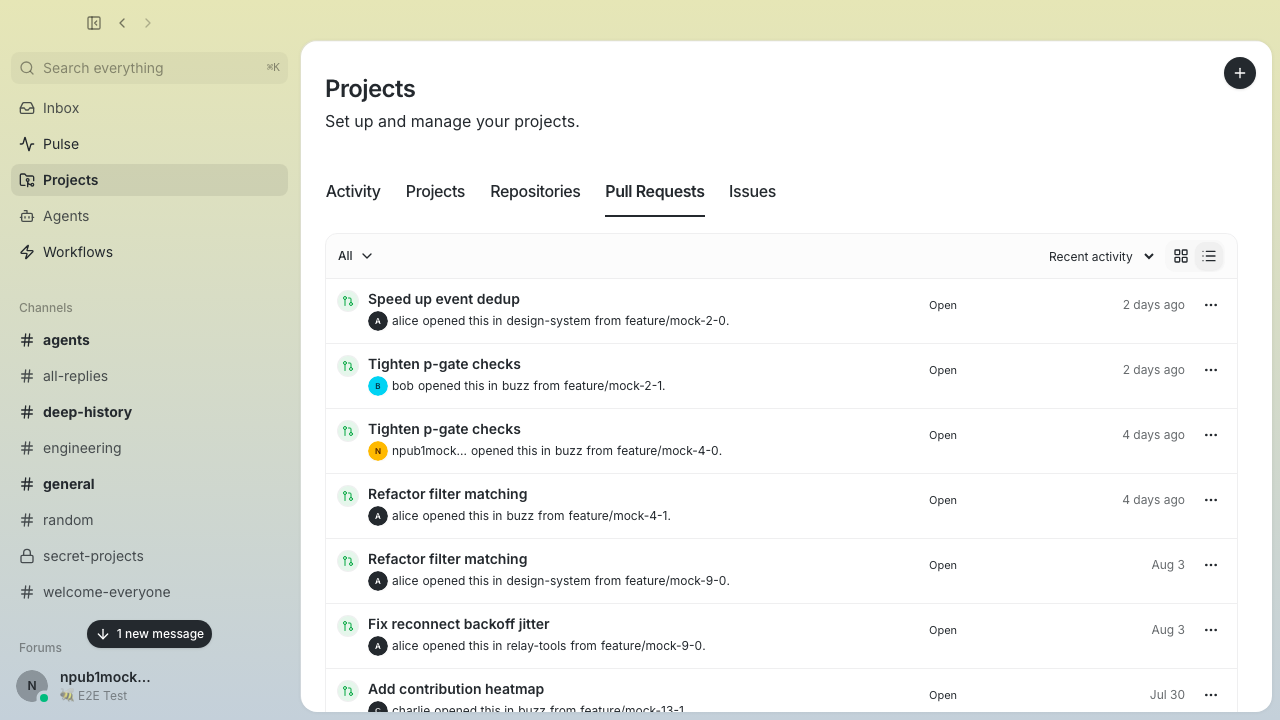 Issues use the same sentence-style hierarchy while keeping status and recency easy to scan. 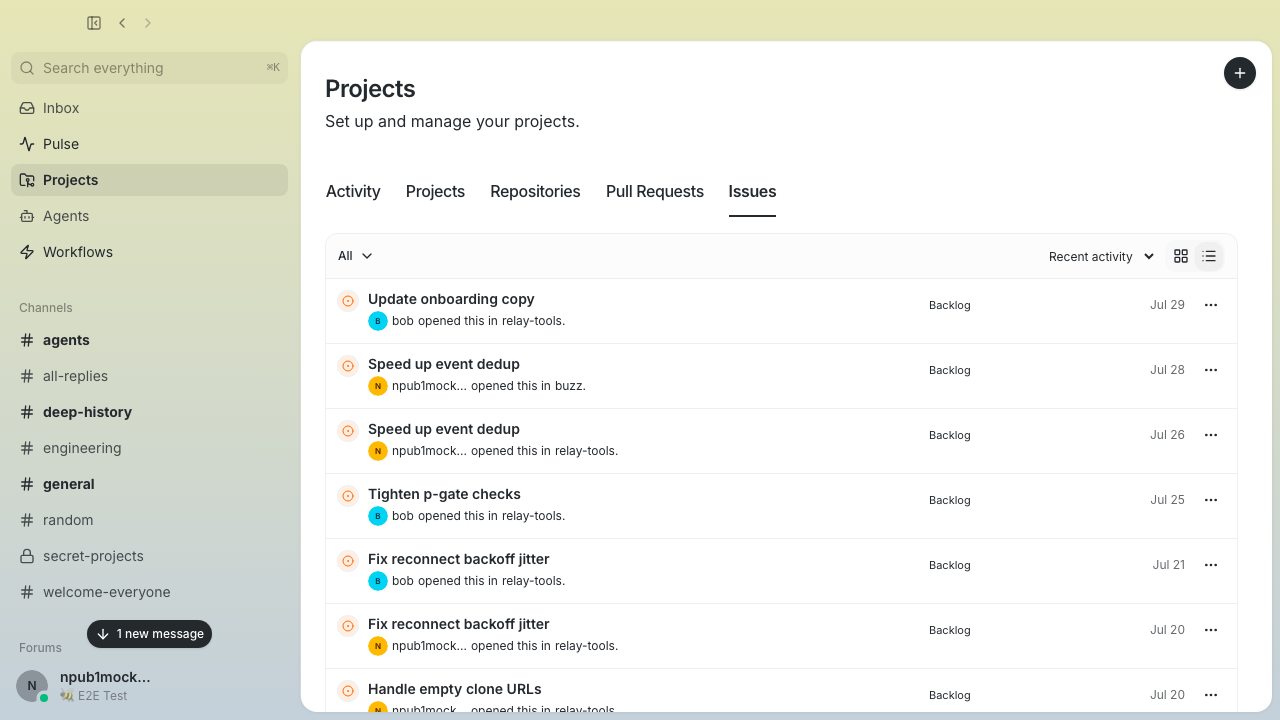 The wide Inbox detail keeps author, timestamp, and origin context readable beside its metadata rail. 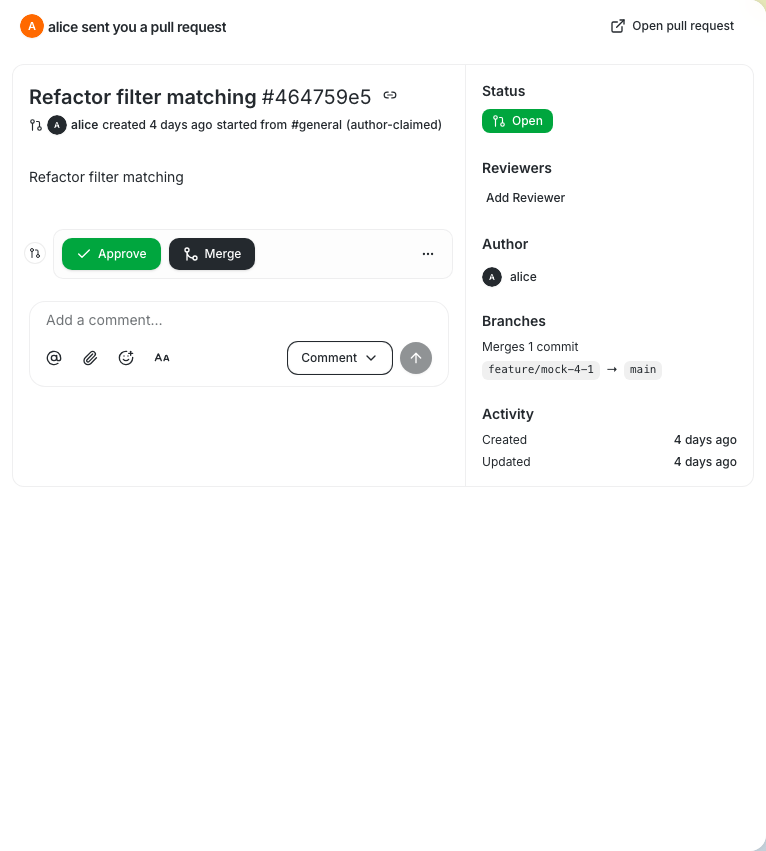 [View the complete six-state Projects v3 screenshot set](https://github.com/block/buzz/pull/5624#issuecomment-5268039672) and [the compact/wide Inbox comparison](https://github.com/block/buzz/pull/5624#issuecomment-5268614585). --- > Supersedes #5624, whose head commit accumulated permanently-queued required check suites (block-dco-check et al.) that GitHub never dispatched. History flattened into a single signed-off commit on latest main; tree verified byte-identical (`git merge-tree`) to merging the original branch into main. --------- Signed-off-by: Thomas Petersen <thomasp@squareup.com> Co-authored-by: Wintermute <3f1797424fd9ad6653a83665c660517777cd7f8c228c0d5907f49e01537f3ca5@buzz.block.builderlab.xyz> |
||
|
Wes
|
1f4c69eccf |
chore(release): release Buzz Desktop version 0.5.12 (#5903)
## Buzz Desktop release v0.5.12 - **Frozen main:** `757779bb1ef22cc4a1c233344baa0946d907e5a6` - **Reviewed candidate:** `bfc34904adc414efcd8e9c5548dff82c3545b677` - **Previous desktop release:** `desktop-v0.5.11` - **Proposed immutable tag:** `desktop-v0.5.12` This PR may be **squash merged** after the Desktop Release Candidate check and all protected-branch checks pass. Merging authorizes publication of the exact reviewed candidate; later or unrelated changes on `main` cannot alter it. The checked-in changelog accounts for every non-merge commit in the release range. The Desktop tag points to the reviewed candidate commit, not the later squash commit. Publication remains bound to that immutable candidate tag. Signed-off-by: Wes <wesbillman@users.noreply.github.com> Co-authored-by: Release Automation <release-automation@users.noreply.github.com> |
||
|
Tom Brow
|
0bb7c60f82 |
fix(mobile): unwrap batched observer telemetry (#5805)
## Summary Buzz Mobile now expands decrypted ACP observer batch envelopes into their inner telemetry frames before sending them through the existing per-agent dedupe, ordering, cap, and channel-filter pipeline. Singleton observer events keep their existing behavior. Malformed batch envelopes remain visible as outer frames, matching the desktop consumer convention, while invalid inner frames use the existing observer decrypt error path. This restores batched agent progress, tool activity, and incremental transcript updates that Mobile previously ignored. ### Related issue Related to #4917. ### Testing Added tests: - [`observer_subscription_test.dart`](https://github.com/block/buzz/blob/main/mobile/test/features/channels/agent_activity/observer_subscription_test.dart) covers valid batches, singleton behavior, malformed envelopes, and invalid inner frames. Full mobile analysis, formatting, file-size validation, and Flutter tests passed. The repository pre-push gate also passed. --------- Signed-off-by: Tom Brow <tomb@block.xyz> Co-authored-by: Tom Brow <tomb@block.xyz> Co-authored-by: Codex <noreply@openai.com> |
||
|
Wes
|
757779bb1e |
perf(desktop): update active turns incrementally (#5897)
## Problem Every observer-store publication made the active-turn bridge scan every running/deployed agent and replay each agent's retained observer journal. Watermarks kept the replay idempotent, but did not remove the repeated work. Under an active fleet, one changed agent therefore caused work proportional to the whole fleet and its retained history. ## Change - observer publications now identify the changed agent and only the newly admitted, retained events - the active-turn bridge still performs one full hydration when its agent list mounts or changes - steady-state publications process only that changed active agent's delta - other observer-store subscribers keep their existing notification behavior - duplicate-only envelopes still do not publish ## Correctness Regression coverage pins: - retained/duplicate history is omitted from deltas - stopped-agent updates do not enter active-turn state - an incremental terminal clears a turn hydrated from retained history - batching still publishes once and preserves transcript/terminal outcomes - existing watermark, tombstone, pruning, community restore, clear, and eviction suites remain green ## Validation Exact pushed head: `a480ffd2531023ea32b2a5518b5d9d41f04577c8` - focused active-turn + observer-retention suites: 90 passed - full desktop suite: 4,891 passed - `pnpm --dir desktop typecheck`: passed - `pnpm --dir desktop check`: passed (pre-existing repository warnings only) - mandatory pre-push hook at the exact pushed head: passed `branch-skew`, desktop check/typecheck/test, mobile tests, Rust tests, and Desktop Tauri checks Packaged same-fleet CPU/RSS validation is follow-up evidence; this PR proves the algorithmic amplification is removed without claiming an installed-app percentage from unit tests. Signed-off-by: Wes <wesbillman@users.noreply.github.com> Co-authored-by: Carl <c7ebe626f000404285d3686e1dc74cc07cc60a9754a150041ba132e14bd3e2ec@buzz.block.builderlab.xyz> |
||
|
Taylor Ho
|
f086eb6544 |
fix(link-previews): send while previews finish in background (#5697)
**Category:** fix **User Impact:** Messages send immediately after submission while link previews finish in the background, with an option to skip delayed preview preparation. **Problem:** Waiting for link-preview metadata or snapshot uploads kept the composer occupied after users pressed Send, while races between completion, timeout, and cancellation risked inconsistent payloads. **Solution:** Freeze and promote speculative preview work into a bounded background send task, clear the composer immediately, and publish exactly once with prepared previews or gracefully without them when skipped, failed, or timed out. https://github.com/user-attachments/assets/987d2f2c-679f-473a-965f-dfb279951e52 <details> <summary>File changes</summary> **desktop/src/features/communities/useCommunityInit.ts** Resets pending link-preview preparation when community context changes so work cannot cross community boundaries. **desktop/src/features/messages/lib/linkPreviewPreparationStore.ts** Adds the coordinator-owned preparation state machine, bounded fallback, Skip behavior, and exactly-once terminal publication handling. **desktop/src/features/messages/ui/ComposerUploadProgressOverlay.tsx** Extends floating background progress UI to include link-preview preparation. **desktop/src/features/messages/ui/ComposerUploadProgressPill.tsx** Adds the preparing-link-preview label and Skip action to the progress pill. **desktop/src/features/messages/ui/MessageComposer.tsx** Hands submitted preview work to the background coordinator and clears the composer immediately. **desktop/src/features/messages/ui/messageComposerAutoSubmit.test.mjs** Updates auto-submit unit coverage for coordinator-owned preview preparation. **desktop/src/features/messages/ui/messageComposerAutoSubmit.ts** Allows submit to promote unfinished preview work instead of blocking composer submission. **desktop/src/features/messages/ui/useComposerLinkPreviews.tsx** Starts preview work speculatively and exposes frozen preparation jobs for adoption by the send flow. **desktop/src/features/messages/ui/useMentionSendFlow.helpers.ts** Carries prepared preview tags through the mention and media payload helpers. **desktop/src/features/messages/ui/useMentionSendFlow.ts** Integrates prepared preview tags into final message publication. **desktop/src/shared/lib/useResolvedLinkPreviews.ts** Exposes the in-flight metadata promise so promoted work can be adopted rather than restarted. **desktop/tests/e2e/messaging.spec.ts** Covers immediate submit, upload handoff, Skip/completion races, failure fallback, auto-send, and exactly-once publication. </details> ## Reproduction steps 1. Enter a supported link and press Send while preview metadata or snapshot upload is still pending. 2. Confirm the composer clears immediately and the floating progress UI shows **Preparing link preview · Skip**. 3. Let preparation finish and confirm one message is published with its preview. 4. Repeat and choose **Skip**; confirm one message is published without waiting for the preview. 5. Simulate preview failure or timeout and confirm the message still publishes once without preview tags. ## Validation - TypeScript, Biome/format, file-size, px-text, and pubkey checks - Full desktop unit suite: 4,734 passed - Focused Playwright messaging suite: 5 passed - Push hooks at `86c0aa7de2ff81b79286c99bf23db12345adc6ca`: desktop check, typecheck, and tests passed --------- Signed-off-by: Taylor Ho <taylorkmho@gmail.com> Signed-off-by: Wes <wesbillman@users.noreply.github.com> Co-authored-by: Carl <acda9e433d19dcd0e6b6840f7f4b98f3a56f1fab98049d444c087019e6d36560@buzz.block.builderlab.xyz> Co-authored-by: Wes <wesbillman@users.noreply.github.com> Co-authored-by: Carl <c7ebe626f000404285d3686e1dc74cc07cc60a9754a150041ba132e14bd3e2ec@buzz.block.builderlab.xyz> |
||
|
Tyler
|
01f76ec971 |
fix(desktop): cut steady-state relay traffic from polls and read-state echo (#5879)
## Problem Desktop webview CPU stayed high after the presence-scope fix (#5830) and the shared useNow ticker (#5861). A per-kind byte tap hot-patched into `relayClientSession.ts` on a live desktop (~500 channels, large agent fleet; 850 s capture correlated with CPU sampling) showed the remaining steady-state relay traffic is mostly self-inflicted: | kind | what | share of inbound bytes | shape | |------|------|-----------------------|-------| | 30078 | read-state | **34%** | our own ~44 KB nip44 blob echoed back every ~10-30 s while reading | | 30030 | emoji union | **33%** | 2-min poll refetching every member's full set (~300 KB burst) | | 30175 | persona catalog | **13%** | same 2-min backstop pattern, ~150 KB per walk | CPU tracked the bursts directly: 3-5% in quiet 10 s buckets vs 44-54% in buckets containing a poll burst or read-state echo. (The kind-24200 observer-frame theory was tested and disproven by the same tap: 9.7% of bytes, steady trickle.) ## Outcome - **Read-state echo drop.** `ReadStateManager` remembers the ids of events it just published (FIFO set capped at 64) and drops their relay echoes before the nip44-decrypt + `JSON.parse` step. Ids are recorded *before* publishing so relay fan-out can't race the OK. The drop consumes the id, so a reconnect replay of the same event still parses normally. Events from other clients of the same pubkey are untouched. - **Poll backstops stretched 2 min → 20 min** for the emoji union and persona catalog queries. The live subscriptions (invalidate on any new 30030/30175) and the reconnect invalidations remain the freshness paths; the poll only exists to cover a silently dropped live event. Behavior on publish, focus, and reconnect is unchanged. - Mechanical: localStorage identity helpers moved to `readStateIdentity.ts` (no behavior change) to keep `readStateManager.ts` under the file-size ratchet. Expected effect on the measured profile: the poll stretch cuts the 30030/30175 bursts (46% of inbound bytes) by 10x; the echo drop removes the recurring ~44 KB nip44-decrypt + parse per publish cycle (the echo still arrives on the wire — nostr filters cannot exclude own-author events — so this is a CPU/IPC saving, not a bandwidth one). ## Acceptance - New tests: echo dropped **before** decrypt (mutation-checked: disabling the drop fails the test), replayed duplicate of the same id still parses, foreign-client events always parse, published-id set stays capped when publishes fail (never-echoed ids). - Full desktop suite **4794/4794**, `tsc --noEmit` clean, `pnpm check` (biome + ratchets) clean at head. ## Not addressed (follow-ups) - The 44 KB blob itself (one read-state event carries all ~500 channels; a delta or per-channel-shard format is a protocol change). - Duplicate delivery of the same events on concurrent `history-` subscriptions (relay/client dedupe). - Webview RSS of 12.5 GB observed on the same machine — retention hunt is separate work; shrinking the heap multiplies the value of this PR since the GC floor scales with live-heap size. Signed-off-by: Eva <011987e296fd5006292d2f930b574be47c7801048d1983c46c425d3c95f0cffd@buzz.block.builderlab.xyz> Co-authored-by: Eva <011987e296fd5006292d2f930b574be47c7801048d1983c46c425d3c95f0cffd@buzz.block.builderlab.xyz> |
||
|
Wes
|
207154706c |
fix(desktop): support channel message path links (#5889)
## Summary - accept `buzz://channel/<uuid>/<64-hex-event-id>` as a compatibility message deep link - activate the desktop window and route path-form message links through the existing durable message-navigation queue - support the same path form when rendered or pasted inside Buzz, while canonicalizing composer output to `buzz://message?...` - retain the existing one-segment channel-link behavior and reject malformed event IDs or extra segments ## Context Buzz Desktop 0.5.11 has no native `channel` route. The recently merged channel-link handling on main recognizes `buzz://channel/<uuid>`, but rejects the externally shared `<channel>/<event-id>` form before window activation. On macOS that presents as Buzz taking the menu bar while its window neither foregrounds nor navigates. ## Test plan - `cargo test --manifest-path desktop/src-tauri/Cargo.toml parse_channel_deep_link` - focused channel-link, composer-link, and markdown unit tests - `pnpm typecheck` - mandatory pre-push hook: desktop checks, full desktop unit tests, and Tauri/Rust checks Installed-app external-open behavior requires a build containing this change; 0.5.11 cannot exercise it because that release predates native channel-link handling. --------- Signed-off-by: Wes <wesbillman@users.noreply.github.com> Co-authored-by: Carl <c7ebe626f000404285d3686e1dc74cc07cc60a9754a150041ba132e14bd3e2ec@buzz.block.builderlab.xyz> |
||
|
Taylor Ho
|
5ddf23d700 |
feat(mobile-messages): render compact Buzz permalink chips (#5639)
**Category:** improvement **User Impact:** Buzz channel, message, repository, pull request, and issue links now display recognizable context and navigate reliably in the mobile app. **Problem:** Bare Buzz permalinks appeared as raw or ambiguous URLs on mobile, while channel and message links were not handled consistently across Markdown forms and startup states. **Solution:** Normalize eligible bare Buzz URLs without consuming Markdown syntax, render them as semantic icon-prefixed chips, and route channel/message targets through the mobile deep-link dispatcher while preserving authored Markdown labels as ordinary links. <details> <summary>File changes</summary> **mobile/lib/features/channels/deep_link_dispatcher.dart** Routes parsed channel and message links through the appropriate in-app navigation callbacks. **mobile/lib/features/channels/message_content.dart** Presents all bare Buzz permalinks as semantic icon chips and keeps authored labels as ordinary links. **mobile/lib/features/channels/message_content/link_normalizer.dart** Normalizes bare and autolinked Buzz URLs without consuming Markdown delimiters, code, or punctuation. **mobile/lib/shared/deeplink/deep_link.dart** Adds strict channel and project-entity parsing alongside message deep links. **mobile/lib/shared/deeplink/pending_deep_link_provider.dart** Preserves pending navigation until the mobile routing surface is ready. **mobile/test/features/channels/channel_detail_page_test.dart** Updates navigation integration coverage for icon-prefixed channel chips. **mobile/test/features/channels/deep_link_dispatcher_test.dart** Covers channel/message dispatch and missing-target behavior. **mobile/test/features/channels/message_content/link_normalizer_test.dart** Exercises Markdown-safe normalization across the full Buzz link suite. **mobile/test/features/channels/message_content_test.dart** Verifies chip labels, icons, semantics, authored-label opt-out, and navigation callbacks. **mobile/test/shared/deeplink/deep_link_test.dart** Covers strict parsing for channel, message, repository, pull-request, and issue links. </details> ## Reproduction steps 1. Run the mobile app and open a channel containing bare `buzz://channel`, `buzz://message`, `buzz://repo`, `buzz://pr`, and `buzz://issue` URLs. 2. Confirm each bare URL renders as one cohesive chip with a type icon, a useful name or shortened identifier, and no duplicated channel `#` character. 3. Add an authored Markdown link such as `[design discussion](buzz://issue?...)` and confirm the supplied label remains an ordinary link rather than becoming a chip. 4. Select channel and message links and confirm they navigate correctly from inline and autolinked forms. ## Screenshots / demos **iOS Simulator — channel, message, repository, pull request, and issue permalink chips** Real app build (`37b2cb5eb`) running on an iPhone 17 Pro simulator.  --------- Signed-off-by: Taylor Ho <taylorkmho@gmail.com> Signed-off-by: Wes <wesbillman@users.noreply.github.com> Co-authored-by: Carl <acda9e433d19dcd0e6b6840f7f4b98f3a56f1fab98049d444c087019e6d36560@buzz.block.builderlab.xyz> Co-authored-by: Wes <wesbillman@users.noreply.github.com> Co-authored-by: Carl <c7ebe626f000404285d3686e1dc74cc07cc60a9754a150041ba132e14bd3e2ec@buzz.block.builderlab.xyz> |
||
|
Wes
|
dbee2914ad |
test(desktop): await channel E2E bridge readiness (#5886)
## Summary - wait for the channel mutation and cache invalidation E2E hooks before using them - make those hooks required after readiness instead of silently skipping fixture setup - keep the production channel settings behavior and assertion unchanged ## Why On slower CI startup, `page.goto()` can resolve before the E2E bridge installs its globals. The test used optional calls, so all three fixture operations could silently do nothing and leave the seeded `General discussion for everyone` description in React Query. The assertion then failed deterministically, including both retries. ## Validation At commit `5b4d5d290b316db5eef78c3596a17c7a270c8163`: - `pnpm -C desktop build:e2e` - focused Playwright test repeated 30 times: 30 passed - `pnpm -C desktop exec biome check tests/e2e/channels.spec.ts` - mandatory pre-push hooks passed on the exact pushed head: `branch-skew`, `desktop-check`, `desktop-typecheck`, `mobile-test`, `desktop-test`, `rust-tests`, and `desktop-tauri-checks` - `git diff --check origin/main...HEAD` Signed-off-by: Wes <wesbillman@users.noreply.github.com> Co-authored-by: Carl <c7ebe626f000404285d3686e1dc74cc07cc60a9754a150041ba132e14bd3e2ec@buzz.block.builderlab.xyz> |















